




Abstract
Problem-solving skills are an ability that must be cultivated to equip students with the skills needed to deal with today’s increasingly complex and volatile environment. Computational thinking represents a new paradigm in problem-solving skills. After Wing proposed Computational Thinking as problem-solving skills in 2006, other scholars investigated this topic; nevertheless, the link between Computational Thinking and problem-solving has not been clearly discussed in previous studies. To uncover evidence for the connection between Computational Thinking and problem-solving skills, we conduct a systematic literature review of 37 papers collected from Web of Science database. The results indicate that (a) problem-solving is discussed in the 37 articles in the context of Computational Thinking, (b) the most frequently employed Computational Thinking stages in problem-solving skills are decomposition, pattern recognition, abstraction, and algorithm, (c) Computational Thinking is closely linked to problem-solving, and (d) Computational Thinking and problem-solving stages serve the same functions in solving problems. The results of this study will encourage the development of education research, particularly in the application of CT as a problem-solving tool in various real-life scenarios.
Plain Language Summary
After Wing proposed Computational Thinking as problem-solving skills in 2006, other scholars investigated this topic; nevertheless, the link between Computational Thinking and problem-solving has not been clearly discussed in previous studies. To uncover evidence for the connection between Computational Thinking and problem-solving skills, we conduct a systematic literature review of 37 papers collected from Web of Science database. The results indicate that (a) problem-solving is discussed in the 37 articles in the context of Computational Thinking, (b) the most frequently employed Computational Thinking stages in problem-solving skills are decomposition, pattern recognition, abstraction, and algorithm, (c) Computational Thinking is closely linked to problem-solving, and (d) Computational Thinking and problem-solving stages serve the same functions in solving problems. The implication of this study is triggering development education research, especially applying CT as problem-solving in various daily cases. The limitation of this study is that data is only taken from previous research, which is in the core collection of the Web of Science. In addition, still a lack of explanation in the literature on how to use CT as a problem-solving skill and implement it to solve a real-world problem. This suggests an excellent opportunity for researchers in the future to research CT, focusing on its use as a PS skill. We recommend four phases that can be used as problem-solving procedures; decomposition, pattern recognition, abstraction, and algorithm.
Introduction
Problem solving (PS), a component of critical thinking (Chaisri et al., 2019; Kuo et al., 2020), is a form of human intelligence that uses a structural phase to find an unknown or developing answer (Jones-Harris & Chamblee, 2017; Polya, 1981); PS organizes thoughts and processes to find a solution. Problem solving is a human skill that is required to deal with the complexity of problems (Durak & Saritepeci, 2018; Kim & Kim, 2016; Román-González et al., 2017). Problem-solving evolves over time in accordance with the increased complexity of problems. The renowned PS theory “how we think” by Dewey (1910), “the nature of human intelligent” by Guilford (1967), “mathematical thinking” by Stacy et al. (1982), and the digital era emerged “Computational Thinking” by Wing (2006) are examples PS skill fields. On another side, PS skills can be fostered and enhanced through learning and training (Csernoch et al., 2021; Kim & Kim, 2016). One learning process that instills problem-solving skills in the current education situation is computational thinking (CT) (Tan et al., 2021; Tikva & Tambouris, 2021a).
Improving PS skills by engaging CT knowledge is an intriguing research area in education (Ilic & Tugtekin, 2018; Marcelino et al., 2018; K. Y. Tang et al., 2020; Tikva & Tambouris, 2021a). The interest in this research topic has increased yearly (Hsu et al., 2018; K. Y. Tang et al., 2020), in particular after Wing (2006) introduced CT as an essential skill in today’s world. Further, these studies demonstrate the positive impact that CT has on the development of PS skills (Berikan & Özdemir, 2020; Israel-Fishelson & Hershkovitz, 2022; Rijo-Garcia et al., 2022; Santos et al., 2015; Tan et al., 2021).
According to Wing (2006), CT is a fundamental skill for humans that encompasses system design, human behavior recognition, and problem solving. Initiated by Wing, CT has been recognized as a type of problem-solving skill which has been studied in multiple fields. These skills have been termed modern problem-solving skills (Hunt & Riley, 2014). Their comprehensive implementation as PS results in varied uses and applications of CT elements (Tikva & Tambouris, 2021b). However, the connection between CT and PS is not clearly explained in the article. Furthermore, the use of different CT elements in each study makes it difficult to understand them as stages for PS. We thus systematically review studies on CT and emphasize the evidence for CT as a problem-solving technique.
The results of this study contribute to a better understanding of the relationship between CT and PS based on a literature review. Additionally, it provides a clear explanation of how CT elements can be implemented in the PS stages, with practical implications for the development of educational studies, particularly in problem-solving using CT. Our study’s results can serve as a guideline for utilizing CT elements to effectively solve problems.
Theories of Problem-Solving
The development of PS began long ago, initiated by Dewey’s (1910 republished in 1997) well-known theory of how people think. His theory is divided into five PS phases: suggestion, intellectualization, guiding idea (hypothesis), reasoning, and hypothesis testing. The development of PS continues even now, in line with the goal of its basic theory. PS is a form of human cognition that uses procedures (Polya, 1981) as a sequence of organized processes and thoughts (Rich & Hodges, 2017). PS has also been described as the transformation from an undesirable state to a desired one (initial state to final state) (Beecher, 2017; Kong & Abelson, 2019).
Currently, PS is defined as a process of creative thinking skills (Kovari & Rajcsanyi-Molnar, 2020; Zhou et al., 2021). Being creative is an important factor in the development of someone’s thinking accompanied by PS abilities against the development of complexities. The advance of PS has evolved in response to the increasing complexity of real-world circumstances. The development of PS is illustrated in Figure 1.

Historical development of problem solving.
This study reviews PS theories offered by four scholars with high citation counts on Google Scholars: Dewey (1910), Polya (1945), Guilford (1967), and Stacey et al. (1982). The highest cited theory divides PS into five completion phases: suggestion, intellectualization, guiding idea (hypothesis), reasoning, and testing hypothesis by action (Dewey, 1910 republished in 1997). This theory is famous in human mind management, in particular in terms of how to face and find solutions to problems.
The other theory of PS is divided into four phases of completion: understanding the problem, devising a plan, carrying out the plan, and looking back (Polya, 2004). Understanding the problem is further divided into working for better understanding and getting acquainted. Devising a plan means finding the connection between known and unknown data. This should eventually result in a plan for solutions. Carrying out this plan means checking each step and executing each step clearly and correctly. Looking back means examining the obtained solution and reformulating the solution so that it can be implemented to solve other problems.
According to Guilford (1967), PS is divided into five completion phases: preparation, analysis, production, verification, and reapplication. Preparation consists of problem preliminary analysis, and defining and setting up the problem (this is called problem recognition). Analysis means becoming familiar with the goal and situational potentialities. Production means generating a tentative idea of a solution for bridging gaps and goal states, whereas verification involves evaluating, refining, and developing the idea. Reapplication returns to earlier stages to select another tentative idea to find a solution.
According to Stacey et al. (1982), PS is divided into three completion phases: entry, attack, and review. Entry means formulating the question precisely and deciding exactly what is to be done. Attack means taking several different approaches and formulating several plans and then trying out these plans. Review is looking back at what has happened to improve and extend our cognitive skills and try to re-frame our resolution to a more general problem.
Thinking of Computational Thinking as a Problem-Solving Skill
Computational Thinking (CT) is a personal skill and a concept that is commonly associated with the field of computer science and education. CT comes from computer science (Denning, 2009; Wing, 2006). Several terms in computer science have been adopted and applied in other fields. Since the promotion of CT by Wing (2006), the field has become an attractive source of research topics. Prior to 2006, Papert (1980) authored a book on CT from a different perspective (Lodi & Martini, 2021): he defines his vision (people using computers to perform mathematically intensive tasks) of how to better connect CT to daily life. In his book, he discusses the use of computers to assess children’s mathematical cognition. He also explains that learning computer programming could empower children and provide them with a robust understanding of mathematics, physics, and probability (Lodi & Martini, 2021). This suggests that CT can be implemented in fields other than computer science and can be applied in daily life.
Wing (2006) argues that CT is a fundamental skill for everyone for reading, writing, and arithmetic, and that this skill could increase the analytical ability of children. She also mentions that CT involves problem solving, system design, and the understanding of human behavior via the conceptualization of fundamental behavior to computer science. In addition, she explains that CT uses abstraction and decomposition to attack large complex problems and design complex systems. Denning (2009) argues that “algorithmic thinking” indicates a mental orientation to formulate problems as a conversion process (in-out) and develop algorithms to execute these conversions. He emphasizes the stages of the algorithm which correspond to the process of problem solving. In computer science, the term algorithm refers to a collection of instructions for performing a task (Hunt & Riley, 2014). In a PS context, algorithm indicates a sequence of discrete actions that are followed to achieve a goal (Hunt & Riley, 2014; Labusch et al., 2019).
Computational thinking has been developed for various purposes with several types of research approaches. In the literature, an approach based on developing the CT skill of children (Asbell-Clarke et al., 2021; Kong et al., 2020; Pérez-Marín et al., 2020; X. Tang et al., 2020) analyzes related variables (Rich et al., 2020; Sun et al., 2020), develops a CT assessment (Brennan & Resnick, 2012; Román-González et al., 2017; X. Tang et al., 2020), and proves that CT is a PS skill. Few studies have been conducted to establish the relation between CT and PS. Notably, a pioneer of this theory believes that CT can be seen as a PS skill (Wing, 2006).
Computational thinking refers to the ability to use cognitive processes to analyze a problem, plan a sequence, and recognize a solution (Arfé et al., 2019). This ability involves higher-order thinking in a cognitive process (Arfé et al., 2019; Román-González et al., 2017; K. Y. Tang et al., 2020; Tikva & Tambouris, 2021a). Higher-order thinking involves Bloom’s taxonomy, which consists of analysis, application, evaluation, and creation (Román-González et al., 2019), and requires CT cognitive processing. These four levels are closely related to process of solving a problem, and are in line with Guilford’s (1967) argument that PS theory includes preparation, analysis, production, verification, and reapplication. However, establishing this more fully requires further investigation through in-depth research or literature analysis. Therefore, we have conducted this study to provide evidence of a relation between CT and PS based on the results of existing studies. We pose four research questions to establish that CT is a PS skill based on the findings of previous studies:
RQ1. Do the articles that evaluate CT discuss PS?
RQ2. What stages of CT were used in the reviewed articles?
RQ3. Does the evidence identified in the reviewed articles indicate a close relationship between CT and PS?
RQ4. How does CT relate to PS techniques?
Methodology
To provide a core-value discussion of the relation between CT and PS, we employ a systematic review of articles from reputable journals. This approach yields an overview of current research that focuses on methods, analysis, and a special topic in research areas (Steiger et al., 2015). The systematic PRISMA review model, developed by Moher et al. (2009), was adopted for the systematic review process.
Procedures for Systematic Literature Review
A six-phase procedure was utilized to reflect logical thinking in the collection and screening of the literature in the scope of this study. The six phases are as follows:
Phase 1: Web of Science (WoS) core collection database records from 2006 to 2021 were identified using the keywords computational thinking and problem solving, yielding 166 articles (n = 166).
To ensure the quality of data sources, we included research papers and review papers that were indexed in SSCI and SSCIE, had abstracts containing the keywords “computational thinking” and “problem-solving,” and were published between 2006 and 2021. The search year began in 2006 because CT was sounded by Wing in that year and lasted in 2021 after a full year. The two search keywords were employed to collect high-quality articles that examined the relationship between the two issues in depth.
Phase 2: Files were selected based on the download availability (i.e., open access vs. university subscription), and the selected articles were downloaded and renamed according to the format “year _ author name _ title” (n = 131).
Phase 3: Screening 1. A word search engine was used to locate specific words and calculate their word frequency. The articles containing at least 10 mentions of “computational thinking” (n = 79) were selected, followed by those containing at least 10 mentions of “problem solving” (n = 46).
Phase 4: Screening 2. The abstracts (n = 37) that addressed computational thinking, problem-solving, or its synonyms and included problem-solving activities were evaluated.
Phase 5: The eligibility of the full-text articles was assessed by employing synonyms of problem solving such as solving a problem, analytical, systematic, scientific, and diagnostic. The result showed that all of the selected articles were eligible (n = 37).
Phase 6: A systematic literature review was utilized to identify and explore the reviewed articles. This was the final phase, which led to drawing conclusions and achieving the research objectives (n = 37).
The six phases of this review are illustrated as Figure 2.

Systematic PRISMA review.
Screening Tools
The PDF-Xchange viewer was used to screen the articles. This application was chosen because it has a word search engine that reads a single PDF article or all PDF articles in a folder, and it executes word searches similar to a web search engine. The advantage of this software is that it searches offline PDF files.
In addition, the search engine displays the occurrence frequencies of word in articles, which helps researchers who need word frequencies for quantitative analyses.
Data Analysis
Analytical logic was used in this study to strengthen the analysis. The data was interpreted qualitatively and quantitatively to facilitate the drawing of conclusions. MAXQDA was used to provide an informative graphical analysis of qualitative data and assist in interpreting qualitative data in a quantitative manner. This is an application used for qualitative data analysis for computer-assisted qualitative data analysis (Kuckartz & Rädiker, 2019). The number of entries obtained in the quantitative analysis results reveals the relation between the content of the articles and the purpose of the data analysis. After obtaining the quantitative results, conclusions were drawn using exploratory analysis, a method that involves searches for specific words or word combinations in documents (Kuckartz & Rädiker, 2019).
Results and Discussion
CT-Reviewed Articles That Cover PS (RQ1)
The first stage of discussion in this study focuses on the distribution and inter-connection of each selected article. The articles focused on two keywords (CT and PS), and the results are shown in Figure 3, which represents 79 articles published from 2006 to 2021. The figure uses two different colors to represent the determined keywords and selected articles.

Distribution of selected articles.
Figure 3 reveals a yearly increase in CT-related articles. The highest trend is in 2021; there is a notable increase between 2019 and 2021. This indicates that research interest in CT and PS has increased over time. This also shows that CT theory is becoming an attractive research topic. Recent studies (Ilic & Tugtekin, 2018; K. Y. Tang et al., 2020) assess the relevance of studies in terms of citations from preceding years. Thus mapping the origin of CT theory reveals a close connection among the selected articles to previous theories.
Figure 4 is a citation map MAXQDA displaying clear relationships among articles that contribute to the development or research of CT. A citation network is a directed graph of great size and complexity whose vertices can be chronologically ordered and whose edges connect earlier with later vertices (Small, 1999). Connection lines in the figure indicate relationships between articles that promote CT and those that discuss CT. In 2006, Wing initiated the promotion of the CT paradigm; since then it has become an attractive research field in education. Most research articles discuss CT based on the Wing’s theory.

Reference citation maps MAXQDA on selected CT-related articles.
The above citation map provides a clear picture of the interconnection among articles. It shows that 32 of the 79 selected papers cite theories other than Wing’s (2006) theory. Another 47 articles simply cite Wing’s idea and thus have a single connection to Wing’s article and are not displayed in Figure 4. From right to left in the Figure 4, the articles are sorted by publication year; the circle sizes indicate how many times the corresponding article has been cited. In addition, the number of citations obtained is represented by the thickness of the lines connecting the articles. This reveals the degree of relevant documents as raw data before conducting further analysis, especially content analysis (Smith, 1981).
Each connection to an article is interpreted as a path of the development of CT in education. The 37 articles are in line with the basic theory of CT in its development, assessment, and advanced interpretation. Every year sees new scientific developments of CT, especially in terms of how it is implemented and adopted in human daily life. Therefore, studies are conducted in various ways to identify the best CT techniques, particularly in the development of CT as a PS skill.
The second stage of the discussion in this study demonstrates the interconnections among articles. We conduct a content analysis on the 37 selected articles. This stage shows the frequency of the phrase problem solving in each article divided by section. Figure 5 shows the frequency of the phrase problem solving in each article. The phrase is most often found in the literature review and results and discussion sections of the articles. This demonstrates that the 37 selected articles are all relevant to the topic of problem solving.
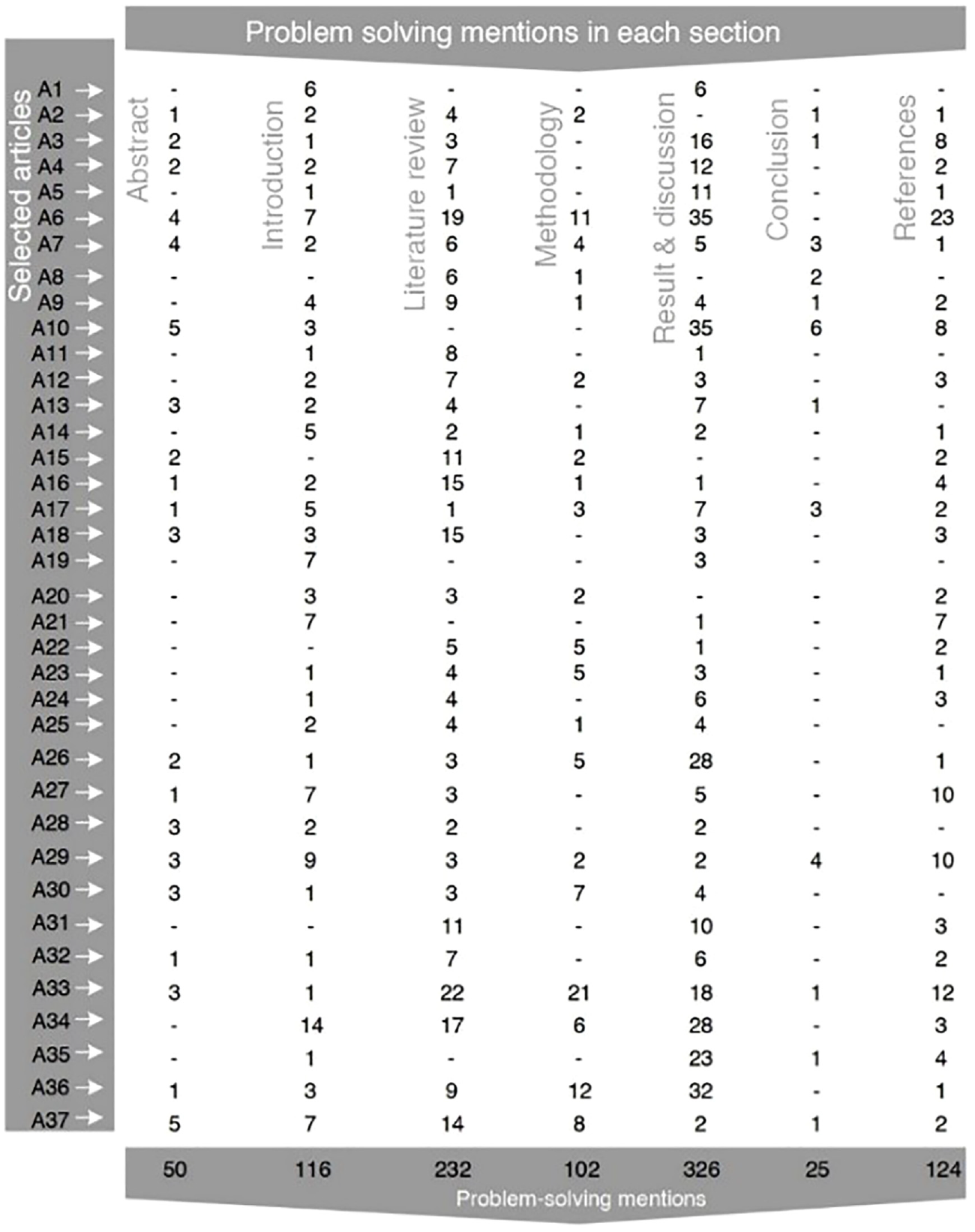
Distribution of problem-solving mentions by article.
The literature review and result-discussion sections show the highest number of mentions, which indicates that the 37 selected articles are related in terms of the theoretical basis, the study results, and the discussion (thus theory reflects reality). These results show that previous studies prove that CT theory is related to PS. Researchers also explain in the discussion sections that PS is an ability that can be achieved by understanding CT. In addition, developing CT skills also improves students’ PS abilities. Some studies explain that students engage in PS via the CT concept (Bers et al., 2014); thus CT learning can be achieved through a PS skill for authentic problems (Lye & Koh, 2014), and CT as a PS methodology can be implemented with computing tools (Mouza et al., 2017).
Further, problem solving is a way to find a solution among all possible ways emanating from the initial state to the goal state (Holyoak, 1990). PS is a familiar word that is recognized at every level of education. Researchers also use words other than PS to explain or describe processes with a similar intent to PS. Figure 6 presents a quantitative analysis related to PS synonyms found in a thesaurus. The seven synonyms were obtained by typing the PS keyword in the search engine thesaurus.com.

Distribution of PS synonyms.
In Figure 6, the discussion sections of the 37 selected articles use several synonyms to describe the PS process: solve a problem, solve problem, analytical, scientific, diagnostic, and investigative. This shows that PS is an often-used phrase, and is used more than any other phrase to explain the PS process. The second and third more common synonyms used in the articles are solve the problem and scientific. Thus problem solving is more appropriate to describe CT than other phrases, as it is mentioned 976 times in the 37 selected articles.
The results in Figure 6 serve as evidence that CT theory is associated with the fundamental abilities to solve a problem, design a system, and recognize human behavior (Wing, 2006). CT can also be associated with algorithmic thinking, indicating a mental orientation to formulate problems as conversion from input to output (Denning, 2009). Formulating problems for students requires the ability to analyze a situation and solve problems of pedagogical activity professionally (Akhmadullina et al., 2019). From the results of the obtained analysis and opinions from previous researchers, this study confirms that CT is a systematic technique for solving complex situations, and it is suitable for use in real problem situations.
CT Stages Used in Reviewed Articles (RQ2)
This study discusses the result of the identification of the various stages of CT employed in the selected studies. Various stages can be applied to achieve CT skills, especially through programming or coding activities (Arfé et al., 2019; Kale et al., 2018; Lye & Koh, 2014; Marcelino et al., 2018). This has been a reasonable indicator since the CT theory was first promoted. Many computer science researchers have developed this topic. The discussions in these studies show that CT can be applied in many fields with various stages in its development and implementation. Therefore, we identify the stages or element applied in the development of CT in the studies, as presented in Figure 7. We determined the frequency of CT elements by using a combination of the MAXQDA word search engine and manual checking.

Applied CT stages by article.
The number of CT stages applied corresponds to the number of CT steps adopted in the studies. Four CT stages—decomposition, pattern recognition, abstraction, and algorithm—found higher adoption in the studies, and were followed by debugging. In computer science, debugging refers to activities that involve programming activities or coding using programming software. In the scope of CT, debugging means solving a problem using a four-step process: debugging the problem (recognition), debugging the process (determining appropriate methods), generating a hypothesis, and attempting to solve the problem (Bers et al., 2014). Most studies which involve programming seek to cultivate students’ CT skills. In theory, the goal of CT development is to apply it not only for programming activities but also in various fields of study (Lodi & Martini, 2021; Wing, 2006). This study identified examples of applying the CT stages to solve real-world problems. We provided examples of daily life problems, such as fixing leaking water pipes (Figure 9) and fixing the failure of motorized vehicles or electronic devices.
In Figure 7, decomposition, pattern recognition, abstraction, algorithm, and debugging are the CT components most adopted in the selected studies. Figure 7 focuses on the relationship between the systematic stages of CT and problem solving does not include debugging as a systematic stage because debugging has previously been represented by pattern recognition and abstraction. This statement is supported by multiple definitions of debugging, which involve determining a suitable solution (Bers et al., 2014), identifying and paying attention to the important elements (Shahin et al., 2022), and improving the program after identifying the error (Yusoff et al., 2021). Pattern recognition, in turn, identifies the environment to learn distinguishing characteristics (Jain et al., 2000), to sort out similarities and differences, or to identify patterns among and within problems (Lee et al., 2022). In addition, the meaning of abstraction is to find a pattern within a problem and solution (Shute et al., 2017) as a key to dealing with complexity (Grover & Pea, 2013) and to reduce the complexity to define the main idea (Park & Green, 2019). These explanations conclude that debugging is represented by pattern recognition and abstraction. Figure 7 reveals that when the debugging stage is applied, the pattern recognition stage is not included, as indicated by the most studies. Therefore, the systematic problem-solving stages of CT are decomposition, pattern recognition, abstraction, and algorithm. Our conclusion is strengthened by these studies, which explain the four stages of CT as systematic stages for solving a problem: decomposition, pattern recognition, abstraction, and algorithm (Anderson, 2016; BBC Bitesize, 2017; Rich & Hodges, 2017; Shute et al., 2017). The table also shows that the highest number of adoptions of the systematic stages of CT is abstraction. Based on that, many researchers adopt abstraction to describe an idea for solving a problem, which becomes the most important stage of PS.
Evidence That CT Is Associated with PS (RQ3)
Previously CT emerged as the cognitive ability to solve complex problems in computer sciences. Complexity is a challenge that people face now and will face in the future. Computer scientists and other researchers argue that CT is a part of computer science that applies in daily problem-solving, in particular PS and recognition behavior (Kong et al., 2020; Moreno-león et al., 2015; Sun et al., 2020; Wing, 2006). Additionally, CT as a subfield of computer science has witnessed tremendous growth, as described in Figure 3. Therefore, we conclude that CT has attracted many researchers to attempt to use and apply it to solve problems in various fields in various ways.
According to the analysis of the selected articles, and based on the relation between CT and PS, we divide our findings on the role of CT in PS into three categories: as a methodology, as knowledge, and as a proof in problem solving. CT as a methodology indicates that CT is used to achieve the goal of PS. Several techniques and activities are described in the literature.
When solving problems, we can apply the stages of PS based on the stages of CT. Meanwhile, CT as knowledge as stated in the literature suggests that CT can be applied to solve problems in various fields of science. Finally, there is clearly a relation between CT and PS, as revealed in the various analyses of the related variables.
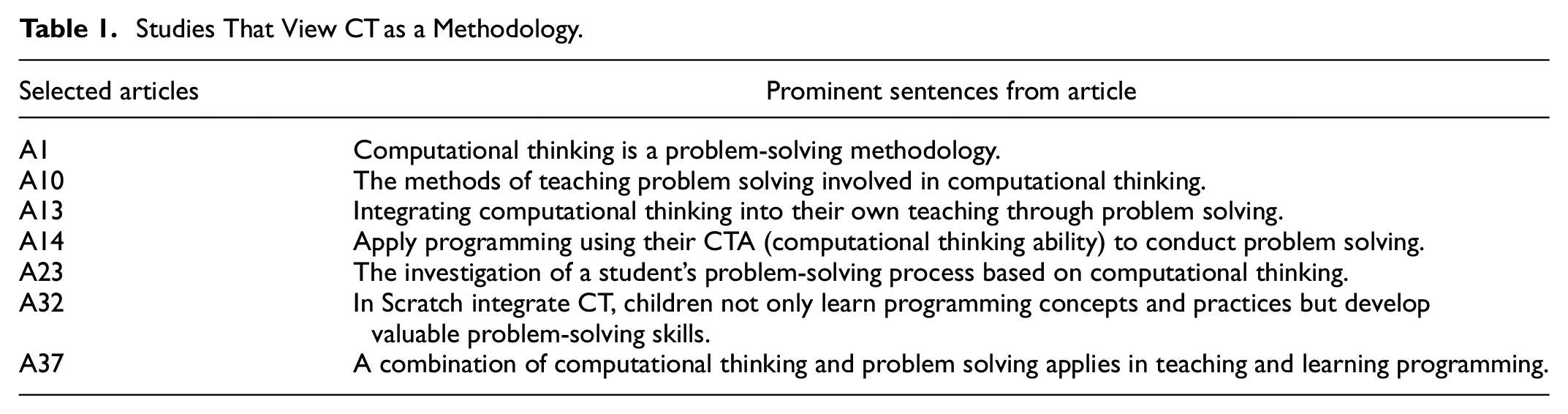
This analysis found that 15 of the 37 selected articles do not explain the relation between CT and PS. As indicated in Tables 1 to 3, the result of a content analysis of 22 of the 37 articles falls into three categories. Each category represents PS from a CT point of view as found in the studies.
Studies That View CT as a Methodology.
Studies That View CT as Knowledge.

Studies That View CT as PS.

The seven articles in Table 1 discuss CT as a methodology that focuses on achieving PS skills. These skills were obtained by teaching CT as stated in Cutumisu and Guo (2019) and teaching programming (Hsiao et al., 2019; Papadakis, 2021; Yusoff et al., 2021). PS skills can also be investigated through CT learning activities in X. Tang et al. (2020). From this finding, the prominent factors show that programming is an activity commonly used when teaching CT and PS skills. In fact, CT can be taught in ways (Marcelino et al., 2018) that do not necessarily involve programming activities.
The prominent sentences in Table 2 view CT as knowledge to gain problem-solving skills. The findings indicate that CT as PS requires critical thinking (Mouza et al., 2017; Rodríguez del Rey et al., 2020). Other authors explain that PS skills are acquired through programming activities that involve CT environments (Bers, 2020; Gilchrist et al., 2021; Rich et al., 2020; Weintrop et al., 2016). In addition, learning PS skills means learning instructional design which is included in the CT process (Arfé et al., 2020; Kong et al., 2020). Meanwhile, PS is a part of CT skill (Ateskan & Hart, 2021; Cano et al., 2021; Tan et al., 2021).
Table 3 shows four studies that establish a relationship between CT and PS. These studies employed an experimental approach, with results that show that CT represented by programming activity exhibits a positive or significant impact and high correlation to PS ability (Bati et al., 2018; Israel-Fishelson & Hershkovitz, 2022; Psycharis & Kallia, 2017). Furthermore, the combination of high CT and high self-efficacy lends confidence to students solving problems (Wei et al., 2021). These findings demonstrate that CT is strongly related to PS skills.
CT as Related to PS Techniques (RQ4)
This study presents an analysis of the scientific relation between CT and prior PS theory. We organize and discuss prior PS theories based on Polya (1945), Guilford (1967), and Stacey et al. (1982). Each researcher has his or her own technique for interpreting the PS process. Problem solving based on Polya (1945 republished in 1981) is divided into four phases, while in Guilford (1967) PS is divided into five phases, and in Stacey et al. (1982) it is divided into three phases. As shown in Figure 8, each phase in these theories has similarities in each step in solving the problems.

Connection between CT and PS theories.
Given the results of the identification of CT components in Figure 7, we adopt four systematic phases as the focus of discussion: decomposition, pattern recognition, abstraction, and algorithm (Anderson, 2016; BBC Bitesize, 2017; Rich & Hodges, 2017; Shute et al., 2017). In a systematic phase of the CT process, the procedure does not proceed to the next phase until the current phase is completed. Figure 5 illustrates the connection between the three PS theories with the phases of PS using CT.
In Figure 8, the various shades of gray indicate PS phases which share functions for solving problems. Phases covered by more than one shade of gray indicate that two phases are represented in one phase in the other theory. For instance, the Entry phase in Stacey et al. (1982) covers two phases in the problem-solving theory: preparation and analysis (Guilford, 1967) and understanding the problem and devising a plan (Polya, 1945 republished in 1981). The shaded area emphasizes the substitution of phases based on the main function of each phase in solving a problem.
PS skills are human capabilities that require high-order thinking (Psycharis & Kallia, 2017). Computational thinking also recognizes high-order thinking (Arfé et al., 2020; Román-González et al., 2017). High-order thinking based on Bloom’s taxonomy consists of four stages: application, analysis, synthesis, and evaluation (Selby, 2015). Analysis has the same function as in PS; it covers understanding the problem, preparation, and entry. Application and synthesis in PS consist of devising a plan, carrying out the plan, production, and attack. Evaluation in PS includes looking back, verification, and review.
Further discussion of this study emphasizes the identification of PS phases applied in the literature in reference to the terms used in each phase in each theory. The identification process using the keywords shown in Table 4 were taken from the PS theories of Polya, Guilford, and Stacey. Those keywords are find the connection, examine (Polya, 1981); problem recognition, evaluating, developing one’s idea (Guilford, 1967); and formulating the question (Stacey et al., 1982).
Identification of Selected Articles Based on Keywords of Three PS Theories.

The keywords have similar functions in explaining each CT phase; for instance, finding the connection refers to the function of pattern recognition; problem recognition and formulating the question is decomposition; developing one’s idea is abstraction; and examination and evaluation refer to the algorithm function.
To provide an overview of CT applications, we attempt to list examples divided into two sections: (1) the application of CT in the literature, and (2) CT applications for solving general problems. We focus on four CT components that can be applied as a problem-solving process: decomposition, pattern recognition, abstraction, and algorithm.
Decomposition, the first CT component, is dividing a problem into smaller problems. In the decomposition phase in Mouza et al. (2017), the Internet is utilized to breakdown a research topic and identify search keywords. In Kale et al. (2018), decomposition uses question prompts to help students make connections between what they know and what they are learning. In Moore et al. (2020), decomposition involves converting a physical course to a mapped figure. This major task includes a complex task in which students divide drawing tasks into discrete actions based on their decomposition strategies.
Pattern recognition, the second component, is recognizing similarities, repetition, or the unique characteristics of a problem. In Wu (2019), pattern recognition utilizes a text-based fish pond simulation, in which students develop the text character on the console in terms of the fish, pond, fishing hook, and bait. Students recognize fish moving from left to right and appearing again on the left. In Moore et al. (2020), pattern recognition uses code cards to move objects on a physical map. Students look for patterns of repetitive steps in the coding card that can be converted into simple moves involving counting tiles on a physical map.
Abstraction, the next component, focuses on important ideas and individual parts of a solution. In Mouza et al. (2017), abstraction utilizes a concept mapping tool in science to model the water cycle. Participants consider a water cycle problem and attempt to find a solution using concept mapping. In Rodríguez del Rey et al. (2020), abstraction hides the inherent complexity of reality to represent only its essential aspects. At this abstraction phase, students are encouraged to divide the major problem into several concrete solutions.
Algorithm compiles the different parts of the solution sequentially into a single unit to solve the main problem. In the problem-solving process, this phase includes execution, whereas when viewed as knowledge it is included as a procedure (Kale et al., 2018). In Moore et al. (2020), students carry out the sequential process of code cards laid out next to an already constructed physical course. In this activity, students learn a sequential process and a procedural process to solve their problems. In Arfé et al. (2020), students carry out programming activities and are asked to follow sequential instructions in programming. These instructions are part of the solution in a complex program.
We propose solving a problem from daily life by using the CT phases. The proposed example is based on a basic understanding of each CT stage and combines the researchers’ understanding of CT. We assume that CT applies not only in computer science but also in other areas (Denning, 2017; Hsu et al., 2018; Lodi & Martini, 2021; X. Tang et al., 2020; Wing, 2006), as well as real-world problems (Kong et al., 2020; Rich & Hodges, 2017).
In the proposed example, the problem is how to stop a leaky water pipe. The PS process using the CT stages is shown in Figure 9, divided into four phases based on the CT stages, as shown by the different shades of gray.

Application of CT stages.
The decomposition stage, where the main problem occurs, is divided into three sub-problems: “Where is the leak?,”“How to stop the water flow?,” and “How to fix the pipe leak?.” These must be solved one by one. If all these problems have a solution, the main problem can also be solved. However, to find the solution, it is necessary to consider and carry out the next phase, namely pattern recognition.
In the pattern recognition stage, we recognize a special characteristic (pattern) exhibited by the main problem or by each subproblem. The main problem exhibits a pattern that must be taken into account, namely that water is a liquid. This is an important factor for approaching and fixing a water leak. The pattern of each problem can be described as follows.
Water has a liquid nature and is permeable: The characteristics of water cause it to permeate small holes or cracks in a pipe. This makes it possible to determine the location of the leak.
Liquid flows downward: Normally, water flows from higher to lower locations. Thus we seek to stop the flow of water by turning off the water valve at a location that is higher than the location of the leak.
Resistance to liquid pressure: Water is difficult to handle, and some materials cannot resist water; therefore, we consider materials that can be used to fix a leak.
In the abstraction stage, we gather ideas to solve each problem by recognizing characteristics from the previous phase. From the ideas gathered, we adopt from the existing solutions without having to reformulate them from scratch. Abstractions for each problem can be described as follows.
Where is the leak? This is answered by locating the “puddle.” A water leak causes a puddle (pooled water) at the current location, and results in wet material. Therefore, to find a leak, we try to find the puddle or wet material.
How to stop the water flow? This is answered by “shutting off the water valve at a location that is higher than the leak position.” Plumbing systems generally include a control valve to stop water flowing from the central water source. When shut off, this will directly stop the leak.
How to repair the leaky pipe? This question is answered by “glue and water insulation.” Small holes in the pipe can be fixed using glue and insulation. An important factor to consider here is what kind of materials are water-resistant. Therefore, we can use glue and water insulation.
In the algorithm stage, we compile the processes from several solutions to solve the main problem. This compilation process follows a systematic procedure. In this case there is a water leak in the pipeline: “find the puddle area”+“shut off the valve”+“apply glue and insulation at the location of the leak.” After the algorithm phase is completed, the main problem has been resolved. Based on the proposed examples, the important point in this discussion is that CT can be implemented as a PS technique using procedural and systematical thinking (Grover & Pea, 2013; Papert, 1980; Rich & Hodges, 2017; Rose et al., 2020).
Conclusion and Further Research
This literature review analysis reveals that the 37 reviewed CT articles are closely related to problem solving because the articles cite Wing’s (2006) theory that CT is a fundamental skill in solving problems for humans. The other evidence is that the discussion regarding problem solving is prominent in each article, and that the term problem solving appears more often than its synonyms. Furthermore, we find that the CT stages used most in the reviewed papers are decomposition, pattern recognition, abstraction, and algorithm. In addition, the reviewed articles demonstrate that the ability to solve problems can be acquired through CT learning, that PS is part of CT, that there is a high correlation between CT and PS, and that the more confident someone is in solving a problem, the higher CT ability he or she possesses. The analysis results also show that the CT stages have the same function as the PS stages. Each role at each stage can be realized through the examples of problem solving proposed in this study.
However, the literature still lacks an explanation on how to effectively use CT as a problem-solving skill and how to implement CT in solving real-world problems. Many prior studies focus only on developing CT capabilities, measuring related variables, and measuring CT capabilities. This suggests an excellent opportunity for researchers in the future to conduct research on CT, focusing on its use as a PS skill. We recommend four phases that can be used as problem-solving procedures; decomposition, pattern recognition, abstraction, and algorithm. These phases have been recognized in the literature (Anderson, 2016; BBC Bitesize, 2017; Rich & Hodges, 2017; Shute et al., 2017) but they are not emphasized in the systematical procedures used.
Supplemental Material
sj-docx-1-sgo-10.1177_21582440241249897 – Supplemental material for Identification of Problem-Solving Techniques in Computational Thinking Studies
Supplemental material, sj-docx-1-sgo-10.1177_21582440241249897 for Identification of Problem-Solving Techniques in Computational Thinking Studies by Ting-Ting Wu, Andik Asmara, Yueh-Min Huang and Intan Permata Hapsari in SAGE Open
Footnotes
Appendix
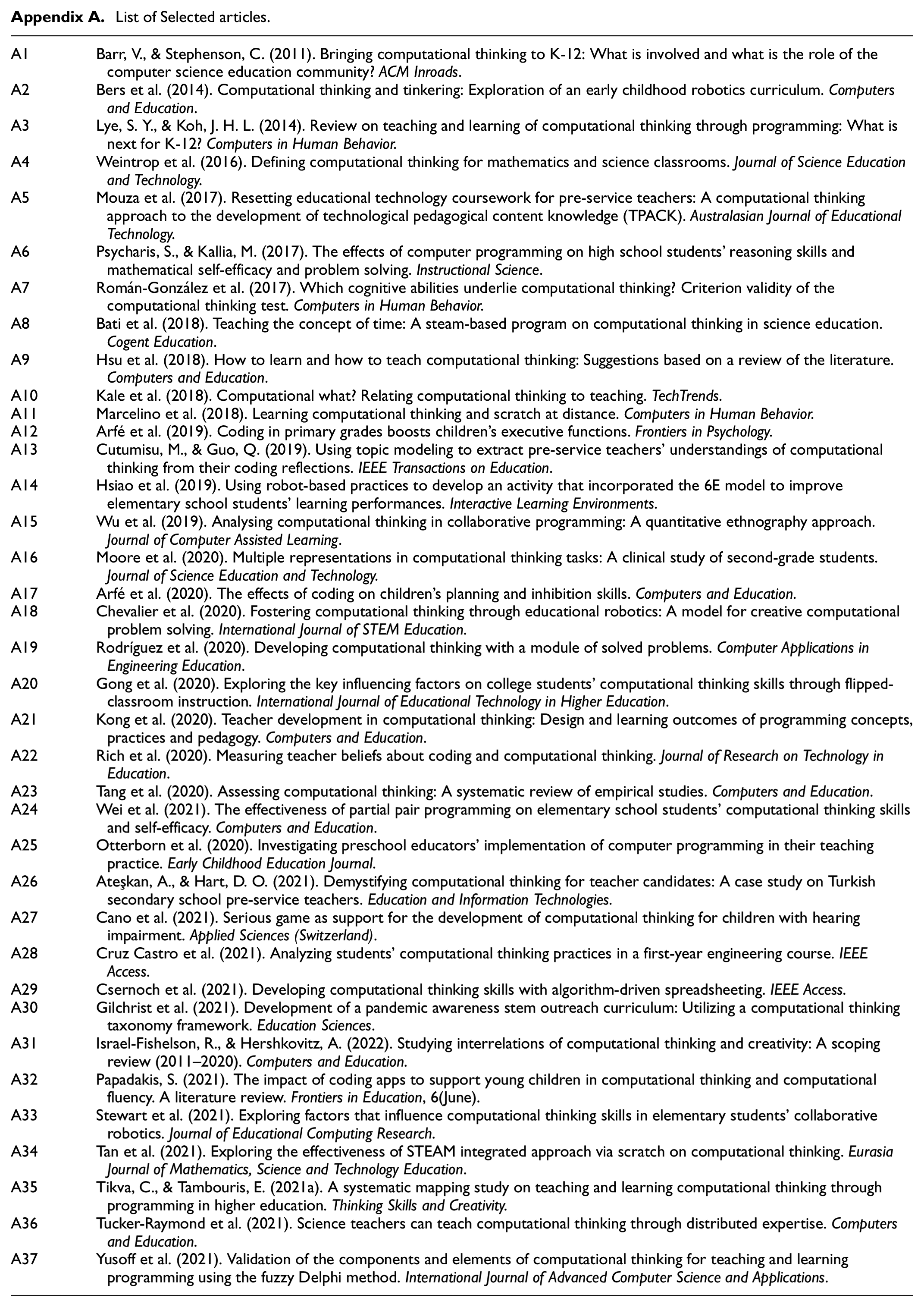
List of Selected articles.
| A1 | Barr, V., & Stephenson, C. (2011). Bringing computational thinking to K-12: What is involved and what is the role of the computer science education community? ACM Inroads. |
| A2 | Bers et al. (2014). Computational thinking and tinkering: Exploration of an early childhood robotics curriculum. Computers and Education. |
| A3 | Lye, S. Y., & Koh, J. H. L. (2014). Review on teaching and learning of computational thinking through programming: What is next for K-12? Computers in Human Behavior. |
| A4 | Weintrop et al. (2016). Defining computational thinking for mathematics and science classrooms. Journal of Science Education and Technology. |
| A5 | Mouza et al. (2017). Resetting educational technology coursework for pre-service teachers: A computational thinking approach to the development of technological pedagogical content knowledge (TPACK). Australasian Journal of Educational Technology. |
| A6 | Psycharis, S., & Kallia, M. (2017). The effects of computer programming on high school students’ reasoning skills and mathematical self-efficacy and problem solving. Instructional Science. |
| A7 | Román-González et al. (2017). Which cognitive abilities underlie computational thinking? Criterion validity of the computational thinking test. Computers in Human Behavior. |
| A8 | Bati et al. (2018). Teaching the concept of time: A steam-based program on computational thinking in science education. Cogent Education. |
| A9 | Hsu et al. (2018). How to learn and how to teach computational thinking: Suggestions based on a review of the literature. Computers and Education. |
| A10 | Kale et al. (2018). Computational what? Relating computational thinking to teaching. TechTrends. |
| A11 | Marcelino et al. (2018). Learning computational thinking and scratch at distance. Computers in Human Behavior. |
| A12 | Arfé et al. (2019). Coding in primary grades boosts children’s executive functions. Frontiers in Psychology. |
| A13 | Cutumisu, M., & Guo, Q. (2019). Using topic modeling to extract pre-service teachers’ understandings of computational thinking from their coding reflections. IEEE Transactions on Education. |
| A14 | Hsiao et al. (2019). Using robot-based practices to develop an activity that incorporated the 6E model to improve elementary school students’ learning performances. Interactive Learning Environments. |
| A15 | Wu et al. (2019). Analysing computational thinking in collaborative programming: A quantitative ethnography approach. Journal of Computer Assisted Learning. |
| A16 | Moore et al. (2020). Multiple representations in computational thinking tasks: A clinical study of second-grade students. Journal of Science Education and Technology. |
| A17 | Arfé et al. (2020). The effects of coding on children’s planning and inhibition skills. Computers and Education. |
| A18 | Chevalier et al. (2020). Fostering computational thinking through educational robotics: A model for creative computational problem solving. International Journal of STEM Education. |
| A19 | Rodríguez et al. (2020). Developing computational thinking with a module of solved problems. Computer Applications in Engineering Education. |
| A20 | Gong et al. (2020). Exploring the key influencing factors on college students’ computational thinking skills through flipped-classroom instruction. International Journal of Educational Technology in Higher Education. |
| A21 | Kong et al. (2020). Teacher development in computational thinking: Design and learning outcomes of programming concepts, practices and pedagogy. Computers and Education. |
| A22 | Rich et al. (2020). Measuring teacher beliefs about coding and computational thinking. Journal of Research on Technology in Education. |
| A23 | Tang et al. (2020). Assessing computational thinking: A systematic review of empirical studies. Computers and Education. |
| A24 | Wei et al. (2021). The effectiveness of partial pair programming on elementary school students’ computational thinking skills and self-efficacy. Computers and Education. |
| A25 | Otterborn et al. (2020). Investigating preschool educators’ implementation of computer programming in their teaching practice. Early Childhood Education Journal. |
| A26 | Ateşkan, A., & Hart, D. O. (2021). Demystifying computational thinking for teacher candidates: A case study on Turkish secondary school pre-service teachers. Education and Information Technologies. |
| A27 | Cano et al. (2021). Serious game as support for the development of computational thinking for children with hearing impairment. Applied Sciences (Switzerland). |
| A28 | Cruz Castro et al. (2021). Analyzing students’ computational thinking practices in a first-year engineering course. IEEE Access. |
| A29 | Csernoch et al. (2021). Developing computational thinking skills with algorithm-driven spreadsheeting. IEEE Access. |
| A30 | Gilchrist et al. (2021). Development of a pandemic awareness stem outreach curriculum: Utilizing a computational thinking taxonomy framework. Education Sciences. |
| A31 | Israel-Fishelson, R., & Hershkovitz, A. (2022). Studying interrelations of computational thinking and creativity: A scoping review (2011–2020). Computers and Education. |
| A32 | Papadakis, S. (2021). The impact of coding apps to support young children in computational thinking and computational fluency. A literature review. Frontiers in Education, 6(June). |
| A33 | Stewart et al. (2021). Exploring factors that influence computational thinking skills in elementary students’ collaborative robotics. Journal of Educational Computing Research. |
| A34 | Tan et al. (2021). Exploring the effectiveness of STEAM integrated approach via scratch on computational thinking. Eurasia Journal of Mathematics, Science and Technology Education. |
| A35 | Tikva, C., & Tambouris, E. (2021a). A systematic mapping study on teaching and learning computational thinking through programming in higher education. Thinking Skills and Creativity. |
| A36 | Tucker-Raymond et al. (2021). Science teachers can teach computational thinking through distributed expertise. Computers and Education. |
| A37 | Yusoff et al. (2021). Validation of the components and elements of computational thinking for teaching and learning programming using the fuzzy Delphi method. International Journal of Advanced Computer Science and Applications. |
Author Contributions
Conceptualization (idea): Andik Asmara, Yueh-Min Huang; Methodology: Andik Asmara, Ting-Ting Wu; Literature search and data analysis: Andik Asmara; Writing—original draft preparation: Andik Asmara, Intan Permata Hapsari; Writing—review and editing: Ting-Ting Wu, Yueh-Min Huang, Intan Permata Hapsari; Funding acquisition: Ting-Ting Wu, Yueh-Min Huang; Supervision: Ting-Ting Wu, Yueh-Min Huang.
Ethical Approval
Not applicable.
Declaration of Conflicting Interests
The author(s) declared no potential conflicts of interest with respect to the research, authorship, and/or publication of this article.
Funding
The author(s) disclosed receipt of the following financial support for the research, authorship, and/or publication of this article: This research is partially supported by the Ministry of Science and Technology, Taiwan, R.O.C. under Grant No. MOST 110-2511-H-224-003-MY3 and MOST 111-2628-H-224-001-MY3.
Consent to Participate
Not applicable.
Consent for Publication
The authors consent to the publication of the submitted manuscript.

Supplemental Material
Supplemental material for this article is available online.
Data Availability Statement
Data sharing not applicable to this article as no datasets were generated or analyzed during the current study.
References
Supplementary Material
Please find the following supplemental material available below.
For Open Access articles published under a Creative Commons License, all supplemental material carries the same license as the article it is associated with.
For non-Open Access articles published, all supplemental material carries a non-exclusive license, and permission requests for re-use of supplemental material or any part of supplemental material shall be sent directly to the copyright owner as specified in the copyright notice associated with the article.
