




Abstract
The green intentions of leaders are crucial for stimulating employees’ green creativity, but there is a dearth of research on how green mindful leadership affects employee green creativity, including the pathways and boundary conditions. This study applies social cognitive theory, role identity theory, and conservation of resources theory to construct a chained mediation model where green mindful leadership influences employee green creativity through employee resilience and green role identity, and also investigates the moderating effect of workplace digitalization. A survey of 305 employees from green digital enterprises was conducted, and the theoretical model was tested using SPSS (a statistical software package widely used for data analysis) and Bootstrap methods (a resampling technique used to estimate statistics on a population by sampling a dataset with replacement). The findings reveal that: (1) green mindful leadership positively affects employee green creativity; (2) employee resilience and green role identity partially mediate the impact of green mindful leadership on employee green creativity; (3) employee resilience enhances green role identity, and these two factors act as a sequential mediator in the relationship between green mindful leadership and employee green creativity; (4) The positive influence of workplace digitalization on employee green creativity through the enhancement of green role identity not only serves as a moderating role for the mediating effect of green role identity but also acts as a moderator in the chain mediation relationship. In light of the research findings, recommendations are offered on how to improve employee green creativity to help enterprises respond to environmental pressures and achieve innovative development.
Keywords
Introduction
Climate change and environmental degradation have become urgent challenges faced by human society on a global scale. Against this backdrop, achieving the goals of “carbon peak and carbon neutrality” has become a global consensus, driving enterprises and organizations to transform toward green and sustainable development. Employee green creativity, defined as the ability of employees to generate novel and useful ideas that contribute to environmentally friendly practices and sustainable development within an organization, is a key driver for enterprises to cope with environmental pressures and achieve innovative development (Plessis & Bettilini, 2017). Green creativity is not only reflected in the innovative activities at the individual employee level but also embodies the collective wisdom and actions of the enterprise, requiring employees to possess traditional innovative qualities while also having a strong sense of social responsibility and environmental awareness. Discussing the cultivation and stimulation of creativity is of great significance to the green transformation of enterprises and the enhancement of their environmental performance.
In the practice of enterprise management, the green intentions of leaders play a crucial role in stimulating employees’ green creativity (Arici & Uysal, 2022). In recent years, concepts such as green transformational leadership (Çop et al., 2021), green inclusive leadership (Bhutto et al., 2021), green service leadership (Lusiani et al., 2020), and responsible leadership have emerged (He et al., 2021), all emphasizing the role of leaders in promoting the green development of organizations. However, these leadership styles highlight environmental intentions but lack attention and perception of their own inner world and the objective world. With the development of research on mindful leadership, Langer (2014) and others introduced mindfulness into the field of environmental management and proposed the concept of green mindfulness. Green mindful leadership has emerged as a new leadership model, characterized by leaders’ high sensitivity to the environment, their open attitude to new information, and their influence on employees through a state of mindfulness, thereby enhancing employees’ attention and perception of the environment and strengthening the connection between individuals and the natural environment (Shamir & Rosen, 2016). The emergence of this leadership model provides a new perspective for understanding how leaders can promote employees’ green creativity through non-traditional means (Bhutto et al., 2021). However, current research on green mindful leadership and how it affects employees’ green creativity is still unclear.
To address this gap, we connect the theories of green mindful leadership with social cognitive theory. Social cognitive theory posits that an individual’s cognition and behavior are influenced by their surrounding environment. This theoretical connection is crucial for our study as it allows us to explore how green mindful leadership, through creating a supportive and mindful environment, can influence employees’ green creativity. Specifically, we examine the mediating roles of employee resilience and green role identification, which are key psychological factors influenced by the environment, as suggested by social cognitive theory. This synthesis of theories provides a comprehensive framework to understand the mechanisms through which green mindful leadership affects employee green creativity, aligning with our research objectives of exploring the underlying processes and the impact of workplace digitalization on these relationships.
Social cognitive theory posits that an individual’s cognition and behavior are influenced by their surrounding environment. Green mindful leadership not only provides employees with an environment rich in resources, mindfulness, support, and trust, but also leads by example to influence employees. These factors not only stimulate employees’ resilience in the face of environmental issues (Çop et al., 2021), but also increase employees’ identification with green roles (Aboramdan et al., 2022), providing a continuous drive for innovation and improvement (Srivastava et al., 2024). Employee resilience, which refers to the adaptability and recovery ability of employees when facing stress and challenges, can enhance employees’ innovative thinking and problem-solving abilities in the context of environmental issues (Batool et al., 2022). Green role identification, where employees internalize environmental behaviors as part of their self-identity, can promote the occurrence of employees’ green innovative behaviors. Both employee resilience and green role identification have become important psychological factors influencing green creativity and green behaviors (Thabet et al., 2023). Green mindful leadership may not only affect employees’ green creativity through a single mediating variable such as employee resilience or green role identification, but also potentially enhance employee resilience to further stimulate employees’ green role identification, thereby forming a chain mediating effect, which is lacking in related research.
In the context of digital transformation, the impact of workplace digitalization on employees has become increasingly significant (Schuster et al., 2023). The application of digital information technology not only changes the way employees work but may also modulate the relationships between green mindful leadership, employee resilience, employee green role identification, and employee green creativity. Exploring the role of workplace digitalization in this process will help organizations better understand how to promote employee green creativity in a digital environment (Lusiani et al., 2020). This study aims to delve into how green mindful leadership drives employee green creativity through employee resilience and green role identification, and analyzes the moderating role of workplace digitalization. By constructing and validating this comprehensive theoretical model, it provides deeper insights into how green mindful leadership affects employee green creativity on multiple levels and dimensions, and also offers practical guidance for organizations to achieve green development and enhance employee green creativity in the context of digitalization.
Theory and Hypotheses
The Positive Impact of Green Mindful Leadership on Employee Creativity
Green mindfulness and mindful leadership emphasize attention and perception of one’s own body and mind (the current internal world) and objective reality (the external world), often connecting the individual with the world, and motivating and guiding individuals to pay attention to the natural environment through mindfulness and environmental responsibility (Y. S. Chen et al., 2014). Leaders with green mindfulness often possess a high degree of environmental sensitivity and maintain an openness to new information, influencing employees’ attention and perception of the current environment through their own state of mindfulness, and strengthening the connection between employees and the natural environment by inspiring employees to engage in green creativity (Y. S. Chen et al., 2015). Green creativity, based on organizational green innovation management and pro-environmental behavior, encompasses employees’ novel ideas about green products, green services, and green production processes within an organization, or their engagement in original and innovative green practices (Y. S. Chen et al., 2014). It requires employees not only to possess traditional innovative qualities, such as diligence, curiosity, and a spirit of innovation, but also to have a strong sense of social responsibility, public welfare, environmental awareness, and high sensitivity to environmental issues.
According to social cognitive theory, a leader’s behavior, attitudes, and values can influence employees’ cognition and behavior. Green mindful leadership can promote the enhancement of employees’ green creativity in the following ways (Sürücü, 2024): First, the environmental sensitivity of green mindful leaders keeps them alert to environmental changes, demonstrating, focusing on the environment, practicing, advocating for, and supporting green behaviors, such as energy saving and emission reduction, resource recycling, and sustainable development practices, which can inspire employees to have more green innovation consciousness and behaviors (M. Zhao et al., 2023). Second, green mindful leaders maintain an open attitude toward new environmental information and sustainable development practices, willing to accept employees’ discussions and exchanges on environmental issues and solutions, which can guide employees to engage in more green thinking (Sun & Xi, 2024). Third, the mindfulness practices of green mindful leaders enable them to think more focused and clearly about environmental issues, demonstrating respect and protection for the environment through their own mindful state and leading by example, prompting employees to recognize the importance of green innovation, thereby stimulating employees to reflect and introspect on environmental issues, and promoting their green creativity (Kalyar et al., 2021). Furthermore, green mindful leadership also enhances employees’ green creativity by establishing green policies and systems, permeating green consciousness at all levels of the organization, and forming an organizational atmosphere that supports green behavior (Aboramdan et al., 2022). Based on this, the following hypothesis is proposed:
The Mediating Role of Employee Resilience
The Conservation of Resources Theory posits that individuals tend to maintain, protect, and accumulate personal resources as a strategy to cope with challenges and stress (Jia et al., 2022). In the context of organizational behavior, employee resilience refers to the ability of employees to maintain a positive attitude and creative thinking when facing challenges and adversity (Lu et al., 2023). The characteristics of green mindful leadership distinguish it from other traditional leadership styles in influencing employee resilience. Firstly, green mindful leaders enhance employees’ awareness of environmental issues through role modeling, education, and guidance, making them more attentive to the impact of personal and organizational activities on the environment, thereby improving adaptability and problem-solving skills, and ultimately enhancing their resilience (Wamsler, 2018). Secondly, green mindful leaders cultivate employees’ mindfulness practices through their own state of mindfulness, encouraging activities such as mindfulness meditation and breathing exercises to focus on the present, effectively manage emotions, reduce work stress and anxiety, and improve employees’ psychological resilience (Panditharathne & Chen, 2021). Thirdly, green mindful leaders support employees in acquiring necessary environmental knowledge and skills through continuous learning, enhancing professional capabilities and confidence in facing environmental changes, and through positive feedback and constructive criticism, help employees learn from failures, strengthening their ability to overcome setbacks and recover and grow, ultimately enhancing their resilience (Yu et al., 2019).
Employee resilience is closely related to a positive mindset, which can stimulate employees’ curiosity and openness, providing a continuous driving force for green innovation (Avery et al., 2011). On one hand, highly resilient employees can effectively manage their emotions, maintaining a positive mood even when facing environmental challenges; this emotional stability is an important psychological foundation for green innovation creation (Cropley & Cropley, 2015). On the other hand, employees with high resilience are more adaptable to environmental changes (Y. Li & Li, 2018), flexibly adjusting innovation strategies, and this adaptability is key to the development of green creativity (Caniëls et al., 2022). Furthermore, employee resilience ensures the continuity of the innovation process, allowing highly resilient employees to continuously participate and invest in green innovation activities even in the face of repeated failures (Batool et al., 2022). It is evident that employee resilience can promote green creativity. Green mindful leadership enhances employees’ environmental awareness, mindfulness practices, professional training, and psychological support, thereby strengthening their resilience (Tugade & Fredrickson, 2004), enabling them to more effectively cope with the challenges and pressures in the innovation process. This resilience not only promotes employees’ positive emotions and attitudes but also enhances their adaptability and the sustainability of innovation (Al-Ghazali et al., 2022), ultimately stimulating green creativity. It is clear that employee resilience plays a bridging role in this process. Based on this, the following hypothesis is proposed:
The Mediating Role of Green Role Identification
Role identity theory suggests that an individual’s behavior and attitudes are influenced by their self-identification within specific social roles. Green role identification is the application of role theory and self-perception in the environmental domain and is an important psychological factor affecting green creativity (Al-Ghazali et al., 2022). A review of relevant literature indicates that employees with green role identification tend to agree with the organization’s green goals, are more likely to exhibit pro-environmental behaviors such as resource conservation and eco-friendly shopping, and have a strong motivation to change environmentally unfriendly situations (Tuan, 2023). According to Amabile’s (2012) componential theory of creativity, intrinsic motivation is a key factor driving individual creativity. Employees’ green role identification enhances their intrinsic interest and commitment to green innovation, thereby stimulating intrinsic motivation. This motivation is an important driver of green creativity because it encourages employees to invest more energy and enthusiasm in green innovation activities (Al-Ghazali et al., 2022). Furthermore, when employees have a sense of identification with a green role, they are more likely to view green innovation as part of their responsibilities and proactively explore and implement green solutions, ultimately demonstrating green creative thinking and behavior related to environmental protection.
Green mindful leadership directly affects employees’ green role identification in several ways. First, green mindful leaders, by personally participating in environmental activities and demonstrating sustainable behaviors, can inspire employees to emulate these actions, thereby increasing employees’ environmental awareness and green identification (Bandura, 1986). Second, through continuous environmental education and communication, employees’ understanding of environmental issues is heightened. This education goes beyond knowledge transfer to include a deep understanding and emotional connection with environmental issues, promoting the internalization of green values among employees (Aboramdan et al., 2022). Third, green mindful leaders encourage employees to engage in green innovation by fostering open and transparent communication, encouraging the sharing of green experiences and knowledge, and supporting employees in proposing and implementing new ideas and solutions related to environmental protection, enhancing their green role (Abdou et al., 2023). Additionally, green mindful leaders often help employees develop the necessary knowledge and skills, recognize and reward employees’ green behaviors, thereby increasing employees’ green identification (Peng et al., 2020). In summary, green mindful leadership enhances employees’ green role identification, which in turn increases their intrinsic interest and commitment to green innovation, stimulates their intrinsic motivation, and ultimately promotes the development of employees’ green creativity (Quan et al., 2022). Based on this, the following hypothesis is proposed:
The Serial Mediating Effect
The Conservation of Resources Theory suggests that individuals are inclined to maintain, protect, and accumulate personal resources as a strategy to cope with environmental changes and work-related stress (Arici & Uysal, 2022). Green mindful leadership not only provides physical resources such as green technology or sustainable materials but also offers psychological support, such as recognition and encouragement, which helps employees maintain a positive attitude when facing environmental changes and work pressure (Rafique et al., 2024). Moreover, the mindful attitude and exemplary behavior of green mindful leaders toward environmental protection can stimulate employees’ intrinsic motivation, prompting them to develop stronger psychological resilience to address environmental issues and overcome challenges. Enhanced employee resilience enables employees to manage work stress more effectively, reducing job burnout and thus freeing up more psychological resources to invest in green behaviors and innovation (Sürücü, 2024).
Employees with high resilience are more likely to accept and internalize the organization’s green values, thereby strengthening their green role identification (Odugbesan et al., 2023). Consequently, a stronger green role identification provides employees with clear direction and goals, motivating them to innovate and think creatively within the green domain. When employees identify with their green roles, they are more likely to invest time and energy exploring new green solutions, thereby enhancing their green creativity. It is evident that employee resilience and green role identification form a positive cycle between green mindful leadership and employee green creativity, where resilience helps employees cope with challenges, and green role identification provides the motivation for continuous engagement (Bhutto et al., 2021). This interaction results in employees not only being able to address current challenges but also making innovative contributions to the organization’s green goals on an ongoing basis. Based on this, the following hypothesis is proposed:
The Moderating Role of Workplace Digitalization
The impact of digital transformation on the workplace is multifaceted, encompassing the application of technologies such as artificial intelligence, the Internet of Things, and blockchain, which provide new avenues and possibilities for employee green creativity (Binsar et al., 2024; Odugbesan et al., 2023). According to the UTAUT model, workplace digitalization includes four aspects: performance expectancy, effort expectancy, social influence, and facilitating conditions. Performance expectancy involves employees’ beliefs about digital technology enhancing work efficiency. Effort expectancy refers to employees’ perceptions of the ease of using digital technology. Social influence reflects employees’ views on the social acceptance and normative pressure of using digital technology. Facilitating conditions pertain to employees’ perceptions of resources and support for using digital technology, and workplace digitalization greatly activates employees’ cognition and behavior (Ouyang et al., 2023).
In terms of performance expectancy in workplace digitalization, if employees believe that digital tools can significantly improve their work performance, they are more likely to apply these tools to innovation and creative processes. Therefore, performance expectancy strengthens the relationship between green role identification and creativity, enabling employees to pursue both environmental sustainability and innovation efficiency. When employees find digital technology easy to grasp and apply, they are more willing to invest time and effort to learn these technologies, thereby enhancing their innovative capabilities. This ease of use lowers the technological barrier to innovation, making employees with green role identification more likely to attempt green creativity (S. U. Rehman et al., 2023). In the work environment, if employees perceive the use of digital technology as a social expectation, they may be more inclined to adopt these technologies due to green role identification, thereby demonstrating higher green creativity within the team (Cardinali & De Giovanni, 2022). When digital workplaces provide the necessary resources and support, employees are more likely to leverage these conditions to achieve innovation. This support includes not only technological resources but also organizational culture and leadership support, both of which can enhance the positive impact of green role identification on creativity. The four dimensions of workplace digitalization positively affect the positive role of employee green role identification on green creativity. Performance expectancy and effort expectancy directly enhance employees’ trust and acceptance of digital technology, social influence strengthens employees’ recognition of the social value of innovation, and facilitating conditions provide the practical possibility for innovation (Wang et al., 2023). These factors together form an environment that promotes innovation, making employees with green role identification more likely to exhibit creative thinking and behavior at work (Setyaningrum et al., 2023).
In the context of workplace digitalization, green mindful leadership can more effectively stimulate employees’ green role identification through various digital means, thereby promoting employee green creativity (Setyaningrum et al., 2023). Using digital communication tools, green mindful leaders can more effectively convey green concepts and goals, making employees feel the organization’s commitment to green development and strengthening employees’ green role identification. Through online training modules and virtual seminars, employees can learn green skills and knowledge anytime, anywhere, improving their understanding and capability of green practices, thus deepening their green role identification (J. Li et al., 2023). Through social media and internal networks, employees can share green innovation cases and success stories, which can serve as role models to motivate employees to strengthen green role identification. Using digital platforms, such as idea management software and online brainstorming tools, employees can propose and test green ideas, and the digital environment also provides support for the incubation of green ideas, promoting employee green creation (Lange & Santarius, 2020).
At the same time, workplace digitalization can promote green role identification through its impact on employee resilience, indirectly enhancing the positive effect of green mindful leadership on green creativity (Binsar et al., 2025). Workplace digitalization requires employees to learn and apply new technologies, and to adapt to these changes, employees need to continuously learn new skills and knowledge, enhancing their ability to face future uncertainties, that is, improving employee resilience (Saleem et al., 2023). Additionally, employees can communicate and collaborate with team members in real-time through various digital platforms, which helps employees stay calm and respond effectively under pressure, and workplace digitalization provides possibilities for flexible work, helping employees manage stress and emotions, further enhancing resilience (Zahoor et al., 2024). High-resilience employees in digital work environments can quickly adapt to new tools and technologies, making them more likely to accept and adopt green practices and processes, master new skills and knowledge required for green innovation, and enhance green role identification; high-resilience employees are also more inclined to face challenges with a positive attitude, maintain commitment and motivation for green goals, and help them maintain green innovation efforts during difficult times, effectively enhancing their green role identification, and more likely to actively participate in green creation(S. U. Rehman et al., 2023). Based on this, the following hypotheses are proposed:
In summary, the theoretical model is constructed as shown in Figure 1.

Theoretical model.
Research Design
Data Collection and Basic Information
This study aims to investigate how green mindful leadership fosters employee green creativity through digital technology across various industries. A quantitative research methodology was employed, utilizing a survey questionnaire to collect data, ensuring the objectivity and generalizability of the research outcomes. The survey targets were carefully selected from organizations that actively implement green policies and sustainable development strategies within the framework of the State Council’s guidance and sustainable development goals, with significant integration of digital technology, such as Contemporary Amperex Technology Co., Limited (CATL). To address potential biases arising from respondents involved in implementing green policies, we conducted further diagnostic tests, including bias analysis and robustness checks, to ensure the validity and reliability of our findings (Lash et al., 2014).
The survey included employees from different departments and functions to ensure the comprehensiveness and multidimensional perspective of the research results (Charalampous et al., 2019). Specifically, we targeted employees from departments such as Research and Development (R&D), Production, Marketing, Human Resources, and Management, as these departments play crucial roles in the implementation of green policies and sustainable practices. This approach allows us to capture the diverse experiences and perspectives of employees across various organizational functions.
To ensure the representativeness of our sample, we employed a stratified random sampling technique. The sample size was determined based on power analysis, considering the effect size, desired power, and significance level (Lakens, 2022). This method ensures that our sample is sufficiently large to detect meaningful relationships while maintaining statistical power. The questionnaire was rigorously pre-tested to ensure the clarity of the questions and the reliability of the scales. The questionnaires were distributed via email, internal organizational platforms, and professional online survey tools, ensuring the convenience of the survey and the efficiency of data collection. To increase the response rate, participants were offered a small incentive, and we ensured the anonymity and confidentiality of the data.
The survey was conducted from July 1, 2024 to August 30, 2024. During the data collection process, the research was assisted by the researcher’s classmates and members of the Enterprise Innovation and Development Research Center at Fujian Business University, ensuring the widespread and effective distribution and collection of the questionnaires. After data collection, a meticulous data cleaning process was conducted to exclude incomplete or abnormal questionnaires, ensuring the accuracy of the analysis results. A total of 365 questionnaires were collected, of which 305 were valid. Descriptive statistical analysis of the data showed that the sample was evenly distributed in terms of gender, age, education, job level, and years of service, reflecting the diversity of the surveyed subjects. The characteristics of the employee sample are shown in Table 1.The sample comprises 305 valid questionnaires with a gender split of 59.3% male and 40.7% female. Ages range widely, from under 25 (31.1%) to 51 and above (22%). Most respondents are general staff (72.8%), with the remainder being managers at various levels. Work experience is predominantly under 6 years (83.3%), and education levels are highest among bachelor’s degree holders (58.7%), though other qualifications are also represented. This diverse sample helps ensure comprehensive and unbiased research outcomes.
Basic Information of the Sample.

Variable Measurement
The questionnaire employed validated scales to measure the variables, including assessments of green mindful leadership, employee resilience, employee green role identification, green creativity, and workplace digitalization. All measurement items were rated using a five-point Likert scale to ensure the consistency and comparability of the scales.
Additionally, control variables were selected, including employee age, gender, education level, management level, and years of work experience.
Research Results
Reliability, Validity, and Common Method Bias Test
The data were analyzed using SPSS 24.0 and Amos 24.0. The results of the reliability and validity tests for the five variables—green mindful leadership, employee resilience, green role identification, employee green creativity, and workplace digitalization—are presented in Table 2. The results indicate that the Cronbach’s α coefficients for all five variables are greater than .8, and the composite reliability (CR) values all exceed .8, suggesting that the scales have high reliability. The validity of the constructs was assessed through convergent validity and discriminant validity. The factor loadings for all variables are greater than .6, and the average variance extracted (AVE) ranges from .504 to .79, all of which are greater than .5, indicating a high level of convergent validity.
Reliability and Validity Analysis Results.

Note. GML = green mindful leadership; ER = employee resilience; GRI = green role identification; EGC = employee green creativity; WD = workplace digitalization.
*, *** denote significant correlations at the .05 and .001 levels, respectively.
To further assess discriminant validity, the square roots of the AVE values for each construct were compared with the correlations between constructs. If the square root of the AVE for a construct is greater than its correlation with any other construct, it suggests that the constructs are distinct from one another, which supports discriminant validity. The results showed that all constructs met this criterion, indicating that the variables are distinct and well-defined.
Additionally, multicollinearity was tested using the variance inflation factor (VIF) for each variable. The VIF values for all variables were below five, indicating that multicollinearity is not a significant issue in this study.
Common method bias was also tested to ensure that the results were not influenced by the method of data collection. This was done using Harman’s single-factor test, which involves examining the unrotated factor solution of all items. If a single factor emerged that accounted for the majority of the covariance among the variables, common method bias would be a concern. However, the results showed that no single factor emerged that explained the majority of the variance, suggesting that common method bias is not a significant issue in this study. In summary, the results of the reliability and validity tests provide evidence that the scales used in this study are reliable and valid, and that common method bias is not a concern. This supports the credibility of the subsequent analysis and interpretation of the data.
Additionally, a confirmatory factor analysis (CFA) was conducted on the variables, and the results are presented in Table 3. The five-factor model demonstrated the best fit, with the following fit indices for the five-factor model: χ2/df = 2.395, CFI = 0.913, TLI = 0.907, IFI = 0.914, RMSEA = 0.068. These indices are the best among all models considered, indicating a high degree of discriminant validity among the variables. Using Harman’s single-factor test for common method bias, the variance explained by the first factor before rotation is 35.61%, which is less than 40%, indicating that there is no significant common method variance bias. A single-factor confirmatory factor analysis was conducted on the variables, and the results showed that the fit of the single-factor CFA was poor (χ2/df = 8.195, CFI = 0.546, TLI = 0.518, IFI = 0.548, RMSEA = 0.154), suggesting that this study effectively controlled for common method bias.
Confirmatory Factor Analysis Results.
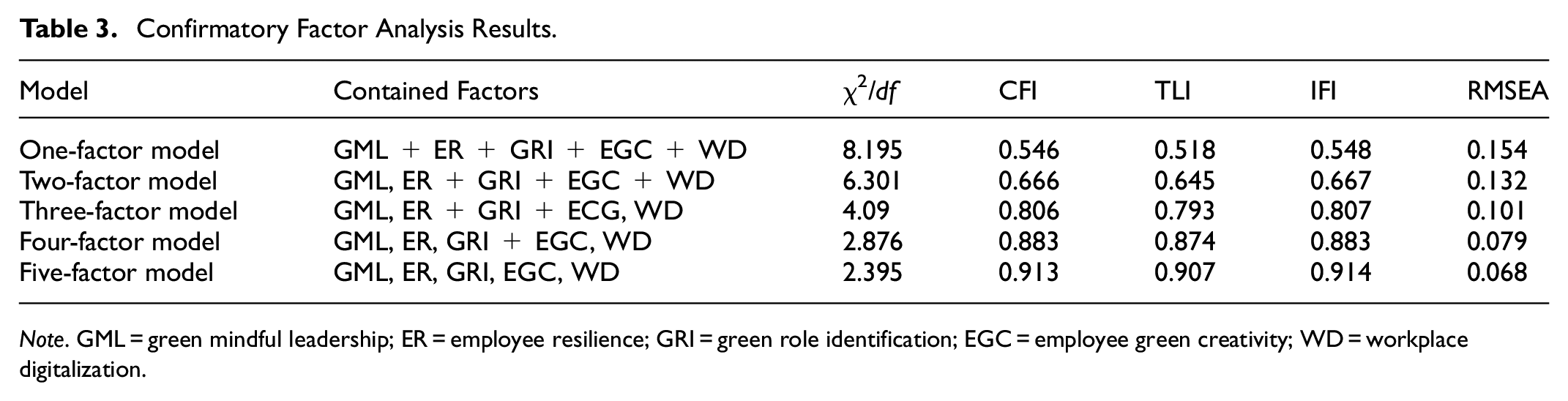
Note. GML = green mindful leadership; ER = employee resilience; GRI = green role identification; EGC = employee green creativity; WD = workplace digitalization.
Descriptive Statistics and Correlation Analysis
The means, standard deviations, and correlation analysis results for the variables are presented in Table 4. Green mindful leadership is significantly and positively correlated with employee resilience, green role identification, and employee green creativity (r = .494, p < .01; r = .463, p < .01; r = .406, p < .01). Employee resilience and green role identification are significantly and positively correlated with employee green creativity (r = .61, p < .01; r = .435, p < .01), and green role identification is significantly and positively correlated with employee green creativity (r = .384, p < .01). The preliminary results are consistent with the hypotheses of this paper, indicating that regression analysis can be conducted. Additionally, the values on the diagonal, which are the square roots of the AVE for the corresponding variables, are all greater than the correlation coefficients between the respective variables, indicating that there is no issue with multicollinearity.
Descriptive Statistics and Correlation Analysis Results.

Note. The values on the diagonal represent the square roots of the AVE for the corresponding variables; *, **, *** denote significant correlations at the .05, .01, and .001 levels, respectively, and the same applies below. GML = green mindful leadership; ER = employee resilience; GRI = green role identification; EGC = employee green creativity; WD = workplace digitalization.
Main Effects and Mediation Effects Test
Hierarchical regression analysis was employed to verify the main effects and mediation effects, with the results presented in Table 5.
Main effect test. Model 6 indicates that green mindful leadership has a positive and significant impact on employee green creativity (β = .42, p < .001), thus validating Hypothesis H1.
Mediation effect test. Models 2 and 7 in Table 5 tested the mediating effect of employee resilience. In Model 2, green mindful leadership significantly and positively affects employee resilience (β = .482, p < .001). When employee resilience was added to Model 6 in Model 7, the results showed that employee resilience significantly and positively affects employee green creativity (β = .322, p < .001). However, compared to Model 6, the coefficient for the effect of green mindful leadership on employee green creativity decreased from 0.42 to 0.264, indicating that employee resilience exerts a partial mediating effect between green mindful leadership and employee green creativity, thus supporting Hypothesis H2. Models 4 and 8 tested the mediating effect of green role identification. In Model 4, green mindful leadership significantly and positively affects green role identification (β = .46, p < .001). When green role identification was added to Model 6 in Model 8, the results showed that green role identification significantly and positively affects employee green creativity (β = .258, p < .001). However, compared to Model 6, the coefficient for the effect of green mindful leadership on employee green creativity decreased from 0.42 to 0.301, indicating that green role identification exerts a partial mediating effect between green mindful leadership and employee green creativity, thus supporting Hypothesis H3.
Serial Mediation Effect Test. The SPSS plugin “process” was utilized, following the operational model provided by Hayes (2018), and the results are presented in Table 6. In the “green mindful leadership → employee resilience → employee green creativity” pathway, the 95% confidence interval is [0.064, 0.254], which does not include 0, indicating that the mediation effect is significant. Therefore, Hypothesis 2 is further validated. In the “green mindful leadership → green role identification → employee green creativity” pathway, the 95% confidence interval is [0.006, 0.092], which also does not include 0, thus further validating Hypothesis 3.In the “green mindful leadership → employee resilience → green role identification → employee green creativity” pathway, the 95% confidence interval is [0.005, 0.095], which does not include 0, indicating that employee resilience and green role identification play a serial mediating role between green mindful leadership and employee green creativity. Therefore, Hypothesis 4 is validated.
Results of Main Effects and Mediation Effects Test.

Note. GML = green mindful leadership; ER = employee resilience; GRI = green role identification; EGC = employee green creativity; WD = workplace digitalization.
Serial Mediation Effect Test Results.

Note. GML = green mindful leadership; ER = employee resilience; GRI = green role identification; EGC = employee green creativity; WD = workplace digitalization.
Moderation Effect Test
Using Process 3.3 (with Bootstrap = 5000 and a 95% confidence interval), following Hayes’s (2018) Model 87, and adhering to the analysis procedure proposed by X. Zhao et al. (2010), the data results are presented in Tables 7 and 8. Under the moderation of workplace digitalization, the effect of green mindful leadership on employee green creativity is 0.173, with a 95% confidence interval of [0.027, 0.318], which does not include 0; the effect of employee green role identification on employee green creativity is 0.161, with a 95% confidence interval of [0.010, 0.312], which does not include 0; and the interaction effect value is 0.241, with a 95% confidence interval of [0.138, 0.343], which does not include 0. This indicates that the moderating effect of workplace digitalization is significant. When workplace digitalization takes a low value, that is, one standard deviation below the mean (Mean − 1SD), the moderating effect value is 0.161, and when workplace digitalization takes a high value, that is, one standard deviation above the mean (Mean + 1SD), the moderating effect value is 0.268, with confidence intervals that do not include 0. It is evident that under strong workplace digitalization scenarios, the effect of employee green role identification on employee green creativity is overall higher than in weak workplace digitalization scenarios. Therefore, Hypothesis 5 is supported.
Moderating Effect of Workplace Digitalization.
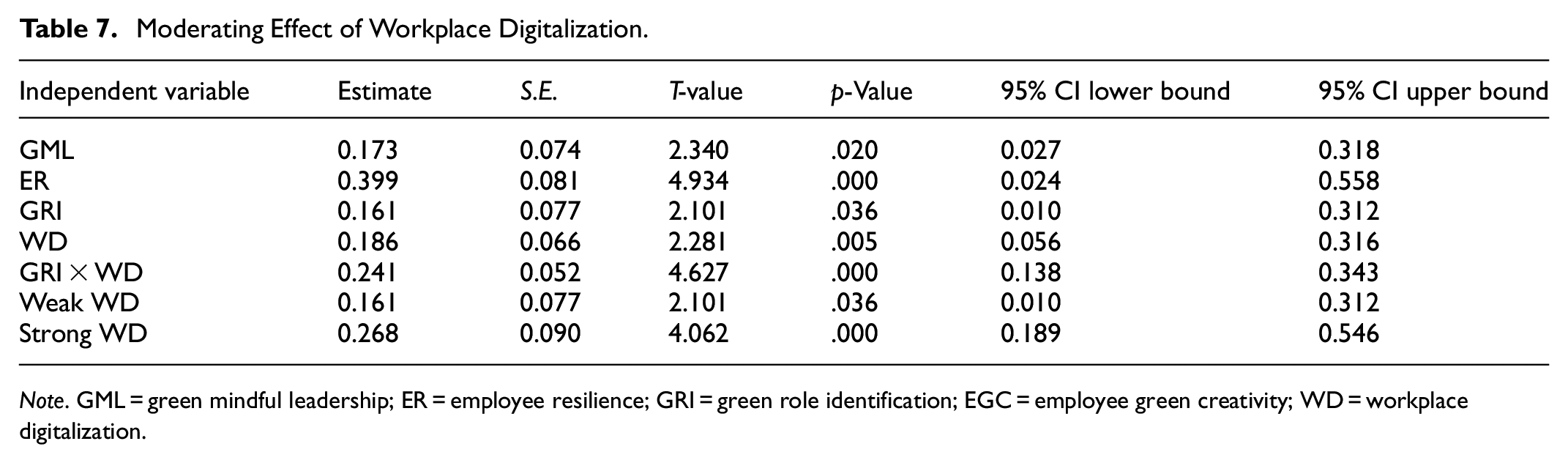
Note. GML = green mindful leadership; ER = employee resilience; GRI = green role identification; EGC = employee green creativity; WD = workplace digitalization.
Mediating Effect of Workplace Digitalization.

Note. GML = green mindful leadership; ER = employee resilience; GRI = green role identification; EGC = employee green creativity; WD = workplace digitalization.
Further verification of the mediating effects under the moderation of workplace digitalization. According to Table 8, when workplace digitalization takes low and high values, the mediating effect values of green role identification are 0.036 and 0.081, respectively, with 95% confidence intervals that do not include 0. Additionally, the paper adopts the Index measure as suggested by Hayes (2018), and the results show an Index value of 0.053, with a 95% confidence interval of [0.017, 0.097], which does not include 0. This indicates that the mediating effect of green role identification remains under the moderation of workplace digitalization. Finally, the difference between the two mediating effects when workplace digitalization is at high (M + 1SD) and low (M − 1SD) levels has a 95% confidence interval of [0.015, 0.083], which does not include 0, also indicating that the moderated mediating effect is significant. All three criteria confirm that Hypothesis 6 is supported, meaning that the mediating effect of employee green role identification remains significant under the moderation of workplace digitalization.
For the moderated serial mediation effect, when workplace digitalization is at a low value, one standard deviation below the mean (Mean − 1SD), the serial mediating effect value is 0.039, with a 95% confidence interval of [0.003, 0.087], which does not include 0. When workplace digitalization is at a high value, one standard deviation above the mean (Mean + 1SD), the serial mediating effect value is 0.09, with a 95% confidence interval of [0.044, 0.153], which does not include 0. It is evident that the serial mediating effect exists at M ± 1SD. Secondly, the Index measure value is 0.059, with a 95% confidence interval of [0.020, 0.096], which does not include 0. Lastly, the difference between the two serial mediating effects when workplace digitalization is at high (M + 1SD) and low (M − 1SD) levels has a 95% confidence interval of [0.025, 0.083], which does not include 0, also indicating that the moderated serial mediating effect is significant. All three criteria confirm that Hypothesis 7 is supported, meaning that the serial mediating effect remains significant under the moderation of workplace digitalization.
Research Conclusions and Recommendations
Research Conclusions
This study constructed and validated an integrated theoretical model to deeply explore the influence mechanism of green mindful leadership on employee green creativity and the moderating role of workplace digitalization. Firstly, the study clearly indicates that green mindful leadership has a significant positive impact on employee green creativity. Green mindful leadership, through its profound understanding of the environment and commitment to sustainable development, can stimulate employees’ green creative behaviors (Sun & Xi, 2024). Secondly, green mindful leadership has a positive effect on employee resilience, enabling employees to be more confident and persistent in the face of environmental issues and green innovation processes, thereby promoting employee green creativity. Thirdly, green mindful leadership can promote employee identification with green roles within the organization; this sense of identification is an important psychological foundation for employee green creativity, providing employees with the motivation to continuously innovate and improve. Fourthly, employee resilience can enhance green role identification, and both play a serial mediating role between green mindful leadership and employee green creativity. This means that under the influence of green mindful leadership, employee resilience not only directly affects their green creativity but also indirectly promotes the development of green creativity by strengthening green role identification. This finding provides a more complex perspective on employee green behavior within organizations. Lastly, the results show that a higher level of workplace digitalization can actively moderate the positive impact of green role identification on employee green creativity, and under the moderation of workplace digitalization, the mediating effect of employee green role identification and the serial mediating effect of green role identification and employee resilience remain significant. This indicates that digitalization is not only a symbol of technological progress but also an important force in driving organizational green innovation (W. Chen et al., 2024).
Originality of the Research
The originality of this research lies in its innovative exploration of the impact of green mindful leadership on employee green creativity and the moderating role of workplace digitalization. This study is one of the first to integrate green mindful leadership into the context of employee green creativity and examine the complex mediating and moderating mechanisms involved. By focusing on the psychological and technological dimensions, this research offers a fresh perspective that has not been thoroughly investigated in previous studies, thereby contributing new knowledge to the field of organizational behavior and environmental psychology.
Theoretical Significance and Practical Implications
The theoretical significance of this study lies in its innovative expansion of research in the fields of organizational behavior and environmental psychology. Firstly, by integrating the concept of green mindful leadership into organizational behavior research, the study enriches the connotations of leadership theory, particularly in terms of leadership expressions that promote sustainable development and environmental responsibility. Secondly, it clarifies the mediating roles of employee resilience and green role identification between green mindful leadership and employee green creativity, providing a new theoretical perspective for understanding how employees demonstrate green innovative behavior within organizations. Additionally, the discovery of serial mediating effects deepens the understanding of employees’ intrinsic motivations and psychological mechanisms, offering a more nuanced explanation for the psychological dynamics in the process of employee green creativity. Lastly, the analysis of the moderating role of workplace digitalization adds a new dimension to the study of the interaction between technological progress and human behavior, fostering a deeper understanding of organizational behavior in the context of digitalization.
On the practical application level, this study provides organizations with actionable strategies to promote employee green creativity. Organizations should prioritize developing leaders’ green awareness and sustainable development concepts through targeted training and education programs (Sun & Xi, 2024). This enables leaders to champion environmental initiatives and integrate green values into decision-making processes. By fostering a culture of sustainability, organizations can enhance employee resilience through stress management programs and career development opportunities, helping them maintain motivation during green innovation projects (Ma & Wang, 2024). Additionally, shaping a strong green culture and implementing incentive mechanisms can strengthen employees’ identification with green behaviors, driving both individual creativity and organizational sustainability (Mirahsani et al., 2024). In the digital age, leveraging digital platforms for knowledge sharing and collaboration can further boost green innovation. Organizations can create dedicated digital spaces for sharing best practices and establishing incubators to support green ideas, providing employees with the resources and guidance needed to turn concepts into reality (Alabdali et al., 2024). These practical steps not only advance organizational sustainability goals but also contribute to global environmental stewardship.
Limitations and Suggestions for Improvement
This study has achieved some findings in deeply exploring the impact of green mindful leadership on employee green creativity and its moderation by workplace digitalization. However, the limitations of the study should not be overlooked. First, the study did not fully consider the impact of the time factor on green mindful leadership and green creativity. Future research could employ longitudinal research designs to explore the dynamic relationship between green mindful leadership and employee green creativity over time (S. U. Rehman et al., 2023). This is important because the effects of leadership styles and employee creativity may evolve and change as time progresses, and understanding these temporal dynamics can provide a more comprehensive picture of their relationship. Qualitative research methods, such as case studies or in-depth interviews, could be particularly useful in uncovering the deeper roles of these mediators and the underlying mechanisms and processes that were not fully explored in this study. Second, although the mediating roles of employee resilience and green role identification have been revealed, there is a lack of in-depth discussion on the underlying mechanisms and processes of these mediators. Future research could use qualitative methods, such as case studies or in-depth interviews, to uncover the deeper roles of these mediators. Third, the study mainly focused on the moderating role of workplace digitalization, but there may be other moderating variables, such as organizational culture and leadership traits, that affect green creativity. Future research could explore more potential moderating variables. Additionally, this study did not fully consider the long-term effects of green mindful leadership and employee green creativity. Future research could focus on the long-term impact of these variables on organizational performance and sustainable development (Ouyang et al., 2023). Understanding the long-term effects is crucial for organizations to develop sustainable strategies and assess the enduring benefits of promoting green mindful leadership and employee green creativity. In summary, while this study provides valuable insights, it also points to the need for further research to address these limitations. By adopting more comprehensive research designs and methodologies, future studies can build upon the current findings and contribute to a more nuanced understanding of the factors influencing green creativity in the workplace.
Footnotes

Ethical Considerations
This study collects data through a questionnaire survey. It does not involve animal experiments, human clinical trials, invasive procedures, or any interventions that might pose risks to participants. The questionnaire does not contain any sensitive, private, or potentially harmful questions. Participation in the survey does not pose any physical, psychological, or social risks to participants. During the study, participants were only required to complete anonymous questionnaires and were not required to disclose any personally identifiable information, including names, contact information, or other identifying details. In accordance with the ethical principles outlined in the Declaration of Helsinki, participants’ anonymity and confidentiality are safeguarded.
Consent to Participate
Prior to completing the questionnaire, participants were clearly informed of key information such as the purpose of the study, the scope of data use, and protective measures through a detailed explanation at the beginning of the questionnaire. Participants were also informed that submitting the questionnaire constitutes informed consent.
Funding
The author disclosed receipt of the following financial support for the research, authorship, and/or publication of this article: This research was supported by the 20242025 Basic Theory Research Program of Philosophy and Social Science Disciplines Guided by Marxism in Fujian Universities and Colleges Key Project (FJ2025MGCA021) and the 2025 Fujian Natural Science Foundation Project (2025J011142). “The Impact of AI on Digital Workers' Work Passion,” has been awarded the Fujian Natural Science Foundation (Grant No. 2025J011142). This grant directly supports the research presented in the manuscript and will cover the article-processing charges.
Declaration of Conflicting Interests
The author declared no potential conflicts of interest with respect to the research, authorship, and/or publication of this article.
Data Availability Statement
The raw data supporting the conclusions of this article will be made available by the authors, without undue reservation.