




Abstract
This study investigates the characteristics that may affect an organization’s capacity for innovation. We explored the effects of learning organizations on creativity through employee resilience and work engagement, utilizing a standardized questionnaire administered to 430 Jordanian bank workers. The data were analyzed using WarpPLS, employing partial least squares structural equation modeling (PLS-SEM) (version 8.0). Our findings reveal a significant and positive influence of “learning organization” on innovation, “work engagement,” and worker resilience. Furthermore, employee resilience and job engagement significantly and positively impact innovation. Additionally, employee resilience and workplace engagement significantly mediate the relationship between learning organizations and innovation. This study’s theoretical implications highlight how organizational learning theory can be used to enhance organizational creativity. A complete strategy that considers both organizational strategies and human aspects is necessary to promote innovation.
Introduction
In today’s fast-paced, dynamic business environment, organizations face increasing pressure to innovate to remain competitive. Innovation has emerged as a crucial factor for businesses seeking to succeed and expand. A learning organization possesses the capacity to acquire new skills and adapt to environmental changes, fostering a culture of ongoing learning and development that is conducive to innovation. The concept of a learning organization was first introduced by Peter Senge in his 1990 book “The Fifth Discipline.” Since then, it has been embraced by both academic and business communities. According to Senge, a learning organization is one that is “constantly expanding its capacity to create its future.” Within such an organization, employees are encouraged to learn and advance their knowledge and skills through a culture of continuous learning. Innovation, defined as the process of developing new concepts, items, or processes that benefit an organization, is essential for businesses to not only survive but also thrive in today’s fast-paced and dynamic business environment. While numerous factors such as consumer demand, market trends, and technological advancements can spur innovation, managing and implementing innovation can be challenging.
The efforts of corporate firms to innovate are evident in the increasing number of banks in Jordan established by foreign investors. This trend is attributed to the experience and technological capabilities of foreign investors than local investors. Additionally, the literature suggests that the increase in the number of banks is not solely due to government facilities and investment support but also that competition in the Jordanian market in the banking sector depends on monopolistic competition. Furthermore, the profitability of foreign banks is higher than that of local banks (Alsmadi et al., 2013). However, another significant environmental change that occurred in Jordan was the recurrent and violent COVID-19 outbreaks, which led to the closure of many departments or the adoption of partial prevention methods (Al-Kazwini et al., 2021). The sudden change brought about by the COVID-19 pandemic highlights the importance of integrating innovation into financial transactions using technology, particularly as physical movement and visits to banks became challenging during the pandemic (Nagendrakumar et al., 2021). Therefore, innovation is considered a crucial factor in enabling Jordanian banks to face external challenges. Given the pivotal role of Jordanian banks in supporting the economy, it is imperative to foster innovation within this sector (Al-Mahayreh & Abdel-Qader, 2015).
Meanwhile, how learning organizations significantly influence innovation and the possible variables that mediate this relationship have not been exhaustively investigated in the literature. Many recent studies have examined the connection between learning organizations and innovation (Al-Mahayreh & Abdel-Qader, 2015; Al-Khasawneh, 2014). According to several researchers, because of their culture of continuous learning and development, learning organizations are better suited to innovation than other organizational types. For instance, Örtenblad (2018) discovered that learning organizations exhibit greater creative and innovation than non-learning organizations. Similarly, Ju et al. (2021) discovered that learning organizations perform better in terms of innovation and possess a greater capacity to manage innovation. Conversely, other researchers have emphasized the challenges in managing innovation within a learning organization. Innovation can prove disruptive and challenging to manage in an environment prioritizing learning and development. For instance, employees in learning organizations may struggle to balance their current responsibilities with the demands of innovation (Gill et al., 2018). Likewise, Abbas et al. (2020) revealed that learning organizations may exhibit reluctance to take risks in innovation, thereby limiting their capacity in this regard. Despite these challenges, many researchers maintain that the benefits of innovation outweigh its drawbacks. Innovation can lead to increased market share, improved customer satisfaction, and higher profitability (Brilliane et al., 2021; E. Kim et al., 2019). Furthermore, it can provide companies with a competitive edge and open new avenues for growth and development.
However, previous studies have overlooked the mediating roles of “employee resilience” and “work engagement.”Yiu et al. (2020) emphasized the role of relationship learning in an organization’s innovative performance, indicating that several studies support this claim. Islam and Munir (2023) and Yiu et al. (2020) highlighted the need to analyze the relationship between organizational learning and innovation ambidexterity, highlighting the lack of studies on the indirect effect of strategic learning capabilities on innovation ambidexterity (Anwar & Niode, 2017; Islam & Munir, 2023). They also emphasized the close relationship between a learning organization and the innovation process, indicating that innovation can be reinforced by high work engagement (Anwar & Niode, 2017).
Moreover, in the context of Jordanian banks, existing studies have failed to examine the role of employees who play a significant role in organizations, particularly in terms of their resilience. Their participation and dedication are important factors that significantly impact an organization. Therefore, this study contributes theoretically by developing a model that provides insight into the mediating roles of “work engagement” and “employee resilience” in the nexus between learning organizations and innovation. Additionally, it responds to previous studies by Anwar and Niode (2017), Islam and Munir (2023), and Yiu et al. (2020), which suggested exploring the indirect relationship between learning organizations and innovation and the mediating role of resilience and work engagement in this relationship. The novelty of this study lies in its incorporation of resilience and work engagement into the learning organization and innovation model. Moreover, it emphasizes to managers and decision-makers the importance of employee engagement and resilience in promoting innovation. This contributes to enhancing competitiveness in today’s turbulent and dynamic era, emphasizing the importance of the learning organization and intellectual capital, the ability to address related problems, and devise solutions to combat the monopolistic competition severely afflicting the sector.
Theoretical Framework and Literature Review
Organizational Learning Theory
Organizational learning theory is a fundamental concept for understanding how organizations acquire, generate, and disseminate knowledge to innovate and improve their performance. It emphasizes the process of knowledge creation within organizations, drawing new knowledge from existing knowledge, and adapting routine behaviors as a function of organizational goals and experience (Birasnav et al., 2019; Handoyo et al., 2019). This theory is closely linked to the concept of a learning organization, which is characterized by its ability to facilitate learning among its members and continuously evolve (Erdem et al., 2014; Real et al., 2014). The learning capacity of an organization is influenced by the behavior of top-level leaders, organizational structure, culture, flexibility, and the uncertainties in the environment in which the organization functions (Hansen et al., 2020). Furthermore, learning organization theory has gained popularity in recent organizational literature as a complementary subject and is associated with the development of systems thinking theory, which cultivates novel perspectives and fosters ongoing individuals learning (Berson et al., 2006).
Organizational learning theory plays a crucial role in fostering innovation within organizations, serving as the cornerstone of innovative activities. It has been studied in relation to entrepreneurial orientation, learning orientation, and business performance, highlighting its mediating role in these relationships. Additionally, responsible learning organizations were analyzed to identify conceptual or causal connections to responsible research and innovation, indicating the relevance of organizational learning theory in promoting responsible and ethical innovation. Moreover, the effects of a leader’s organizational position, goal structure initiation, and democratic style on innovation are mediated by team member learning, emphasizing the impact of organizational learning on innovation across multiple levels within an organization.
In summary, organizational learning theory forms a critical foundation for understanding how organizations learn, adapt, and innovate. It encompasses the concept of a learning organization, the influence of leadership on learning and innovation, and its mediating role in various organizational processes. By integrating this theory into organizational practices, organizations can enhance their capacity to innovate and enhance their performance.
Learning Organization
Organizational learning is an essential component of organizational behaviors, and the concept of learning organizations has gained popularity over the past few decades. A learning organization is one that possesses the capacity to grow and transform to perform better. Peter Senge initially introduced the concept in his book “The Fifth Discipline” (Senge, 1990), defining learning organizations as one that “continually expands its potential to build its future” (Senge, 1990, p. 14). Since then, this idea has been extensively researched and applied across various fields.
The literature has extensively discussed the essential traits of a learning organization. Garvin (1993) identifies five defining qualities of a learning organization: a conducive learning environment, concrete learning procedures and practices, leadership that supports learning, a learning culture, and a systemic perspective. The term “supportive learning environment” describes a company culture that values and promotes learning. Concrete learning processes and practices refer to the specific strategies and tactics employed by an organization to promote learning. Leadership that supports and promotes learning within an organization is referred to as leadership that reinforces learning. A learning culture is characterized by a group’s ideas, values, and actions that support learning. Lastly, an organization’s capacity to perceive itself as a complex system and comprehend the interdependencies among various organizational components is indicative of a systemic perspective.
Moreover, several factors can either facilitate or inhibit organizational learning. Examples of facilitators include a supportive learning environment, leadership that encourages learning, a culture of continuous improvement, knowledge exchange, and the use of technology to facilitate learning (Argote & Miron-Spektor, 2011). Obstacles to organizational learning include insufficient funding, resistance to change, lack of leadership support, a culture of blame, and lack of learning incentives (Argote & Miron-Spektor, 2011). Extensive research has been conducted on how learning organizations affect performance. Senge (1990) asserted that a learning organization is better equipped to adapt to change than a non-learning organization. Such organizations can innovate and enhance their processes and products to maintain competitiveness. Additionally, studies have shown that learning organizations exhibit higher levels of employee engagement and satisfaction (Garvin, 1993; Li & Liu, 2014). For managers and companies, the concept of a learning organization carries significant practical ramifications. Managers can enhance organizational learning by fostering a culture of continuous improvement, strengthening learning through leadership, and cultivating a supportive learning environment (Khosravi & Ahmad, 2013). Organizations can also invest in technology and knowledge management systems to enhance learning and knowledge exchange. Finally, businesses can offer rewards and incentives to promote learning and creativity (Cheung et al., 2013).
Örtenblad (2018) proposed learning organizations as those that can acquire knowledge and disseminate it among all employees, thereby influencing their behavior and vision through applied learning and supportive leadership. Moreover, a learning organization effectively and continuously educates its members to improve its capacity by enhancing their knowledge, empowering individuals through internal and external learning, and leveraging technology to facilitate learning and production. The journey toward becoming a learning organization necessitates firms to fulfill various dimensions of a learning organization; there exists a lack of consensus among scholars regarding these dimensions. However, Watkins and Marsick (1996) developed a model encompassing seven dimensions that most researchers agree upon and is considered to be the most comprehensive framework available. The dimensions of this model are as follows: (a) continuous learning, where learning occurs within an organization’s daily operations, and employees are keen to learn as they learn during their work; (b) encouraging inquiry and dialogue, where the organizational culture encourages employees to inquire and engage in dialogue, and obtain feedback to help individuals acquire skills and clarify their perspectives; (c) team learning and cooperation encouragement, which focuses on team principles in achieving teamwork and encouraging cooperation among employees; (d) developing systems for acquiring and sharing the learning process (an embedded system), which entails developing systems that enable participation in the learning process, ensuring its maintenance, enhancement, and integration with work processes, thereby enabling individuals to apply acquired knowledge; (e) empowering employees, achieved by aligning employees with the organization’s visions and distributing tasks and responsibilities, where the learning process motivates employees to empower employees and assume their responsibilities; (f) system connections, which involves the linking of an organization with the external environment; and, (g) strategic leadership that supports learning, where learning is supported by strategic leadership. Sağsan and Bingol (2010) stated that learning organizations could transition from the learning stage to the knowing stage by using the “knowledge shrine” metaphor. The knowledge shrine encompasses four minarets, facilitating learning organizations to enhance the knowing stage (tacit-to-tacit knowledge transfer, codification strategy versus personalization strategy etc.
It is widely acknowledged that practical experiences gained by employees within organizations directly improve the learning process, thereby stimulating teamwork among groups (Öneren, 2008). Therefore, a learning organization prioritizes continuous education, as it does not happen once because of a specific emergency that occurs within the organization (Anwar & Niode, 2017). Through the organizational learning theory, which urges the exploitation of available resources within organizations to understand current realities or explore, research, and contemplate untapped opportunities (March, 1991), a learning organization, with its characteristics and dimensions, supports innovation.
Innovation
Businesses that innovate can develop distinctive goods or services that distinguish them from their rivals and enhance their market share and profitability. Moreover, innovation can lead to the establishment of novel business models or processes that boost productivity and reduces costs, enabling organizations to reinvest in future expansion and development. Over the past three decades, researchers have shown interest in innovation (Gatignon et al., 2002) for various reasons, the foremost being its role in seizing opportunities and increasing knowledge (Hurmelinna-Laukkanen et al., 2008; Teece, 2000). Additionally, innovation contributes to the development of new, advanced, and unique products and services by enhancing their value. Understanding innovation necessitates its classification; most studies have classified innovation into five types (D. Y. Kim et al., 2012). The literature has focused on five innovation classifications: incremental product, incremental process, radical product, radical process, and administrative (e.g., Chandy & Tellis, 1998; Di Benedetto et al., 2008; Herrmann et al., 2007; Salavou & Lioukas, 2003; Vermeulen, 2005).
Product innovation involves a company’s employees and requires continuous development (Karabulut, 2015). It encompasses the creation of a new service, product, or improvement to existing ones (Karabulut, 2015). Incremental innovations entail improving existing products, services, or technologies, and redesigning them (Ettlie, 1983) to meet the needs of existing customers by enhancing technology, skills, and knowledge (D. Y. Kim et al., 2012). Radical innovation introduces entirely new features in processes, products, or services, resulting in improved performance and cost-effectiveness. Additionally, radical innovation signifies a company’s ability to produce and create new products because it requires the development and improvement of new competencies specific to the areas of technology, markets, and organizations (O’Connor & Ayers, 2005). It is considered the primary driver of companies’ success and growth, strongly influencing financial performance and acquisition of patents (Tellis et al., 2009). Process innovation involves improving production through new technologies, programs, or equipment (Ettlie & Reza, 1992). It can be classified as radical or incremental. Radical innovation involves significant changes in technological directions, approaches, or linkages among core components. Incremental innovation involves minor changes to existing components in terms of design, price, function, quantity, and time (D. Y. Kim et al., 2012).
Administrative innovation encompasses the improvement of organizational structures and related processes through the application of new ideas (Weerawardena, 2003). This form of innovation improves administrative effectiveness by developing new programs or securing new resources through structures, systems, and processes through management and organizations. Strengthening administrative processes and organizational structures indirectly enhances responsiveness to clients’ needs and adds value to the company (D. Y. Kim et al., 2012). Additionally, it aids with the possibility of improving products or developing new ones, and fosters sustainable product creation. Therefore, fostering a creative environment that supports innovation is necessary (Cho et al., 2019). The elements of a learning organization, such as teamwork, organizational learning, and leadership support, encourage cohesion and administrative innovation (Lloréns Montes et al., 2005).
The Relationship between Learning Organizations and Innovation
Organizational learning plays a crucial role in fostering innovation within firms. Song and Chermack (2008) emphasized the integration of organizational learning with individual learning processes within a supportive organizational learning culture to enhance innovative knowledge creation practices, thereby increasing organizational innovativeness. This finding is supported by those of Škerlavaj et al. (2010), who highlight a positive relationship among organizational learning culture, innovative culture, and innovation in South Korean firms. Additionally, Sung and Choi (2014) suggest that investments in training can stimulate learning at multiple levels, leading to organizational innovation.
Furthermore, Bates and Khasawneh (2005) underscore the significance of an organizational learning culture in anticipating and adapting to the dynamics of a changing environment, thereby enabling innovation. Similarly, Tohidi et al. (2012) proposed and validated a measurement scale to capture organizational learning capabilities and examined their effect on innovation. They emphasize the role of organizational learning in stimulating innovation. Moreover, Abbas et al. (2020) reported a positive association among knowledge management, organizational learning, and organizational innovation, highlighting the impact of knowledge management on organizational innovation through mediation analysis. This is further supported by Ferreira et al. (2021), who assert that organizational knowledge, facilitated by organizational learning, stimulates organizational innovation.
Additionally, Islam and Munir (2023) suggest that organizational learning guides organizations in balancing explorative and exploitative innovation, essential for maintaining innovation ambidexterity. Furthermore, Ngereja and Hussein (2021) highlighted the importance of learning as a prerequisite for innovation, as generating new ideas requires acquiring and sharing knowledge within and outside the organization.
Purwanto (2020) conducted a study on private school teachers in Indonesia, examining the relationship between teachers’ ability to innovate and the extent to which organizational learning and structure influence this ability.
Park et al. (2014) conducted a study on organizations across various industries in Korea, revealing that learning organizations directly affect innovative behavior at work and indirectly through work participation. Allouzi (2018) conducted a study on insurance companies in Jordan, discovering that educated organizations directly influence the innovation and influence of learning organizations on job satisfaction, which, in turn, affects organizational innovation as a mediator. This research is beneficial for organizations aiming to simultaneously improve employees’ creativity and satisfaction levels. Additionally, Alsabbagh and Khalil (2017) conducted a study on public and private universities in Damascus, demonstrating the impact of organizational learning on innovation, considering innovation as a basic strategy for achieving competitive sustainability in organizations. They considered innovation as organizational learning, and used the administrative and academic systems of these universities as their study sample, highlighting that organizational learning has a great impact on innovation.
Numerous studies have linked team learning to incremental and radical innovation, with significant focus in the field of healthcare and the Department of Nursing in the Netherlands and Belgium, where a direct relationship between them has been observed (Timmermans et al., 2013). Team learning directly facilitates daily production processes, thereby contributing to directed development processes at work (Kang & Snell, 2009). The basis of work involves individual and group work; working in groups leads to successful and collective innovations within organizations (Barker & Neailey, 1999). Additionally, team learning activities help promote and improve innovation and production (Timmermans et al., 2013). When classifying innovation at the group or individual level, team learning is directly related to it (Sun et al., 2017). Sun et al. (2017) conducted a study in Hong Kong using a sample of 266 white-collar management professionals, revealing that collective and individual learning played a positive role in innovation.
Widmann and Mulder (2018) conducted a study in Germany focusing on professional colleges, targeting teachers within 117 teams, totaling 593 participants. Their study aimed to clarify the relationship between group learning conditions, group learning behaviors, and innovative work behavior (IWB), demonstrating that enhancing group learning conditions can promote innovative work behavior and help employees realize the importance of group learning. Based on previous studies, we propose the following hypothesis.
H1: A positive relationship exists between learning organizations and innovation.
The Mediating Role of Work Engagement
Work engagement is a state of positivity linked to employees’ mindset. It encompasses vigor, dedication, and absorption, and is a permanent state of mind. Vigor refers to mental flexibility, while dedication fosters a sense of enthusiasm and challenge in one’s tasks. Absorption entails a love for work; employees are engrossed in their work that they do not notice the passing of time, desiring to continue to work on their tasks (Schaufeli & Bakker, 2003).
According to the theory of motivation at the workplace, motivation precedes behavior (Vroom et al., 2015). Employees exhibit high work engagement, enabling them to overcome obstacles to achieve their work goals (Bakker & Leiter, 2010). Personal resources such as skills, problem-solving abilities, and intra-group relationships are identified as crucial resources that influence innovative behavior (Scott & Bruce, 1994). A study conducted on technology companies in India suggests that learning organizations positively impact employee engagement in the workplace, with query and dialogue having the greatest effect (Malik & Garg, 2017). Similarly, research on Finnish dentists demonstrated a correlation and a positive relationship between employee engagement and work unit innovativeness (Hakanen et al., 2008). Other studies have also found a positive relationship between innovative behavior and work engagement (Aryee et al., 2012; Suahsti & Sudarma, 2019). Moreover, a study on banks in India revealed a positive relationship between work engagement and innovative employee service behavior (Garg & Dhar, 2017). Additionally, a study conducted by a large Chinese company found a positive relationship between work engagement and employees’ innovative performance (Cheng et al., 2020). Similarly, research on car dealer employees in Malaysia revealed that participation in work improves employees’ innovative behavior (Anwar & Niode, 2017). Rao (2016) confirms that employee engagement in the workplace fosters innovation, whether in improving customer experience, profitability, marketing, or quality. Employee engagement in the workplace also enhances innovative behavior, thereby elevating the organization’s position in the external environment through the contribution of new ideas (Rao, 2016). The innovation process is primarily relates to an individual’s internal motivation, which fundamentally supports innovation (Shalley et al., 2004).
Furthermore, the culture of learning organizations directly or indirectly supports employees’ innovative work behaviors. Work engagement was also found to mediate the relationship between learning organizations and innovative learning behavior (Park et al., 2014), as employees use their abilities to solve problems and drive innovation (Bakker & Leiter, 2010). Fredrickson’s theory of the expansion and construction of emotions suggests that a sense of happiness encourages individuals to gain new experiences, thereby generating new ideas (Hakanen et al., 2008). Therefore, we propose the following hypotheses.
H2: Learning organizations positively affect work engagement
H3: Work engagement positively affects innovation
H4: The interaction between learning organization and innovation is mediated by work engagement.
Employee Resilience as a Mediator Between Learning Organizations and Innovation
Employees’ resilience must be enhanced to effectively adapt and respond to environmental changes (J. Wang et al., 2014). Enhancing employee resilience helps improve work outcomes (Cooke et al., 2019). The concept of employee resilience explains that employees can adapt and use resources when organizations provide them with the necessary resources (Rossi et al., 2013). Various studies have established a relationship between learning organizations and employee resilience. Hodliffe (2014) discovered a relationship among employee empowerment, learning culture, and employee resilience. This is because organizations that focus on empowerment and learning have more resilient employees. Additionally, employees’ resilience is stimulated by the fact that resilience helps employees overcome workplace challenges and facilitates learning from these situations (Stephens et al., 2013; Youssef & Luthans, 2007). Resilience is defined as the ability of individuals, groups, and companies to thrive in diverse environments (Coutu, 2002).
Resilience is also defined as the ability to move past bad or stressful experiences and continue positively (Tugade & Fredrickson, 2004). The resilience cultivated through navigating challenging situations may generate new radical ideas that are more satisfactory for employees on a personal level (Meneghel et al., 2016). Employees facing work pressure and specific deadlines are more likely to generate novel and radical ideas than those who do not (Altaf & Awan, 2011). Resilient employees can generate radical and new ideas for organizational improvement (Bardoel et al., 2014). Therefore, these individuals derive satisfaction in their ability to generate new ideas and eliminate traditional practices, whereas employees lacking resilience are not concerned about personal satisfaction (King et al., 2016; Luthans, 2002). Employees’ ability to handle difficult situations through resilience helps improve creative efforts (Caniëls & Baaten, 2019).
Windle (2011) defined resilience as the process of adapting to stressful and traumatic situations, as well as the ability to adapt to difficulties in situations. Employee resilience is essential for adaptation to changing and unstable environments (J. Wang et al., 2014). This stimulates employee resilience by finding new solutions to unexpected changes and encouraging employees in this direction (Sundblad et al., 2013). Employees’ resilience helps them create new ideas and innovations through past experiences and work on future development (Panpakdee & Limnirankul, 2018). A study on doctors and nurses found that employee creativity is linked to employee resilience, suggesting that experiences gained by employees contribute to their resilience and expertise, thus increasing their confidence and creativity (Anser et al., 2022). Another study conducted in Ethiopia, a country with a developing hospitality industry, focused on service innovation in the hotel sector, revealing that employee resilience has a positive relationship with service innovation (Senbeto & Hon, 2020). Similarly, a study conducted within New Zealand’s hotel sector, focusing on middle management, found that employee resilience positively correlates with innovation in public services (Plimmer et al., 2022).
The relationship between organizational learning and innovation has garnered significant interest in recent research. Several studies have explored the mediating role of organizational resilience in this relationship. For instance, J. Wang et al. (2023) proposed that organizational resilience mediates the relationship between proactive boundary-spanning search and green innovation (J. Wang et al., 2023). Similarly, Yahiamarzouk and Jin (2023) found that organizational learning fully mediates the relationship between environmental scanning and organizational resilience, indicating that environmental scanning does not influence organizational resilience except through the full mediation of organizational learning (YahiaMarzouk & Jin, 2023). Furthermore, Suryaningtyas et al. (2019) aimed to examine the mediating role of organizational resilience between organizational culture and organizational performance, highlighting the importance of organizational resilience in influencing organizational outcomes (Suryaningtyas et al., 2019). Moreover, the mediating role of organizational learning in the relationship between high-performance HR practices and innovation has been highlighted by Jyoti et al. (2017). Additionally, Bates and Khasawneh (2005) suggested a partially mediated linkage in which organizational learning culture directly influences innovation, while the block of transfer climate variables mediates the relationship between organizational learning culture and innovation (Bates & Khasawneh, 2005).
Based on previous studies, it is evident that a relationship exists between learning organizations and employee resilience. Moreover, there is a link between employee resilience and innovation. Therefore, we propose the following hypotheses.
H5: Learning organizations positively impact employee resilience.
H6: Employee resilience correlates with innovation.
H7: The interaction between learning organizations and innovation is mediated by employee resilience.
Figure 1 illustrates the research framework, demonstrating the connections among the variables under consideration.

Research framework.
Research Methodology
Item Measurements
To analyze the study variables, a questionnaire with four sections was created (demographic factors, learning organizations, innovation, work engagement, and employee resilience). Following Yang et al. (2004), a DLOQ scale created by Marsick and Watkins (1997) was employed to assess learning organizations. The scale comprises seven dimensions and 43 components, including implicit systems, group learning, empowerment, and communication within the organization. This was measured using a five-point Likert scale. Innovation was measured using 20 items across three dimensions (product, process, and administration), scored on a seven-point Likert scale, adapted from previous studies (Atuahene-Girna, 2005; Herrmann et al., 2007; D. Y. Kim et al., 2012; Lau et al., 2010; Valle & Vázquez-Bustelo, 2009). Five questions developed by Stephens et al. (2013) were used to assess workforce resilience. Employee work engagement was evaluated using the UWES scale developed by Schaufeli and Bakker (2004), comprising 17 items for each of the three dimensions (vigor, devotion, and absorption), rated on a seven-point Likert scale.
The items used in this study were drawn from previous English language research. The questionnaire was translated into Arabic and then reviewed by a group of arbitrators and lecturers in the Department of Business Administration of Jordanian universities to examine the questionnaire from a linguistic standpoint and ensure clarity, before presenting to human resources managers.
Data Collection and Sample Size
The study’s sample comprises employees from Jordanian banks. Jordan has 22 operational banks, including 16 domestic and six international banks. A report by the Jordanian Central Bank indicated that Jordanian banks had approximately 20,582 employees as of 2022. To ensure a sufficient sample size and stratified proportionate sampling, Krejcie and Morgan’s (1970) method was followed, with a distribution ratio of 73:27 between domestic and international banks. The Qualtrics sample size calculator was employed to determine the appropriate sample size for the study, generating an ideal sample size of 378 with a 95% confidence level and 5% margin of error. Subsequently, the human resources departments of the chosen banks were contacted prior to the distribution of the questionnaire to explain the study’s objectives and obtain consent for data collection. We selected the HR department as the primary contact point. HR departments are responsible for safeguarding confidential and sensitive employee information. Therefore, obtaining information through HR channels ensures confidentiality, building trust between employees and organizations. Additionally, HR departments ensure that information is managed according to legal and ethical guidelines (Brown et al., 2013). Incorporating the HR department in information gathering enhances professionalism and ensures consistent communication procedures in the organization (Ferris et al., 2017). Furthermore, using the HR department ensures adherence to a company’s policies and regulatory standards. HR specialists are knowledgeable about employment laws, company rules, and industry regulations. They are skilled at navigating intricate legal systems and ensuring that the information collection procedure complies with relevant guidelines, thereby minimizing the organization’s legal exposure (Noe et al., 2020). Furthermore, we strictly adhered to established and accepted ethical research practices. We emphasized that participation is voluntary and guaranteed the confidentiality of participants’ information. These measures encouraged participation in the study. Consequently, 430 questionnaires were distributed via e-mail to the top management (including senior managers), middle management (including divisional managers), and lower management (including workers and supervisors). The survey was conducted between February 2022 and June 2022.
The descriptive analysis of the respondents’ demographic characteristics reveals a majority of Jordanian banks, particularly commercial banks. Regarding the job attributes of employees within middle and lower management positions, approximately 70% of the sample comprises male employees. This highlights the reliance of Jordanian banks on male personnel in banking and accounting transactions. Additionally, employees were between 30 and 54 years of age, indicating a diverse age group that contributes to the intellectual capital in banks. Most employees hold a bachelor’s degree or higher, demonstrating the significance of academic qualification in driving innovation in banks, particularly in meeting customer demands for banking services. The results also indicate a range of experience levels, spanning from less than 10 years and up to 20 years. This indicates that task performance in banks relies on the engagement and cooperation between experienced and less experienced employees, fostering the development of intellectual capital across various departments such as finance/accounting, customer service, IT, human resources, public relations, marketing, sales, general affairs, security, R&D, legal affairs, transport and drivers department, and quality control. The sample comprises assistant directors, supervisors, and employees, with current job experience ranging from zero to over 20 years (see Table 1). This indicates that the bank’s management supports employee development, enabling the bank to innovate and contribute to its intellectual capital.
Descriptive Statistics of the Sample.

Findings
We employed IBM SPSS to process the data and analyze respondents’ demographic characteristics. Additionally, WarpPLS (version 8.0) was used to establish associations within the proposed model through Partial Least Squares Structural Equation Modeling (PLS-SEM). According to Kock (2020) and Adetola et al. (2021), PLS-SEM is effective for assessing both linear and nonlinear correlations simultaneously. Additionally, it is particularly effective when dealing with small sample sizes and investigating associations between components and result predictions that reflect the complexity of real-life scenarios (Adetola et al., 2021; Moguluwa et al., 2021).
Measurement Validation
To demonstrate the psychometric validity of our investigation, it was essential to evaluate the measurement model. Kock et al. (2019) and Kock and Moqbel (2021) asserted that a study must be psychometrically sound, which includes, among other factors, minimizing measurement errors, ensuring participants’ understanding of questionnaire items matches that of the researcher and other participants, and maintaining distinctiveness among measured latent variables. Table 2 presents the loadings, cross-loadings, and weights for latent variables and indicators, and associated p-values obtained through confirmatory analysis. The literature states that a legitimate convergent validity is achieved when the p-values of loadings are .05 or less (Adetola et al., 2021; Hair et al., 2019; Kock et al., 2019; Odugbesan et al., 2023). Our research model meets this requirement. Furthermore, Kock (2014) suggested strengthening convergent validity by ensuring indicator weights in PLS-SEM analysis have p-values equal to or less than .05 because these weights are proportional to loadings but of lower magnitude (Kock et al., 2019).
Items Loadings.
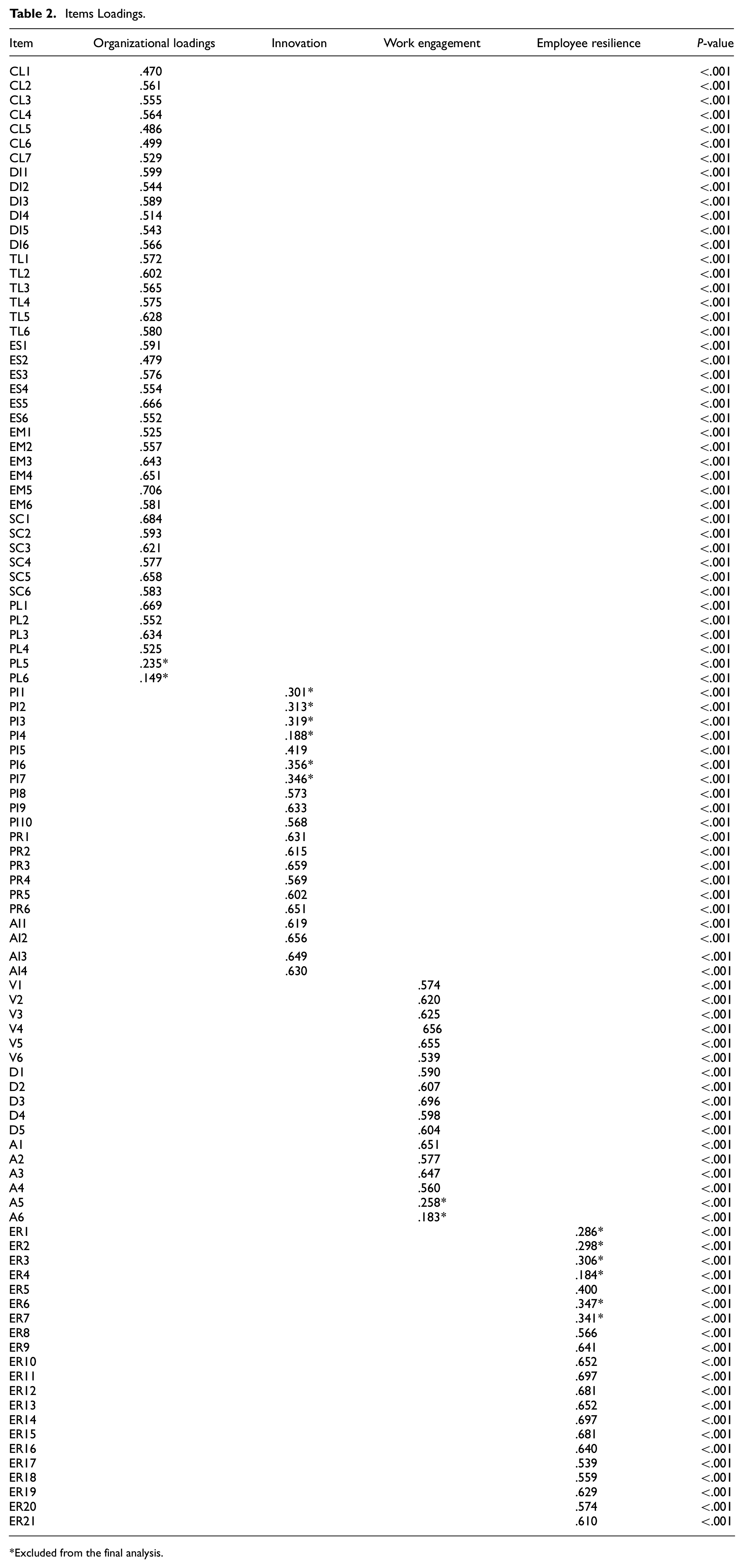
*Excluded from the final analysis.
Table 3 shows the correlation between the latent variables and the square roots of the average variance extracted (AVEs). Fornell and Larcker (1981) and Kock (2014) posited that a measurement model has sufficient discriminant validity if the square root of the AVE for each latent variable is greater than any correlation value involving the latent variable. As shown in Table 3, our study meets this requirement. Moreover, Table 3 presents the numerous latent variable coefficients, enabling analysis of reliability, collinearity, and common bias approaches, both normalcy with respect to our measurement model and predictive validity. Composite reliability (CR) and Cronbach’s alpha coefficients are considered adequate for evaluating reliability, while the full collinearity variance inflation factor (VIF) could be used to evaluate collinearity and common method bias (CMB) (Kock et al., 2019; Odugbesan et al., 2023). The Normality is assessed using Jarque-Bera and robust Jarque-Bera tests based on skewness and excess kurtosis. Predictive validity is evaluated using Q2 coefficients. The measure model is reliable if CR and Cronbach’s alpha coefficients are .7 or higher (Adetola et al., 2021; Kock, 2014; Odugbesan et al., 2023.
Correlations Among Latent Variables and Square Root of AVEs.
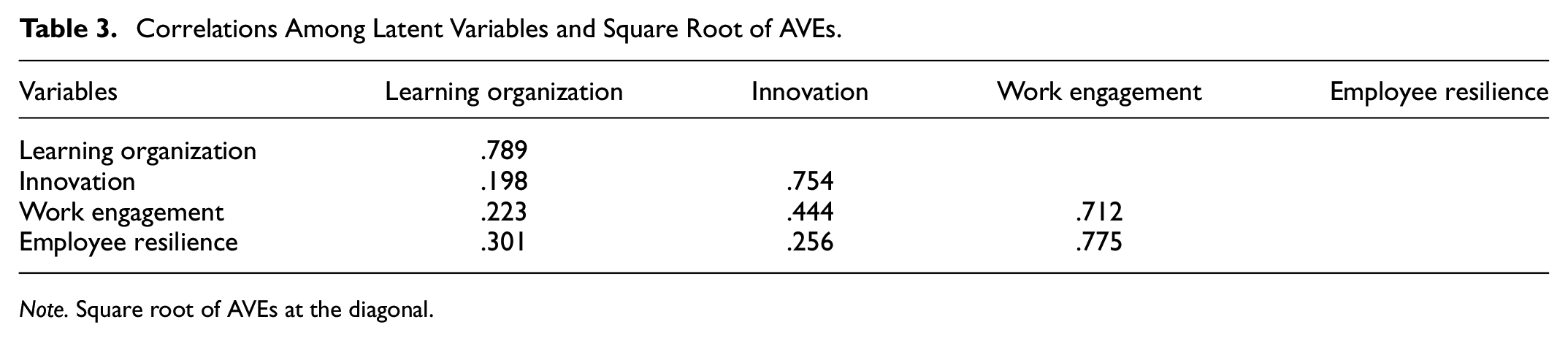
Note. Square root of AVEs at the diagonal.
All collinearity VIF coefficients are anticipated to be less than 3.3 when assessing both vertical and lateral collinearity, and addressing CMB concerns in a measurement model. Table 4 clearly demonstrates that our measurement model satisfies all requirements. Employing a methodology similar to this study, Kock (2015) demonstrated that full collinearity VIF coefficients are often sensitive to common variation among latent variables, particularly regarding CMB. Confirmatory factor analysis, which was employed in this study, enables the detection of CMB in a model even when convergent and discriminant validity criteria are met. We adopted Kock’s recommended threshold of 3.3 for full collinearity VIF coefficients (2015). Moreover, based on Kock’s (2015) recommendations, the Stone-Geisser Q2 coefficients, named after its proponents Geisser (1974) and Stone (1974), were utilized to evaluate predictive validity. These coefficients are only applicable to endogenous latent variables. Research shows that a measurement model with a Q2 coefficient below zero is considered to have acceptable predictive validity. The results presented in Table 3 indicate that the proposed model satisfies this requirement.
Latent Variable Coefficients.

Finally, Table 4 presents the skewness, excess kurtosis, and robust modification test (Gel & Gastwirth, 2008) for data normality, indicating multivariate non-normality of our data. The findings of the normalcy test used in this study support the use of PLS-SEM in our investigation.
Hypotheses Testing
Some studies have suggested that researchers can assess the fit between models and data and model-wide collinearity in PLS-based structural equation modeling studies using global model fit and quality indicators (Adetola et al., 2021; Kock & Moqbel, 2021; Odugbesan et al., 2023. The overall model fit and quality indices used in this study are presented in Table 4. The APC, ARS, and AARS indices yielded p-values of .005, indicating a satisfactory fit between the model and the data. Additionally, the AARS and AVIF values, which are both below 3.3, suggest the absence of multicollinearity at the latent variable block level and within the model. Finally, Table 4 shows an overall goodness-of-fit value of 0.311, indicating a moderate level of agreement between the model and the data.
Table 5 and Figure 2 present the path coefficients associated with the hypotheses proposed in this study, as well as their corresponding significance levels. The results depicted in Table 6 indicate the support, or lack thereof, for each hypothesis. The findings in Table 6 support H1, demonstrating that learning organizations are strongly associated with innovation (β = .194, P = .001). Similarly, H2 is supported by the finding that learning organizations are significantly related to work engagement (β = .950, P = .001). Additionally, innovation and work engagement are substantially correlated (β = .028, P = .010), supporting H3. Moreover, we observed a positive and statistically significant association between learning organizations and employee resilience (H5) (β = .832, P = .001), supporting H5. H4 and H7 proposed that employee resilience and work engagement mediate the link between learning organizations and creativity. The findings shown in Table 6 support H4 (β = .723, P = .001) and H7 (β = .065, P = .001), indicating that both employee resilience and job engagement mediate the association between learning organizations and creativity. The results demonstrate a direct and indirect connection between learning organizations and innovation.
Path Coefficients.


Hypotheses testing results.
Model Fit and Quality Indices.

Discussion
This study aimed to determine the impact of learning organizations on innovation, while exploring the mediating effects of work and employee engagement and flexibility. A random sample of employees in high, middle, and lower management was selected from 22 Jordanian banks, classified as non-Jordanian, Jordanian, Islamic, and Commercial, resulting in a total of 430 respondents. The analysis revealed that job characteristics of bank employees in the study plays a role in the effect of learning organizations on innovation.
The relationship between learning organizations and innovation was established in this study. This finding indicates that learning organizations influence innovation in Jordanian banks. The aligns with previous research demonstrating a link between learning organizations and innovation, arguing that organizational learning is a source of strategic superiority, enabling innovation in adapting to changes (Allouzi, 2018; Alsabbagh & Khalil, 2017; Šebestová & Rylková, 2011; Park et al., 2014; Purwanto, 2020; Sun et al., 2017; Tamayo-Torres et al., 2016).
Additionally, our results are consistent with well-known theoretical frameworks such as organizational learning theory. Organizations promoting a culture of continuous learning are more likely to innovate by accumulating information, adapting to changes, and exploring new ideas and methods. This finding underscores the importance of cultivating learning organization culture in the unique environment of Jordanian banks, characterized by dynamic rivalry, regulatory shifts, and evolving consumer expectations. To remain competitive, banks must quickly adjust to evolving market conditions, technological progress, and client preferences, necessitating innovation in products, services, and processes. Furthermore, activities linked to learning organizations, including ongoing training and development, sharing information, experimentation, and feedback systems, promote creativity. Prioritizing learning in the ever-evolving banking sector enables successful innovation in response to emerging financial products, services, and regulatory requirements. A learning organization culture fosters employee engagement, empowerment, and satisfaction by offering opportunities for growth, skill development, and participation in decision-making processes. Engaged and satisfied employees tend to contribute creative ideas and attempt to enhance organizational processes and services. Jordanian banks can improve their ability to withstand external shocks and uncertainties by promoting a culture of continuous learning within the organization. A mindset of continual learning enables staff to anticipate and adjust to changes efficiently, facilitating innovation in response to new challenges and possibilities.
Moreover, our study demonstrates a significant influence of learning organizations on work engagement. This finding aligns with those of Malik and Garg (2017), who found a similar relationship between learning organizations and work engagement. In Jordanian banks, there exists a direct relationship between learning organizations and work engagement, indicating that promoting a culture of ongoing learning increases employees’ enthusiasm and dedication. When employees perceive that their organization prioritizes their development and growth by offering learning opportunities, they are more inclined to be engaged in their work, leading to higher productivity and performance. Employees in learning organizations tend to experience increased satisfaction with their work environment. To enhance job satisfaction and reduce turnover, Jordanian banks can provide a supportive work environment by offering training, knowledge sharing, and skill development opportunities to their employees. Engaged personnel are more inclined to demonstrate initiative, provide creative suggestions, and collaborate effectively with peers. Learning organizations positively impact work engagement in Jordanian banks, leading to enhanced organizational performance, increased customer satisfaction, improved financial results, and a stronger competitive edge. Highly engaged individuals exhibit greater resilience when confronted with organizational changes including technological developments, legislative reforms, and adjustments in market dynamics. Adaptability is essential for Jordanian banks to operate in a dynamic and rapidly changing business environment. The discovery of the beneficial impact of learning organizations on work engagement suggests that Jordanian banks effectively foster a culture of ongoing learning and enhancement. This culture benefits both individual employees and the entire organization, fostering innovation, creativity, and adaptation across all levels. When employees are engaged, they are more inclined to synchronize their efforts with the strategic aims and objectives of the organization. Thus, the beneficial impact of learning organizations on job engagement indicates that Jordanian banks efficiently utilize their human capital to attain desired results and fulfill their mission and vision.
Additionally, this study established a positive relationship between work engagement and innovation, which corroborates with findings from previous studies (Anwar & Niode, 2017; Aryee et al., 2012; Cheng et al., 2020; Garg & Dhar, 2017; Suahsti & Sudarma, 2019). Thus, this study argues that the demonstrated innovation process is primarily related to employees’ internal motivation, which fundamentally supports innovation. Finally, the significance of the moderating role of work engagement in the relationship between learning organizations and innovation identified in this study indicates that work engagement plays a positive and stimulating role in facilitating organizational learning and innovation. This indicates that Jordanian banks can foster work engagement to drive innovation. This result aligns with those of Hussein et al. (2017), who confirmed a positive relationship between work engagement and the learning organization, and with those of Aryee et al. (2012), Cheng et al. (2020), Garg and Dhar (2017), Malik and Garg (2017), and Suahsti and Sudarma (2019), who demonstrated a positive relationship between work engagement and innovation. This indicates that learning organizations indirectly affect innovation through work engagement.
This study further demonstrates the mediating role of employee resilience in the relationship between learning organizations and innovation. Our findings reveal that employee resilience plays a positive and stimulating role in organizational learning and innovation, and has a direct relationship with the innovation process in Jordanian banks. This result aligns with those of previous studies (Hodliffe, 2014; Malik & Garg, 2020; Meneghel et al., 2016; J. Wang et al., 2014), which confirmed a positive relationship between employee resilience and learning organizations. On the other hand, Altaf and Awan (2011), Anser et al. (2022), Bardoel et al. (2014), Caniëls and Baaten (2019), King et al. (2016), Panpakdee and Limnirankul (2018), Plimmer et al. (2022), and Senbeto and Hon (2020) confirmed that employee resilience positively impacts innovation. Finally, our study indicates that employee resilience mediates the relationship between learning organizations and innovation. This finding indicates that the connection between learning organizations and innovation in Jordanian banks is not immediate, but rather influenced by employee resilience and work engagement. The benefits of promoting a culture of learning within a company for fostering creativity can be achieved through various channels such as improving employee resilience and boosting job engagement. Employee resilience enhances the translation of a learning organization’s cultural benefits into innovative outcomes. Resilient employees are more capable of handling obstacles, failures, and uncertainties that arise during the creative process. They rebound from failures, adjust to change, and persist in their quest for inventive solutions.
Work engagement is essential for driving innovation in Jordanian banks. Engaged personnel are profoundly linked to their jobs, enthusiastic about their roles, and offer their best efforts. This increased level of engagement leads to a greater readiness to participate in innovation projects, collaborate with coworkers, and aggressively pursue opportunities for enhancement. Employee resilience and job engagement play mediating roles in facilitating the translation of learning organizational practices into innovative outcomes by working synergistically. Resilient and engaged staff are more likely to utilize the knowledge, skills, and resources acquired from organizational learning to promote significant innovation in the banking sector. Recognizing the intermediary functions of employee resilience and job engagement is strategically important for Jordanian banks aiming to promote an innovative culture. Banks should implement measures to cultivate resilience and enhance job engagement among employees, in addition to conducting learning programs. This comprehensive method is crucial to harness a company’s inherent innovation capacities. This study emphasizes the need to consider employee well-being and motivational elements when promoting organizational innovation. Jordanian banks may enable employees to contribute to innovation and drive organizational success by focusing on resilience-building activities and fostering a supportive work environment that encourages employee engagement.
Conclusions
This study examined how learning organizations influence innovation in Jordanian banks by considering the mediating variables of work and employee engagement and resilience. The results show a notable correlation between learning organizations and creativity. Organizational learning promotes strategic advantages by facilitating adaptability to change and fostering innovation in response to developing market conditions and consumer expectations. Furthermore, we found a strong correlation between learning organizations and work engagement, emphasizing the significance of ongoing learning opportunities in boosting employee enthusiasm and commitment. Engaged employees are more inclined to offer creative contributions to organizational processes and services, resulting in enhanced performance and a competitive edge. Moreover, this study identified a strong connection between work engagement and innovation, highlighting the importance of internal motivation in stimulating new initiatives. This study confirmed the mediating effects of work engagement and employee resilience on the correlation between learning organizations and creativity, highlighting the significance of creating a nurturing work atmosphere and encouraging resilience-enhancing initiatives.
The study’s theoretical implications highlight how organizational learning theory can be used to enhance organizational creativity. A complete strategy is necessary to promote innovation that considers both organizational strategies and human aspects. This study provides suggestions for Jordanian banks to improve their learning, emphasize different types of innovation, and prioritize work engagement and resilience-building programs. By investing in these areas, banks can establish a culture of innovation and gain a sustained competitive edge in an ever-changing business landscape. Finally, this study enhances the understanding of how organizational learning, work engagement, and resilience impact innovation in Jordanian banks, offering useful insights for scholars and practitioners in organizational development and innovation management.
Study Implications
Although many studies have examined learning organizations as an antecedent of innovation, our study is the first to simultaneously examine the mediating roles of employee resilience and job engagement in the relationship between learning organizations and innovation. Our study provides a fresh perspective on how employee resilience and job engagement influence innovation in Jordanian banks. In contrast to previous studies, our study was conducted in Jordan to better comprehend the topic and amass substantial, empirically based knowledge. While previous research on learning organizations and creativity has yielded notable results, none has examined the relationship between work engagement and employee resilience. Our study aimed to fill this knowledge gap by providing empirical evidence that supports employee resilience and work engagement as antecedents of creativity.
Theoretical Implications
Our results enhance the understanding of organizational learning theory by demonstrating its practical implications for promoting creativity within organizations. Establishing a strong causal link between learning organizations and innovation is essential for fostering a culture that encourages continuous learning and information exchange. This study also enhances the theoretical understanding of how individual factors impact the relationship between organizational learning and innovation by emphasizing the mediating roles of employee resilience and work engagement. This integration highlights the importance of employee well-being and psychological aspects in influencing innovative results in an organizational setting.
Our study highlights that employee resilience and work engagement play crucial roles in the relationship between individual characteristics and organizational processes, thereby influencing innovation. This finding emphasizes the necessity for a comprehensive approach that considers both organizational strategies and human traits to promote innovation within firms. The study also confirms that employee resilience and work engagement are crucial variables for fostering creativity within businesses. It highlights the importance of implementing measures to improve employee well-being and engagement by demonstrating their significant influence on innovation and their role in facilitating the connection between organizational learning and innovation.
This study’s theoretical implications offer useful insights for practitioners and scholars aiming to promote innovation within their firms. Organizations may build an innovative environment by understanding the connection between organizational learning, employee resilience, work engagement, and creativity and implementing specific interventions and tactics.
Practical Implications
This study offers valuable recommendations for practitioners to establish policies that promote employee resilience and work engagement in Jordanian banks. Jordanian banks can reevaluate and enhance their degree of organizational learning by prioritizing continuous learning, dialogue, and inquiry, team learning, embedded systems, empowerment, and system connections. Furthermore, they should focus on product, incremental product, process, incremental process, and administrative innovation to increase their degree of innovation. By emphasizing vigor, dedication, and absorption, the level of work engagement in Jordanian banks can be enhanced. To ensure that employees contribute consistently to businesses’ innovative capability and achieve sustainable competitive advantage, it is crucial to prioritize employees’ capacity for resilience.
Study Limitations and Recommendations for Future Research
Although our study contributes significantly to the literature, it has some limitations. A major limitation of our study is its inability to generalize the findings because our sample comprised Jordanian banks (commercial, Islamic, local, and international). Thus, future studies should replicate this model in other sectors to confirm the validity of the findings. Moreover, a potential limitation may arise from the objectivity of the responses, given that the questionnaire was distributed electronically. This method makes it impossible to verify whether the respondents accurately represent the target sample. This limitation can be addressed in a future study by distributing hard copies of the questionnaire to the target respondents.
Footnotes
Declaration of Conflicting Interests
The author(s) declared no potential conflicts of interest with respect to the research, authorship, and/or publication of this article.
Funding
The author(s) received no financial support for the research, authorship, and/or publication of this article.

Data Availability Statement
The data supporting this study's findings are available upon request from the corresponding author, Sami Mohammad, upon reasonable request.