




Abstract
The main purpose of this research is to examine the role of psychological resources in predicting the engagement of night shift employees. Specifically, it tests how resources like supportive organizational climate, family support, and self-efficacy could help employees stay engaged during night shift work. Additionally, this study explores the mediating role of positive affect and ego-resilience. The cross-sectional data collected from night shift employees (n = 208) working full-time in Canada, the UK, and the US were collected over a period of 3 months. Results of the statistical analysis confirm the significant direct role of self-efficacy and supportive organizational climate in predicting employee engagement. Furthermore, the indirect role of such resources through the mediation of positive affect and ego-resilience was also found. The impact of family support on employee engagement appears significant only through mediators. The current study extends the existing understanding about the role of psychological resources in determining the engagement of night shift employees. It further adds to the literature by explaining mechanisms using positive affect and ego-resilience as mediators.
Keywords
Introduction
Night work cannot be denied as a social and economic reality. Taking, for example, the European Community, about 13.2% of the total employees work in the night shift during the year 2018 (Szkiela et al., 2020). Previously in most of the industrialized countries, employees were working in night shifts only for some essential services such as healthcare, public safety, transportation, etc. (Costa, 2008; Garbarino, 2006). But in recent decades due to increased demand relating to the economic market, the organizations are more focused on re-organizing labor and thus such employment isn’t limited to any specific sector but covers almost every work area like manufacturing, construction, food service, etc. (Arcangeli et al., 2018; Golden, 2015; Khan et al., 2018; Martins et al., 2021).
But re-organization of work in continuous cycles has significant social and economic repercussions in terms of individuals, organizations, and community (Perez et al., 2019). Especially in the organizational context, night shift work has been linked to various negative outcomes such as workplace accidents and errors (Åkerstedt et al., 2002; Gold et al., 1992), reduced operational performance (Waggoner et al., 2012), turnover intentions (Lee et al., 2015), and absenteeism (Costa et al., 1990; Shen & Dicker, 2008). Additionally, previous research on occupational health also highlights the disruptive role of such shifts on employee health as well as social well-being (Price, 2011; Vicente-Herrero et al., 2016). Having all these issues still, the night shift remains highly necessary and in a managerial perspective it remains challenging to motivate employees to perform well during such symptomatically labeled “graveyard shift.”
The current study tests motivational underpinnings that help individuals in staying engaged when working at night. Commonly, the positive role of extrinsic factors remains the focus of interest as a significant predictor of employee acceptance. Such factors may include additional pay, flexible breaks, or additional rest days. However, relatively less attention has been devoted to intrinsic factors that can motivate employees and are necessary for higher individual commitment. Even some previous evidence suggests the good side of the night shift and confirms that an individual may enjoy working in it (King, 2010). Thus, based on the Conservation of Resources (COR) perspective (Hobfoll, 1989, 2001) and Job Demands-Resources (JDR) theory (Bakker & Demerouti, 2014) the current study suggests how psychological resources could help the individual to stay engaged during the night work.
Although a vast body of research has tested the positive role of psychological resources on different samples like academicians (Alzyoud et al., 2014), entrepreneurs (Laguna et al., 2017), and nursing practitioners (D’Emiljo & Du Preez, 2017), etc. But the impact of such resources in elevating individual’s engagement during extraordinary stressful conditions like night shift remains unexplored. It justifies the importance of exploring such a mechanism that links psychological resources to employees’ engagement in a different environment.
The current study specifically tests the direct role of three key psychological resources, that is, supportive organizational climate, self-efficacy, family support in predicting engagement of night shift employees. Additionally, it analyzes the mediating role of ego-resilience and positive affect among these relationships. This paper, first, build the argument about hypothesized relationships based on existing literature by linking it with Conservation of Resources theory (Hobfoll, 1989) and Job Demands-Resources (JDR) theory. Then it provides details about the methodology in terms of research design, data collection procedure, participants, and study measures. Afterward, it presents the findings specifically related to descriptive and model fit, etc. Finally, it concludes by providing a detailed discussion on the contribution of this study and relevant recommendations.
This study makes three main contributions to the existing research. Firstly, the current study makes a theoretical contribution by exploring the impact of various psychological resources on the engagement of night shift employees which has been rarely explored in the existing literature. Secondly, based on the conservation of resources perspective (Hobfoll, 1989) and Job Demands-Resources (JDR) theory, this study contributes in terms of exploring the process through which such resources have an impact on employee engagement by testing parallel mediation of ego-resilience and positive affect. Finally, in terms of methodology, this study tests the hypothesized relationship by taking a sample of night shift employees from three different countries.
Theory
In this section, first, definitions of all study constructs have been provided and then the study hypotheses have been developed based on the existing literature.
Construct Definitions
There are six main constructs in the current study, that is, supportive organizational climate, self-efficacy, family support, ego-resilience, positive affect, and employee engagement. Supportive organizational climate is defined as “Individuals’ perceptions on the quality of communication and social support in their work environment.” It remains individual level construct in the current study based on previous research (Mäkikangas et al., 2007, 2016). Self-efficacy is defined as “An individual’s belief in his or her capacity to execute behaviors necessary to produce specific performance attainments” (Bandura, 1977, 1986). In this study family support remains a part of social support which is defined as “Social interactions or relationships that provide individuals with actual assistance or with a feeling of attachment to a person or group that is perceived as a caring or loving” (Hobfoll & Stokes, 1988, p. 499). Ego resilience is defined broadly as “The personality’s capacity to adapt to uncertainty” (Block, 2002). Affect is the experience of consciously accessible feelings (Fredrickson, 1998). Specifically, Positive affect refers to a dimension in which high levels are characterized by “high energy, full concentration, and pleasurable engagement, whereas low positive affect is characterized by sadness and lethargy” (Watson et al., 1988). Employee engagement is comprised of three dimensions, that is, intellectual, affective, and social engagement. Intellectual engagement is as “the extent to which one is intellectually absorbed in work,” affective engagement is defined as “the extent to which one experiences a state of positive affect relating to one’s work role,” and social engagement is defined as “the extent to which one is socially connected with the working environment and shares common values with colleagues” (Soane et al., 2012).
Hypotheses Development
Supportive organizational climate and employee engagement
Supportive organizational climate is the level of support an individual gets from his/her peers, departments, and supervisor to successfully perform work duties (Luthans et al., 2008). Because of numerous benefits it has remained focus of interest in vast previous research. Specifically, it has been studied and found significantly related with various work outcomes such as job satisfaction (Schyns et al., 2009), work performance (Lee et al., 2016; Luthans et al., 2008), and employee commitment (Rhoades et al., 2001) etc. In addition to that, it has significant role in predicting employee’s well-being (Feldt et al., 2000; Hayat & Afshari, 2020).
By taking Job Demands-Resources (JDR) perspective, the current study proposes the resource based view of supportive organizational climate. Specifically, it suggests that supportive organizational climate may act as a job resource, that is, physical, social, or organizational aspects of the job that may be functional in achieving work goals” (Bakker & Demerouti, 2008). As job resources can bring a feeling that an individual is capable of dealing with stress situations (Hobfoll & Freedy, 1993) so supportive organizational climate can play a significant role during night shift work. This goes along with the COR perspective as well (Hobfoll, 1989, 2001) that by having access to sufficient resources individuals remain less vulnerable to stressful conditions. Various such job resources (e.g., opportunities to learn, job autonomy, and performance feedback) have been suggested linked with employee engagement (Freeney & Tiernan, 2009; Schaufeli et al., 2009). As previous research widely accepts that individuals who feel comfortable at their workplace and perceive their colleagues as supportive show more involvement and commitment so this study proposes that such benefits may also exist in terms of engaging employees during night shift.
Additionally, previous research has also confirmed the role of supportive organizational climate in predicting accumulation of various other psychological resources. Specifically, research showed that availability of supportive organizational environment can enhance individual’s ability to be resilient and effectively handle stressful situations (Ferreira et al., 2018; Hayat & Afshari, 2020). This supports the previous research suggesting that an individual can acquire ego-resilience through environmental conditions such as supervisory support (Hobfoll et al., 2015). Additionally, individuals with higher level of ego-resilience remain more engaged comparing their counterparts (Gawke et al., 2017). So ego-resilient employees having supportive organizations might be in a better position to handle stressful night shift and stay engaged.
Similarly, in addition to resilience, such climate can also bring positive feelings and makes individual more optimistic and hopeful. This accumulated reservoir of resources in turn relates to work outcomes (Luthans et al., 2008). Specifically, organizational support has been confirmed as a predictor of employee’s positive affect (Bashshur et al., 2011). And previous research has also found significant role of positive affect in predicting employee engagement (Wang et al., 2017; Yan et al., 2021). So the current study suggests that supportive organizational climate predicts ego-resilience and positive affect which in turn enhances engagement of night shift employees.
Accordingly it hypothesizes that:
Self-efficacy and employee engagement
Self-efficacy, that is, one’s own ability to achieve or perform any task, has always been considered key personal resource in various settings. Specifically, previous research have confirmed the significant role of self-efficacy in academia (Hatlevik et al., 2018). Some studies have explored the impact of self-efficacy resource on entrepreneurs’ dynamic capabilities (Kevill et al., 2017) and other with coping behavior of military personnel (Delahaij & Van Dam, 2017). In addition to this, beneficial role of self-efficacy on work outcomes also remains widely accepted (Bhatti et al., 2018; Contreras et al., 2020)). Specifically, a meta-analysis (Halbesleben, 2010) confirms the positive role of self-efficacy in predicting employee engagement, that is, “positive, fulfilling, work-related state of mind that is characterized by vigor, dedication and absorption” (Schaufeli et al., 2002, p. 74). This evidence goes along the basic principle of Conservation of Resources theory (Hobfoll, 1989) that individuals with greater resources are better able to invest them and deal with stressful situations. Additionally, it validates the Job Demands-Resources (JDR) perspective that personal resources can help individuals to deal with demanding work environments. Individuals with sufficient resources to deal with challenges can achieve organizational goals which elevates their level of engagement (Bakker et al., 2014).
Self-efficacy can enhance individual’s ego-resilience, that is, a coping resource enables one to deal with situational demands (Gillespie et al., 2007) that helps employees in dealing with stressful situations. People with high resiliency are better able to persist in making efforts (Letzring et al., 2005). Several other studies explored role of resilience like Malik and Garg (2017) showed that the impact of learning organization on employee engagement is mediated by ego-resilience. Similarly, mediation of resilience has been proved significant between growth mindset and psychological well-being of students (Zeng et al., 2016). Numerous other studies confirmed the relationship between resilience and engagement (Cooke et al., 2019; Oliveira & Ferreira, 2016). Thus the current study suggests that individuals with high self-efficacy beliefs are more resilient and in turn remain more engaged during night shifts.
Not only ego-resilience but self-efficacy has also been found predicting positive emotions those are helpful in staying engaged during adverse circumstances (Laguna et al., 2017). Positive emotions have been studied and found related with various outcomes such as entrepreneurial performance (Fodor & Pintea, 2017), job satisfaction, and organizational citizenship behavior (Mostafa, 2017). At individual as well as group level, positive affect proved to be significant predictor of task performance (Knight & Eisenkraft, 2015). It is also evident that positive affect is linked to employee engagement (Van Wijhe et al., 2011). So positive affect has clear distant linkage with employee engagement by enabling one to persist during action (Seo et al., 2004). Accordingly, the current study assumes that self-efficacy beliefs increases positive affect of night shift employees which in turn predicts higher level of engagement.
Previous literature have overlooked role of self-efficacy in engagement of night shift employees. As working in third shift has an impact on one’s routine life that’s connected with its surroundings so personal resources can be crucial in dealing with such situations. Specifically, this study postulates that engagement of night shift employees is contingent upon the state of an individual’s resources. This leads to the following hypotheses:
Family support and employee engagement
Family support in emotional as well as material terms has been found beneficial in various domains. For example, family caregivers can help in coping of cancer patients (Litzelman et al., 2017). Similarly, family financial support has a significant positive relationship with entrepreneurial self-efficacy (Sieger & Minola, 2017). It has also been studied in the context of prisoners and proved to be significantly important in elevating emotional health of their families (Woodall & Kinsella, 2017). Specifically, in work context it has been tested with firm’s performance (Neneh, 2017) and job satisfaction of employees (Kwok et al., 2015). Apart from this, the existing literature also confirms family support as a valuable social resource that predicts employee engagement (Karatepe, 2015). Family support is a key dimension of social support, that is, “Social interactions or relationships that provide individuals with actual assistance or with a feeling of attachment to a person or group that is perceived as a caring or loving” (Hobfoll & Stokes, 1988, p. 499) and has been widely analyzed in various occupational psychology studies. Such social resources are evident of helping individuals to cope with stressful conditions (Kurtessis et al., 2017).
In line with resource caravans notion of Conservation of Resources theory (Hobfoll 1989, 2001) personal resources are considered as outcome of social conditions. Social conditions brings resiliency to the people striving in stressful conditions (Hobfoll & Freedy, 1993). Specifically, previous research confirms family support as a predictor of resilience which enables an individual to deal with stressful conditions (Howard et al., 1999). So this study suggests that family support enhances ego-resilience of night shift employees which in turn make them more engaged. Additionally, family support has direct relationship with positive emotions (Rathunde, 2001) and individuals having such emotions may remain more engaged during night shift.
Previous research lacks in terms of evidence confirming how family support plays a certain role in engagement of night shift employees, since a decision to work nightshifts presupposes previous arrangements with spouses and children over functional work-time schedules. So this leads to the following:
Methodology
Data Collection Procedure
Random sampling was used to select participants for this cross-sectional study. Due to limited resources and access to night shift employees in three countries, a cross-sectional study design was selected to collect data for hypothesized relationships. Employees residing in three countries, that is, Canada, the UK, and the US, and working in various industries like telecommunication, manufacturing, logistics, etc. were invited to participate in the study through LinkedIn professional network. Specifically, employees working on night shift were allowed to participate in the study. After taking initial consent from participants, the online questionnaire was shared through the SurveyMonkey link that remained available for 3 months. Participation in this study was voluntary and no financial reward was offered to respondents. Feedback was provided only to those respondents who initially requested study results.
Study Participants
Initially, 1,286 employees working in the night shift were allowed to participate in the study, and 242 completed the online questionnaire with a response rate of 18.81%. The final sample was 208 as 20 respondents were no more working in night shift, while an additional 14 ceased residing in the three target countries. The final sample N = 208 was comprised of 144 (69.2%), 41 (19.7%), and 23 (11.1%) respondents from US, UK, and Canada, respectively. The majority of the study participants were male, that is, 151 (72.6%) compared with females, that is, 57 (27.4%). Most of the study respondents, that is, 145 (69.7%) were under the age of 40 years. Statistics in terms of marital status were 122 (58.7%) single, 66 (31.7%) married, 19 (9.1%) divorcee, and 1 (0.5%) widowed.
Measures
A 41 items survey instrument was adopted to gather participants’ responses. It comprised six different scales, including supportive organizational climate (4 items), family support (4 items), self-efficacy (10 items), ego resilience (4 items), positive affect (6 items), and employee engagement (9 items). Additional control variables included are age, gender, marital status, and one item related to current working shift status.
Supportive organizational climate
To measure supportive organizational climate, four items were adopted from the previous research on work characteristics (Lehto, 1991; see also Feldt et al., 2004; Mäkikangas et al., 2007). Sample items include “Our workplace is dominated by an atmosphere of openness and solidarity,” and “In difficult tasks I can call on the assistance of my co-workers.” This construct was measured on a 5-point Likert scale (1 = Strongly Disagree; 5 = Strongly Agree), where higher values indicate a supportive climate at the workplace.
Family support
Four items measured family support from the Multidimensional Scale of Perceived Social Support (Zimet et al., 1988). Sample items include “My family really tries to help me” and “I get the emotional help and support I need from my family.” Scale items were measured on a 5-point Likert scale (1 = Strongly Disagree; 5 = Strongly Agree). Additionally, a note was included in the questionnaire “Family can be spouse, parents, siblings, etc.) to clarify the family meaning, especially for those who are single.
Self-efficacy
Self-efficacy was measured by adopting the Generalized Self-Efficacy Scale (Schwarzer & Jerusalem, 1995). The scale consists of 10 items such as “I can always manage to solve difficult problems if I try hard enough” and “I am confident that I could deal efficiently with unexpected events.”
To fit the scale length with others in the survey, it was amplified to a 5-point Likert scale (1 = Strongly Disagree; 5 = Strongly Agree) from the original four.
Ego-resilience
Ego resilience was evaluated using the four items Brief Resilient Coping Scale (Sinclair & Wallston, 2004). Sample items include “I look for creative ways to alter difficult situations” and “Regardless of what happens to me, I believe I can control my reaction to it.” This scale was measured on a 5-point Likert scale (1 = Not at all; 5 = Very well).
Positive affect
Positive affect was evaluated using the six markers of high positive affect from the Job Affect Scale (Brief et al.’s, 1988). Respondents were asked how they felt about each marker, that is, active, strong, excited, enthusiastic, peppy, and elated, in the past week. A 5-point Likert scale (1 = Not at all; 5 = Very much) was used to measure positive affect.
Employee engagement
The ISA Engagement Scale (Soane et al., 2012) was used to evaluate employee engagement. This scale comprises nine engagement items that measure three different dimensions, including intellectual engagement, social engagement, and affective engagement. Each dimension comprises three items. Sample items include “I focus hard on my work” (Intellectual engagement), “I share the same work values as my colleagues” (Social engagement), and “I feel positive about my work” (Affective engagement). A 5-point Likert scale was used to measure the employee engagement items.
Demographics
Age, marital status, and gender were included in this study. Age was coded as 1 = 20 to 25 years, 2 = 26 to 30 years, 3 = 30 to 35 years, 4 = 36 to 40 years, 5 = 41 to 45 years, 6 = 46 to 50 years, and 7 = 51 and above. Gender was coded as 0 = male and 1 = female. Marital status was measured as 1 = single, 2 = married, 3 = divorcee, and 4 = widowed.
Results
Data Screening Procedure
As missing values in data may bring misleading results so data collection for this study was designed by keeping responses for each survey question mandatory. The unattempted questions were reminded to the respondents by the survey tool. This way data was having no missing values. Additionally, outliers may cause harm to study results (Hair et al., 2010) so data were screened for any potential outlier but none of the outliers were found. Furthermore, during data screening, normal distribution was checked by conducting a normality test. The results for study variables ranged between acceptable range, that is, −1.96 and +1.96 for skewness and kurtosis thus validating the normal distribution of the study data.
Descriptive Statistics
To analyze data and explain results with meaningful information descriptive inferential statistics were used. Table 1 presents the means, standard deviations, correlations, and Cronbach’s alpha values for the study variables, that is, Gender, marital status, age, supportive organizational climate, family support, self-efficacy, ego-resilience, positive affect, and employee engagement. According to the results, self-efficacy was having the highest scale value with 4.25 while on the other end gender with 1.27 mean showed the lowest scale value.
Scale of Study Constructs Along With Alpha Reliabilities.

Descriptive statistics (Table 1) show significant correlations between employee engagement and all explanatory variables, with especially high values between employee engagement and self-efficacy (.43**), ego-resilience (.50**), supportive organizational climate (.57**), and positive affect (.69**). A very strong inter-correlation was noted between self-efficacy and ego resilience (.50**) as well as between supportive organizational climate and positive affect (.44**).
Common Method Bias
To check for any possible common method bias (CMB) in the study data, Harman’s single-factor analysis was conducted. The findings showed that the variance explained by the single factor was 29.41% that is less than the cutoff suggested by Harrison et al. (1996). This evidence confirmed that study data may not have a common method bias issue (Table 2).
Descriptive Statistics.
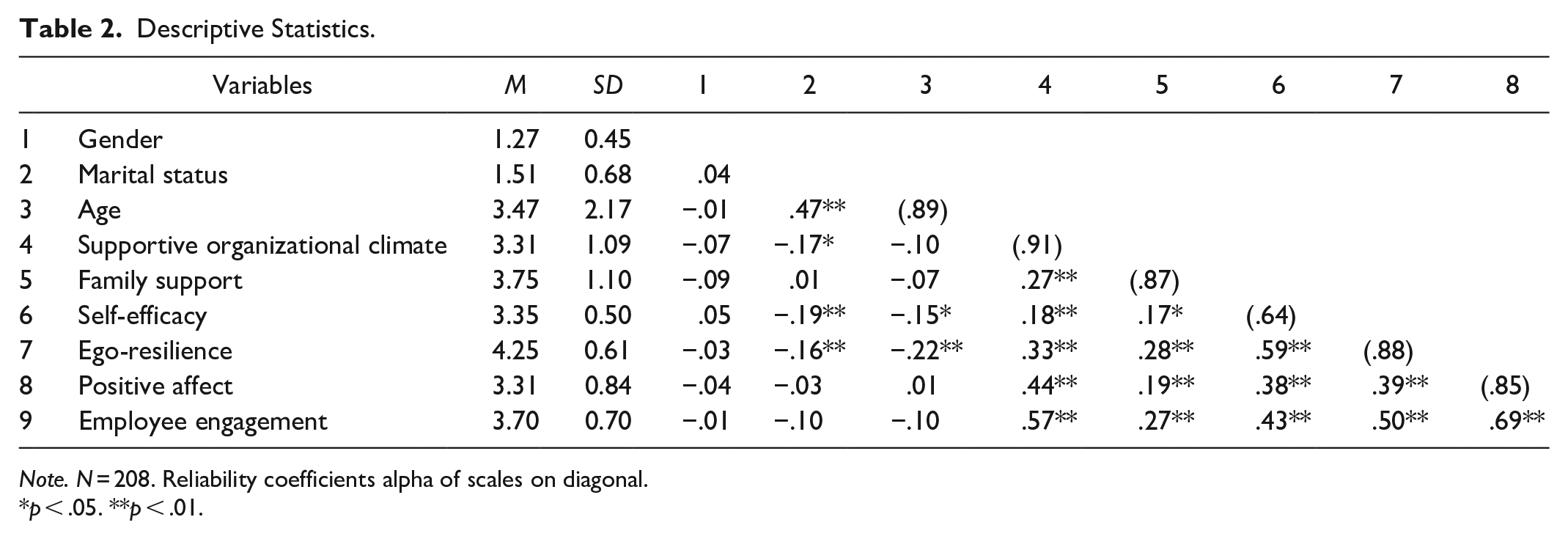
Note. N = 208. Reliability coefficients alpha of scales on diagonal.
p < .05. **p < .01.
Parallel Mediation Model
Parallel mediation model was tested and path analysis results confirmed a good model fit (χ2 = 3.07, p < .08, CFI = 0.99, TLI = 0.93, RMSEA = 0.10, SRMR = 0.01). The results showed a differential relationships between resources, that is, supportive organizational climate, self-efficacy, family support, and employee engagement directly and also through the mediation of ego-resilience as well as positive affect. Supportive organizational climate proved to have direct positive relationship with employee engagement (β = .18, SE = 0.03, p < .001) while self-efficacy and family support showed non-significant relationship with employee engagement (β = .14, SE = 0.07, p = .06) and (β = .02, SE = 0.03, p = .37), respectively. According to standardized indirect effects results supportive organizational climate and self-efficacy both were significantly related to employee engagement (SIE = 0.13, SE = 0.02, p < .001) and (SIE = 0.31, SE = 0.06, p < .001), respectively, while on the other hand family support showed insignificant indirect relationship (SIE = 0.02, SE = 0.01, p = .20).
Figure 1 shows that path coefficients validate partially the various hypotheses. On one hand, the direct and positive relationship between supportive organizational climate and employee engagement is validated (H1a). On another hand, results show insignificant direct relationships between self-efficacy and family support with employee engagement, thus invalidating Hypotheses H2a and H3a. While path analysis indirect effect results showed a significant relationship between supportive organizational climate and employee engagement through the mediation of ego-resilience and positive affect thus validating (H1b and H1c) and also between self-efficacy and employee engagement (H2b and H2c). But the indirect relationship between family support and employee engagement through the mediation of ego-resilience as well as positive affect appeared to be insignificant thus invalidating the hypotheses H3b and H3c.

Resource based parallel mediation model.
Concerning the mediating role of ego-resilience and positive affect, Preacher and Hayes’s (2008) recommendations were followed. Bias-corrected confidence intervals after bootstrapping 95% were calculated. Table 3 shows bootstrapped results for the supportive organizational climate, family support, and self-efficacy with employee engagement mediated by ego-resilience while Tables 4 and 5 shows bootstrapped results for the supportive organizational climate, family support, and self-efficacy with employee engagement mediated by positive affect. In line with the structural model, mediation results showed a significant indirect relationship of supportive organizational climate and self-efficacy with employee engagement through ego-resilience (B = 0.12, boot SE = 0.03, BC-CI [0.06, 0.19]) and (B = 0.19, boot SE = 0.05, BC-CI [0.10, 0.30]), respectively. And also supportive organizational climate and self-efficacy is related to employee engagement through mediation of positive affect (B = 0.29, boot SE = 0.04, BC-CI [0.22, 0.38]) and (B = 0.25, boot SE = 0.04, BC-CI [0.17, 0.33]), respectively. Bootstrapped mediation also showed a significant indirect relationship between family support and employee engagement through ego-resilience (B = 0.12, boot SE = 0.03, BC-CI [0.06, 0.21]) as well as through positive affect (B = 0.13, boot SE = 0.06, BC-CI [0.02, 0.25]).
Path Analysis Results.

p < .001.
Process Indirect Effects With Ego-Resilience Mediation.

Process Indirect Effects With Positive Affect Mediation.

Discussion
The present research aimed to explore the role of motivational resources, including supportive organizational climate, self-efficacy, family support, ego-resilience, and positive affect on employee engagement among night workers. Building from COR (Hobfoll, 1989, 2001) and JDR (Bakker & Demerouti, 2014) theoretical frameworks, an alternative path has been tested, suggesting that night work may also be considered positively by workers. Specifically, this study proposed a resource-based model where employee engagement, defined by a state of cognitive and affective commitment to the job, is impacted by psychological resources. The findings of this study partially supported the hypothesized relationships.
Theoretical Contributions
Results of this study validate the COR and JDR based approach, as all motivational resources impacted significantly, and positively on the engagement outcome. Yet, findings also show interesting patterns that contribute to theory enrichment. Firstly, the mechanism of resources is complex. The present research thus validates a mediation model that emphasizes a differential role of resources concerning the outcome. Concretely, the results show that ego-resilience and positive affect facilitate employee engagement. In other words, such motivating factors as self-efficacy, family support, and supportive organizational support, need the psychological pool of resources to develop and effectively contribute to a state of employee engagement. This important finding adds to previous literature on the necessity to consider differentially the role of resources, as their intrinsic motivational nature should be considered contextually (Hobfoll, 1988; Hobfoll & Walfisch, 1984; Morelli & Cunningham, 2012; Ten Brummelhuis & Bakker, 2012). In the current case, a supportive organizational climate takes the value of a resource passageway due to the specifics of the perceived supportive attitude of fellow night workers. Social bonds among night owls have indeed been found to foster sub-organizational culture, distinct from “regular” daytime work (Powell, 2013).
Secondly, the results highlight the relevance of specific resources that can make night work relatively appealing, or at least functional. For instance, and consistent with the literature, this study suggests that night work relates to a greater sense of autonomy, a perceived latitude from hierarchy, and organizational constraints that relates positively to the development of self-efficacy (Hauck et al., 2010; Stroben et al., 2016). Similarly, results suggest that ego-resilience acts as a necessary factor for night employee engagement. Ego resiliency corresponds to an individual’s ability to adapt to continuous, often hardly predictable, environmental changes (Farkas & Orosz, 2015). This study thus suggests that, at night, greater work latitude from relaxed supervisory control liberates greater psychological flexibility to face challenging situational demands that condition feelings of employee engagement. Finally, the results confirm previous findings of the role of family support on the quality of work performance and commitment (Wayne et al., 2013). It relates to the Conservation of Resources perspective suggesting family support as a beneficial psychological resource to deal with stressful situations (Hobfoll & Spielberger, 1992). Working at night stands as potentially disruptive for social life. As for the impact of other types of nonstandard work schedules (Davis et al., 2008), the present research suggests that employee engagement of nocturnists is conditioned by previously negotiated arrangements with spouses, children, and other family members.
Implications for Practice
The findings of this study have many important implications for practice. Firstly, it’s evident that a supportive organizational climate has a significant impact on the engagement of night shift employees so managers should be creating such a climate at work. This may help employees to deal with stress experienced during the night shift. Employees may develop positive relationships at work in such a supportive climate and this may predict better psychological health as well as work performance (Hayat & Afshari, 2020; Luthans et al., 2008). Secondly, organizations should be providing training and necessary support to elevate an individual’s self-efficacy level. It has been widely validated as a crucial resource in predicting work outcomes (Judge et al., 2007; Klassen & Chiu, 2010) and especially based on findings of this study in making employees more engaged during night shifts. Finally, the results confirmed that family support remains crucial in determining employees’ engagement at work so managers should be avoiding frequent re-scheduling of work shifts so that employees can maintain a specific pattern of personal life. Additionally, employees must be involved when decisions are made regarding their night shift allocation so that individuals having more family support or flexible arrangements can opt for such shifts.
Limitations
The first limitation of the present study is its cross-sectional design. Causal relationships could not be asserted, which would have informed about dynamics of resource development and interactions. Yet, patterns of resource dynamics are deemed essential to further test COR theory (Halbesleben et al., 2014). A second issue concerns the sample. It has been collected in three different national environments, including the US, the UK, and Canada. A larger sample would allow differentiating potential cultural differences concerning the value and the impact of conditioning resources. Additionally, the relatively modest sample size also limits the current findings. More participants would have allowed further testing of hypothetical differences between occupations of diverse contents and contexts, from nurses to law enforcement professionals, hotel and food-service employees, and transport workers.
Finally, a further empirical investigation could distinguish between permanent and shift night workers. It’s proposed that more volunteers can be found among permanent night workers which, in turn, may impact the motivation process, different from those toiling under an assigned schedule.
Conclusion
This research explores the role of conditioning motivational resources in the context of night work. Unlike many other studies, it considers the night context as focal. Results validate a COR and JDR based perspective of the issue, while it highlights a differential impact of selected resources, including supportive organizational climate, self-efficacy, family support, ego resiliency, and positive affect on employee engagement.
Footnotes
Declaration of Conflicting Interests
The author(s) declared no potential conflicts of interest with respect to the research, authorship, and/or publication of this article.
Funding
The author(s) received no financial support for the research, authorship, and/or publication of this article.
