




Abstract
This paper explores whether green mindfulness is the motivation behind green innovation and whether this relationship is moderated by green transformational leadership. The paper also investigates the indirect influence of green mindfulness on environmental performance through the mediating mechanism of green innovation. The above goals are necessary to find solutions that meet environmental goals, especially in emerging countries such as Vietnam. Data was collected from an online survey of 278 managers in manufacturing firms in Vietnam and analyzed using SmartPLS software with the partial least squares structural equation modeling (PLS-SEM). The results showed that green mindfulness directly affects green innovation, which in turn, contributes positively to environmental performance. Green mindfulness also increases environmental performance through the mediating role of green innovation. Moreover, green transformational leadership moderates the effects of green mindfulness on green innovation. These results contribute to the ability to achieve environmental goals in manufacturing firms. The study shows the role of green mindfulness and green transformational leadership in promoting green innovation and environmental performance in manufacturing firms in emerging market contexts.
Keywords
Introduction
Under the harmful effects of environmental pollution, businesses are required to implement policies and solutions for environmental protection (Kong et al., 2020). This responsibility is more related to manufacturing firms. Manufacturing firms are considered the leading cause of environmental pollution (Chaudhuri & Mukhopadhyay, 2006; Levinson, 2009), such as water and air pollution. Indeed, water is an indispensable input in the production process of manufacturing firms (e.g., water involved in washing, cleaning, manufacturing, and machine operation) (Qi et al., 2021). What will the natural environment be like if manufacturing firms are not equipped with wastewater treatment systems? Besides, manufacturing firms are also the main contributors to air pollution (e.g., emissions from factories, coal, and fuel transport vehicles) (Hua et al., 2022). It is confirmed that the concentration of manufacturing firms is related to the level of air pollution in that area (Qian et al., 2021). From this situation, manufacturing firms are required to innovate production toward the environment through specific duties such as reducing waste, water, and coal consumption, increasing the use of recycled materials, and designing environmentally friendly products (Singh et al., 2020).
In bringing a clear insight into the impact of manufacturing firms on the natural environment, recent studies have focused on green innovation as an effective solution to achieving environmental goals in manufacturing firms (Rehman et al., 2021; Singh et al., 2020). Green innovation is a specific expression of pro-environmental behaviors, which derives mainly from the mindfulness of members within the organization (Panno et al., 2018). Indeed, only members within the organization understand the impact of production activities on the environment. With more attention to the green environment, these members can generate positive thinking/creativity and introduce innovative production behaviors toward environmental protection (Kalyar et al., 2021).
This study considers green mindfulness as the core and causal motivation for green innovation and this is because green mindfulness refers to a state of conscious awareness of protecting the environment (Chen et al., 2015). Furthermore, green creativity and green thinking have been shown to have contributed to green innovation (Begum et al., 2022; Song & Yu, 2018). Meanwhile, as the main motivation for green creativity and green thinking (Chen et al., 2015), the role of green mindfulness in green innovation practices is unexplored. In the context of Vietnam, a country heavily affected by climate change (e.g., drought, flood, sea level rise) (McKinley et al., 2021), the study submits that each person or each MF is aware of the harmful effects of climate change, which is mainly caused by environmental pollution. Therefore, it argues that green mindfulness may have been instilled in the awareness of manufacturing firms, and this is the impetus for them to come up with solutions, such as green innovation, to minimize the negative impact on the environment. By virtue of their roles, leaders in manufacturing firms have the main responsibility of protecting the environment (Mittal & Dhar, 2016). This study supports J. Zhang et al.’s (2020) argument that if leaders directed more of their vision to the environment, their followers would also change their mindfulness toward a green environment, thereby increasing the pro-environmental behaviors in organizations. Thus, it can be said that green transformational leadership (GTL) is the motivation that increases the impact of green mindfulness on green innovation in manufacturing firms.
Drawing from the aforementioned arguments, the current study aims to investigate the pivotal role of green mindfulness in promoting green innovation and environmental performance, while also examining the influence of GTL on the relationship between green mindfulness and green innovation. These research gaps have been previously neglected but are crucial to explore, particularly in the context of Vietnam, a developing country facing the adverse effects of climate change. As a result, this study addresses the demands of stakeholders and manufacturing firms regarding the implementation of green innovation toward environmental objectives in Vietnam. To accomplish this, the study seeks to answer the following research questions.
RQ1. Does green mindfulness affect environmental performance via the mediating role of green innovation?
RQ2. Does green transformational leadership moderate the effects of green mindfulness on green innovation?
These research questions are linked to four research objectives, which are as follows: (1) to test the direct effect of green mindfulness on green innovation; (2) to test the direct effect of green innovation on environmental performance; (3) to test the indirect effect of green mindfulness on environmental performance through green innovation; and (4) to test moderating role of GTL on the relationship between green mindfulness and green innovation. To achieve these objectives and answer the research questions, data was collected from managers representing 278 manufacturing firms in Vietnam. Partial least squares structural equation modeling (PLS-SEM) was used with three hierarchical models to test the hypotheses. The study results contribute to the existing literature in the following ways. Firstly, the study explores a positive relationship between green mindfulness and green innovation, which has not been investigated in previous studies. The study shows that green mindfulness is the core motivation for manufacturing firms to implement manufacturing innovation for the environment. Secondly, the study confirms an indirect relationship between green mindfulness and environmental performance through green innovation. This is one of the essential contributions to the Natural Resource-Based View (NRBV) because if manufacturing firms have employees with a higher level of green mindfulness, they can achieve a sustainable competitive advantage by increasing environmental performance. Finally, GTL positively moderates the relationship between green mindfulness and green innovation. This discovery shows the important role of transformational leadership in manufacturing firms. As leaders increase their concern for the environment, they can enhance the mindfulness of members toward a more sustainable environment. In other words, the level of concentration on the GTL increases green mindfulness’ contribution to green innovation. These findings are the basis for stakeholders and manufacturing firms to identify the core motivation of production innovation toward achieving environmental goals.
The next section of the paper presents the literature review, including the theory and hypothesis. The methodology is presented in section 3. Section 4 details the data analysis and results. Discussion and conclusion are presented in section 5 with theoretical implications, practical implications, limitations, and future research directions.
Literature Review and Hypothesis Development
Theory Background
Resource-Based View (RBV) pertains to how internal resources contribute to a business establishing sustainable competitive advantage (J. Barney, 1991; J. B. Barney, 2001). When businesses possess valuable, rare, inimitable, and non-substitutable resources, they can create new value and achieve superior performance that competitors cannot easily achieve. Hart (1995) proposed the NRBV, which is an extension of RBV. The main concept in NRBV is that there are three key strategic capabilities that are sources of competitive advantage. They are pollution prevention, product stewardship, and sustainable development (i.e., clean technology and the base of the pyramid) (Hart & Dowell, 2011). Hart assumed businesses could create a sustainable competitive advantage when they met environmental requirements. However, Hart (1995) did not mention the link between green resources in the organization and environmental performance (Kraus et al., 2020). Meanwhile, green resources can assist an organization in reducing harmful effects on the green environment and achieving environmental goals as well as improving performance (Hart & Dowell, 2011). The study finds that NRBV has been used in previous studies to explain the relationship between green resources and environmental performance, such as corporate social responsibility (Kraus et al., 2020), green intellectual capital, and green human resource management (Rehman et al., 2021). However, there has been no research exploring the role of core green resources (i.e., green mindfulness) in environmentally-oriented activities (i.e., green innovation) and environmental performance.
In bridging the literature gap, this study examines the roles of green mindfulness and green innovation in promoting environmental performance based on NRBV. Despite the existence of a theoretical framework, how green mindfulness affects environmental performance remains unexplored. This paper focuses on the role of green mindfulness in environmental performance through the mediating mechanism of green innovation. It also examines the moderating role of GTL on the relationship between green mindfulness and green innovation. Vietnam is a country significantly impacted by climate change and environmental pollution, as highlighted by McKinley et al. (2021). It can be argued that manufacturing firms in Vietnam are increasingly aware of the negative effects of these phenomena and have developed thoughts and awareness about protecting the environment. However, transforming this green mindfulness into implementing environmental solutions in an organization, such as through green innovation, requires a strong impact from green transformational leadership. This is particularly relevant given the high power distance of leaders in manufacturing firms in Asian countries, as Tran et al. (2017) noted, which enables them to control the impact of green mindfulness on green innovation. Thus, for the above reasons, our study proposed the research model below (Figure 1).
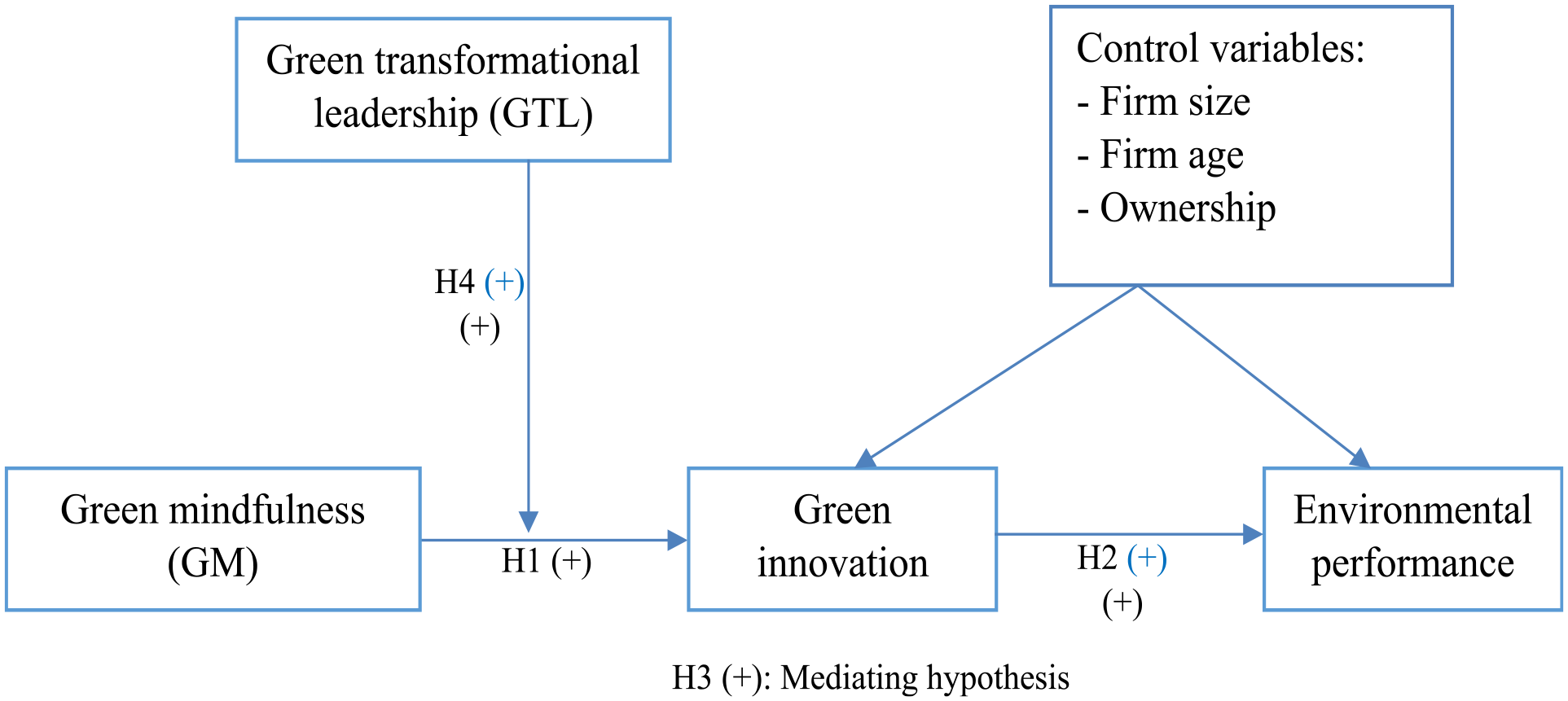
Proposed research model.
Green Mindfulness and Green Innovation
Mindfulness is considered a good means of dealing with high-risk situations that can harm a business. Mindfulness is achieved by creating a forum to share information, ideas, and thoughts among employees in the business (Gerpott et al., 2020). Businesses rely on mindfulness to introduce changes and innovations in their operations to overcome unpredictable situations, and even improve performance (Johnson et al., 2020). Indeed, mindfulness is thought to be the foundation that supports creativity and innovation through the active perception of new information (Hensley, 2020), such as information relevant to environmental degradation (Kalyar et al., 2021). Meanwhile, green mindfulness is defined as an expanded state of awareness of one’s own presence within the context and substance of environmental well-being (Dharmesti et al., 2020, p. 6). In addition, green mindfulness refers to a state of awareness about protecting the environment including the context and content of knowledge related to the environment (Chen et al., 2015).
Previous studies showed that mindfulness also promotes human behaviors toward environmental protection (Amel et al., 2009; Errmann et al., 2021; Panno et al., 2018). For example, when members of an organization are aware of the negative impact of production activities on the ecological environment, they will take action to innovate production processes. They then are able to create new products and services which are more environmentally friendly (Rehman et al., 2021). Besides, they can use less polluting materials, consume less natural resources and minimize hazardous substances or solid waste in the production process (Singh et al., 2020).
It can be seen that green mindfulness promotes pro-environmental behavior through innovation in manufacturing processes or improving products (Errmann et al., 2021; Panno et al., 2018). The green flow model proposed by Amel et al. (2009) argues that green mindfulness promotes green behavior and green practices toward environmental sustainability. Suppose green mindfulness permeated every individual in the organization; they would develop initiatives and share thoughts to reduce the negative impact of manufacturing practices on the environment through innovating manufacturing processes and improving products and services to be more environmentally friendly (Kalyar et al., 2021).
Green innovation is considered an act of improving manufacturing processes and products and services to minimize their harm to the environment; in other words, this is the protection of the ecological environment (Takalo & Tooranloo, 2021). Some studies suggest that green innovation is represented by green processes and product innovation (Singh et al., 2020; Wong et al., 2020). Green product innovation refers to development of a new product or service whose usage does not harm the environment. Meanwhile, green process innovation is understood as a new, self-contained manufacturing process in which materials can be reused, hazardous waste minimized, and raw material consumption reduced (S. Li et al., 2016). From the above discussion, the hypothesis is proposed as follows:
Green Innovation and Environmental Performance
Several studies have shown that green innovation promotes financial performance (Junaid et al., 2022; D. Zhang et al., 2019). Besides, green innovation also refers to the ability to reduce negative impacts on the ecological environment (Z. Huang et al., 2019), mainly through green product innovation and green process innovation. For example, by using less polluting materials and using recycled materials to design new products that are more environmentally friendly, firms can improve some problems relevant to the environment, reduce solid waste and reduce carbon emissions (Singh et al., 2020). In addition, by reducing coal and oil consumption, minimizing the use of hazardous substances, reducing raw material consumption, and increasing the use of clean energy in operating manufacturing processes, firms can achieve their environmental goals. They also enhance their environmental commitments, such as reducing the frequency of environmental accidents and cutting down hazardous waste (Rehman et al., 2021). Because of the above reasons, the study posits that businesses can focus on green innovation to improve both financial and environmental performance. The study’s hypothesis is fully supported by some previous studies in which green innovation focuses on the efficient use of natural resources and saving energy (Q. Zhang et al., 2017), environmentally friendly production, pollution rate reduction (J. W. Huang & Li, 2017), increased use of recycled materials mechanism (Z. Huang et al., 2019). At the same time, environmental performance is an important criterion for evaluating the performance of enterprises with regard to their environmental responsibility (Kleindorfer et al., 2005). From the above discussion, the following hypothesis is proposed:
The Mediating Role of Green Innovation
This study proposes that green innovation plays a mediating role between green mindfulness and environmental performance. The study posits that the mediation role plays out in the following order: (1) mindfulness can help members learn better, so they can have more creative thinking, which is the foundation for coming up with motivating behaviors and innovation in the organization (Amel et al., 2009) and (2) most aspects of innovation are positively related to performance (Davis & Hayes, 2011). From green environmental perspective, mindfulness is believed to encourage green behavior (Errmann et al., 2021). Green behavior (such as green process innovation and green product innovation) is found to significantly promote environmental performance (Rehman et al., 2021).
Several studies have relied on NRBV to argue that green innovation can play a mediating role in the relationship between green resources in an organization and environmental performance (Kraus et al., 2020; Rehman et al., 2021). These resources can be mentioned as green human resource management, green intellectual capital (Rehman et al., 2021), and corporate social responsibility (Kraus et al., 2020). On this premise, the assumption is that green mindfulness is a green resource that can boost environmental performance through green innovation. This study relies on RBV and NRBV to make the following arguments. Firstly, each member of the organization has different perceptions of the environment. They have their own thoughts and creativity to jointly create new values for the organization’s environmental goals. Therefore, green mindfulness is a valuable resource and creates motivation to promote performance (Kroon et al., 2015). On the other hand, this resource is non-substitutable and inimitable, according to RBV (J. Barney, 1991). Secondly, based on NRBV, Hart (1995) showed that capabilities (related to producing products, such as procurement, design, and production) have an important role in connecting valuable resources, non-substitutable resources, and competitive advantage. Hart and Dowell (2011, p. 1467) suggested a link between resources and environmental performance through capabilities. This motivates us to explore the link between green mindfulness (representing resources) and environmental performance through the mediated mechanism of product and process innovation (representing capabilities). From the above discussion, the following hypothesis is put forward:
The Moderating Role of Green Transformational Leadership
Transformational leaders are people who have great perspectives. They often share with employees, promote creativity, and stimulate their intelligence to look to the future together (Mittal & Dhar, 2015). Transformational leadership arouses awareness as well as the thoughts of employees. They expect employees to pay more attention to the common goals and the benefit of the organization (Shafi et al., 2020). Employees can think more about the mutual benefit when they are intrigued and intellectually stimulated, and they believe in the inspirational power of the leader. Employees take action to solve old problems in newer and more creative ways through their mindfulness (Khan et al., 2022).
The increasing attention to the ecological environment has made businesses pay more attention to social responsibility (Kraus et al., 2020). In this situation, leaders want employees to share a business strategy related to the environment. They are encouraged to think more about social ethics and responsibility for the environment in a way that benefits the organization and enhances its competitive position (Mittal, 2016). GTL refers to a leader’s behavior, such as sharing a vision and inspiring and motivating the rest of the organization to work together toward environmental goals (Chen & Chang, 2013). Indeed, with GTL, employees are encouraged to think and create more toward a green environment. Employees can raise environmental awareness, think more, create more, and take specific actions to achieve common environmental goals. GTL leads followers to change mindfulness in a way that cares more about the environment (Riva et al., 2021).
From the above arguments, the paper holds that GTL can create pressure to motivate employees to change their mindfulness toward the environment. Under this pressure, employees have to reform their perception, thought, and creativity to participate more in green innovation activities (Begum et al., 2022; Singh et al., 2020). This argument is well-founded because mindfulness is believed to be the foundation of pro-environmental behavior (Errmann et al., 2021). Therefore, employees cannot stand aside when the leader is more environmentally conscious. They must direct mindfulness toward the common goal of protecting and improving the green environment.
According to Kalyar et al. (2021), when leaders pay little attention to the environment, the mindfulness of members may shift away from the green environment, leading to reduced participation in green innovation and creativity activities. In such scenarios, if leaders do not promote environmental policies, discourage environmental activities, fail to share environmental information with employees, or lack a clear vision of the environment, then employees may have little motivation to engage in environmental issues (Kalyar et al., 2021). Consequently, green mindfulness may not be developed into innovative environmental protection initiatives in organizations with low GTL. Conversely, we believe that when leaders prioritize environmental protection, they create a green culture that strengthens the impact of green mindfulness on green innovation. Employee discussions, reporting, and consultation on environmental activities can significantly impact an enterprise’s green production (Chen & Chang, 2013). This impact is achieved through various measures such as utilizing the least polluting and easily recycled materials, designing eco-friendly products, and reducing production waste. We contend that the level of impact is significantly augmented when leaders effectively communicate a clear vision of environmental goals to their employees (W. Li et al., 2020). This ensures that employees are well-informed and aligned with the organization’s sustainability objectives, thereby enhancing their contribution to green production. In addition, sharing employees’ environmentally-oriented opinions is a motivational factor in driving businesses to adopt innovative practices that minimize waste, reduce the consumption of coal, oil, electricity, and water, and limit the use of raw materials (Begum et al., 2022). This heightened impact is particularly pronounced when leaders actively encourage employees to contribute their green perspectives and ideas while mandating compliance with environmental regulations. Based on the discussion above, we propose the following hypothesis:
Methodology
Research Site
Vietnam is an active member in promoting ecological protection under ASEAN (Emmers & Le Thu, 2021). The study finds that Vietnam is an attractive and suitable research site for its current conditions for the following reasons. Firstly, Vietnam is in the top 10 most polluted countries in the world (The World Bank, 2011). Meanwhile, Vietnam’s greenhouse gas emissions will nearly triple by 2030 due to its heavy reliance on fossil fuels (Alan Boyd, 2018). Vietnam is currently a member of ASEAN, a region heavily affected and vulnerable to climate change. Accordingly, GDP growth in this region could decline by 35% by 2050—while temperatures are likely to increase by 1.5°C over the next 20 years.
Secondly, the Government of Vietnam has fulfilled its environmental commitments. Indeed, Vietnam has committed to Sustainable Development Goals since 2017 (Development Asia, 2020). Moreover, the implementation of Nationally Determined Contributions in 2020 shows that Vietnam is a country with high responsibility for reducing greenhouse gas emissions (United Nations Environment Programme [UNEP], 2020). According to the Vietnamese government’s Decision 403 QD-CP, Vietnam has issued policies toward greening production, reducing the intensity of greenhouse gas emissions, and promoting the use of clean and renewable energy. Recently, Vietnam approved a national environmental protection strategy for green production, developing green and low-carbon economic models (Vietnamese government’s Decision 450 QD-CP). These developments represent the efforts of the Government of Vietnam toward green innovation and sustainable development.
Thirdly, Vietnamese businesses have been implementing green transformation toward enhancing competitive advantages and improving environmental performance. Many businesses have transformed themselves with a “green, clean” business direction as a competitive advantage. They focus more on improving mindfulness toward environmental protection of workers as well as technology, equipment, and production lines to improve processes toward green production (Urban et al., 2020). In developing countries, manufacturing firms are considered economic stewards, so they must be pioneers in showing responsibility for the green environment (Yasir et al., 2020). Indeed, besides raising employees’ environmental awareness, manufacturing firms in Vietnam also prioritize investment in installing advanced control and management systems and renewable energy systems to actively use clean energy. Electricity and water-saving solutions in the production process have been appreciated (The World Bank, 2022). Manufacturing firms have prioritized the production and distribution of green products and used environmentally friendly packaging and materials instead of single-use nylon or plastic. The greening of production also shows the responsibility of manufacturing firms to the community and society to protect the environment and the common ecosystem.
Finally, from the geographical, economic, and cultural similarities with other developing countries in the ASEAN region as well as China (Fry & Mees, 2016), the results of this study can be generalized to the above countries. The factors mentioned above make Vietnam an ideal and suitable research location for this study.
Sample and Data Collection
The unit of analysis in the study is at the firm level, so survey participants must be managers representing their respective organizations. Indeed, only the manager can fully understand an organization’s activity and can make reliable judgments. The study sampled manufacturing firms from the Dun and Bradstreet data (Dun & Bradstreet, 2022). Dun and Bradstreet contain information on 198,397 manufacturing firms operating in Vietnam. The researchers randomly selected 2,000 manufacturing firms for data collection based on a convenient approach. Specifically, researchers collected emails by accessing the profiles of each manufacturing firm following an extended link from Dun and Bradstreet.
The data collection tool used was a questionnaire. Based on Brislin (1970), the questionnaire was originally designed in English. It was translated into Vietnamese. Then, it was translated again into English by bilingual linguists. The researcher designed the questionnaire through two phases. In phase 1, the draft questionnaire was sent to five experts working at the Vietnam Eco-friendly Products Manufacture Association (VEPMA) with the desire to receive contributions in terms of content, design, and scalability. A few minor adjustments were later made. In Phase 2, draft questionnaires were sent to managers in 25 manufacturing firms from Dun and Bradstreet with the expectation of receiving contributions in terms of content, clarity, relevance, and usability. A few minor changes were made after that. The final questionnaire is considered optimal because it was drawn from the opinions of experts and managers.
To gather data, we started by randomly selecting 2,000 manufacturing firms from the Dun and Bradstreet data and compiling a corresponding list of their company email addresses. In early June 2022, we distributed an online questionnaire, utilizing the Google Forms application, to the email addresses of these 2,000 firms, along with an introduction letter outlining the content and purpose of the study. To increase the response rate, email reminders were sent every 2 weeks. After 2 months (June–August 2022), we received 295 responses, and invalid or non-managerial responses were removed from the sample. Ultimately, we analyzed 278 valid responses, which corresponds to a response rate of 13.9%. To establish the adequacy of the sample size, we utilized the G*Power approach, as proposed by Faul et al. (2009). The selected parameters for our study included an effect size of 0.1, statistical power of 0.8, probability level of .05, number of latent variables of 4, and number of observed variables of 22. By employing the G*Power calculation, a minimum sample size of 138 was recommended for our proposed structural model. Hence, with a sample size 278, our study surpasses the minimum sample size suggested.
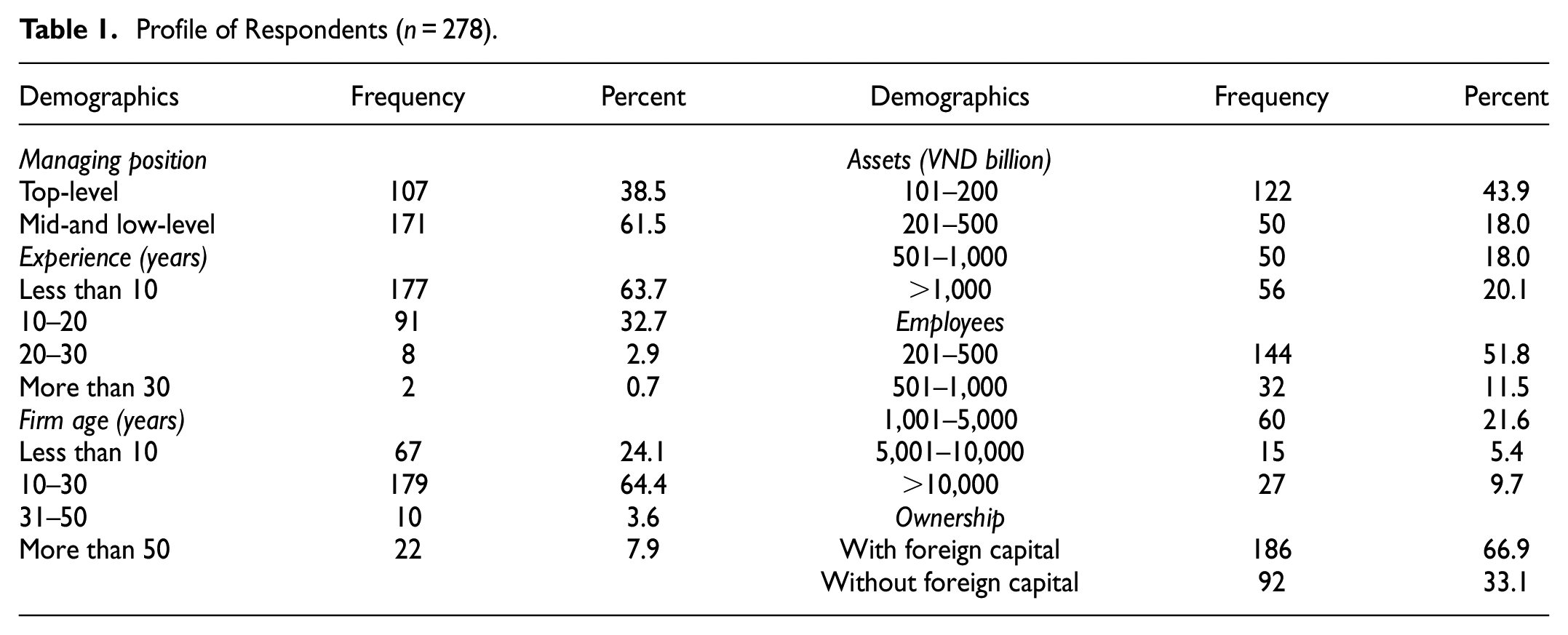
Table 1 shows that mid-and low-level managers account for 61.5%, most managers have less than 10 years of experience (63.7%), and manufacturing firms are invested mainly from foreign capital (186 Manufacturing firms). Besides, manufacturing firms aged 10 to 30 make up the majority. In terms of size, 56.1% of manufacturing firms had assets greater than VND 200 billion (USD 8 million), and nearly half of the sampled manufacturing firms had more than 500 full-time (or equivalent) employees, indicating that the size of participating manufacturing firms was adequate to have sufficient resources to pursue environmental strategies.
Profile of Respondents (n = 278).
The study followed the suggestion of Armstrong and Overton (1977) to check for non-response bias. We used an independent t-test to compare whether there is a difference between early respondents and later respondents based on multiple demographic characteristics. The analysis results showed all of the p values were higher than .05, not any significant differences between early respondents and later respondents. Hence, there was no evidence of non-response bias.
Measurement of Constructs
All main constructs were measured using well-established scales from previous studies, and these scales were all reflective. Green mindfulness was proposed by Williams and Seaman (2010), and this scale was developed by Chen et al. (2015) with 6 items. Next, we refer to GTL from Riva et al. (2021) with 5 items. This inheritance is also reasonable in view of the research context because Vietnam and Bangladesh are both developing countries and are heavily affected by environmental pollution (McEvoy et al., 2014). Therefore, the study assumes that the ways of implementing green transformation from the leaders of manufacturing firms in these two countries may have similarities. The study followed Chen et al. (2006) and Singh et al. (2020) to measure green product innovation with four items and green process innovation with 3 items. Environmental performance was then measured using a 6-item scale adopted by Zhu et al. (2008). This succession is based on economic similarities between China and Vietnam (Fry & Mees, 2016). Another reasonableness comes from the research object when Zhu et al. (2008) also experimented with manufacturing firms. Green mindfulness, green innovation, and environmental performance were measured by using a 7-point Likert scale, while GTL adopted a 5-point Likert scale. Finally, we followed Nguyen and Adomako (2022) to employ firm age, firm size, and ownership as control variables
Data Analysis and Results
The study chose PLS-SEM for analysis because it is suitable for studies with small sample sizes (Sarstedt et al., 2023). PLS-SEM uses bootstrapping to significantly reduce estimation bias, and it does not require the data to be normally distributed like covariance-based SEM (CB-SEM) (Hair et al., 2022). On the other hand, PLS-SEM is a suitable choice for complex models with many types of variables. PLS-SEM has also been widely used in research related to innovation and the choice of PLS-SEM is also consistent with recent studies on green innovation (Kraus et al., 2020; Rehman et al., 2021; Zhao & Huang, 2022).
Scale Evaluation
The study first checked the measurement model in first-order. As the SRMR = 0.049 < 0.08, the data is consistent with the proposed model (Henseler, 2017). All outer loadings higher than 0.708 (ranged between 0.726 and 0.893), CR values higher than 0.7 (ranged between 0.821 and 0.951), and AVE values do not lower than 0.5 (ranged between 0.605 and 0.765) (Table 2). These indicators show that all constructs meet the requirements for reliability and convergent validity (Hair et al., 2022).
Reliability and Convergent Validity Analysis at the First-Order Construct Level.

Note. GM = green mindfulness; GPD = green product innovation; GPC = green process innovation; GTL = green transformational leadership; EP = environmental performance; AVE = average variance extracted; CR = composite reliability.
By the two-stage approach for the second-order variable proposed by Sarstedt et al. (2019), a second-order construct is created, that is, green innovation. At that time, SRMR = 0.076 < 0.08. All outer loadings were higher than 0.708 (ranged between 0.729 and 0.943), CR values higher than 0.7 (ranged between 0.882 and 0.951), and AVE values higher than 0.5 (ranged between 0.609 and 0.765). Therefore, the reliability and convergent validity of the measurement scales are satisfactory (Table 3).
Reliability and Convergent Validity Analysis at the Second-Order Construct Level.

Note. GM = green mindfulness; GTL = green transformational leadership; EP = environmental performance; AVE = average variance extracted; CR = composite reliability.
Discriminant validity was tested by the Fornell-Larcker criterion and Heterotrait-Monotrait (HTMT) ratios. Table 4 shows the square root of the AVE between 0.719 and 0.875, higher than inter-construct correlations (ranged between 0.026 and 0.450) and HTMT ratios did not exceed the threshold of 0.90 (ranged between 0.067 and 0.503). All of the constructs guarantee discriminant validity (Hair et al., 2022).
Discriminant Validity Analysis.

Note. First value = correlation between variables (off-diagonal); second value (italic) = HTMT ratio; numbers in bold diagonal: square root of average variance extracted (Fornell-Larcker).
Common Method Bias and Multicollinearity Issues
Podsakoff et al. (2003) recommended that common method bias (CMB) should be checked to warrant study results. We used Harman’s single factor to test for CMB because it is the most common test in recent experimental studies on green innovation (Qu & Liu, 2022; Rehman et al., 2021). In this way, all items from every construct are loaded into a factor analysis to check whether a single general factor results in the majority of the covariance among the measures. The output revealed the first factor accounted for only 30.488% of the variance (less than 50%), meaning that CMB is not a major problem. Next, we used the inner variance inflation factor (VIF) to test for multicollinearity. As the maximum inner VIF was 2.108 and below the cut-off of 10 (Hair et al., 2019), multicollinearity is not a severe issue in our study.
Hypothesis Testing Results
Three hierarchical models were run to test the hypotheses. Model 1 shows the direct relationship between green mindfulness and green innovation. Model 2 augments model 1, with environmental performance added as the outcome of green innovation. Model 3 is the proposed model, which is model 2 after adding GTL as a moderator in the relationship between green mindfulness and green innovation. Table 5 shows that the direct effects between the main variables are all statistically significant. Specifically, green mindfulness has a positive effect on green innovation (β = .458, t = 9.232 (model 1); β = .458, t = 9.331 (model 2); β = .475, t = 10.213 (model 3)). Green innovation also positively affects environmental performance (β = .196, t = 2.978 (model 2); β = .196, t = 2.921 (model 3)). We also confirmed the indirect effect of green mindfulness on environmental performance through the mediating role of green innovation (βindirect effect = 0.090, t = 2.898 (model 2); βindirect effect = 0.093, t = 2.813 (model 3)). Therefore, hypotheses H1, H2, and H3 are supported.
Hypothesis Testing Results.

Note. IV = independent variable; DV = dependent variable; MeV = mediating variable; MoV = moderating variable; GM = green mindfulness; GI = green innovation; GTL = green transformational leadership; EP = environmental performance.
Significance at 1%.
The study continued to examine the moderating hypothesis H1. One interaction term was created (GTL × GM) from mean centering the independent variable (i.e., green mindfulness) and the moderating variables (i.e., GTL) on avoiding multicollinearity (Aiken et al., 1991). Table 5 shows that GTL positively moderates the relationship between green mindfulness and green innovation (βGTL×GMŽGI = 0.215, t = 4.889). As GTL becomes more robust, the impact of green mindfulness on green innovation also becomes stronger (Figure 2). Therefore, hypothesis H4 is supported.

The interaction term of GTL with green mindfulness on GI.
Discussion and Conclusion
There is increasing interest in green mindfulness because it is seen as a motivation for organizations to offer some environmental solutions, such as green creative process engagement, green creativity, and green behavior (Dharmesti et al., 2020; Errmann et al., 2021; Kalyar et al., 2021). However, how green mindfulness promotes green innovation and contributes to a firm’s environmental performance remains unexplored. This study is based on NRBV to explore the effect of green mindfulness on environmental performance through the mediating mechanism of green innovation. Besides, from the spillover effect of GTL on green mindfulness (Chen & Chang, 2013), the study considers the moderating role of GTL on the relationship between green mindfulness and green innovation.
The study collected data on the responses of managers at various levels (top, mid, and low) of manufacturing firms in Vietnam, revealing a consensus among managers across all levels with regards to environmental issues. The significance of green production as a policy to mitigate the negative impacts of climate change is recognized in the Vietnamese government’s Decisions 403 QD-CP and 450 QD-CP, highlighting the importance of environmental issues in Vietnam. As a country that has been heavily impacted by climate change (McKinley et al., 2021), all citizens and businesses, including managers in the manufacturing sector, understand the detrimental effects of climate change. In line with the management structure and hierarchy in manufacturing firms, senior managers communicate environmental issues to lower-level managers. The decisions and responsiveness of lower-level managers must be relevant to their respective departments, but all managers at every level are expected to provide appropriate responses toward the environmental objectives of the manufacturing firms. This study’s analysis shows consistency in managers’ responses to environmental-related issues, reinforcing the reliability of the research results.
Accordingly, the study showed that green mindfulness positively and significantly affects green innovation. Indeed, previous studies have demonstrated green thinking and green creativity as the main motivations for product innovation to achieve environmental goals (Begum et al., 2022; Song & Yu, 2018). Green mindfulness seems to be the source and the foundation for people to develop green thinking and green creativity. However, no research has explored green mindfulness’ contribution to green innovation. This study bridges this gap by demonstrating that green mindfulness is the primary driver of production innovation aimed at improving environmental performance.
In addition, the study confirmed that green innovation improves environmental performance, which is fully supported by previous studies (Rehman et al., 2021; Singh et al., 2020). Indeed, green innovation is a way for manufacturing firms to limit polluting materials, save electricity and water, and increase the use of recycled materials and eco-friendly design products. The main purpose of green innovation is to help manufacturing firms make positive contributions to the green environment by complying with environmental regulations, limiting negative impacts on the environment, educating employees about the environment, and ultimately reducing the environmental crisis.
The results also confirm the mediating role of green innovation in the relationship between green mindfulness and environmental performance. This study also found the level of green mindfulness’ influence. In addition to promoting green innovation, green mindfulness indirectly affects environmental performance through green innovation. Table 5 shows that green mindfulness directly affects environmental performance. This explains that when green mindfulness has been instilled in members’ awareness, they can actively share, contribute ideas, express opinions, or even advise manufacturing firms on environmental protection. It strongly motivates manufacturing firms to comply with environmental regulations and contribute positively to the green environment.
Finally, research shows that the relationship between green mindfulness and green innovation is positively moderated by GTL. This is a new finding that has never been investigated by previous authors. In other words, when manufacturing firms are more focused on the GTL, green mindfulness will make a more positive contribution to green innovation. The study explored in a logical sequence: when manufacturing firms managers focus more on environmental protection activities, they can create pressure to motivate other members to change their mindfulness toward the environment. In this way, employees must renew their awareness, thinking, and creativity toward environmental protection to participate more in green innovation activities.
Our study presents new findings that contribute to the theoretical understanding of the relationships between green mindfulness, green innovation, and environmental performance. Our analysis shows that green mindfulness has a direct and positive influence on green innovation and that green transformational leadership moderates this relationship. Furthermore, we found that green innovation mediates the relationship between green mindfulness and environmental performance. These findings hold significant implications for manufacturing firms in Vietnam, a country that faces the challenges of climate change and environmental pollution. Our study suggests that when the members of a manufacturing firm are mindful of the environment and engaged in discussions, sharing of environmental information, and advising on environmental issues, the firm can easily implement environmental strategies and policies, such as green innovation. Examples of green innovation include using less polluting materials, recycled materials, reduced energy consumption, and eco-friendly product design. Such innovations can help manufacturing firms achieve environmental performance by reducing the consumption of hazardous materials, solid waste, and carbon emissions while avoiding penalties for violating environmental principles. Our findings highlight that green mindfulness drives environmental policies such as green innovation and leads to improved environmental performance in manufacturing firms. Additionally, we found that green transformational leadership can encourage and motivate employees to cope with environmental issues and enhance the effects of green mindfulness to reduce energy and resource consumption and increase the use of decomposable and recycled materials in production.
Theoretical Implications
The study contributed to the existing theory in four main ways. Firstly, this study bridges a significant gap in the literature by highlighting the role of green mindfulness as a catalyst for both green innovation and environmental performance. In doing so, it extends the existing body of research, such as the works of Song and Yu (2018) and Begum et al. (2022), by emphasizing the fundamental importance of green mindfulness in driving pro-environmental behavior within the manufacturing sector. This finding is particularly relevant in the Vietnamese context, where environmental pollution is on the rise (McKinley et al., 2021), and there is an increasing emphasis on corporate environmental awareness and protection (Vietnamese Government’s Decision 450 QD-CP). This finding also contributed to NRBV in the way that green mindfulness can enhance its ability to innovate production toward the environment and strengthen its competitive advantage. Based on green mindfulness’ foundational role, green innovation is considered a pollution prevention strategy (Hart & Dowell, 2011), which can assist manufacturing firms in achieving environmental goals.
Secondly, our research showed that RBV is not geographically restricted. The study treated green mindfulness as a green resource, and the results showed that it contributes to green innovation in the Vietnamese context. Similarly, based on RBV, previous studies have assumed green intellectual capital and green human resource management as green resources in the organization. They explored the positive association between green intellectual capital and green innovation (Jirakraisiri et al., 2021; Rehman et al., 2021; Wang & Juo, 2021) in Malaysia, Thailand, and Taiwan contexts, respectively. This can contribute to the scalability of RBV around the world.
Thirdly, the study diversifies the role of GTL in environmental activities within the organization. Indeed, few studies point to an explanatory role of GTL in green innovation (Begum et al., 2022). As a pioneer in this area, the study shows that GTL controls green mindfulness’ contribution to green innovation.
Finally, this study reveals the indirect effect of green mindfulness on environmental performance through the mediating role of green innovation, emphasizing the crucial role of green mindfulness in manufacturing firms in Vietnam. With a shared understanding of the negative impacts of climate change on social life and business operations, manufacturing firms are compelled to adopt green innovation practices to enhance their environmental performance. Notably, the spillover effect of green mindfulness, green innovation, and resulting environmental performance supports the Stimulus-Organism-Behaviour-Consequence Framework (SOBC), as previously proposed by Talwar et al. (2021). This discovery also provides a new avenue for advancing the understanding of environmental issues and performance based on SOBC.
Practical Implications
In addition to its theoretical contributions, the study also offered practical implications. Firstly, manufacturing firms need to focus on solutions to instill green mindfulness into each member because green mindfulness is the main motivation for green innovation as well as environmental performance. Manufacturing firms need to create an internal forum for employees to share, contribute ideas, express opinions, and even advise on green environmental issues.
Secondly, leaders in manufacturing firms should demonstrate greater environmental responsibility by implementing the GTL, because they can inspire their followers to pursue environmental goals. The primary advantage of implementing GTL lies in its ability to inspire and foster a sense of camaraderie among employees in safeguarding the business environment. By adopting GTL, employees can gain a broader understanding of environmental issues and adhere to regulations on environmental protection (Riva et al., 2021). Moreover, the presence of GTL encourages employees to actively share green ideas and adopt an environmentally-conscious mindset within their firms. This facilitates effective communication of the green policies and strategies to all organizational members, promoting cohesive action toward shared organizational goals. Notably, when leaders introduce environmentally-oriented strategies, such as green innovation, GTL enables members to express their opinions, share information, and develop a heightened environmental awareness (Chen & Chang, 2013). This, in turn, fosters the design of eco-friendly products, reduces resource consumption, and mitigates emissions. Consequently, GTL serves as an environmental communication mechanism that enhances the positive impact of green mindfulness on green innovation (Begum et al., 2022). In essence, GTL enables firms to seamlessly implement environmental strategies through effective communication and sharing environmental information with all organizational members. Given the prevalent issue of environmental pollution in developing countries, such as Vietnam, leaders in manufacturing enterprises have recognized the detrimental effects of pollution on their firm’s operations. Thus, GTL becomes an essential prerequisite for successfully executing environmental strategies by facilitating communication and information-sharing among members (W. Li et al., 2020).
Thirdly, stakeholders (e.g., government, investors, environmental organizations, green banks) should take measures for manufacturing firms to focus on GTL because GTL can increase the impact of green mindfulness on green innovation. Thirdly, manufacturing firms need to invest more in green product innovation (using easily recyclable materials, designing eco-friendly products, etc.) and in green process innovation (reducing consumption of coal, electricity, and water; minimizing harmful substances in the production process) because these dimensions positively contribute to environmental goals, such as minimizing environmental crises, minimizing negative impacts on the environment.
Finally, drawing on the SOBC framework, it is crucial for managers in manufacturing firms to recognize the spillover effect that arises from the green mindfulness of their members. Managers must take proactive measures to implement green policies and actions, including green innovation, in order to achieve environmental objectives such as reducing hazardous waste, solid waste, the consumption of toxic materials, the frequency of environmental accidents, air pollution emissions, and improving overall environmental conditions.
Limitations and Future Research Directions
Although providing some important findings, this study also had some limitations. Firstly, the study collected data from survey questionnaires, so this cannot completely avoid common method bias. Secondly, our study has a small sample size. Data was analyzed from the perspective of managers from 278 manufacturing enterprises, a relatively small number compared to the number of enterprises operating in Vietnam. This may have an impact on the extent to which the study’s findings can be generalized. Thirdly, based on the discovery that green product innovation does not contribute to environmental performance (Wong et al., 2020), the study recommends that future research should evaluate green innovation at its first-order level, for example, green product innovation, green process innovation, and green managerial innovation. Therefore, researchers can use the dimensions of green innovation to evaluate more precisely and in more detail the impact of green mindfulness on green innovation as well as green innovation on environmental performance. Finally, this model should be tested more in emerging economies to provide more insights into our findings.
Footnotes
Declaration of Conflicting Interests
The author(s) declared no potential conflicts of interest with respect to the research, authorship, and/or publication of this article.
Funding
The author(s) disclosed receipt of the following financial support for the research, authorship, and/or publication of this article: This study was funded by the University of Economics Ho Chi Minh City (UEH), Vietnam.
