




Abstract
This study strives to investigate factors that influence employee job engagement and enhance organizational resilience during crisis. The research model comprises factor like artificial intelligence, flexible HR practices, digital intensity, management intensity, employee creative self-efficacy and investigate employee behavior towards job engagement. In addition to that the moderating effect of employee state of optimism is established between employee job engagement and organizational resilience. Overall, 363 employees have participated in research survey. Statistical results have unveiled significant impact of artificial intelligence, flexible HR practices, digital intensity, management intensity and employee creative self-efficacy in measuring employee job engagement with substantial variance
Plain Language Summary
This study explores key factors like artificial intelligence, flexible HR practices, digital intensity, management intensity, and employee creative self-efficacy that influence employee job engagement and organizational resilience during crisis. A total of 363 employees have participated in the research survey. The findings show that AI is the most impactful factor in driving employee job engagement. The study also reveals that employee optimism strengthens the link between job engagement and resilience. The results unveil practical insights for policymakers to enhance workplace engagement and resilience through targeted strategies, particularly by boosting AI use and employee optimism.
Keywords
Introduction
The increasing rate of natural and man-made crisis has drawn organizations attention to restructure their business strategies. Recently pandemic wave has posed severe threats to organizations due to its unpredictable nature. Moreover, growing economic crisis, political turmoil and terrorism wave are some other unpredictable crises (Fenxia & Wei, 2024). Therefore, continuity of business operations in the face of unpredicted crises is the main challenge for organizations. Nonetheless, prior studies have debated that employee job engagement is the core factor that enhance organization resilience during disruption and ensures continuity of the business operations (Ibrahim & Hussein, 2024; Kim et al., 2024). In resilience context the term job engagement is defined as employee emotional commitment and devotion towards tasks during crisis resulting high organizational resilience and better firm performance (Khairy et al., 2023). Therefore, comprehending factors which enhance employee job engagement at workplace is essential for smooth industrial operations (Khairy et al., 2023). Extending to this authors like Wijayati, Rahman, Rahman, et al. (2022) have claimed that artificial intelligence enhances employee engagement at workplace through monitoring, directions and reward. Although prior studies have emphasized on employee job engagement at workplace for smooth operations during disruption however, scarce research work is existed that establish connection between employee job engagement and organizational resilience (Khairy et al., 2023; Wijayati, Rahman, Rahman, et al., 2022). To fill this research gap current study has established research framework that combines factors such as artificial intelligence, digital intensity, management intensity, creative self-efficacy and flexible HR practices to investigate employee job engagement and organizational resilience.
Artificial intelligence pertain to technology devices that generate cognitive abilities among employees and empower to achieve task autonomously (Pillai et al., 2024; Wijayati, Rahman, Rahman, et al., 2022). Although, artificial intelligence improves organization productivity and boost employee job engagement however the role of organization digital intensity and management intensity cannot be overlooked (He et al., 2023). Digital intensity is seen as organization’s investment in technology enabled initiative to improve business process resulting better customer and employee engagement (McCartney & McCartney, 2020). Likewise, transformative management intensity denotes to management philosophy that encourages employees to introduce innovative strategies to solve problems in the face of disruption (He et al., 2023). Moreover, this study has summarized that employee creative self-efficacy and flexible HR practices are key elements to predict employee job engagement behavior. According to Prayag and Dassanayake (2023) espouse that employee with creative self-efficacy will keep trying to find new solutions to resolve issues and hence increase employee engagement towards task achievement. Moving further flexible HR practices are identified as a process to develop flexible HR policies in recruiting, developing and training diverse human capital in such a way that they would be able to deal with crisis with adaptive HR practices (Li & Lin, 2024). Studies have established that flexible HR practices boost employee confidence and encourage employee to keep working during disruptive events (Lakshman et al., 2022; Li & Lin, 2024). Apart of direct effects employee state of optimism is outlined in research framework as moderating factor. Employee state of optimism is actually tendency and belief to achieve best possible outcome during uncertainty and eliminating potential risk or failure during crisis therefore resilience pertain to adaptive qualities and capability of the organizations that boost adaptive capacity during disruptive events (He et al., 2023; Prayag & Dassanayake, 2023). Therefore, this study has advanced that moderating effect of employee state of optimism boost employee job engagement and organizational resilience. In following section conceptual linkage is established with the help of literature.
Literature Review and Hypotheses Development
Artificial Intelligence, Digital, and Management Intensity
Digital revolution has transformed businesses activities into modern and cost effective business practices. Among digital technologies artificial intelligence has remained spectacular technology. The artificial intelligence is defined as machines or computer models that are capable to stimulate intelligent behavior with minimal human intervention (Wijayati, Rahman, Fahrullah, et al., 2022). More precisely artificial intelligence is seen as technology device that intends to reproduce cognitive skills of humans to achieve task autonomously (Sankaran, 2019). In last few decades the emergence of machines learning, deep learning and big data enabled AI application have brought ease in operations in terms of accuracy and speed. Moreover, studies have also revealed that use of artificial intelligence could engage employees at workplace with cognitive and problem resolving abilities of artificial intelligence (Wijayati, Rahman, Rahman, et al., 2022). Similarly, with the help of artificial intelligence applications employees can predict customer behavior and in better position to analyze customer needs (Wijayati, Rahman, Fahrullah, et al., 2022). Digital intensity is quite different from artificial intelligence and defined as organization investment in technology enabled initiative to improve business process and for better customer and employee engagement. With digital intensity organizations offers opportunity to employees to complete their task through digital technologies and enhance employee capability to deal with crisis. The recent pandemic wave is an evident that organizations with high digital intensity have successfully managed their operations through virtual assistance, self-service kiosks and service robot (Alyoubi & Yamin, 2024; McCartney & McCartney, 2020; Yamin & Abdalatif, 2024). Likewise, through transformative management intensity organizations can motivate employees to keep working during disruption. The term transformative management intensity is actually management philosophy to encourage employees through transformative digital initiatives and introduce innovative strategies to solve problems. Authors like He et al. (2023) have stated that increase in management intensity enhance organizational resilience during turbulent environment. Moreover, studies have revealed that through transformative management intensity organizations build culture that motivate and enables employees to develop creative solutions to deal with unprecedented situation (Chen et al., 2020; He et al., 2023). Therefore, following hypotheses are assumed:
Employee Creative Self-Efficacy and Flexible HR Practices
Aside of technology factors like artificial intelligence and digital intensity the importance of cognitive factors cannot be ignored. For instance literature has revealed that creative self-efficacy encourage employees to keep working in turbulent environment (Prayag & Dassanayake, 2023). The term employee creative self-efficacy is defined as employee belief and ability to produce creative work at workplace. Nevertheless, the concept of creative self-efficacy is yet to be linked with employee job engagement and organizational resilience. Therefore, in this study it is assumed that employee with creative self-efficacy characteristics would have better engagement towards job engagement. In addition to that creative self-efficacy allows employees to solve problems with creative and innovative practices. Thus, it is inferred that employee with creative self-efficacy will keep trying to find new solutions to resolve organizational issue and hence increase their engagement towards task achievement. Similarly, flexible HR practices are also considered important to measure employee behavior towards employee engagement. Although HR practices are conceptualized towards employee engagement however the relationship between flexible human resource practices and employee job engagement is yet to be established. Flexible HR practices are inferred as process to develop flexible HR design in recruiting, developing and training diverse human capital in such a way that they would be able to deal with crisis with adaptive HR policies (Awan et al., 2023; Li & Lin, 2024). According to Lakshman et al. (2022) firms with flexible HR practices have shown resilience during disruption. In addition to that research has also revealed that with flexible HR practices boost employee confidence and encourage employee to keep working during disruptive events (Lakshman et al., 2022). Therefore, one can assume that flexible HR practices influence positively employee behavior towards job engagement in time of crisis.
Employee State of Optimism
Optimism is a cognitive factors and associated with individual happiness, hope, and positive expectations about future (Millstein et al., 2019). The concept of optimism is studied in health sector to measure individual health (Millstein et al., 2019). Similarly, employee state of optimism is studied to investigate how it motivates employees in the face of crisis (He et al., 2023). Nevertheless, employee state of optimism is defined as employee tendency and belief to achieve best possible outcome during uncertainty and eliminate potential risk or failure during disruption (He et al., 2023; Yamin, 2022). Prior studies have revealed that employees with weak state of optimism have shown less capability to deal with crisis (He et al., 2023; Markovits et al., 2014). For instance in recent pandemic wave employees have shown anxiety, fear and job insecurity due to lack of optimism state (Epperson, 2021). Therefore, optimism impact positively individual mental health, subjective well-being and improve resilience ability (Millstein et al., 2019). Moreover, authors like Bouzari and Karatepe (2020) postulated that optimistic employees are more adaptable and less pessimistic about external risks including uncertainty and disruption. Similarly, literature has established that employee engagement enhance organizational resilience. Organizational resilience pertain to adaptive qualities and capability of the organizations that enable organizations to deal with turbulent environment (Prayag & Dassanayake, 2023). As the current research is focused on employee engagement at workplace and organizational resilience and therefore it is anticipated that employee state of optimism brings positive impact towards job engagement and boost organizational resilience (Bouzari & Karatepe, 2020; He et al., 2023; Markovits et al., 2014; Prayag & Dassanayake, 2023). Therefore, moderating effect of employee state of optimism is conceptualized between the relationship of employee job engagement and organizational resilience (Figure 1). Thus, following hypotheses are assumed:

Research framework.
Research Methodology and Design
Sampling and Data Collection
The research model of this study has multiple hypotheses and these hypotheses are tested with empirical data. As the core objective of this study is to understand employee job engagement behavior during disruption and therefore research population of this study is employees working in Saudi banks. It has been noted that employees working in banks have shown anxiety and fear during pandemic resulting lack of interest towards task achievement. Supporting to this authors like He et al. (2023) have revealed that during COVID-19 pandemic services sector has been widely affected. Therefore, understanding banking employee’s job engagement behavior during disruption is crucial. The research design of this study is cross sectional and hence data are collected at once. Prior to data collection sample size of the study is selected (Rahi, 2017a). According to Rahi (2017a) stated that indicators must be multiplied with 5 or 10 to get actual sample size of the study. Following above recommendation sample size of 135 (27 × 5) minimum or 270 (27 × 10) maximum is recommended.
Prior to data collection it is necessary to select appropriate sampling method. In this study data is collected through non-probability sampling approach. Within non-probability sampling this study has adopted purposive sampling approach. The purposive sampling approach was relevant as the objective of this research is to just target banking employees. Data collection process was started by approaching 412 employees working in different banks of Saudi Arabia. These employees have been briefed about the purpose of the research and then requested to participate in employee job engagement and organizational resilience research survey. Moreover, these employees have participated in research survey voluntarily. Survey questionnaires were handed over to employees physically. Among 412 employees 35 had refused to participate in research survey due to time restrained. Nevertheless, remaining 377 employees were contacted through phone calls and requested to return survey questionnaires. Research survey was conducted during the month of July and August 2024. After several phone calls and reminders researcher has successful retrieved 363 questionnaires. Therefore, for data estimation these 363 valid empirical responses were used.
Ethics and Informed Consent
This study was reviewed and approved by the Bioethics Committee of Scientific and Medical research at the University of Jeddah (Ethics approval number: UJ-REC-284). All participants were informed about the study’s purpose, procedures, potential risks, and confidentiality measures through an information sheet provided before participation. Participation in the study was voluntary, and all responses were collected anonymously to protect the privacy of participants. Informed consent was obtained verbally, ensuring that participants had sufficient opportunity to ask questions and withdraw at any point without consequence. The study design minimized any potential risks, ensuring that the benefits to both participants and the broader society outweighed any potential risks. Given the non-sensitive nature of the survey content, formal ethics board approval was granted, and no further approval was required.
Questionnaire Development and Scale Adaptation
Data were collected through structured survey questionnaires. The survey questionnaire comprises cover letter, scale items, and respondent profile. The purpose of the cover letter is to update respondents about research work. Constructs were measured with scale items from previously developed scale. Therefore, scale items were taken from literature and adapted into current research setting. Artificial intelligence items were adapted from prior studies (Wijayati, Rahman, Rahman, et al., 2022). Digital intensity items were adapted from prior research conducted by He et al. (2023) and (Westerman et al., 2012). Scale items for the factor transformative management intensity were adapted from He et al. (2023) and (Westerman et al., 2012). Employee creative self-efficacy was measured with scale items adapted from (Prayag & Dassanayake, 2023) and (Tierney & Farmer, 2002). Likewise, flexible HR practices scale items were adapted from (Li & Lin, 2024). Moving further employee job engagement scale items were adapted from (Khairy et al., 2023). Organizational resilience scale items were adapted from Prayag and Dassanayake (2023) and past study (Kiziloglu & Yamin, 2022). Therefore, employee state of optimism scale items were adapted from (He et al., 2023). These scale items were enumerated on 7 point Likert scale wherein 1 demonstrating to strongly disagree and 7 indicating to strongly agree. Survey questionnaire can be seen in Appendix 1. Moreover, respondents were asked about their gender, age, and experience. Sample composition was 307 male and 56 female. Concerning with employees age sample of 122 employees aged between 21 and 30 years. Therefore, sample of 143 employees was aged between 31 and 40 years. Similarly, sample of 98 employees were aged between 41 and 50 years. In terms of employees experience 123 employees have 16 to 20 years of experience. Therefore, 120 employees have 11 to 15 years of experience. Next to this 90 employees have 6 to 10 years of experience. Nonetheless, only 30 employees are found having 21 to 25 years of experience. Overall, respondents profile presents diverse perspective to understand employee job engagement behavior during crisis.
Statistical Analysis and Results
Common Method Bias and Missing Value Analysis
Prior to factor analysis missing values and common method bias issue were addressed. According to Rahi (2017a) stated that empirical research could be affected with common method variance bias. Therefore, data bias issue is tested with Harman’s single factor solution analysis. To ensure that common method variance bias is not likely issue in data set Harman’s single factor analysis has recommended thresh hold value 40%. (Rahi, 2017a). Data were estimated and results revealed that variance explained by single factor was 19% and less than threshold value. Aside of statistical analysis scale items were also jumbled up prior to mitigate common methods variance bias issue. Next to this missing values were reported through Little’s test. Authors like Rahi (2018) have stated that missing data issue could be resolved following criterion that data must be missing completely at random. Nevertheless, missing value analysis has shown insignificant p-values indicating that data were missing completely at random and no systematic pattern was found in missing values.
Construct Measurement
The common method bias, missing values analysis and descriptive analysis have been assessed with SPSS software. To ensure constructs validity inferential analysis is conducted with Smart-PLSv3.4. Data were estimated with partial least based structural equation modeling. This approach is consistent with current research objectives and supported by prior studies in the same filed (Kiziloglu & Yamin, 2022; Rahi, 2023; Yamin et al., 2024). The first stage in construct measurement is to ensure indicators reliability, constructs reliability and constructs convergent validity. According to Rahi (2018) indicator reliability is considered satisfactory if loading is greater than .60. Data were estimated and results revealed that indicator loadings of the FHR2 and ART 2 were found less than threshold value and therefore eliminate from data set. The composite reliability is established with threshold value .70 as recommended by prior studies (Rahi, 2017b, 2018). Finally, average variance extracted values were found greater than threshold value .50 and hence convergent validity of the construct is established. Results of the constructs measurement are presented in Table 1.
Constructs Measurement.

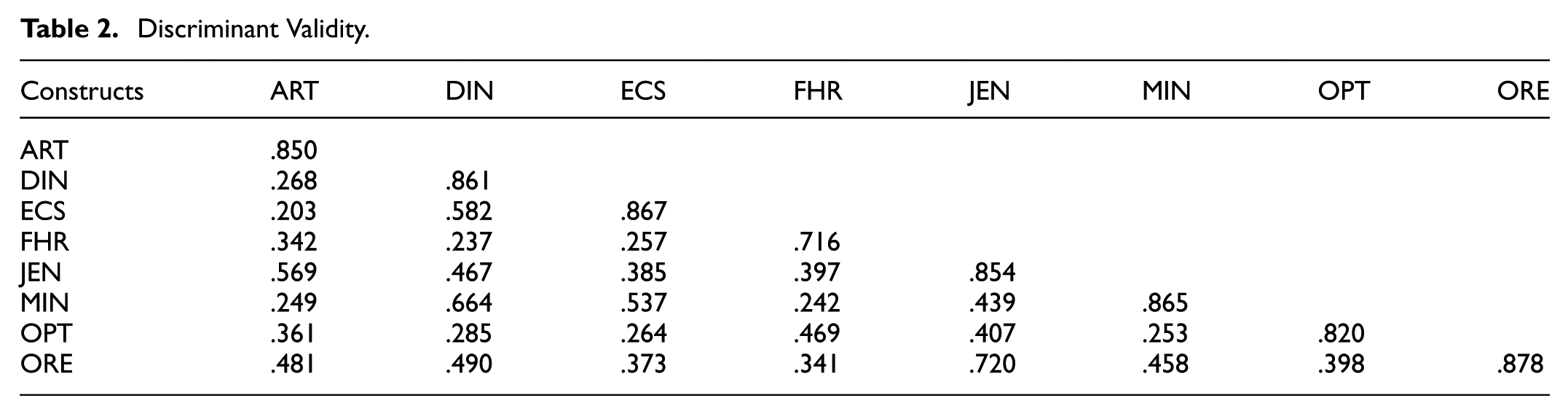
Constructs validity is achieved with discriminant analysis. According to Rahi (2017b) has stated that adequate discriminant validity of the constructs indicate that constructs are measuring distinct concepts. Therefore, discriminant validity is ensured with three kinds of analysis namely Fornell and Larcker, HTMT and cross loading method. At first stage construct discriminant validity is confirmed with Fornell and Larcker method (Fornell, 1992). Following guidelines provided by Fornell (1992) this study has confirmed that square root of average variance extracted is higher. Results of the Fornell anlaysis can be seen in Table 2.
Discriminant Validity.
Another analysis namely Heterotrait–Monotrait ratio analysis is conducted to ensure discriminant validity of the constructs. The HTMT analysis is considered most reliable estimation method and recommended by Kline (2011) and (Gold & Arvind Malhotra, 2001). Moreover, the HTMT methods is also highly recommend in latest methodology based studies (Rahi, 2017a, 2017b, 2022; Yamin & Alyoubi, 2020). According to Rahi (2018) has stated that for satisfactory discriminant validity HTMT values must be less than .85 or .90. Therefore, data were calculated and results have disclosed that all HTMT values are less than .85. Table 3 demonstrates constructs are discriminant and measure distinct concepts in data set.
Heterotrait–Monotrait Ratio Analysis.

After establishing construct discriminant validity through HTMT analysis this research has tested data further with cross loading analysis. Cross loading analysis exhibits indicator loadings with corresponding indicators loadings (Rahi, 2017b). To ensure that constructs are discriminant loadings are evaluated following criterion that indicator loading must be greater than other loadings (Rahi, 2017a). Nevertheless, results have established that indicator loadings are higher and hence confirmed discriminant validity of the constructs. Results of the loadings are shown in Table 4.
Cross Loading Analysis.

Hypotheses Analysis
After confirming constructs validity hypotheses testing is done with bootstrapping method. Bootstrapping methods is highly recommended by prior researchers as it reduces data normality issue and reveals robust results (Rahi, 2017a, 2017b, 2022; Yamin & Alyoubi, 2020). Moreover values of path coefficient, t-statistics and p-values are produced through bootstrapping method (Rahi, 2022). Hypotheses are assessed following values of beta, standard error, p-value and t-statistics as given in Table 5.
Hypotheses Results and Coefficient of Determination.

Hypotheses are tested with structural model and results revealed significant impact of all hypotheses towards job engagement and organizational resilience. Collectively, artificial intelligence, digital intensity, management intensity and employee creative self-efficacy have revealed substantial variance in employee job engagement, that is,
Importance Performance Analysis
The research model is evaluated further with importance performance analysis. According to Rahi (2023) IPMA analysis has capability to disclose border picture of the underpinned factors. Therefore, data were estimated with IPMA analysis following organizational resilience as outcome factor. Findings of the IPMA analysis have demonstrated that for organizational resilience employee job engagement is the most influential factor followed by artificial intelligence. Therefore, the impact of employee state of optimism, digital intensity and flexible human resource practices are found considerable in measuring organizational resilience. This study has summarized that policy makers could enhance organizational resilience through employee job engagement, artificial intelligence, employee state of optimism, digital intensity and flexible human resource practices (Table 6).
The Importance Performance Analysis (IPMA).

Effect Size Analysis
Although IPMA analysis presents macro view of the research framework however, micro view is yet to be observed through effect size analysis. The effect size analysis presents individual impact of each factor and assists managers to achieve maximum task with minimum resources (Yamin, 2021). Therefore, data were estimated following threshold values of the effect size
Factors Effect Size

Moderating Analysis
The employee state of optimism is conceptualized as moderating factor between employee engagement and organizational resilience. It is assumed that with high level of employee state of optimism relationship between job engagement and organizational resilience will be higher. Therefore, data were bootstrapped and statistical findings had revealed significant moderating effect employee state of optimism and endorsed by β = .119, SD = .039, t-statistics 3.069 significance at .000. These findings have indicated that employee state of optimism moderates the relationship between employee job engagement and organizational resilience. Moving further simple slope analysis has also shown increase in employee state of optimism OPT at +JEN demonstrating that increase in employee job engagement at workplace and organizational resilience in the face of crisis. Simple slope analysis output is given in Figure 2 indicating upward trend OPT at +JEN however, OPT at −JEN is showing downward trend. Therefore, this study has established that high level of employee state of optimism will strengthen the relationship between employee job engagement and organizational resilience and hence confirming H7.

Moderating trend with simple slope graph.
Discussion
The increasing numbers of both natural and man-made crises have posed great threat to organizations and drawn organization attention to respond these catastrophic events efficiently and effectively. More recently studies have highlighted that employees feel anxiety and fear in the face of catastrophic events resulting lack of engagement at workplace (Khairy et al., 2023; Lemon & VanDyke, 2024; Mahmud et al., 2021). Therefore, a key challenge for organizations is that how to engage employees at workplace during uncertainty and disruption (Chang & Chang, 2023; Kraus et al., 2021). To address this issue present study has investigated employee job engagement behavior at work place with artificial intelligence, digital intensity, management intensity and employee creative self-efficacy. Empirical findings have revealed that jointly artificial intelligence, digital intensity, management intensity and employee creative self-efficacy positively impact employee job engagement and explained substantial variance
Likewise, employee creative self-efficacy has revealed significant influence in measuring employee job engagement and in line with past study (Prayag & Dassanayake, 2023). Flexible human resource practices has disclosed significant impact in gauging employee job engagement and consistent with prior studies (Lakshman et al., 2022; Li & Lin, 2024). The research framework is further extended with employee state of optimism and employee job engagement and investigated organizational resilience. Collectively, results have shown that both employee state of optimism and employee job engagement explained substantial variance in organizational resilience, that is,
Theoretical Contributions
This study has numerous contributions to theory and literature. At first research framework of this study encompasses cognitive and technology factors to understand employee job engagement during crisis. For instance factors such as artificial intelligence and digital intensity have contained technology characteristics to investigate employee job engagement behavior and hence contribute to information system literature. Similarly, transformative management intensity, employee creative self-efficacy and flexible human resource practices are purely cognitive factors and conceptualized to understand employee job engagement behavior at workplace and hence contribute to behavioral literature. Moreover, combining technology and cognitive factors altogether to investigate employee job engagement behavior has disclosed new dimension in literature and enrich literature substantially. Aside of direct relationships this study has confirmed that moderating effect of employee state of optimism will increase the relationship between employee job engagement and organizational resilience. Therefore, confirming the role of employee state of optimism as moderating factor between employee job engagement and organizational resilient has substantially contributed and adds new dimensions into resilience literature. Another aspect of this research is to confirmed relationship between employee job engagement and organizational resilience. Thus, examining the role of job engagement towards organizational resilience has also contributed to resilience literature largely.
Research Contributions to Practice
Like theoretical contributions this study has multiple practical contributions that could assist policy makers to enhance employee job engagement during crisis and enhance organizational resilience in the face of catastrophic events. Therefore, for managerial implications three types of analysis have been considered including coefficient of determination, effect size analysis and importance performance analysis. Referring to coefficient of determination this study has demonstrated that collectively artificial intelligence, digital intensity, management intensity and employee creative self-efficacy had revealed substantial variance in employee job engagement, that is,
Conclusion
The current study aims to identify factors that boost employee job engagement and organizational resilience in the face of disruption. Therefore, research model is established comprising factor like artificial intelligence, flexible HR practices, digital intensity, management intensity, employee creative self-efficacy to investigate employee behavior towards job engagement. The outcome of this study shows that factors such as artificial intelligence, flexible HR practices, digital intensity, management intensity and employee creative self-efficacy are core factors that influence employee job engagement positively. Moreover, this study has also concluded that employee state of optimism moderates the relationship between employee job engagement and organizational resilience. Statistically, results have revealed overall impact of underpinned factors and demonstrated that jointly artificial intelligence, flexible HR practices, digital intensity, management intensity and employee creative self-efficacy bring
Limitations and Future Research Directions
Aside of several useful findings this study has some limitations and paves promising directions for future researchers. First, research framework of this study has outlined technology and cognitive factors to investigate employee engagement behavior and organizational resilience. However, future researchers could extend current research model with technology theory like technology acceptance model or diffusion of innovation theory. In addition to that the research framework is lacking mediating factor to reduce the complexity of the model. Nevertheless, mediating role of employee job engagement could be studied between exogenous and endogenous factors. This study has followed non-probability sampling approach due to lack of list of the respondents. Nevertheless, probability sampling approach is recommended in future studies to strengthen the research methods. Moreover, the current research model is tested with cross-sectional research methods. Nevertheless, for future studies longitudinal research method is recommended. It is expected that longitudinal research method could shed light on the cognitive barriers of employee engagement and will disclose interesting results due to diverse data set. Finally, organizational resilience is taken as outcome factor in this study however future researcher could extend current research framework with some other outcome factors like employee performance and organizational performance.
Supplemental Material
sj-xlsx-1-sgo-10.1177_21582440251389698 – Supplemental material for Investigating the Role of Artificial Intelligence and Flexible HR Practices in Fostering Employee Job Engagement and Organizational Resilience: The Moderating Effect of Optimism
Supplemental material, sj-xlsx-1-sgo-10.1177_21582440251389698 for Investigating the Role of Artificial Intelligence and Flexible HR Practices in Fostering Employee Job Engagement and Organizational Resilience: The Moderating Effect of Optimism by Abdulrahman Awadh Aljuaid in SAGE Open
Supplemental Material
sj-xlsx-2-sgo-10.1177_21582440251389698 – Supplemental material for Investigating the Role of Artificial Intelligence and Flexible HR Practices in Fostering Employee Job Engagement and Organizational Resilience: The Moderating Effect of Optimism
Supplemental material, sj-xlsx-2-sgo-10.1177_21582440251389698 for Investigating the Role of Artificial Intelligence and Flexible HR Practices in Fostering Employee Job Engagement and Organizational Resilience: The Moderating Effect of Optimism by Abdulrahman Awadh Aljuaid in SAGE Open
Supplemental Material
sj-xlsx-3-sgo-10.1177_21582440251389698 – Supplemental material for Investigating the Role of Artificial Intelligence and Flexible HR Practices in Fostering Employee Job Engagement and Organizational Resilience: The Moderating Effect of Optimism
Supplemental material, sj-xlsx-3-sgo-10.1177_21582440251389698 for Investigating the Role of Artificial Intelligence and Flexible HR Practices in Fostering Employee Job Engagement and Organizational Resilience: The Moderating Effect of Optimism by Abdulrahman Awadh Aljuaid in SAGE Open
Footnotes
Appendix
Survey Questionnaire.

| # | Factors |
|---|---|
| Digital intensity (DIN) | |
| 1. | Digital technology is used to improve operational performance |
| 2. | Customer service is offered through digital technology |
| 3. | This organization sells products through digital channels |
| Employee creative self-efficacy (ECS) | |
| 1. | Employees have ability to solve problems creatively |
| 2. | Employees generate new and novel ideas confidently |
| 3. | Employees are encouraged to share novel ideas |
| Flexible human resource practices (FHR) | |
| 1. | HR polices enables employees to get variety of skills within organization |
| 2. | Employees get job rotation opportunity which in turn enhances their skills |
| 3. | Employees get range of training program to perform multiple tasks |
| Employee job engagement (JEN) | |
| 1. | Employees in our organization are enthusiastic about their job |
| 2. | Employees feel proud of the work they do |
| 3. | Employees feel strong and vigorous at workplace |
| 4. | Employees feel happy and immersed with their work |
| Transformative management intensity (MIN) | |
| 1. | Organization has transformative vision of the digital future |
| 2. | Employees get opportunity to participate in digital conversation |
| 3. | Organization is investing on employees to get digital skills |
| Employee state of optimism (OPT) | |
| 1. | Employees look at the bright side of things during crisis |
| 2. | During crisis and uncertain time I always expect the best |
| 3. | During uncertain time I stay optimistic about the future |
| Organizational resilience (ORE) | |
| 1. | Organization is committed to introduce and developed emergency plan to ensure smooth operation during disruption |
| 2. | This organization is capable to respond unexpected events quickly |
| 3. | This organization has adaptive ability and absorbs unexpected environmental changes |
| Artificial intelligence (ART) | |
| 1. | The use of artificial intelligence engaged me in getting the job done |
| 2. | Artificial intelligence enabled me to find accurate and relevant data |

Ethical Considerations
This study received ethical approval from the bioethics committee of scientific and medical research at University of Jeddah (Approval No. UJ-REC-284). All procedures involving human participants were conducted in accordance with the ethical standards of the committee and the principles of the Declaration of Helsinki.
Consent to Participate
Participation in this study was voluntary, and informed consent was obtained from all participants after they were fully informed about the study’s purpose, procedures, and confidentiality measures. All responses were collected anonymously.
Author Contributions
The author, Abdulrahman Awadh Aljuaid, conducted all aspects of this research independently. This included the conceptualization of the study, data collection and analysis, and the drafting and revising of the manuscript.
Funding
The authors disclosed receipt of the following financial support for the research, authorship, and/or publication of this article: This work was funded by the University of Jeddah, Jeddah, Saudi Arabia under grant No. (UJ-24-DR-780-1). Therefore, the authors thank the University of Jeddah for its technical and financial support.
Declaration of Conflicting Interests
The authors declared no potential conflicts of interest with respect to the research, authorship, and/or publication of this article.
Data Availability Statement
Data sharing not applicable to this article as no datasets were generated or analyzed during the current study.
Supplemental Material
Supplemental material for this article is available online.
References
Supplementary Material
Please find the following supplemental material available below.
For Open Access articles published under a Creative Commons License, all supplemental material carries the same license as the article it is associated with.
For non-Open Access articles published, all supplemental material carries a non-exclusive license, and permission requests for re-use of supplemental material or any part of supplemental material shall be sent directly to the copyright owner as specified in the copyright notice associated with the article.
