



Abstract
The related literature implies that phenomenographic arguments on teaching conception are primarily developed for in-service teachers or university educators. There is also an ongoing tenet among educational phenomenographers that instructors’ conceptions of teaching are inquired into by discriminating teacher-centered and student-centered modes of teaching from each other. In addressing these two issues, first, the present study established a phenomenographic argument regarding prospective teachers’ (PTs) experience-based conceptions of the teaching phenomenon. Second, the current study considers teaching phenomenon in a broader sense within five hierarchical categories: monological, dialogical, dialectical, adaptive-pragmatic, and reflective. A phenomenographic research was conducted to comprehend 39 senior PTs’ teaching conceptions. It is concluded that the PTs mainly experienced and reported three focused dimensions of the phenomenon: monological, dialogical, and dialectical. However, two more sophisticated dimensions, adaptive-pragmatic and reflective teaching, were absent in the PTs’ experienced-based conceptions. Finally, suggestions are offered for educators who considerably fluctuate the PTs’ experiential cognition of the instruction and related conceptions of enacted teaching.
Introduction
Justification for the Study
One of the most featured dimensions of teacher preparation is to scaffold prospective teachers (PTs) to be able to design and implement high-quality in-class teaching (Hollins & Warner, 2021), resulting in academically productive classroom talk (Cochran-Smith et al., 2015; Shaughnessy & Boerst, 2018). Grossman et al. (2009) indicated the vitality of pedagogies of enactment term, which clarifies university-based teacher preparation approximating PTs to engage in higher-order pedagogical adaptations to naturalistic classroom environments. Grossman et al. (2009) stated that pedagogies of enactment are primarily associated with PTs’ pedagogical commitments, which are mostly displayed as their teaching conceptions that may have several sources in the form of school-based experiences.
Cochran-Smith et al. (2015) propose some indicative research fields illuminating high-quality teacher preparation. These are gathered around subject matter knowledge, coursework, fieldwork, curricular issues, and teacher educators. Cochran-Smith et al. (2015) notably stated that PTs’ conceptions of the above-listed aspects of high-quality preparation are paramount. PTs’ teaching conceptions can be diverse (e.g., how an individual learns, teaching strategies for different students, curricular issues, school context, assessment, and evaluation of the outcomes). Cochran-Smith et al. (2015) stressed that having systematic knowledge about PTs’ teaching conceptions and altering their experientially oriented and mostly intuitive views on teaching with more productive ones should be the executive functioning of any teacher preparation program.
Having systematic knowledge regarding PTs’ teaching conceptions is worthwhile regarding some particular aspects of the current theories of teacher preparation. First, as much previous research intends (Milner, 2005), PTs’ teaching conceptions are their personalized theories (Phelps-Gregory et al., 2020) shaping their teaching preferences. Making more accurate projections on the what-aspects and how-aspects of PTs’ in-class teaching, their conceptions of these should be knowable. There may be an incongruity between PTs’ teaching conceptions and practices. Description of the distance between these is the first step to convincing PTs to act in the classroom differently to operate academically productive content representations (Berger et al., 2018). In doing so, PTs’ teaching conceptions should be externalized to compare the theory/concept and practice systematically.
Teacher noticing is an emergent field of inquiry in teacher preparation (Van Es & Sherin, 2021). The current literature shows that PTs’ externalizations regarding the noticing of routine and emergent classroom incidents, as they are proposed to attend to, interpret, or make sense of them, in addition to making decisions for designing better teaching environments based on the classroom video data, is one of the most defining aspects of the profession considered for the highest quality teacher preparation (Van Es & Sherin, 2021). Attending, interpreting, and making decisions about overlapped classroom events are mostly theory-laden. PTs are expected to use their pre-theories or experience-based teaching conceptions as filtration systems for attending or disattending to classroom events. PTs use their experiential or intuitive teaching conceptions to interpret observed classroom events by connecting them to abstract categories of teaching phenomena, such as theories of teaching produced by educational scientists (Taylan, 2017). PTs’ decisions and recommendations on better teaching are regulated by their teaching conceptions, mainly shaped during university-based coursework and fieldwork (Cochran-Smith et al., 2015). A nuanced understanding of PTs’ teaching conceptions will be informative for the studies devoted to teacher noticing. Metaphorically speaking, if the PTs’ instructional noticing is a wall, the experience-based and analytically-oriented mental schemes of the PTs’ on the teaching phenomenon are the bricks of that wall.
State-of-the-art research on teacher preparation contends that PTs should be called reflective practitioners for reform-based innovations (Hébert, 2015). Thus, teacher educators have been searching for systematic ways of equipping PTs with pedagogic tools to make data-based reflections on teaching processes. Critical reflection-in-action is rooted in Dewey’s (1933) and Schön’s (1983, 1987) interpretations. Reflection is naturally embedded in one’s experience (experiential knowledge), which is the evidence of the action since the future action is structured upon one’s experience as a reference point (Schön, 1983, 1987). Reflection sees the theory as the knowledge of practice, which is generated in an evidence-based manner and tested against negative cases (Hébert, 2015). Proponents of reflective practice in teacher preparation acclaim that PTs should be prepared as evaluators of teaching for crystallizing excellent instructional practices (Mulryan-Kyne, 2021). Reflections on teaching bring along a pedagogic awareness to PTs. However, conscious awareness is another dimension for the development of PTs’ vision of teaching. PTs should have meta-awareness regarding their teaching conceptions to observe, analyze, interpret, report, and enhance them. Meta-awareness is mostly about conscious awareness, which is “being aware” of “being aware” of an action (e.g., teaching a subject to students and pondering on the influence of being held conceptions of teaching on one’s teaching orientations). For a monitoring and self-evaluating activity, PTs, as the external readers of research products, may utilize the current study’s outcomes to re-consider their teaching conceptions to act as designers of instruction with meta-awareness. The current study would move the field forward because documenting a phenomenon to be explained is the first step in theory building (Borsboom et al., 2021).
Theoretical Framework
A Nuanced Phenomenographic Understanding of Teaching Phenomenon
The current study aims to develop a phenomenographic argument regarding PTs’ teaching conceptions to add current knowledge of high-quality teacher preparation. Three concepts characterize a phenomenographic argument: experience, conception, and conceptual variation (Hajar, 2021; Soysal & Saruhan, 2023). First, the present study hypothesized that the PTs experienced the teaching phenomenon, especially during the university-based coursework and in-site fieldwork. They might develop their teaching conceptions based on formal and informal experiences. Finally, the PTs’ teaching experiences might incorporate a conceptual variation. As a note, the teaching phenomenon explored in the present study is what appeared to the PTs (Hajar, 2021). However, instructional instantiations that appeared to the PTs might not be visible in their whole or given form (Hajar, 2021; Soysal & Saruhan, 2023).
In the recent study, phenomenography is used as an explorative tool to map out the PTs’ qualitatively different ways of seeing a phenomenon. Phenomenographic researchers accept that different people perceive a phenomenon differently under different conditions. Documenting a logically inclusive structure in which different presumable meanings are associated involves looking at the collective human experience (Åkerlind, 2012; Soysal & Saruhan, 2023). Explaining phenomena based on individuals’ first-hand experiences provides a better understanding. Inquiring into the PTs’ teaching conceptions provides a second-order perspective (Åkerlind, 2018) developed through experiencing the phenomenon.
A phenomenon consists of two dimensions: structural (individual/analytical) and horizontal (holistic/referential). The structural aspect of a phenomenon is the fragmented part that an individual sees and perceives (Åkerlind, 2012). The horizontal aspect is the universal understanding developed for a phenomenon. The universal aspect covers all the structural aspects that individuals form for a phenomenon (Hajar, 2021). The horizontal aspect of a phenomenon is the last point that the human mind has reached in that historical time when experiencing that phenomenon and transforming it into a conception, or it is the outer conceptual periphery (Hajar, 2021). Very rarely can a mind transcendently experience and conceptualize a phenomenon in all aspects or argues that a mind alone cannot approach the universal limits of any phenomenon. The experience-conception relation (Hajar, 2021) demands a collective-intellectual performance rather than an individual one, and it has to involve random variations during the transformation of experiences into conceptions.
Previous phenomenographic arguments are primarily focused on the teacher-centered and student-centered spectrum of the same scale as a horizontal aspect to document teachers’ or teacher educators’ conceptions of learning, teaching, or pedagogy (e.g., Brody & Hadar, 2011; Buaraphan, 2011; Kosar, 2021; López-Íñiguez & Pozo 2014; Soysal & Radmard, 2018; Wall, 2016). However, in the current state of teacher preparation theories, the mentioned horizontal aspect would be oversimplified or too commonsensical. Therefore, to develop a nuanced understanding of the PTs’ teaching conceptions, a broader theoretical lens incorporating five aspects; (i) monological teaching, (ii) dialogical teaching, (iii) dialectical teaching, (iv) adaptive-pragmatic teaching, and (v) reflective teaching, was developed in the present study.
Monological Teaching
In this dimension, univocality dominates teaching activity, and the teacher acts as the primary knower, judger, and evaluator of the claims of others/students (Alexander, 2018; Soysal, 2023). In monological teaching, although students share their alternative ideas in the public plane of the classroom, the teacher searches for a specific response, which must follow the school science social languages. In this layer of teaching, the teacher tries to conduct a prescriptive instructional agenda using different modes of knowledge transmission. In monological teaching, the central purpose of the teacher is to control, check, affirm, or reject student responses. Thus, there would be less inclusivity or engagement of the class members’ existence in the classroom since their contributions are not primarily valued by the teacher (Alexander, 2018).
Dialogical Teaching
In this dimension, multivocality dominates teaching activity (Alexander, 2018). Alternative, even invalid, or incomplete student ideas are welcomed, valued, and featured by the teacher in dialogical teaching. In this dimension, the teacher aims to co-construct school concepts by constantly comparing the differences in the understanding of each student (Wegerif et al., 2019; Soysal, 2023). Instead of dictating unintegrated knowledge pieces, in the dialogical dimension, the teacher maintains social interaction and verbal exchanges within an intellectually and emotionally comfortable classroom environment (Mau & Harkness, 2021). Students are included in verbal exchanges in the dialogical dimension, where there is the inclusivity of their and the teacher’s voices.
Dialectical Teaching
In this dimension, the teacher’s recognition of students’ alternative ideas is inadequate. Furthermore, in the dialectical layer, the teacher aims to engage students in rigorous social negotiations of meanings to reach a mutual conceptual agreement by selecting between diversifying theories (explanation systems) proposed by the students (Wegerif, 2008). The difference between explanatory ideas is chiefly identified and considered in dialogical teaching. However, in dialectical teaching, some specific instructional actions, such as contrasting, rebutting, or counter-arguing, are centralized (Wegerif, 2008). Therefore, dialectical teaching requires discipline-based academic rigor to reach a warranted collective agreement (Soysal, 2023; Williams & Ryan, 2020). Dialogic teaching requires interaction. On the other hand, dialectical teaching is for creating an open-ended, inclusive space for negotiation. Dialogical teaching includes at least two voices (teacher and students) and their differences (Wegerif, 2008); therefore, a teacher implementing dialogical teaching engages students in a specific process where the generation of meanings is a consequence of alternative thinking and talking or conceptual/experiential/experimental difference (Williams & Ryan, 2020). However, beyond dialogical teaching, dialectical teaching requires overcoming, synthesizing, and manufacturing original and instrumental ideas (Wegerif, 2008).
Adaptive-Pragmatic Teaching
Countless factors influence a teaching activity’s progress and intellectual productivity. PTs are specially prepared to understand and develop a version of adaptive-pragmatic teaching where on-the-fly constant arrangements should be executed for well-tuned teaching (Anthony et al., 2015). Turner and Meyer (2000) indicated some constitutive teaching parameters, such as beliefs, goals, values, perceptions, behaviors, classroom management, social relations, physical space, and social-emotional and evaluative climates. Other decisive teaching elements include students’ prior understanding of the topic and cognitive, affective, social, and motivational aspects. The instructional setting’s historical, physical, and social aspects and the participants’ past, present, and future actions also indicate teaching processes.
A teacher may feature monological, dialogical, or dialectical representation techniques in the classroom based on curricular contents under discussion. However, for instance, a student group’s enculturation regarding the negotiation of ideas in the public plane of the classroom may press teachers for adaptive-pragmatic teaching since they may not be familiar with norms of discussion of ideas by the ethos of mutual respect (Boyd & Rubin, 2006; Soysal, 2023). For example, during a lesson, a student may present a baseless claim by trying to make a claim featured for dominating the classroom talk. This is contrary to the norms of accountable teaching (O’Connor & Michaels, 2019), which is a version of the instructional approach adapting at least three accountability norms in argument construction: students should be accountable to the existing school science knowledge cumulative, classmates’ ideas and particularly counter-ideas, and disciplinary norms of logical reasoning (O’Connor & Michaels, 2019). In this case, the teacher has to use an on-moment/emergent strategy (e.g., rehearsing active listening roles or modeling argument construction) to encourage students to revise or change their initial ideas in the presence of counterarguments or rebuttals. Adaptive-pragmatic teaching, therefore, implies a skillful balancing of different school science contents and pedagogic repertoires with the emergent needs of the sociocultural context of a classroom (Griffiths, 2013). Aitken et al. (2013) stressed that PTs should be seen as inquiring professionals who must conceptualize teaching phenomena as content-sensitive actions.
Even though PTs are prepared with specific teaching theories during the coursework, the emergent/unexpected realities of naturalistic classroom environments with individually or culturally different students may force them to improve different versions of adaptive-pragmatic teaching. The teaching phenomenon, therefore, can be experienced and conceptualized as adaptive expertise (Anthony et al., 2015), requiring the devising of new tactics to cope with the background variables of teaching. Therefore, PTs should conceptualize the teaching phenomenon as something innovative, re-consider, and criticize the generic and abstracted teaching theories/norms delivered in the coursework to cope with the non-routine inputs.
Reflective Teaching
Koh et al. (2014) proposed that PTs should see the teaching phenomenon as an evolving process where they experiment with new in-class activities to generate alternatives for teaching a school science topic better than the traditionally accepted approach. Timperley (2013) added that PTs should see teaching as researchable by systematically inquiring about it to build personal pedagogic knowledge as the unique core of professionalism. Teacher educators have the consensus that reflective teaching demands constant attention to the impact of teaching routines on students’ productive disciplinary engagement (Anthony et al., 2015).
Reflection-in-action and reflection-on-action are two sources of the most profound evidential experiences for enacting excellent teaching. Reflective teaching is making alternative pedagogical decisions (Taylan, 2017) on-the-fly during the teaching activity or after thinking profoundly or carefully about (Hébert, 2015) what was happening during teaching regarding many aspects of it. Recent studies argue that teacher preparation should encourage PTs to devise alternative instructional decisions based on classroom-based observational data (Soysal & Soysal, 2022). PTs see the teaching phenomenon as organic by generating alternative instructional plans and implementing them the next time they teach the same topic. This is the ultimate goal of PTs’ understanding of how teaching occurs (Taylan, 2017).
In the new era of teacher preparation, it is stressed that “there is not a single teacher educator who would say that he or she is not concerned about preparing teachers who are reflective” (Tabachnick & Zeichner, 1991, p. 1). PTs should be therefore graduated from the faculty by understanding that reflective teaching is a process of “turning a subject over in the mind and giving it serious and consecutive consideration” (Dewey, 1933, p. 3). Furthermore, in the new era of teacher preparation, the teaching phenomenon is conceptualized as a knowledge base and set of skills tested and approved by scholarly-oriented research. Consequently, teaching as research conception has been gaining popularity. PTs are therefore expected to hold a conceptual understanding by accepting teaching as a process of gathering, analyzing, and interpreting comprehensive and appropriate data to generate evidence of better teaching conditions, consequently by preparing and acting on a plan of action for improved teaching (Hébert, 2015).
In the new era of teacher preparation, as Schön (1983) declares, PTs are anticipated to see the teaching phenomenon as unique expertise or artistic process that must be developed through reflection. Schön (1983) contends that teacher educators prepare PTs to develop a specific understanding of the how-to-teach phenomenon by conceiving it as an intelligent action. Reflective teaching is not a spontaneous task since Schön’s (1983) reflection-in-action idea implies that PTs should see their profession/teaching as bringing their specific awareness to their activities during the performance of the action itself. In the new era of teacher preparation, PTs are encouraged to display an understanding of teaching, such as thinking about teaching while teaching.
Methods
Research Questions
The above-detailed dimensions of teaching are considered a theoretically-oriented horizontal frame of reference to identify the PTs’ teaching conceptions in a phenomenographic manner. From monological to reflective, conceptual complexity/inclusivity or potential for conceptual variation regarding teaching phenomenon is incremental. Two research questions were addressed in the current study:
Research Program
A phenomenographic approach (Hajar, 2021) was adopted in this study to map out the PTs’ teaching conceptions. The featured phenomenon of the study was teaching the thing as it appears to the PTs. Each participant’s teaching phenomenon appeared differently since they might possess unique instructional experiences despite attending the same teacher preparation program. This study’s phenomenographic stance was based on the variation of the PTs’ instructional experiences and related teaching conceptions (Soysal & Saruhan, 2023). Due to their frame of reference, the PTs might document similar, contradictory, and more or less enlarged clarifications of the phenomenon concerning their experience. Thus, the conceptions of the PTs could be aggregated to create an outcome space consisting of the variation of the phenomenon under examination.
Participants and Research Context
In the current study, a purposive participant selection approach was used. As the current study aimed to picture senior PTs’ teaching conceptions using nuanced phenomenographic thinking, only exit-level PTs were included in the present study. They had completed most of the theoretical and practical courses in the education faculty and were on the edge of entering the profession. All the participants were taking their practicum course(s), where they presumably gained profound, authentic experiences. Expectedly, it was the first professional work experience of the participatory PTs. The participants were 39 senior PTs (Females: 28; 71.79%; Males: 11; 28.21%) enrolled in a foundation-supported university in Turkey. The PTs came from diverse sociocultural and socio-economic statuses, receiving a scholarship according to their university-based achievements or paying the instruction fee. Regarding sociocultural status, some participants come from outside the cosmopolitan city (Türkiye, İstanbul), where the university is located, and the current research was conducted. Some participants’ parents were employed as teachers (n = 11; 28.20%). Socio-economic status (SES) variation was inferred based on the stated household income: low income (low SES) (having a family income of less than 20,000 Turkish liras; n = 10; 25.64%), average income (average SES) (having a family income between 20,000 and 40,000 Turkish liras) (n = 11; 28.2%), high income (high SES) (having a family income of 40,000 Turkish liras or more) (n = 18, 46.15%). Many participants (n = 15/18; 83.3%) from high-income households were enrolled in education programs with full scholarships. The sample comprised prospective classroom teachers (n = 21), Turkish Language teaching teachers (n = 11), and elementary mathematics teachers (n = 7) as they were more eager to document their conceptions. The participants’ ages ranged from 22 to 27 years (M = 24.1, SD = 1.2).
From 2006 to 2007, the Higher Education Council updated the content and context of Turkey’s teacher education strategy. The update was regulated by considering the indicated learning outcomes by European Higher Education Area. In general terms, all preparation programs incorporated intensified subject matter knowledge (SMK) of the teaching field (50%), pedagogical knowledge (PK) particular to the teaching profession (30%), and general knowledge about the actualities of the education (20%), and these proportions were flexible. These could be changed according to the nature and structure of the preparation programs. Thus, the PTs were engaged in in-site theoretical courses to improve their SMK. In addition, the PTs attended courses and undertook teaching through on-site practicum courses to form and shape their PK. The SMK-related courses could be more or less instructionally varied regarding the teacher educators’ teaching preferences. The PK-related courses were designated to scaffold the PTs to gain authentic teaching experiences by individually and collaboratively planning, designing, and implementing the instruction in their field.
Data Collection Tool
Qualitative data were gathered through phenomenographic interviewing (Soysal & Saruhan, 2023), which allowed for probing the PTs’ ways of experiencing. The interview was undertaken openly and deeply. Openness means the interviewers were ready to hear unexpected conceptual externalizations guiding fruitful new reflections. Deepness signifies that the participant documentation had to be exhausted until saturated. This allowed the researcher to capture varied aspects of the experienced phenomenon.
A two-staged protocol was developed based on the above-located principles of phenomenographic interviewing. The protocol’s first section, including central and probing questions, was utilized to take the PTs’ teaching conceptions. In addition, case-based conversation openers were used to disclose the limits of PTs’ teaching conceptions. Some sample eliciting questions are listed below.
What do you understand by the word “teaching”?
Could you tell me about a process, case, incident, or any other moment you refer to as an example of good “teaching”?
Could you provide a particular example of your teaching?
What are the better ways, features, or aspects of teaching for the students?
In addition to the one-to-one probing interviewing, the below-exemplified pedagogic cases were shared with the PTs to grasp their critical understanding of the teaching concept.
Conversation opener-1: John is your classmate in the practicum course. In an informal conversation in the schoolyard, John complained that in a trial lesson, even though he presented the content to the fourth graders with different strategies such as power points, videos, question-answer format, direct lecturing etc., the students were not able to capture the big idea of the lesson and basic claims John tried to deliver.
• What would your reaction be to John’s case in terms of his teaching activity?
• Could you please support and explain your responses with examples and shreds of evidence?
Conversation opener-2: In a theoretical lesson of the practicum course, the educator invited you to watch a video clip of a part of in-class teaching. At the end of the video clip, the educator commented on the video by saying, “That is the sample of an excellent teaching performance enacted by an excellent teacher.”
• What could be watched in the video clip that might lead the educator to make the comments stated in the case above?
• Could you please support and explain your responses with examples and shreds of evidence?
Data Gathering Procedures
The interviews were conducted in the researcher’s office. A briefing, including the research aims, was given to the participants. The participants first signed the consent form, therefore, were informed about the anonymity of the study and voice recording. In the Findings section, the anonymity of the participants is genuinely kept by not giving any clarifying information regarding the participants. Only the participants’ gender and teaching program was provided for the attention of external readers, and each participant’s quotations were just specifically labeled to show that their voices were considerably presented in the present study (e.g., J103 [participant], Male [gender], Classroom Teaching [program]). The interviews were conducted in two phases. After responding to the general interview questions, the PTs were directed to the conversation openers. The first interview phase lasted 45 to 75 minutes. However, since the participants had to think deeply about the teaching-based situations (the pedagogic cases exemplified above) to react, the interview process with conversation openers took longer. Therefore, some participants (n = 6) demanded that the second interview process be held on other days because they were tired. The second interviews generally lasted 55 to 90 minutes and were completed within 2 to 5 days.
Data Analysis
Three steps detailed below were taken in the data analysis.
Identifying Ways of Experiencing
The PTs’ ways of experiencing were accepted as partial experience-based conceptual reflections. The PTs had gained partial documentation from their reality created primarily through their teachers in university-based teaching. The PTs received the same teaching during the teacher preparation program. However, the gained experiences could differ from one PT to another. The differentiation of the critical conceptions of the PTs or a search for variation in meanings was, therefore, the first step of the analysis.
Three sub-steps, frequency, pregnancy, and position were followed for conceptual differentiation (Sjostrom & Dahlgren, 2002; Soysal & Saruhan, 2023). First, the PTs uttered some conceptions more frequently than others while reacting to the conversation openers, even though the interviewer asked for other aspects of the phenomenon. In addition to the nuclear ideas that the PTs repeated frequently, the surrounding/bounding ideas were also monitored to enlarge the PTs’ core meanings. This was the pregnancy as the PTs ramified their core conceptions. Finally, the position of the utterances of the PTs within a longer piece of the transcript was also functional in the differentiation of the actual intentions of the PTs. In the initial parts of the utterances, a PT had focused on a specific conception; then, after zooming in, in the last parts of the utterances, s/he summarized his/her ideas by emphasizing the initial conception they had delivered. Thus, the specific positions of the utterances were also helpful in selecting, marking, and differentiating the PTs’ conceptions.
Constructing Categories of Description
The above-clarified differentiation was a theory-laden and data-driven open-coding process. In the second step, constructing categories of description, an axial coding process was taken. Higher-order conceptions were collapsed based on the analytical teaching conceptions experienced and documented by the PTs. The essential and theory-laden criterion was the focused dimension (Åkerlind, 2012) in collapsing the higher-order themes obtained from the analytical differentiations from the meanings pool. Five guiding principles were considered to form internally homogenous and externally heterogeneous categories of descriptions. Finally, three coders trained themselves to ask the below-stated questions to assign the differentiated ways of experiencing to the categories of description.
Does the way of experiencing include only the teacher in identifying the teaching phenomenon as a knowledge delivery process? (Focused dimension: monologic teaching)
Does the way of experiencing incorporate both the teacher and the students in describing the teaching phenomenon as an interactionist process? (Focused dimension: dialogical teaching)
Does the way of experiencing cover the teacher, the students, and a version of academic rigor seeing the teaching phenomenon as the social co-construction of knowledge (Focused dimension: dialectical teaching)
Does the way of experiencing involve the interpretations of the process of teaching as a dynamic, flexible, content-driven, and context-sensitive phenomenon (Focused dimension: adaptive-pragmatic teaching)
Does the way of experiencing embody a version of the reflection-in-action or reflection-on-action interpretation as a way of understanding teaching as a metacognitive monitoring activity (Focused dimension: reflective teaching)
Diagramming the Outcome Space
The last supplementary analysis was establishing an outcome space. There was an additional search for the structural relationships between the categories of description. This is where the hierarchy between the categories of description comes in. There were linear (sequential, equal value among the categories of description) and hierarchical (increasing breadth of awareness) relations between the categories of description based on the considered criteria. In schematizing the outcome space, a pre-diagrammatic thinking tool (conceptual spectrum) based on the state-of-the-art literature on the teaching phenomenon was considered (Figure 1). The extracted categories of descriptions were re-located within a structural-hierarchical continuum, including an incremental breadth of awareness regarding the teaching phenomenon.

Five guiding principles for schematizing the structural and hierarchical relationship between the extracted conceptions of PTs regarding the teaching phenomenon.
Findings
Four categories of description were generated based on the PTs’ externalizations. Each includes an intra-hierarchical conceptual order (Figure 2).

Categories of description-1: Teaching is the transmission of knowledge.
Categories of Description 1: Teaching is the transmission of knowledge
Figure 2 summarizes the PTs’ ways of experiencing teaching. For this description, the PTs conceived the teaching phenomenon as a monological activity, such as transmitting knowledge to others. The teaching phenomenon appeared to the PTs as taken-for-granted and less problematic.
Figure 2 incorporates two sections showing an intra-hierarchical conceptual order. The PTs’ first (C1-1) and second (C1-2) teaching conceptions include delivery modes of teaching, excluding student voices as alternative/invalid/incomplete ways of understanding from the instructional process. Therefore, these descriptions are teacher-focused or monologically-oriented. The first conception indicates the primary knower role of the teacher while teaching (see the extract from participant J103).
“The greatest task of a teacher is to teach. Teachers should love to share their knowledge. Because I love to share my knowledge, I will always say that I will become a teacher to convey my knowledge to others. If you do not have this feeling, you cannot teach anything. A writer says that good teachers tell their learning, not from their books.” (J103, Male, Classroom Teaching)
The second way of experiencing displays the pedagogical need of a teacher that s/he first had to be taught the content; then, in the same manner, s/he would be able to teach the content in the way she was taught (e.g., S112). This shows how these two ways of experiencing separate the teaching and learning or the teacher and learner.
“How a subject is taught to me also affects my instructional choices. For example, while I do not remember some of my math teachers, I never forget some. I can teach math to my students by re-considering what and how my favorite teachers taught me.” (S112, Male, Mathematics Teaching)
The third (C1-3) and fourth (C1-4) conceptions have additional aspects of the teaching (see Figure 2). In the last two conceptions, the core meaning attributed to the teaching phenomenon (knowledge and its transmission) was not altered; instead, the PTs added a few further points exceeding their first and second conceptions.
“I think there are three parts to teaching—input, process, and output. For example, we prepare activities for lessons. These are curriculum-based. These are the inputs. The process is the lessons we teach. But the most important is the “output.” So, we have to ask what we tell, what we teach, and whether there was authentic learning.” (C044, Female, Turkish Language Teaching)
For instance, according to the PTs, for the third conception (see Figure 2), a teacher should be able to provide illustrative feedback to students regarding how much of the delivered information is appropriately acquired by the students. The main idea the PTs held with the third teaching conception was that the effect of the monological instruction should be confirmed via a version of a summative assessment (e.g., C044).
““I was able to teach this subject…” For me to say that children need to use what they have taken from me in their daily lives. In a lecture at my internship school recently, I asked my students, “Why should we brush our teeth for at least 2 minutes?” I explained the answer to the question. But for the teaching to be finalized, students must brush their teeth at home for at least 2 minutes.” (W123, Female, Classroom Teaching)
For the fourth conception, in addition to delivering the subject matter knowledge and its impact’s evaluation, the PTs conceptualized that teaching is related to the transfer of additional knowledge indicating where, when, and how the students would operate such provided knowledge (e.g., W123).
Categories of Description 2: Teaching is responding to the structural and emergent needs of learners
For this description, the PTs included learners in the teaching process. Therefore, the conceptions presented in Figure 3 involved the individual features in addition to the knowledge transmission and its impacts’ evaluation for the teaching mostly related to the teachers, not the learners.
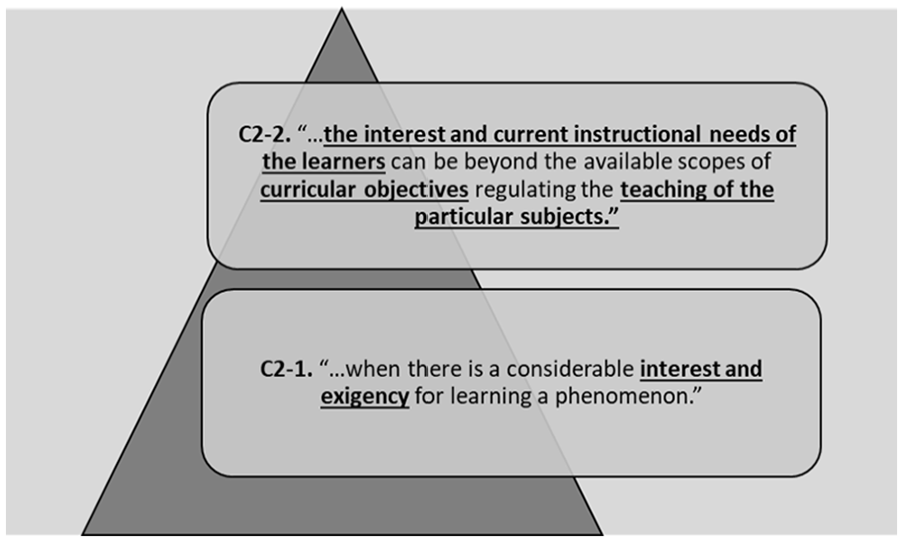
Categories of description-2: Teaching is responding to the structural and emergent needs of learners.
Figure 3 displays the intra-hierarchical relations between the first (C2-1) and second (C2-2) conceptions. The PTs believed that teaching is more achievable when individuals develop an interest in learning. However, for the first teaching conception, the PTs did not provide details concerning how the learners’ interests should be captured. Such experience was therefore focused only on the learner/individual, not on the teaching or instructional ways of grasping a learner’s interest while learning a particular idea.
“First of all, everyone learns according to their own needs. For example, I may need math; therefore, I want to learn math. If I need English, I learn accordingly. At the outset, you need it. For example, there is a broken faucet in the house. You investigate to learn to repair it because I am more motivated to learn what I need at that time. This is more helpful.” (C015, Female, Classroom Teaching)
Exigency was another aspect of the first conception (Figure 3; see also the explanation of C015), reflecting the experiences of the PTs that a teaching process can be triggered if students need new knowledge/skill. However, similar to the interest conception, the PTs failed to explain how the students could be encouraged to learn or did not attach the individual-led conception to the teaching phenomenon.
“For example, I discussed equality and justice with my students in one of my practicum classes, and the discussion went elsewhere. But I could not stop this discussion because the students wanted to discuss it. I just wanted to have these justice and equality discussions for humans, but the students also wanted to discuss animal rights through zoos because, unfortunately, they had watched the cruelty to animals in a zoo in the news. So, I could not prefer to stop arguing that with my students.” (P113, Male, Classroom Teaching)
For the C2-2 (Figure 3), the PTs externalized a broader conception of teaching. The PTs conceptualized that the needs of the students may not be under the prescriptively defined curricular outcomes that they use to adjust and designate the teaching topics. Within the C2-2, the PTs experienced a distinction between the student-led instructional needs and the predetermined scopes of the curricular purposes. Therefore, there is an explicit link between individual-led interest/instructional needs and the teaching phenomenon presented by the PTs. Regarding dialogical teaching, the C2-2 implies that the difference between the curricular outcomes and students’ needs, such as their differentiating or alternative mental schemes or experiences about a curricular topic, should be considered to design the teaching activity (e.g., P113).
Categories of Description 3: Teaching is taking individual differences and group-based needs into account while planning, designing, and implementing instruction
Within this description, the PTs emphasized individual differences and group-based needs in organizing a teaching activity (Figure 4).

Categories of description-3: Teaching is taking individual differences and group-based needs into account while planning, designing, and implementing instruction.
With the C3-1 (Figure 4), the PTs acclaimed that students may have some intellectual limits to successfully capture a curricular topic and its intentions. The PTs commented that the flow of a teaching activity could be determined or adjusted with the students’ intellectual restrictions that can be emerged randomly during a lesson. As externalized within the below-located quote, D088 conceptualized that within a specific moment of her teaching, she realized that students had no adequate understanding of the climate term. This automatically modified the streaming of the lesson. Regarding dialogical teaching, it seems that D088 tried to consider her group’s prior understanding as an alternative point of view but as an intellectual restriction to continue the lesson. D088 might prefer to continue teaching-by-telling by delivering content about the climate. However, as she declared, she preferred considering the conceptual difference as an intellectual limitation or restricted breadth of awareness embedded in her students’ existing mental schemes requiring re-adjusting the lesson flow.
“In a class where we talked about weather events… But before I prepared the course content, I also looked at the curriculum. The students did not know much about the season. This severely limited my activity. I did not know what to do at that moment since I aimed to teach climates. So, I got a little confused. I brought the topic back to weather events, and we just discussed seasonal changes. Then I checked the curriculum, and there was a warning in square brackets such as “the climate term is not mentioned in this unit.” (D088, Female, Classroom Teaching)
For the C3-2, contrary to the C3-1, the PTs perceived the students’ mental restrictions as a starting/triggering point to plan the teaching activity. The difference between the C3-1 and C3-2 is that with the C3-1, the PTs conceived the students’ prior mental schemes as a limitation for a teaching activity. The PTs with the C3-2 experienced the teaching by utilizing the students existing conceptual understanding as a triggering point to re-direct the lesson’s flow. The below-located interpretation from L032 shows that taking individual differences or group-based needs into account may enrich the teaching activity rather than constrain the teaching activity.
“That is the rule: enrich your instruction with multiple methods and techniques to create a positive instructional climate. I expect the students to understand the diversified issues in their own lives. I finish the lesson with an assessment students can associate with their life. While evaluating the lesson, I expect the students to express themselves in their own words rather than remembering the monologues. I do not exclude the background knowledge my students bring to class but use them to enrich the content.” (L032, Female, Classroom Teaching)
According to the PTs, the limited (C3-1) or alternative (C3-2) reasoning/thinking patterns embedded in the students’ mental schemes should be considered for planning and operating teaching. However, C3-1 and C3-2 do not include a concrete teaching idea as an instructional recommendation, as found in C3-3 (Figure 4). As exemplified in the below-located interpretation of a participant, the PTs reported that teaching should embody an instructional diversification in the sense of inevitable individual differences or group-based needs, in which there may be an interaction between aptitude (students and learning) and treatment (teachers and teaching).
“When I try to talk about the same topic with my students at the same grade levels, I think and believe each class or each student has a different harmony. So, a teacher should always have a plan B and plan A. Unfortunately, the images and videos I chose with my advisor while discussing the dilemma of justice and equality did not attract my students’ attention. They also made good interpretations, but the discussion did not reach our intended point. Afterward, I explained the Heinz Dilemma. I narrated it a little bit by storytelling. How a thief saves his wife’s life makes him a hero, had aroused the students. But videos and images about justice and equality worked very well in another group. I think it depends on the group.” (C118, Male, Classroom Teaching)
Categories of Description 4: Teaching is individual construction and social co-construction of knowledge
As seen in Figure 5, the C4-1 and C4-2 imply the PTs’ teaching conceptions in terms of individual construction of knowledge. The other two, the C4-3 and C4-4, are more attached to the socialized ways of the co-construction of knowledge.
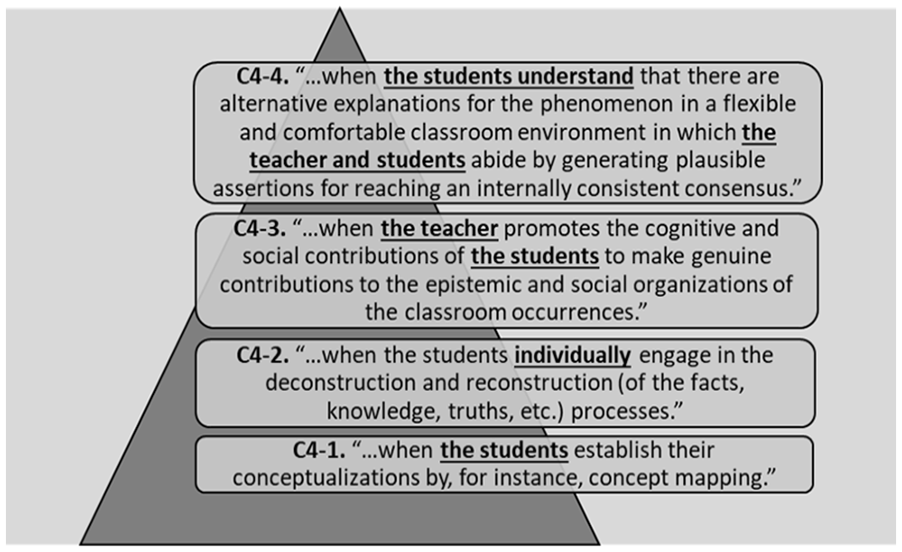
Categories of description-4: Teaching is the individual and social construction of knowledge.
The PTs described that teaching is more related to conceptualizing a topic. It is how an individual may form his/her concepts during teaching. For the C4-1, the PTs explained the teaching phenomenon with the concept formation term. Furthermore, the PTs provided cognitively instrumental ways of teaching via concept forming, such as mapping out the concepts (e.g., F023).
“What should a person undertake if s/he wants to learn a subject? I was a student who could not learn in class. I had trouble in school. I was a student who could not learn in the classroom system. So, I developed a concept map or something else. I figured out how I could learn. For example, when a teacher comes and tells me, “Learn this!” I cannot. They must free me. I will draw the concept map. I will write on my own. I will draw. Of course, I will come to the same conclusion. No other person captures the concepts embedded in my concept mapping. Perhaps, for others, this is a ridiculous idea. But I do understand it. When I do this, everything is resolved for me. Now, I have learned those concepts myself.” (F023, Female, Mathematics Teaching)
In the C4-2, the PTs referred to the specific aspects of teaching, such as facilitating the deconstruction and reconstruction of individually organized mental schemas. This is connected to the Piagetian teaching concepts, such as cognitive development as equilibrium, assimilation, and accommodation (Piaget, 1971). According to the PTs, teaching is to scaffold individually-led cognitive processing where students either deconstruct or reconstruct their cognitive patterns. Thus, these conceptions of the PTs are in harmony with the first wave of constructivism as cognitive/solo constructivism (Miller, 2002); therefore, this can be accepted as more learner-focused.
In dialectical teaching, cognitive deconstruction/reconstruction is a dynamic process where an individual collides with different or contradictory cognitive schemes to reach a novel, broader mental status that may be more explanatory than the previous one in describing, for instance, a curricular concept. For instance, as seen in the below-located quote (T452), it is mentioned that teaching is something to press the students to think and talk about words and their classification in novel ways. As summarized below, the teaching phenomenon is conceptualized as involving the teacher making students dissatisfied with their conceptions of words and categorization. This process can be accepted as dialectical since there is a contradiction or negotiation between the existing conception and teacher-introduced or group-introduced conceptions that seem more intelligible in explicating the task presented by the teacher. In dialectical terms, negation is centralized (Williams & Ryan, 2020), and as externalized below, some students were aggressive since their classification approaches did not meet the criterion, such as covering many words within a single category. Thus, regarding dialectical teaching, the new conception appeared plausible since it could suggest the possibility of a more profound and fruitful grouping of words.
“When I present an idea to my students that they are unfamiliar with, they often do not embrace it first. But when I explain and insist on the idea, things change. For example, we did an activity in the lesson, and we planned it together with my school-based advisor. I gave the students dozens of words with different syllables and letters and asked them to group them. Each group made very different groupings. According to the number of letters, the number of syllables, their similarity, alphabetical order, etc. Then I asked which was the best classification—based on the best classification, which includes the largest number of elements, emerged. Some students were aggressive because their classification did not match it. However, when they reclassified the words according to their meanings, they agreed that this was the best classification method. There was no problem with the vocabulary skills of those children. The important thing was that they reached a new meaning for their classification skills.” (T452, Female, Turkish Language Teaching)
As seen in Figure 5, the C4-3 displays more expanded ways of knowledge construction terms around the teaching phenomenon. Regarding the PTs’ viewpoints, teaching is more achievable when a teacher permits his/her students to make original intellectual contributions to the content under discussion. Furthermore, as the PTs explained, teaching is more possible when a teacher allows for the epistemic (who knows to legitimize what counts and what does not count as a tangible contribution) and social (when and how students can participate in the discourse and take part in interactions) contributions of the students to the classroom interactions and exchanges. However, for the C4-3, the PTs did not account for how a teacher might allow the epistemic and social contributions of the students.
“I think there is no teaching. One can never learn with teaching, not with someone else’s teaching. We must be together to learn. Not with someone’s teaching. To benefit from learning, we need to transform the context we live in while it is transforming us. Teaching is not a learning tool for people. The teaching can only be used for animals. I think everyone in a class is a typical learner. Learning occurs when there are only learners in a class. For example, a teacher sees himself as a learner, so everyone has equal authority. Students learn not only from this teacher but from all the learners, including the teacher, by exploring and questioning together. Learning is the process of questioning within a group. Imagine a class. Everyone is independent and a collaborative researcher. All learners are trying to lead each other to ponder the topics. The teacher constantly asks questions, gives clues, and creates instructional diversity. There are alternative answers in this class, not true-false answers.” (S513, Male, Mathematics Teaching).
The above-stated conceptual gap seems to be closed in the C4-4. Based on the PTs’ expressions (e.g., S513), in terms of dialectical teaching, co-construction of knowledge is feasible when a teacher convinces students that there may be alternative or competing assertions about the topic. Furthermore, the PTs mentioned that for handling the teaching in the classroom, a teacher has to create an argumentative/evaluative or dialectical classroom context where the students and teacher work together to generate more explanatory and exploratory arguments to progress toward an intellectual-social consensus within an intellectually flexible and comfortable classroom setting (e.g., S513). These conceptions follow the second wave of constructivism as in Vygotskian constructivism, covering the intentional, productive, and dialectical reciprocal in-class interactions and exchanges of the less and more knowledgeable others, thus embracing both the teacher and the students.
Discussion
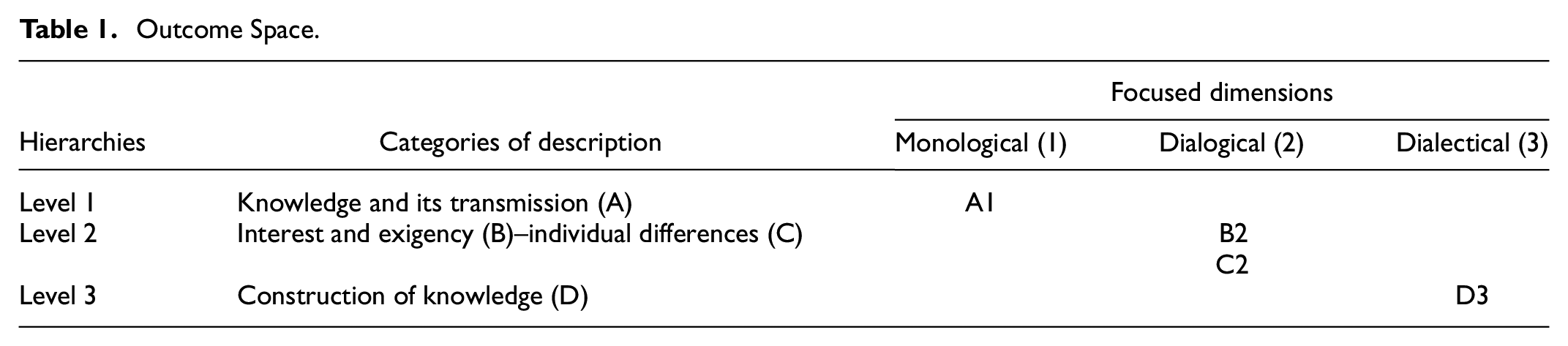
An outcome space (Table 1) was created to show the structural and hierarchical relationships between the description categories. Table 1 displays the focused dimensions of the phenomenon as monological, dialogical, and dialectical. Observing monological conceptions of teaching confirms that the PTs are still exposed to conventional university-based teaching in Turkish. Detecting a monological dimension within the PTs’ teaching conceptions indicates traditional teacher preparation as the diffusion of information from educators to the PTs. This finding is compatible with Leon-Carillo’s (2007) knowledge-source concept, Fox’s (1983) transferring concept, Gurney’s (1995) delivery concept, Hadar’s (2009) school learning concept, or Radmard et al.’s (2022) knowledge transmission modes of teaching domination resulting in negative experiences reported by schooling participants from elementary to secondary levels.
Outcome Space.
It is also observed that the PTs experienced and conceptualized broader dimensions of teaching, such as dialogical and dialectical. These two conceptual aspects are highly compatible with the current state of Turkish teacher preparation strategy and policy, which include the implications of the learning theories and educational practices of Piagetian individual constructivism and Vygotskian social co-constructivism (Soysal & Radmard, 2017). Therefore, the current study tries to open up a discussion implying that the Turkish teacher training system should move forward to guide future PTs to recognize rather sophisticated dimensions of teaching phenomenon such as adaptive-pragmatic teaching and reflective teaching in the new era of teacher preparation.
Two dimensions of teaching phenomenon, such as adaptive-pragmatic and reflective, were absent in the PTs’ experienced-based conceptions of teaching. The outcome space (Table 1) implies that the PTs experienced sophisticated ways of teaching phenomena, such as dialectical teaching, in their university-based educational journey. However, some other more sophisticated teaching experiences, such as adaptive-pragmatic or reflective, are still invisible in the expressions of the PTs. Thus, in this study, it is questioned why the PTs held a version of partial understanding of teaching. Furthermore, some recommendations are offered for expanding PTs’ experiences with more elaborated aspects of the teaching phenomenon.
First, understanding adaptive-pragmatic teaching includes routine and adaptive expertness (Stylianides & Stylianides, 2014). In the context of the present study, routine expertness incorporates three aspects of the teaching phenomenon reported by the PTs (Table 1). As understood from the PTs’ expressions, monological, dialogical, and dialectical aspects of teaching were experienced in a routinized manner. However, adaptive-pragmatic teaching incorporates adaptive expertise showing another version of understanding teaching, which is more situative, contextual, and dynamic. The PTs might not experience a version of adaptive-pragmatic teaching as it is needed considering both structural and emergent qualities of a teaching process concurrently. Bohle Carbonell et al. (2014) asserted that for an adaptive-pragmatic teaching process, PTs should be guided and scaffolded to experiment, make errors, and try different solutions to generate a dynamic-situative-contextual knowledge base for teaching action. As seen in some expressions (e.g., C118), the PTs seemed to experience enacting different teaching plans when needed. However, adaptive-pragmatic teaching is far beyond a teacher’s “current level of reliable performance - ideally in a safe learning context” (Ericsson, 2014, p. 192). Thus, for an adaptive-pragmatic teaching conception, PTs should experience generating a situative-dynamic teaching tool kit by viewing teaching “not only as a resource for learning to teach but as a central element of learning to teach” (McDonald et al., 2014, p. 500).
Like many other countries (e.g., Forzani, 2014), in the Turkish context, teacher preparation reforms are primarily gathered around a set of normative principles, including mostly dialogical and dialectical aspects of in-class teaching, which are characterized by specific instructional actions such as eliciting student thinking, orchestrating group work, collective argumentation, informal reasoning, etc. (Soysal & Radmard, 2017). Thus, the PTs might experience mainly the dialogical and dialectical dimensions of teaching, as diagrammatized in Table 1. On the other hand, Anthony et al. (2015) advocated that for an adaptive-pragmatic teaching experience, PTs should be pressed to consider what they are doing concerning aspects of teaching practice. One of the most instrumental ways of inviting PTs to experience a version of adaptive-pragmatic teaching is to provide learning opportunities where PTs make critical, data-based reflections on their in-class performances by promoting their metacognitive and self-regulated inferences about what aspects and how-aspects of teaching phenomenon (Timperley, 2013). In terms of the outcomes of the present study, it can be inferred that the participating PTs had no chance of being engaged in an adaptive-pragmatic teaching experience, which was an absence in their conceptions.
During the phenomenographic interviews, there were countless attempts to elaborate on the PTs’ teaching conceptions; however, they made no experienced-based attributions to the reflective side of the phenomenon. Classroom events might not occur as PTs intend. Beyond, in-class teaching incidents can mostly happen spontaneously, as that is the nature of classrooms. Thus, teachers’ pedagogical decisions and related actions should be changeable within seconds due to the emergent teaching qualities. Therefore, it should be accepted that teaching action requires dealing with micro-moments (Mameli & Molinari, 2013); however, this requires tremendous intellectual efforts associated with a different understanding of teaching, such as reflection-in-action, which was not observed in the PTs’ documentation.
Reflective teaching is about what a teacher sees when s/he looks at the teaching-related events in his/her classroom or another teacher’s and how much s/he interprets them instructionally (Van Es & Sherin, 2021). PTs are recently expected to conceptualize teaching phenomenon as an activity to select, analyze, and interpret the critical and unimportant situations that arise during teaching a subject (Van Es & Sherin, 2021). Teaching as inquiry is the state-of-the-art conception of teaching (Moeed & Cooney, 2021), implying that developing an excellent understanding of teaching demands studying the self as a prospective teacher. PTs are expected to have a broader teaching conception, such as problematizing, monitoring, analyzing, and interpreting their in-class actions. However, this higher-order aspect of teaching experience was not detected in the participating PTs’ expressions.
One method of developing an understanding of reflective teaching is inviting PTs to self-explore or self-study themselves (or others) through forming personal teaching stories and narratives. Recent systematic reviews (e.g., Chan et al., 2021) show that PTs can be engaged in reflective teaching practices in different ways: (i) by asking PTs to share their reflections after enacting lessons in a typical practicum course, (ii) using artifacts of other teachers’ practices (e.g., specific instructional cases, specifically prepared video clips, and transcripts of lesson videos) to stimulate PTs to make reflections on the teaching activities, or (iii) asking PTs to share their noticing after observing others’ teaching. Expectedly, having a version of reflective teaching would require engaging in the above-listed activities of learning how-to-teach to develop teaching conceptions in the sense of reflective practice. However, during the interviews, the PTs did not tend to share an experience of reflection-in-action regarding the teaching phenomenon. This also implies that the educators of the participating PTs might not have an endeavor to guide them to make data-based reasoning and revisions on their initial or trial in-class performances (Eret-Orhan et al., 2018). Consequently, the PTs might not understand teaching as a reflective public performance.
Final Comments and Educational Remarks
This study concludes that at least the participating PTs still held limited conceptions regarding the teaching phenomenon. In global terms, Cochran-Smith et al. (2015) conclude that there is ample research on how PTs learn to reflect on, inquire into, and learn about changing classroom situations. However, some Turkish teacher educators (Günel & Tanriverdi, 2014; Soysal & Soysal, 2022) claim that adaptive-pragmatic teaching is an infrequent practice, for instance, regarding classroom talk, in the context of teacher preparation. Instead, teacher educators see the teaching phenomenon as an intellectual activity where PTs “must understand, adapt, and modify practices so they are fine-tuned to local histories, cultures, and communities.” (Cochran-Smith & Villegas, 2015, p. 390). This is mostly about developing a breadth of teaching conception, such as adaptive-pragmatic teaching, that was absent in the jargon of the participating PTs.
It is highly recommended that Turkish teacher educators should ask questions about “how and under what conditions teacher candidates learn the complex skills of teaching as part of developing a reflective practitioner stance.” (Cochran-Smith & Villegas, 2015, p. 390). However, some Turkish teacher educators (Günel & Tanriverdi, 2014; Soysal & Soysal, 2022) contend that reflective practice is a sporadic practice among Turkish teacher educators. Expectedly, in the context of the present study, the teachers of the participating PTs might not guide them to experience and conceptualize somewhat different breadthways of seeing the teaching phenomenon.
It should be noted that this is not a localized issue as teacher educators’ conceptions of teaching and related in-class teaching actions regarding teaching and how aspects of teaching remain uncharted territory (Vanassche et al., 2021). It would, therefore, not be fair to expect PTs to externalize rather sophisticated experience-based conceptions of teaching in the absence of teacher educators adopting an aspect of adaptive-pragmatic or reflective teaching practices for teaching how-to-teach. Furthermore, it is globally accepted that teacher educators are a community that has not yet been professionally researched. This is the mystery of higher education teaching how-to-teach (Darling-Hammond, 2020). This situation poses a severe pedagogical obstacle to the preparation of teacher educators (Darling-Hammond, 2020). In this context, the current study’s outcomes suggest that teacher educators’ conceptions of teaching should be re-considered and re-analyzed to test whether they hold complex aspects of teaching phenomenon such as adaptive-pragmatic or reflective. However, it should be noted that re-analyzing teacher educators’ teaching conceptions by considering simplified conceptual categorizations (teacher-centered vs. student-centered), a tenet observed in the previous studies, will not be informed in comprehending what they experience and conceptualize about sophisticated layers of teaching phenomenon. Thus, the current study’s structural-hierarchical thinking tool can investigate how-aspects and what-aspects of teacher educators’ conceptions of teaching before scaffolding PTs to develop an excellent and globalized understanding of teaching.
Footnotes
Declaration of Conflicting Interests
The author(s) declared no potential conflicts of interest with respect to the research, authorship, and/or publication of this article.
Funding
The author(s) received no financial support for the research, authorship, and/or publication of this article.
Ethical Approval
A university committee of research ethics approved this study. Study reference number: 2022/11
