




Abstract
This study explores the adoption of cryptocurrency, specifically Bitcoin, in the Philippines. The authors argue that current behavioral prediction models, such as TRA, TPB, and TAM, do not adequately account for the affective constructs of decision-making when high monetary stakes are involved. To address this gap, the authors propose an integrative model that accounts for financial decision-making processes, risk constructs, and population-specific behavioral strategies. The study used a quantitative-based research design and involved 684 university students from one of the major state universities in the Philippines. The findings show that perceived usefulness, attitude toward cryptocurrency, self-efficacy, and descriptive norms significantly influenced the intention to adopt cryptocurrency. Overall, the study confirms the direct influence of instrumental attitude, knowledge of cryptocurrency, descriptive norm, risk tolerance, ease and difficulty, and control on an individual’s intention to use cryptocurrency. The study contributes to exploring a less studied Philippine consumer base and provides empirical findings and insights into Bitcoin adoption in developing Asian economies.
Introduction
Cryptocurrency has emerged as a dominant financial technology due to its unique features and advantages over other payment methods. According to Philippas et al. (2019), peer-to-peer transactions in real-time across borders and low transaction costs are some of the most significant features of cryptocurrencies. These attributes have made cryptocurrencies appealing even in developing countries where mobile money is used. As a result, the adoption of cryptocurrency is rapidly increasing.
However, cryptocurrency adoption is still limited due to a lack of widespread acceptance. Hemantha (2021) argues that the future growth of cryptocurrency depends on its adoption rate. Several rational choice models, such as the theory of reasoned action (TRA) (Ajzen & Fishbein, 1980), the theory of planned behavior (TPB) (Ajzen, 1991), and the technology adoption model (TAM) (Davis, 1989), have been used to investigate the factors influencing cryptocurrency adoption. These models assume that consumers weigh the costs and benefits of different options before deciding. Since cryptocurrency is still optional for most consumers, these models seem to fit well in the context of cryptocurrency adoption.
Blockchain technology has transformed social and economic relationships and financial processes, making cryptocurrency a widely accepted asset class. Kim (2021) argued that the psychological characteristics of an asset class, rather than its perceived technological aspects, should be investigated to determine consumers’ willingness to buy and use Bitcoin. Thus, traditional models like TAM may not be sufficient to explain adoption intention, especially when considering affective constructs that may significantly impact financial decision-making.
Scholars have suggested that the correlations between the dimensions used in models like TRA and TPB do not fully capture the affective constructs that significantly impact decision-making, especially when high monetary and financial stakes are involved. Therefore, models that account for differences in salient beliefs across populations and behavioral choices of interest must be developed to explain cryptocurrency adoption intention. It is also essential to consider the variations in individual conditions across different cultural and economic backgrounds when developing a model to explain adoption intention.
The authors believe investigating the intention to adopt cryptocurrency should not be solely perceived as a technology adoption construct. Instead, explaining and predicting the intention to adopt cryptocurrencies should integrate an asset’s psychological and affective characteristics with the population-specific behavioral and decision-making process (Sankar, 2019). Thus, the study proposes examining integrative models of change behavior in the intention to adopt cryptocurrency while incorporating risk and knowledge of cryptocurrency in the model. The contribution of this study can rationalize twofold. First, to the best of the researchers’ knowledge, this is the first attempt to integrate financial decision-making processes, such as risk constructs and population-specific behavioral strategies, into a model to explain and predict cryptocurrency adoption. Second, the study contributes to exploring a less studied Philippine consumer base. This research will provide recent empirical findings and insights into Bitcoin in developing Asian economies like the Philippines.
Background
Cryptocurrency Adoption in the Philippine Context
By the start of 2020, the growth of cryptocurrency in the Philippines has steadily gained attention. According to a report by YCPS Marketing & Communication Group (2021), while India and China are taking steps to discourage cryptocurrencies and associated activity, others, including Vietnam, Cambodia, Indonesia, and the Philippines, are seizing the chance to grow their stake in the financial technology sector. As a result, the overall number of domestic cryptocurrency transactions increased by 36% from January to September 2020, jumping from 5.3 to 7.2 million, pushing the Philippines to rank number three in Bitcoin usage, trailing only Nigeria and Vietnam (Vetrichelvi & Priya, 2022).
Consequently, England (2021) confirmed that traditional portfolio managers must consider placing Bitcoin and crypto assets in their asset choices even though the Philippines’ fintech industry is still in its early stages and thus requires crypto-supporting platforms and more significant government and regulatory backing. However, the observed optimism does not seem to translate at the individual level. The Philippines came in 17th in cryptocurrency awareness using Bitcoin-related search phrases, trailing Nigeria, South Africa, Kenya, and India (Anand, 2021). Crypto owners only account for 4,360,579 Filipinos, or 3.98% of the population. The Philippines’ acceptance rate of cryptocurrency (0.26%) is significantly lower than other major countries like Russia and the USA (Francisco et al., 2022).
Doblas (2019) attempted to determine the level of awareness and attitude of college students in the Philippines toward cryptocurrency and its possible influence on adoption. The study found that college students in the Philippines are aware of cryptocurrencies and that both awareness and attitude significantly affect adoption (Yasay, 2021). Still, there is much further need to investigate cryptocurrency adoption in the Philippines. In addition, the number of formal studies conducted to explore the level of awareness and intention to adopt cryptocurrency at the individual level in the Philippines is still much to desire (Lucey et al., 2022).
Integrative Models of Change Behavior
Despite the enormous number of behavioral prediction theories, Ajzen and Fishbein (2000) found that only a few variables addressed in predicting and comprehending behavior. Thus, proposing an integrative behavior model should focus on these few variables. According to the integrated model, there are three critical drivers of intention: attitude toward completing the behavior, perceived norms for behavior performance, and self-efficacy in performing the behavior. According to the concept, any behavior is most likely to occur if the person has a strong desire to perform the behavior, possesses the essential skills and abilities to perform the behavior, and is not hampered by environmental or other factors. The likelihood that a behavior will be performed depends on (a) firm commitment (or form a strong intention) to perform a given behavior, (b) having the necessary skills and abilities to perform the behavior, and (c) there are no environmental constraints to prevent the behavior from being performed, the likelihood of the behavior being performed is very high.
Ajzen and Fishbein (2000) suggest that it is crucial to identify the population’s salient beliefs under consideration. Fishbein and Cappella (2006) noted that the integrative model is conscious and sensitive to cultural and population differences that may result in varying response behaviors because it is structured. However, to the researcher’s knowledge, no study has employed this model in examining the intention to adopt cryptocurrency.
Variables of the Theoretical Models
Risk Tolerance
Bitcoins and other cryptocurrencies have garnered worldwide notoriety as a new variant of digital assets that leverages blockchain technology as a medium of exchange (Gil-Cordero et al., 2020). However, as an asset class, cryptocurrency does possess similar volatility and momentum indicators as stocks. Liu et al. (2022) found that value and momentum strategies highly correlate across asset classes. As a result, cryptocurrency analysis and its subsequent strategies may move in lockstep with their equities market counterparts. If this is the case, the intention to adopt cryptocurrency should consider individuals’ risk preferences as it is happening in the equity market.
Abramova and Böhme (2016) quantitatively explored the multidimensional determinants of Bitcoin use, including perceived benefit and risk. The study findings corroborate the widely held belief that a broad group of people is not attracted to bitcoins because of their fluctuating value. In addition, the risk of losing money if service providers’ systems or users’ devices do not work right and the lack of consumer insurance and protection are also deterrents to adoption. The study also found that Bitcoin users are apprehensive about possible regulatory restrictions on the use of cryptocurrency.
Using consumers’ attitudes toward money, Kim (2021) used the theory of planned behavior to investigate the antecedents and behavioral intention to use Bitcoin. The study found that distrust and anxiety, among others, substantially impacted behavioral intention to use Bitcoin. Furthermore, the study findings suggest that the uncertainty and risk associated with cryptocurrency affect consumers’ choice to use the same.
An exploratory study by Smutny et al. (2021) examined the relationship between motivations and barriers to investing in cryptocurrency and risk propensity. The study found that their lack of financial experience generally puts off individuals prone to taking risks. In addition, the respondent’s opportunity to leverage cryptocurrency’s extreme volatility for speculative trading is not a motivation to invest in cryptocurrency.
Knowledge of Cryptocurrency
Arias-Oliva et al. (2021) argued that financial literacy is also essential because it is a sufficient prerequisite for rejecting blockchain technology. Like most financial and economic decisions, the intention to adopt is highly associated with an individual’s knowledge about the subject. Using financial advisors, Stolper and Walter (2017) demonstrated that literacy in understanding an asset works increases the propensity to demand it. In addition, the same study even asserted that the competence of the individual could withstand exiting or providing information, thereby lessening the like hood of just following what advice or what existing recommendations are available.
Some researchers, like Arias-Oliva et al. (2019), explored the concept of literacy in adopting cryptocurrencies. The study found that financial literacy does not influence the adoption of cryptocurrency. They explained that a consumer’s level of financial literacy might allow the individual to choose other better investments based on available information. This construct, however, focuses solely on the financial aspect of cryptocurrency. As discussed earlier, cryptocurrency adoption must incorporate the technological and economic elements of the subject of interest. Thus, the authors believe that assessing the knowledge about cryptocurrency is a better predictor of adoption than financial knowledge. (Doblas, 2019) found that cryptocurrency awareness is a significant factor in the intention to adopt cryptocurrency.
Attitude
Attitude, which refers to one’s feelings toward a particular behavior, is a predominant factor in all behavioral adoption models (Davis, 1989). However, attitude divides into instrumental and affective components in integrative models of change behavior. French et al. (2005) explained that affective attitude refers to the emotions and motivations elicited by the potential of engaging in the behavior, while the instrumental component of attitude, on the other hand, relates to a more cognitive examination of the amount to which engaging an activity might be beneficial. Therefore, considering attitude in this perspective captures the psychological and affective characteristics of adopting cryptocurrencies.
Consequently, Hwang and Moon (2019) categorically points out that cryptocurrency could provide a unique experience that feeds the desire for enjoyment. The pleasure of relatively new technology could elicit the willingness to adopt cryptocurrency. Nadeem et al. (2021) later confirmed this observation in a study conducted in China. Their study found that perceived enjoyment in cryptocurrency increases the intention to repurchase bitcoins. This observation suggests that attitude toward cryptocurrency is both psychological and emotional. Thus, the following hypotheses were derived;
H1: Instrumental Attitude significantly affect intention to adopt cryptocurrency.
H2: Affective Attitude significantly affects intention to adopt cryptocurrency.
Social Norms
Intimate groups, social groups, communication, and public opinion are all social elements that influence people’s motivation and attitudes toward various behaviors (Cheng et al., 2019). Social influence or norms generally affect cryptocurrency adoption in two ways. First, cryptocurrency adoption may result in social affirmations of personal achievement or prestige and the ability to recognize it as an efficient payment transaction among influential social groups (Kim, 2021). On the other hand, the opinion of others, especially family members, friends, and other influential consumers, may affirm the security of using the technology (Hwang & Moon, 2019), thereby eliciting trust and desire to adopt the technology.
The influence of social norms resonates with the (Abramova & Böhme, 2016) observation that due to its decentralized feature, social consequences, mainly the function of subjective criteria, must be considered while analyzing Bitcoin adoption and use. Consequently, when an individual sees how other members of society gain from Bitcoin in terms of social, economic, and individual benefits, their belief in the technology grows, leading to the adoption of the technology (Yoo et al., 2020). The study will not consider the social norm one-dimensional to increase explanatory power. Therefore, social norms will not regard as one-dimensional in this study. Instead, it will adopt the definition of an integrated model, covering both injunctive and descriptive norms. An injunctive example is how others feel about whether or not the research should carry out the target behavior. In contrast, the explanatory model refers to one’s perspective on whether or not others perform the intended behavior. Thus, the following hypotheses were derived;
H3: Injunctive Norm significantly affect intention to adopt cryptocurrency.
H4: Descriptive Norms significantly affect the intention to adopt cryptocurrency
Self-Efficacy
In the overarching models examined, the sense of how easy or difficult it is to do the goal activity is perceived as behavioral control (Ajzen, 1985). Scholars, however, found that the construct measurements are inconsistent and may even conceptualize as an over-arching predictor that needs further specification. To clarify the ambiguity of perceived behavioral control, the concept was reconceptualized over the years (Ajzen, 2002) to include self-efficacy and controllability. Pertl et al. (2010) noted that properly construed self-efficacy is the ease of performing a behavior and the confidence one possesses in behaving as desired. In addition, controllability was also constructed as an interrelation to perceived self-efficacy.
Alqaryouti et al. (2020) conducted a study to analyze the association between perceived benefits and behavior on cryptocurrency use by involving twenty-five individuals specializing in cryptocurrency. The study found that an induvial perception of ease of use is directly associated with cryptocurrency’s behavioral usage. In addition, Abramova and Böhme (2016) hypothesize that consumers regard Bitcoin as a complex and incomprehensible system that necessitates a significant amount of learning effort, particularly during the early stages of adoption. Therefore, perceived ease tends to be a significant predictor of adoption.
By examining the moderating effect of an individual’s exposure to a digital token, Huang (2019) found a significant association between experience and the tendency to hold cryptocurrencies. Individuals who have gained confidence through their experience with digital money are more likely to use and store cryptocurrencies.
A person’s perspective of technology is positive when they have a high level of optimism or control over it and are more inclined to pioneer its usage. In addition, Sobhanifard and Sadatfarizani (2019) noted that cryptocurrencies like Bitcoin technology are still in their infancy. As a result, technological discomfort caused by the uncertainty and lack of control over how the technology might develop over time may lead to the attractiveness of adopting cryptocurrency. On the other hand, the lack of control over the outcome of a technological application may lead to the deterioration of the intention to adopt. Trying new ideas necessitates taking calculated risks (Connolly & Kick, 2015). Thus, the authors derived the following hypotheses;
H5: Confidence significantly affects intention to adopt cryptocurrency.
H6: Ease and Difficulty significantly affect intention to adopt cryptocurrency.
H7: Control significantly affects intention to adopt cryptocurrency.
Mediation of Variables
The direct effects of the mentioned variables in the previous section do not limit the possibility of recursive relationships among constructs. Behavioral processes represent a complex psychological and affective behavioral and decision-making process. The perspective would imply that some of the variables, especially the main components of the behavioral model (attitude, social norms, and perceived self-efficacy), may be mediated by other latent variables, such as knowledge of cryptocurrency and risk appetite when it comes to influencing one’s intention to adopt cryptocurrency.
To illustrate, a study by Al-hussaini et al. (2019) found that consumers constantly seek a safe reputation against attackers from users with reliable experience of trust network authentication like blockchain technologies. Thus, cryptocurrency’s integration of robust public disclosure, immutability, and consensual agreement of the transactional data record mitigates the perceived risk of new technology. Similar findings of mediating tendency were found by Nuryyev et al. (2021) and Khan et al. (2017) in their studies of payment systems in hotels and banking sectors, respectively. These led the authors to argue that risk tolerance could significantly aid social influence and networks using blockchain and cryptocurrency.
According to research by Abbasi et al. (2021), roughly half of the respondents who have a solid understanding of cryptocurrencies facilitate the circumstances that impact the mentality that emphasizes the adoption of cryptocurrencies. On the other hand, there is an assumption that an individual’s motivation to adopt new technologies in the digital market depends on how well they comprehend how the system would help them accomplish a specific outcome (Miraz et al., 2022). Hong et al. (2020) demonstrated that knowledge mediates behavioral intentions in career and financial decisions and found a similarly positive role. The researcher developed the following hypotheses/paths and research framework based on the earlier studies.
H8: Knowledge of cryptocurrency significantly mediates the effect of Instrumental Attitude, Affective Attitude, Injunctive Norm, Descriptive Norm, Confidence, Ease and Difficulty, and Control on the intention to adopt cryptocurrency.
H9: Risk Tolerance significantly mediates the effect of Instrumental Attitude, Affective Attitude, Injunctive Norm, Descriptive Norm, Confidence, Ease and Difficulty, and Control on the intention to adopt cryptocurrency.
Data and Research Methods
Research Design and Sampling
The study utilized a quantitative-based research design using the structural equation modeling technique to assess the significance of the hypothesized paths and relationships and evaluate the fitness of the integrative behavioral models tested. The study involved 684 university students from one of the major state universities in the Philippines. The instrument was administered online across the university’s satellite campuses, including its main campus.
Instrument
A structured survey questionnaire was used as a data-gathering tool based on previously published studies. The questionnaire comprises five parts. The first part contains five items to assess the respondents’ knowledge of cryptocurrency. The second part includes four items that evaluate the respondents’ risk tolerance. All expressions are on a seven-point semantic differential scale.
The attitude toward cryptocurrency was assessed through six statements-response: “For me, adopting cryptocurrency in the next few years will be. “The items in the questionnaire incorporate the assertion of Fishbein and Cappella (2006) to incorporate the essential elements of the behavior, especially time (in the next few years), to capture the salient characteristics of the behavior being studied. Among the six responses, three of them were used to measure participants’ instrumental attitude toward cryptocurrency by semantic scales “useful vs. useless,”“wise vs. foolish,” and “beneficial vs. harmful.” The other three measures the participants’ affective attitude by using comparative semantics such as “enjoyable vs. unenjoyable,”“pleasant vs. unpleasant,” and “interesting vs. boring.”
On the other hand, Social Norm was captured using four indicators. Two cover injunctive norms, while the other two are designed to assess descriptive norms. All four utilized differing semantics of “strongly agree vs. strongly disagree.” Six items were used regarding elf-efficacy, with two for confidence, perceived ease and difficulty, and controllability. Finally, the intention to adopt cryptocurrency was assessed using three items on a seven-point semantic scale—the same scales were adopted from the works of Fishbein and Cappella (2006).
Analysis
After the data is analyzed using STATA 14. The analysis used Structural Equation Modeling (SEM) to holistically examine the integrative models proposed based on the suggested theoretical constructs. The analysis was carried out using SEM. The technique analyzes the cause-and-effect relationship of variables in mixed hypotheses based on statistical dependence by combining multivariate statistical techniques. The model fit was evaluated using fit indices based on the Chi-Square criterion, Bentler-Bonett Index, or Normed Fit Index (NFI).
Results
The variables’ descriptive statistics (mean, standard deviation, minimum and maximum values, and correlations between variables) are presented in Tables 1 and 2.
Descriptive Statistics of the Variables Used in the Models.

Correlations Belonging to Variables Used in the Model.

Note. KC = Knowledge of cryptocurrency; RT = Risk Tolerance; AI = Attitude-Instrumental; AA = Attitude-Affective; NI = Norm-Injunctive; ND = Norm-Descriptive; SECF = Self-Efficacy – Confidence; SEED = Self-Efficacy – Ease and Difficulty; SECN = Self-Efficacy – Control; IAC = Intention to Adopt.
*Significant at .10.
The descriptive statistics show that most variables are within similar mean ranges except for both components of attitude (affective and instrumental). On the other hand, the lowest mean can be observed in Self-Efficacy – Control. Finally, except for self-efficacy, standard deviation values are relatively similar across all variables, exhibiting the lowest data dispersion.
In Table 2, control is the only variable not correlated to the knowledge of cryptocurrency, risk tolerance, and injunctive norms. In addition, the latter is also not significantly correlated to risk tolerance.
Measurement Model
Structural equation modeling (SEM) evaluated the proposed integrative model. The analyzed model involved ten latent variables– Knowledge of cryptocurrency (KC); Risk Tolerance (RT); Attitude-Instrumental (AI); Attitude-Affective (AA); Norm-Injunctive (NI); Norm-Descriptive (ND); Self-Efficacy – Confidence (SECF); Self-Efficacy – Ease and Difficulty (SEED); Self-Efficacy – Control (SECN); Intention to Adopt (IAC). As seen in Figure 1, both mediators (KC and RT) have factor loading above 0.70, ranging from 0.826 to 0.891 for KC and 0.713 to 0.774 for RT. On the other hand, the explanatory variables (Attitude-Instrumental, Attitude-Affective, Norm-Injunctive, Norm-Descriptive, Self-Efficacy – Confidence, Self-Efficacy – Ease and Difficulty, Self-Efficacy – Control) also have factor loadings above 0.70 (with the exception of one loading factor for NI) with AI = 0.897 to 0.918, AA = 0.945 to 0.945, ND = 0.932 to 0.946, SECF = 0.935 to 0.942, SEED = 0.882 to 0.897, and SECN = 0.935 to 0.942. Finally, the effect variable (Intention to adopt cryptocurrency) also has loading factors above 0.70 (except one factor) ranging from 0.935 to 0.941. The factor loadings above .70 suggest that the designed factors capture sufficient variance to measure each variable. According to Hu and Bentler (1999), social science studies should not discard an item if the loading is less than .70 because doing so would not guarantee an increase in the ratio between variance captured by a construct and variance resulting from measurement error.

Framework of the study.
Table 3, on the other hand, shows the latent factors’ Cronbach alpha and AVE. All constructs have an alpha value higher than .70, as can be seen. All AVEs are also higher than 0.50. The outcomes also demonstrated that, with all AVE values higher than 0.50, all constructs statistically converge to reflect the underlying construct. This finding would imply that the analysis model’s assessment is internally consistent.
Construct Validity and Reliability

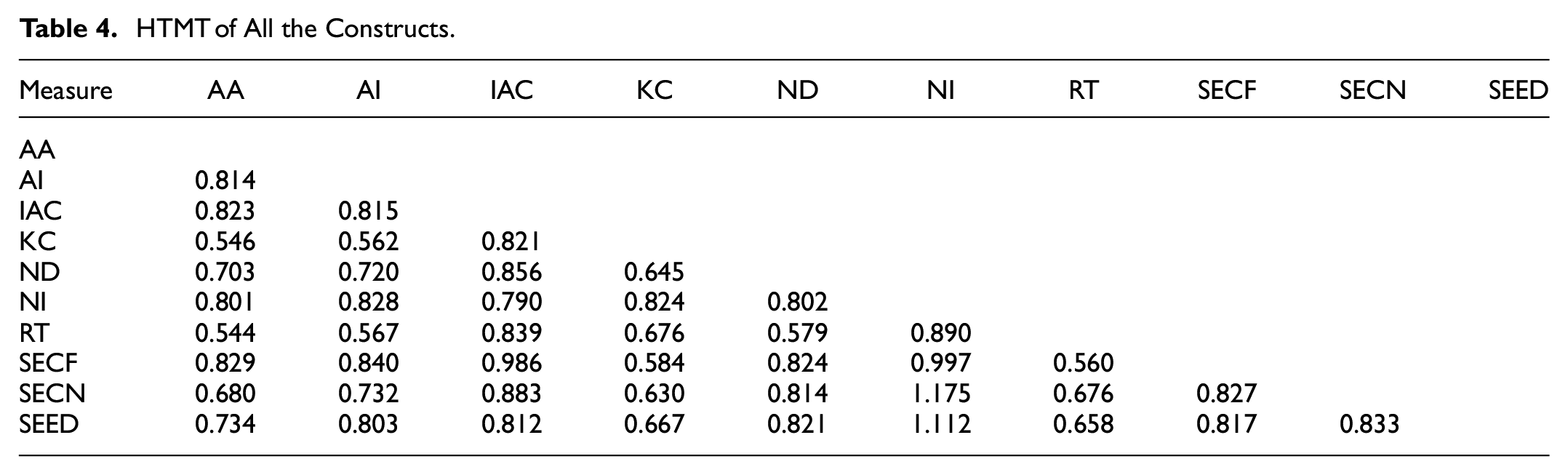
All measurements statistically show discriminant validity, according to the HTMT results in Table 4 above. (All values are lesser than 0.90). According to Henseler et al. (2015), measurements in the model do not all show a lack of discriminant validity when the HTMT is greater than 0.90. In other words, tests designed to analyze other constructs do not correlate with the measurement constructs.
HTMT of All the Constructs.
Last, the model fit was evaluated using fit indices based on the Chi-Square criterion, Bentler-Bonett Index, or Normed Fit Index (NFI). Regarding Figure 2, the model’s study produced SRMR of 0.075, X2 = 3579.27, and NFI of .956. Henseler et al. (2014) state that the SRMR should be less than .10 when used as a goodness of fit measure for PLS-SEM. A value between .90 and .95 is currently regarded as marginal, above .95 is excellent, and below .90 is viewed as a poorly fitting model, according to Wu et al. (2009). Finally, it was determined that the model’s Chi-Square value (X2 = 435.832) was unimportant. However, O’Boyle and Williams (2011) discovered that the Chi-Square test is excessively liberal when variables have non-normal distributions, especially distributions with kurtosis and small sample sizes. (i.e., there are too many type 1 errors). Alternative measurements are, therefore, more trustworthy when evaluating model fit. Consequently, according to the results, the model passed two of the three model fit criteria, demonstrating a good fit.

An integrative model of change behavior (KC, RA, Attitude, Norms, Self-Efficacy to Intention).
Direct Path Analysis
The results show that Instrumental Attitude (AI), knowledge of cryptocurrency (KC), descriptive norm (ND), risk tolerance (RT), Ease and Difficulty (SEED), and Control (SECN) significantly influence the intention of an individual to use cryptocurrency. As seen in Table 5, direct paths from AI → IAC, KC → IAC, ND → IAC, RT → IAC, SECN → RT, SEED → IAC, and SEED → KC were found to be statistically significant at the 5% level. On the other hand, paths ND → KC, NI → KC, NI → RT, and SECN → IAC were statistically significant at the 1% level.
Direct Path Analysis.

Significant at the 5% level; **Significant at the 1% level.
Indirect Path Analysis
Finally, Table 6 summarizes the indirect path of the model under investigation. The results show that among all indirect paths analyzed, only the effect of descriptive norms (ND) on intention to adopt cryptocurrency is significantly mediated by knowledge of cryptocurrency (t = 2.074, p = .039). Considering the significant direct path from ND to IAC observed in Table 5, it could be surmised that knowledge of cryptocurrency partially mediates the influence of descriptive norms on an individual to adopt cryptocurrency.
Indirect Path Analysis.

Significant at the 5% level.
Discussions and Research Implications
The study aims to test an integrative change behavior model that best explains and predicts an individual’s intention to adopt cryptocurrency. By building on the ability of integrative models to capture population-specific behavioral processes and incorporating asset-related constructs like KC and RT, the study was able to determine the best model that mimics the behavior under consideration (Natarajan et al., 2021).
In addition, the study results confirm the recursive relationships among behavioral model components in TRA, TPB, and TAM when models are tested step-wise. The descriptive results of the study showed, among others, that the level of KC about cryptocurrency of college students in the Philippines is fairly above average (4.37/7.00). Furthermore, college students’ attitude toward cryptocurrency is highly positive if the benefit, enjoyment, or challenge associated with cryptocurrency is considered. On the other hand, the level of control tends to be the lowest indicator, suggesting that the consumers in the Philippines are still not sure how they can successfully utilize cryptocurrency. Nonetheless, the overall intention to adopt cryptocurrency was above average (4.49/7.00).
The study results confirm the direct influence of Instrumental Attitude (AI), knowledge of cryptocurrency (KC), descriptive norm (ND), risk tolerance (RT), Ease and Difficulty (SEED), and Control (SECN) significantly influence the intention of an individual to use cryptocurrency. The association of instrumental attitude to adoption reechoes Hemantha’s (2021) findings. The study claimed that the perceived benefits of embracing cryptocurrency technology are a pull factor in the intention to adopt cryptocurrency. Walton and Johnston (2018) were also convinced that the decentralized nature of cryptocurrency and the belief that it is generally acceptable makes the perceived instrumental benefit of cryptocurrency a significant predictor for adoption. The perceived ease, confidence, and control findings are consistent with Alqaryouti et al. (2020). They found that individual perception of ease of use is directly associated with cryptocurrency’s behavioral usage. Similar observations were also found by (Abramova & Böhme, 2016), who posited that consumers have to get over the idea that cryptocurrencies like bitcoins are complex and incomprehensible systems for them to welcome the utilization of same. Moreover, the findings also show that affective attitude and descriptive norm only affect the intention to adopt cryptocurrency if treated alone. Thus, both factors’ influence on cryptocurrency adoption is undermined if associated with other explanatory variables.
Furthermore, the results imply that the KC of cryptocurrency can only influence the intention to adopt cryptocurrency directly if it is associated exclusively with descriptive norms. The result may suggest that the influence of the level of literacy and information about cryptocurrency is best amplified if there is confirmation, both in action and perception, from the social groups and references that an individual significantly considers. The observation supports the study of the assertion of Abramova and Böhme (2016), who points out that due to its decentralized feature, social consequences, mainly the function of subjective norms, play a vital role in explaining the possible adoption of cryptocurrency. An additional explanation may be associated with social factors’ effect on building trust in adopting new technology like bitcoins (Murko & Vrhovec, 2019; Schaupp & Festa, 2018). Since individuals are usually risk-averse, a confirmation from a social group would ease the hesitation, increasing trust in the new system offered. This logic would strongly relate to the study’s other findings that showed that the level of risk combined with social confirmation and the belief that one could successfully pursue cryptocurrency adoption is a powerful predictor of adoption intention (Gagarina et al., 2019). This observation has tremendous implications for cryptocurrency managers and platforms that intend to increase cryptocurrency adoption. The role of social norms significantly signals the use of dynamic descriptive norms. Thus, statements showing the popularity and growth of cryptocurrency over time, like “over the last two years, 6 out of 7 Filipinos have engaged in cryptocurrency investment…” would be the most effective way to draw Filipino consumers to adoption. Using this method, Szejda et al. (2020) argued that highlighting the favorable modification of behavior instead of the opposite is highly effective in taking advantage of social norms.
Finally, in terms of mediation, the study found that knowledge of cryptocurrency partially mediates the influence of descriptive norms on an individual to adopt cryptocurrency. The findings would imply that in aggregate, awareness or literacy on cryptocurrency and perceived risk can influence adoption if (a) an individual has a positive attitude toward cryptocurrency and (b) one believes that the adoption of cryptocurrency is affirmed by society. Furthermore, they believe they can reasonably be consistent and successful in using cryptocurrency as an asset and a technology. Earlier studies have shown either a moderating or mediating role of attitude (Nadeem et al., 2021; Venkatesh et al., 2012), social influence (Arias-Oliva et al., 2021; Yoo et al., 2020), and self-efficacy (Chengyue et al., 2021; Lee, 2021) on encouraging adoption of cryptocurrency. In addition, the studies have confirmed that the major components of behavioral models like TRA, TPB, and TAM significantly influence other phycological and behavioral population-specific factors such as KC, subject awareness, and risk tolerance level toward an asset class.
Conclusion and Directions for Future Research
With the analysis at hand, the study concludes that the mediation of knowledge of cryptocurrency on the influence of descriptive norms on the adoption of cryptocurrency can best explain the intention to adopt cryptocurrency. Therefore, the social nature offered by a decentralized system like cryptocurrency encapsulates its chance of general adoption. For future research, the authors recommend that the risk and reward analysis constructs applied to assets need incorporation as a loading factor in future models needs to test. Also, future studies could include a more significant number of samples that will allow the consideration of specific socio-demographic profiles. In this manner, the results will be enriched, allowing other models to use indices of fit that associate considers the degree of freedom to identify a superior fitting model.
Footnotes
Declaration of Conflicting Interests
The author(s) declared no potential conflicts of interest with respect to the research, authorship, and/or publication of this article.
Funding
The author(s) received no financial support for the research, authorship, and/or publication of this article.

Data Availability Statement
The datasets are available upon request.