




Abstract
In the rapidly evolving business landscape and uncertain job market, particularly with the rise of non-traditional working methods, researchers have raised critical questions about how leadership impacts employees’ attitudinal and behavioral outcomes in the dynamic context. Our research addresses this call by exploring the impact of servant leadership (SL), a distinct leadership style from traditional methods, on organizational citizenship behavior (OCB), a pro-social behavior among employees in Vietnam. Additionally, we investigate how SL affects OCB, considering the mediating roles of technostress (TNS), psychological well-being (PWB), meaningful work (MOW), and organizational commitment (OC). This study employed a quantitative methodology, utilizing cross-sectional data collection from employees who have adopted NWoW in Vietnam. The research model was tested using the Partial Least Squares Structural Equation Modeling (PLS-SEM) approach, given the study’s objective of predictive analysis with a complex research model. The study analyzed 380 valid responses, providing a representative sample to examine these research questions within its distinct cultural and social setting. The results indicate that PWB and MOW play significant mediating roles, whereas TNS and OC did not show significant mediation, prompting further investigation into the relationship between SL and OCB. In particular, the moderator roles of NWoW were highlighted. These findings offer valuable contributions to both the theory and practice of SL in the new working context, suggesting further research based on these intriguing findings.
Plain Language Summary
Our research looks at how a type of leadership called servant leadership influences positive, helpful behavior among employees in Vietnam, especially as work environments and job markets change with new, non-traditional working methods. We specifically examined how this leadership style affects employees’ willingness to go beyond their basic job requirements, considering factors like work-related stress from technology, mental health, the meaningfulness of work, and commitment to the organization. To do this, we gathered data from employees who are using these new work methods and analyzed it using a statistical technique called Partial Least Squares Structural Equation Modeling. Out of 380 responses, we found that employees’ well-being and the meaningfulness of their work are important in linking servant leadership to more proactive and helpful employee behaviors, while technostress and organizational commitment didn’t have the same effect. In particular, the moderator roles of new ways of working (NWoW) were highlighted. This study provides insights into how leadership can be effectively applied in modern work settings and points out interesting directions for future research.
Keywords
Introduction
In the dynamic business environments and uncertain job markets today, new working methods have profoundly transformed leadership approaches, influencing how individuals think and behave within organizations. Leaders and researchers increasingly focus on discovering innovative strategies to foster cooperation and boost competitiveness (Bankins et al., 2024). Amid these changes, servant leadership (SL) has shown promise as a practical approach to addressing the complex challenges of modern organizational environments. SL is gaining recognition for its ability to align with the intricate demands of contemporary organizational landscapes, thereby helping employees feel connected to their workplace and to recognize their importance within the organization (Nauman et al., 2022). Additionally, empirical evidence continuously reinforces servant leaders’ positive impact on vital organizational outcomes such as commitment, happiness, and meaningful work (MOW), further emphasizing its significance in today’s context (Lapointe & Vandenberghe, 2018; W. Wang et al., 2022).
Viewed as an essential factor for organizational growth and success, organizational citizenship behavior (OCB) improves workplace dynamics, bolsters social connections, and impacts employee behaviors critical to organizational outcomes (Coldwell & Callaghan, 2014). This role has become increasingly critical in the unpredictable post-COVID-19 era. As workplace dynamics continue to evolve with increasing reliance on flexible arrangements and digital interfaces, there is a pressing need to reevaluate traditional perspectives on behaviors that promote organizational health, such as OCB (Krajcsák & Kozák, 2022). This reevaluation is crucial to align our understanding of prosocial acts with the complexities of modern work environments.
Leaders must actively promote diverse positive organizational behaviors in dynamic work environments (Contreras et al., 2020). The flexible nature of these settings highlights the necessity to comprehend how such dynamics can shape employees’ OCB. The Leader-Member Exchange (LMX) theory also elucidates how high-quality leader-follower relationships, forged by SL principles, are instrumental in fostering positive employee attitudes and behaviors (Boies & Howell, 2006). Addressing research gaps in leadership, especially regarding SL, is imperative to enhance our comprehension and application of these theories in a rapidly changing global workforce. In addition, it has a predominant focus on Western cultural contexts (Koo & Park, 2018). This geographical and cultural bias raises questions about the applicability and relevance of existing leadership theories in diverse settings where organizational dynamics and employee expectations may vary significantly. The call for more research to explore cultural nuances in SL studies underscores the necessity to extend our research horizons.
Additionally, the necessity of investigating multiple mediating factors becomes evident as most studies have focused only on single mediators, limiting our understanding of the complex psychological processes that enhance the effectiveness of SL (Zhang et al., 2021). Moreover, Vietnam is marked by significant growth in its information industry, influencing all facets of life, including workplace dynamics (Nguyen & Armoogum, 2021). Vietnam presents a unique case for this study due to its combination of rapid industrial development and solid cultural traditions (Dell et al., 2018), such as Confucian principles, which may distinctly impact the manifestation and effectiveness of SL. The rapid economic growth of an emerging nation provides a dynamic context where leadership styles can be tested and observed. Furthermore, because SL’s focus on the growth and welfare of employees aligns with Confucian ideals of benevolence and care for others, it potentially creates a more receptive environment for such leadership practices. Given Vietnam’s distinct cultural and industrial context, this investigation provides valuable insights into how SL influences OCB in non-Western settings. In addition, there is still uncertainty about how SL leads to beneficial results (Lee et al., 2020). Therefore, building on the LMX theory, our research investigates how this altruistic approach of SL inspires followers to motivate employees to exceed their basic duties and actively contribute to the organization’s success through positive behaviors.
Moreover, it is essential to explore the psychological mechanisms through which perceived leadership affects OCB, focusing on technostress (TNS), MOW, and organizational commitment (OC) as mediators. TNS captures the strain induced by excessive technology use, a significant concern in virtual work arrangements that affect employees’ attachment and loyalty to their organization (Harunavamwe & Kanengoni, 2023). SL may mitigate this strain, fostering a sense of connection and commitment. On the other hand, MOW reflects the purpose and importance employees derive from their roles, which can be influenced by leadership approaches in the context of new working methods when aligned with psychological needs (Kubiak, 2022). Additionally, leadership has a crucial impact on employee well-being, especially during challenging times, and enhances life satisfaction by promoting positive workplace climates and trust in leadership (Lee et al., 2020). OC also addresses the strain caused by excessive technology use in virtual work environments, which affects employees’ loyalty and attachment to their organization, a situation that SL can help improve (Hoch et al., 2018). Furthermore, while numerous studies have explored the roles of SL and how it impacts OCB (Lee et al., 2020), there remains a need for greater clarity regarding its effects within a digitalized work context. As digital work practices become more extensive, understanding how leadership influences OCB is increasingly critical.
This study seeks to fill knowledge gaps regarding how gaps in SL influence OCB within digital work environments, with a specific focus on an emerging country, such as Vietnam. The primary objectives include understanding the impact of SL on OCB in digital work settings, investigating the mediating role of TNS, analyzing the mediating role of MOW, evaluating the mediating role of OC, and examining how new ways of working (NWoW) moderate the influence of SL on employees’ OCB. Beyond addressing these research questions, this study offers fresh empirical insights into how SL impacts OCB within the context of new working methods. This underscores the effectiveness of SL in improving employee performance and its adaptability in non-Western contexts. Furthermore, this research aims to provide a more nuanced and comprehensive view of how SL influences employee attitudes and behaviors in modern workplaces by exploring the intermediary roles of TNS, MOW, and OC. Guided by the need to broaden our understanding of SL across diverse cultural landscapes, the research questions are:
RQ1: How do SL and its mediators shape OCB among employees?
RQ2: How does NWoW moderate the influence of SL on employees’ OCB?
This study provides valuable contributions to understanding SL and OCB by enhancing the current knowledge base by providing answers to these pivotal research questions, making contributions in several meaningful ways. First, it empirically examines SL on OCB within the NWoW in an emerging country such as Vietnam. This study underscores the efficacy of SL in boosting employee performance, particularly highlighting its relevance and adaptability in non-Western settings. Second, the study delves into how SL affects OCB by exploring the mediating role of TNS, MOW, PWB, and OC. Notably, the moderating roles of NWoW are explored to emphasize their impact on the link between SL and OCB. These findings are precious as they reveal the complex interactions between leadership style and employee attitudes in today’s workplace environments. By doing so, this study enriches the theoretical framework of leadership research. It enhances practical implications, offering insights crucial for developing effective leadership strategies in diverse and evolving organizational contexts.
Theoretical Background and Hypotheses Development
LMX Theory
The mutually beneficial relationship between leaders and members is described by LMX theory. By building high-quality relationships, leaders can provide followers benefits such as priority for development and respect (Eva et al., 2019). This mechanism explains how such relationships encourage behaviors beyond regular job duties. At the heart of LMX theory, leaders who invest in high-quality LMX relationships set up a cycle of positive expectations as servant leaders influence followers’ extra-role behavior by reciprocated care and concern. Additionally, LMX theory explains that the quality of leader-member exchanges significantly impacts various facets of the workplace, including the management of TNS (Choi, 2024), improvement of employee well-being (Hooper & Martin, 2008), OC (Hsieh, 2012), and perceived MOW (Tummers & Knies, 2013).
SL
Coined by Greenleaf (1970), SL has continued to evolve by developing theoretical frameworks and empirical tests in organizational settings. SL is a leadership approach that prioritizes the needs of employees and communities over the leader’s self-interest, aiming to work altruistically for their benefit (Greenleaf, 1970; Liden et al., 2008). Defined by Eva et al. (2019), this style shifts the leader’s focus from self to others within the organization and enhances organizational citizenship through mechanisms such as invitation, inspiration, and affection. The SL approach emphasizes empowerment, growth, humility, authenticity, interpersonal and managerial acceptance, differentiating itself from other leadership styles. It is unique because it combines leadership, motivation, and service needs (van Dierendonck, 2011). It goes beyond traditional leadership by blending ethics and robust employee engagement to cultivate a unique organizational culture where leaders and followers collaboratively achieve goals without relying on hierarchical power (Carter & Baghurst, 2014). Notably, empirical research on SL remains limited, particularly in the post-COVID-19 era, where there has been an intensified call to explore the positive influence of SL on employee well-being (Lamprinou et al., 2021) and performance (Liden et al., 2015). In practice, servant leaders empower and inspire employees through trust and development, fostering decision-making that drives organizational success and demonstrating a commitment to personal growth, well-being, and performance (Nauman et al., 2022; Z. Wang et al., 2022).
OCB
OCB, a concept first introduced by Currall and Organ (1988) encompasses voluntary and discretionary behaviors that go beyond the formal requirements of a job. These behaviors are instrumental in assisting colleagues and enhancing the organization’s overall effectiveness. Altruism, civic virtue, courtesy, sportsmanship, and conscientiousness are among the various dimensions encompassed by these behaviors, all known to improve group performance and positively impact organizational outcomes (LePine et al., 2002). Leadership-driven alterations in the workplace can markedly impact how much employees engage in these behaviors (Chen et al., 2020). Additionally, leadership plays a crucial role in influencing OCB in remote working environments. Bolino and Turnley (2003) suggested that flexible work environments could potentially enhance OCB by stating “workplace benefits that show appreciation for employees and make it easier for them to go beyond the call of duty” (p. 65). Leaders who demonstrate OCB themselves, provide ethical guidance, support their employees, and involve them in decision-making can foster OCB among their team members. In the 21st century, technological advancements and the shift toward remote working policies may influence the frequency of these extra-role behaviors (Bogler & Somech, 2023). In this context, leaders encourage proactive (Mostafa & El-Motalib, 2019) and collaborative behaviors (Nauman et al., 2022) from employees who go beyond formal job requirements.
Hypothesis Development
Although LMX theory has been widely used to explain relational leadership dynamics, its focus on exchange quality and role differentiation does not fully align with the holistic and morally grounded approach examined in this study. In contrast, SL theory (Eva et al., 2019; Greenleaf, 1970; van Dierendonck, 2011) offers a more suitable foundation for understanding how servant leaders can proactively promote employees’ PWB, reduce TNS, instill a sense of MOW, and build OC for three key reasons. First, SL is grounded in a moral foundation. Rather than emphasizing social exchange, it prioritizes ethical stewardship, with leaders focusing on their followers’ growth and the broader community’s well-being (Lemoine et al., 2019). Second, SL exerts a holistic influence by proactively reducing TNS through empathetic support, enhancing PWB through altruistic empowerment, and fostering MOW by aligning tasks with a more profound sense of purpose. Third, SL serves as a sustainability mechanism by promoting intrinsic motivation (Hoch et al., 2018), allowing leaders to inspire lasting OCB in digital environments. As such, we ground our hypotheses in SL theory, which provides a richer conceptual lens to explain how servant leaders foster sustained OCB in digital work environments (Hoch et al., 2018; Lemoine et al., 2019).
SL and OCB
SL is a management style that prioritizes employees’ well-being (Greenleaf, 2002). The philosophy behind SL seeks to build a work environment characterized by mutual trust, where employees are encouraged to exercise decision-making authority (Lee et al., 2020). This trust consequently motivates employees to exceed their usual responsibilities, exhibiting behaviors that exceed expectations. This leadership approach is seen as a potentially effective response to modern workplace challenges (Neubert et al., 2022). Drawing on the LMX theory, which outlines the reciprocal nature of emotional support and resource exchange within these professional dyads (Liden et al., 2008). It is supported that SL enhances OCB by developing robust social connections marked by shared care and concern. Individual factors like employee empathy and a conducive service climate also support SL’s influence on OCB (Elche et al., 2020). Furthermore, SL’s focus on environmental concerns directly increases employees’ OCB for the environment (Luu, 2019). Likewise, in digital workplaces, SL’s emphasis on trust and empowerment (S. Saleem et al., 2022) can help bridge the gap created by remote interaction, encouraging employees to engage in discretionary behaviors that support both colleagues and organizational goals. Drawing from these findings, this leads to the hypothesis:
H1: SL positively influences OCB
TNS as a Mediator
In today’s digital era, where technology is integral to the workplace, TNS has emerged as a significant threat to extra-role performance (Tarafdar et al., 2015). TNS refers to psychological strain caused by misalignment between employees and tech-driven work environments, often due to intrusive or rapidly changing technologies (Kruse et al., 2014; Tarafdar et al., 2007). TNS has been linked to negative impacts on personal health and professional outcomes, potentially undermining OCB (Califf et al., 2020). Additionally, TNS negatively affects workplace flourishing and encourages withdrawal behaviors, which are contrary to the principles of OCB (Harunavamwe & Kanengoni, 2023). By reducing digital work demands, empowering and supportive leadership can enhance employee capacity and motivation, thereby mitigating TNS (Rohwer et al., 2022). In remote or digital work settings, TNS becomes even more pronounced (Singh et al., 2022) due to continuous online interactions and heavy reliance on communication technologies, making SL’s supportive and empowering style crucial for mitigating these stressors. SL fosters an environment that enhances project success, including IT projects, by promoting accountability, authenticity, and forgiveness among team members (Rademaker et al., 2025). The mediating role of TNS in the relationship between SL and OCB is evident in how SL reduces the adverse effects of technology usage. By lowering TNS, SL helps sustain employees’ capacity and motivation to engage in OCB. According to LMX theory, members enable leaders to effectively identify and mitigate sources of stress, promoting behaviors associated with OCB (Ozer et al., 2014). Thus, SL significantly impacts OCB by reducing TNS through supportive and empowering practices. This reduction in TNS enhances employees’ personal and professional outcomes and boosts their participation in behaviors that uphold the organization’s goals and values. Given these findings, we propose the following hypotheses:
H2. TNS mediates the relationship between SL and OCB
MOW as a Mediator
MOW is a multifaceted concept with various interpretations across disciplines (Michaelson, 2021). Steger et al. (2012) conceptualized meaningfulness in the workplace as a multidimensional construct that extends beyond individual satisfaction. They posited that meaningfulness emerges when people recognize that their work efforts are directed toward the clear goals of the organization and bring greater benefit to society. In line with Hackman et al. (2015) job characteristics theory, meaningfulness is defined as “the value of a work goal or purpose, judged in relation to an individual’s ideals or standards” (Renn & Vandenberg, 1995). This perception of purpose and alignment with personal values is central to how MOW contributes to positive employee attitudes and behaviors. Exploring the impact of SL on the MOW reveals significant insights into how leadership styles can profoundly influence employee attitudes and behaviors. This is because servant leaders prioritize their employees’ needs, promote a collective sense of purpose, and cultivate both personal and professional development (Eva et al., 2019). SL meets employees’ needs and cultivates MOW by emphasizing subordinates’ growth and development. Furthermore, SL is associated with reduced superficial emotional displays and increased genuine emotional expressions in tasks requiring emotional labor (Chen et al., 2020). Grounded in the SL theory, such leadership behavior creates an empowering environment in which employees are more likely to internalize their roles as purposeful (Newman et al., 2017), thereby fostering a deeper experience of MOW. On the other hand, MOW has been positively associated with OCB. The positive correlation between MOW and OCB indicates that employees who perceive their work as meaningful are more likely to participate in discretionary behaviors that benefit the organization, even when such actions fall outside their formal job requirements (Allan et al., 2018). A sense of pride, trust, and meaningful contribution can foster increased OCB (Im & Chung, 2018). In addition, van Dierendonck et al. (2024) indicated that SL enhances individuals’ sense of meaningfulness, fostering a positive cycle that increases their responsiveness to supportive leadership behaviors. Therefore, SL enhances the perceived meaningfulness of work by meeting employees’ needs and promoting genuine emotional engagement. This heightened sense of MOW, in turn, encourages employees to exhibit greater OCB. Therefore, we postulate:
H3: MOW mediates the relationship between SL and OCB.
PWB as a Mediator
Well-being is a comprehensive sense of an individual’s physical, mental, and social state with subjective cognitive and emotional appraisal (Jaiswal & Dyaram, 2020; Topp et al., 2015). In workplace contexts, PWB reflects employees’ ability to manage stress, find satisfaction in their roles, and maintain emotional balance that supports their engagement in OCB (Loon et al., 2019). Given the holistic nature of well-being, it is closely tied to psychological health. We believe that psychological health plays an explanatory role in how SL affects employees’ extra behavior, as the behavior of leaders and managers significantly impacts employees’ work behavior, performance, and overall health (Inceoglu et al., 2018). Specifically, SL empowers employees by granting them autonomy and encouraging participation in decision-making processes (Chiniara & Bentein, 2016). Empowered employees are more inclined to show initiative and engage in OCB because they perceive a heightened responsibility for their team’s and organization’s success. This sense of empowerment creates a synergistic effect that further promotes discretionary behaviors. Employees with higher levels of PWB are more likely to engage in helpful behaviors, such as assisting colleagues without being asked, which are characteristic of OCBs. Additionally, SL fosters trust between employees and leaders, enhancing the quality of their relationships (Chan & Mak, 2014). LMX theory suggests strong, high-quality relationships between leaders and employees lead to positive behavioral outcomes (Boies & Howell, 2006). When employees trust their leaders, they better understand the work environment, leading to greater job satisfaction. Satisfied and engaged employees are typically more willing to go beyond their standard job duties to assist their colleagues and enhance the organization, thus engaging in more OCB. Consequently, this hypothesis aims to explore how SL influences OCB through PWB:
H4: PWB mediates the relationship between SL and OCB.
OC as Mediator
OC is the employees’ psychological attachment and loyalty toward their organization (Allen & Meyer, 1993). Specifically, OC is described by Porter et al. (1974) as “the relative strength of an individual’s identification with and involvement in a particular organization.” Employees with high affective commitment will likely feel a strong emotional connection to their organization. They are more inclined to exert extra effort and remain with the organization over time. Supportive and participative leadership behaviors enhance OC, aligning with the SL philosophy, where the leader’s foremost objective is to serve others (Lapointe & Vandenberghe, 2018; Steyrer et al., 2008; van Dierendonck, 2011). OC tends to increase when leaders exhibit SL qualities such as empathy, listening, stewardship, and focus on employees’ development (Lapointe & Vandenberghe, 2018). Employees dedicated to their organization tend to go beyond their official job duties, engaging in behaviors that are not part of their job descriptions but benefit the organization (Zayas-Ortiz et al., 2015). By fostering emotional bonds and a shared sense of purpose, SL not only strengthens OC but also lays the groundwork for employees to reciprocate through discretionary, citizenship-oriented behaviors. Employees who perceive their leaders as supportive and committed to personal and professional growth are more likely to develop a strong emotional bond with the organization. This aligns with LMX theory, which emphasizes the quality of the leader-member relationship. The theory suggests that subordinates’ work-related attitudes and behaviors are based on the relationship quality that develops through the role-making process with their leader (Kauppila, 2016). Consequently, we propose the following hypothesis:
H5: OC mediates the relationship between SL and OCB.
NWoW as Moderator
NWoW refers to innovative work methods that consider changing social expectations, technological developments, and the need for greater adaptability, agility, and creativity in the workplace (Gerards et al., 2018). NWoW is increasingly characterized by a transfer of control from employers to employees, granting them greater autonomy over their work locations and schedules (Gerards et al., 2018). In such an environment, management’s role evolves to facilitate freedom of work. This often leads to discretionary efforts, where employees choose to put in extra effort by voluntarily taking on tasks or responsibilities that are not part of their official job description (Park, 2016). Furthermore, the essence of SL lies in cultivating a workplace atmosphere where employees feel confident in their ability to make decisions and act autonomously (Chiniara & Bentein, 2016). This management approach is founded on the trust between leaders and their teams, encouraging employees to go beyond their usual responsibilities when they trust their leaders, display exceptional behaviors, and contribute more than expected (Qiu & Dooley, 2022). Additionally, this leadership approach significantly improves the relationship dynamics between leaders and followers, especially in modern workplaces prioritizing independence and creative work methods (Zhang et al., 2021). Therefore, we hypothesize:
H6: NWoW moderates the influence of SL on OCB
Research Method
This study utilizes a quantitative research design and cross-sectional methodology to evaluate the viewpoints of professionals on SL, TNS, MOW, PWB, OC, NWoW, and OCB within Vietnam. The study investigates critical determinants and their relationships, guided by our overarching hypothesis that these factors significantly influence each other in modern work environments. Figure 1 depicts the conceptual framework.
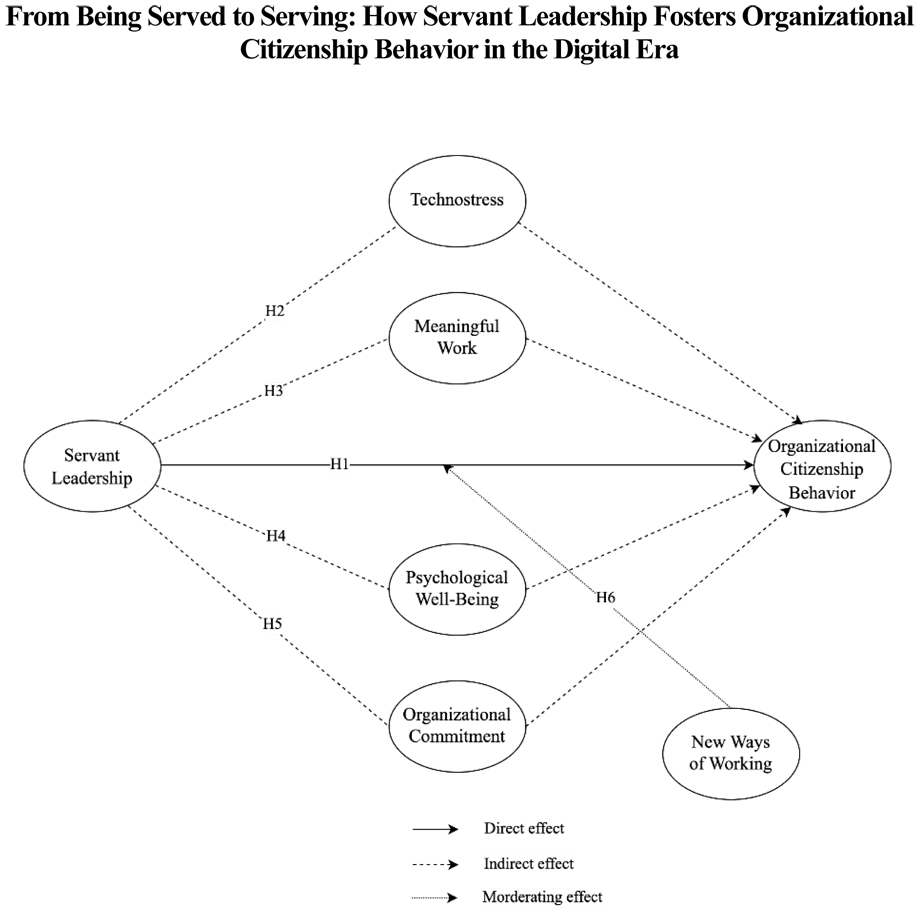
The conceptual framework.
Sampling
Data collection occurred between March and July 2023 using Google Forms. Samples were collected in major cities across Vietnam, aiming to capture a broad range of experiences and viewpoints from individuals who are adopting NWoW. This timeframe enabled the research to encompass a broad spectrum of experiences and perspectives, thus enhancing the ecological validity of the findings. The snowball sampling technique is particularly beneficial for reaching hidden populations, thus allowing for more focused access to research participants.
The research utilized a digitally based questionnaire created with Google Forms for streamlined distribution and collection of responses. The study was carefully designed to pose minimal risk to participants. It did not involve any deception, experimental procedures, or sensitive questions. Measures such as technostress and digital work practices were assessed using general, non-intrusive items (e.g., perceptions of technology overload), avoiding emotionally distressing content. The study followed established ethical guidelines in accordance with the Declaration of Helsinki and the APA Ethical Principles of Psychologists and Code of Conduct (2017, Section 8.05). Before participation, all respondents were provided with an informed consent statement explaining the purpose of the study, their right to withdraw at any time, and assurances of anonymity and confidentiality. By continuing with the survey, participants provided implied consent. Participation was entirely voluntary, and no personally identifiable information was collected and the study did not include any minors. Academic experts reviewed the questionnaire to ensure clarity and pilot-tested it to improve reliability before distribution. Participants were required to answer all questions, ensuring the reliability of the data and minimizing any missing information throughout the collection process. The search for potential respondents was expanded through the authors’ extensive personal and professional networks, thus widening the survey’s scope. The sample comprises employees engaged in NWoW, characterized by remote, hybrid, and flexible digital work arrangements, particularly accelerated by post-COVID workplace transformations. A total of 380 valid responses were collected, which exceeds the minimum sample size recommended for PLS-SEM (Hair et al., 2019), ensuring statistical power and model reliability. Although formal IRB approval was not obtained due to the study’s non-invasive and low-risk nature, the study complied with applicable ethical standards. The potential societal benefits, such as advancing understanding of leadership, workplace well-being, and digital transformation, outweigh the negligible risks associated with anonymous survey participation. These insights are expected to inform organizational practices that promote employee mental health and productivity in Vietnam and other emerging economies. We employed several strategies to mitigate any potential biases introduced by the snowball sampling method, such as overrepresenting certain demographic groups or professional networks. These included setting caps on the number of referrals each participant could make and ensuring a diverse starting group for the referral chain. The demographic characteristics of the sample, detailed in Table 1, include gender, age, education level, marital status, monthly income, positions, and business field, ensuring a comprehensive overview of the participant pool.
Demographic of Participants (N = 380).

Source. Author’s work.
Note. 1 USD, approximately 25,000 VND during the survey period.
Measures
The questionnaires, originally composed in English, were translated into Vietnamese before being distributed to the participants. To ensure semantic equivalence, we utilized the back-translation method (Brislin, 1976). Its comprehensibility was then ensured through pilot testing by a panel of eight independent researchers and a cohort of ten potential respondents. Feedback from these tests was used to refine the survey for clarity and relevance, leading to strategic amendments in the initial drafts. Each variable was assessed on a five-point Likert scale, from 1 (strongly disagree) to 5 (strongly agree). The questionnaire consisted of two parts: Demographic data and measurement of variables. The demographic section captured characteristics of participants, including age, gender, location, and occupation. Scales from prior research were utilized to measure variables. SL was evaluated using thirteen items from F. Saleem et al. (2020), TNS assessment utilized three items from Jaiswal et al. (2024), MOW evaluation employed six items from May et al. (2004), and PWB was determined through an eight-item scale from Jaiswal et al. (2024), OC was assessed with five items according to Moqbel et al. (2013), OCB was evaluated by six items scale borrowed from Henderson et al. (2020), and NWoW was assessed with ten items according to Gerards et al. (2018).
Data Analysis
For data analysis, we utilized SPSS version 25 to conduct a descriptive analysis of demographic information and SmartPLS version 3.2.9 for partial least squares structural equation modeling (PLS-SEM). PLS-SEM was chosen due to its strength in managing complex models and its ability to effectively identify and validate latent constructs within the study’s theoretical framework. This analytical method is especially appropriate for exploratory research to develop and refine theoretical constructs from empirical data (Hair et al., 2019), thereby enriching the academic understanding of SL’s influence on OCB. The measurement model was first assessed for reliability, including: Cronbach’s α > 0.7, Outer Loadings > 0.7, and Composite Reliability (CR) > 0.7, Average Variance Extracted (AVE) > 0.5 (Bagozzi & Yi, 1988; Hair et al., 2014). Discriminant validity is evaluated using the Fornell-Larcker criterion and the Heterotrait-Monotrait (HTMT) ratio (Fornell & Larcker, 1981; Hair et al., 2021; Henseler et al., 2015). After the measurement model’s satisfactory assessment, the structural model was analyzed. Additionally, several model fit and predictive assessment indices were examined to evaluate the overall quality of the structural model. Stone-Geisser’s Q2 values were computed using the blindfolding procedure. All Q2 values exceeded zero, indicating acceptable predictive relevance for the endogenous constructs (Hair et al., 2019). The Standardized Root Mean Square Residual (SRMR) was assessed, yielding a value below the commonly accepted threshold of 0.08, which suggests a good model fit (Henseler, 2017). Lastly, the RMStheta statistic was used to evaluate model specification, confirming its adequacy. The hypotheses were tested employing the bootstrapping technique with 5,000 resamples (Fornell & Larcker, 1981; Hair et al., 2019). This thorough analytical method guaranteed the strength and dependability of the results, offering a detailed insight into the interactions between the variables.
Findings
Common Method Bias
This research meticulously assessed the potential for common method bias (CMB). Harman’s single-factor test, commonly used to examine CMB, was rigorously applied. An exploratory factor analysis, extracting a single factor, revealed that the total variance explained was 44.573%. This falls below the threshold of 50% suggested by recent studies (C.-Y. Li & Fang, 2022; Xu et al., 2022), signifying the non-problematic presence of CMB in the model. In addition, we ensured that the respondents would remain anonymous and confidential to alleviate evaluation apprehension, thereby controlling another source of common method bias. Furthermore, Kock (2015) posits that a Variance Inflation Factor (VIF) exceeding 3.3 could indicate pathological collinearity, potentially signifying that the model is affected by CMB. As shown in Table 2, the comprehensive collinearity assessment results do not present any cause for concern.
Collinearity Statistic (VIF) With Inner Model.

Source. Author’s work.
Note. MOW = meaningful work; NWoW = new ways of working; SL = servant leadership; OC = organizational commitment; OCB = organizational citizenship behavior; TNS = technostress; PWB = psychological well-being.
Measurement Model Analysis
We conducted a pretest of the questionnaire on a small sample (N = 50) who shared similar profiles with the participants in the main study. All participants comprehended and responded to the questions without difficulty. Additionally, the scales demonstrated robust psychometric properties, including high factor loadings and reliabilities. Consequently, we proceeded with the same questionnaire in the main study without any modifications. As indicated in Table 3, reliability was established with Cronbach’s α indices and CR for all factors surpassing the 0.7 threshold (Hair et al., 2021). Additionally, the validity of the constructs was evaluated through two methods. Convergent validity was supported as outer loadings were more than 0.5 (Sarstedt et al., 2022), and AVE for each construct exceeded the established benchmark of 0.5 (Hair et al., 2021).
Result of Reliability and Convergent Validity of All Constructs.

Source. Author’s work.
Discriminant validity, evaluating the distinctiveness of each construct, involves comparing the square roots of the AVE with the inter-construct correlations. Our findings, which show that the former exceeds the latter, were established based on the criteria set forth by Fornell and Larcker (1981) and supported by HTMT values below 0.90 (Henseler et al., 2015), as evidenced in Tables 4 and 5. The R2 value, which varies between 0 and 1, measures the explanatory power of a model, with higher values indicating greater explanatory power. According to Henseler et al. (2009) and Hair et al. (2011)R2 values of 0.75 are considered substantial, 0.50 moderate, and 0.25 weak. The acceptability of R2 values depends on the specific context of the field; Raithel et al. (2012) note that in some disciplines, an R2 value as low as 0.10 may still be deemed satisfactory. In this study, R2 values indicated that our model could explain 41.6%, 34.9%, 48.0%, and 57.5% of the variance in MOW, PWB, OC, and OCB, respectively. However, it only accounted for 5.2% of the variation in TNS. Although R2 values provided insight, they alone do not represent the model’s overall effectiveness, requiring further metrics and factors to assess its robustness.
Fornell-Larcker Criterion.

Source. Author’s work.
Note. MOW = meaningful work; NWoW = new ways of working; SL = servant leadership; OC = organizational commitment; OCB = organizational citizenship behavior; TNS = technostress; PWB = psychological well-being.
Heterotrait-Monotrait Ratio (HTMT).

Source. Author’s work.
Note. MOW = meaningful work; NWoW = new ways of working; SL = servant leadership; OC = organizational commitment; OCB = organizational citizenship behavior; TNS = technostress; PWB = psychological well-being.
Structural Model Analysis and Hypothesis Testing
Connections were determined by investigating path coefficients and p-values. After affirming the reliability and validity of the measurement model, the supposed paths and coefficients were scrutinized using bootstrapping with a sample size of 5,000. This method enabled the following evaluation of hypotheses by using coefficients and p-values. Results from the PLS-SEM analysis, displayed in Table 6, reveal a robust positive relationship between SL and OCB, with a notable effect size (β = .217, p = .003, f2 = 0.046), thus supporting Hypothesis H1. According to Cohen (1988), the f2 values of 0.02, 0.15, and 0.35 indicate a weak, medium, or large effect size between an exogenous and endogenous variable. Nevertheless, Hypothesis H2, positing TNS as a mediator between SL and OCB, is not supported by the data. Hypothesis H3 is affirmed, demonstrating that MOW effectively mediates between SL and perceived OCB. Similarly, Hypothesis H4 is also verified, with PWB mediating SL and OCB. On the contrary, Hypothesis H5, which suggested OC as a mediator, is not supported (see Figure 2). The interaction between SL and NWoW negatively affects OCB, evidenced by a β = −.059, p = .043, and f2 = 0.020 (see Figure 3), thus, Hypothesis H6 is supported. Table 6 also presents the confidence interval values associated with the study.
Path Analysis and Hypothesis Testing.

Source. Author’s work.
Note. MOW = meaningful work; NWoW = new ways of working; SL = servant leadership; OC = organizational commitment; OCB = organizational citizenship behavior; TNS = technostress; PWB = psychological well-being.

The conceptual framework results.
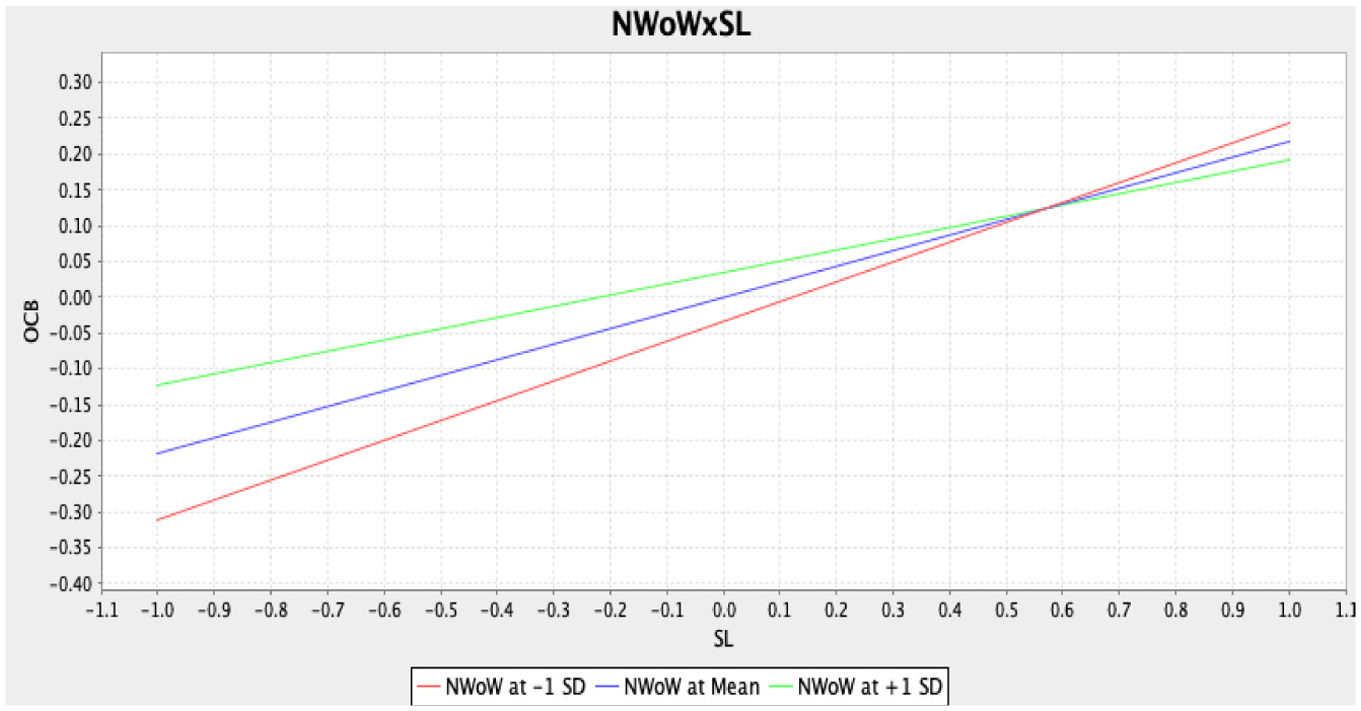
The moderating effect of NWoW on the relationship of SL to OCB.
Moreover, all Q2 values were greater than zero, demonstrating adequate predictive relevance for the endogenous constructs. Model fit indices further confirmed the robustness of the structural model, with SRMR = 0.059 (below the 0.08 threshold), and RMStheta = 0.12, indicating an acceptable level of model specification.
An Importance-Performance Map Analysis (IPMA) was conducted to provide deeper practical insights. According to Hauff et al. (2024), the IPMA framework helps prioritize managerial actions by categorizing variables into four quadrants based on their importance and performance. Variables with high importance but low performance should be prioritized for improvement (Ringle & Sarstedt, 2016). The results showed that SL had the highest importance (0.556) and high performance (83.557), identifying it as the most influential and strategic factor for enhancing OCB. PWB also exhibited high importance (0.286) and the highest performance (89.187), confirming its role as a critical psychological driver of OCB. MOW demonstrated moderate importance (0.221) and high performance (86.837), indicating that it is well-supported in practice and contributes meaningfully to behavioral outcomes. NWoW and TNS showed relatively low importance (0.034 and 0.038, respectively), but high and moderate performance levels (86.153 and 76.589). This suggests that although these factors are well addressed, they have limited direct influence on OCB in the current model. OC recorded the lowest importance (0.027) and a moderate performance (78.941), indicating it is neither a strong predictor nor a current priority in driving citizenship behavior in this context. Figure 4 illustrates the IPMA among research variables.

Importance–performance analysis map.
Discussions
This study was guided by two key research questions: “How do SL and its mediators shape OCB among employees?” and “How do NWoW moderate the influence of SL on employees’ OCB?” The results demonstrate that SL influences OCB both directly and indirectly through the mediating roles of MOW and PWB, while OC and TNS do not serve as significant mediators. Furthermore, NWoW moderates the relationship between SL and OCB, amplifying the negative effects. Based on LMX theory, this study explores the intermediation factors such as PWB, OC, MOW, and OC among data collected from Vietnamese employees who use new working methods.
The findings underscore SL’s profound influence on OCB (β = .217, p = .003, f2 = 0.046). The findings corroborate the pivotal position SL occupies in fostering OCB, harmonizing with the conclusions drawn by Elche et al. (2020) and Luu (2019). These studies collectively suggest that SL is not merely a leadership approach but a critical factor in promoting enhanced interpersonal relationships and commitment to organizational goals. When employees identify with their leaders, they often align with their supervisor’s values and behaviors, thus increasing OCB (Zhao et al., 2016). A servant leader’s ethical behavior, emotional support, and altruistic actions foster a serving climate that encourages employees to adopt similar prosocial behaviors, thereby increasing service-oriented OCB (Chiniara & Bentein, 2017). In Vietnam, these behaviors are further reinforced by cultural values of community, harmony, and mutual assistance, with a robust identification driven by norms emphasizing respect for authority and loyalty to superiors (Truong et al., 2017). Additionally, the LMX theory elucidates how SL augments the quality of leader-follower relationships, leading to enhanced discretionary behaviors such as OCB. These behaviors are fostered by mutual trust, obligation, and respect (Schwarz et al., 2016). In the Vietnamese context, these relationships are further strengthened by cultural norms emphasizing respect for superiors and trust in their leadership (Truong et al., 2017).
This study confirms the mediating role of MOW and PWB on the positive link between SL and OCB (β = .143, p = .001; β = .169, p < .001), respectively, aligning with previous studies (Allan et al., 2018; Eva et al., 2019; Im & Chung, 2018; Kubiak, 2022). The findings suggest that when the perceived meaning of work is elevated and combined with career development opportunities provided by servant leaders, employees are more positively engaged in their work. In addition, when employees experience well-being under the guidance of a servant leader, they tend to respond positively to the favorable treatment they receive. This reciprocity often takes the form of OCB, where employees voluntarily engage in behaviors that benefit their colleagues and the organization. These observations directly address RQ1 by illustrating which mediators are instrumental in translating SL into higher OCB.
This research demonstrates that the SL approach does not directly enhance OCB through TNS mediation (β = .009, p = .375) within the Vietnamese context. This finding contrasts with the assertions by Rohwer et al. (2022), and Harunavamwe and Kanengoni (2023), who posited that TNS could mediate the relationship between SL and OCB. Our observations indicate that while SL may intensify TNS among employees, it fails to foster OCB via this route. Hence, for RQ1, TNS did not represent a viable channel for translating SL into enhanced OCB. Vietnamese leaders may prioritize human relations and support over specific TNS mitigation (Tran, 2021). This focus can increase OCB by fostering a supportive and collaborative work environment.
Our data suggest that OC does not mediate between SL and OCB (β = .019, p = .645), contradicting Hooper and Martin’s (2008) and Howladar and Rahman’s (2021) research. Consequently, in addressing RQ1 regarding how SL and its mediators shape OCB, OC emerges as a less effective mediator in flexible working contexts. The context of NWoW may elucidate why OC is not significantly influential in the dynamics between SL and OCB. Teleworkers often operate in a more autonomous and flexible environment where direct interactions with leaders and peers are limited (Gerards et al., 2018). In such settings, SL’s direct impact on OCB may be more evident, as teleworkers depend more on the support and empowerment from their leaders than on their OC (Walumbwa et al., 2010).
Lastly, the study revealed that the NWoW significantly negatively influences the relationship between SL and OCB in developing countries (β = −.059, p = .043, f2 = 0.020). These results are critical for RQ2, as they demonstrate that although NWoW provides flexibility and autonomy, it can also diminish SL’s positive influence on OCB in particular cultural and organizational contexts. This outcome diverges from the findings of M. Li et al. (2016), which demonstrated that work autonomy orientation had a positive moderating effect on the relationship between leadership and OCB in information technology firms in China. Indeed, NWoW often promotes higher levels of employee autonomy and self-management. In such environments, employees may feel empowered to work independently, reducing their dependence on leadership (Gerards et al., 2018). Consequently, the influence of SL, which focuses on providing support and fostering a sense of community, might need to be more pronounced (Elche et al., 2020). In addition, this new way of working also reduces face-to-face interaction between leaders and employees. This reduction can affect the connection and thereby minimize the positive impact of SL on employees (Linuesa-Langreo et al., 2018). Consequently, with an increase in NWoW, the conventional methods by which SL affects OCB diminish, resulting in a lower impact on OCB.
To enhance the study’s practical implications, we conducted an IPMA. The analysis revealed that SL (importance = 0.556; performance = 83.557) and PWB (importance = 0.286; performance = 89.187) are the two most impactful and well-performing constructs influencing OCB. These findings suggest that organizations aiming to foster citizenship behaviors should prioritize the development of SL competencies and invest in well-being initiatives. While constructs like MOW and NWoW demonstrated high performance, their lower importance indicates supportive but secondary roles in promoting OCB. Conversely, OC and TNS, although relevant, showed minimal total effects, suggesting a need for integrated strategies to enhance their influence. This IPMA enriches the model’s practical application and offers a roadmap for leadership and HR development in digital and flexible work environments.
Implications, Limitations, and Future Directions
Theoretical Implications
This research contributes to LMX theory by providing empirical evidence on how servant leaders influence OCB in the context of new working methods. This understanding can be integrated into LMX theory to enhance the understanding of leader-follower relationships in the modern workplace. Our results indicate that PWB and MOW mediate the mechanism of SL’s impact on OCB, highlighting the importance of considering employees’ work context and psychological state. In addition, some aspects of work methods with technological elements, such as TNS or OC attitudes, do not influence the exchange relationship between leaders and employees. This suggests that in digitally mediated environments, relational and psychological dimensions may be more critical to fostering OCB than structural or attitudinal elements. A finding that needs to be emphasized here is the negative moderating role of NWoW on the dynamics between SL and OCB. This contribution is meaningful for adapting the LMX theory to contemporary organizational settings, as it provides an understanding of how leadership and follower behaviors interact in the context of modern work practices.
As digital and flexible work arrangements increasingly redefine workplace dynamics, this finding underscores the need to adapt LMX theory to account for how such transformations can weaken the effectiveness of leader-follower relationships traditionally built through direct interaction. Our results confirm Greenleaf’s foundational SL premise that leaders who prioritize serving others over self-interest create distinctive organizational outcomes (Greenleaf, 1970, 2002). While previous theoretical frameworks have positioned SL as primarily focused on follower development, our research demonstrates that this approach remains effective even in technologically mediated work environments. Additionally, our research extends SL theory by identifying specific mechanisms through which servant leaders influence OCB in modern work contexts. By demonstrating that PWB and MOW serve as critical mediating mechanisms, we add theoretical precision to understanding how SL operates in contemporary settings. This confirms Spears’ (2025) conceptualization of SL as promoting “a holistic approach to work” and “sense of community” while adapting these principles to new working methods. It sheds light on new avenues for research and practical applications in leadership and organizational behavior, particularly in the digital transformation era.
Practical Implications
In light of the swiftly changing economic environment, organizations must understand how leadership facets and environmental stressors, especially in technology-driven settings, impact employee outcomes (Howladar & Rahman, 2021). Our research underscores the positive influence of SL on OCB, particularly in a developing country like Vietnam that is experiencing swift technological advancement. Vietnamese employees, shaped by collectivist values, relational dynamics, and hierarchical organizational cultures, tend to seek meaningful interpersonal connections and personal validation from their leaders. Organizations can amplify the effects of SL by fostering a work environment where employees find professional meaning and improve their mental well-being. This can be accomplished by aligning tasks with employees’ skills and values, clearly communicating goals, and offering opportunities for career development. Additionally, organizations can implement training or coaching initiatives to manage stress and promote mental health awareness. Given our finding that PWB and MOW significantly mediate the relationship between SL and OCB, organizations should proactively adopt leadership practices that explicitly prioritize employees’ well-being, meaningfulness, and purpose. Such targeted practices can significantly enhance engagement, motivation, and discretionary behaviors among employees operating in digitally intensive work environments. Furthermore, organizations must understand how leadership dimensions and environmental stressors affect OC and OCB, especially in technology-intensive environments. Interestingly, our findings indicate that NWoW negatively moderates the link between SL and OCB, suggesting that NWoW may weaken the positive impact of SL. Managers should recognize that NWoW practices may undermine the positive effect of SL. While embracing NWoW, they should also foster SL traits such as empathy, community building, and personal attention. Managers should deliberately cultivate SL traits, such as empathy, community building, and personal attention, in a virtual and hybrid environment. They should encourage leaders to maintain strong interpersonal connections through regular check-ins, virtual team-building activities, and open communication channels. Managers can establish structured opportunities for relationship-building, such as scheduled in-person or synchronous virtual meetings, to reinforce trust and collaboration. Organizations can also revise performance management systems to acknowledge and reward OCBs demonstrated in digital environments, including online collaboration and virtual assistance.
In addition, they should encourage leaders to maintain strong interpersonal connections with employees even in tech-driven environments. Particularly for Vietnamese knowledge workers who typically value interpersonal connections and relational support, organizations adopting NWoW need to ensure that SL behaviors are effectively translated into virtual and remote interactions. This includes providing regular digital check-ins, personalized communication strategies, and virtual team-building activities to sustain emotional bonds and engagement levels. Additionally, investing in virtual mental health support, such as online mindfulness training and stress management programs, can mitigate the potential negative effects of TNS and isolation often encountered in flexible and remote working conditions.
Limitations and Future Directions
Our study highlights the varied mechanisms through which SL impacts OCB and the moderating effect of new working practices on this relationship within an emerging country’s context. This study not only addresses the research question but also responds to the growing call for further exploration in this area, as noted by previous scholars (Contreras et al., 2020; Gerards et al., 2018; Koo & Park, 2018; Zhang et al., 2021). However, this research still has the following limitations. The cross-sectional design of this study limits the ability to draw definitive causal inferences, as the data were collected at a single point in time. Future studies could benefit from utilizing longitudinal or experimental approaches, which would provide stronger evidence and a clearer understanding of the causal relationships, thereby deepening insights into the dynamics and temporal patterns associated with the observed correlations. Such methodologies allow researchers to track changes over time and manipulate key factors, thereby addressing limitations inherent in cross-sectional or correlational studies. To complement quantitative findings, qualitative approaches, such as interviews or organizational case studies, can uncover deeper contextual insights. Moreover, hierarchical verification across organizational levels (e.g., leaders, middle managers, employees) would better validate the leadership–behavior relationship and further contextualize the effects revealed in IPMA. Although this study employed PLS-SEM to analyze the structural relationships, we acknowledge that linear modeling has limitations in capturing complex interactions. Future research could apply nonlinear analysis techniques and examine endogenous relationships to uncover deeper causal mechanisms and improve explanatory power.
Given Vietnam’s considerable rural population and the dynamic nature of its growing agricultural and manufacturing industries, future research should also consider the unique characteristics of these sectors and populations. In addition, our investigation into the influence of SL on OCB within the Vietnamese context may need to be reconsidered when extrapolating our findings to other settings. The significance and interpretation of SL could vary across different sociocultural landscapes. Consequently, future studies should examine our results’ applicability in various contexts such as different industries or cultural settings to enhance the generalizability of these insights.
Moreover, our results show that neither OC nor TNS mediate the confirmed positive relationship between SL and OCB. This observation suggests that while SL has a beneficial impact on OCB, the mechanisms through which it exerts this influence may bypass the conventional mediators of stress and commitment. Therefore, future investigations should consider exploring alternative mediators or the specific conditions under which TNS and OC might affect the dynamics between SL and OCB. In addition, this study did not account for potentially individual factors such as organizational culture, job autonomy, and employee personal traits (e.g., proactive personality). The absence of these controls may limit the explanatory power of the model, as these variables could moderate or mediate the relationship between SL and key outcomes. Future research should incorporate these variables to capture the complexity of the leader-follower dynamics better and to enhance the model’s generality across diverse organizational settings. Finally, this study further explores the negative moderating influence of NWoW on the relationship between SL and OCB. Accordingly, future research should consider these adverse outcomes to broaden the scope of their investigations, identifying underlying factors that contribute to these dynamics or exploring contexts in which these adverse effects might be mitigated.
Conclusion
This study highlights the vital role of SL in promoting OCB within the evolving context of NWoW. The finding emphasizes that while SL positively influences OCB, the impact can be moderated by adopting new working practices, particularly in emerging countries like Vietnam. The findings suggest that SL’s effectiveness in promoting OCB is enhanced when leaders focus on MOW and PWB while addressing employees’ potential TNS and OC challenges. This research contributes to LMX theory by empirically demonstrating that MOW and PWB mediate the relationship between SL and OCB. It also underscores the importance of understanding cultural and contextual factors, as the Vietnamese context provides unique insights into how SL can be adapted to different environments. Organizations should craft strategies to fully leverage SL by cultivating a supportive work environment that resonates with employees’ values and needs. This includes providing career development opportunities and addressing stressors associated with new working methods.
Additionally, the negative moderating effect of NWoW on the SL-OCB relationship highlights the need for tailored programs that support employees in adapting to these changes. This study offers valuable insights, but it has certain limitations. The cross-sectional design and specific focus on Vietnam may restrict the broader applicability of our findings. To address these constraints, future research should explore these relationships across diverse contexts. Additionally, employing longitudinal methods would enable a more robust examination of causal mechanisms over time. In conclusion, SL remains vital for enhancing organizational citizenship behavior, particularly when tailored to the specific challenges and opportunities of NWoW and diverse cultural contexts. The findings reinforce recognizing and providing valuable suggestions for leaders and organizations aiming to navigate the complexities of modern work environments while fostering a culture of commitment and mutual support.
Footnotes
Acknowledgements
The authors express their profound gratitude to the study participants for their valuable time and contributions. They also thank their esteemed colleagues for their unwavering support and collaboration throughout this research. Special thanks are extended to the editor and reviewers for their thoughtful feedback and guidance throughout the review process.
Ethical Considerations
This study was conducted in accordance with SAGE’s publishing ethics and the APA Ethical Principles of Psychologists and Code of Conduct (2017), Section 8.05. It did not require formal approval from an Institutional Review Board (IRB) or ethics committee, as it involved minimal risk and complied with local regulations, specifically, the National Health and Wellness Commission guidelines, which state that only life science and medical studies require formal ethical review ( ). The study design posed no foreseeable harm to participants. It utilized an anonymous, self-administered online questionnaire covering general work-related topics, with no collection of personal identifiers or sensitive information. Participation was voluntary, and respondents could withdraw at any time. All data were anonymized and securely stored. Informed consent was obtained through a detailed introductory statement at the beginning of the survey, which explained the study’s purpose, confidentiality, and voluntary nature. In line with APA Ethics Code Section 8.05(c), proceeding with the survey was considered as implied consent in this low-risk, anonymous research. The study did not involve vulnerable populations, minors, or any form of deception. It was conducted in accordance with the ethical principles outlined in the Declaration of Helsinki.
Author Contributions
Funding
The author(s) received no financial support for the research, authorship, and/or publication of this article.
Declaration of Conflicting Interests
The author(s) declared no potential conflicts of interest with respect to the research, authorship, and/or publication of this article.
Data Availability Statement
Data will be made available on request.
Declaration of Generative AI and AI-assisted Technologies in the Writing Process
While preparing this work, the authors used ChatGPT and Grammarly to improve readability. After using this tool/service, the authors reviewed and edited the content as needed and took full responsibility for the publication’s content.