




Abstract
The purpose of this article is to contribute to the existing servant leadership literature, especially at the individual level of analysis in new settings, by examining the potential joint effects of servant leadership, dyadic duration, and job self-efficacy, with organizational citizenship behaviors (OCBs) as the dependent variable. We, after analyzing survey data from 148 leader–follower dyads collected from an engineering venture, find that dyadic duration is a significant moderator of the relationship between servant leadership and OCB. Furthermore, the moderating effect of dyadic duration on the relationship between servant leadership and OCB depends on job self-efficacy, such that the interaction effect is neutralized when job self-efficacy is high rather than low. The findings about interactive effects can provide useful information that will help to better deploy servant leadership in organizations to create positive follower outcomes.
Introduction
A number of studies have recognized the capability of servant leaders to create benefits for individuals, teams, and organizations (see Eva et al., 2019 for a review). In particular, servant leadership has been found to be a strong determinant of followers’ organizational citizenship behavior (OCB; e.g., Chen et al., 2015; Walumbwa et al., 2010; Zhao et al., 2016)—one of the most desirable follower behaviors because of its significant correlation with many advantageous outcomes, such as task performance (Hoffman et al., 2007; Wang et al., 2005), organizational productivity (de Waal & Sivro, 2012; Podsakoff & MacKenzie, 1997), and customer satisfaction (Podsakoff et al., 2009). Although the positive relationship between servant leadership and follower OCB has been considered in several studies, the conditions under which this link is enhanced have received little research attention (Hunter et al., 2013; Walumbwa et al., 2010). The call for further analysis of potential mediators and moderators, therefore, should be addressed to enhance the knowledge of which situations lead followers of servant leaders to engage in behaviors beyond what is required by their positions. This article proposes a further investigation of the relationship between servant leadership and follower OCB to fill gaps in the literature, notably by integrating the potential effect of time (i.e., dyadic duration) and follower job self-efficacy into the hypothesized model based on social exchange theory. By investigating these issues, we seek to provide an in-depth understanding of the development of the servant leader–follower relationship, particularly by further investigating the link between servant leader behaviors and follower OCB over time and determining which followers are more likely to exhibit OCB when working with servant leaders.
Our research contributes to the literature in several ways. First, we explicitly acknowledge the importance of time, specifically the amount of time a follower works under the supervision of a particular leader, as this is proposed to be a critical factor that can govern the relationship between leader behaviors (e.g., servant leadership) and follower behaviors (e.g., follower OCB) (Graen & Scandura, 1987; Maslyn & Uhl-Bien, 2001; Mossholder et al., 1990). The role of time in organizational behavior studies, especially in the leadership area, is undeniably central because it can have a substantial impact on the conceptualization of theoretical constructs and the associations among them; thus, it may lead to major alterations in the propositions that a theory embodies (George & Jones, 2000). For instance, every leadership input takes time to become effective, and there is no certain duration that can be applied to them all (see Shamir, 2011). Some may exert a somewhat instantaneous impact on follower outcomes, while others may require more time to create the same effect (e.g., the amount of time it takes for servant leadership to make any change in follower OCB may be different from that of other forms of leadership). In addition, the same leadership input may affect disparate follower outcomes after different durations of exposure (e.g., the amount of time it takes for servant leadership to affect follower OCB is likely to be different from that of other follower outcomes). However, despite its inarguably noteworthy role in determining the dynamics of the leader–follower connection, the temporality phenomenon in leadership research seems to have been largely overlooked (Bluedorn & Jaussi, 2008; Shamir, 2011). Indeed, we know rather little about dyadic duration’s role in the servant leader–follower relationship and how it predicts follower engagement in OCB.
Second, the extant research recognizes servant leadership and follower job self-efficacy as significant predictors of follower OCB (e.g., relationship between job self-efficacy and follower OCB: Beauregard, 2012; Chen & Kao, 2011; Kim & Park, 2008; relationship between servant leadership and follower OCB: Chen et al., 2015; Liden et al., 2008; Walumbwa et al., 2010; Zhao et al., 2016) but has not revealed the significance of any potential interactions between them, especially as the duration of the servant leader–follower dyad increases. The integration of interpersonal relationships with job-related motivational beliefs has been argued to be of critical importance to follower performance and outcomes (Liden et al., 2000). By studying a theoretical framework of the three-way interaction among these variables, this study may help organizations better deploy servant leadership by identifying situations in which servant leaders can have more of an impact on follower OCB.
Third, most research has investigated this issue at the team level (Ehrhart, 2004; Walumbwa et al., 2010), while the remaining research has been conducted at the individual level but with aims other than analyzing interactive effects, especially three-way interactions, with servant leadership predicting follower OCB. In addition, most servant leadership research has collected data from Western countries, which may pose a generalizability issue for servant leadership itself and its association with outcome variables. By discovering servant leadership’s effect in Asian culture at the individual level, we will help fill this gap in the literature.
Theoretical Background and Hypotheses
Servant Leadership and Follower OCB
Because they spend most of their working time under the supervision of servant leaders, followers tend to be intensively influenced by such leaders, which makes any follower outcome highly dependent on servant leader behaviors. The mechanism explaining why followers react to servant leader behaviors can be better illuminated within the scope of social exchange theory (Blau, 1964). Social exchange theory (Blau, 1964; Cropanzano & Mitchell, 2005) asserts that the norm of reciprocity (Gouldner, 1960) inherently guides social interactions between two parties (i.e., the individuals within one party may feel obliged to do something in return after obtaining a favor from the others). This form of tacit reciprocity is likely to last until a perceived balance of exchange appears.
Servant leadership entails serving others, appreciating the “diversity of people’s gifts and talents” (DePree, 1989, p. 9), making followers’ interests and development a higher priority than the leader’s own interests (Greenleaf, 1970; Sendjaya & Sarros, 2002), and infusing the organization with a sense of service (Walumbwa et al., 2010). Typical servant leaders are able to help and empathize with other people (Eva et al., 2019), especially those who are considered underprivileged, by putting themselves in other people’s shoes and listening to their concerns (Giampetro-Meyer et al., 1998). Servant leaders are also known for their unconditional support of their followers, listening to followers’ needs and interests, providing opportunities for followers to take the initiative, participating in the decision-making process, demonstrating an ethical presence, and encouraging followers to contribute to society (Reed et al., 2011; Stone et al., 2004).
Because servant leaders “want their subordinates to improve for their own good, and view development of followers as an end, in and of itself, not merely a means to reach the leader’s or organization’s goals” (Ehrhart, 2004, p. 69), and because they put their followers first (Eva et al., 2019) and genuinely care about their personal and professional development (Greenleaf, 1997; Matteson & Irving, 2006), servant leaders are likely to engage in empowering and helping tactics, such as inspirational appeals and consultations (Greenleaf, 1977; Lopez, 1995), or coordinating work assignments to suit both followers’ needs and organizational objectives. Therefore, followers of servant leaders tend to find themselves invited into decision-making processes with authentic support from leaders and feel a sense of power over both their task operations and outcomes (Hunter et al., 2013).
This series of concern and support from servant leaders induces trust in followers and strengthens the social exchange process between the two parties. Because servant leaders always concern themselves with followers’ needs and goals, assist and support followers on their growth path, and are even willing to self-sacrifice (Liden et al., 2008), they create an ethical situation in which followers are expected to respond to such leaders’ infusion of selfless behavior and socio-emotional resources with long-term reciprocal acts, including OCB (Walumbwa et al., 2010), in an attempt to maintain the favorable working environment. Our proposal is in alignment with Zhang and Chen’s (2013) indication that, although OCB is implied in its conceptualization as an impersonal dedication, OCB engagement can be driven by personal and relationship-related goals. Thus, we hypothesize the following:
Moderating Role of Dyadic Duration in the Relationship Between Servant Leadership and Follower OCB
In addition to the norm of reciprocity, leader–follower relationships are also characterized by a dynamic dimension (Antonakis et al., 2012; Bluedorn & Jaussi, 2008; Shamir, 2011). Shamir (2011) argued in his recent study that when leadership is viewed as a product of bidirectional (i.e., leader–follower) interaction, it processes and evolves; the inclusion of time in research, therefore, is warranted. In addition, the relationship is considered to be time-dependent because it takes time for internal entities (i.e., leaders and followers) to understand the current workplace situation, regarding what has happened and what will happen (Johns, 2006; Shipp & Jansen, 2011). Research on other leadership theories has confirmed the importance of time in the leader–follower relationship, implicitly and explicitly.
For example, when studying follower perceptions of transformational leaders’ care toward followers as individuals, Avolio and Bass (1995) also examined the length of time it took for a transformational leader to develop a follower because the perception of individualized concern, in terms of amount and nature, could be determined by the tenure with the leader. Furthermore, several studies have suggested that the outcomes of specific leadership behaviors may rely on their timing; some forms of leadership may take effect at an early phase of the relationship, while others may need more time to produce desirable outcomes (e.g., Huy, 2001; Kozlowski et al., 2009).
The acknowledgment of time’s value in connecting leaders and their followers is not new in the servant leadership literature. In the measure of servant leadership that Liden et al. (2008) proposed, one item considered time devotion as a crucial indicator in shaping follower perceptions of leadership effectiveness (i.e., “My manager takes time to talk to me on a personal level”). It is interesting, however, that although Liden et al. (2008) addressed the average dyadic duration of the leader–follower relationship in their study sample’s statistical report, they did not include this construct in their theoretical building or empirical testing. In a more recent research, Chan and Mak (2014) attempted to study the role of time in servant leadership by identifying organizational tenure as a moderator that helps to explain the discrepancies in follower perceptions. Specifically, they found that the shorter the time followers work for an organization, the more they enjoy the serving behavior of their leader.
In this article, we believe that considering the duration of the dyadic relationship between servant leaders and followers in the hypothesized model is essential and relevant when investigating conditions in which followers are more likely to pay back servant leaders’ pro-social behaviors; the longer the dyadic duration, the more influence servant leaders can exercise on followers to motivate them to act in a selfless manner. This is likely true because servant leadership’s delegation is cumulative during the development process of the relationship with followers, and follower reciprocity is also developed. Evidently, when followers’ tenure with servant leaders becomes longer, they are more likely to gain a deeper understanding of servant leaders (Maslyn & Uhl-Bien, 2001; Mossholder et al., 1990) and add up the helping behaviors that servant leaders exhibit over time; they will thus be more likely to feel obligated to reciprocate. Accordingly, we hypothesize the following:
Neutralizing Effect of Job Self-efficacy
We contended in the previous section that time might shape the processes and context of servant leadership, but the sole analysis of time and the one-way effect of servant leadership is not adequate to portray the servant leadership dynamics. This is true because leadership is conceptualized with the inclusion of followership (Graen & Scandura, 1987; Hollander & Offermann, 1990), meaning that followers also play a role in determining the significance of leadership. Accordingly, it is very likely that not all followers, who have a long tenure with their servant leaders, will exhibit the same level of OCB behaviors due to the impact of follower-related factors such as followers’ perceptions of leadership processes and followers’ psychological experiences. In this article, we employ the construct of follower job self-efficacy—a follower psychological experience that has been conceptualized as the positive motivational belief of followers, whereby they are confident that they possess the skills and knowledge to perform work-related tasks well (Spreitzer, 1995)—to deeply analyze the role of followers in servant leadership dynamics and better understand the determinants of follower OCB. We expect that the examination of servant leadership in conjunction with dyadic duration and follower job self-efficacy afforded by the job will provide greater insight into the workplace context that surrounds followers.
The servant leader–follower dyad is characterized by a high level of social exchange quality and emotional support for all of the leader’s followers (Henderson et al., 2009). It can be suggested, therefore, that servant leaders motivate their followers to feel inspired and be willing to deliver a positive performance. Meanwhile, follower job self-efficacy is acknowledged as an alternative key motivator that directs and influences follower behaviors (Harris et al., 2009; Spreitzer, 1995). Just as followers differ in their connection and length of tenure with servant leaders, they might also differ in the location of the motivation that leads to their decision regarding OCB performance. Based on social exchange theory, we suggest that the exchange of resources with servant leaders becomes more critical for followers who lack confidence and self-efficacy in the job context (Cropanzano & Mitchell, 2005), because the relationship with servant leaders seems to be a logical place to seek job benefits and is arguably the most important relationship that the followers have (Manzoni & Barsoux, 2002). Our contention aligns with theoretical and empirical support from leader–member exchange (LMX) research (e.g., Harris et al., 2009; Mossholder et al., 1990). For example, according to results found by Harris et al. (2009), LMX quality and empowerment, two motivating factors for followers in the workplace, interacted with and influenced follower OCB, such that the highest level of OCB was obtained when LMX quality was high and empowerment was low.
In light of the above, we continue to argue that when there is a paucity of perceived job self-efficacy, followers with long dyadic durations are more likely to be motivated to participate in exchange behaviors (e.g., OCB) than those with short dyadic durations. This is true because a considerable amount of time spent working with servant leaders allows them to understand that the quality of the relationship with servant leaders can compensate for the deficiency of motivation caused by a low level of job self-efficacy, and one way to nurture this positive relationship is to reciprocate the helping behaviors of servant leaders. In contrast, when followers experience a high level of job self-efficacy and feel motivated by the job itself, the relationship with servant leaders becomes less integral, leading to a weaker association between servant leadership and follower OCB in the case of followers with high dyadic durations. New followers, no matter how competent they feel, might tend to focus on building a good leader–follower relationship to satisfy their need for affiliation and understand their role activities and the organizational formalities/norms (Graen & Scandura, 1987). Accordingly, we predict the following three-way interaction:
The hypothetical research model for this study is depicted in Figure 1.
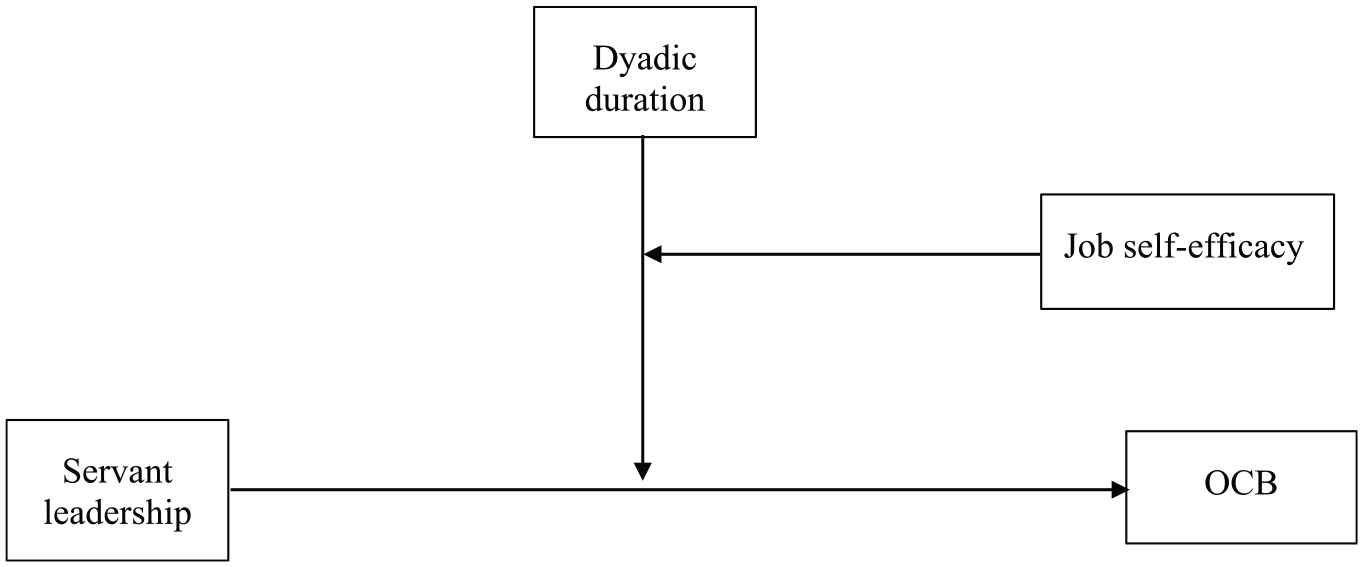
Hypothesized model.
Method
Sample and Procedure
The data, which were used under the authorization of a servant leadership project conducted by the authors, were collected from employees and their supervisors in an engineering venture located in Vietnam. There were 148 leader–follower dyads participated in the survey (response rate: 89.7%). All participants were in charge of assembling phone components. The average follower age was 25 years, with mean work experience of 9 months in the company and mean working time under the current supervisor of 8 months. The average leader’s age was 39 years, with mean work experience in a leadership position of nearly 7 years. Most participants were male (male followers: 81.5 %, male leaders: 85.7%). Overall, we examined 148 leader–follower dyads in this study.
The questionnaire was translated from English into Vietnamese by two professional translators. Because the original measures were in English and have been used mostly in Western cultures, we adopted Brislin’s (1970) back-translation method to ensure translation accuracy when people from an Eastern culture responded to the questionnaires. A trained research assistant delivered envelopes to followers and leaders in the chosen organization. A typical envelope for a follower included an introductory letter written by a researcher and a questionnaire sheet with a participant number; only one researcher knew the name–participant number matches. The participant number was used to assure employees that their identities would be kept confidential. A typical envelope for a team leader included an introductory letter and questionnaire sheets with the names of their current subordinates. All participants were advised by the research assistant to seal their envelopes right after completing the questionnaires for confidentiality reasons. Approximately 2 weeks after the surveys’ delivery, the research assistant returned to the organization to collect the sealed response envelopes and then submitted them to the researchers.
Measures
Servant leadership
Followers evaluated their leaders using Liden et al.’s (2014) seven-item scale (α = .86), which is a shortened version of the full measurement scale developed by Liden et al. (2008). Liden et al. (2015) verified the high psychometrics value of the seven-item scale and its appropriateness as an alternative to the 28-item scale. Followers answered on a 7-point Likert-type scale, ranging from 1 = strongly disagree to 7 = strongly agree. Example items are as follows: “My leader puts my best interests ahead of his or her own”; “My leader gives me the freedom to handle difficult situations in the way that I feel is best”; and “My leader emphasizes the importance of giving back to the community” (see the appendix for the complete scale).
Organizational citizenship behavior
The six-item scale suggested by Wayne et al. (1997) was used to assess OCB (α = .93). Leaders answered six questions about follower behaviors, as listed below, on a 7-point scale, ranging from 1 = always to 7 = never. Example items are as follows: “This employee helps others with their work when they have been absent even when he or she is not required to do so”; “This employee volunteers to do things not formally required by the job”; and “This employee takes the initiative to orient new employees to the department even though it is not part of his or her job description” (see the appendix for complete scale).
Job self-efficacy
The three-item scale suggested by Spreitzer (1995) to measure job self-efficacy was used in the questionnaire (α = .79). Followers answered on a 7-point Likert-type scale, ranging from 1 = strongly disagree to 7 = strongly agree. Sample items are as follows: “I am confident about my ability to do my job” and “I am self-assured about my capabilities to perform my work activities” (see the appendix for complete items).
Dyadic duration
Dyadic duration was measured by the number of months employees worked under the supervision of their current leaders.
Control variable
To account for the potential impact of team differences on our endogenous variables, we included team differences as control variables by creating a dummy variable for each team.
Analysis Strategy
We used the STATA 12.1 statistical software for the analysis in this study. Following the suggestion of Aiken and West (1991), we mean-centered the servant leadership, dyadic duration, and follower job self-efficacy variables before conducting any further analysis to improve the interpretability of the hypothesized effects. We tested the direct effect and moderation-specific hypotheses by applying ordinary least squares regression.
Results
Confirmatory Factor Analysis and Chi-Square Model Comparison Tests
Confirmatory factor analysis was employed to validate the construct distinctiveness of all four variables in the study and provide evidence that the hypothesized model suited the data. As indicated in Table 1, the hypothesized four-factor model was deemed a good fit, with all fit statistics within acceptable standards, χ2(df = 157) = 225.17, root mean square error of approximation (RMSEA) = .06, Tucker–Lewis index (TLI) = .93, comparative fit index (CFI) = .95. We also examined two alternative nested models. The first alternative model was considered because of the likelihood of common method variance susceptibility when both sets of servant leadership and job self-efficacy items were self-assessed by followers only. The hypothesized model was shown to be superior in terms of data fit to the alternative models through chi-square model comparison tests (Bentler & Bonett, 1980); the results showed that both the first and the second alternative models were significantly worse fits.
Results of Confirmatory Factor Analysis and Chi-Square Model Comparison Tests.

Note. CFI = comparative fit index; TLI = Tucker–Lewis index; RMSEA = root mean square error of approximation.
Three-factor model = servant leadership, job self-efficacy, and organizational citizenship behavior combined.
Two-factor model = servant leadership and job self-efficacy combined.
Descriptive Statistics and Correlations
The means, standard deviations, and correlations among variables are presented in Table 2. Correlations among the study variables—namely OCB, servant leadership, dyadic duration, and follower job self-efficacy—were found to be consistent with theory-based predictions, with the strongest correlations manifesting in the relationships between servant leadership and OCB (r = .43, p < .001) and between dyadic duration and OCB (r = .43, p < .001).
Means, Standard Deviations, Correlations, and Reliabilities.

Note. N = 148 dyads. OCB = organizational citizenship behavior; SL = servant leadership; DD = dyadic duration; SE = job self-efficacy. Figures in parentheses are Cronbach’s alphas.
p <.001.
Hypothesis Testing
Hypothesis 1 postulated that servant leadership is positively related to OCB. As shown in Model 2 in Table 3, the relationship between servant leadership and OCB (β = .28, p < .001) was found to be statistically significant. Thus, Hypothesis 1 was supported.
Results of Hierarchical Multiple Regression Analyses for Follower OCB.

Note. N = 148 dyads. OCB = organizational citizenship behavior; SL = servant leadership; DD = dyadic duration; SE = job self-efficacy. Entries are standardized regression coefficients. Team dummies are included in the analyses.
p < .05. **p < .01. ***p < .001; two-tailed test.
Hypothesis 2 regarded leader–follower dyadic duration as a moderator of the relationship between servant leadership and OCB. As shown in Model 3 in Table 3, the interaction term of servant leadership multiplied by dyadic duration was significantly positive in OCB (β = .22, p <. 01). Following the procedure recommended by Aiken and West (1991), we plotted the interaction at conditional values (i.e., 1 SD above and below the mean) of dyadic duration, as illustrated in Figure 2. The simple slope analysis showed that the positive association between servant leadership and OCB was stronger when the dyadic duration was longer (b = .82, p <. 001), but became weaker and non-significant (b = .19, ns) when the dyadic duration was shorter. Therefore, Hypothesis 2 was supported.

Moderating effect of dyadic duration on the relationship between servant leadership and OCB.
To test Hypothesis 3, which posited that there is a three-way interaction among servant leadership, dyadic duration, and follower job self-efficacy with follower OCB as the dependent variable, we adopted a similar analysis method. The results, as reported in Model 4 in Table 3, revealed that the three-way interaction term was significant (β = −.16, p < .5). The comparison of Models 3 and 4 showed an increase in the variance explained from .49 to .51 (F for increment in R2 = 4.74, p <.05), indicating the superiority of the three-way interaction model (Model 4) to the model without three-way interaction (Model 3). We also followed Aiken and West’s (1991) procedure to plot the pattern of the moderated results (see Figure 3), which suggested that the highest level of follower OCB was present when servant leadership and dyadic duration were high and follower job self-efficacy was low (b = .75, p <. 001). When the three explanatory variables (i.e., servant leadership, dyadic duration, and follower job self-efficacy) were all high, the level of follower OCB was lower but still significant (b = .56, p <. 01). No interactive effects were identified when dyadic duration was low in both situations of high job self-efficacy (b = .24, ns) and low job self-efficacy (b = −.16, ns). To further examine this pattern, we computed a slope difference test for each pairwise comparison (Dawson & Richter, 2006). As shown in Table 4, while the slope difference of the pair of (2) and (4), which illustrated the interaction effect when job self-efficacy was low, was significant, the slope difference of the pair of (1) and (3), which illustrated the interaction effect when job self-efficacy was high, was neutralized. These findings support Hypothesis 3.
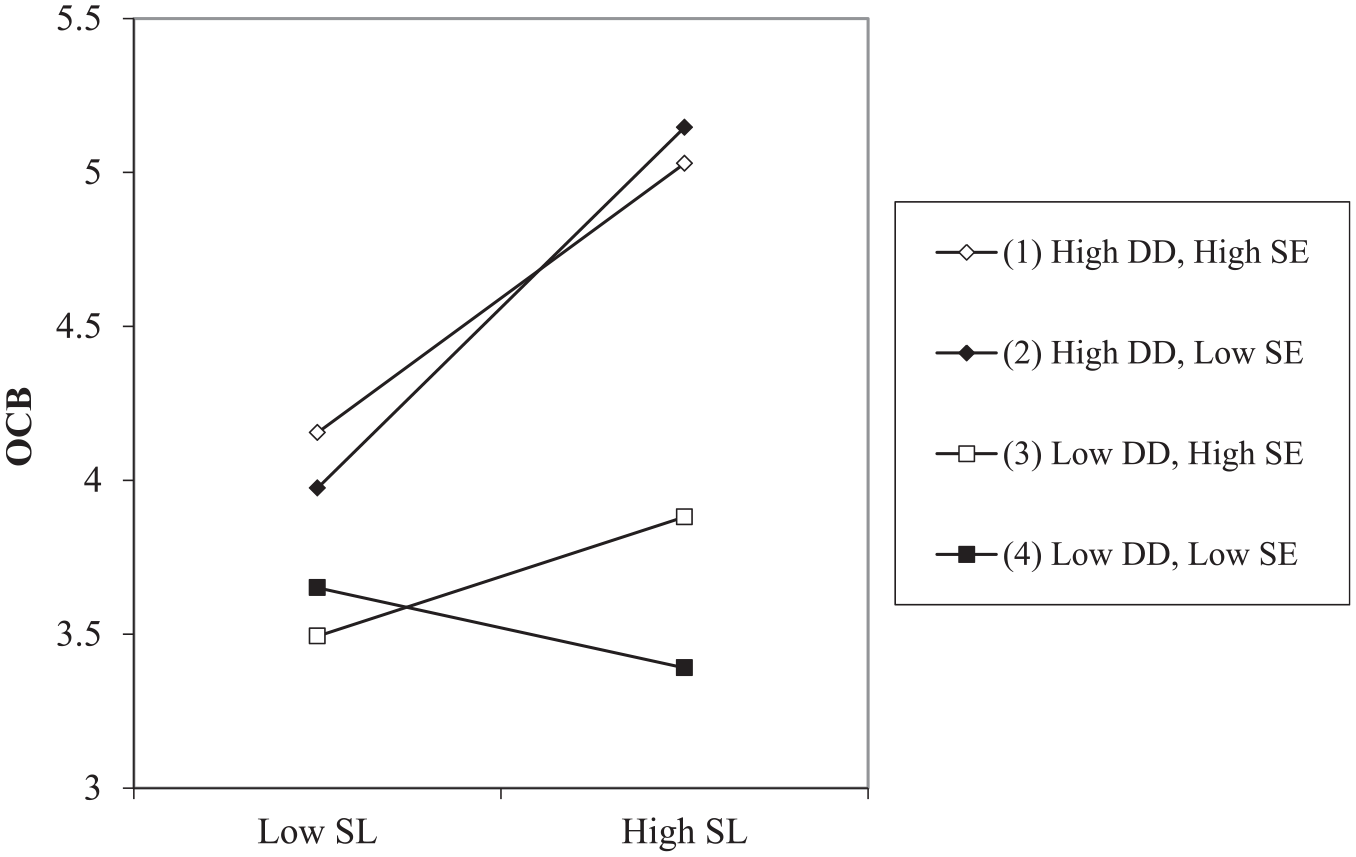
Three-way interaction between servant leadership, dyadic duration, and job self-efficacy.
Slope Differences for the Three-Way Interaction With Follower OCB as the Dependent Variable.
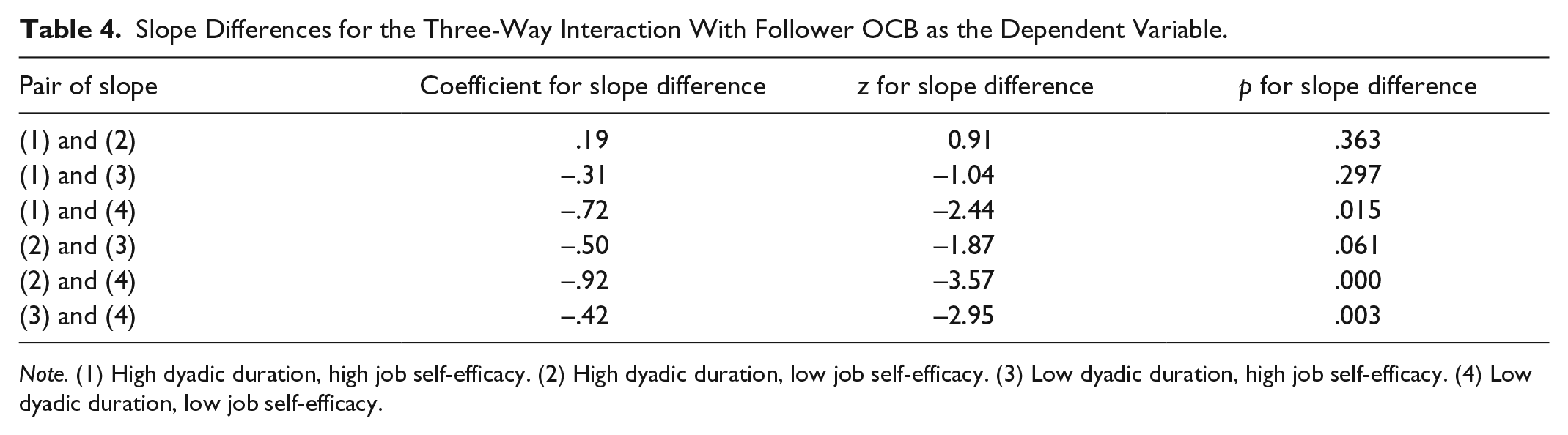
Note. (1) High dyadic duration, high job self-efficacy. (2) High dyadic duration, low job self-efficacy. (3) Low dyadic duration, high job self-efficacy. (4) Low dyadic duration, low job self-efficacy.
Discussion
Theoretical Contribution
The main contribution of this research comes from the employment of dyadic duration as a boundary variable of the relationship between servant leadership and follower OCB. Research on the temporal variables in leadership theories may be important for advancing the field, but it has received little attention (Ancona et al., 2001; Bluedorn, 2002; Bluedorn & Jaussi, 2008; Chan & Mak, 2014; Mitchell & James, 2001; Shamir, 2011). This is problematic because leadership is time-dependent (Shamir, 2011); leadership takes time to influence consequences (Antonakis et al., 2012); and leadership features can change as time passes (Liden & Antonakis, 2009). It is only by observing the evolution of leadership over time that we can progress toward understanding the dynamic quality of leadership and build more robust leadership theories. We managed to fill the gap in the servant leadership literature by starting with a basic question: Is there a connection between the length of the servant leader–follower dyad and follower behaviors?
We examined a model of simple moderation with dyadic duration as a moderator and found a significant impact of dyadic duration on the relationship between servant leadership and follower OCB. This examination, as far as we are aware, is the first of its type in the field of servant leadership. It appears that followers of servant leaders are more likely to perform positive behaviors toward the organization as their tenure with their leaders lengthens. It also seems that in servant leadership, it takes time for followers to aggregate information about the benefits they receive from their leaders, and OCB is considered to be a reciprocal behavior.
This pattern lines up with Maslyn and Uhl-Bien’s (2001) finding that followers increase their effort when a high-quality LMX relationship matures. However, Mossholder et al.’s (1990) study revealed different results, indicating that the longer followers work for the same leaders, the less their behaviors are influenced by the leaders’ qualities. The disparity among the three studies is probably due to the samples used. Like Maslyn and Uhl-Bien’s (2001) sample, the mean dyadic duration in our study was quite short, with little variation (i.e., M = 7.49, SD = 3.50), while the statistics of dyadic duration in Mossholder et al.’s (1990) sample were comparatively larger (i.e., M = 18.88, SD = 13.74). It is possible that in our study and Maslyn and Uhl-Bien’s (2001) study, the followers were still in the “honeymoon” stage with their leaders, while some of the followers in Mossholder et al.’s (1990) study knew “what behaviors are viewed as desirable, and without guidance, may [have been] able to deliver work outcomes in a form corresponding to their particular supervisor’s standards” (p. 385). An alternative explanation for this phenomenon is the potential capability of servant leadership to influence followers in a way that can endure the test of time (i.e., as servant leaders continue to create a supportive and nurturing working environment, followers feel obliged to return the servant leaders’ favors).
Our primary contribution to both the servant leadership and follower job self-efficacy lines of research is arguably our examination of the three-way interaction among servant leadership, dyadic duration, and follower job self-efficacy on follower OCB. Both interpersonal relationships and follower job-related motivational beliefs have been confirmed to be associated with a list of desirable outcomes including OCB (e.g., Newman et al., 2015; Spreitzer et al., 1997; Walumbwa et al., 2010; Wang et al., 2005), but little is known about the interaction effect of these variables in the servant leadership literature. Hence, how servant leadership and follower job self-efficacy act jointly to determine critical follower behaviors remains unclear. We attempted to examine this interactive effect in light of dyadic duration because we believe the inclusion of time helps to present a more realistic working situation. It was found that followers who have long dyadic durations with their servant leaders are likely to perform OCB when job-related job self-efficacy is low but are less likely to perform OCB when job-related job self-efficacy is high. The highest level of follower OCB was found when servant leadership was high, dyadic duration was high, and follower job self-efficacy was low. For followers experiencing low levels of job self-efficacy, servant leaders become a logical source of motivation that they cannot get from their jobs, but this phenomenon only occurs for followers who have long working relationship with their leaders, because those who recently joined the relationship tend to pay most attention to their leaders regardless of their job self-efficacy.
We also confirmed the existence of a significantly positive relationship between servant leadership and OCB at the individual level in a completely new social context. It is undeniable that previous research proved and explained this relationship (e.g., Ehrhart, 2004; Walumbwa et al., 2010), but the current literature on servant leadership and OCB is still insufficient in terms of generalizability and reliability. More specifically, while a growing number of studies have focused on the context of Asian countries (e.g., Chen et al., 2015; Hu & Liden, 2011; Madison & Eva, 2019; Newman et al., 2015), there have been few with sample collected in Vietnam (Tuan, 2017). A lack of industry diversity is also of concern, as studies conducted in retail stores (Ehrhart, 2004; Liden et al., 2008), educational systems (Güçel & Begec, 2012), multinational enterprises (Walumbwa et al., 2010), and the banking world (Hu & Liden, 2011) dominate the field. Because our data were collected in a new industry (i.e., an engineering firm) within an Asian culture which has received little attention (i.e., Vietnam), we contributed to improving the generalizability of servant leadership and OCB.
Practical Implications
Our study has practical implications, especially for leadership and management. OCB are desirable behaviors that any organization would hope to receive from employees. However, this particular type of employee performance is inherently voluntary, meaning that employees should be self-motivated to do it, rather than forced to by organizations. Since servant leadership was found to be positively related to the pro-social behaviors of followers, leaders and managers are encouraged to dedicate more effort to exhibiting servant leadership styles. From a broader perspective, HR managers should consider different methods of fostering this unique type of leadership in their organizations, such as by creating a supportive environment for servant leaders to grow, recruiting those who possess servant leadership qualities, and providing training programs for current leaders.
Furthermore, organizations should be aware that time does play a role in determining the intensity of the servant leadership–OCB relationship; the longer employees work with servant leaders, the more likely they are to engage in OCB. For servant leadership to be beneficially conducted and to lead to a maximum level of follower OCB, we advise organizations to fully consider time as an important factor in addition to effort. Specifically, the exhibition of servant leadership qualities should be maintained and be consistent over time so that the leadership impact on followers will lead to expected outcomes. Nevertheless, it should be noted that, if the extent to which followers feel confident about their ability to accomplish work tasks is considerable, servant leadership’s impact on followers will weaken over time. In that case, it is practical for leaders to focus on follower job self-efficacy. If followers, by contrast, are not highly competent, servant leaders can become an alternative source of motivation, pushing them to contribute more to the organization.
Limitations and Future Research
There are several study limitations to be noted. First, the question of generalizability, which might be posed due to the fact that the data were collected from a single unit (an engineering company in Vietnam), should be addressed through further work in other settings and cultures.
Second, because our data were cross-sectional, the causality direction of our proposed relationships cannot be completely affirmed. We asserted that servant leadership and follower job self-efficacy generate follower OCB, but it is possible for the reverse causal relationships to occur. For example, followers who perform pro-social behaviors may influence their immediate leaders to practice altruistic qualities, because the leader–follower relationship is inherently a result of the joint contributions of leaders and followers (Collinson, 2005; Shamir, 2011). The two parties affect each other; the leader affects the followers’ attitudes and behaviors, and the followers affect the leader’s attitudes and behaviors. Therefore, experiment-based or longitudinal research is warranted to address this issue.
Third, because we did not include other leadership styles (e.g., transformational leadership or charismatic leadership) in our study as control variables, future studies could take this issue into consideration to more strongly validate the variance in individual and organizational outcomes accounted for by servant leadership.
Fourth, we measured servant leadership as perceived by followers with the aim of addressing the dearth of analyses at the individual level in the current literature, especially in terms of psychological processes regulating the relationship between servant leadership and OCB. To expand the scope of our findings, similar studies examining servant leadership at the team level should be conducted, such that servant leadership will be a result of the aggregated perceived servant leadership of each follower.
Fifth, because the responses were drawn from a newly established organization, which resulted in followers having a short tenure with their immediate leaders, we failed to account for any potential influence of a longer dyadic duration on the variables of interest. Previous research on leadership (Mossholder et al., 1990; Shamir, 2011) and mentorship (Turban et al., 2002) suggested that the relationship between role models/leaders and the learning behavior of followers does not always grow stronger as time goes by; instead, it can deteriorate from a specific level of leader input. In other words, followers may at first exhibit a favorable reaction to leaders’ behavioral styles, but may, after a certain amount of time, be unaffected by the leadership input as the relationship reaches its habituation stage. Since the durations of all dyads in our study were relatively short (i.e., less than a year), followers might have been experiencing the early stages of their relationship with their leaders, which are characterized by attention, interaction, collaboration, and role clarification (Baird & Kram, 1983; Bass, 1981). Further research employing a longitudinal design is essential to confirm whether the impact of servant leadership on follower outcomes endures the test of time. This would not only answer questions regarding how servant leadership and follower job self-efficacy change over time but also test whether the moderating effect of follower job self-efficacy is still pronounced even when the relationship with servant leaders reaches another phase.
Sixth, researchers may also be interested in examining interaction frequency with leaders as a boundary condition such that followers who interact with servant leaders more frequently tend to be more influenced by servant leaders’ behaviors. Another potential moderator that is worth studying is whether followers perceive servant leadership as an ideal or not (i.e., ideal leader prototype). A recent study by Lacroix and Verdorfer (2017) suggested that since servant leadership behavior might be seen too good to be true or undesirable, it can trigger avoidance and caution among followers. It is, therefore, possible that servant leadership can produce meaningful outcomes for only those followers whose congruence between ideal leader prototype and servant leadership is high.
Finally, we urge researchers to conduct studies on other outcome variables. Although we examined a key follower behavioral outcome (OCB), greater insight into the potential interactive effects of servant leadership, dyadic duration, and follower job self-efficacy will be gained if other behaviors, follower job attitudes, behavioral intentions, and well-being are included in the hypothesized models of future research.
Conclusion
Leaders make an irreplaceable contribution to organizations, especially in the way they affect people under their supervision through the way they behave and perform within organizations. It is the right time for organizations to restore positive feelings and trust in current and potential employees after all the wrongdoing caused by bad management in recent years. In this study, we provided an examination located in the world of unconventional, moral, and people-centered leadership. We developed a hypothesized model to examine whether the length of time spent by highly competent followers working under the supervision of servant leaders accentuates the impact of such leaders on follower OCB. We found that dyadic duration matters in this relationship because followers who work with servant leaders for a longer time react more positively to them than those who work with them for a shorter time. We also discovered a three-way interaction, such that the relationship between servant leadership and follower OCB is strongest as time passes for followers who have a low level of job self-efficacy in the workplace context.
Footnotes
Appendix
Items used to measure servant leadership and organizational citizenship behavior:
Declaration of Conflicting Interests
The author(s) declared no potential conflicts of interest with respect to the research, authorship, and/or publication of this article.
Funding
The author(s) received no financial support for the research, authorship, and/or publication of this article.
