




Abstract
The COVID-19 pandemic has significantly reshaped the landscape of work, prompting an urgent inquiry into the new ways of working among scholars and industry practitioners. Amidst this global transformation, Vietnam stands out as a developing nation embracing remote and hybrid working models, yet there is a notable gap in empirical research. This study aims to provide valuable insights into the intricate interplay between new ways of working (NWOW), meaningful work (MW), technostress (TNS), and perceived job performance (JP) in the context of an emerging economy. The study adopted a cross-sectional quantitative approach, utilizing a questionnaire administered through online platforms to a diverse group of professional participants in Vietnam. Convenience sampling was used to gather data. Upon completion of data collection, a total of 309 valid observations were obtained, ensuring an extensive representation of the research phenomenon within its distinct sociocultural context. The analysis was conducted using partial least squares structural equation modeling (PLS-SEM), a method well-suited for robust testing of hypotheses. This study shows a positive correlation between NWOW and both TNS and JP. However, the negative relationship between TNS and JP was not statistically supported. On the other hand, the study confirmed a strong positive relationship between NWOW and perceived MW, which also significantly impacted JP. The study provides actionable insights for organizations planning to implement or enhance NWOW, stressing the importance of understanding its complex impacts on MW and TNS. This study significantly contributes to the literature by exploring the intricate relationships among NWOW, TNS, MW, and JP in an emerging economic context, providing a nuanced understanding of these dynamics.
Plain language summary
Focusing on Vietnam, this study explored how modern work methods affect job performance, stress from technology, and the sense of meaningful work. An online survey was used to collect and analyze 309 valid responses. Findings show that while these new work practices increase job performance and meaningfulness, they also lead to more technostress. However, this stress insignificantly reduce job performance. The study underscores the need for organizations in developing countries to balance the benefits of modern work styles with employee well-being.
Introduction
The contemporary era, marked by swift technological advances and the pervasive impact of globalization has led to a transformative shift in the professional landscape, with the emergence of flexible work structures like telecommuting and flexible hours (Angelici & Profeta, 2024). This transition is evident in the rise of new ways of working (NWOW), signaling a transformation in conventional work paradigms. However, it is imperative to recognize that not every facet of NWOW produces favorable outcomes. Specific contexts might inversely affect job satisfaction (Ameen et al., 2023; Gerards et al., 2018), and the relationship between remote work and technostress (TNS) remains uncertain, with many questions unanswered (Singh et al., 2022). TNS, characterized by the stress experienced due to the use of information and communication technologies, can significantly impact employee well-being and performance (Tarafdar et al., 2007). Moreover, the ongoing post-effects of the COVID-19 pandemic add layers of complexity to the perception of meaningful work (MW), as employees reassess their work roles and the significance of their contributions (Kramer & Kramer, 2020). In parallel, organizations grapple with creating an environment that nurtures these aspirations while bolstering competitiveness and performance (Ameen et al., 2023). The dynamic interplay between NWOW, TNS, and MW underscores the necessity for organizations to adapt their strategies to foster a supportive and productive work environment. This complexity necessitates concerted efforts from academics, practitioners, and policymakers to understand employee experiences and dictate organizational outcomes (Putnam et al., 2014).
The significance and implications of understanding NWOW span multiple dimensions. Innovative occupational tasks have been noted in professions where innovations are boosting results or widening market reach. Yet, there’s a noticeable gap in empirical studies diving into the direct influence of NWOW on employees’ performance (Gerards et al., 2018) a crucial factor for both productivity and organizational triumph. Hence, understanding the association between NWOW and employees’ performance is critical for organizations aiming to adopt and optimize these practices. While some research has explored aspects of NWOW, there is a dearth of comprehensive studies that examine its direct effects on job performance (JP) across diverse contexts (D. E. Bailey & Kurland, 2002; Harker Martin & MacDonnell, 2012; B. Wang et al., 2021). Existing research lacks a comprehensive examination of the interconnected roles of MW and TNS as mediators in the relationship between NWOW and JP. Most studies have explored these factors in isolation, failing to capture their interdependent nature and mutual influence (Gerards et al., 2018; Rosso et al., 2010; Ruostela et al., 2015). This limitation is significant because MW and TNS are critical to understanding how NWOW impacts overall JP, necessitating a more integrated analytical approach (Karanika-Murray & Biron, 2020; Molino et al., 2015; Spreitzer et al., 2017). Consequently, a comprehensive and in-depth analysis is essential to uncover the mechanisms by which NWOW affects JP through these linked intermediaries (Groen et al., 2018; Liu et al., 2021).
Furthermore, critical research gaps hinder our comprehensive understanding of this paradigm shift. Most research on NWOW has predominantly focused on Western societies, leaving a substantial void in comprehending how NWOW shapes employee experiences and outcomes in emerging economies (M. H. Nguyen, 2021; World Bank Group, 2016). Such a Western-centric perspective fails to account for the unique sociocultural, economic, and institutional factors that influence the adoption and consequences of NWOW in these contexts. This Western-centric perspective overlooks the unique sociocultural, economic, and institutional factors prevalent in emerging economies, which can significantly influence the adoption and consequences of NWOW (Budhwar & Debrah, 2013; Budhwar et al., 2016; Meyer & Peng, 2016). In turn, bridging this gap by conducting studies within emerging economies is crucial, allowing for a more holistic and globally applicable understanding of the phenomena. Research on Vietnam is important because the country presents a unique blend of sociocultural changes and technological advancements. Specifically, a study by Thi Kim Ngan et al. (2021) highlights Vietnam’s socio-cultural shifts, while others (Pham et al., 2022) emphasize its technological modernization. Adding to this intrigue, the World Bank Group (2016) lauds Vietnam’s exceptional economic progression since the 1990s, placing it amongst East Asia’s most dynamic emerging nations. This confluence has engendered a transformative work environment, reflecting the global trends and the unique local dynamics of this rapidly evolving economy.
This study aims to investigate the direct influence of NWOW practices on perceived JP among employees, addressing the significant gap in empirical studies regarding this relationship. Furthermore, it examines the mediating roles of MW and TNS in the relationship between NWOW practices and perceived JP, aiming to provide a comprehensive understanding of these interconnected factors, which have often been studied in isolation. By exploring these aspects, the study seeks to answer the research questions:
RQ1: How does adopting NWOW practices influence perceived JP among employees?
RQ2: How do MW and TNS mediate the relationship between NWOW practices and perceived JP?
This research seeks to bridge notable gaps by examining the complex relationships among NWOW, MW, TNS, and perceived JP, offering a distinctive viewpoint on NWOW’s impact on perceived JP. It highlights MW as a mediator in the NWOW-JP connection, emphasizing the importance individuals place on their employment. The outcomes can guide organizations using NWOW to enhance job outcomes and employees’ well-being while considering TNS (Andrulli & Gerards, 2023). These findings also help academics construct theoretical frameworks on NWOW, JP, TNS, and MW. In addition, conducting this research in Vietnam expands NWOW’s global relevance and encourages studies in different emerging markets, enhancing a universal understanding of NWOW. It adds to the little understanding of NWOW in non-Western contexts by revealing the cultural and institutional elements that affect these practices.
The structure of this paper is organized as follows: Section “Literature Review and Hypothesis Development” reviews the relevant literature and develops the hypotheses. Section “Research Methodology” describes the research methodology, including data collection and analysis procedures. Section “Findings” presents the results of the measurement model analysis, structural model analysis, and hypothesis testing. Section “Discussions” discusses the findings, their implications, and the limitations of the study. Finally, Section “Conclusion” provides the conclusion of our research.
Literature Review and Hypothesis Development
New Ways of Working
NWOW, characterized by flexibility and autonomy, has been envisioned since the 1930s, 1960s, and 1980s, each era predicting a fundamental transformation in the nature of work (Cherry, 2020). According to Gerards et al. (2018), NWOW encompasses several aspects that collectively redefine work environments and practices. These aspects include working independently of time and place, focusing on performance rather than processes, ensuring access to organizational knowledge, allowing flexible work arrangements, and recognizing the interplay between physical and mental environments. Industry 4.0 has further enhanced these conditions by integrating automation with digital culture and leveraging technologies in the workplace (Mazali, 2018). This integration has made information virtually free and available in real time, significantly affecting data collection and usage. The Internet of Things (IoT) exemplifies how everything is becoming. Additionally, following the impact of COVID-19, employees are increasingly moving away from conventional office setups and utilizing digital technologies to work from various locations, further popularizing NWOW (Amankwah-Amoah et al., 2021).
NWOW, encompassing flexible work setups and digital technology utilization, has been gaining traction in academic discussions (Gerards et al., 2018). It is an ongoing transformation process that has exhibited positive ripples across various aspects of work, such as improved work-life balance and deepened organizational dedication (Bakker et al., 2023; Chowhan & Pike, 2022). Markers of success, such as reduced employee attrition rates and increased job satisfaction, have been linked to NWOW, which also has documented potential to boosting productivity and enhance employee engagement (Angelici & Profeta, 2024; Mohammed et al., 2022). NWOW presents opportunities for enhanced performance and improved work-life balance (De Vincenzi et al., 2022; Ollo-López et al., 2021). It empowers employees to operate remotely with flexibility and initiative while also amplifying the utilization of ICT. These elements can shape the profound connection individuals maintain with their professions influencing their perception of MW (Lysova et al., 2023). Besides, the intensified reliance on digital technologies enhances TNS, influencing information overload and continuous connectivity (Ewers & Kangmennaang, 2023). Employees are also compelled to balance productivity and personal fulfillment while concurrently managing TNS-related issues (Andrulli & Gerards, 2023; Jaiswal et al., 2024).
Job Demands-Resources (JD-R) Model and Conservation of Resources (COR)
This research will be guided by the JD-R model (Bakker & Demerouti, 2007) and the COR theory (Hobfoll, 1989), which have been widely recognized in the field. The JD-R model categorizes job characteristics into job demands, which require sustained effort and can lead to stress, and job resources, which help achieve work goals, reduce demands, and promote personal growth (Bakker et al., 2005). A notable study by Bakker et al. (2005) lends weight to the JD-R model by showing that job demands and resources significantly influence an employee’s well-being and JP. In the scope of this research, NWOW is perceived as a job resource that can enhance perceived JP. A study by Ten Brummelhuis et al. (2012) showed that flexible work arrangements, a form of NWOW, contributed positively to employee performance. Tarafdar et al. (2007) underscore that TNS is a job demand that impacts employee well-being and performance negatively, emphasizing the balance between job demands and resources (Tarafdar et al., 2019), making it a relevant consideration in our research. The COR theory complements the JD-R model by emphasizing the role of resource gain and loss in influencing well-being and performance (Hobfoll et al., 2018) positing that individuals strive to obtain and protect valuable resources. NWOW can be seen as a strategy for employees to gain resources such as time and flexibility, thereby reducing stress (Hobfoll, 1989). An essential aspect of our research is the concept of MW which helps determine how NWOW practices and TNS interact to influence an employee’s perception of the significance of their work, subsequently affecting their performance. In a study by Rosso et al. (2010), the authors suggest that MW can significantly predict job satisfaction and JP. Furthermore, the COR theory underlines the crucial role of resource loss and gain in shaping employee well-being and explains how NWOW practices and TNS influence resource availability (Hobfoll et al., 2018). This aspect indirectly contributes to creating MW, as employees with more resources are more likely to perceive their work as meaningful. Therefore, the COR theory and the JD-R model provide a theoretical background for this study. The COR theory highlights the significance of resource dynamics, explaining how NWOW and TNS influence resource availability, indirectly contributing to the perception of MW. On the other hand, The JD-R model further clarifies this by presenting NWOW as a job resource that boosts JP with TNS, which is considered a job demand that impacts these aspects. The theoretical framework is showed in Figure 1

Conceptual model.
Hypothesis Development
NWOW and JP
The evolution of workspaces through flexible and autonomous NWOW has provided employees the opportunity to align their work tasks with personal preferences and lifestyle needs, increasing job satisfaction and JP (Lazauskaite-Zabielske et al., 2020; Mohammed et al., 2022). Emphasizing the pivotal role of intelligent working as an integral facet of NWOW, previous research underscores its influence on bolstering productivity (Angelici & Profeta, 2024). Thoughtful engagement in flexible work patterns has been found to boost effectiveness (Mohammed et al., 2022), and a strong correlation between intelligent working practices, self-efficacy, and performance improvements has been identified (Chowhan & Pike, 2022; Yener et al., 2021). The autonomy granted by NWOW catalyzes job customization, leading to optimized performance. In addition, improved work-life balance, facilitated by NWOW, correlates with enhanced JP when work methods adapt in ways that allow employees to balance their professional and personal lives better, and they often excel more in their jobs (Chowhan & Pike, 2022). Besides, flexible work atmospheres could thus be instrumental in fostering more rewarding work experiences and superior performance (Chatterjee et al., 2022). According to the JD-R theory, these elements can be seen as job resources that enhance employees’ ability to perform their tasks efficiently (Lesener et al., 2019; Nakrošienė et al., 2019; Van Steenbergen et al., 2018). Moreover, the flexibility and autonomy provided by NWOW can lead to increased job satisfaction and performance (Alfes et al., 2022; Nakrošienė et al., 2019). Therefore, we propose the hypothesis:
H1. NWOW has a positive impact on perceived JP.
The Mediating Role of TNS in the Relationship Between NWOW and JP
Brod (1984) characterizes TNS as a relatively new condition that arises when individuals struggle to adjust or adapt to new computer technologies. It highlights the stress or discomfort that some people experience as they try to navigate or keep pace with the rapid advancements in computer technology. The swift integration of innovative digital tools, characteristic of NWOW, necessitates employees to adjust rapidly to dynamic work processes (Carnevale & Hatak, 2020). This accelerated change could induce TNS, particularly intensified by the blurred boundaries between work and personal life in remote and flexible work contexts, fostering an “always-on” perception (Spagnoli et al., 2020). Also, the dependency on technology for communication and collaboration in NWOW raises issues about privacy, cybersecurity, and potential technical difficulties, intensifying TNS (Hwang & Cha, 2018). Besides, while NWOW offers several advantages, the increased reliance on technology can lead to technostress (Q. Wang & Zhao, 2023). Technostress is seen as a challenge or barrier that makes it difficult for employees to achieve optimal concentration and productivity (Taser et al., 2022). The JD-R theory suggests that excessive job demands, such as constant connectivity and the pressure to adapt to new technologies quickly, can result in stress (Dutta & Mishra, 2023). Hence, we hypothesize:
H2a: NWOW positively impacts TNS.
TNS reduces JP by causing cognitive overload and affecting productivity as employees trying to adapt to new technologies become distracted, and their work output suffers (Tarafdar et al., 2015). Beyond performance, the presence of technological uncertainty and complexity further complicates individuals’ responsibilities in their work and hinders their ability to balance their family lives (Yener et al., 2021), affecting well-being, increasing anxiety, decreasing job satisfaction, and lowering productivity (Pflügner et al., 2021; Rohwer et al., 2022; Saleem et al., 2021). TNS can impair employees’ cognitive functioning, leading to reduced JP (Tarafdar et al., 2011). According to the COR theory, the loss of resources due to stress can diminish an individual’s capacity to perform well at work (Hobfoll, 1989; Westman et al., 2004). Thus, we hypothesize:
H2b: TNS negatively impacts perceived JP.
As TNS rises due to NWOW implementation, it holds the potential to profoundly impact perceived JP, as highlighted by Tarafdar et al. (2015). This increase could negatively affect performance, not just by diminishing cognitive capabilities but also by leading to an increase in mistakes (Tarafdar et al., 2010). Although the direct implementation of NWOW can foster improvements in performance, its indirect consequences may potentially diminish performance due to the intensification of TNS. Thus, the equilibrium between these direct and indirect influences is pivotal in determining the comprehensive effect on JP. We propose that TNS, as a hindrance demand, negatively affects JP by depleting the resources initially supplied by the NWOW. Therefore, we predict:
H2: TNS mediates the relationship between NWOW and perceived JP.
The Mediating Role of MW in the Relationship Between NWOW and JP
There is generally a lack of consensus on the definition of MW. Some emphasize individual cognitive perceptions, stressing intrinsic rewards (Hackman & Oldham, 1976; Rosso et al., 2010) while others focus on its relational aspect, anchored in societal values (C. Bailey et al., 2019; Michaelson et al., 2014). In our study, we embrace the definition of MW (Rosso et al., 2010), where individuals perceive their work as both significant and positively impactful. Job design–related working conditions examine how the structural attributes of a job, coupled with experiences from various professions, shape the perception of MW (Blustein et al., 2023). The concept of flexibility, given its established connection with MW (Rosso et al., 2010) and autonomy, involves giving employees control over tasks and processes related to their work (Mohammed et al., 2022). It can significantly contribute to job satisfaction and the sense of intrinsic value in one’s work which was shown in previous research (Cantarero et al., 2022; Mousa et al., 2021; Palumbo et al., 2021). Furthermore, NWOW encourages skill application and personal growth, which are critical contributors to perceived MW (Gerards et al., 2021). According to the JD-R theory, job resources are aspects of the job that aid in achieving work goals and promote personal growth, learning, and development (Lesener et al., 2019). It suggests that NWOW serves as a job resource, contributing to employees finding their work more meaningful by providing autonomy, flexibility, and opportunities for personal growth (Martela et al., 2021). This leads us to the following prediction:
H3a: NWOW positively impacts perceived MW.
The intricate relationship between MW and JP hinges on the realization that when individuals perceive their tasks as meaningful, they naturally put their time and effort into performing them (Han et al., 2020). This sense of purpose often manifests as increased engagement, proactive initiatives, and a steadfast commitment to their designated roles, culminating in elevated self-evaluations of their job output. When individuals feel that their work is making a difference or contributing to a greater purpose, it ignites motivation, zeal, and dedication, pushing them to surpass the ordinary and be dedicated to excelling in their tasks (Michaelson, 2021). In addition, when employees feel a strong sense of meaning in their work, they experience improved psychological well-being and deliver better performance outcomes (Allan et al., 2019). Besides, MW is associated with higher motivation, engagement, and JP (Allan et al., 2019). According to the JD-R theory, job resources that make work more meaningful can directly enhance JP (Bakker et al., 2023). Thus, we hypothesize:
H3b: The perceived MW positively impacts perceived JP.
Perceiving the meaning of work empowers employees with resilience during challenges and instills a deep sense of purpose, fueling motivation and engagement (Allan et al., 2019). When employees are driven by purpose and find their work meaningful, they not only exceed their basic responsibilities but also align with the overarching goals and values of their organization. This harmonization forges a deeper bond between the employees and their organization, paving the way for heightened job satisfaction (Allan et al., 2019). Such an enriched connection and fulfillment subsequently contribute to the enhancement of JP. Using the JD-R theory, the experience of meaning at work can be enhanced in modern organizations by increasing job resources and managing job demands, by boosting employee influence in decision-making (Clausen & Borg, 2011; Lesener et al., 2019). We propose that NWOW can enhance the meaningfulness of work, which in turn can improve JP. Therefore, we hypothesize:
H3: MW mediates the relationship between NWOW and perceived JP.
The Serial Double Mediating Role of TNS and MW in the Relationship Between NWOW and JP
NWOW brings with it technological challenges that amplify TNS as highlighted by Tarafdar et al. (2015). This surge in TNS can subsequently erode the sense of MW, leading to diminished motivation and engagement (Lee et al., 2017). The perceived significance of work is known to directly impact JP, with a diminished sense of purpose potentially leading to less favorable performance outcomes. Moreover, there is evidence in the literature supporting this model, with studies demonstrating the effect of TNS on the perception of MW and job outcomes (Aleksić et al., 2024; Jaiswal et al., 2024). Moreover, there is an indication that TNS can facilitate innovation and effectiveness when managed appropriately (Nastjuk et al., 2024), adding another dimension to the intricate relationship between these variables. Therefore, a two-step process might affect the connection between NWOW and JP, where TNS and the perception of MW act as successive mediators. We propose a serial mediation model where the relationship between NWOW and JP is mediated first by TNS and then by MW. NWOW acts as a job resource that may initially cause TNS, a job demand that can reduce JP. However, if employees find their MW, this can mitigate the negative effects of TNS and enhance JP. Based on this, we suggest the following hypothesis:
H4: The relationship between NWOW and perceived JP is serially mediated by TNS and MW
Research Methodology
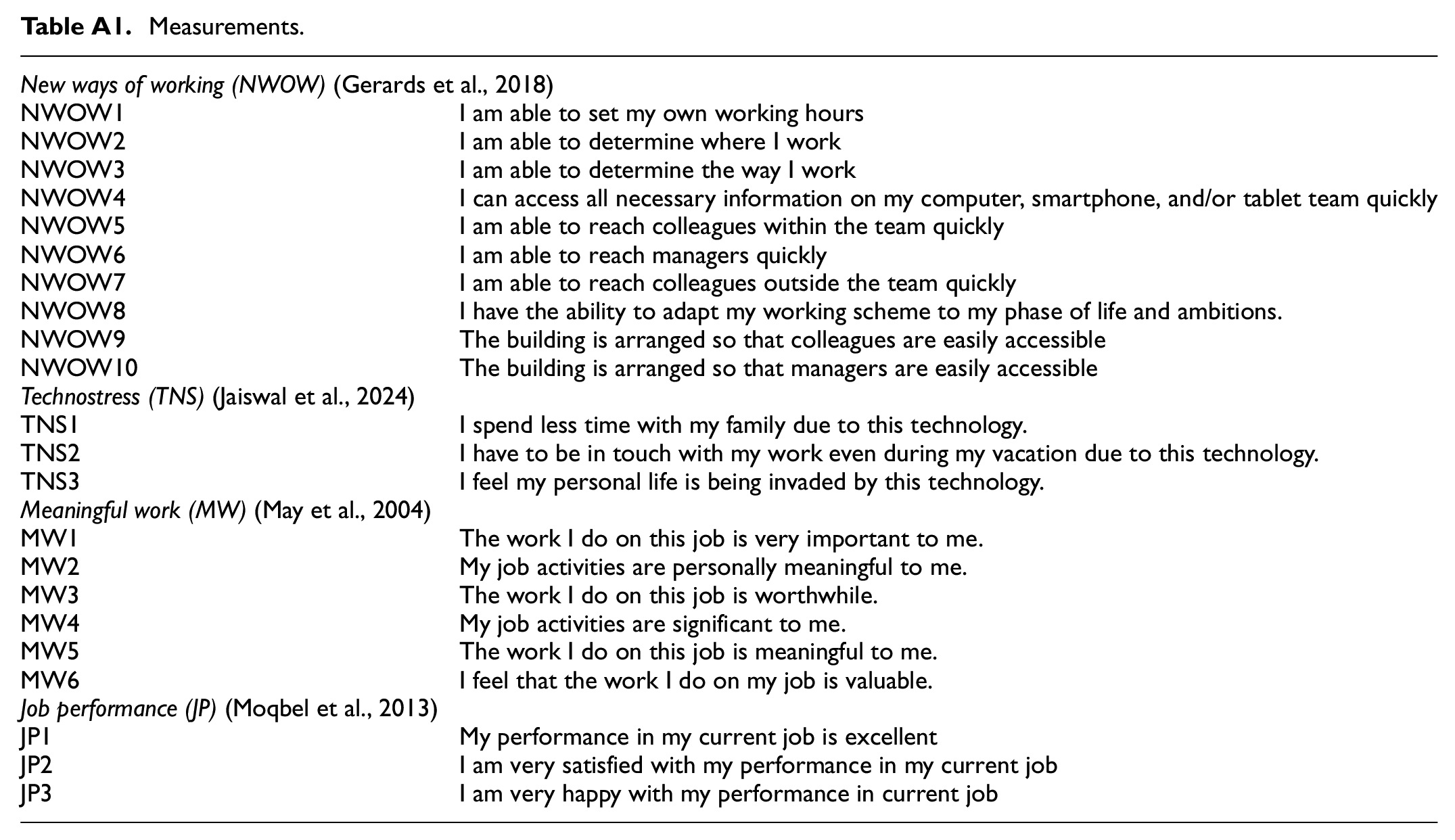
The conversation around the “future of work” has gained substantial momentum, particularly in the wake of the COVID-19 pandemic’s impact on traditional work environments. Amidst this global transformation, Vietnam stands out as a developing nation embracing remote and hybrid working models, yet there is a notable gap in empirical research. This study aims to provide valuable insights into the intricate interplay between NWOW, MW, TNS, and JP. Guided by the hypothesis that these factors significantly affect one another in modern workplaces. Data was gathered from March to June 2023 via Google Forms across diverse Vietnamese cities and occupations. The original English questionnaire was translated into Vietnamese via the back-translation method (Brislin, 1976). Its comprehensibility was then ensured through pre-testing by a panel of eight independent researchers and a cohort of ten potential respondents. Feedback from these tests was used to refine the survey for clarity and relevance, leading to strategic amendments in the initial drafts. NWOW in Vietnam has garnered increased attention post-COVID-19 (Le et al., 2022; M. H. Nguyen, 2021; M. H. Nguyen & Armoogum, 2021). Our research is among the first to explore these methods within this specific context and background. In this study, we examine the effect of NWOW on employee performance in general. To achieve this, exploratory research was conducted using a convenience sampling method, meaning the sample does not cover specific industries or services. Data were collected using a digital survey questionnaire disseminated through Google Forms. We expanded the survey’s reach by leveraging both personal and professional networks, inviting participants to complete the questionnaire directly on Google Forms as well as via email and social media platforms. At the end of the survey, we received responses from 336 individuals across significant critical economic sectors in Vietnam. This varied sample supports the broad applicability of the results to various professional environments. Following a meticulous examination to ensure data quality, responses with the same answer for all options were eliminated. The effective sample size comprised 309 valid responses (Table 1). Participation was voluntary, and confidentiality was assured. Furthermore, participants provided informed consent, upholding the ethical standards of the research. For variable measures, scales from previous studies were adopted. NWOW was measured with ten items based on Gerards et al. (2018); TNS was gauged using three items from Jaiswal et al. (2024). MW was assessed with six items, according to May et al. (2004), and JP was measured through three items based on Moqbel et al. (2013). All items were assessed on a 5-point Likert scale.
Sample Characteristics.

Source. Author’s work.
SPSS 25 was used for the descriptive analysis of demographic information, and SmartPLS 4.9.0.2 was used for SEM. Data were analyzed using the variance-based SEM technique, Smart-PLS, which is suitable for hypothesis testing and path analysis in explanatory studies (Farooq & Radovic-Markovic, 2017). SEM comprises a measurement model for testing construct validity and reliability and a structural model for examining variable relationships (Anderson & Gerbing, 1988; Smith, 2003). The results confirm data quality and structural model consistency (Hair et al., 2014). Statistical analysis evaluated the reliability, convergence, discrimination, and fit of the measurement and structural models using Cronbach’s alpha, factor loading, AVE, and CR (Bagozzi & Yi, 1988; Hair et al., 2010, 2014, 2021), as well as the square root of AVE and Fornell–Larcker criterion (Fornell & Larcker, 1981). The relationships in the structural model were assessed using bootstrapping results.
Findings
Multicollinearity and Common Method Bias
This study carefully evaluated the possibility of multicollinearity and common method bias (CMB) using the variance inflation factor (VIF). Based on Hair et al. (2011) criterion, all VIF values in this research ranged from 1.000 to 1.472, indicating no significant multicollinearity concerns in the model. We ensured participants that their responses would remain anonymous and confidential. This measure helps minimize evaluation apprehension and, consequently, another potential source of common method bias (Podsakoff et al., 2003). Additionally, we have employed Harman’s single-factor test and VIF analysis, which are widely used techniques for detecting CMB (Kock, 2015; Podsakoff et al., 2003). The application of exploratory factor analysis with Harman’s single-factor extraction indicated that the percentage of total variance extracted was 38.315%. This falls below the threshold of 50% suggested by recent studies (C.-Y. Li & Fang, 2022; Xu et al., 2022) signifying the non-problematic presence of CMB in the model. With a strong emphasis on research rigor and the importance of curbing CMB, this study executed procedural strategies ahead of data collection to limit potential CMB. The primary objective of these strategies was to enhance the accuracy of responses by mitigating any systematic bias.
Model Fit Indices
The model fit values indicate that the proposed model adequately represents the data. The standardized root mean square residual (SRMR) value of 0.079, which is below the threshold of 0.08, suggests a good fit between the observed and predicted correlations. Although the Chi-square statistic of 1,093.458 is high, this is typical for large samples and does not necessarily indicate poor fit. Additionally, the normed fit index (NFI) value of 0.752, while not exceeding the ideal threshold of 0.90, falls within an acceptable range for Partial least squares structural equation modeling (PLS-SEM), suggesting the model is a reasonable fit. Therefore, model fit values collectively support the conclusion that the model has an adequate fit to the data.
Measurement Model Analysis
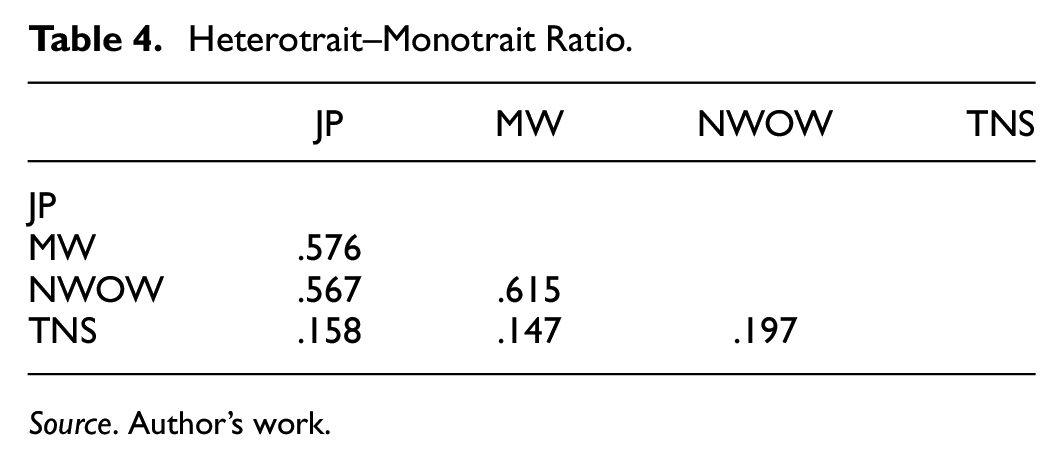
Our study underwent an extensive evaluation to ensure the accuracy of the measurement model. As shown in Table 2, reliability was confirmed with Cronbach’s Alpha indices and composite reliability of all factors exceeding the .70 threshold (Hair et al., 2021). Convergent validity was supported as factor loadings and AVE for each construct surpassed the accepted standards of 0.6 and 0.5, respectively. Discriminant validity, determining the distinctness of each construct, was affirmed based on Fornell and Larcker’s (1981) criteria and verified Heterotrait-Monotrait ratio (HTMT) values below 0.90, as evidenced in Tables 3 and 4. R-square values indicated that our model could explain 34% and 32.1% of the variance in JP and MW, respectively. However, it only accounted for 1.7% of the variation in TNS. Although R-square values provide insight, they alone do not represent the model’s overall effectiveness, requiring further metrics and factors to assess its robustness.
Result of Reliability and Convergent Validity.

Source. Author’s work.
Fornell–Larcker Criterion.

Source. Author’s work.
Heterotrait–Monotrait Ratio.
Source. Author’s work.
Structural Model Analysis and Hypothesis Testing
The data empirically supports the hypothesis, showing a significant positive relationship between NWOW and perceived JP (β = .305, p < .001) and a positive relationship between NWOW and TNS (β = .130, p = .075). The anticipated negative relationship between TNS and JP was not statistically significant (β = .062, p = .258). Thus, hypothesis H2b and the proposed mediating role of TNS in the NWOW-JP relationship (H2) were not supported. The evidence indicates a significant positive link between NWOW and perceived MW (β = .553, p < .001), reinforcing the hypothesis H3a. Similarly, there’s a notable positive association between perceived MW and JP (β = .339, p < .001), which supports hypothesis H3b. Thus, it’s established that MW acts as a mediator in the relationship between NWOW and perceived JP (β = .188, p < .001), affirming hypothesis H3. Finally, given the absence of a significant indirect effect of NWOW on JP via the sequential mediator’s TNS and MW (β = .003, p = .308), hypothesis H4 did not receive empirical support (Figure 2).Table 5 contains the SEM analysis results.

Diagram of SEM analysis results.
Path Analysis and Hypothesis Testing.

Source. Author’s work.
Discussions
Our results demonstrated a significant positive correlation between NWOW and perceived JP, a finding that resonates with prior studies endorsing the benefits of flexible and autonomous work practices for performance tasks (Mohammed et al., 2022; Tunk & Kumar, 2023). These results provide empirical support for the theories postulated by Hill et al. (2003) and Baltes et al. (1999), which suggest that flexibility intrinsic to new work arrangements can heighten job satisfaction, an acknowledged precursor to better performance (Alfes et al., 2022; Judge et al., 2001). The finding of empirical evidence corroborates that NWOW, when implemented as a job resource, significantly enhances employees’ performance efficacy (Van Steenbergen et al., 2018). Additionally, the results align with Hackman and Oldham (1976) job design theory, which underscores how autonomy can enhance JP by facilitating task customization.
The significant correlation between NWOW and TNS (β = .130, p = .075) supports hypothesis 2a. This suggests that integrating novel digital tools and platforms may increase stress levels as much as earlier studies such as Brod (1984) and Tarafdar et al. (2007) anticipated. Further, our findings indicate that TNS does not significantly negatively affect perceived JP (β = .062, p = .258), contradicting Hypothesis 2b. This result diverges from earlier work arguing that TNS can impair JP, leading to cognitive overload (Hobfoll, 1989; Rohwer et al., 2022). Effective stress management strategies, supportive organizational culture, or individual resilience might mitigate TNS’s impact, variables of this study did not account for this proposition. Therefore, this study’s results did not support hypothesis 2, which posited a mediation effect of TNS on the relationship between NWOW and perceived JP. Our findings imply that while NWOW might raise TNS, this does not necessarily negatively affect JP outcomes, providing a different perspective from the current literature and suggesting the need for future studies to elucidate this complex relationship further.
We uncovered a pronounced positive correlation between NWOW and MW, marked by a coefficient of β = .553 with a significance level of p < .001. Supporting Hypothesis 3a and aligning with literature proposing that new work methods enhance the perception of work as meaningful (Althorpe, 2023; Humphrey et al., 2007; Martela et al., 2021). The NWOW provides employees with greater control over how, when, and where they work. This increased autonomy leads to a stronger sense of ownership and purpose in one’s work (Martela et al., 2021). Furthermore, there emerged a salient positive link between the perception of MW and JP, indicated by a coefficient of β = .339 and a significance level of p < .001, reaffirming Hypothesis 3b and supporting the concept that MW can enhance JP due to increased intrinsic motivation, goal alignment, and engagement (Chalofsky & Krishna, 2009; Han et al., 2021). In a further enlightening revelation, MW was discerned to act as a mediator, orchestrating the relationship between NWOW and JP (with a coefficient of β = .188 and significance p < .001), reinforcing Hypothesis 3 and previous theoretical claims (Pratt & Ashforth, 2003; Steger et al., 2012).
Finally, our data indicated that the relationship between NWOW and JP was not significantly serially mediated by TNS and MW (β = .003, p = .308). This contradicts Hypothesis 4, which suggested sequential mediation of TNS and MW. Our results hint at a potential resilience in employees to technological changes introduced by NWOW without an associated increase in TNS or diminished sense of MW (Ayyagari et al., 2011; Lee et al., 2017; Tarafdar et al., 2015). It appears that employees may be successfully leveraging NWOW-related resources to maintain their psychological resources (Hobfoll, 1989), preventing resource loss that could lead to increased technostress or decreased work meaningfulness. Moreover, our results question the claim that TNS reduces the sense of MW (Salanova et al., 2013) and suggest that workers might leverage resources provided by NWOW to counter TNS, as per the Job Demands-Resources model (Bakker & Demerouti, 2007). However, the non-significant relationship between TNS and JP contradicts earlier studies (Grant, 2008; Rich et al., 2010) and suggests the need to consider additional factors in future research.
Considering the relatively small effect sizes observed in some of the findings, critically evaluating the practical implications of these results is imperative. Specifically, the R-squared value for TNS is only .017, indicating that NWOW explains merely 1.7% of the variance in TNS. This small effect size suggests a weak relationship between NWOW and TNS. Although this relationship is statistically significant, its practical significance might initially appear limited (Cohen, 2013). Nevertheless, even minor changes in TNS can have considerable implications for employee well-being and productivity over time. For instance, reducing TNS, even slightly, can improve mental health, job satisfaction, and overall performance, which are vital for long-term organizational health and employee retention (Tarafdar et al., 2007). The results are compared with those of similar studies to contextualize these findings within the broader literature. Previous research has demonstrated varying degrees of impact of NWOW on TNS, indicating that factors such as organizational culture, technological infrastructure, and individual differences might moderate this relationship (Ragu-Nathan et al., 2008). By situating these findings within this context, a more nuanced understanding of the effects of NWOW is gained, providing a basis for future research to explore these moderating factors. On the other hand, the substantial influence of NWOW on JP and MW highlights the potential benefits of modern working practices (Gagné & Deci, 2005. Concurrently, the small but significant effect on TNS invites further investigation into how NWOW can be optimized to minimize TNS and enhance employee well-being (Ayyagari et al., 2011). These insights offer a balanced view of the statistical and practical implications of the research, contributing valuable knowledge to the field of organizational behavior and management.
Implications
Theoretical Implications
This research significantly contributes to the existing body of knowledge around NWOW and its impact on JP. Despite the increasing adoption of NWOW across industries and organizations, our understanding of how these novel work practices influence JP remains incomplete. Our study provides fresh theoretical insights that directly address this gap. By introducing perceived MW as a mediator in the relationship between NWOW and JP, our research expands the theoretical scope of NWOW impacts. Our findings highlight that the enhanced autonomy and flexibility offered by NWOW may help cultivate a sense of MW, thereby positively affecting JP. Contrary to expected outcomes, our study found that TNS and MW do not serially mediate the relationship between NWOW and JP. This suggests that the impact of NWOW is perhaps not a simple, linear process but is instead characterized by multiple intersecting pathways. This insight urges a rethinking of theoretical models around NWOW, paving the way for exploring the non-linear or simultaneous influences that NWOW can have on JP.
Besides, the results of this study provide evidence that the prevailing perception of NWOW has a significant influence on JP extending to an emerging context such as Vietnam. The observed positive relationship between NWOW and JP is perceived to support the generalizability of the NWOW model in different economic and cultural contexts, complementing the existing research mainly conducted in developed markets (Bosua et al., 2012). This provides a springboard for future empirical studies of NWOW in other developing economies, highlighting the relevance of NWOW models beyond the traditional research context. Furthermore, our findings challenge the popular belief that NWOW, through increased TNS, adversely affects JP (Tarafdar et al., 2015; Yener et al., 2021). Contrary to L. Li and Wang (2021) study, our data indicates that while the implementation of NWOW does influence TNS, which does not consistently impact JP. Although employee’s JP is expected to be impaired by TNS (Tarafdar et al., 2011), this paper hints at the possibility that the effects of TNS might be more contingent on context, that is, Vietnam, than previously thought. In Vietnam, strong communal values and a collective work ethic often lead to a higher tolerance for stressors, with employees prioritizing group harmony and job retention over personal discomfort, thus minimizing the effect of TNS (N. Y. Nguyen & Hack-Polay, 2024). Conversely, in developed Western countries, individualism and a focus on personal well-being are more pronounced (Hofstede, 1980). Such insights prompt additional empirical research to identify the exact circumstances when TNS plays a crucial role in the NWOW model.
Practical Implications
The strong positive association between NWOW and perceived MW implies that NWOW implementation can enhance employees’ sense of purpose and engagement, boosting performance. Therefore, managers and decision-makers should enhance autonomy and flexibility in the workplace, promoting a sense of MW by clearly communicating organizational goals and providing regular recognition and feedback. It’s crucial to address TNS through comprehensive technology training and limiting digital overload. Recognizing that NWOW’s impact may not follow a simple linear path, they should adopt models that account for multiple intersecting pathways and develop customized approaches for different teams. Continuous feedback mechanisms and adaptable policies are essential for evolving employee needs. Supportive leadership, exemplified by empowered leaders who model healthy NWOW practices and robust employee well-being programs that promote work-life balance, will further drive JP and employee satisfaction.
Limitations and Future Research
The results of this study, while significant, possess academic limitations that guide subsequent research. While providing insights regarding NWOW in developing countries, future research might incorporate various cultural and economic factors to understand NWOW’s influence on work performance further. Secondly, the study, with its cross-sectional design, provides a snapshot of variable correlations at a specific instance, but these dynamics may shift with time; longitudinal research can provide a more detailed understanding by effectively tracking these changes over time. Additionally, the reliance on self-reported data introduces potential biases, including those of social desirability and memory. While self-report measures can provide valuable insights into individuals’ perceptions of their performance, they are inherently subjective. To address these limitations, future research should consider incorporating more objective measures of job performance. This could involve replicating the study with the addition of supervisor ratings or objective data collection methods alongside surveys. To mitigate these issues and common method bias, future studies could incorporate factor scores from an unmeasured latent method factor (Podsakoff et al., 2003).
Moreover, future studies may utilize more objective work performance measurements (Table A1, Appendix), TNS, and triangulated data from qualitative research techniques like interviews or focus groups to further understand the phenomenon. Finally, while NWOW mainly focuses on highly educated workers, who are often key drivers of organizational growth (Alfes et al., 2022), our use of convenience sampling led to a respondent pool characterized by high educational attainment due to the professional networks of the authors. To overcome the limitations of the non-probability sampling method, future research should consider employing a random sampling approach to capture a more diverse array of respondents, including employees from various educational backgrounds.
This research only examined TNS and MW as mediators of NWOW and JP. Future studies should incorporate other mediating or moderating factors, such as personality characteristics, skills, attitudes, organizational culture, and leadership, to provide a complete theoretical framework for understanding how NWOW affects JP. Finally, our research found no evidence that NWOW indirectly affects workplace performance via serial effecting of TNS and MW. This suggests exploring these variables’ complicated interactions and possible intersections. Despite these limitations, this research has improved our knowledge of NWOW and job success in developing countries. Subsequent research holds the promise further to illuminate the academic discourse on NWOW and JP.
Conclusion
Our study has advanced our knowledge of NWOW and its effects on JP, especially in developing economies. We found additional insights into NWOW’s complicated effects on JP by including TNS and MW in our theoretical framework. According to our research, NWOW improves workplace performance, TNS and MW. However, TNS’s role in the nexus between NWOW and JP was more intricate than anticipated, as it did not significantly associate this association, pointing to a complex interplay among these elements. This enables new study options for examining NWOW, TNS, MW, and JP’s contextual dependencies and complicated interrelationships. The result has improved our knowledge of NWOW’s impacts on JP, but it has also highlighted the need to constantly update our theoretical models to account for the fast-changing nature of work. To improve on this study’s conclusions, further research in diverse cultural and economic situations and the addition of mediating or moderating factors are needed. This study provides valuable insights for businesses in developing markets adopting or refining NWOW, guiding the balance between JP, TNS, and MW while also underscoring the need for deeper exploration of NWOW dynamics in the 21st-century workplace, vital for both academia and the business world.
Footnotes
Appendix
Measurements.
| New ways of working (NWOW) (Gerards et al., 2018) | |
| NWOW1 | I am able to set my own working hours |
| NWOW2 | I am able to determine where I work |
| NWOW3 | I am able to determine the way I work |
| NWOW4 | I can access all necessary information on my computer, smartphone, and/or tablet team quickly |
| NWOW5 | I am able to reach colleagues within the team quickly |
| NWOW6 | I am able to reach managers quickly |
| NWOW7 | I am able to reach colleagues outside the team quickly |
| NWOW8 | I have the ability to adapt my working scheme to my phase of life and ambitions. |
| NWOW9 | The building is arranged so that colleagues are easily accessible |
| NWOW10 | The building is arranged so that managers are easily accessible |
| Technostress (TNS) (Jaiswal et al., 2024) | |
| TNS1 | I spend less time with my family due to this technology. |
| TNS2 | I have to be in touch with my work even during my vacation due to this technology. |
| TNS3 | I feel my personal life is being invaded by this technology. |
| Meaningful work (MW) (May et al., 2004) | |
| MW1 | The work I do on this job is very important to me. |
| MW2 | My job activities are personally meaningful to me. |
| MW3 | The work I do on this job is worthwhile. |
| MW4 | My job activities are significant to me. |
| MW5 | The work I do on this job is meaningful to me. |
| MW6 | I feel that the work I do on my job is valuable. |
| Job performance (JP) (Moqbel et al., 2013) | |
| JP1 | My performance in my current job is excellent |
| JP2 | I am very satisfied with my performance in my current job |
| JP3 | I am very happy with my performance in current job |
Acknowledgements
The authors express deep appreciation to the study participants and esteemed colleagues for their substantial contributions and support, which were essential to this research. This paper, part of a series from one project, employed the salami slicing technique. The authors also acknowledge the crucial roles of reviewers, editors, research teams, and collaborators.
Author Contributions
Phuong Ngoc-Duy Nguyen and Huan Hong Nguyen collaboratively drafted the study. They revised the manuscript, with Phuong focusing on project management, reviewing/editing, and Huan focusing on manuscript writing and reviewing/editing. Trang Thi Giang assisted in conceptualization, managed data collection, and contributed to interpretation and manuscript editing. Hiep Cong Duong contributed to the study’s design, coordinated data collection, conducted the PLS-SEM analysis, and reviewed the manuscript. Linh Duy-Yen Nguyen contributed to model conceptualization, manuscript writing, and reviewing/editing. All authors agreed on the final manuscript.
Declaration of Conflicting Interests
The author(s) declared the following potential conflicts of interest with respect to the research, authorship, and/or publication of this article: Data Access
Funding
The author(s) received no financial support for the research, authorship, and/or publication of this article.
Ethical Approval
The present study was conducted following stringent ethical guidelines about research involving human participants, encompassing informed consent, voluntary involvement, and the preservation of confidentiality. A strict confidentiality protocol was implemented, and personally identifiable information was removed or anonymized to safeguard participants’ privacy. According to the “Ethical Review of Biomedical Research Involving Human Beings,” a public source from China’s National Health and Wellness Commission, all life science and medical research activities involving human beings should be subject to ethical review ( ). Business research and management are not part of life science and medical research activities involving human beings and only require clear and explicit informed consent prior to data collection. No formal ethics approval was therefore required in this case because (a) the data is completely anonymous with no personal information being collected; (b) the data is not considered to be sensitive or confidential in nature; (c) the issues being researched are not likely to upset or disturb participants; (d) vulnerable or dependent groups are not included; and (e) there is no risk of possible disclosures or reporting obligations. This study has been performed in accordance with the Declaration of Helsinki. Written informed consent for participation was obtained from respondents who participated in the survey. For the respondents who participated in the survey were asked to read the ethical statement posted at the top of the form (There is no compensation for responding, nor is there any known risk. To ensure that all information will remain confidential, please do not include your name. Participation is strictly voluntary, and you may refuse to participate at any time) and proceed only if they agree. No data was collected from anyone under 18 years old.
Data Availability Statement
The data that support the findings of this study are openly available on Figshare at . Readers and researchers can access and utilize the dataset under the terms and conditions of the Figshare repository, ensuring transparency and reproducibility of the research findings. The dataset includes data for understanding and replicating the analysis.