




Abstract
Servant leadership style has drawn much attention in the last decade to leadership studies on account of its focus on serving others first. Extant literature calls for a better understanding of the underlying mechanism for servant leadership to positively influence performance within an organization. We position servant leadership to contribute to firms’ sustainable performance, by empirically studying the mediating mechanism of bi-dimensional trust, namely affective and cognitive trust, between servant leadership and individual performance. Our data comprised of dyadic samples of 233 pairs of subordinates and their supervisors. The results from hierarchical linear model (HLM) for clustered data showed that servant leadership strongly predicted affective trust, organizational citizenship behaviors (OCBs), and task performance of subordinates; affective trust fully mediated servant leadership’s effect on task performance while partially mediates servant leadership’s effect on subordinates’ OCB. In contrast, cognitive trust did not mediate servant leadership’s effect on either OCB or task performance. These findings reveal the relevance of affective trust as the underlying mechanism which mediates and deciphers servant leadership into positive individual performance.
Keywords
Introduction
Servant leadership has been recognized as a leadership philosophy addressing the concerns of ethics (Carter & Baghurst, 2014). As a burgeoning research area, servant leadership links leadership to ethics, virtues, and morality (Lanctot & Irving, 2010; Parris & Peachey, 2013). It has attracted research interest in the field of organizational studies in the last decades with its special attention to the leader’s role as a servant, putting the needs of others first to consequently foster positive organizational outcomes (Lapointe & vandernberghe, 2018; Liu, 2019; Newman et al., 2017). This focus on serving others dramatically shifts the center of leadership studies from solely leading to balancing the paradox of leading and serving at the same time. While charismatic and transformational leaders could create extraordinary outcomes (e.g., Mohandas Gandhi, Rev. Martin Luther King), the results could also be a disaster in the absence of moral safeguards (e.g., Adolph Hitler, Rev. Jim Jones). Servant leadership not only is inspirational but also contains moral safeguards (Graham, 1991). This paradoxical leadership function and style of servant provides critical mechanisms in the workplace to safeguard business ethics of an organization while also seeking performance.
Recognizing the paradoxical relationship, researchers have emphasized the need to focus on how the underlying mechanisms of servant leadership affect organizational outcomes (Chiniara & Bentein, 2016; van Dierendonck, 2011). Trust has been highlighted as a part of the important mediating processes for servant leadership to affect organizational outcomes (van Dierendonck, 2011) and moves theory away from the homo oeconomicus (“economic man”) model that assumes the individual as rational, individualistic, opportunistic, and self-serving (Donaldson & Davis, 1991; Mele, 2009). Several reviews (e.g., Parris & Peachey, 2013; Russell and Gregory Stone, 2002; Sendjaya & Sarros, 2002; van Dierendonck, 2011) have included the specific role of trust in the relationship between servant leaders and followers. We specifically examine the mediation effects of trust between servant leadership and performance in this article.
The mediating role of trust has been studied in other contexts. These include the relationship between transformational leadership and organizational performance like organizational citizenship behaviors (OCBs; Pillai et al., 1999; Podsakoff et al., 1990; Zhu et al., 2013) and job performance (Jung & Avolio, 2000; Zhu et al., 2013). Van Dierendonck (2011) called for such a trust mediating effect study in servant leadership. However, a systematic examination of the mediating role of trust in the relationship between servant leadership and individual performance is still lacking. There are studies incorporating a role for trust in servant leadership (e.g., Politis & Politis, 2017; Rosnani, 2018), and Joseph and Winston (2005) found a positive relationship. Other studies examining the mediating role of trust treated it as a uni-dimensional variable (Jaramillo et al., 2015; Politis & Politis, 2017; Rosnani, 2018). Due to recent advances and application of bi-dimensional trust (i.e., cognitive and affective trust) in leadership (Zhu et al., 2013), the distinction between these two dimensions of trust in servant leadership is necessary to enhance the understanding of the underlying functional mechanism of servant leadership toward performance. Prior research has only examined this mechanism on team performance at group level (Schaubroeck et al., 2011).
To fill this gap, we first elucidate the role of different dimensions of trust in mediating between servant leadership and individual performance. There is a growing body of literature showing that leadership has varied effects at the individual and group levels (Dansereau et al., 1999; Waldman & Yammarino, 1999; Zhu et al., 2013). Some studies (e.g., Rezaei et al., 2012; Sendjaya & Pekerti, 2010) also have looked at trust collectively. Yet, Newman et al. (2017) point out that the individual-level mechanisms underlying the link between servant leadership and OCB is still poorly understood. Thus, we focus on the impact of servant leadership on individual performance through affective and cognitive trust as mediating mechanisms. The findings of this study may enable us to better understand how to leverage the effects of servant leadership to promote a desired individual performance through trust.
Servant Leadership
Greenleaf’s (1977) conceptualization of servant leadership as a distinct style introduced a new stream of research in the leadership literature. The focus then shifted from the leader’s persona to that of others and led to a concept of leadership where the leader was in the service of others while at the same time practiced listening, built consensus, and provided foresight. This perspective had been recognized in ancient religious leaders’ practices (Sendjaya & Sarros, 2002) both in the East and in the West, yet its conceptualization as servant leadership in modern management literature was new. Only recently we are beginning to understand its multilevel organizational function (Hunter et al., 2013) and empirical studies began less than 20 years ago (Laub, 1999), leaving room for further definition, interpretation, and operationalization (van Dierendonck, 2011).
In the views of Russell and Gregory Stone (2002), van Dierendonck (2011), and Parris and Peachey (2013), servant leaders look for a higher plane of operation, and their prime motivation in leadership is their desire to serve their followers. Both dimensions of servant leadership “to serve” and “to lead” are important for prosperity of an organization (Ragnarsson et al., 2018). According to Sendjaya and Sarros (2002), “the servant leader operates on an assumption that ‘I am the leader, therefore I serve’ rather than ‘I am the leader, therefore I lead’” (p. 60). This is the underlying philosophy of servant leadership, and it does not imply that the leader would necessarily have low self-esteem or an attitude of servility (van Dierendonck, 2011). A deep connection between servant leadership and compassionate love results in the modesty, gratitude, tolerance, and selflessness of a servant leader (van Dierendonck & Patterson, 2015). Indeed, by explicitly emphasizing the needs of followers (Patterson, 2003), instead of an authoritative power distance, servant leadership shifted the focus notably from an economic man to a humanistic model with governance based on viewing individuals as pro-organizational, self-actualizing, and trustworthy (van Dierendonck, 2011). Servant leadership shares various elements, that is, personal integrity, ethical behavior, altruism, and role modeling with an ethical leadership approach (Liden et al., 2008; Reed et al., 2011).
In the rational paradigm, leaders are often seen as isolated heroes who have command and control capabilities. The term leader, in an organizational context, has been used for a person who holds a managerial position and is in a capacity to give orders to other organizational members (Sendjaya & Sarros, 2002). Contrary to this general perception, Levering and Moskowitz (2000) indeed identified servant leadership styles in some of the best U.S. companies (such as Southwest Airlines and TD Industries) in the United States based on a Fortune magazine survey. Considering the role of a servant leader as a manager expanded Greenleaf’s visualization of a servant leader as a servant first and then a leader, finding a place for the style in an organizational context. Consequently, various servant leadership models and measurements emerged in the last decade (Chiniara & Bentein, 2016).
Ehrhart (2004) was among the very first scholars who empirically tested servant leadership. In a cross-sectional study involving grocery store departments, he concluded that servant leadership is empirically distinct from leader–member exchange and transformational leadership styles and found evidence that servant leadership promoted both fair workplace environments and OCB that benefit organizations. In this study, Ehrhart developed, tested, and validated a 14-item scale for the measurement of servant leadership. Liden et al. (2008), using organizational field data, developed, tested, and validated a 28-item servant leadership scale and likewise concluded that servant leadership emerged as empirically distinct from both transformational and leader–member exchange styles. They also identified positive relationships between servant leadership and in-role performance, organizational commitment, and community citizenship behaviors. Sendjaya et al. (2019) provided support for a six-item parsimonious scale. Recently, van Dierendonck et al. (2017) introduced an 18-item scale showing cross-cultural factorial stability.
Compared with various leadership styles, servant leadership shares some overlapping characteristics with transformational leadership (van Dierendonck et al., 2014) but with some critical differences. Transformational leaders are highly competent and provide a clear and compelling agenda and inspire the followers in the pursuit of that agenda (Hackman, 2002). Yet, unlike a transformational leader who focuses on organizational objectives, a servant leader focuses on his or her followers. According to Stone Gregory et al. (2004), while servant leaders do not have a particular affinity for an abstract corporation or organization, they have an unconditional concern for those who constitute that organization. Continuing this distinction, the focus of a servant leader is not the performance of followers but the development of their positive attitudes and behavior. This suggests the need for clarity in the direct and mediated relationship between servant leadership and individual performance including task performance and OCB.
Studies have examined the effect of various mediating variables, such as social identity measures, autonomy, competence, and need satisfaction, on the relationship of servant leadership and performance (Chiniara & Bentein, 2016). Trust, despite its great relevance within a humanistic paradigm of the organizations (van Dierendonck, 2011), has not yet been studied as a mediating variable between servant leadership and performance. Zhu et al. (2013) and other scholars studied trust’s mediating role on transformational effects. Given the overlapping characteristics between these two types of leadership, we argue that trust can also play a mediating role in the relationship between servant leadership and performance which we discuss later in the article.
Servant Leadership and Individual Performance
Scholars have distinguished between in-role and extra-role behaviors in the relationship between servant leadership and individual performance. In-role behaviors, such as task performance, are formally recognized by the organization and are fixed by job descriptions (Chiniara & Bentein, 2016; Williams & Anderson, 1991). Extra-role behavior is discretionary in nature and has no direct link to the formal reward system that is meant to guide employees’ activity in an organization. OCB falls under the dimension of extra-role behavior (Katz, 1964). In the following sections, we examine the literature relating servant leadership with OCB, and task performance.
Servant leadership and in-role behaviors
Task performance by itself could be studied at the level of organization, team and individual. Task performance is the most common in-role behavior measured for individual performance. Chiniara and Bentein (2016) empirically found that servant leadership indirectly affects task performance; servant leaders provide autonomy and self-sufficiency which results in the higher levels of performance of their subordinates. Other studies have identified a positive impact of servant leadership on team performance (Schaubroeck et al., 2011), firm performance (Peterson et al., 2012), financial performance of organizations (Ruschman, 2002), and individual performance (Jaramillo et al., 2015). While we would associate leadership with higher performance at the organizational level, the leader as a supervisor of employees would also be expected to make a direct impact at the individual level. Thus, we decided to focus on individual-level performance.
Servant leaders strongly believe that they have a duty of stewardship. They are people-centric and value services to others in general and more specifically to their followers. In organizational settings, servant leaders believe in every employee and treat them with respect and humility. The employee is given an opportunity to do meaningful work. Favorable attitudes of employees toward their supervisors were found to be related to the productivity of employees (Bass, 1990). Jaramillo et al. (2015) found significant and positive association between servant leadership and salespersons’ task performance. Performance can be potentially linked to leadership when the primary focus of the leader is to serve the followers (Joseph & Winston, 2005). As leader behavior has an impact on subordinate performance, a servant leader’s subordinates have high levels of engagement and loyalty which can potentially contribute toward higher levels of productivity (Hess, 2013). Thus, we hypothesize the following:
Servant leadership and extra-role behavior
Leader behavior exercises a strong influence on subordinate behavior by being a model to emulate or a standard to meet. Different leadership styles, including transformational leadership, transactional leadership, leader–member exchange, and servant leadership, have been identified as important predictors of OCB in subordinates (Mahembe & Engelbrecht, 2014; Podsakoff et al., 1990; Schlechter & Engelbrecht, 2006). Social exchange theory proposes reciprocity in the relationship, where an individual who receives any kind of reward would try to reciprocate with something of similar value. Given the servant attitude of the leader, subordinates are expected to respond with a similar attitude and behavior and are likely to promote reflective behavior (Erdurmazlı, 2019; Newman et al., 2017). McNeff and Irving (2017), in their qualitative study, also found a positive association between servant leadership and employees’ extra-role behavior.
Despite the increasing importance of servant leadership, few studies have empirically tested the impact of servant leadership on the OCB of employees (Mahembe & Engelbrecht, 2014). Burns (1978) first identified the process of an upward spiral, which works in the interplay between leaders and followers. Russell and Gregory Stone (2002) identified that the job attitudes of followers and their performance were the consequences of servant leadership. Since the followers are receiving moral and motivational support, and feel a sense of importance placed on their well-being by the leader, they try to reciprocate through citizenship behavior. Servant leadership encourages moral reasoning in the followers which results in higher levels of citizenship behavior (Graham, 1995) in them. Similarly, studies by Ng et al. (2008), Neubert et al. (2008), and Zhao et al. (2016) found a positive association between servant leadership and OCB of followers. Similarly, Neubert et al. (2016) also found positive association between servant leadership and employee helping behavior. The multilevel study by Ehrhart (2004) also supported servant leadership as a potential antecedent of followers’ OCB. The subordinates demonstrate OCB to reciprocate the leader’s humility and modesty. Hence, we propose the following hypothesis:
Trust as a Mediator
Social exchange theory views the social behavior of individuals as a result of exchanges in both economic and social outcomes (Lambe et al., 2001). According to Stafford (2008), social exchanges involve a connection with another person, involve trust as opposed to legal obligations, are more flexible, and rarely involve explicit bargaining. Social exchange theory also suggests the desire to reduce losses and maximize gains by individuals in interactional relationships between them (Thibaut & Kelley, 1959). Homans (1961), having focused on the reinforcement principle of social exchange, defined it as an exchange of tangible or intangible activities between at least two individuals. According to the theory, a relationship which provides more gain than loss (tangible or intangible) will produce mutual trust (Blau, 1964). In servant leadership, the process of interaction and exchange (explicit or implicit) between the servant leader and subordinates is central to the relationship (Liden et al., 2008). In the process of serving the followers, the leader engages in a high level of interaction with them and would, therefore, influence the level of trust and relationship (Schwarz et al., 2016).
The exchange relationship is an intervening construct between two partners, and the character of the relationship will define the consequences (Cropanzano & Mitchell, 2005, Erdurmazlı, 2019). Trust is a promising relational construct in a work setting between two interacting individuals (Dirks & Ferrin, 2002), and it is a key component in a successful relationship between a leader and followers. It helps them cooperate, manage, share, and enable mutual understanding (Dirks & Ferrin, 2002; Erdurmazlı, 2019). It also reflects the level of confidence of one person in the competence and skill of another (Nyhan & Marlowe, 1997). Scholars have identified many dimensions of trust including political trust (Hetherington, 1998), societal trust (Shah et al., 2001), dyadic trust (Gurtman, 1992), trust in workplace (Holton, 2001), organizational trust (Armstrong-Stassen et al., 2001), and managers’ and subordinates’ trust (Barling et al., 2003). As the aim of this research was to understand the mechanism underlying how servant leadership affects, and interacts with, followers at an individual level in an organizational setting, we focused on subordinates’ trust in their leader as the explanatory factor mediating between servant leadership and individual performance.
Trust in the leader is considered to be an important precursor for individual performance, and leadership style and practices are linked with trust in leaders (Dirks & Ferrin, 2002). The servant leadership literature identifies trust as an integral part of the leader–follower relationship (Greenleaf, 1977; Joseph & Winston, 2005; Russell and Gregory Stone, 2002). As Greenleaf (1977) pointed out, trust is the foundation of legitimacy in leadership. Serving others affects the personal relationships within the group and imbues the social relationships with trust and liking, according to the relational dimension of group social capital (Linuesa-Langreo et al., 2018).
Several earlier empirical studies on leadership have conceptualized trust as a uni-dimensional construct and found it fully mediating the relationship between leadership styles (e.g., transformational leadership) and employee behavior (Jung & Avolio, 2000; Pillai et al., 1999; Podsakoff et al., 1990). Studies of the mediating role of trust between transformational leadership and performance showed mixed results. Some identified a positive link between transformational leadership and trust and also recognized a partially mediated linking of trust between transformational leadership and individual performance of followers (Pillai et al., 1999; Podsakoff et al., 1990; Schaubroeck et al., 2011).
Since McAllister (1995) treated trust as a bi-dimensional variable—dealing with the central elements in cognitive trust as competence and responsibility, and affective trust as a feeling of emotional security relying on faith in the interaction, more recent developments in the leadership and trust literature have incorporated these two dimensions of trust. Affective trust reflects a special relationship demonstrating concern about welfare, and cognitive trust echoes issues such as reliability, integrity, fairness, and honesty (Dirks & Ferrin, 2002; Wang et al., 2010; Yang & Mossholder, 2010; Yang et al., 2009). Affective trust is based on a reciprocal exchange of care and concern between two parties (Dirks & Ferrin, 2002; Yang et al., 2009), whereas cognitive trust has an influence on followers’ attitudes and their perceptions about the leader’s characteristics including knowledge, skills, abilities, and competence (Wang et al., 2010; Yang et al., 2009). Farling et al. (1999) also viewed a transformational embedded trust as a multidimensional construct for explaining the relationship between the servant leader and followers’ outcomes. Similarly, the meta-analysis of Dirks and Ferrin (2002) concluded that cognitive and affective trust are associated differently with leaders’ behavior and recommended that researchers include affective and cognitive dimensions within a single study to distinguish between the processes.
Van Dierendonck’s (2011) proposed model gives trust a specific mediating role in linking servant leadership with performance. Since Dirks and Ferrin’s (2002) meta-analysis did not include servant leadership in their research of trust in leadership, a much greater understanding of the role of bi-dimensional trust in servant leadership is needed, particularly given that trust is a central element in the servant leadership.
Trust mediating servant leadership and in-role behaviors
With regard to in-role behaviors, McAllister (1995) suggested that the attitudinal response of subordinates toward their supervisor’s behavior is affected by both cognitive and affective trust. As servant leaders help to empower and develop their followers not only through expressing humility but also stewardship, legitimacy, and by providing direction (Ling et al., 2017; van Dierendonck, 2011), we argue that both affective and cognitive trust will positively mediate the relationship of servant leadership and subordinates’ task performance.
Servant leadership style emphasizes the welfare of others by reducing negative interpersonal conflicts and cultivates a sense of community (Schaubroeck et al., 2011). As the focus of the servant leader is to strengthen the bond with the subordinates, such a style therefore elicits higher levels of affective trust in the subordinates. Affective trust produces a stronger emotional response in the form of stronger emotional connections and feelings of obligation (Miao et al., 2014). These relationships go beyond the economic exchange (Miao et al., 2014), and in turn, the subordinates try to reciprocate by showing positive workplace attitudes and, consequently, positive workplace task performance. The earlier studies of Schaubroeck et al. (2011) and Chan and Mak (2014) showed a positive mediation effect for affective trust between servant leadership and team performance. Although investigating transformational leadership, Zhu et al. (2013) also found that affective trust fully mediated the relationship between leadership and work outcomes of the followers. Hence, we propose the following:
Cognitive trust is more relevant in task-related processes (Yang et al., 2009), so it is expected to influence task performance. Cognitive trust, as instrumental in nature, is based on the rational evaluation by the subordinates about their supervisors’ characteristics such as competence, knowledge, and reliability. A servant leader’s role is like a steward who holds the organization in trust (Reinke, 2004). Servant leaders not only help followers in their development but also inspire them to strive, excel, and flourish (McMinn, 2001). They are influential, develop a vision for their followers, and gain credibility and trust from them (Farling et al., 1999). Knowledge and competence in business are two important factors that make followers trust a leader and consider him or her to be effective. Melchar and Bosco (2010) identified wisdom, including both knowledge and competence, as the most important characteristic of servant leaders besides organizational stewardship and altruistic calling.
There is mixed empirical evidence regarding the impact of cognitive trust on subordinates’ task performance. When the supervisor has ability, integrity, competence, and reliability, the subordinates can focus their resources on “task goal attainment” (Yang et al., 2009, p. 52), and hence cognitive trust is positively related to the in-role behavior of employees. Yang and Mossholder (2010) identified the positive impact of cognitive trust on follower work outcomes. Similarly, Zhu and Akhtar (2014) also found cognitive trust positively mediating the relationship of leadership style (i.e., transformational leadership) and task performance of subordinates. However, Zhu et al. (2013) found that cognitive trust negatively mediated the relationship between transformational leadership and the job performance of subordinates. Although Schaubroeck et al. (2011) also found a positive mediation effect through cognitive trust between transformational leadership and team performance, it did not exist in servant leadership. We therefore propose the following:
Trust mediating servant leadership and extra-role behaviors
With regard to extra-role behavior, that is, OCB, a servant leader’s focus is to develop a positive attitude and a sense of community among the subordinates (Schaubroeck et al., 2011). Servant leaders behave with humility, modesty, honesty, and trustworthiness, which create a positive and psychologically secure environment for the subordinates. This environment not only lays the foundation for affective trust but also induces cognitive trust in subordinates. Supervisor trustworthiness can help in developing a safe social environment at work, and leaders’ considerate behavior can generate group cohesion and a high level of employee interactions (Shim et al., 2016). When servant leaders manage to develop quality relationships with their subordinates by inducing cognitive and affective trust, it results in a reciprocal exchange and the extra-role behaviors (i.e., OCB; Lu, 2014; Moorman, 1991).
In the specific case of affective trust, the study of Yang and Mossholder’s (2010) using 210 dyadic data found that extra-role behaviors like OCB are related to affective trust in the supervisor. Studying the mediating role of affective trust on transformational leadership, Zhu et al. (2013) found a positive mediation effect between leadership and followers’ affective organizational commitment and OCBs.
Again, the role of cognitive trust seems to be more ambiguous. Since cognitive trust reflects the subordinates’ belief in the competence of the leader, their confidence in the leader’s ability to be a guide, facilitate their task efforts and evaluate their work experience in a favorable manner supposedly reinforces a safe social environment and sense of community at work. Some earlier studies found that cognitive trust enhanced the willingness of workers to share information and seek proactive feedback (Mayer et al., 1995; Paswan et al., 2005). On the contrary, Zhu et al. (2013) found insignificant mediating effects of cognitive trust between transformational leadership and the followers’ affective organizational commitment and OCBs. Schaubroeck et al. (2011) even concede that servant leadership should not be expected to have further influence through cognitive trust after accounting for the effect of transformational leadership. Building on the above theoretical and empirical findings, we propose the following hypotheses:
Method
Sample and Data Collection
A total of 233 heads of department (HODs)—faculty member dyads from four public universities located in Pakistan—participated in our study. The respondents consisted of 28 HODs, with faculty members working under them. Each group consist of 1 HOD and 5 to 13 faculty members. Faculty members were responsible for teaching as well as administrative tasks assigned to them by their respective HOD.
The questionnaire for subordinates (faculty members) and supervisors (HOD) was administered separately. Questionnaires were distributed to all faculty members working under each HOD and their participation was voluntary. In the questionnaire for subordinates, administered in a single wave, faculty members provided their personal demographic data and ranked the servant leadership behavior of their HOD and their cognitive and affective trust in their HOD. In the questionnaire for HODs, also collected in a single wave, Heads were required to provide the OCB and job performance of their subordinates.
Before distributing questionnaires to subordinate and supervisor groups, participants were informed of the purposes of the research and promised anonymity. Both sets of questionnaires were coded to ensure that the responses of the subordinates and their direct supervisors could be matched. In total, 233 fully completed supervisor/subordinate dyadic responses were returned, out of a total of 500 distributed, indicating a response rate of 46.6%. The sample respondents comprised 233 subordinates and 28 HODs. Of the sampled subordinates, around 61% were male and their average tenure under the HOD was 2.6 years. Of the 28 supervisors, around 58% were male. On average, they had been employed in a HOD capacity for around 4.6 years.
Measures
All items were measured on 5-point Likert-type scale (1 = strongly disagree; 5 = strongly agree). The questionnaires were in English, a language known to the respondents and widely used in educational institutions in Pakistan. A few of the terms/phrases in the scales were revised to make the meaning clear, taking into account local usage of the language.
Servant leadership
We measured servant leadership using Ehrhart’s (2004) 14-item scale. This scale was selected because, first, it has been widely used and validated in different organizational settings (e.g., Hunter et al., 2013; Mayer et al., 2008; Miao et al., 2014; Neubert et al., 2008; Walumbwa et al., 2010) and, second, the original study had empirically validated the scale on two separate samples. Each respondent was asked to rate the servant leadership of his or her HOD. Examples of items are as follows: “My department head spends the time to form quality relationships with subordinates” and “My department head creates a sense of community among subordinates” (see the complete list in Table 3).
Trust
Affective trust was measured with five items and cognitive trust with six items developed by McAllister (1995). These were measures of the subordinate’s trust in the supervisor. Examples of items for affective trust are as follows: “We have a sharing relationship. We can both freely share our ideas, feelings, and hopes” and “I can talk freely to this individual about difficulties I am having at work and know that she or he will want to listen.” Similarly, examples of items for cognitive trust are as follows: “This person approaches his or her job with professionalism and dedication” and “Given this person’s track record, I see no reason to doubt his or her competence and preparation for the job.”
Organizational citizenship behavior
The OCBs of faculty members were measured by their respective HOD using a multidimensional OCB scale developed by Podsakoff et al. (1990). The scale, having five dimensions, has been widely used and consistently exhibits good psychometric properties. For the current study, we followed Zhu et al. (2013) and focused on altruism and conscientiousness, the two primary dimensions of OCB measuring the interpersonal and job/task performance within the organization. Nine items measuring altruism toward colleagues and conscientiousness were used. Examples of these items are as follows: “This employee is willing to assist new colleagues to adjust to the work environment” and “This employee is willing to help colleagues solve work-related problems.”
Task performance
Following the recommendations of Gooty et al. (2009), we dropped two reverse-coded items of the seven-item job performance scale developed by Williams and Anderson (1991). Hence, HODs rated their faculty members on five items. Examples of items used in the survey are as follows: “This employee makes an important contribution to the overall performance of our working unit” and “This employee is one of the excellent employees in our work unit.”
Control variables
Leadership studies have identified gender, age, tenure (Riordan et al., 2003), and education level of subordinate (Newman et al., 2017) as connected to employee work-related outcomes including OCB and task performance (Chiniara & Bentein, 2016). As recommended by Chiniara and Bentein (2016) and to control the confounding effects, we included gender, age, and tenure with supervisor as control variables in our analysis. Gender was measured as a dummy variable (0 = male, 1 = female), age and tenure were measured in years, and subordinate’s education level was measured on a five-point scale.
Statistical Analysis
We used Mplus 8.1 to test all of the hypotheses of this study. In our qualified sample, respondents were nested into different departments and universities. Ordinary least squares (OLS) regression is not recommended with nested data, as using it could underestimate standard error, and additionally, there could also be problems of interdependence among study variables when data sample is nested (Bauer & Curran, 2003). Multilevel modeling is recommended in such situations (Scherbaum & Ferreter, 2009). All of our study variables were operated at individual level of analyses; therefore, we used random coefficient regression models at single level of analyses. Although, with this technique, we eliminated potential chances of standard error underestimation and interdependence among study variable but model fit results of chi-square generated with random models cannot be used in a regular way (Muthén & Muthén, 1998-2010). Therefore, on recommendations of Muthén and Muthén, we also performed Satorra–Bentler difference test using log-likelihood method for chi-square. We grand-mean-centered all the main variables of this study (Hofmann & Gavin, 1998).
We followed a three-step procedure (Baron & Kenny, 1986) to access the mediating role of affective trust and cognitive trust on the relationship between servant leadership and task performance and OCB. First, we regressed task performance on servant leadership in the presence of all of the control variables of this study, and then we also regressed OCB on servant leadership in the presence of all of the control variables of this study.
Data Analysis
An incremental two-step approach to structural equation modeling (SEM) technique was used for data analysis with SPSS 20 and AMOS 20 software.
Reliability
Reliability and internal consistency of the data were checked with the help of Cronbach’s alpha scores. The alpha value of the whole scale was .966 while its values ranged between .897 and .933 for each latent variable. Descriptive statistics were based on the latent variables and were calculated using SPSS. These values are given in Table 2. Similarly, composite reliability of constructs was calculated by running the output of the confirmatory factor analysis (CFA) or measurement model through AMOS 20. The composite reliability for all constructs lies between .89 and .94.
Validity
All observed variables, except CT6 (cognitive trust 6) and SL14 (servant leadership 14), significantly (p < .001) loaded on their respective latent constructs, and the squared multiple correlation value of each observed variable was greater than .5, indicating convergent validity. The squared multiple correlation value for CT6 was .203 and SL14 was .245, and both were consequently removed from the analysis.
We used the Fornell and Larcker (1981) criteria for the assessment of discriminant validity. Average variance extracted (AVE) values were compared with the shared variance. In all cases, the AVE was greater than the shared variance, hence demonstrating discriminant validity of the data. Results are presented in Table 1.
Descriptive Statistics, Correlations, and Shared Variance for Constructs.

Note. Shared variance in parenthesis; AVE in diagonal. AVE = average variance extracted.
p < .01.
Model Estimation and Analysis
As a first step in the incremental approach to SEM, fitting of the measurement or CFA model was done using the maximum likelihood estimation (MLE) method.
CFA measurement model
Three different CFA models were run: a three-factor model having servant leadership, and cognitive and affective trust as separate constructs; a two-factor model having servant leadership as one construct, and cognitive and affective trust as a single construct; and a one-factor model in which servant leadership, and cognitive and affective trust were loaded in a single construct. Results showed that the three-factor model was a better fit compared with the two- and single-factor models (see Table 2).
Summary of CFA Results.

Note. CFA = confirmatory factor analysis; CFI: comparative fit index; RMR: root mean square residual; GFI: goodness-of-fit index; RMSEA = root mean square error of approximation.
Final CFA was performed by taking all constructs (latent and observed) including dependent, mediators, and independent simultaneously. The results of the measurement model identified that all observed variables had t-values greater than 2.50, their factor loadings were greater than 0.5, and R2 was also greater than .5. Therefore, none of the observed variables was considered for removal from the model (Jöreskog & Sörbom, 2006). The goodness-of-fit indices for CFA were χ2 = 969, df = 619, χ2/df = 1.56, p < .001, comparative fit index (CFI) = 0.94, Tucker–Lewis index (TLI) = 0.94, incremental fit index (IFI) = 0.94, root mean square residual (RMR) = 0.04, and root mean square error of approximation (RMSEA) = 0.049. Table 3 shows the results of the measurement model—CFA.
CFA of items present in the model.

Note. CFA = confirmatory factor analysis; CR = composite reliability.
Hierarchical Regression and Hypothesis Testing
The hypothesized model was a parallel mediation model in which two dimensions of trust were proposed to meditate the relationship between servant leadership and followers’ OCB and their task performance. We followed a three-step procedure (Baron & Kenny, 1986) to access the mediating role of affective trust and cognitive trust on the relationship between servant leadership and task performance and OCB. First, we regressed task performance on servant leadership in the presence of all of the control variables of this study, and then we also regressed OCB on servant leadership in the presence of all of the control variables of this study. The results of these analyses are shown in Table 4. We found significant coefficients: servant leadership was positively related to task performance (β = .419, p < .05) and OCB (β = .710, p < .01). We then regressed mediators on independent variables; results of these analyses are shown in Table 4. We found significant coefficient for servant leadership and affective trust relationship (β = .719, p < .01) and insignificant coefficient for servant leadership and cognitive trust relationship (β = .214, p < .10). In the next step, task performance and OCB were regressed only with affective trust as in previous regression results servant leadership was not significant with cognitive trust. We found significant coefficients for the relationship between affective trust and task performance (β = .368, p < .01) and for the relationship between affective trust and OCB (β = .543, p < .01). Finally, to confirm the pattern of mediation, we regressed task performance on servant leadership and OCB on servant leadership in the presence of affective trust. Results of these regression analyses are shown in Table 4; in the presence of affective trust, we found a insignificant relationship of servant leadership with task performance (β = .225, p < .10) and a significant coefficient with reduced magnitude of the relationship between servant leadership and OCB (β = .466, p < .05). Standardized regression weights greater than .5 are considered to be large, whereas weights between 0.5 and 0.1 are considered to be moderate (Kline, 2005). The effect of servant leadership on affective trust was found to be large with standardized regression weight equal to .719. Results are presented in Table 4. A visual representation of the results is given in Figure 1.
Cluster Regression Analyses.

Note. Observations = 233. Clusters = 28. Gender was coded as 0 = female, 1 = male. Education was coded as 1 = college graduate, 2 = bachelor degree, 3 = master degree, 4 = doctoral degree. OCB = organizational citizenship behaviors; HOD: head of department.
Δχ2 refers to Satorra–Bentler scaled chi-square difference test: Muthén and Muthén (1998–2010). Δdf is the change in degrees of freedom. R2 is the proportional reduction in error variance (Snijders & Bosker, 2012).
Models 1 and 2: dependent variable regressed on independent variables. Models 3 and 4: mediators regressed on independent variables. Models 5 and 6: dependent variables regressed on mediators. Models 7 and 8: dependent variables regressed on independent variables (mediators included).
*p < .10. **p < .05. ***p < .01.
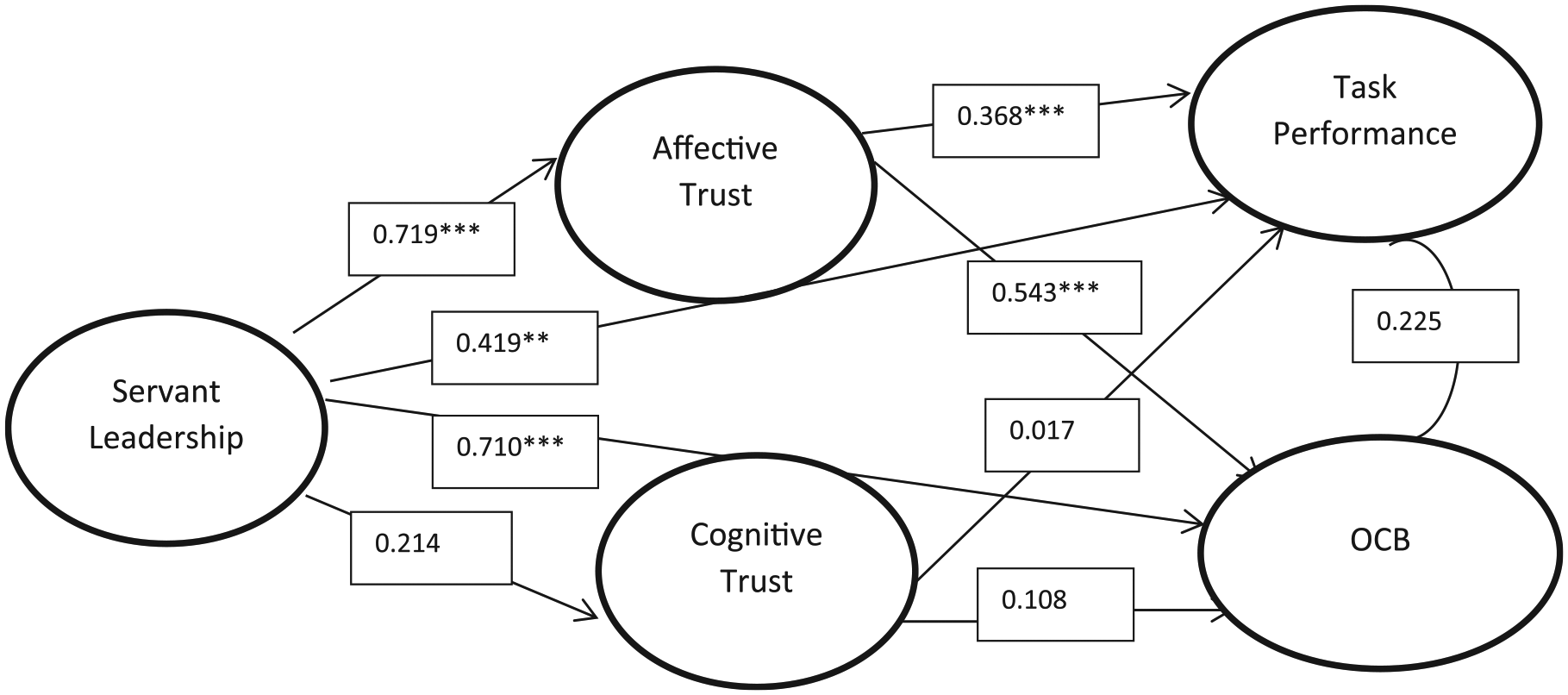
Parallel mediation model estimation results.
Discussion
Our study examined the mediating role of trust in the relationship between servant leadership and performance. We sharpened the focus in two ways: by defining trust as bi-dimensional and by looking at performance at the individual level. The study was designed to advance our knowledge on the relatively young research domain of servant leadership, specifically unraveling its influence on performance at an individual level. Our goal was to examine, in an individual performing work environment, how servant leadership influences performance, hypothesizing the mediating role of bi-dimensional trust. Overall, we found strong support for affective trust to intervene and mediate positively in the relationship between servant leadership and individual performance. However, an insignificant role was played by cognitive trust when both dimensions of trust were examined. As cognitive trust is closely related to task activities, this lack of significance was surprising. Another important result of our study was that servant leadership had neither a direct nor indirect (mediated through cognitive trust) effect on performance, although it had a significant direct impact on OCB of subordinates. Consistent with the literature available on trust (Zhu & Akhtar, 2014), our findings confirmed that cognitive and affective trust were two empirically distinguishable dimensions of trust.
Our study makes a two-fold contribution to the literature of servant leadership. First, we found strong evidence of trust as a key construct in the underlying mechanism influencing servant leadership and individual performance. Servant leadership has no direct effect on task performance, although it has a significant direct impact on the OCB of subordinates. It is undeniable that trust, as a crucial part of a humanistic model of organization, connects servant leaders with their followers by leading with a human touch rather than through a pure economic model. Second, our results show the benefit of distinguishing two dimensions of trust (Zhu et al., 2013; Zhu & Akhtar, 2014) in the effect of servant leadership (Schaubroeck et al., 2011). While servant leadership has a significant impact on both dimensions of trust, this impact is more significant on affective than cognitive trust. These findings are important since they confirm the central premise of servant leadership on trustworthiness, especially the relevant mediation role of affective trust. Our study responds to the call to explore the mediating role of trust in the relationship between servant leadership and followers’ performance (van Dierendonck, 2011). Our work also extends the work of Schaubroeck et al. (2011) on the effect of servant leadership at an individual level and clarifies the underlying mechanism influencing how trust mediates between servant leadership and individual performance.
Our results, which are consistent with expectations and results from earlier empirical studies, demonstrate that affective trust positively mediates the relationship between servant leadership and individual performance. This also confirms what Zhu et al. (2013) highlighted about the importance of affective trust as a mechanism in their study on transformational leadership, in contrast with cognitive trust. Affective trust is established through a mutual exchange of concern and care between the subordinate and leader and thus translates it into positive outcomes (both task performance and OCB) within the organization. This is also in line with what Chiniara and Bentein’s (2016) found: Servant leaders tend to build trustworthy dyadic relationships with followers and create a psychologically safe and fair climate where employees strongly feel they can be themselves, make their own decisions and feel connected to others, which naturally leads to the adoption of helpful behaviors towards colleagues and conscientious behaviors in favor of the organization. (p. 136)
These findings are consistent with the theoretical foundations of servant leadership, where the primary objective of servant leader is to serve and meet the needs of the followers (Russell & Gregory Stone, 2002). Servant leaders help to empower and develop their followers, through expressing humility, stewardship, legitimacy, and by providing the direction (van Dierendonck, 2011). To quote Harvey (2001), “. . . chasing profits is peripheral; the real point of business is to serve as one of the institutions through which society develops and exercises the capacity for constructive action” (pp. 38–39). Servant leaders focus on the welfare of others by reducing negative relationship conflicts between individuals and develop a sense of community (Schaubroeck et al., 2011). All these activities facilitate affective trust and develop positive work behaviors in subordinates.
Unlike several other studies, we did not treat trust as a uni-dimensional variable. Two distinguishable dimensions of trust were treated as mediators in the relationship between servant leadership and subordinates OCB and performance. Mediation analysis results also support the fact that both cognitive and affective trust are two separate constructs and both mediate differently the relationship of servant leadership and subordinate OCB and performance. There is no indirect impact of servant leadership on OCB and performance of subordinate through cognitive trust. In keeping with the conceptual attributes of servant leadership, these results suggest that affective trust, which is established through mutual exchange of concern and care between the subordinate and leader, is translated into positive work outcomes (both performance and OCB) for the organization. Cognitive trust, on the contrary, which is established through the followers’ instrumental evaluation of the leader’s abilities, is not significant. Lu et al. (2019) also found affective trust as more important in predicting servant leadership influence on employees’ emotional labor, when empirically investigating these two dimensions of trust between servant leader and employee emotional labor. By delving deeper into the mediating role of trust, we make a theoretical contribution to the study of servant leadership. We believe our results will help future researchers to explore other dimensions of trust and whether trust can mediate the relationship with organizational performance also.
The non-significant role of cognitive trust in the relationship between servant leadership and performance may also reflect the cultural context. Apart from collectivist values, Pakistan also exhibits a relatively high-power distance in society. Subordinates accept that power is distributed unequally in society and see their supervisors as justifiably having authority over them. This may suppress the effect of a servant leaders’ empowering orientation on followers’ performance and OCB through cognitive trust. Cognitive trust may act as a precursor to affective trust, and where cognitive trust is lacking, affective trust in the leader may take the form of ingratiation. This suggests an alternative explanation for the relationship between cognitive and affective trust. We suggest further exploration of this relationship by scholars in future research.
The present study also contributes to the literature by providing a more comprehensive understanding of the mediating role of trust in the relationship of servant leadership with performance and OCB. Thus, it brings trust back to focus as one of the original dimensions as enunciated by Greenleaf (1977). Some studies on servant leadership have considered trust as a uni-dimensional construct, whereas others have considered other mediating relationships of servant leadership with performance and behavior of subordinates. There has been little consideration of the mediating role of cognitive and affective trust in servant leadership and performance and behavior relationships of subordinates. Considering the different potential dimensions of trust in servant leadership, our findings suggest that servant leaders more effectively generate affective trust in subordinates, and this affective trust mediates the relationship of servant leadership and OCB and performance of subordinates.
Practical Implications
This insight is of value to a practicing manager by stressing the importance of building trust, especially affective trust. Too often, leadership is identified with meeting financial or market-oriented organizational goals and the focus is placed on achieving those goals. The needs of professionalism may sometimes lead a manager to maintain a distance from subordinates. Cognitive and affective trust are not mutually exclusive; they have a symbiotic relationship in influencing performance and OCB. Thus, by following a humanistic approach, displaying the norms of servant leadership, and paying attention to building cognitive and affective trust, a manager creates the conditions for the right kind of in-role and extra-role behaviors which have been shown in other studies to positively influence performance. The current study offers practical implications for managers looking to promote leadership, trust, and performance in subordinates. Similarly, in terms of training future leaders, their skills in building affective trust among their followers also need special attention. Our findings suggest that if the focus of the manager is to enhance the citizenship behavior and task performance in subordinates, servant leadership, through building affective trust along with cognitive trust, is the right leadership strategy, whereas a significant mediation effect cannot be achieved with cognitive trust alone. The findings of this study highlight the importance of training supervisory-level employees to exhibit behaviors that would lead toward trust development in subordinates.
Specifically to Pakistan, we note that there are differences in the leadership and decision-making practices between public and private universities (Zulfqar et al., 2016). Thus, apart from national cultural characteristics affecting the role of trust, organizational governance may also play a role and the implications of our study must be borne in mind as being directly relevant to public institutions. Since these dominate the education sector in Pakistan, our study would be of immediate relevance to them.
Limitation and Future Research
We now spell out the limitations of our study. We have already mentioned, in the “Discussion” section, the possible influence of the societal context of Pakistan’s national culture. The collectivist values and high-power distance (Hofstede et al., 1997) generate social reciprocity and continued interaction and are also conducive to generate affective trust in subordinates. Thus, our results highlighting the effect of affective trust may be partially explained by the context of this study, similar to the way context may have affected Zhu et al.’s (2013) study in China. This would limit the generalizability of our conclusions.
We also note that high-power distance may suppress the effect of a servant leaders’ empowering orientation on followers’ performance and OCB through cognitive trust. We have already mentioned that cognitive trust may act as a precursor to affective trust as a serial mediation effect, where cognitive trust contributes to performance through affective trust in the leader and may take the form of ingratiation. We suggest further exploration of this relationship by scholars in future research. As identified by Liu (2019), race, gender, sexuality, age, and class of both leader and subordinates could also affect the dynamics of servant leadership and subordinate behavior model; future research needs to consider these factors while modeling servant leadership and subordinates’ behaviors. Similarly, any further studies in different social cultural contexts may enhance the universality of the resulting framework.
The above consideration of the context points to an important but missing discussion in many studies on leadership. The nature of the variables and their interactions considered in this study are strongly influenced by culture and human relationships. Thus, concepts from culture and human relationships can qualify the generalizability of the results from studies, such as ours, and thereby provide a richer understanding of leadership and its link to business ethics. Studies on servant leadership are particularly susceptible to missing this crucial factor, and so we urge future researchers to provide an explicit consideration of the context of their study.
Footnotes
Declaration of Conflicting Interests
The author(s) declared no potential conflicts of interest with respect to the research, authorship, and/or publication of this article.
Funding
The author(s) received no financial support for the research, authorship, and/or publication of this article.
Ethical approval
All procedures performed in studies involving human participants were in accordance with the ethical standards of the institutional and/or national research committee and with the 1964 Helsinki declaration and its later amendments or comparable ethical standards.
