



Abstract
This study investigates the role of the digital economy in promoting sustainable prosperity across Chinese provinces from 2011 to 2020. The research develops an innovative theoretical framework that integrates resource-based view (RBV) and open innovation theories, examining how digital technologies contribute to economic growth, social equity, and efficient resource distribution. Utilizing a longitudinal panel analysis, we explore the direct and indirect effects of the digital economy on sustainable prosperity, focusing on the prosperity degree, equality degree, and sharing degree. Our findings show that the digital economy significantly enhances all three dimensions of sustainable prosperity, with coefficients of 0.693 for sustainable prosperity, 1.959 for prosperity degree, 2.048 for equality degree, and 1.360 for sharing degree, all statistically significant at the 1% level. Moreover, the study reveals the mediating roles of resource allocation efficiency and technological innovation in these effects, demonstrating how digitalization drives broader economic and social benefits. The results also underscore the potential of the digital economy to reduce regional disparities and foster urban-rural integration. This research contributes to the literature by combining RBV and open innovation theories with a spatial analysis, offering new insights into how digital transformation can promote inclusive and sustainable growth. The findings provide important implications for policymakers seeking to leverage digital technologies for balanced regional development.
Plain language summary
From 2011 to 2020, our study examined how China’s growing digital landscape has been influencing economic growth and societal well-being across different regions. We focused on the development of the digital economy—like improvements in internet and technology infrastructure—and its effects on creating a prosperous, fair, and resource-efficient society. Our findings reveal that advancements in digital technology not only boost the economy directly by enhancing businesses and services but also indirectly by improving how resources are distributed and used more efficiently. This has important implications, especially for rural areas, highlighting the need for better digital access to bridge the gap between urban and rural communities. The insights from our research suggest that strategic digital-focused policies can promote more inclusive growth and help achieve long-term sustainable development goals across China. This study offers valuable lessons for policymakers and business leaders looking to harness the power of digital innovation for broader social and economic benefits.
Keywords
Introduction
In recent years, wealth disparities have become an increasingly prominent issue in global economic discourse (N. Khan et al., 2024; Y. Liu et al., 2023). Addressing these disparities while ensuring continued economic growth has emerged as a significant challenge for policymakers and scholars alike (Berg & Ostry, 2017; Woolcock, 1998). The concept of sustainable prosperity has gained traction as a framework to reconcile these tensions, advocating for an economic system that fosters growth while ensuring equitable wealth distribution and safeguarding environmental and social integrity (Dong et al., 2023; J. Zou et al., 2024). Despite the theoretical appeal of sustainable prosperity, its realization remains a complex endeavor, particularly in terms of meeting the diverse material needs of populations without exacerbating inequalities. Emerging frameworks for achieving sustainable prosperity now emphasize the role of initial wealth creators in advancing broader societal welfare, a paradigm that underscores efficiency alongside equity (Belmonte-Ureña et al., 2021; Wang et al., 2022). However, the challenge of integrating these elements effectively remains underexplored, particularly in light of technological advancements and their implications for regional development.
The increasing significance of the digital economy in recent years has introduced new avenues for addressing wealth disparities and promoting regional prosperity (Baffour Gyau et al., 2025; Hajli et al., 2025). Several nations have prioritized digital transformation, implementing policies to integrate digital technologies into economic systems, recognizing their potential to foster inclusive growth (ElMassah & Mohieldin, 2020; T. Khan & Emon, 2024). Concurrently, academic research has highlighted the transformative role of digitalization in reshaping economies, particularly in the context of income disparities and regional development (Covucci et al., 2024; Dąbrowska et al., 2022; Y. Zhang et al., 2024). A growing body of literature has demonstrated that digital technologies—such as artificial intelligence, blockchain, and the Internet of Things—are not only reshaping industries but also influencing wage structures and regional prosperity (Y. Chen et al., 2021; Ren et al., 2022). Studies have found that digitalization is linked to regional income growth, with evidence suggesting that digital progress helps bridge income gaps (Luo et al., 2023; Shahbaz et al., 2022; J. Zou et al., 2024). Despite these advancements, there remains a need for a more structured exploration of the digital economy’s potential to promote sustainable prosperity, particularly in addressing the broader implications of digital transformation for social equity and environmental sustainability.
The primary motivation for this research is to construct a comprehensive theoretical framework that explicates the relationship between the digital economy and sustainable prosperity, particularly in the context of China’s ongoing digital transformation. As China moves further into the digital age, understanding how digital technologies influence economic growth and social equity is imperative. This study aims to bridge the gap in the existing literature by providing empirical evidence from a longitudinal panel analysis of Chinese provincial data from 2011 to 2020. This period is significant due to the substantial developments in digital infrastructure and economic policies during these years, which have laid the foundation for the rapid expansion of digital technologies in the country.
Our research is driven by several key questions: How does the digital economy influence sustainable prosperity across different regions? What mechanisms underpin this influence, and how do they vary across distinct socio-economic contexts within China? We aim to explore how digitalization affects resource allocation efficiency, technological innovation, and urban-rural integration. Furthermore, we seek to understand whether the digital economy differentially impacts the three dimensions of sustainable prosperity: economic prosperity, equity, and sharing. By addressing these questions, we aim to provide a nuanced understanding of the mechanisms through which the digital economy can contribute to a more equitable and sustainable development model.
The literature examining the relationship between the digital economy and sustainable prosperity is expanding, yet it remains fragmented and lacks a coherent theoretical framework that fully accounts for the dynamic interplay between digital technologies and sustainable development. While much of the existing research focuses on the economic effects of digitalization, particularly on income disparities (Teece, 2018; J. Zou & Deng, 2022), there is limited exploration of its role in fostering broader dimensions of sustainable prosperity. Existing studies primarily address income inequality but do not sufficiently consider how digitalization impacts the social and environmental aspects of prosperity (Bauer, 2018; Grybauskas et al., 2022). Additionally, few studies have systematically analyzed the role of digital transformation in addressing regional disparities and promoting inclusive growth (Liu et al., 2024 H. Liu et al., 2024; Q. Liu & Yang, 2024). This literature gap highlights the need for further exploration of how digital technologies can contribute to sustainable prosperity, particularly through the lenses of social equity and environmental sustainability.
Building upon this gap, our study integrates insights from resource-based theory and open innovation frameworks to develop a more comprehensive understanding of the mechanisms through which the digital economy influences sustainable prosperity. This theoretical fusion enables us to explore not only the economic impact of digitalization but also its broader social and environmental implications, providing a more holistic view of its potential to foster equitable development. Our research makes several key contributions to the literature on the digital economy and sustainable prosperity. Theoretically, we construct a unified framework that integrates resource-based and open innovation perspectives, offering a robust explanation of how digital technologies can contribute to sustainable economic and social outcomes. Methodologically, our study employs a longitudinal panel data analysis, drawing on provincial-level data from China over a 10-year period. This approach enhances the empirical validity of our findings and provides insights that can be extrapolated to other geopolitical contexts. From a practical perspective, our findings offer valuable implications for policymakers and business leaders. We highlight the importance of crafting policies and strategies that leverage digital technologies to optimize resource allocation, foster equitable growth, and promote inclusive development. Moreover, our research underscores the significance of digital integration in addressing regional disparities and facilitating urban-rural integration, key factors in achieving sustainable prosperity. Ultimately, this study provides both theoretical and practical contributions to the fields of digital economics, sustainable development, and policy-making, offering new insights into how digital transformation can foster a more equitable and sustainable global economy.
Theory Framework
China is currently undergoing a critical transition toward high-quality development, marked by a transformation in growth drivers, the optimization of its economic structure, and a shift in development paradigms (Li et al., 2024; Q. Zhang et al., 2023). At the core of this transformation is the digital economy, which plays a pivotal role in enhancing economic resilience and fostering innovative capabilities through new modes of innovation, connectivity, and resource sharing (Boh et al., 2023; Yang et al., 2023; Y. Zou, 2024). The digital economy not only reshapes the resource allocation mechanisms but also provides new drivers for achieving sustainable prosperity and urban-rural integration.
The RBV and open innovation theories offer a robust framework for understanding how the digital economy influences resource allocation, fosters sustainable prosperity, and drives urban-rural integration. RBV posits that the strategic management of resources is essential for gaining a competitive advantage (Barney, 1991; Helfat et al., 2023). In the context of the digital economy, resources are not limited to physical assets but extend to digital resources such as data, technological infrastructure, and human capital. These resources can be decentralized and scaled across regions (Guo et al., 2023), thereby enhancing regional competitiveness and innovation capacity (Ciulli & Kolk, 2023; Zeng et al., 2023). The optimization of resource allocation across regions facilitates more equitable development and reduces regional disparities, promoting coordinated economic growth.
Furthermore, the digital economy contributes to sustainable prosperity through its impact on resource distribution and its role in narrowing the development gap between urban and rural areas. Sustainable prosperity can be understood through its three dimensions: prosperity degree, equality degree, and sharing degree (N. Khan et al., 2024). Prosperity degree refers to overall economic output and improvements in quality of life, equality degree addresses the reduction of regional disparities, and sharing degree reflects the extent to which economic benefits are distributed throughout society (Cruz et al., 2015). The digital economy facilitates the efficient and inclusive distribution of resources such as capital, technology, and information, thereby enhancing these dimensions of sustainable prosperity and contributing to a more balanced regional development model.
The open innovation theory further complements the digital economy’s transformative effects by emphasizing the importance of collaboration and external knowledge flows. Open innovation suggests that innovation is no longer confined to the boundaries of organizations; instead, it is driven by the exchange of ideas, knowledge, and technologies from both internal and external sources (Chesbrough, 2003; Nambisan et al., 2019). In the context of the digital economy, this theory becomes particularly relevant, as it encourages regions and firms to leverage both internal and external resources to innovate, thereby accelerating the pace of innovation and fostering a dynamic and flexible innovation ecosystem (Audretsch & Belitski, 2023; Ogink et al., 2023). The digital economy provides the infrastructure for real-time communication and data sharing, facilitating collaboration across regions and sectors and enabling specialized regional development based on comparative advantages (Dian et al., 2024; Teece, 2018).
By integrating RBV and open innovation theories, it becomes evident how the digital economy not only optimizes resource allocation but also fosters innovation collaboration across regions. Through RBV, the digital economy enables the decentralization and effective utilization of key resources such as capital, technology, and knowledge (J. Zhou et al., 2024). This, in turn, facilitates a more equitable and efficient distribution of resources, contributing to the narrowing of regional disparities and promoting sustainable prosperity. Through open innovation, the digital economy fosters cross-regional collaborations, enhancing the collective innovation capacity of different regions and driving specialized development (Ding & Luo, 2024; Q. Zhou et al., 2024), which ultimately contributes to urban-rural integration and balanced economic growth.
In terms of sustainable prosperity, the digital economy’s impact is evident in its ability to enhance the prosperity degree, equality degree, and sharing degree by ensuring the efficient and inclusive flow of resources. By fostering the development of both urban and rural areas, the digital economy bridges gaps in economic development and ensures that the benefits of innovation are more broadly shared across society. This is critical in advancing the goals of sustainable prosperity, as the digital economy plays a crucial role in improving living standards, reducing inequalities, and enhancing social inclusion (Y. Zou, 2024; J. Zou et al., 2024).
Moreover, the digital economy acts as a catalyst for scientific and technological innovation, which is a key driver of sustainable prosperity. Innovation, particularly in the fields of technology and information, enhances economic efficiency, improves quality of life, and promotes a more equitable distribution of resources (Hui et al., 2023). Open innovation theory supports this process by enabling the flow of knowledge and technology across regions and sectors, thereby accelerating the adoption and diffusion of new innovations (Audretsch & Belitski, 2023; Ogink et al., 2023). This, in turn, supports the creation of a more sustainable and inclusive innovation ecosystem, essential for achieving sustainable prosperity and urban-rural integration (Liu et al., 2024).
In conclusion, by synthesizing the RBV and open innovation theories, the digital economy not only optimizes resource allocation and drives innovation but also plays a central role in fostering sustainable prosperity and urban-rural integration. This theoretical framework provides a solid foundation for understanding the profound impact of the digital economy on China’s economic transformation and offers critical insights into how digital technologies can contribute to achieving balanced and inclusive development across urban and rural regions (Figure 1).

The theoretical framework.
Methodology
Variable Measurements
Digital Economy
The study by T. Zhao et al. (2020) employs a research method to measure the level of digital economy development, where five indicators are utilized. The specific proxy variables used in the study are the number of Internet broadband access users per capita, the ratio of employees in the computer service and software industry to staff of urban units, the total number of telecommunication services per capita, the number of cell phone users per capita, and the total index in the Peking University Digital Inclusive Finance Index. To reduce dimensionality, the data is standardized, and Global Principal Component Analysis (GPCA) is employed to determine the level of digital economy development (T. Zhao et al., 2020). For more detailed information, please refer to Table 1.
Variable Measurement Index System.

Sustainable Prosperity
Sustainable prosperity can be regarded as a complex system composed of three subsystems: prosperity degree, equality degree and sharing degree (Jackson & Victor, 2020; Lazonick, 2009). Only when the three subsystems shift toward orderliness and achieve coordination and unity in the overall linkage and dynamic adjustment, can the orderly development toward the goal of sustainable prosperity be truly realized. Therefore, sustainable prosperity should be viewed from the perspective of the system and the whole. From the perspective of coupling coordination, sustainable prosperity means that the subsystems of prosperity degree, equality degree, and sharing degree witness a high degree of coordination under a high coupling degree. The sustainable prosperity index is measured via the use of the coupling coordination degree model in the following part. Referring to the existing research on the construction of sustainable prosperity index model, the evaluation index system of sustainable prosperity constructed in this article is shown in the following table. Due to the limitation in the length of article, the original indicators are not explained here.
The development process of level of sustainable prosperity is essentially a system evolving from low to high, and from disorder to order. The internal variables of the system are divided into slow and fast variables, among which the slow variables (order parameters) determine the characteristics and laws of the system evolution. Therefore, the synergy of the sustainable prosperity level system can be measured by the equations of the ordered variables within the sustainable prosperity level system, which can effectively measure the orderliness and synergy of each subsystem.
The essence of synergy theory lies in the analysis of how temporal, spatial, and functional structures can spontaneously emerge through internal synergy. It also involves studying commonalities and exploring interdisciplinary laws based on the principle that “the cooperation among multiple subsystems is governed by the same principle, independent of the subsystems’ characteristics.” According to the slaving principle of synergy theory, the system’s evolution rate is determined by the ordinal parameter. The ordinal parameter has two distinct effects on the system: the positive effect and the negative effect. In this context, a positive indicator indicates a positive correlation between the indicator value and the system’s operation, while a negative indicator indicates a negative correlation between the indicator value and the system’s operation.
In this article, the sustainable prosperity composite system is defined, and the composite system synergy model is constructed. The model construction process is as followed: The subsystem of sustainable prosperity system is set as

Here,

It can be seen from the Equation 2, the bigger the
At the initial moment

The following conditions are satisfied in Equation 3:

θ is determined by the sign of the smallest increment and is used to indicate the overall direction of change. It can be seen from Equation 3 that, the bigger
For indicators where larger values mean poorer performance, each value is transformed by subtracting it from the sample maximum and dividing by the range, that is,
Urban-Rural Integration Development
The key to achieving integrated urban-rural development, which treats urban and rural areas as a unified entity, lies in bridging the urban-rural income gap, facilitating the two-way flow of factors between urban and rural areas, transforming the dual structure into a unified structure, and ultimately achieving the free movement of urban and rural factors and balanced allocation of public resources (Y. S. Liu, 2018; H. P. Zhang et al., 2020). To effectively implement targeted measures and understand the dynamic mechanisms of promoting urban-rural integration, scholars have investigated the impact of factors such as economic development level, land policy reform, and labor mobility on urban-rural integration. Building upon these findings, scholars have proposed pathways for promoting urban-rural integration development, which involve deepening the mechanisms of factor flow between urban and rural areas, establishing a unified urban-rural factor market, and promoting the equal distribution of urban and rural public services (Y. Liu & Hao, 2023; Tong et al., 2023; H. P. Zhang et al., 2020). It is evident that the core of achieving integrated urban-rural development lies in addressing the dysfunctional urban-rural relationship and prioritizing equality, autonomy, and endogeneity in rural development.
Urban-rural integration entails comprehensive planning that considers urban and rural areas as a whole, encompassing the living standards of residents, primary, secondary, and tertiary industries, welfare protection, and ecological and environmental management. By establishing and improving relevant systems, multi-dimensional “two-way interaction” and “mutual integration” between population, space, economy, society, and ecology in urban and rural areas are promoted, leading to comprehensive revitalization of rural areas. Drawing insights from X. Lu et al. (2021) index system for measuring the level of urban-rural integration in China, and considering the principles of scientificity, comprehensiveness, and accessibility, this article constructs an index system to measure the level of urban-rural integration development across five dimensions: human, space, economy, society, and ecology. Finally, the data from the indicators are inverted and standardized, and the entropy weight TOPSIS method is applied for dimensionality reduction to obtain the level of urban-rural integration development (J. N. Zhou et al., 2019). Refer to Table 1 for more details.
Efficiency of Resource Factor Allocation
The efficiency of factor allocation can be reflected by the degree of distortion in factor markets. Drawing lessons from Lin and Du (2013), the article uses the relative gap between the factor market development score of each region and the highest factor market development score in the sample to measure the degree of factor market distortion. Specifically, the factor market distortion indicators constructed in the article are:

Here:
Scientific and Technological Innovation
Control Variables
Foreign direct investment Fdi not only triggers technology spillover effect, but also brings advanced management experience to local enterprises. It is conducive to the improvement of productivity of local enterprises, and then leads to sustainable prosperity. Therefore, the proportion of FDI in regional GDP is selected as a proxy variable for FDI (Lin & Du, 2013). Population density
Econometric Model Construction
The following basic econometric model is constructed to analyze the impact of digital economy development on sustainable prosperity.

Here,
Meanwhile, it is proposed to use the mediating effect model to test some mechanism effects of digital economy development that promotes sustainable prosperity, including resource allocation effect, and scientific and technological innovation effect. The mediating effect model is shown in Equation 7:

Here,
Following Baron and Kenny’s (1986) causal-steps framework, we: (i) regress the sustainability outcome on
Data Sources and Descriptive Statistics
The study encompasses 31 provincial administrative units in China, excluding Hong Kong, Macao, and Taiwan. The research period spans from 2011 to 2020. The data sources for the sustainable prosperity index system are as follows:
Gini coefficient: Calculated using J. Chen et al. (2010)’s method, the original data for the Gini coefficient are sourced from provincial statistical yearbooks. The incidence of rural poverty is obtained from the 2020 China Rural Poverty Monitoring Report.
Fiscal expenditures on people’s livelihood: These expenditures pertain to areas such as education, culture and sports, social security, employment, healthcare, environmental protection, and housing security. The relevant data are sourced from the website of the National Bureau of Statistics.
Indicators such as the ratio of urban income to rural income, Gini coefficient measuring income gap between different industries, and GDP per capita: The data or raw data for these indicators are obtained from the website of the National Bureau of Statistics. Table 2 presents the descriptive statistics results of each variable.
Descriptive Statistics Results of Each Variable.

The data on the level of the digital economy, level of urban-rural integration, and the degree of sustainable prosperity are presented below.
Figure 2 showcases the average urban-rural integration level in 31 Chinese provinces and central government municipalities between 2011 and 2020. It excludes data for Hong Kong, Macao, and Taiwan. Southern regions such as Yunnan, Guangxi, Guangdong, Fujian, Zhejiang, Hunan, Jiangxi, and Hainan register the highest integration levels. Provinces like Sichuan, Chongqing, Guizhou, Hubei, Shaanxi, Heilongjiang, Jilin, Liaoning, and Beijing follow suit. Inner Mongolia, Hebei, Tianjin, Henan, and Anhui show a medium level of integration. Shanxi, Shandong, Jiangsu, and Shanghai have lower levels, while Xinjiang, Tibet, Qinghai, Gansu, and Ningxia record the lowest.

Urban-rural integration level.
Figure 3 details the average level of the digital economy across the same regions over the same period. Here, Beijing stands out with the highest level, trailed by Guangdong, Zhejiang, and Shanghai. Medium level provinces include Inner Mongolia, Liaoning, Shaanxi, Jiangsu, and Fujian. A lower average level is seen in Xinjiang, Qinghai, Ningxia, Sichuan, Chongqing, Hubei, Shanxi, Hebei, Shandong, Tianjin, Heilongjiang, Jilin, and Hainan. The bottom tier comprises Tibet, Yunnan, Guangxi, Guizhou, Hunan, Jiangxi, Anhui, Henan, and Gansu.

Digital economy level.
In Figure 4, the average level of sustainable prosperity is illustrated for the same period and regions. Beijing and Shanghai lead the pack, with Inner Mongolia and Tibet following closely. Xinjiang, Ningxia, Shaanxi, Chongqing, Jilin, Liaoning, Jiangsu, Zhejiang, Fujian, Guangdong, Hainan, and Tianjin have a median level. Gansu, Qinghai, Sichuan, Yunnan, Guizhou, Guangxi, Hunan, Jiangxi, Hubei, Anhui, Henan, Shanxi, and Shandong fall lower on the scale, while Hebei and Heilongjiang lag with the lowest levels.

Sustainable prosperity level.
Figure 5 presents the average degree of prosperity across the same Chinese regions between 2011 and 2020. Beijing and Shanghai top the chart, followed by Jiangsu, Zhejiang, and Tianjin. The middle level includes Shandong, Fujian, and Guangdong, while the lower level groups Xinjiang, Tibet, Sichuan, Chongqing, Inner Mongolia, Ningxia, Shaanxi, Hubei, Hunan, Jiangxi, Anhui, Hebei, Liaoning, and Hainan. Qinghai, Gansu, Shanxi, Henan, Heilongjiang, Jilin, Yunnan, Guizhou, and Guangxi register the lowest levels.

Richness level.
Figure 6 portrays the average degree of resource sharing over the same timeframe. Beijing and Shanghai lead with the highest degree. The next level consists of Inner Mongolia, Jilin, Liaoning, Tianjin, Ningxia, Shaanxi, Chongqing, Jiangsu, Zhejiang, Hainan, and Tibet. The middle tier includes Xinjiang, Heilongjiang, Hubei, Fujian, and Guangdong. Lower levels are seen in Gansu, Qinghai, Sichuan, Yunnan, Guizhou, Guangxi, Hunan, Jiangxi, Shanxi, and Shandong. Lastly, Hebei, Henan, and Anhui have the lowest degree of sharing.

Sharing level.
Lastly, Figure 7 represents the average level of equality across various regions. Heilongjiang, Tianjin, Shanghai, and Hainan exhibit the highest levels of equality. Beijing, Hebei, Shandong, Zhejiang, Fujian, Jiangxi, Hubei, Chongqing, and Sichuan demonstrate moderately high levels of equality. Jilin, Liaoning, Shaanxi, Jiangsu, Hunan, and Guangxi have medium levels of equality. Inner Mongolia, Qinghai, Shanxi, Henan, Anhui, Ningxia, and Guangdong have relatively low levels of equality. The lowest levels of equality are observed in Xinjiang, Tibet, Gansu, Yunnan, and Guizhou.

Equality level.
Multicollinearity Test
Variance Inflation Factor (VIF) is a widely used diagnostic tool to assess the multicollinearity in regression models (Thompson et al., 2017). It quantifies how much the variance of an estimated regression coefficient increases when your predictors are correlated. Specifically, the VIF of each variable is calculated as the ratio of the variance of the estimated regression coefficient for that variable in the full model, to the variance of the regression coefficient for that variable in a model where it is the only predictor.
The general rules for interpreting VIF values are as follows:
If the VIF value for any variable exceeds 10 (or in stricter cases, 5), it indicates that multicollinearity may be present for that variable, and such a variable might need to be excluded from the model to improve stability and interpretability.
Tolerance is defined as the reciprocal of the VIF value (Tolerance = 1/VIF). A tolerance value below 0.1 (or more strictly, below 0.2) suggests multicollinearity concerns for the corresponding variable.
A null VIF value suggests that the variable is highly problematic and should be removed from the analysis.
In the case of very high VIF values or high correlation coefficients among predictors, it is advised to exclude such variables and perform the analysis again to ensure more reliable results.
Table 3 presents the results of the collinearity analysis using VIF values and their corresponding tolerance values for the variables under consideration. The VIF values for all variables—digital economy (3.333), factor allocation efficiency (4.432), technological innovation (3.440), foreign direct investment (1.624), population density (2.571), financial development level (3.459), foreign trade (2.368), and infrastructure (2.905)—are well below the critical threshold of 5, and their tolerance values (ranging from 0.226 to 0.616) are above the cutoff of 0.2. These findings suggest that there is no significant multicollinearity present among the variables.
Collinearity Diagnosis.
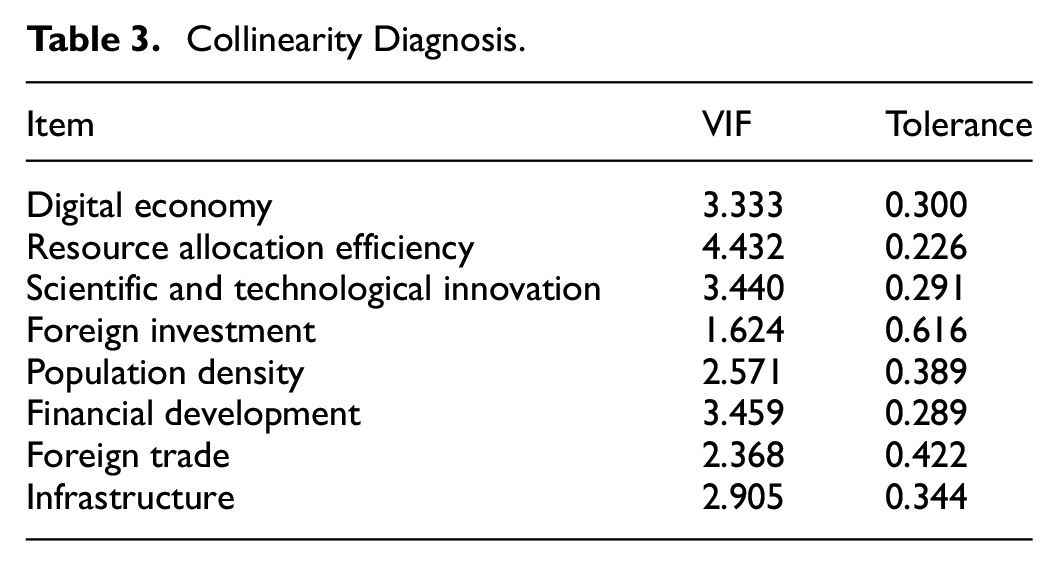
Based on these results, none of the variables in the model display problematic multicollinearity, as neither the VIF values exceed 5 nor do any tolerance values fall below 0.2. Consequently, the analysis does not indicate the need for any adjustments to the model, such as removing variables, as the variables all meet the acceptable thresholds for multicollinearity. Thus, the model appears stable and free from significant multicollinearity issues.
Regression Result Analysis
The results presented in Table 4 offer a detailed examination of the relationships between various economic variables (digital economy, foreign investment, population density, financial development, foreign trade, and infrastructure) and four dependent variables: sustainable prosperity, prosperity degree, equality degree, and sharing degree. Each variable’s effect is represented by the regression coefficients, along with t-values in parentheses. The statistical significance of these coefficients is indicated by asterisks, with ** denoting significance at the 1% level and * at the 5% level. The overall model fit is indicated by R-squared values for both the full model and the within-group model, alongside the Chi-square test statistics.
Regression Results.

Note. The value of t is in the bracket.
p < .05. **p < .01.
Sustainable Prosperity
The digital economy significantly influences sustainable prosperity (β = .693, t = 3.556, p < .01), indicating a positive relationship, suggesting that advancements in the digital economy contribute substantially to sustainable prosperity. This finding can be attributed to the positive externalities generated by digital transformation, such as increased innovation, productivity, and economic diversification, which are central to sustainable prosperity. In contrast, foreign investment has an insignificant effect on sustainable prosperity (β = −.005, t = −1.308, p > .10), as indicated by the t-value falling below the conventional threshold for statistical significance. The non-significance of this relationship could reflect the potential diminishing returns or the indirect nature of foreign investment’s impact on long-term sustainable prosperity, possibly mediated by other factors such as institutional quality or local policy environments. Population density shows a statistically significant negative effect on Sustainable Prosperity (β = −.006, t = −2.364, p < .05), which may suggest that higher population density, typically associated with urban congestion and environmental strain, can undermine efforts toward achieving sustainable prosperity. However, this relationship appears marginal, implying that the negative effects may vary depending on regional contexts. Financial development, with a positive and statistically significant coefficient (β = .046, t = 2.565, p < .05), supports the hypothesis that robust financial systems enhance sustainable prosperity. Access to finance is critical for fostering innovation and sustainable investments, which could explain this positive association. Foreign trade (β = −.000, t = −0.058, p > .10) demonstrates an insignificant effect on Sustainable Prosperity, which may be due to the complexity and multi-dimensional nature of trade relationships. The absence of a significant relationship suggests that foreign trade, in isolation, may not directly affect the sustainability outcomes measured in this study. Infrastructure has a negative but non-significant effect on sustainable prosperity (β = −.010, t = −1.246, p > .10), which is contrary to expectations. This could be explained by the fact that infrastructure development, although vital, may not yet be sufficiently advanced or may not be optimized to support sustainable prosperity goals in the studied regions.
Prosperity Degree
Digital economy (β = 1.959, t = 20.823, p < .01) exhibits a highly significant and strong positive relationship with prosperity degree, indicating that the digital economy plays a critical role in enhancing overall prosperity. The extraordinarily high t-value reflects the substantial economic impact of digital transformation on prosperity, likely driven by increases in productivity, economic growth, and access to technological advancements. Foreign investment (β = .005, t = 1.605, p > .10) shows a marginally significant effect on Prosperity Degree, but the relationship is weak and fails to reach conventional levels of statistical significance. The weak effect may be due to varying impacts of foreign investment depending on industry sectors or the maturity of the local economy, which is not captured fully in the current model. Population density (β = −.003, t = −2.392, p < .05) significantly impacts prosperity degree in a negative direction, reflecting how higher population density could contribute to urban challenges such as congestion, pollution, and inequality, which can impede prosperity. Financial development (β = .034, t = 1.997, p < .05) also significantly enhances prosperity degree, consistent with the notion that a well-developed financial sector promotes economic growth by facilitating investments, consumption, and entrepreneurial activities. Foreign trade (β = .001, t = 1.660, p < .10) shows a marginally significant positive relationship with prosperity degree, which suggests that foreign trade might have a small but potentially beneficial role in enhancing prosperity, primarily through access to broader markets and diverse resources. Infrastructure (β = −.005, t = −0.667, p > .10) shows no significant effect on prosperity degree. This result may be due to the fact that infrastructure investments, while important, are only one component of the broader factors that drive prosperity. Its lack of significance here suggests that infrastructure alone may not be sufficient without complementary policies and innovations.
Equality Degree
In the case of equality degree, digital economy (β = 2.048, t = 7.484, p < .01) again shows a significant and positive relationship. The digital economy has been shown to reduce inequality by promoting equal access to opportunities and reducing geographical barriers, which may explain the positive effect observed here. Foreign investment (β = .004, t = 0.585, p > .10) has an insignificant effect on equality degree, further supporting the notion that foreign investment alone may not directly address issues of social equity and income inequality. The limited direct impact of foreign investment on equality could be due to the uneven distribution of its benefits across regions and sectors. Population density (β = .009, t = 1.527, p > .10) shows a positive, though not statistically significant, effect on equality degree. The limited impact could be due to other factors, such as the capacity of local governance systems to manage urbanization and distribute resources effectively. Financial development (β = −.048, t = −1.106, p > .10) has a negative and insignificant effect on equality degree, suggesting that while financial development could theoretically reduce inequality by enabling wealth creation, its effects are not uniform across different regions, possibly due to the wealth concentration in specific sectors or areas. Foreign trade (β = −.002, t = −0.463, p > .10) and infrastructure (β = −.002, t = −0.147, p > .10) both exhibit insignificant negative relationships with equality degree, indicating that these factors, on their own, do not strongly influence equality outcomes in the current model.
Sharing Degree
Digital economy (β = 1.360, t = 22.146, p < .01) continues to show a significant positive relationship with sharing degree, indicating that the digital economy promotes a more equitable distribution of wealth and opportunities across regions, enhancing social welfare and participation. Foreign investment (β = −.006, t = −1.879, p < .05) demonstrates a negative but statistically significant relationship with sharing degree. This suggests that while foreign investment may stimulate economic growth, it may not always lead to an equitable distribution of wealth and benefits, possibly due to issues such as capital flight or unequal investment patterns. Population density (β = .000, t = 0.020, p > .10) shows no significant impact on sharing degree, highlighting that population size alone does not inherently affect the equitable sharing of wealth and resources. Financial development (β = .028, t = 1.974, p < .05) positively influences sharing degree, reinforcing the idea that financial development helps ensure more inclusive economic participation and sharing of resources. Foreign trade (β = .001, t = 2.685, p < .01) and Infrastructure (β = .022, t = 2.242, p < .05) both have positive and significant effects on sharing degree, suggesting that both trade and infrastructure development contribute to wealth distribution, especially when these factors are well-integrated with policies aimed at equity.
In summary, the results from Table 4 suggest that the Digital Economy has the most robust and consistent positive impacts across all four dependent variables. Conversely, foreign investment, population density, and infrastructure show mixed effects, with many relationships being insignificant, which may be attributed to contextual factors such as governance or the stage of economic development. Financial development, on the other hand, consistently exhibits positive effects on prosperity and sharing degrees, highlighting the crucial role of financial systems in promoting economic well-being and inclusive growth. These findings are crucial for policymakers aiming to foster sustainable and equitable development through targeted investments in digital infrastructure and financial systems.
To further examine the correlation between the level of sustainable prosperity and the level of urban-rural integration, the Table 5 presents the regression results from fixed effect panel (FE) and random effect panel (RE) models. The coefficient of influence reveals a positive relationship between the level of sustainable prosperity and the level of urban-rural integration. In the FE model, the regression coefficient is 0.087, while in the RE model, it is 0.086. Both coefficients demonstrate statistical significance at the 5% level, indicating that the level of sustainable prosperity has a discernible impact on the level of urban-rural integration. Thus, there exists a positive correlation between these two factors.
The Regression Results From FE and RE Models.

Note. Dependent variable: the level of urban-rural integration. The value of t is in the bracket.
p < .05. **p < .01.
Mediating Effect Analysis
Table 6 presents the results of testing the mediating role of the digital economy in influencing urban-rural integration development via resource allocation and scientific-technological innovation. The regression coefficients of the principal explanatory variable—the digital economy’s level-on both resource allocation and scientific and technological innovation are positive and significant at a 1% level. The coefficient on resource allocation is 14.630, suggesting a significant positive effect of an improved digital economy level on resource allocation. The coefficient on scientific and technological innovation is 9.811, indicating that the digital economy level supports scientific and technological innovation—a higher digital economy level corresponds to a higher level of technology and innovation.
Results of Medicating Effect.

Note. The value of t is in the bracket.
p < .05. **p < .01.
Foreign investment registers a −0.105 coefficient on resource allocation, although it is not significant, implying a slight inhibiting effect on resource allocation in China’s urban and rural areas. However, its coefficient on scientific and technological innovation is .148, significant at a 5% level, suggesting that foreign investment promotes scientific and technological innovation in China to a certain extent.
Population density shows positive and significant coefficients at a 1% level on both resource allocation and scientific and technological innovation, indicating a positive correlation.
Foreign trade demonstrates a .066 coefficient on resource allocation, significant at a 1% level, indicating it positively impacts China’s resource allocation. However, its coefficient on scientific and technological innovation is .021, not significant, implying that foreign trade has minimal effect on China’s scientific and technological innovation.
Infrastructure yields a −.086 coefficient on resource allocation, although not highly significant. However, its coefficient on scientific and technological innovation is −.615, significant at a 1% level, suggesting a negative correlation between infrastructure and the level of scientific and technological innovation.
From these analyses, we can conclude that a clear mediating effect exists. This reveals two pathways: “digital economy → resource allocation → sustainable prosperity → urban-rural integration development” and “digital economy → scientific and technological innovation → sustainable prosperity → urban-rural integration development.”
Robustness Test
In order to confirm the reliability of the model exploring the impact of the digital economy on sustainable prosperity, we enhanced the computation method of the digital economy using the entropy value method. The results of this robustness test are presented in Table 7.
Robustness Test Result.

Note. The value of t is in the bracket.
p < .05. **p < .01.
The coefficients of the digital economy on prosperity, equality, and sharing degrees are .232, .225, and .240, respectively. All of these coefficients are positive and significant at the 5% level, indicating that the digital economy has a positive impact on prosperity, equality, and sharing. The coefficients of factor allocation efficiency on prosperity, equality, and sharing degrees are all significant at the 1% level, suggesting a significant positive effect on these dimensions. The coefficient of scientific and technological innovation on prosperity degree is .025, significant at the 1% level, indicating that higher levels of innovation contribute to prosperity in both urban and rural areas. The coefficients on equality and sharing degrees are .038 and .020, respectively, and are also significant at the 1% level, suggesting that enhancing scientific and technological innovation also improves equality and sharing. Foreign investment shows a coefficient of .003 for both prosperity and equality degrees, but these are not significant. However, the coefficient for sharing degree is −.007, significant at the 5% level, indicating that foreign investment has a marginal impact on prosperity and equality, but negatively affects sharing. Population density shows a coefficient of −.010 on both prosperity and equality degrees, significant at the 1% level, implying that increased population density negatively affects these dimensions. The coefficient for sharing degree is −.005, also significant at the 1% level, suggesting a negative correlation with sharing. Financial development has insignificant coefficients on prosperity, equality, and sharing degrees, implying a minor impact on these dimensions. Foreign trade shows a coefficient of −.015 for prosperity degree, significant at the 1% level, indicating a negative effect. The coefficients for equality and sharing degrees are −.018 and −.010, respectively, both significant at the 1% level, suggesting that foreign trade expansion negatively impacts these dimensions. Infrastructure has insignificant coefficients on prosperity and equality degrees, but its coefficient on sharing degree is .034, significant at the 1% level, indicating a positive correlation with sharing.
Overall, the results show that the digital economy, our core explanatory variable, has positive coefficients for prosperity, equality, and sharing degrees, with the coefficients for prosperity and equality significant at the 5% level. The coefficients of other control variables closely resemble the aforementioned results, confirming that the initial regression results are robust.
Discussion and Conclusions
Summary of Purpose and Discussion of Results
This study has undertaken a rigorous empirical analysis to explore the relationship between the digital economy and sustainable prosperity, with a focus on China’s provincial data from 2011 to 2020. Our methodology integrated advanced quantitative techniques such as principal component analysis, synergy models, and the entropy weight method, offering a comprehensive framework for understanding the dynamic impacts of digital transformation across regions. This multi-dimensional approach provided a robust basis for examining the spatiotemporal variation in digital economy development and its implications for sustainable prosperity.
The analysis highlights the positive correlation between the digital economy and various dimensions of sustainable prosperity, particularly economic prosperity, equality, and sharing. The results, derived from a two-way fixed-effect panel model, underline the significance of digital infrastructure in driving growth while addressing regional disparities. Specifically, the digital economy emerged as a key driver of prosperity, facilitating more efficient resource distribution and supporting technological innovation, which are crucial for advancing sustainable development. These findings are in line with previous studies, such as those by Skare et al. (2024), on the transformative role of technological innovation in economic growth. Moreover, the inclusion of a mediating effect model revealed that the digital economy not only has a direct influence but also enhances resource allocation efficiency and innovation capacities, highlighting its indirect impact on sustainable prosperity.
Theoretical Contribution
This research makes a significant theoretical contribution to the field by integrating RBV and open innovation theories to explore the multifaceted role of the digital economy in driving sustainable prosperity. This theoretical fusion provides a robust framework for understanding the complex interactions between digital technologies, resource allocation, and innovation processes, and their collective impact on regional economic outcomes. The combined perspective enhances our understanding of how digitalization influences not only economic prosperity but also social equity and environmental sustainability, which are core dimensions of sustainable prosperity.
The RBV, as articulated by Barney (1991), underscores the strategic value of a firm’s resources in creating competitive advantage. In the context of the digital economy, we expand this notion to include not only traditional resources such as capital and human capital but also digital resources, including data, technological infrastructure, and digital platforms. These resources can be decentralized and leveraged across regions, thereby enhancing regional innovation capacities and economic competitiveness. Our study highlights how the digital economy can optimize resource allocation across regions, reducing disparities and promoting equitable growth. This integration of RBV with digital technologies offers a nuanced understanding of how digital resources can be deployed strategically to address regional imbalances, an area that remains underexplored in the current literature.
The open innovation theory, as proposed by Chesbrough (2003), emphasizes the importance of external knowledge flows and collaborative innovation. This theory has particular relevance in the digital economy, where technological advancements are often driven by collaborative efforts between firms, governments, and other stakeholders across various sectors. By integrating open innovation theory, our research highlights how digital technologies foster innovation through both internal and external collaborations, driving economic growth, reducing inequalities, and improving resource distribution. This theoretical lens allows us to examine how regions can leverage both local and external resources to accelerate innovation, which in turn enhances the inclusiveness and sustainability of economic growth. The role of open innovation in the digital economy aligns with the findings of Audretsch and Belitski (2023), who emphasize how cross-regional and cross-sectoral collaborations can catalyze local economic development through shared knowledge and expertise.
Additionally, our study makes a crucial contribution by introducing a spatial dimension to the theoretical discussion of the digital economy. While much of the existing literature focuses on the economic impact of digitalization at the firm or national level, we extend this analysis to regional disparities. The spatial clustering effects of digital economy development suggest that digitalization can reduce regional inequalities by promoting localized growth and enhancing access to digital infrastructure and services. By examining the spatial variation in the digital economy’s impact on sustainable prosperity, our research offers new insights into the role of geography in shaping the outcomes of digital transformation. This perspective is in line with Krugman’s (1991) theories on spatial economics, which argue that regional factors and the distribution of resources play a central role in determining economic outcomes. Our research adds to this body of work by demonstrating that digitalization not only reshapes industries but also has the potential to reduce the geographical disparities that have traditionally hindered balanced regional development.
In sum, the theoretical framework we propose provides a comprehensive and integrated view of the digital economy’s potential to drive sustainable prosperity. By combining RBV and open innovation theories and incorporating a spatial analysis, our study enhances existing theoretical models and provides a more holistic understanding of the dynamic relationships between digital technologies, resource allocation, innovation, and regional development. This contribution is crucial for advancing both academic research and policy-making, as it offers a structured way to understand the mechanisms through which digital technologies can contribute to economic, social, and environmental sustainability. Future research could build on this framework by exploring how other dimensions of the digital economy—such as cybersecurity, data governance, and digital labor—further influence these dynamics across different global contexts.
Practical Implications
The practical implications of our study are profound and provide actionable insights for policymakers and business leaders. First, the results underscore the need for a comprehensive strategy to enhance digital infrastructure, particularly in rural regions. Bridging the digital divide through increased access to digital technologies is critical for fostering equitable economic growth and addressing regional disparities. This finding resonates with the work of Alhassan and Adam (2024), who emphasized the importance of inclusive digital policies for achieving balanced development. Policymakers should prioritize initiatives that improve digital literacy and expand digital services, ensuring that both urban and rural populations can participate in and benefit from the digital economy.
Second, our study advocates for policies aimed at narrowing the digital divide, particularly in terms of service quality and efficiency. By enhancing the digital capabilities of rural areas, the integration of digital and traditional industries can be accelerated, thereby creating a more resilient and adaptive economy. This recommendation aligns with the broader transformative models discussed in the digital economy literature (Hanelt et al., 2021), which highlight the potential of digital transformation to drive sustainable growth.
Finally, our findings stress the importance of removing barriers to labor and resource flows between urban and rural areas. The development of policies that promote urban-rural integration through improved social security systems and factor mobility is essential for achieving balanced development. Government intervention is crucial in dismantling the structural barriers that hinder the free movement of labor and capital, as suggested by Castells (1996) in his discussions on network societies. By facilitating urban-rural integration, policymakers can enhance the inclusive benefits of digital economy advancements, ensuring that prosperity is shared more equitably.
Limitations and Future Research
Despite the significant contributions of this study, there are several limitations worth noting. First, the construction of indicators for urban-rural integration and digital economy development may involve a degree of subjectivity. While our methodology followed established frameworks, the lack of a universally agreed-upon standard for these indicators means that alternative definitions and metrics could yield different results. Future studies should aim to refine these indicators and develop more universally applicable measures.
Second, while the study draws on a broad range of factors influencing urban-rural integration and digital economy development, it is limited by the relatively short period under analysis. The emerging nature of China’s digital countryside strategy and the insufficient quantitative literature on the specific impact of digital economy on urban-rural integration means that some key factors may not have been fully explored. As the digital economy continues to evolve, future research could expand the set of influencing factors and consider longer time horizons to assess the sustained impact of digital technologies on regional development.
Third, several key constructs are captured with single-dimensional proxy variables whose granularity is inherently limited. For example, we measure technological innovation by the number of granted patents, an indicator that does not differentiate between high-impact inventions and low-value filings, nor does it reflect downstream commercialization, citation intensity, or patent family breadth. Similarly, resource-allocation efficiency is proxied by factor-productivity ratios that overlook qualitative aspects such as institutional frictions or intersectoral labor mobility. These simplifications may bias effect sizes and obscure heterogeneous mechanisms. Future research should experiment with richer proxies—for example, weighted patent-quality indices, licensing revenues, or forward citations—and triangulate alternative datasets (venture-capital flows, technology-transfer contracts, labor-mobility surveys) to validate the robustness of our conclusions.
In conclusion, this study significantly advances our understanding of the digital economy’s role in fostering sustainable prosperity. By integrating theoretical perspectives from resource-based and open innovation theories and offering empirical insights into China’s provincial-level data, we provide a solid foundation for future research on the intersection of digital transformation and sustainable development. The practical recommendations derived from our findings hold the potential to inform policymaking and business strategies aimed at promoting equitable and sustainable economic growth in the digital age.
Footnotes

Ethical Considerations
This article does not contain any studies with human or animal participants.
Funding
This paper was supported and funded by the Zhejiang Province Philosophy and Social Science Planning Project “A study on climate-resilient design decisions for low-rise residential buildings in northern Zhejiang cities from a multi-agent perspective”, (Grant No. 23NDJC105YB); the National Natural Science Youth Foundation of China, “Control elements and technical strategy of old town renewal under the coupling of ‘Urban Renewal and Ecological Restoration-carbon peaking and carbon neutrality’” (Grant No. 52308039); The Fundamental Research Funds for the Provincial Universities of Zhejiang “Research on innovative design of urban and rural environment under the integration of arts and sciences” (GB202402001); Zhejiang University of Technology’s 2022 Humanities and Social Sciences Pre-research Fund (Grant No. SKY-ZX-20220247)
Declaration of Conflicting Interests
The author(s) declared no potential conflicts of interest with respect to the research, authorship, and/or publication of this article.
Data Availability Statement
The data used in this article is available upon reasonable request.