




Abstract
The development of ethnic tourism has promoted the wider dissemination of folk culture. As tourists become key participants in interacting with folk culture, guiding them to consciously inherit and protect this culture has become an important issue. Rituals are a significant form of cultural presentation, characterized by profound anti-structuralism, spatiality, isolation, and symbolism. This study employs a questionnaire survey method to examine the impact of the sense of tourism ritual on tourists’ perception of folk cultural value, place attachment, and behavioral intention to protect folk culture. The results show that the sense of tourism ritual influences tourists’ willingness to protect folk culture through the identification of cultural value and place attachment. This research enhances the basic theoretical framework of the sense of tourism ritual, providing effective theoretical guidance for tourism providers and destination managers, meeting tourists' higher-level spiritual needs. Additionally, it offers suggestions on how to guide tourists to consciously protect folk culture in the context of folk cultural development.
Keywords
Introduction
Ethnic tourism originates from the concept proposed by anthropologist Nunez (Nunez, 1963) when summarizing the phenomenon of weekend tourism. Subsequently, Cohen (2001) and others expanded on this concept from the perspective of anthropological studies of tourism objects. They defined ethnic tourism as a series of sightseeing activities aimed at attracting people who do not fully belong to the main ethnic groups of a country, possibly due to the political or social status of its ecological environment, cultural characteristics, or unique tourism value. With the increasing demand for spiritual and cultural experiences, ethnic tourism has received growing attention, whether it's exploring the original folk customs of ethnic minority communities or enjoying leisure and entertainment in urban folk culture (Tian et al., 2023). Currently, there are approximately 370 million ethnic minorities distributed in about 90 countries or regions globally, accounting for 5% of the world's total population (Higgins-Desbiolles, 2019). Many ethnic minority regions have become famous tourist destinations due to their unique cultural value. Among them, China is a multi-ethnic country with a long history and rich culture, boasting abundant and diverse ethnic tourism resources. This trend has injected new vitality into folk culture, not only driving local economic development and enriching tourists' understanding of ethnic and folk culture but also providing opportunities for local residents to inherit and revive their own folk customs (Lor et al., 2019).
In terms of cultural attributes, ethnic tourism represents a type of tourism that reflects the cultural characteristics of a country or region (Ruhanen et al., 2021). The folk culture of ethnic areas is manifested in various aspects of local life, including marriage, family and social customs, entertainment such as music and dance, festivals, and beliefs. It also encompasses oral arts (epics and folk songs), performing arts (folk dances, folk arts), and folk crafts (embroidery, paper cutting, lacquer painting, and facial masks) (Ara et al., 2022). However, this also indicates that the presentation of folk culture depends on specific spaces, skills, and interpretations, making the inheritance of folk culture more restrictive. Existing research has carried out a considerable amount of work on the exploration, development, planning, and inheritance of folk culture (Huang, 2022; Ibaydullaev, 2022). Among them, folk culture provides tourists with the widest range of exhibits and more opportunities for participation in activities through tourism, enabling cross-ethnic and cross-regional cultural interaction and inheritance (Fraser, 2020). Therefore, tourism is an important means for the dissemination of folk culture, and how to inherit folk culture through tourism activities has become an important topic (Yang, et al., 2022).
Rituals are a significant mode of expression in folk culture (Abrahams, 2019). Ethnic tourism products integrate various elements of folk tourism, such as legends, attire, and food. Due to their unique content and presentation forms, they often exhibit a particular ritualistic quality. Tourists participating in tourism rituals not only perceive the authenticity of tangible objects but also experience the authenticity of intangible culture. These intangible cultural elements include everyday clothing choices, folk festivals and legends, as well as attire, food, beliefs, customs, etc. (van Roojen, 2010). The locality and perceived authenticity of ethnic tourism are crucial foundations for generating a sense of ritual among tourists. This sense of ritual is a psychological state formed by individuals through participating in ritual situations or engaging in ritual activities (Weinberger, 2015), which constitutes a unique and significant experience in folk tourism (Zatori et al., 2018). However, existing research has mostly elaborated on the expression and functions of tourism rituals from the perspective of ritual theory and social ritual chains (Li, 2020; Li, et al., 2024). A small amount of research on the sense of tourism ritual has also extensively explored its essence, connotation, and characteristics. For example, some studies suggest that the sense of tourism ritual includes feelings of awe, happiness, pleasure, solemnity, etc (Yan & Yang, 2020a, 2020b). Additionally, some scholars have further concluded that the sense of tourism ritual can promote identity integration and strengthen local identity (Lin et al., 2020; Lv et al., 2023). However, further research is needed to explore how the sense of ritual affects tourist psychology and subsequently influences tourist behavior. This study extends the focus from rituals to the sense of ritual, from destination rituals to tourist psychology, to investigate how a strong sense of tourism ritual can mobilize tourists’ cognition and emotions, thereby triggering tourists’ behaviors towards the protection of folk culture.
Literature Review and Research Hypothesis
Ethnic Tourism and Folk Culture
Folk tourism refers to tourism products that generate from the traditional customs of a certain region or a specific ethnic group through the development and externalization of its internal folk culture (Ara et al., 2022). Early studies defined the concept of ethnic tourism (King, 1994) and explored the development models of ethnic tourism (Caffyn & Lutz, 1999). Some research has proposed a framework for the development of ethnic tourism, focusing on the planning of ethnic attractions or related management issues. The framework consists of three parts: key stakeholders, socio-cultural issues, and potential solutions, among which the cultural issues of ethnic tourism development are an important aspect (Yang & Wall, 2009).
Folk culture is an important cultural foundation of ethnic regions, and the protection of folk culture has always been an important topic in the development of ethnic regions (Kafadar, 2021). Existing research suggests that the protection of folk culture can be approached from perspectives such as those of intellectual property law (Janke, 2019), resource restoration (literature), and rational tourism development planning (Wang, 2022). It can also be approached by increasing residents’ sense of identity in order to trigger supportive behaviors (Fan et al., 2021), and by forming positive internal reputations through external incentive measures (Ai et al., 2022). However, with the rapid development of ethnic tourism, tourists themselves have become important personnel, who come into close contact with folk culture. The inheritance and protection of folk culture are crucial to the attitudes and behaviors of tourists.
As a sophisticated form of tourism, ethnic tourism is a cultural tourism process, characterized by regional and ethnic features (Xiao, 2022). On the one hand, the interests and needs of tourists can sometimes stimulate a revival of culture (Frey & Briviba, 2021). Indeed, tourism offers some groups a means to make their plight known to the outside world, which they would not have under other circumstances (Tian et al., 2023). The tourism industry can help raise awareness of ethnic groups whose identities have been eroded by internal and external forces, protect the cultural heritage of marginalized minority groups, and promote the recovery, preservation, and celebration of ethnic characteristics that are seen as dying or disappearing (Ghahramani et al., 2020). On the other hand, tourists, as transient outsiders, may feel a sense of alienation from the folk atmosphere, leading to a lower sense of identification with the cultures, lifestyles, and ethnic groups (Yang & Wall, 2023). The uniqueness and locality of folk culture make it more susceptible to being judged by outsiders. How to transform tourists from external “others” into a “self” that is undergoing the experience, and to consciously inherit folk culture by breaking through the ethnic barriers of traditional folklore, is an important issue that needs to be resolved, and another focus that the academic community should consider.
The inheritance of folk culture has always been closely related to issues of authenticity, with organizers often presenting their culture through authentic folklore or staged authenticity, to make it more attractive (Park et al., 2019). Therefore, the process of ethnic tourism is often filled with ceremonial elements. The main content of ethnic tourism is experiencing local folk customs and culture, but some special performing ceremonies or traditional customs are often constrained by time and space. For example, the water-sprinkling festival of the Dai Minority is generally held in the middle of June of Dai calendar (about April 13 to April 16 every year). But, in order to provide a chance for every tourist who travels to Yunnan and Xishuangbanna to experience the traditional festival of the Dai Minority, water-sprinkling festival has evolved into a routine ceremonial performance. The ceremonial performance provides many benefits for tourists: First, it provides a novel experience for tourists. Second, it will help them get involved into the local culture by wearing local traditional clothing while participating in those activities. Third, it will engage them and further help them form a strong sense of ritual by understanding the meaning of water-sprinkling festival, a new year and a special and significant day of the Dai Minority, and enjoying the new year wishes from the performers. When the performers interact with tourists by sharing the wishes during the water-sprinkling process, tourists will immerse in the happy and relaxed environment with a feeling of celebrating the new year with the Dai Minorities. This sacred processes and authentic experiences conveyed through ceremonies enhance tourists’ cognition of local folklore. How the sense of ritual shaped by tourism ceremonies affects tourists’ attitudes and behaviors is the focus of this study.
Ritual and the Sense of Tourism Ritual
Rituals originally emerged in the religious domain and are often used to study the relationship between culture and religion. Ritual sense refers to the psychological state formed by individuals participating in rituals (Weinberger, 2015). Durkheim (2016) pointed out that rituals are a sacred expression of life, dividing the world into two parts: the sacred and the profane. With the development of modern civilization and the reform of social systems, rituals have gradually spread from religious culture to social life. He regarded rituals as a game or theatrical performance of social relationships and then proposed the dichotomy of the sacred and the profane, establishing a bridge between religion and "secular life". Ritual sense is often associated with experiences such as the sacred, constraint, and identity, and it has a powerful cohesive function (Weinberger, 2015). However, ritual activities can stimulate individuals’ ritual sense, enabling them to grasp the symbolic significance of ritual activities or environments more accurately, thus making it easier to extract values and internalize spirits (Durkheim, 2016).
With the continuous improvement of research on the ritual, Bunden and Graburn (2018) introduced the concept of “the sense of ritual” into the field of tourism and divided human life into sacred (non-ordinary) and secular (working at home) days. Similar to the classification of religious rituals (sacred vs. profane), Graburn took tourism as the boundary between sacred and profane. He explained tourism activities with the ritual theory derived from anthropology, and corresponded the three stages of tourism (before, during and after travel) with the three stages of a ritual (secular - sacred - secular). Currently, tourism was regarded as a ritual has become a common view of tourism anthropology (Bargeman & Richards, 2020).
Yan and Yang (2020a) pointed out that “the total emotional reaction generated by tourists’ participation in various tourism ritual activities provided by the destination and their connection with the external world is the sense of tourism ritual, which includes the sense of awe, happiness, pleasure and dignity.” Moreover, they summarized four characteristics of the sense of ritual, namely subjective, participative, procedural and situational, as well as the functions (e.g., identity change, standardization and cohesion, amusement and enhanced experience (Sun & Lv, 2024; Yan & Yang, 2020a, 2020b). This paper holds that the sense of tourism ritual is the concretization of the sense of ritual in the context of tourism, which can trigger tourists’ spiritual resonance, and it is of great significance. There are two sources of the sense of ritual in tourism. One is when tourists regard tourism as a special ritual, and the other is when tourists generate a sense of ritual (a psychological state) on a basis of the ritual activities or behaviors during the travel process (Sterchele, 2020). This paper argues that the sense of ritual can be classified into inner and outer sense directly. The inner sense of ritual refers to one generated from the special meaning of tourism, and it is the result when tourists associate tourism with the meaning of life and personal feelings. Hence, the inner sense of ritual is more cline to the sense formed pro-actively, which is always formed before the travel. The outer sense of ritual is described as the one generated from the ritual activities during the visit, and it is the result that created by the destination managers intendedly. Hence, the outer sense of ritual is more cline to the sense formed passively from the external stimulus, which is always formed during or after the visit. The two types of senses are equally important. Although both of them can exist independently, they are not separated from each other, showing a relationship of interaction and transformation.
For the tourists who did not give special meaning to the journey at the beginning, the strong and high-level outer sense of ritual can arouse the inner sense of ritual through penetration. During the visit, the marketers can hold the ritual activities and stimulate tourists’ outer sense of ritual by planning a special layout and creating a different atmosphere (Hill et al., 2022; Sun & Lv, 2021). If the sense of ritual is strong enough to impress the tourists, they may treat the unique journey as an unforgettable experience and give it a different meaning (Sterchele, 2020). Noticeably, it should be emphasized that not all the outer senses of ritual can arouse the inner sense of ritual of a tourist. Both the outer and inner sense of ritual can exist independently. Only when the strength of the sense exceeds the threshold, the strong and high level of outer sense of tourism ritual can arouse the inner sense of tourism ritual.
Secondly, the inner sense of tourism ritual is the support of the outer sense of tourism ritual regarding the significance. For tourists who originally have the inner sense of tourism ritual, they have higher expectations for tourism experience. They hope the tourism scenes they experience are in line with the meaning they assign to the journey. Tourists who have special expectations will be more actively immersed in the journey to meet their demands for tourism to the greatest extent. Hence, when they participate the ceremonial events during the visit, they will pay attention to the external form of the event (Ponte et al., 2021). Moreover, they will also unconsciously associate themselves with the ritual when they interpret the unique significance of various kinds of symbols and ceremonial events, for the purpose of examining whether the event or symbolic scene match the expectation of the journey. On a basis of the personal significance, the outer sense of tourism ritual becomes more impressed, which result in a greater effect on tourists’ experience and behavior. For tourists who do not have inner sense of tourism ritual, they may not recognize the special significance of the journey. So, they passively enter into the ceremonial context, and generate the outer sense of tourism ritual when they face the marketers’ measures of shaping the outer sense of tourism ritual. However, comparing with tourists with inner sense of tourism ritual, the engagement level of tourists with outer sense of tourism ritual is lower. Meanwhile, lacking the support of personal significance, the outer sense of tourism ritual may have less influence on tourists' experience or behavior.
Existing research has extensively studied the external sense of ritual, such as how marketers can create ritual activities or events through various ritual elements, such as planning event progress, designing event layouts, and constructing meaningful symbols (Hill et al., 2022). Tourism destinations can shape the specific carriers of tourism ritual sense through storytelling, scene reenactments, and other methods (Cai et al., 2021; Lv et al., 2022). Similarly, folk activities often exhibit unique symbolic meanings within local cultures. To visualize these symbolic meanings, folk activities employ symbols and specific procedures or steps (Ironside and Massie, 2020). When tourists participate in each procedure alongside locals, they can easily immerse themselves in the current ritual scene and experience a sense of tourism ritual. It is worth noting that tourists may also form a low level of external tourism ritual sense during their visit, but because the perception does not reach the threshold, it cannot evoke an internal tourism ritual sense. However, existing research primarily focuses on shaping the external sense of tourism ritual through tourism development, such as creating special tourism scenes and authentic stages, employing ritual theory to engage tourists fully through interactive rituals, and so on(Joo et al., 2023; Sterchele, 2020). However, there is limited emphasis on the study of internal ritual sense, which remains largely in the conceptual discussion stage. This study extends the perspective from ritual to ritual sense, transforming the tourist’s psychology through destination rituals, and explores how the strong sense of tourism ritual can mobilize tourists’ cognition and emotions, thereby triggering tourists’ protection behavior towards folk culture.
Folk Culture Value Cognition and Protection Behavior
Folk culture is one of the life sources of an ethnic group and shows the competence of the groups’ civilization (Dundes, 2019). It is usually regarded as an ecological niche in the field of culture, which means it is not real and it is not a “quality” culture (Bakke, 2014). Folk culture that generates from the middle and lower levels can present the inherent characteristics of an ethnic group at best, which is the extension of the history and it can reach the heart of the tourists (Huang, 2022). With its unique cultural connotation, folk culture has become one of the branches of Chinese culture. The current culture retained has been screened by history and society and shows important cultural, economic and social values.
Based on protection motivation theory, it is found that intention of tourists’ protection behavior is influenced by personal value cognition, and differences between tourists’ value cognition can affect behavioral intention and actual behavior (Wang et al., 2020). As a relatively stable historical heritage and cultural form of folks, folk culture has rich value connotation, and its existence is of great significance to the protection of cultural resources in China. However, the lack of creativity and folk culture atmosphere does not only affect the dissemination of folk culture, but also lead to the destruction of cultural resources (Xiao, 2022). Tourism ritual can be a great complementary, since the sense of tourism ritual generated can increase tourists’ cognition of connotation and value, which promotes the protection and inheritance of folk culture. Furthermore, folk culture is of great value to the social environment that tourists rely on. Therefore, tourists with a higher cognitive level of folk culture value express a higher level of behavioral intention to protect folk culture (Yang et al., 2013; Zhou, 2021). Literature on ethnic tourism / folk culture based on motivation conservation theory shown in Table 1.
Literature on Ethnic Tourism / Folk Culture Based on Motivation Conservation Theory.

Tourists’ recognition of tourist destination ritual will cause psychological and identity changes of tourists (Rodríguez-Campo et al., 2021). When tourists are stimulated by various folk customs activities, they may generate a sense of ritual, which initiate the transition of identity, that is, to identify and digest tourism information through identity transition. The transition will free themselves from daily life, eliminate the identity barrier between them and the locals, and generate a sense of emotional integration. The emotional resonance generated will make the tourists perceive themselves as the member of the locals, which is different from any previous emotion. So, the sense of ritual can stimulate the identity of individuals within a group (Kavanagh et al., 2019). At the same time, these tourism ceremonies with local symbols and cultural connotations make tourists have a different emotional resonance from the past. In other words, the value of folk culture is not only a heritage of the past, but also a kind of collective memory and identity (Wang et al., 2020). Therefore, when tourists get involved with local people, they obtain their social identity and accept the cultural values embedded behind the identity.
Tourists’ perception of rituals can effectively motivate them to travel, and tourism rituals enhance the immersion of tourists and improve the tourism experience.(Shi et al, 2022).Tourist engagement can make tourists experience the unique folk culture, and then identify the superior value.
Therefore, the following hypotheses are proposed:
Place Attachment
Apart from the cognition of folk culture value, tourists’ behavioral intention of folk culture protection is also affected by place attachment. Place attachment is the emotional connection between people and specific places (Sebastien, 2020), including emotion (e.g., emotion and feeling), cognition (e.g., thought, knowledge and belief) and behavior (e.g., action and behavior), among which emotional factors come first (Jin et al., 2020). It includes two measurement dimensions: place dependence and place identity (Sebastien, 2020). Place identity is a kind of emotional attachment, which mainly refers to the sense of belonging to a particular environment on a basis of tourists’ feelings, preferences and other factors. Place dependence is an individual’s dependence on the function of a place, and it is based on the special resources of a place that can meet the demands of tourists. Place identity emphasizes emotional attachment, that is, individuals or communities define themselves through the place, which is considered as a media, and treat themselves as a member of the place (Vada et al., 2019).
Previous studies have confirmed that when an individual generates attachment to the environmental resources of a place, they will behave more responsibly for local environment or culture (Daryanto & Song, 2021) and be more willing to pay more for local environmental resources protection (Song et al., 2019). Similarly, tourists with stronger attachment to a place are more willing to be responsible for the long-term interests, that is, they are more willing to protect local folk culture (Faccioli et al., 2020; Lv et al., 2024; Valizadeh et al., 2020).
Place attachment can also significantly affect tourists’ perception of the value of folk culture. Since both place attachment and the cognition of folk culture value are associated with individuals’ identification with local resources (environment and culture), they are closely related (Ram et al., 2016). Since folk culture is an important part of the local social culture, place attachment can promote tourists’ identification with local cultural value and thus promote tourists’ place identity. Some studies have shown that place attachment can strengthen individuals’ recognition of local cultural value and make them value the cultural resources more. Ganji et al. (2021) also provided evidence that place attachment is the premise of the value cognition that local residents place on the destination attractions.
On the one hand, tourism ritual encourages tourists to form a field experience in the ethnic tourism, which can further interact with the folk environment (Wu et al. 2023). For those who have strong sense of ritual, they can build up a psychological connection with the environment, and it is at this time, they are more likely to generate an emotional attachment with the environment, that is, the place identity. On the other hand, the formation of the sense of ritual indicates that ethnic tourism brings a unique experience and value to the tourists, meeting their travel demands and emotional needs to some extent. As a result, the sense of tourism ritual will encourage tourists to generate place dependence. Considering that place identity and place dependence are two dimensions of place attachment, the sense of tourism ritual promote the generation of place attachment.
When tourists form the sense of ritual, they may forget their daily identity and become the inheritors of folk-custom. Therefore, compared with the identity of tourists, the identity of being the inheritor of folk culture can increase tourists’ behavioral intention to protect folk culture. Moreover, the sense of ethnic tourism ritual can increase tourists’ cultural confidence and cohesion, and this culture identity can also improve tourists’ behavioral intention to protect folk culture.
Figure 1 shows our research framework.

Research framework.
Method
Questionnaire Design and Measures
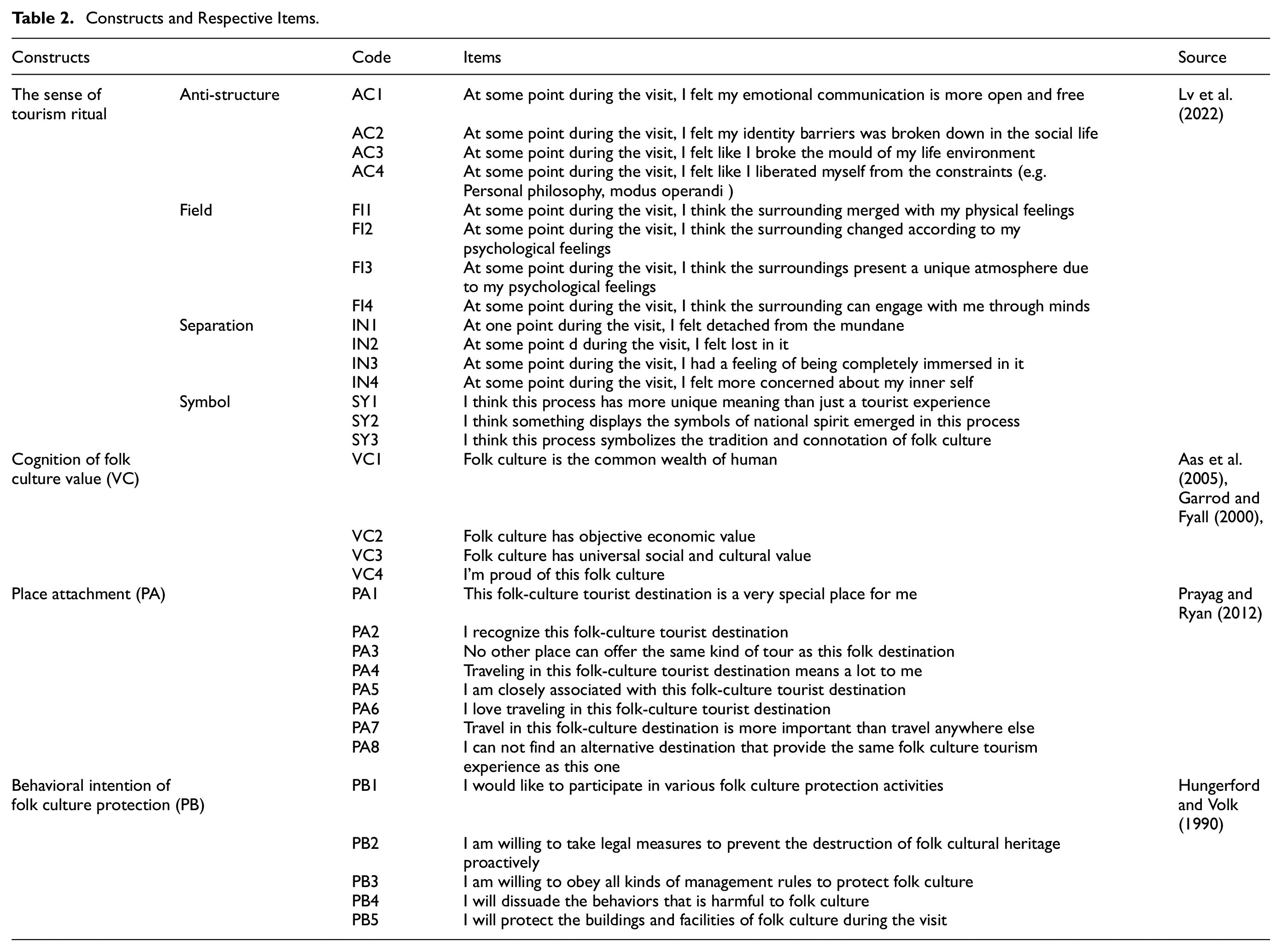
Following the theory and findings of previous literature, this study adopted the mature scale. We made some adjustment to the items based on the context and characteristics of folk culture. The questionnaire consists of five parts. The first part is the screening item, which inquires whether the participants have experience of folk tourism. The respondents with folk tourism experience were selected as the research objects. The second part measures the respondents’ sense of tourism ritual. With adoption and adjustment of current scale, we developed the items (Table 2). Following Lv et al. (2022), the scale have four dimensions and 15 questionnaires. The third part measures the tourists’ cognition of folk culture value and place attachment. Following Aas et al. (2005) and Garrod and Fyall (2000), we measure the cognition of folk culture value with four items. Following Prayag and Ryan (2012), we use eight items to measure place attachment. The fourth part measures the behavioral intention of folk culture protection, with five items adopted from Hungerford and Volk (1990). All items were measured on a seven-point Likert scale (1 = strongly disagree, 7 = strongly agree). Finally, the fifth part collects the demographic information of the respondents, including gender, age, education background and income, details have been shown in Table 2.
Constructs and Respective Items.
Sample and Data Collection
Before the survey began, we submitted the investigation plan to the scientific committee for ethical review and obtained permission. Since this study was carried out during the pandemic period, a large-scale field survey was not available. Therefore, an online survey was adopted and questionnaires were distributed through the professional online research platform “Sojump”. Sojump is a professional online research platform in China With over 10 million users and a cumulative collection of over 20 billion answer sheets We use the platform’s sample service to distribute samples through random sampling.To ensure the validity of the questionnaire, a filtering question was set to ensure that the respondents had folk tourism experience. Therefore, the samples are suitable for folk culture tourism research. A total of 380 questionnaires were collected, of which 345 were valid. The effective sample size is more than 10 times the number of items. The demographic information of respondents is shown in Table 3. Of all respondents, 48.8% were male and 51.2% were female. 41.7% of the participants were aged 19 to 25, and 65.5% had a bachelor’s degree. 47.2% of respondents had a monthly income between 5,001and 8,000 yuan (Table 3).
Demographic Information of the Respondents.

Results
Reliability Test
Reliability refers to the consistency, reliability, and stability of a measure. This paper used internal consistency index to test the reliability. According to the suggestions of Gefen and Straub (2005), Cronbach’s a and Composite Reliability (CR) were used for analysis. It is generally believed that Cronbach’s a coefficient above .7 meets the reliability standard, and a coefficient above .8 indicates high reliability. The combined reliability (CR) calculated by confirmatory factor analysis (CFA) can also be used to evaluate internal consistency. A higher value of CR means higher reliability. A lower value of CR means lower reliability. In this paper, the standard of the reliability test proposed by Hatcher (1994) was adopted. .6 was taken as the minimum acceptable reliability value. If the combined reliability of each dimension is greater than .7, it indicates good reliability. As shown in Table 4, the Cronbach’s a coefficient and CR value of all the variables in this study exceeds .8, indicating that the scale has good reliability.
The Results of Reliability Test.

Confirmatory Factor Analysis
AMOS 22.0 was used for confirmatory factor analysis (CFA). Confirmatory Factor Analysis measures the validity and reliability of the model. and the consistency and inconsistency of the research model with the data were assessed with various fit indices obtained from the test results(Aydin & Emeksiz, 2018).There are two types of construct validity: convergent validity and discriminant validity. Convergent validity refers to the extent of correlation between different items of the same variable, and it can be analyzed by normalizing factor loadings and Average Variance Extracted (AVE). The value of CR and AVE ranges from 0 to 1, where a higher value indicates higher reliability level. The factor loading is more than .7, and the AVE is more than or equal to .5 confirms the convergent validity. Discriminant validity refers to whether there are significant differences between different constructs. The discriminant validity is mainly analyzed by comparing the correlations with the square root of average variance extracted (AVE). If the correlation coefficient between two latent variables is less than the AVE square root of the main latent variable, indicating good discriminant validity, details have been shown in Table 5.
Model Fit Indices and Fit Thresholds.

Confirmatory Factor Analysis of The Sense of Tourism Ritual
Confirmatory factor analysis includes first-order and high-order confirmatory factor analysis. In this paper, all variables are first-order latent variables except for the sense of tourism ritual, which is second-order latent variable. Therefore, this paper conduct both the first-order and the second-order confirmatory factor analysis.
(1) The first-order confirmatory factor analysis of the sense of tourism ritual
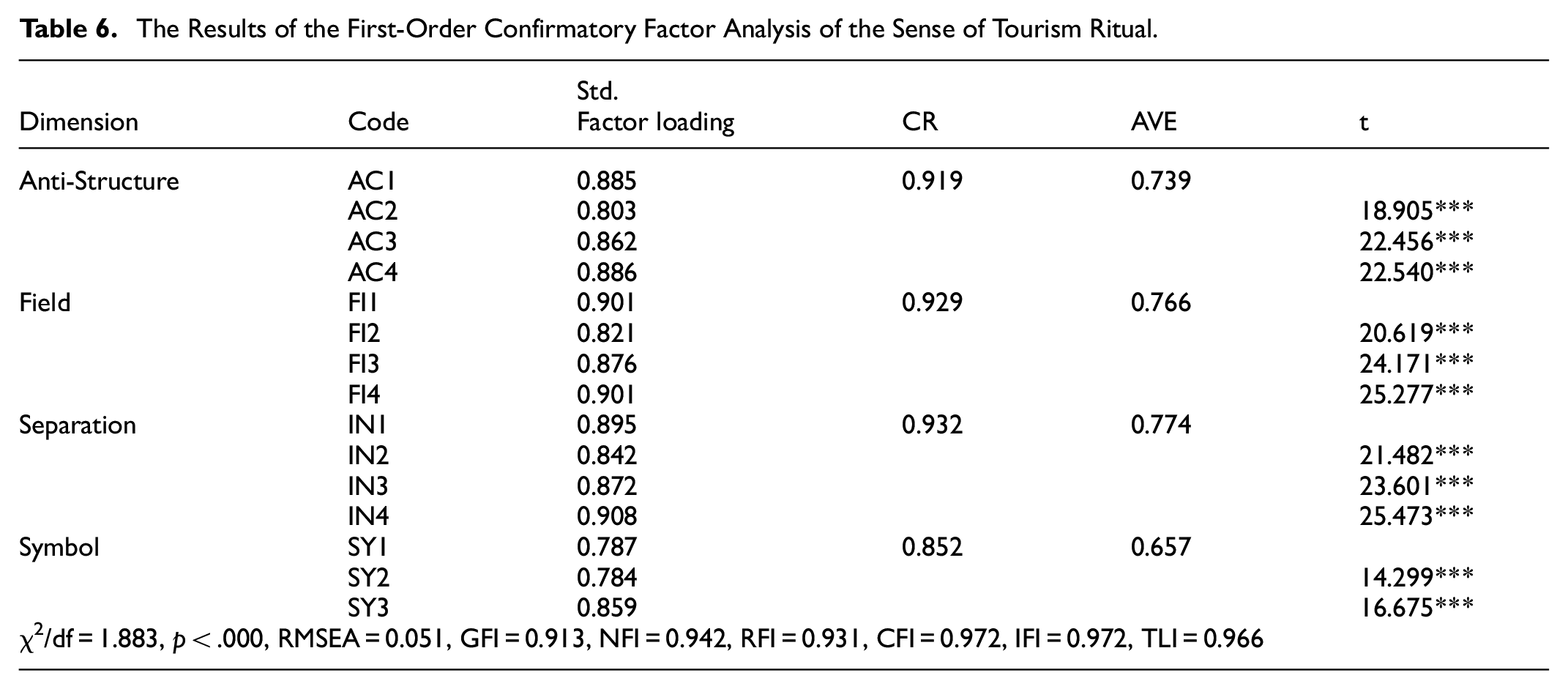
First, the four dimensions (anti-structural, regional, isolated and symbolic) of the sense of tourism ritual were analyzed by the first-order CFA. The results show that χ2/df = 1.883, p < .000, RMSEA = 0.051, GFI = 0.913, NFI = 0.942, RFI = 0.931, CFI = 0.972, IFI = 0.972, TLI = 0.966, among which, χ2/df < 3, RMSEA < 0.08, GFI NFI RFI CFI IFI TLI were all above 0.9. The Fit indices exceeds the fit threshold, which indicates that the model fits well. According to the results of confirmatory factor analysis, the standardized factor loadings of all items of the four dimensions ranged from 0.852 to 0.932, which were above 0.7. All the AVE values of each latent variable exceeded the threshold of 0.5, indicating good convergence validity. The AVE square root of each variable is greater than the correlation coefficient between each two variables, indicating good discriminant validity. The results are shown in Tables 6 and 7.
The Results of the First-Order Confirmatory Factor Analysis of the Sense of Tourism Ritual.
Discriminant Validity.

Note. N = 378; CR = composite reliability; AVE = average variance extracted; All correlation coefficients were significant at 0.01 level; [ ]is the square foot of AVE.
(2) The second-order confirmatory factor analysis of the sense of tourism ritual
After the first-order CFA, the second-order CFA should be constructed to test whether there is a common factor for the four dimensions, namely the sense of tourism ritual. As shown in Table 8, the test results showed χ2/df = 1.877, p < .000, RMSEA = 0.050, GFI = 0.909, NFI = 0.939, RFI = 0.931, CFI = 0.971, IFI = 0.971, TLI = 0.966, with all fitting indices satisfying the established criteria, and the model fit was excellent. The standardized factor loadings of all the measurement items of the sense of tourism ritual ranged from 0.772 to 0.908, greater than 0.7. The AVE values of the first-order latent variables exceeded the standard of 0.5, indicating good convergent validity. The standardized factor loadings of the four first-order latent variables were all above 0.7, and the AVE of the second-order latent variable was greater than 0.5. Therefore, the model passed the second-order CFA test.
The Results of the Second-Order Confirmatory Factor Analysis of the Sense of Tourism Ritual.

p < .05, **p < .01, ***p < .001.
Confirmatory Factor Analysis of All Variables
CFA tests were carried out on four variables: the sense of tourism ritual, cognition of folk culture value, place attachment and behavioral intention of folk culture protection. Through the analysis of maximum likelihood estimation in AMOS, the results of model fit are shown in Table 9, χ2/df = 1.464, p < .000, RMSEA = 0.037, GFI = 0.857, NFI = 0.926, RFI = 0.916, CFI = 0.957, IFI = 0.957, TLI = 0.953, among which, χ2/df < 3, RMSEA < 0.08, GFI > 0.85, NFI, RFI, CFI, IFI, TLI were all above 0.9. The estimated model index met the fit threshold, and the fitting indices were all within the range of threshold values, indicating an effective measurement model. The standardized factor loadings of all the measurement items of the sense of tourism ritual ranged from 0.732 to 0.981, greater than 0.7. The AVE values of the first-order latent variables exceeded the standard of 0.5, indicating good convergent validity. The correlation coefficients between the AVE square root of two variables are shown in Table 10. The values on the diagonal represent the AVE square root of each variable, which were greater than the correlation coefficients between each two variables, indicating good discriminative validity.
The Results of CFA of all Variables.

The AVE Square Root of all Variables and the Correlation Coefficients.
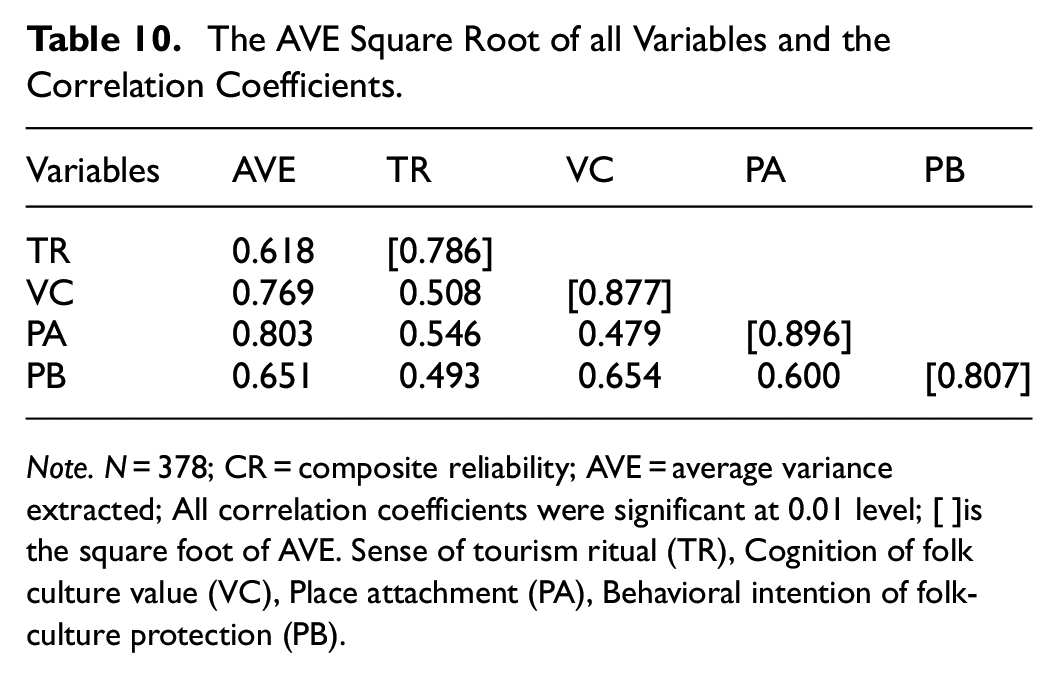
Note. N = 378; CR = composite reliability; AVE = average variance extracted; All correlation coefficients were significant at 0.01 level; [ ]is the square foot of AVE. Sense of tourism ritual (TR), Cognition of folk culture value (VC), Place attachment (PA), Behavioral intention of folk-culture protection (PB).
Structural Equation Model Analysis
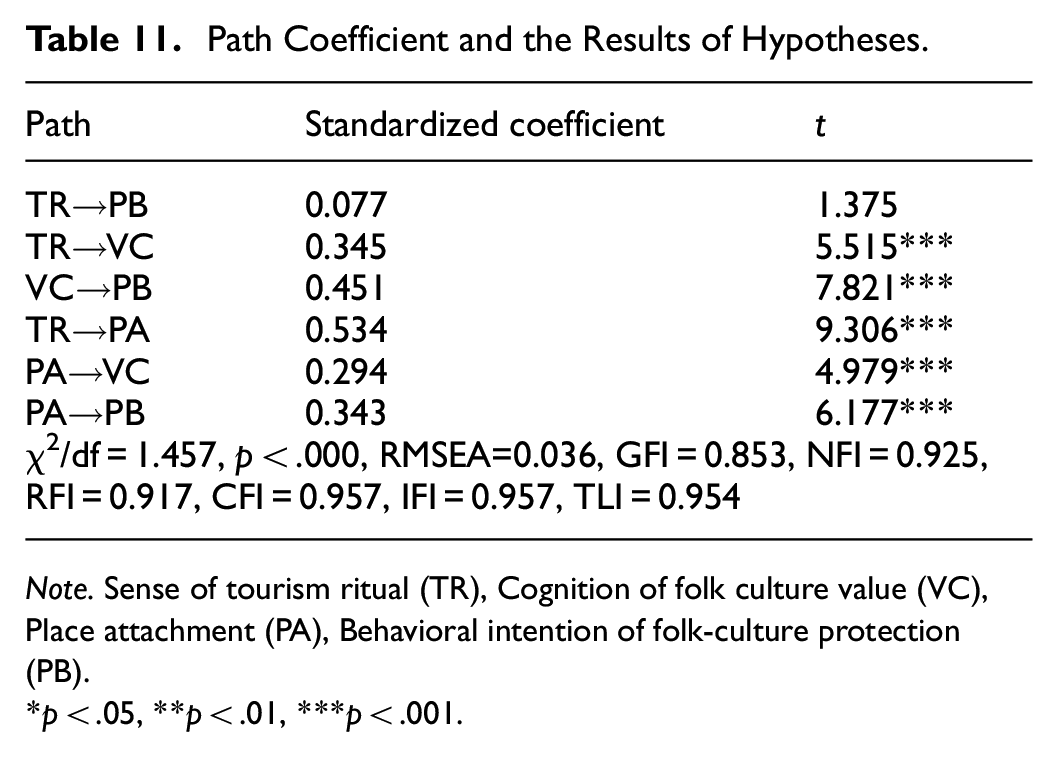
In this study, the structural equation model was constructed in AMOS22.0, the maximum likelihood method of structural equation modeling is more efficient and less affected by sample bias(Rockwood, 2021). Table 11 shows the model fit results of the structural equation model, with χ2/df = 1.457, p < .000, RMSEA = 0.036, GFI = 0.853, NFI = 0.925, RFI = 0.917, CFI = 0.957, IFI = 0.957, TLI = 0.954. Since χ2/df < 3, RMSEA < 0.05, NFI, CFI, IFI, TLI are all above 0.9, and GFI > 0.85, which is within the acceptable range, indicating an effective structural equation model.
Path Coefficient and the Results of Hypotheses.
Note. Sense of tourism ritual (TR), Cognition of folk culture value (VC), Place attachment (PA), Behavioral intention of folk-culture protection (PB).
p < .05, **p < .01, ***p < .001.
The path analysis and hypothesis testing results of the structural equation model are shown in Table 11 and Figure 2. The direct effect of sense of tourism ritual on the behavioral intention of folk culture protection was no significant (β = .077, t = 1.375, p > .05). The sense of tourism ritual has a significant positive impact on the cognition of folk culture value (β = .345, t = 9.306, p < .001), and H2a is supported. Cognition of folk culture value has a significant positive influence on the behavioral intention of folk culture protection (β = .451, t = 7.821, p < .001), and H2b is supported. The sense of tourism ritual (β = .534, t = 4.979, p < .001) has a significant positive effect on place attachment, and H3a is supported. Place attachment (β = .343, t = 5.515, p < .001) has a significant positive influence on the behavioral intention of folk culture protection, and H3b is supported; Place attachment (β = .294, t = 4.979, p < .001) has a significant positive impact on the cognition of folk culture value, and H4 is supported. Overall, although the direct effect of the sense of tourism ritual on the behavioral intention of folk culture protection is not significant, the indirect effect is significant, and the total effect is significant. Therefore, H1 is supported.

The theoretical model and standardized path coefficient.
Conclusion and Discussion
Conclusion
Previous research has demonstrated from the perspectives of ritual theory and social interaction ritual chains that social interaction and tourism rituals can enhance tourists’ sense of authenticity and increase their sense of identification (Cai et al., 2021; Hill et al., 2022; Shi et al., 2022; Sterchele, 2020; Weinberger, 2015), laying a solid foundation for the study of tourism rituals. However, there has been little research interpreting tourist responses from the perspective of tourist psychology, namely, the sense of ritual (Li, 2020; Li et al., 2024). This study from the perspective of tourism ritual sense analyzes the cognitive and emotional psychological processes of tourists under ethnic tourism rituals, expanding the responsibility for protecting folk culture from local organizers to tourist autonomous behavior. This study, based on protection motivation theory, investigates and validates the influence of ethnic tourism ritual sense on destination culture protection behavior and its underlying mechanisms through a questionnaire survey of potential tourists. The research has drawn the following conclusions:
Firstly, the sense of tourism ritual significantly and positively affects tourists’ intention to protect folk culture. Previous research on tourism rituals has focused more on their positive impact on enhancing the tourist experience, such as the positive impact on their experience quality and satisfaction.(McCracken,1986 ) However, this study found that tourists' sense of tourism ritual not only enhances their own experience, but also enables them to actively participate in the protection of local folk culture. This proactive protective behavior is more effective than passive forms of protection such as warnings and prohibitions.
Secondly, the sense of tourism ritual positively influences folk culture protection behavior through tourists' attachment to the place. Ethnic tourism provides unique experiences and emotional value to tourists (Ara et al., 2022), satisfying their emotional needs and thereby stimulating the development of place attachment (Ram et al., 2016; Wu et al. 2023). When tourists form a sense of tourism ritual by participating in various folk activities, they integrate into the local community, gain identity, and respect the underlying cultural values. Thus, tourists develop emotional attachment to the Local culture after forming a sense of ritual.
Thirdly, the sense of tourism ritual positively affects folk culture protection behavior through tourists’ cognition of folk culture value. Rituals not only enhance psychological connections, but also have educational functions. (Arslan et al., 2012; Tian, 2018) .Previous research has mainly focused on the role of rituals in strengthening identification and changing cognition. (Plester, 2014).This study further incorporates the latter function of ritual into the model. Research has found that the tourism rituals in ethnic regions often have strong educational attributes, indicating that tourists are immersed in the tourism environment, making it easier for them to experience cultural values. Thus, enhancing tourists' cognition of folk culture value through the sense of tourism ritual results in a special educational effect in cultural comparison, ultimately leading to protective behavior.
Lastly, the results also demonstrate that place attachment further positively influences tourists' cognition of folk culture value. This study constructs an integrated research framework that unifies the two functions of ritual into one model. Compared to the single mediation model commonly used in previous studies, this study provides a more complete understanding of the pathway through which rituals play a role and a more detailed depiction of the psychological process black box of tourists. This model demonstrates intention to protect folk culture is not only directly influenced by the sense of tourism ritual but also by the joint effects of place attachment and cognition of folk culture value. When tourists develop place attachment during ethnic tourism, they recognize the value of local folk culture and thus enhance their understanding of cultural value. When ethnic tourists develop place attachment, indicating functional and emotional attachment to the place, they will focus on the sustainable development of the local area and strive to protect its tourism environment and culture. Tourists’ cognition of folk culture value, including cultural inheritance and social life, typically leads to a strong intention to protect folk culture.
Theoretical Implications
The theoretical contributions of this paper are as follows: First, this study improves the basic theoretical framework of the sense of tourism ritual, and enriches related research. Taking ethnic tourism as the background, this paper explores and verifies the enhancing effect of the sense of tourism ritual on tourists’ protection behavior of folk culture from the perspective of the sense of ritual. This paper deepens the related theory of the sense of ritual and extends its application.
Second, this study identifies new measures to promote tourists’ protection behavior of folk culture. This study found the sense of tourism ritual can influence tourists’ behavioral intention of folk culture protection through tourists’ cognition of the value of folk culture and place attachment. This study contributes to current related literature on folk culture protection from the perspective of the sense of ritual.
Third, this study reveals the underlying psychological mechanism that the sense of tourism ritual influences tourists’ protection behavior of folk culture. When tourists generate place attachment during the visit, they recognize the value of local folk culture, and increase their cognition of culture value, which always result in a stronger intention to protect the local folk custom. When tourists generate place attachment, that is, when they develop functional dependence and emotional attachment to the place, they are more likely to concern with the sustainable development of the place and try their best to protect the local tourism environment and culture.
Managerial Implications
Firstly, destination marketing practitioners should focus on the creation of a sense of ritual in tourism. Nowadays, consumers are not only concerned with basic needs but also emphasize experiences and subjective feelings, showing an interest in “surprise” and “fun.” Regarding the anti-structural nature of the sense of tourism ritual, tourist destinations should emphasize “novelty” and create ethnic tourism experiences that are different from daily experiences, such as with the wearing of ethnic costumes and the singing of folk songs; in terms of the spatiality of the sense of tourism ritual, it is important to focus on the creation of festival atmospheres and destination scenes, forming specific spatial and temporal scene characteristics; regarding the separateness of the sense of tourism ritual, it is necessary to guide tourists from general experiences to peak experiences. With the diversification of tourism experience demands, more and more tourists expect to undergo a kind of immersion during their travels. The pursuit of “poetry and distance” and the experience of a sense of ritual gradually become their important travel motives; in terms of the symbolism of the sense of tourism ritual, it is essential to mobilize more folk elements and symbols, branding the tourism destination and establishing a unique image of the tourism destination. Some excellent tourism marketers have created popular tourism products by cultivating and enhancing the sense of ritual in tourism activities, including crossing the Arctic Circle in Rovaniemi (Santa Claus Village, Finland), the Avignon Festival (Southern France), the Flower Festival (Japan), and the Nadam Festival (Inner Mongolia, China). Therefore, tourism marketers should evoke and strengthen the inner sense of tourism ritual through the penetration of a strong and high level of external tourism ritual: take the sense of ritual seriously, reshape activities with a sense of ritual, and develop products with a sense of ritual.
Secondly, in addition to forming a sense of ritual, ethnic tourism providers should also increase the emotional connection between tourists and destinations (place attachment) and consciously enhance tourists' cognition of local cultural values (folk culture value cognition) to promote customers' protective behaviors towards local folk culture. Specific measures include: fully integrating folk elements into tourism rituals and providing folk explanations to guide tourists to deeply participate and invest in the sense of ritual in folk customs tourism; additionally, destinations should make full use of narrative discourse to explain ethnic history and local culture. This narrative discourse can help to bridge the relationship with tourists, and through storytelling, tourists can develop emotional resonance and identification, which can lead to more emotional value investment by tourists.
Finally, for ethnic tourism destinations to achieve long-term development, guiding tourists to autonomously protect folk culture is of utmost importance. This study provides management insights and suggestions for the development of ethnic tourism, the inheritance of folk culture, and the protection of cultural diversity. And this protective behavior, fundamentally, is based on the concept of co-creation of value. During the marketing process, destinations should reasonably maintain the legitimate rights and interests of tourists, avoiding exaggeration and deception and representing the most genuine aspects of ethnic areas. The emphasis on economic benefits should not lead to the distortion of tourism rituals.
Limitation and Future Research
This study focuses on the influence of the sense of ritual in the consumption field, especially in the field of tourism consumption, but there are still some limitations:
First, the universality of the research conclusion needs to be improved. This study takes ethnic tourism as the background. Although setting up the consumption scenario can delineate the research scope, but it constrains the application of the research conclusion to other consumption context. We will pay attention to the application of the sense of tourism ritual in various tourism context and consumption scenarios in the future research.
Second, the robustness of the research method needs to be strengthened. The questionnaire development and empirical test of this study adopted scientific quantitative research methods. However, due to the limitations of research funds and time, all questionnaires were only distributed through the Sojump platform, resulting in single sample source and slightly insufficient sample quantity. Moreover, participants should recall their tourism experience to answer the questions, so it is hard to rule out the distractions. Therefore, there could be some difference between the answers and the real situation. Although survey has been widely used in the research filed of consumer behavior, it has limitation. Future research can use large sample or filed experiment to increase the robustness of the findings.
Third, although this study proposes a two-layer (inner and outer) model of the sense of tourism ritual, there may still be unknown theoretical boundaries, and there is room for further improvement for the categories summarized in qualitative research.
Footnotes

Consent to Participate
All the human participants gave the written informed consent prior to the enrollment.
Funding
The author(s) disclosed receipt of the following financial support for the research, authorship, and/or publication of this article: This work is supported by (1)Sichuan Landscape and Recreation Research Center, Project number(No. JGYQ2024003), (2) National Sports General Administration of Sports Culture Development Center·Xihua Normal University Sports Culture Research Base(No. 24TB003), (3) Sichuan Leisure Sports Industry Development Research Center(No.XXTYCY2024A10),and(4) The Ministry of Education of Humanities and Social Science Project (No. 23YJA630072).
Declaration of Conflicting Interests
The author(s) declared no potential conflicts of interest with respect to the research, authorship, and/or publication of this article.
Data Availability Statement
The data that support the findings of this study are available from the corresponding author upon reasonable request.