




Abstract
This quantitative study used the Stimulus-Organism-Response theory to examine the relationships among authentic experience, tourist satisfaction, place attachment, and behavioral intention in religious destination context. The survey questionnaire was designed to obtain the data. The responses of 566 tourists that paid a visit to the Father Diep Church, a famous religious destination in southern Vietnam, were analyzed. The results revealed that tourist satisfaction significantly influenced on place attachment, destination revisit intention, and word-of-mouth. Furthermore, word-of-mouth and revisit intentions were sharply and positively impacted by place attachment, whereas the influence of authentic experience on tourist satisfaction, revisit intention, and word-of-mouth was noteworthy. Moreover, demographic factors, such as being female, being a business tourist, and observing a different religion (non-Catholic), were associated with higher revisit intention. These findings could provide guidelines for developing marketing strategies for religious destinations and be theoretically based on for further empirical validation.
Plain Language Summary
This study develops and tests a conceptual model that offers hypotheses regarding place attachment, authentic experience, tourist satisfaction, word of mouth, and destination revisit intention with respect to a case of Vietnamese religious tourism. We collected data using a survey questionnaire, and the respondents comprised 566 tourists visiting the Father Diep Church, a famous religious destination in southern Vietnam that inherited both Catholic and Confucian traditions. This study addresses gaps in the literature by investigating the relationships among place attachment, authentic experience, satisfaction, destination revisit intention, and word of mouth for the Father Diep Church study.
Introduction
Religious tourism possesses the potential to effectively promote inclusive and sustainable development (Griffin & Raj, 2017). Due to people’s fear of nature’s power and the rise of numerous diverse religious ideologies around the world, it is thought to be the earliest kind of tourism (Hsiao-Ming et al., 2020). The first research on religious tourism were released in the 1980s (Cohen, 1984; Graburn, 1983) in several tourism magazines. Following that, a assortment of religious tourism was developed that took the growth of pilgrimage movements in many religions into account (Nolan & Nolan, 1992). Religious tourism can be regarded as a contemporary pattern of visits to religious destinations (Dolatabadi et al., 2013).
Visits to tourist destinations with religious significance because of their sacred nature are known as religious tourism (Griffin and Raj, 2017). Religion accounts for the majority of religious tourism contents (Rinschede, 1992). It involves traveling to pilgrimage centers at the local, regional, national, or international level, and participating in religious ceremonies, conferences, celebrations, and other religion-oriented events that necessitate leaving one’s home environment (Rodrigues & McIntosh, 2014). Religious tourism is characterized by a diverse and segmented travel cohort that encompasses individuals seeking the satisfaction of modern multifaceted aspirations, such as spirituality, reflection, peace, and direction (Kim et al., 2019). Religious travel has a long history, dating back to the early pilgrimages centuries ago (Shackley, 1998). Recently, the market for religious tourism has grown and become broader, embracing a variety of niches like luxury religious travel, volunteer-focused religious travel, and modern pilgrimages (Rodrigues & McIntosh, 2014). Approximately 300–330 million tourists visit religious sites worldwide annually (Griffin & Raj, 2017). Religious tourists and pilgrims who self-identify as such exhibit exceptional commitment to these sites and locations (Kim et al., 2019). The cultural and economic development of areas with a religious component may be impacted by religious tourism (Kim et al., 2019). Since it influences cultural activities, social relationships, monetary revenue, and transportation planning, the issue of drawing visitors to religious tourism destinations has assumed crucial importance (Chen & Chen, 2010).
Vietnam has many religions, the most prominent of which are Buddhism, Catholicism, and Confucianism. However, one characteristic differentiates Vietnam from other countries in terms of religion: the combination of Catholicism and Confucianism at a famous church in southern Vietnam. The Tac Say Church in the Mekong Delta of Vietnam, also known as the “Father Diep Church,” has been there for about a century and is connected to the life of the revered Vietnamese Catholic priest Truong Buu Diep. Visitors to this church worship Father Truong Buu Diep, a sacred priest who sacrificed himself to save parishioners and is considered to bring blessings to the minds of Catholics. The Father Diep Church is a religious destination with Vietnamese characteristics inherited from both Catholicism and Confucianism, where worshippers can burn incense and pray. Tourists, mainly domestic Vietnamese tourists, travel to Father Diep Church to voice their desires (e.g., praying for good business or health) or to practice spirituality, contemplation, and tranquility. The famous religious destination, Father Diep Church, attracts millions of Catholic tourists annually.
The physical and psychological components are highly valued by religious tourists and are linked to satisfying feelings (Patwardhan et al., 2020). Consumption-related emotional experiences play a crucial role in determining post-consumption behaviors, including satisfaction, place attachment, destination selection, and intention to revisit (Hosany et al., 2016). The development of attachment individuals is particularly significant in tourism development planning, as it influences the physical aspects of local places as well as the meanings associated with them, connections people form with others, and the locations inside the destination’s boundaries (Kaján, 2014).
The relationship between place attachment and its antecedents, including tourist satisfaction has been evaluated by tourism scholars (e.g., Hosany et al., 2016; Lee et al., 2012; Zhang et al., 2019), and outcomes, such as word-of-mouth (WOM) (Chen et al., 2014; Lee et al., 2012) and revisit intention (Isa et al., 2020; Song et al., 2017). However, to date, few studies have considered the antecedents and outcomes of place attachment in the background of religious destinations. Additionally, there has not been much discussion in the literature about the significance of authentic experiences for visitor happiness and behavioral loyalty (i.e., propensity to return and refer others to a site). It is crucial to look at these connections in the context of places of worship. By examining the relationships between place attachment, authentic experience, satisfaction, destination revisit intention, and WOM about Father Diep Church, this study closes this gap in the literature. Moreover, his study examines differences in religious tourism behavior (i.e., revisit intention) among demographic groups (e.g., gender and travel reason).
The rest of this essay is presented as following. The concepts of framework and the literature review are offered first, and then the methodology, design of study, and analytical findings are explained. The study’s implications and limitations are then examined.
Theoretical Framework and Hypothesis Development
Theoretical Background
The foundation for the research approach for this study is the stimulus-organism-response (SOR) hypothesis (Jacoby, 2002). One of the most reliable and practical frameworks for studying green consumption is the SOR framework (Lee et al., 2020). Three sorts of consumer responses to the environment are separated under the SOR model. A person’s internal condition (organism) creates responses (responses) when subjected to an external environmental stimulus (S). The genuine experience was the study’s motivating factor. The main components of the investigation are tourist satisfaction and site attachment. The revisit intention and WOM are the response components in this study.
Tourist Satisfaction
The success of destination marketing is significantly influenced by visitor satisfaction (Yoon & Uysal, 2005), as it affects tourists’ destination choices, consumption behaviors, and intention to revisit (Suh & Youjae, 2006).
According to Oliver (1997), a consumer’s fulfillment reaction is what is meant by “satisfaction” in settings of consumer marketing. When a product’s actual performance or result is compared to expectations, it can cause sentiments of happiness or disappointment (Kotler & Keller, 2016).
In the tourism background, pre-travel expectation and post-travel experiences are what primarily determine enjoyment (Chen & Chen, 2010). It evaluates the entire visitor experience and has been thoroughly researched in the industry of tourism (Hsiao-Ming et al., 2020; Liao et al., 2021; Shafiee et al., 2016). In contrast to dissatisfaction, which happens when experiences fall short of expectations, tourists are delighted when their tourism experiences bring them more pleasure than they anticipated (Chen & Chen, 2010). In other words, positive disconfirmation will result if visitors perceive that the performance or features of the tourist destination actually exceed their expectations (Liao et al., 2021).
Transaction-specific and general pleasure are the two categories into which visitor satisfaction may be divided (Eid & El-Gohary, 2015). The satisfaction within a particular context is referred to as transaction-specific satisfaction. The term “overall satisfaction” on the other hand denotes contentment with the full service package (Wardi et al., 2018). Overall satisfaction was assessed in this study.
Destination Revisit Intention
The main emphasis of current tourism literature is on travelers’ revisit intention to various forms of tourism (Lam & Hsu, 2006). From the perspective of Chang et al.’s (2014) view, the intention to revisit a location refers to visitors’ desire to go there again.
It can offer precise forecasts of a choice to return, such as buying a vacation package to the same place, by measuring a individual’s willingness or inclination to pay a second visit to the same place (Han & Kim, 2010). D. Wang (2004) asserts that retaining existing consumers is more cost-savings than attracting new ones. The expenditure of repeat tourists is also frequently higher, in addition, the duration of their stay is also longer compared to the first time they arrived (Lehto et al., 2004; D. Wang, 2004). The phrase “destination revisit intention” is known as the inclination of tourists to go back to the same tourist attraction in the investigation. Positive revisit intention is known as the inclination to travel, to make travel plans, or to spend time and money on travel-related goods or services (Lee et al., 2020).
There has been much research on the relationship between customer satisfaction and behavioral intentions in the service business (Seetanah et al., 2020). According to Fornell (1992), the more pleased consumers are with the services they receive, the more likely they are to act favorably toward the service provider and the less likely they are to switch to other service providers. Tourist satisfaction is recognized as a significant indicator of revisit intention at the destination level (Cifci, 2021), which is in numerous prior research (Chen & Chen, 2010; Chi & Qu, 2008; Seetanah et al., 2020). Tourists incline to turn back to a place if they had a positive experience there (Hsiao-Ming et al., 2020; Liao et al., 2021). Hence, it is clear that the intention to revisit depends on tourist satisfaction (Shafiee et al., 2016) and satisfaction is correlated with intentions to revisit religious destinations (Liao et al., 2021; Nguyen-Viet & Nguyen Van, 2021; Rahman et al., 2022). Hence, hypothesis was proposed as following:
Hypothesis 1: Tourist satisfaction positively impacts destination revisit intention.
Word-of-Mouth
The end objectives of destination and tourist marketing is revisit intention and WOM (Shafiee et al., 2021). Since the 1960s, WOM has been concentrated of marketing studies (Arndt, 1967; Engel et al., 1969). WOM is characterized as customer interaction in which people discuss their personal impressions of a business or a product (Richins, 1983). It describes unofficial, one-on-one conversations between a non-commercial representative and a recipient about a name, a thing, a company, or a service following the view of Harrison-Walker (2001). WOM is the practice of communicating customer experiences to family, friends, and colleagues, which seems to sharply influence on customers’ decision to own product or service (T. Wang et al., 2017). WOM is regarded in tourism research as an active type of campaigning for endorsing a specific spot to acquaintances such as relatives and friends (Lai, 2020). Positive WOM helps to build a favorable perception of the destination and raises consciousness of it among those who would not otherwise be aware of it (Phillips et al., 2011). WoM has a big influence on decisions about travel destinations, attitudes, and behavioral intentions (Preko et al., 2021).
WOM can be traditional and electronic (eWOM) (Kim et al., 2014; King et al., 2014; T. Wang et al., 2017). EWOM occurs in an online environment (e.g., social networks such as Facebook, Twitter, or LinkedIn), where the information sharing can be quickly taken place among individuals whereas traditional WOM is often offline with person-to-person conversations (King et al., 2014). Hence, eWOM allows for information exchange without the requirement for in-person communication and has no geographic restriction (Kim et al., 2014; King et al., 2014; T. Wang et al., 2017).
Unlike commercial advertising, WOM is very reliable since individuals rely on their friends, family, and other close friends for information (Hwang & Lee, 2018). Positive recommendations from friends and family may have a greater effect on others’ attitudes and behaviors than any other kind of marketing communication (Simpson & Siguaw, 2008). Consumer behavior is significantly influenced by consumer-to-consumer interpersonal communication about purchasing experiences (Casidy et al., 2021). The current study approaches WOM in a traditional way, as traditional WOM—through the communicator’s attitude, personality, and degree of reverence toward Father Diep Church—has a strong impact on listeners.
Marketing has paid a lot of attention to the relationship between satisfaction and word-of-mouth (Duarte et al., 2018; Ha & Im, 2012) and tourism (Hwang & Lee, 2018; T. Wang et al., 2017). Additionally, research demonstrates that visitors who are pleased with their destination are more inclined to suggest it to others (Hwang & Lee, 2018; T. Wang et al., 2017). By contrast, dissatisfied tourists engage in negative WOM (Prayag & Ryan, 2011). Religious tourism studies have found that tourist satisfaction affects WOM (Preko et al., 2021; Wardi et al., 2018). Thus, the second hypothesis was proposed as following:
Hypothesis 2: Tourist satisfaction positively impacts WOM.
Place Attachment
Affective bonds or connections between people and certain places are also called as place attachment (Hidalgo & Hernandez, 2001). It is the outcome of individuals’ cumulative interactions with an environment’s physical and social components, which results in emotional attachments to that location (Stylidis, 2017). The phrase “place attachment” is used to indicate the strong emotional ties that people form when they engage with a particular environment (Ramkissoon, 2015). This represents a psychological connection formed through accumulated experiences that carry both affective and symbolic meanings (Song et al., 2017). Place attachment is a response to experiences associated with a particular destination (Cifci, 2021).
Based on Patwardhan et al. (2020) and Zhang et al. (2019), place attachment is a multifaceted notion that may be further broken down into the subconcepts of place identity and dependence. Place identity includes self-identification and emotions that result from the interplay of a person’s self-image with the surroundings. It symbolizes how a location and a person’s identity are intertwined and includes both cognitive and emotive components (Ramkissoon et al., 2013). Place identity is the perception that a place can represent part of one’s self-image and contributes to the formation of emotional attachment to a specific are (Alexandris et al., 2006). In term of travelers, place identity indicates about their symbolic attachment to a destination through self-identification (Cifci, 2021).
Conversely, place dependence focuses more on the functional aspects of a place. It relates to a place’s distinctive features that set it apart from comparable or rival places and that are necessary for achieving a person’s seeks and goals (Alexandris et al., 2006; Song et al., 2017; Tsai et al., 2020). The importance of a location in delivering the essential services for desired leisure activities is highlighted by this functional attachment (Alexandris et al., 2006). In addition, the place attachment is manifested in the physical features of the environment (Ramkissoon et al., 2013). Place dependence is a reflection of a person’s practical attachment to a place to meet their needs, wants, or desires associated with a destination (Cifci, 2021).
Tourist satisfaction and place attachment have totally aroused interest from academic researchers and industry practitioners (Ramkissoon et al., 2018). Visitors’ satisfaction may be a precursor to place attachment, according to several research (Hosany et al., 2016; Lee et al., 2012; Su et al., 2011; Zhang et al., 2019). According to Su et al. (2011), tourist satisfaction impacts on both place identity and dependence. Moreover, Hosany et al. (2016) demonstrated a beneficial effect of satisfaction exists in the context of foreign visitors in Thailand while Lee et al. (2012) and Zhang et al. (2019) claimed visitor satisfaction is a useful indicator in the context of festivals. For nature-based attractions to succeed in our fiercely competitive marketplaces, place satisfaction and place attachment strategies are essential (Ramkissoon et al., 2018). Considering these issues, the third hypothesis was proposed:
Hypothesis 3a: Tourist satisfaction positively impacts place identity.
Hypothesis 3b: Tourist satisfaction positively impacts place dependence.
Moreover, data from several studies indicate that place attachment positively impacts WOM (Chen et al., 2014; Lee et al., 2012). Travelers may engage in WOM communication to recommend destinations, discuss interesting activities or events, or express a desire to support a destination (Chen et al., 2014). Chen et al. (2014) showed that place attachment affected WOM behavior in Sydney and Shanghai. Similarly, Lee et al. (2012) explored that place attachment was an antecedent of WOM at tourist agricultural festivals in Texas. Hence, the fourth hypothesis was proposed:
Hypothesis 4a: Place identity positively impacts WOM.
Hypothesis 4b: Place dependence positively impacts destination WOM.
Prior research have proposed that the place attachment construct is significant in intention to revisit (Isa et al., 2020; Song et al., 2017). For example, Isa et al. (2020) indicated that visitors to Indonesia’s Batam Island were more likely to return if they had a strong sense of place. In the Chinese province of Hainan, Song et al. (2017) investigated the connection between visitors who play golf and their inclinations to return to that location. Hence, the fifth hypothesis was proposed:
Hypothesis 5a: Place identity positively impacts destination revisit intention.
Hypothesis 5b: Place dependence positively impacts destination revisit intention.
Authentic Experience
An authentic experience relates to an individual’s feelings that they relate to their knowledge of and feelings toward a specific object (Selwyn, 1996). This object may take the form of artwork, celebrations, rituals, foods, clothing, or dwellings made by locals in accordance with long-standing tradition or conventions (Lee et al., 2020). Authenticity in tourism encompasses personal and experiential interpretation of a tourist in authentic engagement with a destination’s place, culture, customs, activities, or other elements often rooted in traditional cultural practices (Ram et al., 2016). In addition, authentic experiences can be crafted and enhanced through storytelling and entertainment that connect visitors’ experiences and local history to their own values and aspirations (Engeset & Elvekrok, 2015).
Farrelly et al. (2019) highlighted the significance of physically embodying culturally and historically significant aspects and actively conveying meaning to create a successful authentic experience. Therefore, the important cues and ties to the local history and context should be highlighted by tourist vendors and management. The pursuit of authenticity is particularly relevant for festivals and pilgrimage attendees (Lee et al., 2015), making the construction of authentic experiences and analyzing their effects important areas of research in tourism (Taheri et al., 2018). Comprehending participants’ real-world experiences and examining their relationships with other variables can aid festival organizers in effectively managing marketing events (Lee et al., 2020).
According to Engeset and Elvekrok (2015) and Girish & Chen (2017), storytelling is an authenticity component that teaches visitors about the background or origin of the environment in which they enjoy their experiences. It also leaves visitors feeling fulfilled. The influence of authentic experiences on satisfaction has been empirically demonstrated in earlier studies. Engeset and Elvekrok (2015) claimed that a authentic experience boosts visitor satisfaction, and according to Girish and Chen’s (2017) findings, it is a reliable indicator of visitor satisfaction. As such, the sixth hypothesis was proposed:
Hypothesis 6: An authentic experience positively impacts tourist satisfaction.
Moreover, scholars have examined authentic experiences as precedents for revisit intention (Ja Kim et al., 2020; Kolar & Zabkar, 2010). Kolar and Zabkar (2010) urged more investigation into the relationship between place attachment and intention to repay a visit. Girish and Chen (2017) noted that authentic experience favorably impacts on revisit intention. Ja Kim et al. (2020) established that authentic experience predicts revisit intention. Thus, travelers’ viewpoints of travel authenticity are important, and a higher impression of authenticity increases travel intention (Ja Kim et al., 2020). Hence, the seventh hypothesis was proposed:
Hypothesis 7: An authentic experience positively impacts destination revisit intention.
Empirical studies have reported that authenticity considerably impacts on visitor word-of-mouth (WOM) activities (Antón et al., 2019; Rasoolimanesh et al., 2021). Rasoolimanesh et al. (2021) reported that a high level of authenticity leads to tourist WOM. According to Antón et al. (2019), e-WOM activity in the background of dining involved authenticity. Hence, the eighth hypothesis was proposed:
Hypothesis 8: An authentic experience positively impacts WOM.
A conceptual model diagram is presented in Figure 1.

A conceptual model diagram.
Methodology
Measurement
The origin language of survey questionnaire is English and then it was translated into Vietnamese which is the mother language of respondent for deeper understanding of questions by two native speakers before returning to English. These steps were taken to ensure the Vietnamese version was accurate and equivalent to the original English version.
This study used six constructs: destination revisit intention, tourist satisfaction, WOM, authentic experience, place identity, and place dependence. We assessed place identity using six items and place dependence using three items. From Song et al. (2017), these nine things were modified. Five items taken from Ja Kim et al. (2020) that were modified to measure the authentic experience. Five questions adapted from Nguyen-Viet and Nguyen Van (2021) were used to gauge visitor satisfaction. WOM was assessed by taking three items adopted from Wardi et al. (2018). Three questions adapted from Nguyen-Viet and Nguyen Van (2021) were used to evaluate the inclination to revisit a destination. Items of each variables was ranked on a five-point Likert scale with the fluctuation from 1 (strongly disagree) to 5 (strongly agree).
To minimize response bias and guarantee clarity of the survey questions, a pilot survey was conducted. A bilingual questionnaire was used, based on a pilot test conducted in September 2020 with 80 respondents. The pilot test had good findings, with eight variables matching the expected structures. All Cronbach’s cores above the generally accepted cutoff of 0.70 and the factor loadings fluctuated from 0.7 to 0.9, reflecting strong internal consistency reliability.
Sampling and Data Collection
We tested our hypotheses by capturing data from tourists at Father Diep Church. Convenience sampling was performed. An interviewer distributed questionnaires and instructions on how to complete them to respondents. Although the sample was not chosen at random, it was unable to have access to comprehensive visitor lists, which would have ensured that the sample was highly representative of all visitors to Father Diep Church.
At the Father Diep Church gates, participants were questioned during morning and afternoon sessions. Trained interviewers were told not to speak with more than 10 tourists from the same group in order to prevent bias that may result from a similarity in the tourists’ province of origin. In around ten minutes, respondents were required to do the self-administered survey on-site, in the place where they often unwind after visiting Father Diep Church. Respondents were informed that they were eligible for token rewards for their involvement. We collected 600 questionnaires between December 2020 and February 2021 adhering the standard quality control procedure of the Bac Lieu Statistics Office. There are 566 completed questionnaires with the majority of respondents who were female (56.5%), business travelers (56%), older than 40 years (65.9%), and non-Catholics (other religions; 62.2%). The demographic data of the valid respondents is reflected in Table 1.
Demographic Characteristics.

Results
Testing Scale
The outcomes of evaluating construct reliability using composite reliability are shown in Tables 2 and 3. The results, which fall between 0.755 and 0.890, satisfy the suggested threshold of 0.6 or above (Hair et al., 2010). The values of each construct’s items in Cronbach’s alpha are all bigger than 0.6 indicating strong reliability and internal consistency between the variables (Hair et al., 2010).
Constructs With Items and Reliability and Validity.

Results of Test for Discriminant Validity.

Note. The bold diagonal elements are the square root of the variance shared between the constructs and their measures; off diagonal elements are the correlations among constructs.
The convergent validity was accepted by looking at standardized factor loadings, which varied between 0.605 and 0.965 higher than the recommended threshold of 0.5 (Hair et al., 2010). Additionally, the average variance extracted (AVE) exceeded the level of 0.5 for discriminant validity, fluctuating between 0.510 and 0.670 (Hair et al., 2010). Furthermore, the square root of the AVE for each of the latent variables is larger than its bivariate correlation with any other variables to verify discriminant validity. From the viewpoint of Fornell and Larcker’s (1981) criteria, it means that it is unique and unrelated to the others and this criterion confirms that each construct exhibits discriminant validity in the model.
Standardized factor loadings were applied to evaluate convergent validity, and the average variance was retrieved. All items’ standardized factor loadings varied between 0.605 and 0.965, which is over the suggested limits of 0.5 (Hair et al., 2010).
We follow common method bias to evaluate the model via Harman’s single factor tests in accordance with Podsakoff et al.’s (2003) recommendations. Only 36.849% of the data’s variation could be attributed to the first unrotated element, proving that the common technique bias was of little relevance.
Model Testing
AMOS version 20.0 was applied to measure the relationships between the components and to optimize the likelihood approach of structural equation modeling (SEM) concurrently. According to the test model results shown in Figure 2, the test model had a chi2 value of 680.894, 264 degrees of freedom, a Cmin/df ratio of 2.579, a Tucker-Lewis fit index (TLI) of 0.938 (>0.9), a comparative fit index (CFI) of 0.946 (>0.9), and an RMSEA of 0.053 (0.07).

Results of model testing.
Estimated Model
The estimated model’s findings are shown in Table 4, which showed that visitor satisfaction significantly influenced both destination revisit intention (β = .327, p < .000) and WOM (β = .209, p < .000). Hence, this supports for the H1 and H2.
Results of Standardized Estimate Model.
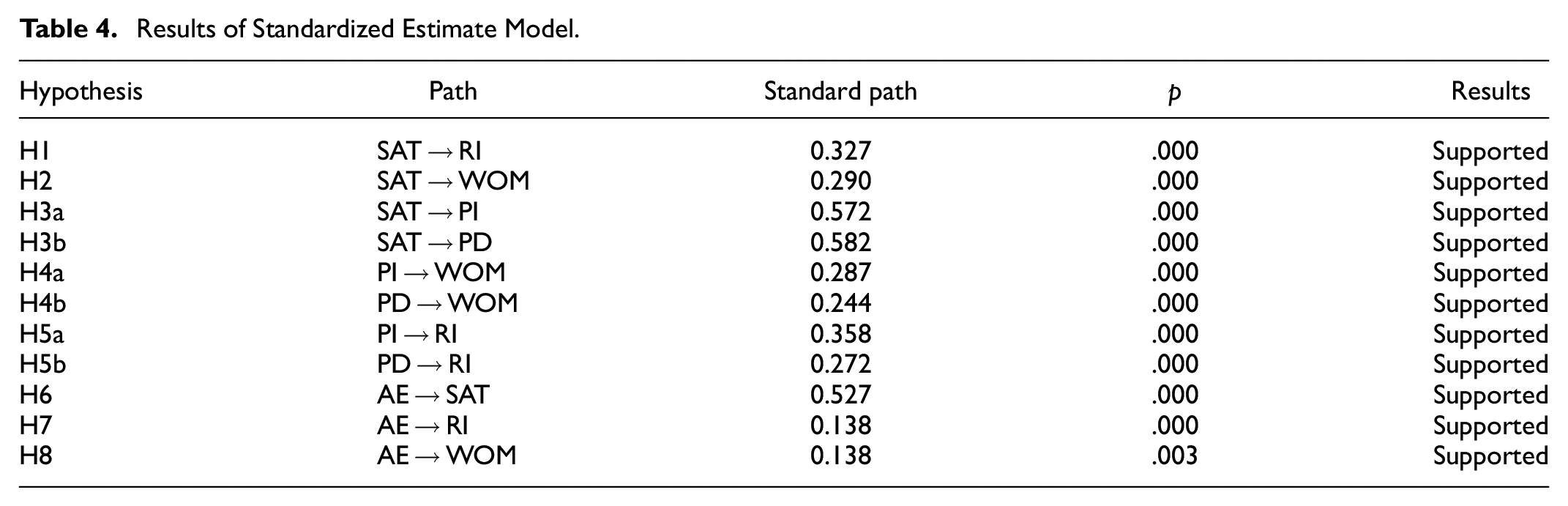
In addition, the value of β = .572, p < .000 for place identity and β = .582, p < .01 for place dependence show that the place attachment dimension was significantly impacted by tourist satisfaction. Hence, H3a and H3b also supported in this study.
As hypothesized, the place attachment dimension significantly and positively influence on WOM (β = .287, p < .000 for place identity; β = .244, p < .000 for place dependence) and revisit intention (β = .358, p < .000 for place identity; β = .272, p < .000 for place dependence). Therefore, H4a, H4b, H5a, and H5b were supported.
These findings indicated that an authentic experience had a high impact on tourist satisfaction (β = .527, p < .000), revisit intention (β = .138, p < .000), and WOM (β = 0.138, p < .003). Hence, these values support for H6, H7, and H8.
Finally, this study found that women (mean = 3.049), business tourists (mean = 2.875), and people with other religions (mean = 2.965) were more likely to exhibit revisit intention toward religious destinations, such as Father Diep Church, than men (mean = 2.414), non-business travelers (mean = 2.648), and non-Catholics (mean = 2.457; p < .05).
Discussion and Implications
Discussion
The research evaluated the relationships between the elements of place attachment (place identity, place dependence), authentic experience, tourist satisfaction, WOM, and religious destination revisit intention using the Father Diep Church, a religious destination with Vietnamese characteristics inherited from both the Catholic and Confucian traditions. We proposed eight hypotheses with respect to our model and reflected that tourist satisfaction sharply impacted on destination revisit intention. The findings correspond with those of Chi and Qu (2008) and Seetanah et al. (2020); others’ findings regarding WOM (Hwang & Lee, 2018; T. Wang et al., 2017; Wardi et al., 2018) also align with the present exploration.
The place attachment dimension involving—is piercingly influenced by visitor satisfaction. The outcomes of Su et al. (2011), Hosany et al. (2016), and Zhang et al. (2019) are corroborated by these ones. Furthermore, the results are in line with those in the leisure and social psychology literature that contend that a individual’s level of satisfaction with their social and natural surroundings has a direct impact on how much they value an area in particular (Lee et al., 2012).
Our study indicates that place attachment significantly enhances WOM supporting for the view of Lee et al. (2012) and Chen et al. (2014) and revisit intention (supporting for the point of Isa et al. (2020) and Song et al. (2017).
Furthermore, this study generated findings that align with previous studies asserting that tourists’ satisfaction is significantly impacted by their ability to have an authentic experience (Engeset & Elvekrok, 2015; Girish & Chen, 2017), WOM (Antón et al., 2019; Rasoolimanesh et al., 2021), and revisit intention (Ja Kim et al., 2020; Kolar & Zabkar, 2010).
Last but not least, this investigation claims that women, business tourists, and people with other religions were more likely to exhibit revisit intention toward the Father Diep Church than men, non-business travelers, and non-Catholics.
Theoretical Implications
There are a handful of theoretical implications in the research outcomes. First, they aid the insight of the relationship between place attachment, authentic experience, satisfaction, destination revisit intention, and WOM toward a religious place (i.e., Father Diep Church). While there is no reflection of these relationships in literature, our findings contradict earlier studies within a religious context, especially that pertaining to decision-making and revisit intention (Hsiao-Ming et al., 2020; Liao et al., 2021; Patwardhan et al., 2020; Rasoolimanesh et al., 2021), satisfaction (Liao et al., 2021; Wardi et al., 2018), traditional WOM (Casidy et al., 2021; Wardi et al., 2018), place attachment (Patwardhan et al., 2020; Zhang et al., 2019), and having an authentic experience (Girish & Chen, 2017; Lee et al., 2020; Rasoolimanesh et al., 2021). The contribution of current study is to focus on literature via investigating the relationships among place attachment, authentic experience, satisfaction, destination revisit intention, and WOM for Father Diep Church, which has not been undertaken previously. This study demonstrated that traditional WOM was the most effective and positive means of spreading the word about this religious tourism destination option and engendering loyalty among tourists who have previously visited the destination. Specifically, we found that business travelers tend to have positive WOM toward this destination.
Finally, the investigation explored whether non-Catholics (other religions), women, and business tourists were more likely to have a revisit intention and WOM with respect to religious destinations, such as Father Diep Church, relative to non-Catholics, men, and non-business travelers. This finding fills a gap within the literature by revealing differences in revisit intention between men and women, Catholic and non-Catholic individuals, and business and non-business travelers.
Practical Implications
A practical recommendation is provided by the study’s findings. They have important practical implications for religious destination management groups, event organizers, and managers of sacred places, as well as for entrepreneurs who want to advertise certain events as tourist attractions to benefit the local community economically and socially. This information is crucial for religious destination management organizations and event planners should collaborate to create marketing plans that capitalize on events as authentic experiences, concentrating on visitor satisfaction and highlighting the critical role that tourism plays in this context. The outcomes show that visitors’ place attachment, authentic experience, and tourist satisfaction play crucial roles in forging connections with the event environment, which will eventually influence visitors’ intents to revisit to the area. The most fulfilling encounters at a place leave a “soft spot” in the minds of customers, influence their decisions and actions in the future, and are frequently the most trustworthy source of data in revisit intention and WOM communication (Rasoolimanesh et al., 2021). In light of this, destination management companies and event planners should acknowledge that visitors’ authentic experiences, tourist satisfaction, and place attachment are crucial factors influencing tourists’ intentions to revisit to spread the word about religious sites. Managers must develop strategies that enable the venue and its inhabitants to welcome travelers in a personal and emotional way. This may be done by including locals in the event’s planning and implementation. Residents would feel more empowered as a result, which would probably increase their propensity to engage in close relationships with tourists.
The research discovered that place attachment has satisfaction as a precursor. As suggested in earlier studies (Hosany et al., 2016; Zhang et al., 2019), encouraging social interactions between visitors and locals is one strategy to foster place attachment. Another is enhancing how visitors connect with the physical environments (for instance, enhancing how religious events are explained and giving people greater chances to participate in them).
Moreover, onsite promotion of activities and the availability of applications that enable visitors to personalize their experiences are strategies for strengthening place identity and dependence (Hosany et al., 2016). For instance, onsite marketing activities (e.g., sign-ups for loyalty programs or distributing souvenirs associated with the life of Father Diep) prompt tourists to stay at church for about two to three days, allowing them to might experience the role of a parishioner serving the church. Moreover, tourism marketers should repair and preserve church equipment and the tomb of Father Diep.
In addition, our outcome indicates that authentic experiences have a favorable influence on visitor satisfaction. Tourism marketers can create a joyful atmosphere for all visitors, regardless of psychographic differences, in appropriate facilities (e.g., properly managed crowds during the festival) and under appropriate arrangements (e.g., better accommodation facilities and adequate car parking facilities). Effective execution of these elements may influence visitors’ pleasure levels.
Finally, the majority of visitors that visited Father Diep Church were non-Catholic business travelers, which is a fascinating result of this study. These tourists tend to go to religious places at the beginning of the lunar year to pray for the success of their business and return at the end of the year to pray in a tribute ceremony. Tourism marketers should focus on non-Catholic tourist groups and expand their offerings of worship and ceremony products at the beginning and end of each lunar year.
Limitations and Future Research
The investigation expanded the body of knowledge concerning the relationship among destination revisit intention, WOM, satisfaction, place attachment, and authentic experience in a religious context, which prior research have not addressed. However, there are some limitations in this findings. First, it is cross-sectional and thus has limited generalizability. Second, because the poll was only done in Vietnam, outcomes of the research cannot be extrapolated to other nations. Third, the destination chosen in the investigation was the Father Diep Church; therefore, the results may not be applicable to sites pertaining to other religions.
Additionally, the antecedents of place attachment were not tested; hence, upcoming studies should take these antecedents into account, such as emotional solidarity and cultural environment. The findings of convenience sampling could not be typical of all sample sizes, which could be another issue. Our sample size (N = 566) was small. Future researchers could conduct surveys with larger sample sizes and focus on other religions and destination contexts.
Footnotes
Declaration of Conflicting Interests
The author(s) declared no potential conflicts of interest with respect to the research, authorship, and/or publication of this article.
Funding
The author(s) disclosed receipt of the following financial support for the research, authorship, and/or publication of this article: This research is funded by University of Economics Ho Chi Minh City (Vietnam).
