




Abstract
The research purpose revolves around the investigation of follower green awareness (FGA) that influences the organizational commitment of leader. The study undertakes the moderation-mediation model of perceived organizational support from followers and the mediating role of leader motivation towards sustainable development goals (SDGs). Four hundred twenty-nine followers from healthcare companies were analyzed quantitatively through SEM-PLS and process model for moderation-mediation, was analyzed through Johnson-Neyman graph. The analysis concludes that all hypotheses are significant. Follower green awareness is considered an important toolkit for creating green practices in healthcare companies, and it also stimulates the commitment of leaders towards green practices. Moreover, leader motivations towards SDGs partially mediate the FGA and LGOC relationship. The indirect relationship of the moderator (FPOS) was also significant. Insights obtained from this study support designing and implementing employee training programs concentrating on follower awareness towards sustainable practices. This awareness cultivates a culture of sustainability that permeates the entire workforce. Moreover, the insights from leader motivation towards SDGs and its positive impact on leader commitment can contribute towards informed strategic planning and decision-making processes. Through the lens of Munir & Ghani and Shamir, the present study empirically investigates reversing the lens perspective. Followers wield equal significance as leaders foster in eco-friendly activities. The study extends the AMO theory by focusing on followers’ contributions to offering resources that influence leader commitment.
Keywords
Introduction
The increasing frequency and severity of extreme weather conditions brought widespread social and environmental problems (Abbass et al., 2022). This increases the demand for businesses to become more sustainable. Companies are being informed to reduce the environmental impact and improve their social performance (Rupa & Saif, 2021). Literature suggests that sustainability provides a multifaceted approach in organizations for creating a balance among economic stability, social equity, and a long-lasting environment (Munir et al., 2025). Hence, the United Nations Sustainable Development Goals (UN-SDGs) act as a driver for promoting organizational sustainability because organizations have the resources, expertise, and power to influence the realization of sustainable development goals at local and global forums. Hence, alignment in strategic decisions, operational endeavors, and initiatives can leverage pressing global concerns by creating a positive impact through a multi-dimensional approach of economic, social, and environmental (ESG) (Munir & Watts, 2024).
Due to this, various multinational organizations are motivated to adopt initiatives such as waste recycling, energy conservation, sustainable procurement, carbon neutrality, and climate action (Muff et al., 2020). Conversely, small and medium enterprises are striving to cope with the SDGs. Similarly, developing nations have fewer concerns about environmental stability, even though a major chunk of industrial production takes place in these countries (Munir et al., 2024; Puppim de Oliveira & Jabbour, 2016). Therefore, there is a need to address the issue through the implementation of the SDGs through stakeholder engagement.
In this regard, the awareness and knowledge of all stakeholders contribute positively towards the Sustainable Development Goals (SDGs). The understanding of individuals towards sustainability and its benefits for the organization, society, and overall community motivates them to engage in sustainable practices. These green people act as catalysts for not only promoting their awareness among other fellows but also pushing them to implement it in their daily routines (Munir & Ghani, 2024). Green awareness is not an inherent characteristic; however, these individuals learn from religious norms and observe them from their upbringing (Shen et al., 2016). Similarly, the awareness of followers acts as an inspiring tool for other individuals to actively engage in green initiatives in the workplace. The encouragement and motivation of leaders towards SDG implementation in the workplace and following green awareness both reinforce the commitment level of leaders to sustainability as a shared value and vision. Furthermore, followers’ green awareness can create a culture of accountability for upholding the standard of sustainability. These followers ensure that green practices remain a priority in each operation they conduct and encourage others to follow their footprints. Hence, peer support in valuing, recognizing, and endorsing the outcome of green practices from green followers creates a green culture. According to Li et al.’s (2022) research study, there is a positive relationship between employee green awareness and green culture. Conversely, the need for a greener planet emphasizes the need for every individual to live sustainable lifestyles that are beneficial to both society and the environment. Therefore, the awareness of one individual can influence others in the organization, where the influence drives a decision either to adopt or reduce the impact of sustainable practices. However, when the outcome of influence is strong in terms of caring, valuing, and recognition awarded by other followers and the willingness of the leader towards the adoption of the SDGs in an organization, it creates an impact in the organization in terms of the leader’s commitment towards the implementation of the SDGs.
The untouched dimension of green practice from the follower perspective needs to be explored. Asadi et al., (2019) research has also explored the embrace of eco-friendly activities by followers directly involved in executing the company’s environmental programs. So, the backing of followers’ green awareness aids in managing environmental risk, reduces costs linked with waste disposal and promotes sustainable innovation. Moreover, green awareness contributes more if green followers get perceived organizational support (POS) from other followers; therefore, followers’ positive environmental contributions and peers valuing their work are more likely to create a culture where management is inspired by followers’ awareness and knowledge (Munir & Ghani, 2024). The rationale for taking FPOS is to bridge the gap that may appear because follower-green awareness alone cannot create a strong positive influence on the leader due to its position; however, organizational support can strengthen the relationship between FGA and LGOC.
Literature heavily asserts the importance of green awareness, leader motivation, and organizational support; however, the present research tends to bring novelty in terms of the followership perspective. Fewer studies focus on follower persuasion of the leader. Therefore, the proposed model is expected to be significantly helpful for other researchers in viewing the followership perspective of healthcare companies in Pakistan. The rationale for selecting healthcare companies is based on their impact on people’s lives and well-being. This indicates the dire need for research to investigate the sustainable practices adopted by followers who are aware of their beneficial outcomes and how they create an impact on leader commitment via organizational support and leader motivation towards the SDGs.
Theoretical Framework
The AMO (ability, motivation, opportunity) theory explains the framework for understanding the dynamic of follower awareness and its impact on leader commitment. The ability component of AMO theory reflects the knowledge, awareness, and skills that followers hold and apply to their deliverables. Therefore, follower green awareness is the ability to implement green practices in the workplace. The second component, motivation, is driving behavior that encourages followers to apply their awareness to adopting sustainable operational conduct in the workplace. Therefore, internally motivated followers who pursue green practices and who perceive strong external rewards or recognition for adopting green practices actively engage in sustainable initiatives. The third component is opportunity, which accentuates the significance of support, resources, and structure offered by the organization for applying green awareness to an assigned task. Follower-perceived organizational support is more relevant in this context due to the care, value, and support elements that peers show towards green initiatives. Overall, the integration of AMO theory further sheds light on the green behavior (Rayner & Morgan, 2017). The leader’s motivation towards the SDGs further creates a road map for follower green awareness and follower support to influence the leader’s commitment.
Hypothesis Development
According to Uhl-Bien et al. (2014), there is a need to study the followership perspective in an organizational context due to its dynamic behavioral outcome, and the leader’s impact will be unjustifiable without studying the followership. Similarly, Kean et al. (2011) also acknowledge the distinct effects that can be observed on the leader by studying followership. There is a need for follower-centric leadership studies (Matshoba-Ramuedzisi et al., 2022). Thus, the authors work on certain variables and test the impact of follower-centric variables (follower-green awareness and follower-perceived organizational support) on leader development variables such as leader-green organizational commitment via leader motivation towards SDGs.
Follower Centric Variables
Green practices occur through policies that devolve to followers in the organization. Hence, the fundamental contributors, “followers,” actively engage in eco-friendly strategies to truly advance in implementing the organizational sustainable agenda. Bastardoz and Vugt (2019) assert that it is necessary to understand the follower environment in which they exist. Therefore, the knowledge related to their surroundings, the culture in which they exist, and their upbringing all contribute to developing follower awareness. Green awareness significantly contributes to environmental performance. Moreover, environmental principles, values, and understanding influence the workplace culture. The follower’s green awareness fosters a culture that reduces anti-environmental behaviors (Darvishmotevali & Altinay, 2022). When followers are aware of the environmental impact of their actions, they are more likely to make choices that are less harmful to the environment. For example, followers who are aware of the environmental impact of printing documents may be more likely to print only what they need or to use double-sided printing. One of the reasons for being aware is due to followers’ education and training about environmental issues. This education serves to understand the significance of a green environment and the potential outcomes that their negative actions can bring to the environment. Moreover, the education, care, and awareness shown by followers also serve as an inspiration tool for people who inherently value sustainable goals, including leaders (Munir, 2023). Thus, it fosters environmental consciousness in leaders.
Consequently, the following hypothesis has been developed between FGA and LGOC:
According to Hiatt and Creasey (2012), resistance to change is normal human behavior. The study examined follower awareness and organizational support as change agents towards the willingness of leaders to show commitment to green practices. However, if leaders are motivated by the SDGs, then there is a greater likelihood of accepting the influence of change. Therefore, the championing of SDGs by leaders can have a greater impact on followers’ influence on leaders. The present study takes leader motivation towards SDGs as a mediator to comprehend the sense of shared purpose among leader and followers and encourages collaboration from the follower on achieving environmental objectives by showing leader commitment. Therefore, we have developed the following hypothesis:
Leadership Outcome
The influence created by followers through their awareness of accepting sustainable goals has a behavioral change outcome for the leader. When a leader shows commitment towards certain actions or implements any behaviors, this shift often occurs from previous patterns or behaviors. This change in leader commitment can manifest in different ways, such as encouraging sustainable initiatives, promoting sustainable change, or distributing sustainable resources among followers. Leader-green organizational commitments reflect a tangible change in behaviors that align with sustainable development goals.
Leader motivation towards sustainability acts as a cornerstone (Faraz et al., 2021; Li et al., 2020) for the organizations to progress, and their vocal support in the presence of follower green awareness further legitimizes the followers’ actions to adopt green practices. The role of the mediating variable in the present study demonstrates the personal interest shown by the leader after observing the follower’s green awareness and the benefits of green principles for the organization. One rationale for adopting the mediating variable is its categorization, which intensifies or limits the behavioral outcome of the leader. Hence, we have developed the following hypothesis:
Mediating Role of Leader Motivation Towards SDGs
A motivated leader sets a tone for the culture. Our point of study reflects on follower green awareness that influences leader commitment, this influence ignites passion and inspiration in leaders if they are motivated toward the SDGs. The leader’s motivation serves as an encouragement factor for leaders to demonstrate sustainable commitment (Eide et al., 2020) and for followers to become more aware of sustainable challenges that they can solve through sustainable innovation (Seyff et al., 2022). Therefore, leader motivation aligns with followers’ green awareness and is more likely to perceive their level of commitment as more authenticated, thus encouraging them to demonstrate such green practices. Therefore, the fourth hypothesis is as follows:
Moderating Role of FPOS
When followers’ awareness receives substantial organizational support and recognition for fostering green initiatives, then the impact of leader commitment towards the SDGs will be strong and long-lasting. Conversely, the value and awareness initiated by followers in the organizational culture may make leaders more inclined to engage and be motivated by green initiatives (Munir, 2023; Munir & Ghani, 2024). Similarly, higher perceived organizational support develops a robust connection between followers and leaders. Moreover, followers’ advocation towards sustainable development goals and organizational support bring high commitment levels to organizational culture. Therefore, the fifth hypothesis is based on the indirect effect among FGA, LGOC, and LM (mediator) via FPOS (moderator):
The conceptual framework covers novelty in the green practice domain in followership perspective (Figure 1). The AMO theory adopted to cover the theoretical gap and took perspective of sustainable followership.

Conceptual framework of sustainable followership.
Methodology
Participants and Sampling Techniques
The researcher conducted an online survey to collect data from followers (employees) who are working for healthcare companies. The convenience sampling technique is used for collecting the data. The rationale for adopting convenience sampling is that specific groups of people are dispersed at different locations, making it hard to collect random samples, and there is a lack of a sample frame. According to SMEDA (2022), 15,000 employees are working in pharmaceutical companies in Pakistan which is segment taking for healthcare. Due to the known population size, researchers use Andrew Fisher’s formula for identifying the minimum number in the sample size. The researcher sent an online survey request to 628 employees, out of whom 432 accepted the request and only 429 sent the filled-out copy. Therefore, the sample size is 429. It makes it a 67% response rate.
Measurement
The 7-point Likert scale was adopted to rate the questionnaire items. The questionnaire was adopted from existing scales that ensure relevance and validity. However, researchers satisfy the content validity by consulting with two experts and ensure the relevance, clarity, and completeness of the selected items by tailoring the questions to specific research contexts. The items from Ballantyne et al.’s (2009) and Safari et al.’s (2018) studies were taken to study the followers’ green awareness. The sample items are “I have gained knowledge about environmental issues, and I actively search for information about green practices.”Lamm et al. (2014) study items were taken for follower-perceived organizational support variables. The sample items are: “My organization likes when I take sustainable initiatives.”Gagné et al. (2015) study items were taken for leader motivation towards SDGs. The sample items are “I personally like dedicating energy and attention to sustainable tasks.”Mowday et al. (1979) study items were taken for leader organizational commitment. The sample items are: “I take pride in the green practices associated with this organization. The questionnaire is given in the appendix.
Data analysis
SPSS version 25 was used for identifying outliers and common method variance, and Smart PLS version 4 was used to analyze the convergent, discriminant, and moderation mediation models.
Finding
Researchers conduct pilot testing to establish the clarity, completeness, and feasibility of the questionnaire. Sixteen participants took part in pilot testing, and the Cronbach alpha of all constructs was above the accepted threshold (0.7). The questionnaire was also checked by the field expert, and the positive remarks from the expert further validated the study.
Respondent Profile
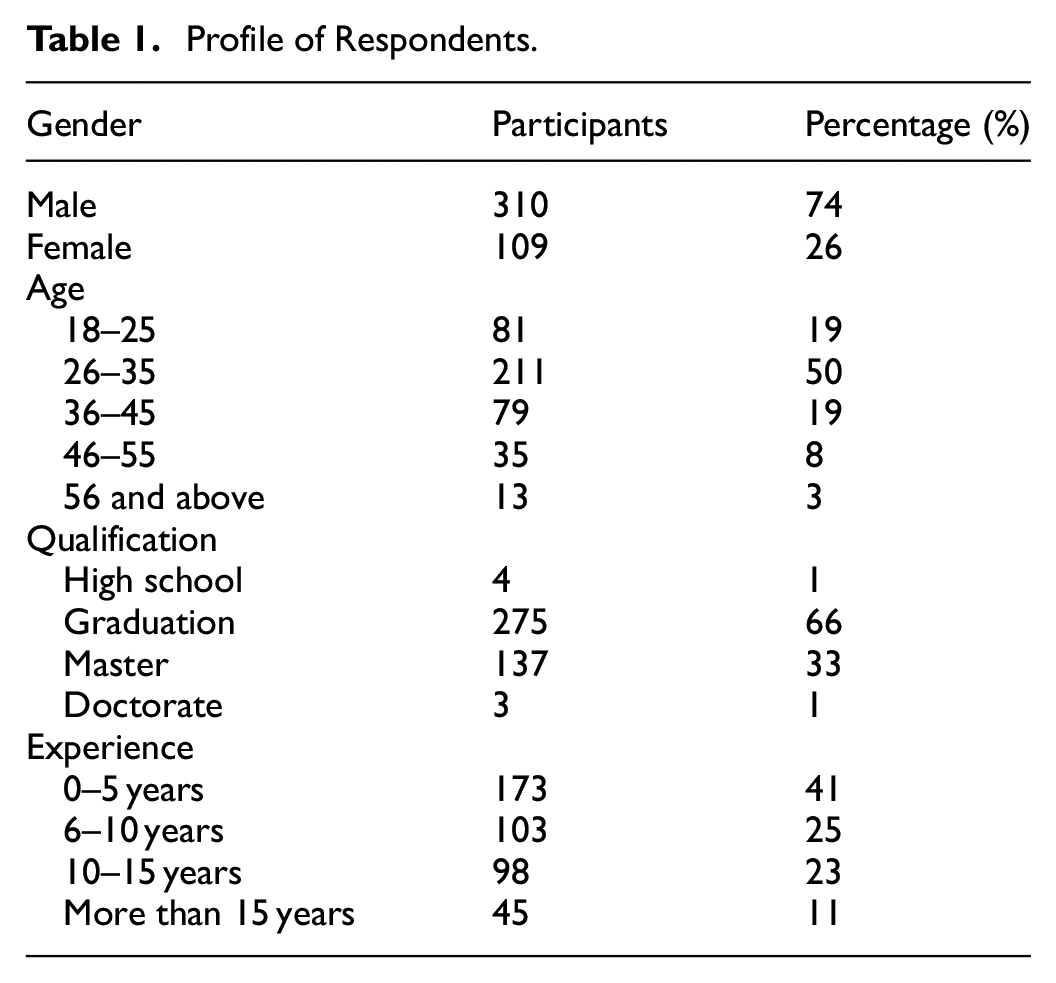
The demographic variables consist of gender, age, education, and experience. There were 74% males and 26% females. Fifty percent of respondents fall in the age bracket of 26 to 35, 19% fall in the age bracket of 18 to 25, 19% fall in the age bracket of 36 to 45, 8% fall in the age bracket of 46 to 55, and only 3% are above 56. Sixty-six percent have a bachelor’s degree, 33% have a master’s degree, 1% have a high school education, and 1% hold a doctorate. Twenty-five percent of followers have 5 to 10 years of work experience. There are a total of 25 healthcare companies that took part in the research, of which the majority fall into the mid-size category. Table 1 contains the detailed respondent’s profile.
Profile of Respondents.
Data Screening
Mahalanobis distance is used to identify outliers in the data sets (Leys et al., 2018). The result indicates that there were only three outliers in the data set, and all of them had p-values below .001.
The researcher used SPSS to check the normality of the data using skewness and kurtosis analysis. The researcher found an acceptable range (−2 to +2) of skewness and kurtosis values in the dataset.
Common method variance has been checked by Harman’s single-factor test in the data set. The outcome of the exploratory factor analysis showed that one factor emerged, and this factor accounted for 27.01%.
Measurement Model
Researchers use Cronbach’s alpha for measuring internal consistency (reliability). The values fall between zero and one, with higher values indicating better internal consistency.
For convergent validity, researchers use average variance extracted (AVE). Table 2 indicates that AVEs for all constructs are higher than the acceptable values (0.50), as reaffirmed by Hair et al. (2010). Composite reliability also measures internal consistency, specifically in structural equation modeling (SEM). Table 2 indicates values of composite reliability fall between 0 and 1, which shows a better reliability outcome.
AVE and Composite Reliability.
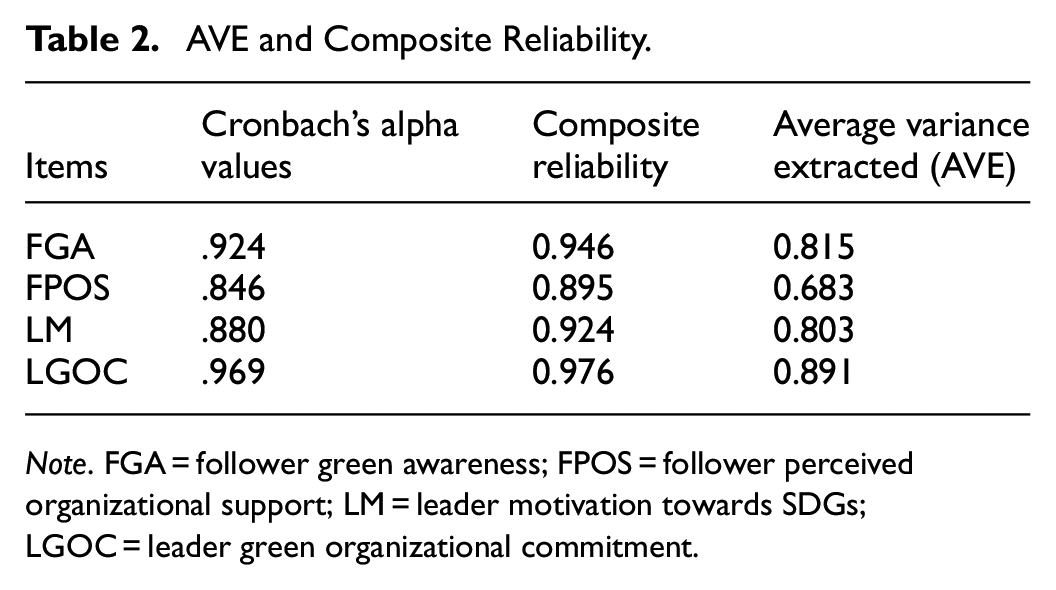
Note. FGA = follower green awareness; FPOS = follower perceived organizational support; LM = leader motivation towards SDGs; LGOC = leader green organizational commitment.
The Fornell-Larcker criterion is a common way to assess discriminant validity. However, the heterotrait-monotrait (HTMT) ratio of correlations is an alternative and more effective method (Creswell & Creswell, 2014). The HTMT ratio is the ratio of the correlations within the constructs to the correlations between the constructs. A higher HTMT ratio indicates better discriminant validity. The HTMT ratio was used as a criterion or as a statistical test in this study. If the HTMT ratio is greater than 0.85 or 0.90, then there is an issue with discriminant validity. If the confidence interval of the HTMT ratio does not include 1, then there is sufficient discriminant validity. In this case, all the latent variables meet the Fornell-Larcker criterion, suggesting that they have adequate discriminant validity (as shown in Table 3).
Mean, Standard Deviation, Fornell-Larcker Criterion for Discriminant Validity.

The correlation coefficient values were moderate. However, variance inflation factor (VIF) values are used to check the multicollinearity. Its values ranged from 2.957 to 3.818, which is below 10. This indicates that there is no evidence of multicollinearity.
Hypothesis Testing
The H1 to H3 hypothesis shows the results of all direct relations. The path coefficient values and the t values for each path were determined through the bootstrapping. Researcher use 5,000 resamples with one tail.
There is a positive beta value in all direct relations (FGA → LGOC (0.611); FGA → LM (0.638); LM → LGOC (0.167), as shown in Table 4. In other words, as followers’ green awareness increases, so will the leader’s green organizational commitment, and so on. The p-value is less than .05, which indicate a significant relationship between FGA → LGOC; FGA → LM and LM → LGOC.
Hypothesis Testing.

Mediating Role of LM (Hypothesis 4)
When the p-value is lower than the critical value of .05, then the p-value is concluded to be significant. Furthermore, a mediating relationship is also considered significant when there is no zero straddled between the lower confidence limit and the upper confidence limit (Hayes, 2013). The confidence limits provide a range within which the true population parameter is likely to fall. In this case, the 95% confidence interval for the mediation effect is given by the upper limit (0.215) and the lower limit (0.031).
Table 5 results show that (β = .112, p < .024) possessed a significant indirect effect on LGOC through LM as the mediator. Thus, hypothesis H4 is also supported.
Hypothesis Test of Mediator Variable (LM).

Moderation, Moderation Analysis (Hypothesis 5)
The researcher analyzes the moderation mediation model through a process model using Smart PLS 4.0. The conditional mediation (CoMe) technique through the PLS-SEM Process option is used. According to Hayes (2018), the role of the CoMe index is to quantify the moderator effect on the mediator. The FPOS interacts with LM in the research model; hence, LM values may change due to the effect of the FPOS. According to Hayes and Rockwood (2017), an independent variable can impact another variable through a mediator; this relationship is conditioned by the moderator.
The rationale for using the bias-corrected and accelerated (BCA) bootstrap method is that it refines the estimates and confidence interval by addressing biases and improving accuracy. Table 6 indicates that hypothesis 5 is supported because the p-value is less than 0.05 (p = .045). The value (β = −.009) of the FPOS index “p2-p5” suggests that the influence of FGA on LGOC through LM is inversely affected by the moderator FPOS.
Moderation-Mediation Effect of FPOS on FGA and LGOC via LM.

The conditional indirect effect (Table 7) reveals that the standard deviation of the moderator (FPOS) is 1.00539. When FPOS increases by +1, the mediating effect (FGA → LM → LGOC) decreases, whereas a decrease in FPOS by −1 leads to an increase in the mediating effect (FGA → LM → LGOC). The influence of FGA on leadership commitment via LM is significant at high and average levels of FPOS but becomes insignificant at low levels of FPOS.
Probing Moderated Indirect Relation.

Figure 2 shows the structural faremwork. Researcher use above data for plotting the Johnson-Neyman’s graph in Figure 3.

Path coefficient and p-values of all hypothesis.

Johnson-Neyman’s moderated mediation plot.
Discussion and Conclusion
Discussion
Alreahi et al. (2022) emphasized in their study that followers’ green awareness is important for creating a sustainable environment in the organization. The present study stands parallel to Alreahi et al. (2022) and further elaborates on this understanding by incorporating the perspective that being green-aware can develop a constructive behavioral outcome in the environment. Individuals play an important role in organizational settings in facilitating the behavior of the system. They can develop awareness through observations and information obtained from diverse areas. Hence, our model reflects the persuasion model in explaining pro-environmental behavior (Kollmuss & Agyeman, 2002). Followers who embrace sustainable practices lead to cost savings and improve resource efficiency, which supports a decision made by the leader to recognize and capitalize on the green awareness of the followers, which offers overall economic benefits and a competitive edge for the organization. Hence, followers who are environmentally conscious and favor businesses develop an influence on the leader to be committed to sustainability.
International agencies and governments are imposing strict environmental laws and regulations worldwide to address pressing challenges such as biodiversity and ecosystems, pollution, natural resource management, and environmentally sound management of waste, chemicals, etc. The United Nations proposes sustainable development goals that act as a blueprint for a sustainable future (Rant, 2020). Leader motivation for implementing sustainable goals in the organization can explain the relationship between follower green awareness and leader commitment. Leader motivation towards implementing the SDGs for mitigating the issues regarding environmental damage increases the resilience of followers to adopt green practices. Thus, leader motivation coupled with follower green awareness promotes a more effective exchange of ideas and commitment to green initiatives. It develops a mutually reinforcing dynamic where follower information, awareness, and knowledge inspire and motivate the leader to maintain and strengthen their commitment to green practices.
Followers who value green initiatives and perceive organizational support from their peers are in a position to exert a strong influence on the leader’s green organizational commitment. Hence, followers who perceive strong organizational support set clear expectations for environmentally responsible behavior in the organization (Hameed et al., 2021). This clarity moderates the relationship between follower green awareness and leader GOC by providing a framework within which leaders understand and respond to follower initiatives, contributing to a positive organizational culture that values green practices. The presence of perceived organizational support (POS) contributes to the development of trust; leaders are more likely to show commitment and engagement in green behavior, especially when followers are aware of and value environmentally friendly practices (Munir & Ghani, 2024). Arshadi (2011) concluded a positive relationship between POS and organizational commitment, and Musenze and Mayende (2023) concluded a moderating role of POS on leadership and innovative work behavior. The present study also indicates a positive relationship between follower POS, follower awareness, and leader commitment. Therefore, perceived organizational support facilitates the integration of sustainable practices into the organizational framework. This integration moderates the relationship by creating a systemic approach to green commitment, endorsed and supported by follower awareness, value, and knowledge.
On these grounds, it is necessary to study the followership perspective as suggested by Shamir (2007) and Matthews et al. (2021) on green practices to systematize and integrate the available literature. Importantly, existing literature explores the outcomes of green leadership and ignores the perspectives of followers (Munir, 2023). Our investigation suggests a new dimension related to follower-leader relations and its impact on green practices. Furthermore, the investigation considers responsibility and accountability in light of followers-leader relationships through AMO theory. The light reflected on follower awareness of green practices initiated the motivation and commitment of the leader.
Conclusion
The study was conducted to examine the dire need for sustainability in followers who influence the organizational culture through their knowledge, awareness, and values. The proposed model integrates the green followers’ perspectives with the outcomes of leaders on green practices. The aim was achieved through the investigation of the follower’s green awareness, which impacts the dependent variable (leaders’ green organizational commitment). The study undertakes the moderation mediation model by studying the impact of follower-perceived organizational support (moderator) and leader motivation on SDGs as mediators. The study concludes that all hypotheses are significant. Follower green awareness is considered an important toolkit for creating green practices in healthcare companies, and it also stimulates the commitment of leaders towards green practices
Theoretical Implications
The study took a theoretical perspective from different aspects. First of all, it investigates the variables that drive followers’ willingness to adopt green practices. Researchers explain this motivation of followers through the AMO theory. The awareness of followers towards environmental issues and concerns is considered an ability to implement green practices. Followers of green awareness can increase the knowledge of others by sharing information about sustainable practices and advocating for implementing eco-friendly resources. Thus, collaboration and discussion with peers and recognition from leaders develop the ability to use green resources. Similarly, leader motivation towards the SDGs also indicates their willingness to adopt sustainable practices. Follower awareness and leader motivation create a sense of urgency to foster sustainable practices in the organization. Moreover, follower support appears as an opportunity for green followers to actively engage in promoting and adopting green practices that develop favorable conditions for leaders to work towards sustainable development goals.
Secondly, the followership perspective on sustainability is new in the literature. Various studies focus on the impact of leaders on followers. However, this relationship is only half developed if it is not viewed from the reciprocal viewpoint of followership. According to Marion and Uhl-Bien (2001), followers are an integral part of the leadership process. Similarly, Chaleff (1997) and Hurwitz and Hurwitz (2020) assert that courageous, inspiring, and exemplary followers are the heart of organizational success. Hence, the present study took follower green awareness as an inspiring and exemplary tool for fostering sustainable culture and developing leader commitment in organizations.
Lastly, the study incorporates the importance of followers in the organization by considering them as the ultimate game changer. Followers appear as change agents for fostering sustainable development goals in the organization.
Practical Implications
Followership studies take a passive footprint in predominant leader-centric literature. Conversely, the role of followers in promoting sustainable development goals is actively ignored. Moreover, the followership study in emerging markets has taken a backstep, where the leader is considered a real role model for organization success. Therefore, the present study incorporates the followership perspective and highlights their inspiring role in adopting sustainable practices by leaders in developing countries, like Pakistan. Pakistan is a low-income country that heavily relies on public health facilities. The role of healthcare companies in Pakistan plays an important role in promoting the sustainable development goals of the UN. Due to the large pool of labor in healthcare companies, it is necessary to investigate the knowledge, awareness, and skills of their followers regarding sustainable practices.
The significance of this research holds practical implications within the realm of sustainability. Firstly, larger organizations begin to value green practices, whereas small and medium-sized businesses are less involved (Firdaus & Mohamed Udin, 2014). Hence, the present study takes the initiative to investigate green practices in small, medium, and large-scale companies, mainly the healthcare industry. Secondly, the present study empowers followers by providing an opportunity to contribute their green ideas to the organization, which creates a culture of shared responsibility and stakeholder engagement. Thirdly, the study enhances collaboration among followers across all levels of departments. The collaborative approach shown by followers can lead to green creativity towards complex environmental issues. Fourthly, the followership perspective on sustainability develops a culture that prioritizes eco-friendly concerns and their social impact on the community. Lastly, the study influences leaders to be more responsible and commit to sustainable initiatives.
Future Implications and Limitation
The term sustainable practices is under consideration by local and global agencies. Due to its importance, it is necessary to study the role of followers in sustainable practices. Therefore, comprehending the follower’s green awareness, follower voluntary engagement in sustainable goals, and peer support contribute towards the positive outcome of the implementation of green policies in true spirit. Moreover, the study focuses on hiring green followers, which means they are aware, value, and care about sustainable development goals; they tend to promote eco-friendly practices and create an environmentally committed culture in the organization. However, direct intervention in the form of continuous support from followers further strengthens the influence of leaders. Moreover, insights from followership studies support designing collaborative leadership programs for nurturing leadership approaches and empowering followers. Organizations need to restructure their processes to better understand the role of the follower in promoting sustainability through training, decentralizing decision-making, and developing agile frameworks that contribute to green creativity.
The followership perspective is understudied compared to the leadership perspective. However, there are a few limitations while empirically studying the followership study. Firstly, there is a scarcity of sustainable followership concepts about behavior, due to which limited understanding has been developed. Secondly, followership has multifaceted dimensions influenced by situation, resources, organizational structure, size, and other contextual factors. The present research limits these dimensions, and future research requires careful consideration when studying followership. Thirdly, traditional scales may not capture the sustainability perspective; therefore, future studies require customized measurement scales. Fourthly, it requires continuous tracking of the effect of followership on leader commitment. Therefore, a longitudinal study with segregation based on firm size gives more clarity. Lastly, changing the methodological method from quantitative to qualitative will support the investigation of more in-depth behavioral change influences and reasons.
Footnotes
Appendix

Ethical Considerations
This study involved human participants and was conducted in accordance with the ethical principles outlined in Iqra University institution’s ethics policy. Ethical approval was obtained from Iqra University. The study design minimized risk to participants by using anonymous surveys, excluding sensitive questions, etc. All participation was voluntary, and participants were informed of their right to withdraw at any time without consequence. Informed consent was obtained prior to participation, either in written or digital form. Participants were assured of confidentiality and anonymity throughout the research process. The potential benefits of this study—such as improving organizational sustainability practices, enhancing strategic decision-making, and promoting leader commitment through increased follower awareness—were deemed to outweigh any minimal risks posed to participants, which were mitigated through anonymity and voluntary participation.
Funding
The author received no financial support for the research, authorship, and/or publication of this article.
Declaration of Conflicting Interests
The author declared no potential conflicts of interest with respect to the research, authorship, and/or publication of this article.
Data Availability Statement
The data that support the findings of this study are not publicly available, and restrictions apply to the availability of these data.
Animals Welfare
This research project does not involve human participants, animals, or any identifiable personal information.