




Abstract
This study examined a moderated mediation model to explain how the indirect effect of transformational leadership (TL) on employees’ organizational commitment (OC) via procedural justice (PJ) is moderated by career growth opportunities (CGOs) in organizations. Data were gathered from 265 college faculty members. The results indicate that PJ serves as mediator between TL and OC, and this mediation process is affected by career growth. This research contributes to the leadership, human resource management, and organizational psychology literature by explaining how CGOs may affect the mediating process of PJ through which the relationship between TL and OC is determined. Organizational leaders can take insights from the findings of this study to increase their employees’ OC. Theoretical implications and future research directions have been discussed.
Keywords
Introduction
In the dynamic business era of the 21st century, committed employees are crucial for organizational effectiveness and sustained competitive advantage (Kuo, 2013). Organizations having committed employees are likely to perform low-cost operations, produce high-quality products and services, and succeed in achieving their goals (Aina & Verma, 2017). Organizations strive to increase their employees’ organizational commitment (OC) because it affects their performance in the long run (Salleh et al., 2016). OC refers to “the relative strength of an individual’s identification with and involvement in a particular organization” (Mowday et al., 1979, p. 226). In other words, OC represents the strength of relationship between employee and the organization (Meyer & Allen, 1991).
Existing literature has reported many antecedents of OC such as job satisfaction (Valaei & Rezaei, 2016), organizational trust and policies (Vanhala et al., 2016), supervisory behavior (Mathieu et al., 2016), organizational rewards (Nazir et al., 2016), and personal and job-related factors (Bouarif, 2015). Existing studies have recognized that, among many predictors, transformational leadership (TL) is strongly associated with employees’ OC (Aina & Verma, 2017; Gulluce et al., 2016). TL “occurs when one or more persons engage with others in such a way that the leaders and followers raise one another to higher levels of motivation and morality” (Burns, 1978, p. 20). TL style allows leaders to focus on developing followers’ potential by identifying their higher needs, inspiring them to go beyond their self-interests to achieve their organization’s goals (Monje et al., 2020), by achieving superior value systems, motivation levels, and moralities (Bass, 1994; Bass & Avolio, 1994). The key characteristics of TL include idealized influence, inspirational motivation, intellectual stimulation, and individualized consideration (Robbins & Judge, 2011). The essence of TL is that its core characteristics develop in employees a sense of pride, psychological empowerment, and trust in organization, which result in employees’ greater commitment with their organization (Castro et al., 2008; Chan & Mak, 2014; Top et al., 2015).
Although the mediation-centered studies are investigating diverse mechanisms through which TL affects OC, perceptions of organizational justice (especially procedural justice [PJ]) have received relatively less attention as a mediator of this relationship (H. Kim & Kim, 2015). PJ refers to the fairness in the processes responsible for outcomes such as promotions or budgetary allocations (Cohen-Charash & Spector, 2001). PJ has long been studied as a consequence of TL (Deschamps et al., 2016), and as an antecedent of OC (Yusof & Shamsuri, 2006). Hence, PJ can be studied as a mediator of the relationship between TL and OC.
Unfortunately, only a few studies have examined the mediating role of PJ in the relationship between TL and OC (Gumusluoglu et al., 2013; H. Kim & Kim, 2015; Rokhman & Hassan, 2012). There is also lack of studies demonstrating organizational contextual factors potentially affecting the strength of this mediating effect. So, there is a dire need to advance research toward investigating moderated mediation mechanisms of the abovementioned relationship because a scientific inquiry into the mediating process requires examining its boundary conditions (Hayes, 2018).
Specific organizational contexts provide boundary conditions to the diverse relationships that exist among different organizational phenomena (Heslin, 2009). “Context involves the set of situational opportunities and countervailing constraints that affect the occurrence, meaning, and outcomes of certain behaviors” (Heslin, 2009, p. 133). Organizations having good contexts are likely to win positive behaviors from their employees (Treviño et al., 1998). Contingency theory of leadership (Fiedler, 1967) posits that a leader’s performance is affected by organizational contingencies. Current literature has also confirmed that leadership effectiveness is affected by organizational contingencies such as team size and tenure (Bachrach & Mullins, 2019), mechanistic–organic contexts (Dust et al., 2014), organizational structure (S. Kim & Shin, 2019), culture type (H. Kim & Kim, 2015), and goal orientation (Pieterse et al., 2019). It suggests that leaders perform better in organizations where positive contingencies exist. Given that, it can be stated that the indirect effect of TL on OC through PJ may be affected by the level of “situational opportunities” in an organization.
Career growth opportunity (CGO) is an important organizational contingency, and provides an inspirational perspective on why individuals may set about positive work attitudes such as OC (Lu et al., 2016; Q. Weng et al., 2010). It refers to one’s perceptions pertaining to the likelihoods of growth and advancement opportunities in one’s work organization (Jans, 1989). CGOs can be assimilated to the “career ladder,” which involves skills development, learning, and promotions (Juhdi et al., 2013; Nouri & Parker, 2013; Spector, 1996; Wu & Chaturvedi, 2009). CGOs enable employees to not only grow within their current organization but also increase their employability in other organizations (Chay & Aryee, 1999). As a “key personal resource,” employability is defined as the possibility to get and retain an employment (Lu et al., 2016, p. 38). Insights from existing literature also inform that, as an important organizational resource, CGOs “reflect high levels of commitment” (Lu et al., 2016, p. 40). It suggests that as CGOs increase, employees perceive themselves as more resourceful and are more committed to their organization.
As an organizational contingency, CGOs may affect the relationships between diverse organizational phenomena and employee attitudes such as turnover intentions, job involvement, and OC (Chay & Aryee, 1999; Lu et al., 2016). For example, Chay and Aryee (1999) examined the moderating effect of CGOs on the relationship between careerist orientation and work attitudes, but found no support for moderation. Lu et al. (2016) found that perceived career opportunity “moderated the relationships between employability, emotional exhaustion, and turnover intention” (p. 37). Given that, it can be stated that CGO is a potential moderating variable based on which the indirect effect of TL on employee commitment through PJ may differ. To the researchers’ knowledge, no previous study has examined the moderating effect of CGOs on the indirect relationship between TL and OC through PJ.
The objective of this study was twofold. First, this study sought to examine the mediating role of PJ in the relationship between TL and OC. Based on the congruence proposition (Bachrach & Mullins, 2019; Drazin & Van de Ven, 1985) in contingency theory of organizational design (Lawrence & Lorsch, 1967; Scott, 1981), this study postulates that employees’ commitment is an organization’s strategic requirement, and organizations need to achieve fit between leadership style and employee commitment. Contingency theory’s fit as mediation perspective places emphasis on understanding the systematic influence of the mediating process in the relationship between organizational phenomena and outcomes (Asiaei et al., 2018; Boyd et al., 2012; Du et al., 2019; Shamekhi, Scheepers, & Ahmed, 2018; Venkatraman, 1989). Using insights from this perspective, the current study presumes that the role of PJ (the mediator) is critical to transfer the effect of TL on employees’ OC. Second, a moderated mediation model of PJ and CGOs was theorized and empirically tested. In other words, this study examined how the indirect effect of TL on OC, through PJ, is moderated by the perceptions of CGOs in an organization. The law of interaction or contingency proposition in contingency theory (Drazin & Van de Ven, 1985; Dubin, 1976; Karatepe et al., 2018) and the contingency theory of leadership (Fiedler, 1967; Popp & Hadwich, 2018) guided that the effect of TL on OC depends on the interaction between PJ and CGOs. This study contributes to existing literature by examining a moderated mediation model, which explains how the indirect effect of TL on employees’ OC, through perceptions of PJ, is moderated by perceptions of CGOs.
Theory and Hypotheses
Figure 1 shows this study’s theoretical model, which indicates that the indirect effect of TL on OC, through PJ, is moderated by CGOs in an organization. Specifically, CGOs moderate the relationship between PJ and OC. Existing literature has shown that TL is a strong predictor of OC (Keskes et al., 2018) and PJ (J. Li et al., 2018). The relationship between PJ and OC also exists in literature (H. Kim & Kim, 2015; Lind & Tyler, 1988; Yusof & Shamsuri, 2006). Therefore, this study seeks to develop an argument for mediating effect of PJ in the relationship between TL and OC, and the moderating effect of CGOs on this mediation process. For this purpose, we used the congruent and contingent propositions from the contingency theory of organizational design and leadership (Drazin & Van de Ven, 1985; Otley, 2016). Contingency theory’s congruence–contingency reasoning has been well recognized in current literature for developing mediation and moderating hypotheses (Bachrach & Mullins, 2019; Cao et al., 2011; Otley, 2016; Wiengarten et al., 2013). This study used the notion of fit as mediation for developing mediation hypothesis, and the contingent proposition or law of interaction was used for moderated mediation hypothesis.

Theoretical model.
Contingency theory of organization design (Lawrence & Lorsch, 1967; Scott, 1981) suggests that an organization’s effectiveness and survival depend on the fit between its processes and context (Drazin & Van de Ven, 1985). This idea has been examined in many recent studies. For example, in a study of 111 warehouses in Belgium and the Netherlands, it was found that effective warehouse management requires congruence between management structure and the context (Faber et al., 2018). Prajogo (2016) found that a strategic fit between firm’s strategies and business environment is important for achieving higher performance. Similarly, Alamri (2019) found that organizational performance depends much on the fit between strategic management accounting facets and organizational context. The results of these studies indicate the robustness of contingency theory in current literature.
As discussed earlier, existing literature has identified two specific propositions of contingency theory: congruent and contingent propositions (Fry & Smith, 1987; Otley, 2016). The congruent proposition puts forward the idea of “a simple unconditional association” among organizational phenomena (Drazin & Van de Ven, 1985, p. 514). For example, the greater the task structure, the higher the performance and satisfaction from supportive leadership (House, 1971). The contingent proposition places conditions on the associations between different organizational phenomena (Drazin & Van de Ven, 1985). For example, the intensity of the relationship between job design and employee motivation depends on employee’s growth need strength (Hackman & Oldham, 1976).
Contemporary research has used congruence proposition in a variety of studies to examine the effect of congruence between leadership style and organizational culture on employees’ innovative behavior (Zheng et al., 2019), congruence effects in postcrisis communication about corporate social responsibility (S. Kim & Choi, 2018), and the influence of leader–follower congruence on follower competence and commitment (Thompson & Glasø, 2018). Similarly, satisfaction with leadership has been examined in relation to the congruence between perceived and preferred leadership behaviors (Chia et al., 2015). Studies have also used the contingent proposition to test moderating effects. Using contingent proposition, Roca-Puig et al. (2004) found that the effect of human resource management systems on employee commitment depends on organization’s competitive strategy. Astakhova and Porter (2015) used the same perspective to examine how person–organization fit provides boundary conditions for the indirect effect of harmonious work passion and obsessive work passion on job performance through organizational identification. Fit as moderation perspective has also been used to examine the conditional or interaction effect of fit between warehouse management structure and context on warehouse performance (Faber et al., 2018). Similarly, Seong and Choi (2019) found that leader–member exchange and team–member exchange act as moderating contingencies for the relationship between person–organization fit and employee creativity. The abovementioned studies indicate that the congruence and contingent propositions of contingency theory are quite pertinent in literature for testing mediation, moderation, and moderated mediation hypotheses.
Mediation Hypothesis
The congruence proposition has been classified in two main groups: the macrocongruence and microcongruence (S. H. Kim et al., 2019; Mealiea & Lee, 1979; Park et al., 2011; Van de Ven et al., 2013). The macrocongruence is concerned with the alignment between an organization’s internal structure and external environment. The notion of microcongruence is related to the fit between the elements of organizational context and individual behavior (Fry & Smith, 1987; Matherne et al., 2016). Within the discussion of congruence proposition, this study has focused on microcongruence because it is concerned with the relationships in the internal context of organizations. Leadership is an important component of organizational context (Caniëls et al., 2018). Specifically, TL is the transformational element of an organization’s culture (Bass & Avolio, 1994), which is the part of an organization’s context (Drazin & Van de Ven, 1985). OC is an act or behavior—originated from an individual’s “internalized normative pressures”—toward “organizational goals and interests” (Wiener, 1982, p. 421). Given that leadership is an organizational context factor and employee commitment is a behavior, the notion of microcongruence in contingency theory proposes a fit between leadership and employees’ OC (Byza et al., 2019).
A match between leader characteristics and organization’s strategic requirements has been emphasized in leadership and organizational behavior literature (Fry & Smith, 1987). If committed employees are necessary for achieving competitive advantage (Kuo, 2013), organizations need to provide employees with leaders who are capable to enhance employees’ commitment with their organization. TL is believed to be a strong predictor of employees’ OC (Keskes et al., 2018) because it is characterized by a leader’s individualized consideration, idealized influence, intellectual stimulation, and inspirational motivation of followers (Judge & Bono, 2000). The notion of microcongruence in contingency theory suggests that the stronger the leaders are in these characteristics, the higher the employees’ OC is (Keskes et al., 2018).
However, the question remains, why the strength of TL provides fit to achieve OC from an employee. Previous studies have endeavored to answer this question by studying the mediators of this relationship, such as leader–member exchange (Keskes et al., 2018), trust (Chiang & Wang, 2012), value congruence (Givens, 2011), distributive justice (Gillet et al., 2013), and empowerment (Ismail et al., 2011). PJ has received relatively less attention as mediator of this relationship. It may be due to the researchers’ greater attention toward examining the direct effects (antecedents and consequences) of PJ that only a few recent studies have examined PJ as mediator in the relationship between TL and OC (H. Kim & Kim, 2015). Although Rokhman and Hassan (2012) reported partial mediation of PJ between TL and OC, they did not measure the indirect effect, which is necessary for determining mediation in a research model (Hair et al., 2014). H. Kim and Kim (2015) and Gumusluoglu et al. (2013) examined the mediating role of PJ between TL and organizational affective commitment in South Korean and Turkish contexts, respectively. In a sample of 300 agency workers in China, X. Wang et al. (2014) examined the mediating role of organizational justice in the abovementioned relationship. PJ was used as a lower order construct, and its specific effect was not reported. Consistent with this limited line of research, this study poses that the relationship between TL and OC is explained by employees’ perceptions of PJ.
PJ represents an employee’s fairness perception about the processes that determine organizational outcomes (Lind & Tyler, 1988). It is related to an employee’s trust in institutions and authorities (Alexander & Ruderman, 1987; Folger & Konovsky, 1989; Grootelaar & van den Bos, 2018; Tyler, 2001; Walters & Bolger, 2019). TL plays an important role in developing employees’ perceptions of PJ (Deschamps et al., 2016). Perceptions of PJ have strong ties with TL because these perceptions tend to fortify the individual member’s attachment with the leader (Yusof & Shamsuri, 2006).
Perceptions of PJ enhance employees’ commitment with their organization (Ponnu & Chuah, 2010). Employees are likely to develop a high perception of PJ when their leaders provide them a required level of individualized considerations and support through fair organizational policies and procedures. Employees with high perceptions of PJ (resulting from TL style) are likely to feel indebted and obligated to exhibit organizationally desired reactions including commitment to the organization (H. Kim & Kim, 2015; Lind & Tyler, 1988). Given that, it can be stated that the stronger the TL, the stronger will be employees’ perceptions of PJ, and subsequently, employees’ commitment with their organization will be higher.
This idea is consistent with the congruence or fit proposition of contingency theory. The fit as mediation perspective in contingency theory posits that the effect of an organizational phenomenon on organizational outcomes is explained by a systematic influence of another (mediating) phenomenon (Asiaei et al., 2018; Du et al., 2019; Shamekhi, Scheepers, & Ahmed, 2018; Venkatraman, 1989). This idea is quite compelling in the current discussion on organizational research. For example, Bergeron et al. (2001) used the idea of fit as mediation to examine the mediating role of strategic information technology (IT) management in the relationship between strategic orientation and firm performance. Based on the same idea, M. J. Kim et al. (2015) theorized “use context” as a mediator of the relationship between motivators (enjoyment, mobility, time saving, and value) on consumer satisfaction. Similarly, Yang et al. (2019) examined fit as a mediator of the relationship between green supply chain management and green information system. In the context of this study, fit as a mediation perspective suggests that PJ acts as an enabling route (Yang et al., 2019) between TL and OC. It means that employees’ perceptions of PJ play an important role in providing fit between TL and OC.
The structure–conduct–performance paradigm of industrial organization is also based on the idea of fit as mediation as it posits that firm conduct (the mediator) “plays a critical role in translating market-structure opportunities into firm performance” (Venkatraman, 1989, p. 430). In other words, the structure has an indirect effect on performance, through conduct. PJ is perceived as an organization’s discretionary action or conduct (Moorman et al., 1998) that can provide a bond between TL and employee’s OC (H. Kim & Kim, 2015). Given that, it can be stated that the stronger the TL, the stronger will be employees’ perceptions of PJ, and subsequently, employees’ commitment with their organization will be higher. Based on this discussion, we developed the following hypothesis.
Moderated Mediation Hypothesis
CGOs such as personal development (Juhdi et al., 2013), effective training and promotional equity (Nouri & Parker, 2013; Wu & Chaturvedi, 2009), and opportunities for learning (Ng et al., 2009) affect employees’ psychological attachment with their organization (Q. Wang et al., 2014). Empirical research has demonstrated that CGOs are negatively associated with employee turnover (Biswakarma, 2016) and positively linked to OC (Bedeian et al., 1991; Nouri & Parker, 2013; Ohunakin et al., 2018; Q. Weng et al., 2010; Q. Weng & McElroy, 2012). The argument behind these findings is mainly based on the principles of social exchanges in organizations (Blau, 1964), which posit that people tend to reciprocate services or favors that they receive from others. This reciprocity eventuates because “social exchange tends to engender feelings of personal obligation, gratitude and trust” (Blau, 1964, p. 94). It suggests that employees’ perceptions of CGOs in their work organization will make them to feel obligated to exhibit greater commitment with their organization.
From our discussion in the previous section, it can be stated that perceptions of PJ play a vital role in enhancing employees’ OC. Because perceptions of PJ and CGOs are positively associated with OC, both phenomena are highly likely to interact with each other to affect OC; the level of one phenomena may influence the effect of the other on OC. This idea is in line with the contingency proposition in the contingency theory of organization (Drazin & Van de Ven, 1985; Faber et al., 2018). The law of interaction (Dubin, 1976) in contingency theory suggests that “boundary conditions specify the ranges over which a relationship is expected to hold” (Drazin & Van de Ven, 1985, p. 514). This law explains variation in organizational and job outcomes when different organizational phenomena interact with each other (Karatepe et al., 2018; Vigoda-Gadot & Talmud, 2010). Given that, it can be postulated that a variation in OC can be observed when employees’ perceptions of PJ interact with different levels of CGOs. It suggests that employees are highly likely to reciprocate by showing stronger commitment to their organization when their perceptions of fairness as well as the growth opportunities are stronger as compared with when there are fewer growth opportunities.
Based on the above discussion, this study argues that the commitment-enhancing effect of PJ can be increased when employees’ perceptions of CGOs are high. In other words, the relationship between PJ and OC will be stronger when employees perceive greater CGOs, in relation to a weaker relationship when employees perceive fewer opportunities inside the organization (Frone, 2018). Give that, it can be stated that CGOs will moderate the relationship between PJ perceptions and OC. It can be formally hypothesized as follows:
It follows from Hypothesis 2a that the indirect effect of TL on OC through PJ might be affected by the level of CGOs in organizations. This phenomenon points toward a moderated mediation process. Moderated mediation is believed to occur when the magnitude (strength) of an indirect effect relies on the level of moderator (Preacher et al., 2007). In terms of path models (as shown in Figure 1), “moderated mediation means when either or both of the paths from [predictor (TL) to mediator (PJ) and from mediator to outcome variable (OC)], which constitute the indirect effect of [predictor on outcome], vary across levels of [moderator (career growth opportunities)]” (Edwards & Lambert, 2007, p. 6). Specifically, this study argues that CGOs moderate the path from PJ to OC (Figure 1). In other words, the interaction of PJ and CGOs will affect the overall mediating process shown in Figure 1.
This idea is consistent with contingency theory of leadership (Fiedler, 1967; Popp & Hadwich, 2018), which postulates that leadership effectiveness depends much on organizational contingencies. As “an important contextual variable” (Lu et al., 2016, p. 38), CGO provides organizations with a unique context that may influence leaders’ effectiveness in terms of their subordinates’ attitudes and behaviors (S. Kim & Shin, 2019). Even if transformational leaders succeed in improving employees’ perceptions of PJ, and subsequently, may improve their attitude such as OC, this sequence of relationships may differ as a function of employees’ perceptions of CGOs in their organization. In other words, it cannot be expected that employees having good perceptions of PJ (emerged from TL style) would certainly develop a positive attitude, for example, OC. This indirect effect may differ to the extent to which employees perceive CGOs in an organization. As CGO provides employees with plentiful resources, and consequently, enhances their OC (Frone, 2018), the effect of TL on employees’ perceptions of PJ and its subsequent effect on OC will thrive better in an environment of greater CGOs.
CGOs, in fact, provide a context for favorable social exchanges (Blau, 1964) and equity (Adams, 1965) within an organization. In other words, social exchanges and perceptions of equity are contingent on CGOs in organizations. Employees feel obligated to remain committed with their organization if they are provided with CGOs. Alternatively, if CGOs are not provided, employees will try to balance the equation by lowering their performance, and exhibiting absenteeism and turnover intentions (Nouri & Parker, 2013). Therefore, the effect of this resentment could harm the relationship between TL and OC. In other words, the effect of TL on OC may be affected by the level of perceived CGOs in their organization.
Although perceptions of PJ, resulting from TL style, provide a basis for employees’ OC, such benefits cannot be effectively obtained unless organizational contextual factors (such as CGOs) effectively interact with it. Because the effectiveness of leadership depends much on organizational contingencies, the effect of TL on employees’ OC through PJ is likely to vary at different levels of CGOs. In light of Edwards and Lambert (2007), this study predicates that the linear effect of TL on OC, through PJ, may differ across the levels of the moderator (CGOs). As such, CGOs moderate the mediated influence of TL on OC through perceptions of PJ. Thus, this study hypothesized the following:
Method
This study used a deductive approach as it focused on testing hypotheses based on existing theories (Saunders et al., 2009). A cross-sectional survey was conducted to obtain subjective ratings of the study sample. The survey was based on “a single data collection technique and corresponding analysis procedures (mono method)” as described in Saunders, Lewis and Thornhill (2009, p. 151). Data analyses were based on the principles of partial least squares structural equation modeling (PLS-SEM). These principles mainly include rules of thumb for evaluating the measurement model (internal consistency reliability, convergent validity, and discriminant validity) and the structural model (collinearity assessment, testing significance of path coefficients, and assessing the level of coefficient of determination or R2; Hair et al., 2014).
Population
The population of this study consists of the 446 faculty members from 26 branches of private colleges in three subdistricts (Vehari, Burewala, and Mailsi) of Vehari district of Pakistan. Private colleges provide appropriate settings for measuring leadership and its outcome because a well-established system of leader–follower relationship exists in these organizations, and that is why much previous leadership research has been conducted in such organizations (Alonderiene & Majauskaite, 2016; Mayseless, 2010). Specifically, private colleges provide suitable settings for examining the effect of CGOs on leadership effectiveness in terms of PJ and OC. Unlike public colleges, Pakistan’s private colleges provide little job security but provide CGOs in terms of trainings and experience, which increase employees’ employability within and outside these colleges. As CGOs serve as a vehicle for greater employability (Lu et al., 2016), private colleges provide suitable context for this study. Moreover, college faculty is a suitable population because teachers’ OC is important for improving student achievement and institution’s performance (Hamid et al., 2013; Kushman, 1992). In Pakistani colleges, the faculty works under a well-established hierarchy of leadership (e.g., principals and directors) who may exhibit those leadership styles that enhance subordinates’ perceptions of PJ and OC (Aina & Verma, 2017; Deschamps et al., 2016).
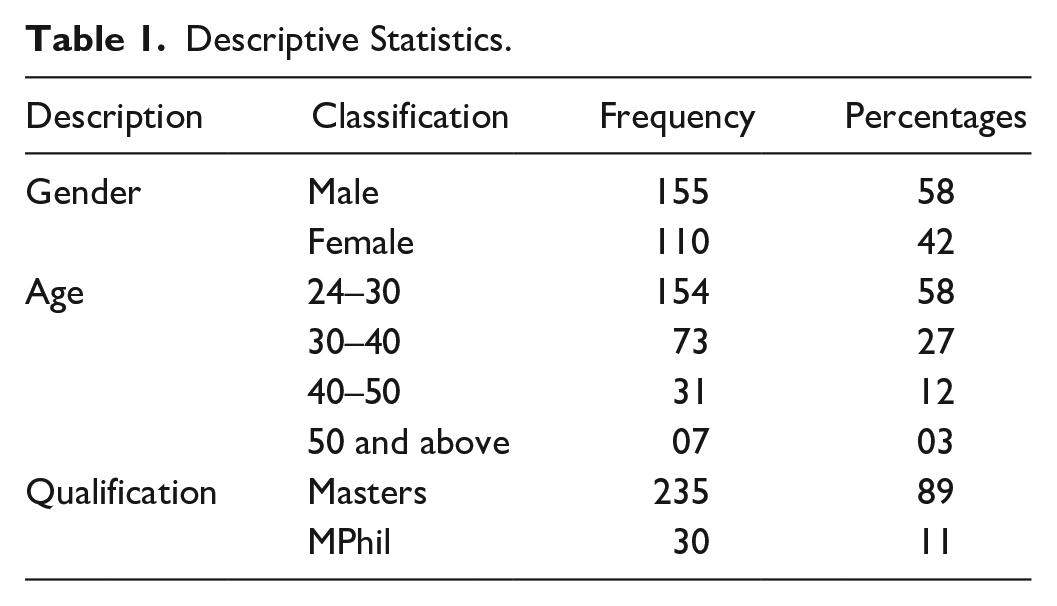
Sample size was determined by using Hair et al.’s (2014) table, which suggested a sample of 191 for a statistical power of 80%, a significance level of 1% (p < .01), and a minimum R2 value of .10, when four arrowheads point a construct (the case in this study). In a multiple regression behavioral study, expecting a small or medium R2 is quite normal because statistically significant results can be obtained even with a small R2 (Cohen, 1988, 1992; Hair et al., 2014). In such studies, the expected R2 value of .10 reflects almost a medium level of variance in the endogenous variables explained by the exogenous variables (Cohen, 1988, 1992; Hair et al., 2016; Miles, 2014). As R2 is an indicator of a model’s predictive accuracy, it can be stated that an expected R2 value of .10 can assess a medium level of predictive accuracy of our model. In behavioral sciences, lower expected R2 is associated with higher sample size (Cohen, 1988). In light of this fact, and a low expected response rate, a sample of 350 was selected by using simple random sampling. It took about 1 month to collect 290 responses (65%). Of these responses, 25 were too incomplete to be considered for data analysis. Only 265 responses contained usable data. Table 1 shows the description of the respondents.
Descriptive Statistics.
Measures
TL
TL was measured by using a 20-item questionnaire used in Ismail et al. (2011). These authors developed a modified questionnaire based on the Multifactor Leadership Questionnaire (MLQ) (Bass, 1994, 1999; Bycio et al., 1995; Hartog et al., 1997), and reported Cronbach’s alpha as .97. In this study, the Cronbach’s alpha’s value for this questionnaire is .94 (Table 2). This questionnaire is quite suitable for this study as it combines all four characteristics of TL: inspirational motivation, idealized influence, individualized consideration, and intellectual stimulation (Bass & Avolio, 1997). This combined questionnaire is consonant with the current theoretical and empirical developments in TL (Avolio et al., 2004; Bass, 1999).
Evaluation of Measurement Model.

Note. CGO = career growth opportunity; OC = organizational commitment; PJ = procedural justice; TL = transformational leadership.
Factor loadings. bCronbach’s alpha. cCR = composite reliability. dAVE = average variance extracted.
PJ
Moorman’s (1991) seven-item scale was used to measure PJ. This scale is part of Moorman’s Organizational Justice Scale, which has “been described as one of the most comprehensive and frequently used measures of organizational justice” (Burton et al., 2008, p. 54). In Moorman and Burton et al. (2008), the Cronbach’s alpha value for PJ scale was .94 and .95, respectively. In this study, the Cronbach’s alpha for this construct is .95 (Table 2).
CGOs
CGOs were measured by four items derived from four dimensions of career growth—career goal progress, promotion speed, professional ability development, and remuneration growth—described in Q. X. Weng and Hu (2009). For this construct, the Cronbach’s alpha value of .78 shows a good internal consistency (Table 2).
OC
A 12-item questionnaire was used to measure OC. Based on Mowday et al. (1979), these 12 items were used by Ismail et al. (2011), who found a good internal consistency with Cronbach’s alpha of .93. The current study has also found this construct internally consistent with a Cronbach’s alpha value of .90 (Table 2).
For all the questionnaires, a 5-point Likert-type scale ranging from 1 (strongly disagree) to 5 (strongly agree) was used. Faculty members’ self-ratings were used to measure all the variables.
Data Analysis and Empirical Results
Data were analyzed by using PLS-SEM in the latest version of PLS software (SmartPLS 3.2.6). PLS-SEM is appropriate for predictive applications and theory building (Hair et al., 2016). It can be equally applicable for reflective as well as formative measurement models (Hair et al., 2014). This study used the reflective measurement model because this kind of model can best fit in measuring perceptions, attitudes, and behaviors (Jarvis et al., 2003). In PLS path modeling, the first step of data analysis is to validate the data in measurement model, and the second step is to estimate path coefficients and their significance in the structural model.
Evaluation of Measurement Model
This study followed Hair et al. (2014) for evaluating measurement model by applying the following reliability and validity criteria: internal consistency reliability, convergent validity, and discriminant validity. Table 2 shows the factor loadings of individual items, Cronbach’s alpha, composite reliability (CR), and average variance extracted (AVE) for the latent variables. The internal consistency reliability is measured based on the correlations between different indicator variables of the same construct. This reliability is determined if the values of Cronbach’s alpha and CR are equal to or greater than .70. Table 2 shows that the values of Cronbach’s alpha and CR are greater than .70. The convergent validity was established by factor loadings and AVE of the latent constructs. The convergent validity is “the extent to which a measure correlates positively with alternative measures of the same construct” (Hair et al., 2014, p. 102). The values of factor loadings greater than .70 and AVE greater than .50 are considered appropriate for determining the convergent validity (Hair et al., 2014). In Table 2, the value of AVE greater than .50 and factor loadings greater than .70 demonstrate that convergent validity has been established in our data. The items (OC2, OC11 from OC, and TL1, TL2, TL13, TL16, TL18, TL19, TL20 from TL) with loadings less than .40 were deleted to increase the validity (Hair et al., 2014). Dropping items from a reflective construct does not change the meaning of construct, as long as the reliability of that construct is adequate (Hair et al., 2014; Jarvis et al., 2003). Table 2 shows that the constructs with dropped indicators have sufficient reliabilities. So, item deletion does not affect the overall analyses of this study.
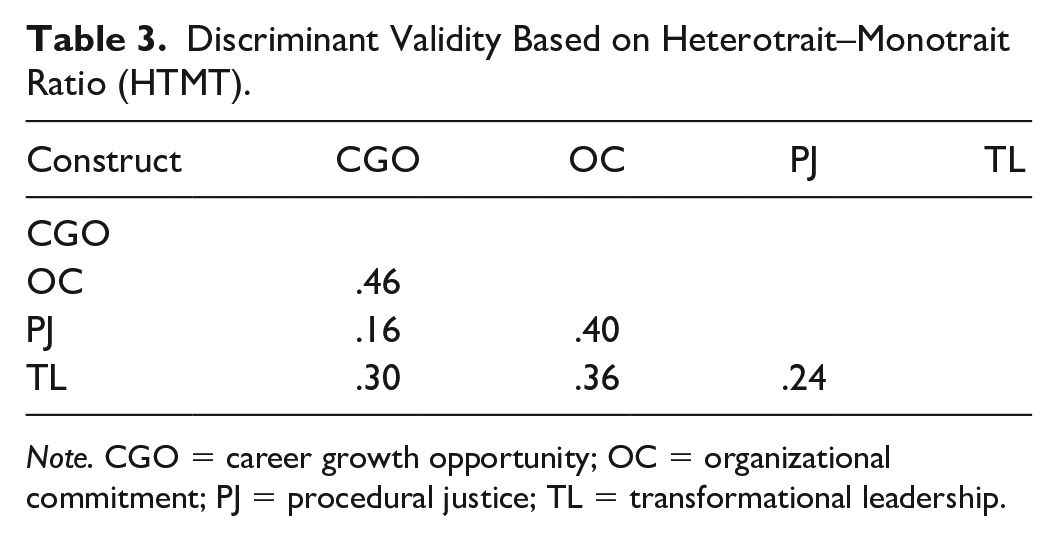
The final step in evaluating measurement model is to test discriminant validity of all the constructs, which means to ensure that each construct has its own individual position and is distinct from other constructs. Traditionally, the discriminant validity is determined by using cross loadings of the indicators and Fornell and Larcker’s (1981) criterion. However, these methods are insufficiently sensitive to detect discriminant validity (Henseler et al., 2015). Henseler et al. (2015) introduced a more sensitive new criterion, heterotrait–monotrait (HTMT) ratio of correlations, for measuring discriminant validity. This study used HTMT ratio of correlations to detect discriminant validity. HTMT ratio “is the average of the heterotrait-heteromethod correlations (i.e., the correlations of indicators across constructs measuring different phenomena), relative to the average of the monotrait-heteromethod correlations (i.e., the correlations of indicators within the same construct)” (Henseler et al., 2015, p. 121). Based on Henseler et al., Haider et al. (2018) described that “HTMT, in fact, estimates the correlation between constructs. If two constructs’ indicators have an HTMT value clearly smaller than 1, it shows that these constructs are different from each other because their true correlation is different from 1” (p. 33). If the value of HTMT ratio is less than 1, it means that these constructs are different from each other. As a strict criterion, the HTMT value should be less than .85. Table 3 shows that HTMT values between the constructs are significantly lower than .85. Thus, discriminant validity has been established in our data.
Discriminant Validity Based on Heterotrait–Monotrait Ratio (HTMT).
Note. CGO = career growth opportunity; OC = organizational commitment; PJ = procedural justice; TL = transformational leadership.
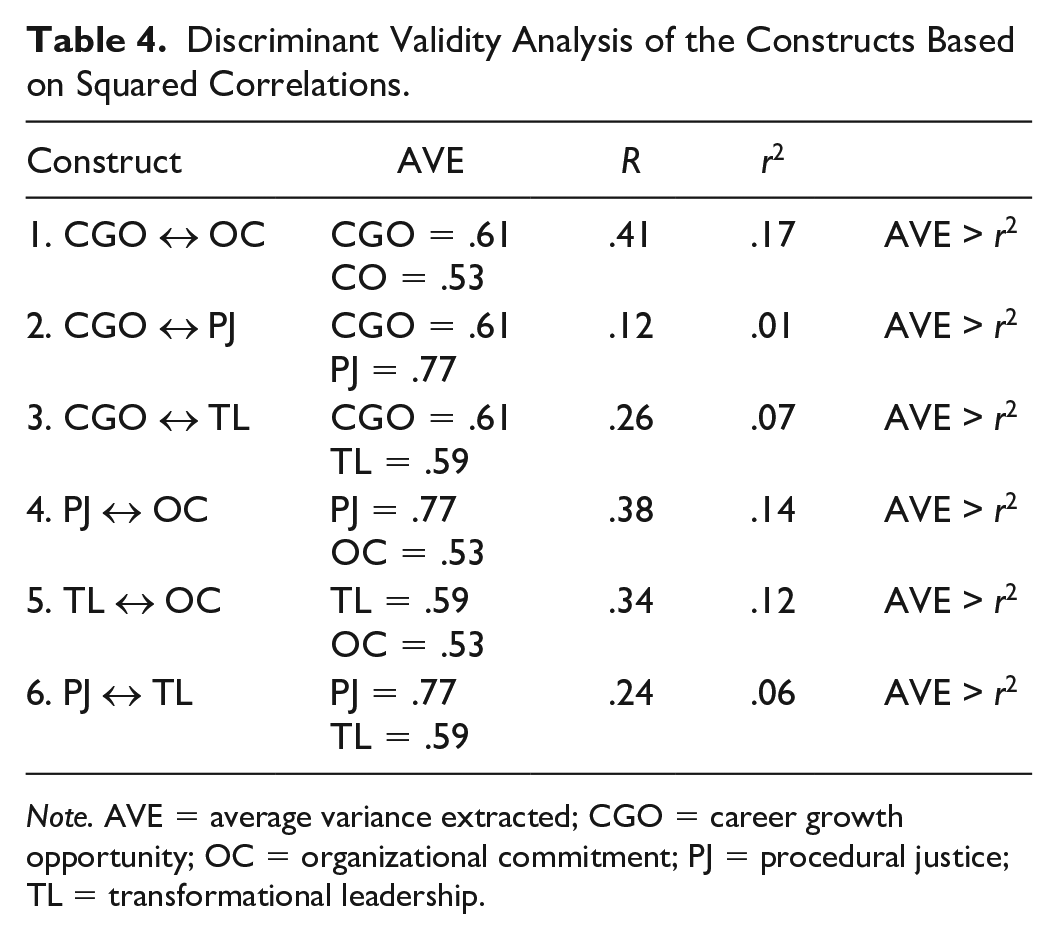
As an alternate method, correlations of variables were used to measure discriminant validity. According to H. Kim and Kim (2015), “discriminant validity can be established by examining whether the AVE of each construct exceeds the squared correlation coefficient between the constructs (r2)” (p. 170). The results in Table 4 indicate that all constructs’ AVE values are greater than their corresponding squared correlation coefficients. So, discriminant validity has been established by using this criterion too.
Discriminant Validity Analysis of the Constructs Based on Squared Correlations.
Note. AVE = average variance extracted; CGO = career growth opportunity; OC = organizational commitment; PJ = procedural justice; TL = transformational leadership.
Evaluation of Structural Model
The first step in evaluating a structural model is to assess collinearity issues. In the context of a PLS structural model, a high correlation between two or more constructs creates collinearity issue (Hair et al., 2014). As a general rule to avoid collinearity, the value of variance inflation factor (VIF) should not be greater than 5. The collinearity test in SmartPLS provided VIF values ranging from 1.00 to 1.13, which indicate the absence of collinearity among this study’s variables. At the second step, path coefficients of hypothesized relationships were obtained by applying the PLS algorithm, and their significance was tested by using the bootstrapping process, which calculates t values through bootstrap standard error. A relationship’s t value greater than 1.96 (p < .05) indicates the significance of that relationship. Finally, coefficient of determination (R2) was assessed. R2 explains the level of variance explained by the predictor variables in the criterion variable.
Mediation Test
Based on the mediation principles described in Baron and Kenny (1986) and Muller et al. (2005), this study used the following three equations for estimating mediation.



Table 5 shows PLS regression results for mediation equations (Equations 1–3). Based on the information in Table 5, two path models (Model A and Model B) were drawn in Figure 2. The classical Baron and Kenny (1986) approach suggests that a mediation test involves fulfilling four conditions. First, the direct relationship (between independent and dependent variables) must be significant in the absence of a mediator. Second, the relationship between the predictor and mediator must be significant. Third, the relationship between mediator and outcome variable must be significant. Figure 2 shows that the above three conditions have been fulfilled in our model. The fourth condition is about the indirect effect; the indirect effect of predictor on dependent variable, through the mediator, must be significant. The bootstrapping process in SmartPLS 3 software calculated this specific indirect effect (TL→PJ→OC). Table 5 shows that the indirect effect of TL on OC through PJ is significant (β = .08; t value = 3.45).
PLS Regression Results for Mediation Model.

Note. PLS = partial least squares; OC = organizational commitment; PJ = procedural justice; TL = transformational leadership.
p < .01.

Mediation model (Model A and Model B).
Once these conditions are fulfilled, the mediation is determined by specifying whether the direct effect’s path coefficient has reduced its value when the models are compared with and without mediator. Figure 2 shows that path coefficient of direct relationship reduced its value from .36 to .27 (from Model A to Model B). It means that the mediator (PJ) absorbed some effect of TL on OC.
Traditionally, the strength or size of mediation is determined by using Sobel’s test (Hair et al., 2014). However, the use of variance accounted for (VAF) is recommended “because the distributional assumptions of Sobel test do not hold for indirect effect, and it lacks statistical power” (Haider et al., 2018, p. 34). This study used VAF formula to measure the strength of mediation.


The VAF value between .20 and .80 indicates partial mediation (Hair et al., 2016). Based on Rucker et al. (2011), this study states that a mediator (PJ) has been documented between TL and OC, and the possibility of other mediators of this relationship cannot be ignored. Given that, the significant indirect effect indicates that PJ mediates the relationship between TL and OC (Hypothesis 1 supported).
Moderated Mediation Analysis
This research has used moderated mediation procedures described in Muller et al. (2005). Following these seminal works, the moderated mediation in our model can be estimated by testing the following three equations.



The model in Equation 4 estimates the moderation of overall treatment effect (effect of independent variable on dependent variable). Equation 5 estimates the moderation of treatment effect on mediator (effect of independent variable on mediating variable). In Equation 6, both the partial effect of the PJ (mediator) on OC (dependent variable) and residual effect of the TL (independent variable) on OC (dependent variable), controlling for PJ (mediator), are moderated.
Insights from Muller et al. (2005) suggest that in a moderated mediation model, there exists a general effect of independent variable on dependent variable (i.e., the effect of TL on OC, β41 in our model), and the size of this effect is not dependent on the moderator (career growth) (β43 = 0). But the strength of the intervening (mediating) process is dependent on moderator (CGO). Therefore, either the effect of TL (independent variable) on the PJ (mediator) is dependent on the career growth (moderator) (β53 ≠ 0) or the partial effect of PJ on OC depends on career growth (β65 ≠ 0), or both. On the same lines, if TL’s effect on PJ is dependent on career growth (β53 ≠ 0), then necessarily there will be a limited or partial effect of the PJ on the OC, on average (β64 ≠ 0), or if the partial effect of the PJ on the OC depends on the career growth (β65 ≠ 0), then there should exist a general TL effect on PJ (β51 ≠ 0).
Precisely, moderated mediation infers that the indirect effect of TL on OC, through PJ, (mediator) is dependent on CGOs (moderator). It means that one of the effect either from TL to PJ depends upon the career growth (β53 ≠ 0, and the partial effect of PJ on OC depends is nonzero [β64 ≠ 0]), and/or the partial effect of PJ on OC depends on career growth (β65 ≠ 0), and average effect of TL on PJ is nonzero (β51 ≠ 0). As already mentioned, if there is no moderation of TL effect (β43 = 0), it entails that the residual direct effect of TL on OC is moderated (β63 ≠ 0) while controlling for PJ (the mediator).
The above discussion suggests that testing moderated mediation requires estimating Equations 4 through 6. In Equation 4, it is expected that the effect of independent variable (TL) on dependent variable (OC) is significant (β41 ≠ 0), whereas the interaction effect of TL and CGO (TL × CGO) is not significant (β43 = 0). In Equations 5 and 6,
a. both β53 and β64 should be significant,
b. both β51 and β65 should be significant, and
c. either (a) or (b), or both (a) and (b) should exist.
Muller et al. (2005) suggested that because of the above conditions, the residual effect of TL on OC should be moderated (i.e., β63 may be significant). However, these authors do not believe in the significance of β63 as a necessary condition for determining moderated mediation. To establish moderated mediation, we not only applied the abovementioned rules but also used insights from Gutiérrez-Doña et al. (2009) because these authors tested a moderated mediation model similar to the one used in this research. Therefore, we finally solved the moderated mediation model by using the following equations:



PLS-SEM allows estimation of all these equations simultaneously. However, the estimation of residual effect of independent variable on dependent variable requires estimating Equation 7 separate from Equations 8 and 9. Thus, the Equation 7 was estimated first. As per rules, the relationship between independent and dependent variables should be significant. The results of this equation (Table 6) indicate that there exists a significant general effect of TL on OC (β71 = .36, t = 7.62). In addition to this, one needs to determine the effect of the independent variable on the mediator, and the mediator’s effect on the dependent variable (Gutiérrez-Doña et al., 2009; Muller et al., 2005). The results in Table 6 indicate that both the TL–PJ relationship (β81 = .24, t = 4.42) and the PJ–OC relationship (β93 = .26, t = 5.18) are significant.
PLS Regression Results for Moderated Mediation Model.

Note. PLS = partial least squares; OC = organizational commitment; PJ = procedural justice; TL = transformational leadership; CGO = career growth opportunity.
p < .01.
Figure 3 shows the interaction chart for low and high (±1 standard deviation [SD]) levels of employees’ perceptions of CGOs. The central (mean), upper (+1 SD), and lower (−1 SD) lines represent a medium, high, and low level of perceptions of CGOs, respectively. A comparison of central line with upper line indicates that a rise in employees’ perceptions of PJ is linked to a greater increase in OC when their perceptions of CGOs are higher. A comparison of central line with lower line indicates that employee’s OC increases to an inferior level for the same increase in PJ when perceptions of CGOs are low.

Moderating effect.
In our research model, neither the effect of TL on OC is dependent on moderator nor is the TL–PJ relationship affected by the moderator (CGO). However, the strength of the intervening process is dependent on moderator. As already described, in a moderated mediation model, either the effect of TL (independent variable) on the PJ (mediator) is dependent on the CGO or/and the partial effect of PJ on OC depends on moderator CGO. This study hypothesized the latter case, when the effect of PJ (on OC) is dependent on CGO (moderator). Table 6 shows that this effect is significant in our model (interaction effect: β94 = .22, t = 5.09). In such a case, it is also important that the main effect of moderator on dependent variable be significant (Haider et al., 2017). Results in Table 6 indicate that the main effect of moderator (CGO) on dependent variable (OC) is significant (β92 = .31, t = 5.81). Based on the information given in Table 6, the graphical form of the empirical results has been shown in Figure 4.
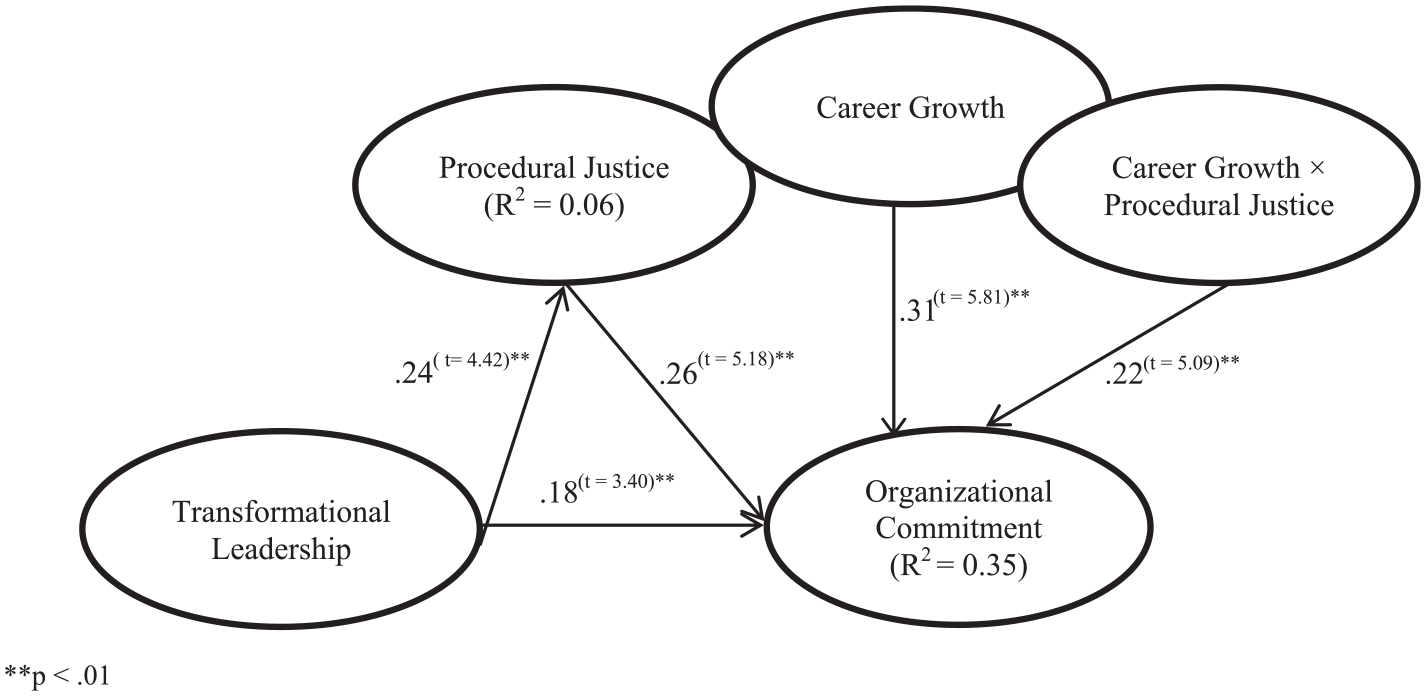
Moderated mediation model.
The results in Table 6 and Figure 4 indicate that following Muller et al. (2005) and Gutiérrez-Doña et al. (2009), moderated mediation has been established in our model. PJ partially mediated the relationship between TL and OC, and this mediation was moderated by the perceptions of CGOs (Hypothesis 2a and Hypothesis 2b supported).
Predictive Accuracy of Model
The predictive accuracy of a model can be assessed by R2 value, which “ranges from 0 to 1 with higher levels indicating higher levels of predictive accuracy” (Hair et al., 2014, p. 175). In the context of behavioral research, R2 values equal to .02, .13, and .26 indicate small, medium, and large effects, respectively (Cohen, 1988; Miles, 2014). Figure 4 provides R2 values for PJ (R2 = .06) and OC (R2 = .35). These values suggest that the variance explained by TL in PJ is 6%, which is between a low (.02) and medium (.13) effect size as described above. However, the variance explained by all the study variables in our outcome variable (i.e., OC) is higher than the large effect size (.26). It suggests that our study variables have explained a large variance in OC, and reflect a high predictive accuracy of our model.
Discussion
This study was initiated to understand how and why TL affects employees’ OC. The congruence proposition and “fit as mediation” approach of contingency theory suggested that TL influences employees’ OC by positively affecting their perceptions of PJ. Moreover, the law of interaction in contingency theory guided that the indirect effect of TL on OC through PJ may vary when perceptions of PJ interact with CGOs in their organization. This study found that perceptions of PJ mediate the relationship between TL and OC (Hypothesis 1 supported). This result is consistent with the mediation procedures explained in Baron and Kenny (1986). Following these procedures, at first step, TL was significantly related to OC (β = .36, t value = 7.62). This result is consistent with that of previous studies (Aina & Verma, 2017; Bycio et al., 1995; Gulluce et al., 2016; Kedenburg, 2014; Limsila & Ogunlana, 2008). Second, consistent with previous research (Asgari et al., 2008; Deschamps et al., 2016; Rokhman & Hassan, 2012), TL was found to be a significant predictor of employees’ perceptions of PJ (β = .24, t value = 4.42). Third, PJ significantly predicted employees’ OC (β = .32, t value = 6.15). This result is consistent with S. Li et al. (2010) and Loi et al. (2006). Fourth, the effect of TL on OC, controlling for the effect of PJ, was significant (β = .08, t value = 3.45). It means that the indirect effect of TL on OC through PJ was significant. Consistent with Rokhman and Hassan (2012), this study found a partial mediation effect of PJ in the TL–OC relationship. However, the indirect is weaker in our study when we compare with Rokhman and Hassan and H. Kim and Kim (2015), where the indirect path coefficients were .189 and .113, respectively. This may be due to methodological differences, and distinct contexts of the studies.
The findings of this research indicate that perceptions of CGOs moderate the relationship between perceptions of PJ and OC (Hypothesis 2a supported). The results from Hypotheses 2a and 2b explicate how the indirect effect of TL on OC via perceptions of PJ is moderated by the perceptions of CGOs in their organization. These results are in line with the procedures explained in Muller et al. (2005) and Gutiérrez-Doña et al. (2009). Based on these procedures, we found that the interaction of PJ and CGOs significantly affected the indirect effect of TL on OC through PJ. Two conditions of moderated mediation, as explained in Muller et al., were fulfilled. First, the effect of TL on OC was significant (β = .36, t value = 7.62). Second, both the effect of TL on perceptions of PJ (β = .24, t = 4.42) and the effect of the interaction of PJ and CGOs on OC (β = .22, t = 5.09) were significant.
The results suggest that, as a positive contingency, CGOs enhance the “fit” effect of PJ in the relationship between TL and OC. This idea is consistent with the contingency theory of leadership, which suggests that leaders may exert greater influence on their followers when organizational contingencies match with their leadership style (Fiedler, 1967). The effect of TL on employees’ perceptions of PJ and the subsequent effect on OC are enhanced when employees perceive greater growth opportunities within their organization. Previous research has also provided such findings where the indirect effect of TL on OC, through PJ, is affected by organizational context (i.e., span of control; Gumusluoglu et al., 2013).
Theoretical Implications
Contingency researchers have long recognized that organizational effectiveness and performance depend on the congruence between different organizational components including structure, context, and individual behaviors (Fry & Smith, 1987). Although the notion of “fit as mediation” has been used in strategy research to justify mediation processes between the structure and performance of an organization, relatively less attention has been paid to use this argument for the fit among organizational contextual factors. Moreover, contingency theory has been intensively applied on moderation studies, and there is an overall lack of mediational studies applying the principles of this theory as an argument for indirect effect. Boyd et al. (2012) found that “for each test of mediation, there were more than six tests of moderation” (p. 287). This study strived to apply the “fit as mediation” for examining the fit between organizational context and individual behaviors, and also tested the “law of interaction” within the same mediation model.
In this way, this study contributes to contingency theory by explaining the process of microcongruence in organizations where a specific phenomenon (i.e., PJ) that provides fit between organizational contextual factors (i.e., TL) and individual behaviors (i.e., OC) might strengthen or lessen this fit when it interacts with other phenomena in the context of an organization (i.e., CGOs). Specifically, this study informs about the complexities of organizational contingencies, and draws researchers’ attention toward the “fit” as a moderated mediation phenomenon, which indicates that the dynamism in an organization’s environment shifts the situation of “fit” from one state to another when different organizational contingencies interact. Given that, this study contributes to the limited literature on multiple congruencies (Goel et al., 2019; Gresov, 1989) and configural approach (Snow et al., 2005) to contingency theory of organization. In this way, this study draws researchers’ attention to investigate moderated mediation mechanisms using contingency theory to extend the understanding about the contextual factors that regulate the role of leadership in individual-level outcomes from fit perspective.
This study’s theoretical implications can be strengthened from two perspectives. First, CGOs such as learning and development reflect those organizational structures that empower employees toward career advancement (Monje et al., 2020). Learning and development are very much related to employees’ overall ability (Keller, 2006), which may substitute for leadership, and account for unique variance in employees’ attitude (Keller, 2006; Podsakoff et al., 1996). For a more applied advancement in leadership and organization theory, future studies can extend our work by experimenting on those structures that, on one hand, provide CGOs to employees, but on the other hand limit leaders’ position power to help employees in career advancement. Under such structures, future studies may examine how much CGOs substitute for TL with respect to their influence on employees’ OC. Second, studies may also be conducted in situations where leaders’ career mentoring (Scandura & Schriesheim, 1994) can be examined as an augmenter of the leaders’ effect on employee commitment, at different levels of leader–member relationships (Sosik et al., 2004).
Practical Implications
Organizational leaders have been in pursuit of identifying a new set of leadership behaviors and ways that can promote employee commitment, which helps in better functioning of the organization. This study guides organizational leaders that their ability to enhance perceptions of PJ can improve employees’ commitment with their organization. Moreover, our results imply that the interaction of PJ and CGOs increases employee commitment more strongly. Organizations can provide their employees with just procedures and opportunities for career growth to enhance their commitment. The findings of this study indicate that TL style’s effect on employees’ perceptions of PJ may not be effective in achieving employees’ OC in the absence of CGOs. Organizations seeking commitment from their employees should provide them with CGOs such as training, learning, personal development, promotions. Moreover, by considering the results of this study, college principals can adopt TL style, and the higher authorities can provide college faculty with appropriate opportunities of growth and development. This will increase not only the faculty’s commitment but also the quality of education and overall performance of colleges. However, not all the principals have characteristics of transformational leaders. Colleges can benefit from leadership training programs that have been considered effective for leadership development, and consequently, for positive employee outcomes (Barling et al., 1996; Monje et al., 2020).
Limitations and Recommendations for Future Research
As with every research, this study has some limitations. First, the use of single source data from employees’ self-ratings may be a source of common method bias (Podsakoff et al., 2003). Future research should also consider leaders’ perceptions. Second, owing to the financial and time limits, this study used a cross-sectional survey design. However, cross-sectional designs remain unable to adequately infer causality among the relationship in a model. Therefore, a longitudinal research design is desirable to deliver supplementary and stronger backing for the effects tested in this study. Third, this study’s statistical analysis did not control the effect of individual differences such as personality, career orientation, and age. For example, employees with high careerist orientation may have more chances to perceive incompatibility with their interests and interests of their organization, and may lower job involvement and OC (Chay & Aryee, 1999). Based on this, it can be stated that employees’ career orientation could further moderate the relationships studied here. Similarly, the difference in the personalities of employees may also affect the relationships studied in this research. Future studies can test the relationships of this study from the perspective of employee’s career orientation, personality, and age distribution in sample. Finally, this study focused only on private colleges of District Vehari in Southern Punjab. Future studies can focus on other organizations and other districts as well. As the survey of this study was limited to the faculty of private colleges, concerns may arise about the external validity or generalizability of the results. However, besides these potential concerns, this research explains the processes and conditions that account for the effect of TL on OC. The support from future studies in other contexts would further enhance researchers’ and managers’ understanding about the dual effect of TL and CGOs on employees’ justice perceptions and OC.
Conclusion
The existing literature examined leadership and career prospects as two alternative mechanisms through which employee commitment toward the organization may be explained. However, the current study offered an explanation from an integrative perspective stating that leadership and career context, both, collectively determine employees’ commitment toward their organizations. At first, this study concluded that employees’ leadership contributes toward employees’ commitment through perceptions of PJ. Second, this study also concluded that the effect of employees’ justice perceptions on their commitment varies with respect to their perceptions of “career growth opportunities” ensured by their organization. It suggests that fair procedures are necessary but not sufficient to achieve employees’ OC. CGOs matter for greater employee commitment (Nouri & Parker, 2013). The more opportunities the firm ensures, the more committed the employees would be toward their organization. This study also concluded that the relationship between TL and OC through PJ is highly influenced by employee’s perceptions of CGOs in their organization. As dictated by the “law of interaction” in contingency theory (Dubin, 1976), this study supported an integrative role of PJ and CGOs in determining the effect of TL on employees’ OC.
Footnotes
Acknowledgements
The authors are thankful to the editor and the anonymous reviewers for their highly constructive feedback and exceptional service.
Declaration of Conflicting Interests
The author(s) declared no potential conflicts of interest with respect to the research, authorship, and/or publication of this article.
Funding
The author(s) received no financial support for the research, authorship, and/or publication of this article.
