




Abstract
Social physique anxiety is characterized by feelings of distress experienced when individuals believe they are negatively evaluated on their physique. It could be a risk factor for the development of depressive symptoms. In a sample of 1,724 undergraduate students (average age = 19.96 ± 1.29 years, 59.51% women), this study tested a model exploring whether psychological resilience could mediate the association between social physique anxiety and depressive symptoms, and examined gender’s moderating role in the tested model. Results indicated that social physique anxiety was positively associated with depressive symptoms (r = .359, p < .001) and negatively associated with psychological resilience (r = –.355, p < .001). Psychological resilience was inversely related to depressive symptoms (r = –.508, p < .001). Mediation analysis revealed a positive indirect effect of social physique anxiety on depressive symptoms through psychological resilience (indirect effect = 0.155, SE = 0.014, 95% CI [0.128, 0.182]). Furthermore, a first stage conditional effect of gender was observed that social physique anxiety had a stronger negative effect on psychological resilience in men than in women (moderated mediation index = −0.057, SE = 0.029, 95% CI = [−0.115, −0.001]. This study provides insight into the relationships among social physique anxiety, psychological resilience, and depressive symptoms. It holds promise to inform the development of treatment aiming to reduce depressive symptoms in individuals at risk of social physique anxiety.
Introduction
Social physique anxiety is an emotional distress experienced when individuals believe that their physique may be negatively evaluated by others (Hart et al., 1989; Herring et al., 2021). It is a common psychological issue among young people, as several studies have reported mild to moderate levels of social physique anxiety in their respective samples (Rothberger et al., 2015; Tsartsapakis & Zafeiroudi, 2025; Tsartsapakis et al., 2023). The phenomenon of social physique anxiety is largely attributable to the pervasive emphasis on an “ideal” appearance (Grogan, 2010). In Western cultures, this “ideal” appearance is characterized by a slender and toned physique for women (Markula, 2001; McComb & Mills, 2022), and a muscular and toned build for men (Grogan & Richards, 2002; Hargreaves & Tiggemann, 2009). It is worth noting that, with the increasing influence of Western culture and media in the contemporary world, the pursuit of such socially desirable body ideals has become more common among individuals from non-Western cultures (Jill Thompson et al., 2020; Madanat et al., 2007). This includes those from Confucian cultural backgrounds, which have traditionally placed greater emphasis on intellectual achievement than on physical fitness or appearance (Tan et al., 2013). Indeed, an emerging body of research confirms the relevance of social physique anxiety within Confucian cultural contexts. For instance, research has reported a link between media internalized pressure and social physique anxiety in a sample of Chinese university students (Fu et al., 2022). Adding to this, a study in the media-saturated context of Taiwan identified a correlation between social physique anxiety and clothing-related decisions (Liao & Huang, 2024).
While concerns over one’s physique could in some cases serve as a motivating factor for people to improve how they look and leave a desirable impression on others, it oftentimes links to an unhealthy relationship with one’s body and the development of anxiety about one’s physique (Brudzynski & Ebben, 2010). As indicated by a meta-analytic study (Paterna et al., 2021), there is a positive correlation between internalization of the body shape ideals and body dissatisfaction (average effect size r = .43, 95% CI [0.40, 0.46], k = 57 studies). In addition, another meta-analysis (Barnes et al., 2020) has demonstrated a positive association between body dissatisfaction and anxiety symptoms (pooled correlation r = .40, 95% CI [0.28, 0.51], k = 12).
For individuals with social physique anxiety, their perceived negative evaluation by others could be disproportionate to what may be reasonably expected (Kroon et al., 2023). Negative consequences could therefore arise, such as perception of social incompetence, attempts to reduce and minimize social interactions, and avoidance of social circumstances where physique evaluation could take place (La Rocque & Cioe, 2011; Thompson et al., 2003). Furthermore, social physique anxiety may be associated with an array of adverse mental health results (Alcaraz-Ibáñez et al., 2017), such as the development of depressive symptoms (Pimenta et al., 2009; Sabiston et al., 2014). As a mental health burden, depression is characterized by a range of symptoms, such as a reduced interest and enthusiasm in activities that a person used to enjoy, a loss of positive mood and feelings, a decreased motivation to do things, a feeling of hopelessness and self-worthlessness, and a heightened rate of suicidal thoughts and attempts (American Psychiatric Association, 2022). Thus, people with depressive symptoms could be negatively affected in their everyday functioning and have a reduced productivity in their study or work (Lerner & Henke, 2008; Simon et al., 2001). Moreover, if left unattended, depressive symptoms, or the sub-clinical level of depression, may further develop into an advanced stage, namely clinically diagnosed depression (Mitchell et al., 2009; Williams et al., 2002).
The association between social physique anxiety and depressive symptoms seems plausible theoretically. According to the body dissatisfaction–driven hypothesis (Patalay et al., 2015; Paxton et al., 2006), when individuals perceive a gap between their actual and ideal bodies, this dissatisfaction becomes a potent risk factor for depressive symptoms. Rooted in sociocultural and vulnerability–stress frameworks, the hypothesis holds that persistent negative self-evaluations of one’s physique foster affective and emotional vulnerabilities, which conspire to the development of depressive symptoms. Despite the paucity of empirical studies in this area, preliminary findings suggest a link between social physique anxiety and depressive symptoms (Alcaraz-Ibáñez & Sicilia, 2020; Sabiston et al., 2014).
To mitigate the association between social physique anxiety and depressive symptoms, an important factor to consider is psychological resilience. It is conceptualized as the ability to cope with mental stress without long term negative consequences (Nuttman-Shwartz & Green, 2021; Schetter & Dolbier, 2011), and could allow people to adapt positively when experiencing stressful situations (Herrman et al., 2011). Initially developed in developmental literature to study childhood adversity (Werner, 1989, 1993), the concept of psychological resilience has since been applied to other areas. These include addressing bullying in education (Andreou et al., 2020; Lin et al., 2020) and managing physical illnesses like cancer and heart disease in clinical settings (Toukhsati et al., 2017).
Psychological resilience may act as a buffer against depression. In the face of stress, a resilient person might use positive coping strategies (Han et al., 2021; Rahman et al., 2021; Steinhardt & Dolbier, 2008), building and maintaining a supportive social network (Dorrance Hall & Scharp, 2021; Sippel et al., 2015), thereby reducing the risk of slipping into depression. Conversely, someone with lower resilience might struggle more, leading to feelings of hopelessness and other depressive symptoms (Canale et al., 2019). Indeed, there is empirical evidence showing that higher resilience correlates with lower depression rates. A meta-analytic review shows a significant negative association between psychological resilience and depression, such that higher reports of resilience are associated with decreased reports of depression. The overall weighted average correlation between resilience and depression was −.39 (SE = 0.03, z = −13.26, p < .001), with a 95% CI from −0.45 to −0.33 (Watters et al., 2023). A prospective study further indicates that resilience measured at baseline predicts lower depression scores 3 months later, even after controlling for initial symptom levels (Loh et al., 2014). Besides, while no study to date has examined the association between social physique anxiety and psychological resilience, there is circumstantial evidence indicating a negative link between generalized anxiety and psychological resilience (Peñacoba et al., 2021; Petzold et al., 2020). Social physique anxiety is a specific type of anxiety that involves fear of negative body evaluation by others and the pressure to meet idealized body standards. The experience of social physique anxiety has the potential to erode an individual’s psychological resilience through increased negative self-evaluation, social withdrawal, and chronic pressure if left unmanaged. Therefore, it is hypothesized in the present study that psychological resilience may be associated with both social physique anxiety and depressive symptoms. Also, as personal adaptive resources, psychological resilience may serve as a mediator in the relationship between social physique anxiety and depressive symptoms.
Moreover, previous research has documented gender differences in social physique anxiety and depressive symptoms. Some studies report that women are more likely to score higher than do men in social physique anxiety (McLester et al., 2018; Miller & Fry, 2018; Portman et al., 2018; Rothberger et al., 2015), and are more prone to depressive symptoms (Hyde & Mezulis, 2020; Piccinelli & Wilkinson, 2000; Salk et al., 2017). As to psychological resilience, results to date are mixed. While some show that men may have a higher level of psychological resilience (Erdogan et al., 2015), others did not find a significant difference between men and women (Afek et al., 2021). Moreover, other than potential mean difference, little is known whether the potential mediating effect of psychological resilience in the relationship between social physique anxiety and depressive symptoms would differ for men and women. As researchers point out, it is important to move beyond mere mean-level comparisons to the examination of differential relations among variables of interest, which could help gain better insight into the phenomenon and design gender-tailored interventions (Cunningham & Xiang, 2008). Exploring psychological resilience as a potential mediator between social physique anxiety and depressive symptoms could provide a modifiable protective mechanism that can be bolstered through prevention programs. Also, examining gender as a moderator could uncover whether men and women differ in these pathways, allowing for gender-sensitive approaches. Overall, this research holds promise to guide more effective strategies to reduce depressive symptoms by enhancing psychological resilience and addressing social physique anxiety in young populations.
The current research evaluated three hypotheses. First, it was hypothesized that there would be a positive association between social physique anxiety and depressive symptoms (H1). Second, it was hypothesized that psychological resilience would show a mediating role in the association between social physique anxiety and depressive symptoms, where higher reported social physique anxiety would correlate with lower psychological resilience, and lower resilience in turn would correlate with higher depressive symptoms (H2). Third, it was hypothesized that gender would moderate the indirect effect of social physique anxiety on depressive symptoms via psychological resilience. Specifically, it was hypothesized that gender would moderate both stages of the mediation pathway, including the effect of social physique anxiety on psychological resilience (H3a, a-path), and the effect of psychological resilience on depressive symptoms (H3b, b-path). Given the exploratory nature of gender’s moderating effects and the absence of prior empirical evidence, no directional predictions were made regarding how gender might influence these pathways.
Methods
Participants
Participants were recruited from a large public university located in Xinxiang, Henan Province, China. As a comprehensive university and one of the country’s largest higher education institutions, it offers a broad range of study programs for undergraduate students in natural sciences, engineering, social sciences, and humanities. The inclusion criteria were as follows: being current students between the ages of 18 and 29 years (i.e., young adults); being able to read, write, and comprehend Chinese to ensure the validity of the self-report. Individuals who had used psychotropic medication within the previous month, which could alter anxiety, resilience, or depressive symptom levels, were excluded from participation.
Procedure
An online survey was created first at Wen Juan Xing, a professional survey platform widely used in China. A training session was conducted for six undergraduate research assistants to ensure effective data collection and minimize bias. Subsequently, the author acquired a class schedule from the University’s Academic Registry and developed a comprehensive plan for assigning research assistants to specific college classes for data collection. After the initial preparations, research assistants went to classrooms, either before the start of the class or during breaks, to conduct data collection. They sought permission and assistance from class tutors to facilitate this process. Research assistants then distributed survey invitations, allowing interested participants to complete the online survey via a QR code. The cover page of the online survey presented the study’s information and highlighted the voluntary, confidential, and anonymous nature of the participants’ involvement. Participants indicated their informed consent by clicking on an opt-in button displayed on the online survey. Ethical approval was sought and granted from the ethics committee of the author’s affiliation. Participants completed the online survey voluntarily without monetary or non-monetary compensation. The survey was designed to be completed within approximately 7 to 9 min based on pilot testing.
Measurements
General information questionnaire. It aimed to collect basic information of participants, such as age, gender, and the colleges with which they were affiliated. Of note, the wording of the gender question was “What is your gender identity?” to focus on identity rather than biological assignment.
Social physique anxiety. It was measured by the Chinese Social Physique Anxiety Scale (CSPAS, Wen et al., 2021; Xu & Ji, 2008). The CSPAS employs a five-point Likert type scale, ranging from 1 (Not at all characteristic of me) to 5 (Extremely characteristic of me). It contains fifteen items, with nine positively worded items and six negatively worded items. The items assess anxiety and discomfort experiences associated with perceived evaluation of one’s physique. Specifically, the items are categorized into three dimensions (Xu & Ji, 2008), namely concerns about negative judgment of others (items 1, 4, 6, 9, 12, and 14); discomfort in having to show one’s own physique (items 2, 7, 10, 11, 13, and 15); and anxiety about physical and social comparisons with others (items 3, 5, and 8). Scoring is to reversely code negatively worded items and then calculate the sum of items. A sample item reads: “When in the presence of a person important to me, I worry about receiving a negative evaluation about my physique.” A higher score reflects a higher level of social physique anxiety.
Psychological resilience. Participants’ psychological resilience was assessed by the Brief Resilience Scale (BRS, Smith et al., 2008). It has been validated and widely used in people from different countries (Chmitorz et al., 2018; de Holanda Coelho et al., 2016; Konaszewski et al., 2020; Rodríguez-Rey et al., 2016), including in Chinese individuals (Lai & Yue, 2014). The scale encompasses six items, representing how resilient an individual is in the face of adversity. Participants answered the items on a five-point Likert type scale (1 = strongly disagree to 5 = strongly agree). A sample item reads: “I usually come through difficult times with little trouble.” Scoring is by reversely coding items 2, 4, and 6, and summing item scores, with a total score ranging from 6 to 36. The higher a score is, the greater an individual possesses the ability to be resilient.
Depressive symptoms. Participants’ symptoms of depression were measured with the depression subscale of the Depression Anxiety Stress scale-21 (DAS-21). The DAS-21 was developed from its long 42-item version (Lovibond & Lovibond, 1995), and has shown adequate validity and reliability across diverse samples from various countries (Daza et al., 2002; Lee et al., 2019; Oei et al., 2013; Yıldırım et al., 2018), including in China (Wang et al., 2016). The depression subscale contains seven items representing various depressive symptoms a person may experience over the past week. Responses are anchored along a four-point Likert type scale (0 = did not apply to me at all to 3 = applied to me very much or most of the time), yielding a total score range between 0 and 21. Scoring is by totaling item scores, and a higher score indicates a greater level of depressive symptoms. A sample item reads: “I was unable to become enthusiastic about anything.”
Data Analysis
Statistical analysis was conducted with IBM SPSS Statistical software version 26.0. Descriptive data, such as mean values and standard deviations were computed for the variables. Due to the difference in measurement scale of study variables, scores of variable measures were standardized prior to analyses. The internal consistency of the measures was assessed using Cronbach’s alpha. Zero-order correlations were computed for each of the following variable pairs: social physique anxiety and depressive symptoms, social physique anxiety and psychological resilience, and psychological resilience and depressive symptoms. T-tests were used to analyze the significance of differences in social physique anxiety, psychological resilience, and depressive symptoms across gender. Furthermore, mediation analysis was carried out with Hayes’s PROCESS Macro for SPSS (Version 3.5), to address the potential mediating role of psychological resilience between social physique anxiety and depressive symptoms (Model 4). In addition, Model 59 in PROCESS Macro was used to evaluate the hypothesized moderated mediation model. The significance of the effects was examined using a bootstrapping method with 5,000 resamples (Bland & Altman, 2015). It can produce robust standard errors for parameter estimation, and 95% confidence intervals of the effects not crossing zero indicate the examined effects are significant (Hayes, 2015; Mallinckrodt et al., 2006).
Results
In total, 1,724 willing participants (mean age = 19.96 years, SD = 1.29, range = 18–29) took part in this study and completed the online survey. Women participants consisted of 59.51% of the sample, with a total number of 1,026. In addition, 819 participants reported studying in a program in natural sciences or engineering, and 879 reported studying in a program in social sciences or humanities; 26 participants did not provide this information.
The internal consistency reliability analysis showed acceptable reliability for the first dimension of the social physique anxiety measure (α = .753, 95% CI [0.735, 0.771]). The remaining two dimensions demonstrated poor reliability (α = .404 and .592) and were therefore excluded from subsequent analysis. In addition, the Cronbach’s alpha values of the measures for psychological resilience and depressive symptoms were .706 (95% CI = [0.685, 0.728]) and .886 (95% CI = [0.878, 0.894]), respectively. These values indicate an acceptable level of reliability.
The mean score of social physique anxiety was slightly higher for women participants (M = 17.25, SD = 4.39) than for men participants (M = 16.92, SD = 4.24), but it did not reach statistical significance, t (1722) = −1.527, p = .127. No statistically significant difference was observed in the average score of psychological resilience across gender (M = 20.46, SD = 4.00 for men vs. M = 20.60, SD = 3.80 for women; t (1722) = −0.744, p = .457). However, men participants scored significantly higher in depressive symptoms than did women participants (M = 4.18, SD = 4.06 vs. M = 3.75, SD = 3.71; t (1403.493) = 2.215, p < .05). Correlation analysis showed that a higher level of social physique anxiety was associated with a reduced level of psychological resilience (r = −.355, p < .001), and an increased level of being depressive (r = .359, p < .001). Besides, a higher level of psychological resilience was related with a lower level of depressive symptoms (r = −.508, p < .001).
Regarding the mediation model analysis, results showed the expected positive association between social physique anxiety and depressive symptoms (β = .205, p < .001), and a negative association with psychological resilience (β = −.355, p < .001). Additionally, psychological resilience was negatively associated with depressive symptoms, after controlling for the effect of social physique anxiety (β = −.435, p < .001). Finally, there was a positive indirect effect of social physique anxiety on depressive symptoms through psychological resilience, where β = .155, SE = 0.014, 95% CI = [0.128, 0.182]. In other words, people high in social physique anxiety may have a reduced level of psychological resilience, which in turn was associated with a heightened level of depressive symptoms. Therefore, a partial mediation was supported, with an indirect effect accounting for 43.01% of the total effect.
Moderated mediation existed if either or both patterns could be established: first, the path between social physique anxiety and psychological resilience was moderated by participants’ gender (first-stage moderation); and second, the path between psychological resilience and depressive symptoms was moderated by participants’ gender (second-stage moderation). Results of the moderated mediation model are displayed in Figure 1. The tested model showed that there was a positive effect of social physique anxiety on depressive symptoms (β = .199, p < .01), but this effect was not moderated by gender (β = .005, p > .05). Additionally, the effect of social physique anxiety on psychological resilience was negative (β = −.580, p < .001), and this effect was moderated by gender (β = .139, p < .01). Finally, the effect of psychological resilience on depressive symptoms was negative (β = −.422, p < .001), but this effect was not moderated by gender (β = −.008, p > .05). As such, a first-stage moderation was found. The percentile bootstrap analysis further indicated that the indirect effect of social physique anxiety on depressive symptoms through psychological resilience was moderated by gender, with a significant index of moderated mediation (i.e., the difference between conditional indirect effects across gender) of −0.057 (SE = 0.029, 95% CI [−0.115, −0.001]). Specifically, the conditional indirect effect was β = 0.189 (SE = 0.023, 95% CI [0.147, 0.234]) for men and β = 0.132 (SE = 0.018, 95% CI [0.099, 0.169]) for women. To illustrate the gendered effect in the mediation analysis, this study plotted predicted psychological resilience against social physique anxiety, for both men and women participants (See Figure 2). The simple slope tests showed that social physique anxiety had a greater effect on psychological resilience in men participants than in women participants. The hypothesis testing results of the present study are summarized in Table 1.
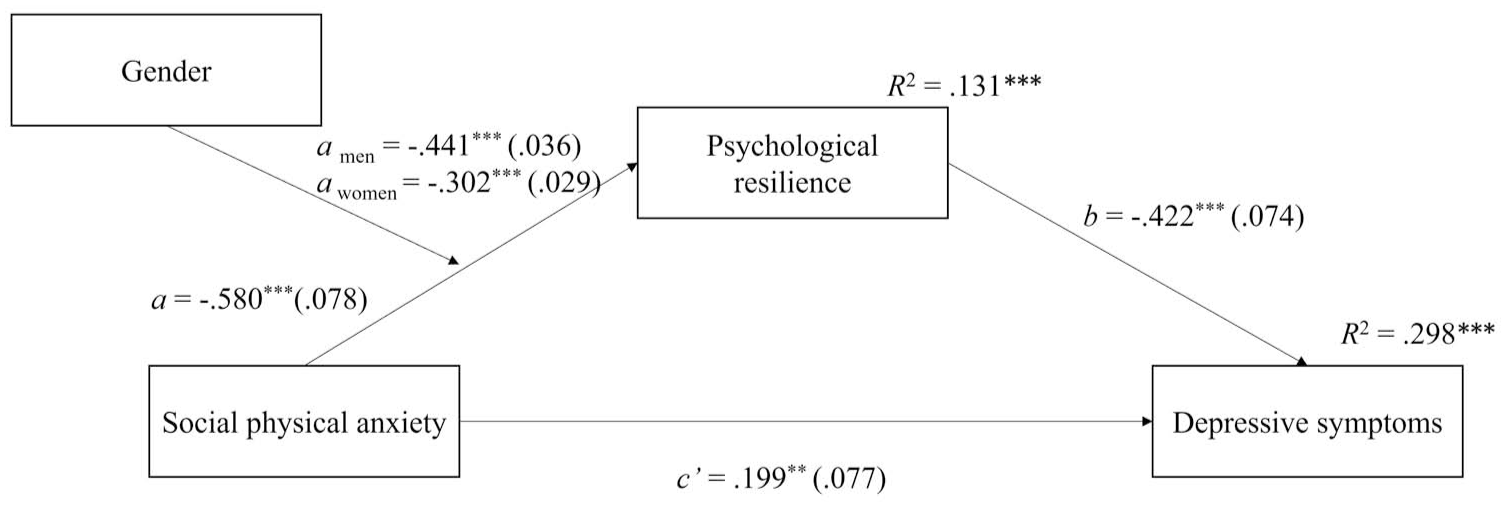
Results of the tested moderated mediation model (N = 1,724).

Psychological resilience as a function of social physique anxiety across gender (N = 1,724).
Hypothesis Testing Results.

Note. SPA = Social Physique Anxiety.
Discussion
People are oftentimes concerned about how their physical appearance looks to others. Indeed, some people may become anxious that they are unable to present their physique in a socially desirable manner, and be overwhelmed with feelings of worry, nervousness and fear associated with potential negative evaluations of their physique (Sabiston et al., 2014). Individuals affected by social physique anxiety could be troubled by a series of adverse consequences, such as low self-esteem and depression. Psychological resilience, as the ability to cope mentally and emotionally in the face of stress and difficulties, may help individuals overcome and protect their mental health. This study explored the role of psychological resilience in social physique anxiety and depressive symptoms and clarified their relations among undergraduate students in China. Importantly, social physique anxiety had both direct and indirect effects on depressive symptoms, and psychological resilience emerged as a mediator in the above relation. Meanwhile, moderated mediation showed there was a first-stage moderation that participants’ gender moderated the path between social physique anxiety and psychological resilience.
Social physique anxiety highlights the interpersonal aspect of body esteem, as it concerns a person’s feelings about how others perceive their physique (Sabiston et al., 2014). With a socially desirable physique in mind, when people believe they are unable to attain a socially favorable physique, they might be unsatisfied and likely experience social physique anxiety (Leary & Jongman-Sereno, 2014). While social physique anxiety is an important psychosocial issue in contemporary society, extant literature appears scant, especially compared with existing research on some other mental health conditions, such as panic disorder and phobia disorder (Domhardt et al., 2020). Given its possible negative psychosocial consequences, it should not be overlooked, and more scholarly attention is warranted. This study revealed that social physique anxiety had a direct and positive link with depressive symptoms, which is in agreement with past findings (Alcaraz-Ibáñez & Sicilia, 2020; Dickerson & Kemeny, 2004), A body-dissatisfaction-driven hypothesis has been proposed to account for such an effect (Patalay et al., 2015), suggesting that depressive symptoms could emanate from failed attempts to bring one’s body back in line with pursued ideal and may in turn facilitate the emergence of depressive symptoms (Sharpe et al., 2018).
In addition, psychological resilience mediated the effect between social physique anxiety and depressive symptoms. Psychological resilience involves the necessary mental resources to adapt well in the face of challenges, adversity, and stress, and could enable individuals to stay positive and protect their mental health when coming across stressful events and experiences (Kalisch et al., 2017; Windle, 2011). Thus, it could be a potential modifiable target in future intervention studies aiming to reduce depressive symptoms among individuals with social physique anxiety. Evidence-based approaches to bolster psychological resilience could include cognitive-behavioural therapy (Hatice et al., 2021), mindfulness-based interventions (Oh et al., 2022), and programs focused on building social support networks (Dorrance Hall & Scharp, 2021).
It has been shown in earlier research that levels of social physique anxiety and depressive symptoms would vary between women and men (Hyde & Mezulis, 2020; McLester et al., 2018). Indeed, some gender differences were observed in this study. Scholars have put forwarded several factors that may account for such difference, including biological, affective, cognitive, and sociocultural factors (Hyde & Mezulis, 2020; Zhao et al., 2020). As to the social physique anxiety score, no significant gender difference was observed. Traditionally, social physique anxiety is considered more of a problem for women (Kowalski et al., 2006); but based on the findings, it seems that social physique anxiety could affect both genders. Moreover, to the best of the author’s knowledge, this is the first study to move beyond mean differences of the variables across genders, and further explore the potential gendered effect in the associations among social physique anxiety, psychological resilience, and depressive symptoms. The moderated mediation analysis suggests that the negative effect of social physique anxiety on psychological resilience could be stronger for men. Conventionally, research on social physique anxiety indicates that women may be at a higher risk (Mülazimoğlu-Balli et al., 2010; Sabiston et al., 2014); however, it seems that social physique anxiety is also very relevant to men, as our contemporary society is putting increasing pressure on an idealized masculine physique (Ouyang et al., 2021). Hence, scholarly attention should be given to men as well. Nonetheless, given research on the moderated effect of gender is still in the initial stage, future studies to confirm the findings are warranted.
Some limitations associated with the study and future directions need to be discussed. The cross-sectional nature of the study precludes the possibility of inferring causal relations of the variables. It would be desirable to investigate the temporal connections of the variables in the future. Besides, while participants were recruited from diverse undergraduate programs in various disciplines, they were still limited to one university. Therefore, future study could consider having a more representative undergraduate sample by involving students from different institutions. Furthermore, the use of a binary gender measure is a limitation, as it does not capture the full gender spectrum. Future research should employ multi-category measures to facilitate a more comprehensive understanding of these relationships.
Notwithstanding the limitations, there were several strengths associated with the current study. First, this study has attempted to recruit a large sample size, which could provide more statistical power to the analyses, and offer increased precision in model testing. Second, although the psychometric properties of the measurements were supported by past research, this study also tested their reliability prior to analysis to ensure robust results. This methodological caution strengthened the credibility of the results. Third, another strength was the novel integration of social physique anxiety and depressive symptoms in a model for testing. This study addressed a research gap by examining the role of psychological resilience in the relationship between them. This offers a potential intervention target for counselors and practitioners helping individuals susceptible to social physique anxiety.
Conclusion
This study demonstrated the mediating role of psychological resilience in the relationship between social physique anxiety and depressive symptoms. Social physique anxiety was associated with increased depressive symptoms, both directly and indirectly, through reduced psychological resilience. A first-stage moderating effect of gender was also observed in the pathway between social physique anxiety and resilience. These findings suggest that enhancing psychological resilience may be a beneficial strategy for mitigating depressive symptoms among individuals susceptible to social physique anxiety.
Footnotes
Acknowledgements
The author wishes to thank all the participants in the study.

Ethical Considerations
The study was conducted in accordance with the Declaration of Helsinki and approved by the Ethics Committee of College of Sport and Health, Henan Normal University (protocol code HNSD-21-16).
Consent to Participate
Informed consent was obtained from the participants involved in the study.
Author Contributions
The author confirms sole responsibility for the study’s conception, data analysis, and manuscript preparation.
Funding
The author received no financial support for the research, authorship, and/or publication of this article.
Declaration of Conflicting Interests
The author declared no potential conflicts of interest with respect to the research, authorship, and/or publication of this article.