




Abstract
A vital component for sustainable economic development is the entrepreneurship regardless of the social, geopolitical, and economic situations. However, it is an intimidating challenge to develop and maintain productive small and medium enterprises (SMEs). This article investigates the role of entrepreneurial self-efficacy (ESE) and institutional environment in entrepreneurial orientation and the development of a successful entrepreneurship-based SME. It integrates the institutional climate, self-efficacy, and theory of planned behavior to address the abovementioned challenge in the context of the Kingdom of Saudi Arabia. This study adopts an instrument to collect data from Saudi SME owners and employs SPSS Amos to analyze the proposed moderated mediation model. The outcomes of this study identify the contribution of ESE and institutional environment in the productiveness of an effective entrepreneurship-based SME.
Keywords
The literature on the entrepreneurship practices in small and medium enterprises (SMEs) provides a significant foundation and potential for research and theoretical background in Saudi Arabia (Alfawaz et al., 2014). The massive share of entrepreneurship is acknowledged by scholars in SMEs that are playing an active role in the economic development of countries (Anokhin et al., 2008; Eniola & Entebang, 2015). Moreover, Dejardin (2000) and Holcombe (1998) recognized that economic growth is highly linked with the production of entrepreneurial SMEs. The studies in the global context found that the SMEs massively contribute toward the economic development of countries, which is corroborated in the studies of Otsuki (2002), De Kok et al. (2011), Wymenga et al. (2012), Federation of Small Businesses (FSB, 2012), and Ramady (2010). For example, SMEs comprise 97% of total business in Europe and contribute 67% of total employment (De Kok et al., 2011; Wymenga et al., 2012).
The annual report of the commission of the European Union presented an 86% increase in employment, and they possessed the responsibility of 99.8% of business activities that were nonfinancial (Gaganis et al., 2019). Particularly, FSB (2012) mentioned that SMEs accounted for 98% of private-sector businesses in the United Kingdom. No doubt, there is a significant contribution of entrepreneurship-based SMEs in the development of sustainable economic development.
Most interestingly, the role of SMEs in the presence of social platforms has risen abruptly (Sabato et al., 2017). The spike on the avenues of entrepreneurial activities can be witnessed at large in young entrepreneurs worldwide (Sabato et al., 2017). As such, there is a worldwide emphasis on SMEs for sustainable economic development at both the industrial and commercial levels (Allen & Malin, 2008; Eniola, 2018; Hall et al., 2010; Hockerts & Wüstenhagen, 2010; Kelley et al., 2011). However, the significance of entrepreneurship and its role in the small–medium enterprises is questionable in the context of the Kingdom of Saudi Arabia (KSA) due to two main factors: first, mismatch amid the acquisition of education and requirements of market-based skills and the lack of entrepreneurial inclination; second, the lack of institutional infrastructure features that assist in the identification, creation, and management of opportunities (Kayed & Kabir Hassan, 2011; Khan, 2016; Whiteoak et al., 2006).
Considering the context of the typical royal society, political structure, and economic context of the KSA, this research establishes its methodology toward an experimental investigation on succeeding assumptions.
First, as argued by Bandura (1986, p. 371), “People judge their capacity for challenging activities more in terms of their perceptions of the knowledge, skills, and strategies they have at their command than solely in terms of how much they will exert themselves.” Consistent with this argument, this study assumes that entrepreneurial intentions are, at least in part, a function of the entrepreneurs’ self-efficacy. The current study endeavors to understand this phenomenon in the light of resourcefulness (Zauszniewski, 2016). Recently, scholars are inciting more researches to study entrepreneurship from the perspective of resourcefulness (Moss & Cristina Dahik, 2020; Welter et al., 2018). Broadly speaking, entrepreneurship is “the process by which individuals—either on their own or inside organizations—pursue opportunities” or “future situations that are both desirable and feasible.” Thereby, this process requires the mobilization of resources and the pursuit of entrepreneurial initiatives simultaneously (Korsgaard et al., 2016). This argument goes in line with the social cognitive theory (SCT) as it mainly revolves around the principle of reciprocity. Inseparably, the current study explored the usefulness of resourcefulness in entrepreneurship. Entrepreneurs view resourcefulness as a financial bootstrapping that helps individuals to pursue scarce resources for maximum utilization of these resources (Welter et al., 2018). Although the dilemma is how entrepreneurs deal with resource constraints, mainly focusing on formal and informal institutions. In this regard, gauging entrepreneurship through the lens of resourcefulness, in a country like KSA, enriched with plenteous resources, is an area of investigation.
Furthermore, formal and informal organizations have an economic role in the development by developing entrepreneurship-based small–medium enterprises. Hence, the institutional influence might moderate the association amid entrepreneurial self-efficacy (ESE), entrepreneurial orientation, and small, medium enterprises positively by 50% (Schmutzler et al., 2019; Urbano et al., 2019).
Third, the abovementioned assumptions may hold in a typical capitalist market structure but maybe questionable and require further investigation under the political (monarchical), social, and religious context of the KSA.
The following part of the study discussed the detailed part of the KSA context. It summarized and highlights the research gaps, entrepreneurship concerns, and their contribution to the development of SMEs. The entrepreneurship-based small–medium enterprises can bring extraordinary expectations for the presently stationary economy of the KSA.
The current economic decline due to the consistent decrease in oil prices has suggestions for policy makers and authorities. For example, without active private-sector contribution, primarily through entrepreneurship-based SMEs, the KSA’s economy may not sustain in the long run (Saudi Vision, 2030). However, the development of the useful entrepreneurial class was difficult for the Kingdom as it lags in two critical requirements. These factors are related to the market infrastructure, institutional environment, and entrepreneurial behavior. For instance, the entrepreneurship process requires particular dynamic abilities that permit individuals to create, exploit, and identify the entrepreneurial opportunities facilitating the institutional structure to the sustainable development of small, medium enterprises (Letaifa & Goglio-Primard, 2016).
The scholarly researches and literature suggested that particular behavioral characteristics influence the individual and organizational performance of small, medium enterprises (Fishbein & Ajzen, 1975; Herron & Robinson, 1993; Hollenbeck & Whitener, 1988). The impact of entrepreneurial behaviors and actions is mediated by the motivation derived individually from perceived efficacy. These factors also influence the abilities of individuals in the form of financial and other resources and skills. These resources and skills are the main functions of market infrastructure and other simplifying organizations. The KSA lacks the required skills and characteristics in the present generation that is discussed earlier. The rentier economy suffered from the usually discussed Dutch disease conditions (Ebrahim-Zadeh, 2003; Heeks, 1998). Due to this deficiency, several economic issues are rising that involve the badly developed private-sector mismatch amid market needs and education, lack of skilled labor force, and a strong reliance on foreign emigrants (Alfawaz et al., 2014; Ayadi & Gadi, 2013; Hendrix & Noland, 2014; International Monetary Fund. Monetary & Capital Markets Department, 2012, cited in Ramady, 2010). In addition, the lavish public policies of the Monarchy have developed a nonentrepreneurial attitude in the youth of Saudi Arabia (Kayed & Kabir Hassan, 2011).
This generous public support is the reason why the present generation, that contains 50% of the population, displays a better inclination to join public-sector administrations instead of reaching out to the private sector (Kayed, 2011).
According to the figures in the source mentioned above, more than 50% of employers in micro-enterprises (two to five employees) and 35% of employers in small enterprises (six to 15 employees) have only a high school degree. Furthermore, only 1% to 6% of employers in micro, small, and medium enterprises have a master’s degree. The figures are 9% to 12% for the relevant technical diploma in all three categories.
Second, the KSA has been widely dependent on petroleum products and religious tourisms Hajj and Umrah, which has caused the lack of market development and delayed the evolution of institutional infrastructure and an appropriate market that helps in the development of small, medium enterprises. The oil sector is contributing to gross domestic product (GDP) by 41% and found 90% of the exports of the country (Corneo, 2011). According to the statistics of the KSA, almost 80% of the obstacles to small–medium enterprises are created either by the lag of appropriate institutions or by inappropriate policies of current institutions.
These hurdles mainly include government service fees (32%), government actions and bureaucracy (16%), work and labor laws (14%), and recruitment difficulty (13%).
In a nutshell, despite the immense importance of entrepreneurship in the economic development of any country, developing and maintaining a productive entrepreneurship-based SME is a significant challenge. Under this issue, this research will investigate the role of ESE and institutional environment in entrepreneurial intentions and development of small, medium enterprises in the KSA empirically.
Contextual Justification
Entrepreneurship, SMEs, and Dutch Disease Syndrome
The KSA is the world’s largest oil exporter, with an output of around 78 billion barrels of oil per annum, providing approximately 13% of the global oil supply (Alfawaz et al., 2014). The oil sector’s contribution to GDP is nearly 40% while constituting a massive 90% of the country’s exports (Corneo, 2011). As declared before, heavy dependence on oil resources has directed to numerous problems, including unemployment. Specifically, 28.4% of the youth aged 15 to 24 years (comprising 50% of the total population) was unemployed in 2010 (Almobaireek et al., 2011; Murphy, 2012). This is caused by high reliance on foreign expatriates (especially in the skilled labor sector) and a wide disparity between the skills requirements in the market and the Saudi curriculum (Alfawaz et al., 2014). This mismatch between graduate-level education and market-related workforce has led to job-seeking behavior geared toward the public sector among the youth and to the ever-growing number of foreign expatriates (Hockerts & Wüstenhagen, 2010). With a consistent decrease in oil prices, there is a significant decline in the economy of KSA. In addition, the alarming factor is that the reduction in government expenditure has led to a vital reduction of private-sector activities, as these are dependent on the spending of government as well. There is a strong need for alternate options that help the growth of entrepreneurship and economic diversification (Ayadi & Gadi, 2013; Hendrix & Noland, 2014; Ramady, 2010). The present economic circumstances of the KSA can be described via usual adverse relations amid natural economic development and natural sources known as Dutch disease syndrome (Ebrahim-Zadeh, 2003; Gylfason, 1984; Heeks, 1998). The mismanagement in the allocation of historically earned revenues from oil resources has led the country on a different path that is far away from sustainable economic development (Auty & Kiiski, 2001; Ayadi & Gadi, 2013; Kayed & Kabir Hassan, 2011). Figure 1 below provides a comprehensive view of the so-called “Dutch disease syndrome” that the KSA is currently suffering from.

Dutch disease syndrome.
As can be seen from d1 through d2, there is substantial reliance on oil-based income and religious tourism. The following impacts can be observed due to the fluctuation in oil prices:
a. the inconsistency among education and market necessities guiding to joblessness and community job-seeking behaviors,
b. dependence on foreign emigrants and imported products and services,
c. absence of a capable private sector and renting procedures have led to a smaller expanded economy that is bearing since the present decrease in oil prices, and
d. the government’s generous spending on the people, which further aggravates unemployment and rent-seeking behaviors. Although the aim is to create goodwill for the Monarchy, it instead further impedes economic progress.
According to Pacheco et al. (2010), it is suggested that the entrepreneurs and mainly green entrepreneurs can overwhelm the weak institutional hurdles and market returns by managing the sustainable opportunities and imitating sustainability of international competitiveness. In the meantime, the writers of this study struggle that at least in the particular, religious and sociocultural context of the KSA, proper education and social eradication, cultural behaviors, and market standards that obstruct the entrepreneurial alignment are vital (Kayed & Kabir Hassan, 2011). There is a lack of maximum level of self-efficacy from young entrepreneurs in creating or identifying the opportunities. One of the traditional examples is the strength of the typical norm Wasta in the context of the KSA (Cunningham & Sarayrah, 1993; Ebrahimi & Mirbargkar, 2017; Whiteoak et al., 2006). The term suggests the social and personal influential power to entrepreneurs in the decision-making areas, acquisition of resources, and trade-related interaction in the market of product (Hutchings & Weir, 2006).
The writers of this study, at this stage, do not oppose the current progress in the theory of entrepreneurship and institutional economics (S. A. Alvarez & Barney, 2007; T. L. Anderson et al., 1998; Langlois & Hodgson, 1992; North, 2005; Sarasvathy, 2001). These might offer leadership on how maintainable entrepreneurship may overwhelm these market-related obstructions and create opportunities that may lead to supportable development. Nevertheless, the previously discussed questions of the youth to become entrepreneurs beyond this formal and informal institution and organizational change, that are often considered as crucial features in sustainable change studies and their dependence, have been highlighted in numerous contributions (Fuenfschilling et al., 2017; Fuenfschilling & Truffer, 2014; Geels, 2004; Jolly et al., 2016; Jolly & Raven, 2015; Smink et al., 2015).
In a particular context, the organizations and policies articulate a legal, economic, and cultural system of challenges that an entrepreneur must face while facilitating the development and growth of small, medium enterprises. The section below discusses in detail the role of ESE and formal and informal institutions in developing a prosperous entrepreneurship-based small–medium enterprises sector.
Literature Review
ESE, Entrepreneurial Orientation, and the Development of SMEs
Currently, the ambidexterity is presented as the fundamental feature of successful entrepreneurs. According to Volery et al. (2015), ambidexterity is defined as the capacity of the entrepreneurs to effectively capitalize and identify the market opportunities (Volery et al., 2015). The researchers suggested that investigation into individual entrepreneurial behavior was further conducted. According to Fang et al. (2010), the features enable the entrepreneurs to understand the familiar tactics, while they tried to identify new approaches and opportunities that provide efficiency because this feature drives development and makes a business maintainable.
An extensive review of the literature suggests that institutional outcomes and entrepreneurial performance are affected by personal traits (Baum & Locke, 2004; Brandstätter, 2011; Poon et al., 2006; Zhao & Seibert, 2006). Newman et al. (2019) stated that one of the vital personal traits is self-efficacy. Tracing its roots in the SCT (Bandura, 2001), self-efficacy highlights a part of the social setting, repetition of the behavior, and replication in social learning (Newman et al., 2019). In this respect, Wood and Bandura (1989) demarcated self-efficacy as the belief of one in his or her capability to establish his or her intellectual strengths, inspiration, and categorization of movements in a way that advances him or her to switch over life events (Wood & Bandura, 1989). For those individuals who possess less self-efficacy, it avoids less competency and risk taking. Whereas those who own great self-efficacy might reserve instill assurance and struggles (Thomas & Velthouse, 1990). Therefore, unpredictable with the substance of ambidexterity, scholars have repeatedly suggested the ESE as the key component in beginning the new small–medium businesses.
In the current study, the authors espoused the domain-specific construct of self-efficacy, that is, self-efficacy in entrepreneurship (Newman et al., 2019). The theoretical backgrounds of ESE are defined from the perspective of an agency where the individuals mutually interact with their external and internal environments (Bandura, 2001).
Instead of agency underlying self-efficacy, ESE is intertwined with the delivery of performance outcomes vis-à-vis entrepreneurial actions and beliefs (Newman et al., 2019). As per the researches of Chen et al. (1998), Kickul et al. (2009), Krueger and Brazeal (1994), McGee et al. (2009), and Zhao et al. (2005), entrepreneur self-efficacy is the self-concept of an entrepreneur of being capable of performing the task that enables the individual to develop sufficient place to move. There is experimental evidence on the relation amid ESE and performance-oriented results. For instance, Forbes (2005) identified the significant influence of ESE on the abilities of entrepreneurs in making decisions regarding the detailed strategies. In the same way, Luthans and Ibrayeva (2006) and McGee et al. (2009) found evidence on mediating effects and direct ESE on the performance in the transition economies context.
It is suggested that the effect of ESE on scheme performance is not adequately detailed (Baum et al., 2001; Hmieleski & Baron, 2008; Poon et al., 2006) and warrants additional context-specific experimental inquiries (Markman et al., 2016). However, what relics to be seen is whether this association is strong in the existence of a mediator variable. This study is mainly significant in the KSA background because, as discussed previously, the incompatibility amid market-based skills and education system necessities has commanded a lack of entrepreneurial leaning or direction (Whiteoak et al., 2006). Scholars struggle with entrepreneurial purposes serious in translating entrepreneurial characters into organization-level consequences (Ahlin et al., 2014; Fillis & Rentschler, 2010; Matthews, 2007; Poon et al., 2006; Rauch et al., 2009; Wiklund, 1999; Wiklund & Shepherd, 2005). These features become critical in a market framework such as the KSA, where the political, religious, traditional, communal, and economic viewpoints question the capability of distinctive entrepreneurial methods toward entrepreneurship (Jepperson, 1991). Thus, Hypothesis 1 is proposed as follows:
Hypothesis 1 is further divided into three subhypotheses to identify the moderating effect of the institutional environment at both the first (X-M) and second (M-Y) stages of the indirect effect. The approach is consistent with one of the moderated mediation designs called “total moderation effect”.
The following are the three subhypotheses related to the moderation effect mentioned above.
Theoretical Framework
The theoretical framework of this study is founded on the SCT and the theory of planned behavior, explained as follows.
SCT was developed by Bandura (1993). The theory applies the concept that social or psychological factors influence individual behaviors. This means that individual success can be anticipated “by the beliefs that one holds about one’s abilities rather than by the skills and understanding one keeps or one’s prior attainments” (Bandura, 1997, p. 47). The SCT factor investigated in this study is the self-efficacy of entrepreneurs, which has emerged as an important construct for entrepreneurial orientation. Thus, this study provides a substantial body of evidential support for its influences on startups (Baum et al., 2001; Boyd & Vozikis, 1994; Chen et al., 1998; Krueger, 2003; Segal et al., 2005). Accordingly, in this study, ESE, entrepreneurial orientation, and SME development are explained through SCT.
Meanwhile, the theory of planned behavior was developed by Ajzen (1991). According to this theory, ESE focuses on the amount of a professed behavioral control of an individual, which is an important factor of individual intention to occupy in a convincing performance. Consequently, conferring to this theory, ESE raises entrepreneurial behavior by intensifying the entrepreneurial intentions of individuals (Chen et al., 1998), as variables used in this research, involving institutional background, entrepreneurial orientation, and ESE, are, similarly, explained by the theory of planned behavior.
There is a logical position between the two theoretical models discussed earlier.
First, SCT is functional in entrepreneurial orientation, ESE, and new startups of business. Second, the SCT and theory of planned behavior both have mental and emotional impacts on institutional environments. Therefore, understandably, the two theoretical models are related to each other in this research.
The Conceptual Model
The conceptual model is current, given the subsequent research certainties (Figure 2). First, the entrepreneurship literature is still in the examination of a pure analytical context that makes obvious the causes and the effects. A long list of factors has been mainly part of elements that increase the entrepreneurship. This list contains the normal factors such as education, universities, human capital (Fayolle & Byrne, 2010; Rice et al., 2010), public and private financing, customers, regulatory procedures, organizational infrastructure, organizational external and internal environment (Isenberg, 2011; Stam, 2015), leadership roles and models, and the environment that supports the entrepreneurial activities, tolerance, and capacity to handle failures and risks, an attitude toward the experimentation, and positive entrepreneurial behavior (Isenberg, 2011). These listed factors have already been discussed in past studies and literature, and is vague what values should be added in introducing a new concept such as the entrepreneurship ecosystem in the first place. Third, the researches related to entrepreneurial ecosystems normally highlight a specific place or group to discuss the particular feature of holistic infrastructure. However, the experimental researches have shown that there is a vital difference in the financing of entrepreneurship all around the regions (Acs & Armington, 2006; Motoyama & Watkins, 2014), and it is not clear how the entrepreneurship ecosystem will explain the differences among the areas.

Conceptual model.
Research Method
The research hypothesis and conceptual framework are outlined to meet the objectives of the research and adopting a detailed methodology for the research, which is discussed in this section.
This section will discuss in detail the summary of sampling that will provide the justification, profile, features, and numbers. The details are presented according to the measurement scale extracted from the literature that is validated before the actual analysis through confirmatory analysis using the structural equation modeling using Amos 21 and SPSS statistical software.
Sampling
As mentioned earlier, due to the tendencies and attitude of Saudi youth as a mismatch amid their market-based skills and education, this study will not consider business graduates (De Noble et al., 1999; Moberg, 2014). Hence, the pool of respondents from small–medium enterprises is selected to collect valid responses. The data of small, medium enterprises owners are collected from the website of the ministry of commerce (https://m.mci.gov.sa/en/MediaCenter/open-data/Pages/default.aspx). The data collected started from the Saudi capital Riyadh. Saudi entrepreneurs and small, medium enterprises owners with at least a high school education, six to 49 employees, were identified, and a scheme with at least 3 years of age.
Establishment Survey
The profile of the respondents was evaluated properly with proper investigation and consideration. By using snowball sampling, those respondents were selected who possess the ability to understand the concepts of sustainable growth, entrepreneurship, and innovation, and those who intend to enhance further through innovation. The researchers used social media friends, and reached the contacts and business circles of entrepreneurs to highlight the sufficient responses.
Respondents were selected from organizations across diverse industries ranging from agriculture and fishing to electricity, gas and water supply, transportation and storage, real estate, and professional and technical services, among others. Following a snowball sampling approach, data were collected across multiple metro cities in the KSA. The majority of businesses confined to small family-owned corporations or businesses with restricted shareholder, with a yearly income going from 6 million Saudi riyal to 21 million Saudi riyal. Top management (mainly, and marketing managers, or else) were recognized, and the questionnaire was sent over surface postal with a cover for mailing back. In addition, the online examination of the scale by the businesspersons was aligned with their consent taken by a telephone call earlier. In the multiple cities of the KSA, a minimum of two and a maximum of three owners or managers of the small–medium enterprises were contacted from the entire 1,625 SME organizations across the industries. A total of 3,241 questionnaires, including physically distributed and online, were sent with a sufficient response rate of 15% to 25% observed by recent studies (Singhapakdi et al., 2010; Singhapakdi & Vitell, 2007).
Using Armstrong and Overton’s (1977) suggestions, the nonresponse favoritism was not included by associating the replies of the late and early responders, and we found no important dissimilarity regarding the means of the variables that are questioned. Total 552 questionnaires, out of which 342 online and 210 paper based, were reverted, out of which 17 were rejected due to imperfect or missing answers. As a result, 536 valid examinations with an actual retort rate of 16.5% were subject to additional analysis. The response rate is sufficient, as for an effective structural equation modeling (SEM), a minimum of 1:8 parameters to observation ratio is required (Hair et al., 2011). The adequacy of the sample size was further established through a Kaiser–Meyer–Olkin (KMO) test (KMO value = 0.687).
The collected data are subjected to analytical testing in eventually two stages. First, the reliability and legitimacy of the measurement and models are established through assenting analysis using statistical software packages SPSS. Second, the structural model of full validated was run for testing of hypothesis.
Measurement Scales
The crucial variables in this research are ESE, entrepreneurial orientation, institutional environment, and small, medium enterprises development. As mentioned earlier, the scales linked with constructs were adopted from past researches, which have established already the dependability and validity of these concepts in managing cross-cultural settings. However, to ensure the sturdiness of research and to validate the constructs in the particular context of the Saudi Arabian Kingdom, a confirmatory analysis was performed. Moberg (2014) developed the scale of ESE that contains 20 items, whereas the Institutional Environment Scale consists of 13 items developed by Busenitz et al. (2000) that has also been widely used in past researches (Ebrahimi & Mirbargkar, 2017; Nasution et al., 2011; Nasution & Mavondo, 2008; Ndubisi & Iftikhar, 2012). Finally, the nine-item SME Development Scale used by Ebrahimi and Mirbargkar (2017) was applied in this study. The measure of ESE has five dimensions: creativity (five items), planning (three items), marshaling (three items), managing ambiguity (five items), and financial literacy (four items). The Institutional Environment Scale has three dimensions: legislative, cognitive, and normative environment. The legislative environment has five questions, whereas the cognitive and normative environments have four items each. The optimum and extensively used operationalization of the notion of entrepreneurial orientation is a resultant from Covin and Slevin (1989), which is based on Miller and Friesen’s (1982) prior theory of entrepreneurial orientation. Other scholars, for example, Lumpkin and Dess (1996) and Kreiser et al. (2002), measured entrepreneurial orientation as a multidirectional concept, where all measurement indicates an independent thought. Regardless of the disagreement of any uni- or multidimensional entrepreneurial orientation concept, the scale is verified as reliable and steady in many studies (Green et al., 2008; Kreiser et al., 2002; Runyan et al., 2008; Wiklund, 1999). The scale of entrepreneurial orientation consisting of 13 items has three dimensions, particularly, five items of risk taking, five items of reactiveness, and three items of autonomy. The scale of small, medium enterprises contains three dimensions with nine items, three items of increasing employment, three items of financial performance, and three items of new industries.
Analysis and Results
The 55 items in the questionnaire were observed for their communicative measurements, covering skewness and standard deviation kurtosis, and means. Mainstream items had a statistics mean of more than four on the positive side, representing a comprehensive positive answer to processes. The standard deviation controlled a narrow spread from 1.02 to 1.46. The approaches of kurtosis and skewness also offered satisfactory values of 3 and 10, respectively (Kline, 1998).
Reliability Analysis
The individual reliability analysis was conducted for each of the four scales. After a little alteration (i.e., removal of undependable items), all of them presented a Cronbach’s alpha value of at least .76, more than the suggested and broadly recognized lower edge of .6, as shown in Figure 3 (Nunnally & Bernstein, 1994). All the items nearly presented an alpha value of more than .7, which excludes the few items that present values lower than .70 that were deleted in a result.

Confirmatory factor analysis.
These included three items in the Institutional Environment Scale (one from each specific environment)—Item 4 from the legislative environment, Item 2 from the normative environment, and Item 3 from the cognitive environment.
Similarly, five in the ESE, one in the SME development, and three in the EO scales were deleted. Specifically, for the ESE scale, Items 4 and 5 from creativity (α = .54 and .23, respectively), Items 2 and 4 from managing ambiguity (α = .39 and .38, respectively), and Item 3 from financial literacy with an alpha value equal to .44 were deleted. Finally, two items—Item 2 from new employment and Item 2 from new industry constructs—were deleted from the SME Development Scale (α = .43 and .49, respectively). The items showing poor reliability in the Entrepreneurial Orientation Scale were Item 4 from risk taking (α = .42) and Items 3 and 5 from proactiveness, with their alpha values at .33 and .51, respectively. Deletions of these items, as mentioned earlier, lead to the development of general scale dependability. This is interesting that all the scales are approved with respect to literature. In addition, to bring more comprehensiveness into the dimensions of research, construct reliability was also suggested to enhance internal reliability (Hair et al., 1998). The construct reliability for the scales was observed to be higher than .70, approving the internal consistency sufficiently (Table 2).
Model Fit and Validity
The authors of this article used multiple fit indices (i.e., root mean residual [RMR], comparative fit index [CFI], goodness-of-fit index [GFI], normed fit index [NFI], Tucker–Lewis index [TLI], and root mean square error of approximation [RMSEA]) to establish our model’s goodness of fit with the data. Both the convergent and discriminant validity of the scales were established through confirmatory factor analysis (CFA; Figure 2). The processes used were goodness-of-fit indices (chi-square was not measured because of its compassion to sample size; Berg, 2009), standardized loadings factor, average extracted variance (AVE), composite reliability (CR) values, and an assessment of the AVE with the correlation factors (amid measurements in this case) squared for each of the theories. Tables 1 and 2 provide an instant of the fit directories, and other figures obtained during validity and reliability examination through CFA.
Goodness-of-Fit Measures for CFA.
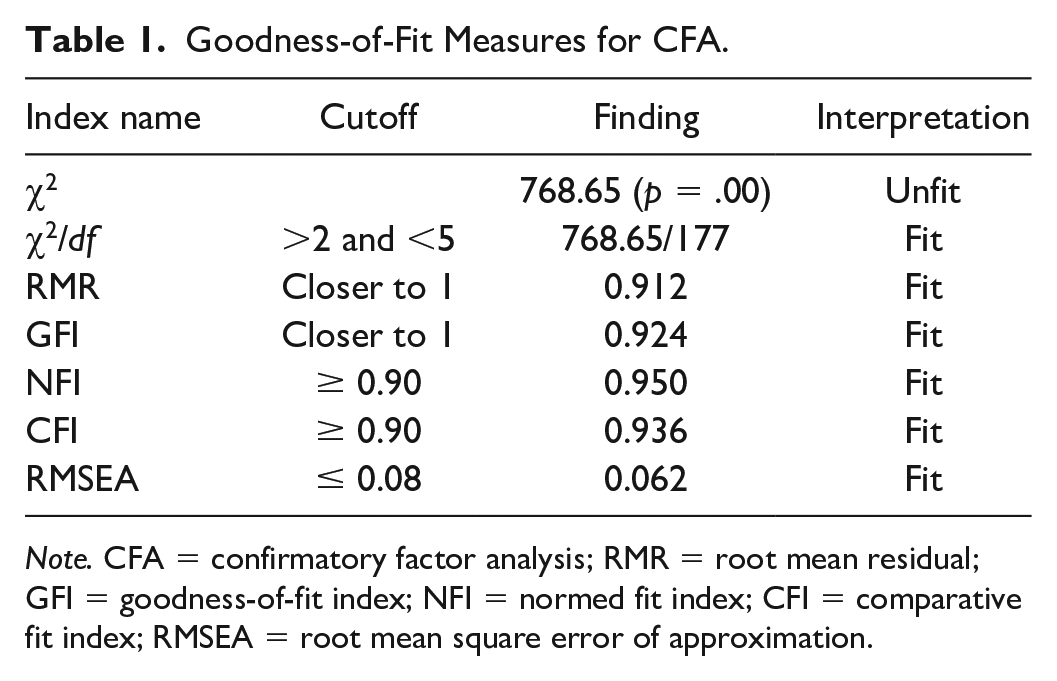
Note. CFA = confirmatory factor analysis; RMR = root mean residual; GFI = goodness-of-fit index; NFI = normed fit index; CFI = comparative fit index; RMSEA = root mean square error of approximation.
CFA Output.

Note. CFA = confirmatory factor analysis; SME = small and medium enterprise; CR = composite reliability; AVE = average extracted variance.
Significance level (p < .01).
The fit indices shown in Table 1 are the final output of a series of modifications in the measurement of constructs upon following the modification indices produced by AMOS. The error terms of several items within constructs showed correlation and were accordingly covaried to specify and eliminate errors (Figure 3) and to improve model fit.
This is not theoretically surprising, as mentioned earlier. All the measurement scales were adapted to different social, cultural settings, and the items’ behavior within a range is always subject to cross-cultural variations (Hofstetter et al., 2013). Besides, the error terms of some of the items across constructs also showed reasonable correlation due to their theoretical relevance; for example, the items of proactiveness and creativity, to some extent, deteriorated the fit statistics (still in the acceptable range). For this possible reason, we have to neglect one of the fit indices (TLI) whose values could not be improved significantly (to the accepted level). As evident from the table, the standardized loading of all the items is considerably higher and more significant than the interconstruct correlations (Figure 3). The same is true for the AVE of each latent construct establishing the discriminant validity (Fornell & Larcker, 1981). Table 1 and Figure 3 also prove the convergent validity of our measurement model. All the items showed a significantly higher loading of more than .70 on their respective constructs, with t values significant at 1% (J. C. Anderson & Gerbing, 1988).
Hypotheses Testing and Analysis of the Structural Model
This study followed Hu and Bentler (1999) to validate its structural model and establish a model fit. RMR and RMSEA were used as absolute fit measures, and GFI, CFI, and TLI as incremental fit indices. The structural model appeared with a relatively better fit offering values: χ2 = 38.23, GFI = 0.964, TLI = 0.922, CFI = 0.977, RMSEA = 0.013, RMR = .096. Chi-square was significant for the measurement model, but its value was less than the tabulated value, proving the model to be of reasonable fit. This is probably a result of deleting the problematic items from each construct. Instead of latent constructs, the authors used scale means for each of the constructs.
Hypotheses Testing
The first hypothesis of this research is that entrepreneurial orientation mediates the association amid ESE and small, medium enterprises development. Researchers have claimed that the use of the attached indicators may give relatively stronger results in SEM (Baumgartner & Homburg, 1996). However, the source, as mentioned earlier, also indicated that the use of composite indicators is a standard convention in SEM. Therefore, consistent with Gainer and Padanyi (2005), this research used scale means to estimate the structural relationships concerning the formulated hypotheses. Two separate models were run to determine the mediation effect, following Baron and Kenny (1986), as shown in Figure 4.

Standardized total effects with two-tailed significance (BC; group number 1: default model).
The output in Table 3 confirms a reasonable mediation effect of entrepreneurial orientation between ESE and SME development in KSA.
Indirect Effect.

Note. SME = small and medium enterprise.
Standardized Total Effects With Two-Tailed Significance (BC; Group Number 1: Default Model)
Furthermore, as evident from Figure 4, the direct effect of ESE (0.35) is significantly reduced to 0.22, although still significant. This is again confirming the partial mediation effect of entrepreneurial orientation in the relationship between ESE and SME development, leading to the acceptance of the first hypothesis in the KSA context.
The second hypothesis of this research is about the positive moderation effect of the institutional environment on the direct relationship between ESE and SME development, as well as on their indirect relationship through entrepreneurial orientation.
For a better understanding of the methodology, readers are advised to follow Bollen (1989) and Hayduk (1987), who emphasized in detail the use and modeling of moderation via interaction terms in SEM. This study adopts the recommendations of the abovementioned sources, who recommended running two models in AMOS for estimating the interaction effect. The critical assumption is that the first model (without interaction) is nested in the second/full model, where all the variables and formed interactions are incorporated. The difference in chi-square values of the two models and its significance indicates whether interaction exists or not. Besides, the study used Ping’s (1996) two-step approach for the estimation of a structural model involving potential interactions; that is, scale means for each construct were calculated and mean centered by calculating z scores to reduce the correlations between multiple items and their errors (Aiken & West, 1991).
Consistently, as evident from Figure 5, an initial model was run in AMOS to determine the significance of the independent and moderating variables on the dependent and moderating variables. It must be noted here that the study has three subhypotheses concerning the moderation effect of the institutional environment; specifically, the Saudi institutional environment not only moderates the relationship between ESE and SME development but also moderates the indirect effect of ESE on SME development through entrepreneurial orientation. Therefore, three versions of the full structural model were run, and the chi-square difference was calculated to determine the moderating effect at three different stages/paths, as suggested in Hypotheses 1a, 1b, and 1c. Table 4 provides a comprehensive picture of the results obtained in relation to the three subhypotheses of Hypothesis 1, which is about the moderating effect of the institutional environment. The results suggest that the institutional environment moderates the relationship between ESE and SME development, such that better institutional support may increase the impact of ESE on SME development in the KSA. The same is true for the development of a positive attitude toward entrepreneurship-based enterprise development, (i.e., entrepreneurial orientation) and the impact of that attitude toward SME-based economic progress through the growth and proliferation of such organizations. Therefore, this study accepted all three subhypotheses, suggesting that a better institutional environment may positively facilitate the development of SMEs in the KSA by fostering the impact of ESE directly and indirectly through entrepreneurial orientation.
Structural Estimate.

Note. SME = small and medium enterprise.
Significance Level (p < .01).

The effects of the independent and moderating variable on the dependent and moderating variables.
Discussion
Based on the evidence in the current study, entrepreneurial orientation explains the effects of ESE in SME development in the KSA context. The results of this study were encouraging, and the authors expect the generalization of these findings due to several reasons. First, the data were collected from SME owners, and a relatively large sample size serves the justification for generalizing the results, especially in the Arab countries (Genc et al., 2019). Second, due to prevailing economic pitfalls, Arab countries are giving considerable attention in augmenting the SMEs’ contribution in their GDPs (Elasrag, 2010). Thus, factors promoting SMEs’ growth are of utmost significance for these countries (Nasr & Rostom, 2013). Thereby, the authors expect the generalization of the proposed theoretical framework beyond the current sample.
The findings of this study offer interesting results in line with existing entrepreneurial literature. For instance, consistent with the previous studies (Semrau et al., 2016; Tang & Tang, 2012), the authors found a positive relationship between entrepreneurial orientation and SME development. Firms that are proactive in responding to the changing market trends, innovative, and risk takers tend to deliver superior entrepreneurial results. Furthermore, drawing on the SCT, our study provided evidence that individuals who possess a high degree of ESE are more likely to choose to become entrepreneurs (or have the intentions of becoming entrepreneurs), because of the belief that they can execute this role better (Zhao et al., 2005). This line of enquiry is further corroborated by Ahlin et al. (2014)—that ESE is positively related to exercising entrepreneurial roles in individuals.
The present study also adds to the literature of the institutional environment by following recommendations of Fang et al. (2010) and emphasizes its role on the relationship of self-efficacy and entrepreneurial orientation. The study identified that a supportive institutional environment, both formal and informal, is likely to have a critical role in boosting SMEs’ development in any country (Scott, 2008), especially in the KSA context, where the monarchial political system creates restrains in boosting SMEs’ development. The findings of this study support the theoretical framework and are aligned with the empirical study conducted across 43 countries (Sambharya & Musteen, 2014). The authors found the importance of institutional structures for entrepreneurial activities. However, they found varying results depending on entrepreneurial activity, thereby suggesting the complexity of this phenomenon and further investigation. In this regard, our study addressed the call of Sambharya and Musteen (2014) and presented useful empirical insights in support of this phenomenon.
Theoretical and Practical Contributions
The findings of this study offer substantial theoretical and practical implications. From a theoretical perspective, the findings confirmed our proposed relationships that appraisals of entrepreneurial orientation play a significant role in explaining how ESE influences SMEs’ development through the moderating role of the institutional environment. Most explanations of SME growth in the Arab countries have examined the appraisals of technology (Elbeltagi et al., 2013) and e-commerce (Abed et al., 2015), including the extent to which these countries have innovation capability that results in enhancing the SMEs’ growth. The present study has examined the cognitive factor, that is, ESE, and institutional factor, that is, entrepreneurial ecosystem to explain the role of entrepreneurial orientation in SMEs’ development. Thus, by integrating institutional environment, the current study addressed this gap by explaining the role of entrepreneurial ecosystem on the relationship between ESE and SMEs’ development.
From a practical perspective, our study provides rich insights. For instance, the findings of this study, in harmony with previous literature, threw light on the importance of the cognitive factor, that is, ESE in boosting SMEs’ development in the KSA. Therefore, policy makers are necessitated to design educational systems and programs in a way that increases entrepreneurial awareness in this area to increase entrepreneurial venturing (Sambharya & Musteen, 2014). In addition to the education preparedness as a critical attribute to the environmental munificence, other factors in the support or constraint of SMEs’ development include international diversity of a region, research and development (R&D) expenditures, and availability of financial capitals (Dickson et al., 2013). Furthermore, the findings offer grounds for understanding the degree of economic freedom, for example, trade regulations and tax structures are important factors in boosting SMEs’ development.
Conclusion
Entrepreneurship is frequently considered by both scholarly and practitioner-based research findings as a remedy to serve global sustainability challenges. Nevertheless, entrepreneurship is the result of settled human components that allow creating, identifying, and exploiting the market opportunities linked with the incremental development. These features enable entrepreneurs to understand and utilize familiar and known strategies on the prospects that are related to the market, while in the same way trying to highlight new approaches and opportunities that lend efficiency.
This study mainly investigates the causal relation amid ESE and small–medium enterprises’ development with reference to the KSA and, at the same time, investigates the impact of entrepreneurial orientation and the moderating impact of the institutional environment. This study provides numerous practical and theoretical contributions.
The crucial theme of vision 2030 of the Saudi Arabian Kingdom is the attention on increasing the capacity and skills to surge the dependability and quality of the manufacturing sector. The main idea is to construct and prepare the Saudi Arabian economy from a hire charge state to an internally recognized, self-efficient, and market-based economy. In this regard, this research delivers policymaking for professional participation of the administration in the edification, in the given market context, to shape, groom, and ease the development of Saudi youth into proficient entrepreneurs. Furthermore, in line with the theory of planned performance, this study proposes the concept that administrations must provide entrepreneurs and youth to exist and advance in the promising market-based approach toward the development of small–medium enterprises–based private sector. This is mainly related in the context of KSA, where the social norms and market disturb the attitude of young graduates (Cunningham & Sarayrah, 1993; Ebrahimi & Mirbargkar, 2017; Whiteoak et al., 2006).
Moreover, the theoretical framework, in harmony with the empirical data, offers practical implications such as the real indicator that determines the extent of the entrepreneurial ecosystem’s development and its effectiveness at the regional level. Consequently, efforts should be expanded at the national level to reach the various regions of the KSA to benefit from the comparative advantages. This also contributes to driving the growth of local entrepreneurship in all regions of the KSA through three main engines: (a) enabling communication and interaction between different groups that represent the entrepreneurship ecosystem at the regional level, (b) involving the region’s entrepreneurial community in the generation and implementation of initiatives to develop the entrepreneurial ecosystem, and (c) educating the various groups in the region’s entrepreneurial ecosystem about the challenges and opportunities, with the aim of improvement and development.
This research agonizes from a few boundaries. First, it did not recognize and distinguish amid entrepreneurs of “opportunity” and “necessity” and from the cluster of small–medium enterprises; the data are focused on these items. Appropriately organizing opportunistic entrepreneurs, who are mainly talented businesspersons, and acquiring their responses may provide better comparative knowledge. Furthermore, the research accepted measures that were established in very different economic, religious, legal, and social circumstances that may influence the strength of the responses gathered concerning variables of interest. In this concern, forthcoming scholars should concentrate on the suitable sample collection and strategy of suitable instruments for effective calculations.
Footnotes
Declaration of Conflicting Interests
The author(s) declared no potential conflicts of interest with respect to the research, authorship, and/or publication of this article.
Funding
The author(s) received no financial support for the research, authorship, and/or publication of this article.
