




Abstract
The translation of the Chinese folk language plays a vital role in preserving cultural authenticity and shaping the distinctive style of Chinese children’s literature. This study employs Zhou Lingshun’s theory of Translator Behaviour Criticism to examine Helen Wang’s English translation of Cao Wenxuan’s Bronze and Sunflower (2015/2005), with a specific focus on the translation of folk language elements such as dialects, colloquialisms, idioms, and set phrases. By focusing on translating dialect words and idiomatic expressions, this research examines how the English version reconstructs the original’s stylistic features, including its emotional depth, cultural context, and aesthetic tendencies. The findings reveal notable challenges in representing dialects, encapsulating local cultural nuances and conveying character identity and emotional tone. While some of Helen Wang’s translations achieve functional equivalence, others dilute the authenticity of the source text by opting for standard English or omitting culturally loaded terms. Similarly, the translation of idiomatic expressions, integral to the narrative’s humour and local flavour, often needs help to balance literal meaning with the expressive and aesthetic functions of the original. This results in the loss of natural simplicity and vibrancy inherent in the folk language. This study proposes that in translating folk language for children’s literature, translators should strive to balance fidelity to the original’s folk characteristics (“seeking truth”) with the practical needs of target readers (“seeking utility”). Such an approach ensures cultural authenticity while meeting the reading expectations of child audiences, ultimately creating translations that effectively convey the richness of the original work.
Keywords
Introduction
In children’s literature, the challenge of translating culturally rich texts for a global audience has long been debated (Al-Fouzan, 2019; Hazard, 1944; You, 2018, 2019, 2023). Retaining the unique flavour of culture while ensuring accessibility for readers from different linguistic backgrounds is particularly crucial in works deeply embedded in folk language. As Chinese President Xi Jinping emphasised, “telling China’s stories well” is about narrating events and preserving the cultural essence of Chinese literature for international audiences (Xi, 2013). This is especially true for Chinese children’s literature, where folk expressions—such as dialects, idioms, proverbs, and colloquialisms—serve as linguistic tools and essential vehicles for cultural transmission. Xu (2020) notes, “The folk language reflects the cultural authenticity of Chinese children’s literature, shaping its unique cultural features and spiritual essence. To a large extent, this is where the charm of Chinese children’s literature lies” (p. 93). Authenticity has a threefold connotation of “original, real, and credible” (Zhao, 2012, p. 11). It refers to something innate, unadulterated, or “genuine” (Lin, 2003, p. 47). Translation, by nature, involves cross-cultural communication, so cultural authenticity should be the reading experience that the target audience yearns for (Carbonell, 1996, pp. 79–98). I argue that folk language is an essential aspect of embodying the cultural authenticity of Chinese children’s literature, and it is also one of the critical elements that constitute the unique style of these works. Therefore, the translation of folk language impacts the success or failure of recreating the style in translated children’s literature, making it significant research value.
One such work that highlights the intersection of cultural authenticity and translation is Bronze and Sunflower (《青铜葵花》), a seminal novel by Cao Wenxuan. Recognised internationally, Cao’s novel offers a rich tapestry of rural Chinese life, conveyed through various folk languages. This paper examines the translation of the folk language in Bronze and Sunflower (2015/2005), authored by Cao Wenxuan, the first Chinese writer to win the Hans Christian Andersen Award in 2016. Originally published in Chinese in 2005, the novel was translated into English by Helen Wang. The English edition, released by Walker Books in the UK in 2015 and Candlewick Press in the US in 2017, achieved notable commercial success and critical acclaim, marking a significant milestone for Chinese children’s literature in English-speaking markets (Zoe, 2015). Wang’s translation won the Marsh Christian Award for Children’s Literature in Translation in 2017, and Walker Books received the PEN Translation Award for promoting the work internationally. Walker Books positioned the translation as a critical example of Eastern literature in its “World Voices—Global Best Novels Series,” highlighting the importance of preserving the original text’s cultural and stylistic elements.
Helen Wang’s English translation of Bronze and Sunflower successfully captures much of the original novel’s emotional depth, themes, and aesthetic essence. However, there are notable issues in the translation of the folk language. Drawing on Zhou Lingshun’s framework of Translator Behaviour Criticism for translating folk languages, which includes dialects, idiomatic expressions, colloquialisms, proverbs, “xiehouyu” (a type of Chinese pun or wordplay), slang, chengyu (Chinese idioms), maxims, and famous sayings, this paper examines the challenges of translating such regionally distinctive elements. Zhou (2016) argues that when translating folk languages, translators must not only reconstruct the local flavour of the original text to preserve its style faithfully but also consider the readers’ ability to comprehend it, balancing “truth” with “utility” (pp. 77–82). In the case of this novel, Helen Wang’s treatment of dialects, colloquialisms, idioms, and proverbs falls short of fully conveying the distinctive regional character of the original text. As a result, the unique modes of thinking associated with rural Chinese communities are lost, weakening or distorting the emotional impact and diminishing the folk language’s natural, simple, and vibrant aesthetic qualities.
Research on Bronze and Sunflower
Since its English publication, Bronze and Sunflower has garnered widespread acclaim from diverse audiences, with Helen Wang’s translation receiving particular praise. Esteemed British and American review platforms have commended the English edition, but their assessments reveal varied emphases and implicit limitations. For instance, The Horn Book Magazine celebrated Wang’s ability to maintain the original text’s style while ensuring readability, and the Independent lauded the novel as “heartwarming” and “lyrical.” Similarly, the Cox Review highlighted Cao Wenxuan’s vivid prose, focusing on rural life’s joys and struggles. However, The New York Times Book Review offered a more nuanced perspective, noting that while some scenes are evocative, others might discomfort readers—a critique that gestures towards unexamined tensions in the translation’s reception. While these initial reviews underline the translation’s success in engaging Western audiences, they seldom probe deeper into the complexities of preserving folk language and cultural authenticity, which are central to the source text’s essence. By contrast, academic studies, as shown below in Figure 1, have taken a more analytical approach, focusing on external factors such as publication mechanisms, promotional strategies, and audience engagement.

“Clustering Keywords” of Bronze and Sunflower from 2014 to 2025.
Sun (2017) emphasised the role of reputable publishers, skilled translators, and copyright agencies in expanding the novel’s global reach, while Fu (2018) examined the translation of idioms and culturally rich expressions, leveraging “medio-translatology” to highlight its international dissemination. Similarly, Xu (2019) and Xiu (2020) explored dissemination strategies. Nevertheless, these studies primarily view the translation as a vehicle for cultural export, neglecting a critical engagement with the nuanced qualities of Wang’s work itself. A few researchers have applied theoretical frameworks to examine the translation in detail, but their critiques often fall short of offering a holistic understanding. For example, Xu (2020) touched on the translation of folk language but provided limited analysis, and Li (2019) used Skopos theory to discuss cultural explanations, rhythm, and rhetoric. However, the strategies proposed often prioritise functional adequacy over cultural depth. In 2008, Gao’s translation aesthetics approach identified some loss in aesthetic nuance, but it is necessary to investigate how this affects cultural authenticity, especially for young readers (Gao, 2008). While Shu (2019) addressed linguistic features such as phonetics, lexis, syntax, and rhetoric, the analysis needed more specificity in addressing the challenges posed by folk language. These studies often celebrate the translation’s achievements without rigorously interrogating its limitations, especially in the context of children’s literature. Thematic and stylistic analyses similarly reveal gaps in the literature. Hai and Ying (2020) explored metaphor translation, balancing foreignisation and domestication strategies, but they overlooked dialects and colloquialisms, which are crucial for retaining cultural fidelity. Zhu (2022) advocated domestication in translating four-character idioms but needed to connect this strategy to broader folk elements. Zhao et al. (2022) critiqued omissions in narrative space translation, yet their analysis did not extend to how these omissions influence the representation of folk language. Chen and Song (2025) made strides in analysing gender representation, noting that Sunflower’s characterisation challenges stereotypes, but they did not examine how these changes intersect with the preservation of folk elements. These studies provide valuable insights but often fragment their focus, leaving critical dimensions of folk language translation underexplored.
Moreover, Existing research frequently applies general literary theories without sufficiently accounting for the unique traits of children’s literature, as Yang et al. (2006) cautioned. Children’s literature demands rhythmic simplicity, rhetorical appeal, and accessibility, yet many analyses fail to balance these traits with the need to preserve cultural authenticity. Zhou (2016) emphasises the importance of folk language elements—dialects, colloquialisms, idioms, and set phrases—as integral to the cultural essence of the source text. However, the translation of these elements remains underexplored. Moreover, Cui and Xu (2024) examine the genre shift in the translation of Bronze and Sunflower, tracing its transition from a Bildungsroman to historical fiction. Through analysis of interviews, notes, blog posts, and reviews, they reveal how literary agents, publishers, critics, and readers influenced this transformation, reshaping the work’s reception in the target culture. Their study underscores the importance of considering external literary and cultural forces in translation outcomes. However, scant attention has been paid to how Helen Wang’s translation negotiates the competing demands of cultural fidelity and global accessibility while maintaining the work’s emotional depth, cultural identity, and aesthetic richness. This gap highlights the need for a critical exploration of how translation strategies preserve the richness of the original text while adapting it for an international audience.
Theoretical Framework
Translation criticism is a crucial bridge between translation theory and practice (Newmark, 2001). It plays a crucial role in fostering meaningful interactions between theoretical concepts and real-world translation tasks, providing a scientific evaluation of translation decisions, and broadening the scope of translation activities (Liu, 2022, pp. 5–13+191). Traditional translation studies primarily focused on intra-translation, exploring the relationship between the source text (ST) and the translated text (TT). With the advent of the “Cultural Turn” in the latter half of the twentieth century, translation studies shifted from text and linguistics to extra-translation, emphasising the impact of sociological factors such as ideology, culture, and society on translation. In the text-centred phase, translation criticism concerns the “truth” of the transformation between the source and translated texts, often overlooking social factors and the translator’s subjective agency. In contrast, during the culture-centred phase, translation critics concentrated on social and cultural factors but did not give equal importance to the linguistic aspects of translation. Professor Zhou Lingshun is one of the scholars who has emphasised the importance of studying translators and has published a series of articles since 2010 discussing translator behaviour. The theory of Translator Behaviour Criticism was introduced in his book A Theoretical Framework for Translator Behaviour Criticism, published in 2014. The theory returns to a critique of the translation while balancing internal and external factors. It examines the translator’s role and general behaviour, particularly the socialisation process during translation (Zhou, 2014b, p. 4).
Professor Zhou has introduced the “Truth-seeking—Utility-attaining” Continuum Model of Evaluation as a framework in his book for assessing translator behaviour and translation quality. In Translator Behaviour Criticism, “Truth-seeking” refers to the translator’s effort to fully or partially capture the meaning and truth embedded in the original text to achieve the goal of utility-attaining. “Utility-attaining,” on the other hand, pertains to the attitudes and methods the translator employs to meet societal or reader needs based on the pursuit of truth (Zhou, 2010, p. 95). As Ye (2022) notes, while “Truth-seeking” and “Utility-attaining” are distinct, they are interconnected and reflect issues of translator behaviour and the degree of socialisation in translation (p. 19). “Truth-seeking” is tied to the source text (ST) and depends on the extent of truth pursued. At the same time, “Utility-attaining” is oriented toward society/reader and depends on the level of utility addressed. The “Truth-seeking—Utility-attaining” continuum is both a critical and descriptive model and an analytical tool (Zhou, 2014a, p. 29). “Truth-seeking” is an essential condition for translation, as it requires the translator to ensure the translation remains faithful to the ST. It can be seen as the instinctive response of the translator’s linguistic nature and represents the most fundamental starting point for translator behaviour. However, the translator is not only a linguistic being but also a social one. Therefore, they must consider social factors during translation to achieve “Utility-attaining.” From the perspective of Translator Behaviour Criticism, both the translator’s actions and the translation itself exist on a continuum, with a gradient that evolves throughout the process. The relationship between the “Truth-seeking—Utility-attaining” evaluative continuum and other continuums is illustrated in Figure 2.

Relationship between the “Truth-seeking-Utility-attaining” evaluative model of continuum and other continuums (Zhou, 2014b, p. 92).
This analysis of translator behaviour highlights how the translator’s actions reflect a dynamic interplay between linguistic and social factors. The translator’s navigation between the “truth-seeking” and “utility-attaining” ends of the continuum is crucial in understanding how translation decisions are made. As Zhou argues, the translation is first presented on the “author/source text - reader/society” translation continuum, where the translator’s behaviour is reflected in their “truth-seeking” at the “author/source text” end and “utility-attaining” at the “reader/society” end. This forms the “truth-seeking—utility-attaining” translator behaviour continuum. When the translator’s behaviour leans towards the left end, it indicates that the translator primarily exhibits their “linguistic” nature, with a greater emphasis on being a “language user.” When the translator’s behaviour leans towards the right end, it suggests that the translator primarily exhibits their “social” nature, with a greater focus on being a “social being.” This creates the “linguistic-social” translator attribute continuum and the “language user-social being” translator identity/role continuum. Since it is a continuum, we must acknowledge the gradual transitions at each stage, which objectively describe the translation, translator behaviour, translator attributes, and translator identity/role. Among the various continuums, the translator behaviour continuum plays a central role because the translator is the subject of translation practice and the executor. The changes in the translation continuum and the translator attribute continuum are aligned, ultimately stemming from the changes in the translator’s “truth-seeking” and “utility-attaining” behaviours as the actor.
Beyond linguistic fidelity, translation often requires understanding the cultural nuances embedded in the source text. This becomes particularly important when translating culturally rich or locally grounded elements, such as “folk language.” These elements are not merely linguistic choices but carry the social and cultural weight that shapes both the translation process and the final product. One such critical aspect is the translation of “folk language,” a concept Professor Zhou Lingshun defines in his work on translation and cultural expressions. In his article “The Translation of Folk Language and Its Criticism Study,” published in 2016, Professor Zhou introduced the “folk language” concept while discarding traditional linguistic labels. He considers idioms, dialects, and other cultural expressions in folk literature as “folk language units” (Ye, 2022, p. 9). As Zhou notes, folk language refers to the linguistic expressions with local characteristics, word-of-mouth, popular and refined and spread among the people, which to a certain degree can reflect local custom and practice, culture and folkway as well as a cultural tradition. Examples include sayings such as, ‘Follow a chicken if you marry a chicken, follow a dog if you marry a dog’ (Zhou, 2016, p. 80). Folk language does not view locution, dialect, slang, idioms, and other forms separately but rather as an integrated set of language units, all of which share the folk characteristics of their cultural origin. To better facilitate the English translation of folk language, Professor Zhou Lingshun proposed a classification framework for folk language, as demonstrated in Figure 3.
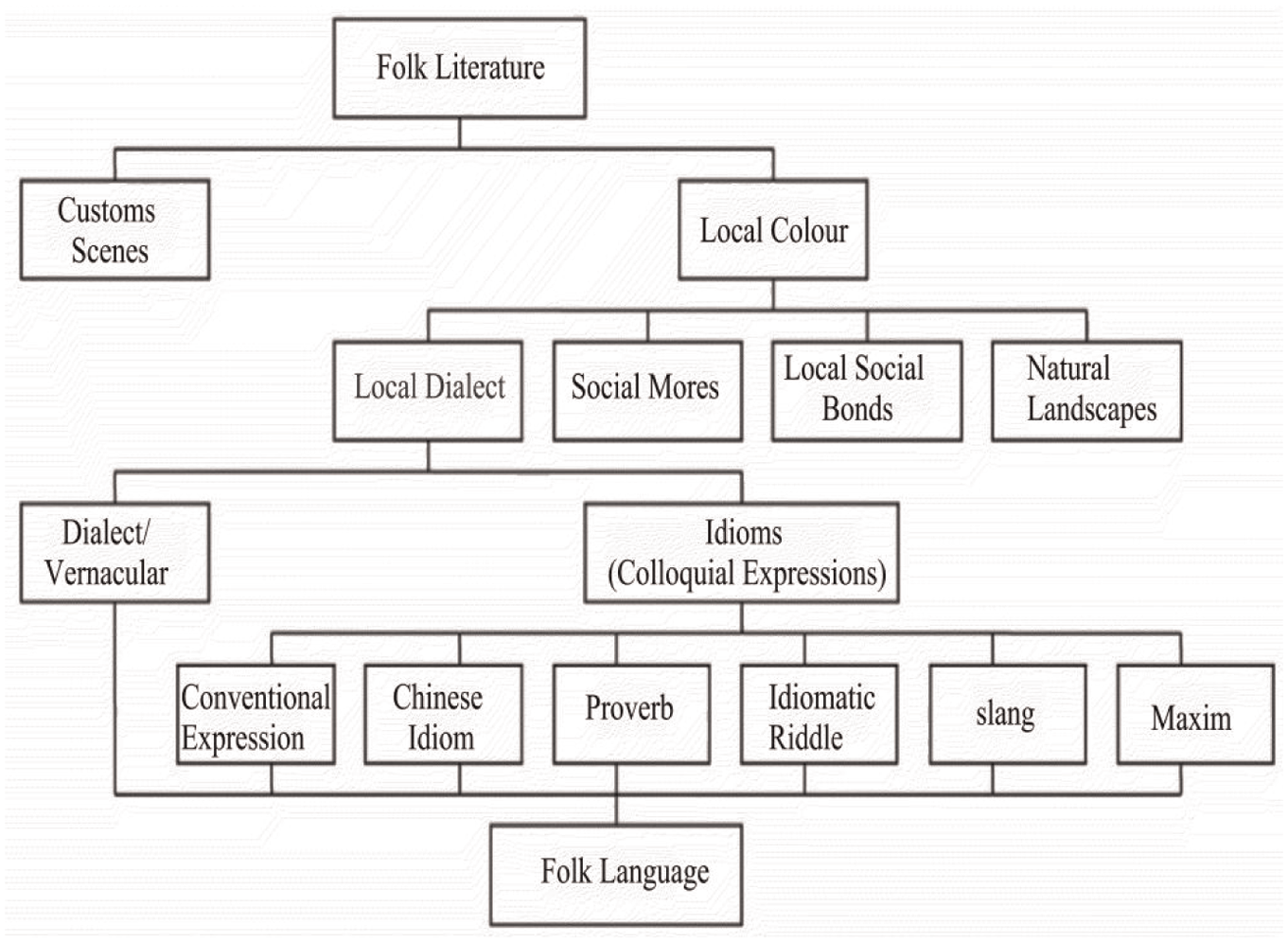
The relationship between “folk literature” and “folk language,” as well as the connection between ‘folk language’ and other related terms (Zhou, 2016, p. 79).
Professor Zhou (2016) further illustrates that “folk language is a high-level generalisation of idioms, proverbs, allegorical sayings, slang, maxims, dialects, and locution, which is used to express the ‘local colour’ in folk literature” (p. 78). This conceptualisation of folk language goes beyond simple linguistic forms to capture the essence of cultural identity and communal life. According to Zhou, folk language is not just a collection of words or phrases but an integral part of a society’s cultural fabric, reflecting local customs, beliefs, and practices. It serves as a vehicle for transmitting the values and wisdom of a particular community, often through oral traditions that shape collective memory and identity. Zhou’s definition underscores the multi-dimensional nature of folk language, which encompasses the practical use of language in everyday life and its symbolic and cultural significance. For instance, proverbs and maxims often encapsulate collective wisdom and moral teachings, while slang and dialects are expressions of regional and social identity. Idioms and allegorical sayings, on the other hand, offer insight into a community’s worldview, using metaphor and figurative language to express complex ideas in accessible terms.
Indeed, there has been a surge in the application of Translation Behaviour Criticism in recent years. By searching for the term “translator behaviour criticism” in CNKI, the researcher collected the results and conducted a visualisation analysis using Cite Space, software designed to visualise and analyse citation networks of scholarly literature. The findings, shown in Figure 4 below, represent the clustering of keywords from January 1, 2014, to March 30, 2025, based on 301 key documents. The analysis reveals that research on translation practice through the lens of Translation Behaviour Criticism is predominantly focused on translating folk literature, theatrical works, prose, novels, and other literary materials, highlighting the theory’s growing relevance and potential applications.

“Clustering Keywords” of Literature on TBC from 2014 to 2025.
As Xu (2020) notes, local sentiment is an essential theme in Chinese children’s literature, and local language is a distinctive feature of its language style (p. 94). Folk language is characterised by wit, vividness, simplicity, and naturalness, vividly demonstrating the local culture, customs, and humanities. However, the difficulty of translating vernacular language lies in its unique “local flavour” originates from the local conditions and historical and cultural deposits of a specific region, which is unrepeatable. This characteristic makes it difficult to find an utterly corresponding expression in the target language, and translators often lament that “a skilful woman cannot cook without rice.” For novels with a solid local flavour in Chinese children’s literature, the folk language embodies the distinctive traits of the author and the character’s thoughts, emotions, and aesthetic inclinations. The success or failure of the translation is closely related to style reconstruction and is a crucial aspect for translators to grasp in the internationalisation of Chinese children’s literature. The style embodies the author’s unique thoughts, emotions, and aesthetic characteristics. The style of children’s literature is unique, both for a specific subject matter or for a particular writer, showing subtle and far-reaching style characteristics. It is an essential requirement for translators to grasp the stylistic characteristics of different subjects and authors accurately. Especially in translating Chinese children’s literature works with strong local flavour, folk language has become the concentrated embodiment of the author’s and characters’ thoughts, feelings, and aesthetic tendencies. The translation effect of a work is closely related to the reproduction of the style. Therefore, in the process of Chinese children’s literature going international, the translator must accurately grasp this key point.
Cao Wenxuan, a writer hailing from the water towns of northern Jiangsu Province, China, is known for his stories that revolve around the theme of time’s passage (Xu, 2000, p. 71). His writing exudes a strong sense of local sentiment and prominently features rural children as characters. Most of these characters hail from rural areas, and distinct regional dialects naturally influence their language habits. The use of folk language not only creates an immersive sense of place but also helps to shape vivid characters that reflect their ways of thinking and emotions while enhancing the aesthetic effect of the work. This stylistic trait is a defining feature in Cao Wenxuan’s works. Therefore, when translating them—especially in terms of Chinese rural characteristics—translators should trace their origins and capture their unique features to reconstruct the original work’s stylistic traits (Xu, 2020, p. 94). In Bronze and Sunflower (《青铜葵花》), the use of vernacular forms reflects the local cultural and historical context, presenting significant challenges in translation. The difficulty lies in preserving the original’s cultural essence while adapting it for a different audience, especially when direct equivalents in the target language may not exist. In order to effectively analyse how translators deal with these challenges, this study adopts Zhou’s (2016) framework of folk language, mainly focusing on two fundamental principles: truth-seeking and utility-attaining. The principle of truth-seeking emphasises the translator’s responsibility to remain faithful to the cultural and emotional essence of the original work while utility-attaining stresses the importance of making the translation accessible and meaningful for the target audience. By applying these principles, we can better assess how translators balance accuracy and cultural adaptation in their work. Figure 5 provides a concise overview of the research methodology for this study, outlining how these principles are employed to examine the following research questions:
RQ1. How effectively does Helen Wang’s translation of Bronze and Sunflower (《青铜葵花》) capture the local dialect, colloquial expressions, idiomatic phrases, and proverbs from the original Chinese text?
RQ2. What are the successes and challenges in preserving the cultural essence and stylistic features of Cao Wenxuan’s original text in the English translation of Bronze and Sunflower (《青铜葵花》), particularly concerning the interplay between truth-seeking (preserving the authenticity of the original) and utility-attaining (adapting the text for the target audience’s understanding)?

Research methodology.
Methods
Research Design
This study employs a qualitative research design to explore the complexities of translating folk language and cultural context in Cao Wenxuan’s children’s novel Bronze and Sunflower (《青铜葵花》). Given the intricate nature of these translation challenges, qualitative research is particularly suited to offer an in-depth interpretation and analysis (Mandal, 2018). This approach enables a detailed examination of how local language and cultural elements are represented across languages, focusing on translating key stylistic features that reflect the author’s cultural and emotional expression. The study analyses explicitly Helen Wang’s translation of Bronze and Sunflower (2015), evaluating how effectively it captures the distinctive traits of the original work’s local flavour, emotions, and aesthetic inclinations. The analysis focuses on two critical aspects: dialect and idiomatic expressions. These elements are particularly significant in preserving the cultural essence of the original text. By comparing both texts, the study aims to identify the successes and challenges in reconstructing the source text’s stylistic and cultural features in translation and to contribute to improving the quality of Chinese children’s literature translations for international audiences.
Study Sample
This study adopts purposive sampling, a standard qualitative research method, to intentionally select data that offer rich, symbolic insights (Ary et al., 2010). Rather than statistical generalisation, qualitative research seeks a deep understanding of specific instances that offer valuable insights into the subject under study (Ritchie et al., 2003). Data for this study were sourced from Cao Wenxuan’s original work 青铜葵花 (2005) and its English translation, Bronze and Sunflower (2015) by Helen Wang. The study focuses on several pivotal scenes, particularly the river and Cadre School scenes. These two moments were chosen due to their significant cultural and linguistic features, importance in the novel’s plot development, and prominent use of local dialects and folk expressions. The river scene and Cadre School scene are central to the novel’s themes of rural life, personal growth, and the characters’ emotional landscape. By analysing these scenes, the study aims to showcase how translation choices affect the source text's cultural integrity and stylistic elements. This purposive selection allows a deeper understanding of translators' challenges in preserving the local flavour and cultural context, highlighting the specific linguistic and cultural nuances.
Data Analysis
Data analysis for this study follows a comparative approach involving a detailed manual comparison between the original text 青铜葵花 (2005) and its English translation, Bronze and Sunflower (2015). The analysis focuses on the river and Cadre School scenes, as these scenes are linguistically and culturally rich and have significant narrative roles that contribute to the novel’s overall theme. In evaluating the translation of these scenes, the study examines several factors, including how the translator handled cultural adaptation, linguistic choices, and narrative style. Special attention was given to how idiomatic expressions and dialects were rendered in the English version and whether the translation succeeded in maintaining the original’s cultural and emotional essence. The study utilised a thick description methodology to provide a comprehensive and detailed account of the translation process (Mills et al., 2009), ensuring a thorough and credible analysis of the translation strategies. By offering an in-depth portrayal of the translation choices, this research highlights the complexities of preserving cultural context in translated children’s literature, as emphasised by Shenton (2004).
Results and Discussion
In the translation of Bronze and Sunflower, dialects are linguistic variants distinct from Standard Chinese, characterised by differences in pronunciation, vocabulary, and grammar (Tang & Van Heuven, 2009). Dialectal vocabulary, with its rich local characteristics, imparts a unique regional cultural atmosphere and aesthetic value to literary works (You, 2018). Translating such dialectal elements demands a truth-seeking approach. Truth-seeking, as the core objective of the translation process, emphasises faithfully reproducing the source text’s meaning, cultural depth, and emotional resonance (Zhou, 2016). This principle requires the translator to maintain a “shadow-like” relationship between the source and target texts, preserving the linguistic and cultural traits of the original. Typically aligned with foreignisation strategies, truth-seeking highlights the distinctiveness of the source culture, ensuring the translation remains faithful to the source text’s emotional and cultural nuances. However, truth-seeking does not exist independently of “utility-attaining,” which focuses on readability and the target audience’s reception. These two concepts form opposite ends of a continuum, requiring translators to balance fidelity and practicality.
Wang’s translation of folk language elements presents significant challenges due to their deep cultural roots. For instance, the translation of culturally specific terms in Bronze and Sunflower demonstrates notable strategies: “奶奶” is transliterated as “nai nai” rather than using the commonly recognised “grandmother”; “大麦地” is rendered as “da mai di” with an explanatory phrase, “the barleylands”; and “嫡亲孙女” is translated as “her granddaughter, her flesh and blood,” with “her flesh and blood” elaborating on the concept of “嫡亲.” These choices effectively preserve the local linguistic flavour and contribute to maintaining the novel’s regional characteristics. Despite these efforts, challenges remain, particularly in conveying the original text’s cultural authenticity and stylistic nuance. These issues highlight the need for further exploration to improve the quality and fidelity of translations in Chinese children’s literature. Drawing on Zhou Lingshun’s theory of truth-seeking and utility-attaining, this study examines the translation strategies used for local language elements in the English version of Bronze and Sunflower. The principle of truth-seeking underscores the importance of preserving the cultural and emotional essence of the original work while utility-attaining emphasises accessibility and resonance with the target audience. By applying these principles, this paper aims to address the challenges in translating local languages and propose strategies for enhancing the translation process.
In modern Chinese, regional dialects exhibit notable pronunciation, vocabulary, and grammar differences. These regional dialect words reflect the uniqueness of local culture and enhance the local colour and authenticity of literary works. Regional dialect words carry distinct cultural characteristics specific to certain geographic areas, reflecting the uniqueness of local culture. For example, many words in Bronze and Sunflower (《青铜葵花》) are directly derived from the local dialect of the author’s hometown, contributing to the work’s strong sense of rural life and vividly shaping its characters. Therefore, when translating these regional dialect words, the translator must address the linguistic differences and seek truth to preserve the local cultural essence embedded in the original, ensuring that the translation effectively conveys the source text’s regional flavour and emotional tone. Failure to seek truth will lead to inaccuracy and misunderstanding, and readers cannot grasp the text’s meaning. A notable example is the character “死” (sǐ, meaning “death”). While typically associated with the end of life, in the China Yancheng dialect, it is often used to express intensity (Zhu, 2014, pp. 96-100). In formal contexts, euphemisms such as “逝世” (shìshì, passed away) or “安息” (ānxī, rest in peace) are commonly used instead. However, in everyday speech, “死” is a frequently used term, imbued with various meanings and conveying a wide range of emotions, showcasing the character’s nuanced feelings:

In Bronze and Sunflower (《青铜葵花》), the phrase “死到屋里去” provides a vivid example of Zhou Lingshun’s concepts of
Moreover, Dorst (2011) argues that dialect words convey rich emotional nuances, making characters’ inner feelings more vivid and distinct, but also, as a specialised language of specific social groups, they help make characters’ images and personality traits more pronounced, three-dimensional, and concrete (pp. 113–135). In Bronze and Sunflower (《青铜葵花》), Cao Wenxuan skillfully uses social dialect words to bring the characters to life and highlight their unique aesthetic qualities:
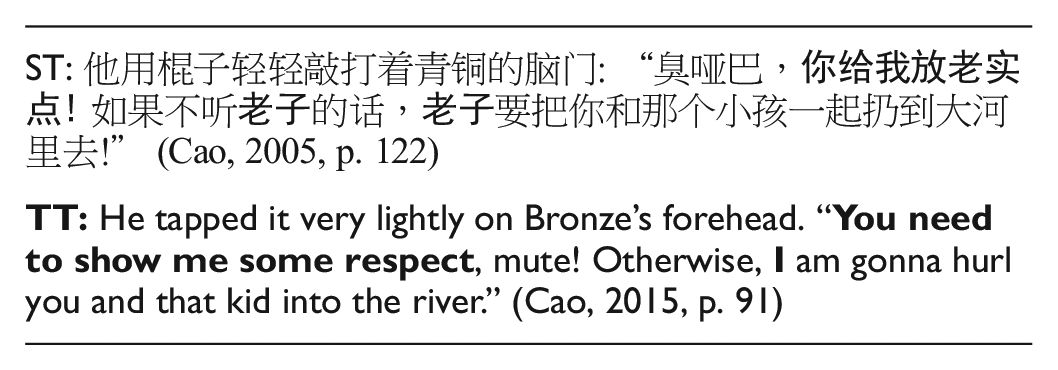
In Chinese Pinyin, the character “子” can be pronounced in two ways: with a falling-rising tone or as a light sound. These different pronunciations result in changes to the meaning of the conventional implicature, as illustrated in the following table.
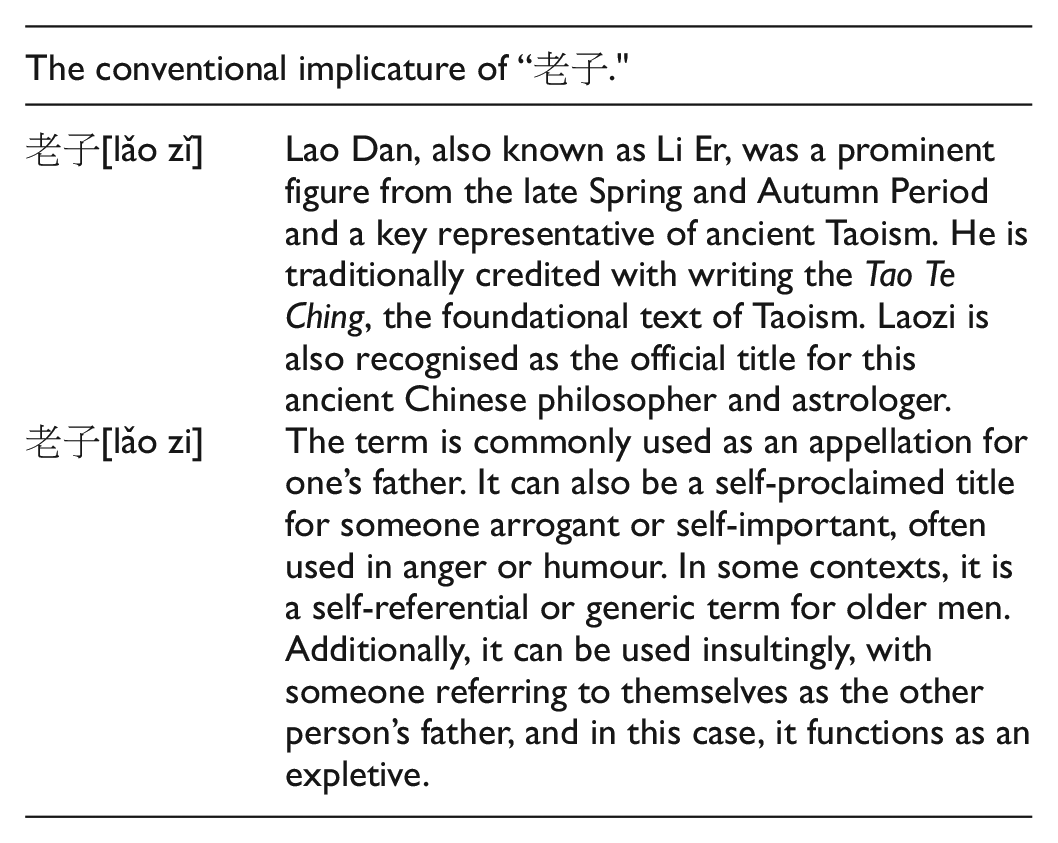
Liu (2013) notes that in the Chinese dialect, the Putonghua “Laozi” (老子) may function as either a term of respect or, in some contexts, a self-referential expression conveying arrogance or dominance (pp. 251–276). In Bronze and Sunflower (《青铜葵花》), when a child from the neighbouring village refers to himself as “Laozi” during a confrontation with Bronze, it conveys contempt and authority, highlighting his impolite and candid nature. This term enriches the depiction of rural children, adding authenticity and aesthetic quality to the narrative. However, Wang’s translation renders “Laozi” as “I” and omits one instance, diluting the emotional intensity and cultural specificity. For example, translating “你给我放老实点” as “You need to show me some respect” fails to capture the original tone. A more nuanced rendering, such as “You had better behave yourself. Remember who is boss; otherwise, I will throw you and that kid into the river,” better reflects the superiority and threat implied by “Laozi.” Drawing on Zhou Lingshun’s (2017) framework of seeking truth and utility-attaining in translation, the translator’s challenge lies in balancing the accurate conveyance of cultural meaning (truth) and creating a relatable, functional expression for the target audience (utility). While “your father” aligns with the literal meaning, it risks misrepresenting the threatening tone in the original. Conversely, “boss” aligns more closely with the narrative’s intent and emotional resonance, preserving the character’s arrogance and the conflict’s tension. This case illustrates the importance of capturing both linguistic and cultural nuances to maintain the literary uniqueness of the source text while ensuring accessibility for English-speaking readers.
E. P. Wang and Zhidan (2023) notes that idioms are fixed phrases or sentences in a language that generally cannot be altered in structure and must be understood as a whole to grasp their meaning (pp. 125–133). Idioms include colloquialisms, proverbs, sayings, euphemisms, slang, and maxims (Zhou, 2016, pp. 77–82). Slang, in particular, is a distinctive and representative idiom form (Thorne, 2014). Moore et al. (2010) define Chinese slang, or lǐyǔ, as “vulgar or dialectal words with minimal usage” (pp. 524–538). Slang is informal and often humorous, emerging from everyday life as simple, catchy local expressions. In Bronze and Sunflower (《青铜葵花》), slang frequently appears, adding a layer of cultural depth and emotional resonance. While most translations of these slang terms are satisfactory, there are instances where the translations diverge significantly from the original, sometimes leading to amusing or confusing outcomes. Zhou (2017) emphasises that translating slang requires a careful balance between “truth-seeking” and “utility-attaining” (pp. 103–109). The translator must strive to remain faithful to the original meaning while ensuring that the translated text is understandable and relatable to the target audience. In this sense, preserving both emotional intensity and cultural context in slang translations is crucial for maintaining the essence of the original. The translation should reflect not only the literal meaning of the terms but also the tone, humour, and underlying sentiment that characterise the slang in its native context.

In Bronze and Sunflower (《青铜葵花》), the word “熊样” (xióng yàng) is used to describe villagers who become dispirited over minor issues. In Chinese culture, bears are often depicted as slow and clumsy, and when used to describe people, the term carries a mild derogatory connotation, indicating someone timid or foolish. After a locust plague leads to famine and many villagers collapse from hunger, the village head, feeling anxious, decides to lead the villagers in singing on the open ground to boost morale. When some villagers sing half-heartedly, the village head shouts, “熊样,把腰杆挺直了!” This term reflects his frustration, urgency, concern, and care, highlighting his close relationship with the villagers. However, in Wang’s translation, rendering “熊样” as “as strong as bears” turns it into a form of encouragement, which significantly alters the original term’s derogatory meaning, leading to a mismatch in both meaning and style. In Western culture, bears are generally associated with strength and power. I argue that Wang’s translation could create a misleading interpretation of the village head’s intent. To avoid misunderstanding, it is appropriate to omit the bear imagery and instead focus on conveying the original tone of frustration and scolding. English has slang that conveys laziness or negativity, such as “weasel out,” so translating “熊样” as “Do not try to weasel out of this” can better capture the original term’s local colour and the village head’s scolding tone. Zhou (2017) argues that translating regional dialects requires a balance between “truth-seeking” and “utility-attaining” (pp. 103-109). In this case, truth-seeking involves preserving the local colour and the emotional nuance of the original word “熊样.” At the same time, utility-attaining makes the translation accessible and understandable to the target audience. The translator’s task is to convey the source text’s meaning and emotional undercurrent while ensuring that it resonates appropriately within the cultural and linguistic context of the target language. By selecting “weasel out” as the translation for “熊样”, the translator maintains the emotional tone of the original and adapts it to an English-language context in a way that remains true to the underlying intent without sacrificing readability or clarity. Thus, achieving the right balance between these two principles is essential for a meaningful and effective translation.
In addition, for a polysemous word denoting slang, the translator may only translate its literal meaning, potentially missing its idiomatic usage. For example, a mistake occurs in two sentences with the phrase “风声.”

The word “风声" appears in the text and can refer to either the sound of the wind or, more contextually, the news or rumours. In the article, both instances of “风声” refer to the rumours about city people wanting to take Sunflower back to the city, which is undoubtedly bad news for the Bronze family. When the village people discussed this news, they deliberately refrained from talking about it in front of the family of Bronze because they were uncertain whether it was true or when the city people would come. The villagers did not want the family to know about this, and their anxiety grew when someone from outside entered the village. In this context, “风声” refers to news or rumours. However, the translator mistakenly renders it as “wind,” which is a literal translation that fails to capture the idiomatic meaning of the phrase. This translation error can be analysed through the lens of Zhou Lingshun’s concepts of “truth-seeking” and “utility-attaining” in translation. Truth-seeking emphasises that the translator must strive to reproduce the original text’s meaning, emotional tone, and cultural essence. In this case, translating “风声” as “wind” ignores the idiomatic and cultural meaning of the word as “news” or “rumours,” which diminishes the accuracy and emotional resonance of the original text. The truth-seeking approach would require the translator to recognise the context in which “风声” is used and choose a translation that accurately conveys the intended meaning, preserving the narrative’s emotional and cultural depth. On the other hand, utility-attaining focuses on ensuring that the translation is accessible and comprehensible to the target audience. While the literal translation of “风声” as “wind” might be understandable to English speakers, it strips away the essential context of the rumours, which is critical to understanding the tension and anxiety within the story. A translation that adheres more closely to the idiomatic meaning of “news” or “rumours” would better serve both truth-seeking and utility-attaining, allowing readers to fully grasp the emotional undertones and the significance of the villagers’ actions. The translator’s focus on the literal meaning of “风声” as “wind” neglects the idiomatic sense of the phrase, which affects both the truth-seeking and utility-attaining goals of translation. A more careful reading of the original text, considering both the literal and idiomatic meanings, would improve the accuracy and effectiveness of the translation. The translator should balance these two principles to ensure that the translation faithfully represents the original work’s cultural and emotional nuances while being accessible to the target audience.

In this example, the translation error stems from the misunderstanding of the word “美”, which carries a dual meaning in the original text: “good-looking” and “complacency.” In the story’s context, the mother’s remark and her action of tapping Sunflower’s head reflect complacency or narcissism rather than simply a comment on physical appearance. The mother’s words should convey a sense of playful criticism about Sunflower’s vanity. However, the translation incorrectly leans toward the more superficial meaning of “good-looking” without capturing the psychological undercurrent of complacency. This issue can be analysed through Zhou Lingshun’s concepts of truth-seeking and utility-attaining in translation. The principle of truth-seeking emphasises the need for the translation to reflect the original text’s authentic emotional and psychological nuances. In this case, the mother’s actions—tapping Sunflower’s head—suggest a close, playful relationship and a subtle critique of her daughter’s vanity. By failing to recognise this, the translator misses an essential layer of meaning, distorting the original passage’s emotional essence. On the other hand, the concept of utility-attaining stresses the importance of making the translated text readable and resonant for the target audience. A literal translation of “good-looking” would not carry the same tone or depth for English readers as it does for Chinese readers. By focusing only on a superficial translation of “美” as “good-looking,” the translator sacrifices the depth of the cultural and emotional context, leading to a translation that may be clear but does not “attain utility” in terms of the full impact of the source text. In this case, the translator’s failure to capture the nuance of complacency weakens the emotional connection between the characters, thus failing to provide an accurate truth-seeking translation while also hindering the translation’s ability to achieve the intended impact on the target audience, thus neglecting the goal of “utility-attaining”. The translation should aim to convey the “narcissistic tone” and playful intimacy in a manner that would resonate with English-speaking audiences, preserving the psychological depth of the original. For example, the mother’s words could be translated as “Look at how full of yourself you are!” or “See how proud you are of yourself!” which would capture both the tone of “complacency” and the intimate, playful nature of the relationship. Thus, the error here highlights the need for a more nuanced approach that considers both the truth of the original meaning and the utility for the target audience, ensuring that the translation accurately reflects the emotional and psychological undertones of the original work.
Moreover, English idiomatic expressions are fixed phrases that often convey a complete meaning with a robust colloquial flavour and typically carry metaphorical significance (Drew & Holt, 1988; Rodríguez-Muñoz, 2024). However, in Chinese, idiomatic expressions, or “惯用语” (guàn yòng yǔ) follow a three-character pattern and are widely used in everyday conversation. They have a fixed structure but allow for some flexibility in their usage. As Wen (2022) observes, idiomatic expressions achieve vivid imagery and unique expressive power by employing metaphorical and rhetorical techniques. They are generally concise and clear, reflecting the cultural and traditional values of the Chinese people, and are well-received by the public. Idiomatic expressions encapsulate cultural nuances and reveal the speaker’s thought processes and style, often incorporating humour and playfulness. When translating these expressions, it is essential to fully grasp their underlying cognitive characteristics and playful elements to recreate the original’s thought patterns and aesthetic qualities faithfully:
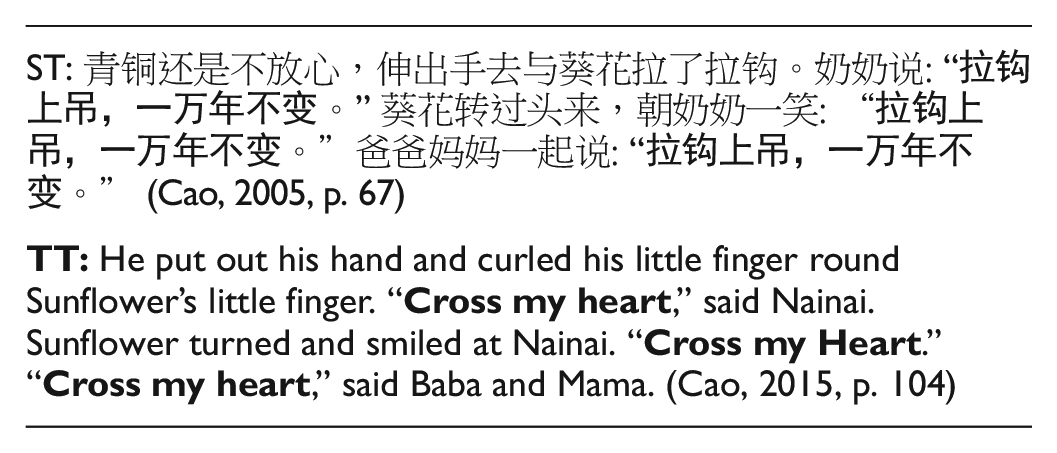
The word “吊” (diào) originates from ancient Chinese practices where coins with holes were strung together on a rope to prevent them from scattering. Over time, this practice evolved into a symbolic gesture for making promises, especially among children and in rural contexts. This idiom represents a typical rural or childlike way of making commitments and reflects a specific cognitive and cultural style. In Bronze and Sunflower (《青铜葵花》), the phrase “拉钩上吊,一万年不变” is used to depict a promise of eternal fidelity, often accompanied by a gesture of intertwining pinky fingers. This vivid visual expression captures the sincerity and simplicity of a child’s promise, illustrating a deep connection to rural traditions and childlike sincerity. However, the translation of this idiom as “cross my heart” in the English version overlooks the specific cultural connotations of the original Chinese phrase. Stewart (2021) observes that “Cross my heart” is typically used in Western contexts to make a vow, often with religious undertones (pp. 3–16). Wang’s translation of the phrase “拉钩上吊,一万年不变” into “Cross my heart” could lead to misunderstandings about the cultural background of the promise. It loses the rural and childlike essence of the original phrase and might confuse readers about the cultural context.
To maintain the original’s cultural and emotional impact, a more fitting translation could be: “Pinky promise, pinky promise, never change.” This captures both the gesture and the playful, poetic nature of the original idiom, aligning with the Western concept of a pinky promise while preserving its cultural significance. This approach ensures that the promise retains its intended meaning and emotional resonance, bridging the cultural gap. Zhou Lingshun’s concept of truth-seeking and utility-attaining offers valuable insight into this translation challenge (Zhou, 2017, pp. 103–109). According to Zhou, truth-seeking refers to the translator’s effort to represent the original meaning faithfully. At the same time, utility-attaining involves adapting the translation for the target audience to ensure it is comprehensible and engaging. In this case, while “cross my heart” may be a familiar and understandable phrase in English, it sacrifices the specific cultural and emotional weight carried by “拉钩上吊,一万年不变.” A translation that seeks the truth of the original phrase’s meaning would preserve the playful, childlike promise and the cultural context of rural Chinese traditions. The phrase “Pinky promise, pinky promise, never change” is a more utility-attaining choice, as it aligns with both the emotional essence of the original and an idiomatic expression familiar to an English-speaking audience. By finding this balance, the translation respects the cultural significance of the original while ensuring its emotional impact is maintained for readers across languages.
Y. Wang (2023) notes that idioms, a key feature of Chinese culture, are a specific type of “熟语” (shú yǔ) that typically consist of four characters, reflecting a wide range of structures and origins. They represent a distilled essence of the language, akin to a mirror that reveals the cultural heritage and spirit of the nation. The development of idioms is deeply rooted in the material and spiritual conditions of the people, imbuing them with significant cultural meaning and mirroring distinctive cognitive and emotional patterns. In the novel Bronze and Sunflower (《青铜葵花》), idioms are used extensively. While most idiomatic expressions are translated effectively, some reveal gaps in capturing the original stylistic nuances. In light of Zhou Lingshun’s insights, translations must preserve the rich cultural and emotional layers embedded in idiomatic expressions, ensuring that the target language faithfully conveys the stylistic and cultural essence of the original.

The idiom “粗茶淡饭” (literally ‘coarse tea and plain rice’) describes a simple diet and a frugal lifestyle. According to Liu and Chang (2024), tea holds deep cultural significance in Chinese society, symbolising heritage and resilience even during financial hardship (pp. 714-727). In Bronze and Sunflower (《青铜葵花》), “粗茶淡饭” vividly portrays Sunflower’s poverty and hardship, aligning with the themes of suffering and moral lessons emphasised by Cao Wenxuan. Cao (2002) argues that suffering illuminates characters, ideas, and all narrative aspects (p. 273). However, translating “粗茶淡饭” as “fresh food” fails to reflect its original cultural and emotional depth. “Fresh food” suggests a positive connotation of nutritious and flavourful meals, which misrepresents the impoverished lifestyle implied by the idiom. Similarly, translating “风里雨里” (literally “in the wind and rain”) as “fresh air” overlooks its intended meaning of enduring challenges, reducing its impact. These mistranslations arise from prioritising accessibility (utility-attaining) over fidelity to the source text (truth-seeking), resulting in a loss of cultural nuance and thematic alignment. A practical approach balances these two ends by drawing on Zhou Lingshun’s continuum of “truth-seeking” and “utility-attaining” in translation. A translation like “rustic food and peasant tea” for “粗茶淡饭” retains the imagery of “tea” and “rice,” preserving the idiom’s association with poverty and resilience while being accessible to target readers. Similarly, rendering “风里雨里” as “weathered the storm” captures its metaphorical essence of hardship without deviating from the source’s intent. By prioritising fidelity (truth-seeking) while considering readability (utility-attaining), such translations maintain the cultural and emotional integrity of the original text, ensuring the core themes and sentiments are fully conveyed to the audience. Here are some examples that demonstrate how Helen Wang’s translations might not fully align with the principles of seeking truth (忠实) and utility attain (通达), as outlined by Zhou Lingshun:

Helen Wang’s translation of idiomatic expressions in Bronze and Sunflower often undermines Zhou Lingshun’s principle of truth-seeking by prioritising surface-level clarity over cultural fidelity. For instance, her translation of 赖着屁股不走 as “dig his heels in” fails to encapsulate the emotional weight and stubbornness implied in the original. While “dig his heels in” captures obstinacy, it lacks the vivid imagery and layered connotations of physical immobility and emotional entanglement conveyed in the source text. A more fitting translation, such as “cling stubbornly” or “refuse to budge,” would retain both the literal and metaphorical dimensions of the idiom, staying true to its cultural and narrative significance. Similarly, 福分, translated as “too good for us,” distorts the term’s essence, reducing it to an undeserved favour rather than a heartfelt blessing imbued with gratitude and humility. This misinterpretation shifts the tone and emotional resonance of the original text. A more precise translation, such as “blessing” or “good fortune,” would better reflect the cultural reverence and ethical values embedded in the idiom, aligning with the truth-seeking aspect of translation.
Wang’s approach further falters with expressions like 昏了头, rendered as “a little worse for wear,” which flattens the complexity of the idiom. The original describes a state of confusion or mental disorientation, yet Wang’s version trivialises this emotional nuance. A translation such as “dazed” or “bewildered” would preserve the psychological depth of the expression. Likewise, 砸锅卖铁, translated as “smash their wok and sell the metal,” is overly literal, failing to convey the idiom’s profound implication of total sacrifice. A more culturally and emotionally resonant alternative, such as “sacrifice everything” or “give up all you have,” would better articulate the gravity of the situation. Additional mistranslations reveal a consistent pattern of cultural oversimplification. 吃闲饭, translated as “did nothing to earn her keep,” captures the essential meaning but lacks the idiom’s implicit social judgement. A more muscular rendering, such as “living off others” or “freeloading,” would better convey the derogatory tone of the original. Similarly, 斤斤计较, rendered as “haggle over every Jin,” misrepresents the idiom’s broader criticism of being overly meticulous or petty. A more appropriate alternative, such as “nitpicking” or “quibbling over trifles,” would align with the idiom’s evaluative undertone. The translation of 耍什么名堂 as “up to something” neutralises the accusatory implication of the original. A sharper alternative, such as “What tricks are you playing?” retains the confrontational tone and cultural richness. Furthermore, 上火, rendered as “getting worked up,” fails to capture the idiom’s dual connotations of emotional agitation and physical discomfort. A more accurate rendering like “burn with frustration” or “be in a fit of anger” would better encapsulate its layered meaning. By privileging surface-level equivalence and disregarding cultural specificity, Helen Wang’s translations not only obscure the idiomatic richness of the original text but also dilute its thematic and emotional depth. This compromises the balance of truth-seeking and utility-attaining central to Zhou Lingshun’s principles. A more rigorous approach, combining cultural fidelity with accessibility, would honour the original text’s cultural identity while effectively communicating its nuances to the target audience.
Conclusion
The integration of folk language in translating Chinese children’s literature is pivotal for maintaining cultural authenticity and capturing the distinctive style of the original works. Chinese folk language, though often simple, carries profound expressive power, reflecting unique cognitive styles, emotional nuances, and aesthetic values. However, translating these elements is challenging, mainly when local dialects, colloquialisms, idiomatic expressions, and proverbs are involved. This study, focusing on the English translation of Bronze and Sunflower, demonstrates that while the translation succeeds in preserving the thematic richness and aesthetic qualities of the source text, it needs to address the subtleties of the Chinese folk languages. The translation needs to accurately render the rural dialects and idiomatic expressions that form an essential part of the cognitive and emotional landscape of the original work. As a result, it needs to gain more of the distinctive perspective of rural Chinese communities and strengthen the emotional impact and cultural richness embedded in these expressions. In light of Zhou Lingshun’s principles of translation, this study underscores the importance of both seeking truth (忠实) and utility attainment (通达) when translating Chinese folk language. The principle of seeking truth emphasises the need for fidelity to the text’s original cultural and emotional essence. Translators must carefully preserve the cognitive and cultural perspectives embedded in rural dialects and idiomatic expressions. At the same time, the principle of utility attainment calls for making the translation accessible and relatable to the target audience, ensuring that the cultural richness of the source material is conveyed in a manner that resonates with readers. Future translations should focus on techniques that preserve the cultural authenticity of folk language while being engaging and comprehensible for young readers. One possible approach is using contextual annotations or footnotes to explain cultural references without disrupting the reading flow. Another approach could involve creative equivalencies or culturally adapted phrasing that conveys the emotional tone and humour of the original while making it accessible to the target audience. For instance, using familiar idioms or expressions in the target language that mirror the original’s emotional intent or cognitive perspective could help preserve the folk language’s style and substance.
Furthermore, the study’s limited scope—focusing only on specific scenes—should be acknowledged, as this may not fully capture the complexity of translating folk language throughout the text. A more comprehensive analysis of the entire translation could provide deeper insights into how the folk language is handled. By recognising these limitations, future research can explore more effective strategies for translating the rural characteristics of Chinese children’s literature, thus enhancing the overall translation quality and cultural fidelity. In this way, translators can better align with Zhou’s principles and contribute to translations that uphold the original works’ cultural authenticity and emotional resonance.
Footnotes

Funding
The authors received no financial support for this article’s research, authorship, and/or publication.
Declaration of Conflicting Interests
The authors declared no potential conflicts of interest concerning this article’s research, authorship, and/or publication.
Data Availability Statement
Data sharing not applicable to this article as no datasets were generated or analyzed during the current study.