




Abstract
This article examines authenticity in South Korean hip hop culture. Building on subcultural theory and cultural hybridization theory, it explores authenticity dynamics in this scene, and the role of the local media as a cultural mediator. Data were collected using a mixed-methods approach over two stages. Stage 1 was a quantitative content analysis of seminal South Korean hip hop program, Show Me the Money. Stage 2 comprised of qualitative participant observation in Seoul hip hop night clubs, and eight semistructured interviews with rappers and journalists. Key findings suggest there is a constant struggle between authenticity and commodification, where commodification dominates the South Korean hip hop scene. This work contributes to the interdisciplinary field of journalism studies by aligning itself with cultural theory to widen the Western view of South Korean hip hop.
Introduction
With most academic work on South Korean (hereafter Korean) music focused on Korean pop music, AKA K-pop (Howard, 2006; Lie, 2015; Nam, 2012 1 ), the burgeoning popularity of Korean hip hop has largely been neglected. Based on research for my Honors’ thesis, this article seeks to build on previous literature (Lee, 2007, 2011; Morelli, 2001; Um, 2013) to gain a wider understanding of Korean hip hop culture from a holistic perspective.
Expanding on Rupa Huq’s (2006) work on global music, this article combines cultural hybridization (Appadurai, 1996; Kraidy, 2008) and subcultural theory (Hall & Jefferson, 1975; Hebdige, 1979; Thornton, 1996) to understand Korean hip hop. Authenticity, or “keepin’ it real,” as it is known in the hip hop world (Forman, 2013, p. 65) is integral to analyzing global hip hop culture. Therefore, to help address the Korean hip hop research deficit, this article aims to answer the question: What are the dynamics of authenticity in Korea hip hop? In addition, since the media is key in subcultural authenticating processes (Thornton, 1996), being a cultural mediator (Harries & Wahl-Jorgensen, 2007), the media’s role in Korean hip hop is also examined.
Informed by archive research and a literature review, data were collected using a mixed-methods approach, combining qualitative and quantitative data analysis, over two stages (Creswell, 2009). The first stage was the quantitative stage consisting of a content analysis of Korean rap program Show Me the Money (SMTM). The second stage was the qualitative stage comprising of eight semistructured interviews (three music journalists and five rappers) and participant observation during two field trips to Seoul in March-April, and June 2016 (18 days in total). Utilizing this mixed-methods approach helps to present a much-needed holistic snapshot of Korean hip hop culture from a lived experience.
Subcultural Authenticity and Globalization
Defined as a “subdivision within a culture” (Negus, 1996, p. 15), subcultures are frequently characterized as social groups “organised around shared interests and practices” (Gelder and Thornton cited in Shuker, 2013, p. 175). Music subcultures, like hip hop, distinguish themselves from others in society (Shuker, 2013) by developing “social rituals which underpin their collective identity” (Clarke, Hall, Jefferson, & Roberts, 1975, p. 47).
The Birmingham School’s subcultural theorists utilized a Marxist approach to examine subcultures, arguing subcultural activity is a form of resistance against dominant society (Hall & Jefferson, 1975; Hebdige, 1979). This school argued subcultures, such as punk, arise from youths’ interactions with their parent culture and the dominant culture (Clarke et al., 1975). Building on the Birmingham School and looking at rave subculture, Sarah Thornton (1996) argues subcultures are not based on youth deviance but rather shared practices and consumption, informed by the media. Rupa Huq (2006) critiques the Birmingham School (Hall & Jefferson, 1975; Hebdige, 1979) and Thornton’s homogeneous subcultural analysis. Instead, exploring the ethnic and global nature of music subcultures, Huq argues subcultures are diverse and reflect a wide range of class and ethnic backgrounds. Huq and others also note the underrepresentation of women in subcultures (McRobbie & Garber, 1975) particularly in hip hop culture (Rose, 2008; Watkins, 2005). But importantly, pointing to the absence of Asian youth in subcultural studies, Huq’s work is integral to understanding how hip hop, a Black-driven subculture, is adapted by Korean youth.
There are three key subcultural concepts particularly relevant to this article; subcultural capital, style, and authenticity. Subcultural theory relies heavily on symbols (Clarke et al., 1975; Hebdige, 1979) and is underpinned by Claude Levi-Strauss’ concept of “bricolage,” or the appropriation of objects to create new meanings (cited in Hebdige, 1979, p. 103). Subcultures create boundaries between group members and outsiders (Clarke et al., 1975) by signifying membership through adopting symbols and objects, for example, chains and cropped hair by the punks (Hebdige, 1979). Dick Hebdige (1979, p. 103) builds on Strauss’ bricolage concept, contending subcultures wear particular fashion styles to reflect distinct cultural identities and communicate “forbidden meanings” to its group members. While the punk subculture recycled affordable everyday objects, such as safety pins and plastic bin liners (Hebdige, 1979), the original U.S. hip hop style was largely based on fake gold chains and fake designer clothing (Rose, 1994). Partly undermining this original style, modern hip hop bricolage in the U.S. (and worldwide) is based on wearing elite sportswear brands such as Nike and Adidas (Blair, 2004). This shift in modern hip hop style means “products are surrounded with a web of social significance . . . creating value above and beyond the basic utility of the product” (Blair, 2004, p. 500). Style in hip hop culture is thus integral to subcultural identity, impinging “on class distinctions and hierarchies by using commodities to claim the cultural terrain” (Rose, 1994, p. 36).
Style is a form of what Thornton (1996, p. 11) terms subcultural capital, where “young people negotiate and accumulate status within their own social worlds.” This concept builds on Pierre Bourdieu’s (1984, p. 12) concept “cultural capital” defined as knowledge “which confers social status” (Thornton, 1996, p. 10). While Bourdieu’s concept is linked to a Marxist class analysis, Thornton’s (1996, p. 11) concept is tied to possessing the “cultural knowledge” to participate in a subculture, such as hip hop.
Subcultural capital and thus fashion are tied to ideas of authenticity. In music subcultures, authenticity is concerned with the organic representation of a subculture, that is, when “it rings true or feels real; when it has credibility and comes across as genuine” (Thornton, 1996, p. 26). In subcultures like hip hop, authenticity is concerned with community building (Pennycook, 2007) and is tied to “establishing in-group/out-group distinctions” (McLeod, 1999, p. 146). Therefore, subcultural capital is the way in which group members signify subcultural membership and thus their authenticity (Thornton, 1996).
Key to authenticity are the divisions between “mainstream” and “underground” scenes in music subcultures, which are often characterized as a binary (Thornton, 1996, pp. 92, 117). The underground scene is distinguished as authentic and against mass produced products and consumption, and thus attributed to subcultural activity (Thornton, 1996). In contrast, the mainstream scene is manufactured, consumed for and by the masses and generally unrelated to rebellious activity (Thornton, 1996). Yet, unlike Hebdige (1979), Thornton (1996) contends that the distinctions between these scenes are context driven and fluid.
One of the ways authenticity is defined is through the media. The media is a cultural disseminator that helps organize and interpret subcultural experience (Hebdige, 1979). It is “essential to the creation, classification and distribution of cultural knowledge” (Thornton, 1996, p. 118). In this, it is integral in defining the “underground” scene, or what is “hip” and authentic for subcultural members (Thornton, 1996, p. 118). As a media example, television reflects a particular culture’s codes, which are “a rule-governed system of signs . . . used to generate and circulate meanings in and for that culture” (Fiske, 1987, p. 4). In a culture, such as Korean hip hop, messages are “encoded” with meaning, and its television programs “carry a socially convincing sense of [the] real,” produced to be understood by all audiences (Fiske, 1987, pp. 5, 21). Therefore, the media is a cultural mediator which seeks to educate the public of happenings in the arts (Harries & Wahl-Jorgensen, 2007). Applicable to a study of Korean hip hop, music journalists are “influential as gatekeepers of taste, arbiters of cultural history and publicists for” local subculture (Shuker, 2013, p. 158).
Finally, globalization is integral to understanding hip hop’s move from the U.S. into Korea. Globalization, the process of worldwide capital flows (Jameson, 1998), has been instrumental in the global dissemination of hip hop culture (Huq, 2006; Mitchell, 2001; Richardson & Pough, 2016 2 ). This concept impinges on the bidirectional flow of information, technological changes and media innovation to allow for freer cultural flows (Appadurai, 1996). However, globalization is noted to be too broad and has been replaced by the concepts glocalization and hybridization to better understand international music flows (Shuker, 2013). These two concepts are very similar as they both characterize the global being adapted in a local context. Yet, specifically, cultural hybridization has a cultural focus and emphasizes cultural interplay where “traces of other cultures exist in every culture” (Kraidy, 2008, p. 148). Here, a culture is not linked to ethnicity but rather “the mobilization of group identities” allowing for a wide range of identity conceptions (Appadurai, 1996, p. 13). This helps theorize the move of hip hop culture around the world and into countries like Korea.
Hip Hop, a Globalized Culture
Hip hop culture comprises of four key elements: rapping, DJing, breakdancing, and graffiti art, but rap is the most well-known and representative element of the culture (Price, 2006) and the focus of this article. Hip hop culture emerged from the New York City Bronx in the early 1970s and was created by marginalized Black and Latino youths (Rose, 1994). Yet, despite the Latino influence, the subculture is largely driven and represented by Black male youth (Jeffries, 2014; Neal, 2004). The culture emerged from a context of poverty, gang violence, and substantial economic and structural changes (Ards, 2004; Jeffries, 2011). This was at a time of policy-driven neglect for many urban youths, which was a huge shift from the progress of the civil rights movement (Rose, 2008; Watkins, 2004). In this context of deprivation and systematic oppression, hip hop emerged as a coping mechanism to resist and critique repressive society (Boyd, 2004; Queeley, 2003) and as form of enjoyment (Price, 2006).
However, the culture’s increasing popularity shifted these dynamics. Hip hop moved from the Bronx to become mainstream during the 1980s and completely commercialized by the 1990s (Jeffries, 2011). Consequently, the divide between mainstream and underground hip hop became more pronounced. Socially conscious hip hop emerged as an underground subgenre dealing with social and political issues (Forman, 2000). While mainstream, commodified rap was shaped by corporate imperatives focused on selling “hood stories” (Chang, 2007; Jeffries, 2011, p. 2; Rose, 2008).
It was during the 1990s that hip hop culture was exported as a U.S. cultural commodity worldwide (Price, 2006). In this, commodification became “a prerequisite for the export of rap to other countries” (Wermuth, 2001, p. 152). This became problematic as sometimes Black culture and hip hop were imitated for its trendiness (Osumare, 2009; Wood, 1997). Despite this, hip hop resonated with youth worldwide who felt marginalized by their own society, and allowed them to musically express experiences of their own (Motley & Henderson, 2008). Hip hop has thus become “a lingua franca that binds young people all around the world, all while giving them the chance to alter it with their own national flavour” (Chang, 2007, p. 60).
However, there is anxiety surrounding the adaptation of hip hop with the incompatibly between the “underprivileged urban Americans who created hip hop and those of the relatively wealthy, monocultural youth” engaging with hip hop on a global scale (Pennay, 2001, p. 113). For example, the Japanese hip hop subculture’s “middle class-ness” seemingly contradicts its view of hip hop as “the music of the oppressed” (Thomas, 2016, p. 213). Therefore, rejection of some aspects of the original U.S. culture is vital so that local youth can claim cultural identity over the music (Pennycook, 2007). To do so, youth adopt the codes and symbols from the original U.S. hip hop subculture and add their own flair to reflect their local culture (Morgan, 2016; Morgan & Bennett, 2011; Motley & Henderson, 2008).
Korean History and Music Industry
Korea during the 1990s saw the emergence the shinsedae, a generation of Koreans in their 20s whose modern lifestyle focused on spending and economic status (Jung, 2006; Lie, 2015). During this period of rapid globalization, Korean youth were led “toward the enjoyment, adaptation and imitation of emerging global trends in their own popular culture” (Buzo cited in Jung, 2006, p. 112). It was at this time that hip hop culture arrived in Korea.
In the wake of the 1997 International Monetary Fund Asian financial crisis, Korean cultural industries focused on exporting Korean culture into neighboring countries (Ju & Lee, 2015; Siriyuvasak & Shin, 2007). This resulted in the Korean wave or Hallyu, which denotes the international popularity of Korean pop culture from the late 1990s (Ryoo, 2009; Shin, 2012). One of the most successful exports of the Korean wave is K-pop and because of this, much of the academic work on Korean music focuses on this genre (Howard, 2006; Lie, 2015; Nam, 2012; see also Note 1). Despite this international popularity, differing from other countries (Negus, 1996; Shuker, 2013) in Korea, locally produced music such as K-pop is more popular than its global counterparts (Morelli, 2001). In addition, with the increasing worldwide dissemination of Korean popular culture, negative depictions of Black people have emerged (Han, 2015). As Gil-Soo Han (2015) notes, blackfacing in K-pop and the Korean media is a form of Korean nationalism.
In the literature, Korean hip hop is often mentioned to contextualize wider K-pop research (Kwon, 2012; Nam, 2012). Here, there is a focus on the K-pop group, Seo Taiji, and the Boys who emerged during the early 1990s. The groups are credited with popularizing hip hop culture in Korea, but are defined as rap-dance, rather than hip hop (Nam, 2012). In other literature, Korean hip hop is contextualized alongside other “black music” in Korea such as soul (Yang, 2017, p. 95). Finally, literature has also linked Korean people and hip hop in articles dealing with wider hip hop culture (Motley & Henderson, 2008; Wood, 1997).
As noted, research solely on Korean hip hop is minimal (Jung, 2006; Lee, 2007, 2011; Morelli, 2001; Um, 2013). Much of this research focuses on analysis of texts such as lyrics, rather than original data (Jung, 2006; Lee, 2007, 2011; Um, 2013). This research also often centers on Seo Taiji and the Boys (Jung, 2006; Morelli, 2001). In terms of authenticity, Sarah Morelli (2001) notes English usage and the adoption Western cultural markers are authenticators in Korean hip hop, while Jamie Lee (2007, 2011) notes that African American slang is also used as an authenticator. Hae-Kyung Um (2013) analyses authenticity in more depth, looking at the dynamics of the mainstream (K-pop) and underground (hip hop) scenes, but takes a more historical approach to the subculture. In addition, authenticity, and the mainstream and underground scenes in Korean hip hop are briefly examined in Jaeyoung Yang’s (2017, p. 95) work on “black music,” again with a historical approach.
Building on the existing literature on Korean hip hop authenticity, this study analyses how hip hop symbols are adapted in Korea in the current context. Hip hop authenticity or “keepin’ it real” (Forman, 2013, p. 65 3 ) values things above money and is opposed to commercialization (Huq, 2006; Jeffries, 2011). The concept is concerned with “being true to one’s roots,” rather than artistic realism (Schur, 2009, p. 58). Use of U.S. aesthetics or symbols is integral to understanding how authenticity is argued in the hip hop diaspora. There are three forms of aesthetics or symbols key to this article: style, the use of language, and referencing (Rose, 1994; Schur, 2009; Williams, 2011). Aligning with Hebdige’s (1979) style bricolage, style denotes the clothing and accessory choices of rappers, such as, gold chains and baggy designer sportswear clothing (Perry, 2004; Rose, 1994). Language usage refers to the vernacular speech used in the hip hop subculture, where there is an emphasis on “language use over language meaning” (Schur, 2009, p. 29). Linked to Thornton’s (1996) subcultural capital, referencing or layering in hip hop is the process of utilizing sound samples and quoting past texts (Williams, 2011). References also refer to a rapper’s local figures and landmarks (Schur, 2009) and are often strongly linked to representing one’s home turf, or hood (Forman, 2000). However, this “keepin’ it real” (Forman, 2013, p. 65) logic is problematic when examining the hip hop diaspora (Pennycook, 2007) because some symbols are not translatable across cultures. This leads to the question: How does the Korean hip hop scene understand keepin’ it real?
Research Method
To explore the research question, data were collected using a mixed-methods approach, defined as using both qualitative and quantitative research methods (Creswell, 2009). With the minimal work on Korea hip hop, this method was utilized to offer a more contemporary snapshot of the Korean scene. Data were collected in two stages; the first stage involved a quantitative content analysis of Korean program SMTM. SMTM, created in 2012, is a Korean hip hop reality TV program and a seminal media example of Korean hip hop culture. The 10 fan subbed episodes (total of 10 hrs of viewing) of the fourth season from 2015 were watched online with English subtitles. Objective research approaches like content analysis are criticized for loss of meaning and context (Bertrand & Hughes, 2005; Kolmer, 2008). However, a mixed-methods approach was adopted to address these limitations.
Derived from a literature review of hip hop culture and its local Korean scene, 20 themes were found through open coding in the content analysis (Corbin & Strauss, 2008): appearance, back story, community engagement, coolness, critique, English, established rapper, format, graphics and editing, guest, idols, Korean culture reference, money, performance, props, rivalry, rules, SMTM meta reference, skill and women. The code SMTM meta reference refers to allusions to SMTM within the discourse of the show. For example, when a rapper performed lyrics about SMTM on the show.
Building on data from the first, the second research stage involved two types of qualitative research: participant observation and interviews by the author. Both stages were conducted in Seoul, Korea, over a total of 18 days (8 days in March-April, and 10 days in June 2016).
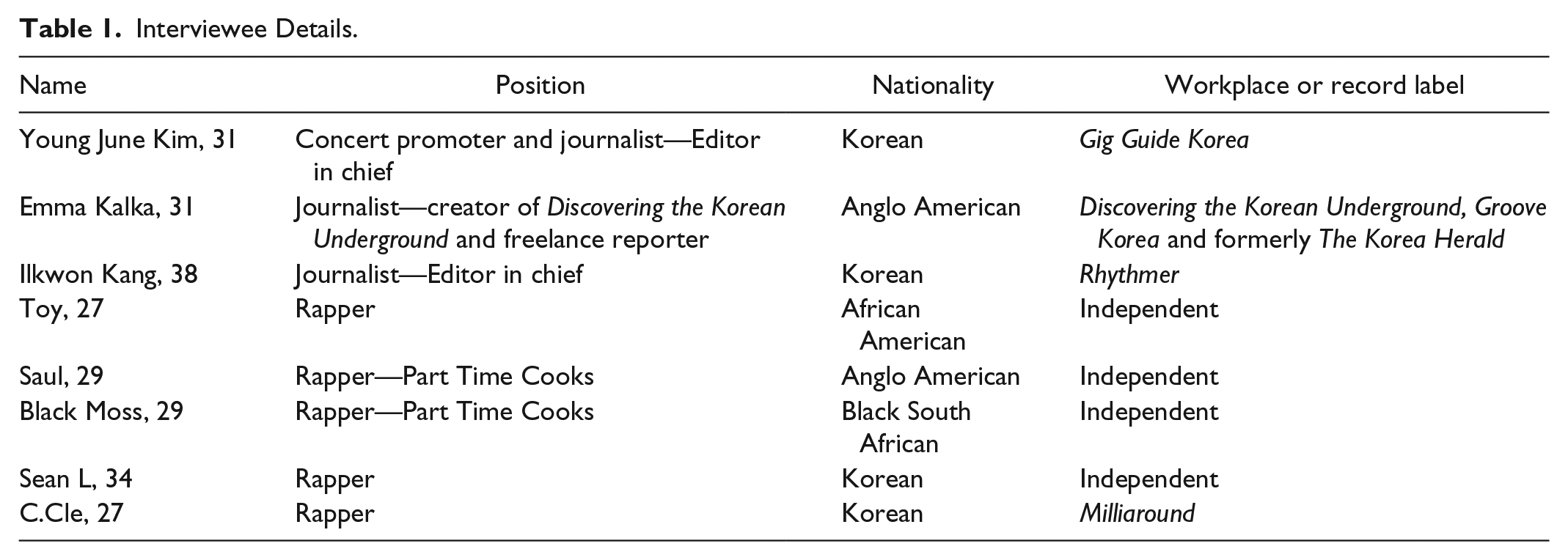
Eight semistructured interviews (see Table 1) were conducted in person with interviewees who were all living and working in Korea at the time. Questions were derived from the literature review and content analysis findings. There was a bias here regarding gender and occupation. More males were interviewed, reflecting the inherent gender bias in the music industry (McCormack, 2016; McRobbie & Garber, 1975; Music Victoria, 2015) and in hip hop culture (Rose, 2008; Watkins, 2005). Moreover, more musicians were interviewed than journalists, but this occupation bias was addressed with the inclusion of the SMTM content analysis during the first stage of the research. Regarding ethnicity, four interviewees were Korean, three came from the U.S. and one was South African. This multicultural view ensured a global perspective on the Korean hip hop subculture.
Interviewee Details.
The participant observation focused on two youth hubs in Seoul (Hongdae and Itaewon) known as the best places to engage with local hip hop culture. Five nights were spent attending hip hop shows, clubs, DJ sets, and a large concert. In addition, non-hip hop specific shows, clubs, and a music festival were attended on six occasions. Time constraints limited this stage of the analysis; nonetheless, these field trips allowed for a rich snapshot of Korean hip hop culture from a lived experience. All qualitative analysis is noted for its subjectivity (Ritchie, 2003) and is difficult to replicate and compare with similar studies (Lewis, 2003). However, utilizing a mixed-methods approach in this study combines the strengths of objective, quantitative data with subjective, qualitative data to offer a more holistic snapshot of the local hip hop scene.
Research Findings
Authenticity and Symbols
Use of English language
The use of the English language was prominent in the mixed-methods data, that is, both the qualitative and quantitative data. English language was used in all episodes of SMTM and was prominent during the participant observation concert experiences. For example, at Korean rapper Dok2’s large concert at the Yes24 Live Hall in east Seoul, English words were constantly heard. Dok2 and fellow Illionaire Records 4 rappers Beenzino and The Quiett casually dropped English buzz phrases such as “turn up” and “let’s go” and curses such as “fuck” throughout the concert. Here, English usage was an attempt to pay homage to the original U.S. hip hop culture. This aligns with previous research on the Korean (Lee, 2007, 2011; Morelli, 2001; Um, 2013) and Dutch hip hop scenes (Wermuth, 2001) that argue English is used to mark authenticity.
In the interviews, this theme was critically discussed by Korean journalist Kang and American rapper Toy. Both argue using English was a marker of coolness, not authenticity. Kang notes, aligning with research (Wermuth, 2001), French and Spanish rappers “use [their] own language.” Doing so supports the view that the creation and use of local slang allows for greater identification with the local scene (Pennycook, 2007). However, Kang highlights Korean rappers prefer using English slang and curses such as “motherfucker,” over local curses such as shibal (fuck) and pyeongshin (retard). He argues this practice damages Korean hip hop’s authenticity because rappers do not create their “own slang.” This concern aligns with cultural hybridization theory (Appadurai, 1996; Kraidy, 2008) where a culture should be shaped according to the local context to demonstrate an authentic adaptation of the original culture. In hip hop culture, this would be reflected in the usage of Korean by local rappers.
In contrast, Korean rappers Sean L and C.Cle contend English language is used purely for musical reasons. Both rappers emphasize that local rappers are concerned with the composition and overall sound of music, opposed to the language used, aligning with Schur’s (2009) emphasis on language use over meaning. C.Cle notes the Korean language is a “weak point” for local rappers, and as Sean L expands: “Pure Korean is not as smooth sounding” compared with English. Sound is emphasized again when C.Cle notes that using different languages in hip hop is like using various musical instruments; “If the Korean is the piano,” then “English is the guitars.” Both rappers also incorporate other languages such as Japanese and Spanish 5 into their lyrics. Therefore, both rappers create a local hybrid hip hop sound by using various languages which supports the notion of cultural hybridity (Appadurai, 1996; Kraidy, 2008) laced with elements of authenticity.
Style
Style was another prominent symbol derived from the mixed-methods data. The emphasis of style was an important marker of hip hop authenticity and signifier of group membership for both rappers and clubgoers of both genders. The content analysis reflected that in all SMTM episodes, the style of judges and contestants aligned with modern hip hop sportswear fashion. The wearing of hoodies, sweatshirts, gold chains, snapback caps, and Nike sneakers was “intentional communication” (Hebdige, 1979, p. 102) displaying subcultural capital to other members of the scene (Thornton, 1996).
The importance of style was also inherent during participant observation in the local club districts of Hongdae and Itaewon, during the spring (March-April) and summer (June) field trips. I visited hip hop and RnB clubs In2Deep and The Henz Club in Hongdae, and Cakeshop and Union in Itaewon, where clubgoers’ style mimicked the current U.S. trends. Across the seasons and genders, Korean hip hop fashion was associated with well-known sportswear brands such as trendy names Stüssy, Bape, and Supreme and classics Nike and Adidas. The only notable Korean style twist was black or white surgical masks worn as accessories.
In autumn, Korean men wore slightly oversized plain t-shirts (mostly black, white, or gray), baseball jerseys, bomber jackets, hoodies, dark jeans, track pants, sneakers (mostly Nike), Timberland boots, and snapback caps. In summer, the only change in style was dark loose knee length shorts were worn instead of jeans.
Unlike their male counterparts, the style of female clubbers was more covert and shifting. In summer, some women did not wear hip hop fashion but instead a more feminine style: simple monotone blue or white blouses and striped dresses, typical of local fashion trends. Other women’s fashion did parallel male hip hop fashion with, for example, t-shirts and baseball jerseys, which sometimes were long enough to be worn as dresses. Regardless of season, jeans were often replaced with white or black short skirts or shorts. This observation highlights that while women’s style floated, the male hip hop bricolage had a stable identification. In part, these findings support the marginalization of women in music subcultures (McRobbie & Garber, 1975).
The importance of style was mirrored in the interviews, helping to contextualize the importance of subcultural capital (Thornton, 1996) and bricolage (Hebdige, 1979) in group membership. As journalist and promoter Kim notes, “People think if we do not wear hip hop fashion . . . [we are not] a hip hop musician or fan.” This emphasizes that fashion choices directly link to Korean hip hop’s authenticity and the strict set of hip hop’s worldwide guidelines.
Korean references
Korean references were the final prominent hip hop symbol to emerge from the mixed-methods data. Eighty percent of SMTM episodes referenced Korean places and culture, for example, lyrical allusions to Korean cities and conflicts involving the Korean age hierarchy. Murry Forman (2000, p. 72) notes the importance of rapping “about situations, scenes and sites that comprise the lived experience” of a rapper’s hometown to reflect authenticity. Korean rapper C.Cle spoke of regional specialties where music and rap styles should differ according to location, something prominent in Japan and the U.S. However, he notes many Korean rappers only rap about Seoul, even if they are originally from another city. C.Cle’s (and Forman’s) comments link to the concept of “layering” in hip hop where location referencing in lyrics allows rappers to claim ownership over their music (Schur, 2009, p. 50). Derived from the original U.S. subculture’s ideology, this location referencing reflects authenticity and hybridity through adaptation to the local context (Appadurai, 1996; Bennett, 2000; Kraidy, 2008).
In the interviews, Korean references were also associated with emotional responses. As C.Cle notes, Korean rappers use feelings such as happiness, depression, and anger in their lyrics. These “common feelings” are also referenced in the U.S. subculture, but C.Cle says Korean rappers reinterpret these emotions according to “Korean feelings.” Fellow Korean rapper Sean L also noted common feelings of anger stemming from the oppression of Korean people with Japanese imperialism, which though different relates to the oppression of Black people in the U.S. In turn, this supports the view that hip hop is an international form of expression for the oppressed (Osumare, 2009; Wood, 1997).
American journalist Kalka expands on this, highlighting that in the beginning hip hop was a way to resist Korean society’s “conservative standard.” She says becoming rapper was a form of rebellion in itself because it challenged the traditional family oriented Korean lifestyle driven by Confucian ideology. In line with the key original U.S. hip hop value of revolting against the hegemony (Boyd, 2004; Osumare, 2009; Queeley, 2003), Korean rappers apply it to their own context; in the U.S., hip hop revolts against the White middle to upper class; in Korea, it revolts against traditional Korean standards. By referencing their own culture in lyrics, Korean rappers hybridize the subculture.
At the same time, lyrical themes differ between the U.S. and Korean hip hop cultures. Journalist and promoter Kim notes the difference between “aggressive” U.S. hip hop, and “sentimental” Korean hip hop, associated with “love.” Kim contends this reflects variances in lifestyle and cultural values of the Korean and U.S. scenes, where Korean hip hop began with “pop culture” as opposed to “street” culture. He notes that some Korean rappers attempt to mirror their U.S. counterparts and be “badass” but instead are “soft, gentle and melancholic.” Although this reflects hybridity, Kim highlights this sentimental focus has devalued the authenticity of the local scene. Moreover, Kim notes that in Korea, sentimental Korean hip hop shows sell better than international hip hop shows, aligning with literature where Koreans prefer locally produced music (Morelli, 2001).
This sentimentality is also problematized by Kalka. She says there is a preference to write about love and breakups because it is “easier for [local] people to digest.” She is critical of the preference of emotional themes over the grassroots rebellious themes. She contends even though “Korean people are not happy with a lot of things today,” like the youth unemployment rate, these social issues are rarely reflected in the local music. However, as American rapper Toy, also critical of this, points out, local rappers are reluctant to “speak out” for fear of “consequence.”
Authenticity, Coolness, and Trends
Coolness in the Korean hip hop scene was a prominent and contested theme in the mixed-methods data. Coolness is synonymous with Thornton’s (1996, p. 26) subcultural capital form “hipness,” related to the “mainstream” and “underground” binary. The content analysis found 60% of SMTM episodes featured coolness, where it was a compliment and thus had a positive association. In the interviews, coolness was also prominent, but had a negative association. All interviewees agreed hip hop was a trend in Korea. The term trend in music often describes mainstream music, meaning it is associated with culturally dominant forms (Forman, 2013) and not rebellious subcultural ideology (Hebdige, 1979). American rapper Toy and Korean journalist Kang denote trend negatively, suggesting hip hop in Korea is “just a trend.” Accordingly, the local scene is characterized as part of the mainstream which works in opposition to Thornton’s (1996) hipness (and adjoining coolness) concept; in the Korean scene, coolness is related to mainstream culture, not underground culture.
However, journalist and promoter Kim complicates this further. Aligning with Toy and Kang’s view, he notes hip hop is the “most mainstream,” “most hip . . . popular thing in Korea right now.” Yet, Kim also highlights Korean hip hop record labels, Hi-lite Records and VisMajor Company, “pretend” to be “underground because it looks cool” even though they “make money, a lot of money.” These comments support Thornton’s (1996) hipness concept as the underground is seen as desirable, thus linked to coolness. Overall, these comments align with Um’s (2013) view that the Korean mainstream and underground scenes are not clearly defined.
Yet, regardless of the division of scenes, Korean hip hop culture has an overarching concern with coolness, mirroring Japan (Osumare, 2009; Wood, 1997). Toy highlights many emerging Korean rappers become rappers because “it’s cool” and “looks like fun.” She argues coolness is not a legitimate incentive for becoming a rapper and this type of engagement with the culture is short lived and inauthentic. Adding to this, Kang contends there is limited knowledge of the subculture in Korea, hence why hip hop is a trend in Korea. Toy concurs with Kang, “A lot of [Korean rappers] are imitating something that they have seen in America . . . I do not think they really know what hip hop is, why people do it, where it came from.” Korean rappers C.Cle and Sean L also recognize the lack of local knowledge of hip hop culture in terms of coolness. However, C.Cle contends coolness is a gateway to understanding and appreciating wider hip hop culture. Likewise, Part Time Cooks rappers Saul and Black Moss, and Kim note that trend culture is not specific to Korea. As Black Moss highlights, worldwide many “people know the roots of hip hop, and there’s a lot of people that catch onto the trends.”
Authenticity and Black Culture
Though only present in interview data, this theme was highly contested. American rapper Toy contends the poor knowledge of the U.S. grassroots hip hop stems from Koreans not understanding Black culture. Although sympathetic to Korean homogeneous history, in line with literature (Han, 2015), Toy critiques local hip hop’s lack of in-depth cultural knowledge. She says Korean rappers believe, “If I use English or I say the N word, if I imitate this aspect of black music, or black culture, people are going to like me more.” However, people “lose respect” for this “pure ignorance,” she says, adding “I wish more people would educate themselves about culture that they are trying to imitate.” Korean journalist Kang expands on this point highlighting Korean rappers “copy black rappers and black style” because “black rappers are cool.” This suggests that Koreans adopt Black culture to follow current trends, mirroring the Japanese hip hop scene (Osumare, 2009; Wood, 1997). However, South African rapper Black Moss notes that in Korea, “hip hop is black music . . . and influenced by that culture” something absent in other countries. This point was exemplified with Kang’s usage of “black music” and journalist and promoter Kim’s mention of “black fashion” when speaking about hip hop. This acknowledgment of hip hop’s Black originators is an attempt to pay homage to the subculture’s U.S. grassroots, something also referenced in the Japanese scene (Condry, 2006). Likewise, this definition of “black music” in Korea is also noted in the literature (Yang, 2017, p. 95).
However, Toy notes this homage can be problematic as in Korea, “Koreans often use black people to legitimize hip hop.” As a contestant on two seasons of SMTM, Toy felt like “the token black person.” Especially during Season Three, she was not “sure if they actually liked [her] because of [her] talent” or because she was Black. Toy’s SMTM experiences reflect that Black culture is adopted to authenticate local hip hop culture, again paralleling Japan (Osumare, 2009; Wood, 1997). This racial authenticating is where Korean hip hop departs from many other hip hop scenes as authenticity is not argued through race, but through the adaptation of U.S. hip hop’s symbols (Morgan, 2016; Morgan & Bennett, 2011; Motley & Henderson, 2008).
This racial authentication, though problematic, is not seen as malicious by all non-Koreans interviewed for this project. As American journalist Kalka contends, cultural appropriation 6 in Korean hip hop is unintentional because it stems “from a place of ignorance.” In fact, the hip hop scene counters racist adoptions of Black people in other Korean pop culture (Han, 2015). As Gil-Soo Han (2015, p. 5) contends, “blackfacing” in Korea is not done to appreciate Black people or their culture, but to “ridicule and legitimize negative perceptions of the black.”
Commodification and the Emergence of Korean Hip Hop
This theme was only present in interview data. U.S. hip hop culture came to Korea during the 1990s, a time of rapid change where Korean society was opening up to global culture flows. As American rapper Saul notes,
Korea has been isolated for a long time, but with the access to internet, it got bombarded with all sorts of cultures [such as] hip hop, the coolest culture in the world. So of course, people are going to run with it.
Part of this globalization process was technological innovation, which was integral to the beginnings of Korean hip hop. As journalists Kang and Kalka highlight Korean hip hop originated as an online community in chatrooms and forums.
Since cultural hybridization impinges on the adaptation of one culture by another (Appadurai, 1996; Kraidy, 2008) in Korea, it is integral to understand the differences between the beginnings of the U.S. and Korean hip hop cultures. Emerging in the 1970s as a grassroots culture and form of expression for the oppressed, the original hip hop culture became completely commercialized by the 1990s (Chang, 2007). It was this commodified and not ideologically rebellious form that Korea was first exposed to, as Sean L notes, some Koreans even think hip hop originated on the U.S. West Coast. The early Korean hip hop groups reflected this commodified culture, for example Seo Taiji and the Boys who emerged in the early 1990s (Nam, 2012). Although the group are credited with popularizing hip hop culture in Korea (Nam, 2012), journalist and promoter Kim notes groups like Seo Taiji and the Boys are not regarded as real rappers; they were just “copying some kind of mood of hip hop.” Kalka and Kang contend that real Korean hip hop emerged in the late 1990s with the creation of legendary club Master Plan, a venue which is considered to be the birthplace of underground hip hop in Seoul, and the emergence of groups like Garion.
Commodification and Fashion
This theme was only present in the qualitative data and took a more historical perspective on hip hop fashion in Korea. In the shops of Hongdae and Edae, two university areas in Seoul, the commercialization of hip hop fashion was prominent. Small shops and large chain stores alike were filled with racks of black or white oversized t-shirts, green or black bomber jackets and shelves of snapback caps. A small store in Hondgae even sold t-shirts adorned with the images of influential American rappers, The Notorious B.I.G., and Tupac. Often, the music played in these stores was also Korean hip hop, meaning hip hop music and other aspects of the culture collide.
Journalist and promoter Kim contends fashion was the first element of hip hop culture to reach Korea. Growing up in Seoul in the late 1990s, he recalls youth wearing the hip hop bricolage of Nike shoes and baggy jeans. He says, “We are kind of a hip hop guy” but we “never knew what hip hop was, so we tried to relate” by wearing the fashion. Kim highlights that few locals understood hip hop culture, and merely copied “hip hop fashion; black fashion.” This aligns with the Japanese scene where only a small number of youths wearing hip hop fashion actually consumed the music (Condry, 2006). Therefore, Korean hip hop’s grounding in fashion suggests an inauthentic and commodity-based appropriation of the hip hop subculture.
This Korean emphasis on fashion links back to the emergence of the shinsedae in the 1990s. At this time, Korean youth had a new buying power (Ju & Lee, 2015; Jung, 2006) and coinciding with opening cultural channels (Howard, 2006) allowed hip hop culture to blossom in Korea. This economic context emphasizes class distinctions, an element absent in U.K. theorists’ Marxist view of subcultures (Hall & Jefferson, 1975; Hebdige, 1979; Thornton, 1996) as critiqued by Huq (2006). Paralleling the German hip hop scene (Pennay, 2001), there is a disparity between the lower-class U.S. originators and the mostly middle class Koreans engaging with hip hop culture. Simply, this is because Korean youth must buy hip hop culture. Korean consumption of hip hop music and fashion is required because the meanings and key symbols of the subculture were not created by them but by Americans. Therefore, financial capital is needed to participate in the local scene, which is a shift from the origins of hip hop.
Original grassroots hip hop style of cheap fake jewelry and fake designer clothes (Rose, 1994) was a rebellious statement against the upper class. But ironically, as hip hop culture became commercialized during the 1980s, the exaggerated sportswear style moved from fake to real, and brands like Adidas and Nike became seminal markers of subcultural status (Perry, 2004). Because style is a key authenticator in Korean hip hop, local fans must reflect hip hop’s designer bricolage (Hebdige, 1979). Therefore, hip hop style’s commodification and mainstreaming in Korea means subcultural style “become[s] ‘frozen,’” and its original meaning is lost (Hebdidge, 1979, p. 96).
Commodification, Performance, and Concerts
The role of performance and concerts was dealt with in the mixed-methods data. In the content analysis, live performance was a strong authenticator in SMTM. All episodes featured performances, where a rapper’s place in the competition impinged on good live performance. Naturally, the emphasis on live performance was also prominent in the participant observation. Two notable examples of live Korean hip hop performance were Shining Ground and the aforementioned Dok2 (of Illionaire Records) concert. Illionaire Records is noted to make much of its revenue from live performances. This was evident at the Dok2 concert with a 3000-strong crowd rapping along to every word. The other example, Shining Ground, is a biweekly show that gives emerging rappers a chance to perform live. It is held at In2Deep, a club in Hongdae owned by first generation rapper Onesun. The performance stage was a small platform, about 1 by 2 m. Two solo rappers and one group performed a few songs each; the group and one solo rapper performed 1990s boom bap style, while the other solo rapper performed a modern trap style. The event drew a small audience of about 20, who mostly seem to be friends of the rappers. Despite the small audience, the rappers performed as if they were in front of thousands calling out to “solijilleo!” (scream), as the audience bounced along to the thump of the music.
Korean rappers, Sean L and C.Cle, also note hip hop performances reflect authenticity. Linking back to content analysis findings, C.Cle contends performing well live is a “basic” skill for a rapper. Sean L expands, saying “A real rapper is someone who [if someone] gives you a microphone, [you] can rap.” Both rappers noted the ability to perform spontaneously was an authenticity marker and even demonstrated this themselves by rapping during the interviews. Therefore, as Thornton (1996) suggests, live performance reflects subcultural capital and thus authenticity.
Yet, hip hop performances and concerts in the Korean scene are also big money spinners. As American journalist Kalka says, money in the Korean scene “is not made through album sales.” She notes though big K-pop idols can make money from music sales, for nonidol musicians “the way to make money is through shows.” Journalist and promoter Kim agrees contending, with “live performance, you have a chance at making good money.”
This commercial emphasis on live performances has ramifications on local rappers. Contrasting with the U.S. grassroots performances devoid of commercial interest, Korean hip hop performances are associated with financial gain. Careful to differential his own promoting practices informed by being a journalist, Kim contends most Korean promoters are “jackasses, they only care about money . . . just selling the show and getting commission.” As noted by Kalka,
There are not a lot of clubs out there who are working with rookie, or amateur rappers. If venues organise a show, or there is a big concert, they want big name rappers because they are going to bring in the crowds . . . to make money.
Kalka’s comment implies emerging rappers have limited opportunities to perform and master their craft, in turn fueling the Illionaire oligarchy.
Commodification and SMTM as a Cultural Mediator
A hugely contentious theme in the mixed-methods data was the position of SMTM in Korean hip hop. In the content analysis, 80% of episodes featured SMTM meta references by contestants, judges, and producers. This highlights the prominence of the show within the Korean hip hop scene. However, the kind of influence SMTM has on the culture was highly contested in the interviews.
American journalist Kalka notes, with the rise of the second wave of K-pop idols, hip hop’s mainstream popularity ebbed during the early 2000s. However, as journalist and promoter Kim notes, though K-pop still dominates the local music industry, hip hop has now resurged as Korea’s next most popular music genre. Korean rapper Seal L highlights SMTM’s creation is the reason for this popularity resurgence. As Korean journalist Kang argues, SMTM is so influential in Korean hip hop, the program “is the boss” of the subculture and dictates the activities of the mainstream hip hop sphere. This is not a good thing as “SMTM has messed up Korean hip hop culture” by commercializing the hip hop industry, Kang adds. Kalka expands on this by noting, “The producers of SMTM are not out to spread [authentic] hip hop culture, they just want to make a good show.”
A key example is the “diss battle” 7 controversy derived from the content analysis. Korean rapper C.Cle notes, SMTM used the “diss battle” as a tactic to increase viewership and generate profit. Kang builds on this point, highlighting that the SMTM producers confessed to him they are completely ignorant of hip hop culture. Kang notes a “rap battle is part of the hip hop culture, but diss is not,” yet a diss battle task was set on SMTM. Therefore, on SMTM hip hop culture “is taken for a walk” just to make money, he adds.
As the media is a key subcultural knowledge distributor (Thornton, 1996), defining subcultural experiences for both subcultural insiders and outsiders (Hebdige, 1979), SMTM affects the perception of hip hop culture in Korea. Mass media forms choose certain aspects of a subculture to share according to what the dominant culture deem important, particularly in regard to commercial interest (Clarke, 1975). Television programs, in particular, promote a certain sense of reality and set of meanings (Fiske, 1987). In this, SMTM spreads its own definition of authentic hip hop culture, one that overtly reflects hip hop as a money-making exercise to generate more profit. Moreover, since SMTM is so seminal in the culture, it reflects this commercialized image as authentic, in turn influencing the general public’s image of hip hop culture. This also affects emerging rappers, as Sean L says, “Young people who do not know about real hip hop” just the follow the trend SMTM created.
Moreover, it was common knowledge among interviewees that SMTM was a fixed program. As Kalka notes, contracts are written to ensure some participants are guaranteed places in the competition. Toy concurs, noting as a contestant on SMTM, everything “was already planned.” She was told by the producers, “You are gonna make it to the next round. We just can’t tell you who’s going to choose you.” SMTM’s fixing practices foster an already growing public mistrust of the Korean media, as Kalka notes, “The media’s not very well respected here.”
Journalist and promoter Kim expands on this, contending it stems from Korean media outlets systematically translating articles, where “western media’s opinion is our media’s opinion.” Kim adds, since Koreans “do not have proper media for [their] hipster shit,” they turn to U.S. music website, Pitchfork. This suggests the Korean media fail as a cultural mediator to educate the Korean public about music (Harries & Wahl-Jorgensen, 2007). Yet, the three journalists interviewed here (Kim, Kalka, and Kang) counter this by educating the public about the local Korean scene. With websites Gig Guide Korea and Rhythmer, Kim and Kang, respectively, critique the Korean music industry. While Kalka has written extensively about the Korean underground hip hop scene and blogs under Discovering the Korean Underground.
Alongside the journalists, C.Cle notes local musicians are also cultural mediators (Harries & Wahl-Jorgensen, 2007) and can disrupt the commercialization of hip hop culture. He notes while on SMTM rappers can gain exposure and “do business with viewers.” Rappers’ participation on SMTM is a tool for change since they can use the program to “promote the true hip hop to many viewers,” he says. Doing so combats the overt commercialization and enhances the local hip hop culture’s authenticity.
Conclusion
Attempting to address the vast gap in Korean hip hop research, this article offers a holistic snapshot of authenticity in the Korean hip hop scene. The key finding of the mixed-methods analysis was the dynamics of authenticity shifted according to the infiltration of commercialization in the scene. This points to an intense struggle between authenticity and commodification in the subculture, where commodification completely dominates authenticity. This in turn undermines hip hop’s rebellious ideology and acts to completely industrialize hip hop culture in Korea.
Aspects from the U.S. grassroots culture, such as style and English language, were directly reproduced in the Korean scene as authenticators, reflecting an overall inability to culturally hybridize hip hop culture (Appadurai, 1996; Kraidy, 2008). This mimicking and incapacity to hybridize is based on a deficit of grassroots hip hop subcultural knowledge. Moreover, commercialization has transformed authenticators, such as fashion and performance, into money spinners. This has created an inauthentic image of hip hop culture, one based on consumption, of which all subcultural members must conform. The cultural power of program SMTM has aided the commodification of the local hip hop culture. This means, two types of cultural mediators arise (Harries & Wahl-Jorgensen, 2007): SMTM distributing commercialized hip hop culture, and the journalists and rappers distributing authentic hip hop culture. To work against ongoing commodification, true cultural mediators are crucial in repairing the damage of commercialization in the Korean hip hop scene.
Future research on Korean hip hop could investigate three areas: strategies for promoting authenticity in this subculture, accountability and perceptions of local music media, and the underrepresentation of women in the Korean hip hop scene. While widening the view of the Korean music scene, undertaking this research will contribute to the interdisciplinary link between journalism and cultural studies.
Footnotes
Declaration of Conflicting Interests
The author(s) declared no potential conflicts of interest with respect to the research, authorship, and/or publication of this article.
Funding
The author(s) received no financial support for the research, authorship, and/or publication of this article.