




Abstract
Tourism is not only a visual experience but also an auditory pleasure that could be directly experienced through music performances as traditional music performances to experience local culture. “Nanyin” ancient music as a UNESCO intangible cultural heritage in China has become an essential music tourism attraction. This study aims to analyze tourists’ perception of “Nanyin” ancient music, explore the relationship between tourists'’ expectations, existential authenticity, and loyalty, and the moderating effect of cultural identity. To achieve the above research purposes, the research adopts a mixed research method, through the content analysis method and questionnaire survey, research findings revealed that existential authenticity has a mediating effect between tourists’ expectations and loyalty, and cultural identity plays a significant moderating role between tourists’ expectations of existential authenticity, existential authenticity, and loyalty. For the sustainable development of music tourism in China, this article proposes strategies to promote traditional music tourism products and service provisions in the Chinese tourism market.
Introduction
As a heritage with local significance, traditional music inherits, and enriches local culture in spirit (Zhang, 2018) and makes a significant contribution to the local economy materially (Zhang et al., 2020). In modern society, meeting tourists’ expectations of traditional culture is the key to the continuity of traditional music as a tourism resource, especially to meet the different needs of tourists for traditional culture. For traditional music, the concept of authenticity is an indispensable element (Gibson & Connell, 2005). Many studies have explored the authenticity of China’s indigenous heritage (Li & Zhou, 2021). Besides, despite the practical significance of traditional music as a socio-economic and cultural phenomenon, there is a lack of research exploring tourists’ loyalty to traditional music. Although some researchers mainly analyzed the relationship between different types of music culture and tourism consumption from the perspective of tourism disciplines (Johinke, 2018; Mura & Yuen, 2019; Toulaki, 2023), they did not explore the relationship between tourists’ expectations, authenticity, and loyalty from the perspective of tourist perception in specific regions, especially in Asian countries (such as China).
As a cultural landscape that can provide a specific cultural identity and sense of belonging (Cocks et al., 2017), traditional music is one of the important resources of heritage tourism (Gibson & Connell, 2007), attracting more and more tourists to visit and experience the local cultural sites they consider unique (Xie et al., 2007), traditional music is of great significance to the place. However, existing studies on the cultural identity of ICH mainly focus on the cultural identity of ICH products (Huang et al., 2021), and few studies have explored tourists’ cultural identity of ICH itself.
To fill these research gaps, this study selects the UNESCO Intangible Cultural Heritage (ICH) “Nanyin” ancient music as a case study, conducting a mixed-research, and exploring the relationship between tourists’ expectations, existential authenticity, loyalty, and cultural identity. Specifically, this study will address the following four main issues: (1) What is the tourists’ perception of Nanyin traditional music? (2) What is the relationship between tourists’ expectations, existential authenticity, and loyalty to intangible cultural heritage music (ICHM) tourism? (3) How does cultural identity regulate the relationship between tourists’ expectations and existential authenticity? (4) How does cultural identity regulate the relationship between existential authenticity and loyalty?
Literature Review and Research Hypothesis
Music and Tourism
In the past 20 years, scholars have explored different aspects of music and tourism consumption (Gibson & Connell, 2005; Mura & Yuen, 2019; Ord & Behr, 2023). The influence of music tourism on the production and consumption structure of space is often embedded in the strategies of tourism marketing and management practices (Saldanha, 2002). Besides vision, sound also plays a key role in creating the tourism landscape and tourism experience (Gibson & Connell, 2007).
Music tourism refers to individuals going to a place where they do not often live to listen to live performances or experience the history and culture related to music creation or performance (Campbell, 2011). Tourism scholars pay more attention to the relationship between different types of music culture and tourism consumption (Toulaki, 2023). These discussions on different types of music mainly include ethnic music tourism, popular music tourism, and punk music tourism (Johinke, 2018; Mura & Yuen, 2019; Toulaki, 2023). At present, the practice of music tourism has also been carried out in many areas of China (such as Gulangyu in Xiamen), however, the theoretical research on music tourism is still in its infancy. Scholars have mainly explored the importance of traditional music tourism development (Li & Zhou, 2021). These studies show that traditional music resources, as an important part of the cultural tourism landscape, play an important role in economic development and cultural inheritance (Ord & Behr, 2023). Although this literature has achieved microscopic research results, in general, the research on music tourism in China in recent years is rather scattered.
Overall, as a kind of cultural tourism, current research on music tourism is an intersection of sound studies, folklore studies, geographical studies, and tourism studies (Johinke, 2018). The research on the relationship between different music types and the tourism consumption culture has enriched the research content of cultural tourism and also provided an important reference for this research.
Expectation Disconfirmation Theory (EDT)
At present, expectation disconfirmation theory has become an important theory in marketing and consumer behavior research (Uzir et al., 2021). The expectation is the customer’s belief about the product or service (Bhattacherjee, 2001), and the difference between the belief before consumption and the experience during consumption is called disconfirmation. This difference can be positive or negative (Uzir et al., 2021). Positive uncertainty occurs when a customer’s perception of the quality of a service or product is better than expected. Conversely, negative uncertainty occurs when the customer perceives that the quality of the service or product is worse than expected (Matolo & Salia, 2023; Yi et al., 2021). According to this theory, positive uncertainty will lead to customer satisfaction, while negative uncertainty will lead to dissatisfaction with products or services (Van Ryzin, 2013). The use of the theory covers many disciplines and aims to determine customer satisfaction based on pre-purchase expectations and post-purchase experience perceptions. Specifically, the theory is used in marketing (Meirovich et al., 2020; Yi et al., 2021), information technology (Salahshour et al., 2017), aviation (Ban & Kim, 2019), and tourism (Agyeiwaah et al., 2016; Matolo & Salia, 2023).
In the study, tourists’ expectations of Nanyin’s traditional music performances are compared with their experience at the scene. The experience of tourists and the feedback of people from the destination may change their travel expectations and views on service standards (Kozak, 2001), thus affecting their overall satisfaction (Duman & Ozturk, 2005) and loyalty (Yoon & Uysal, 2005) to the destination. Fu et al. (2018) believed that the expectation of a specific product will affect the perceived behavioral intention of customers. This is similar to Nam’s (2009) view that expectations between the same cultural group will promote the generation of loyalty. Since any behavior that fails to meet or exceeds customer expectations may lead to customer dissatisfaction, providing customers with high expectations is an important factor for customer loyalty (Ali et al., 2018). Marketers must clarify their customers’ expectations (Ofir & Simonson, 2006) and the key factors to meet their expectations because there is an important link between customer expectations and loyalty. Based on this, the first hypothesis is proposed:
With the emergence of tourism, there have been some changes in the function and form of artistic performance, these changes depend largely on tourists’ expectations of artistic performance (Torabian & Arai, 2016). In ICH tourism, authenticity is an important factor in attracting tourists to visit. In many discussions of objects, performance, or cultural practices, expectations of authenticity may be more clearly expressed than any other expectation (Theodossopoulos, 2013). Some empirical studies have tested the attitude, awareness, and behavior related to tourism, proving that tourists’ expectations have a direct impact on their perception (Sheng & Chen, 2012), and behavioral attitudes (Hsu et al., 2010). Cokisler’s (2018) study shows that tourists’ perception of authenticity depends mainly on their cultural background. Under different cultural concepts, the expectations and demands of individual tourists will have priority in influencing their perception of authenticity. In this sense, Nanyin as the UNESCO ICH, its long history and unique form of performance attracted many tourists from different cultures. Their expectations for Nanyin traditional music performance will also affect their perception of authenticity on the spot. Accordingly, the following hypothesis is proposed:
Existential Authenticity and Loyalty
Today, authenticity has become an important concept in the field of heritage (Su, 2018; Li & Zhou, 2021). When heritage is influenced by interests in tourism, it’s easy to cross the line of authenticity and become unreal (Qiu et al., 2022). Su (2019) analyzed the local ICH in the commercialization of music tourism from the perspective of music players and believed that authenticity is the key point to discuss between the protection of ICH and the commercialization of tourism. For traditional music, the concept of authenticity is an indispensable element (Gibson & Connell, 2005). Authentic music refers to the type of music that is evaluated as credible, original, and representative, and reflects the intention of performers (Daniel, 1996). From the perspective of the connotation of authenticity, it is the true representation of the culture of an objective entity, which is closely related to historical and cultural tourism products and involves the representation of exotic cultures or the past (Cao et al., 2017). In the process of tourism, tourists are in a certain time and space, and it’s difficult to seek objective authenticity in the inherent space. Therefore, heritage tourism should not be limited to objective authenticity but should focus on understanding people’s subjective experiences and perceptions in a special environment to verify whether these products conform to the authenticity of their cognition. Based on this, existential authenticity is selected as the measurement content in this study to obtain more reasonable research results. Existential authenticity targets individuals’ authentic selves via “personal or intersubjective feelings activated by the liminal process of tourist activities” (Wang, 1999).
The pursuit of intimate, place-specific musical experiences reflects a search for more authentic alternatives to the mass-tourist experience (Ord & Behr, 2023). Authenticity is also considered a value concept and an important driving force for tourists to make travel decisions and go to distant places (Olsen, 2002; Naoi, 2004; Steiner & Reisinger, 2006). Studies have proved that authenticity has an impact on tourist loyalty, especially the perception of authenticity in heritage tourism has a positive impact on tourist loyalty (Poria et al., 2003). Among them, Kolar and Zabkar (2010) have confirmed that existential authenticity has a significant impact on tourist loyalty. Zhou et al. (2013) study showed that the public’s perception of the authenticity of traditional culture affected loyalty’ by studying the model of consumer authenticity. Based on the existing research, this study proposes the following hypothesis:
The Moderating Effect of Cultural Identity
The concept of cultural identity is the combination of the concepts of “culture” and “identity” (Duong, 2021). It’s the result of the compatibility of behaviors, attitudes, and values between two cultures (Bautista de Domanico et al., 1994). Research on identity is ubiquitous in tourism (Chiang & Chen, 2023; Zong, 2023). Each tourist destination seeks to show its unique personality and characteristics to tourists and publicize it by emphasizing and reflecting its national cultural identity (Lanfant, 1995). In particular, one way in which a country or region presents itself to visitors is through the promotion and interpretation of its national heritage, through tangible or intangible cultural heritage, promoting and encouraging mutual understanding between people of different ethnic and cultural backgrounds, reviving and preserving local traditional skills, the cultural identity of the local community is preserved (Worku Tadesse, 2023). In heritage tourism, foreign tourists can be told “national stories” or “local stories” to strengthen cultural identity and self-image (Lanfant, 1995). Therefore, the presentation of any national heritage is an ideological process. However, the existing research on cultural identity mainly focuses on minority culture (Eyou et al., 2000), which is rarely involved in the field of ICH tourism.
ICH is composed of all intangible manifestations of culture, which represents the diversity of the heritage of human life and is the most important carrier of cultural diversity (Diao, 2015). The main components of ICH are the “self-identification” of the heritage and its authenticity (Lenzerini, 2011). Music mostly reveals the culture in an invisible state in a dominant state, or other words, the culture is hidden under the figuration of musical behavior (Wang, 2018). As a kind of cultural performance, tourists expect to see more authentic and historical scenes on the stage to feel the cultural and historical stories of Nanyin.
As mentioned above, tourists’ perception of authenticity mainly depends on their cultural background. When tourists are participating in tourism activities with different cultural backgrounds, previous tourism experience can enable them to acquire some relevant knowledge and behavioral ability (Frias-Jamilena et al., 2018), and have their expectations for tourism activities. For all those who are exposed to cross-cultural travel experiences, the individual’s cultural background is highly correlated with their behavior and perception during the tour. People with a bicultural background are more likely to have a cultural identity when the integration of two different cultures is low (Torelli et al., 2010). This identification with another culture reflects the tourists’ loyalty to tourism activities. Due to Nanyin having a strong language foundation and its music tourism development being in its infancy, there are few international tourists especially come to enjoy Nanyin’s performances. Therefore, the cultural identity discussed in this article is mainly the identification of Nanyin culture by tourists outside the southern Fujian region in mainland China. Based on the relationship and research background described above, the following hypotheses are proposed:
According to the literature review and research hypothesis, the following research model (Figure 1) is constructed.

Proposed conceptual model.
Methodology
Research Design
To answer the aforementioned research questions, this study considers a mixed-method research. Creswell (2013) suggested that a combination of research methods helped to investigate complex phenomena and present diverse perspectives. To analyze tourists’ perception and loyalty to Nanyin traditional music tourism, this study will conduct two studies.
Study 1 will conduct a social network analysis to obtain tourists’ perceptions of Nanyin traditional music tourism. Study 2 will conduct a questionnaire survey on tourists to obtain their expectations, existential authenticity, loyalty, and cultural identity of Nanyin traditional music tourism.
Case Study
Nanyin is the most ancient music in China. The name of the song, the instrument used, and the performance posture (Figure 2), are enough to show that Nanyin is closely related to the songs of the Tang, Song, and Yuan dynasties in China, forming a three-dimensional history of ancient Chinese music. During the long-term spread and evolution of the ancient “Maritime Silk Road,” Nanyin has formed its unique artistic personality (Wang, 2018). As the most important carrier of music and cultural diversity in China, Nanyin was listed by UNESCO on the Intangible Cultural Heritage of Humanity on October 1, 2009.

Nan traditional music performance.
As a typical representative of southern Fujian culture, Quanzhou, Xiamen, and Zhangzhou are the most representative regions of Nanyin cultural inheritance (Cai, 2006). At present, Quanzhou, Xiamen, and Zhangzhou have 135, 55, and 13 Nanyin societies respectively (Fujian Nanyin Website, 2023; Figure 3). Due to differences in cultural landscapes and regional backgrounds, Nanyin also shows different cultural traits and musical differences in the three regions. Quanzhou has done a lot of work in protecting and inheriting the Nanyin culture. In addition to the establishment of the Nanyin Society of China and the Quanzhou Local Opera Research Society, Nanyin also entered the primary and secondary school classrooms. It is worth noting that in 2003, Quanzhou Normal University founded the major of Nanyin and began to enroll students in 2003 (Cai, 2006). At present, the Nanyin performance in Quanzhou is mainly for public benefit, attracting many community residents and individual tourists. The Nanyin of Xiamen has rich cultural integration characteristics, and the Nanyin Society has many performances and exchanges at home and abroad. Among them, the performance of “The Spirit of Southern Fujian,” which combines the characteristics of Nanyin and other elements, is the main way for tourists to understand Nanyin culture in Xiamen. Nanyin in Zhangzhou has a long history and Zhangzhou has the only temple of Nanyin Langjun (the Nanyin ancestor: Mengchang) in southern Fujian. At present, Nanyin is not only limited to religious activities in Zhangzhou but also has become a leisure activity for local people (Li et al., 2016).

Distribution of Nanyin societies in Fujian, China.
Social Network Content Analysis
To more intuitively present the tourists’ perception of the Nanyin performance, we randomly extracted 555 online comments on the performance in recent 3 years (2019 to 2022) from Sina Weibo for text analysis, and by extracting core words, ROST CM (ROST Content Mining System, a Chinese social network analysis tool) is used to form a social network semantic graph as shown in Figure 4. Among them, the first-level core vocabulary “culture,”“southern Fujian,”“instrument,”“ancient music,”“China,” and “Quanzhou” show that in the minds of tourists, Nanyin is an ancient music with the core of southern Fujian culture. The second-level core vocabulary “traditional,”“history,”“performance,” etc., indicate that Nanyin has a traditional form of performance. Due to the use of the southern Fujian dialect (Hokkien) for singing, it is difficult for foreign tourists to understand the real meaning of Nanyin. As can be seen from Figure 5, Pipa ( ) and a vertical bamboo flute (
 ) are the two most impressive instruments for tourists in the Nanyin performance. The performance way of Nanyin is Pipa (
 ) and three-stringed plucked instrument (
 ) on the right, a vertical bamboo flute and two-stringed plucked instrument (
 ) on the left, and the clappers sit in the middle to sing.

Network semantic graph.
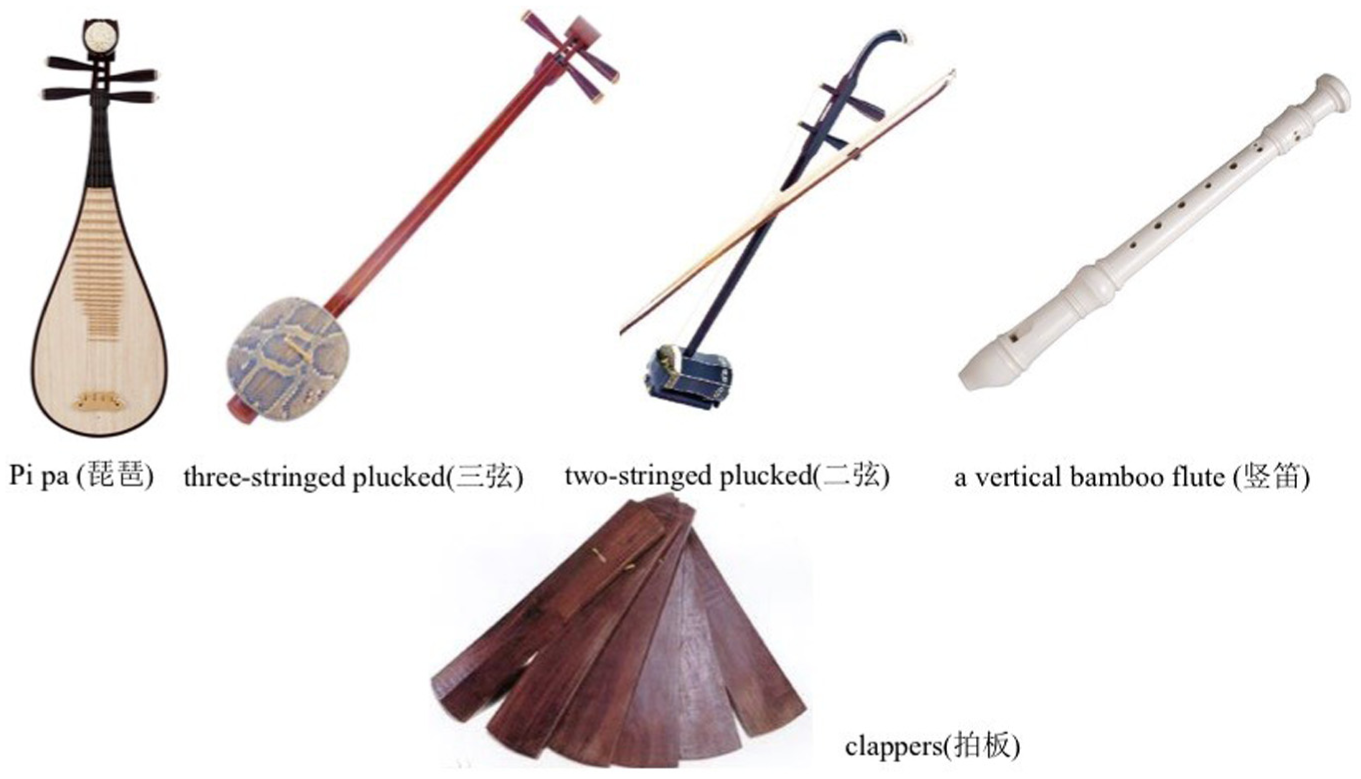
The instruments of Nanyin traditional music performance.
Nowadays, Nanyin enthusiasts in southern Fujian have spontaneously formed many folk societies, and some societies will perform free public performances in the evening. In addition to spreading in southern Fujian, Hong Kong, Macao, and Taiwan, Nanyin also spread to the Philippines, Indonesia, Singapore, Malaysia, Thailand, Myanmar, and Vietnam, and became a spiritual bond that maintains the overseas Chinese and their compatriots of Taiwan. There is a close relationship between Nanyin and language, which is an important link to the cultural identity of people in southern Fujian. The specific manifestation of this identity is folk identity based on regional culture (Zhang, 2016), which also plays a positive role in promoting national identity.
Questionnaire Survey and Data Analysis
All the scales in this study are from existing scales confirmed by previous studies, but considering the applicability of the scale under different cultural backgrounds (Sin et al., 1999), we first apply exploratory factor analysis (EFA) to deduce the four potential dimensions of tourists’ expectations, existential authenticity, cultural identity, and loyalty, and delete some items. After exploratory factor analysis, the conceptual model is tested using confirmatory factor analysis (CFA) and structural equation model (SEM), which examine the causal relationship between the four variables. SEM provides researchers with the conditions to evaluate and modify the internal structural relations of the model and is conducive to promoting the development of the theory (Anderson & Gerbing, 1998).
Design of Observation Scale
The questionnaire of this study includes two parts. The first part is to evaluate the tourists’ expectations, the perception of existential authenticity, loyalty, and cultural identity, measured by the five-point Likert scale (from “1 = strongly disagree” to “5 = strongly agree”), the second part is mainly to obtain demographic information of the respondents.
Based on the existing concepts and research, the specific measurement project of the model is contextualized according to the background of the research object “Nanyin.” Among them, the variable of tourists’ expectations refers to the work of Higgs et al. (2005) and Rojas and Camarero (2008). The development of the concept of authenticity is mainly based on the concept of existential authenticity proposed by Ning (1999), and the measurement items refer to Kolar and Zabkar (2010). The measurement of loyalty includes two dimensions of revisit and recommendation intention (Chi & Qu, 2008; Yoon & Uysal, 2005), consisting of four questions. To make the cultural identity variable meet the cultural background and particularity of the research object, the scale developed by Chinese scholar Tang et al. (2015) is applied. In addition to cultural identity variables, the measurement of other variables is all quoted from English literature. To make scientific and reasonable references and conform to the research background of this paper, we invite two experts in this field to confirm the translation of the scale. Finally, we get 21 items form this survey.
Data Collection and Sample Structure
The questionnaire survey data collection was conducted from October 2020 to January 2021. The main research places are Quanzhou, Xiamen, and Zhangzhou. A total of five undergraduate students were invited to conduct field questionnaires. Before the formal investigation, all the researchers received a short-term (1 day) training, which included the basic knowledge of Nanyin, such as: how to identify tourists, how to politely invite them to answer questions, and how to answer their questions. The questionnaire collection is mainly carried out during the week and the weekend, aiming to include tourists of mass tourism and tourists with cultural motivation. The investigation time is from 7:30 p.m. to 11:30 p.m., which is the performance time of Nanyin. The investigation method adopted in this study is the on-site intercept, which can effectively reduce the “stretching” effect caused by the memory-recall problem (Woodside & Dubelaar, 2002).
It should be noted that since most of the performances in these places are free and attract many individual tourists, there are many residents among the people watching the performances. To avoid confusion, we require researchers to politely ask potential respondents if they are visiting the area before handing out each questionnaire, and we only invite them to respond when researchers get a positive answer.
According to Wu (2009), the questionnaire should be 10 to 15 times of items, so we distributed 350 questionnaires in the 3 places together. Since we had conducted preliminary screening before asking respondents to fill in the questionnaires, this increased the recovery rate and efficiency of the questionnaires. In the end, we collected 339 questionnaires, according to the criteria such as too short answer time and obvious regularity of the answer, 32 invalid questionnaires were deleted, and finally get 307 valid questionnaires, with an effective rate of 91%. The sample information is shown in Table 1.
Basic Information Statistics of Samples (n = 307).

Empirical Study
Exploratory Factor Analysis
By further observing the output results of exploratory factor analysis, five items with low factor loading are deleted. respectively is in the tourists’ expectations variable “I think that the center will have professionally available to offer me information and respond to my needs” and “I expect to find modern, technologically advanced installations (like electronic screen),” the perception of existential authenticity in “I like special arrangements, events, concerts connected to Nanyin,” as well as the cultural identity of “I would like to participate in the activities related to the Nanyin” and loyalty of “I would like to appreciate this traditional music performance again.” In the concept of loyalty, although the first item of revisiting intention was deleted, it just shows that Nanyin has not been recognized and accepted by all the people. After deleting these items, we finally get four stable factors (Table 2).
Overall Table of Measurement Model.

Reliability and Validity Test
According to the two-step method of Anderson and Gerbing (1988), confirmatory factor analysis (CFA) is first carried out to reduce the inaccuracy of the subsequent measurement model. The software AMOS 21.0 with the maximum likelihood estimation method is used for verification. According to House (2003), all fitting indexes reached the ideal standard (Table 3), indicating that the model and data have a good fitting degree, and the variables constructed in this study have good convergent validity.
Goodness-of-Fit Test Result of Models of CFA (n = 307).

We then evaluate the reliability and structural validity of the identified four-factor potential structure. As shown in Table 4, Cronbach’s α of four factors is between .843 and .904 (>.7), indicating that the internal consistency of each factor is good. Combination reliability (CR) is between .8453 and .9061 (the critical value > .6) (Wu, 2009), indicating that the intrinsic quality of the model is good. In addition, the standardized factor loading (SFL) of the 16 items is between .603 and .916, both greater than .5, meeting the requirements (Hung & Petrick, 2010). R2 is between .364 and .839 (the critical value > .3; Tabachnick & Fidell, 2007). The above results show that the data reliability is satisfactory (Wu, 2009).
Confirmatory Factor Analysis Results (n = 307).
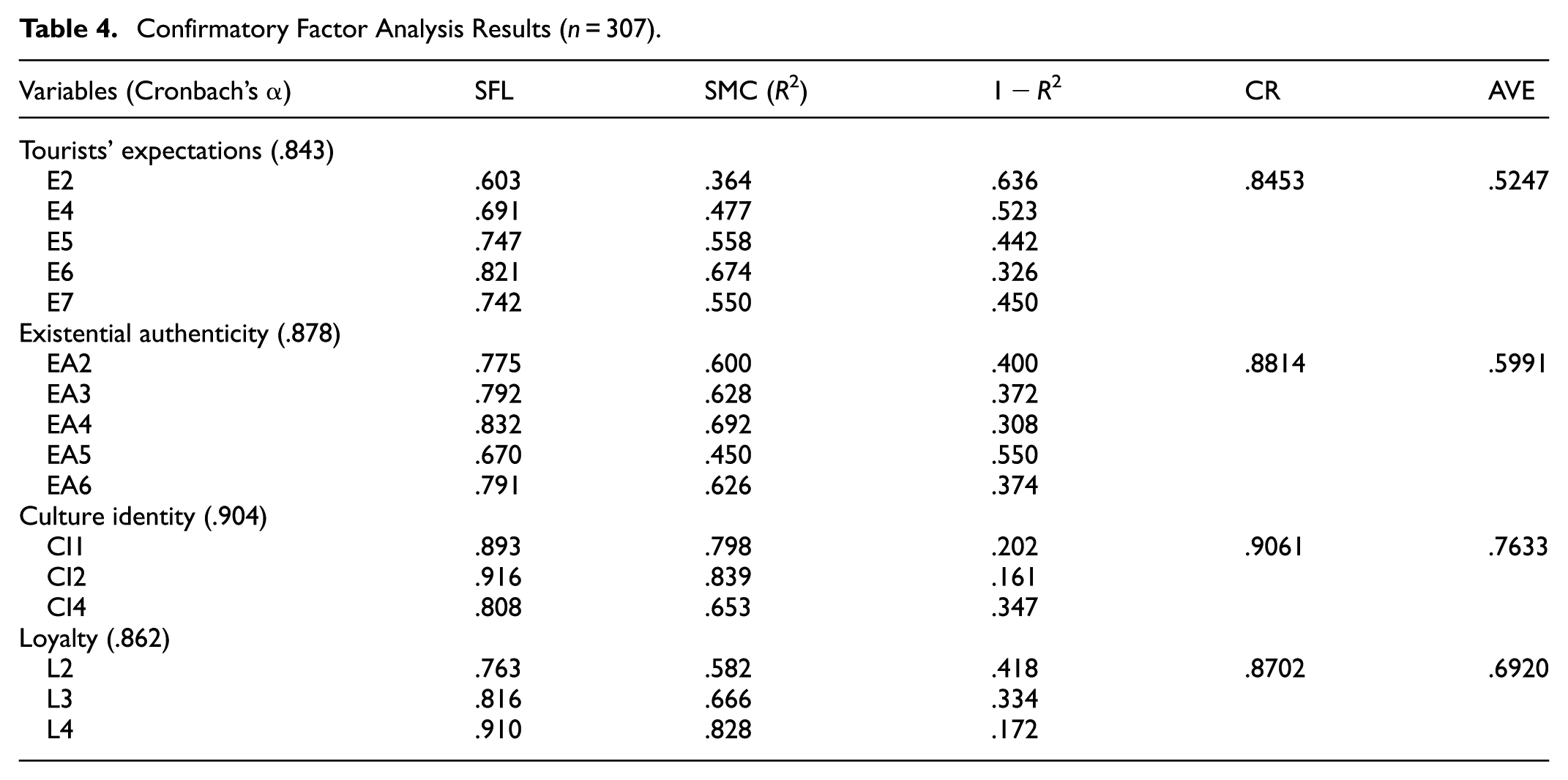
The validity of convergence is tested by testing the factor loading and the extracted average variance (AVE). As shown in Table 4, the factor loads of all 16 items are both greater than .5, and the AVE values of 4 variables are between .5247 and .7633, all higher than the standard of .5, indicating that the intrinsic quality of the model is relatively ideal (Wu, 2009).
Direct Effect and Mediating Effect Test
When the fitting result of the whole model reaches the ideal value, the structural equation model can be used for analysis. In this study, the direct effects and mediating effects of 307 samples are tested by AMOS21.0 and ML. The result of the model fitting is shown in Table 5.
Goodness-of-Fit Index of Initial Model (n = 307).

The analysis results show that the effect of tourists’ expectations on loyalty (−.023, p > .05) is not significant, so hypothesis 3 is not established (Table 6). Tourists’ expectations of Nanyin performance has a significant positive influence on the perception of existential authenticity (.858, p = .001), and there is a significant positive effect of existential authenticity perception on loyalty (.618, p < .001; Table 6).
Path Estimate and Hypothesis Test Results of SEM.

means p < .001, Figure 6 is the same.
According to the model test results (Figure 6), when the regression coefficient product test on the intermediary path rejects H0: ab = 0, the mediation effect is significant (Wen et al., 2004). In this study, the indirect effect value of the perception of existential authenticity between tourists’ expectations and loyalty is .383, therefore, in the case that hypothesis 1 in the study has not been preliminarily verified, the perception of existential authenticity has a complete mediating effect on tourists’ expectations and loyalty.

The test result of the integrated model.
Moderating Effect Test
According to the study of Wen et al. (2005), when both independent variables and moderator variables are latent, since the measurement of latent variables may have deviation, therefore, the latent variables are considered as continuous variables. Based on this, the study used the interaction product term to test the moderating effect. When the product of the potential interaction term and the standardized path coefficient of the dependent variable are significant (p <.05), the moderating effect exists. If the product of potential interaction terms and the standardized path coefficient of dependent variables are not significant (p > .05), there is no moderating effect. The results show that the standardized path coefficient of the potential variable of the interaction term between tourists’ expectations and cultural identity on the perception of existential authenticity is β = .060*** (p < .001), indicating that the cultural identity has a significant moderating effect on the tourists’ expectations and the perception of existential authenticity, and hypothesis H4 is established. The standardized path coefficient of the interaction term latent variable between the perception of existential authenticity and cultural identity on loyalty is β = .054*** (p < .001), indicating that cultural identity has a significant moderating effect between the perception of existential authenticity and loyalty, H5 is established.
Discussion and Conclusion
Discussion
For the ICHM, it’s important to explore its relationship with the perception of tourists, because music tourism is regarded as an important way to promote local economic growth and restore traditional culture (Kuah & Liu 2016; Ord & Behr, 2023). Therefore, the research results of this article have both theoretical and practical implications for tourism researchers and managers.
Theoretical Implications
Firstly, different from fashion music, Nanyin traditional music is sung in the Fujian dialect (Hokkien), which is difficult for foreign tourists to understand. This study further explores the relationship between language and tourism in the context of Chinese music tourism, which responds to existing research calls for more discussion on language-related tourism research (Lu et al., 2019).
Secondly, through literature review and the derivation of the research status, this study takes tourists’ expectations as the antecedent variable affecting tourists’ existential authenticity of the ICHM “Nanyin,” and verifies the hypothesis, the result complements previous studies (Huang et al, 2021; Kolar & Zabkar, 2010; Zhou et al., 2013). The research results extend the scope of the application of expectation disconfirmation theory. Secondly, the research takes existential authenticity as an intermediary variable and introduces it into the field of ICHM. The research results help enrich the theoretical knowledge of authenticity theory in the field of ICH tourism research. Previous studies have shown that tourists with higher education levels can perceive a higher level of authenticity (Chhabra et al., 2003). In this study, more than half of the respondents have a bachelor’s degree or above, for these tourists, they perceive a relatively high level of authenticity, and their willingness to revisit is also higher. However, due to cultural and language barriers, the communication of authenticity is more complicated. For tourists who have never been exposed to Fujian dialect (Hokkien), Nanyin, which is sung by Fujian dialect (Hokkien), may increase their overlapping layers of authenticity perception (Theodossopoulos, 2013).
Thirdly, based on existing quantitative studies on heritage tourism, our study added cultural identity as a moderating variable to verify the positive moderating effect of cultural identity on tourists’ perception of ICHM. Since cultural identity reflects positive emotions about a culture, it emphasizes connections related to historical development and cultural heritage (Zhang et al., 2020). Therefore, a UNESCO ICH with a long history, the study of cultural identity not only helps to expand the research content in the field of tourism but also has important reference significance for history and ethnology.
Practical Implications
The research of this paper provides practical references for local stakeholders. As Quanzhou is a World Heritage city attracting more and more tourists, local stakeholders should work together to develop a unique music tourism route.
First of all, Nanyin elements into various tourism products, such as creating Nanyin-themed boutique homestays, Nanyin studies tourism route, Nanyin cultural and creative products; Secondly, the Nanyin Music Museum with exhibition and education should be established to popularize the knowledge of Nanyin and ICH to the public and enhance the public’s ICH awareness. On the one hand, Nanyin Music Museum can regularly invite inheritors to perform, which is conducive to strengthening the sense of existence of visitors; On the other hand, primary and secondary schools can regularly organize students to visit and study at Nanyin Music Museum, cultivate children’s interest from an early age, and lay a foundation for the subsequent cultivation of Nanyin inheritors; Thirdly, integrate Nanyin performances into movies or television. Because artists organized by civil society are more about inheriting culture, they cannot promote this culture. Therefore, in addition to traditional performances by inheritors and Nanyin artists, marketing agencies (such as Fujian Province and municipal and county tourism bureaus) can integrate Nanyin performances into films or television, launch live broadcasts of Nanyin performances, and combine them with modern music for stage performances. In addition, it is also possible to take the historical story of Nanyin as a prototype, shoot a propaganda video in the place where the story takes place, and broadcast it in regions outside Minnan and other countries, to generate tourists’ expectations for Nanyin performances and stimulate tourists’ motivation to travel. Salzburg has become a famous music tourist city due to the broadcast of the film “The Sound of Music.” In China, the 1960 film Liu Sanjie, which combined traditional folk music with beautiful landscapes, attracted many tourists. In the development of music tourism, the popularity of music works can be used to fully interpret the plot of music stories and reproduce the atmosphere of music stories in the place where it takes place, to create a musical journey exclusive to a certain era for tourists.
Finally, establish a community music theme park. Precious traditional music should be rooted in a cultural center and constantly spread to the local people (Takahashi, 2013). Therefore, the local cultural background can be combined to establish a community music theme park, integrate traditional culture into leisure activities, enhance community residents’ cultural identity of Nanyin, and realize sustainable inheritance of Nanyin.
Conclusion
This study’s core innovation and theoretical contribution lies in the extension of the scope of application of expectation disconfirmation theory and authenticity theory. This study conducts a mixed method to explore the tourists’ perceptions and loyalty to Nanyin traditional music tourism. Since few previous studies have explored tourists’ perceptions of ICHM, this study has established a foundation for a deeper and more comprehensive understanding of the relationship between music and tourism. In addition, the research results of this study also provide practical reference for local stakeholders. Specifically, this study draws the following main conclusions through qualitative and quantitative data analysis.
According to social network content analysis, what impresses tourists most about Nanyin traditional music is its traditional culture and performance instruments. Due to the use of the Fujian dialect (Hokkien) for singing, it is difficult for foreign tourists to understand the real meaning of Nanyin, this is also why our researchers found fewer tourists experiencing Nanyin’s traditional music tourism.
In the performance of Nanyin traditional music, tourists’ expectations have a significant positive influence on their existential authenticity. Among the interviewees, 92.18% of the tourists had seen similar traditional music performances before, indicating that some of them had formed their cognition and expectations of traditional music in their mind before they came to the place of Nanyin traditional music performance. These existing cognition and expectations contribute to the formation of the perception of authenticity. Since there is a complete mediating effect of existential authenticity between tourists’ expectations and loyalty, the higher the existential authenticity they perceive, the higher their willingness to revisit and recommendations.
This study also found that cultural identity positively moderates the relationship between tourists’ expectations and existential authenticity. It shows that tourists who identify with Nanyin traditional music culture are more likely to have expectations about the performance content or the scene atmosphere, which has a significant positive impact on the perception of existential authenticity. Cultural identity also has a positive moderating effect between existential authenticity and loyalty, indicating that the tourists with a high degree of cultural recognition of Nanyin also have a stronger existential authenticity of Nanyin traditional music, and their loyalty is also higher.
Therefore, local governments and tourism enterprises should pay attention to the spread of Nanyin culture, so that more people will have a sense of identity with Nanyin culture. Specifically, Nanyin culture can be promoted to other countries or regions outside southern Fujian, which may enhance people’s expectations for the Nanyin performance and realize the positive perception of the Nanyin culture, thus helping to realize the recognition of the Nanyin culture, because this is an important influencing factor for people’s willingness to revisit.
Limitations and Future Research
The study provides a basic framework for a deeper understanding of tourists’ perceptions and loyalty to traditional music tourism. Still, there are some limitations, mainly reflected in the limitations of the questionnaire samples. The sample of international tourists is not collected in the survey, and it is limited to domestic tourists outside the Fujian region of mainland China. Although Nanyin is a UNESCO ICH, when we visited the research site, we found that few international tourists visited Nanyin’s performance venues in Quanzhou, Xiamen. Since the discussion of cultural identity must be based on tourists from different cultural backgrounds, in the case of sufficient funds and time, in addition to studying the identification of tourists outside the southern Fujian region of mainland China to Nanyin culture, the researchers should also further explore the identification of Nanyin culture by international tourists.
There may be several potential directions for future research. First of all, this study focuses on tourists’ perception of ICHM. Other types of ICH tourism have also attracted much attention, and the inheritance of ICH is on the verge of crisis. Therefore, it is suggested that future studies can introduce this model into other situations, and make appropriate optimization according to the specific research situations. Secondly, future research can adopt various methods to acquire tourists’ perceptions of ICHM, such as in-depth interviews and observations. Third, our research mainly discusses tourists’ views on ICHM in the theory of authenticity and identity. Future research can combine with some other theories to discuss different subjects’ views on ICHM tourism, such as community residents or inheritors of ICH, etc.
Supplemental Material
sj-jpg-1-sgo-10.1177_21582440251374400 – Supplemental material for Tourists’ Perceptions and Loyalty of Nanyin Traditional Music in Chinese Music Tourism
Supplemental material, sj-jpg-1-sgo-10.1177_21582440251374400 for Tourists’ Perceptions and Loyalty of Nanyin Traditional Music in Chinese Music Tourism by Peiyu Wu, Xiyue Wang, Yuanshui Huang and Xiaoyan Yang in SAGE Open
Supplemental Material
sj-jpg-2-sgo-10.1177_21582440251374400 – Supplemental material for Tourists’ Perceptions and Loyalty of Nanyin Traditional Music in Chinese Music Tourism
Supplemental material, sj-jpg-2-sgo-10.1177_21582440251374400 for Tourists’ Perceptions and Loyalty of Nanyin Traditional Music in Chinese Music Tourism by Peiyu Wu, Xiyue Wang, Yuanshui Huang and Xiaoyan Yang in SAGE Open
Footnotes
Acknowledgements
I am heartily thankful to all those who supported me in any respect during the completion of my article.

Ethical Considerations
The study did not involve experiments on animals or humans.
Funding
The authors received no financial support for the research, authorship, and/or publication of this article.
Declaration of Conflicting Interests
The authors declared no potential conflicts of interest with respect to the research, authorship, and/or publication of this article.
Data Availability Statement
Data sharing not applicable to this article as no datasets were generated or analyzed during the current study.
References
Supplementary Material
Please find the following supplemental material available below.
For Open Access articles published under a Creative Commons License, all supplemental material carries the same license as the article it is associated with.
For non-Open Access articles published, all supplemental material carries a non-exclusive license, and permission requests for re-use of supplemental material or any part of supplemental material shall be sent directly to the copyright owner as specified in the copyright notice associated with the article.


