



Abstract
Translating narrative space is a necessity due to its fundamental role in children’s literature. To date, studies have shown that efforts to examine the strategy in rendering the space issues in children’s literature translation remain scarce. Responding to that, the paper aims to explore how narrative space is transferred from one language to another. The theoretical framework is based on Ryan et al.’s model of narrative space and Baker’s framing strategies. A qualitative approach is designed to study the renowned Chinese children’s literature Bronze and Sunflower and its English version. A total of 146 examples are purposively selected as the samples. The findings show that selective appropriation is the most frequently used framing strategy. Also, it is observed that the translator prefers to omit some repeated settings and descriptions of spatial frames even though the source text elaborates them, consequently softening the sense of space in the target context. The findings may provide new insights into a better understanding of spatial issues in the translation of children’s literature.
Introduction
The early 21st century has witnessed the combination of narrative theory and translation studies launched by Mona Baker and ever-increasing approval for framing narratives in translation henceforth. In this light, relevant studies on narrative elements in translation would largely broaden the scope of translation studies and advance the “cultural turn” in translation studies. Moreover, influenced by the “spatial turn” in humanities and social sciences in the late 20th century, a growing number of narrative theorists turned toward narrative space in literary studies (Buchholz & Jahn, 2005; Hones, 2011) and recognized its powerful role in understanding “the cognitive processing of stories and the role of space in narrative structure” (Ryan et al., 2016, p. 3). Narrative space is defined as “the physical environment in which the characters of narrative to live and move” (Ryan et al., p. 3), extending from “the individual object described in a narrative to the cosmic order in which the story takes place” (Ryan et al., p. 23). Concerning the rendering of narrative space, Li (2015) punctuates that narrative space in the target text should be consistent with the one in the source text, thus providing readers with a similar sense of space for reading. However, creating the same narrative space is not an easy task. De Bleeker (2014) reveals that translation does alter narrative space in the fictional universe, either subtly or obviously. These views seem to contrast with each other, but on the other hand, call for more scholarly attention to pay on the issues surrounding narrative space. The current study hence attempts to investigate how narrative space is translated from one language to another and whether it is altered in the target text.
To illustrate the translation of narrative space, this paper probes into the fictional space in Bronze and Sunflower (2005/2017) created by Cao Wenxuan, the first Chinese writer who won the prestigious Hans Christian Andersen Award in 2016, the world’s top prize in the field of children’s literature. Bronze and Sunflower was originally written in Chinese by Cao in 2005. Subsequently, it was translated into English by Helen Wang, published by the UK’ Walker Books in 2015 and republished by the US’s Candlewick Press in 2017. It was the bestselling Chinese children’s literature hitting the English-language bookshelf in 2015 (Zoe, 2015). Besides, Wang’s outstanding translation of Bronze and Sunflower earned her the 2017 Marsh Christian Award for Children’s Literature in Translation. Its publisher Walker Books, was further awarded the PEN Translation Award for publishing such an excellent work. These awards, to a great extent, verify the success of the English translation of Bronze and Sunflower and make it an important hallmark in the realm of Chinese children’s literature for both the author and the translator.
Furthermore, narrative space is the most important element in representing the unique beauty in Bronze and Sunflower (Tan, 2014). A similar view of narrative space is emphasized by Cao (2003) as states that scenes are the basic units and the consecutive scenes constitute the whole story in Bronze and Sunflower. Indeed, narrative space pushes the development of the story in Bronze and Sunflower. Set in the rural village named Damaidi during the Cultural Revolution (a socio-political movement launched by the chairman of the Communist Party of China Mao Zedong from 1966 to 1976), the book narrates the friendship between a mute peasant boy named Bronze and a city girl called Sunflower, and how they survive various disasters that befall the poor rural villages. The main plots are put forward as one space/subspace shifts to another such as the city, sunflower field and Cadre School (a place where the Chinese authorities sent huge numbers of professional people from the cities to labor camps in remote rural areas). As such, the exploration of narrative space in Bronze and Sunflower could increase the empirical data in translating spatial elements in the field of children’s literature.
For carrying out the research on narrative space through the twin lenses of narrative theory and translation studies, it is a prerequisite to clarify corresponding concepts and delimit the study scope. As far as narrative space is concerned, Ryan et al. (2016) propose a model of narrative space involving spatial frames, setting, story space, storyworld, and narrative universe. Following the multi-layered model, this paper offers detailed categories of narrative space which can be observed in Bronze and Sunflower. Besides, the study employs Baker’s view of translation, that is, translation is defined as a form of (re)-narration in which the focus is to construct the world in another language rather than transferring semantic content accurately (Baker, 2006). She further identifies four framing strategies (temporal and spatial framing, selective appropriation, labeling, and positioning of participants) to construct narratives in the target context. Although Baker’s narrative account is often used to enlighten the translation study of political conflict, this paper extends the framework into the translated children’s literary works, which is also a future direction emphasized by Baker (2014).
Space in Children’s Literature
Space is an under-researched area within children’s literature scholarship, especially when compared to other elements such as themes (Bengtsson, 2009; Goldstein & Bloom, 2015) and characters (Nikki & Yates, 2002; Nikolajeva, 2003). Despite that, this phenomenon has been compensated as various scholars are inclined toward space and acknowledge its indispensable function in offering the domain for the character, time, environment, and plot (Bakhtin, 1990; Ronen, 1986). Fiction happens in space (Hones, 2014). Without space, the characters’ existence would lose much of its significance. Specifically, in the realm of children’s literature, the issues surrounding space have been emphasized by recent scholars such as Thompson and Sealey (2007), Bradford and Baccolini (2011), Hayles (2011), Cecire et al. (2015), Pullman (2015), and Kujundžić (2020).
Children’s literature is always characterized by the didactic nature, the dual readership, the simplicity at narrative and discoursal levels, and the asymmetrical communication between the reader and the writer (Čermáková, 2018). However, this view seems to ignore the role of space which is underlined by Nikolajeva (2016), arguing that “among the significant features of modern children’s literature is the daring use of time and space relations” (p. 9). She further identifies that one important feature of the realistic children’s novel is the “concrete, sometimes also clearly limited space” (Nikolajeva, 2016, p. 124) since it is associated with the development of the protagonists’ spiritual maturity. Approaching similar views, Thompson and Sealey (2007) point out that children’s fictions, according to the British National Corpus, are slightly different from the adults’ fictions in the perception of spatiality. For instance, the creatures which are common to adults may tower over a child protagonist. This spatial attribute which is nowadays at the core of some scholarly disciplines thus adds to the growing body of research on the unique features of children’ literature.
Further, Bradford and Baccolini (2011) reveal that space not only affords the background where events occur but also interweaves with an individual’s identity-formation and the development of interpersonal relationships. Based on cultural geography, postcolonial theory and utopian studies, they situate detailed discussions on Maurice Sendak’s picture book Where the Wild Things Are (1963). It is found that the different spaces inhabited by the protagonists show the spatial distribution of hierarchical power relations or hierarchical division in the society. Moreover, spaces constitute “a locus for individual and cultural identity, incorporating sensual, esthetic and emotional dimensions” (Bradford & Baccolini, 2011, p. 55). For example, they explain, the semi-gated communities where Titus and his friends live indicate the poor’s habitation. While in the affluent sections of society, each house is its own private space under protective surroundings. In this light, the spatial distribution is more than geographical but material and cultural, affecting children’s ways of thinking about themselves and their world.
In the same vein, Hayles (2011) confirms that human characters’ sense of self is established in different social spaces constructed within the text. Taking Harry Potter and the Philosopher’s Stone as an instance, Rowling constructs the Muggle world and a parallel world of magic. Although Harry Potter belongs to the wizarding world, he is unaware of the social order and value in this world because of his Muggle upbringing. Gradually, he begins to know his relative social position in this parallel space and gets an owl as an unspoken marker of his magical identity. As such, space is not an inactive background but a dynamic narrative element that is continuously being negotiated through the relations between characters. And the individual’s identity is not fixed but fluid as the character moves from one space to another.
Additionally, space facilitates the construction of the contour of childhood in children’s literature. Cecire et al. (2015) reveal that one recurring characteristic of classic children’s literature is “the designation of special spaces of childhood into which only children may pass” (p. 1). They further explain that some locations such as Wonderland and Neverland are often seen as a world for childhood with their own logic and landmarks, different from adult reality. Similarly, Pullman (2015) concurs that the space built-in children’s literature, either imaginary or material, indicates the potential profile of childhood. In this regard, space in children’s literature, whether real or imaginary, provides a variety of geographies for childhood experience, thus enriching the understanding of the spatial dimensions of childhood.
Although the aforementioned studies draw more attention to the studies of space in children’s literature, they do not touch upon how space is constructed in children’s literature which is highlighted later by Kujundžić (2020). Taking the Grimms’ collection Childrenʼs and Household Tales (1857) as a case study, Kujundžić examines the structure and organization of narrative space in the fairy tale. Based on Ryan et al.ʼs model of narrative space, her study demonstrates the complex process of constructing narrative space in the fairy tale and proves that the relations between the character’s identity and space are dynamic and bidirectional. Nevertheless, Kujundžić’s study is only based on nineteenth-century German fairy tales. The spatial issues in Chinese children’s literature are still a niche, which deserves to be explored further to offer insight into narratology, literary geography and Chinese children’s literature.
Space in Translation Studies
The scholarly attention devoted to the translation of space has still been little. It is partly due to its long-neglected position in literary works, subsequently pushing the translated counterpart to a marginalized status. Nevertheless, some recent researchers began to draw interest in the translation issues surrounding space in children’s literature (Zur, 2020), dramas (Wang, 2014), and science fiction (Chen, 2019; De Bleeker, 2014).
Translators in children’s literature take great liberties in translating space. Lathey (2006) notes that the children “cannot be expected to have acquired the breadth of understanding of other cultures, languages and geographies that are taken for granted in an adult readership” (Lathey, 2006, p. 7). This may lead to considerable deviations between the original and translated text from the aspects of cultures, languages and geographic space. Further, Zur’s (2020) investigation exemplifies the discrepancies of geographic space in the translation of children’s literature. By comparing the Russian and Korean versions of Flight to the Moon, Zur finds that Korean translators enjoy much freedom by editing and adding spatial content. For example, Korean translators give a rich description of scenery which is a word-less scene in the original Russian.
Zur’s study confirms the alteration of geographic space in the translation of children’s literature. Wang (2014), based on Lefebvre’s spatial criticism, proves the deviation of space between the source and target texts in drama translation. Wang selects English playwright Sir James Matthew Barrie’s Dear Brutus (1917) which was translated by Chinese dramatist Hong Shen as 第二梦 (Di Er Meng) in 1925 as a case study. It is revealed that landscape space, psychological space and social space are reconstructed in consideration of the target audience’s expectation and acceptance. A case in point is that the British country villa has been replaced by a house with strong Chinese Taoist cultural flavors such as burning incense sticks on the tea table and a picture of the Azure Dragon which is worshiped by the Taoists on the right wall. Although the translated space is quite different from the original one, Wang points out, it has a great effect on creating a mysterious atmosphere in the drama.
Conversely, Li (2015) emphasizes that the translator should not alter the original space since it fails to offer the same experience for the target readership to enjoy the space. Especially, the target text should construct the same narrative space as in the source text, or, the translation is doomed to failure. However, Li does not offer further data analysis, which makes her claim lack empirical support. Unlike Li, De Bleeker (2014), through the twin lenses of narratology and comparative translation analysis, argues that translation alters narrative space when it is translated from one language to another. Drawing upon a three-layered narratological framework involving constructed space by the reader, textual manifestation of space, and scenography, De Bleeker scrutinizes space in narrative created by Patrick Chamoiseau’s science novels Chronique des sept misères (2002), Texaco (2003), and their English and Dutch translations. Through the analysis, De Bleeker finds that the layer of scenography witnesses many changes in translation through the omission of appendices, the addition of notes or glossary and redesign of the cover. In this way, the alteration made in translation does influence the narrative space, thereby making the translated versions meet the narration habits of the target reader.
Similarly, Chen (2019) focuses on the spatial narrative features represented in Hao Jingfang’s science fiction Folding Beijing (2015). Based on Zoran’s model of narrative space (1984), Chen finds that the original spatial features are changed when they are translated from Chinese to English. (a) In the topographic level, the translator translates the name of the places faithfully. (b) At the chronotopic level, the target text strictly follows the synchronic and diachronic relations in the source text. (c) On the textual level, it keeps the original narration tempo and narrative sequence while adding more information and adjust the narrative layout. Chen’s study details the retainment and alteration between the source and target texts in different layers of space, offering the empirical data of the spatial alteration in translation.
Despite that De Bleeker’s and Chen’s investigations provide detailed analysis on the alteration of narrative space in translation, there remains a notable paucity of evidence-based literature specifically relating to translation strategies causing the alteration. The current study attempts to take one step further, aiming to identify the translation strategies used and explore how they are employed by the translator to transfer the narrative space in Bronze and Sunflower.
Theoretical Framework
The current study mainly concerns the translation of narrative space in Cao’s children’s fiction Bronze and Sunflower (2005/2017). To deal with the possible problems in rendering narrative space, the theoretical framework is based on Ryan et al.’s (2016) model of narrative space and Baker’s (2006) framing strategies.
Narrative space is identified by the model of narrative space comprising spatial frames, setting, story space, storyworld, and narrative universe (Ryan et al., 2016). Spatial frames refer to “the immediate surroundings of the characters” as “shifting scenes of action” (Ryan et al., 2016, p. 24). From this point, spatial frames would change or flow into each other as the characters move. For example, a “courtyard” frame can change into a “kitchen” frame as Sunflower moves. While spatial frames seem changeable, the setting, in contrast, is relatively stable. It refers to a “socio-historico-geographic category that embraces the entire text” (Ryan et al., 2016, p. 24). For instance, the setting of Bronze and Sunflower is under the background of the Cultural Revolution (1966–1976) in China. Story space is labeled as “the space relevant to the plot as mapped by actions and thoughts of the characters” (Ryan et al., 2016, p. 24). Accordingly, it contains “all the spatial frames plus all the locations mentioned by the text that are not the scene of actually occurring events” (Ryan et al., 2016, p. 24). In Bronze and Sunflower, it comprises places, namely the cadre schools and Damaidi. Ryan et al. continue to introduce storyworld which is the “story space completed by the reader’s imagination on the basis of the principle of minimal departure” (p. 24). It superimposes the location in the text onto the places of the real world. The city which is not described with detailed information is a case in point, readers could assume the basic layout of the city such as the buildings and streets. The last level is narrative universe which includes “the world presented as actual by the text, plus all the counterfactual worlds constructed by characters as beliefs, wishes, fears, speculations, hypothetical thinking, dreams, fantasies, and imaginative creations” (Ryan et al., 2016, p. 25). A case can be seen is that Sunflower believes her father is still in the sunflower field although he died. As such, the multi-layered model offers detailed categories of narrative space which can be observed in Bronze and Sunflower.
Concerning the framing strategies, Baker (2006) regards them as kind of translation strategies contributing to the configuration of narratives. Framing is “an active strategy that implies agency and by means of which we consciously participate in the construction of reality” (Baker, 2006, p. 106). In other words, framing is not a strategy for presenting events, but a way to construct how the events are presented to others. The framing strategies (temporal and spatial framing, selective appropriation, labeling, and repositioning of participants in the narrative) are therefore served as the analytical tools for the translated narrative space in this study. Temporal and spatial framing means that that selected text is put in a temporal and spatial sequence to become meaningful. Selective appropriation of textual material is fulfilled in patterns of omission and addition. Labeling refers to the use of a lexical expression to identify a place, an event or other elements in a narrative. Positioning of participants concerns how the participants of narratives are positioned in a narrative. Figure 1 briefly shows the theoretical framework of this study.
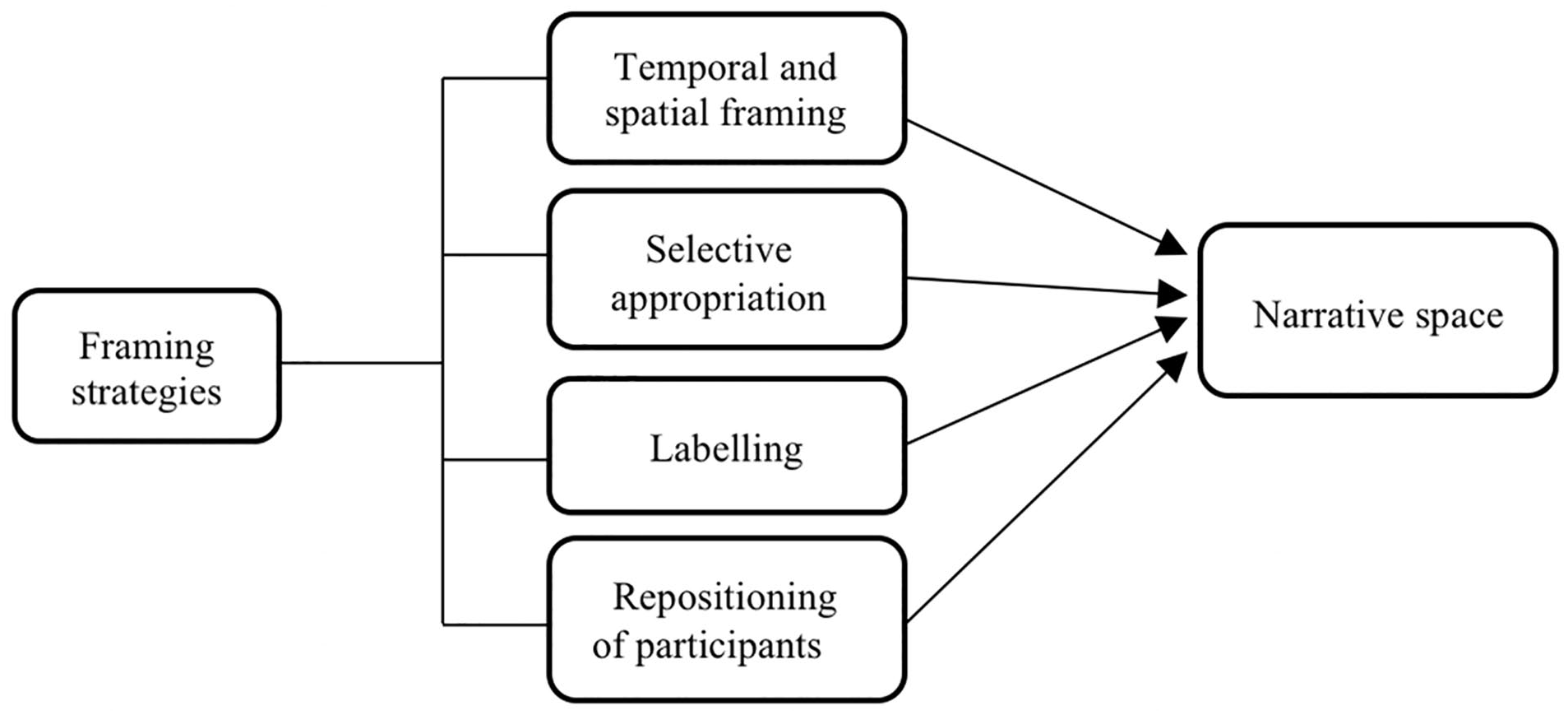
Theoretical framework.
Based on Ryan et al.’s (2016) model of narrative space and Baker’s (2006) framing strategies, this study addresses the following research questions:
Method
Research Design
This study employs a qualitative research design because the translation issues pertinent to space are complex and require deep interpretation and analysis. Furthermore, translation research, to some extent, depends on the qualitative approach to gain an in-depth understanding of the research problem across languages (Mandal, 2018). The research questions are about what and how the framing strategies are used to translate the narrative space in Bronze and Sunflower. The data thus are characterized by textual data from Chinese and English languages rather than numerical data, which are appropriate for qualitative measurements.
Study Sample
This study utilizes purposive sampling since the sample in a qualitative study is believed to be representative rather than random (Ary et al., 2010). Specifically, qualitative research favors symbolic representation which is not intended to be statistically representative but is based on the shared characteristics of the population (Ritchie et al., 2003). Thus, the authors of the current study select samples to offer relevant information about the topic, which is also guided by the research questions. In practice, the data were extracted from the original Chinese text 青铜葵花 (Qing Tong Kui Hua) (Cao, 2005) and its English translated version Bronze and Sunflower (Cao, 2017). The current study purposively selected two scenes, the river and the Cadre School, as the samples. The rationales behind this selection are that (1) they are based on the shared characteristics of narrative space; (2) they span different cases of narrative space; (3) they put forward the development of the plots.
Data Analysis
Data analysis was guided by Baker (2006), who considers translation as a kind of framing device by which translators “resort to various strategies to strengthen or undermine particular aspects of the narratives they mediate, explicitly or implicitly” (p. 105). The data in the source text were compared with the ones in the target text to identify the framing strategies deployed by the translator. In this process, the computer-aided software Atlas. ti was used to facilitate the comparison. Then, analyses of specific examples were conducted to examine the application of the four strategies, namely temporal and spatial framing, selective appropriation, labeling, and repositioning of participants in the narrative.
Furthermore, to increase the credibility of the study, the researchers use thick description which is known to describe the phenomena under study in detail (Mills et al., 2010). Shenton (2004) argues that thick description is particularly needed to provide sufficient information and make readers understand. Thus, the researchers of the current study offer a thick description of the translating of narrative space in the translation of Bronze and Sunflower.
Results and Discussion
Based on the data collection and analysis methods mentioned in the above section, this study locates 146 examples with framing strategies, namely selective appropriation, temporal and spatial framing, labeling, and repositioning of participants. The finding reveals that selective appropriation is the most frequently used in framing narrative space, accounting for 71% of the total data. Temporal and spatial framing, repositioning of participants and labeling take up 14%, 11%, and 4% respectively, which show relatively low frequency among the framing strategies (Figure 2).

Distribution of the framing strategies in the translation of narrative space.
Selective Appropriation
Selective appropriation of textual material is “realized in patterns of omission and addition designed to suppress, accentuate or elaborate particular aspects of a narrative encoded in the source text or utterance, or aspects of the larger narrative(s) in which it is embedded” (Baker, 2006, p. 114). Accordingly, it is achieved through omission and addition, by which the translator excludes or includes specific information. In the current study, omission is more frequently used than addition. The former occupies 82%, whereas the latter accounts for 18%. This study now proceeds to illustrate omission and addition.
Omission
In the current study, the translator frequently employs omission, whether deliberate or not, to filter or diminish particular aspects of narrative in the source text. The two examples below are taken from the data to explain how omission takes place.
In Example 1, “河那边是大麦地” (On the other side of the river was Damaidi) and “在大河边” (by the river), which are the geographical sites in the source text, could be deemed as settings where the story happens. The sentence “on the other side of the river was Damaidi” takes up a whole paragraph in the original text, particularly drawing the readers’ attention to the topographical layout of the setting. The adverbial place “by the river” marks the location of the old elm tree. Notwithstanding, the repetition of the spatial information could “stress the stability of the frame, as opposed to the transitory nature of the events that occur within it” (Bal, 2009, p. 143). It further helps to accentuate the sense of space. It is noted that the source text inclines to highlight the space involving the river, Damaidi, an old elm tree and Sunflower, foregrounding a broad and lonely spatial frame. However, the target text manipulates the lens to produce a reduced picture just including an old elm tree, Sunflower and water, thereby softening the sense of space.

The source text in example 2 shows the spatial frames which are filled with the river water and the reeds. The dynamic descriptions such as “芦苇被流水摇动着” (the reeds were shaken by the running water), “颤抖的叶子” (the trembling leaves), “被水调皮地胳肢了” (tickled by the naughty water) help to create a natural and lively atmosphere surrounding the characters. However, the translator filters them out in the English version. The possible reason may be due to the fact that extensive presentation of space unavoidably interrupts narrative time. Thus, to guarantee the tempo of narrative in the target context, the translator sacrifices the esthetic perception that arose from nature.

Based on the above analysis, the study finds that the translator prefers to cut out the repeated settings and detailed depiction of spatial frames (see Table 1), therefore leading to the weakening of narrative space in the target text. Furthermore, the omission is the most frequently used method in translating narrative space in Bronze and Sunflower, indicating that the narrative space in the target text may always be altered by deletion, rather than other methods.
Omissions in Selective Appropriation.

Addition
In selective appropriation reframing strategy, adding information is a way to highlight some specific aspects of the narrative, as seen in the following examples.

In example 3, the source text starts with Sunflower’s spatial movement (walked to the river) without explicit temporal information, thus emphasizing the place of action at the very beginning. Whereas, the target text adds a time marker “one day” before the action, revealing the time when the event occurs in the story. This temporal information serves as a guide for the reader to follow the chronological order of the events, which indicates the plots would develop as time proceeds. Remarkably, this study finds more examples (Table 2) showing the translator’s preference for adding temporal information such as “in the early morning” and “when.” It is noted that these temporal expressions are moved to the beginning of the sentences and replaced the original spatial objects. As such, the privilege of additional time markers shores up the temporal frame in the target text, but meanwhile, weakens the frames of space.
Additions in Selective Appropriation.

Temporal and Spatial Framing
Temporal and spatial framing involves “selecting a particular text and embedding it in a temporal and spatial context that accentuates the narrative it depicts and encourages us to establish links between it and current narratives that touch our lives” (Baker, 2006, p. 112). It mainly focuses on the sequential order, either temporal or spatial, which carries meaning in a narrative.

Example 4 locates in the second paragraph of chapter one. The source text starts with a list of spatial frames which were wet: the grass, the flowers, the windmills, the buildings, the water buffaloes. And then it concludes that everything was wet. Rather than following this sequence, the target text reverses it by placing the outcome “everything was wet” first and exposition “the grass, the flowers, the windmills, the buildings, the water buffaloes, the birds, the air” later. This order conforms with the reversal-type structure (outcome–exposition–complication–climax–initiating event) which evokes a high curiosity response in fiction (Knobloch et al., 2004).
Additionally, the repetition of the word “wet” has been avoided in the target text, leading to a more concise narration. The translator highlights in an interview that English readers are not used to a number of repetitions in a story (Zoe, 2015). Hence, she endeavors to reduce information and repetition when translates the text for the young readership. Nonetheless, in the source text, the author attaches much attention to create a sense of wet space via reiterating the status of wet from one object to another. It’s hard to say which style is better, but rather that each version has a different emphasis on the sequence, space, and time.
Labeling
Labeling is defined as “using a lexical item, term or phrase to identify a person, place, group, event or any other key element in a narrative” (Baker, 2006, p. 122). In the following example, purposive framing by labeling is chosen to shape the understanding of the narrative.

The source text in example 5 shows an abstract space that is relatively independent of other worlds, indicating a general setting for narrative. The Chinese phrase “相对独立的世界” (relatively separate world) expresses the intense sense of space, while in the English version, the world is labeled as “the city people lived in a world of their own,” which softens the sense of space. Moreover, the exclusiveness of the world which is only for the city people instead of other groups has been highlighted in the translated text. Through labeling, the translator changes the space from an abstract and separate world into a concrete and exclusive place of city people.
Repositioning of Participants
Repositioning means that “participants can be repositioned in relation to each other and the reader or hearer through the linguistic management of time, space, deixis, dialect, register, use of epithets, and various means of self-and other identification” (Baker, 2006, p. 132). The following case discusses the rendering of the scene through repositioning.

In example 6, the Chinese version depicts the spatial frames involving “the faint sound of the river” and “the dogs barking in Damaidi.” The use of “there is” not only reflects the spatial situation of utterance but also indicates that this viewing position is assumed by the narrator of the story. In this way, readers can access these sounds through his or her feeling and accept them as the reality of the fictional world. Whereas, in the target text, the translator adds a participant “she” (here refers to Sunflower) in the context and describes the sounds from her personal experience. The narrative angle of view thus exists in the character of the narrative, rather than the external narrator, influencing the objectivity of the spatial frames. Besides, rearranging the position of the character and the receptor of the narrative result in suppressing the narrator’s voice. Perceiving the sound through the character’s focalization would shorten the distance between the reader and the character, hence encouraging personal identification with the character.
Conclusion
The application of framing strategies into the rendering of narrative space in children’s literature offers a promising perspective in the interdisciplinary field of narrative theory and translation studies. For one thing, narrative space is continuously reconfigured by framing strategies in translation; for another, framing strategies allows the translator to look beyond accuracy and equivalence so that the alteration of narrative space can be reconfirmed. Through analysis, the study reveals that selective appropriation is the most frequently used framing strategy to tone down or eliminate the sense of space in the target context. Thus, this study can be attributed to a better understanding of spatial issues in the translation of children’s literature and enlighten the translation strategies in children’s literature. Indeed, spatial information in the target text does not necessarily keep in line with what is presented in the source text, which would prompt us to engage with Chinese and Western narrative habitus and translator’s style in the future study. Furthermore, the translation of spatial issues in a wider range of genres such as comics, adult literary works and films would be involved in future directions. Moreover, narrative account to translation can be expected to trace the translator’s voice in either literary or non-literary translation.
Footnotes
Declaration of Conflicting Interests
The author(s) declared no potential conflicts of interest with respect to the research, authorship, and/or publication of this article.
Funding
The author(s) disclosed receipt of the following financial support for the research, authorship, and/or publication of this article: This work was supported by the [2019 National Social Science Foundation of China] under Grant [number 19CYY012].
