




Abstract
The explicitation hypothesis, which posits that translations tend to provide more explicit information compared with source texts, has been extensively studied as one of the translation universals in corpus-based translation studies. Previous studies have focused on grammatical cohesive devices, with little research into lexical cohesion to examine the explicitation hypothesis, which is also under-investigated within the realm of children’s literature. Comparing 10 Chinese versions of Alice’s Adventures in Wonderland with the English original, this article re-examines the explicitation hypothesis by investigating character name repetition, which belongs to lexical cohesion, through corpus analysis techniques and qualitative analysis. The results indicate that character names occur significantly more often in the Chinese translations than in the English original, supporting the hypothesis. At individual character level, the keyness analysis reveals that only the name Alice has a significant difference, and thus we posit that explicitation is potentially associated with the centrality of the character in a story. Additionally, the qualitative analysis explores the literary and narrative effects of the repeated occurrences of character names. This study contributes by introducing character name repetition as a novel indicator of explicitation and identifying a new variable that influences the degree of explicitation, encapsulated in the newly proposed “character-driven” theory.
Keywords
Introduction
Translation, as an interlingual practice, has been viewed by some translation scholars as a distinct form of language or a “third code” with unique linguistic characteristics that differ from both the source and target languages’ grammatical structures (Baker, 1993; Frawley, 1984). Scholars have proposed the existence of specific features within translational language, known as translation universals (TU) (Chesterman, 2004). In recent years, the utilization of corpora in language research has facilitated the study of TU, which has made significant progress in translation studies (Luo & Li, 2022; Puurtinen, 2004; Yang & Li, 2021; Zhang et al., 2020, 2022).
Specifically, TU refers to universal features of translations which are pertinent to “the relation between translations and source texts” (Chesterman, 2004, p. 1) and “the relation between translations and comparable non-translations in the target language” (2004, p. 1). The former relation is called S-universals while the latter T-universals (Chesterman, 2004). According to Chesterman’s (2004) summary of existing proposed TU, potential T-universals include simplification (i.e., translations tend to be less complex), normalization (i.e., translations tend to conform to the norms of target language), etc. On the other hand, potential S-universals include the law of interference (i.e., translations would be influenced by source language), retranslation hypothesis (i.e., early translations tend to be closer to target culture), explicitation hypothesis (i.e., translations tend to be more explicit), etc. (Chesterman, 2004).
Explicitation might manifest itself as an increase in cohesive explicitness (Blum-Kulka, 1986). According to Baker (1996), there are syntactic and lexical explicitation. An example of syntactic explicitation in English is the addition of complementizer “that” in reported speech. For lexical explicitation, Baker points out that it may be demonstrated through the excessive use of conjunctions or explanatory vocabulary. Tang and Li (2016) have also found a tendency for professional interpreters to add more conjunctive adjuncts for explicitation. These studies point to the fact that cohesive devices are closely related to the explicitation hypothesis, and the absence or the existence of these cohesive devices might either reject or support this hypothesis.
Cohesive devices are formal linguistic devices that are important in writing as they can establish links between sentences and give readers a sense of connectedness in the text (Jones, 2012; McCarthy, 1991). Children’s literature is an important area to study cohesive devices because children likely need more help in comprehension than adults due to less reading experience or prior knowledge (Corrigan & Surber, 2009). Readability is of high importance in children’s literature and cohesive devices play an important role in enhancing readers’ comprehension. However, few studies have examined cohesive devices, particularly few for lexical cohesion, and explicitation hypothesis in the context of children’s literature. Moreover, character name repetition leads to a high level of explicitness but has not been studied as an indicator to examine the explicitation hypothesis. It will be valuable to examine how lexical cohesive devices influence the explicitation hypothesis in this context, shedding light on the mechanisms through which these devices facilitate comprehension and contribute to the overall readability of children’s literature.
To address the research gap, this study aims to re-examine the explicitation hypothesis through an investigation of character name repetition—an aspect of lexical cohesion that significantly contributes to textual coherence and reader comprehension. This repetition is particularly noteworthy in children’s literature, where maintaining character recognition is crucial for young readers who are still developing their ability to track plot and character development. By analyzing character name repetition in the selected English children’s story, Alice’s Adventures in Wonderland, and its ten Chinese translations, this study will explore how the frequency and context of using character names can lead to explicitation, thereby making the narrative more accessible and understandable to the target audience. This explicitation may manifest as an increase in character name usage in translation, which could serve to clarify character actions and relationships, ensuring that younger readers can follow the story with greater ease. This study aims to address the following research questions (RQ).
Literature Review
Cohesive devices play a crucial role in increasing explicitness of a text. This section provides a review of the existing literature about cohesive devices in the study of explicitation hypothesis and the testing of this hypothesis in the context of children’s literature. This review synthesizes findings from relevant studies to identify gaps in current research.
Cohesive Devices and the Explicitation Hypothesis
Cohesive devices have a close relationship with explicitation hypothesis because one way to achieve explicitation in translation is to increase cohesive explicitness (Baker, 1996; Blum-Kulka, 1986). According to Halliday and Hasan (1976), cohesive devices can be divided into grammatical cohesive devices and lexical cohesive devices. The main categories of grammatical cohesive devices include conjunction, reference, substitution, and ellipsis, while lexical cohesion devices encompass reiteration and collocation. For reiteration, “a reiterated item may be a repetition, a synonym or near-synonym, a superordinate, or a general word.” (Halliday & Hasan, 1976, p. 278)
A large number of previous studies have focused on grammatical cohesive devices especially conjunctions when investigating the explicitation hypothesis (Li & Li, 2021; Marco, 2018). For example, Song (2022) studied the connectives used in The Lord of the Rings and its Chinese translations, as well as other non-translated Chinese texts. Song’s analysis supports the explicitation hypothesis as there were higher occurrences of connectives in translations. Zufferey and Cartoni (2014) discovered only certain French connectives, such as puisque, had a higher use for explicitation than other connectives. Similarly, some English connectives, such as since and given that, were used more frequently for explicitation than others. Their study indicates that the phenomenon of explicitation in translation can vary with different connectives. Dong (2018) collected English scientific texts and their Chinese translations and focused on the translation of grammatical metaphor. She found that grammatical metaphors in the ST were made more explicit by adding more conjunctions in the Chinese translations, so that the logical relationships conveyed by the sentences were clearer. Chen (2004) explored the tendency of explicitation in translation through examining conjunctions. Chen’s corpora contained English source texts, translated Chinese texts, and non-translated Chinese texts in the area of popular science and technology. His study reported that more conjunctions were used in TT than in ST or in non-translated Chinese texts. Both Dong (2018) and Chen (2004) found some support for the explicitation hypothesis but they focused on conjunctions, which belong to grammatical cohesive device.
Some other studies have focused on the use of personal pronouns as an indicator of explicitation. Pronouns belong to the category of reference in grammatical cohesive devices (Halliday & Hasan, 1976; Jones, 2012). Wang and Hu (2010) analyzed corpora of translated literature and non-translated literature in Chinese and found that personal pronouns were used more often in translations, supporting the hypothesis. Jiménez-Crespo (2011) also found greater use of personal pronouns in translated Spanish corporate texts than in non-translated texts. Similarly, Zhu (2023), Zhang et al. (2020), Ahangar and Rahnemoon (2019), and Tong (2013) examined personal pronouns and provided some evidence for explicitation hypothesis.
In fact, there have been mixed findings regarding the explicitation hypothesis. Marco (2018) examined the explicitation hypothesis through investigating the use of connectives in translated and non-translated Catalan texts. His analysis found that the occurrences of connectives in translations and non-translations did not have a significant difference. Moreover, the type of logical relationship might play a role in explicitation, as Marco (2018) reported that there were significantly more consequence connectives in translations than in non-translations but the same phenomenon was not observed for contrast connectives. Alasmri and Kruger (2018) studied the use of conjunctions in translated and non-translated Arabic texts and found that conjunctions were used more often in non-translated Arabic texts than in translated Arabic texts, which is opposite to the explicitation hypothesis.
Cheong (2006) focused on English-Korean and Korean-English translations and measured explicitness or implicitness by word count, frequency of the use of connectives, and frequency of the use of brackets and parentheses. The results revealed that apart from explicitation, there were also implicitation and contraction in TT, depending on factors such as the translation direction, text domain, and target readers’ knowledge. This highlights the multifaceted characteristic of the explicitation phenomenon.
Based on the existing literature, it is found that previous studies have extensively examined the explicitation hypothesis with grammatical cohesive devices. However, very limited studies have investigated the hypothesis using lexical cohesion as an indicator. Lexical cohesion is “the cohesive effect achieved by the selection of vocabulary” (Halliday & Hasan, 1976, p. 274). This means that general nouns can be used as cohesive devices when they have a common referent or echo each other. There are different types of lexical cohesion, which includes the use of repetition, synonym, near-synonym, hypernym, etc. (Halliday & Hasan, 1976). The related semantic meanings of nouns help the text hang together and contribute to cohesion.
Li and Li (2021) argue that cohesive explicitness is not limited to connectives but far beyond them. Their study focused on cohesive chains, which are chains of related or similar lexical items, in Hongloumeng and two English translations. However, previous research on the explicitation hypothesis has primarily focused on examining grammatical elements, neglecting the exploration of its potential implications on lexical cohesion. Although the study by Hansen-Schirra et al. (2007) considered lexical cohesion when comparing explicitness between English originals and German translations, they acknowledged the limitation that they relied on the indicators of type-token ratio and lexical density, which could only measure lexical cohesion indirectly. Therefore, there is a need for a broader investigation into the explicitation hypothesis, encompassing the realm of lexical cohesion to enhance our understanding of this phenomenon.
Testing Explicitation Hypothesis in the Context of Children’s Literature
As reported by Cheong (2006), the factor of target readers’ knowledge could affect explicitation. When it comes to the topic of children’s literature in this study, target readers’ knowledge might be an even more crucial factor as translators might bear children’s knowledge in mind, considering their needs and their level of comprehension. This might lead to a greater tendency for translators to adopt the explicitation strategy. Therefore, translated children’s literature might be more likely to manifest the characteristics of explicitation than other genres of writing (Yang, 2020; Zhang et al., 2020). As pointed out by Alasmri and Kruger (2018), although there has been growing awareness of the relationship between TU and genre, little has been done to explore this area. Therefore, Alasmri and Kruger (2018) explored the use of conjunctions in Arabic fictional narratives and legal texts but obtained mixed findings: for the use of Arabian “but,” the explicitation hypothesis was supported in fictional narratives but not in legal texts; for Arabian “or,” the results in legal texts were opposite to the hypothesis; for Arabian “and,” the hypothesis was supported in legal text but not in fictional narratives. These show that further investigation of the explicitation hypothesis in genre is required. By investigating the explicitation hypothesis in children’s literature, we can gain insights into how explicitation manifests itself in this genre and how it might affect children’s comprehension of texts.
Only a handful of studies have examined the explicitation hypothesis in the context of children’s literature. Yang (2020) discussed the explicitation phenomenon in the Chinese translation of Adventures of Huckleberry Finn through the perspectives of ideational, interpersonal, and textual explicitation. Yang illustrated explicitation in the translation mainly by describing examples. Yang’s study is a rather broad and general discussion about explicitation and does not have a specific focus on a particular linguistic element. Xu and Sun (2021) also took a qualitative approach in examining explicitation in translation, comparing the explicitation strategy in different Chinese translation versions of The Wonderful Wizard of Oz. Similar to Yang’s study, Xu and Sun (2021) did not focus on specific linguistic elements. Instead, their study focused on the stylistic effects of explicitation such as replicating the emotions and aesthetics contained in the ST. Puurtinen (2004) compared the use of clause connectives between children’s literature translated from English into Finnish and non-translated children’s literature in Finnish. Her results did not find a clear tendency of explicitation.
A recent study was conducted by Zhang et al. (2020), who compiled their own corpora of translated Chinese children’s literature (translated from English) and comparable non-translated Chinese children’s literature. They compared the use of personal pronouns between the two corpora to examine the explicitation hypothesis. Personal pronouns are believed to increase cohesion because they force readers to trace backward or forward to make sense of a text, creating a sense that the sentences stick together (Jones, 2012). The frequency of personal pronouns served as an operationalization of explicitness in Zhang et al. (2020)’s study. Their results showed that third-person pronouns were used significantly more often in translations than in non-translations, while there were no significant differences for first-person and second-person pronouns. In their qualitative analysis, they found that personal pronouns were sometimes added to translations although there were no corresponding pronouns in the source texts. In addition, there were cases where pronouns were retained in the translations when the source texts contained those pronouns, but they were not necessary in Chinese.
The study of Zhang et al. (2020) shares a similar aim with this study as both aim to examine the explicitation hypothesis in children’s literature. However, this study is different in two main aspects. Firstly, the current study compares translated texts (TT) with source texts (ST), that is, examining the explicitation hypothesis as an S-universal, while Zhang et al. (2020) compared TT with non-translated texts in the same language. Therefore, this study examines the explicitation hypothesis from a different angle. Comparing translations with their ST offers the advantage of direct comparison. This approach allows us to observe precisely how ST has been altered and to what extent, as well as to determine whether and how certain elements were rendered more explicit by the translators.
Secondly, this study focuses on character name repetition, which is a type of lexical cohesion, while Zhang et al. (2020) focused on personal pronouns, which belong to grammatical cohesion. Although the use of personal pronouns can increase explicitness by giving hints about which referents they are referring to, they are not as explicit as directly repeating character names because there could be more than one possible referent. The use of personal pronouns might still involve ambiguity. This point is illustrated by the following example.
Accordingly, after milking, behold Marilla and Anne walking down the lane, the former erect and triumphant, the latter drooping and dejected. But halfway down Anne’s dejection vanished as if by enchantment. She lifted her head and stepped lightly along, her eyes fixed on the sunset sky and an air of subdued exhilaration about her. Marilla beheld the change disapprovingly. This was no meek penitent such as it behooved her to take into the presence of the offended Mrs. Lynde. (Montgomery, 1908, chapter 10, para. 26)
There are a number of “her” in the above excerpt taken from Anne of Green Gables, written by Lucy Maud Montgomery. As two female characters are involved in this narrative, “her” can possibly refer to Marilla or Anne. Although most readers can identify which character the personal pronoun is referring to by looking at the co-text and following the logic, younger readers might not be able to do so due to insufficient reading and comprehension skills. They might be confused especially by the personal pronoun “her” in the last sentence as it is preceded by “Marilla” instead of “Anne.” Therefore, although personal pronouns can help readers identify referents and achieve a certain level of explicitness, repeating character names leads to an even higher level of explicitness. Therefore, this study specifically examines character name repetition as an operationalization of explicitation.
Data and Methodology
Data Collection
This study analyzed the data through corpus-based techniques and attempted to explore empirically the explicitation hypothesis in children’s literature. We aimed to select a representative English children’s literary work and several Chinese versions for the analysis so that we could compare multiple translated versions and observe the phenomenon of explicitation from different translators. To select representative English children’s literature to be analyzed in this study, we consulted the following information:
The results of a survey conducted by British Broadcasting Corporation (BBC). In 2023, BBC carried out a survey of “The 100 greatest children's books of all time” (BBC Culture, 2023, title) where 177 experts in children’s literature from fifty-six countries were invited to select and rank ten greatest children’s books (BBC Culture, 2023).
A list of translated children’s literature included in a corpus built by (Zhang et al., 2020, 2022).
Based on the scores from a large pool of experts, BBC compiled a list of top 100 children’s books (BBC Culture, 2023). The results are representative as the survey involved a large number of professionals such as children’s literature writers, illustrators, academics, critics, and journalists, from different countries (BBC Culture, 2023). To select a representative and significant children’s book, this study considered the twenty greatest children’s books on the list.
Other than relying solely on BBC’s list, this study also considered a list of translated Chinese children’s literature included in a corpus constructed by Zhang et al. (2020, 2022) to increase the rigor of text selection. They considered recommendations from Chinese publishers or booksellers regarding children’s books suitable for children aged from seven to eleven and then chose the ones that were deemed more representative. Besides, the children’s story should be originally written in English because the current study aims to explore English-Chinese translation. According to the above criteria, Alice’s Adventures in Wonderland (hereafter AAW) was selected for this study as it ranks second on BBC’s list and is also included in the study of Zhang et al. (2020, 2022), which shows that AAW is a highly representative and important children’s literary work. The high reputation of AAW is also reflected in its significant impacts on popular culture, such as movies and theatre, as well as in the awards it has won, for example, Notable Children’s Books of the Association for Library Service to Children (American Library Association, 2000) and the Mathical Book Prize (Mathical Books, 2015). AAW is “among the most translated books and most quoted books in the world” (Hunt, 2011, pp. 35–36).
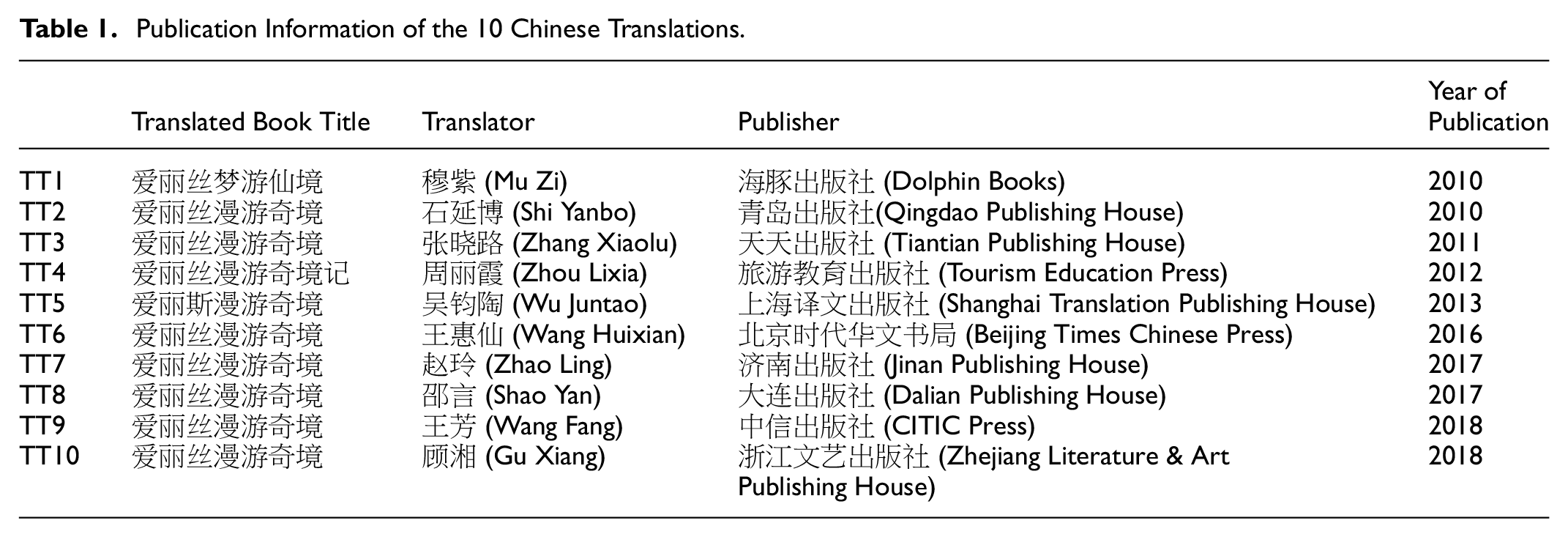
Regarding the selection of translated versions, we chose the translations that were published in the 2010s to better reflect the most updated translation trends. To be consistent and to avoid introducing the variable of geographical differences in language, translations published in mainland China were selected. As a result, we selected ten translations, publication information of which is presented in Table 1. The English original and the Chinese translations were obtained online and copied to Microsoft Word.
Publication Information of the 10 Chinese Translations.
Data Analysis
The texts were uploaded to Sketch Engine to facilitate the data analysis. Table 2 provides information about the size of each text.
Word Tokens in the English Original and Chinese Translations.

This study focuses on the repetition of major characters’ names, which are listed in Table 3. These names were selected based on their frequencies in the English original. Therefore, these characters are the relatively more important characters as they have the highest frequencies in the story. Although the use of personal pronouns is related to the use of character names, this study only focuses on the repetition of names but not repetition of personal pronouns because the aim of the study is to explore explicitation and the use of personal pronouns might not represent the highest level of explicitness (refer to Section “Testing Explicitation Hypothesis in the Context of Children’s Literature”), which means that a shift from name to personal pronoun already leads to a reduction in explicitness. Therefore, to investigate the explicitness of the text, this study distinguishes between names and personal pronouns.
Major Characters’ Names Examined in This Study.

After identifying which characters’ names to be examined, this study investigated character name repetition through both quantitative corpus analysis techniques and qualitative analysis. Quantitative analysis involved counting the frequency of character names. Then the frequency data was analyzed using the statistical software R for two-sample test of the same mean. Keyness analysis, one of the basic corpus analysis methods (Gabrielatos, 2018), was also applied to investigate whether the frequencies of each character name in the English ST and Chinese TTs are significantly different. Qualitative analysis was conducted using concordance lines, which allow this study to delve into the examples with context and have a deeper understanding of the use of repetition.
Results
Quantitative Analysis
The normalized frequencies of character names are summarized in Table 4. To test whether the mean frequencies of the English ST and the Chinese translations are the same, we first took an average of the ten translations and then compared with the English ST.
Normalized Frequency of Major Characters’ Names.
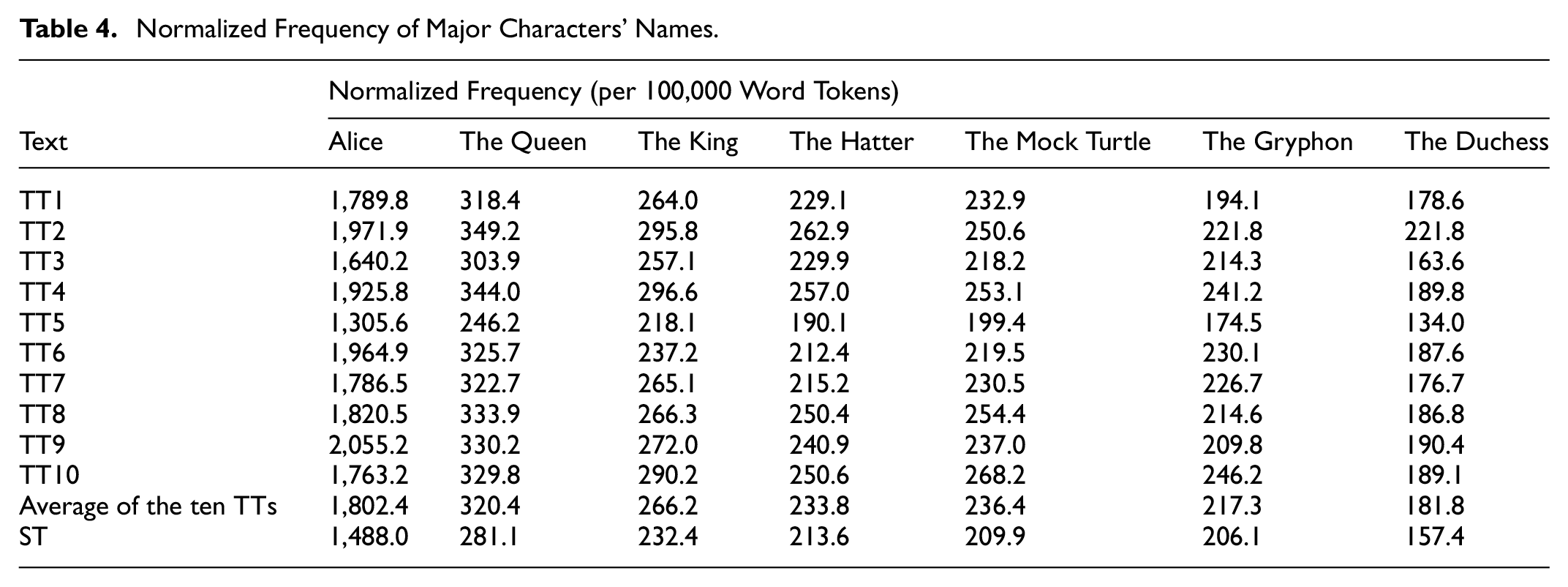
The normalized frequencies of character names from the English ST and the Chinese TTs (average) are two paired vectors. To test whether the two vectors have the same mean, paired t-test can be used if they are normally distributed. Shapiro-Wilk test for normality shows that they are not normally distributed, with the null hypotheses being rejected at the 5% significance level. As the vectors are not normally distributed, paired Wilcoxon signed rank test can be used to test whether their means are significantly different. The result shows that the difference is significant (p = .01563). The statistical analysis confirms that overall, the frequency of the selected character names in the Chinese TTs is significantly higher than that in the English ST, providing support to the explicitation hypothesis.
After testing the significance of the overall difference in the ST and TTs, we have further examined the differences at individual character level using the keyness analysis (see Table 5), in which log-likelihood (LL) was calculated by the log-likelihood calculator of WMatrix. Raw frequencies, instead of normalized frequencies, were input to the calculator as the text/corpus size was taken into account by the calculator.
Results of Log-Likelihood in Keyness Analysis.

p < .001; **p < .01; *p < .05.
Each Chinese TT was set to be the main corpus while the English ST was the reference corpus. Therefore, a positive LL implies an overuse of the target word in the Chinese TT relative to the English ST. Whether the result is significant is determined by the value of LL. According to WMatrix, an LL greater than or equal to 3.84 indicates that the difference is significant at the 5% significance level (WMatrix, 2016).
The findings indicate that the phenomenon of explicitation is prominent for the protagonist, Alice, whose name appears significantly more frequently in the Chinese TTs than in the English ST, except for TT3 and TT5 whose LLs are not statistically significant. However, other characters’ names do not show a significant LL. The explicitation hypothesis is partially supported at character level. Such results reveal a noticeable pattern that the name of the protagonist, Alice, is overused at a much greater degree in the Chinese TTs relative to the English ST than other less important characters are. In other words, explicitation in relation to the main character (explicitation means greater frequency of the main character’ name in the Chinese TTs than in the English ST) is stronger than explicitation in relation to other supporting characters.
But why is there significant LL only for the name “Alice”? In other words, why did the explicitation phenomenon only happen to “Alice” but not to other characters in the analysis? In view of this, we would like to propose an innovative “character-driven” theory in literary translation regarding the explicitation hypothesis. Under this theory, we posit that in the process of translation, a translator probably believes that the more important a character is, the more important it is for a reader not to misunderstand the referent in the text and not to have misinterpretation about the character. Such misunderstandings could have led to major comprehension problems in the story. As a result, a translator might tend to make more explicit the reference of a protagonist, who is the most significant character in the story, to avoid ambiguity as much as possible. Especially when the target readers are children, this approach might be particularly important to enhance readers’ comprehension. Therefore, we propose that the phenomenon of explicitation might be driven by the centrality of the character, which we call a “character-driven” theory.
Qualitative Analysis
Examining the concordances with character names and their contexts, this study has found that there are two main situations where character name repetition is more frequent in the Chinese translations than the English original. The first situation is where there are multiple characters in the context and the translator might repeat the character names in order to better distinguish between the characters and avoid confusion.
(1) ST: “Come on, then!” roared the Queen, and Alice joined the procession, wondering very much what would happen next. “It’s—it’s a very fine day!” said a timid voice at TT8: “那就过来!” 王后喊道。于是爱丽丝加入了这支队伍,心里想着,以后会发生什么事情呢? “这,这真是一个好天气啊!” [“Come here then!” The queen shouted. So Alice joined the procession, thinking “what will happen later?” “This… This is really a nice day!” Beside (Carroll, 2017a, p. 68) TT9: “那就快过来!” 王后几乎是在咆哮了。于是爱丽丝也加入了队伍,心里想着,一会儿又会发生什么呢? “这……这真是个好天气啊!” [“Come here quickly then!” The queen was almost ranting. So Alice joined the procession, thinking “what will happen in a while?” “This… This is really a nice day! Beside (Carroll, 2018, pp. 100–101)
Example (1) shows a typical situation where the translator chose to repeat character names for clarification. There are two female characters, Alice and the Queen, in the context, and a number of personal pronouns are used in the ST. The translator of TT8, Shao Yan, employed the strategy of character name repetition at two places, where he translated “said a timid voice at her side” as “爱丽丝身旁一个胆怯的声音说” [Beside Alice a timid voice said] and “She was walking by the White Rabbit” as “原来那只白兔恰巧走在爱丽丝旁边” [It turned out that the white rabbit happened to be walking next to Alice]. By replacing the personal pronouns with names, the translator eliminated the potential ambiguity so that young readers would not mistake Alice for the Queen. The translator of TT9, Wang Fang, opted for an even higher degree of explicitness by applying the strategy of character name repetition at three places. Apart from using character names in the two places as Shao Yan did, Wang Fang also translated the clause “who was peeping anxiously into her face” as “白兔正不安地偷看爱丽丝的脸呢” [the rabbit was peeking at Alice’s face uneasily], clarifying whose face was being peeped into.
(2) ST: Alice glanced rather anxiously at the cook, to see if she meant to take the hint; but the cook was busily stirring the soup, and seemed not to be listening, so TT6: 爱丽丝很紧张地看了厨师一眼,看看她是否有收到公爵夫人的指示。但是那厨师正忙着搅拌汤汁,根本没有听到那些话,所以
[Alice gave the cook a nervous look to see if she had received the Duchess’s instruction. But the cook was busy stirring the soup, and did not hear the words, so (Carroll, 2016, p. 76) TT7: 爱丽丝担心地瞅了一眼厨师,看她是不是真有要动手的迹象,但厨师正忙着搅汤,似乎没有在听。于是,
[Alice glanced worriedly at the cook to see if she was really showing signs of making a move, but the cook was busy stirring the soup and did not seem to be listening. So, (Carroll, 2017b, p. 47)
In this scene, there are three female characters, namely, Alice, the cook, and the Duchess. The two translators in Example (2) replaced the personal pronoun “she” in “so she went on again” by “爱丽丝” [Alice]. The translator of TT6, Wang Huixian, further clarified what “the hint” was referring to, by translating it as “公爵夫人的指示” [the Duchess’s instruction]. Therefore, Example (2) once again demonstrates translators’ strategy of character name repetition to avoid ambiguity.
The qualitative analysis does not only find that repetition of character names occurs when multiple characters are mentioned, but also finds that translators might repeat character names when it is obvious that only one character is in the context. This is particularly observed in the plot where the protagonist Alice landed into a hall with many doors after falling into the Rabbit-Hole. It is found that the translator translated a lot of pronouns “she” and “her” in the first sentence of a paragraph as “爱丽丝” [Alice]. The examples below illustrate this point.
The examples in Tables 6–8 were taken from the first chapter of AAW. Instead of following the ST and using personal pronouns, these translators shared a similar strategy of repeating the character name “爱丽丝” [Alice], although it is very clear that there is only one character in the context. Therefore, the reason for this translation strategy does not seem to be clarifying the referent among several characters. Instead, such a strategy might serve to keep reminding readers which character is central to the plot and help readers follow the story more closely. This interpretation echoes Toolan (2016)’s idea about repetitions in narrative.
These repetitions are an inexplicit promoting of sameness, of recurrent focus on words or things mentioned earlier; they enact a resistance narratorially to moving on to wholly new words or things, and an insistence on ‘saying more’ about what have already been chosen as topics – in particular, saying more about the presented narrative situation. (Toolan, 2016, p. 28)
This implies that repetition of character names foregrounds the recurrent focus of the text, retaining readers’ attention on the particular words or things. For the case illustrated in AAW, there is a long portrayal of Alice’s situation after falling down the Rabbit-Hole and no other characters are involved. The translators emphasized the name of Alice in most of the paragraphs, highlighting the centrality of the protagonist and keeping the protagonist in the focus of readers. A more intuitive interpretation of this point is that by repeating the character name more, the name could give readers a stronger impression and could be remembered more easily. In other words, this helps reinforce the presence and stress the importance of a character. This strategy can draw readers’ attention and might create a stronger connection between the reader and the character.
Examples of the Repetitions of “Alice” Extracted from TT1.

Examples of the Repetitions of “Alice” Extracted from TT2.

Examples of the Repetitions of “Alice” Extracted from TT6.

Discussion
RQ1 is mainly addressed through quantitative analysis. The findings show that the overall frequency of character names in the Chinese TTs is significantly higher than that in the English ST. This provides some support to the explicitation hypothesis. When it comes to the individual characters, according to the keyness analysis, only the name Alice has significantly higher frequency in the Chinese TTs than in the English ST. The explicitation hypothesis is partially supported at character level. As the results indicate that explicitation phenomenon only happens to the main character but not to other supporting characters, we posit that explicitation might be associated with the centrality of a character.
Therefore, we suggest an innovative “character-driven” theory in literary translation regarding the explicitation hypothesis. It posits that explicitation is driven by the centrality of a character because during the translation process, translators operate under the assumption that the significance of a character correlates directly with the importance of preventing misinterpretation of that character by the reader. Misunderstandings related to the main characters could lead to difficulties in comprehending the narrative. Consequently, translators may be inclined to clarify references to the protagonist, who invariably holds the pivotal role in the story, to minimize ambiguity. This strategy is especially crucial when the intended readers are children, as it could enhance their understanding of the text. In addition, it helps reinforce the presence of a character, drawing readers’ attention and creating a stronger connection between the reader and the character. This study provides valuable insights into the phenomenon of explicitation through the perspective of children’s literature. Future studies could conduct more case studies or corpus-based studies to further testify this character-driven theory with other literary works or other genres.
This character-driven theory builds upon the asymmetry hypothesis posited by Klaudy and Károly (2005) and the factors affecting explicitation proposed by Zufferey and Cartoni (2014). Klaudy and Károly (2005) oppose to the symmetric explicitation hypothesis which supposes “all cases of language-specific explicitation in the L1→L2 direction are symmetrical (i.e., matched by implicitation in the L2→L1 direction)” (p. 13) and show that translators tend to prefer explicitation more than implicitation in both translation directions between English and Hungarian. Therefore, they propose the asymmetry hypothesis, which refers to translators’ general tendency of higher preference for explicitation over implicitation (Klaudy & Károly, 2005). Borrowing such asymmetry hypothesis, the character-driven theory means that the translation related to the major characters tends to be more asymmetric than the translation related to other characters. In other words, translators might tend to have a higher preference for explicitation when the text is pertinent to the main characters.
Furthermore, Zufferey and Cartoni (2014) propose that the degree of explicitation might vary with four factors, which are “the role of different source languages,”“the role of different target languages,”“the role of specific lexical items,” and “the role of discourse relations” (p. 363) but their study discovered that only the last two factors had a significant impact on explicitation. Our character-driven theory is relevant to the “role of specific lexical items” they proposed (Zufferey & Cartoni, 2014, p. 363). Zufferey and Cartoni only included connectives in their discussion of such specific lexical items. Their study showed that certain connectives play a greater role in explicitation than other connectives. In the same vein, we propose that the names of major characters play a greater role in explicitation than the names of other less important characters. In this way, the character-driven theory could be considered as an expansion of Zufferey and Cartoni (2014)’s theory.
Similarly, Cheong (2006) listed some variables affecting explicitation that scholars have focused on, such as translation direction, text function, text domain, and genre, while he also suggested some new variables including readers’“domain-specific knowledge,”“cultural-specific knowledge,” and “familiarity with subject matter of the text” (351). These variables exemplify the diverse facets of the explicitation phenomenon. The new variable of the centrality of a character proposed by this study also provides a new perspective that the explicitation hypothesis could be explored at a more granular level within the text. The variable of text domain, for example, focuses on the whole text (at the text level). However, this study illustrates that the degree of explicitation could even vary within a text at the character level. This contributes to further understanding of translation phenomenon and might encourage further exploration of this new aspect of explicitation.
The qualitative analysis has explored the literary contexts for the use of character names and provided more explanations and details about the explicitation phenomenon, addressing RQ2 and RQ3. We have identified two main situations for a greater repetition of character names in TT than in ST. In the first situation, multiple characters are involved in the plot. For example, multiple characters are mentioned in a dialogue or appear in a scene. It is relatively easy to understand that the reason for repetition is to better clarify the referents so that misinterpretations could be avoided. This kind of narrative is likely to have the effect of improving readers’ comprehension of the story. For the second situation, we have found that there is a greater repetition of character name in TT than in ST even when there is only one character involved in the context. We argue that this strategy is to highlight the recurrent focus of the story, and thus reinforce the presence and stress the importance of a character, as shown by the examples from various translators of AAW. Therefore, from a narrative perspective, character name repetition could better engage the readers and help them follow the story more closely. The second situation also echoes our findings that the protagonist tends to be presented more explicitly, as the name Alice is the only name with a significant LL. Therefore, explicitation phenomenon tends to happen to the main characters, leading to greater repetition of their names.
Next, it comes to the critical question as to why the repetition of character name did not happen as often in the English original as in the Chinese translations. We believe that there are two main reasons. Character name repetition being more frequent in the Chinese translations than in the English original could be attributed to the different linguistic and literary traditions of the two languages. Regarding the linguistic traditions, it is the style of English writing to showcase the variation of language, whereas repetitions are common for Chinese writings (Lian, 1993). For example, native English speakers often adopt the strategy of nominal substitution, which refers to the use of pronouns or other nouns to substitute nouns to avoid repetitions, while native Chinese speakers tend to repeat the nouns instead of replacing them with pronouns (Lian, 1993). Traditionally, pronouns are not used as extensively in Chinese as in English, and personal pronouns that distinguish genders have a relatively short history in China as they have been used only since around 1917 (Lian, 1993). According to Wang (2019), when a sentence in classical Chinese contains a subject, the subject is often a noun, not pronoun. Therefore, repetition of nouns has been common in Chinese. Under the traditions of Chinese language, people might not tend to use personal pronouns heavily, as these pronouns could still lead to ambiguity in texts (Lian, 1993). Such differences in linguistic tradition between English and Chinese are relevant to explain why character names were repeated at a higher frequency in the Chinese translation than in the English original in general.
There has also been a Chinese literary tradition to elevate protagonists, who are called “larger-than-life” characters (Riep, 2008, p. 130). In the late Qing period (late 19th century-1911), there were stories in which their protagonists were elevated, serving as role models of moral values, in an attempt to modernize the nation and change people’s mindset for the salvation of the country (Hu, 2024; Li, 2024). Larger-than-life characters prevailed especially in the literature for nation-building in the Maoist China (1949–1976) and the early post-Mao period (Riep, 2008). As Chinese Communist Party (CCP) emerged victorious in the Chinese Civil War and founded the People’s Republic of China (PRC) in 1949, it was keen to write history from its perspective and build its national image (Riep, 2008). As a result, the heroic victory over the Japanese and the Nationalists became an integral and much emphasized part in the history of PRC in order to present the image of a strong nation (Denton, 2007; Riep, 2008). This led to the production of heroic literature that often featured larger-than-life protagonists, who acted selflessly and were very brave, wise, and idealized (Hegel, 1984). Such characters could “build an image of a strong and unified nation” (Denton, 2007, p. 1) and glorify CCP members, legitimizing the rule of the party (Denton, 2007). In the Maoist era, different art forms, such as film, fiction, and drama, witnessed heroic narratives with many larger-than-life characters (Fan, 2018; Riep, 2008).
Moreover, during the Cultural Revolution, the government adopted the principle of “Three Prominences” as the basis of character portrayal in literary creation (Fan, 2018). The principle stated explicitly that “among all characters, give prominence to positive characters; among the positive, give prominence to heroic characters; and among the heroic, give prominence to the principal heroic character” (Fan, 2018, p. 77). Therefore, central characters were given prominence in various art forms to build strong characters fitting the prevailing ideology. Our study found that the protagonist in the Chinese translated versions of AAW received more prominence than she was in the English original, measured in terms of name repetition. This finding aligns with such literary tradition nurtured since the founding of PRC. Although Alice is not a heroic character for political propaganda, children’s literature and propaganda share a similar function of education or shaping the minds of their target audience. It is possible that these Chinese translators were influenced by the literary traditions prevalent in their own cultural and political environment and were familiar with literary practices that prioritize the protagonist’s role in conveying messages or representing certain values. In other words, the translators’ choices could have been shaped by their cultural background and the literary conventions they were accustomed to.
The second reason could be explained by translators’ cognitive processing and their awareness of their role and task (Chesterman, 2004; Kruger & Van Rooy, 2016). Some scholars have discussed explicitation as an inherent property of translations (Blum-Kulka, 1986; Øverås, 1998), which might tend to provide more explicit information than ST because a translator’s interpretation might lead to more redundancy in TT when s/he tries to convey the implicit information contained in the ST (Blum-Kulka, 1986). In other words, the translation-inherent explicitation might be caused by the tendency for translators to reflect their interpretation and their unpacking of the meanings and logical relations in the text (Kruger & Van Rooy, 2016). This is related to the cognitive processing of the translators, who are conscious of their role as a mediator between TT readers and ST (Chesterman, 2004) and thus they would have greater consideration for readers’ need and aim to reduce the risk of miscommunication (Kruger & Van Rooy, 2016). Therefore, they might try to eliminate ambiguity by stating the name of the referent directly.
Conclusion
To date, scant research has examined the explicitation hypothesis in translated children’s literature and used lexical cohesion as an indicator of explicitation. This study compared the patterns of character name repetition in ten Chinese versions of Alice’s Adventures in Wonderland with the English original both quantitatively and qualitatively in order to examine the explicitation hypothesis. This study contributes to the literature by proposing character name repetition as a new indicator of explicitation and broadens the concept of explicitation. The current study also makes theoretical contributions by introducing a new variable, the centrality of a character, which affects the degree of explicitation, and by proposing an innovative character-driven theory regarding the explicitation hypothesis. It also contributes to a greater understanding of the characteristic of Chinese translation language in children’s literature. As such, this study provides great insights into the use of explicitation strategy in translation through the perspective of children’s literature, which is an area that has been scarcely discussed in relation to explicitation hypothesis.
A limitation of this study is that we only studied Alice’s Adventures in Wonderland. The results could be better generalized if more children’s stories were examined. Therefore, a study of a larger scale could be conducted in the future. Futures studies could also compare Chinese translations against non-translated Chinese texts. To further expand our understanding of the explicitation hypothesis, it would be valuable for future studies to investigate children’s literature in other language pairs or translation directions, for example, from Chinese into English. Studying translation in another language such as Japanese might reveal whether high repetition of character name is a feature inherent in the Chinese language or also in another language. When it comes to children’s reception, our study did not empirically examine the potential improvement in comprehension resulting from increased repetition of character names. Future studies could undertake experimental investigations to explore the impact of repeated character name exposure on children’s comprehension.
As we propose that the two main reasons for more frequent repetition of character names in the Chinese translations than in the English originals are the different linguistic and literary traditions between the two languages and translators’ cognitive processing, future research could further explore which factor has a more dominating impact on repetition. Such exploration could lead to a deeper understanding about translation process.
Footnotes

Ethical considerations
This article does not contain any studies with human or animal participants.
Consent to participate
There are no human participants in this article and informed consent is not required.
Consent for publication
The article does not contain any data from an individual person and informed consent is not required.
Author Contributions
Ruby Ka Yee HUI conceived of the presented idea, collected the data, and performed the analyses. Ruby Ka Yee HUI and Dechao LI wrote the manuscript.
Funding
The author(s) disclosed receipt of the following financial support for the research, authorship, and/or publication of this article: The work described in this paper was partially supported by a grant from the Research Grants Council of the Hong Kong Special Administrative Region, China [Project No. PolyU 15603623].
Declaration of Conflicting Interests
The author(s) declared no potential conflicts of interest with respect to the research, authorship, and/or publication of this article.
Data Availability Statement
Data sharing not applicable to this article as no datasets were generated or analyzed during the current study.
Disclosure statement on the use of AI
The author(s) used assistive AI tools to improve language and grammar but did not use AI tools to produce content.