




Abstract
This study aims to evaluate the impact of Silk Road e-commerce cooperation on the export trade of the Guangdong-Hong Kong-Macao Greater Bay Area. Since 2016, China has entered into memorandums of understanding (MOUs) for e-commerce cooperation with various countries, establishing bilateral partnerships, which provides us with a quasi-natural experiment. This study employs the multi-period difference-in-differences (DID) method, drawing on export data from 166 countries and regions spanning 2010 to 2022. The findings reveal that Silk Road e-commerce cooperation has significantly enhanced exports from the Greater Bay Area, primarily by reducing cross-border logistics costs and trade-related search costs. Furthermore, the cooperation has notably boosted exports to African and Asian countries, with much more significant effect on exports to developing economies. This study lies in its pioneering focus on the Greater Bay Area’s active engagement in the international trade through the Silk Road E-commerce cooperation, providing valuable theoretical support for understanding the connection between institutional openness and trade.
Plain language summary
Utilizing data of the Guangdong-Hong Kong-Macao Greater Bay Area’s foreign export trade to 166 countries and regions from 2010-2022, this study employs the multi-period DID method to assess the impact of the bilateral cooperation of Silk Road e-commerce as a policy intervention. The mechanism analysis reveals that the cooperation enhances the export trade of the Greater Bay Area by reducing both search costs and cross-border logistics cost. Heterogeneity analysis further shows that Silk Road e commerce cooperation significantly boosts the Greater Bay Area’s export trade with Asian and African countries, but does not have significant effect on trade with countries in Oceania, Europe and the Americas. Additionally, the promotion of export trade between the Greater Bay Area and developing economies is more pronounced than that with developed economies.
Introduction
The Silk Road was first proposed by German geographer Richthofen in 1877. In the era of rapid development of e-commerce, the historical name Silk Road has been given a new era connotation. The Belt and Road Initiative (BRI) is a major international strategy designed to promote the development of the Silk Road Economic Belt and the 21st Century Maritime Silk Road. Since 2013, China has signed over 200 cooperation documents pertaining to BRI with more than 150 countries and over 30 international organizations (China E-commerce Public Service Network, 2024). This widespread participation highlights the increasing benefits derived from the development of cross-border e-commerce among Belt and Road countries (Ren et al., 2024). According to the explanation of Silk Road e-commerce by the National Development and Reform Commission of China, Silk Road e-commerce is an important measure to actively promote international cooperation in e-commerce in accordance with the joint construction of the BRI, give full play to the advantages of China’s e-commerce technology application, model innovation and market size. The advent of Silk Road e-commerce has opened a new channel for economic and trade cooperation under the BRI, becoming a new engine for its accelerated construction (People’s Daily Overseas Edition, 2022). This shift is particularly notable given the impacts of the development of e-commerce, the COVID-19 pandemic, and other factors, which have significantly affected the development of offline markets. By the end of May 2024, China has signed memorandums of understanding on e-commerce cooperation with 31 countries across 5 continents. This strategic move has facilitated extensive experience sharing and policy exchanges between China and its partner countries. It has also fostered in-depth cooperation between enterprises, promoted the trade of high-quality products through cross-border e-commerce, and strengthened international collaboration in logistics, transportation, mobile payment, and other sectors.
The research on Silk Road e-commerce and foreign trade has garnered significant attention in academic circles. On the one hand, a substantial body of literature approaches Silk Road e-commerce from the perspective of international cooperation. This cooperation encompasses areas such as policy exchange, planning coordination, industrial promotion, and local partnerships. The Digital Silk Road initiative is instrumental in strengthening industrial cooperation between countries and forming new economic production clusters. This initiative leverages e-commerce and advanced technologies, including the Internet, artificial intelligence, big data, cloud computing and blockchain (Lazanyuk & Revinova, 2020). The international cooperation of Silk Road e-commerce focuses on enhancing digital cooperation with partner countries through policy communication platforms, government-enterprise exchange meetings and capacity-building activities (R. Zhang & Qian, 2020). While promoting the development of cross-border e-commerce trade, e-commerce platforms and regulatory frameworks have been gradually improved (An, 2022). New cooperation models, such as cloud exhibitions, cloud lecture halls, special shopping festivals, and government-enterprise dialogues, have also been explored (Wang, 2022). Zhang et al. (2023) analyzed the effect of trade sharing from the cooperation relationship, focusing on the trade cooperation network formed by the BRI. While these studies highlight the achievements of Silk Road e-commerce cooperation, they still lack rigorous empirical evidence and theoretical support. On the other hand, some scholars focus on the trade promotion effect of Silk Road e-commerce. Wang et al. (2024) empirically tested the impact of the Digital Silk Road initiative on foreign trade and investigated its economic effects on cross-border trade. Other studies have examined trade links between China and regions such as Southeast Asia and Africa, exploring factors like digital industrial policy (Naughton, 2022), digital development potential (Huang, 2019), and digital integration (Eguegu, 2022). These factors are identified as positively influencing cross-border digital trade activities.
Guangdong-Hong Kong-Macao Greater Bay Area is at the forefront of China’s opening up and serves as a prominent hub for industries, benefiting from its advantageous geographical location and robust industrial foundation. The Greater Bay Area with its unique regional environment of “one country, two systems and three regions,” making it a major player in trade with countries along the Belt and Road. Scholars also pay more and more attention to the economic and trade research of the Guangdong-Hong Kong-Macao Greater Bay Area. On one hand, some scholars comprehensively evaluate the trade and economic competitive advantages of the Greater Bay Area by constructing evaluation index system; On the other hand, some scholars analyze the pattern of economic and trade cooperation in the Greater Bay Area and its regional integration. Liu (2017) analyzed the economic competitiveness of major bay areas worldwide across dimensions such as economy, trade, finance, and enterprises activity, and believed that the Guangdong-Hong Kong-Macao Greater Bay ranks mid-level in international comparisons but leads within China. Feng (2016) emphasized that service trade cooperation is the primary content and driving force for deep cooperation between Guangdong, Hong Kong and Macao. Similarly, Huang et al. (2018) highlighted that each region possesses unique advantages in the economic and trade development of the BRI. Focusing on trade integration within the Greater Bay Area, Song (2020) employed principal component analysis to examine the trade characteristics and competitive advantages of Guangdong, Hong Kong and Macao, and explored the trade competition and cooperation relationships among the three regions, and proposed optimization paths for enhancing the trade relationships. Scholars analyzed the overall situation, import-export structure and international competitiveness of service trade in the Greater Bay Area, and used grey correlation model and entropy method to measure the coordination level of regional service trade (Xu et al., 2021). It can be found that, there are a growing body of research on individual regional trade dynamics within the Greater Bay Area but indicate a gap in quantitative and comprehensive analyses.
Based on this, this study empirically tested the impact of Silk Road e-commerce on the export trade of the Greater Bay Area by using the data of foreign export trade from 2010 to 2022. The analysis employs the multi-period DID method to explore the impact mechanism of Silk Road e-commerce on the export trade of Greater Bay Area from the perspective of trade search cost and cross-border logistics cost. Compared to existing studies, this study makes the following marginal contributions: In terms of research methodology, unlike prior studies that predominantly utilize qualitative analysis, this study employs the multi-period DID method to empirically test the impact of Silk Road e-commerce on the export trade of the Greater Bay Area. Potential endogeneity problems in the regression model are addressed through various robustness tests, thereby maximizing the credibility of the empirical findings. In terms of research content, this study lies in its pioneering focus on the Greater Bay Area’s active engagement in the construction of digital global trade rules through the Silk Road E-commerce cooperation, explores the impact of Silk Road e-commerce cooperation on the export trade of the Greater Bay Area, a region at the forefront and industrial plateau of China’s opening up. By examining this relationship, the study provides valuable theoretical support for understanding the connection between institutional openness and trade. Additionally, the findings contribute to the construction of a “Chinese template” for digital economic and trade rules in the context of institutional opening-up. The paper is structured as follows: the second section encompasses relevant literature and research hypotheses; the third section outlines the research data and methods, including models, variables, and data; the fourth section presents empirical results and tests; the fifth section presents heterogeneity analyses; the sixth section examines the impact mechanism; finally, a conclusion section concludes the paper.
Research Hypotheses
China has actively pursued international cooperation in Silk Road e-commerce, broadening trade channels through initiatives such as dedicated sales zones, live broadcast bases, online national pavilions, and multi-platform linkages (Yan, 2022). The Silk Road e-commerce cooperation facilitates policy dialogue and experience-sharing between governments and enterprises in China and partner countries. This collaboration fosters bilateral engagement in digital technology investment and trade, while also promoting the bilateral trade of high-quality specialty products through e-commerce platforms (Ye & Cai, 2024). This integration is facilitated by the reduction of trade transaction costs, improved trade facilitation, and enhanced interconnectivity between countries (Herrero & Xu, 2017; Tang et al., 2019). The gradual implementation of the BRI and the establishment of the China-Europe Railway Express (CR Express) and the China-Russia Economic Corridor have significantly reduced the cost of trade and transportation in inland provinces of China. CR Express serves as a vital carrier for Silk Road e-commerce trade, facilitating the export of products to BRI countries via cross-border e-commerce platforms and creating new channels for products to access international markets (Ji & Wang, 2023; J. Zhang, 2022). Additionally, some scholars have pointed out that the overcoming of spatial constraints and the reduction of economic costs are crucial factors enabling the progress of international cooperation in Silk Road e-commerce, despite the challenges posed by the COVID-19 pandemic (Liu, 2023). Based on this, the following hypothesis is proposed:
The global digital divide represents a critical barrier to the development of digital services trade worldwide (Freund & Weinhold, 2002; Lin, 2015; Wang et al., 2022). A larger digital divide between two countries correlates with a lower willingness for regulatory trade cooperation (Elsig & Klotz, 2021; Han et al., 2019). Nations and regions with advanced digital infrastructure and higher capacities for digital technology application are more likely to benefit from the dividends of digital economy growth (Chen & Zhou, 2023). Internet technology plays a pivotal role in reducing search and information costs (Anderson & Van Wincoop, 2003), and e-commerce simplifies intermediary trade processes, further lowering these costs (Sun et al., 2017). By introducing search platforms and enhancing search mechanisms, e-commerce significantly improves search efficiency and reduces associated costs (Dinerstein et al., 2018; Jolivet & Turon, 2019). In a platform-based trading model, businesses can easily access product information and directly communicate with sellers about product specifications, after-sales policies, and other details (Fink et al., 2005). Traditional trade, with buyers and sellers often located in different regions, poses challenges to efficient transactions. Cross-border e-commerce mitigates these barriers by consolidating numerous merchants and products on a single platform, offering buyers a wide range of differentiated goods and substantially reducing search costs (Lendle et al., 2016). Lower trade costs, in turn, foster trade expansion (Chen & Chen, 2011; Tang et al., 2019). Through trade facilitation measures such as electronic authentication and electronic contracts, Silk Road e-commerce cooperation further streamlines trade procedures (Wilson, 2009), directly reducing objective trade costs and supporting the growth of trade scale and performance (H. S. Zhang & Pan, 2021). Based on this, the following hypothesis is proposed:
Within the BRI framework, logistics infrastructure has been a crucial factor for the sustainable development of cross-border e-commerce (Gurbanova & Wang, 2023). Lei (2020) analyzed the spillover effects of cross-border e-commerce on the development of the manufacturing industry in the Maritime Silk Road Economic Belt under different logistics levels through the panel data threshold effect regression model. Cross-border e-commerce platforms effectively reduce logistics costs by integrating logistics providers and offering comprehensive logistics solutions. Previous studies have identified logistics barriers as a significant impediment to the development of cross-border e-commerce (Gessner & Snodgrass, 2015; Gomez-Herrera et al., 2014). Compared to traditional trade, cross-border e-commerce exhibits a stronger dependency on logistics performance. When foreign trade enterprises engage with cross-border e-commerce platforms, they benefit from the integrated logistics solutions provided by these platforms. This approach helps enterprises overcome challenges associated with unfamiliar overseas logistics networks, high logistics costs, and low delivery rates that may arise when independently navigating logistics partnerships. Additionally, the integration of logistics services through these platforms facilitates the establishment of reliable international logistics channels, contributing to a reduction in overall logistics costs (H. S. Zhang & Pan, 2021). Based on this, the following hypothesis is proposed:
Materials and Methods
Data Sources
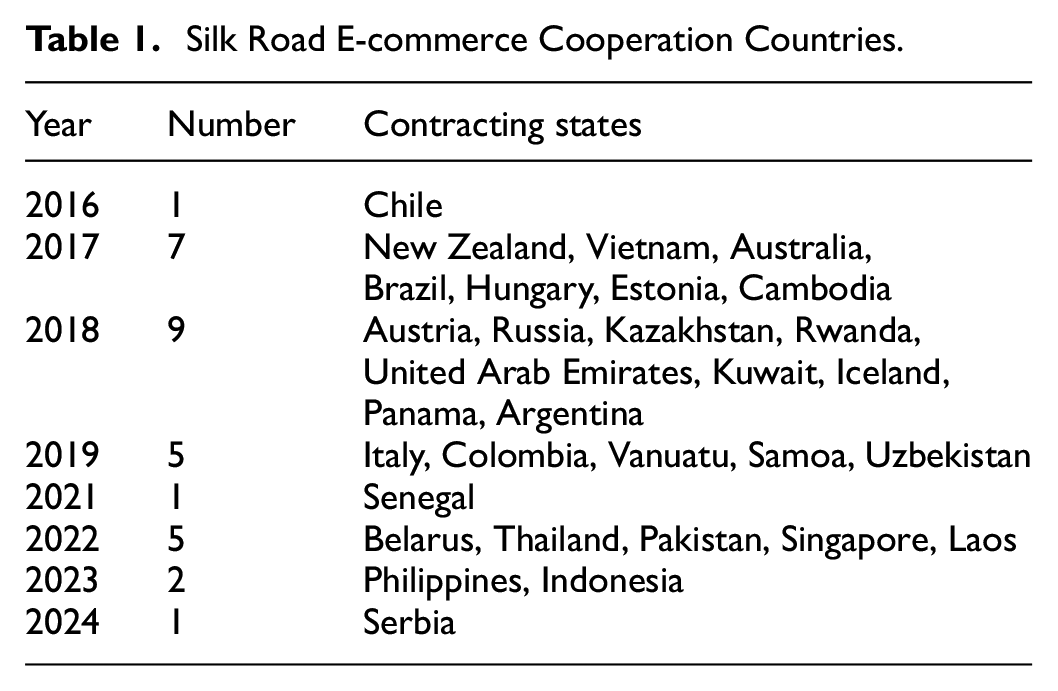
By May 2024, China had signed memorandums of e-commerce cooperation with 31 countries and established bilateral cooperation mechanisms (Table 1). This study treats this as a quasi-natural experiment. Taking the time when China signed memorandums of e-commerce cooperation with other countries as the policy point for establishing the bilateral cooperation relationships of Silk Road e-commerce. The study selects countries participating in Silk Road e-commerce cooperation as the treatment group, categorized by the year they joined: 1 country in 2016, 7 countries in 2017, 9 countries in 2018, 5 countries in 2019, 1 country in 2021, and 5 countries in 2022. As countries that have only recently signed the memorandum of cooperation may not yet have established a complete policy implementation system, their early inclusion could lead to an underestimation of the policy’s impact. Therefore, this study selects as the treatment group the 28 countries that signed before January 2023.
Silk Road E-commerce Cooperation Countries.
The data for this study was obtained from multiple authoritative sources, including the China Customs database, United Nations Commodity Trade Statistics database (UN Comtrade), National Bureau of Statistics, China Belt and Road Network, World Bank (WB), and Guangdong Provincial Bureau of Statistics. Consequently, panel data covering a time span from 2010 to 2022 was collected for a total of 166 countries and regions. In addition, since the Guangdong-Hong Kong-Macao Greater Bay Area includes Hong Kong, Macao and nine mainland cities in Guangdong Province, and the annual trade volume of nine mainland cities accounts for a larger proportion of the trade volume of Guangdong Province, such as 95.6% in 2022 (Guangdong Sub-Administration of GACC, 2023), this study uses the data of Guangdong Province to replace the data of nine mainland cities. The missing values are supplemented by linear interpolation (the proportion of missing values is below 5%).
Research Methods and Variable Description
Due to the varying signing times of e-commerce cooperation agreements with different countries, this study employs the multi-period DID method to explore whether the Silk Road e-commerce cooperation has promoted the export trade of the Guangdong-Hong Kong-Macao Greater Bay Area. This method allows us to account for the staggered implementation of the policy across different countries and over different time periods. The empirical model is specified as follows:


Where i refers to the country and t refers to the year; and
Dependent variable: To measure the level of export growth in the Greater Bay Area (export), this study uses the logarithm of the export volume of the Greater Bay Area to various countries as the dependent variable, which is in line with the standard practice in the existing literature.
Independent variable: The independent variable of this study is dummy variable
Control variables: This study selected a series of control variables to control for the impact of other factors on the export trade of the Greater Bay Area. The level of economic development (perGDP) is expressed as the logarithm of GDP per capita. Ease of Doing Business (EDB) is expressed as the logarithm of the World Bank’s Ease of Doing Business score. Economic growth (industry) is expressed as the logarithm of industrial value added. In addition, the control variables include the logarithm of mobile cellular subscriptions per 100 people (subs), the logarithm of the official exchange rate (ex), mobile network coverage (net) and the proportion of the urban population (urbanpop).
Intermediate variables: The previous theoretical analysis suggests that there are several possible transmission mechanisms for the impact of Silk Road e-commerce on trade: search cost of trade and cross-border logistics cost. Based on this, combined with the analysis of existing literature, this study introduces two intermediate variables: search cost and logistics cost. Search cost is expressed as the reciprocal of information and communication technology (ICT) export intensity, where ICT export intensity is the proportion of ICT exports to total service exports. Logistics cost is expressed as the reciprocal of logistics performance index (LPI).
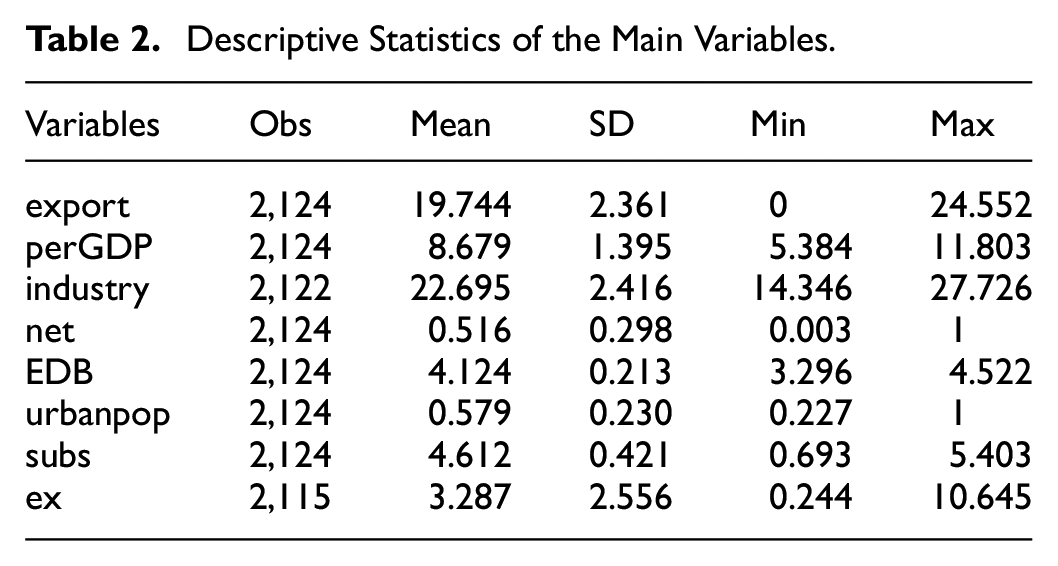
The descriptive statistical results of the main variables are reported in Table 2. Among them, the dependent variable has a mean of 19.744 and a standard deviation of 2.361, indicating variability in recorded exports across the sample. The minimum value of 0 suggests no export activity from the Greater Bay Area to certain countries or regions, while the maximum value of 24.552 reflects particularly high export levels in specific instances. Overall, export performance appears stable for most countries or regions, although unique economic or policy factors may account for some observed differences.
Descriptive Statistics of the Main Variables.
Results
Baseline Regression Results
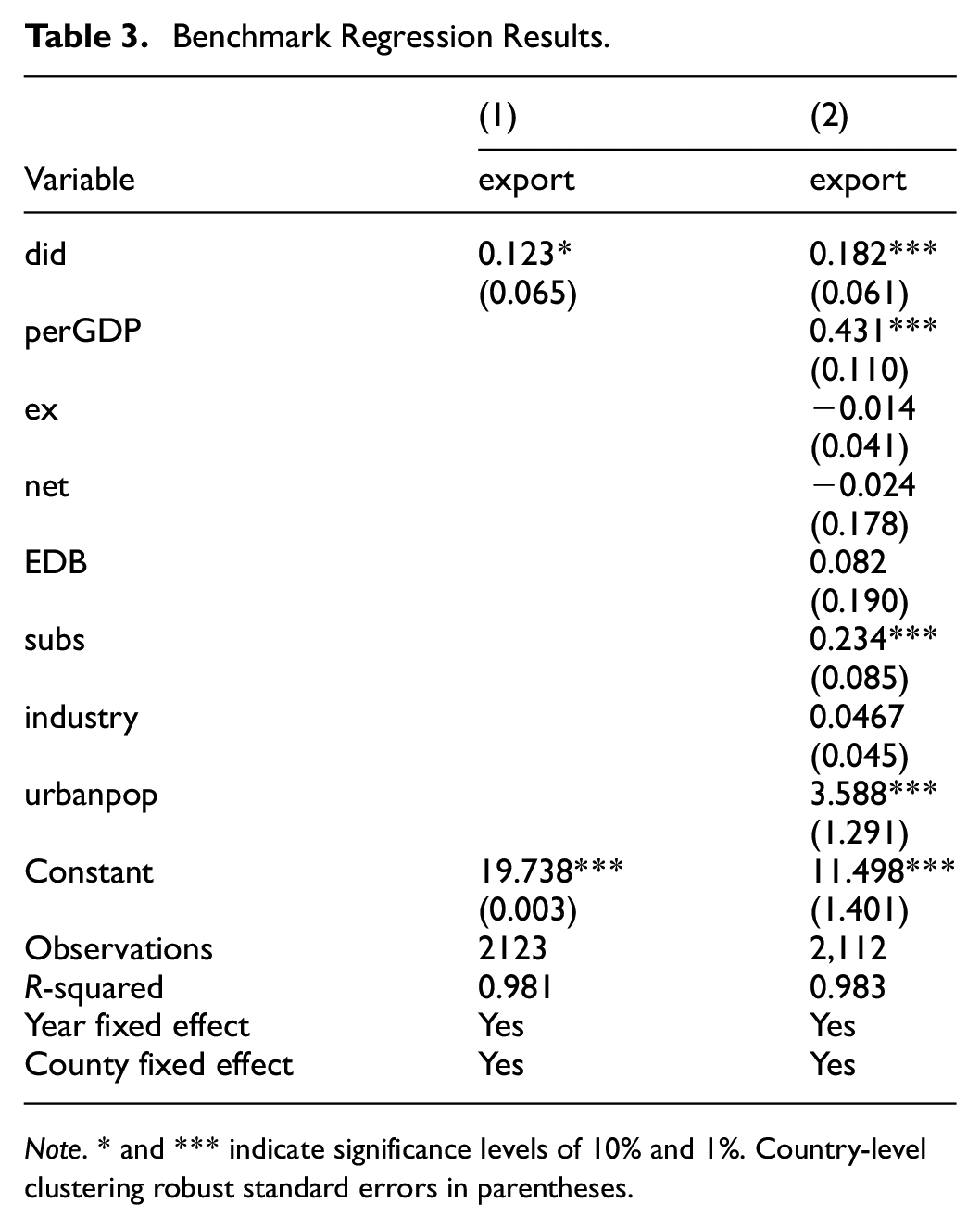
According to Model 1, this study evaluates the impact of the Silk Road e-commerce cooperation on the export trade of the Guangdong-Hong Kong-Macao Greater Bay Area, and the regression results are shown in Table 3.
Benchmark Regression Results.
Note. * and *** indicate significance levels of 10% and 1%. Country-level clustering robust standard errors in parentheses.
Columns 1 and 2 report the results of regression without control variables and regression with control variables under the control of time fixed effects and individual fixed effects. The empirical results show that the regression coefficients of did are significantly positive at the 1% level, indicating that the Silk Road e-commerce cooperation significantly promotes export from the Greater Bay Area. Specifically, the Silk Road e-commerce cooperation has increased the export from the Greater Bay Area to partner countries by 18.2% relative to other countries, thus verifying Hypothesis 1.
Parallel Trend Test
The key prerequisite assumption for the validity of the multi-period DID method is the parallel trend assumption. The export trends of the Guangdong-Hong Kong-Macao Greater Bay Area to the treatment and control groups countries are consistent over time before and after policy implementation. Therefore, this study uses the event study method for parallel trend testing (Jacobson et al., 1993), and adopts the following econometric model:

where
Based on the distribution characteristics of the sample data, the data before the establishment of the bilateral relations of Silk Road E-commerce are aggregated to period −7, and the data after the establishment of the cooperation mechanism are aggregated to period 5. When t < 0,

Parallel trend test for export.
The parallel trend test plot shown in Figure 1 indicates that the coefficient is not significant when t < 0. These results indicate that there was no significant difference in the export of the Greater Bay Area to the treatment group and the control group before the establishment of the bilateral relations of Silk Road e-commerce. The parallel trend test shows that
Placebo Test
To enhance the robustness of the results and determine whether the observed effects are indeed attributable to the study variables rather than external or random factors, a placebo test was conducted. Following the approach of Chetty and Saez (2013), a non-repeating random sampling was drawn from the existing 166 countries and regions, treating these samples as China’s “Silk Road e-commerce partner countries” with assigned hypothetical policy implementation dates, and the remaining countries were taken as the virtual control group. This method enables an assessment of whether the treatment effect remains significant under these “assumed partnerships.” This process was repeated 500 times to obtain 500 estimated coefficients of

Placebo test.
Robustness Test
Inclusion of Lagged Variable in Regression
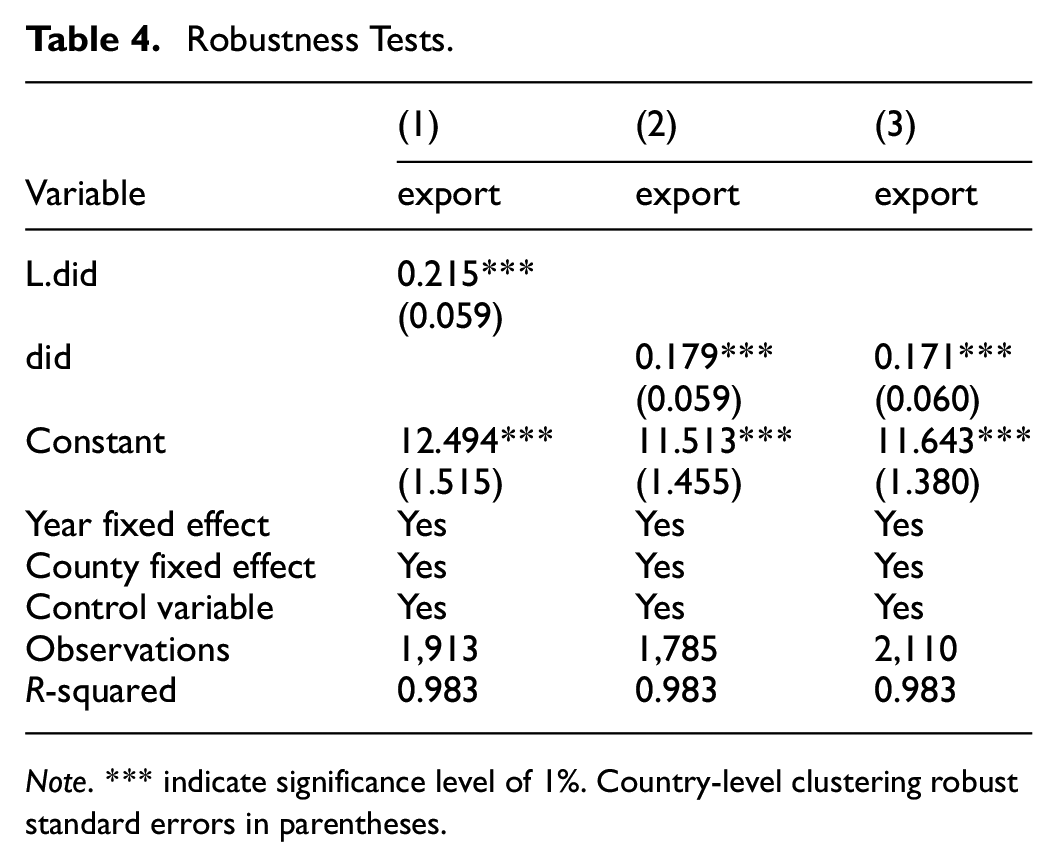
Considering that the Silk Road e-commerce cooperation may have a long time lag effect on the export of the Greater Bay Area, the dummy variables in the regression model are replaced by the second period, and the regression analysis is conducted again (Table 4, column 1). The results are not substantially different from the previous research conclusions, indicating that the research conclusions in this paper are relatively robust.
Robustness Tests.
Note. *** indicate significance level of 1%. Country-level clustering robust standard errors in parentheses.
Excluding Data for 2020 and 2021
Due to the impact of the COVID-19 pandemic, there are fluctuations in the data. In order to ensure that the conclusion of the empirical analysis is not affected by the epidemic (Mao et al., 2023), the regression results after excluding the samples from 2020 and 2021 are given in this study (Table 4, column 2), and the results have no significant changes.
Replacement Model
In order to reduce the bias in regression results caused by sample self-selection, this study adopts the propensity score matching difference-in-differences method (PSM-DID) to further test the impact of the Silk Road e-commerce cooperation on exports from the Greater Bay Area. The logit model is used to calculate the propensity score of each country. The nearest neighbor matching method is then applied to identify individuals in the control group with similar characteristics to those in the treatment group (Cao et al., 2021). Subsequently, balance and standard support tests are conducted on the matching results, and observations falling outside the region of standard support are excluded. The matched sample data is regressed using the DID method (Xiong & Sui, 2023). The results are presented in Table 4, column 3. The core explanatory variables are significant at the 1% levels, and the estimation coefficient is positive, indicating that the bilateral cooperation relations have positive effects on the export from the Greater Bay Area. This also proves that the results of the previous estimation are robust.
To assess the robustness of these findings, the study also adopts the Callaway and Sant’Anna Difference-in-Differences (CSDID) approach (Callaway & Sant’Anna, 2021). This method is built on the principle of double robustness and helps mitigate estimation biases commonly found in traditional DID models. Its core idea is to divide the sample into different treatment groups based on the timing of treatment and estimate treatment effects separately for each group. These effects are then aggregated into the average treatment effect on the treated (ATT) using a weighting strategy that assigns lower weights to groups potentially subject to bias, thereby improving the robustness of the final estimate. As reported in Table 5, all four types of average treatment effect estimates consistently demonstrate that Silk Road e-commerce cooperation has significantly enhanced the exports from the Greater Bay Area. These findings align with the baseline results, thereby confirming the robustness of our conclusions.
CSDID Test Results.
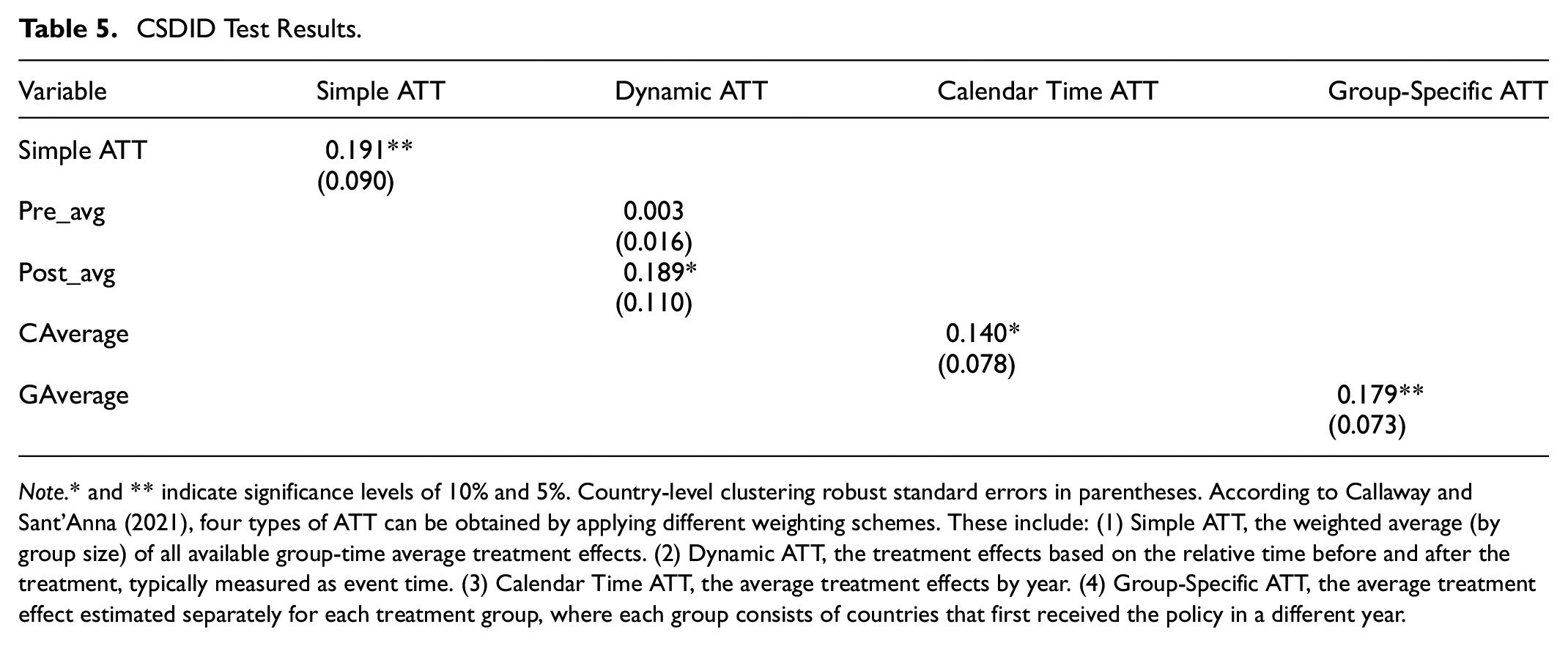
Note.* and ** indicate significance levels of 10% and 5%. Country-level clustering robust standard errors in parentheses. According to Callaway and Sant’Anna (2021), four types of ATT can be obtained by applying different weighting schemes. These include: (1) Simple ATT, the weighted average (by group size) of all available group-time average treatment effects. (2) Dynamic ATT, the treatment effects based on the relative time before and after the treatment, typically measured as event time. (3) Calendar Time ATT, the average treatment effects by year. (4) Group-Specific ATT, the average treatment effect estimated separately for each treatment group, where each group consists of countries that first received the policy in a different year.
Heterogeneity Test
Geographic Location
To investigate whether the impact of the Silk Road E-commerce cooperation on the export trade of the Guangdong-Hong Kong-Macao Greater Bay Area varies based on the geographical location of trading countries, this study conducts a grouped regression analysis by categorizing the sample countries into Europe, America, Africa, Asia, and Oceania. The findings, presented in columns 1 to 5 of Table 6, indicate that the Silk Road e-commerce cooperation significantly boosts export between the Greater Bay Area and African and Asian countries, but shows no significant effect on exports to Oceania, European and American countries. Specifically, since the establishment of the cooperation relations, exports from the Greater Bay Area to African partners have increased by 74.4% relative to other African countries, and exports to Asian partners have risen by 18.5% compared to the rest of Asia. The greater efficacy of the cooperation mechanism in enhancing exports to Asian and African countries, as opposed to Oceania, Europe, and America, may be attributed to the higher logistics costs associated with trading with more distant regions like Oceania, which potentially offset the advantages conferred by Silk Road e-commerce. Additionally, the Greater Bay Area’s products may already hold a substantial market share in Oceania, limiting the observed changes.
Heterogeneity Test.

Note. *, **, and *** indicate significance levels of 10%, 5%, and 1%. Country-level clustering robust standard errors in parentheses.
Level of Economic Development
Based on the practice of H. S. Zhang and Pan (2021), the sample countries with Human Development Index(HDI) higher than 8.0 are classified as developed economies, while those with an HDI below this threshold are categorized as developing economies. The grouped regression results are shown in columns 6 and 7 of Table 6, reveal that the Silk Road e-commerce cooperation has a more pronounced effect on promoting exports between the Greater Bay Area and developing economies. This significant impact can be attributed to the greater willingness of developing countries to adopt Silk Road e-commerce to better satisfy their market demands. Conversely, the relatively mature and highly penetrated e-commerce markets in developed countries may diminish the influence of the Silk Road e-commerce cooperation, resulting in a less significant impact on the Greater Bay Area’s exports to these regions.
Impact Mechanism Test
This study incorporated the concepts of search cost and logistics cost (Lendle et al., 2016), and in conjunction with the aforementioned theoretical analysis, examined the impact mechanism of bilateral cooperation of Silk Road e-commerce on the export trade of the Greater Bay Area using a two-step approach (Jiang, 2022). In this framework, the reciprocal of information and communications technology (ICT) export intensity of a trading country is taken as search cost(SC), and the reciprocal of logistics performance index (LPI) is used to measure the cross-border logistics cost(LC). A country’s ICT services export intensity (the proportion of ICT services exports to total services exports) reflects the country’s digital infrastructure, so the higher the ICT services export intensity, the better the information access capacity, the lower the search cost of trade. Similarly, the higher the LPI, the lower the cost of cross-border logistics. The specific model was set as follows:

The regression test of model (1) above shows that, at the 1% level, the bilateral cooperation of Silk Road e-commerce has a significant positive impact on the export trade of the Greater Bay Area. Subsequently, Model (4) was tested, and the results are presented in columns 1 and 2 of Table 7. It can be seen that the bilateral cooperation of Silk Road e-commerce has significantly reduce search costs of trade and that this impact is negative and significant at the 10% statistical level, with an effect of 8.59%. Its impact on cross-border logistics costs is negative and significant at the level of 5%, with an effect of 2.18%.
Mechanisms.
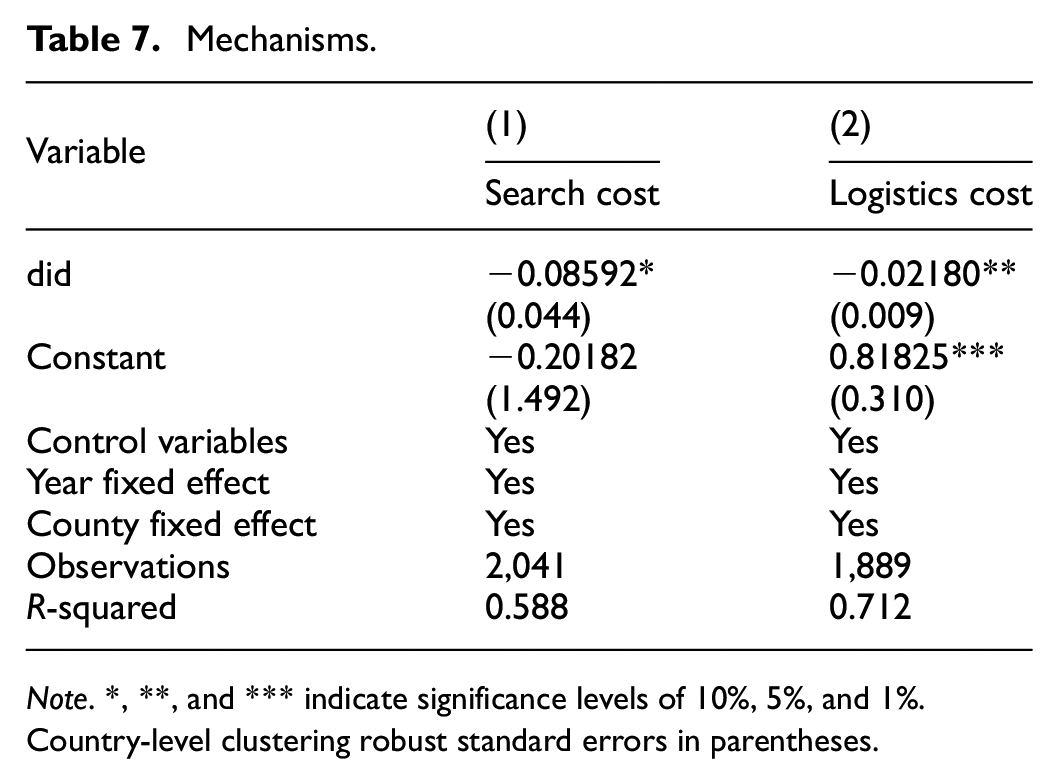
Note. *, **, and *** indicate significance levels of 10%, 5%, and 1%. Country-level clustering robust standard errors in parentheses.
In addition, previous research has demonstrated that cross-border e-commerce policies reduce import trade costs by reducing consumer search costs (H. S. Zhang & Pan, 2021). During the import process, consumers in the importing country can utilize cross-border e-commerce platforms to search for products from the Greater Bay Area, and enterprises in the Greater Bay Area can more easily sell their products to these consumers via these platforms, thus reducing import trade costs. The cost of cross-border logistics has a significant inhibitory effect on the development of foreign trade. To sustain the growth of a country’s foreign trade volume, it is essential to enhance the construction of cross-border logistics infrastructure to reduce logistics costs (Wei & Zhang, 2022). In summary, the bilateral cooperation facilitated by Silk Road e-commerce can promote the export trade of the Greater Bay Area by reducing both trade search costs and cross-border logistics costs. Hypothesis 2 and 3 are verified.
Conclusions
Study Conclusions
Utilizing panel data of the Guangdong-Hong Kong-Macao Greater Bay Area’s foreign export trade to 166 countries and regions from 2010 to 2022, this study provides robust evidence that: (1) Silk Road e-commerce cooperation positively impacts the export trade of the Greater Bay Area. and this positive impact remains robust even after incorporating lagged variables, excluding certain samples, and substituting the PSM-DID model, among other robustness tests; (2) By fostering reduced search and logistics costs, these cooperative agreements are especially effective in emerging markets, where they open new trade pathways and support economic growth; (3) Unlike the limited effects observed for exports to Oceania, Europe, and the Americas, e-commerce cooperation demonstrates a distinct positive impact on trade with Asian and African countries, indicating that market readiness and infrastructure are key factors in the success of e-commerce policies. Additionally, the impact is more pronounced in exports to developing economies, where e-commerce cooperation can help mitigate substantial structural barriers. These results align with existing literature, which suggests that developing markets—often facing higher initial trade costs—stand to benefit disproportionately from trade facilitation measures. Despite the demonstrated effectiveness of these policies, continual adaptation and model optimization are necessary to fully understand and leverage institutional factors affecting cross-border e-commerce. In 2023, Guangdong Province established the country’s first cross-border e-commerce full-mode public service platform, achieving comprehensive coverage of B2B and B2C sectors. This platform provides one-stop “customs, exchange, tariff” services for the majority of cross-border e-commerce enterprises participating in Silk Road e-commerce cooperation. Hong Kong, with its mature financial system and shipping system, boasts an extensive business network spanning the Asia-Pacific region and beyond. Meanwhile, Macao offers a unique economic and trade service platform with Portuguese-speaking countries and possesses significant capital resources. Together, these regions within the Greater Bay Area contribute significantly to the BRI. Through regular policy evaluation, expanded cooperation across industries, and strategic support to both developing and developed economies, the Greater Bay Area can further solidify its role in the global digital economy.
Policy Suggestions
Based on the above conclusions, the following policy implications are proposed:
Since the effects of signing memorandums of cooperation and implementing trade policies accumulate over time, it is imperative for partner countries to regularly evaluate their impact on trade and revisions should be made in response to market dynamics and policy implementation efficacy to ensure continued relevance and impact. Most of the memorandums signed between China and partner countries currently focus on broad official cooperation in areas like policy communication, planning alignment, professional training, and capacity building, without concrete cooperation plans or agreement (Zhao et al., 2024). In terms of the depth and breadth of cooperation, there is a need to expand collaboration by engaging additional industries or sectors and diversifying the range of goods or services.
In addition, tapping into the market potential of developing countries, compared with developed countries, particularly those along the Belt and Road in Southeast Asia, South America, Africa and other emerging markets with their large population bases and lower levels of e-commerce development and coverage, which means significant growth opportunities and development potential. Providing technological consultation and assistance to these technologically underdeveloped countries can facilitate the acquisition of essential skills for cross-border e-commerce development, thereby fostering cooperation and growth in bilateral cross-border e-commerce. To facilitate this, more cultural exchange activities and business seminars should be encouraged and organized to help trading partners better understand different languages and cultures, business habits and practices, legal environment and regulatory systems, thereby reducing trade challenges and barriers. Notably, the establishment of a fair, equitable, and transparent environment for e-commerce development is crucial to addressing and mitigating the concerns and reservations expressed by certain countries regarding international cooperation within the Silk Road e-commerce.
This study examines and discusses the impact of Silk Road e-commerce on the export trade of the Greater Bay Area. It is important to note that there are certain limitations in this study that warrant further exploration and refinement. First, some factors, such as the impact of policy uncertainty on trade, were not considered in the analysis. Additionally, it is possible that certain countries in the control group engage in cross-border e-commerce with China without a formal memorandum, which may still be influenced by Silk Road e-commerce cooperation. As cross-border e-commerce is still in a rapid growth phase, and the global digital trade regulations have yet to fully materialize (Ma et al., 2024), future research will need to build upon and refine the understanding of Silk Road e-commerce cooperation’s effectiveness.
Footnotes
Acknowledgements
None.

Funding
The authors disclosed receipt of the following financial support for the research, authorship, and/or publication of this article: This research was funded by the 14th Five-Year Plan Project for the Development of Philosophy and Social Sciences of Guangzhou (2021GZGJ28) and the Youth Innovative Talent Funding Project of the Department of Education of Guangdong Province (2021KQNCX143).
Declaration of Conflicting Interests
The authors declared no potential conflicts of interest with respect to the research, authorship, and/or publication of this article.
Data Availability Statement
Data sharing not applicable to this article as no datasets were generated or analyzed during the current study.