




Abstract
This study applies phraseologies to the comparative examination of China’s Greater Bay Area plan between Chinese and Anglo-American English-language press. Findings show that the Chinese texts are concerned in promoting cross-border Greater Bay Area integrated development allied with positive references to the role of Hong Kong, whereas the Anglo-American texts construct the Greater Bay Area plan as a political project and place emphasis on the negative impact on Hong Kong. Also, while the Chinese texts focus on government support to legitimate the plan, the Anglo-American texts underline political threat to Hong Kong as a form of delegitimation. This study explicated the social-political factors behind each particular way of representation by presenting an approach that could yield insights into the new politicalized Hong Kong.
Introduction
Studies of phraseology has shown that words are not randomly distributed but co-selected in linguistic patterns such as pattern grammar (Hunston, 2002; Hunston & Francis, 2000), phraseology (Sinclair, 1987, 1996, 2004; Tognini-Bonelli, 2001), n-grams or lexical bundles or clusters (Biber et al., 2004; Carter & McCarthy, 2006), phrase-frames (Fletcher, 2021), skipgrams (Wilks, 2005), and phrasal constructions (Stubbs, 2005). Sinclair’s (1987)“idiom principle” is the basis of phraseological tendency which suggests a multi-word lexical item or an extended unit of meaning. His definition of a lexical item represents the lexical structure higher than a word that “all complete lexical items realize an element of meaning which is a function of the item in its cotext and context” (Sinclair’s, 2004, p. 121). The phenomenon of extended units of meaning is very rarely independent of the environment in which it appears (Sinclair, 2004). Tognini-Bonelli (2001, p. 19) also notes that multi-word-units are defined by the strict correlation which exists between a node and its context. According to Sinclair (2004, p. 30), “words cannot remain perpetually independent in their patterning… they begin to retain traces of repeated events in their usage, and expectation of events such as collocations arise.” Corpus linguistics has provided evidence to embrace the concept of extended-unit-of-meaning model of language given the larger phrasal unit of meaning is better understood as uncovering patterns of co-selection in the corpus.
The present study adopts a corpus-driven phraseological analysis (Cheng, 2006; Cheng & Lam, 2010, 2013; Taljard, 2014; Hou, 2018) on keywords (Adolphs, 2006; Scott, 2015; Scott & Tribble, 2006; Stubbs, 2010) to critically compare how China’s Greater Bay Area (GBA hereafter) plan is discursively represented between China’s and Anglo-American English-language press. It has two specific objectives: (1) to uncover in what way and to what extent they are different in their representations of the issue, and (2) to account for the social-political and ideological factors behind each way of representation. The motivation for conducting this research is to introduce a corpus-driven phraseological analysis to provide rigorous linguistic evidence to geopolitical studies of China’s cross-border strategy by contextualizing the inquiry within reference to different news reports associated with the GBA plan. This research thus contributes toward wider understanding of China’s GBA plan, particularly when considering integration of autonomous Hong Kong with mainland China and the extent to which media representations are “tailored” for different political and ideological positions. The next section introduces China’s GBA plan and describes different voices with regard to the integration of this cross-border plan. Then, it is devoted to concgrams (Greaves, 2009) as an analytical approach to identify the extent of phraseologies in a corpus. The method section describes the data, method of phraseologies derived and research design. In the analysis section, I outline differences and similarities between the two datasets and provide explanations for the findings, noting some of the ways that phraseological choices could contribute to uncover social-political differences in media representations. Finally, it concludes the methodological rigor of phraseological analysis on social-political events and future studies on the new politicalized Hong Kong.
China’s Great Bay Area Plan
The Guangdong-Hong Kong-Macau Greater Bay Area, simply Greater Bay Area or GBA is also known as Pearl River Delta region in southern China, consisting of eleven cites, nine in the coastal Guangdong province in south China and two special administrative regions, Hong Kong and Macau. As an updated version of Pearl River Delta initiative, the GBA plan, according to Chinese official Xinhua news agency, emphasizes the integration of cross-border eleven cities into “a global technology innovation center and finance powerhouse with advanced manufacturing and modern service industries” and to take on a new mission as the “shining pearl” of China’s Belt and Road Initiative (Zhang, 2018). In February 2019 the Chinese government formally issued the outline development plan as an official guide to the current and future cooperation and development in the Bay Area.
As a new engine to sustain China’s economic development, the GBA plan was implemented to strengthen competitiveness in regional and global competition. Zheng (2018) notes that China has to source new engines to boost economic growth by establishing new opening areas in the context of slow economic increase. Most importantly, the GBA plan provides a new platform for pursuing economic linkages between Guangdong, Hong Kong, and Macau, where the three cross-border areas have separate political systems and custom zones with different legal system and governance culture. In recent years the Hong Kong community has sparked strong resistance to the prospect of closer economic integration with mainland China (Yu, 2019). As a result, the rising pro-democracy movement in Hong Kong was a strong push for the Chinese government’s resolution to promulgate the GBA plan in an attempt to curb the protest by aligning Hong Kong closer with the mainland China economically and politically.
Chinese researchers have started to tackle GBA plan mainly focusing on the coordination and integration of the cross-border three areas including China’s Guangdong, Hong Kong, and Macao in the background of “One country, Two systems.” 1 Despite the vast majority of relevant Chinese domestic studies on GBA integration such as education cooperation, talent collaboration, and economic integration, predicting favorable developmental prospects and opportunities in the Bay Area (Cao, 2019; Lu, 2019; Zhou et al., 2019), many western news reports have emerged which suspected the Chinese government’s ongoing controlling effort to integrate the two special administrative regions, particularly Hong Kong, further into China. According to the Basic Laws of Hong Kong and Macau, 2 the previous capitalist system and way of life in Hong Kong and Macau shall remain unchanged for 50 years after the British-ruled Hong Kong and Portuguese-ruled Macao transferred sovereignty to China since 1997 and 1999, respectively. Nevertheless, Hong Kong emerges as a frequent target in news reports associated with GBA plan and receives critical comments such as “…spread resources away from Hong Kong and into China’s vaunted Greater Bay Area” (The Independent, 21 October 2018) and “China pushes to integrate Hong Kong through patriotic education” (Wall Street Journal, 1 November 2019). Hence, the GBA plan is designed to expedite further reintegration of Hong Kong with respect to the “One country, Two systems” implementation in terms of China’s “internal geopolitics”; whereas, challenges and criticisms are pervasive to the autonomous Hong Kong within the Bay Area with regard to “external geopolitics” (Subra, 2012).
Concgrams as Phraseological Tendency
Concgrams are regarded as a starting point for identifying and quantifying the extent of phraseology in a text or corpus (Cheng, 2014; Cheng et al., 2009; Greaves & Warren, 2007; Warren, 2009, 2010). According to Cheng et al. (2006, p. 414), a concgram is defined as “all of the permutations of constituency variation and positional variation generated by the association of two or more words.” It has the potential of finding co-occurring words with up to twelve intervening words, but only those which are meaningfully associated warrant study. Through the process of concgramming a corpus to uncover its phraseological variation, it is better to understand words in combination not in isolation from each other, in other words, words are co-selected. Greaves and Warren (2007, p. 289) point out, “concgrams are a useful source of raw data to reveal the co-selections made by the speakers and writers represented in a text or corpus.”
Studies using concgrams are mainly focused on examining the aboutness of texts and corpora (Cheng, 2007; Cheng et al., 2009; Greaves & Warren, 2007; Milizia & Spinzi, 2008; Warren, 2010). In one typical study, Warren (2010) evaluates the advantage of determining the aboutness of engineering texts by identifying the most frequently occurring two-word lexical concgrams as compared to single word frequency lists. In another systematic analysis of phraseologies, Cheng et al. (2009) examine a frequently occurring lexical two-word concgram play/role because of its high frequency in the BNC and across various text types in the corpus, through which general observations of word co-occurrence are summarized, contributing to an analytical procedure for identifying phraseological variation within concgrams. It has been found that the meaningfully associated concgrams, be they constituency variation or positional variation in terms of configuration, adhere to the canonical form with varying degrees of turbulence. Additionally, Cheng and Lam (2013) examine the most frequent two-word lexical phraseology political/Hong Kong across the four media corpora concerning both Chinese and western news reports on the handover of Hong Kong during two time periods (1996–1998 and 2006–2008). The phraseology political/Hong Kong is analyzed with regard to its five semantic preferences for their favorable and unfavorable or neutral semantic prosodies, providing a methodological approach of exploring political-related issues in the context of before and after the handover of Hong Kong.
The present study provides analyses of phraseologies not only generated from two-word concgrams by ConcGram 1.0 (Greaves, 2009) but also phraseologies associated with keywords within semantic categories generated by Wmatrix (Rayson, 2008). More importantly, a qualitative and contextual-based analysis is conducted to explicate the social-political factors and identify prevailing ideological assumptions and values of the accumulated prototypical meanings.
Data and Methods
The data between GBA Chinese media corpus consisting of 268 texts (131,043 words) and Anglo-American corpus 56 texts (57,105 words) was retrieved by the search items “China” and “greater bay area” using together for related news reports and articles published between 2015 and 2020 from database LexisNexis. The Chinese media corpus provided an abundant resource of related full texts from China’s state-run main English-language press including China Daily, Global Times, People’s Daily Online, Xinhua General News, and Beijing Review. The Anglo-American corpus included texts from prominent newspapers such as The Washington Post, The New York Times, Wall Street Journals, The Sunday Times, The Guardian, The Independent, and Financial Times. Media environment in China is known as restrictive and China’s state-run main English-language press serves the primary function of publicizing the stances of the Chinese government to the world (Hou, 2019, 2021). Fu et al. (2012) notes that Chinese newspapers are directly or indirectly affiliated with the Chinese government. Hill and Segev (2014) also argue that “Chinese news has a different, more cloistered view of the world than news from more putatively “free” presses’ (p. 1811). The Anglo-American newspapers belong to liberal media system and known for their professionalism with wide international influence and tend to be more critical on China issues. Hanitzsch (2011, p. 485) notes that the Anglo-American news coverage has a strong “skeptical and critical attitude toward the government and business elites.” As such, contrastive analysis between China’s and Anglo-American English texts is predictably to be written for different purposes.
It is worth noting that the size difference between the two corpora will not affect the validity of contrastive analysis in view of the same selection criterion and different media attention in the construction of China’s GBA plan. The comparison is labeled “corpus-driven” (Tognini-Bonelli, 2001) because the resulting concgrams and semantic categories are emerged from the corpora rather than from related literature.
First, phraseologies were identified on the raw data of two-word lists of concgrams generated by ConcGram 1.0 with the function of exclusion lists to exclude the function or grammatical associations. This was done for the consideration of only focusing on lexically-rich two-word associations because they represent the aboutness of the article from which they originate, and more importantly, meanings in language were primarily constructed by lexical words and the association of lexical words. In order to make a distinction between “co-occurring” words (i.e., concgrams) and meaningfully “associated” words (i.e., phraseology; Warren, 2011), the concgram concordances were examined. Thus, manual checking of each concgram concordance line was required so as to remove the instances that were the repeats of the same concordance line and drop the lines that were not meaningfully associated or do not conform to the canonical form of the two-word concgram (Cheng et al., 2009; Warren, 2011). Some frequent two-word concgrams such as Hong/Kong were found actually one word of the city name Hong Kong, then the phraseology for Hong Kong were generated through the function of three-word concgram.
Then, the GBA Chinese corpus and Anglo-American corpus were swapped with each other as study corpus and reference corpus to generate the overused semantic categories by Wmatrix (Rayson, 2008), because the underused categories of one corpus would be the duplicates of overused ones within another. This step provided keywords within dominant semantic categories between China’s and Anglo-American English texts and categories that were more salient within one corpus against the other. Keywords in the categories with relative frequencies both high and similar in both corpora were considered to be common categories, and those in the categories have exceptionally higher relative frequencies in one corpus than the other were considered to be salient categories.
A final step involved mapping the equivalence between concgrams and keywords. With the help of ConcGram, phraseological analyses were conducted based on the concgrams and keywords between the two corpora so as to identify their semantic preference and semantic prosody (Sinclair, 2004). Semantic preference is “the restriction of regular co-occurrence of items which share a semantic feature” (Sinclair, 2004, p. 142) and semantic prosody is “the determiner of the meaning of the whole lexical item” and provides clues as to how the rest of the item is to be interpreted functionally (Sinclair, 2004, p. 141). Findings were outlined through the accumulated effects on the co-constructions of social-political values and ideological positions around contrastive analysis.
Findings
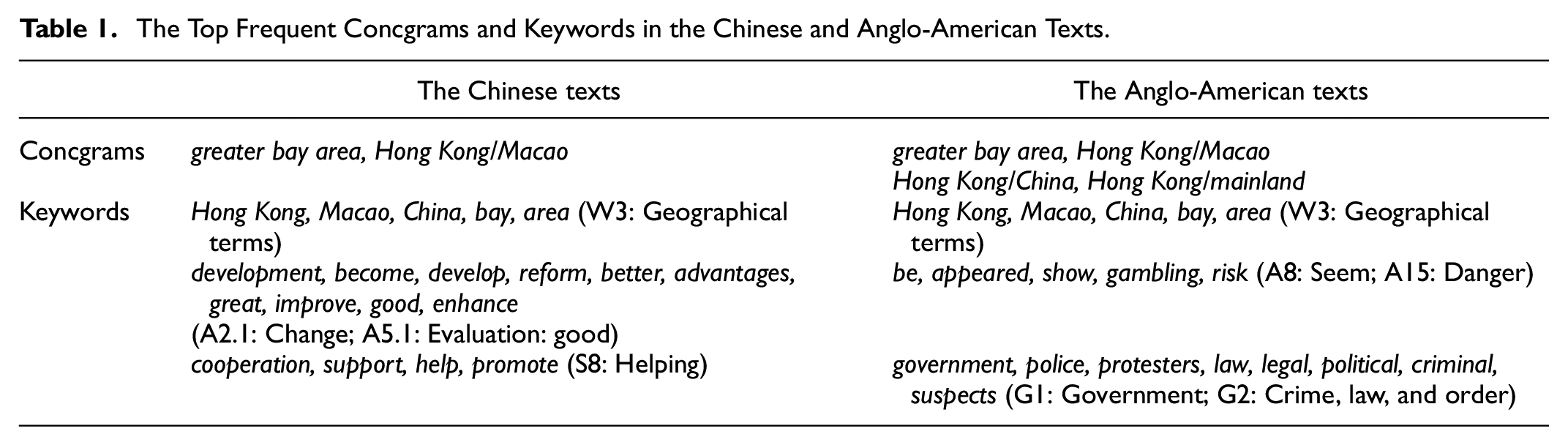
It has been found that China’s and Anglo-American texts show a strong degree of similar theme indicated by the frequent multi-word-unit greater bay area and two-word concgram Hong Kong/Macao in both corpora. While concgrams Hong Kong/China and Hong Kong/mainland, showing Hong Kong’s peculiar role to China, were emphasized in Anglo-American texts. Keywords of common categories in both corpora pertains to geographical names including Hong Kong, Macao, China, bay, and area, further indicating that GBA and the cross-border three parts are the central themes. This is consistent with high frequency of phraseologies generated by ConcGram.
In addition, the social conditions and evaluations of GBA plan were indicative from the common category of “General and abstract terms” (A category) in which subcategories of the Chinese texts were “Change” and “Evaluation: Good” with keywords including development, become, develop, reform, better, advantages, great, improve, good, and enhance; while subcategories of “Existing,”“Seem,” and “Danger” consisting of keywords such as forms of be, appeared, show, gambling, risk were prominent in the Anglo-American texts. With regard to salient categories, “Social actions, states & processes” (S category) in the Chinese texts were salient and showed the preoccupation of contribution, evidenced by the subcategory “Helping” indicative of self-positive representation with high frequency keywords such as cooperation, support, help, and promote. Whereas, the Anglo-American texts focused on government and politics, evidenced by the category of “Government and public domain” (G category) containing keywords such as government, police, protesters, law, legal, political, criminal, and suspects. It is evident that except the similar theme on the cross-border GBA plan including China, Hong Kong, and Macao, the Chinese and Anglo-American texts display the results of distinctive focuses in terms of top frequent concgrams and keywords as shown in Table 1.
The Top Frequent Concgrams and Keywords in the Chinese and Anglo-American Texts.
Common Categories
The multi-word-unit greater bay area is one of the most frequent instances of geographical names relating to the theme with 1,330 occurrences in the Chinese texts and 115 in the Anglo-American texts. The phraseological analysis shows that the semantic preference and semantic prosody associated with greater bay area in the Chinese data can be classified into three groups: (1) all-round contributions of GBA through strong collocates such as development (23%), economic (6%), opportunity (6%), innovation (5%), and cooperation (4%) express favorable attitudinal meanings referring to all potentials approved of by the initiation of GBA plan. Such expressions as coordinated development, economic cooperation, historical opportunity, high-tech innovation, and future cooperation associated with greater bay area apparently contribute to the cross-border integration of a development plan; (2) the GBA plan is envisioned as a forward or upward change of state in strength through the model verb will at the N + 1 position followed by verbs such as evolve, inject, help, facilitate, usher, drive, revitalize, enrich, promote, and foster (66 times, 5%, Figure 1), all of which create an undertone of a favorable plan to accomplish in the years to come; (3) Hong Kong’s inclusion in GBA (482 times, 36%) tends to be used to justify the benefits of the GBA plan for the development of Hong Kong, as the following Example (1) indicates:
(1) Leung Chun-ying, chief executive of the Hong Kong Special Administrative Region (SAR) has said that the development plan for Guangdong-Hong Kong-Macao

Sample concordance lines of greater bay area/will.
Findings in the Anglo-American texts show that the semantic preference and semantic prosody associated with greater bay area can be classified into two main groups: (1) GBA is China’s national policy indicating a political-driven plan for regional development (21 times, 18%). This is manifested by such expressions as a Beijing-driven plan, a state-led initiative, a key national strategy, an ambitious project, a political project (Figure 2); (2) Hong Kong’s integration into the area (39 times, 34%) is used emphatically as a means of reinforcing Hong Kong’s resources to GBA, as indicated in Example (2):
(2) Some say that a new £12bn bridge linking Hong Kong to the mainland city of Zhuhai and the gambling enclave of Macau-set to open next week—will further spread resources away from Hong Kong and into China’s vaunted Greater Bay Area. The 34-mile crossing will cut travel times between Hong Kong and Zhuhai to around 40 minutes.

Sample concordance lines of greater bay area.
The frequent reference to greater bay area in both Chinese and Anglo-American texts in the category of geographical names indicates different semantic meanings each expresses to argue the implementation of China’s GBA plan. The predominant theme relating to contribution and dynamism associated with GBA, and opportunities for Hong Kong in the Chinese texts could therefore be seen as a way to legitimating and validating the GBA initiative; whereas, the Anglo-American texts associated with government plan, national strategy, and political project, and resources away from Hong Kong may reflect the West distrust to China.
The common category of “General and abstract terms” provides an additional dichotomy between positive-self and negative-other media representation. In the “Change” and “Evaluation: Good” subcategories of the Chinese texts, the two-word phraseologies to/become, has/become, and will/become are found to be highly recurrent in the Chinese texts (N = 142) and manifest in the consistent pattern of co-selections paradigmatically realized by subjects including GBA (28 occurrences), and the three main cities in the area—Hong Kong and Macao (18 occurrences) and Shenzhen (7 occurrences), and the newly-built bridge (7 occurrences) connecting Hong Kong, Zhuhai, and Macao within the area. Syntagmatically, the GBA tends to represent a semantic prosody of “forward-looking and promising,” with examples of co-occurring words such as world-leading, competitive, first-class international, globally influential, successful, growth engine, and innovation and technology hub (Figure 3).

Sample concordance lines of has/become, will/become, to/become.
Of the keyword phraseologies development/of, development/Hong Kong, to/better, better/Hong Kong, advantages/Hong Kong, advantages/to, advantages/of in the Chinese texts, GBA, and Hong Kong are consistently given more attention with regard to the favorable conditions. Hong Kong’s association with new impetus, new booster, fresh vitality, long-term prosperity, unlimited opportunities, new vistas, and solid foundation in the phraseology development/Hong Kong (13%, 35 occurrences, Figure 4), creates a positive semantic prosody of “Hong Kong’s development is guaranteed.”

Sample concordance lines of development/Hong Kong.
Moreover, the phraseology Advantages/Hong Kong further translates Hong Kong’s advantages in finance, shipping and trade, innovation, tourism industry, world-class universities, and modern services with a praiseworthy aim within the framework of GBA. An illustrative instance is shown in Example (3).
(3) Lo noted that the Hong Kong Tourism Board does not solely pursue a simple increase in tourist arrivals. “We are also looking ways to cooperate with relevant partners in the Chinese mainland and leverage Hong Kong’s advantages in the tourism industry to promote coordinated development within the framework of the Greater Bay Area.” In February, the Chinese government unveiled a development plan for the Guangdong-Hong Kong-Macao Greater Bay Area, aiming to turn the region into a showcase for cooperation between the Chinese mainland, Macao, and Hong Kong.
In the Chinese texts, additional prominent references to favorable evaluations associated with GBA are found from the keywords great (72 times) and good (58 times) which consistently collocate with nouns at N + 1 position. The paradigmatic choices include importance (seven times), opportunities (13), significance (six times), achievement (five times), advantages (four times), business (five times), ecosystem (four times), environment (four times), and so on, all of which tend to create a semantic prosody of “an appreciative result.” Furthermore, the keywords improve (65 times) and enhance (49 times) tend to be colligationally preceded by to (35%) and followed by a noun phrase to the right side such as connectivity, security, collaboration, environment, livelihood, and system-related area of work and activity for a desired state of existence that has yet to be achieved (Figure 5). It can be said the semantic prosody is perceived as “desirable aims” with the implementation of GBA plan.

Sample concordance lines of improve and enhance.
While in the Anglo-American texts, keywords such as forms of be (1,384 times), appeared (12 times), show (19 times), seem(ed) (10 times), gambling (22 times), and risk(s) (35 times) are found prominent in the subcategories of “Existing,”“Seem,” and “Danger” within the common category of “General and abstract terms.” The five forms of be including is, are, be, was, and were are found frequently preceded by Hong Kong (69 times, 5%) and the collocates of which are associated with freedom of speech and the press, universal suffrage, autonomy, political experiment, Beijing, Taiwan, Chinese Communist Party, assembly, political mood, protests, and so on (67%, 46 times, Figure 6), serve to suggest the semantic preference of “increased politicization” (Martin, 2007) of Hong Kong as it merges into the GBA. The phraseology Hong Kong/be in the Anglo-American texts indicates a negative semantic prosody of “political crisis,” which is exemplified partly by the attitudinal words such as dwindling, challenge, threat, havoc, and clouded associated with phraseologies including Hong Kong/is, Hong Kong/are, and Hong Kong/was (Figure 6).
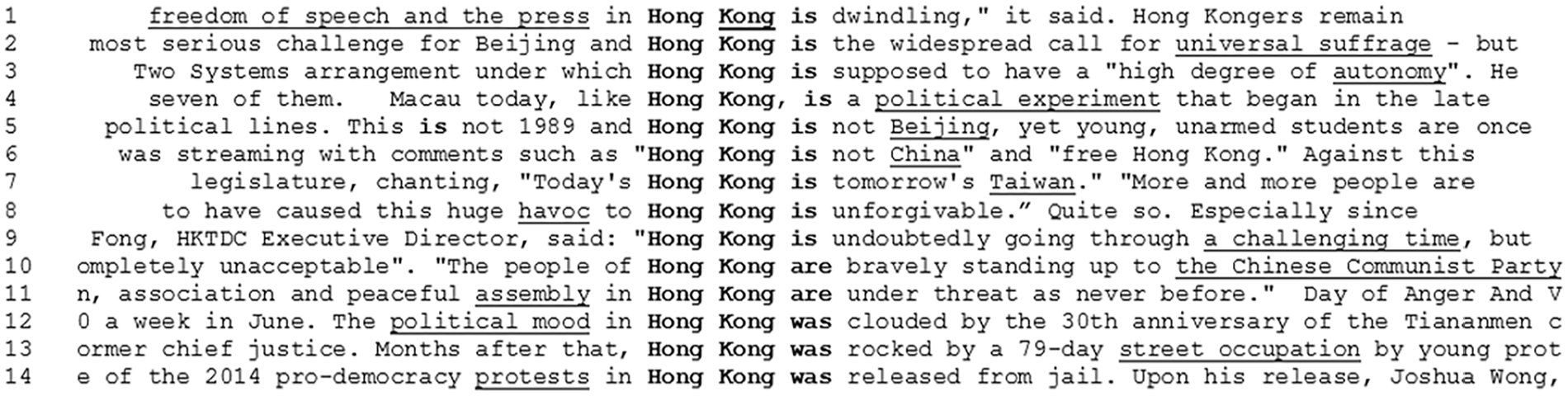
Sample concordance lines of Hong Kong/be.
In the “Existing” subcategory, another frequent contiguous phraseology it is (73 times) is found to denote the GBA-related regions and business, particularly Hong Kong’s status, role, and protest (23 times, 32%), but are negatively referenced to a semantic prosody of “unattainable and pessimistic” under the framework of GBA plan, as in Example (4).
(4) The international community has a separate duty. It is counterproductive to call for an independent Hong Kong or to further inflame the rhetoric. But we should be supporting—urgently and in our own streets—their right to freedom of assembly, association, and expression, and to have an independent judiciary.
The “Seem” subcategory including keywords appeared, show, and all associated spellings of seem normally translate the Hong Kong protests in an unassured and questionable context (18 times, 32%). The Hong Kong’s protests starting in June 2019 was against the Chinese government’s attempt to pass a new extradition bill which would have ultimately allowed the extradition of fugitives to mainland China. It has sparked activist protesters demand full democracy and clashes with police. In a small number of cases, topics of the Hong Kong protests such as decades of civil unrest would have seemed absurd; to win over Hong Kong latest protests show failures of China’s years of efforts and Video from the scene appeared to show an attacker… are made explicit in the Anglo-American texts, indicating that it is likely the Hong Kong protests zoomed in with the implementation of GBA plan. In addition, the keyword risk and risks are found frequently co-occur with politics-related words such as protesters, handover agreement, sustainable strategy, Beijing, law, trade war, political, sanction, and so on (20 times, 57%), mostly interpreting a risky Hong Kong under the framework GBA plan and the “One country, Two systems.” Regarding the semantic prosody, it serves to create negative political settings for Hong Kong’s future development, as indicated in Example (5).
(5) The U.S. State Department warned in an April 25 statement that Hong Kong’s “long-established special status in international affairs” is at risk with the continued erosion of “one country, two systems.”
Chinese Category
The Chinese texts contained a much higher proportion of keywords relating to the subcategory of “Helping” in the category of “Social actions, states & processes” (S category). It is manifest that keywords such as cooperation (310 times), support (122 times), help (131 times), and promote (101 times) tend to provide positive representation on the GBA plan. For the most frequently occurring keyword cooperation, it has a strong collocation with Guangdong, Hong Kong, and Macao (41 times), Hong Kong and Macao (20 times), and Shenzhen-Hong Kong (13 times), creating a semantic preference of cooperation among three main cities including Hong Kong, Macao, and Shenzhen. Another semantic preference associated with cooperation creates a context of all-round and versatile cooperation including such areas as scientific research, environmental protection, education and healthcare, innovation and technology, and particularly in economic and trade cooperation (57 times, 18%). Regarding the semantic prosody, 33% (102 out of 310) of instances carry the positive meaning of “forward and upward driving force.” This is because cooperation is often preceded by verbs such as deepen, expand, enhance, facilitate, promote, strengthen, boost, foster, and so on (Figure 7).

Sample concordance lines of cooperation.
With 120 instances of support in the Chinese texts, the phraseologies support/to (63 times), support/for (41 times), and support/government (22 times) are identified as the most frequent. Given that the GBA plan implemented by the Chinese government, a strong pattern of collocation with the central government in the uses of support/government (64%, 14 out of 22 times) creates a prominent semantic preference of “the central government support.” Other supporting mechanisms relating to policy, investment, finance, local government, technology, and management are found frequent in support/to (33%, 21 out of 63 times). Regarding the supporting object, the associated collocates including new enterprises, private enterprises, tourism economy, economic construction, industrial cooperation, construction, projects, socio-economic development, and so on provide evidence of a semantic preference of “economic field” (33%, 21 out of 63 times). In the corpus, the three strongest collocates preceding support are strong, solid, and continued at N − 1 position (occurring 21 times collectively) suggests a positive semantic prosody of “obligatory support,” a point which is made clear by the Example (6).
(6) The plan calls for efforts to strengthen infrastructural development, enhance external and internal connectivity, push forward the establishment of an infrastructural network with a rational layout, comprehensive functions, smooth connections and efficient operations, and provide solid support for socio-economic development in the Greater Bay Area.
The two frequent phraseologies to/help (68 times) and will/help (45 times) identified from the keyword help tend to collocate with various resources associated with the GBA plan for achieving the purpose of assistance pertaining to coordinated development and understanding among the three areas. Among the 113 instances of to/help and will/help examined, 31% (35 times) of the resources indicates a semantic preference of institutionalized and substantial help, because human resources, master plan, public services, diplomatic resources, real economy, investment, national funding, the bridge, and so on are the consistent pattern of co-selections (see Figure 8). 45% (51 out of 113) of the instances of to/help and will/help occur with words and phrases such as optimizing, amazing, greatly, strengthen, enhance, advantage, high-quality, potential, and so on, all of which serve to create the positive semantic prosody of “aspirational.”

Sample concordance lines of will/help and to/help.
For the keyword promote, the phraseologies promote/to (69 out of 101 times) and promote/development (33 out of 101 times) are found frequent and meaningfully associated. In the Chinese texts, the three strongest collocates of promote/to are cooperation, coordination, and integration (occurring 21 times collectively). As a cross-border project, GBA plan was born out of regional coordinated development in such areas as technology, innovation, tourism industry, clothing industry, transportation, literary integration, and so on, which is also indicative from the phraseology promote/development. Thus, the action of promote creates a positive official driving force to make the cross-border integration happen and expand, as the following Example (7) indicates.
(7) Efforts should be made to promote cooperation in technology and innovation between the mainland, Hong Kong, and Macao, said Han, adding that a series of measures would be adopted to facilitate customs clearance of personnel and goods in the Greater Bay Area, as well as the exit and entry of samples for scientific research, laboratory reagents, and genetic resources.
Keywords associated positive-self representation in the Chinese media emerged as statistically significant and highly supportive to the integration of GBA plan. It is confirmed that the unusually frequent use of “helping” keyword-associated phraseological analyses are indicative of the Chinese government support and institutional help to the GBA cross-border cooperation and regional development.
Anglo-American Category
The Anglo-American texts appear to be more focused on “Government and public domain” (G category) compared to the Chinese texts, with keywords such as government (144 times), police (95 times), protesters (96 times), law (91 times), legal (65 times), political (90 times), criminal (6 times), and suspects (5 times). The most frequent phraseology identified from government is government/Chinese (31%, 45 out of 144 times), providing a semantic preference of “the Chinese government’s intention to control Hong Kong and Macao.” Examples of words surrounding government/Chinese discovered in the concordance lines include tighten its grip, bind more tightly, surveillance as normal, hardened its approach, undermining independence, undercut Hong Kong, foisted on us, and so on. The cumulative effect of such words, across 67% of the instances (30 out of 45), is to underscore the sense that the GBA plan is a political strategic project. As such, it constructs unfavorable and politicalized views by binding Hong Kong and Macao much closer to mainland China and serving the interest of the Chinese government.
The keyword police is found to be strongly co-occurred with protesters (32%, 30 out 95 times), generally translates hostility between the two parties with a cruel image on the police. The collocates of the phraseology police/protesters including words such as brutality, violence, hostility, riot, and so on, occurring 19 times are indicative of police’s aggressive defence on the protesters, which helps to give negative semantic prosody of the new politicalized Hong Kong (Cheng & Lam, 2013). An illustrative instance is shown in Example (8).
(8) China’s aviation authority said that in light of situation in Hong Kong, it will increase transfer capacity in the Greater Bay Area airports. Protesters entered the terminal carrying banners and placards accusing the Hong Kong police of using excessive force.
Then, the keyword law is found most frequently occurred as the multi-word-unit rule of law in the context of Hong Kong (26%, 25 out of 91 times). On the one hand, the rule of law is indicative of Hong Kong’s strength and value to the integrity of legal system, which is manifested by co-occurring expressions such as Hong Kong’s core value, a bedrock principle, Hong Kong’s most important asset, Hong Kong’s international reputation, and so on (44%,11 out of 25 times). On the other hand, collocates of rule of law associated with words and expressions relating to unfavorable conditions such as damage, encroach, undermining, assault, run counter to, faces growing risks, and so on (48%, 12 out of 25 times) suggest Hong Kong’s rule of law is undergoing threat. Therefore, the Anglo-American texts serve to create the semantic prosody that Hong Kong once prides on the core-valued rule of law is now tragically facing risks with the implementation of an integrated GBA plan.
Next, the most frequent phraseology legal/system(s) (35%, 23 out of 65 times) identified from the keyword legal provide additional evidence of both reputations and challenges to Hong Kong’s rule of law. The collocates of the phraseology legal/system(s) including words such as fairness and transparency, international respect, sound, respected, and so on (39%, 9 out of 23) positively suggest Hong Kong’s well-established legal system. Whereas, the challenges facing China’s GBA plan as it seeks to integrate three different political and customs entities with very different legal systems are unavoidable. The different legal systems confronting Hong Kong, Macao, and mainland China are manifest in the consistent pattern of co-selections such as different, separate, distinct, and so on in 43% (10 out 23) of the instances, as in Example (9).
(9) But “the vision of the Greater Bay Area is far more than just a bridge or a railway,” said professor Chen Guanghan of Sun Yat-sen University’s Research Institute of the Development of Guangdong, Hong Kong, and Macau. “No country has ever tried something like this before, merging different tax and customs and legal systems.”
In addition, with 90 instances of political in the Anglo-American texts, the phraseology political/Hong Kong (31 times) is identified as the most frequent, creating a semantic prosody of negative politicalized force to Hong Kong from China. This is because political/Hong Kong has a strong collocation with such words as clouded, undermining, control, crisis, erode, discord, indoctrination, opposition, and so on (71%, 22 out of 31 times, Figure 9).

Sample concordance lines of political/Hong Kong.
This pattern could be attributed to confrontations between political freedom and crisis in Hong Kong. The Anglo-American texts are found to rely more on representing the threat to Hong Kong’s political freedom, for example, “China’s influence is undermining political freedoms in Hong Kong,”“Beijing … exerting political control over Hong Kong,”“…erode political and civil liberties,” and “indoctrination of political ideology.”
A final prominent phraseology is criminal/suspects (six times) though a very small number of occurrences in the Anglo-American texts. A close examination of the concordance lines shows a further reference regarding Hong Kong extradition bill and formal withdrawal of criminal suspects to mainland China. It serves to create a negative semantic prosody of political environment in Hong Kong under the framework of the GBA plan, with examples of distrust to the Chinese government such as “the Communist Party-controlled court system has a conviction rate as high as 99%,”“the Communist Party controls the courts and forced confessions are common,” and “cannot be guaranteed a full and fair trial on the mainland.”
Discussion
This study shows that both China’s and Anglo-American texts focus on the Greater Bay Area and Hong Kong but were widely represented in constructing different social-political practices. The Chinese texts appeared to promote the GBA plan as a development strategy of cross-border integration with appreciative results, desirable aims, and promising future, and its additional role as a new booster for Hong Kong’s development. Whereas, a strong focus on othering the GBA plan as a political-driven project is underscored in the Anglo-American texts, along with negative impact on Hong Kong in terms of political crisis and protests.
Different media representations between the Chinese and Anglo-American texts confirmed the dichotomy between positive-self government support to promote GBA integrated development and negative-other politicized crisis to erode Hong Kong. The Chinese texts were salient on aspects of cooperation, government support, and institutional help so as to legitimate the GBA plan, and inform the world an aspirational strategy to sustain China’s development in the Greater Bay Area. While the Anglo-American texts are evidenced to emphasize Chinese government’s control exerted over Hong Kong, such as the extradition bill which leads to the protests, and the threat to Hong Kong’s rule of law as a form of delegitimation.
A general understanding of the different ways of media representation can be attribute to different perspectives regarding China’s GBA plan. As noted above, the Chinese media employed positive-self presentation to reinforce the GBA plan as a social-economic development with government support for the sake of integrated advantages in the region; the Anglo-American media adopted the strategy of shifting the focus to political issues anything negative associated with Hong Kong, a leading part in the region. On the one hand, considering the geopolitical significance of Hong Kong as a bridge between mainland China and the West and “anti-China” ideology that has long been cultivated (Stone & Xiao, 2007), it is understandable that critics of GBA plan see it as another attempt to make Hong Kong into “just another Chinese city” and erode its uniqueness (Byrnes, 2022). On the other hand, under the framework of “One country, Two systems,” Hong Kong’s integration with the Greater Bay Area can only be achieved by intensifying the “One country” principle as well as blurring its autonomy under the “Two systems” (Yuen & Cheng, 2020). Thus, the cross-border integrated development plan of “One country” overriding the political divisions of “Two systems” could be the rationale of negative politicized representation of Hong Kong in the Anglo-American texts.
More to the point, the Anglo-American media constructs GBA plan as a threat to undermine political freedom of Hong Kong rather than a project to integrate regional economic development. This could indicate the West’s distrust to China and its associated GBA plan deemed to be a potential risk to the high degree of autonomy in Hong Kong by losing its unique political and economic systems. In recent years, Beijing has taken what critics say are brazen steps to encroach on Hong Kong’s political system (Maizland & Albert, 2021). Davis (2020) argues there were a series of official initiatives aimed at enhancing China’s control in ways that would undermine both the autonomy and the rule of law in Hong Kong after its handover in 1997. The most assertive action China took was the enactment of Hong Kong national security law in 2020 when China could establish a security force in Hong Kong. Yu (2019) argues that China nearly dismantled the concept of “One country, Two systems” after the implementation of national security law over Hong Kong. Therefore, the Anglo-American media’s extensive coverage of China’s GBA plan goes particularly to the Hong Kong issue, that is, to construct a negative image of the Chinese government and place emphasis on the negative impact on Hong Kong.
This study also provides implications that Hong Kong is the front line in the geopolitical “new cold war” situation between China and the western countries represented by the UK and US (Toru, 2020). To this extend, China’s GBA plan is nothing less than a political megaproject directed from China’s highest level to promote GBA’s leading role in national economic development and to address Chinese geopolitics. In fact, economic and political-ideological differences between Hong Kong and mainland China have been the fountainhead of integration that triggered the formation of GBA plan. Following the GBA plan and the later enactment of national security law, Hong Kong has in recent years developed into a politically fraught global financial hub. Insofar as the geopolitical position of Hong Kong is concerned, it remains to be seen as to how the autonomous Hong Kong, under the politicalized environment represented in this study, would deal with integrated development of China’s GBA plan in the future. But it is clear that the new cold war has been escalated even faster between world powers that China and USA have already strained by the trade conflict since 2018. In the face of GBA’s geographical location and economic significance in China, USA has threatened to terminate special treatment of Hong Kong regarding trade matters in response to the promulgation of national security law for Hong Kong.
Conclusion
This study contributed to a corpus-driven phraseological analysis of comparative media representations of China’s GBA plan and revealed different socio-political co-constructions on the establishment of ideological positions associated with China’s strategic development project. Methodologically, phraseological analysis associated with semantic preferences and semantic prosodies revealing different features and attitudes is an approach might prove to be useful in the study of a range of other social-political news events. The findings of this study not only confirmed the old stereotypes of news reports on China issues between positive-self Chinese and negative-other Western, but also revealed increased reactions of political sensitivities and alerts on Chinese politics and policies from the West. It is suggested that the challenges of GBA plan for Hong Kong is not only how to break through cross-border system barriers, regional competition and political divisions for integrated development, but also how to deal with the politically autonomous Hong Kong in the context of pro-democracy protest and criticism from international community.
Footnotes
Declaration of Conflicting Interests
The author declared no potential conflicts of interest with respect to the research, authorship, and/or publication of this article.
Funding
The author disclosed receipt of the following financial support for the research, authorship, and/or publication of this article: The work described in this paper was substantially supported by Guangzhou Philosophy and Social Sciences Planning Project (Grant Number: 2019GZYB20); Philosophy and Social Sciences Planning Project of Guangdong Province (Grant Number: GD20CWY04); and Jinan University Shenzhen Campus Funding Program (Grant Number: JNSZQH2106).
