




Abstract
The carbon emission trading market (carbon market) is an important policy tool for China to achieve the goal of “carbon peak and carbon neutrality” through market mechanism. This paper uses panel data of 30 provinces in China from 2005 to 2019 to examine the emission reduction effect (ERE) of China’s carbon market pilots using multi-period Difference-in-Differences (DID)method, and then analyzes the factors influencing ERE and the economic impact of carbon market. According to the Bacon decomposition and a series of robustness tests, the results reveal that China’s carbon market pilots have significant ERE. Both the expansion of the carbon market scale and the improvement of market activity level can significantly boost the carbon market’s ERE. Meanwhile, the establishment of carbon market has no negative impact on the economic growth. Therefore, we propose to accelerate the construction of the national carbon market, incorporating more industries in a systematic manner, expand the scale of the carbon market, steadily promote the innovation of carbon financial instruments, improve the activity of the carbon market, so as to promote the transformation of China’s green and low-carbon economy and achieve the emission reduction target as scheduled.
Keywords
Introduction
Since the 1990s, the global warming caused by the sharp increase of greenhouse gas concentrations has caused serious impact and damage to the natural ecosystem on which humans rely, and it has become a major problem that must be addressed urgently in the development of human society. As the world’s largest emitter of carbon dioxide (BP, 2021; J. Wu et al., 2021), China has prioritized the goal of reducing carbon dioxide emission, listing “carbon peak and carbon neutrality” as a major strategy and strive to achieve the peak of carbon dioxide emission by 2030 which is called “the 2030 goal” and achieve carbon neutrality by 2060 which is called “the 2060 goal,” in order to meet the goals of Paris Agreement (Zhong et al., 2021).
Carbon emission trading market (carbon market) is an innovative environmental solution that establishes carbon emission property rights and “market-oriented” property rights trading mechanism (Hua & Dong, 2019; Hu et al., 2020). Its core mechanism is to generate reasonable carbon price signals through trading and transmit them to enterprises, guiding them to make cost-effective carbon emission reduction decisions, prompting them to eliminate backward production capacity, increase investment in green technology research and development, and finally achieve carbon emission reduction.
In October 2011, the General Office of the National Development and Reform Commission (NDRC) issued the notice on the Pilot Work of Carbon Emission Trading, which was the starting point for the development of China’s carbon trading market. China’s carbon emission trading pilot program has been officially launched in Beijing, Shanghai, Tianjin, Chongqing, Hubei, Guangdong, Shenzhen and Fujian provinces since 2013 (M. Duan et al., 2014; Han et al., 2012; Jotzo, 2013; Lo, 2012). Moreover, the NDRC officially launched the establishment of the national carbon market in 2017. Therefore, on July 16, 2021, the national carbon market officially launched online trading, and 2,225 power generation enterprises were included in the national carbon trading system as the first batch of key emission control units.
In comparison to Western developed countries (Ellerman et al., 2010; Grubb et al., 2011; Mol, 2012; Pezzey & Jotzo, 2013; Spaargaren & Mol, 2013), China’s carbon market development is still in its early stages. There are critical questions for China’s carbon market: the primary metric is how far the establishment of carbon markets can bring environmental dividends? Furthermore, what factors influence the emission reduction effect (ERE) of China’s carbon market? Whether the trade-off between economic growth and environmental protection, which has long plagued developing countries, can be broken (Y. Zhang et al., 2020) These are urgent questions for China to further develop its carbon market. Discussing the above-mentioned questions cannot only provide empirical reference for China to promote the establishment of national carbon market, but can also help in the optimization of China’s sustainable development path and the transition to the green and low-carbon economy.
Our paper is carried out as follows: The second part reviews the relative literature; the third part explains the theoretical mechanism; the fourth part is research design, which introduces the model, variables and data; the fifth part shows the empirical results and robustness test; the sixth part is the analysis of influencing factors and economic effect; the last part is conclusions and policy enlightenment.
Literature Review
Literature Related to Carbon Emission Reduction Mechanism of Carbon Market
The earliest studies on carbon market can be traced back to the property rights theory of Coase (1960). The theory points out that through the clear definition of property rights and the use of market mechanism, external costs can be internalized and external problems can be solved. Inspired by the theory of property rights, Dales (1968) proposed the concept of emission right trading. He believed that under the objective condition of limited environmental resources, the commercialization of emission rights and the establishment of emission rights trading market could optimize the allocation of environmental resources and reduce the total amount of pollution emission.
Based on theoretical research, some Western countries took the lead in implementing a series of carbon-reduction practices. In 2005, the European Union Emissions Trading Scheme (EU ETS) was launched which is the world’s first transnational cap-and-trade system for greenhouse gas emission, and it is a market-based approach to implementing Kyoto Protocol emission reductions (Ellerman et al., 2010; Grubb et al., 2011; Spaargaren & Mol, 2013). Stern (2009) pointed out that the cost difference of carbon emission (CE)would promote the achievement of emission reduction targets via the market mechanism.
Research on the ERE of China’s Carbon Market
Although China’s carbon market is relatively new, it is growing quickly and carbon market pilots have been established in several regions since 2011 (Y. Zhang et al., 2020). Moreover, its first national Emission Trading Scheme (ETS) in the power sector has been established in 2017 and it will continue to expand its carbon market coverage over time. Recently, the effect of carbon market on emission reduction and whether it can help China achieve the goal of “carbon peak and carbon neutrality” have become hot topics of scholars’ research. At present, some scholars believe that China’s carbon market pilots have effectively achieved ERE (Chen et al., 2020; H. Duan et al., 2018; Zhu et al., 2020). Even some scholars are optimistic about the realization of “the 2030 goal” (H. Wang et al., 2019). However, other scholars still believe that the China’s carbon market has a limited impact on emission reduction, and that the peak of China’s CE may occur after 2030 (Cui et al., 2019; J. Wang et al., 2019; Y. Zhang et al., 2020). Only by fully implementing existing and announced policies will China be able to meet “the 2030 goal” on time (Gallagher et al., 2019).
Research on the Influencing Factors of Carbon Market
Most scholars examine the carbon market influencing factors from the standpoint of the deficiencies of current carbon market. For example, Lo (2016) believes that China’s current carbon market pilots are hampered by a lack of domestic demand and effective social investment, which will limit China’s carbon market’s ability to reduce emission. Furthermore, based on the current development status of China’s gradual pilot promotion of the carbon market, some studies have been proposed from the perspective of expanding the scale of the carbon market to promote the linkage of carbon market pilots, reduce the cost of CE, and increase market liquidity (Ibikunle et al., 2016; Ranson & Stavins, 2016).
Research on the Impact of the Carbon Market on Economic Growth
The relationship between environmental protection measures and economic growth has always been the focus of academic discussion. Neoclassical economic theorists believe that environmental protection measures will inevitably bring additional private costs to economic subjects, hinder the improvement of productivity, reduce market competitiveness, and ultimately have a negative impact on economic development (Jorgenson & Wilcoxen, 1990). Porter (1991), however, took a completely different viewpoint, that reasonable but strict environmental protection could inspire innovation, improve production technology, and thereby offset the cost due to environmental governance, increase the competitive advantage of economic entities. The idea proposed by Porter is now known as the Porter hypothesis and has been confirmed by numerous studies (Porter & Linde, 1995). As a measure of environmental protection, whether carbon market will cause economic decline or bring economic dividends has been widely discussed by scholars (Dong et al., 2018; Liu et al., 2017). H. Duan et al. (2018) developed a stochastic energy-economy-environment (3E) synthesis model to evaluate China’s energy and climate goals for 2030. R. Wu et al. (2016) used the static CGE model to evaluate the economic effects of carbon emission trading policies in Shanghai, China, and concluded that carbon cap-and-trade can reduce the negative impact on economic output and employment. However, researchers such as Fujimori et al. (2015) studied synergistic effects of carbon trading on other pollutants and social welfare and found that the emission reduction brought by the establishment of carbon market reduced the welfare loss from 0.7%–0.9% to 0.1%–0.5%.
Methodological Overview of Carbon Market-Related Research
From the perspective of research methods, Computable General Equilibrium simulation (CGE) model (Tan et al., 2018; Tang et al., 2020; R. Wu et al., 2016), Propensity Score Matching with Difference-in-Differences (PSM-DID) model (Gao et al., 2020; Xuan et al., 2020; Y. Zhang et al., 2020), Data Envelopment Analysis (DEA) method (Jaraitė & Di Maria, 2012; S. S. Zhang et al., 2016) have been widely used by scholars to measure the ERE of carbon market.
Gap in Literature
To summarize, existing literature has yielded numerous research findings on the ERE and theoretical mechanism of carbon market, but there is still room for further research. It is embodied in the following aspects: (1) In terms of research methods, most existing studies treat pilot regions in a rough way, and usually set a unified policy implementation time when exploring the ERE of carbon market pilots. However, the different timing of the establishment of China’s carbon market pilot will undoubtedly affect the accuracy and credibility of the empirical results of DID model with a single policy implementation time to a certain extent (Xu, 2021; Y. J. Zhang & Liu, 2020). (2) In terms of research objectives, most scholars focus on testing the ERE of the carbon market, with few studies delving deeper into the influencing factors of the carbon market; therefore, improvement is still needed in the variables selection. (3) According to the latest econometric literature of DID theory, bidirectional fixed effect estimators are biased in the presence of time-heterogeneous processing effects when used in the design of multi-period DID studies (Callaway & Sant’Anna, 2021; Goodman-Bacon, 2021). However, most studies that used the DID method to examine the ERE of China’s carbon market pilots did not diagnose or correct these errors.
Contribution of This Paper
Based on the analysis above, our paper’s marginal contribution is reflected in the following aspects: (1) Based on the launch time of each carbon market pilot, multi-period DID model is developed to more accurately evaluate the ERE of carbon emission trading policies. Simultaneously, in order to alleviate the endogeneity problem, the randomness of the selection of the policy treatment group and the implementation time are discussed in the research design part. (2) In terms of exploring the factors influencing the carbon market, our paper examines the influence of relative market scale and relative market activity level on the ERE in the pilot area, which adds to the research on the factors that influence the carbon market’s ability to reduce emission. (3) Bacon decomposition method is first applied in the multi-period DID study to diagnose the bidirectional fixed effect bias in the estimation of ERE in China’s carbon market pilots, which more rigorously demonstrates the robustness of the baseline regression results in our paper.
Theoretical Mechanism
Carbon Emission Reduction Mechanism of Carbon Market
The carbon market is an institutional arrangement designed to reduce the environmental and economic costs of emission reduction while effectively promoting the transition to low-carbon economy (Zhu et al., 2020). The internal logic is as follows: the government determines the annual total emission quota according to the regional carbon emission cap and the current stage of regional economic development. On this basis, taking into account the historical emissions of the specific enterprise and the advanced emission level of the industry, CE quota is allocated to the enterprise. To maximize profits and meet their own development needs, enterprises can buy or sell carbon quota on the carbon market (Anger, 2008; Fernández-Amador et al., 2017).
Under the control of relevant rules formulated by the government, enterprises that fail to implement the contract will be punished more than the market transaction cost to encourage enterprises to actively participate in carbon market transactions. The enterprises are controlled and face the pressure of fulfilling the contract as a result of the synergistic effect of government regulation and market mechanism; on the other hand, they can choose to buy or sell quotas in the market based on their own circumstances. More specifically, when the marginal cost of emission reduction is lower than the market price of carbon quotas, as a “rational economic man,” enterprises can reduce CE by improving the process, implementing green technology innovation, or other means. Furthermore, they can earn extra money by selling excess carbon quotas on the carbon market. When the price of the carbon quota in circulation is lower than the marginal cost of emission reduction, market participants will buy the carbon quota from other enterprises in the market to complete contracts on time at the lowest possible cost. Carbon emission trading, when implemented through a market mechanism, can improve the enthusiasm of each participant in emission reduction, reduce emission reduction costs, and, ultimately, reduce the CE level of the entire society. Therefore, the goal of carbon market is to achieve a reasonable allocation of resources among all participants through free trade and market circulation based on the commodity attribute of carbon emission rights. From the aforementioned analysis, we propose hypothesis 1.
The Influence Mechanism of the Carbon Market Scale and Its Activity Level
Furthermore, if the carbon market has ERE, which factors affect this effect? For this issue, it has been pointed out in the literature that the larger the scale of the carbon market is, the more beneficial it is to reduce CE in pilot areas (Hu & Ding, 2020). However, due to the differences in regional characteristics, the trading scale of carbon market pilots in different regions cannot be directly compared. It is more scientific to combine the total amount of regional carbon quota trading the regional CE level. The greater the proportion of carbon quota circulation in local CE, the greater the impact of carbon market on regional ERE. Therefore, with the expansion of the relative market scale, there are more and more market participants, and their influence is also increasing, which is conducive to discovering the true marginal cost of emission reduction, encouraging participants’ enthusiasm for emission reduction, and thus strengthening the market mechanism.
The relative liquidity of carbon market is an important factor (Y. Wu et al., 2021). Sufficient liquidity is a key factor in the formation of effective price, which will greatly affect the reduction decisions of market participants. The lack of liquidity means that the market is not active enough and participants do not trade with sufficient enthusiasm, which ultimately undermines the carbon market’s ability to reduce emissions. Therefore, we propose the following two hypotheses.
The Impact of the Carbon Market on Economic Growth
The establishment of carbon market pilot will first restrict the emission behavior of participants, and most of the emission control subjects included in the carbon market are traditional industrial sectors with high carbon emission characteristics that their economic activities are usually accompanied by higher emission behaviors. As a result, the carbon market may be inhibiting regional economic growth as well as reducing emission. Indeed, some scholars found through empirical research that carbon markets work by reducing regional economic output (H. Zhang et al., 2019). On the other hand, we should not ignore the incentive effect of carbon market emission limits on enterprises. The Porter hypothesis states that appropriate external environmental regulations will give enterprises more incentives to engage in R&D and innovation activities, improve their production efficiency, offset the external costs brought by environmental regulations, and ultimately promote the development of the regional economy (Porter, 1991). Participants are not only restricted by carbon market policies but also obtain external incentives, which means joining the carbon market makes enterprises realize that it is a long-term strategy to obtain more economic profits from the market to reduce emission through technological innovation (Lokhov & Welsch, 2008; Wei & Ren, 2021).
Therefore, influenced by the above two factors, the carbon market may not have a significant inhibiting effect on regional economic growth. Based on the above analysis, we propose hypothesis 4.
Research Design
Model
Our paper regards China’s carbon market pilot policy as a quasi-natural experiment. Since the start-up time of each carbon market pilot is not consistent, our paper uses the multi-period DID model to evaluate the ERE of the carbon market. Under the premise that the treatment group and the control group meet the parallel trend hypothesis, the multi-period DID model can more accurately test the policy effect of the carbon market.
Based on the classical DID model set by Imbens and Wooldridge (2009) and a series of extended DID models (Dong et al., 2019; Shen et al., 2017; H. Zhang et al., 2019), we construct a multi-period DID model as follows (Xu, 2021):

In model (1), subscripts
Test of Recognition Conditions
To make the setting of the DID model in our paper conform to the premise assumptions of “random grouping” and “random event,” the following two issues should be discussed: (1) the randomness of the selection of carbon market pilots and (2) the randomness of the establishment time of the carbon market.
Test of Random Selection of Carbon Market Pilot Areas
Based on existing literature research (Dietz & Rosa, 1994; Y. Duan et al., 2016; Gao et al., 2020; Shao et al., 2011; Yang, 2015), we select the following variables that may affect the selection of the carbon market: regional economic development level (
Test of the Preliminary Factors Selected for the Pilot Carbon Market.
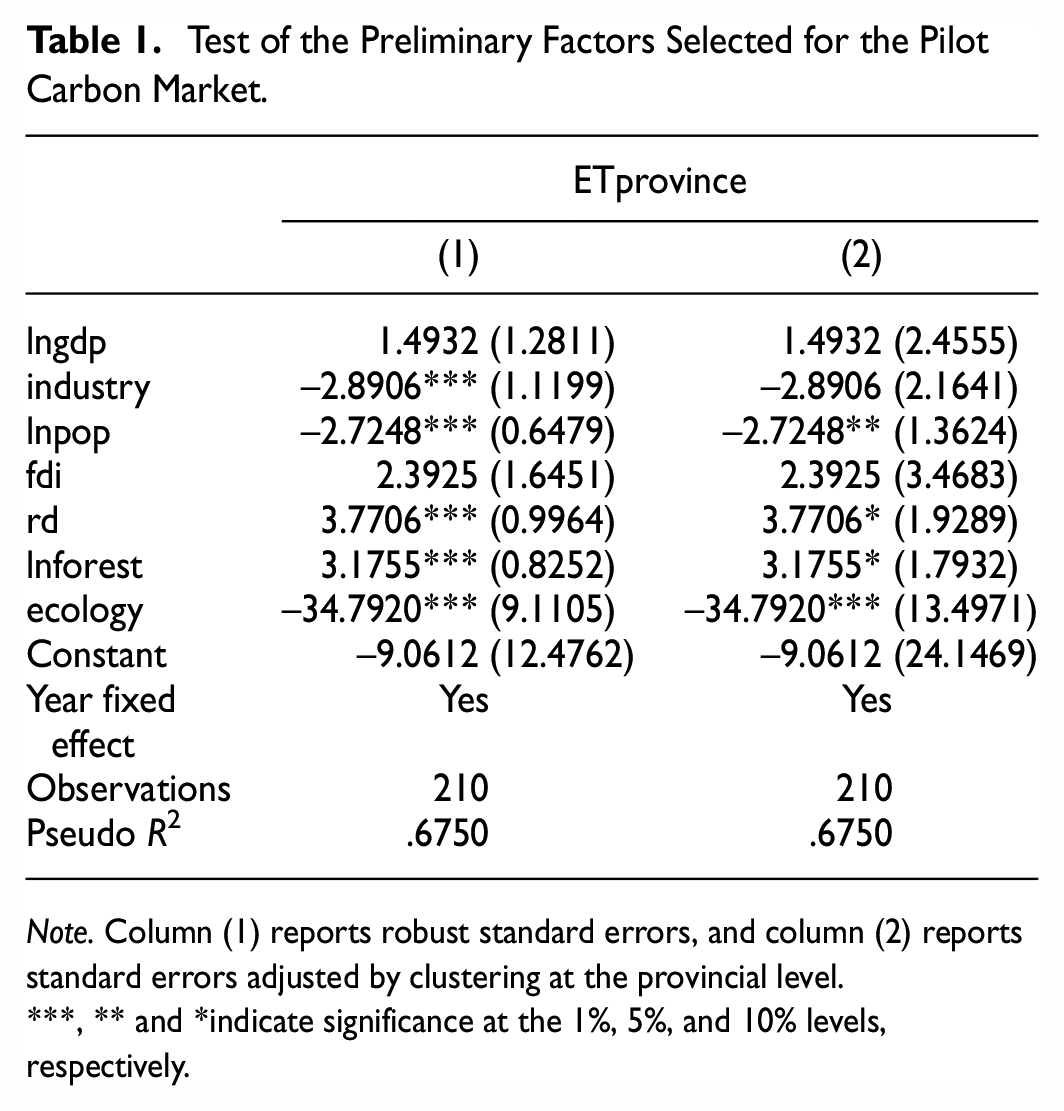
Note. Column (1) reports robust standard errors, and column (2) reports standard errors adjusted by clustering at the provincial level.
, ** and *indicate significance at the 1%, 5%, and 10% levels, respectively.
The results show that the selection of carbon market pilot is mainly influenced by variables
Discussion on the Randomness of the Establishment Time of the Carbon Market
The carbon market is an institutional innovation for China to carry out industrial upgrading and green economic transformation in the face of international pressure on emission reduction, which can be considered to be unpredictable. There is no landmark event that directly leads to the establishment of carbon market pilot. Therefore, it can be considered that the successive carbon market pilots established during this period are relatively random. To make the discussion more rigorous, our paper will test the expected effect of carbon market in the robustness analysis.
Variables and Data
The Dependent Variable
Following the relative papers (Mahmood, 2020; Zhao et al., 2013),
The Core Independent Variable
According to the classic DID model (Imbens & Wooldridge, 2009) and a series of extended DID models (Dong et al., 2019; Shen et al., 2017; Xu, 2021; H. Zhang et al., 2019),
Control Variables
Based on the above analysis of the preliminary factors selected for the pilot regions of carbon market, control variables selected in our paper include: (1)
Data
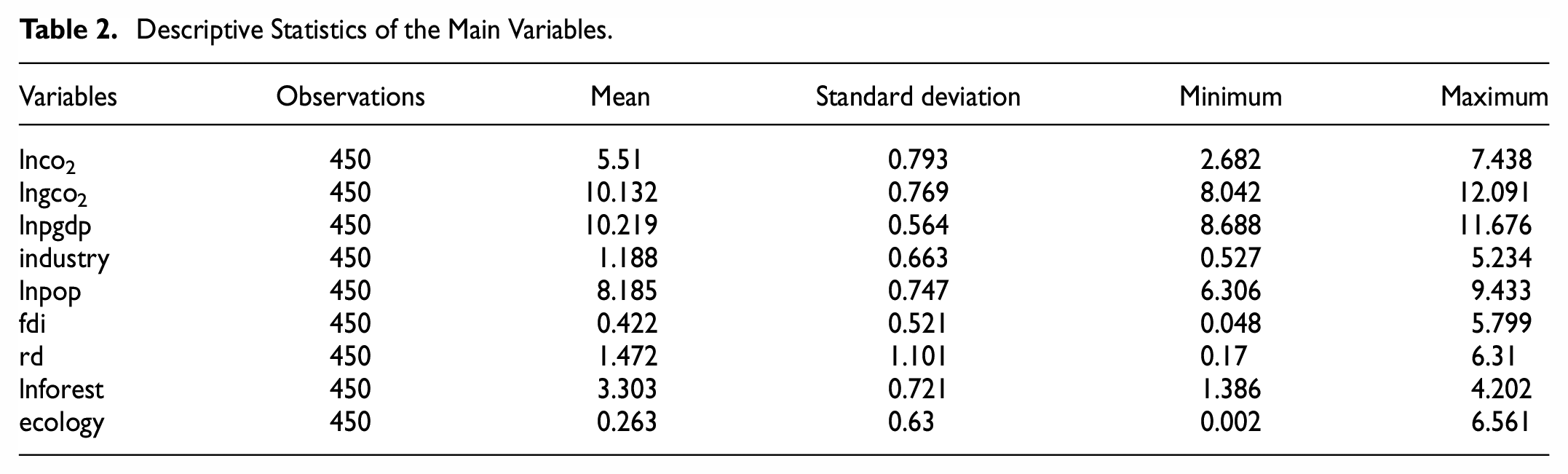
We construct panel data of 30 provinces in China from 2005 to 2019 to test the ERE of the carbon market. The carbon emission data of each region were collected from the China Carbon Emission Accounting Database (CEADs), and the R&D investment data were collated from The Statistical Bulletin of National Investment in Science and Technology. The amount of completed investment in industrial pollution control were from the China Environmental Statistics Yearbook in each year. The rest of the relevant data were from the China Statistical Yearbook. The descriptive statistical results of the main variables are reported in Table 2.
Descriptive Statistics of the Main Variables.
Results
Baseline Regression Results
Table 3 reports results of model (1). When only individual fixed effect and year fixed effect are controlled, the coefficients of
Regression Results of the Baseline Model.

Note. Values in brackets are robust standard errors for clustering adjustment at the provincial level.
, **, and * are significant at the levels of 1%, 5%, and 10%, respectively.
Test of Parallel Trend and Analysis of Policy Dynamic Effect
The most important premise of DID model is to satisfy the parallel trend hypothesis (Bertrand et al., 2004). Therefore, to estimate the “pure” policy effect, we conduct parallel trend test and policy dynamic effect analysis.
First, to visually display the difference between the treatment group and the control group, our paper draws the time trend chart of CE and CEI. As shown in Figures 1 and 2, both dependent variables in the treatment group are lower than those in the control group. Before 2011, the carbon emissions of the two groups basically showed a parallel trend. However, after 2011, the two independent variables of the treatment group showed a significant downward trend.
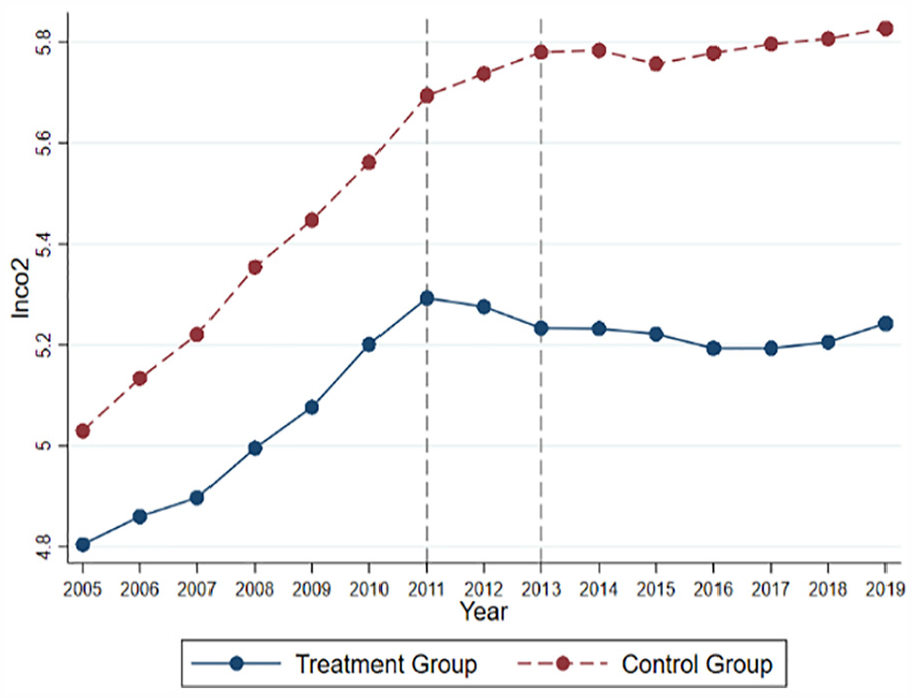
Time trend of carbon emission (CE).

Time trend of carbon emission intensity (CEI).
To test the parallel trend hypothesis more accurately and analyze the policy dynamic effect, our paper uses the event study method (Huang, 2018; W. Wang et al., 2018; Y. Wu et al., 2021). Specifically, 7 years before the establishment of the carbon market pilot in each region are taken as the comparison benchmark to construct a parallel trend test model, as shown below:
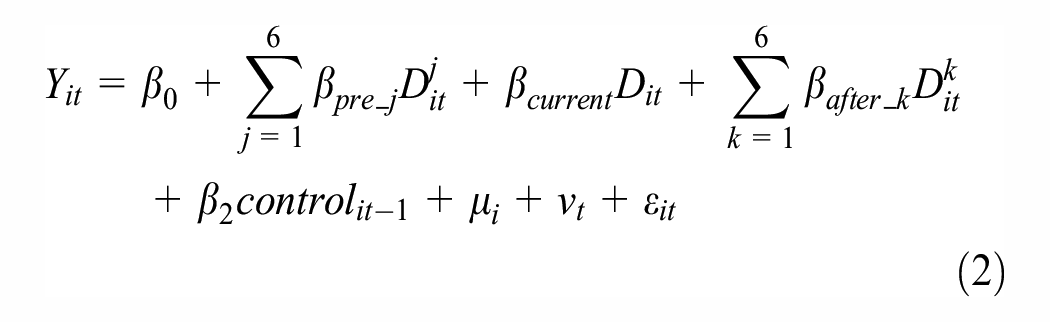
In model (2),
The Results of the Parallel Trend Test.

Note. Values in brackets are robust standard errors for clustering adjustment at the provincial level.
, **, and * are significant at the levels of 1%, 5%, and 10%, respectively .
In Table 4, the corresponding coefficients
Furthermore, the policy effect coefficients during and after the establishment of the carbon market in Table 4 provide data support for our paper to investigate the dynamic effects of carbon market policies. For both CE and CEI, the estimated coefficients after the policy implementation time are significantly negative at the 5%−10% level. Specifically, from the current period of policy implementation to the first 3 years after implementation, although the regression coefficient did not pass the significance test of 5%, its absolute value increased year by year. However, in the fourth and fifth years after the implementation of the policy, the absolute value of the estimated coefficient still shows an upwards trend, and its significance reaches 5%, which indicates that the reduction effect of carbon market may have a certain time lag and be cumulative over a long time. A reasonable explanation is that with the gradual development of carbon market, the corresponding management measures will be improved, and the role of the market mechanism continues to emerge, and its influence on regional emission reduction is also deepening and strengthening. At the same time, to more intuitively show the long-term impact of the ERE of carbon market, our paper draws a dynamic effect diagram of the carbon market pilot policy (Figures 3 and 4). It is observed that in the period after policy implementation, the regression coefficient shows a downwards trend overall, indicating that ERE of carbon market is persistent, cumulative and time-lagged to a certain extent.

Results of parallel trend test and policy dynamic effect when the dependent variable is CE.

Results of parallel trend test and policy dynamic effect when the dependent variable is CEI.
Diagnosis of Bidirectional Fixed Effect Estimator Bias
Our paper uses Bacon decomposition to conduct a bidirectional fixed effect bias test for the estimators obtained above. This method can decompose the total multi-period DID estimator into three parts: (1) provinces with carbon market pilots (treatment group) and provinces with no carbon market pilot (control group); (2) provinces that set up carbon market pilots earlier (treatment group) and provinces that set up carbon market pilots later (control group); and (3) provinces that set up carbon market pilots later (treatment group) and provinces that set up carbon market pilots earlier (control group).
The decomposition results of the total DID estimator without adding control variables are shown in Table 5. The results of the total DID estimator are the same as the baseline regression results in Table 4, and the weighted average of the average DID estimator in each group is equal to the total DID estimator. Furthermore, we note that the “unsatisfactory” subgroup of “provinces that set up carbon market pilots later (treatment group) and provinces that set up carbon market pilots earlier (control group)” has a weight of only 1.3%, indicating that this subgroup has little influence on the total bidirectional fixed effect estimator. The group with the greatest influence on the total bidirectional fixed effect estimator is “provinces with carbon market pilots (treatment group) and provinces with no carbon market pilot (control group),” which is also the focus of the research design of our paper, accounting for 96.6% of the weight.
Results of Bacon Decomposition.
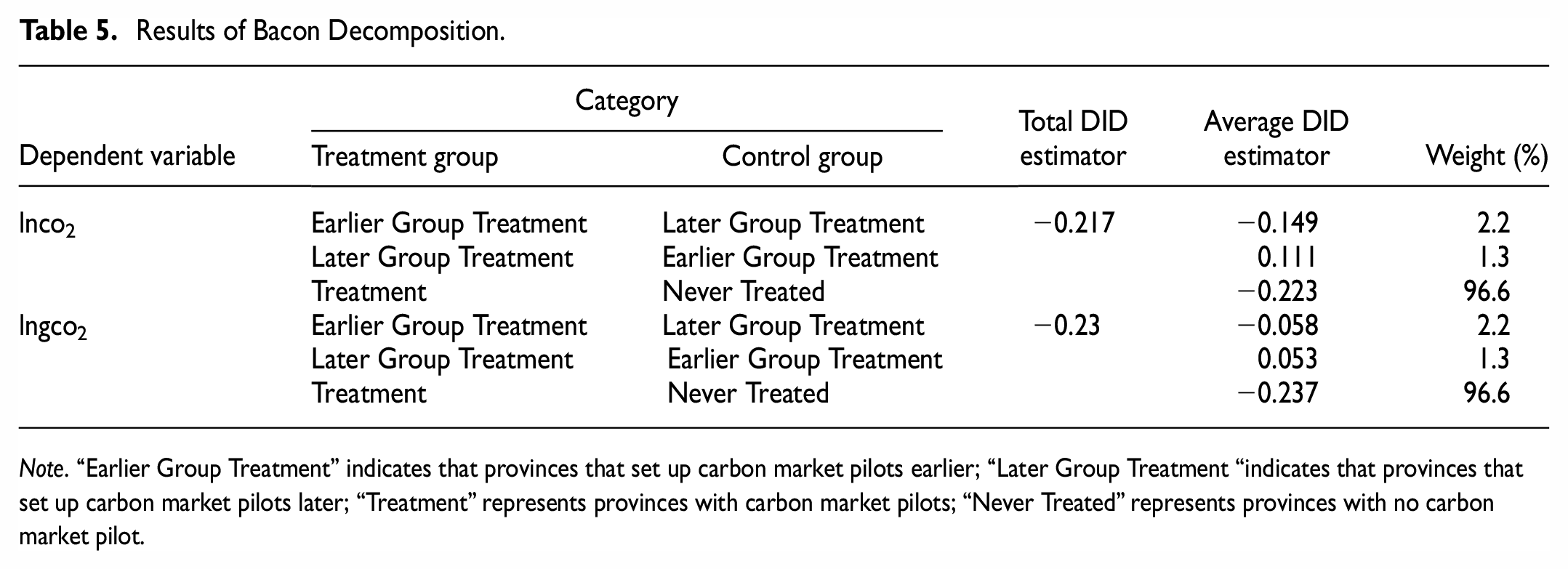
Note. “Earlier Group Treatment” indicates that provinces that set up carbon market pilots earlier; “Later Group Treatment “indicates that provinces that set up carbon market pilots later; “Treatment” represents provinces with carbon market pilots; “Never Treated” represents provinces with no carbon market pilot.
Therefore, even if there is an “unsatisfactory” control group in this study, it only lowers the total bidirectional fixed effect estimator to a very small extent, and this study may underestimate the ERE of China’s carbon market to a very small extent.
To more intuitively present the weight of each potential category and its influence on the total bidirectional fixed effect estimator, weight diagrams of the Bacon decomposition are presented in our paper, as shown in Figures 5 and 6.

Weight diagram of Bacon decomposition when the dependent variable is CE.
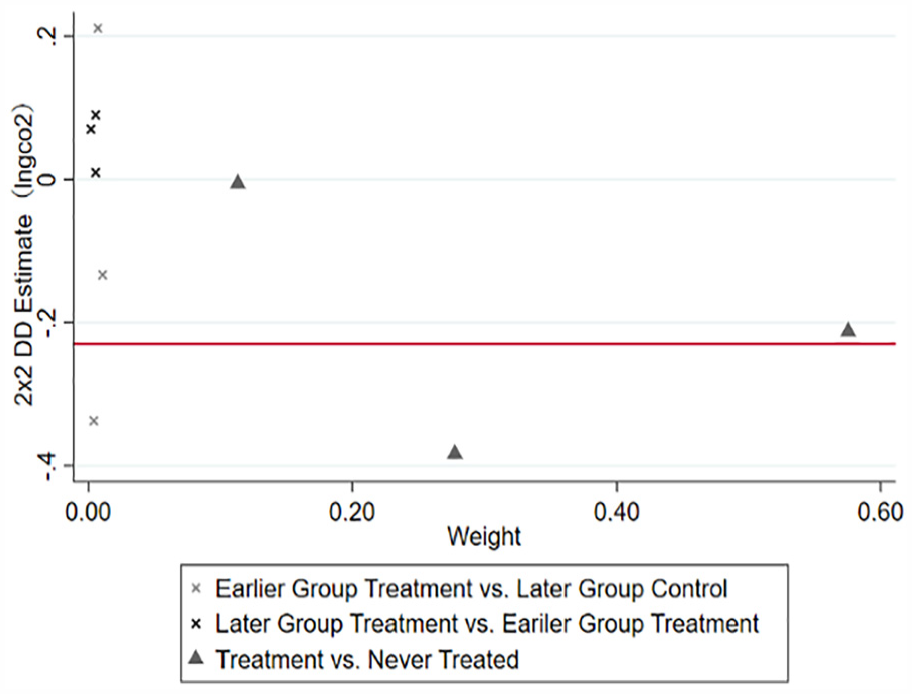
Weight diagram of Bacon decomposition when the dependent variable is CEI.
Placebo Test
To make the baseline results more robust, a placebo test is carried out. The specific operation is as follows: non-repeated random sampling was conducted for 30 provinces and policy time in the sample. Seven provinces were selected each time as the virtual treatment group and its corresponding random policy time point, and the remaining provinces were taken as the virtual control group. This process was repeated1,000 times to obtain1,000 estimated coefficients of

Empirical cumulative distribution of placebo test coefficients when the dependent variable is CE.

Empirical cumulative distribution of placebo test coefficients when the dependent variable is CEI.
As seen from the figures above, when the dependent variables are CE and CEI, the empirical cumulative distribution of coefficients of
Robustness Test
Specify the Implementation Time of the Policy
Considering the specific month difference in the establishment time of the carbon market pilots, to investigate the policy effect in a more precise way, our paper refers to the method of Lu et al. (2017) to test the robustness of the baseline results34. A new rule is as follows: we reassign the variable
Regression Results Considering the Monthly Difference of Policy Implementation Time.

Note. Values in brackets are robust standard errors for clustering adjustment at the provincial level.
, **, and * are significant at the levels of 1%, 5%, and 10%, respectively.
Expected Effect Test
To further test the randomness of the carbon market, our paper conducts the expected effect test to examine whether CE are affected by the expectations of the establishment of the carbon market. Table 7 reveals the regression results. The coefficient of interaction variable
Results of Expected Effect Test.

Note. Values in brackets are robust standard errors for clustering adjustment at the provincial level.
, **, and * are significant at the levels of 1%, 5%, and 10%, respectively.
Robustness Test Excluding Some Special Samples
We further conduct a robustness test by eliminating some special samples. The eliminated samples were as follows: (1) Beijing, Shanghai and Guangzhou. The economies of Beijing, Shanghai and Guangzhou are the strongest among China. In addition to the carbon market pilot policy, these three regions may have implemented other energy-saving and emission reduction policies that may interfere with the identification of the effects of the carbon market pilot policy. (2) Chongqing. Among all the carbon market pilot regions in China, only the carbon market in Chongqing adopts the enterprise independent reporting system for quota allocation. To avoid excessive costs, enterprises tend to declare more CE, which leads to relatively low activity of the carbon market in Chongqing and may affect our baseline regression results. (3) Fujian. The carbon market in Fujian was launched late, and the market was not fully developed, which may also affect the overall evaluation effect of the carbon market policy.
In our paper, the above three groups of special samples are removed step by step to test the robustness of the baseline regression results. In Table 8, column (1) and (4) are the regression results excluding Beijing, Shanghai and Guangzhou, column (2) and (5) are the regression results excluding Chongqing, and column (3) and (6) are the regression results excluding Fujian. After the elimination of special samples step by step, the estimated coefficient of the core independent variable
Regression Results Excluding Special Samples.

Note. Values in brackets are robust standard errors for clustering adjustment at the provincial level.
, **, and * are significant at the levels of 1%, 5%, and 10%, respectively.
Further Analysis
Analysis of the Impact of Carbon Market Scale and Carbon Market Activity
The above regression results indicate that the carbon market has significant ERE. However, China’s carbon market is still in its early stages, and various problems are emerging in the operation process: for example, due to the imperfection of the market mechanism and the unreasonable allocation of quotas, the due date effect is relatively common; the carbon price in the pilot areas is generally low and deviates greatly from the marginal emission reduction cost of enterprises; the fluctuation of carbon price is large, the carbon market has not fully explored the price discovery function, and the expectation of quota value is not clear. Therefore, to test the influencing factors of the carbon market ERE, referring to Moser and Voena (2012), we construct a continuous DID model for further research. In other words, continuous variables that can reflect the characteristics of the carbon market are used to replace the dummy variables of policy grouping to form the interaction term with the dummy variable of policy time. To better identify the impact of the characteristics of the carbon market itself on the reduction effect, model (3) is constructed as follows:

In model (3),
The results of Table 9 show that the larger the relative market scale of the carbon market is, the higher the relative market activity level, and the stronger the ERE. Specifically, from the dimension of market scale, coefficients of
Analysis of Influencing Factors of ERE.

Note. Values in brackets are robust standard errors for clustering adjustment at the provincial level.
, **, and * are significant at the levels of 1%, 5%, and 10%, respectively.
Analysis of the Economic Impact of the Carbon Market
Carbon emission trading policy may affect local economic by influencing business activities. On one hand, enterprises subjected to emission restrictions may reduce their production scale to a certain extent to reduce emission reduction costs and complete compliance; on the other hand, under the pressure of external environmental regulations, participants will have greater motivation and incentives to carry out technological innovation, thus improving the production efficiency of enterprises and enhancing competitiveness and profitability. Therefore, to test whether carbon market pilots have negative impact on regional economic growth, on the basis of model (1), our paper constructs the following model (4):

In model (4), the dependent variable is replaced by
Table 10 shows the regression results. Whether or not to join the control variables, the estimated coefficient of interaction variable is always positive but not significant. This shows that carbon market pilots have no significant inhibiting impact on regional economic output. According to the above theoretical analysis, this may be the result of mutual offset between the inhibiting and promoting effects of carbon market policies on regional economic output. Empirically speaking, it can be concluded that the carbon market effectively reduces regional CE and CEI without significant negative impact on the regional economy. Therefore, the carbon market mainly achieves ERE by reducing regional CEI. Hypothesis 4 is valid.
Analysis of the Economic Impact of the Carbon Market.

Note. Values in brackets are robust standard errors for clustering adjustment at the provincial level.
, **, and * are significant at the levels of 1%, 5%, and 10%, respectively.
Conclusions and Policy Implications
Our paper reveals that: (1) Overall, China’s carbon market can effectively reduce CE and CEI in pilot areas. (2) In terms of influencing factors, the expansion of the relative market scale and the improvement of the relative market activity level can significantly enhance the ERE of the carbon market in pilot areas. (3) In terms of economic impact, the carbon market has no significant inhibiting effect on the economic growth.
The following policy implications are proposed: (1) Summarize regional pilot experience and accelerate the development of the national carbon market. At present, the regional carbon market continues to play its role, providing experience for the construction of the national carbon market, and promoting the coordination between the pilot areas and the national carbon market in terms of the depth of docking, trading process, quota allocation and quota transfer held by enterprises. (2) Expand market scale and include more industries in an orderly manner. At present, only the electric power industry is included in the national carbon market. Actually, the high energy consumption industries should also be included, such as chemical, iron and steel, paper making, and civil aviation. (3) In terms of ensuring economic growth, the innovation of carbon financial products should be gradually promoted. At the present stage, the expansion of the market scale and the improvement of market activity are largely limited by the characteristics of the single trading object (carbon quota spot) and the single participant (enterprises). Therefore, it is necessary to innovate financial products, introduce financial instruments such as carbon futures and carbon forwards. In the long run, the entry of other diversified players is indispensable. The participation of diversified players can more effectively stimulate the activity of the carbon market, improve market liquidity, and thus form a reasonable and effective carbon price. It must be emphasized that financial innovation in the carbon market should be steadily promoted. Risk control should be combined with the introduction of diversified market players, and carbon financial instruments should be fully utilized to promote the construction and improvement of the national carbon market.
This study can be further developed from the following aspects: (1) Further explore the paths and mechanisms by which China’s carbon market exerts its ERE; (2) Further study the impact of the carbon market on the innovation ability of enterprises and thus enrich the research on the Porter’s hypothesis.
Supplemental Material
sj-do-1-sgo-10.1177_21582440231206626 – Supplemental material for Emission Reduction Effect, Influencing Factors and Economic Impact of China’s Carbon Market
Supplemental material, sj-do-1-sgo-10.1177_21582440231206626 for Emission Reduction Effect, Influencing Factors and Economic Impact of China’s Carbon Market by Heng Zhang, Ziwei Zhang, Keyuan Sun and Yutong Zou in SAGE Open
Supplemental Material
sj-dta-2-sgo-10.1177_21582440231206626 – for Emission Reduction Effect, Influencing Factors and Economic Impact of China’s Carbon Market
sj-dta-2-sgo-10.1177_21582440231206626 for Emission Reduction Effect, Influencing Factors and Economic Impact of China’s Carbon Market by Heng Zhang, Ziwei Zhang, Keyuan Sun and Yutong Zou in SAGE Open
Footnotes
Declaration of Conflicting Interests
The author(s) declared no potential conflicts of interest with respect to the research, authorship, and/or publication of this article.
Funding
The author(s) disclosed receipt of the following financial support for the research, authorship, and/or publication of this article: The authors are grateful for the research support from the following foundations:
(1) Liaoning Provincial Department of Education Project, grant number (LJKMR20220425);
(2) Liaoning Province Economic and Social Development Research Project,grant number(2024lsljdybkt-001).

Supplemental Material
Supplemental material for this article is available online.
References
Supplementary Material
Please find the following supplemental material available below.
For Open Access articles published under a Creative Commons License, all supplemental material carries the same license as the article it is associated with.
For non-Open Access articles published, all supplemental material carries a non-exclusive license, and permission requests for re-use of supplemental material or any part of supplemental material shall be sent directly to the copyright owner as specified in the copyright notice associated with the article.
