




Abstract
Understanding the policy context of elderly care services, providing scientifically grounded recommendations, and effectively promoting the development of elderly care services in China are of great significance for advancing the nation’s high-level economic and social development. This study employs word frequency analysis to examine elderly care policy documents in China from 2006 to 2022. By focusing on six key dimensions, including the involved stakeholders, and conducting comprehensive, longitudinal, and core analyses of word frequency, the study utilizes summary tables, word clouds, Venn diagrams, and semantic networks to analyze the data. The findings indicate that while the foundation of these policies is relatively stable, the overall development of services remains in the early stages and requires further refinement. Relevant stakeholders in elderly care services should prioritize policy analysis and research, explore the intrinsic characteristics of these policies, understand policy development trends, and formulate better strategies for providing elderly care services. These approaches will contribute to the harmonious and sustainable development of services and ensure improved care for older adults in China.
Introduction
China is currently experiencing rapid economic and social development, accompanied by significant improvements in healthcare, and a notable increase in life expectancy. In 2021, individuals aged 65 and above represented for 14.2% of the population. According to the United Nations, a country is classified as experiencing “deep aging” when individuals older than 65 reaches 14% of the population. Thus, China has officially entered this stage of demographic transition. The rapid but hasincrease in the number of older adults has intensified societal pressures also created new opportunities in the elderly care services and related industries. Public service resources have begun undergoing transformation and reconfiguration, particularly in sectors such as healthcare (Han et al., 2016), elderly care (Tun et al., 2021), and commercial insurance (Gao et al., 2022). The government has started to regulate the elderly care market appropriately, aiming to foster its orderly development within legal boundaries (Wu, 2021). The service sector seeks to improve the life quality of older adults, with the primary beneficiaries being the population of older adults. Key stakeholders in this sector include government agencies, social organizations, and institutional stakeholders. The services provided encompass not only daily physical assistance but also emotional support for solitary older adults. Furthermore, the sector frequently offers cultural and recreational activities, thereby enhancing the overall well-being of seniors. Presently, the operational model of the industry is gradually shifting toward a more market-oriented, industrialized, and socialized approach (Zhao et al., 2020).
In 2006, the Office of the National Commission on Aging, in collaboration with other relevant departments, issued the “Opinions on Accelerating the Development of the Elderly Care Service Industry.” This document clarified that the development of the relevant industry not only promotes the growth of related industries but also contributes to economic and social development, playing a significant role in enhancing the life quality of the entire population. In 2019, the publication of the “National Medium and Long-Term Plan for Active Response to Population Aging” (hereinafter referred to as the “Plan”) marked the recognition of addressing population aging as a national strategy. It demonstrates strong government support for elderly care services and ensures the protection of the rights and interests within the industry. Subsequent policies, such as the “Notice on the Implementation of the 2020 Special Action for Enhancing Service Quality in Elderly Care Facilities,” reflect the continuous refinement of these policies in China. The fundamental framework for elderly care services has been established (M. Wang et al., 2023), while specific measures have been introduced to further develop the sector and advance social progress.
The phenomenon of social aging is becoming increasingly pronounced, characterized by diverse stakeholders, multiple dimensions, and stages of development. The accelerating trend of aging has brought about dynamic changes in the industry, making the task difficult and complex (Halsall et al., 2023). Additionally, population aging has had significant effects on other industries, such as the digital technology application of small/medium-sized companies (Xie & Xu, 2024), and global renewable energy (Sui et al., 2024). Against this backdrop, the Chinese government has issued numerous policy documents related to elderly care services. These directives serve to define clear objectives, guide implementation, and regulate operational procedures, thereby fostering the enhancement of the development system of the industry. This article analyzes the scientific rationale behind the country’s formulation of elderly care services by reviewing related policies. It aims to help stakeholders in the sector better implement these policies, promote the growth of the industry, and provide insights for other countries. The main contributions of this article are as follows:
This article systematically analyzes China’s elderly care service policy documents and identifies key characteristics of these policies using word frequency analysis techniques.
Through a review of relevant policy documents, this article highlights the critical release of the “Plan” as a key turning point, using it as a demarcation to compare and analyze the changes in policies before and after its introduction, thereby tracing the development trends of these policies.
We compile and compare word frequencies, generate frequency graphs and Venn diagrams, and employ Semantic network analysis techniques to create visual representations, helping readers better understand the characteristics and evolving trends of these policies.
Related Work
Research on elderly care services has become an important global issue, attracting extensive scholarly attention, particularly in the context of population aging. This article first examines the current state of elderly care policies and services, followed by a review of existing literature in the field.
Current Situation of Elderly Care Service
With ongoing industrialization and urbanization, the traditional role of families in supporting elderly care has diminished (Aboderin, 2004). As a result, the responsibility for elderly care is increasingly shifting from the family to societal institutions. Different countries have adopted diverse approaches to address this issue. In developed nations, various models of elderly care have emerged. Denmark, for instance, with its relatively small population, adopts a “home-based elderly care” model. This system includes a universal free healthcare program and offers targeted services to improve the satisfaction of older adults. In Australia, the government has established an elderly care assessment team to conduct physical and psychological evaluations of older adults. Based on their needs and preferences, the team determines the most suitable form of care and oversees the entire process to ensure high-quality services. In the Netherlands, elderly care services are tailored to the physical condition of older adults. The country has developed life apartments for self-sufficient older adults and operates specialized nursing homes, such as “prop villages,” for older women with Alzheimer’s disease. These initiatives incorporate the concept of “happy aging” and encourage wide community involvement.
Various countries choose elderly care service models based on factors, such as their level of economic development. China, in turn, has developed its own approach by incorporating elements from the elderly care systems of various countries, tailoring them to its unique developmental context. The Chinese model can be described as both traditional and developmental. Traditional elderly care includes three primary forms: home-based care, community-based care, and institution-based care. The developmental aspect focuses on newer models, such as mutual assistance care, tourism-based care, and housing-based care (Huang et al., 2021). Research conducted by J. Wang and Wu (2017) investigated the role of domestic helpers in elderly care services in China. While acknowledging the valuable contributions of domestic helpers in supporting elderly care, the study highlights several challenges they face, including difficulties in adapting to urban life, lack of professional training, and potential risks of abuse. The study calls for the development of training and education programs to better equip domestic helpers, ensuring their legal rights and cultural competencies are protected. It also emphasizes the requirement to provide domestic helpers with access to medical care, social welfare, and career development opportunities, thereby supporting their greater involvement in family-based care.
With the advancement of technology, leveraging technological innovations to enhance these services has become a research hotspot. F. Zhang et al. (2023) explored how smart buildings can improve the life quality for older individuals. Current technology-enabled smart buildings utilize sensor devices, artificial intelligence, and other technologies to effectively address some of the complex safety and health risks faced by older adults.
Policy Analysis on Elderly Care Service
Policy analysis plays a critical role in helping decision-makers choose the most appropriate course of action by clarifying issues, proposing alternative solutions, and evaluating their potential consequences. A variety of analytical tools are used in policy analysis to collect relevant data and present it to stakeholders in a way that facilitates informed decision-making (Walker, 2000).
A study employed a multi-level analysis of retirement policies across 21 European countries Naldini et al. (2016), focusing on macro factors, such as formal care coverage, direct payment and care allowances, and norms regarding intergenerational obligations, influencing middle-aged women’s decisions to reduce or discontinue jobs to take care of their parents. The research findings indicate that access to formal care services can reduce the caregiving strain on family members, particularly women, thereby supporting their continued employment. Additionally, a family-oriented caregiving culture may hinder the development of de-familialized care policies provided by the public sector. Currently, most European countries implement limited formal care services and stringent regulations on intergenerational obligations, which hinder women’s involvement in the workforce, that is, due to these strict policy regulations, middle-aged women are forced to give up their jobs or reduce their working hours while caring for older adults. In China, the aging trend is becoming increasingly prominent, necessitating timely adjustments to policy documents related to elderly care services. These adjustments should be based on the new characteristics and trends of older individuals, aiming to guide and regulate their roles in society. Using content analysis technology, Zhao et al. (2020) conducted research on the synergy of elderly care services in China across three dimensions: policy strength, measures, and goals. The study highlighted an overall increase in synergy, but also noted issues related to uneven development. Recommendations were made to foster greater motivation for the advancement of these services. A quantitative study by X. Li et al. (2021) focused on policy tools within China’s elderly care industry, identifying issues such as the uneven distribution of participating stakeholders. Suggestions were to optimize and regulate these policy tools in order to promote industrial innovation. Furthermore, Lobanov-Rostovsky et al. (2023) used policy analysis to study the construction of long-term care systems for older individuals. They summarized the population and epidemiological trends related to aging and health in China from 1970 to 2022. Within a social-ecological framework, they identified key determinants for improving population health. However, the study focuses solely on the relationship between aging and health.
In summary, while considerable progress has been made in the research on elderly care services, policy-level analyses remain relatively scarce. Existing studies on pension service policies often lack a focus on policy choices. For example, X. Li et al. (2021) included the “Guiding Opinions on Actively Promoting the Action of ‘Internet plus’” and other policies in their research. Moreover, there is a noticeable tendency to rely on macro-level analytical tools, as demonstrated by Zhao et al. (2020), which examines the quantity of policies from various perspectives. In contrast, this paper utilizes word frequency analysis techniques to conduct a more detailed examination of policy texts. By utilizing comprehensive, longitudinal, and core analyses across three dimensions, along with visualization tools such as summary tables, word clouds, and Venn diagrams, this study aims to analyze key policy documents related to elderly care services in China, issued between 2006 and 2022. This methodology facilitates a deeper understanding of the intrinsic characteristics of these policies and helps identify emerging trends in their development.
Materials and Methods
Data Sources and Selection
To search for relevant policy documents on elderly care and aging, keywords including “elderly care,”“old age,”“older adults,”“aging,” and “population aging” were used to search the title of policy documents on official websites, including the State Council website. Policies that were not directly related to the research topic, such as speeches and work reports from various provinces and cities, and comprehensive policies including the “14th Five-Year Plan,” were excluded. Consequently, a total of 20 relevant policies at the national level on elderly care services, spanning from 2006 to 2022, were identified. The publication dates, document titles, and issuing departments were compiled and summarized, as shown in Table 1.
20 Policies Related to Elderly Care Services.

Data Processing Methods
This study comprehensively analyzes the 20 collected policy documents on elderly care services, examining them from the perspectives of comprehensiveness, continuity, and systematicity. Three approaches are employed to conduct a keyword frequency analysis: overall perspective analysis, longitudinal analysis, and core analysis. First, from an overall perspective, keywords are extracted from the 20 policy documents, and word cloud visualizations are generated using a word cloud generator. The aim of this approach is to gain a holistic understanding of the key characteristics of policies related to elderly care services. Second, a longitudinal analysis is conducted using the “Plan” as a reference point. The policies are divided into two time periods: 2006 to 2019 and 2019 to 2022. This analysis offers a clear depiction of the developmental characteristics and trends in elderly care service-related policies over time. Third, focusing on the release of the “Plan,” a core analysis is performed by creating a Venn diagram based on the extracted keywords. This approach identifies the overlapping core word frequencies in the longitudinal analysis, highlighting the fundamental features of policies related to elderly care services.
Summarize the Frequency of Keywords
Comprehensive Summary of Elderly Care Service Policies
The Regional Operations Support Team (ROST) platform, developed by Prof. Shen, is an innovative data analysis tool for the humanities, and social sciences, incorporating various functionalities of Content Mining (CM), also known as ROST CM. Currently, ROST has been utilized in numerous research papers and publications(Chen et al., 2020; Y. Zhang et al., 2024). In this work, we utilize two functionalities of ROST, the word frequency analysis, and the social network and semantic network analysis, both of which are included in the module of “Functional analysis.”
The word frequency analysis tool provided by ROST was used in this work to process the relevant policy documents. Based on the distribution structure of high-frequency words, keywords with a frequency greater than 150 were selected, and irrelevant terms were excluded. As a result, 30 keywords, including “elderly care” and “service,” were extracted. According to the related literature (Zheng et al., 2020), these keywords were classified into six dimensions: basic concepts, involved stakeholders, mechanism support, implementation effects, service provision, and development planning. The specific classification is presented in Table 2.
Statistics on High-Frequency Words in Elderly Care Service Policy Documents.

As shown in Table 2, the keywords “elderly care” and “service” are the fundamental concepts of these policy documents, with frequencies far exceeding other keywords, with 1943 and 1848 occurrences respectively. This indicates that the existing policies in China are primarily centered on the concept of “elderly care” and place significant emphasis on the provision of “service” throughout the elderly care process. The frequencies of the keywords “old age”(356 occurrences) and “health” (346 occurrences) appear with similar frequencies, indicating that current focus of elderly care policies is on “older adults” with a strong emphasis on their “health.”
In terms of the involved stakeholders dimension, the term “institution” has the highest frequency at 935 occurrences, indicating that institutions are the core stakeholders in elderly care services. This is followed closely by “older adults” with 727 occurrences, highlighting the fact that older adults are the primary recipients of these services. Other notable terms include “Country” (482 occurrences), “society” (371 occurrences), and “community” (268 occurrences). The frequency distribution reflects the hierarchical importance of different stakeholders in elderly care services, from top to bottom.
Regarding mechanism support, the terms “system” and “mechanism” appear with similar frequencies of 193 and 175 occurrences, respectively. This indicates that, in terms of issuing elderly care service “policies” (205 occurrences), the publishing authority emphasize both the establishment of a “system” and the improvement of the “mechanism.”
For implementation effects, the government places significant importance on two aspects: “sanitation” with 186 occurrences, and “safety” with 161 occurrences. This reflects the belief that improving “sanitation” for older adults, conducting regular inspections of elderly care facilities, strengthening their “safety,” and ensuring their overall safety are critical components of elderly care services.
With regard to service provision, there is a clear focus on “medical” (222 occurrences) and “nursing” (153 occurrences) services. These are regarded as the primary means of ensuring the continuity and quality of elderly care within the system. Additionally, in terms of requirements for elderly care service practitioners, effective “management” (229 occurrences) and “supervision” (172 occurrences) of institutions and medical staff are seen as essential for the efficient implementation of these policies. Proper supervision ensures that the requirements of older individuals are met, thereby improving the overall level of these social services.
Regarding development planning, China’s policies regarding elderly care services have a clear direction. The primary themes are “development” with 526 occurrences and “planning” with 190 occurrences. A significant number of opinions related to ‘construction’ (414 occurrences) have been proposed, emphasizing the active implementation of various activities related to these services. These activities focus on positively “carrying out” (238 occurrences) and implementing (173 occurrences) these activities (238 occurrences), and enriching the diversity of these activities. Strengthening (316 occurrences) the management of these services, establishing (232 occurrences) a sound service system, improving (178 occurrences) the mechanisms for elderly care services, and safeguarding the rights and interests of older adults. Additionally, accelerating the “integration” (171 occurrences) of medical care and elderly care, offering “promotion” (166 occurrences) to the policy implementation, and providing “encouragement” (217 occurrences) active participation of relevant stakeholders are key areas of focus in the development of these services.
Based on these 20 policy documents, a word cloud is generated by the WordCloud library of Python (Mueller, 2023) to visually represent the high-frequency words. For further details, please refer to Figure 1.

The word cloud of these 20 policy documents.
Longitudinal Summary of Elderly Care Service Policies
An analysis of these 20 policy documents reveals a significant turning point in their development occurred in 2019. Starting from this year, government bodies such as the State Council began to intensify the issuance of these policies. Between 2019 and 2020, 10 policy documents were published, accounting for 50% of the analyzed policy documents. This indicates a substantial increase in state support for these during this period. By using the “Plan” released by the State Council in 2019 as a dividing line, we separately analyze the high-frequency keywords in policy documents from 2006 to 2019 and from 2019 to 2022. The results are summarized in Table 3, which provides a comprehensive analysis of the keywords over time.
Keywords of Policy Documents From 2006 to 2019 and From 2019 to 2022.
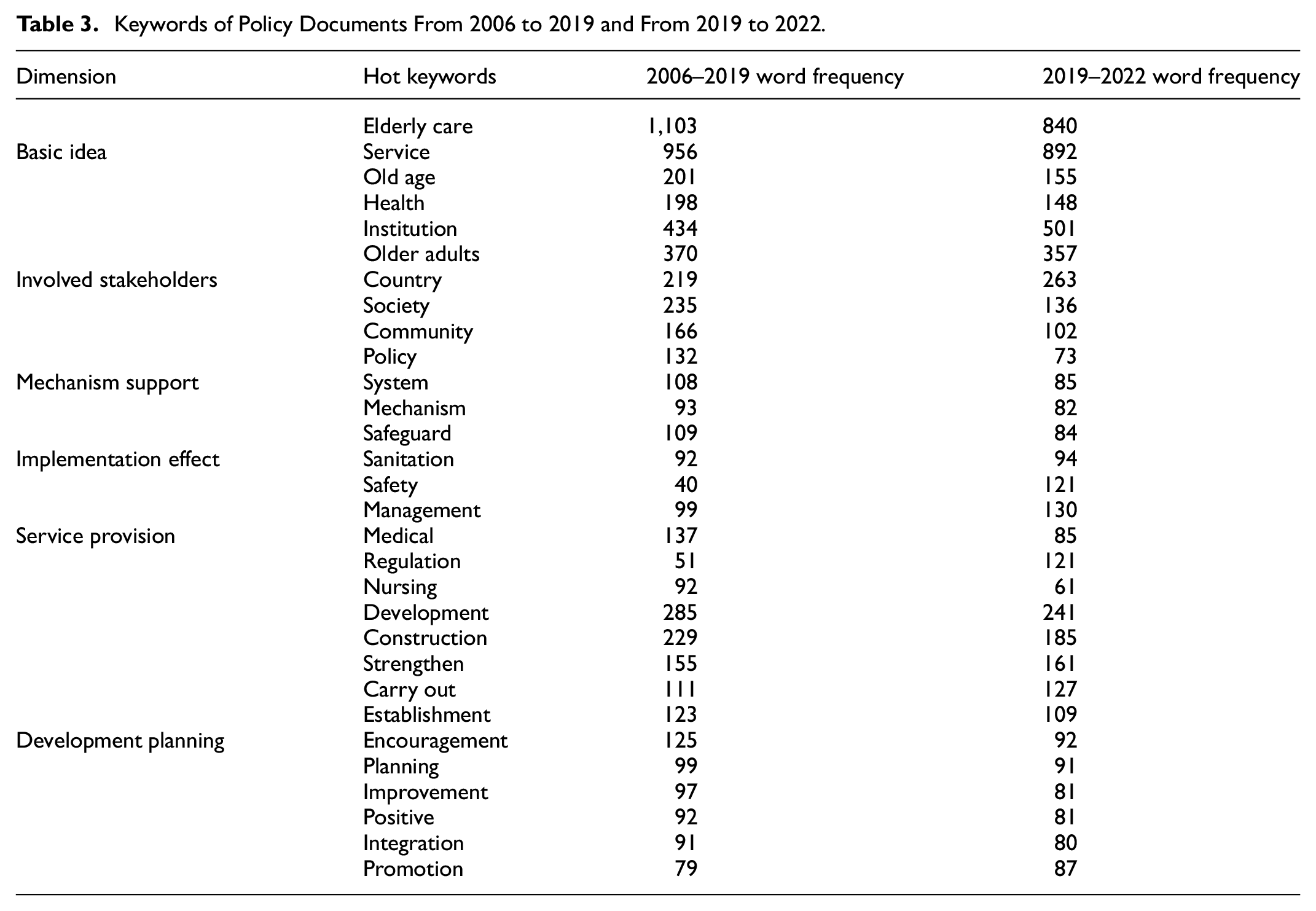
According to Table 3, it can be observed that from 2006 to 2019, the concept of “elderly care” (1,103 occurrences) was the dominant focus in national and governmental policies. However, compared to the period from 2019 to 2022, there has been a greater focus on the concept of “service” (892 occurrences). This shift reflects a change in the focus of these policies, with increasing attention being paid to the quality of service delivery. The trend indicates a policy orientation that seeks to enhance the service quality, thereby ensuring better services for older adults and fostering social harmony.
In terms of the dimensions related to the stakeholders involved, the frequency of terms related to the “country” has increased from 219 to 263 occurrences, while the frequency of other stakeholder-related terms has decreased. This shift suggests that elderly care services are increasingly receiving attention from the state, with their policy significance continuing to rise. The growing emphasis on the role of the “country” in top-level design is expected to facilitate the more effective implementation of elderly care service policies.
From the perspectives of implementation effects and service provision, the frequencies of terms such as “safety,”“management,” and “supervision” have significantly increased, while other related keywords have declined. Specifically, the frequency of “safety” has surged from 40 to 121 occurrences, and “supervision” has increased from 51 to 121 occurrences. The significant progression of the industry has underscored the importance of “safety,” and efforts in “management” and “supervision” will likely continue to be strengthened in the coming years.
Regarding development planning, the frequencies of the keywords “strengthen” (161 occurrences) and “promote” (87 occurrences) have been notably emphasized in both time periods. These terms underscore the focus on intensifying efforts in these services and promoting the policy implementation, contributing to the development of the sector and fostering a more harmonious society.
Core Summary Based on the Release of the “Plan”
Based on the keyword analysis results from 2006 to 2019 and from 2019 to 2022, keywords with frequencies greater than 150 in both periods are selected. These keywords are then placed in the intersecting and non-intersecting areas to form core keyword combinations, while maintaining their ranking according to frequency in the comprehensive analysis. Keywords with frequencies greater than 100 but different occurrences in the two periods are represented outside the intersection. Following these criteria, a Venn diagram illustrating the keyword frequencies in elderly care service policy documents has been constructed, as shown in Figure 2.

Venn diagram of word frequency in elderly care service policy documents.
According to Figure 2, there are 10 high-frequency keywords that distinguish elderly care service policies in China from 2006 to 2019 from those since 2019. Additionally, three high-frequency keywords can be used to distinguish policies since 2019 from those in the earlier period. Furthermore, 10 core keywords overlap between the two periods. Both periods emphasize the importance of “service.” The quality of service directly impacts the experience and perception of elderly care, as reflected in the policy focus. High-level terms such as “society,”“elderly care,” and “service” play a significant role in advancing these policies. The involvement of the “country” is crucial in facilitating facilitate the implementation of these policies, accelerate internal restructuring, and optimizing both “elderly care” and related “institutions.” Moreover, policies emphasize the “development” and “strengthening” of the “elderly care” system, ensuring the protection of the rights and interests of “older adults,” particularly in terms of “service” provision. From 2006 to 2019, policies emphasized the central role of the “community” (166 occurrences) in “elderly care” service, providing actively “encouragement” (125 occurrences) “community” services for “older adults” residents, focused on establishing (123 occurrences) an “elderly care” service “system” (108 occurrences), and promoted harmonious development of “society” (235 occurrences) and “elderly care.” The integration of “medical” (137 occurrences) and “elderly care” policies helped ensure (109 occurrences) the “health” (198 occurrences) of older adults. Since 2019, elderly care service policies have placed a greater emphasis on the role of “management” (130 occurrences) to ensure the “safety” (121 occurrences) of older adults receiving care. Enhanced monitoring (121 occurrences) of primary service providers has promoted the healthy development of “elderly care” services and contributed to elevating the overall level of “social” service.
Analysis on the Intrinsic Characteristics and Development Trends
This section provides an in-depth analysis of these policies, examining their intrinsic characteristics and highlighting their development trends from a comprehensive, longitudinal, and core perspective. It aims to offer a foundation for relevant stakeholders to improve elderly care services and achieve higher standards of service provision in China.
Comprehensive Analysis of Elderly Care Service Policies
The conclusions drawn from the comprehensive analysis include two points: “Emphasizing key Stakeholders and enhancing participation in elderly care services” and “Reasonable planning to promote the development of elderly care services”.
Emphasizing Key Stakeholders and Enhancing Participation in Elderly Care Services
According to high-frequency keyword quantities and frequencies, performance related to stakeholders is clearly highlighted. Among the five high-frequency keywords, “institutions” and “older adults” stand out, with 935 and 727 occurrences, respectively, reflecting their prominence in policy discourse. In comparison, “country,”“society,” and “community” are mentioned fewer times, with 482, 371, and 268 occurrences, respectively. Nevertheless, all exceeding 250 occurrences and indicating their significant presence in the overall analysis of these policies.
The majority of older adults seeking care in community based institutions is due to the migration of their children for work and their inability to accompany them on a long-term basis. Therefore, it is crucial to focus on improving the involvement of service providers in fulfilling these needs and promoting health insurance on a household basis (Q. Wang et al., 2021). According to the 2023 “China Insurance Yearbook” statistics, the proportion of households participating in commercial health insurance has increased by 40% over the past 5 years. Taking Shenzhen (a Special Economic Zone in Guangdong Province) as an example, a community under its jurisdiction successfully promoted a family health insurance plan through government subsidies and collaboration with businesses, resulting in a more than 30% increase in the medical coverage rate for elderly residents in the community.
With the rapid development of society and the increasing issue of population aging, community-based elderly care institutions must keep pace with the times by promoting the application of smart technologies in these services, thereby improving the care quality for older adults. First and foremost, community elderly care institutions should vigorously advance the construction of smart infrastructure by leveraging modern technologies including artificial intelligence (AI) and cloud computing. This can help create an intelligent environment for older individuals. For instance, the installation of smart home devices, integrated with voice assistants, automation equipment, and environmental sensing technologies, can assist older adults in living more independently, reducing their reliance on others, and enhancing their autonomy. While location-based services can be used to easily detect the exact outdoor location of older individuals (H. Li et al., 2022). Moreover, the use of intelligent monitoring and telemedicine technologies can enable caregivers to track the health conditions of old age residents instantly, promptly identify health issues, and take timely interventions to prevent sudden illnesses or accidents. In terms of leisure and recreational facilities, community elderly care institutions should upgrade these amenities by aligning them with the interests and needs of older adults. By introducing virtual reality (VR) technology and digital entertainment systems, older adults can enjoy a rich variety of cultural, recreational, and social activities, alleviating feelings of loneliness and improving their mental well-being. Additionally, the design of such facilities should prioritize accessibility, comfort, and intelligence, ensuring that older adults can enjoy recreational activities safely and conveniently. Furthermore, community elderly care institutions should invest more in specialized medical equipment, equipping themselves with advanced medical instruments and health management systems to enhance their ability to track the health conditions and manage diseases of older individuals on a daily basis. Smart health management devices can assist caregivers in more accurately tracking vital health indicators, such as heart rate, enabling early warnings, and personalized treatments. Through technological advancements, community-based institutions can not only improve the service efficiency but also enhance the quality of life for older adults, providing them with a safer, more comfortable, and healthier aging experience.
Universities should place greater emphasis on training professionals for elderly care sector, ensuring a continuous supply of high-quality medical staff to support the sustainable development of these services in China. Moreover, innovative mechanisms for the service system must be established, emphasizing not only physical health but also the mental well-being of older adult. The voluntary efforts of social organizations can play an essential role in offering care to older adults left behind, enriching their recreational activities, and actively facilitating cultural exchange. This holistic approach will significantly improve the quality of these services in China and drive the comprehensive advancement of the industry (Hao et al., 2021).
A supportive policy environment is crucial for the healthy development of these services. The national government must prioritize its role in elderly social construction and enhance governance capacity. Relevant policies supporting elderly care services should be aligned with broader social development goals, focusing on continuous improvement and optimization of regulatory frameworks for community elderly care institutions. Government departments can play a pivotal role by providing financial support for elderly care service infrastructure, particularly in rural areas where services are still underdeveloped. Increased investment in these regions will help address the longstanding issue of insufficient elderly care supply in rural China. Additionally, state-owned enterprises should be encouraged to actively develop elderly care facilities and infrastructure, while government agencies can be guided to transition into recuperation and vacation institutions. The stakeholders responsible for providing elderly care services should concentrate on essential areas such as healthcare and rehabilitation, life assistance, health preservation, and leisure tourism. Within the scope of national standards, these organizations can engage in the research, development, and promotion of products specifically designed to meet the requirements of older individuals (Hao et al., 2021).
Reasonable Planning to Promote the Development of Elderly Care Services
Based on the frequency statistics in Table 2, we observed that the highest concentration of high-frequency keywords relates to development planning, with a total of 11 keywords: “development,”“construction,”“strengthen,”“implement,”“establish,”“encourage,”“planning,”“improve,”“actively,”“combine,” and “promote.” These account for 37% of all high-frequency keywords.
Elderly care services are a vital component of social governance, and high-quality elderly care services play a crucial role in fostering harmonious social development. Both the 19th National Congress of the Communist Party of China and the national government’s “14th Five-Year Plan” clearly outline the Party’s and the country’s stance on addressing an aging population, emphasizing the adoption of a proactive strategy to address population aging and elevating this issue to a national priority. The entire country is called upon to collaborate in overcoming the social challenges posed by population aging. To effectively address these challenges, reasonable planning is necessary. This includes clarifying the service content of various elderly care providers, clearly delineating the scope of services for each stakeholder, and adopting a categorization approach to standardize elderly care services. During this categorization process, measurable service components, such as service duration and personnel requirements, should be highlighted. These quantifiable elements should be standardized as primary services, ensuring a foundation for future improvements. Conversely, services that are less quantifiable should be considered supplementary measures aimed at supporting the overall development of elderly care services. Once the service categories are established, the specific service contents and scopes for each level should be defined. Given the purposive nature of community-based elderly care services, there is often ambiguity regarding responsibility and authority. Therefore, reasonable planning is essential to create a clear framework within government departments. It is crucial to impose strict requirements on community elderly care institutions, guided by contract law to clarify responsibilities and expectations surrounding elderly care services. Currently, there is an imbalance in the service supply, which leads to a passive reception of services by older individuals. To address this, we need effective planning to establish a robust feedback mechanism and strengthen the monitoring mechanism for elderly care services. Long-term tracking of the services provided to older adults should be conducted through information records and home visits. Feedback channels should be improved by organizing personnel and optimizing service allocation, thus forming a complete “observation-feedback” system for elderly care services. Moreover, reasonable planning should aim to optimize the broader elderly care industry market. Clear access rules need to be established, and public welfare-oriented elderly care services should be promoted. Integrating elderly care with healthcare, through the creation of a unified platform for medical and elderly care resources, will enable better resource allocation. This integrated approach will foster a diversified and cooperative environment for elderly care services. Such efforts will ultimately enhance public satisfaction and improve the governance effectiveness (Qu, 2022).
Finally, to effectively promote the development of these services, it is essential to focus on the strategic planning of technological advancements in elderly care sector. One key approach is to invest in research and development of smart healthcare technologies, including the integration of wearable devices that monitor vital signs in real time. Data collected from these devices can be analyzed through AI to predict potential health risks, enabling early intervention. Additionally, telemedicine platforms should be expanded, allowing older adults, especially the ones with limited mobility, to access remote consultations with healthcare professionals. The implementation of robotics in caregiving is another promising development. By fostering collaboration between healthcare providers, tech companies, and policymakers, a comprehensive and sustainable technological infrastructure can be established to persistently enhance the quality of elderly care services and the life quality of older adults.
Longitudinal Analysis of Elderly Care Service Policies
Through a longitudinal analysis of the service policy based on the release of the “Plan,” it can be concluded that there exists firm foundation of elderly care service policies in China, and these policies focus on the service provision in elderly care sector.
Firm Foundation of Elderly Care Service Policies in China
According to Figure 2, comparing the frequency of keywords in elderly care service policy documents between 2006 and 2019, the quantity increased by 3.33 times during the period from 2019 to 2022. This significant rise highlights that, since 2006, the Chinese government has placed increasing importance to the service development, laying a strong foundation for these policies in the country. By the end of 2004, the population aged 60 (resp. 65) and above in China had reached 0.14 (resp. 0.0968) billion, making up for nearly 11% (resp.7.6%) of the total population. Traditional elderly care secure measures, which primarily relied on economic assistance, were no longer sufficient to meet the evolving needs of older adults. As a result, China’s elderly care policies shifted focus to developing high-quality services, transitioning from mere financial support to service-based care aimed at addressing the requirements of older individuals (Bai & Xuesi, 2022).
The traditional virtues of the Chinese nation including respect and reverence for older adults, have long guided the country’s approach to aging. Since the release of the policy “Opinions on Accelerating the Development of the Elderly Care Service Industry” in 2006, the government has continuously highlighted the importance of addressing population aging and improving the service quality. Starting in 2011, relevant policies began to be issued annually. In 2011, a notice was issued regarding the construction of the social elderly care service system for the period from 2011 to 2015. In 2014, opinions on the training of elderly care service professionals were put forward. In 2015, policies emphasized the integration of medical and health care with elderly care services. In 2016, the relevant market was fully opened. The 2017 action plan began to focus on the role of intelligent products and information system platforms in smart and healthy aging, utilizing the information technology industry to meet the demands of the people for health and elderly care services. In November 2019, the State Council issued the “National Medium and Long-Term Plan for Active Response to Population Aging,” which outlined the specific measures China would take to actively respond to population aging, with distinct ideas, principles, and goals for each. It covers various aspects such as social wealth, labor supply, product and service supply-demand systems, and elderly care secure measures. The ultimate goal is to gradually develop a comprehensive service industry.
Focus on the Service Provision in Elderly Care Sector
After excluding keywords with a frequency greater than 150 from the overlapping period between 2006 and 2019 and 2019 to 2022, it was found that the keywords related to service provision in the latter period accounted for 67% of the total keywords with a frequency greater than 100. This indicates that from 2019 to 2022, relevant departments have emphasized service provision in elderly care policies, aiming to provide safe, reliable, and high-quality services, focusing on the management and supervision of community institutions.
According to relevant studies, elderly care institutions in China currently lack the qualifications to provide professional medical services, resulting in poor service quality and inefficient resource allocation. Consequently, the integration of medical and elderly care services has become a key trend in China’s elderly care sector. To address this, it is essential to enhance the medical service capabilities of community-based institutions, actively support the development of the “integration of medical and elderly care” and provide professional medical services to older adults in need. Locating elderly care institutions near public resources not only facilitates government supervision but also meets the healthcare and visitation needs of older adults and their families, effectively reducing the government’s initial cost investment in social institutions. It is crucial to manage investment scale scientifically, set a reasonable capacity for each institution, and improve the standards of these services. The national government must oversee the service level of institutions through legal channels, ensuring the protection of older adult’s legitimate rights and promoting the development of the industry, ultimately driving economic, and social progress.
Core Analysis Based on the Release of the “Plan”
Through core analysis based on the release of the “Plan,” two conclusions can be drawn: China’s elderly care policies focus on the core elements, is centered on basic concepts, radiates to the involved stakeholders, and is supported by development planning.
Focus on the Core Elements
The word frequency Venn diagram of elderly care policy documents clearly shows that the core keywords intersecting between 2006–2019 and 2019–2022 include “service,”“elderly care,”“institution,”“older adults,”“country,”“development,”“construction,”“strengthen,” and “elderly.” Among them, “older adults” represents the core group of these services, “country” denotes key government agencies involved in elderly care, and “institution” and “community” serve as the main service providers. This highlights that China’s elderly care policies have consistently centered on these core elements.
The supply system of these services is diversifying, with the government, institutions, and communities emerging as the primary providers. Effective integration and cooperation among these diverse stakeholders are essential for delivering comprehensive elderly care services. While the government remains the natural provider of public services, the increasing aging population and diverse needs of older adults make it challenging for the government alone to meet all demands. The involvement of institutions, communities, and other social forces helps alleviate this pressure. To achieve the synergistic effect of “1 + 1 > 2”,it is necessary to introduce multiple service providers. In the service planning, hierarchical divisions should be made to better organize the service framework (Xu & Zhu, 2021). Effective communication mechanisms are key to optimizing internal cooperation. As the primary planner, the government must adopt a global perspective, allocate resources according to national development goals, and supervise their management. Community institutions, as secondary planners, should refine services based on the framework established by the government and consider evaluations from service recipients, identify their true needs, allocate resources scientifically, improve information-sharing mechanisms, and promote the service development.
Centered on Basic Concepts, Radiating the Involved Stakeholders, Supported by Development Planning
A semantic network was constructed based on the policy documents using ROST, creating a diagram of these policies, as presented in Figure 3. The functionality of semantic network analysis is included in ROST’s “Functional analysis” module.
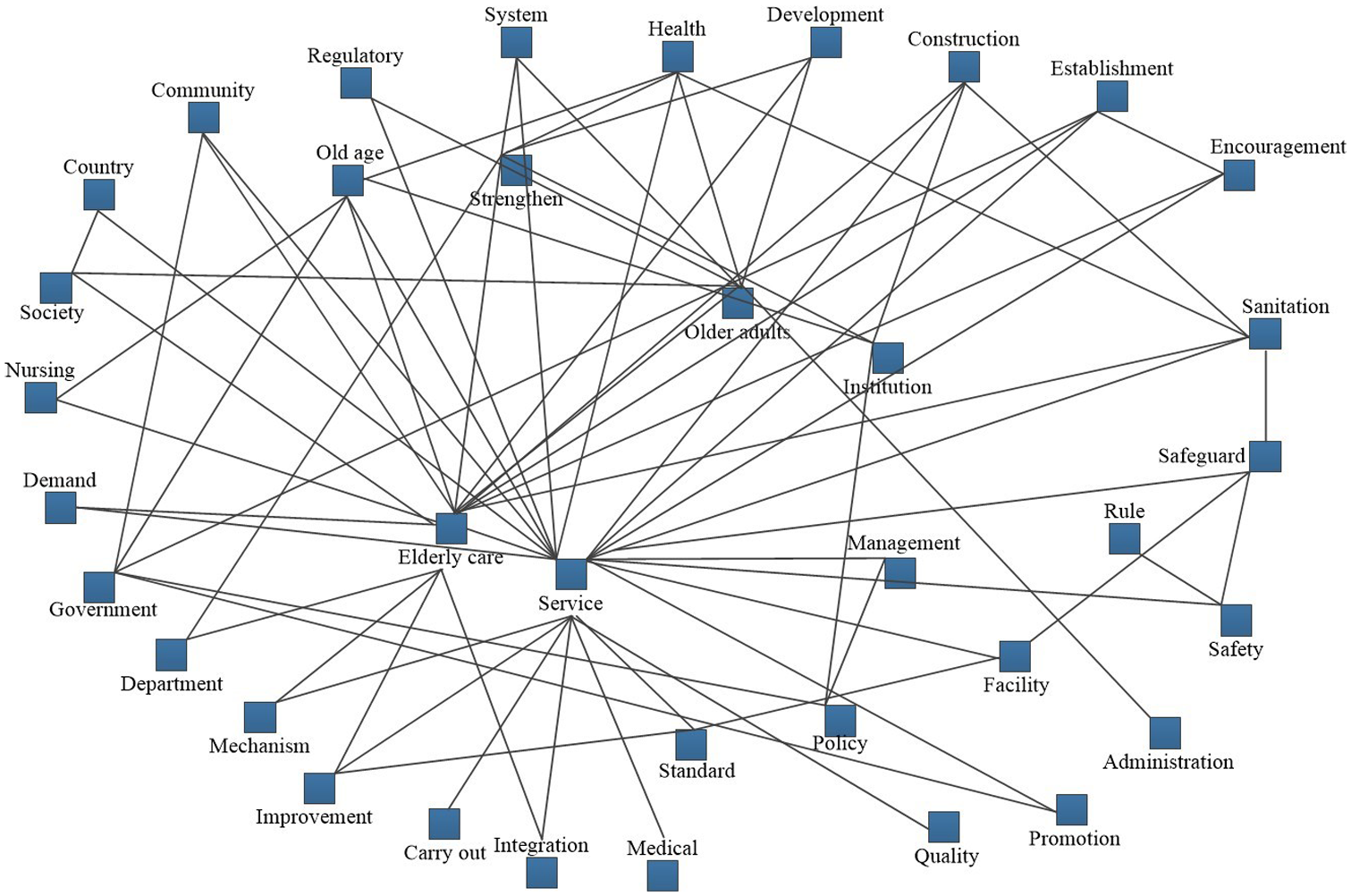
The semantic network.
According to Figure 3, it can be observed that the keywords “elderly care” and “services” are positioned at the center of the semantic network, with other keywords directly or indirectly connected to them through intermediary terms. This highlights that China’s elderly care service policies are fundamentally centered around these core concepts. With “elderly care” and “services” as the nucleus, keywords such as “institutions,”“older adults,” and “country” radiate outwards, supported by development-related keywords like “development”’, “construction,” and “strengthen.” The overall distribution of keywords in the semantic network appears dispersed. Keywords such as “development,”“older adults,” and “institutions” have stronger connections with “elderly care” and “services,” while keywords like “health” and “sanitation” are closely linked to these core concepts. There are also connections between “health” and high-frequency keywords like “elderly care,”“development,”“institutions,”“older adults.” Similar relationships exist with other terms like “establishment” and “management,” confirming the interconnections and interdependence among the various keywords.
At the core of the network lie the fundamental concepts, with the overarching goal of elderly care services being to improve the life quality for older adults, which the most direct, and effective indicator for evaluating the quality of these services. Relevant studies suggest that the quality of community services significantly impacts the quality of services experienced by older adults. Focused on the key stakeholders and supported by development planning, it is essential to address existing challenges in the institutions providing elderly care services, effectively meet the diverse requirements of older individuals, and emphasize the coordinated role of the government. As living standards continue to rise, the demand for these services has become increasingly varied. However, the current level of community-based service institutions is insufficient meet the full spectrum of older adults’ needs (Deng & Yu, 2021). In the current digital age, scientific and technological advancements play an undeniable role and shaping social transformation. Therefore, integrating digital technology with social governance can effectively link elderly care services with artificial intelligence, move beyond outdated service models, innovate the mechanisms of the elderly care system, and foster cross-disciplinary integration and development. Taking Shenzhen as an example once again, several of the city’s elderly care facilities have already been equipped with a range of smart devices. Among these, electric transfer aids assist in safely moving older adults, portable bathing machines address hygiene and personal care challenges, and rehabilitation robots provide personalized care plans tailored to the specific needs of each older adult. Based on the effective promotion of modernizing elderly care services, the industry has transitioned from providing isolated services to offering a comprehensive and coordinated approach to people’s livelihood. The design of the relevant service system has transitioned from a single focus to comprehensive coordination, emphasizing the overall situation and placing the needs of older adults at the center. This involves enhancing the service capacity, scientifically integrating and utilizing national, community, and institutional resources, and coordinating the responsibilities of the government, community, and institutions. By fully leveraging their respective strengths, the “medical-care integration” model can be improved, progressively optimizing elderly care governance, and contributing to the construction of a healthy China, which, in turn, promotes social harmony.
Conclusion
In China, medical and health conditions have continuously improved, leading to a significant increase in average life expectancy. Currently, China has entered an era of deep aging, and the trend of social aging is steadily accelerating. This article utilizes word frequency analysis technology to examine 20 policies closely related to elderly care services. By categorizing them according to the release of the “plan,” the analysis is conducted from three key perspectives. It is evident that China’s policies emphasize the role of key stakeholders and encourage greater participation in these services. Simultaneously, efforts have been made to implement strategic planning to promote its healthy development. Furthermore, these policies are built on a solid foundation, prioritizing the provision of care services for older adults. Through core analysis, it becomes clear that these policies are fundamentally centered around older adults. Driven by fundamental concepts, they radiate outward from the key stakeholders involved and are supported by strategic development planning. The overarching goal of these policies is the comprehensive promotion of a healthy China, with a focus on optimizing and enhancing elderly care governance to foster social harmony. This article applies policy analysis techniques to examine the scientific context behind the formulation of elderly care policies in China. It aims to assist relevant stakeholders in better implementing these policies, and contribute Chinese insights and solutions to the global advancement of elderly care services.
Since this study draws a distinction based on the release of the “plan” and conducts a national-level policy analysis, there are certain limitations, such as the limited number of policy documents. In the future, we plan to expand the scope of analysis to include a broader range of documents on elderly care policies. Specifically, we will examine the policy changes before and after the outbreak of the COVID-19 pandemic or conduct a comparative analysis of policies across different regions, in order to better understand developmental trends of elderly care policies in China.
Footnotes
Acknowledgements
The authors thank the SAGE Open review team for their excellent guidance throughout the review process.

Ethical Considerations
This research did not require IRB approval because we only use public policies for data analysis.
Funding
The author(s) disclosed receipt of the following financial support for the research, authorship, and/or publication of this article: Zhejiang Provincial Philosophy and Social Sciences Planning Project (grant/award number: 24NDQN120YBM; 22NDJC188YB).
Declaration of Conflicting Interests
The author(s) declared no potential conflicts of interest with respect to the research, authorship, and/or publication of this article.
Data Availability Statement
Data sharing not applicable to this article as no datasets were generated or analyzed during the current study.