




Abstract
Faced with the severe situation of global population aging, smart elderly care services have become an effective way to solve the dilemma of elderly care. In recent years, the Chinese government has frequently issued policies to promote the rapid development of smart elderly care service. This paper constructs a three-dimensional analysis framework of “policy objective-policy tool-value chain” and uses content analysis method, which is a structured research method that analyzes the content of text, to analyze 126 policies at the national level of China’s Smart elderly care service from 2012 to 2022. Through the quantitative statistical analysis, this study finds that the distribution of policy objectives is uneven, the structure of policy tools is imbalanced, the support strength of each link of the value chains is different, and the cross-fitting effect of dimensions is insufficient. In the future, pay attention to the balanced development of the needs of the elderly; Promote the complementarity of various policy tools; Strengthen the systematization of all links of the value chains; Improve the fitting effect between policy objectives, policy tools and value chains, and strive to improve the weak points of each combination model.
Introduction
With the advancement of medical technology and the improvement of living standards, population aging has become a global problem. The World Population Outlook 2022 report released by the United Nations predicts that the proportion of the world’s population aged 65 and over is expected to rise from 10% in 2022 to 16% in 2050. Due to the increase in the elderly population, social security systems such as pension and medical insurance in various countries are facing greater financial pressure. A research report from the World Economic Forum titled “We’ll live to 100 – How can we afford it?” pointed out that by 2050, the pension gap faced by the six major pension savings countries worldwide (the United States, the United Kingdom, Japan, The Netherlands, Canada, and Australia) reached $224 trillion. If China and India are included, the pension gap is expected to reach $400 trillion. This means that countries need to increase financial investment and reform the existing social security system to ensure that the basic living needs of the elderly are met.
With the continuous development of modern technologies such as artificial intelligence, cloud computing, and the Internet of Things, technological progress has provided technical support for the elderly care service industry. Smart elderly care has gradually become the focus of governments and society around the world. Smart elderly care provides more convenient and efficient services to the elderly through technological innovation, effectively alleviating the pressure of elderly care. For example, the Paro robot in Japan can simulate the appearance and movements of pets, providing companionship and comfort for the elderly; France has successfully put Zora robots into use in nursing homes and hospitals, relieving loneliness for the elderly.
As the largest developing country, China is currently characterized by “getting old before getting rich,” and the issue of elderly care has become one of the hot social issues to be solved urgently. Under the severe situation of population aging, the Chinese government attaches great importance to the development of elderly care. The Chinese government has successively issued a series of policies such as Several Opinions on Comprehensively Opening the Elderly Care Service Market to Improve the Quality of Elderly Care Services and Notice on Pilot Demonstration of Smart Health Care Applications. The elderly care service system has been gradually improved and the quality of elderly care services has been improved.
However, China’s elderly care still faces enormous pressure. According to the seventh national census data, the proportion of people aged 60 and above in China reached 18.70%, with 13.50% aged 65 or above. Compared with 2010, the proportion of people aged 60 and above increased by 5.44 percentage points. This shows that China’s elderly population is not only large, but also the aging process has accelerated significantly. Under the background of the “Silver Wave,” the traditional elderly care service model has been difficult to meet to the needs of the multi-level development of elderly care services. As an emerging elderly care service model, smart elderly care has brought opportunities for the development of elderly care services.
Smart elderly care is a basic and innovative means to improve the quality of life and elderly care services for the elderly through the use of Internet, biomedical and information technology (Stojkoska & Trivodaliev, 2017). The early research of smart elderly care pays more attention to the needs of elderly people, and now tends to the research and development and application of information technology. For example, explore how to use new technologies to improve the quality of medical care services for the elderly, as well as the level of specialization and standardization in elderly health management, especially the research on the use of products such as smart homes and service-oriented robots in elderly medical services and health management. Helal and Bull (2019) pointed out that to build smart homes and communities, it is necessary to combine technology with living space to design products for the elderly. Jeong et al. (2018) focused on the role of intelligent nursing derived from science and technology, and believes that intelligent nursing services based on telemedicine and remote monitoring can meet the needs of some elderly people with chronic diseases. Redfern (2019) found that mobile health technology can effectively promote the prevention and treatment of cardiovascular and cerebrovascular diseases. In addition, scholars have also focused on the smart elderly care service models and practical experiences of different countries. The Sweet-Home project in France, which operates smart home systems using voice recognition or tactile commands, provides convenience for elderly people with mobility and visual difficulties (Portet et al., 2013). Assisting Carers Using Telematics Interventions to meet Older persons’ Needs (ACTION) is an EU project designed to enhance the independence, autonomy and quality of life of frail older people and their family carers by offering information, education and support via ICT (Magnusson et al., 2002).
In comparison, Chinese scholars have studied smart elderly care services relatively late. However, in recent years, smart elderly care services have gradually attracted the attention of Chinese academia. Scholars have discussed the connotation concept, service mode, platform construction and index system (Guo et al., 2016; Sui & Peng, 2016; Wei, 2021; Zhao & Zhao, 2022). There are also studies that have focused on the effect of smart elderly service on meeting diversified needs and reducing service supply costs (Q. Zhang & Li, 2019), as well as multiple problems such as social risks and monotonous services (L. Zhang & Han, 2017; Zhu & Tang, 2020). The development of smart elderly care services is inseparable from policy support and guidance. A few scholars have carried out relevant policy text research, mainly from the perspective of policy tools, or based on a single policy text, or focusing on the central and local government level policy text set. For example, Implementation Plan for Effectively Solving the Difficulties of the Elderly in Using Intelligent Technology (Yang & Hu, 2021), the central-level smart elderly care industry policy (J. F. Huang & Zhang, 2020), the Yangtze River Delta region smart elderly care policy (J. Y. Huang, 2020).
Through literature review, it was found that although some studies have conducted quantitative analysis of China’s smart elderly care service policies, there are still shortcomings. On the one hand, the above research is mostly based on a single policy text or regional policy set, which cannot well present the whole picture of China’s smart elderly care service policy, and the content of the policy text needs to be further explored. On the other hand, the perspective focusing on policy tools is relatively simple, and few studies have constructed a multidimensional analytical framework for the overall analysis of China’s smart elderly care service policies, which is not conducive to accurately identifying the characteristics of the policy system and the combination of policy elements. Based on this, this paper attempts to construct a three-dimensional analysis framework of “policy objective-policy tool-value chain,” using content analysis method to explore the important characteristics of the content of China’s smart elderly care service policies. This study will contribute to the improvement of the Chinese government’s follow-up social security policy system and provide some experience and reference for the optimization of smart elderly care service policies in other countries.
Analysis Framework
Selection of Analysis Dimension
Policy text is an important carrier to reflect the government policy behavior. A reasonable policy structure needs to reflect the organic combination of policy objectives and policy tools (X. P. Huang et al., 2020). Therefore, in the extraction dimension of policy text, the academic community generally regards policy objectives and policy tools as two traditional analysis perspectives, focusing on the text content analysis of “what to do” and “how to do.” This paper chooses the two as analysis dimensions according to the usual. The policy goal is the effect and purpose that decision-makers hope to achieve through the implementation of policies. It not only guides decision-makers to choose appropriate policy tools, but also provides a benchmark for subsequent policy evaluation (Fan & Tan, 2017). Although policy objectives can convey the purpose or intention behind the policy, the transformation of policy objectives from concept to reality is inseparable from the use of policy tools, so it is necessary to study the perspective of policy tools.
Policy tools are the means for decision-makers to achieve a specific goal (Gu & Wu, 2007). This instrumental perspective is helpful to understand how the government affects the smart elderly care services. The correct choice of policy tools requires a clear classification of policy tools. Regarding the theoretical research on policy tool classification, Dutch economist Kirschen was the first to attempt to classify policy tools and sorted out 64 generalized tools. After the rise of the 1980s, the theory of policy tool classification has become increasingly mature. Currently, scholars have classified policy tools according to different classification criteria. The most widely used classification methods are as follows: dividing policy tools into environmental policy tools, supply-oriented policy tools, demand-oriented policy tools according to the differences in the role of policy tools (Rothwell & Zegveld, 1984); dividing policy instruments into voluntary, mandatory and mixed types according to the degree of government intervention in the provision of public goods and services (Howlett & Ramesh, 1995).
At present, smart elderly care service is still an emerging industry. The relevant macro-control policies issued by the government in a certain period contain the direction of guiding the development of smart elderly care industry, which is of great significance for promoting the optimization and upgrading of smart elderly care industry structure. Although policy objectives and policy tools are very important, it is inevitable to ignore the complexity and systematicness of smart elderly care service as a livelihood project by only solving the problem of which means to achieve what purpose. Some studies have pointed out that policy tools can reflect specific action measures within the policy, but cannot reflect the actual value of each stage of the industrial chain (Mao & Mei, 2020). Therefore, in order to explore the characteristics of policy content more comprehensively and deeply, it is necessary to include the value chain analysis dimension based on the whole service process, combined with the development links of policy objectives and policy tools.
Michael Porter, a famous strategist at Harvard Business School in the United States, proposed the value chain analysis method, arguing that the increase in internal and external value of enterprises comes from basic activities and supportive activities (Cao & Shi, 2018), and then the value chain theory has gradually been enriched and developed. The value chain usually refers to the value-added process of industrialization and marketization of the innovation object by forming a dynamic feedback mechanism around a core innovation object such as technology or service, with the goal of meeting the demand, through the creative proposal, basic research, product development, industrialization, marketing and other related nodes (Roper et al., 2008). The introduction of this dimension mainly has the following functions: Starting from the process of industrial development, by adding another dimension to supplement the two dimensions of policy objectives and policy tools, it is helpful to make up for the monotonicity and deficiency of the two; By systematically decomposing the growth process of smart elderly care industry, it is helpful to better present the stage characteristics of smart elderly care policy.
From the above analysis, it can be seen that the smart elderly care service policy not only involves specific policy objectives, different types of policy tool selection and combination, but also contains different links in the value chain. Therefore, based on the existing research and practice, this paper finally selects three dimensions: policy objectives, policy tools, and value chain.
Construction of Analytical Framework
From the perspective of policy objectives, the value goal of smart elderly care services lies in safeguarding the rights and interests of the elderly and meeting their needs (R. X. Zhang & Zhang, 2020). Therefore, the analysis is carried out with the help of demand factors. According to Maslow’s hierarchy of needs theory, human needs can be divided into physiological needs, security needs, social needs, respect needs and self-realization needs from low to high (Maslow, 1943). Based on this theory, combined with the current China’s smart elderly care service policy, with reference to existing research (Mao & Liu, 2021), the needs of the elderly can be divided into three categories: basic needs, relational needs and development needs. Basic needs refer to meeting the basic needs of the elderly, including physiological needs such as food, clothing, housing, transportation, health care and security needs such as home security, traffic security and social security, respectively corresponding to the physiological needs and security needs of Maslow’s hierarchy of needs theory. Relational needs, that is, to meet the emotional needs of the elderly, refer to the social needs of family, love, friendship, team and belief in the spiritual comfort level of the elderly, corresponding to the social needs of Maslow’s hierarchy of needs theory. Development needs refer to meeting the high-level needs of the elderly, including respect needs such as self-affirmation, family status and social evaluation, and self-actualization needs such as improving cognition, mastering skills and job hunting, respectively corresponding to the respect needs and self-actualization needs of Maslow’s hierarchy of needs theory.
From the perspective of policy tool dimension, Rothwell and Zegveld’s policy tool classification has significant intra-dimensional aggregation validity and inter-dimensional discrimination validity, and has strong target pertinence and content guidance (Li & Gu, 2016). This paper uses this classification idea to divide China’s smart elderly care service policy tools into three categories: environmental, supply, and demand. Environmental policy tools mean that the government improves the external environment for the development of smart elderly services through target planning, regulatory control, strategic measures, financial support, tax incentives and other means, which is mainly manifested as the indirect influence on the development of smart elderly services. Supply-oriented policy tool means that the government promotes the supply of various related factors through infrastructure, capital investment, talent cultivation, information services and scientific and technological support, which is mainly manifested as a direct driving force for the development of smart elderly care services. Demand-oriented policy tools, that is, the government expands the service market by guiding public demand through government procurement, service outsourcing, trade control and other means, which is mainly manifested as the direct driving force for the development of smart elderly care services.
From the perspective of value chain dimension, combined with the characteristics of China’s smart elderly care service policy and the development of elderly care industry, the value chain dimension of smart elderly care service policy analysis is divided into three links: research and development and technical support, industrialization and scale, marketization and application. Research and development and technical support is the fundamental stage in the development process of smart elderly care services. This stage mainly produces results through the use of scientific research investment in knowledge, technology, and other aspects, focusing on the research and development of equipment and terminal service operations for smart elderly care. Industrialization and scale is the in-depth stage of the development process of smart elderly care services. This stage is responsible for putting the output results into practice and promoting the expansion of the scale of smart elderly care related products and services. Marketization and application is the expansion stage of the development process of smart elderly care services. This stage is the expansion and exploration on the basis of the first two stages. It aims to speed up the promotion of smart elderly care services throughout the society and provide higher quality and more convenient public services for the elderly.
In summary, the analysis of smart elderly care service policy is inseparable from the three dimensions of policy objectives, policy tools and value chain. Reasonable and clear policy objectives are the premise of policy implementation, and provide guidance for the scientific selection of policy tools and the effective operation of the value chain. Policy tools are the bridge between policy objectives and results. They are the means to transform policy intentions into policy actions, and provide support for the smooth realization of policy objectives and the improvement of efficiency and quality in the value chain. The value chain reflects the value realization process of smart elderly care service, and contains the catalytic effect of policy objectives and policy means in each stage of the value chain, which is the key to ensure the positive flow of the value chain. The above dimensions and coupling relationship become an important window to identify the content characteristics of smart elderly care service policy.
Therefore, this paper constructs a three-dimensional analysis framework of smart elderly care service policy with policy objective as X axis, policy tool as Y axis and value chain as Z axis, as shown in Figure 1. The policy system of smart elderly care service can be regarded as a policy space composed of three dimensions: policy objectives, policy tools, and value chain. It contains different points, lines, surfaces and bodies, which respectively represent different policy implications. Point refers to the smallest unit subordinate to a certain dimension, which is manifested as a point, such as the physiological needs of basic needs in the dimension of policy objectives. Line refers to some policy provisions involving only a certain dimension, manifested as a line. The surface is a cross section composed of axes, involving two dimensions. The body is represented as a cube or polyhedron, involving three dimensions. Based on this, the analysis framework provides a basis to follow for the single-dimensional, two-dimensional and three-dimensional analysis of the smart elderly care service policy in the following paper.
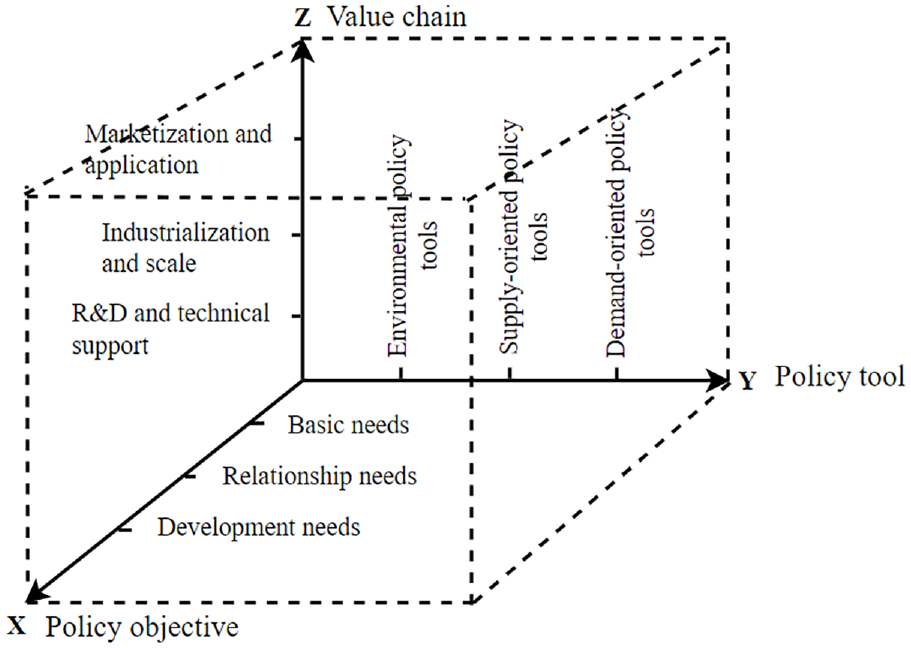
Three-dimensional analysis framework of smart elderly care service policy.
Materials and Methods
Content analysis method is a structured research method that analyzes the content of text. Its principle is to analyze the amount of information contained in the text and its changes, in order to achieve reproducible and effective inference of the text content (Qiu & Zou, 2004). This method first sprouted in the field of journalism and communication. In the 1950s, American scholar Berelson (1952) formally classified it as one of the scientific research methods. It has since been widely applied in fields such as information science, sociology, and management. The advantage of content analysis is that it can continuously process a large number of long-term data and analyze the facts more objectively to obtain conclusions (Liu, 2014). This is in line with the research ideas of this paper, so the content analysis method is adopted.
Scientific and reasonable policy text selection is the primary premise of policy text content analysis. Smart elderly care service policies refer to various laws, regulations, and policies formulated in China. In this study, we take the national policy text closely related to China’s smart elderly care service policies as the analysis sample, including regulations, plans, notices, methods, programs, opinions, etc. China Aging Office first proposed the concept of “intelligent elderly care” in 2012, encouraging and supporting the exploration of smart elderly care practice, and then relevant policies were successively introduced. Therefore, this study focuses on the current effective smart elderly care service policies at the central level from 2012 to 2022. The data were collected from the policy and regulation platform. To ensure data effectiveness, the obtained policy texts were manually identified and screened, and texts irrelevant or less relevant to the research were filtered and deleted. Finally, 126 policy texts were obtained. The specific search strategies are the following:
Platform: Chinese government law data bank and China Law retrieval system, which provides a large number of legal policies; for further comprehensiveness, the data were supplemented from the websites of the State Council and its subordinate ministries and commissions.
Search expression: Keywords such as “smart elderly care services,”“smart elderly care,” and “smart services” were retrieved.
Policy years: Policies issued from 2012 to 2022.
According to the constructed analysis framework, the filtered smart elderly care service policy text is coded. To ensure the scientific and reliable coding, the specific process is as follows:
Coding training. Each coder needs to understand and master the specific connotation and operation process of the unit they are responsible for in advance.
Multi-person coding. The authors of this article serve as the coder to encode the content of the policy text separately. If the code is consistent, it is considered to be passed; if there are differences, the research group will reach an agreement after collective discussion. If there are still differences, the opinions of at least two experts in related fields will be consulted until they are unified.
Coding results. Following the principle of unified coding and non-subdivision, the coding results are presented in the form of “policy number-chapter number-sequence number,” such as “3-4-1,” which represents the first rule of chapter 4 of the policy text numbered 3, and finally forms the content analysis unit coding table of China’s smart elderly care service policy text, as shown in Table 1.
Example of Text Coding of China’s Smart Elderly Care Service Policies.

Results
Overall Analysis of Smart Elderly Care Service Policy
From Figure 2, it can be seen that during the period from 2012 to 2022, the overall number of China’s smart elderly care service policies shows a fluctuating upward trend, indicating that the Chinese government is increasingly emphasizing the development of smart elderly care services. It is worth noting that there are two obvious turning points during the period. First, in 2017, this is the second year that China has entered the thirteenth 5-year Plan period. In order to improve the construction level of the elderly care service system and implement the overall deployment of a number of plans, such as the Outline of the thirteenth Five-Year Plan for National Economic and Social Development of the People’s Republic of China, the number of policies in this year reached 15, forming a small peak. Second, in 2020. In the context of the COVID-19 pandemic, in order to protect the legitimate rights and interests of the elderly and improve the digital skills of the elderly, 19 policy documents have been issued successively, such as the Notice on Strengthening Care Services for the Elderly with Special Difficulties during the Prevention and Control of the Epidemic.
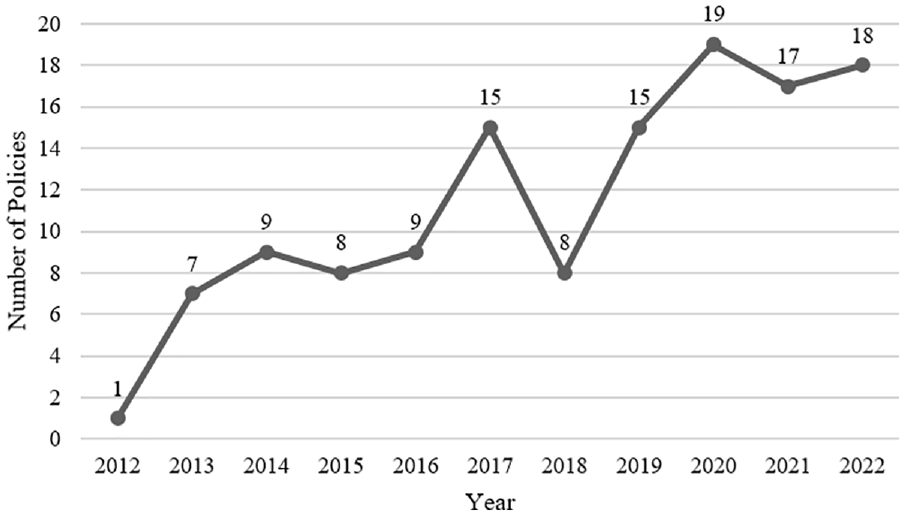
Annual number of China’s smart elderly care service policies, 2012 to 2022.
Single-Dimensional Analysis
Analysis of policy objectives. From Table 2, it can be seen that the smart elderly care service policies as a whole involves basic needs, relationship needs and development needs, indicating that the basic framework of China’s smart elderly care service policies has been preliminarily formed. However, from the perspective of the proportion of various needs, the proportion of the three types of needs is relatively unbalanced, with the highest number of basic needs and the lowest number of relational needs represented by social needs. Specifically, the basic needs are mainly physiological needs, a total of 266, accounting for more than half; There are a total of 55 security needs, accounting for 12.76%; In the category of development needs, there are 88 policy provisions related to self- realization needs, accounting for 20.42%. Respect needs accounts for the least.
Overall Distribution of Policy Objectives.

The data results show that the policy support for basic needs is the strongest. The Chinese government has issued policies to give priority to the basic rights and interests of the elderly, including basic necessities of life, health care and life security, to meet their material needs. In recent years, due to the outbreak of COVID-19 pandemic, the Chinese government has issued some policies on the use of smart technology for the elderly. The proportion of self-actualization needs has increased. The elderly can not only enjoy social welfare, but also actively create value for society. However, the social needs and respect needs of the elderly, such as spiritual comfort, personal dignity, and social evaluation, have insufficient responses. The diversified and multi-level needs of the elderly in China need to be further met.
Analysis of policy tools. From Table 3, it can be seen that China’s smart elderly care service policies cover three types of policy tools. However, the proportion distribution of the three is uneven, indicating that there is a gap in the degree of dependence of the Chinese government on different types of policy tools. The Chinese government pays attention to improving the developmental environment of smart elderly care services, and focuses on the driving role of supply-oriented policy tools. The driving force of demand-oriented policy tools is relatively weak. (1) Environmental policy tools. The number of two types of policy tools, target planning and strategic measures, is relatively large, totaling 209, accounting for 35.36%; There are a total of 33 regulatory control tools, accounting for 5.58%; The proportion of financial support and tax incentives is relatively small. (2) Supply-oriented policy tools. Science and technology support is the most frequently used, totaling 136, accounting for 23.01%; Information services ranked second, totaling 108, accounting for 18.27%; The amount of infrastructure, talent cultivation and capital investment is relatively small. (3) Demand-oriented policy tools. The overall quantity of service outsourcing, government procurement and trade control is relatively small.
Overall Distribution of Policy Tools.
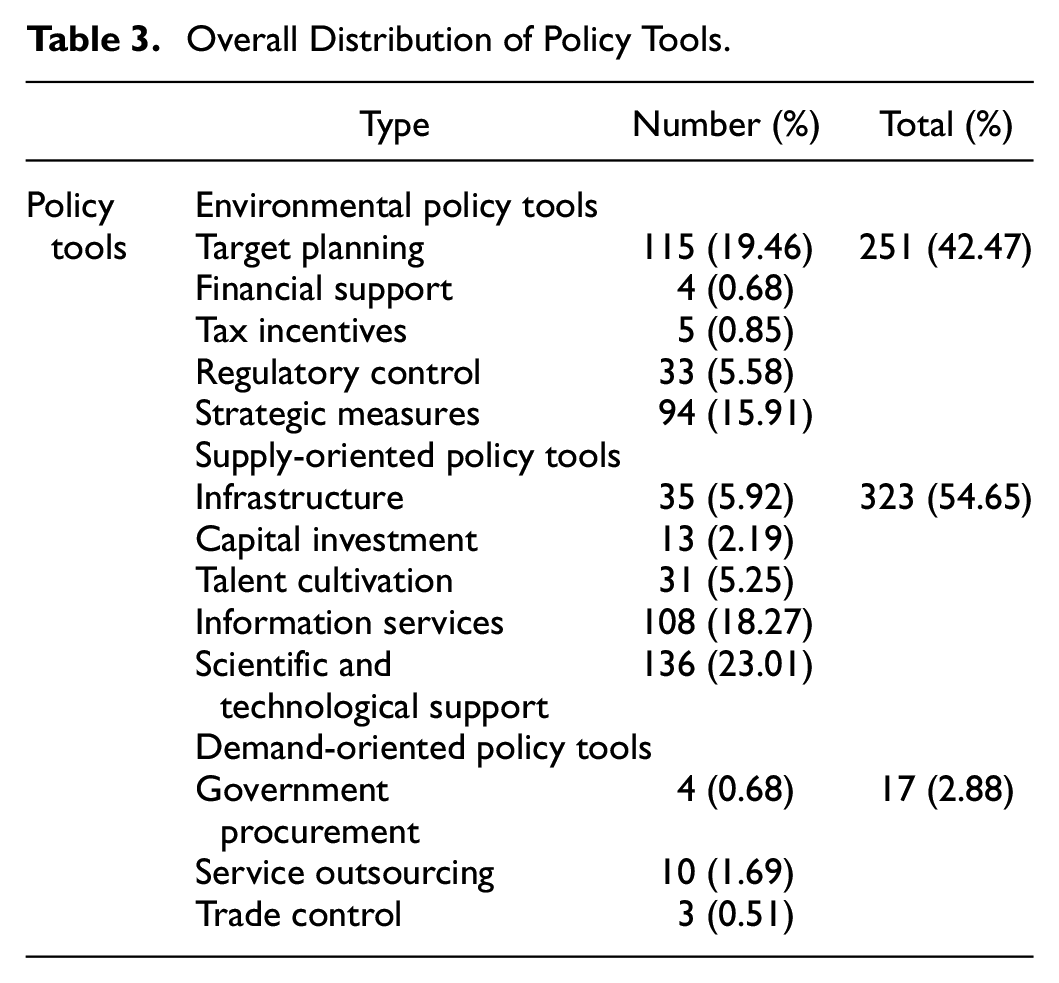
From the above analysis, it can be seen that in terms of environmental policy tools, the Chinese government has a strong target planning for smart elderly care services, encourages and supports the development of smart elderly care services through strategic measures, and improves the degree of rule of law through regulatory control tools. However, these policy tools have certain ambiguity, which may lead to the problem of policy implementation bias. At the same time, financial support and tax incentives are relatively insufficient, and the policy regulation function needs to be fully utilized. In terms of supply-oriented policy tools, the Chinese government actively uses information technology to innovate the supply model of elderly care services. In terms of demand-oriented policy tools, policy support is relatively weak, which is not conducive to forming a strong policy pull to promote the sustainable and healthy development of China’s smart elderly care services.
Analysis of value chains. According to Table 4, China’s smart elderly care service policy considers three aspects: research and development and technical support, industrialization and scale, marketization and application. The overall value chain of the smart elderly care service industry is relatively complete, but it focuses more on research and development and technical support. The number of policy provisions involved in the stage of research and development and technical support is 200, accounting for 41.24%. This shows that the Chinese government encourages the development of new elderly care service products, such as the Implementation Opinions on Further Expanding the Supply of Elderly Care Services to Promote Consumption of Elderly Care Services, which proposes supporting the research and development of products such as exoskeleton robots, care and rehabilitation robots, virtual reality rehabilitation training equipment. With the release of market vitality, the inherent potential of China’ smart elderly care service market is gradually being explored, mainly through multiple trials of smart elderly care pilot projects, such as the Notice on the Pilot Demonstration of Smart Health Pension Application, actively exploring new models of elderly care services. In comparison, there are not many policies on industrialization and scale. This is mainly due to the fact that China’s smart elderly care service is in the exploratory stage, and it is vulnerable to front-end research and development and back-end market applications. Therefore, the scale of China’s smart elderly care related products and services needs to be further expanded.
Overall Distribution of Value Chains.

Two-Dimensional Analysis
Policy Objectives and Policy Tools
The data results in Table 5 show that, on the whole, in promoting the realization of policy objectives, environmental policy tools have the highest frequency, supply-oriented policy tools have the middle frequency, and demand-oriented policy tools have a relatively low frequency. (1) Basic needs. Environmental policy tools, supply-oriented policy tools and demand-oriented policy tools all support the basic needs policy objective, among which environmental policy tools are used the most, with a total of 348, accounting for 65.29%. Policy tools such as target planning, scientific and technological support, information services, and strategic measures are widely used. (2) Relationship needs. The realization of relationship needs policy objective mainly relies on two types of environmental policy tools and supply-oriented policy tools. The use of policy tools such as target planning, information services, scientific and technological support accounts for a relatively large proportion. (3) Development needs. The policy objectives mainly involve two categories: environmental policy tools and supply-oriented policy tools. Specifically, it is mainly based on the use of policy tools such as target planning, scientific and technological support, information services and strategic measures. Overall, the use of policy tools for China’s smart elderly care services is more likely to meet the basic needs of the elderly and effectively ensure the bottom line for the elderly, mainly through actively creating a good policy atmosphere and providing smarter and more convenient services.
Distribution of Two-Dimensional Analysis Between Policy Objectives and Policy Tools.

Policy Objectives and Value Chains
From Table 6, it can be seen that the policy objectives of the three links all focus on basic needs, especially physiological needs, followed by development needs, and finally relationship needs. (1) Research and development and technical support. The total number of various needs is the highest, with a total of 166, accounting for 46.11%. Among them, there are 136 basic needs, accounting for 81.93%; There are a total of 9 relationship needs, accounting for 5.42%; There are a total of 21 development needs, accounting for 12.65%. (2) Industrialization and scale. The total number of various needs is 92, accounting for 25.6%, of which 76 are basic needs, accounting for the most, followed by development needs and relationship needs. (3) Marketization and promotion application. There are a total of 102 demands of various types, accounting for 28.33%. Among them, there are a total of 78 basic needs, accounting for 76.47%; there are a total of 22 development needs, accounting for 21.57%; the number of relationship needs is the least. The data results show that in order to meet the multi-level needs of the elderly, the whole link of the value chain of China’s smart elderly care services is relatively complete. At present, the value chain is focused on the research and development phase, mainly through basic research and development and technical support to optimize services for the elderly. At the same time, the scale of products and the popularization of the pilot are also actively promoted, but the value chain as a whole pays less attention to the relationship needs and development needs.
Distribution of Two-Dimensional Analysis Between Policy Objectives and Value Chains.

Policy Tools and Value Chains
As can be seen from Table 7, all types of policy tools are covered in the value chain. The use of supply-oriented policy tools is the most frequent, followed by environmental policy tools, and demand-oriented policy tools are the least. (1) Research and development and technical support. The number of environmental policy tools is 56, with strategic measures and target planning accounting for a relatively large proportion; The number of supply-oriented policy tools is the largest, with 138, among which the number of technology support far exceeds that of other secondary policy tools. The proportion of demand-oriented policy tools is relatively small. (2) Industrialization and scale. The frequency of using environmental policy tools is the highest, with 72, accounting for 56.69%. The frequency of using supply-oriented policy tools is in the middle, with 48, accounting for 37.79%, mainly information services, scientific and technological support, and infrastructure; demand-oriented policy tools are used the least frequently, mainly service outsourcing. (3) Marketization and application. The number of environmental policy tools is 73, and the number of target planning is 46; The number of supply-oriented policy tools is 72, accounting for 48.32%, among which the number of scientific and technological support and information services is larger; Demand-oriented policy tools are used the least frequently, including government procurement and service outsourcing.
Distribution of Two-Dimensional Analysis Between Policy Tools and Value Chains.

The data results show that the use of policy tools for China’s smart elderly care services is mainly concentrated in the stage of research and development and technical support, followed by the stage of marketization and application, which fully reflects the government’s emphasis on the application of intelligent technology in elderly care services, and focuses on the leading role of various demonstration pilots in the overall innovation and reform of smart elderly care services, but the policy support in the industrialization stage is relatively weak. In terms of the use of policy tool types, the number of supply-oriented policy tools is the largest, which has a greater support effect on all links of the value chain, especially the number of scientific and technological support.
Three-Dimensional Analysis
As can be seen from Table 8, the value chains all focus on the basic needs under the dimension of policy objectives, followed by the development needs, and finally the relationship needs. In terms of the types of policy tools, the emphasis is on supply-oriented policy tools and environmental policy tools. (1) Research and development and technical support. The number of basic needs is 132, accounting for 82.5%, the number of relationship needs is 8, accounting for 5.00%, and the number of development needs is 20, accounting for 12.50%; the number of environmental policy tools is 44, accounting for 27.50%, supply-oriented policy tools is 115, accounting for 71.87%, and demand-oriented policy tools are the least. (2) Industrialization and scale. The number of basic needs is 77, accounting for 82.79%, the number of development needs is 15, accounting for 16.13%, and the proportion of relationship needs is the smallest; the number of environmental policy tools is 50, accounting for 53.76%, supply-oriented policy tools are 38, accounting for 40.86%, and demand-oriented policy tools are the least. (3) Marketization and application. The number of basic needs is 76, accounting for 75.25%, the number of development needs is 23, accounting for 22.77%, and the proportion of relationship needs is the smallest. The number of environmental policy tools is 42, accounting for 41.58%; the number of supply-oriented policy tools is 57, accounting for 56.44%; the number of demand-oriented policy tools is the least. According to the data analysis, China’s smart elderly care service policy is prominent in the combination mode of “basic needs, supply-oriented policy tools, research and development and technical support,” that is, giving full play to the driving force of supply-oriented policy tools such as scientific and technological support and information services, accelerating the research and development of smart care service products, and giving priority to the basic needs of the elderly.
Distribution of Three-Dimensional Analysis Among Policy Objectives, Policy Tools and Value Chains.

Conclusions and Discussion
Conclusions
This study constructs a three-dimensional analytical framework to analyze China’s smart elderly care services policies from 2012 to 2022. The following research conclusions are drawn.
First, the level of policy objectives is not evenly distributed. The policy objectives of China’s smart elderly care service are diversified, covering the basic needs, relationship needs and development needs of the elderly. However, the proportion of policies for the three types of demand is not balanced. The basic needs mainly based on physiological needs have the most policy support. Certain aspects of elderly care can receive more attention and resources compared to others. Overall, in terms of setting the goals of China’s smart elderly care service policies, there is a coexistence of “basic protection” and “promoting high-end” characteristics: to ensure the supply of products and services that are closely related to the daily life of the elderly group; to encourage the research and application of relevant intelligent products and services to meet the growing high-level needs of the elderly.
Second, there is a structural imbalance in policy tools. As China’s smart elderly care service is still in its early stage, the current overall structure focuses on the application of environmental policy tools and supply-oriented policy tools, which provides a good environment and strong guarantee for the development of smart elderly care services. However, demand-oriented policy tools are underutilized or not effectively implemented, which can easily lead to inefficiencies or gaps in policy implementation. Specifically, environmental policy tools mainly include target planning, regulatory control and strategic measures, while the effects of financial support and tax incentives need to be fully exploited. Among supply-oriented policy tools, science and technology support and information services are used more frequently, while infrastructure, talent cultivation, and capital investment are relatively small. Government procurement, service outsourcing and trade control, which are subordinate to demand-oriented policy tools, are relatively insufficient.
Third, the support of each link of the value chain is different. China’s smart elderly care service policy considers three links, and has basically formed a complete smart elderly care service industry chain. However, the policy support for each link is different. At present, the focus of the policy is at the front end, that is, the stage of research and development and technical support. This means that the government strongly supports the research and development and design of aging-related products, which is conducive to laying the foundation for the high-quality development of smart elderly care. In addition to the front end, the back end of China’s smart pension industry has also been actively developing in recent years, mainly due to the relevant construction of the demonstration pilot, injecting new vitality into the marketization and application. However, the policy support for industrialization and scale is insufficient, and there is a lack of sufficient organization or standardization. This is mainly because China’s smart elderly care services are still in the exploratory stage, and many related projects are not mature, and its development prospects are relatively broad.
Fourth, the cross-fitting effect of dimensions is insufficient. From the perspective of two-dimensional intersection, in terms of policy objectives and policy tools, China’s smart elderly care service policy tools are mainly used to meet the basic needs of the elderly. Specifically, environmental policy tools based on goal planning and strategic measures, supply-oriented policy tools based on scientific and technological support and information services, and the design and application of demand-oriented policy tools need to be strengthened. In terms of policy objectives and value chain, the value chain of smart elderly care service covers the needs of the elderly at all levels, but focuses on ensuring basic needs, especially in the stage of research and development and technical support. In terms of policy tools and value chain, policy tools are mainly used in the stage of research and development and technical support, marketization and application, focusing on the use of supply-oriented policy tools based on scientific and technological support. From the perspective of three-dimensional intersection, China’s smart elderly care service policy is highlighted as the combination mode of “basic needs, supply-oriented policy tools, research and development and technical support.”
Suggestions
According to the above research conclusions, this study provides valuable insights for the construction and formulation of smart elderly care service policy in other countries, especially developing countries.
First, pay attention to the balanced development of the needs level of the elderly, and appropriately prioritize the relationship needs and development needs. (1) Accurately identify the different levels of elderly care service needs. We should fully consider the diversified needs, and strive to achieve targeted accuracy for different groups such as healthy elderly, empty nesters, and disabled elderly. (2) Continue to protect the basic needs of the elderly. The elderly care service should turn to high-quality development, strengthen the upgrading of related products and services at the basic needs of the elderly, promote the intelligence, convenience and efficiency of smart elderly care service, and improve the satisfaction of the elderly care service. (3) Focus on relationship needs and development needs. The strategic focus should be gradually shifted to the multi-level development of smart elderly care services.
Second, improve the structural layout of policy tools and promote the complementary advantages of various policy tools. (1) Optimize the connotation of environmental policy tools. Pay attention to avoiding “policy congestion” situations, refine some macro policy clauses appropriately to reduce policy ambiguity and enhance policy operability. At the same time, further strengthen financial support and tax preferential policies to better stimulate the innovation behavior of the main suppliers. (2) Adjust the structure of supply-oriented policy tools. Infrastructure such as hardware platforms and service centers should be actively built; encourage industry-university-research cooperation and accelerate the cultivation of new talents for smart elderly care; introduce social capital and broaden capital investment channels. (3) Increase the number of demand-oriented policy tools. The pulling force of policy tools such as government procurement, service outsourcing, and trade control should be fully utilized.
Third, strengthen the systematicness of each link of the value chain and increase support for industrialization and scale. (1) Continue to improve the basic research and development capabilities. Encourage relevant enterprises and institutions to adopt new processes, new materials and new technologies, strengthen the design and development of suitable aging. Comprehensively deepen the application of big data in smart elderly care services, and strengthen the research on key technologies such as the storage cleaning, analysis, and security protection of massive data. (2) Promote industrialization and large-scale development. Enrich and strengthen the smart elderly care industry chain, promote the transformation of scientific and technological achievements, improve the accessibility of smart elderly care services. (3) Promote marketization and application. Continue to support plural forces to participate in the development of smart elderly care services and actively cultivate new formats of smart elderly care services. Strengthen the construction of demonstration projects, encourage local governments to explore new models of smart elderly care services in combination with local characteristics.
Finally, improve the fitting effect between policy objectives, policy tools and value chain, and focus on improving the weak points of each combination model. (1) Strengthen the adaptability of policy tools to policy objectives. It is necessary to actively play the indirect role of financial support and tax incentives, and increase investment in infrastructure, capital and talents. At the same time, strengthen the support of policy tools for relationship needs and development needs. (2) Balance the needs of all levels of the value chain. While meeting the basic needs, we should also actively pay attention to the relationship needs and development needs, provide a new path for the development of the smart elderly care industry, and deeply tap the market potential. (3) The value chain should consider various policy tools. According to the characteristics of smart elderly care service projects, scientifically and rationally match policy tools.
Limitations and Future Research Directions
Through a systematic quantitative analysis of 126 smart elderly care service policy documents, this study shows the external characteristics of China’s smart elderly care service policies such as the issuing time, policy objectives and policy tools. In the future, we can further expand the concept of smart elderly care service policy and include as many policy texts as possible that are pertinent to smart elderly care service scenarios. Moreover, interviews with policy makers and assessments of policy implementations are encouraged to evaluate the use and effects of smart elderly care service policy tools. In addition, we only collected China’s smart elderly care service policies at the national level and did not consider policy texts from other countries or regions. Future research should collect more textual data, conduct comparative analysis of smart elderly care service policies in different countries or regions, and explore their situations and characteristics in detail.
Footnotes
Declaration of Conflicting Interests
The author declared no potential conflicts of interest with respect to the research, authorship, and/or publication of this article.
Funding
The author received no financial support for the research, authorship, and/or publication of this article.

Data Availability Statement
Data sharing not applicable to this article as no datasets were generated or analyzed during the current study.