




Abstract
The study aimed to examine the mediating effect of teachers’ curriculum literacy between 21st-century teaching skills and professional self-efficacy. The study was conducted with the relational survey model. The study group consisted of 463 teachers. In the study, the data were collected using the “Use of 21st Century Teaching Skills Scale,”“Teacher Self-Efficacy Perception Scale” and “Curriculum Literacy Scale.” In the analysis, descriptive statistics and normality assumptions of the variables were tested. After this stage, Pearson product-moment correlation coefficients indicating the relationships of the variables considered within the scope of the structural equation model (SEM) were calculated and it was concluded that the necessary assumptions for the model were met. The SEM was conducted in two steps: measurement and structural modeling. In the study, a positive and moderately significant relationship between teachers’ 21st-century teaching skills, curriculum literacy and professional self-efficacy was determined. Moreover, it was found that curriculum literacy played a mediating role between teachers’ 21st-century teaching skills and teacher self-efficacy. In the context of this research, curriculum literacy can be considered a key competency in the acquisition of 21st-century teaching skills and the formation of teacher self-efficacy perceptions.
Introduction
In the 21st century, changes in the economy, technology, social life and politics, also those affecting the education system, have caused people to have different qualitative characteristics and thus differentiated the knowledge and skills gained (Cansoy, 2018). Y. Wang (2012) stated that the goals of education have evolved over time to focus on providing students with the knowledge and skills they presently need and are likely to need in the future, and on training qualified people for rapidly changing employment policies. In this context, in order for students to be successful in their worklife and to keep up with global changes, it is considered necessary for them to acquire some skills that are characterized as “21st century skills,” that is those beyond basic knowledge and skills (Dede, 2010; Silva, 2009; Trilling & Fadel, 2009). Called 21st-century competencies or skills, these skills include the competencies required for individuals to function in the information society (Ellis, 2012; Wagner, 2008). The 21st century skills that are necessary for the learners to adapt to life can only be achieved by providing appropriate learning environments for them. It is the teachers’ responsibility to give students these experiences (Yaşar, 2021). Various factors related to 21st-century skills that teachers need to acquire influence their performance, which reflects their behavior in the school setting. (Corpuz & Salandanan, 2012). Teachers have the most important role in the implementation of 21st-century skills, being expected to meet the needs of the new century through curriculums; as Ortlieb (2013) stated, higher-level thinking skills are not innate, they must be taught. According to Orhan Göksün (2016, p.14), teachers who educate 21st-century learners are expected to be able to plan and manage that educational process well. It is necessary to effectively implement appropriate education and training programs to meet changing and developing needs (Fer, 2019, pp.13–14). Teachers, as the most important element of the education system, have a great responsibility in the implementation and evaluation stages of the curriculums prepared in line with the required 21st-century skills. This requires teachers to have “curriculum literacy skills.” The curriculum that enables students to acquire the desired qualities is the factor that provides support to teachers. Therefore, one of the foundations of success in education is the teachers’ mastery of the curriculum of their field and their ability to put this curriculum into practice. In addition, the adoption of these changes in teacher roles involves psychological sensitivities, which have a significant impact on teacher identities, such as fear of uncertainty, fear of not being able to meet expectations, and problems with self-esteem and self-perception (Voinea & Pălăşan, 2014). In other words, teachers need to have certain competencies in order to fulfill their responsibilities (Gordon, 2010). Self-efficacy is considered the most important of these competencies and is defined as an individual’s belief in their ability to perform in specific situations by Bandura (1997).
Twenty-First Century Teaching Skills
With the developments in economic, technological, social, political and educational fields, the differentiated student profile and a more dynamic understanding of teacher development require teacher competencies to be updated in line with 21st-century skills (İnal & Büyükyavuz, 2013; MEB, 2008, 2009; Partnership for 21st Century Skills [P21], 2010; Turkish Education Association [TED], 2009; TÜSİAD, 2013; Yavuz et al., 2015). A 21st-century teacher who must respond to the needs of today and tomorrow is not only a person who presents content to students and assesses them, but also a person who is involved in teaching and learning, a good manager, a good observer and a qualified guide who can organize the processes. According to Anagün et al. (2016), teachers are expected to have acquired these skills, characterized as 21st-century skills, and to utilize them in the learning-teaching process. Several international organizations and initiatives, including the Assessment and Teaching of 21st-Century Skills project, the Partnership for 21st-Century Skills, the OECD’s Definition and Selection of Competences, the International Society for Technology in Education, the Asia-Pacific Economic Cooperation, the European Commission, and the European Union’s Key Competences for Lifelong Learning, have proposed various definitions for these skills (Ananiadou & Claro, 2009; Binkley et al., 2012). These organizations defined those skills that they predict to be required by individuals living in the 21st century to become effective citizens as “21st Century Skills” and explained the basic qualities of mentioned skills with different classifications (Organization for Economic Cooperation and Development [OECD], 2005). Although there are many different perspectives on how to classify 21st century skills in the literature, the most recognized classification is the skill classification in the Partnership for 21st Century Skills Report [P21] (2015, 2019). These skills were classified into three groups as “Life and Career Skills.”“Learning and Innovation Skills,”“Information, Media and Technology Skills.” As can be seen, the skills that take place in the first group are classified as Life and Career Skills and are subdivided as Flexibility and Adaptability, Initiative and Self Direction, Social and Cross-Cultural Skills, Productivity and Accountability, and Leadership and Responsibility. Learning and Innovation Skills were focused more on thinking skills and collaboration/communication, and they are explained under the headings of Critical Thinking, Communication, Collaboration, and Creativity. The final group, Information, Media and Technology Skills, includes competencies in information literacy, media literacy, and ICT (Information, Communications, and Technology) literacy. In Türkiye, following the findings of many reports, these 21st-century skills have been included in the new curriculum from 2017 under three main headings: “professional knowledge,”“professional skills,” and “attitudes and values” (MEB, 2017, pp.13–16). Orhan Göksün (2016), the researcher whose scale is used in the present study as data collection tool and therefore on which the categorization is based, categorized 21st-century teacher skills as managerial, techno-pedagogical, affirming, flexible teaching, and productive skills. Managerial skills refer to teachers’ skills such as classroom management, process and activity management; techno-pedagogical skills refer to the skills that emerge when technology and pedagogical skills are employed together; affirming skills refer to the display of affirming approaches to correct behaviors by transforming them into teachable moments; flexible teaching skills refer to the skills that make teaching independent from the classroom environment and productive skills refer to teachers’ material production skills (p.91). To sum up, 21st-century teachers are expected to be equipped with the skills of taking responsibility, leading their students, having media and technology knowledge, and being flexible, creative and collaborative both with students and colleagues. In this case, it is also important for teachers to have competencies in information literacy and pedagogical skills mentioned above. In other words, teachers are yet expected to be “curriculum literate” in order to develop contemporary knowledge and a technology-based curriculum focused on the profile of the 21st-century individual and reach the necessary level of scientific or mental competence. To effectively incorporate 21st-century skills into the core curriculum, teachers must also develop the required competencies (Cretu, 2017).
Teacher Self-Efficacy
Self-efficacy refers to an individual’s belief in their ability to perform in specific situations (Bandura, 1997). According to Hsieh (2004), self-efficacy, plays a significant role in the individual’s participation in activities and in determining how much effort he will spend on the activities he participates in and in making decisions, Individuals with a high sense of efficacy make more effort and show determination to accomplish a task (Senemoğlu, 2011; Woolfolk-Hoy, 2004; Zimmerman, 2000; Zimmerman & Schunk, 2003). The task-specific focus of self-efficacy distinguishes it from other concepts such as self-esteem or confidence (Bandura, 1986).
Bandura’s self-efficacy belief theory, as in many other fields, is also used to determine the level of teachers’ beliefs about their ability to fulfill the competencies required by the profession. According to Tschannen-Moran and Hoy (2001, p.783), teacher self-efficacy is a judgment of one’s capacity to bring students’ learning products to the desired level, including difficult and unmotivated students. In the context of education, self-efficacy plays a crucial role in motivation, as it affects both student learning and teachers’ professional behaviors (Klassen et al., 2011). Teachers assess their self-efficacy using four sources identified by Bandura and adapted by Locke et al. (2013). Mastery experiences enhance confidence through successful classroom practices, while physiological and emotional states—such as excitement or anxiety—affect self-efficacy. Vicarious experiences involve learning by observing skilled colleagues, and social persuasion includes positive feedback that reinforces a teacher’s belief in their abilities.
Curriculum Literacy
Changes in society inevitably lead to changes in curriculum and therefore in the duties of teachers. The implementation of a new curriculum requires, first and foremost, that teachers are equipped with the knowledge and skills required by the curriculum. A curriculum becomes meaningful only when teachers implement it. A curriculum is a plan in the first place; it becomes a reality when it is applied to students (C. Marsh, 2014). Teachers have a key role and critical importance in the implementation and interpretation of the curriculum (Darling-Hammond, 2009; Thornton, 2005; H. Wang & Cheng, 2009). No matter how well a curriculum is prepared, any mistake in its implementation can hinder the school from achieving its goals. In short, the efficient implementation of a curriculum depends primarily on the teachers’ understanding of the curriculum. This is thought to be possible only if teachers are “curriculum literate.”
Erdem and Eğmiär (2018) defines curriculum literacy as having knowledge about curricula, interpreting them, examining them critically and adapting them in accordance with the conditions in which they will be applied. A teacher’s possession of curriculum literacy skills empowers him to adapt to a change in the curriculum more easily and to take precautions by anticipating the problems he may encounter in practice. Teachers’ high level of curriculum literacy will be highly effective in achieving the goals of the curricula (Aslan & Gürlen, 2019). Having a high level of curriculum literacy does not mean constantly criticizing the curriculum or commenting on it from a narrow perspective. On the contrary, it is to approach the curriculum with a critical perspective, to recognize the shortcomings of the curriculum, and through which to carry out multi-faceted studies to overcome these shortcomings. However, in essence, curriculum literacy is the ability to understand and interpret the main and renewed statements in the curriculum (Keskin, 2020). A curriculum-literate teacher is expected to make realistic and feasible plans in accordance with the current environment and contextual situations instead of conventional plans (Erdem & Eğmiär, 2018). Teachers who are responsible for teaching should have some competencies while fulfilling their responsibilities (Gordon, 2010), which curriculum literacy will also shed light on (Akınoğlu & Doğan, 2012). Teachers having high self-efficacy are more ready to adopt innovative educational practices and are more willing to try new methods (Evers et al., 2002). Therefore, “teacher self-efficacy” can be considered one of the most important of these competencies while carrying out their responsibilities. According to some sources in the literature, teachers’ high levels of self-efficacy affect students’ motivation and achievement, classroom management strategies, and their ability to work with difficult students over time in a positive way (Goddard & Goddard, 2001; Paneque & Barbetta, 2006).
Theoretical Framework
Twenty-first century teaching skills include higher-order cognitive skills such as critical thinking, collaboration, communication, and creativity, and these skills influence both teachers’ classroom practices and decision-making processes (Trilling & Fadel, 2009). However, the effective reflection of these skills in the teaching environment depends on the teacher’s knowledge of the curriculum and their ability to use this knowledge functionally, that is, their curriculum literacy. Shulman (1986) stated that teachers integrate content and instruction through pedagogical content knowledge, and in this context, curriculum literacy has become an indicator of the teacher’s capacity to apply teaching skills. According to Bandura’s (1997) social cognitive theory, individuals develop their self-efficacy beliefs through interaction with environmental factors. Teachers’ ability to effectively use 21st-century skills, the integration of these skills into the curriculum, and their application in classroom practices can increase teacher self-efficacy. Therefore, this study assumes that the variable of curriculum literacy may play a mediating role in the relationship between 21st-century skills and teacher self-efficacy.
Curriculum literacy aligns with constructivist learning theory, which highlights students’ active knowledge construction while positioning teachers as facilitators of this process (Chuang, 2021; Hunter, 2015; Zajda, 2021). The constructivist learning theory positions the teacher not as a passive implementer of the curriculum, but as a pedagogical agent who transforms the curriculum to support active learning by students. In this context, curriculum literacy is an extension of constructivist pedagogy at both the theoretical and practical levels (Fosnot, 2005; Pinar, 2012). Curriculum literacy encompasses teachers’ understanding of the curriculum, their ability to implement it in the classroom with flexibility, and their capacity to adapt content to meet students’ needs (MEB, 2023). Twenty-first century teaching skills, including technology use, critical thinking, problem-solving, and collaborative learning, are integral to constructivist learning environments (Hunter, 2015; Zajda, 2021). Shulman (1986) divides teacher knowledge into three basic categories: subject knowledge, which refers to the teacher’s deep academic knowledge of the subject; pedagogical knowledge, which refers to general educational knowledge about teaching methods and classroom management; and pedagogical content knowledge (PCK), which refers to the integrated knowledge of content and teaching strategies necessary to make the subject understandable to students. This approach emphasizes that effective teaching requires knowing both what to teach and how to teach it. This situation highlights the importance of teachers being curriculum literate. In addition, with teacher self-efficacy, teachers use 21st-century teaching skills to implement the curriculum effectively in the teaching process (Darling-Hammond, 2006). Because when teachers are confident in themselves, they tend to teach their students more effectively. Bandura’s Self-Efficacy Theory, which is explained within the scope of social cognitive theory, argues that individuals’ confidence in their abilities greatly affects their performance (Bandura, 1997; Bandura, 2011). According to Bandura’s self-efficacy theory, individuals’ belief in their own competence to accomplish a particular task strongly influences their behavior, efforts, and achievements. Self-efficacy guides the extent to which an individual will persevere in the face of challenges, their motivation, and their determination in the learning process. Bandura identifies four primary sources of this belief: direct experiences, the experiences of others, verbal persuasion, and physiological states (Bandura, 1997). In this context, it is emphasized that one of the critical factors for teachers to achieve success is self-efficacy belief supported by tools such as curriculum literacy. Curriculum literacy increases teachers’ self-confidence and enables them to use 21st-century teaching skills more effectively. The connection between these phenomena can be built on the idea that teachers’ teaching skills can be increased by improving their curriculum literacy.
Although there has been no change in the knowledge or concepts of universal truths, the differentiation in the interests and needs of 21st-century learners has changed the content expectations of this knowledge and concepts; therefore, there is a need for teachers to structure the content with an awareness of these expectations. Corpuz and Salandanan (2012) stated that a teacher must also possess 21st-century skills to be effective in their role. Merely, teaching core subjects using traditional methods is insufficient in equipping students with the skills demanded by the modern world. Educational programs need to incorporate these skills. Moreover, changes in society inevitably change the curricula and, accordingly, the tasks of teachers. In other words, according to Alvior (2014), the curriculum has become more dynamic due to changes in society. As a result, one approach to bridging the gap between the requirements of the modern world and students’ preparedness is to ensure that the curriculum is relevant and aligned with these demands. According to Fer (2019, pp.13–14), meeting changing and evolving needs requires developing education and curriculums in line with the evolution of these needs and effective implementation of these curricula. The teacher, being the most significant element of the education system, has the main responsibility to interpret, implement, and evaluate the effects of curriculum prepared in light of 21st-century skills on students. This requires teachers to have curriculum literacy skills. The full implementation of a curriculum depends first of all on the knowledge and understanding of the curriculum by the implementers. This can only be possible if teachers are curriculum literate. According to Erdem and Eğmiär (2018), a curriculum-literate teacher is expected to make realistic and feasible plans by interpreting the current environment and contextual situations instead of the usual routine plans. Teachers’ curriculum literacy skills are a set of competencies that are completed by knowing and understanding the curriculum and adapting this curriculum to the teaching process. Moreover, according to Gordon (2010), teachers are expected to have other certain competencies while fulfilling their responsibilities. Self-efficacy is thought to be one of the most important of these competencies, which is frequently studied in education since being considered as an important factor affecting academic achievement and behavior (Skaalvik & Skaalvik, 2007; Tschannen-Moran & Hoy, 2001). Teacher self-efficacy belief, an important aspect of self-efficacy, is essential for teachers to tackle different conditions and overcome different problems (Bandura, 1977). Although the concept of 21st-century skills a much-studied topic, there are few studies that examine 21st-century teacher skills as a whole. From this viewpoint, it can be seen that studies that deal with the conceptual framework of 21st century skills in the context of teacher self-efficacy (Wilborn, 2013) and 21st century skills in terms of learning, instructional design or program development principles (Acedo & Hughes, 2014; Sharif & Cho, 2015; Yáñez-Aldecoa et al., 2015;) and professional development (Sharif & Cho, 2015) are in the minority. Moreover, there are a few recent and related research on similar topics (Kara et al., 2022; Öpengin & Elmas, 2023). Studies that collect data based on opinion and perception of competence are mostly conducted on prospective teachers (Anagün et al., 2016; Dağhan et al., 2017; Günüç et al., 2013; Kozikoğlu and Özcanlı, 2020; Özdemir Özden et al., 2018). Therefore, the mediation effect of teachers’ levels of curriculum literacy between 21st-century teacher skills and professional self-efficacy is analyzed in a conscious way. Thus, it is believed that, while obtaining detailed data on these variables, the current study is thought to fill this gap in the literature as well as. However, the development and implementation of 21st-century teaching skills and curriculum literacy cannot be considered in isolation from the socio-cultural dynamics and educational disparities present in different contexts, such as those observed in Türkiye.
The demographic and cultural diversity of Türkiye leads to economic and social disparities between regions; in particular, there are serious inequalities in terms of educational opportunities, and achievement levels in eastern regions (TEDMEM, 2023). Gender inequality negatively affects girls’ access to education in disadvantaged regions of Türkiye (Aydemir et al., 2022; TÜİK, 2022). The system based on centralized exams causes teachers and students to focus on exams and reinforces this pressure at the family and community levels (OECD, 2015). Internal migration and refugee flows have led to the proliferation of multicultural classrooms, requiring teachers to have cultural awareness and differentiated teaching skills, while also highlighting inclusive education policies (UNICEF Türkiye, 2022). In this context, it is important to address issues such as teacher competencies, curriculum literacy, technology integration, and student motivation in the context of Türkiye in educational research.
The 21st century approach to education aims to equip individuals with skills such as critical thinking, problem solving, digital literacy, communication, and collaboration, beyond simply acquiring knowledge (Fadel et al., 2015). In this context, the 21st-century teaching skills that teachers should possess are also among the priorities of education policies in Turkey (MEB, 2023). However, the process of teachers acquiring these skills is directly influenced by the country’s socio-cultural and structural dynamics.
Self-efficacy perception, defined as a critical determinant of teachers’ professional development in Turkey, is defined as an individual’s belief in their ability to successfully perform tasks based on Bandura’s (1977) social cognitive theory. Research shows that teachers’ self-efficacy perceptions are closely related to professional development opportunities, supportive school climate, and educational policies (Ceylan, 2020; Çobanoğlu, 2011; Kaya, 2021; Öztürk, 2022; Tekin, 2023; Türker & Kahraman, 2021). There are findings specific to Türkiye sample that digital skills and curriculum literacy have a positive effect on self-efficacy perceptions, especially with the increase in digitalization (Erbenzer & Aslan, 2023; Kahveci, 2021; Kurt et al., 2022).
Curriculum literacy is the ability of teachers to move beyond being passive implementers of the curriculum and instead critically evaluate it and adapt it to teaching processes. Studies conducted on the levels of curriculum literacy among teachers in Türkiye emphasize the importance of increasing teachers’ professional autonomy and their capacity to adapt to local needs in order to develop this skill (Aydın & Kurt, 2022; Saracaloğlu & Gündüz Çetin, 2023). However, the centralized education structure of Türkiye limits teachers’ participation in curriculum development processes, which hinders the development of curriculum literacy (Bümen, 2019; Turan & Yılmaz Kılıçoğlu, 2017).
In addition, regional and socio-economic inequalities in Türkiye (Ilgar, 2023) significantly differentiate teachers’ access to professional development opportunities and technological infrastructure. Teachers working in rural and eastern provinces, in particular, have limited access to digital tools and in-service training opportunities, which negatively affects the acquisition of 21st-century teaching skills and the development of teachers’ self-efficacy perceptions (Atabek, 2019; Çittir et al., 2025; Eğitim Reformu Girişimi (ERG), 2020). In this regard, programs such as “Türkiye Century Education Model” launched by the Ministry of National Education in recent years aim to develop teachers’ digital skills and reduce regional inequalities (MEB, 2023).
In conclusion, within the context of the Turkish education system, the mediating role of curriculum literacy in the relationship between teachers’ 21st-century teaching skills and their perceptions of professional self-efficacy is shaped not only by individual teacher skills but also by the interaction of educational policies, socio-cultural structures, and regional differences. Therefore, this research is important in terms of systemic regulations that will support teachers in acquiring these competencies, professional development programs that are sensitive to local needs, and the strengthening of digital infrastructure.
Purpose of the Study
In this context, the purpose of this study is to examine the mediating effect of curriculum literacy levels of teachers between 21st-century teacher skills and professional self-efficacy in terms of various variables. Within the framework of this general purpose, answers to the following questions will be sought:
What are the levels of teachers’ 21st-century teacher skills, professional self-efficacy, and curriculum literacy?
Does curriculum literacy have a mediating effect on the relationship between teachers’ 21st-century teacher skills and professional self-efficacy?
Method
Research Model
In the study, which aims to find out the mediating effect of curriculum literacy on the relationship between teachers’ 21st-century teacher skills and teacher self-efficacy, a relational survey model was used. According to Cohen et al. (2000), the relational survey model is used to find out the presence or degree of co-variance between two or more variables. The dependent variable of the study is the Teacher Self-Efficacy. The independent variable of the study is 21st Century Teaching Skills. The moderating variable of the study is Curriculum Literacy.
Participants
The study was conducted in a medium-sized province in the Western Black Sea region of Türkiye with a population of approximately 310,000. The pool of potential responders living in that province was a total of 2,165 teachers at Ministry of National Education primary, secondary, and high schools in the central district of the province where the study was conducted. The study employed the convenience sampling technique, which involves selecting participants being readily available (Büyüköztürk et al., 2016). The participants were chosen based on their easy accessibility and willingness to participate in the research. Within the scope of the research, a total of 532 teachers working at primary and secondary schools were contacted and 463 teachers were able to respond. Participant information and consent form was presented to the participants before the scales were applied. In this form, information about the research was given and it was stated that participation was voluntary. When the participants confirmed that they voluntarily agreed to participate in the study, the scales were administered. The applied measurement tools did not pose a risk as they measured the attitudes of the participants. Demographic information about participants is presented in Table 1.
Demographic Information of the Teachers in the Study Group.
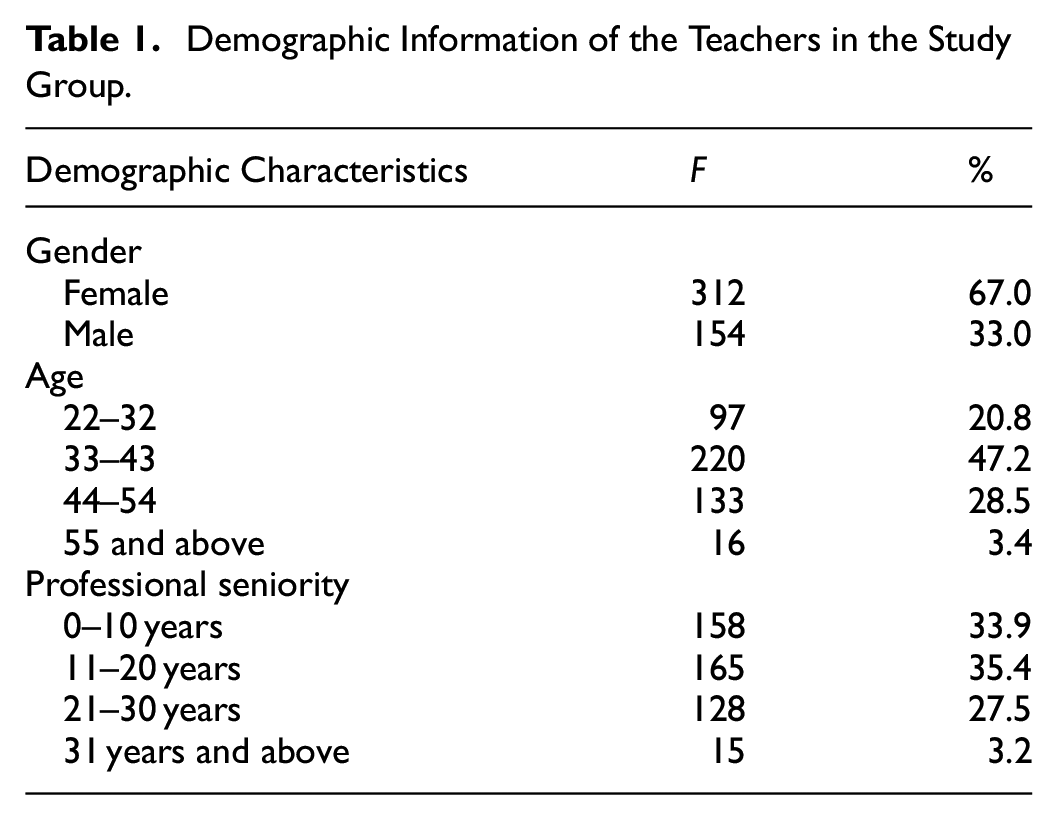
As seen in Table 1, there were 312 female teachers and 154 male teachers in the study group. When the age distribution of the teachers is analyzed, the number of teachers in the 33 to 43 age range is higher than the other age groups. Approximately 34% of the teachers have 0 to 10 years of seniority, 35% have 11 to 20 years, 27% have 21 to 30 years, and 3% have 31 years or more of seniority. The gender, professional seniority, and age distribution is considered to be representative of the teacher population in the context.
Data Collection Tools
In the study, “Scale for the Use of 21st-Century Teaching Skills,”“Curriculum Literacy Scale,” and “Teacher Self-Efficacy Perception Scale” were used to collect data.
Curriculum Literacy Scale (CLS)
The “Curriculum Literacy Scale” was developed by Akyıldız (2020). The scale consists of a total of 36 items and 4 sub-dimensions: curriculum objectives, curriculum content, learning-teaching process, and measurement and evaluation. This scale gives information about teachers’ competencies related to aims and objectives, curriculum content, the learning-teaching process, and measurement and evaluation. The curriculum objectives sub-dimension includes items such as “I can write objectives for all three learning domains (cognitive, affective, and kinesthetic)”; the curriculum content sub-dimension includes items such as “I can choose suitable content for the realization of the target”; the learning-teaching process sub-dimension includes items such as “I can design learning-teaching processes in accordance with the objectives” and the measurement and evaluation sub-dimension includes items such as “I can determine the level of target achievement.” The Cronbach Alpha reliability value of the whole scale was found to be .97, while the Cronbach Alpha reliability values of the sub-factors were found to be between .84 and .94: curriculum objectives sub-dimension with Cronbach Alpha reliability .84, curriculum content sub-dimension with Cronbach Alpha reliability .90, learning-teaching process sub-dimension with Cronbach Alpha reliability .94 and measurement and evaluation sub-dimension with Cronbach Alpha reliability .93. The scale has five-point Likert-type scoring. Within the scope of this study, the four-dimensional structure of the scale was examined by confirmatory factor analysis and this structure of the scale was confirmed (χ2 = 1534.679; SD = 577; p < .001; GFI = 0.85; AGFI = 0.82; CFI = 0.91; TLI = 0.90; PGFI = 0.73; PNFI = 0.79; RMSEA = 0.060 and SRMR = 0.042).
Teacher Self-Efficacy Perception Scale (TPEPS)
The “Teacher Self-Efficacy Perception Scale” developed by Tschannen-Moran and Hoy (2001) and adapted into Turkish by Çapa et al. (2005) consists of 24 items in total with sub-dimensions of self-efficacy for student engagement, self-efficacy for instructional strategies and self-efficacy for classroom management. The self-efficacy for instructional strategies sub-dimension includes items such as “To what extent can you use a variety of assessment strategies?;” the self-efficacy for classroom management sub-dimension includes items such as “How much can you do to control disruptive behavior in the classroom?;” the self-efficacy for student engagement sub-dimension includes items such as “How much can you do to get students to believe they can do well in schoolwork?.” The scale has nine-point Likert-type scoring. The Cronbach Alpha reliability of the whole scale was found to be .93; while the Cronbach Alpha reliability values of the sub-factors were found to be between .82 and .86: self-efficacy for student engagement sub-dimension with Cronbach Alpha reliability .82, self-efficacy for instructional strategies sub-dimension with Cronbach Alpha reliability .86, self-efficacy for classroom management sub-dimension with Cronbach Alpha reliability .84. Within the scope of this study, the three-dimensional structure of the scale was examined by confirmatory factor analysis and this structure of the scale was confirmed (χ2 = 823.552; SD = 242; p < .001; GFI = 0.87; AGFI = 0.83; CFI = 0.90; TLI = 0.88; PGFI = 0.70; PNFI = 0.77; RMSEA = 0.072 and SRMR = 0.052).
Twenty-First Century Teacher Skills Utilization Scale (21CTSUS)
The “21st Century Teacher Skills Utilization Scale” developed by Orhan Göksün (2016) consists of 5 sub-factors, namely affirming skills, managerial skills, productive skills, flexible teaching skills and technopedagogical skills, and a total of 27 items. The affirming skills sub-dimension includes items such as “I ensure that my students respect individual differences;” the managerial skills sub-dimension includes items such as “I create classroom rules together with my students;” the productive skills sub-dimension includes items such as “I prepare worksheets for my students;” the flexible teaching skills sub-dimension includes items such as “I organize educational activities outside the classroom” and the techno-pedagogical skills sub-dimension includes items such as “I share what I have learnt by using digital tools.” The Cronbach Alpha reliability of the whole scale was found to be .87; while the Cronbach Alpha reliability values of the sub-factors were found to be between .42 and .85: affirming skills sub-dimension with Cronbach Alpha reliability .42, managerial skills sub-dimension with Cronbach Alpha reliability .85, productive skills sub-dimension with Cronbach Alpha reliability .71, flexible teaching skills sub-dimension with Cronbach Alpha reliability .75, techno-pedagogical skills sub-dimension with Cronbach Alpha reliability .63. The affirming skills sub-dimension with Cronbach Alpha reliability .42 has three items and explained the 5.9% variance of the scale. The fact that the items form a meaningful and interpretable structure with each other and that this sub-dimension contributes more than 4% to the explained variance and high internal consistency coefficient of the whole scale can be accepted as proof of the acceptability of the structure. The 23rd item of the 21st-teacher skills utilization level scale is reverse scored. The scale has 5-point Likert-type scoring. Within the scope of this study, the five-dimensional structure of the scale was examined by confirmatory factor analysis and this structure of the scale was confirmed (χ2 = 934.951; SD = 302; p < .001; GFI = 0.85; AGFI = 0.82; CFI = 0.86; TLI = 0.84; PGFI = 0.68; PNFI = 0.70; RMSEA = 0.067 and SRMR = 0.067).
Data Collection Process
After the approval of Bolu Abant İzzet Baysal University Human Research Ethics Committee in Social Sciences (meeting 2022/07; dated 26.07.2022), additional legal permission was obtained from the provincial Ministry of National Education. Then, the scale link was sent to the administrators of the schools affiliated with the provincial national education directorate. Data were collected by school administrators forwarding the scale link having been prepared via Google Forms to the teachers working in their schools between 03.10.2022 and 30.11.2022.
Data Analysis
The primary objective of this study was to test the mediating role of curriculum literacy in the relationship between 21st-century teaching skills (independent variable) and teacher self-efficacy (dependent variable). Given that this research model involves complex, hypothesized relationships among latent variables (constructs that are not directly observed but are inferred from measured items), Structural Equation Modeling (SEM) was selected as the most appropriate analytical technique. Unlike traditional regression analyses, SEM allows for the simultaneous examination of both the measurement model (confirming that the latent variables are reliably and validly measured) and the structural model (testing the hypothesized relationships between these variables). Furthermore, SEM accounts for measurement error in the observed variables, thereby providing more accurate and unbiased estimates of the path coefficients (Kline, 2015). Therefore, SEM was deemed essential for a holistic and rigorous examination of the proposed mediation model. The data analysis was conducted in two main phases: (1) preliminary analysis and (2) structural equation modeling, using IBM SPSS Statistics v25 (IBM Corp. Released, 2017) for initial data screening and IBM SPSS Amos v24 (Arbuckle, 2016) for the main analysis. Statistical significance levels of 0.05 and 0.001 were accepted within the scope of the study.
Preliminary Analysis: Prior to the main analysis, the dataset was screened to ensure its suitability for SEM. This involved computing descriptive statistics (mean, standard deviation) for all variables. The assumption of multivariate normality was assessed by examining the skewness and kurtosis coefficients for each variable. Values within the ±1.5 range were considered indicative of no severe deviation from normality (Tabachnick & Fidell, 2013). Subsequently, a Pearson product-moment correlation analysis was performed to examine the direction and strength of the linear relationships among the latent variables. The results of these preliminary checks confirmed that the necessary assumptions for conducting SEM were met.
Structural Equation Modeling (SEM): The analysis followed the two-step approach recommended by Anderson and Gerbing (1988): Step 1: Measurement Model Assessment: First, a Confirmatory Factor Analysis (CFA) was conducted to establish the measurement model. The purpose of this step was to confirm that the observed items were valid and reliable indicators of their respective latent constructs (21st-Century Teaching Skills, Curriculum Literacy, and Teacher Self-Efficacy). The construct validity of the model, including its internal consistency, convergent validity, and discriminant validity, was thoroughly assessed. Step 2: Structural Model Testing: After confirming an acceptable fit for the measurement model, the structural model was tested to examine the hypothesized relationships. First, a direct effect model was tested to assess the direct path from 21st-century teaching skills to teacher self-efficacy without the mediator. Following this, the full mediation model, including curriculum literacy as a mediator, was specified and tested. To determine the statistical significance of the indirect effect, the bootstrapping method with 5,000 resamples was employed. The indirect effect is considered statistically significant if the 95% bias-corrected confidence interval (CI) does not contain zero (Preacher & Hayes, 2008).
Chi-square test results and goodness of fit indices were used to examine the appropriateness of the SEM models both in the confirmatory factor analysis of the measurement instruments and in the mediation relationship established. These indices are the Goodness of Fit Index (GFI), the Adjusted Goodness of Fit Index (AGFI), the Comparative Fit Index (CFI), the Tucker-Lewis Index (TLI), the Parsimonious Normed Fit Index (PNFI), the Parsimonious Goodness of Fit Index (PGFI), the Root Mean Square Error of Approximation (RMSEA) and the Standardized Root Mean Square Residual (SRMR).
In order to evaluate the degree of fit of the obtained fit indices to the model, various cut-off scores are presented. Accordingly, GFI, CFI and TLI values of 0.95 and above are considered as a good fit and values of 0.90 and above are considered as an acceptable fit (Schermelleh-Engel et al., 2003). For AGFI, a value of 0.90 and above indicates a good fit and 0.85 indicates an acceptable fit (Schermelleh-Engel et al., 2003). In addition to these, there are studies in which 0.85 for GFI and 0.80 for AGFI are taken as acceptable (H. W. Marsh et al., 1988). For PNFI and PGFI, a value of 95 and above is interpreted as a good fit, while values of 0.50 and above are interpreted as an acceptable fit (Meyers et al., 2006). Finally, similarly, for RMSEA and SRMR values, values less than 0.05 indicate a good fit, while values less than 0.08 indicate an acceptable fit (Byrne, 2013). However, RMSEA values between 0.80 and 0.10 indicate mediocre/average/moderate/borderline fit (Schumacker & Lomax, 2016).
While constructing the models within the scope of the study, the factor scores determined by confirmatory factor analysis of each scale were taken as observed variables, while the constructs that they measure were taken as latent variables. In order to provide the validity of the model established in the study, the bootstrap technique, which is a resampling technique, was used. This technique is a statistical method that allows the indirect effect to be examined by selecting different samples from the data of the study (Preacher & Hayes, 2008). In the bootstrap technique, the lower and upper 95% confidence interval values were calculated with 5,000 resamples. The fact that the lower and upper limits of the confidence interval do not contain zero values supports the existence of an indirect effect and shows that it is significant (Shrout & Bolger, 2002).
To establish the construct validity of the measurement model, its internal consistency, convergent validity, and discriminant validity were assessed. Internal consistency was evaluated using Cronbach’s Alpha (α). Convergent validity, the degree to which items of a specific construct converge, was evaluated using Composite Reliability (CR) and Average Variance Extracted (AVE). For adequate reliability and convergent validity, Cronbach’s Alpha and CR values should exceed .70, and AVE values should be above .50 (Hair et al., 2017). Discriminant validity, which ensures that a construct is distinct from other constructs, was assessed using the Fornell and Larcker (1981) criterion. According to this criterion, the square root of the AVE for each construct should be greater than its correlation with any other construct. The results are shown in Table 2.
Construct Reliability, Validity, and Correlation Matrix.

Note. α = Cronbach’s Alpha; CR = composite reliability; AVE = average variance extracted.
Diagonal elements in bold parentheses are the square roots of the AVE values.
p < .001.
The results, presented in Table 2, confirm that all criteria for reliability and validity were met.
However, the factor loadings for CLS were determined to be between 0.636 and 0.831, for TPEPS between 0.601 and 0.848, and for 21CTSUS between 0.486 and 0.897. In addition, the combined reliability composite (CR) of the model was 0.94, and the average variance value (AVE) was 0.54. These values indicate that internal consistency reliability and convergent validity were achieved (Appendix 1).
Findings
The data collection tools used in the study are founded on a theoretical basis and limited by resources. In this context, the study is limited to the data obtained from the data collection scales, and the statistical analyses used limited to the findings obtained.
Firstly, descriptive statistics including arithmetic mean, standard deviation, skewness, and kurtosis coefficients and correlation values between the variables for the 21st-century teacher skills, curriculum literacy, and teacher self-efficacy variables are given in Table 3.
Descriptive Statistics.

p < .001.
When the arithmetic mean values in Table 3 were examined, it was seen that 21st-century teacher skills were 176.74 (S.S. = 17.65), curriculum literacy was 149.74 (S.S. = 14.45) and teacher self-efficacy was 106.94 (S.S. = 10.87). The skewness values for these variables were calculated as −0.57, −0.17, and −0.32, and kurtosis values as 0.27, 0.45, and 0.39, respectively. When these values were analyzed and the histogram graphs of the relevant variables were examined, it was determined that the normality assumption within the assumptions of SEM analysis was met. When the relationships between the variables were examined, there was a positive, moderate (<0.30) and statistically significant (r = .569 and r = .509) relationship between 21st-century teacher skills and curriculum literacy and teacher self-efficacy; similarly, a positive, moderate (<0.30) and statistically significant (r = .513) relationship between curriculum literacy and teacher self-efficacy was found.
Within the scope of SEM analysis, a measurement model was established in the first step. In this model, there are five observed variables (managerial skills, techno-pedagogical skills, affirming skills, flexible teaching skills and productive skills) that define the latent variable of 21st-century teacher skills, four observed variables (curriculum objectives, curriculum content, learning-teaching process, and assessment and evaluation) that define the latent variable of curriculum literacy, and three observed variables (self-efficacy for student engagement, self-efficacy for instructional strategies, and self-efficacy for classroom management) that define the latent variable of teacher self-efficacy. The fit indices of the model were calculated as χ2 = 185.158; SD = 51; p < .001; GFI = 0.94; AGFI = 0.91; CFI = 0.96; TLI = 0.95; PGFI = 0.61; PNFI = 0.73; RMSEA = 0.075 and SRMR = 0.048. Considering the fit indices, it is seen that the model has excellent and acceptable fit values. In the measurement model, the standardized path coefficients between the observed variables and the latent variables in the model were between 0.58 and 0.91 for the 21st-century teacher skills latent variable, between 0.77 and 0.91 for the curriculum literacy latent variable, and between 0.53 and 0.77 for the teacher self-efficacy latent variable, all of which were statistically significant. Considering the fit indices and related path coefficient explanations, it was determined that the model had appropriate conditions for the establishment of the structural model.
Before the structural model, it was tested whether there was no mediator variable, that is, whether 21st-century teacher skills directly predicted teacher self-efficacy. The fit indices for this model were calculated as χ2 = 89.253; SD = 17; p < .001; GFI = 0.95; AGFI = 0.90; CFI = 0.96; TLI = 0.94; PGFI = 0.45; PNFI = 0.58; RMSEA = 0.096 and SRMR = 0.045. Considering the fit indices, it is seen that the model has excellent and acceptable fit values. According to the results, 21st-century teacher skills directly and statistically significantly predicted curriculum literacy (B = 2.54, 95% CI [1.99, 3.22], β = .57, p < .001, R2 = .32).
Within the scope of the structural model, the mediation of curriculum literacy was examined, and the fit indices for this model were calculated as χ2 = 85.158; SD = 51; p < .001; GFI = 0.94; AGFI = 0.91; CFI = 0.96; TLI = 0.95; PGFI = 0.61; PNFI = 0.73; RMSEA = 0.075 and SRMR = 0.048. Considering the fit indices, it is seen that the model has excellent and acceptable fit values. Accordingly, the mediating model of curriculum literacy between 21st-century teacher skills and teacher self-efficacy was accepted, and the structural model of the model is presented in Figure 1.

Mediating model of curriculum literacy between 21st-century teacher skills and teacher self-efficacy.
The statistics obtained as a result of analyzing the direct and indirect relationships related to the mediator model and their predictive status with the bootstrap method are presented in Table 4.
Direct and Indirect Effects Between 21st-Century Teacher Skills and Teacher Self-Efficacy Mediated by Curriculum Literacy (Bootstrap).

p < .001.
As can be seen in Table 4, there are path coefficients and confidence intervals indicating the confidence intervals of direct and indirect relationships related to the model. According to the results, 21st-century teacher skills directly and statistically significantly predicted curriculum literacy (B = 2.54, 95% CI [1.99, 3.22], β = .57, p < .001, R2 = 0.32.2). Curriculum literacy directly and statistically significantly predicted teacher self-efficacy (B = 0.72, 95% CI [0.59, 0.85], β = .47, p < .001). When the indirect effect was examined within the scope of the model, it was seen that 21st-century teacher skills indirectly and statistically significantly predicted teacher self-efficacy mediated by curriculum literacy (B = 1.82, 95% CI [1.35, 2.43], β = .27, p < .001). As a result of the bootstrap analysis, when the unstandardized path coefficient does not contain the value 0, that is, it is not in the lower and upper 95% confidence interval, it can be said that the mediation of curriculum literacy in the tested model is provided.
Discussion
In the study, it was found that curriculum literacy has a mediating role between teachers’ 21st-century teacher skills and teacher self-efficacy. This result can be interpreted to mean being curriculum literate affects teachers’ having 21st-century teacher skills and teacher self-efficacy. It can be thought that teachers’ being curriculum literate contributes to the effective implementation of the curriculum in the learning-teaching process. Thus, students can acquire the features targeted in the program. Programs should be developed in line with the needs of the age. In this context, the importance of including 21st-century skills in the national curriculum (MEB, 2011, 2017) and international education studies (P21, 2010) and reflecting these skills to the learning-teaching process with the implementation of curricula is increasing day by day. In studies on the suitability of curricula for 21st-century skills (Bektaş et al., 2019; Belet Boyaci & Güner Özer, 2019; Çetin & Çetin, 2021; Kalemkuş, 2021; Kurudayioğlu & Soysal, 2019; Voogt & Roblin, 2012; Yorulmaz et al., 2021), it was argued that these skills should be adequately included in the curriculum. With the inclusion of 21st-century skills in the curriculum, it is vital for teachers to have 21st-century teacher skills, to perceive themselves as competent in the teaching profession, and to be curriculum literate, which is the mediator of these characteristics, during the implementation process of the curriculum. Based on the results of the study, it can be argued that there is a connection between teachers’ 21st-century teaching skills and teacher self-efficacy and that this connection is realized through curriculum literacy. This may suggest that teachers’ development of 21st-century skills such as contemporary teaching methods, technology use, and student-centered teaching may positively affect their general sense of self-efficacy. These connections are strengthened through curriculum literacy. It is important that teachers, who are responsible for the effective implementation of curricula embrace their role, accept the principles on which the curriculum is based, and become curriculum literate. In addition, teachers need to have many skills and competencies in implementing the program (MEB, 2017). It can be said that these skills and competencies, which constitute the sub-dimensions of the scales applied within the scope of this research, affect each other. Teachers who have managerial skills can be more effective in classroom management. Good classroom management can positively affect student behavior and increase student engagement. Classroom management self-efficacy may include the ability to attract students’ attention, intervene effectively in discipline problems, and positively influence the classroom atmosphere. Teachers who have techno-pedagogical skills can teach students more effectively by using technology effectively. These skills may be linked to the ability to use various teaching strategies. Self-efficacy in teaching strategies may include the ability to take into account various learning styles and student needs while teaching. Teachers with assertive skills can effectively motivate and guide students to learn. Self-efficacy for student engagement may include the ability to engage students, use interactive teaching methods, and provide students with an understanding of learning objectives. Teachers with flexible teaching skills can teach students in accordance with different learning styles and speeds. This flexibility can be associated with the ability to successfully implement various teaching strategies. Teachers with generative skills can create an effective learning environment in the classroom and manage resources effectively. Classroom management self-efficacy may include the ability to encourage interaction in the classroom, form student groups, and provide effective feedback to students. These characteristics come to the forefront in teachers who use the curriculum as a road map of what to do and how to do it in order to meet the objectives in the curriculum, to process the content, to implement the learning-teaching process, and to apply measurement-evaluation methods. In this process, it is shown that teachers’ ability to understand, evaluate and effectively implement curricula can play an important role in the relationship between 21st-century skills and self-efficacy. In this context, it can be suggested to carry out activities relating to curriculum literacy in in-service practices during the professional development process of teachers. In addition, workshops where teachers actively participate in curriculum development studies can be organized.
According to another result, there is a positive, moderate, significant relationship between teachers’ 21st-century teacher skills, curriculum literacy, and teacher self-efficacy. In addition, teachers’ 21st-century teacher skills predict teacher self-efficacy and curriculum literacy, and curriculum literacy predicts teacher self-efficacy. In the context of these results, it can be said that teachers’ having 21st-century teacher skills contributes positively to their teacher self-efficacy and curriculum literacy. Similar to these results, Kuloğlu (2022) concluded that pre-service teachers’ 21st-century learner skills predicted their curriculum literacy levels. Davis (2018) also concluded that the higher the self-efficacy of teachers based on teacher perceptions, the more effective they are in teaching 21st-century skills. In addition, Kozikoğlu and Özcanlı (2020) pointed out that there was a significant, positive, and moderate relationship between teachers’ level of commitment to the profession and 21st-century teacher skills. In this context, teachers should be supported to gain the necessary competencies in 21st-century teacher skills, curriculum literacy, and teacher self-efficacy in order to provide students with 21st-century skills in the education process. It is evident that teachers need to continuously improve themselves in order to educate their students according to the requirements of the age. In the studies conducted, increasing the awareness of 21st-century pedagogy in teachers (Bernhardt, 2015; Bunker, 2012), teachers developing activities suitable for 21st-century skills (Bernhardt, 2015; Cansoy, 2018; Garba et al., 2015; Kereluik et al., 2013) and pre-service teachers gaining the competencies to transfer their pedagogical knowledge to practice to reflect 21st-century skills in their teaching plans and in-class practices (Val. century skills to their teaching plans and in-class practices (Valli et al., 2014) were emphasized. Therefore, it can be said that teachers who have teacher self-efficacy and are curriculum literate have an advantage. In the current study, it was concluded that teachers’ curriculum literacy predicted teacher self-efficacy. In line with this result, Ünal and Kırkıç (2022) determined a significant positive relationship between teacher self-efficacy beliefs and teachers’ curriculum literacy and that teachers’ self-efficacy beliefs significantly predicted teachers’ curriculum literacy level. In Güleş’s (2022) study, it was determined that there was a moderate positive and significant relationship between the sub-dimensions of curriculum literacy competence and commitment to the curriculum. In addition, in Keskin’s (2020) study, it was determined that teachers’ perceptions of curriculum literacy changed positively in line with the importance they attach to the curriculum. In the same study, it was also stated that teachers considered curriculum literacy as a professional competence. In the study conducted by Kale (2022), it was found that there was a strong positive relationship between teachers’ perceptions of professional identity and curriculum literacy levels. In Dilek’s (2020) study, it was determined that there was a significant positive relationship between pre-service teachers’ curriculum literacy levels and their pedagogical knowledge and skills levels. In this context, teachers who think that they are competent in curriculum literacy also have teacher self-efficacy perceptions. These perceptions of teachers can support the effective implementation of curricula. According to Nieveen and Plomp (2018), 21st-century skills can be acquired by students through the effective implementation of curricula. The research results emphasize the importance of educational systems and schools focusing on educational reforms to strengthen teachers’ 21st-century skills. Moreover, it can be suggested that curriculum literacy should be included in professional development programs to increase teachers’ self-efficacy.
In Türkiye, given the centralized structure of education policies and socio-economic differences, factors such as equality in education, gender, cultural diversity, digitalization, and social change (Akyüz, 2019) may impact teachers’ development of curriculum literacy and 21st-century skills and their self-efficacy perceptions. The infrastructure, support, and opportunities for teachers to develop curriculum literacy may not be equal in every region. In this process, the mediating role of curriculum literacy between teacher self-efficacy and 21st-century teaching skills should be considered as an issue that affects not only individual teachers’ acquisition of these skills in their professional development processes but also the overall structures of the education system. In this context, it can be argued that reform and improvement processes in education should be shaped in a more inclusive, sensitive to local needs, and sustainable manner.
Curriculum literacy can enable teachers to manage the learning-teaching process more efficiently, use 21st-century teaching skills effectively, and overcome the difficulties they face in their teaching processes. In this context, the mediating effect of curriculum literacy on teachers’ developing 21st-century teaching skills and increasing their self-efficacy can be an essential part of teachers’ professional development.
Conclusion
The results of this study highlight the importance of focusing on curriculum literacy to strengthen teachers’ professional development and training programs. In particular, the competencies that teachers, who are the implementers of the curriculum, should have in the 21st century have come to the forefront with their competencies in teaching approaches and designs and information and communication technologies literacy (Dağhan et al., 2017). Moreover, the creation of learning environments in accordance with 21st-century standards, implementation of 21st-century curricula, and provision of 21st-century professional development have started to take place in education systems in different countries (Gelen, 2017). Finally, in the context of this research, curriculum literacy can be considered a key competency in the acquisition of 21st-century teacher skills and the formation of teacher self-efficacy perceptions
Limitations and Suggestions for Future Research
One of the limitations of the study is that the research was conducted only with teachers working in schools in a medium-sized province in the Western Black Sea Region in Türkiye. It may be possible to reach more general results with studies conducted with teachers working in different regions and different schools. Türkiye consists of seven different geographical regions, and further research can be conducted in the other six regions as well, comparing regional differences and discussing the causes and consequences of these differences. Examples can also be taken from cities, towns, and rural settlements. The current study was conducted on teachers working at primary, secondary, and high schools at the Ministry of National Education in the central district of the province. Similar studies can be conducted at different levels of the education system, especially with teachers working in preschool, higher education, and special education institutions, and the differences and similarities between these variables can be examined. In future studies, new models can be developed using the variables of teachers’ demographic and professional characteristics. Additionally, this study employed a cross-sectional design, which restricts the ability to infer causal relationships among variables. Longitudinal or experimental studies are recommended to better understand the directionality and long-term effects of these relationships. In addition, studies revealing the connection of curriculum literacy with different variables can also be conducted. For example, the relationships between curriculum literacy and concepts such as using instructional strategies, designing and developing instructional materials, integrating digital tools into the learning-teaching process, and encouraging student engagement and motivation can be examined.
In the present study, the mediation role was examined by using structural equation modeling within the structure developed for the concepts investigated. In future studies, reapplication of the same model in different samples may contribute to a deeper understanding of the relationships between variables. Additionally, more in-depth analyses can be performed by using qualitative and quantitative data together. Teachers’ practices and perceptions in greater depth through interviews or focus group studies can be examined. Furthermore, by studying the teacher group over multiple periods, it is possible to track the development processes of their curriculum literacy levels, 21st century teaching skills, and teacher self-efficacy levels. In this context, it can be said that more research is needed on the design/development/implementation/evaluation of programs for the acquisition of 21st-century skills in the education process and the competencies that need to be developed in teachers in this process.
Footnotes
Appendix 1

Ethical Considerations
Bolu Abant Izzet Baysal University Human Research Ethics Committee in Social Sciences (meeting 2022/07; dated 26.07.2022).
Author Contributions
The authors contributed equally to the study.
Funding
The author(s) received no financial support for the research, authorship, and/or publication of this article.
Declaration of Conflicting Interests
The author(s) declared no potential conflicts of interest with respect to the research, authorship, and/or publication of this article.
Data Availability Statement
If you’d like to, the data can be e-mailed to the editor by the corresponding author.