




Abstract
The study used a correlational design based on a cause-and-effect relationship among philosophy of education dispositions, critical reading self-efficacy perceptions, and curriculum literacy perceptions. Five theoretical models were proposed in light of the theories and research explaining the relationships between the variables. In addition, structural equation modeling was established to determine whether a significant difference existed between the mediator variable critical reading self-efficacy perception, predictor variable, and outcome variable. SPSS PROCESS macro, Model 4 (Version 4.1; Hayes, 2022) was used for mediation analysis. The study was conducted with 158 prospective Turkish language teachers determined by the non-probability cluster sampling method in Turkey in the fall semester of the 2023 to 2024 academic year. Path analysis was performed to determine the significance of the hypotheses. The results indicated that prospective teachers’ philosophy of education dispositions and curriculum literacy perceptions affect each other positively, and critical reading self-efficacy perceptions and curriculum literacy perceptions affect each other positively. It was concluded that critical reading self-efficacy perception had a high mediating role in the effect of philosophy of education dispositions on curriculum literacy.
Keywords
Introduction
Prospective teachers’ critical reading self-efficacy perceptions, reading the curriculum critically with a meaningful awareness, and having a philosophy of education are essential in becoming qualified Turkish language teachers. Curriculum literacy includes components such as curriculum knowledge, understanding and evaluating the types, components (in the context of technical and non-technical curriculum development models), structure and process of curriculum and curriculum development, and the theoretical (social, philosophical, psychological, economic, etc.), and philosophical foundations of curriculum. It is also the process of knowing different types of curriculum and curriculum development models with all dimensions, interpreting them, analyzing them with a critical eye, adapting the curriculum types according to the context, synthesizing different contexts related to the curriculum, developing a critical and analytical perspective on curriculum types and curriculum development process, and making practical evaluations. In this process, curriculum literacy can also be considered the ability and competencies to develop creative solution proposals and create different and functional interpretations for the implementation. Therefore, curriculum literacy, which is a dynamic process, requires the use of higher-order thinking processes and skills. It is also essential to consider that attitude, knowledge (philosophy of the curriculum or programs, theoretical structure, and concepts, etc.), and skills (skills of planning, preparing, implementing, guiding, monitoring, evaluating, and managing the curriculum) are used in tandem and in a flexible, interactive way in the curriculum literacy process.
Prospective Turkish language teachers receive nearly 70 courses during their eight-semester undergraduate education. The Council of Higher Education classifies these courses as professional knowledge, general knowledge, and field knowledge. Of these courses, 33% are professional knowledge courses, 18% are general knowledge courses, and 49% are field knowledge courses (Council of Higher Education, 2018). These ratios are more or less the same in all universities across Turkey. The Turkish language program could include elective or compulsory courses under the titles of philosophy of education, critical reading, and curriculum literacy, or other courses may consist of philosophy of education, critical reading, and curriculum literacy in their content, which is in line with the fundamental characteristics of the teaching profession.
Success in the teaching profession requires initially understanding the basic education philosophy behind the system (Baker, 2023). Achieving success in education may not be possible with teachers who do not have background knowledge of the philosophy of education. Therefore, a good command of the philosophical approaches of teachers, as the implementers of the curriculum, is vital for the applicability of the curriculum. Prospective teachers’ possession of critical reading skills and philosophy of education is essential in understanding, criticizing, and implementing the curriculum. Curriculum literacy is another concept that teachers and prospective teachers need to master to evaluate the curriculum more comprehensively. Curriculum literacy is an essential teacher competency and a broad concept that includes critical literacy and educational philosophies.
Philosophy of Education Dispositions
Philosophy is a fundamental element that determines our perspective on life. Philosophy is the art of asking questions and questioning life, and the perspectives of learners who have developed themselves in this questioning could be more critical. In addition to epistemology (What is knowledge? What is its source? What are the ways of accessing knowledge? Is knowledge absolute or relative? etc.), ontology (what is existence? etc.), and axiology (what is value, what is absolute? etc.), philosophy is the art of being on a path that deals with everything human beings are interested in. In this art, the philosophy of education is seen as the intersection of education and philosophy (Gutek, 2006). According to the types of philosophy of education and the contextual situations addressed, it can create new hypotheses to be used in learning and teaching processes. Hence, progressive developments in more specialized educational research in the fields of education history, education psychology, and education sociology in the 20th century also emphasized the importance of philosophically investigating the foundations of morality, the nature and foundations of knowledge, and the nature of human beings for education purposes and practices (Hirst, 1998; cited in Singal, 2021). Today, this importance continues to be renewed and developed. Philosophy of education is a way of researcher existence that deepens and broadens our understanding of the richness and complexity of human life (Roberts, 2016), which is a continuum. As Hand (2014) put it, the questions that the philosophy of education aims to answer are important in a future where the philosophy of education is practitioner-oriented. If these questions are recognized by teachers and engage the stakeholders of learning processes in higher-order thinking, they are considered practitioner-oriented. In addition, we may encounter a variety of resources to benefit from when we consider the philosophy of education both as an academic subject and a way of life. Utilizing this diversity of resources in teacher training programs could provide different perspectives to practitioner teachers and students. Therefore, arrangements to make the philosophy of education functional in teacher training programs are critical in training qualified teachers. In this regard, the role of the philosophy of education should include looking into the future and giving birth to the world of the future, which requires being open to questioning its priorities and questions as well as critical thinking.
Curriculum Literacy of Education
Curriculum literacy is a dynamic and flexible process where the elements within the curriculum interact. In this regard, the concept of curriculum literacy was put forward after the idea of curriculum knowledge was seen as incomplete (Ariav, 1988), and it is the process of synthesizing different contexts related to curriculum, developing a critical and analytical perspective on curriculum types and curriculum development process, and making practical evaluations. This concept is generally defined as “having the necessary knowledge and skills to understand, implement and evaluate curriculum, teachers’ understanding and perception of curriculum, their attitudes towards curriculum, and their skills and competencies in the implementation of the curriculum” (General Directorate of Secondary Education, 2022, p. 5). Achievements of the goals in the curriculum depend on teachers’ curriculum literacy competencies (Ariav, 1988; General Directorate of Secondary Education, 2022). In such a process, curriculum literacy is considered an essential type acquired by teachers and prospective teachers. Curriculum literacy is a crucial competence that should be acquired before starting the teaching profession. Porter’s (1994) Policy Attributes Theory is essential in curriculum literacy. The theory provides a specificity, consistency, authority, power, and stability framework that influences policy implementation. Specificity refers to the degree to which the expectation of commitment to curriculum literacy is precise and detailed; consistency refers to the alignment of curriculum literacy adoption and implementation; authority refers to the involvement of stakeholders in decision-making about curriculum literacy adoption; and power refers to the use by educational leaders (e.g., principals, curriculum specialists) of sanctions and rewards associated with compliance with the implementation of adopted curriculum literacy. Stability is related to the extent to which the adopted curriculum literacy remains stable over time. In such a process, the prominent concepts within curriculum literacy include curriculum knowledge, curriculum awareness, curriculum fidelity, curriculum implementation, and teachers’ curriculum competency. Ariav (1988) defined the initial level of curriculum literacy as selecting appropriate materials for a subject, adapting them to the learning environment, and evaluating it, and stated that curriculum literacy had a broader scope than curriculum knowledge. Having a good command of the curriculum development process and having an awareness of the variables affecting the curriculum development process are also included in the scope of advanced curriculum literacy. Therefore, curriculum literacy is a structure associated with teachers’ roles and tasks related to all curriculum dimensions, processes, elements, and contexts.
Critical Reading Self-Efficacy
Critical reading involves high-order thinking and includes different critical reading strategies and skills (Wallace, 2010). Critical reading is a structure that involves questioning, analysis, and evaluation. In this flexible process, a critical reader evaluates the text with all its dimensions, questions the validity and reliability of the arguments and information by researching different sources, makes inferences, and analyses and evaluates the author’s point of view. Tomasek (2009) argues that critical reading is more than processing information from assigned readings; critical reading and writing is a construct that involves synthesizing and responding to the big ideas present in a selected reading. Tomasek (2009) posits that critical reading transcends the mere processing of information from assigned texts, proposing that it is a multifaceted construct entailing the synthesis and response to the central ideas within a given reading. She identifies six categories of reading and writing that facilitate learners’ engagement with texts critically: the identification of a problem or issue, the establishment of connections, the interpretation of evidence, the challenge of assumptions, the application of ideas, and the adoption of alternative perspectives. By responding to prompts within these categories, learners are encouraged to expand, clarify, or modify their understanding of topics through an interactive exploration of and engagement with the text (Tomasek, 2009). Within this framework, prospective teachers who have developed a strong sense of self-efficacy can effectively reflect this in their curriculum literacy.
Model and Hypotheses
Philosophy of Education Dispositions and Its Relationship With Curriculum Literacy Perception
The conceptual framework of this study is based on research conducted in the last three decades (Alsubaie, 2016; Becker, 2009; Dewey, 2012; Gutek, 2006; Hanushek, 2011; Love, 2010; Poulson et al., 2001; Tesar et al., 2021). Teachers’ internalization of educational philosophies and curriculum literacy are essential for enhancing their professional competencies and qualifications. Hence, the human capital theory discussed by Becker (2009) and Hanushek (2011) indicates that increasing the quality of the teacher contributes to the increase of learning outcomes in dimensions such as critical reading, philosophy of education, and curriculum literacy. Such a process is considered to improve students’ social and economic conditions. Alsubaie (2016) emphasizes that teachers are the most critical component of the learning and teaching process regarding curriculum implementation. Therefore, teachers’ educational philosophy dispositions can directly affect their curriculum literacy as practitioners. From an epistemological point of view, it is assumed that knowledge is not fixed and stable; it could change according to the context or situation where individuals create knowledge themselves (Dewey, 2012; Gutek, 2006). In this regard, teachers who view knowledge from a changing framework and read the curriculum in the context of this development could be more effective. Hence, the first (H1) and second (H2) hypotheses of the study were formed as follows:
Critical Reading Self-Efficacy Perception and Its Relationship With Curriculum Literacy Perception
The conceptual framework of critical reading is essential to the higher-order thinking process. Prospective teachers who have formed a positive self-efficacy perception in identifying the problem, making connections, interpreting evidence, challenging assumptions, making applications, and taking a different perspective in critical reading are believed to be able to read the curriculum in all its dimensions. Hence, the literature includes studies that examined the relationship between critical reading and curriculum literacy (Blixen & Pannell, 2020; Farrar & Stone, 2019; Freire, 2020; Thomas & Dyches, 2019). Vasquez et al. (2019) define critical literacy as a “way of being and doing” that supports social justice and equity issues, and the continuity feeds into curriculum literacy. Based on Freire’s (2020) critical pedagogy principles, critical literacy is a theory that has implications for practice. Mature epistemological beliefs and a progressive and reconstructivist philosophy of education nurture the critical consciousness involved in this process. In Freire’s (2020) words, education is political; learners with a critical reading self-efficacy perception can read the curriculum better. In this regard, the perception of self-efficacy formed for critical reading supports curriculum literacy in practice by feeding on the contemporary approaches of educational philosophy. Critical literacy and a positive self-efficacy perception could be considered part of teachers’ intellectual development and activities within curriculum literacy. In this process, prospective teachers can understand and apply the elements of curriculum literacy, and more importantly, they can think critically and contribute to the development of the curriculum.
In this context, the third (H3) and fourth (H4) hypotheses of the study were formed as follows:
Critical Reading Self-Efficacy Perception as a Mediating Variable
Higher-order thinking processes and skills are essential in this age. Prospective teachers’ development of critical reading and positive self-efficacy perceptions may contribute to the guided learning support they will provide their students. They may also have a positive impact on reading the curriculum more effectively. An analysis of the literature indicates no studies that deal with critical reading self-efficacy perception as a mediating variable between the philosophy of education dispositions and curriculum literacy, which makes the study valuable in terms of its contribution to the field. In this regard, critical reading self-efficacy perception may mediate between philosophy of education dispositions and curriculum literacy perception. Hence, the fifth hypothesis of the study was formed as follows.
Current Study
Prospective Turkish language teachers’ philosophy of education dispositions is considered to affect their critical reading self-efficacy perceptions, and their critical reading self-efficacy perceptions are thought to affect their curriculum literacy. A literature review indicated no studies that examined the relationships between philosophy of education dispositions, critical reading self-efficacy perceptions, and curriculum literacy perceptions as a bivariate variable in tandem and that evaluated critical reading self-efficacy perception as a mediating variable. This study explained the relationship between the philosophy of education dispositions, critical reading self-efficacy perception, and curriculum literacy in light of the related literature. Five theoretical models were proposed in light of the theories and research explaining the relationships between the variables. The proposed models are shown in Models 1, 2, 3, 4, and 5.
In Model 1, while the predicted variable philosophy of education dispositions is represented by the symbol (X1), curriculum literacy perception is represented by the symbol (Y1). In Model 2, while the predicted variable curriculum literacy perception is represented by the symbol (X2), philosophy of education dispositions is represented by the symbol (Y2). In Model 3, while the predicted variable critical reading self-efficacy perception is represented by the symbol (X3), curriculum literacy perception is represented by the symbol (Y3). In Model 4, the predicted variable curriculum literacy perception is represented by the symbol (X4), and critical reading self-efficacy perception is represented by the symbol (Y4). In Model 5, the estimated variables are philosophy of education dispositions, represented by the symbol (X1), and curriculum literacy perception, represented by the symbol (Y1). Critical reading self-efficacy perception is the mediating variable indicated by the symbol M.
In this sense, this study investigated the hypotheses formulated to test the relationships between Prospective Turkish language teachers’ philosophy of education dispositions, critical reading self-efficacy perceptions, and curriculum literacy perceptions and whether critical reading self-efficacy perceptions mediate the relationship between philosophy of education dispositions and curriculum literacy perceptions.
The following sections of this study present the research method, findings, discussion, conclusions, recommendations, and limitations.
Method
Research Design and Participants
The study employed a correlational design to examine the potential cause-and-effect relationships among philosophy of education dispositions, critical reading self-efficacy perceptions, and curriculum literacy perceptions. This aligns with L. Cohen et al. (2007), emphasizing correlational research to explore associations between variables in educational studies.
The target population of the research consisted of third and fourth-year prospective Turkish language teachers enrolled in the Turkish Language Teaching departments of the Faculty of Education at two different universities in Turkey in the fall semester of the 2023 to 2024 academic year. The minimum sample size for a correlational study generally accepted by most researchers is 30 (Fraenkel & Wallen, 2012). The study participants were 158 prospective Turkish language teachers enrolled in the departments determined by the non-probability cluster sampling method. Non-probability cluster sampling is a cost-effective and practical method, mainly when the population is naturally divided into clusters, even though it does not allow for generalization to the entire population (Singh & Masuku, 2014). An analysis of the demographic distribution of the prospective teachers showed that 102 (64.6%) were female, 55 (34.8%) were male, one (0.06%) did not indicate gender, 89 (53.2%) were enrolled in the third year, and 74 (46.8%) were enrolled in the fourth year. When the teachers were asked to evaluate the level of importance of curriculum in their fields, one (0.6%) teacher stated it was not necessary at all, 7 (4.4%) noted a little critical, 80 (50.6%) stated it was required, and 70 (44.3%) stated very important. When the participants were asked to evaluate the level of importance of philosophy of education in the field, two (1.3%) teachers noted that it was not necessary at all, 33 (20.9%) stated that it was a little important, 90 (57%) stated important, and 33 (20.9%) stated very important.
Procedure
Ethical permissions were obtained for the study. After the participants were informed about the purpose of the study, necessary permissions were obtained from them. The researchers collected data from the study face-to-face over a semester using the Critical Reading Self-Efficacy Perception Scale, the Philosophy of Education Dispositions Scale, and the Curriculum Literacy Scale.
Data Collection Tools
Data were collected through the “Personal Information Form” to determine prospective teachers’ characteristics; the “Critical Reading Self-Efficacy Perception Scale” (CRSEPS) to decide on their critical reading self-efficacy perceptions; the “Philosophy of Education Dispositions Scale” (PEDS) to measure their philosophy of education dispositions; and the “Curriculum Literacy Scale” (CLS) to measure their curriculum literacy.
Personal Information Form
The researchers developed an 8-item Personal Information Form to describe the sample in terms of personal characteristics.
Critical Reading Self-Efficacy Perception Scale (CRSEPS)
The 41-item scale was developed by Karabay (2013) in a study conducted on 650 prospective teachers. The scale consists of three factors: evaluation, research-investigation, and visual. Cronbach’s alpha internal consistency coefficients were .69, .78, and .91, respectively. Cronbach’s alpha for the whole scale was reported as .91. Confirmatory factor analysis results showed that the χ2/SD ratio of the scale was 2.92, RMSEA value was less than 0.10, GFI was 0.66, AGFI was 0.63, SRMR was less than 0.08, NNFI is 0.92, and CFI was 0.93. The analyses performed on 127 normally distributed data within the scope of this study showed that Cronbach’s alpha internal consistency coefficients (n = 127) were .94 in total, .94 in the first factor, .78 in the second factor, and .83 in the third factor. Besides, confirmatory factor analysis conducted within the scope of the study (n = 127) showed that the fit index values (χ2 = 1,235,693, SD = 763, p = .000, CMIN = 1,235,693 CMIN/df = 1.620, RMSEA = 0.070, χ2/df = 1.620, CFI = 0.806, IFI = 0.811) were by the recommended criteria. Sample items from the scale are given below (Karabay, 2013):
I take into account the visuals used while evaluating the reading text.
After reading a text, I think about how this text could be written differently.
Philosophy of Education Dispositions Scale (PEDS)
The Philosophy of Education Dispositions scale is a 36-item scale developed by Aytaç and Uyangör (2020) with 535 prospective teachers enrolled in the Faculty of Education and Social Sciences Institute of a state university in the 2017 to 2018 academic year. Exploratory factor analysis indicated a 5-point Likert-type scale of 36 items and 4 dimensions. The total variance explained by the scale was found to be 45.01%. The scale dimensions included a Progressive Philosophy of Education Dispositions, a Reconstructionist Philosophy of Education Dispositions, an Essentialist Philosophy of Education Dispositions, and a Perennialist Philosophy of Education Dispositions. Cronbach’s alpha values were .83 for the total scale, .89 for the Progressive Philosophy of Education Dispositions sub-scale, .84 for the Reconstructionist Philosophy of Education Dispositions sub-scale, .82 for the Philosophy of Education Dispositions sub-scale, and .66 for the Perennialist Philosophy of Education Dispositions sub-scale.
Analyses performed on 127 normally distributed data within the scope of this study showed that Cronbach’s alpha internal consistency coefficients (n = 127) were .89 in the total scale, .86 in the first factor, .84 in the second factor, .82 in the third factor and .81 in the fourth factor. Besides, confirmatory factor analysis conducted within the scope of the study (n = 127) showed that the fit index values (χ2 = 876,481, SD = 577, p = .000, CMIN = 876,481 CMIN/df = 1.519, RMSEA = 0.064, χ2/df = 1.519, CFI = 0.839, IFI = 0.844, TLI = 0.825) were by the recommended criteria. Sample items from the scale are given below (Aytaç & Uyangör, 2020):
The aim of education should be to reshape society.
Students should be taught unchanging, universal values and knowledge.
Curriculum Literacy Scale (CLS)
The 68-item draft version of the scale developed by Keskin and Korkmaz (2021) was administered to 406 teachers working in public schools in primary, secondary, and high schools in six different districts in Ankara in the fall semester of the 2018 to 2019 education year. Exploratory Factor Analysis (EFA) was conducted. The analysis results indicated a four-dimensional structure of the scale. The CFA results of the scale confirmed the four-dimensional structure consisting of 38 items. These dimensions included (a) knowing the curriculum, (b) implementing the curriculum, (c) questioning the curriculum, and (d) valuing the curriculum. Cronbach’s alpha values of the scale were .89 for knowing the curriculum, .86 for implementing the curriculum, .74 for questioning the curriculum, .64 for valuing the curriculum, and .934 for the total. The CFA values of the scale explaining 59% of the total variance were RMSEA 0.060, SRMR 0.052, GFI 0.982, CFI 0.902, and NFI was 0.920. Analyses performed on 127 normally distributed data within the scope of this study showed that Cronbach’s alpha internal consistency coefficients (n = 127) were .91 in total, .85 in the first factor, .74 in the second factor, .65 in the third factor, and .70 in the fourth factor. In addition, confirmatory factor analysis conducted within the scope of the study (n = 127) showed that the fit index values (χ2 = 999.315, SD = 644, p = .000, CMIN = 999.315, CMIN/df = 1.552, RMSEA = 0.066, χ2/df = 1.552, CFI = 0.750, IFI = 0.760, TLI = 0.727) were by the recommended criteria. Sample items from the scale are given below (Keskin & Korkmaz, 2021):
I have read the entire curriculum I am going to implement.
I understand the educational philosophy on which the curriculum is based.
Model Fit Assumptions
The fit indices determined to evaluate the CFA results were as follows: Critical Reading Self-Efficacy Perception Scale (χ2 = 1,235,693, SD = 763, p = .000, CMIN = 1,235,693 CMIN/df = 1.620, RMSEA = 0.070, χ2/df = 1.620 value, CFI = 0.806, IFI = 0.811), Philosophy of Education Dispositions Scale (χ2 = 876,481, SD = 577, p = .000, CMIN = 876,481 CMIN/df = 1.519, RMSEA = 0.064, χ2/df = 1.519 value, CFI = 0.839, IFI = 0.844, TLI = 0.825), and Curriculum Literacy Scale (χ2 = 999,315, SD = 644, p = . 000, CMIN = 999,315, CMIN/df = 1.552, RMSEA = 0.066, χ2/df = 1.552 value, CFI = 0.750, IFI = 0.760, TLI = 0.727). The χ2 “p” Value, RMSEA, RMR, CMIN, and χ2/SD were found to be by the proposed criteria (Hooper et al., 2008; Schreiber et al., 2006; Tabachnick et al., 2013). Table 2 demonstrates the fit index values regarding the validity of the models proposed in the study. Table 2 shows that χ2 “p” value, RMSEA, RMR, CMIN, and χ2/SD values are by the recommended criteria proposed in three models (Hooper et al., 2008; Schreiber et al., 2006; Tabachnick et al., 2013). However, the models demonstrated weak fit in the GFI, AGFI, PGFI, RFI, CFI, IFI, and TLI fit index values.
Data Analysis
This study established structural equation modeling to test H1, H2, H3, and H4. In addition, H5 structural equation modeling was established to find out whether a significant difference existed between the mediator variable critical reading self-efficacy perception (M), predictor variable (X1), and outcome variable (Y1).
Before the data set was analyzed, analyses included missing data, univariate and multivariate normality, outliers, and multicollinearity values (Tabachnick et al., 2013). Analysis of the presence of any missing data in the data set showed that there was no missing data. Kurtosis and skewness coefficients were examined for univariate normality values. Hence, the distribution of the data collected from 158 prospective Turkish language teachers was found to be not normal. For this reason, the extreme values in the data set were removed, and a structure consisting of data from 127 prospective teachers was reached as a result of the removal of the extreme values from the data set by looking at the Mahalanobis values. For the 127 samples, kurtosis and skewness values were within normal values. Linearity was determined with the scatter diagrams of the variables.
Multicollinearity and singularity checks of the correlation matrix were also significant in many dimensions. Variance Inflation Factor (VIF), Tolerance (T), and Conditional Index (CI) values were examined for the analysis of the multicollinearity problem (Tabachnick et al., 2013). It was found that the VIF value was less than 10 (Myers, 1990), the T value was different from 0 (Menard, 1995), and the CI value was less than 30 (Paulson, 2007). When we look at the pairwise relationships of all variables, the binary correlations between the curriculum literacy perception and philosophy of education dispositions scores showed a significant relationship (p < .01). The pairwise correlations between philosophy of education dispositions scores and critical reading self-efficacy perception scores showed a significant relationship (p < .01). In addition, critical reading self-efficacy perception scores and curriculum literacy perception scores showed a significant relationship (p < .01).
Structural Equation Modeling (SEM)
SEM analysis is a multivariate regression model that reveals causal relationships between the investigated variables (Kline, 2016). SEM examines covariance between observed variables to make inferences about latent variables (Schreiber et al., 2006). SEM analysis makes examining different variables related to models with complex relationships possible. The model proposal was examined by applying path analysis to the data obtained from the study. SEM analysis made it possible to determine whether there was a significant cause-and-effect relationship between the variables of the models proposed from the hypotheses for the study.
Structural equation modeling was used in the proposed theoretical Model 1 to determine whether a significant difference existed between the predictor variable philosophy of education dispositions (X1) and curriculum literacy perception (Y1). In Model 2, structural equation modeling was used to determine whether a significant difference existed between the predictor variable curriculum literacy perception (X2) and philosophy of education dispositions (Y2). In Model 3, structural equation modeling was used to determine whether a significant difference existed between the predictor variable critical reading self-efficacy perception (X3) and curriculum literacy perception (Y3). In Model 4, structural equation modeling was used to determine whether a significant difference existed between the predictor variable curriculum literacy perception (X4) and critical reading self-efficacy perception (Y4). The variables estimated in Model 5 included philosophy of education dispositions indicated by the symbol (X5) and curriculum literacy perceptions indicated by the symbol (Y5). The dimension of critical reading self-efficacy perception is the mediating variable indicated by the symbol M.
The results obtained from the analysis were evaluated according to the model fit assumptions and various good fit indices. AMOS 24 was used for CFA and path analysis in H2, H3, H44 and SPSS PROCESS macro, Model 4 (Version 4.1; Hayes, 2022) was used for Hypotheses 1 and 5, in which critical reading self-efficacy perception was the mediating variable (M). In addition, the bootstrapping method (Bollen & Stine, 1990) was used to perform the mediation analysis. Statistical significance was determined at the 5% level with a 95% confidence interval (J. F. Cohen et al., 2016).
Findings
The study’s findings are presented as follows: Initially, the descriptive statistical values between the variables that formed the hypothesis of the relationship research were explained (see Table 1). This was followed by the findings showing whether the hypotheses in the research model were accepted or rejected (see Table 2).
Pairwise Correlations Between the Total Dimensions of the Variables Analyzed.

Correlation is significant at the .01 level (two-tailed).
Path Analysis Results.
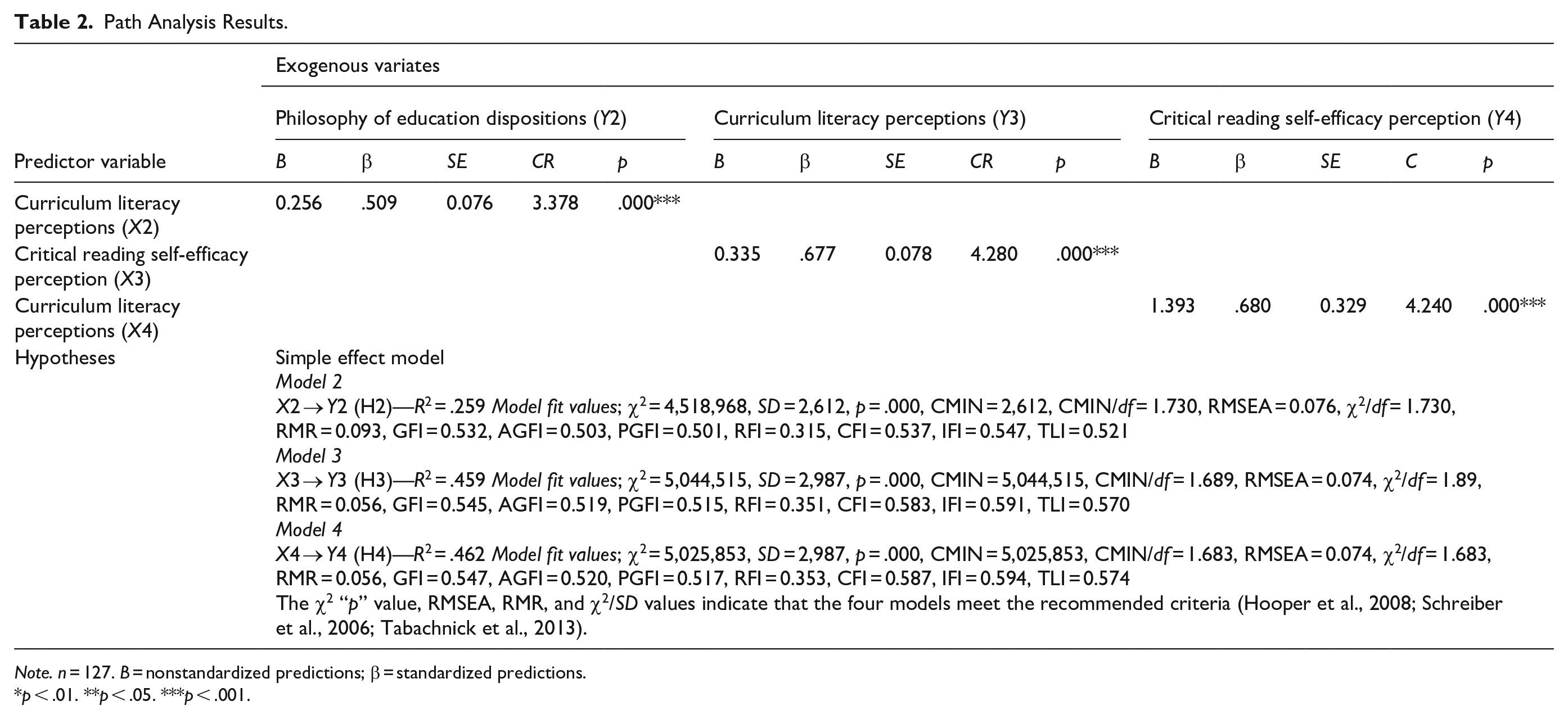
Note. n = 127. B = nonstandardized predictions; β = standardized predictions.
p < .01. **p < .05. ***p < .001.
Table 1 presents the pairwise correlations between the total dimensions of the variables analyzed in the study. An analysis of the pairwise correlations of all variables showed that the pairwise correlations between the scores of curriculum literacy perception, critical reading self-efficacy perception, and philosophy of education dispositions showed a significant relationship in all relationship correlations (p < .001). In addition, the pairwise correlations of the philosophy of education dispositions and critical reading self-efficacy perception total scores showed a significant relationship (p < .001). Curriculum literacy perceptions and critical reading self-efficacy perception total scores also showed a significant relationship (p < .001). Kurtosis and skewness values showed that the variables took values between −1 and +1. In this regard, the variables of the study showed a normal distribution. Figures 1 to 5, as well as Tables 2 and 3, show the parameters in the models.

The theoretical representation of the model for the prediction curriculum literacy perception total and philosophy of education dispositions total.

The theoretical representation of the model for the prediction of critical reading self-efficacy perception total and curriculum literacy perception total.

The theoretical representation of the model for the prediction of curriculum literacy perception total and critical reading self-efficacy perception total.

Theoretical representation of the proposed model.

The analysis results regarding the mediating role of the critical reading self-efficacy perception between philosophy of education dispositions and curriculum literacy perception.
Total, Direct, Indirect, and Fully Standardized Effects of Philosophy of Education Dispositions (X) on curriculum literacy (Y) (Bootstrapping Indirect Effects and 95% CI for the Sequential Mediating Model).

Note. Five thousand bootstrap samples with 95% CI. CI = confidence interval.
Table 1 shows the pairwise correlations between the total dimensions of the variables analyzed.
Structural equation modeling was performed to test the hypotheses about the proposed relationships between Prospective Turkish language teachers’ curriculum literacy perceptions, critical reading self-efficacy, and philosophy of education dispositions. Table 2 presents the results of the H2, H3, and H4 analyses.
Structural equation modeling was performed to test the hypotheses about the proposed relationships between Prospective Turkish language teachers’ curriculum literacy perceptions, critical reading self-efficacy, and philosophy of education dispositions. Table 2 presents H2, H3, and H4 analysis results.
Table 2 shows that total curriculum literacy perception (X2) directly and positively affects philosophy of education dispositions total (Y2) (β = .509; CR = 3.378; p < .001). The hypothesis in the simple effect model was confirmed, and curriculum literacy perception total directly and positively affected the philosophy of education dispositions total, confirming the H2 hypothesis of the study.
Figure 1 shows the theoretical representation of the model for the prediction of curriculum literacy perception total and the philosophy of education dispositions total.
According to Table 2, critical reading self-efficacy perception total (X3) directly and positively affects curriculum literacy perception total (Y3) (β = .677; CR = 4.280; p < .001). The hypothesis in the simple effect model was confirmed, and critical reading self-efficacy perception directly and positively affected curriculum literacy perception total, confirming the H3 hypothesis of the study.
Figure 2 shows the theoretical representation of the model for the prediction of critical reading self-efficacy perception total and curriculum literacy perception total.
Table 2 shows that curriculum literacy perception total (X4) directly and positively affects critical reading self-efficacy perception total (Y4) (β = .680; CR = 4.240; p < .001). The hypothesis in the simple effect model was confirmed, and the curriculum literacy perception total was found to directly and positively affect the critical reading self-efficacy perception total. Hence, the H4 hypothesis of the study was confirmed.
Figure 3 shows the theoretical representation of the model for the prediction of curriculum literacy perception total and critical reading self-efficacy perception total.
Correlation analysis results indicated significant relationships between the predictor variable philosophy of education dispositions, the predicted variable curriculum literacy perceptions, and the mediating variable critical reading self-efficacy perception. This result shows that the mediating role of critical reading self-efficacy perception in the effect of philosophy of education dispositions on curriculum literacy perception can be examined. For this purpose, mediation effect analysis was conducted using the bootstrap method developed by Preacher and Hayes (2008), providing more valid and reliable results for analyzing mediation models. To support the research hypotheses in mediation effect analyses conducted with the bootstrap method, the 95% Bias Corrected and Accelerated Confidence Interval (BCA CI) values obtained as a result of the study should not include zero (0) value (Hayes, 2022).
First, before the mediator variable critical reading perception self-efficacy was included in the analysis, the total effect of the predictor variable philosophy of education dispositions on the predicted variable curriculum literacy perception was examined. This effect was found to be significant (F1, 125 = 19.342, p < .05). The philosophy of education dispositions explained 36% of the variance in the curriculum literacy perception variable (b = 0.413, 0.094, 95% CI = [0.227, 0.598], t = 4.398, p < .05). This result shows that philosophy of education dispositions increased with the increase in curriculum literacy perception scores (path c), confirming the H1 hypothesis of the study. The analysis results are presented in Figure 4.
Figure 5 presents the results of the analysis regarding the mediating role of the perception of critical reading self-efficacy between the philosophy of education dispositions and curriculum literacy perception. This result shows that philosophy of education disposition scores increase with the increase in the curriculum literacy perception scores (Path c), confirming the H1 hypothesis of the study. Figure 5 displays the analysis results.
Table 3 shows the indirect effects and associated 95% confidence intervals (CIs). Philosophy of education dispositions significantly affects curriculum literacy (b = 0.413, β = .366, t = 4.398). When critical reading self-efficacy perception is controlled in the results, the direct effect of the philosophy of education dispositions on the curriculum literacy perception is significant (b = 0.162, β = .144). In the final phase, the bootstrapping method was performed to determine the indirect effect of the philosophy of education dispositions on curriculum literacy through critical reading self-efficacy perception (a.b). Hence, the indirect effect of the philosophy of education dispositions on curriculum literacy through critical reading self-efficacy perception was found to be significant (b = 0.251, β = .222, 95% CI = [0.131, 0.324], BootSe = 0.049) because bootstrapping analysis indicates that 95% adjusted and accelerated confidence interval values (95% BCA CI) do not include the value of 0 (zero).
Table 3 demonstrates the difference between the total effect (path c) and the direct effect (path c) of philosophy of education dispositions on curriculum literacy, indicating that the indirect effect through the critical reading self-efficacy perception is 22% (0.222). According to Preacher and Kelley (2011), a fully standardized effect size can be interpreted as a low mediation if it is close to K2 = 0.01, as a medium mediation effect if it is close to K2 = 0.09, and as a high mediation effect if it is close to K2 = 0.25 (cited in Akçakanat et al., 2019). In this regard, critical reading self-efficacy perception seems to have a high mediating role (K2 = 0.22) in the effect of philosophy of education dispositions on curriculum literacy. Therefore, the H5 hypothesis of the study was confirmed.
Conclusion
Hypotheses H1, H2, H3, H4, and H5 of the study were confirmed. The study’s results were analyzed according to the values suggested by J. Cohen (1988). According to hypothesis H1, the philosophy of education dispositions positively relates to curriculum literacy perception. This positively affects prospective teachers’ ability to implement and evaluate the curriculum. According to the H2 hypothesis of this study, curriculum literacy perception is positively related to philosophy of education dispositions. The analysis of this hypothesis in the literature shows that teachers’ curriculum experiences affect their philosophy of education dispositions (Alsubaie, 2016).
According to the H3 hypothesis of the study, critical reading self-efficacy perception is positively related to curriculum literacy perception. In the literature, it is reported that there is a relationship between teachers’ critical reading skills and their ability to implement and evaluate curriculum content (Blixen & Pannell, 2020; Williams, 2022). According to hypothesis H4, the perception of curriculum literacy is positively related to the perception of critical reading self-efficacy. The analysis of the study’s hypothesis H4 in terms of the literature shows that curriculum literacy is directly related to curricula (Steiner et al., 2018).
According to hypothesis H5, critical reading self-efficacy perception showed a high mediating effect on the effect of educational philosophy dispositions on curriculum literacy. In other words, critical reading self-efficacy perception increases the positive effect of the philosophy of education dispositions on curriculum literacy perception. While the philosophy of education affects critical reading self-efficacy perceptions, critical reading self-efficacy perceptions affect curriculum literacy. Therefore, critical reading self-efficacy perceptions mediate in influencing curriculum literacy and philosophy of education dispositions.
Discussion
It is believed that the training of qualified teachers will improve the quality of learning support provided to students. In this context, improving the quality of future teachers requires an emphasis on the philosophy of education, critical reading, and curriculum literacy in teacher training programs. This approach aims to create a teacher figure who can respond to global needs. Considering that even the best curricula are only as good as their implementers, it is believed that improving the professional competencies of prospective teachers will positively impact future generations’ development. In this process, it is believed that positive developments in prospective teachers’ philosophy of education, critical reading skills, and curriculum literacy will positively impact the curriculum process. It is valuable for prospective teachers to be aware of their competencies, educational philosophies, critical reading skills, curriculum literacy levels, and the relationships between these variables in order to become teachers with the qualifications for the global world. In this context, the study’s hypotheses were discussed in the light of the literature.
Prospective teachers’ philosophy of education dispositions positively relates to their perceptions of curriculum literacy. According to Jenkins (2020), curriculum implementation directly relates to teachers’ perspectives and beliefs. The philosophy of education dispositions is one of the most important dynamics in this relationship. The analysis of this hypothesis in terms of the literature shows that the philosophy of education is an important variable in curriculum literacy (Belbase et al., 2022; Khasawneh et al., 2023; Tesar et al., 2021; Verdugo Camacho & Paredes Morales, 2020). In this context, Ornstein (2011) argues that educational philosophy influences the school curriculum and curriculum literacy, and the different educational philosophies (Perennialist, Essentialist, Progressivist, and Reconstructionist) adopted by prospective teachers can help them read, understand, analyze, and evaluate the curriculum more effectively. Similarly, Wang (2014) states that perceptions of the philosophy of education are effective in curriculum literacy. Moore (2000) states that curriculum development and education are directly related to the social context and the philosophy of education in this context. Cahayani and Suastra (2024) emphasize that a progressive educational philosophy is appropriate for independent learning programs and their literacy. In this educational philosophy, students learn in a progressive, constructive, and dynamic way and become active participants in the independent learning and teaching program. This situation shows the relationship between curriculum literacy and progressive philosophy, one of the educational philosophies. Similarly, Faiz and Kurniawaty (2020) emphasize that Progressivism educational philosophy’s adaptive and non-coercive structure is related to the flexibility dimension of curriculum literacy. In this context, the human capital theory discussed by Becker (2009) and Hanushek (2011) states that the increase in teacher quality contributes to the increase in learning outcomes in dimensions such as critical reading, philosophy of education, and curriculum literacy. In this process, prospective teachers who evaluate knowledge from a developing framework and read the curriculum in the context of this development can be more effective in their profession. In this respect, giving the necessary value to educational philosophies can provide a new vision for curriculum literacy. Developing a philosophy of education that is open to development should be a priority to make prospective teachers’ curriculum literacy more functional.
Prospective teachers’ perception of curriculum literacy relates positively to their philosophy of education. The analysis of this hypothesis in the literature shows that teachers’ curriculum experiences affect their philosophy of education dispositions (Alsubaie, 2016). Educators’ ability to analyze and evaluate the curriculum contributes to questioning and internalizing educational philosophies (Apple, 2018). With the generations to be raised, reading and implementing the program effectively contributes to forming functional educational philosophies in the social structure. The results of both theoretical and experimental studies are consistent with the findings of H1 and H2 supported in this study. In this context, prospective teachers’ philosophy of education dispositions and curriculum literacy mutually influence each other. This result is similar to the studies in critical pedagogy, which show that the philosophy of education is an effective variable in teachers’ quality of education and their ability to read the curriculum. Therefore, the literature shows that educational philosophy (Costa, 2001) is directly related to metacognition, critical thinking, and reading. Literature shows that student-centered and problem-centered curriculum designs are based on Progressivism, Reconstructionism, and Existentialism, while subject-centered curriculum design is based on Perennialist and Essentialism (Oliva, 2009; Ornstein & Hunkins, 2009).
Prospective teachers’ perception of critical reading self-efficacy positively relates to their perception of curriculum literacy. Prospective teachers use different strategies (Gainer, 2012) that help reveal and question the implicit meanings underlying the text in their critical reading skills, and their positive self-efficacy perceptions can increase their curriculum literacy. Prospective teachers’ perception of curriculum literacy directly and positively affects their perception of critical reading self-efficacy. Steiner et al. (2018) underlined that curriculum literacy is directly related to programs. When prospective teachers try to understand, evaluate, and synthesize programs by examining them, they are among the texts that can be read critically. Thus, prospective teachers can examine the curriculum with the eyes of a critical reader. Turkish language teaching undergraduate programs include curriculum analysis and critical reading courses and contribute to these two variables’ direct and positive effects on each other. In light of the research conducted so far, critical reading self-efficacy perception can positively affect the development of curriculum literacy perception.
Prospective teachers’ perception of critical reading self-efficacy showed a high mediating effect on the effect of philosophy of education dispositions on curriculum literacy. In other words, critical reading self-efficacy perception increases the positive effect of the philosophy of education dispositions on curriculum literacy perception. While the philosophy of education affects critical reading self-efficacy perceptions, critical reading self-efficacy perceptions affect curriculum literacy. Therefore, critical reading self-efficacy perceptions mediate in influencing curriculum literacy and philosophy of education dispositions. It is reported that prospective teachers with low critical reading and low self-efficacy perceptions cannot be effective in the teaching profession, teaching practices, and curriculum literacy (Corzo & Chacon, 2014; De Barón & Smith, 2016). Therefore, student achievement is affected by the quality of the education received by teachers and the level of teachers’ reorganization of teaching (Burroughs et al., 2019; Chetty et al., 2014). In this context, it is important to support prospective teachers’ critical reading and related positive self-efficacy and curriculum literacies to make them more effective teachers. According to the results of H5 of this study, critical self-efficacy perception partially mediates between the philosophy of education dispositions and curriculum literacy. In this case, developing prospective teachers’ philosophy of education will directly affect their critical reading self-efficacy perceptions and curriculum literacy. Therefore, prospective teachers are expected to have higher curriculum literacy when they enter the profession. Therefore, developing prospective teachers’ philosophy of education dispositions directly affects their critical reading self-efficacy perceptions and curriculum literacies. Therefore, prospective teachers are expected to have higher curriculum literacy when they enter the profession. The results of this study show that neither critical reading self-efficacy nor curriculum literacy can be developed without supporting the development and internalization of prospective teachers’ philosophy of education dispositions. In this context, prospective teachers who cannot develop their critical reading and self-efficacy perceptions may become teachers who do not have sufficient curriculum literacy and cannot evaluate the curriculum in all its dimensions in a qualified way (Gainer, 2012; Williams, 2022). Therefore, it is critical to support practices to develop prospective teachers’ critical reading, curriculum literacy, and philosophy of education dispositions in teacher education programs, and this network of relationships should be reflected in teacher education programs. The literature shows that critical reading positively affects educational philosophy (Farieta & Deprato, 2024) and curriculum (Williams, 2022; Wolfe, 2010). Critical reading is a philosophical, moral, and political approach to understanding the language used. It originates from critical pedagogy and contributes to different program practices with its processes and skills (Luke, 2012). Individuals with critical reading and self-efficacy perception can analyze texts more profoundly and thus internalize educational philosophies better. These skills enable them to be more effective in teaching processes and allow the curriculum to be evaluated critically. While critical reading helps individuals discover and question the implicit meanings in texts, self-efficacy perception increases their self-confidence. Critical reading and self-efficacy perception are critical for prospective teachers to develop curriculum literacy and pedagogical competencies. Supporting these skills in education programs contributes to teachers taking part in education more effectively and qualifiedly.
Recommendations
The following recommendations are made based on the findings of the study:
Adding the critical reading course in the Turkish language teaching undergraduate program and other undergraduate teaching programs may increase prospective teachers’ perceptions of critical reading self-efficacy.
Faculty members could be provided with training in trainer programs on the reflection of critical reading, curriculum literacy, and philosophy of education on the teaching undergraduate program to raise more qualified prospective teachers.
In-service training can be organized to increase teachers’ perceptions of critical reading self-efficacy and curriculum literacy.
Limitations
The study was conducted in the Turkish language teaching department, which can be considered a limitation. In this regard, quantitative data should be supported with data from different teaching fields.
Footnotes

Ethical Considerations
All procedures performed in studies involving human participants were conducted in accordance with the ethical standards of the institutional and/or national research committee and with the 1964 Helsinki declaration and its later amendments or comparable ethical standards. Approval was granted by the Ethics Committee of Düzce University (Ethical Approval No: 24.10.2023-354870).
Consent to Participate
Informed consent was obtained from all individual participants included in the study.
Author Contributions
Onur Er: Writing—review & editing, Writing—original draft, Methodology, Investigation, Formal analysis, Data curation, Conceptualization. Özden Demir: Writing—review & editing, Writing—original draft, Methodology, Formal analysis, Data curation.
Funding
The author(s) received no financial support for the research, authorship, and/or publication of this article.
Declaration of Conflicting Interests
The author(s) declared no potential conflicts of interest with respect to the research, authorship, and/or publication of this article.
Data Availability Statement
The datasets generated during and/or analyzed during the current study are available from the corresponding author on reasonable request.