



Abstract
This study elucidates the relationship between instructional leadership and teacher self-efficacy by identifying the moderating role of teacher collegiality. Survey data were collected from 1,498 teachers at 53 middle schools in Henan, China. Findings indicate that instructional leadership has a positive impact on teacher self-efficacy. More importantly, teacher collegiality was found to moderate the relationship between principal instructional leadership and teacher self-efficacy. More specifically, when there was a high level of teacher collegiality, instructional leadership positively predicted teacher self-efficacy; however, when there was a low level of teacher collegiality, instructional leadership barely predicted teacher self-efficacy. In addition to elaborating on the relationship between principal instructional leadership and teacher self-efficacy, this study underscores the importance of teacher collegiality in promoting the effectiveness of instructional leadership.
Plain Language Summary
An increasing number of studies have examined whether and how principal instructional leadership influences teacher attitudes. However, the impact of principal instructional leadership on teacher collegiality and self-efficacy has not been explored simultaneously. This study investigated a moderation model of principal instructional leadership and teacher self-efficacy. Survey data were collected from 1,498 teachers at 53 middle schools in Henan, China. The results showed principal instructional leadership has a positive impact on teacher self-efficacy. More importantly, teacher collegiality moderated the relationship between principal instructional leadership and teacher self-efficacy. When there was a high level of teacher collegiality, instructional leadership positively predicted teacher self-efficacy; however, when there was a low level of teacher collegiality, instructional leadership barely predicted teacher self-efficacy. This study extended the relationship between principal instructional leadership and teacher self-efficacy and emphasizes the importance of teacher collegiality in promoting the effectiveness of instructional leadership.
Introduction
The rise of the accountability movement in the Western countries resulted in a greater focus on student and school achievement. Given the importance of “instructional leadership” for school effectiveness, subsequent research focused on the relationship between instructional leadership and student achievement. Empirical studies have demonstrated that principal instructional leadership has an indirect influence on student achievement (Hallinger et al., 1996). In this respect, one of the most important paths involves the influence of principal leadership on teacher self-efficacy (Dale & Phillips, 2011). Meanwhile, numerous studies have found that instructional leadership significantly predicts teacher self-efficacy (Bellibas & Liu, 2017; Calik et al., 2012; Duyar et al., 2013). However, research on the internal influence mechanism of instructional leadership on teacher self-efficacy is still in its infancy, while few studies have explored potential sophisticated moderating effects.
Different social systems and cultures produce different instructional leadership practices (Hallinger, 1995; Walker & Hallinger, 2015). The concept of instructional leadership originated in a Western context, and research in this field was largely limited to Western countries before 2000 (Hallinger, 1989; Hallinger & Leithwood, 1996; Hallinger & Murphy, 1985). In recent years, an growing number of scholars have invested in building a global knowledge base of instructional leadership practices in a cross-cultural context (Hallinger & Lee, 2014; Hallinger & Walker, 2017; Harris et al., 2017; Liu & Hallinger, 2018; Truong et al., 2017). This study contributes to this burgeoning field by exploring instructional leadership in the Chinese context.
The Chinese education system has traditionally been highly centralized and uniform. Within this education system, the role of the principal has been to implement the agenda of the Ministry of Education (MOE), with relatively little autonomy. Since the turn of the millennium, China has adopted a series of curriculum reforms that have required teachers and principals to amend their practice to facilitate student learning (Qian & Walker, 2013). This reform created a new institutional context for principals and reshaped the relationship between principals and teachers (Liu, Hallinger, et al., 2016). Principals are expected to take a more active role in leading teachers in the development of teaching and learning (Qian & Walker, 2013). In the Professional Standards for Compulsory Education School Principals issued by the MOE in 2013, instructional leadership was listed as one of the professional responsibilities of principals for the first time (Zheng et al., 2019). These policies have drawn attention to the importance of practicing instructional leadership. Therefore, within the Chinese context, this study examines the instructional leadership role of principals and how their practices shape teacher self-efficacy.
Theoretical Framework
This section reviews the relevant literature on instructional leadership, teacher self-efficacy, and teacher collegiality, and establishes this study’s conceptual model.
Principal Instructional Leadership
Instructional leadership research originated with several studies exploring effective schools in the early 1970s (Hallinger et al., 1983). In their review of the existing educational leadership literature, Murphy et al. (1983) identified some of the major recurring problems in the field, namely, the limited generalizability of findings, lack of explanatory models and behavioral indicators, and premature application of research findings. To address these issues, they developed a model of instructional leadership comprising three dimensions: defining the school mission, managing the instructional program, and promoting a positive school learning climate (Hallinger & Murphy, 1985). Known as the Principal Instructional Management Rating Scale (PIMRS), this conceptual framework and associated survey instrument have been proven reliable and valid over the past 30 years (Hallinger, 2011). Indeed, the PIMRS has become the most prevalent conceptualization of principal instructional leadership (Hallinger et al., 2017).
With the global focus on student achievement, a growing number of studies on instructional leadership have emerged in the field of leadership. However, there are some doubt regarding and criticisms of instructional leadership, resulting in the development of several competing leadership models, primarily transformational leadership (Leithwood, 1994; Leithwood & Jantzi, 1999; Silins, 1992), and distributed leadership (Gronn, 2003; Hallinger & Heck, 2009; Heck & Hallinger, 2010). Although scholars continue to debate the strengths of different types of leadership, Robinson et al. (2008) show that instructional leadership has a much greater effect on student achievement compared to other forms of leadership. Significantly, instructional leadership has an indirect effect on student achievement insofar as it occurs via teachers (Hallinger, 2003, 2005; Hallinger et al., 1996; Miller et al., 2015).
As the research on instructional leadership matured in the Western context, scholars began turning their attention to Asia, Africa, and Latin America (Al-Mahdy et al., 2018; Hallinger, 2019, 2020; Hallinger & Lee, 2014; Hallinger & Walker, 2017; Hallinger et al., 2018; Walker & Hallinger, 2015). They confirm that different politics, economies, cultures, and institutions shape different leadership practices (Hallinger & Lee, 2013; Harris et al., 2017; Qian et al., 2017). In China, studies on principal instructional leadership still lack empirical evidence (Walker & Qian, 2015; Walker et al., 2012). In recent years, some Chinese scholars have sought to address this issue through a series of studies, becoming active in the field of international studies as a result.
In this respect, Zhao and Liu (2010) constructed a framework comprising four dimensions based on localization practice, namely, (1) defining the school mission and goals, (2) promoting teacher development, (3) managing instruction, and (4) managing public relations. More recently, based on the framework developed by Hallinger and Murphy (1985), Qian et al. (2017) interviewed 22 Chinese primary school principals and provided a preliminary framework of Chinese principals’ instructional leadership using qualitative analysis. They subsequently expanded and refined this preliminary framework using a larger and more diversified sample comprising 101 primary school principals (Walker & Qian, 2020). Based on interview data, this refined framework consisted of six dimensions: (1) defining purpose and direction, (2) managing and improving teaching and learning, (3) nurturing positive and collaborative teacher culture, (4) developing and improving school curriculum, (5) fostering professional development to enhance teachers, and (6) promoting connections with external stakeholders’ capacity. Meanwhile, another study constructed four dimensions based on localization practice, namely Defining the school mission and goals, Promoting teacher development, Managing instruction, and Managing public relations (Zhao & Liu, 2010). Comparing the instructional leadership frameworks in Chinese and Western contexts found that Chinese principals pay more attention to the development of teachers, explaining why “promoting teacher development” is a separate dimension in the Chinese framework (Hou et al., 2019; Qian et al., 2017; Walker & Qian, 2020).
Influenced by Confucian values, research indicates that Chinese principals tend to prioritize the cultivation of harmonious relations between teachers (Qian et al., 2017; Walker & Qian, 2020). At the policy level, in 2013, the MOE released Professional Standards for Compulsory Education School Principals, which identified instructional leadership as one of the responsibilities of a principal and presented specific behavior indicators in this respect (Liu, Xu, et al., 2016). For example, this guideline requires principals to conduct in-depth classroom observations, provide teaching feedback to teachers, stipulate the classroom observation time for each semester; pay attention to the development of each teacher, and guide teachers to formulate professional development plans based on their characteristics (Liu, Xu, et al., 2016).
Compared to the United States, Britain, Australia, and other Western countries, China was the last to formulate professional standards for principals. Nevertheless, the traditional organizational structure and institution of Chinese schools—including the presence of subject-based teaching research groups (jiaoyanzu), collective lesson preparation (jitibeike), class observation and evaluation (tingpingke), and public lessons (gongkaike)—provide fertile grounds for the development of principals’ instructional leadership (Walker & Qian, 2020; Zheng et al., 2019). In this regard, one of the principal’s daily tasks is to participate in teaching and research activities and provide guidance to teachers, as well as ensure that all teachers participate in these activities. According to the 2018 Teaching and Learning International Survey (TALIS), of the 48 participating countries and regions, Chinese principals rank first in terms of the proportion of total working time spent on curriculum and instruction. Conducted by the Organisation for Economic Co-operation and Development (OECD), TALIS survey data revealed the high investment of Chinese principals in the curriculum and instruction. Underlying this result is the complex and anxious psychology of Chinese principals facing the great challenge of educational reform.
In the 21st century, Chinese education entered a new stage, with quality-oriented education (suzhi jiaoyu), which focuses on the all-round development of students, becoming the goal of education reform (Qian et al., 2017). Educational reform has resulted in changes to the traditional curriculum model and teaching methods, including a shift away from traditional teacher-centered instruction toward student-centered learning and the transition from highly centralized curriculum to the development of unique school curricula (xiaoben kecheng) (Qian et al., 2017). Principal instructional leadership has become particularly important in the institution of such reform (Guo & Lu, 2018). In the context of education reform, principals’ concerns are no longer restricted to students’ academic performance, but expanded to include balancing the implementation of national education reform policies and high expectations for students’ academic performance (Qian et al., 2017). Accordingly, scholars have called for the construction of a richer database on Chinese instructional leadership to explore its complexity (Walker et al., 2012).
Principal Instructional Leadership and Teacher Self-Efficacy
Based on Bandura’s theory of self-efficacy, the concept of teachers self-efficacy refers to teachers’ belief in their abilities to attain desired results in terms of student involvement and learning, even with students who lack motivation (Tschannen-Moran & Hoy, 2001). Self-efficacy can influence an individual’s actions, emotional state, thinking processes, cognitive function, choice of activities and behavioral settings, coping activities, and performance (Bandura, 1977, 1982, 1989). Research demonstrates that principal leadership has a positive effect on teacher self-efficacy (Bellibas & Liu, 2017; Calik et al., 2012; Cansoy & Parlar, 2018; Fackler & Malmberg, 2016; Ma & Marion, 2021). Moreover, several studies have shown that a higher degree of teacher self-efficacy positively impacts teachers’ psychological well-being and success (Liu & Hallinger, 2018; Zee & Koomen, 2016). More importantly, it can also influence student achievement and motivation (Caprara et al., 2006). Teacher self-efficacy thus plays a mediating role in the impact of principal leadership on teacher professional learning, collective teacher efficacy, and student academic achievement (Calik et al., 2012; Dale & Phillips, 2011; Liu & Hallinger, 2018).
However, little research exists on the internal mechanism between instructional leadership and teacher self-efficacy, especially in China. That said, analyzing TALIS (2013) data, Bellibas and Liu (2017) found that the effect size of instructional leadership on teacher self-efficacy differs from one context to another, indicating that a significant relationship cannot be generalized across different contexts. More recently, several significant empirical studies have examined how instructional leadership influences teacher self-efficacy in China (Ma & Marion, 2021; Zheng et al., 2019). These studies have similarly concluded that instructional leadership indirectly affects teacher self-efficacy through mediating variables. More specifically, Zheng et al. (2019) identified four components—namely, the professional learning community, collaborative activity, de-privatized practice, and reflective dialogue—that fully mediated the effects of instructional leadership on teacher self-efficacy. Meanwhile, Ma and Marion (2021) found that two dimensions of instructional leadership—defining the school’s mission and managing the instructional program—were fully mediated by trust, while a third dimension, developing a positive environment, was partially mediated through trust.
Such research has undoubtedly enriched the existing literature on the relationship between instructional leadership and teacher self-efficacy (Ma & Marion, 2021). However, although these studies reveal potential paths between instructional leadership and teacher self-efficacy, they have not elucidated how the influence of teaching leadership on teacher self-efficacy can be optimized, underscoring the need to explore the mediating mechanism between principal instructional leadership and teacher self-efficacy.
Principal Instructional Leadership and Teacher Self-Efficacy and Collegiality
Collegiality is a vague and imprecise concept (Hargreaves, 1994), often used interchangeably with “collaboration” in educational practices (Fielding, 1999). Collaboration has been defined as having common goals, trust, and greater decision-making power at the school and classroom levels (Ford & Youngs, 2018; Torrance & Humes, 2015). It is closely related to Professional Learning Communities (PLCs) and regarded as a key factor in their success (Ford & Youngs, 2018). Kelchtermans (2006) differentiated between collegiality and collaboration by defining the latter as teachers’ cooperative actions, and the former as the quality of teacher relations with normative and relational dimensions. There are two kinds of support in the workplace (Fenlason & Beehr, 1994): instrumental and emotional. The majority of research has focused on professional collaboration, which focuses on instrumental support but ignores emotional support, such as the sharing of emotional experiences. In this regard, Nias (1998) found that teachers need to be able to share their happiness in times of success and have someone to listen and understand in times of frustration. As this study is primarily interested in how teachers’ professional cooperation and emotional bonds promote the influence of instructional leadership on teacher self-efficacy, “collegiality” is used to capture a wider range of teachers’ emotions, behaviors, and actions.
Many scholars have advanced the benefits of teacher collegiality, including improved student achievement (Y. Goddard et al., 2007; Shah, 2012); improved teacher attitudes and actions, such as job satisfaction (Pounder, 1999), efficacy (Slavit et al., 2011), professional development (Egodawatte et al., 2011; Park et al., 2007), trust (Tschannen-Moran, 2004), commitment (Shah & Abualrob, 2012), and instruction (Bertrand et al., 2006; Slavit et al., 2011); and positive influence on school climate (Westheimer, 2008). Shachar and Shmuelevitz (1997) found an association between a higher level of teachers’ collaboration and a higher level of teachers’ self-efficacy. Good collegiality helps teachers reinforce teaching competence and confidence, thereby increasing their self-efficacy (Shah, 2012; Wang, 2015). However, contrived collegiality—characterized as formal, predetermined, and fixed in time and space—has been shown to have a negative impact on teachers’ participation in collaboration, such as withholding their trust, restricting their participation, or leaving their school and the profession altogether (Hargreaves, 2019).
China has a long history of teacher collaboration groups, which promote teachers’ teaching and learning. According to Zhang and Pang (2016), collectivist culture benefits teachers’ collaboration. Although the collaboration between Chinese teachers may seem contrived collegiality on the surface, further examination reveals it to be genuine collegiality (Wang, 2015). The results of the Programme for International Student Assessment (PISA) and TALIS have seen Chinese teacher collaboration groups attract global attention, resulting in the Chinese version of the PLC becoming a research focus (Liu & Hallinger, 2018; Liu et al., 2022; Qian & Walker, 2020; Wang, 2015; Zhang & Pang, 2016; Zheng et al., 2019, 2021).
In recent years, some scholars have linked PLCs to principal leadership and emphasized the essential role of teacher collaboration (Liu & Hallinger, 2018; Qian & Walker, 2020; Zheng et al., 2019). As the organizer of teacher collaboration, Chinese principals believe that harmonious relationships among teachers helps sustain a healthy school environment and support teachers’ efforts (Qian et al., 2017). Meanwhile, other studies have confirmed the mediating role of trust in the relationship between principal leadership and PLCs (Li et al., 2016; Zheng et al., 2019). Trust is one of the characteristics distinguishing arranged collegiality from contrived collegiality (Hargreaves, 2013), and is thought to facilitate genuine collegiality in Chinese PLCs (Wang, 2015). Whether focusing on PLCs or emphasizing trust, these studies similarly highlight the relationship between teachers.
Research indicates that teacher collaboration can affect teacher self-efficacy (Duyar et al., 2013) and is associated with instructional leadership (Li et al., 2016). Moreover, instructional leadership has a significant impact on teacher collaboration (Miller et al., 2015). As a facilitator of teacher-teacher relationships, the principal is required to provide teachers with opportunities to improve their interpersonal relationships (Shah & Abualrob, 2012). In this respect, scholars (Qian et al., (2017) found that “nurturing positive and collaborative relationships with and between teachers” is a major work dimension of Chinese principals, one playing a key role in their ability to create a positive and safe learning environment for staff.
Although some studies have explored collaboration as a mediation between leadership and teacher efficacy (R. Goddard et al., 2015; Ma & Marion, 2021; Zheng et al., 2019), most studies have focused on teacher collaboration as limited to the professional sphere of teacher relationships, neglecting emotional interaction between teachers beyond collaboration. Although both are essential factors in the efficient functioning of instructional leadership, scholars have yet to consider teacher professional and emotional interaction simultaneously. Accordingly, this study uses the concept of “collegiality,” which encompasses both professional and emotional interaction in the workplace.
This research addresses the two research questions. First, how principal instructional leadership can impact on teacher self-efficacy? Second, what role does teacher collegiality play in the relationship between principal instructional leadership and teacher self-efficacy. As Figure 1 illustrates, based on existing research and collected data, this study proposes a moderation effect model comprising three variables: principal instructional leadership, teachers self-efficacy, and teachers collegiality. Based on the foregoing, this study proposes the following two hypotheses:
H1: Instructional leadership is positively related to teacher self-efficacy.
H2: Teacher collegiality moderates the relationship between instructional leadership and teacher self-efficacy such that when teacher collegiality is high, the positive impact of instructional leadership on teacher self-efficacy will be stronger.

Research model.
Methods
Data Collection
Survey data were collected from the Investigation of Curriculum and Instruction in China (ICIC), which comprised survey data from 1,498 teachers and 53 principals at 53 middle schools in Henan, China. An oral explanation of the purpose of the ICIC research project, as well as potential risks, benefits, and confidentiality was presented to all participants prior to their taking the survey. Survey participation was voluntary and anonymous.
In Henan, middle schools are distributed in four districts representing a range of socioeconomic statuses. Sampling procedures were executed to ensure the acquisition of a representative sample of middle schools from all four districts. Sample characteristics included school level (key, ordinary, and weak), school location (urban, rural-urban-continuum, and rural), and school nature (public and private). In terms of sex, 77.4% of the middle school principals were male and 22.6% were female, while teachers were predominately female (68.8%).
Instruments
Following the aforementioned variables, hypotheses, and the research model (Figure 1), we used the instruments for principal instructional leadership, teacher self-efficacy, and teacher collegiality.
Principal Instructional Leadership
The most prevalent conceptual framework of principal instructional leadership was developed by Hallinger and Murphy (1985), and comprises three dimensions: (1) defining the school mission, (2) managing the instructional program, and (3) developing a positive school learning climate. Indeed, this framework has been employed in 26 different countries and proven to be reliable (Hallinger et al., 2013). In this framework, five items were used to measure principal instructional leadership (Appendix A). Some studies have confirmed the significant differences between the perceptions of teachers and principals, with the bulk of evidence revealing that principal’s self-reports yield higher ratings than those of teachers (Hallinger, 2011). This study conducted a t-test on the matching questions in the questionnaire given to teachers and that given to principals; results were consistent with those of the aforementioned studies. Therefore, teacher perceptions remain the preferred source of data on the principals’ instructional leadership.
Teacher Self-Efficacy
Building on Bandura’s theory of self-efficacy, the concept of teachers self-efficacy refers to teachers’ beliefs in their abilities to attain desired results in terms of student involvement and learning, even with students who lack motivation (Tschannen-Moran & Hoy, 2001). Based on the Ohio State Teacher Efficacy Scale, which focuses on the three domains of classroom teaching (instructional practices, classroom management, and student engagement), this study used six items to measure this variable (Appendix B).
Teacher Collegiality
Although conceptually vague and imprecise (Hargreaves, 1994), collegiality describes the relationship among teachers in terms of instrumental and emotional support (Fenlason & Beehr, 1994). This study used five items divided into two dimensions (Appendix C) to measure this variable. Item response categories ranged from 1 (“Almost Never”) to 4 (“Almost Always”).
Reliability was measured with Cronbach’s alpha test of internal consistency. Confirmatory factor analysis (CFA) was conducted to assess the construct validity of the measurement model. Model fit was deemed acceptable with CFI > 0.90, TLI > 0.90, SRMR < 0.08, and RMSEA < 0.08. The reliability of the scales exceeded the standard of 0.70 recommended by Nunnally and Bernstein for exploratory research. As Table 1 shows, Cronbach’s alpha coefficients and model fit indices were acceptable for all variables.
The Goodness of Fit Measures for the Main Constructs.

Data Analysis
To analyze the data, this study first used SPSS 25.0 to test the impact of common method bias, as well as discern descriptive statistics and correlation. Next, Mplus 7.0 was used to test the moderation model. Standard z-scores were used to decrease potential multicollinearity problems in the analyses. Lastly, the Wald test was used to examine this model in different locations (urban, rural-urban-continuum, and rural), school levels (key, ordinary, and weak), and natures (public and private).
Results
As all measures were collected from the same source, this study tested the impact of common method bias. This study created a one-factor model combining all of the study variables into a single factor. Results showed that the items generated a total of three factors, which explained 53.25% of the variance. The one-factor model explained 33.79% of the variance, which is less than the 50% standard proposed by Hair et al. (1998).
Table 2 presents the means, standard deviations, and correlations among the study variables. Data indicated that teachers perceived the principals to be moderately engaged in instructional leadership (M = 2.80, SD = 0.61). Teacher collegiality scored 2.98 (SD = 0.58) and self-efficacy scored 3.03 (SD = 0.51). Correlation results revealed a significantly positive correlation among principal instructional leadership, teacher collegiality, and self-efficacy.
Descriptive Statistics of and Correlations Between the Constructs.
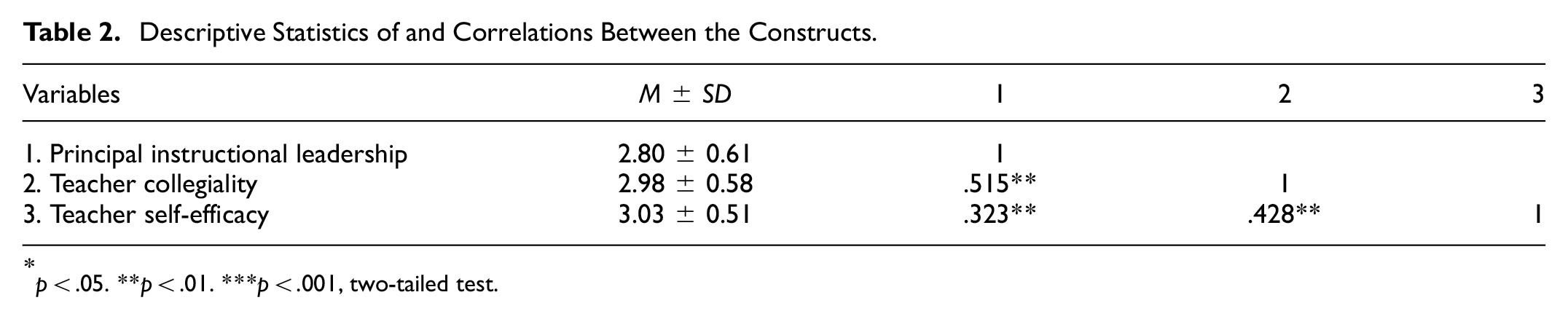
p < .05. **p < .01. ***p < .001, two-tailed test.
This study then tested the moderating effects of teacher collegiality on the relationship between instructional leadership and teacher self-efficacy. To control for potential confounding variables, teacher’ sex, teaching experience, and highest education level were used as control variables. As Figure 2 shows, instructional leadership significantly predicted teacher self-efficacy (β = .133, t = 3.596, p < .001), while teacher collegiality had a moderating effect on the relationship between principal instructional leadership and teacher self-efficacy (β = .120, t = 2.537, p < .05).
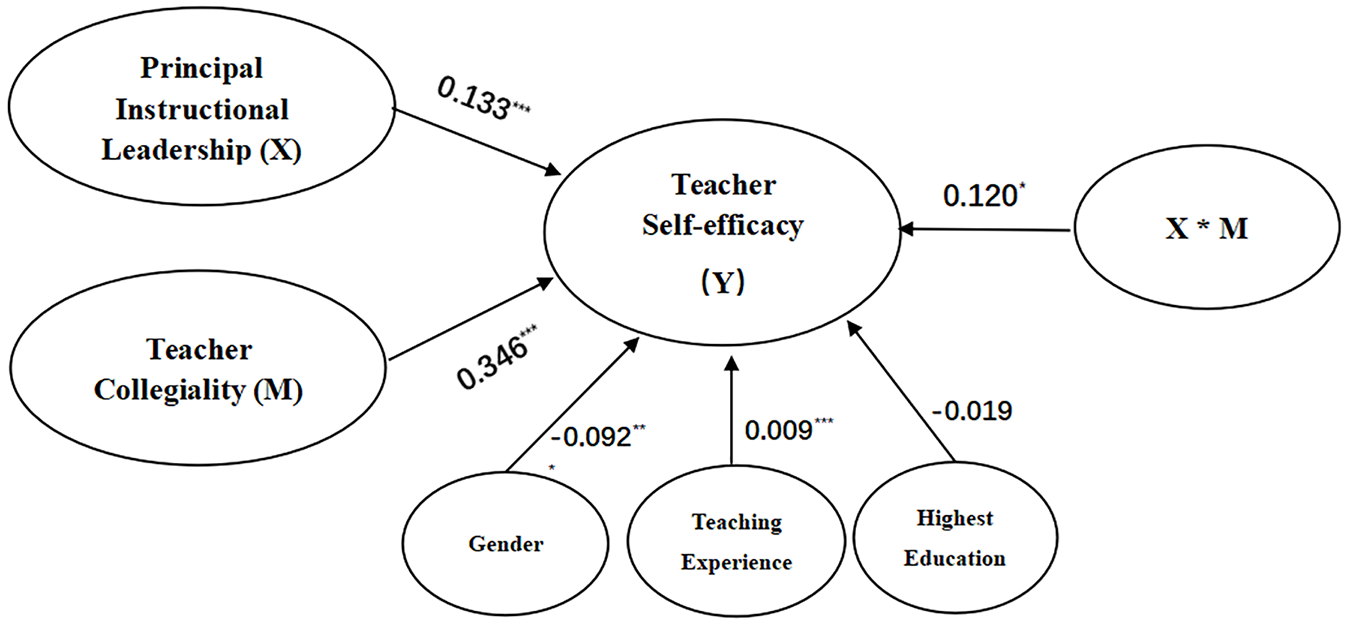
Moderation model.
Figure 3 illustrates the interactions between variables. The criteria for dividing teacher collegiality into two levels was dependent on the mean score ±1 SD (Cohen et al., 2003). When teacher collegiality was high, instructional leadership positively predicted teacher self-efficacy. When teacher collegiality was low, instructional leadership barely predicted teacher self-efficacy.
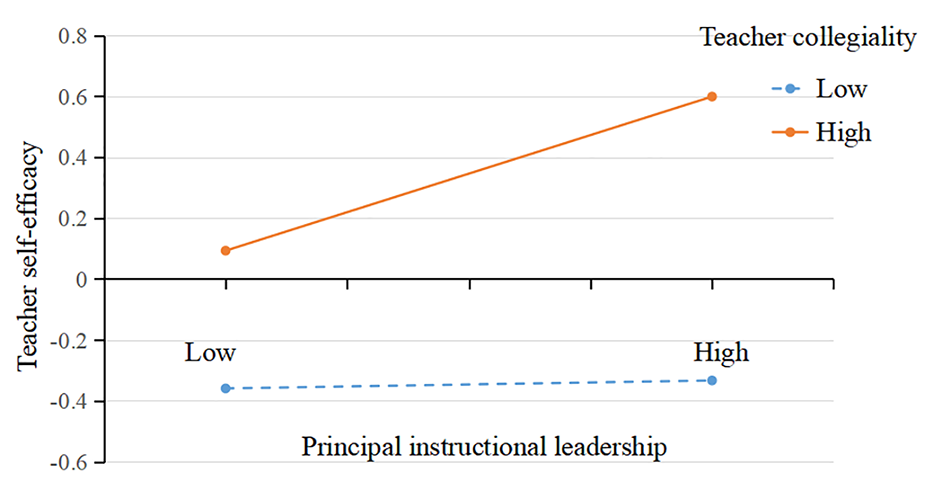
Moderating role of teacher collegiality in the relationship between instructional leadership and teacher self-efficacy.
Finally, this moderated model was tested in a different school location, level, and nature. Table 3 shows, none of the paths were significantly different. In other words, the moderated model is stable regardless of changes in school location, level, and nature.
Wald Test Results.

Discussion
Although scholars have recognized the importance of teacher collegiality (Shah & Abualrob, 2012), few studies have investigated its function in the field of principal leadership. Previous studies paid attention to collaboration, which was considered a subset of collegiality, and neglected teachers’ emotional interaction in the workplace. This elucidates the relationship between instructional leadership and teacher self-efficacy by revealing the moderating role of teacher collegiality in the Chinese context. This section discusses this study’s main findings and their implications.
First, results show that Chinese principals valued instructional leadership. Certainly, understood from the contextual perspective of traditional Chinese education, most principals may consider improving student achievement as the ultimate goal of school development. Moreover, most principals have rich teaching experience with which to guide teachers.
Second, instructional leadership had a positive effect on teacher self-efficacy, which was consistent with the findings of prior studies (Liu & Hallinger, 2018). This finding suggests that instructional leadership behaviors influenced teacher self-efficacy by setting goals and standards for the school, developing teacher professional learning, observing teachers’ classes, and providing feedback and guidance (Fackler & Malmberg, 2016; Tschannen-Moran & Hoy, 2007). According to Bandura (1997), four aspects of information influence the development and formation of self-efficacy: mastery experiences, vicarious experiences, verbal persuasion, and physical and emotional states. From the perspective of Bandura’s theory of self-efficacy, principals’ guidance and feedback can be classified separately as a source of vicarious experience and verbal persuasion, thereby promoting teacher self-efficacy.
Third, this study proposes a model of moderation in which teacher collegiality moderates the impact of principal instructional leadership on teacher self-efficacy. Analysis revealed that this model remains stable, with no observable changes when applied to a school location, level, and nature. In other words, this model suggests that the impact of instructional leadership could become more effective when there is a high level of teacher collegiality. This result is particularly significant in the Chinese context. In populous China, restrictions on principals’ time and experience can limit one-on-one communication with teachers, hindering the efficacy of instructional leadership. Therefore, the results of this study provide a possible solution for principals in China or other populous countries, namely, that principals should strive to establish good teacher collegiality to promote the effect of their instructional leadership on teacher self-efficacy.
Certainly, teacher collaboration has served as a key element in promoting school effectiveness and teacher performance (Y. Goddard et al., 2007). Zheng et al. (2019) found that teachers’ collaborative activity as a component of the PLC mediated the effects of instructional leadership on teacher self-efficacy. In the context of Chinese collective culture, principals could take advantage of teaching and research activities (jiaoyan huodong) or lesson preparation groups (beikezu) to promote teacher collaboration in practice. Chinese principals are facilitators of collaborative relationships among teachers, with positive interpersonal interactions between staff found to play a significant role in sustaining a healthy school environment and supporting the work of principals (Qian et al., 2017). At the same time, greater value should be placed on emotional support between teachers. Nias (1998) found teachers have requirements for sharing their happiness in times of success and need someone to listen and understand in times of frustration. According to social exchange theory, positive relationships are essential sources of emotional support for employees (Colbert et al., 2016). As such, it is necessary to make principals aware of the importance of teacher collegiality in order to promote effective instructional leadership.
However, it is important to note that, under the influence of Confucian culture, Chinese teachers are used to obeying people of a higher status and older age, resulting in their rarely expressing their own views. Good teacher collegiality may help teachers break through the high power distance and express different opinions. However, principals should be wary of superficial harmony. In order to protect one another’s dignity (mianzi), communication between teachers often lacks depth and criticality (Zheng et al., 2019). Principals thus need to find a balanced mid-point between harmony and critical dialogue. As Hargreaves (2019) noted, “dialogue became deep and demanding, yet trusting and respectful at the same time.”
The findings of this study thus have important practical implications for the leadership approach of Chinese principals, particularly in view of the challenges faced in responding to and implementing China’s quality-education reforms. Findings suggest that instructional leadership had a positive impact on teacher self-efficacy, and teacher collegiality significantly moderated this relationship. Therefore, when promoting teacher self-efficacy, principals should not solely focus on instructional leadership but pay attention to creating a climate facilitating a high level of teacher collegiality. With a high level of teacher collegiality, teachers can gain instrumental support and emotional support, which will enhance their positive attitudes in the workplace.
This study contributes to research on instructional leadership research in China and the growing body of research on the effects of principal instructional leadership in non-Western, developing societies. In view of the fact that instructional leadership practices need to be understood in relation to different cultural and social contexts, this study has implications for societies with similar cultural characteristics. In highly hierarchical societies, individual teachers may feel intimidated by higher-status principals and be reluctant to express their own ideas or challenge the ideas of those in a higher position (Hallinger & Walker, 2017; Zheng et al., 2019). Therefore, principals in high power distance societies may be able to influence individual teachers more effectively by facilitating high teacher collegiality. Principals should take more responsibility for creating good relationships among teachers to ensure deep conversations.
Footnotes
Appendix A: Items of Instructional Leadership
Appendix B: Items of Teacher Collegiality
Appendix C: Items of Teacher Self-Efficacy
Acknowledgements
We would like to thank Institute of Curriculum and Instruction, East China Normal University for supporting this study.
Declaration of Conflicting Interests
The author(s) declared no potential conflicts of interest with respect to the research, authorship, and/or publication of this article.
Funding
The author(s) disclosed receipt of the following financial support for the research, authorship, and/or publication of this article: This article is to acknowledge the support by the China MOE Project of Key Research Institute of Humanities and Social Sciences (No. 22JJD88024).
Ethical Approval
Research being conducted for the paper has been reviewed and approved by East China Normal University Committee on Human Research Protection. The purpose of the research project along with issues of risks, benefits, and confidentiality was explained orally to all participants before taking the survey. The survey was voluntary and anonymous.

Data Availability Statement
Data sharing not applicable to this article as no datasets were generated or analyzed during the current study.