




Abstract
This study intends to demonstrate a detailed knowledge map of language teachers’ self-efficacy research via the past 20 years’ data from the Web of Science (WoS) database. A bibliometric analysis was employed to analyze the articles published between 2003 and March 2023 to show the status of language teachers’ self-efficacy research in the last two decades. Hot research topics and future directions in this field have also been discussed. By applying the inclusion and exclusion criteria, a total of 250 documents were finally retrieved for analysis. Through production, citation, and content analysis with the help of Biblioshiny, this study finds that language teachers’ self-efficacy research has increasingly gained popularity in the academic field over the past 20 years, and its booming production involves many authors, journals, institutions, and countries. Furthermore, English teachers’ “professional development,” “beliefs,” “job satisfaction/burnout,” and context impacting the construction of teachers’ self-efficacy are the hotspots in language teachers’ self-efficacy research. However, specific issues concerning measures to develop language teachers’ self-efficacy and their effect on practical language teaching and learning will keep good topics in future research.
Plain language summary
Language teachers’ self-efficacy, as part of language teachers’ internal beliefs, has recently become a hot research topic in teacher development research. In order to systematically clarify the current status, trends and directions of language teachers’ self-efficacy research, this review surveys 250 articles published from 2003 to March 2023 in WoS with Biblioshiny. To be specific, it showcases the annual publication of documents, leading publishing journals, highly cited articles and major contributors (country, institution, author) in this field. It is found that the annual number of publications has been on an upward trend over the last two decades. Among countries, China is the most prolific and cited country. In terms of research content, the topics of research change over time but teachers’ self-efficacy beliefs has always been the most researched theme. The interactive relationship between language teachers’ self-efficacy and emotional factors is the main development direction of current and future research. Despite some limitations, this review is still of significance for future research to explore language teachers’ self-efficacy from different perspectives.
Keywords
Introduction
As is acknowledged, education plays a pivotal role in the development of modern society and the key to quality education lies largely in teachers. With the rapid development of educational reforms, the requirements for teachers’ professional literacy keep changing. In recent years, researchers have increasingly shifted their attention to the inner psychological mechanisms and cogni-tive processes of teachers. Thus, research on teachers’ self-efficacy has become a hot topic. Teachers’ self-efficacy is an important part of their professional development and a subjective professional experience that has significant impact on teaching practice. As an internal psychological feeling, teachers’ self-efficacy is not only an assessment of their self-teaching ability, but also a reflection of their current beliefs, experiences, and behaviors which play essential roles in their professional development.
The concept of self-efficacy was first proposed by American psychologist Albert Bandura (1977) who conceptualized self-efficacy in his social cognitive theory which emphasizes cognitive factors such as self-belief, perception and expectation. Scholars have different opinions about the definition of self-efficacy. Stajkovic (1998) refers to self-efficacy as an individual’s convictions (or confidence) about his or her abilities to mobilize the motivation, cognitive resources, and courses of action needed to successfully execute a specific task within a given context. According to Graham (2011), self-efficacy is the belief in one’s ability to carry out specific tasks successfully. Bandura (1986) defines self-efficacy as people’s judgments of their capabilities to organize and execute courses of action required to attain designated types of performances. Self-efficacy was further enriched by Bandura (1977) who concluded that self-efficacy is composed of outcome expectancy and efficacy expectancy. Outcome expectancy refers to people’s estimation that a given behavior will lead to certain outcomes while efficacy expectancy refers to the conviction that one can successfully execute the behavior required to produce the outcomes (Bandura, 1977). Among the various definitions, many are made based on Bandura’s definition and categorization of self-efficacy which are more authoritative and in line with the research on teachers’ self-efficacy. Therefore, it lays down an important foundation and reference for subsequent researchers.
Self-efficacy does not exist in isolation but is often linked to some other psychological concepts such as self-regulated strategies. L. Wang (2022) investigated the effects of college students’ English learning strategies (listening, speaking, reading, and writing) on English learners’ self-efficacy and found that the use of learning strategies had a positive effect on EFL students’ self-assessment of their ability to complete language tasks. Sun and Wang (2020) found that students’ writing self-efficacy and writing self-regulated learning strategies were significantly correlated and predictive of students’ writing proficiency. It can be seen that self-efficacy plays an important role in students’ learning process, and the learning process is largely influenced by teachers, so the study of teachers’ self-efficacy is also crucial in teaching and learning research. In addition, language teachers’ professional learning plays a vital role in their development. Recently, more researchers are dedicated to studying language teachers’ learning strategies which can be promoted by boosting their self-efficacy.
Teachers’ self-efficacy is a kind of self-belief according to most researchers. Guskey and Passaro (1994) define teachers’ self-efficacy as teachers’ belief or conviction that they can influence how well students learn. This definition focuses on the extent to which teachers trust their ability to influence student development. Tschannen-Moran (1998) believes that teachers’ self-efficacy is their belief in the capability to organize and execute courses of action required to successfully accomplish a specific teaching task in a particular context. This can be seen as the extension of Bandura’s argument which puts more emphasis on teachers’ beliefs in their ability to teach.
Numerous studies have shown that teachers’ self-efficacy is an important factor influencing teachers’ class teaching and management behaviors (Ashton & Webb, 1986; Chacon, 2005; Saltali, 2022; Zee & Koomen, 2016). Teachers with a high level of self-efficacy are open to new ideas and more willing to experiment with new methods to better meet the needs of their students (Guskey, 1988; Ghaith & Yaghi, 1997). In addition, some related studies have also found that teachers’ self-efficacy is closely related to students’ learning motivation and academic achievement (Love et al., 2020; Mojavezi & Tamiz, 2012; Muijs & Rejnolds, 2002; Ross, 1992; L. Wang, 2022).
Teachers’ self-efficacy is also inextricably linked to their own professional development and a number of studies have confirmed that teachers’ self-efficacy is negatively related to their burnout (Aloe et al., 2014; Kim & Burić, 2020; Skaalvik & Skaalvik, 2010; Zee & Koomen, 2016) while positively related to job satisfaction (Collie et al., 2012; Marcionetti & Castelli, 2023; Zee & Koomen, 2016). It is evident that teachers’ self-efficacy as a belief has a tremendous impact on all their teaching aspects and is closely linked not only to teachers’ own professional development but also to the motivation and quality of students’ learning. Therefore, research on teachers’ self-efficacy is necessary.
Research on teachers’ self-efficacy has been underway for decades with quite fruitful findings. However, it can be found that most of the previous studies have treated teachers as a general group. With the development of globalization, language has become increasingly important in international communication. The role of language teachers is crucial in the language teaching and learning process. However, there is a lack of systematic reviews on language teachers’ self-efficacy research. Therefore, in order to better clarify the development history, current situation, and future directions of language teachers’ self-efficacy research, this study uses Bibliometric software to review relevant research documents collected in WoS over the last 20 years.
Methodology
Research Method
In order to display the research progress on language teachers’ self-efficacy, this review adopts bibliometric analysis by drawing intuitive network maps with Biblioshiny under the R environment.
Bibliometric analysis is an applicable method to thoroughly and quickly explore a new research field, which has been successfully used in different fields. It provides an effective way to handle hundreds, even thousands of papers and review the related literature from a macro perspective to characterize the development in a research field (C. Wang et al., 2020). It is also useful in analyzing the structure of disciplines, helping to describe the research frontiers, and discovering the research hotspots.
Biblioshiny, running in the Java environment, is a software developed by Massimo Aria from the University of Naples Federico II. It is a visual analysis tool based on the Bibliometrix package, which can provide a wide range of statistical and graphical techniques for a complete set of scientific bibliometric analysis and visualization, and supports the analysis of bibliographic data from two databases: Web of Science and Scopus. BiblioShiny can analyze authors, documents, conceptual structures, knowledge structures, social networks, etc. of imported documents.
As a bibliometric analysis tool designed for quantitative research, Biblioshiny offers a wide range of options for visual analysis. Using Biblioshiny software, a series of visual maps generated from a large amount of literature can be used to explore a range of information such as annual literature production and citations, authors, countries, journals, research institutions, and so on. In addition, it is also possible to analyze the research hotspots and future trends in a particular research area by constructing word cloud maps, keyword clustering maps, thematic maps, and so on. Therefore, this study chooses the bibliometric analysis method and biblioshiny software to make a comprehensive analysis of language teachers’ self-efficacy research, so as to answer the research questions more efficiently and quickly.
Figure 1 illustrates the research design and steps of this study.

Analysis steps.
Data Source and Collection
Web of Science (WoS) is the largest comprehensive academic information resource covering various disciplines. As is acknowledged, WoS contains a remarkable treasure of data on scientific content, impact and collaborations on a global scale. The research data in this review comes from the WoS Core Collection database [Social Sciences Citations Index (SSCI) and Arts and Humanities Citation Index (A&HCI)] which represents high-level achievements of research findings.
Figure 2 presents the flow chart for data collection. In the process of data collection, the authors searched by title with the terms “teacher self-efficacy” or “teachers’ self-efficacy” or “teacher efficacy” or “teachers’ efficacy.” After limiting the time span from 2003 to 2023 and the language to English, a total of 1,697 articles were obtained. From these, relevant documents were manually screened. Then, the authors searched by topic with the term “language teacher self-efficacy” or “language teachers’ self-efficacy” or “language teacher efficacy” or “language teachers’ efficacy,” yielding a total of 1,312 papers from which documents related to teachers’ self-efficacy were selected. After scrutiny, 250 valid documents which are closely related to language teachers’ self-efficacy were finally obtained for analysis.

PRISMA flow chart for data collection.
Table 1 shows the main information of the data on language teachers’ self-efficacy research. It can be seen that over the past 20 years, 250 valid documents on language teachers’ self-efficacy come from 121 sources, with an average of 9.68 citations per document. At the same time, 401 keywords plus were retrieved and 518 authors can be found in these 250 documents. Out of the authors, only 70 of them finished their work independently while a majority collaborated in their research. As far as collaboration is concerned, there is an average of 2.29 authors per document, with a 24.8% international collaboration rate between authors. The number of articles with multiple authors is much higher than those with single authors, showing that researchers have a strong willingness to collaborate in their research. In terms of document types, there are 238 research articles but only 12 reviews in language teachers’ self-efficacy research from WoS in the last two decades.
Main Information of the Data.

Research Questions
Using bibliometric analysis, this study aims to review language teachers’ self-efficacy research from its productivity, citation and content. To be specific, the following questions are to be answered in this article.
(1) What is the distribution pattern of annual publications on language teachers’ self-efficacy research?
(2) What are the most relevant journals and most cited documents in language teachers’ self-efficacy research? Who/Which are the major contributors in terms of authors, affiliations and countries?
(3) What are the current research hot topics and thematic evolution in language teachers’ self-efficacy research?
(4) What are the current research limitation and future research direction of language teachers’ self-efficacy?
Results and Discussion
Distribution of Publications Over the Years
The annual production of publications in a certain research field can reflect the popularity development of this field. The distribution of annual publications on language teachers’ self-efficacy research can visualize the research level and development trend of this field. Figure 3 presents the annual production of the documents from 2003 to March 2023. As can be seen, research on language teachers’ self-efficacy shows an upward trend with an annual growth rate of 12.25% which indicates that this research topic has attracted increasing attention, especially in recent years. (It has to be noted that the data was collected in March 2023, so there is less relevant documents in 2023, resulting in a downward trend in 2023.)

Annual production of publications from 2003 to 2023.3.
The research development of language teachers’ self-efficacy in the last two decades can be roughly divided into three stages. The first stage was from 2003 to 2012, during which the number of articles on language teachers’ self-efficacy was relatively small, indicating that it was still in its initial stage of development. The second stage lasted from 2013 to 2018 and the number of publications began to increase steadily in a fluctuating manner, reaching a stage of stable development. The third stage was from 2019 to now and research on language teachers’ self-efficacy developed dramatically with the number of publications reaching its peak in 2022. It is predictable that the annual publications on language teachers’ self-efficacy will receive more and more attention in the future.
Most Cited Documents
Analysis of Annual Citation Pattern
Figure 4 demonstrates the average article citations per year of language teachers’ self-efficacy research. It can be seen that the average citation per year fluctuates greatly with a general downward trend. After reaching the peak of 8.21 in 2005, the average citations started to decline to the lowest in 2007. Although there were upward fluctuations in the middle of the process, the overall trend is downward. In 2005, publications reached their highest level of average citations while the annual publication was extremely low with only one paper published. In 2022, although the average citations per year dropped almost to the lowest, the annual production of papers reached its highest level.
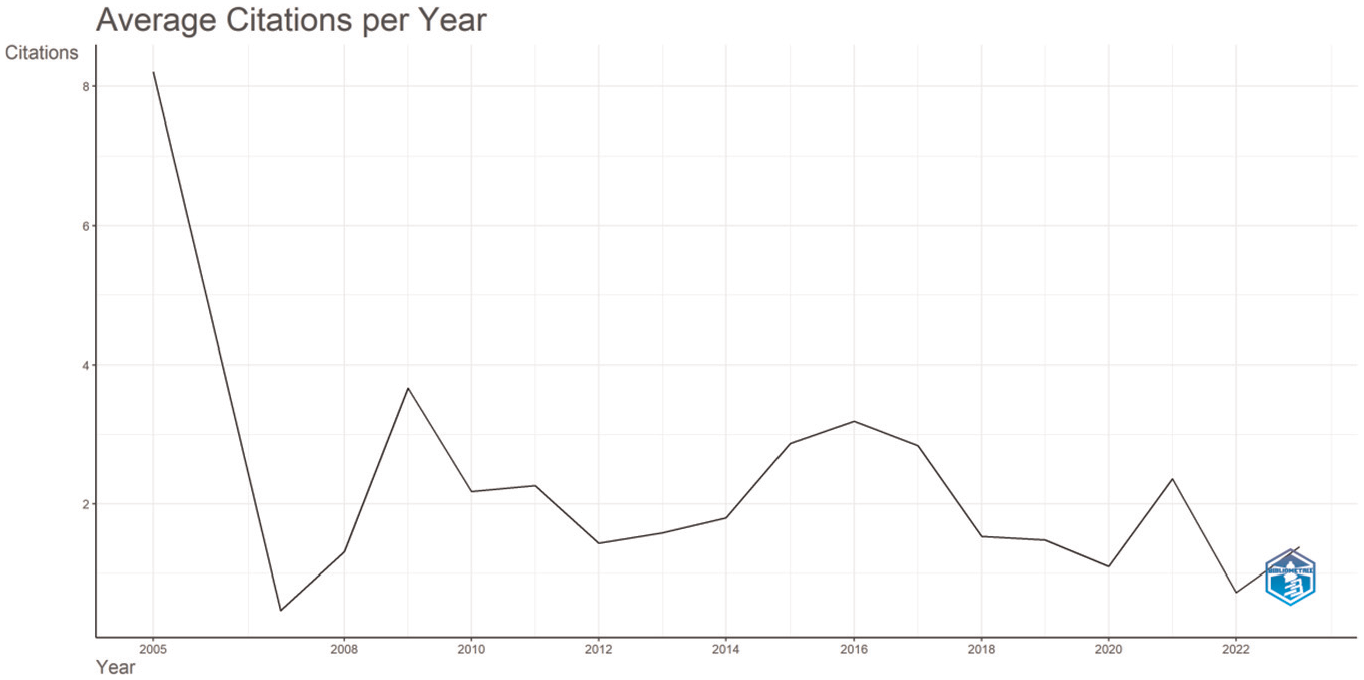
Annual average citation of publications from 2003 to 2023.3.
Analysis of Historical Citation Network
Historical citation network analysis can help to better understand the developmental evolution and intellectual structure of language teachers’ self-efficacy research to access key literature at different stages. The historical direct citation network is generated in Figure 5. Each node inside represents a key document and the connecting lines between them signify the association between publications.

Historical citation network.
Figure 5 presents the citation relationships among the top 17 local cited articles with only two subnetworks in different colors. It can also be seen in the figure that there are a few years in which nodes do not exist, suggesting that there are no core articles of high impact in these years. The first node in this figure is Teachers’ perceived efficacy among English as a language teachers in middle schools in Venezuela. This study explored English teachers’ self-efficacy beliefs in Venezuela and found that teachers’ self-efficacy was correlated with their self-reported English proficiency (Chacon, 2005). Results also indicate that teachers’ efficacy for instructional strategies is higher than efficacy for management and engagement. As the earliest highly cited publication, this article lays the foundation and provides references and directions for the development of language teachers’ self-efficacy research.
The second subnetwork consists of only two core documents that assess the impact of in-service training on language teachers’ self-efficacy. In his research, Kormos (2017) investigated whether language teachers’ self-efficacy differed before and after participating in a massive open online course (MOOC). The results showed that participants had more positive attitudes and higher self-efficacy beliefs after the course compared to at the beginning of the course and participants who completed more tasks during the course showed increased self-efficacy after the course. This study points out the positive impact of MOOC on language teachers’ self-efficacy and suggests that such programs should be included in pre-service and in-service language teacher training programs.
Analysis of Highly Cited Literature
The citation of the literature can reflect the academic value of the literature in a certain field, and the highly cited literature can, to a certain extent, reflect the research focus and research results of a certain research field, lay the foundation and model for the research and development of a certain field, and provide important references and directions for the subsequent scholars. Research papers’ influence is usually measured by citations which can be calculated by local citation score (LCS) and global citation score (GCS). LCS refers to the number of citations an article has been cited in the currently collected databases while GCS refers to the number of citations an article has been cited in the entire WoS database. Therefore, the local citation score must be less than or equal to the global citation score. Table 2 demonstrates the top 10 most cited articles based on global citation score. Chacon’s (2005) article, which reveals that there is a positive correlation between teachers’ self-efficacy and language proficiency, has both the highest LGS and GCS.
Top 10 Most Cited Documents Based on Global Citations.

The second most globally cited document is authored by Frenzel. By developing a four-item scale (Teacher Emotions Scale, TES) for three of the most relevant emotions of enjoyment, anger, and anxiety, his study examines the reliability and internal validity of the four scales and provides consistent evidence of theoretically meaningful relationships between teachers’ general affect, burnout, job-satisfaction and self-efficacy (Frenzel, 2016).
Self-efficacy, Reflection, and Burnout among Iranian EFL Teachers: The Mediating Role of Emotion Regulation written by Fathi is the third most globally cited document with 74 global citations. This study tests structural models of teachers’ reflection, self-efficacy, burnout, and emotion regulation among Iranian EFL teachers. It reveals that self-efficacy, emotion management, and reflection have the potential to reduce teachers’ burnout, suggesting that EFL teacher training should focus on these aspects (Fathi, 2021). Both these two articles have high GCS, but their local citation scores are almost zero, suggesting that their research topics are broader and scholars have well-integrated language teachers’ self-efficacy with other research areas.
Analysis of Most Relevant Journals
The analysis of journals in the literature is not only useful in pointing out the sources of high-quality works in the field and identifying influential journals in the field but also in providing researchers with the necessary guidance in locating the literature and publishing their works. Table 3 demonstrates the top 10 most relevant sources of language teachers’ self-efficacy research in terms of the number of publications. These journals are the most prolific in the field of language teachers’ self-efficacy and they have made important contributions to the development and advancement of this research topic.
Top 10 Most Relevant Journals.
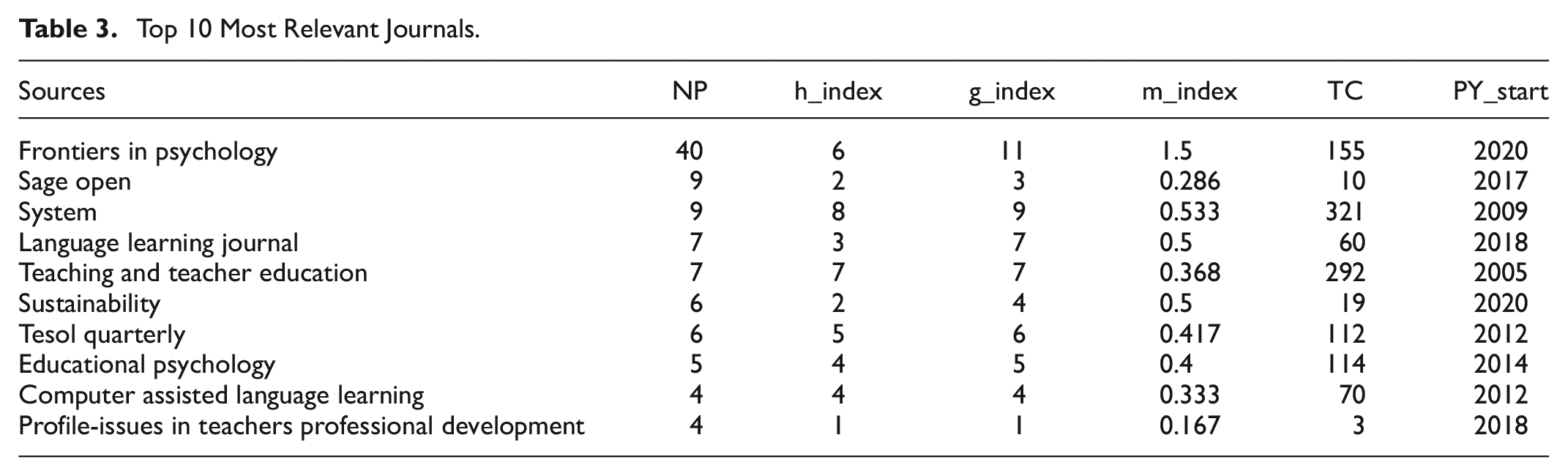
Productivity does not completely reflect the influence of a journal. It is also very important to analyze the impact of a journal. H-index can be used to measure a journal’s impact with H stands for the number of high citations. The higher the h-index is, the greater the journal’s contribution and influence in a given field is (Sun & Wang, 2020). From the perspective of citations, the top 5 most influential journals are System (Total Citation = 321; h-index:8), Teaching and Teacher Education (292; h-index:7), Frontiers in Psychology (155; h-index:6), Educational Psychology (114; h-index:4), and Tesol Quarterly (112; h-index:5). It can be concluded that these are the most influential and leading journals in the field of language teachers’ self-efficacy research. Among them, System and Teaching and Teacher Education are the two core journals with the longest history, the greatest academic influence, and the highest document quality in language teachers’ self-efficacy research.
It is worth noting that although Frontiers in Psychology has published most articles, its total citations and h-index are only in the third place. However, System and Teaching and Teacher Education only publish nine and seven articles respectively, their total citation and h-index are far higher than other journals, revealing that these two journals are the most influential in the development of language teachers’ self-efficacy research.
The source evolution of the top five productive journals is presented in Figure 6, showing the number of publications of these five journals from 2005 to March 2023. As can be seen, the publications in these five journals all present a stable upward trend, especially in recent years. The growing trend in publications also demonstrates that System is the earliest to publish articles on language teachers’ self-efficacy and it continues to exert influence until now. Instead, Frontiers in Psychology has only been publishing on this topic since 2020, but it has become the most prolific journal with 40 articles published in just three years, and shows strong development momentum.

Source dynamics of language teachers’ self-efficacy research.
Main Contributors Based on Authors, Countries, and Affiliations
Analysis of Productive Authors
According to Lotka’s Law, in the field of language teachers’ self-efficacy research, 481 out of 518 authors published one article, accounting for 92.7% of the total. There is only one author who has published six articles. It can be concluded that most authors have published only one article and there are very few high-yielding authors, which indicates that the contribution of the research papers in this field mainly comes from low-yielding authors. Besides, it also indicates that the research on language teachers’ self-efficacy is not mature and stable enough and the core group of authors in this field has not yet been formed.
Biblioshiny evaluates the academic influence of authors through the H index, G index, total number of citations, and number of publications, which comprehensively reflects the authors’ academic outputs and academic contributions through the objective analysis of the number of publications and citations, and helps researchers to identify the research experts and leading figures in a certain research field. The top 10 productive authors are presented in Table 4. Wyatt from Khalifa University ranks first in terms of the number of publications and he is the most productive author on this research topic. Wyatt has contributed six documents over the past 20 years and has got 102 citations with 17 citations per document. It can be seen that Wyatt’s publications are of high quality and he has made significant contributions to language teachers’ self-efficacy research. His research interests mainly concentrate on language teachers’ self-efficacy beliefs especially the use of beliefs and their relationship with practical knowledge.
Top 10 Prolific Authors.

Fathi, Faez, and Zhang tied for second place with four published papers each. It is worth noting that Fathi, from the University of Kurdistan, has concentrated on teachers’ self-efficacy since 2021 but has reaped 88 citations in just 2 years with 22 citations per document. His research interests mainly focus on the relationship between language teachers’ self-efficacy and emotional factors, especially the interactive correlation between teachers’ self-efficacy and factors such as emotion regulation, job burnout, and work engagement. Faez from the University of Western Ontario also publishes four articles and receives 66 citations with 16.5 citations per document. His research interests cover the factors influencing language teachers’ self-efficacy, the interrelationship between language proficiency, and the measurement of language teachers’ self-efficacy beliefs. In addition, Zhang from the University of Auckland has a total of 53 citations in his works related to language teachers’ self-efficacy. He mainly pays attention to the relationship between language teachers’ self-efficacy and various internal and external factors such as working environment and motivation. The top 10 authors have all published more than two papers in this field and many researchers have only begun to engage in this field in recent years.
Figure 7 presents the most productive authors’ research production over time. The size of the circle represents the number of published documents and the shade of the color signifies the amount of citations (Xie et al., 2020). It can be seen that Wyatt published articles from 2010 to 2021, making significant contributions to the development of teachers’ self-efficacy research. However, it demonstrates that many researchers have just begun to explore this topic in recent years, indicating that research on language teachers’ self-efficacy is still in the rising stage and has great development potential in the future.

Authors’ production over time.
The productivity of authors in the number of published documents does not completely equal their influence on the number of total citations (Gao, 2022). Table 5 shows the top 15 authors in terms of the number of citations. The most influential author in the field of language teachers’ self-efficacy is Chacon from the University of Los Andes Tachira, harvesting a total of 156 citations. His article Teachers’ perceived efficacy among English as a language teachers in middle schools in Venezuela attracted a great deal of scholarly attention and became a seminal article in the development and advancement of the field.
Top 15 Influential Authors.

Measuring Teachers’ enjoyment, anger, and anxiety: The Teacher Emotions Scales (TES), co-authored by seven researchers, tests the relationship between general effect, burnout, job satisfaction, and self-efficacy (Frenzel, 2016). It has important theoretical and practical implications for the research on language teachers’ self-efficacy. Wyatt is another influential researcher whose publications have been cited 102 times and Fathi ranks fourth with a total citation of 88. Fathi’s works provide important guidance and direction for research on language teachers’ self-efficacy from psychological perspectives.
Leading Countries
The discussion of countries can reflect the progress and results achieved by different countries in a particular field of research as well as understanding the cooperation between countries in research, identifying highly productive and influential countries in the field, and providing references for researchers to draw upon. Figure 8 demonstrates the corresponding authors’ countries of the articles. MCP means the number of co-authored publications between authors from different countries while SCP stands for the number of co-authored articles between authors from the same country. The MCP Ratio denotes the ratio of cooperation between different countries.

Corresponding authors’ country.
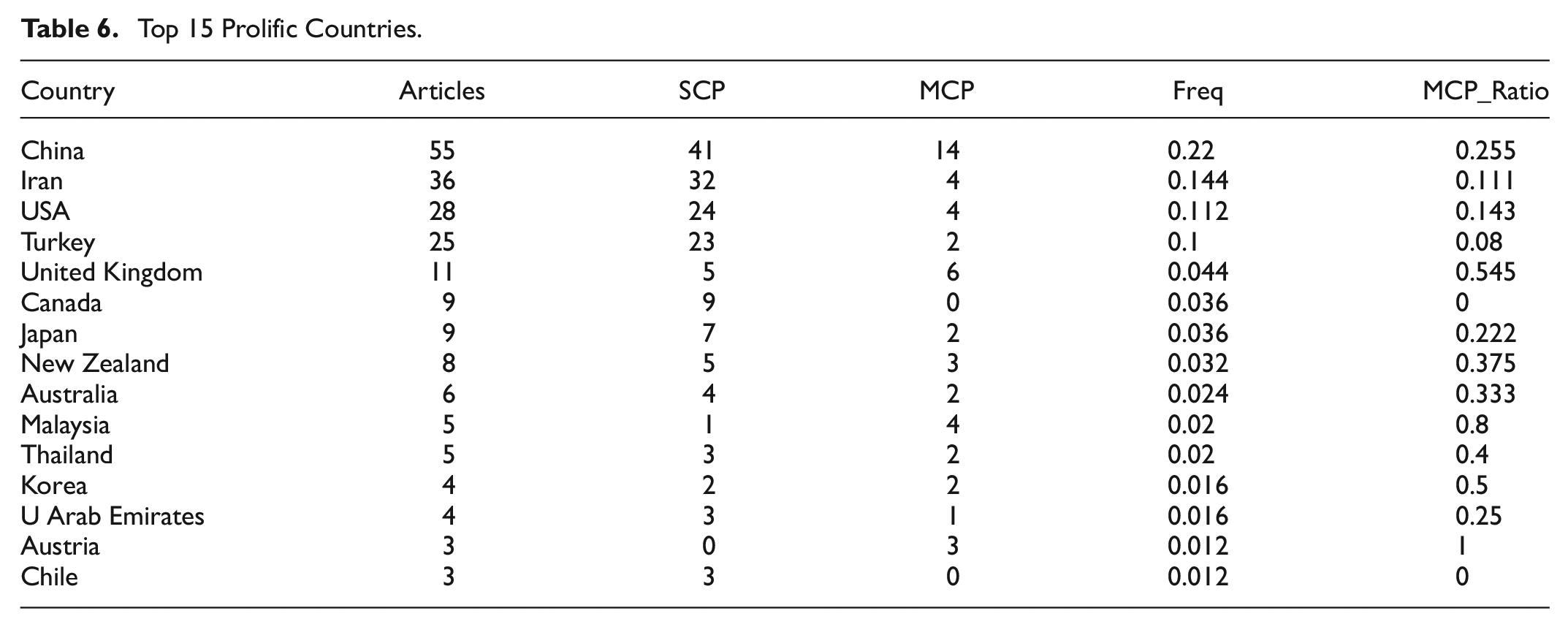
As Figure 8 shows, SCP is much larger than MCP for most countries and it indicates that researchers of language teachers’ self-efficacy are more inclined to cooperate within the country rather than to cooperate internationally. Although in terms of quantity, China conducts the most international cooperation among authors, its MCP ratio is not the highest. Austria and Germany have the highest MCP rate with three articles all published through international cooperation among authors. As for Malaysia, it has the MCP ratio of 0.8. All these three countries have a strong willingness to conduct international cooperation in language teachers’ self-efficacy research. However, it can be concluded that researchers generally prefer to cooperate within the country rather than looking for international cooperation.
The top 15 prolific countries involved in language teachers’ self-efficacy research based on the number of publications are shown in Table 6. It can be seen that China is the most productive country with 55 publications, followed by Iran (36), the United States (28), Turkey (25), the United Kingdom (11), Canada (9), Japan (9), New Zealand (8), Australia (6), Malaysia (5), and Thailand (5). Obviously, China has published most articles, showing its indispensable and important position in this field. In addition, in terms of regional distribution, seven of the top 15 productive countries are in Asia, which proves Asia’s emerging impact in this research field.
Top 15 Prolific Countries.
With regard to the number of citations from different countries, Table 7 lists the top 15 most cited countries in language teachers’ self-efficacy research. As shown in Table 7, China is the most cited country with 372 total citations and an average of 6.8 citations per article, followed by Iran with 335 total citations. Only China and Iran reach a total of more than 300 citations, revealing their major contribution to language teachers’ self-efficacy research.
Top 15 Influential Countries.

With a total citation of 295, the United States ranks third, then followed by the United Kingdom with a total citation of 268 and Turkey with 184 citations. It is worth mentioning that Germany gets a total citation of 166 with only three articles and the average citation of each article is as high as 55.3, showing the high quality and influence of these articles. As for the average citations per article, Venezuela (156) takes the first place, followed by Germany (55.3), Singapore (25.5), the United Kingdom (24.64), Korea (24), Belgium (16), Canada (12.3), and New Zealand (11.9). Of these countries, it can be concluded that despite the large number of articles published by developing countries, the influence of developed countries is still higher.
Analysis of Leading Affiliations
The top 15 leading affiliations of language teachers’ self-efficacy research are shown in Figure 9. Islamic Azad University ranks first in terms of the number of publications (21), followed by University of Auckland (11) and Henan University (8), Mersin University (8), Razi University (8), and University of Kurdistan (8). The Chinese University of Hong Kong, Education University of Hong Kong, University of Macau, and University of North Carolina at Chapel Hill each published 7 articles ranking in the fourth position. It is observed that the top 15 leading affiliations have published at least 5 articles on language teachers’ self-efficacy. It can also be seen that five of the top 15 institutions are from China, three from Iran, two from Turkey, two from the United States, and one each from New Zealand, Australia, and Thailand. Therefore, it seems that China and Iran have played a key role and made great efforts in language teachers’ self-efficacy research.

Most relevant affiliations.
Research Content and Hotspots Analysis
Analysis of High-frequency Keywords
Keywords are highly condensed and summarized for the topic of an article, which is the essence and core of an article. High-frequency keywords and keyword co-occurrence are important reference indexes for bibliometric research, which can represent the research hotspots in the field and reflect the close relationship between research topics and the degree of attention. In this study, World Cloud and a 20-node Word Tree Map have been constructed using “Author’s Keywords” search criteria as shown in Figures 10 and 11. Within the authors’ keyword occurrence, the topic of “belief” has been mentioned 80 times, accounting for about 13% of the total keywords. Other frequent keywords are “self-efficacy” (8%), “students” (5%), “job satisfaction” (5%), and “English” (5%). These five most frequent keywords account for about 36% of the total number of keywords and therefore are the most popular research content.
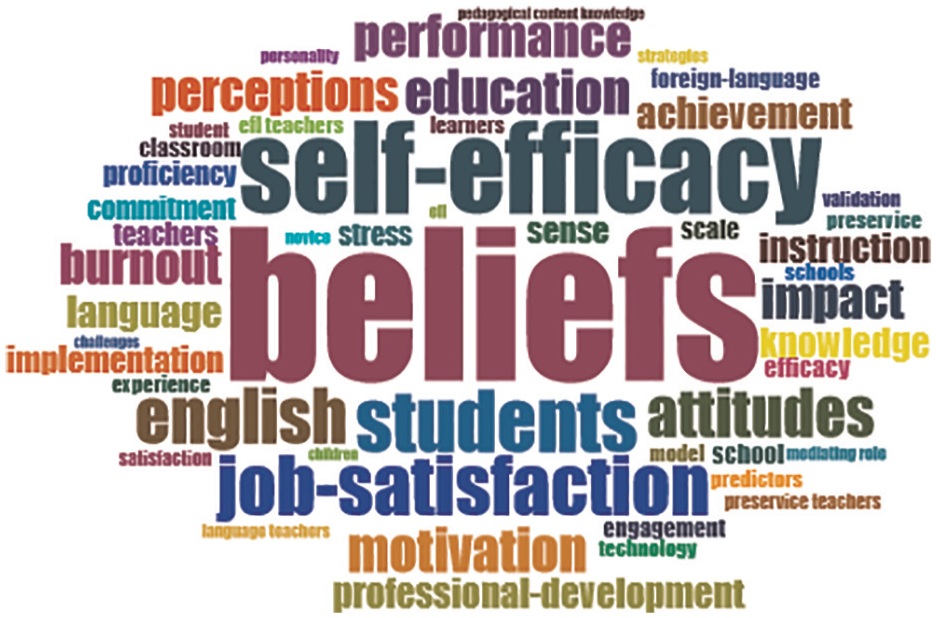
Word cloud.

Tree map.
The most frequent word is “beliefs,” indicating that there is an inseparable relationship between language teachers’ self-efficacy and their beliefs. “Job satisfaction” is the fourth frequently occurring keyword which indicates that an increasing number of researchers are exploring the interactive relationship between teachers’ self-efficacy and job satisfaction. In addition, the third frequently occurring keyword is “students” which implies that language teachers’ self-efficacy may inevitably affect students’ learning and development. The emergence of words like “motivation,” “achievement,” “knowledge,” “proficiency,” and “instruction” shows their close relationship to language teachers’ self-efficacy.
Figure 12 demonstrates the cumulative word frequency of the top 10 most frequent keywords over the past 20 years. As can be observed from the figure, the development of these 10 high-frequency keywords in the past 20 years is on the rise. Keywords such as “beliefs,” “students,” “attitudes,” and “education” have been in development for a long time. “Job satisfaction,” “burnout,” and “motivation” later emerged faster which have shown strong developmental momentum and gradually became research hotspots and thematic trends in this field of study.
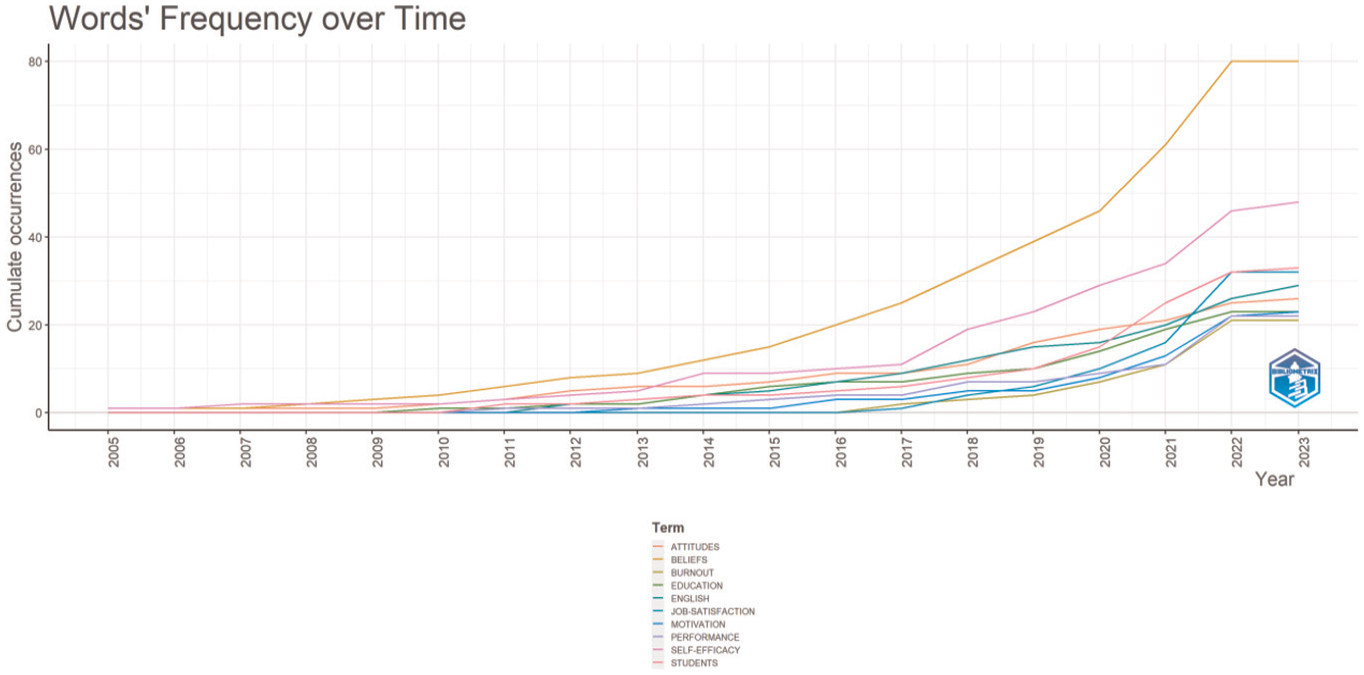
Word frequency trend.
Cluster Analysis
Cluster analysis is often used in bibliometric analysis. The categories with the closest distance are merged by the established algorithm of the program and a large research field is divided into several hot topic areas. Each keyword in the area has great similarities, but there are great differences between categories. A multiple correspondence analysis (MCA) reflects the similarity between keywords by compressing a large number of keywords into a two or three dimensional space (Hadid, 2022).
Figure 13 demonstrates the keyword co-occurrence and the keywords in the figure are marked with different colors. From the figure, it can be seen that language teachers’ self-efficacy research can be broadly categorized into four clusters. In this study, hierarchical clustering is also used to cluster the highly frequent keywords based on MCA. As shown in Figure 14, a tree dendrogram detailing the affinity relationships between keywords of language teachers’ self-efficacy research is generated.

Co-occurrence of keyword.

Topic dendrogram of the hierarchical cluster of keywords.
The tree dendrogram can be divided into two big clusters. The first cluster is the largest one which contains many keywords such as “impact,” “job-satisfaction,” “burnout,” “stress,” “achievement,” “knowledge,” “work engagement,” “determinants,” “mediating role,” “classroom,” “strategies,” “instruction,” “attitudes,” “students,” “learners,” “performance,” “motivation,” etc. These researches mainly pay attention to the effects of self-efficacy on language teachers as well as the interrelationships between teachers’ self-efficacy and their teaching and emotional factors. The second cluster, on the other hand, includes only four keywords such as “EFL,” “novice,” “proficiency,” and “schools,” which are not easily focused. The more detailed information about the categories is presented below.
The first category of research mainly focuses on the beliefs and cognitive aspects of language teachers’ self-efficacy. It includes keywords such as “beliefs,” “perceptions,” “attitudes,” “challenges,” “experience,” etc. Self-efficacy beliefs, as an internal psychological trait, have an important impact on language teachers’ words and behavior, which in turn affects their professional development. Thompson (2019) investigated the sources of self-efficacy formation among Japanese high school English teachers and found that social feedback from colleagues was a key source of teachers’ self-efficacy. He notes that this may reflect the influence of the Japanese culture and personal and alternative teaching experiences were also identified as sources of self-efficacy formation.
The second type of research mainly focuses on the relationship between language teachers’ self-efficacy and their emotional factors such as job satisfaction, burnout, stress, engagement, and so on. Researchers are committed to exploring the relationship between language teachers’ self-efficacy and their internal and emotional activities and then observing how they affect teachers’ work and research so as to ultimately provide effective suggestions and methods for teachers’ professional development and enhancement. Teachers’ work is stressful and they are vulnerable to various working pressures which easily makes them experience professional burnout. Researchers have looked for ways to reduce teacher burnout by exploring the relationship between language teachers’ self-efficacy and burnout. Zhou (2022) found that grit and self-efficacy can negatively predict EFL teachers’ burnout; grittier and self-efficacious teachers are less likely to experience burnout during their professional life.
The relationship between language teachers’ self-efficacy and teaching behavior and classroom management is another important research topic. Language teachers’ self-efficacy not only affects teachers’ own motivation and initiative but also will be reflected in their teaching, which in turn influences learners. Moreover, in modern language teaching, a variety of new teaching methods and tools continue to emerge and it is crucial for teachers to be able to update their teaching ideas and manage the class in a more reasonable way. Teachers’ self-efficacy predicts their use of teaching methods to a certain extent and researchers have found that there is a significant relationship between English teachers’ self-efficacy and their use of teaching methods. As English teachers’ self-efficacy develops, they are more inclined to use communicative pedagogies (Kaygisiz, 2018). Therefore, research on language teachers’ self-efficacy is of great significance for refining teachers’ teaching methods as well as students’ learning. The interactive relationship between language teachers’ self-efficacy and teaching has become a hot topic in this field.
The fourth category of research focuses on the effects of some external factors such as teacher training, culture, and environment on language teachers’ self-efficacy especially novice and pre-service teachers. For language teachers, various kinds of teacher training programs are essential. Given the importance of self-efficacy, whether language teacher training programs are effective and what methods can improve their self-efficacy have become hot topics among researchers. Some researchers have found that teacher training programs and instructions have a positive impact on language teachers’ self-efficacy development by increasing teachers’ confidence in teaching and self-efficacy beliefs (Tsui, 2018; D. Wu et al., 2019). This is helpful and influential in language teachers’ imagination of their roles as teachers and their pedagogical development. Therefore, through these studies, it can be concluded that schools can help teachers especially novice teachers to improve their self-efficacy by providing them with appropriate training and working conditions.
From the above analysis, it can be seen that many factors connected with language teachers particularly EFL teachers’ self-efficacy have been studied in recent years. These factors include internal and external ones. Self-efficacy is a complicated psychological trait which is related to self-belief, motivation, learning strategy, class teaching, job burnout/satisfaction, etc. As for external factors, culture, and working environment are influential elements and they have also been studied according to keywords analysis.
Thematic Evolution
Thematic maps can clearly help researchers illustrate the development trend of different research themes in a certain field and the research themes and research hotspots at different stages, which is also conducive to predicting the future development direction to a certain extent. As exhibited by Figure 15, the keyword-based Sankey diagram demonstrates the thematic evolution and developmental path of language teachers’ self-efficacy research. In order to better visualize the development of thematic hotspots, thematic maps in Figures 16 to 18 have been drawn. In these figures, the horizontal axis represents centrality (x-axis) and the vertical axis signifies density (y-axis). The higher the centrality is, the greater the influence of the theme is on other themes and the higher the density is, the more maturely the theme develops (R. Wu et al., 2022).

Thematic evolution of keywords.

Thematic map from 2003 to 2012.

Thematic map from 2013 to 2018.

Thematic map from 2019 to 2023.3.
Each thematic map is divided into four quadrants with different themes. The themes in the first quadrant (Motor themes) are significant and highly developed in language teachers’ self-efficacy research with high centrality and density. Although the themes in the second quadrant (Niche themes) are well-developed, they are relatively isolated and less important with high density but low centrality. Emerging or declining themes in the third quadrant have weakly developed and are marginal in recent years with both low centrality and density. The themes in the fourth quadrant (Basic themes) are also very vital to the research field but are not mature enough to cover the general topics.
From 2003 to 2012, the research on language teachers’ self-efficacy was in the initial stage, so there were relatively few research themes including “belief,” “self-efficacy,” “English,” “instruction,” “students,” “education,” “attitudes,” etc. Among them, “belief,” “self-efficacy,” and “English” are the most important and best-developed research themes. “Attitudes” and “scale” are the basic themes with good development momentum in this field and these themes encompass many different areas. In this phase, scholars have focused on beliefs and attitudes about language teachers’ self-efficacy and the measurement of their self-efficacy. Some researchers have investigated whether the self-efficacy beliefs of elementary school English teachers change in response to a number of variables such as course training (Guven & Cakir, 2012). “Students” and “instruction” in the second quadrant are niche themes that are well-developed while “education” in the third quadrant belongs to emerging or declining themes that are weakly developed.
From 2013 to 2018, research on language teachers’ self-efficacy began to develop stably with many research themes and hotspots emerging. For example, “motivation,” “classroom,” “perception,” “environment,” and “achievement emotions” are new emerging keywords. “Students” and “instruction” have evolved from niche themes in the second quadrant to motor themes in the first quadrant and “education” has evolved from the third quadrant to the first quadrant, becoming significant and highly developed themes. From 2013 to 2018, “beliefs,” “education,” “classroom,” “perceptions,” and “attitudes” are motor themes with high centrality and density, attracting many researchers’ attention. “Self-efficacy,” “sense,” and “performance” are basic or transversal themes with high centrality but low density. At this stage researchers mainly pay attention to the interactive relationship between language teachers’ self-efficacy in classroom settings and their teaching behavior, language teachers’ perception of self-efficacy, and the influence of some other factors on teachers’ self-efficacy.
Language teachers’ self-efficacy, as an internal belief of teachers, plays a vital role in all aspects of teachers. It also affects students’ learning effects by influencing teachers’ teaching methods and styles. Baleghizadeh (2017) revealed that the teaching style of language teachers is one of the important factors that are related to self-efficacy and this is an effective factor in generating better teaching performance and enhancing students’ achievement.
Between 2019 and March 2023, “job satisfaction,” “burnout,” “stress,” and “language literacy” are newly emerging motor themes that should be further developed given their importance for future research. In addition, it can be seen that the study of language teachers’ self-efficacy beliefs has always been the most dominant theme in this field. Although it has changed from the first quadrant in the second phase to the fourth quadrant, “education” is still important as the general theme. The second quadrant primarily includes specific but underrepresented research themes that are still well-developed and rapidly growing, which include “language proficiency,” “Chinese,” and “classrooms.” “Women,” “identity,” “trust,” and “social cognitive theory” in the third quadrant have been studied but have undergone a decreasing trend with low centrality and density.
During this period, research themes and hotspots have concentrated on the interactive relationships between language teachers’ self-efficacy and emotional factors as well as the relationship between teachers’ own factors and the influence of self-efficacy. As an intrinsic trait, self-efficacy is closely related to teachers’ teaching and working. Ali and Mehdi (2020) investigated the relationship between EFL teachers’ self-efficacy and burnout levels in Iranian English language teachers and found that there is a significant correlation between teachers’ self-efficacy and burnout. Among EFL teachers, a higher level of burnout is correlated with a lower level of self-efficacy. As a psychological characteristic of teachers, self-efficacy affects their teaching methods and working styles by influencing their perceptions and emotions. In addition, it also indirectly influences learners’ learning efficiency and achievements. Therefore, teachers’ self-efficacy is an indispensable research area in language teaching and learning which is worthy of more in-depth and detailed research and development in the future.
Discussion
Language teachers’ self-efficacy is becoming an important concept in the professional development of language teachers. Researchers in the field of study have contributed greatly to exploring the development of language teachers’ self-efficacy. Although there are more studies on language teachers’ self-efficacy, there is a lack of a comprehensive overview and bibliometric analysis on this topic. Bibliometric analysis is a very useful tool for analyzing published documents and databases, so it is important and necessary to conduct a bibliometric analysis. To fill this gap and better answer the research questions, this paper systematically describes the methodology and data sources and applies Biblioshiny to process and analyze the WoS data in detail.
In terms of annual publications, the number of publications on language teachers’ self-efficacy research has been on the rise in general, especially in recent years, when the number of publications has surged. The number of annual publications is uneven. Although the research on teachers’ self-efficacy began earlier, the research on language teachers’ self-efficacy began later, and the research in this field began to gradually attract attention in the last two decades. It was not until the last decade that the number of publications began to increase significantly. Therefore, in the future, more researchers will devote themselves to the study of language teachers’ self-efficacy to conduct comprehensive research on the field from all aspects and to promote and improve the development and maturity of language teachers’ self-efficacy research.
Based on the most relevant authors, countries, and institutions, five influential language teacher self-efficacy research countries can be identified: China, Iran, the United States, Turkey, and the United Kingdom. International cooperation has also been reflected and strengthened in language teachers’ self-efficacy research. Surprisingly, in addition to some traditionally developed countries that have made significant contributions to the field, some developing countries have risen to the forefront and are gradually assuming leading and dominant roles, showing the strong vitality of developing countries and the increased emphasis and commitment to research. This finding suggests that developing countries can also be the backbone and leading force in teacher education research, thus providing encouragement, confidence, and reference for some developing countries to promote their national development in certain fields of academic research.
In terms of the themes of the research, the most relevant sources reveal that the main direction of language teachers’ self-efficacy research may be about the relationship between teachers’ self-efficacy and teachers’ professional development, especially about teachers’ emotions such as burnout and classroom teaching. These scholars’ focus on language teachers’ self-efficacy has expanded from beliefs and measurements to more complex and authentic classroom teaching and professional development. Given the importance of teachers’ self-efficacy, how to effectively improve it will also become a pressing research question. The study of language teachers’ self-efficacy is an emerging topic, which makes the research on this topic difficult and stagnant due to the psychological state of teachers, but at the same time, it also shows that this area of research contains a vast space for development that needs to be developed and improved by more researchers.
Conclusion
Teachers’ self-efficacy is of great importance to their professional development. Although research on language teachers’ self-efficacy has drawn considerable attention in recent decades, systematic literature review of this field still lacks. This article, by using Biblioshiny, presents the research status of language teachers’ self-efficacy from research production, citation and content. Also, it provides a clearer understanding of this particular research field which is more complicated and meaningful than it was previously thought. The first question of this study concerns the distribution pattern of annual academic publications on language teachers’ self-efficacy research in the recent two decades. The number of published articles has shown an undulating upward trend since 2005, maintaining a relatively steady increase afterward. Before 2012, the research on language teachers’ self-efficacy was in its starting stage with a small number of annual publications. From 2013, the number of articles began to grow steadily until it experienced a rapid growth after 2019. From the distribution pattern of annual publications, it can be predicted that the future development momentum will remain strong.
In examining the second question regarding influential journals, articles, and major contributors to the field of language teachers’ self-efficacy, it is noteworthy that some journals received high citations with fewer publications. It is revealed that Frontiers in Psychology is the most prolific journal in the field of language teachers’ self-efficacy research with 40 published articles. On the other hand, System is the most influential journal with 321 citations with only nine articles. Chacon’s article titled Teachers’ Perceived Efficiency Among English as a language teachers in middle schools in Venezuela is the most cited document with both the highest GCS and LCS and it has made an extraordinary contribution to the study of language teachers’ self-efficacy research, laying an important foundation for the study of language teachers’ self-efficacy research.
The main contributors to the research on language teachers’ self-efficacy have been listed with authors, affiliations, and countries. Wyatt is the most prolific author, ranking first in terms of the number of publications, h-index, g-index, and citations. Fathi follows in second place and although his research has been conducted for a relatively short period of time, he has published a number of influential articles. Islamic Azad University, which has published most articles on language teachers’ self-efficacy, is the leading and prolific research institution in this field. As far as countries are concerned, China is the biggest contributor to language teachers’ self-efficacy research, showing the significant power and outstanding contribution of developing countries to this research field. However, developed countries such as the United States and the United Kingdom still have a strong influence in this field. It is also found that in the study of language teachers’ self-efficacy, researchers from various countries prefer cooperation within countries rather than seeking cooperation internationally, reflecting researchers’ cooperation between countries needs to be strengthened.
As for the thematic evolution of keywords and hotspots in language teachers’ self-efficacy research, the top five high-frequency keywords in language teachers’ self-efficacy research are “beliefs,” “self-efficacy,” “students,” “job satisfaction,” and “English.” However, the research hotspots of language teachers’ self-efficacy have kept changing over time. In the beginning stage, scholars mainly focused on the beliefs and attitudes of language teachers’ self-efficacy. From 2013 to 2018, researchers then shifted more attention to the interactive relationship between language teachers’ self-efficacy and teaching. In the last few years, the interactive relationship between language teachers’ self-efficacy and emotional factors has become a hot topic for researchers.
Therefore, according to the keyword clustering network, the research hotspots of language teachers’ self-efficacy research can be divided into four main categories. The first category focuses on the study of language teachers’ own self-efficacy including teachers’ self-efficacy beliefs, perceptions, attitudes, and so on. The second category concentrates on the interactive relationship between teachers’ self-efficacy and emotional factors as well as the impact on teachers’ own professional development. The third category pays attention to the correlations between language teachers’ self-efficacy and teaching behaviors, class management, and students’ learning. Language teachers’ self-efficacy is internalized to influence their own initiative and motivation while externalized to influence the teaching process and dramatically affect students’ learning. Thus, the relationship between language teachers’ self-efficacy and teaching, curriculum, and students constitutes the third category of research in this field. The fourth category focuses on the impact of external factors such as teacher training and their working environment on language teachers’ self-efficacy.
Teachers’ self-efficacy is a complex concept, which as an internal psychological experience of teachers is inextricably linked with all aspects of teachers, especially with their professional development and classroom teaching. Language teachers’ self-efficacy is essentially the subjective feeling of teachers about their own teaching and development. Only when teachers objectively and fairly evaluate their own teaching can language teachers’ self-efficacy become the “predictor” of their teaching behavior and teaching effect. Only when teachers have certain professional knowledge and language skills can self-efficacy have a positive effect on their teaching behavior. Therefore, the first step for language teachers to improve their self-efficacy is to strengthen their professional knowledge of language and education, especially their understanding of the nature of language teaching and their knowledge of students and learning contexts. This knowledge exists in teachers’ minds, influences their cognitive processing, and directs their teaching behaviors which play a great role in the formation of teachers’ self-efficacy.
In addition, language teachers’ reasonable and positive self-efficacy is a good psychological foundation for teachers’ professional development, which helps teachers to critically reflect on and creatively construct their teaching practice, and can stimulate teachers’ professional self-confidence as well as teaching motivation, thus making teachers hold an optimistic attitude toward their professional development prospects. Language teachers’ self-efficacy is the result of both internal and external factors. The establishment of a learning community can play a positive role in language teachers’ self-efficacy. Teachers communicate, discuss, and learn from each other, complement each other’s strengths and weaknesses, and engage in positive self-reflection and evaluation of their professional development and teaching, thus providing a channel for teachers’ learning, a link between teachers, and a direction for teachers’ self-professional development.
Although the improvement of language teachers’ self-efficacy is dependent on teachers themselves, teachers are constantly influenced by the external environment, especially the group team in which they work. Therefore, schools should strive to create a relaxed, equal, and harmonious environment for teachers, and encourage and support teachers to engage in various forms of pedagogical exchanges. Schools can provide appropriate training for language teachers, especially novice teachers, as needed, and allow experienced teachers to mentor young teachers, so as to encourage teachers to continue to learn and improve and to increase their self-confidence. In addition, schools can improve the teacher evaluation system and raise teachers’ salaries to improve teachers’ sense of satisfaction and self-identity. As for pedagogical implications, more student-centered teaching methods such as communicative language teaching (CLT) and task-based language teaching (TBLT) should be adopted in class teaching to develop teachers’ self-efficacy.
Limitations and Future Directions
The last research question deals with the future directions of language teachers’ self-efficacy research and the limitations of this review article. First of all, through analysis, it can be found that most of the research on language teachers’ self-efficacy is conducted on English teachers. “English” is a frequent keyword in the Word Cloud. Although English is the most widely used language and its teaching scale is very large, other language teachers’ self-efficacy research should not be ignored. However, research on other language teachers’ self-efficacy is scarce in the international academic community. Therefore, future research could focus more on other language teachers’ self-efficacy research.
Secondly, in terms of research subjects, college language teachers are the main targets in language teachers’ self-efficacy research. Tertiary level language teachers are not only responsible for teaching but also for research activities. Therefore, self-efficacy will have a broader impact on college language teachers, thus college language teachers will remain the focus of researchers. Although higher education takes the main task of cultivating high-level language talents, language teaching in primary and secondary schools also plays an important role in the language education system. Currently, there is relatively less research on self-efficacy of primary and secondary school language teachers and this is detrimental to the overall development of language education. Future research needs to pay more attention to different levels of language teachers’ self-efficacy so that the research will be more comprehensive and extensive.
Thirdly, as for research themes, the interactive correlation between language teachers’ self-efficacy and emotional factors such as burnout, work engagement, and job satisfaction will remain important for future research. Research on language teachers’ self-efficacy should continue to explore how teachers’ personal and external factors affect their self-efficacy under certain sociocultural contexts. In the field of language teacher self-efficacy research, the important role of teacher self-efficacy on students’ learning behavior has been less addressed, which should be the focus of future research. The impact of language teachers’ self-efficacy on learners’ motivation and attitudes needs to be further strengthened. The ultimate goal of language teaching is to motivate students to engage in learning, so further investigation of students’ attitudes can present the whole picture of teaching and learning improvement with the help of teachers’ self-efficacy development. In addition, so far most researchers have studied teacher efficacy from the perspective of individual teachers, but not much literature has been accumulated on teachers’ collective efficacy, which is a concern for future researchers.
To sum up, this study still has some limitations despite following a rigorous bibliometric analysis procedure. Firstly, the data in this study were only obtained from WoS core collection, thus some important publications indexed in other databases may have been missed. Secondly, this paper confined the language type of the literature to English in the data collection process, thus leading to some relevant articles written in other languages being ignored, resulting in incomplete data. Thirdly, this study limited the type of literature to articles and reviews, which may surely ignore some other types of related articles. Finally, the bibliometric analysis may also have certain defects. Although it can help researchers quickly figure out the development of a research field in a short period of time, the data it requires is easily affected by the quantity, source, and quality of the literature itself, as well as by researchers’ subjective consciousness. The main way of bibliometric analysis is to collect, screen, and organize the literature, but it is unable to analyze and explore the literature in detail and lacks in-depth research.
In view of these limitations, this review puts forward several suggestions for future research on language teachers’ self-efficacy. First, future research could expand the data search scope by integrating documents from different databases (Google Scholar, Eric, Scopus, etc.) in order to incorporate more comprehensive and complete data into the analysis. Second, future studies could include publications in other languages and more different types of documents so as not to miss important works. Thirdly, future research could also incorporate some other techniques and methods such as text analysis to reveal deeper textual information, thus enriching the findings on language teachers’ self-efficacy research. Last but not the least, more attention will be paid to specific measures to develop language teachers’ self-efficacy and their effect on practical language teaching and learning in future research.
Footnotes
Declaration of Conflicting Interests
The author(s) declared no potential conflicts of interest with respect to the research, authorship, and/or publication of this article.
Funding
The author(s) disclosed receipt of the following financial support for the research, authorship, and/or publication of this article: This work was supported by the Philosophy & Social Science Research Projects of Universities in Jiangsu Province [Grant Number: 2022SYJB2245].

Data Availability Statement
The data are available from the corresponding author on reasonable request.