




Abstract
Promoting income growth for farmers in ecological protection areas is a critical prerequisite for the effective implementation and widespread adoption of the ecological compensation mechanism. The study uses the Xin’an River as a case, empirically analyzing the impact of horizontal ecological compensation policies on farmers’ income in the basin, based on panel data from 89 counties in Anhui and Zhejiang provinces between 2007 and 2021, employing the PSM-DID model. We found that (i) overall, the policy increased the income of farmers in the watershed by an average of 16.0%. (ii) In terms of spatial dimension, the policy led to a 24.7% increase in farmers’ income in midstream, significantly higher than in the upstream(11.6%) and downstream (15.9%) regions. (iii) In the temporal context, there was no significant difference in the impact of the three rounds of policies on farmers’ income. This study provides a new perspective in the spatio-temporal research of cross-provincial ecological compensation policies, offers empirical support for evaluating the benefits of the Xin’an River ecological compensation policies to farmers, and serves as an important reference for further optimization of the ecological compensation policy system.
Introduction
Over the past four decades, China has experienced rapid economic growth, but this progress has been accompanied by increasing resource and environmental constraints, with water pollution becoming particularly prominent. Unlike air or heavy metal pollution, which tends to be localized, water pollution exhibits the typical Pigovian externality of “upstream pollution, downstream consequences.” This dynamic has led to imbalances in the responsibilities for governance and the distribution of benefits between the upper and lower reaches of river basins. In response to this issue, the Chinese government has implemented a series of ecological compensation policies, which provide financial incentives to encourage ecosystem service providers to fulfill their conservation obligations, while compensating for the economic losses caused by development restrictions. Among these, Xin’an River serves as China’s first cross-provincial ecological compensation pilot region, involving Anhui and Zhejiang provinces. This case not only provides a practical example for coordinating the ecological responsibilities and benefit distribution between upstream and downstream areas but also offers valuable insights into the design and optimization of ecological compensation mechanisms.
Income distribution effects are a crucial issue in evaluating ecological horizontal compensation policies, and understanding these effects is vital for assessing the sustainability and scalability of such policies. The impact of the Xin’an River ecological compensation policy on farmers’ income exhibits a complex duality. On one hand, the policy creates new income sources for farmers by developing rural tourism, improving agricultural practices, providing skills training, and offering public welfare jobs, which may increase their income levels. On the other hand, stringent water quality assessments have limited the development of high-pollution and high-energy consumption industries, restricting traditional agricultural activities, which may result in decreased income. Therefore, the first research question of this paper is: What is the overall impact of the Xin’an River ecological compensation policy on farmers’ income—positive or negative? From a temporal perspective, the Xin’an River ecological compensation policy has undergone three rounds of adjustments since its implementation in 2012. Each round of the policy has seen changes in the compensation subject, funding sources, and assessment standards. The first pilot (2012–2014) was led by the central government, providing a yearly fund of 300 million yuan, with Zhejiang and Anhui provinces each contributing 100 million yuan, totaling 500 million yuan. Compensation was based on the annual average concentrations of four water quality indicators: permanganate index, ammonia nitrogen, total phosphorus, and total nitrogen, focusing on upstream and downstream areas. The second pilot (2015–2017) saw a gradual reduction in central government funding and an increase in local government contributions. The compensation amount decreased from the first round’s 500 million yuan per year to 400, 300, and 200 million yuan in a step-down model, while a graded subsidy mechanism was introduced with more detailed reward gradients for water quality standards. The third pilot (2018–2020) was entirely funded by local governments in Anhui and Zhejiang, with each contributing 200 million yuan annually, and the central government ceased direct disbursements. The weightings for the assessment indicators were adjusted, with the permanganate index and ammonia nitrogen each accounting for 22%, and total phosphorus and total nitrogen each accounting for 28%. Additionally, the water quality stability coefficient was raised to 0.9. Thus, the second research question of this paper is: Does the temporal variation in policy implementation across different rounds affect farmers’ income differently? From a spatial perspective, 80% of the water system area in the Xin’an River Basin is located in the upstream and midstream regions, which bear stricter environmental management responsibilities to ensure the water quality and quantity for downstream areas, thereby imposing greater constraints on local residents’ livelihoods. In upstream areas like Shexian County in Huangshan City, strict ecological protection requirements have led to the full implementation of pesticide and fertilizer distribution policies, significantly restricting local agricultural production. However, the direct economic compensation is relatively low, leading to limited improvements in farmers’ income. In the midstream regions, such as Tunxi District and Xiuning County, local residents, including reservoir area immigrants and fishermen, have benefited from a range of income sources through economic subsidies and employment opportunities, while also achieving dual benefits of ecology and economy by developing specialized agriculture (e.g., tea cultivation and aquaculture). In the downstream areas, such as Chun’an County in Zhejiang Province, there was no significant industrial restructuring prior to the pilot policy implementation due to a well-developed tertiary industry and fewer industrial enterprises. However, the improvement in water quality in Qiandao Lake after the implementation of the pilot policy significantly boosted local eco-tourism, while also promoting the growth of high-value industries such as organic agricultural products and eco-water products, thus enhancing the market value of ecological products in the downstream areas. Based on this, the third research question of this paper is: Does the implementation of the policy differ between upstream, midstream, and downstream regions, leading to spatial heterogeneity in farmers’ income?
To explore the impact of the Xin’an River ecological compensation policy on farmers’ income and its temporal and spatial heterogeneity, this study analyzes panel data from 89 counties in the Xin’an River Basin across Anhui and Zhejiang provinces from 2007 to 2021. The analysis is based on the Propensity Score Matching-Difference in Differences (PSM-DID) model. The PSM method matches areas with and without policy implementation based on similar characteristics, minimizing the impact of selection bias. The DID method constructs a double difference framework to quantify the income differential effects before and after policy implementation across various time and spatial dimensions. The study finds that the horizontal ecological compensation policy in the Xin’an River Basin significantly boosted farmers’ income, confirming the positive impact of the ecological compensation policy. However, the policy’s effects across spatial dimensions exhibit significant differences, with farmers in the midstream and downstream areas benefiting more than those in the upstream areas. This disparity is primarily due to stricter environmental governance requirements in the upstream areas, while the midstream and downstream areas benefited more from the realization of ecological product value and optimization of economic structures. Furthermore, the income-enhancing effects of the three rounds of the policy did not show significant differences, indicating that while there were changes in governance standards and compensation mechanisms, the overall impact on farmers’ income remained relatively stable.
The significance and contributions of this study are threefold: (i) From a regional perspective, this study reveals the heterogeneous impact of the Xin’an River Basin’s horizontal ecological compensation policy on farmers’ income across different regions and policy stages, providing new insights for watershed governance research and offering empirical support for evaluating the income distribution effects of such policies. (ii) From the perspective of generalizability, the study validates the impact of cumulative temporal effects and regional differences on policy outcomes, providing practical guidance for designing horizontal ecological compensation policies in other river basins and regions. (iii) From a macro level, this study provides empirical evidence from both time and spatial dimensions for constructing a theoretical framework for horizontal ecological compensation mechanisms, contributing academic support for the systematic development of ecological compensation policies and offering valuable lessons for similar policies internationally.
Literature Review
In studies related to the income distribution effects of ecological compensation policies, academic discussions focus on its positive impact on income growth, its insignificance, and its potential suppressive effects, without reaching a consensus.
The first perspective holds that ecological compensation policies can promote the income levels of farmers in compensated areas through both direct and indirect means. Direct methods include financial compensation and the establishment of public service jobs. For example, policies such as returning farmland to forest, ecological forest protection, and ecological migration increase farmers’ transfer income through cash subsidies (Z. S. Chen & Guo, 2024; Han et al., 2024; Xia et al., 2024). At the same time, the creation of public service jobs, such as forest rangers, sanitation workers, and river cleaners, significantly boosts farmers’ wage income. Indirect effects are reflected in the economic benefits brought by improvements in the ecological environment (Shi et al., 2024; Zhang & Guo, 2024; Zhao & Ren, 2022). On one hand, the ecological compensation policy has optimized agricultural planting and aquaculture structures. With the growing demand for organic agricultural products and eco-friendly aquatic products, farmers producing high-value products have increased their operational income (Sun & Zhao, 2022; Y. Wang et al., 2024; B. Zhu et al., 2023). On the other hand, significant improvements in the ecological environment have promoted the development of rural tourism, driving industries such as farm stays, handicraft sales, and tourism services, thereby creating diverse employment opportunities for farmers and raising their income levels (Zhang & Guo, 2024; B. Zhu et al., 2023).
The second perspective suggests that the impact of ecological compensation policies on farmers’ income is not significant. While non-monetary support and intellectual services provided by technical ecological compensation projects can enhance farmers’ capacity for ecological protection, their direct impact on income levels is relatively limited (Xie et al., 2024). In ecological function zones, the restrictions on development activities lead to higher opportunity costs, which results in limited income impacts for local residents (Yang et al., 2023). Furthermore, the income growth effect of fallow compensation is weak for high-income farmers, primarily because these farmers have low reliance on agriculture and their income is mainly derived from non-agricultural employment. As a result, the impact of fallow compensation on their household income structure is limited (Djodjic & Villa, 2015). Additionally, the income growth effect of ecological compensation is weaker for high-income farmers, whose income structure is predominantly non-agricultural, thus limiting the policy’s potential to raise their income (Gong et al., 2021; Liu et al., 2024).
The third perspective suggests that ecological compensation policies may have a suppressive effect on farmers’ income, primarily manifested in restrictions on economic activities, increased opportunity costs, and heightened livelihood vulnerability. In terms of economic activity restrictions, studies have found that the stricter water quality assessment standards set by the watershed ecological compensation policy in upstream areas prevent farmers from engaging in high-revenue but high-pollution agricultural activities, thus directly reducing household income (X. Q. Li, 2024; Xie et al., 2024). Regarding increased opportunity costs, the existing compensation standards are insufficient to offset the losses farmers incur from giving up other economic activities in favor of ecological protection, resulting in a significant negative impact on farmers’ long-term income (Qin et al., 2015). In terms of increased livelihood vulnerability, some studies have observed that the ecological compensation policy, in the absence of sufficient long-term support, leads some farmers to fall into the “poverty-environment trap” due to excessive reliance on environmental resources, a dual dilemma where their livelihood capital decreases while ecological protection responsibilities intensify (Wen et al., 2022). Furthermore, differences in compensation standards and insufficient adaptive capacity among farmers exacerbate the economic vulnerability of those in compensated regions (Lu & Wu, 2023).
Existing literature provides important references for this study, but there remains room for further exploration. Although previous studies have indicated that variations in policy mechanisms and differences in farmers’ income structures can affect the policy outcomes, they have insufficiently addressed the disparities in resource endowments, industrial structures, and ecological protection needs across different regions, which may lead to differing policy effects. Additionally, current research has primarily focused on the short-term effects of ecological compensation policies, with limited assessments of the long-term impacts of multiple rounds of policy implementation and adjustments on farmers’ income. Many studies rely on income comparisons at a single point in time, failing to adequately consider the differences in the income effects arising from multiple rounds of ecological compensation policy adjustments. In light of these gaps, this study analyzes the impact of ecological compensation policies on farmers’ income in the Xin’an River Basin, using data from the three rounds of the ecological horizontal compensation pilot. It also explores the varying effects of the policy on farmers’ income from the perspectives of regional differences, focusing on the upper, middle, and lower reaches, and examines the effects of policy adjustments at different stages.
Theoretical Analysis and Research Hypotheses
Neoclassical growth theory posits that capital, labor, and technological progress are the primary drivers of economic growth (Solow, 1956). Within this framework, the Xin’an River Ecological Horizontal Compensation Policy contributes to the increase in the income of basin residents through capital accumulation, labor transfer, and technological advancement. First, capital accumulation plays a crucial role in increasing farmers’ transfer income and asset income through direct financial subsidies and green credit support. For instance, farmers residing below the 108 m water level of the Xin’an River Reservoir, predominantly in Shexian and Chun’an counties, received direct economic subsidies, along with green credit support, which significantly boosted their transfer income and financial well-being (Hou et al., 2021; Kermagoret et al., 2016). In addition, for local residents whose land was requisitioned due to hydropower or mineral resource development, the policy implemented a long-term asset income increase through equity dividends, thus enhancing their asset-based income over time (Kermagoret et al., 2016). This combination of direct financial support and asset-building mechanisms has not only improved farmers’ immediate economic conditions but also laid a solid foundation for their long-term economic advancement (S. Zhu, 2014). Secondly, labor mobility, facilitated by policy-driven skills training and employment opportunities, has effectively increased farmers’ wage income (L. Wu et al., 2018). Ecological protection projects have provided employment opportunities for farmers and equipped them with new skills, thus broadening their employment prospects and leading to higher wage-based income (Y. Wang et al., 2024). This shift has encouraged farmers to participate in income-generating activities within sectors such as ecological agriculture and tourism, helping them adapt to the evolving economic landscape and diversify their income streams (Zhou & Huang, 2022). Finally, technological advancements, particularly in agricultural practices and environmental management, have led to indirect income growth (Hu, 2023). The policy has promoted the development of ecological agriculture, supported the reduction of chemical inputs such as fertilizers and pesticides, and invested in key infrastructure, such as roads and irrigation systems, thereby reducing production costs and enhancing agricultural productivity (Ahmed & Gemeda, 2021; Ayuya & Macharia, 2021; Santos & Shimada, 2021). Furthermore, the improved ecological environment has not only boosted farmland productivity but also increased the market value of crops, resulting in long-term economic benefits for farmers (Hu, 2023). Enhanced environmental conditions have also strengthened farmers’ resilience to natural disasters, reducing the economic losses caused by such events and contributing to an overall improvement in their economic welfare (M. Wu et al., 2020).Based on this, the first hypothesis of this study is proposed:
It is important to note that the impact of ecological compensation policies on farmers’ income in the Xin’an River Basin may vary significantly across the upstream, midstream, and downstream regions, due to differences in ecological environment, resource endowment, economic development levels, and policy implementation intensity. In the upstream region, the environmental protection efforts and ecological restoration capacity have a direct impact on the water quality downstream (T. Li et al., 2022). As a result, the upstream areas face stricter restrictions on agricultural production and local livelihoods. Ecological compensation policies mainly increase farmers’ transfer income through direct economic subsidies and green credit. However, due to significant limitations on agricultural production and living conditions, the potential for income growth may be relatively constrained. In contrast, in the midstream region, the implementation of ecological compensation policies is more flexible, focusing on enhancing farmers’ production capacity and sustainability. Policies such as skills training, agricultural technology support, and infrastructure development have effectively supported increases in farmers’ operating income. In the downstream region, with a more diversified economy and a higher proportion of non-agricultural employment, the impact of ecological compensation policies is not only reflected in improvements in water quality and increased agricultural output, but also through the promotion of high-value industries such as eco-tourism and eco-agriculture, which indirectly boost farmers’ income. Based on these regional differences, the second hypothesis of this study is proposed:
From the perspective of policy implementation stages, the Xin’an River ecological compensation policy has evolved through three major phases, each characterized by different implementation approaches and priorities, which directly impacted the policy’s effects on farmers’ income. The first phase of the ecological compensation pilot (2012–2014) was primarily implemented by the central government in collaboration with the provincial governments of Anhui and Zhejiang. The total compensation fund was 500 million yuan annually, with 300 million yuan provided by the central government and 100 million yuan each from Zhejiang and Anhui. The compensation standards were based on the “Surface Water Environmental Quality Standards” (GB3838-2002), using the annual average concentrations of four indicators—permanganate index, ammonia nitrogen, total phosphorus, and total nitrogen—as the basis for compensation. In this phase, the policy focused on improving water quality and pollution control, mainly implemented through fund transfers. For farmers, the direct impacts of the policy were twofold: first, through direct economic subsidies for ecological migrants, which increased their transfer income; and second, through green credit support, which provided agricultural development funds. This phase focused on short-term compensation and did not emphasize farmers’ long-term development, with farmers’ income growth largely dependent on direct fiscal subsidies. The second phase of the ecological compensation pilot (2015–2017) saw significant changes in both compensation amounts and the implementation approach. The total compensation funds gradually decreased, with the central government’s contribution declining from 500 million yuan per year to 400, 300, and 200 million yuan, implementing a gradual reduction in subsidies, while local governments increased their financial contributions. In terms of compensation standards, a tiered subsidy mechanism was introduced, where the specific compensation amount was determined by the water quality standards achieved. This phase of the policy placed more emphasis on enhancing regional self-development capacity, focusing on directing funds toward ecological protection and sustainable agricultural development. It gradually encouraged farmers to increase income by improving agricultural production conditions and enhancing market adaptability. For farmers, the impact of the policy was not only reflected in the compensation funds but also in the improvement of their production capacity, particularly through support in agricultural technical training and infrastructure development, which helped improve agricultural production efficiency and market competitiveness. The third phase of the ecological compensation pilot (2018–2020) further deepened the implementation of the previous two phases, focusing on the sustained improvement of ecological protection and water environmental governance. The compensation funds were set at 200 million yuan each annually for Anhui and Zhejiang, with the compensation standards unchanged but the weightings of the four indicators adjusted, and the water quality stability coefficient increased. In this phase, the policy gradually shifted focus to building long-term mechanisms and improving infrastructure, such as rural sewage treatment, centralized waste treatment, and the upgrading of sewage treatment plants. Farmers’ income sources gradually shifted from direct compensation to long-term ecological industry benefits and indirect effects from infrastructure projects. In this phase, the ecological compensation policy not only promoted the growth of farmers’ income but also enhanced their livelihood capital and risk resilience, particularly through improvements in agricultural production conditions and the development of ecological industries, resulting in more stable income sources. Thus, from the fiscal subsidy-oriented first phase to the self-development capacity-building second phase, and then to the long-term development and infrastructure construction of the third phase, the policy’s impact on farmers’ income shows distinct differences across stages. Therefore, the third hypothesis of this study is proposed:

Theoretical model of the Xin’an river ecological compensation policy.
Research Design
Model Establishment
In studying the impact of watershed ecological compensation on rural residents’ income, accurately distinguishing the effects of the compensation policy from other time-varying factors is crucial. Drawing on existing research (Yang et al., 2023), we first employ the Propensity Score Matching (PSM) model to match treatment and control groups with similar characteristics, thereby reducing selection bias caused by non-random policy allocation. We then apply the Difference-in-Differences (DID) method to compare changes before and after the policy implementation to identify its effects. The model is specified as shown in equation (1)

In Equation 1,
Data Sources
The data used to assess the impact of the Xin’an River Ecological Compensation Policy on farmers’ income were sourced from the county-level data of 89 counties under 28 cities in Anhui and Zhejiang provinces, as reported in the respective Statistical Yearbooks. Considering the timeline of the Xin’an River Ecological Compensation Policy, which began in 2012 and concluded its third phase in 2020, as well as the availability of data, we selected the period from 2007 to 2021 for this study. Based on the policy trial areas, we identified six counties—Jixi, She, Xiuning, Yi, and Qimen in Huangshan City, Anhui Province, and Chun’an in Hangzhou City, Zhejiang Province—as the treatment group. The remaining 83 counties in Anhui and Zhejiang provinces served as the control group, yielding a total of 1,335 observations.
Variable Selection
This study carefully considers data availability and draws extensively on existing research (Huo et al., 2022; S. Wang et al., 2022; Zeleke et al., 2023) to select control variables, including agricultural mechanization level, industrial structure, county government fiscal revenue, cropping structure, economic development level, per capita capital investment, and educational human capital. Specifically, agricultural mechanization level is measured by total agricultural machinery power. Industrial structure is gaged by the proportion of primary industry output. County government fiscal revenue is represented by government fiscal income. Cropping structure is assessed by the proportion of grain crop planting area. Economic development level is indicated by per capita GDP. Per capita capital investment is measured by rural electricity consumption, and educational human capital is reflected in fiscal education expenditure. The specific definitions of each variable are detailed in Table 1.
Variables and Definitions.

Descriptive Statistics
The descriptive statistics in Table 2 indicate that the policy has generally promoted an average increase in farmers’ income within the watershed. The mean income for the treatment group (N = 90) is 9.112, which is significantly higher than the control group (N = 1,245), with a mean of 8.928. The mean value of the policy treatment variable (treati × postt) is 0.667 in the treatment group, while it is 0 in the control group, indicating that the treatment group was significantly affected after the policy implementation. There are some differences in control variables such as industrialization level, education level, cultural background, mechanization level, farmland income, ecological environment quality, and investment levels between the treatment and control groups. However, the overall trend aligns with expectations, suggesting that the policy has played a positive role in promoting income growth among farmers. These results provide empirical support for further evaluating the benefits of the ecological compensation policy for farmers and offer valuable insights for optimizing the policy framework.
Descriptive Statistics.

Empirical Analysis
PSM Results Analysis
We estimate propensity scores using a Logit regression model (Rosenbaum & Rubin, 1985). Given that current academic literature does not definitively identify a superior matching method, and to minimize potential estimation bias introduced by any specific matching method, we employ five different matching techniques: k-nearest neighbor matching, caliper matching, caliper within k-nearest neighbor matching, kernel matching, and local linear regression matching. This approach ensures robust matching results.
Kernel Density Plot of Propensity Score Matching
Figure 2 presents the kernel density distribution of propensity scores for the treatment and control groups before and after k-nearest neighbor matching. Before matching, there was a significant bias in propensity scores between the two groups. However, after matching, this bias was substantially reduced, with a greater overlap in propensity scores across a wide range, indicating a good match. Table 3 shows the matching results, with the number of control group samples reduced to 459, while the treatment group remained at 90 samples, bringing the total sample size to 549. The matching process effectively reduced sample selection bias, providing a reliable data foundation for evaluating the impact of the ecological compensation policy on farmers’ income.
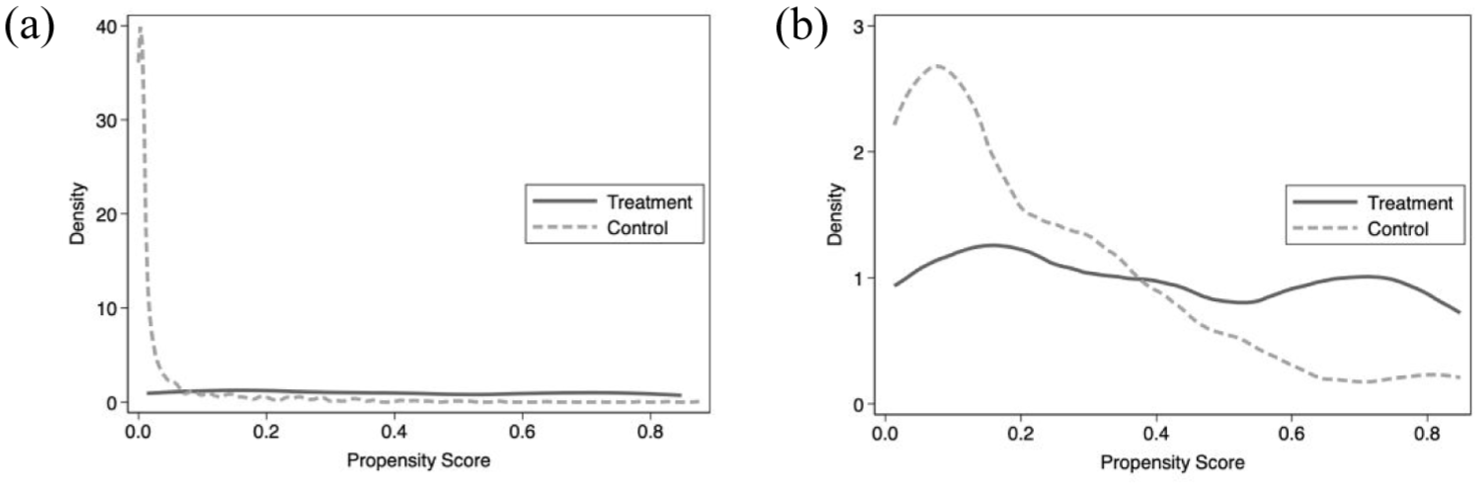
(a and b) Kernel density function graph before propensity score matching.
Results of Propensity Score Matching.

Balance Test
The balance test results in Table 4 indicate that after matching, the standardized bias of the explanatory variables decreased from 83.3% before matching to a range of 11.0% to 18.7%. This significant reduction in bias meets the balance test criterion of less than 20%. Additionally, the pseudo R1 decreased from 0.42 before matching to a range of 0.03 to 0.127, and the LR statistic dropped from 277.13 before matching to a range of 6.42 to 31.58. These results demonstrate that the propensity score matching method effectively reduced the differences in the distribution of explanatory variables between the treatment and control groups, significantly improving the balance of the sample. This enhanced balance provides a reliable data foundation for further evaluating the impact of the ecological compensation policy on farmers’ income.
Results of Balance Test Before and After PSM.

According to the balance test results before and after k-nearest neighbor matching in Table 5, the standardized bias of the explanatory variables ranged from −70.5% to −121.4% before matching, indicating significant systematic differences that make direct analysis of the ecological compensation policy’s impact on farmers’ income unreliable. After matching, the standardized bias was significantly reduced to a range of 11.0% to 18.7%, all below 20%, indicating that the differences in explanatory variables between the treatment and control groups were substantially minimized. Furthermore, the pseudo R1 decreased from 0.42 before matching to a range of 0.03 to 0.127 after matching, and the LR statistic dropped from 277.13 to a range of 6.42 to 31.58, further confirming that the matched samples are more balanced.
Test Results of Explanatory Variable Balance Before and After Nearest Neighbor Matching.

The results of the T-test indicate that, before matching, significant differences existed in variables such as industrial structure, educational human capital, cropping structure, agricultural mechanization level, county government fiscal revenue, and per capita capital investment (all p-values < .05), except for economic development level. After matching, the T-test results for all variables showed no significant differences (all p-values > .05), indicating that the differences in explanatory variables between the treatment and control groups were no longer significant post-matching. Combined with Figure 3, it is evident that there was a significant bias between the treatment and experimental groups before matching, which was effectively reduced to within 20 after matching, verifying the balance hypothesis.

Test results of explanatory variable balance before and after k-nearest neighbor matching.
DID Results Analysis
Baseline Regression Results
Table 6 presents the results of the baseline regression model. Column (1) includes only the policy difference term, without any control variables, and estimates are based on a two-way fixed effects model. Control variables are then added sequentially using a stepwise regression approach. The results show that while the policy difference values exhibit slight changes with the inclusion of the seven control variables, they remain significantly positive at the 1% level. The impact of the ecological compensation policy on rural residents’ net income is demonstrated in model (8) of Table 6, where the coefficient of the key explanatory variable is 0.160, indicating a statistically significant increase of 16.0% in rural residents’ income within the watershed due to the implementation of the Xin’an River Ecological Compensation Policy, consistent with the findings of D. J. Chen et al. (2023). Interviews with the Huangshan City Environmental Protection Bureau reveal that the government strongly supports residents of the Xin’an River Basin by leveraging the ecological benefits of the ecological compensation program. This support includes direct compensation to farmers through increases in transfer income, wage income, and asset income, as well as indirect compensation through skills training, cost constraints, and environmental value enhancement. These findings confirm Hypothesis 1.
Baseline Regression Results.

Note. Standard errors in parentheses. *p < .1, **p < .05, ***p < .01.
The emergence of this result can be attributed to multiple factors. First, the government significantly increased farmers’ transfer income and asset income through direct economic subsidies and green credit support, particularly in ecological migration and protection projects. For example, farmers living below the 108 m waterline of the Xin’an River Reservoir in Shexian and Chun’an counties received direct economic subsidies, effectively improving their income levels. Secondly, the ecological compensation policy enhanced farmers’ production capabilities by providing agricultural technical assistance and improving production conditions, especially in the areas of higher value-added crop cultivation and resource utilization efficiency, leading to an increase in their operational income. Moreover, the policy also supported farmers through skills training and the expansion of diversified income channels, strengthening their economic independence and stabilizing income sources. By supporting farmers in participating in ecological agriculture and reducing agricultural production costs, their income structure was optimized. This outcome signifies that the implementation of ecological compensation policies not only significantly raised farmers’ income levels but also enhanced their resilience to economic risks and market adaptability. With the growth of transfer income, wage income, and asset income, farmers’ livelihood security was strengthened, allowing them to better cope with market fluctuations and natural disasters. Additionally, improvements in production conditions and technological levels laid a foundation for sustainable local economic development, fostering a win-win situation between ecological protection and economic growth.
Heterogeneity Analysis
Given the differences in economic foundations and factor endowments across the pilot counties, the policy effects may exhibit spatial heterogeneity. The pilot program was conducted in three phases, transitioning from a supportive model to a self-sustaining one, which may introduce temporal heterogeneity. We first analyze the policy effects on farmers’ income across upstream, midstream, and downstream regions based on the location of the counties implementing the ecological compensation. We then examine whether there are differences in the impact across the three phases of the policy on farmers’ income within the entire watershed.
(i) Spatial Heterogeneity. According to the spatial heterogeneity results in Table 7, the Xin’an River ecological compensation policy has had a significant positive impact on farmers’ income in upstream, midstream, and downstream areas during the three rounds of pilot implementation. The coefficient for the core explanatory variable in upstream areas is 0.116, indicating that the policy has led to an 11.6% increase in income for upstream farmers. For midstream areas, the coefficient is 0.247, suggesting a 24.7% income increase for midstream farmers, which is approximately 2.1 times that of the upstream, highlighting a significant difference in the policy’s effect on income between upstream and midstream farmers. The coefficient for downstream areas is 0.159, implying a 15.9% income increase for downstream farmers, which is 8.8% less than that for midstream, indicating a significant difference in the policy’s effect on income between midstream and downstream farmers. The results above indicate that the policy’s effect on increasing farmers’ income in the upstream, downstream, and midstream regions gradually strengthens. This can be attributed to several factors. In the upstream areas, stricter ecological protection measures and limitations on resource development and usage, compared to the middle and lower stream regions, have led farmers to gradually shift their livelihoods from traditional agriculture to sectors such as tourism and environmental protection industries, resulting in greater resource input. As the environmental protection efforts in the upstream areas have intensified, the natural endowments of the downstream regions have also improved, positively affecting the income of downstream farmers. The policy’s impact on the income of midstream farmers is the most significant, as this region’s counties have leveraged their advantages to develop distinctive industries. For instance, Shexian County has been recognized as one of the “Top 100 Tea Industry Counties” in China and “The First County for Mountain Spring Fish Farming in China,” while the tea export base has been designated as a national foreign trade transformation and upgrading demonstration base. In addition, She County has promoted local economic growth by developing tourism, creating employment opportunities, and increasing income through the preservation of its historical heritage, such as the creation of the Huizhou Ancient City and the establishment of a non-material cultural heritage base. Therefore, this study concludes that the Xin’an River ecological compensation policy has a significant spatial heterogeneity in its impact on farmers’ income across upstream, midstream, and downstream regions, thereby validating Hypothesis 2.
Spatial Heterogeneity.

Note. Standard errors in parentheses. *p < .1, **p < .05, ***p < .01.
Although the spatial heterogeneity of policy effects has been validated, it is not necessarily the case that the closer a region is to the downstream, the stronger the income-increasing effect of the policy. According to the interview results, the water environmental protection requirements in the midstream areas are actually higher than those in the downstream. However, the midstream region is more adept at developing specialized industries, which makes the income-increasing effect of the policy more significant in this area. In contrast, while the downstream region has more natural resources and livelihood options, the relatively high proportion of non-agricultural employment in this area results in a weaker income-increasing effect of the policy. Therefore, for the ecological compensation policy to be effective, local governments must make optimal use of compensation funds, tailor policies to local industry advantages and development needs, and design targeted measures. This is key to maximizing the policy’s effects and reducing income disparities across regions.
(ii)Temporal Heterogeneity. To examine whether there are differences in the impact of the three rounds of pilot implementation on the income distribution among farmers, we conducted a temporal heterogeneity analysis, with the results presented in Table 8. The coefficient for the core explanatory variable is 0.163 for the first round, indicating a 16.3% increase in farmers’ income. For the second round, the coefficient is 0.141, suggesting a 14.1% increase, and for the third round, the coefficient is 0.161, indicating a 16.1% increase. The range of the promotional effects across the three rounds is 2.2%, with only a 0.2% difference between the first and third rounds. This leads to the conclusion that there is no significant temporal heterogeneity in the impact of the Xin’an River ecological compensation policy on farmers’ income. Therefore, Hypothesis 3 is not supported.
Temporal Heterogeneity.

Note. Standard errors in parentheses. *p < .1, **p < .05, ***p < .01.
The lack of significant differences in the effects of the three rounds of policy implementation can be attributed to several factors, including the complementary nature of direct and indirect compensation, regional differences in government implementation efforts and resource endowments, as well as external economic factors. Although the policy shifted from a “blood transfusion” model to a “blood-making” model, the indirect compensation measures (such as skills training and environmental value enhancement) helped to offset the reduction in direct compensation to some extent, keeping the increase in farmers’ income relatively stable. Particularly under the “blood-making” policy, despite improvements in farmers’ production capacity and market adaptability, this change did not significantly accelerate income growth in the short term. Secondly, the differences in policy implementation efforts and resource endowments across regions contributed to the lack of noticeable variation in policy effects across the three rounds. For instance, although the upstream areas had stricter ecological protection requirements, regional disparities in policy enforcement led to no significant difference in income growth compared to other areas. Finally, external economic factors, such as market price fluctuations and natural disasters, also interfered with the long-term effects of the policy. These factors impacted the growth potential of farmers’ income, resulting in relatively consistent implementation effects across different time periods.
Stability Test
Parallel Trends Test
The difference-in-differences approach depends on the assumption that the treatment and control groups follow parallel trends before the policy intervention. This means that, before the Xin’an River ecological compensation policy was implemented, the income trends of farmers in the affected counties should be similar to those in the unaffected counties. If significant differences exist, it would introduce bias. To test the parallel trends assumption, we use a time-series analysis method and construct the following econometric model:

In the model, k = 0 represents the first year of policy implementation (2012), and this paper focuses on the estimated coefficients βk. To avoid multicollinearity, the base year (2011) is omitted; hence, the βk estimated coefficients represent the differences in county-level farmers’ income changes for the 4 years before, 3 years before, 2 years before the policy implementation, and from the first year to the last year of policy implementation. By examining the balance test results (Figure 4) that display the size of the estimated coefficients and their corresponding 95% confidence intervals, it can be observed that the estimated coefficients before the policy implementation are not significant, and the estimated coefficients after the policy implementation have passed the 5% significance test. Therefore, the parallel trends assumption is satisfied.

Parallel trend test.
Placebo Test
To reduce the impact of omitted variables on policy evaluation, we have included year fixed effects and county fixed effects in the analysis. However, unobserved factors may still influence the results. To address this, we follow the methods of Ma et al. (2023) and Tang et al. (2020) by conducting an indirect placebo test using a permutation test. This test helps determine whether the observed results are statistically significant or merely due to chance. In the permutation test, the null hypothesis states that the Xin’an River ecological compensation policy has no significant impact on farmers’ net income within the watershed. Under this hypothesis, the estimated coefficients derived from the original dataset are considered as potential outcomes under a scenario of no policy effect, essentially forming part of a random sample. Based on this, we use the permutation test to construct a reference distribution of the estimated coefficients, which allows us to statistically infer the validity of the null hypothesis. The results of the permutation test, shown in Figure 5, reveal that the actual estimated values from the difference-in-differences model significantly deviate from the random distribution. Specifically, the estimated coefficients tend to cluster around zero and approximately follow a normal distribution. The corresponding p-values are all greater than 0.1, indicating that at the 10% significance level, these estimated results are not statistically significant. This reduces the likelihood that the effects observed are due to other policy interventions or random factors. This finding is consistent with the expectations of the placebo test and further supports the robustness of the baseline regression analysis.

Placebo test.
Research Conclusions and Policy Recommendations
Research Conclusions and Limitations
Research Conclusions
The ecological compensation policy has overall contributed to a 16.0% increase in farmers’ income within the watershed. This income growth can be attributed to several mechanisms. First, the policy provides direct financial compensation to farmers participating in ecological protection, which is a key factor in boosting their income. Second, the policy encourages and supports farmers in engaging in industries related to ecological protection, such as ecological agriculture and tourism. This not only enhances farmers’ income-generating capacity but also promotes the transformation and upgrading of rural industrial structures. Additionally, the policy offers training and technical support, enhancing farmers’ skills and knowledge, enabling them to better utilize local resources, and further expanding their income sources. Finally, the comprehensive benefits of ecological restoration and environmental protection brought about by the policy have improved farmers’ living and production conditions, laying a solid foundation for sustainable income growth. In summary, the ecological compensation policy has effectively increased farmers’ income through financial support, industrial promotion, capacity building, and overall enhancement of ecological benefits.
Our research reveals significant differences in the impact of the ecological compensation policy on farmers’ income across different regions. Income growth was most pronounced in the midstream region at 24.7%, lowest in the upstream region at 11.6%, and 15.9% in the downstream region. These differences are attributed to variations in policy implementation intensity, industrial development, geographic environment, and resource endowments. In the upstream region, strict ecological protection requirements and limited resource use pose greater challenges for farmers in transitioning their livelihoods, resulting in smaller income gains. In contrast, the midstream region has significantly boosted farmers’ income through the development of specialized industries such as tea exports and tourism. The income growth in the downstream region relies more on the natural resource benefits stemming from upstream and midstream ecological protection. These differences present both positive effects and potential challenges. On one hand, the rapid development in the midstream region contributes to regional balance and serves as a model for other areas. On the other hand, the slower income growth in the upstream region may exacerbate regional imbalances and lead to social discontent. If the policy phases and implementation strategies do not adequately address the specific needs of each region, the policy effects may become uneven. Additionally, income disparities may impact ecological protection efforts. The slow income growth in the upstream region may lead to overexploitation of resources, undermining the effectiveness of the ecological compensation policy.
Our study finds no significant differences in the impact of the three policy phases on farmers’ income. The continuity and stability of these policies have been key, with each phase building on the successes and addressing the shortcomings of the previous one. This has ensured consistent goals, content, and enforcement. For instance, while the transition from a “supportive” to a “self-sustaining” model led to a reduction in transfer income, this was offset by increases in wage income, reduced costs, and enhanced environmental value, supporting steady income growth. The cumulative effect of the policies over time has also been significant. As each phase progressed, improvements in water quality and green economic development have contributed to income growth. Public satisfaction with the ecological compensation projects has steadily increased, providing a strong social foundation for continued policy implementation. The balanced development across upstream, midstream, and downstream regions further underscores the effectiveness and stability of these policies.
However, the long-term stability of the policy effects may present challenges. Farmers and policymakers might experience “policy fatigue,” reducing the drive for innovation and potentially limiting further economic development. Additionally, while the policies have promoted regional equity, their long-term effects could obscure underlying social inequalities that need to be addressed.
Limitations
This study provides valuable insights and recommendations on the design and implementation of the Xin’an River ecological compensation policy and its impact on rural residents’ income within the watershed. However, there is room for further improvement in the scope and depth of the research. In particular, the study lacks sufficient micro-level analysis, which limits our understanding of farmers’ behavior, policy acceptance, and the specific effects of the policy’s implementation. Therefore, future research will focus on conducting in-depth micro-level investigations. We plan to use methods such as surveys, in-depth interviews, and case studies to gather data on farmers’ perceptions of the ecological compensation policy, their motivations for participation, satisfaction levels, and the policy’s specific impact on their livelihoods and production methods. This approach will help reveal the differences in policy responses among various groups of farmers and provide more precise evidence for policy adjustments.
Management Insights
First, implement a differentiated compensation strategy based on regional differences. Due to the differences in the growth of farmers’ incomes in the upstream, midstream and downstream areas within the Xin’an River Basin, it is recommended that more targeted ecological compensation strategies be developed based on the resource endowments, ecological protection pressures, and levels of industrial development of each region. For the upstream areas, considering the more stringent requirements for ecological protection, investment in capacity building for ecological protection can be appropriately increased, and more technical support and green credit support can be provided to promote the transformation of farmers’ livelihoods. The midstream region can further strengthen the cultivation of specialty industries (e.g., tea, tourism, etc.), promote the extension of the industrial chain, and raise the level of farmers’ income. Downstream regions, on the other hand, should focus on the sustainability of industrial development, encourage the ecological transformation of agriculture, and flexibly adjust the intensity and mode of compensation according to the needs of regional economic development.
Secondly, we should promote the deepening of the “blood-forming” compensation model. As the ecological compensation policy gradually shifts from a “blood-transfusion” to a “blood-creation” approach, support for the enhancement of farmers’ productive capacity should be further increased. It is recommended that investment in agricultural technology training, ecological agriculture development and industrial infrastructure construction in the midstream and downstream areas be increased to improve farmers’ market adaptability and production skills. At the same time, local governments should be encouraged to cooperate with enterprises to promote the use of compensation funds for the construction of ecological industry chains and the development of green economy projects, so as to ensure a long-term and stable channel for farmers to increase their income.
Thirdly, the integration and development of ecological industries with the local economy should be strengthened. Policies should focus on the development of ecological industries with local characteristics, and further enhance farmers’ incomes by promoting cooperation between leading enterprises and farmers and establishing a stable production and marketing docking mechanism. Especially for midstream areas, the government should strengthen support and guidance for specialty industries, build local brands, and promote deep processing of agricultural products and high value-added industries. Local governments should provide financial support, tax incentives and technical guidance to help farmers enhance the added value of their industries and expand their market share.
Fourth, the supervision and optimization of the use of compensation funds should be strengthened. In order to improve the effectiveness of the use of compensation funds, it is recommended that an assessment of the effectiveness of the use of compensation funds be carried out in each policy cycle to ensure that the funds can be accurately invested in the areas and groups that need them most. Especially for low-income groups, local governments should provide more liquidity support, such as interest-free loans and financial subsidies, according to the actual situation, to help them get through short-term difficulties. At the same time, supervision of ecological protection projects should be strengthened to ensure their sustainability and long-term benefits, and to bring more stable economic returns to farmers.
Fifthly, a long-term mechanism for ecological compensation should be established. In order to ensure the continuity and stability of the policy, it is recommended that a sound long-term mechanism be established, including rolling support for eco-compensation funds and policy innovation and improvement by local governments. By strengthening collaboration between different regions, we will promote cross-regional cooperation on ecological compensation programs, share the fruits of ecological protection, and promote coordinated regional economic development. Interaction and communication between the government and farmers will be strengthened to enhance farmers’ recognition of and participation in the policy, forming a good situation of tripartite synergy among the government, farmers and enterprises.
Footnotes
Acknowledgements
We thank the municipal governments of Huangshan City, Anhui Province and Hangzhou City, Zhejiang Province for providing data and information. We are grateful to the journal for the opportunity to submit the manuscript and for the valuable review time. We will continue our efforts to contribute to the research in related fields.

Funding
The authors disclosed receipt of the following financial support for the research, authorship, and/or publication of this article: This work was supported by the National Social Science Foundation of China under Grant (number 22XMZ076).
Declaration of Conflicting Interests
The authors declared no potential conflicts of interest with respect to the research, authorship, and/or publication of this article.