




Abstract
At present, the vast majority of Chinese farmers’ income comes from factor income. The distortion of factor market affects the sustainable growth of farmers’ income and the optimization of income structure to a certain extent. The development of factor market is particularly important to solve the problem of increasing farmers’ income. Based on the panel data of 28 provinces (cities, autonomous regions) in China from 1997 to 2021, this study constructs a spatial panel model to empirically analyze the spatial impact of the three major factor market distortions on Farmers’ income growth. The results show that Chinese farmers’ income has a strong spatial dependence, and there is a significant spatial correlation effect in different regions. There are serious market distortions, which have significantly hindered the growth of farmers’ income. The distortion of China’s factor market not only inhibits the growth of farmers’ income in this region, but also has a significant negative spatial spillover effect. The distortion of factor market restricts the improvement of farmers’ income in adjacent areas. In the future, we need to further straighten out the influencing factors and give full play to the income increasing efficiency of various factors.
Plain Language Summary
This study will take the impact of factor market distortion on Farmers’ income as the research perspective, and conduct a quantitative empirical study on the impact of three factor market distortions on Farmers’ income in different regions, which can provide policy reference for effectively improving farmers’ income in different regions. Therefore, this paper takes the factor market distortion and farmers’ income growth as the research object, based on the provincial panel data model, uses the generalized moment estimation and quasi maximum likelihood estimation and other research methods to empirically analyze the factors affecting farmers’ income increase, and empirically analyzes the spatial impact of farmers’ income increase and its spillover effect under the factor market distortion, so as to provide decision-making basis for the sustainable growth of farmers’ income in different regions.
Introduction
The issue of “agriculture, rural areas, and farmers” has always been the focus of academic research. Improving the income level of farmers is an important manifestation of improving the high-quality development of China’s rural economy, an important way to achieve the “rural revitalization strategy,” and an important measure to promote the goal of common prosperity. Over the past decade, the average annual growth rate of China’s farmers’ income has been low, and there is a certain gap between urban and rural income. The weak growth of farmers’ income will hinder the overall rapid development of China’s economy. From 2004 to 2021, the state has issued the No. 1 central document for 18 consecutive years, formulated and implemented a series of policies to promote the development of “agriculture, rural areas, and farmers,” and the level of farmers’ agricultural income and non-agricultural income has increased to a certain extent. However, the differences in human and natural resources between regions will lead to the imbalance of rural economic development, which in turn will lead to the large-scale cross regional circulation of natural resources and production factors. Due to urban-rural factors, regional factors, sectoral factors, and differences in education level, the urban-rural income gap is still obvious, and the imbalance of development still exists. The incomplete rural factor market and unreasonable factor allocation between different regions will lead to the distortion of regional economic relations, affect the efficiency of economic operation, and may also cause a series of contradictions and bring many social problems. Common prosperity is the essential requirement of socialism and an important feature of Chinese path to modernization. To consolidate and expand the achievements of poverty alleviation and comprehensively promote rural revitalization, we must achieve common prosperity for farmers and rural areas. Therefore, exploring the regional factor market and factor allocation, realizing the rational allocation of factors through scientific ways and methods, and realizing the coordinated growth of rural economy in different regions has become the focus of current academia and government.
How to stimulate the vitality of microeconomic entities and improve the income level of farmers, the answer still needs to draw nutrients from the soil of traditional Chinese economic society. With the continuous deepening of reform and opening up, the degree of factor marketization in China has significantly increased, and the close relationship between farmers’ income increase and factor market development has further deepened. The adjustment of agricultural production structure in the reform of market economy has driven the transformation of Chinese traditional agriculture to modern agriculture, triggered the flow of various factor resources between agricultural and non-agricultural sectors. However, due to various reasons, the market-oriented reform process of China’s capital, labor, land, and other factors obviously lags behind the commodity market, which makes it difficult to fully realize the market value of factors closely related to farmers’ income, and restricts the optimization of farmers’ income structure and the growth of total income. The incomplete labor market and the lack of market operation mechanism of land and capital market will have an impact on the improvement of farmers’ income level and the adjustment of income source structure, and then restrict the improvement of farmers’ welfare. Therefore, it is of great practical significance to clarify and further analyze the influencing factors of farmers’ income growth in different provinces and regions, and to identify the path of farmers’ income growth changes in different regions affected by the distortion of factor markets, for scientifically formulating various policies and measures for rural and agricultural development, effectively promoting farmers’ income growth in different regions, and reducing the differences in farmers’ income levels in different regions.
Literature Review
With the deepening of the reform and opening up process, China’s factor marketization has significantly improved, and the relationship between farmers’ income increase and factor market development has further deepened. The adjustment of agricultural production structure in the transformation of market economy has driven the transformation of traditional agriculture to modern agriculture in China, triggered the flow of various factors and resources between agricultural and non-agricultural sectors, changed the structure of farmers’ income sources in different regions, and led to the increase of farmers’ income. However, due to various reasons, the marketization reform process of China’s capital, labor, land, and other factors is obviously lagging behind the commodity market, resulting in the difficulty of fully realizing the market value of factors closely related to farmers’ income, which restricts the optimization of farmers’ income structure and the growth of total income. The existing literature mainly focuses on the distortion of the factor market and the income of farmers.
Research on Factor Market Distortion
Factor market distortion refers to the failure to achieve the optimal allocation of various production factor resources caused by incomplete market. The price of factor market deviates from the cost compensation that should have been obtained. Some studies believe that the distortion of resource allocation caused by the lagging development of the production factor market, especially the labor market, and the distortion is different in different regions (Cai et al., 2001). The existing factor market does not completely present factor flow obstacles, factor price rigidity, and factor price differentiation. Some paper study the economic effects of factor price distortions from the aspects of resource allocation efficiency, total factor productivity, and social welfare losses, and believes that countries with factor market price distortions are vulnerable to social welfare losses. The original policy differences between various regions in the reform and opening up and the existing institutional obstacles make the rural production factors including capital, labor, land, and so on unable to realize the original value according to the market transaction price, and cannot be allocated to the production and consumption links with higher efficiency, which affects the increase of farmers’ income to a certain extent. Other studies have studied that there are obvious regional differences in the degree of marketization due to the factor endowment and policy systems in different regions (Fan et al., 2011). The analytical framework of classical theory on income distribution and growth implies two premises: first, the system is unchanged, or at least stable; Second, the management system of factor market is relatively perfect, and the allocation of factors is completely market-oriented. However, at present, the marketization of factors in China lags behind the marketization of products, and the level of factor marketization is still very low, resulting in the phenomenon of “asymmetry” between factor marketization and product market. The incompleteness of China’s factor market is mainly reflected in the distortion of factor supply, factor price, and factor allocation (Y. F. Lin & Liu, 2004). The distortion of factor market will affect the path of China’s economic growth, lead to the distortion of resource use structure, and then affect the efficiency of resource allocation. The current process of factor market reform is not only lagging behind the product market (J. Zhang et al., 2011), and the marketization process of factor markets in different regions is also inconsistent (B. Q. Lin & Du, 2013). This distortion is difficult to eliminate in the short term due to institutional reasons (Y. W. Zhang, 2008). The factor market is inefficient due to price distortion caused by various distortions, and then the factor resources cannot achieve the optimal efficiency through market transactions (D. M. Luo et al., 2012). The factor market scored the lowest in the degree of marketization of the domestic economy (Dou, 2010). The distortion was mainly caused by the government’s control policy on factor prices (Qian & Mou, 2013).
Research on Farmers’ Income
The existing literature on the problem of farmers’ income mainly focuses on the difficulties and challenges of farmers’ income growth, the influencing factors and solutions of farmers’ income growth, the potential of farmers’ income growth, and the optimization of income structure. Some paper took the relationship between farmers’ income level and non-agricultural employment in Pakistan, Nigeria, Ethiopia, and other countries as the research object, and believed that the non-agricultural employment of rural residents after the economic reform would contribute to the improvement of their overall income level, but this may also make farmers’ income more affected by the external environment, and the effect of income increase is uncertain (Norseman, 2004; Holden et al., 2004; Rashidin et al., 2020). The transition of China’s economic structure from a dual economy to a single economic structure provided a good external environment for farmers’ income increase (X. W. Chen, 2011).The economic structure adjustment and transformation since the reform and opening up have created conditions for farmers in different regions to stabilize the income increase mechanism (Zhou et al., 2017). But in the face of complex and volatile historical opportunities, the development of factor market and economic system reform can improve the response of farmers’ income growth to economic growth (Dang, 2016). With the acceleration of the market-oriented process, there are significant differences in the prices of factors such as land, labor, and capital between urban and rural areas (C. X. Luo, 2012). The core of the structural reform of the agricultural supply side is the market-oriented reform in the field of resource factors (Zhong, 2019). The market should play a decisive role in the allocation of factors (Gong et al., 2019).The source of factor market distortion should be eliminated (Yang, 2019).Chinese farmers have become market-oriented or market-oriented farmers, and their various economic behaviors to participate in the market also depend on the allocation of their family economic resources (Wu, 2020) . There is a great correlation between factor input and farmers’ income increase (Huang et al., 2009), and the incomplete market-oriented reform of various factors such as the labor market directly restricts the extent to which farmers make full use of the market mechanism to promote the sustainable growth of income under the market mechanism to a certain extent (D. W. Wang, 2010).Through the comprehensive and systematic reform of the three major factor markets, the level of division of labor and cooperation among farmers should be improved, Promote the specialization level of agricultural production, and lay the foundation of modern agriculture for the continuous increase of farmers’ income (X. H. Wang & Wen, 2017). In addition, the economic decision-making of farmers depends on the economic resource conditions that farmers can grasp, and the increase of farmers’ income must improve their viability and the optimal allocation of factors. We should improve the factor market allocation system, promote the rational allocation of labor, land, capital and other factors, and improve the government’s macro-control functions and other policies to promote the increase of farmers’ income (Z. G. Xu et al., 2017). We should start with guiding the optimal allocation of various agricultural and rural resources, adapt to the needs of domestic and foreign markets, adjust relevant agriculture-related preferential policies, and optimize the structure of farmers’ income sources (B. K. Chen et al., 2020; H. Y. Zhang, 2015). That factors such as farmers’ own quality, resource market allocation efficiency, and economic and social system have affected farmers’ income increase to a certain extent, and the potential for farmers’ income growth after breaking the existing institutional barriers is huge (Tu & Yang, 2022). The overall vitality of the rural economy was insufficient, the contribution of agriculture-related technology to agricultural production and operation was not high, agriculture-related policies could not be focused, agriculture-related technology could not be effectively promoted due to the limitations of agricultural production and operation, and the employment and profit opportunities of farmers in different regions were different, which led to the lack of income growth of farmers (He, 2020).
The existing achievements have deeply studied the measurement and impact of factor market distortion from multiple perspectives and levels. A large number of literatures have studied the internal and external factors of farmers’ income growth, which has laid the foundation for this paper. However, few literatures pay attention to the spatial impact of factor market environment on the adjustment and sustainable growth of farmers’ income structure in different regions, and there are few studies on the effect of factor market distortion on the difference of farmers’ income growth in different regions. Based on the above facts, this study will take the impact of factor market distortion on Farmers’ income as the research perspective, and conduct a quantitative empirical study on the impact of three factor market distortions on Farmers’ income in different regions, which can provide policy reference for effectively improving farmers’ income in different regions. Therefore, this paper takes the factor market distortion and farmers’ income growth as the research object, based on the provincial panel data model, uses the generalized moment estimation and quasi maximum likelihood estimation and other research methods to empirically analyze the factors affecting farmers’ income increase, and empirically analyzes the spatial impact of farmers’ income increase and its spillover effect under the factor market distortion, so as to provide decision-making basis for the sustainable growth of farmers’ income in different regions.
Theoretical Analysis and Model Construction
Theoretical Analysis
Based on the system of combining distribution according to work and distribution according to production factors, the essence of farmers’ income is the primary distribution and redistribution of production relations, involving the number of various production factors owned by farmers and the factor market transaction mechanism. The increase of farmers’ income is determined by the quantity and efficiency of the factor contribution under the specific production relationship. The initial distribution is affected by the value of production factors such as capital, land, and labor. Redistribution depends on national macroeconomic control policies. The welfare of farmers is closely related to the quantity and quality of tangible resources, such as human, material and financial resources, as well as the operating mechanism and efficiency of the capital market, land market, labor market, and other factor markets. The improvement of the operational efficiency of the factor market is the premise of the improvement of farmers’ welfare. In a perfectly competitive market, the factor price will reach an equilibrium state according to the free trading rules of the market, and obtain the value of the factor itself. Therefore, there will be no expansion trend of the factor compensation gap, which will become stable with the adjustment of the factor supply and demand relationship.
The essence of farmers’ income is to obtain corresponding rewards by investing various production factors under certain production relations. The operating mechanism of the factor market determines the quantity and quality of the remuneration. However, the reform of China’s factor market lags behind the product market, and the mechanism of capital market, land market, labor force, and other factor markets has not been fully established. Market transactions are distorted. The distortion of factor market has broken the automatic balance mechanism. The remuneration obtained by the factor owner cannot better reflect its own value. The differences in the development level of market economy, institutional barriers, operating mechanism, and distortion degree of factor market in different regions lead to the differences in the remuneration of factor owners, which restricts the efficiency of factor allocation and the realization of value. Under the distortion of the factor market, the relationship between supply and demand of factors has been broken, and the capital, labor, and other factors in underdeveloped regions have failed to realize their due value due to various obstacles, which is detrimental to the efficiency of the market economy, affects the fairness of the distribution of factor income, and finally enlarges the difference in the remuneration of factor owners in different regions. With the deepening of the reform of the factor market, although the degree of distortion of various factor markets in different regions has eased, it will still exist for a long time. The factors that affect the change of farmers’ income and the adjustment of the source structure among regions are relatively complex, because there is a certain degree of intersection between the influencing factors of different regions. Therefore, the spatial lag model and the spatial error model are used to analyze the spatial correlation and effect of the influencing factors of farmers’ income growth and structural change in different regions.
Model Construction
In recent years, research at home and abroad has focused on the impact of incomplete factor market on Farmers’ income. The distortion of factor market has become an important obstacle to the growth of farmers’ income. Farmers’ welfare depends on the number of factor resources and the efficiency of factor market operation. To ensure the way to increase farmers’ income, we need to improve the operation of factor market. The three major incomes of Chinese farmers, including wages, family management and property, belong to factor income, and transfer income belongs to non factor income caused by agricultural policies. At present, the vast majority of Chinese farmers’ income comes from factor income. The distortion of factor market affects the sustainable and effective growth of farmers’ income to a certain extent. The development of factor market is particularly important to solve the problem of increasing farmers’ income. At present, due to the regional differences in human, natural, and geographical conditions, coupled with regional policy and institutional obstacles, many factors of production, including labor, land, and capital, will not be able to follow market transactions to allocate them to links with higher production efficiency for a period of time in the future. The serious lag in the process of factor marketization will lead to the distortion of factor market, which will lead to the differences in the sources and growth ranges of farmers’ income in different regions, and will also lead to the expansion of farmers’ income differences in different regions. In order to improve farmers’ income level and improve farmers’ income structure through a series of agricultural related and agricultural benefit policy adjustments, we must face up to the impact of the distortion of regional factor market in reality. The defect of the existing research is that it ignores the spatial effect. The spatial spillover effects of various factors between regions have been mostly ignored in the analysis of the income of farmers between regions. According to the above theoretical analysis, farmers’ income is not only affected by the distortion of factor markets in surrounding areas, but also affected by other regions.
In order to deeply analyze the impact of factor market distortion on Farmers’ income increase, this paper uses the panel data of 28 provinces from 1997 to 2021, takes the farmers’ income level in different provinces as the explanatory variable, selects the market distortion value of three major factors such as capital, labor, and land as the core explanatory variable, and introduces human capital, financial development, trade openness, scale management, regional industrialization agricultural policy measures, and other control variables for spatial econometric research. Based on the above variable selection, the specific model is set as follows.

Where Yit is the explained variable (farmers’ income level in different regions); Xit is n × K order explanatory variables (distorted values of capital market, labor market, land market, control variables, etc.); αit is individual effect.
This study will explore the spatial effect of farmers’ income growth in different regions under the distortion of factor market and its spatial spillover impact. Therefore, this study establishes spatial lag model, spatial error model, and spatial Dubin panel model to analyze at the same time. The model is set as follows.

Where Yit and Xit have the same meaning as formula (1); W is n × N order spatial weight matrix, that research uses the geographical distance between provincial capitals to construct the spatial weight matrix, because the geographical distance between provincial capitals is fixed, not affected by external factors, and can avoid the endogeneity of spatial metrology model; WYit is a spatial autoregressive term; ρ is the autoregressive coefficient; εit is the vector of random error term. The spatial error model will be used to further analyze the spatial spillover impact of the observed value error of farmers’ income in adjacent areas on Farmers’ income in this region. The specific model is as follows:



Where λ is the spatial error coefficient. There is a certain significant spatial spillover of socio-economic factors in adjacent regions, which restricts the growth potential of farmers’ income in this region. Therefore, the spatial impact of farmers’ income increase is studied and demonstrated. The weighted term of spatial weight matrix of multiple explanatory variables is introduced as one of the explanatory variables, and the spatial Dubin model is established as follows

Where WY and WX represent the spatial effects of the explained variable and the explanatory variable respectively. The study uses the spatial distance between provincial capitals and the reciprocal of spatial distance to expand the robustness of the spatial Dubin model.
Variable Setting
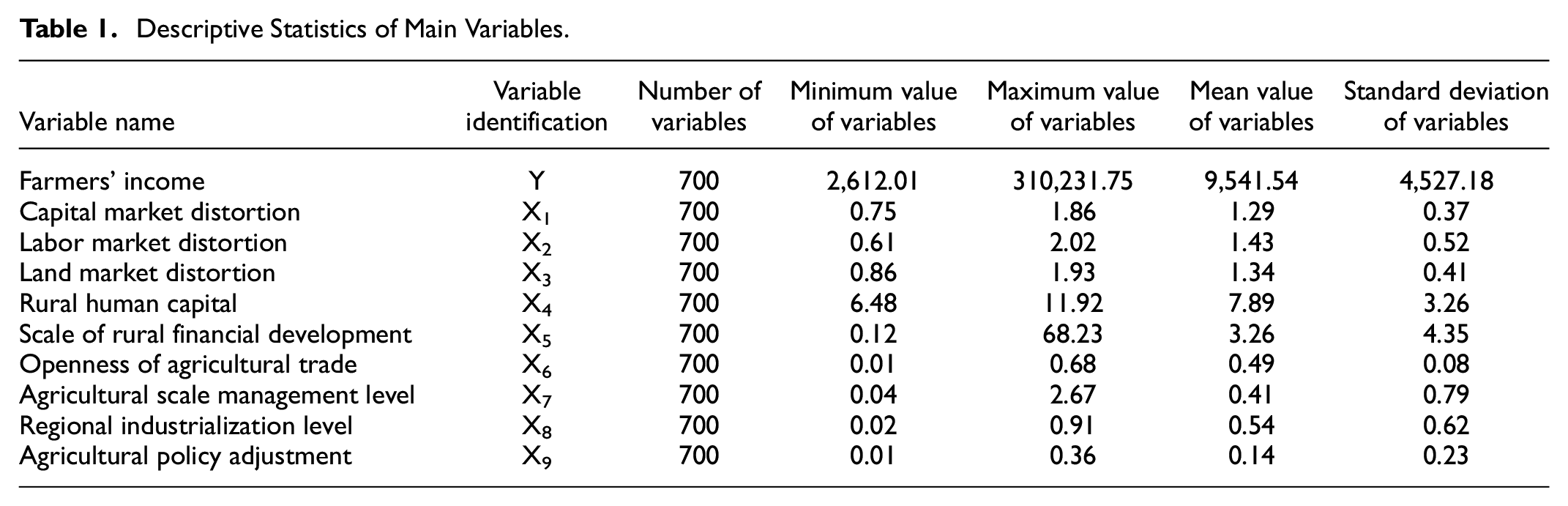
In this study, variables are divided into explained variables, explanatory variables, and control variables. The descriptive statistics of each variable are shown in Table 1.
Descriptive Statistics of Main Variables.
Explained Variables
The explanatory variable is the overall income level of farmers’ families in different provinces. The study uses the indicator of per capita disposable income of rural households to measure it. An average indicator calculated according to the permanent population of rural households is the average income of all its members. The structure of farmers’ income consists of four parts: wage, family management, property, and transfer, which are closely related to the factor market. The three factor market distortions and control variables affect the changes of farmers’ income structure and the overall level of income to a certain extent, which can measure the changes of farmers’ welfare on the whole, and comprehensively reflect the impact of factors such as factor market distortions on Farmers’ income.
Explanatory Variables
The explanatory variable is the distorted value of the three factor market. The existing literature only involves the price distortion of the capital market and the labor market, and the role of land factors in China’s agricultural production and management is very critical for farmers’ income increase. Existing studies ignore the impact of the relatively serious price distortion in the land market on Farmers’ income structure adjustment and the change of the overall income level, which will obviously affect the scientific rationality of the research on the change of farmers’ income structure and the continuous growth of income level. The distortion of China’s land market comes from the monopoly of local governments on the non-agricultural market of agricultural land. Local governments use such institutional monopoly to obtain financial funds. The higher the income of land transfer fees, the greater the degree of distortion of the land market. This paper will use the research methods of existing research to estimate the distortion value of capital market and labor market from 1997 to 2021 (Shang, 2016; Shi et al., 2012), and use the ratio of residential land price to industrial land price as the quantitative index to measure the distortion of land factors.
Control Variables
The research involves six variables: rural human capital level, rural financial development level, agricultural trade opening level, agricultural scale operation degree, regional industrialization degree, agricultural policy, and so on. The level of rural human capital is calculated by the average level of education in rural areas. The development level of rural finance is expressed as the ratio of the sum of rural deposits and loans to the GDP of the primary industry. The opening level of agricultural trade is calculated by the ratio of total agricultural trade value to regional GDP. The degree of agricultural scale operation is expressed by the ratio of the total power of agricultural machinery to the area of regional cultivated land. The degree of regional industrialization is expressed by the proportion of the added value of the secondary industry in the regional GDP. Agricultural policy is measured by the ratio of government expenditure related to agriculture to regional GDP.
Data Sources
The panel data of 28 provinces in China from 1997 to 2021 are used as the sample. These data are mainly collected from all the data from China Statistical Yearbook (1998–2022), China Rural Statistical Yearbook (1998–2022), China 60-year statistical data collection, China Financial Statistical Yearbook (1998–2022), China fiscal Yearbook (1998–2022), etc. The missing data in a few years is supplemented by finding the statistical bulletin data of relevant websites of provinces and cities with missing data; Very few missing data are replaced by the average value of the previous two years. In order to eliminate the influence of price level changes and eliminate heteroscedasticity, this paper takes the 1997 data as the base period, uses the price index to deflate the data, and takes the logarithm of all variables for calculation.
Empirical Analysis
Empirical Analysis Without Considering Spatial Factors
In order to overcome the unreliability of estimation results caused by endogenous problems, this paper uses the system generalized moment estimation method to study. The results are shown in Table 2. Through the regression, test and selection of the three effect models, through the joint hypothesis test and Hausman test, this paper selects the fixed effect model for the result analysis. The individual fixed effect model regression results in Table 2 show that the regression results of the model variables of the capital factor market, labor factor market, and land factor market are all negative, and the factor market distortions of capital and labor are significant at the 5% significance level, but the land market distortions fail to pass the significance test. The coefficient of labor market distortion in the random effect result is positive, and it does not pass the significance test. The regression results of the two-way fixed effect model are basically in line with expectations. The market distortion coefficients of the three factors have passed the significance test, but the significance level is not high. Among other control variables, the regression coefficient of rural human capital level did not pass the significance test. Although the rural financial development level, the opening level of agricultural trade, and the adjustment of agricultural policies all passed the significance test at the 5% significance level, their coefficient symbols are contrary to the practical theory. Therefore, the results in Table 2 show that the relationship between relevant variables may not be accurately obtained without considering spatial factors.
Estimation Results of Fixed and Random Effects of Farmers’ Income.
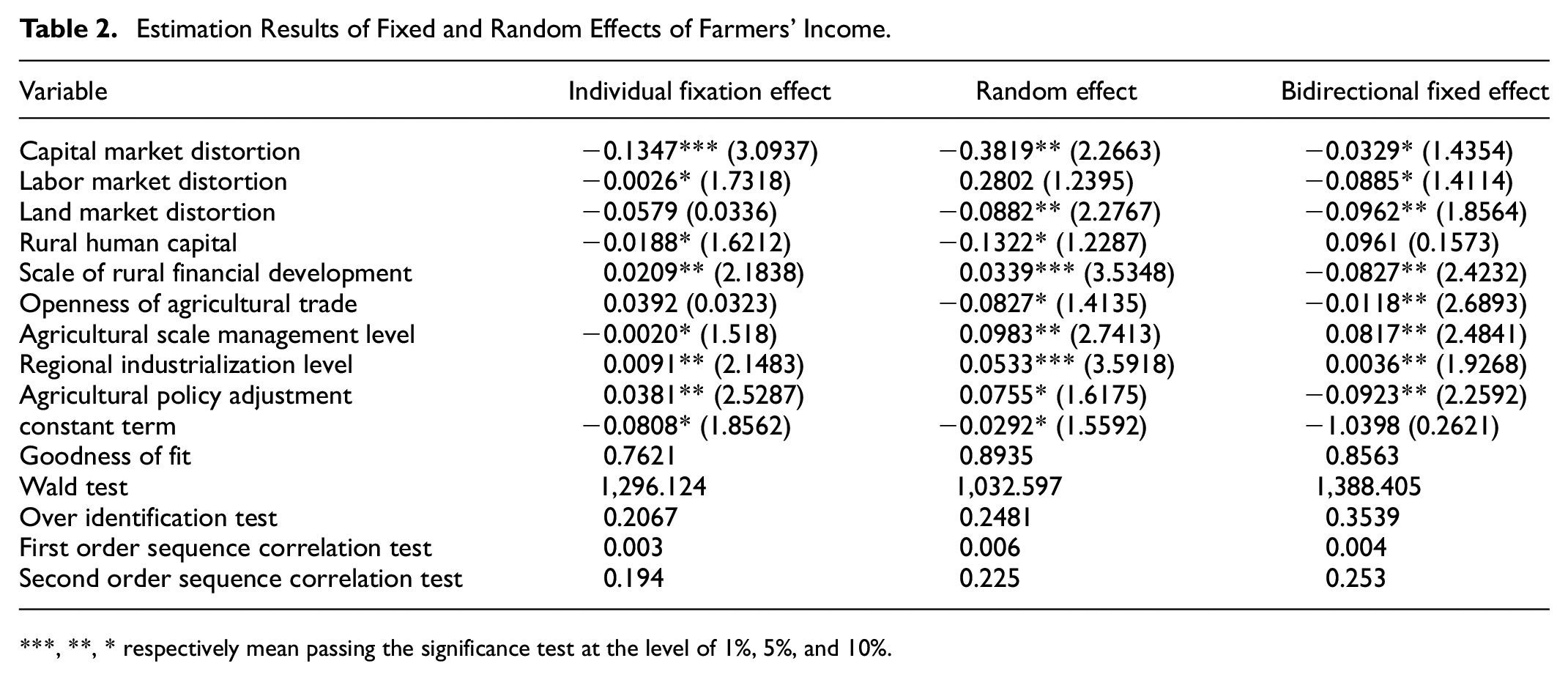
, **, * respectively mean passing the significance test at the level of 1%, 5%, and 10%.
Empirical Analysis Incorporating Spatial Factors
Spatial Autocorrelation Test
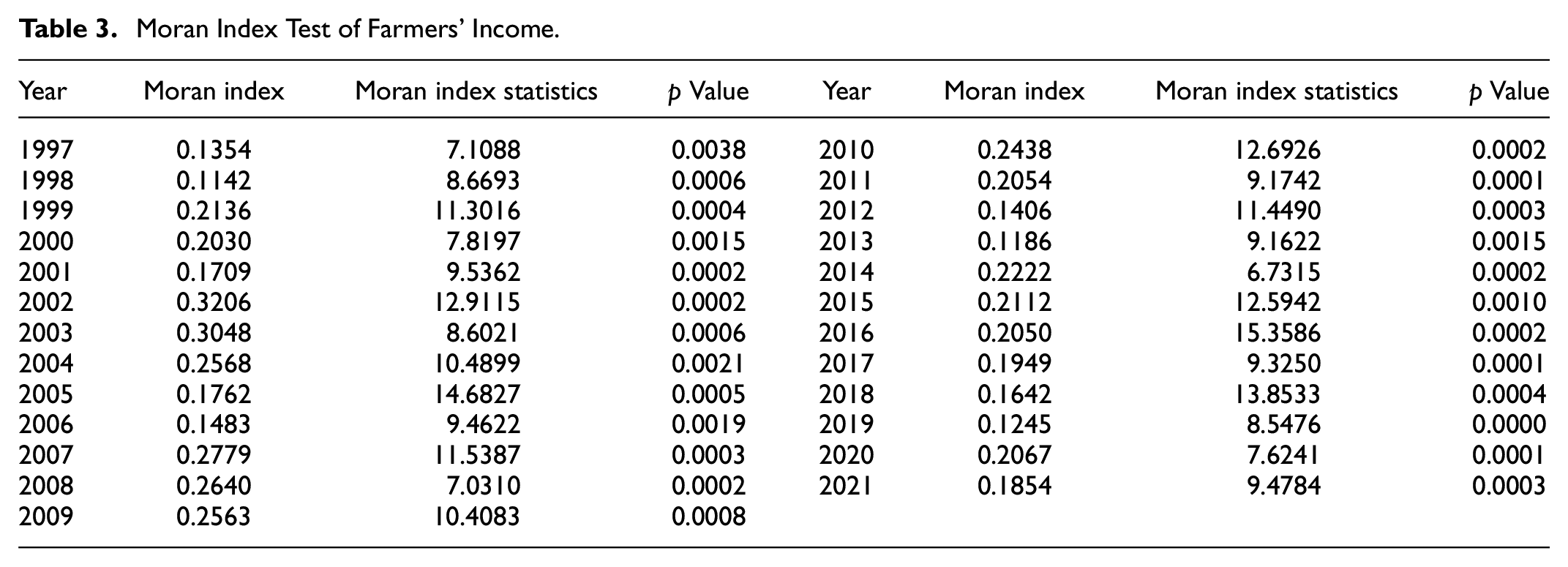
Based on the consideration of spatial correlation, this paper applies geoda software to analyze the overall Moran index of farmers’ income, in order to reveal the spatial correlation of farmers’ income in different regions. In Table 3, the Moran index values of farmers’ income in 28 provinces (cities, autonomous regions) from 1997 to 2021 were greater than zero respectively. At the same time, the p value in Table 3 shows that the judgment passed the significance test at the 5% level, so there is a significant spatial autocorrelation in farmers’ income in different regions. Combined with the results in Table 2, this paper believes that farmers’ income as a whole shows significant spatial correlation, and the use of spatial econometric model can better reveal the regional spatial differences of farmers’ income in different regions.
Moran Index Test of Farmers’ Income.
Estimation of Empirical Results of SDM Model
At a given significance level, the different values of Moran’s I mean that the correlation between the observed values is different. Based on the Moran index, this paper shows that there is a positive correlation between the observed values. The research uses the spatial panel data model to analyze the influencing factors of farmers’ income. Considering the spatial dependence and heterogeneity, the model includes both the lag term of the explained variable and the lag term of the explained variable. The spatial econometric model used in this paper is based on the traditional econometric model, which incorporates the spatial correlation of various variables to eliminate endogeneity, and uses spatial lag model, spatial error model, and spatial Dubin model (1) to estimate parameters. At the same time, this paper uses the reciprocal matrix of the spatial distance between the provincial capitals of different provinces as the spatial weight (2), further tests the robustness of the spatial Dubin model, and compares it with the spatial Dubin model (1). Because the independent variable contains spatial weight matrix, this paper uses quasi maximum likelihood estimation to estimate the parameters of the above four models. At the same time, according to the results of joint hypothesis test and Hausman test, the fixed effect model is selected for empirical research. Table 4 shows that the regression results of the two spatial weight models are basically similar. The core variables passed the significance test, and the influence direction basically met the expectations, indicating that the model results are robust. The following analysis is based on the spatial Doberman model (1).
Spatial Model Estimation Results.
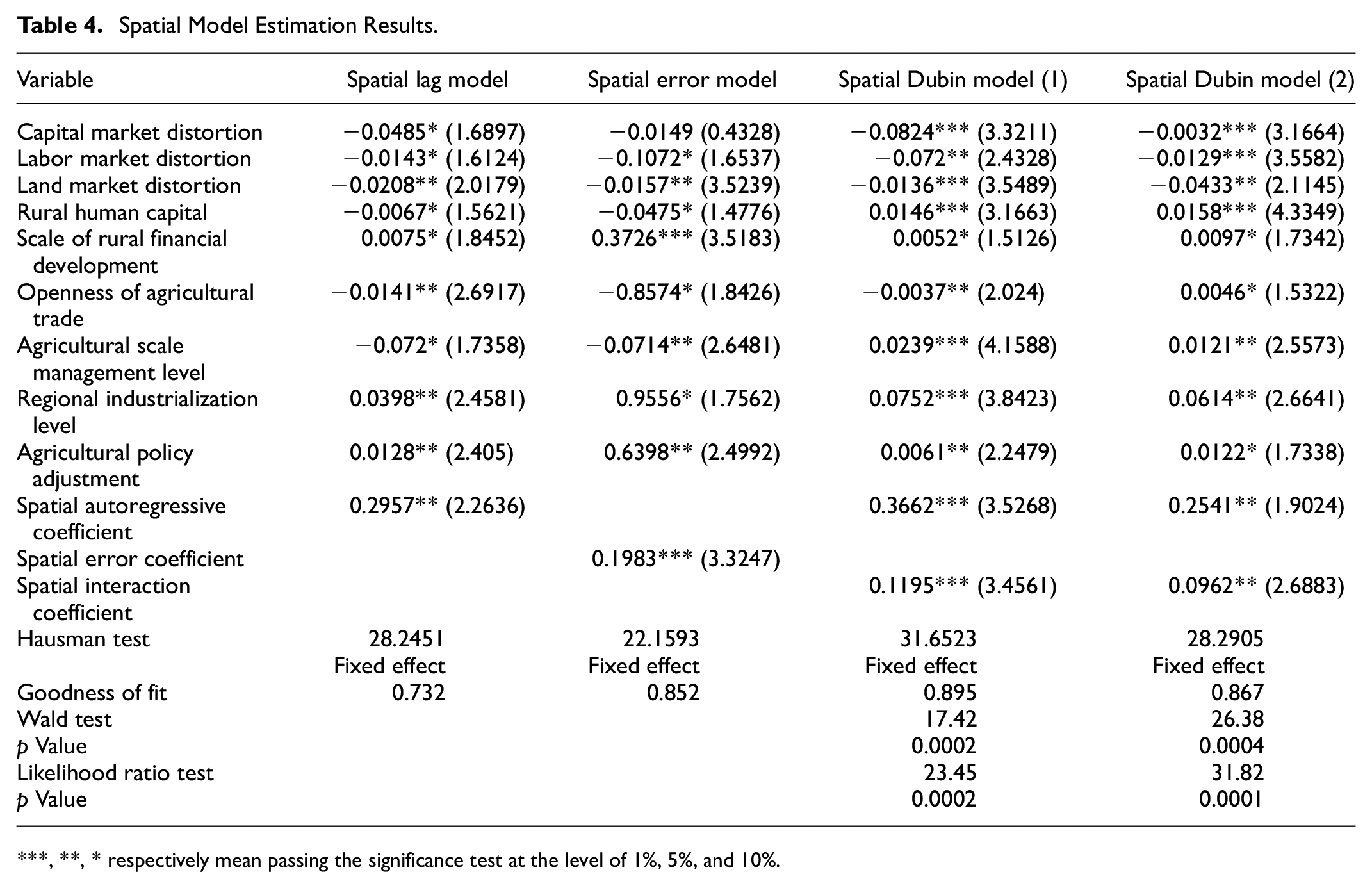
, **, * respectively mean passing the significance test at the level of 1%, 5%, and 10%.
The results of spatial Dubin model (1) in Table 4 show that capital market distortion, labor market distortion, land market distortion, and farmers’ income growth have a negative relationship at the 5% significance level, which are −0.0824, −0.072, −0.0136 respectively, which means that the three major factor market distortions inhibit farmers’ income growth, and are more significant than the ordinary panel model in Table 2, indicating that when considering the spatial correlation of provinces, Factor market distortion has a greater significant negative relationship with the increase of farmers’ income, and the three factor market distortions have a greater inhibitory effect on agricultural income. Therefore, it is urgent to deepen the reform through the capital market, labor market, land market, and other factor markets, promote the coordinated and balanced development strategy of urban-rural integration, and establish a long-term mechanism for increasing farmers’ income. The factor market distortion has a restraining effect on farmers’ income, which shows that only by continuously optimizing the operating mechanism of the factor market, improving the factor market environment, and ensuring that the factor market distortion value decreases can farmers’ income be improved. This result is consistent with the research conclusion of J. Y. Xu (2008). Therefore, we should continue to accelerate the reform process of the factor market, accelerate the balanced development of rural capital, labor, land and other factor markets, and expand the channels of farmers’ income sources.
Rural human capital and farmers’ income growth show a significant positive impact at the 1% level, because the emphasis on rural education has improved farmers’ quality to a certain extent through the popularization of 9-year compulsory education and various public welfare training, and a 1% increase in rural human capital can drive farmers’ income increase by 0.0146%. Since the reform and opening up, the operational and wage income of farmers has been significantly increased by giving play to the skills effect of farmers and the non-agricultural transfer effect of labor force, which shows that the improvement of rural human capital can significantly improve the income level of farmers under certain conditions. Although the scale of rural financial development has promoted the growth of farmers’ income to a certain extent, the significance is not high and the impact is limited, indicating that the effect of rural financial development on Farmers’ income has not been fully played, which is inseparable from the profit seeking nature of financial capital. A large amount of financial capital formed in rural areas has flowed to the non-agricultural sector, and at the same time, the shortage of funds in agricultural production and operation can not be met. In the future, we should continue to increase support and guidance for the development of rural finance, improve the rural financial environment, and give play to the kinetic effect of finance leading rural economic growth. The opening up of agricultural trade has not promoted the growth of farmers’ income, but has a restraining effect. In recent years, China’s agricultural trade deficit every year and the influx of foreign agricultural products have reduced the market price of domestic agricultural products to a certain extent. At the same time, due to its insufficient advantages, China’s agricultural products are difficult to play its positive role in adjusting the agricultural production structure and expanding agricultural employment channels, Farmers cannot enjoy the welfare improvement effect brought by trade liberalization.
The level of agricultural scale operation has a positive impact on Farmers’ income increase at the 1% significance level. It can apply new agricultural technology to a certain extent, reduce agricultural production costs, improve agricultural total factor productivity, and then comprehensively improve farmers’ operating income, agricultural wage income, land circulation, and other property income, which can become a strong guarantee for farmers’ income increase. The level of regional industrialization promotes the growth of farmers’ income at the 1% significance level, because on the one hand, the development of regional industrialization requires a large amount of input of agricultural raw materials, which can drive the rise of the sales price of agricultural products, on the other hand, it can attract farmers to non-agricultural employment, and can effectively optimize the structure of farmers’ income, indicating that the development of regional industrialization can effectively promote farmers’ income to a certain extent. The adjustment of agriculture related policies significantly promoted the increase of farmers’ income at the level of 5%, but the impact was limited, only 0.0061, indicating that the directivity of the existing agriculture related policies to increase income needs to be further improved, and the imperfections of various market mechanisms directly weakened the policy effect to a certain extent.
Spatial Effect Decomposition
Table 4 the results of the model may be due to the interaction between variables in specific spatial units. Therefore, the study further uses the partial differential method of spatial Dubin model to decompose the direct effect and indirect effect, so as to further analyze the spatial influence of independent variables on dependent variables. In Table 5, the direct effect and total utility of capital market distortion on Farmers’ income at the 1% significance level are negative, which are −0.0541 and −0.0506 respectively, indicating that capital market distortion inhibits the growth of farmers’ income in this region. However, the capital market distortion has a positive indirect effect on the income level of farmers in adjacent regions at the level of 5%, indicating that the capital market distortion in this region has increased the income growth of farmers in adjacent regions to a certain extent, showing a spatial spillover effect. Labor market distortion has a significant negative effect on the effective use of farmers’ income at the 5% level, indicating that labor market distortion has an obstacle effect on the growth of farmers’ income in this region and adjacent areas. Since the reform and opening up, although the labor market segmentation between urban and rural areas and regions in China has improved, the discriminatory and differentiated social security system for migrant workers still infringes on the fundamental rights and interests of farmers to a certain extent, and various institutional obstacles hinder the sustained growth of farmers’ income. The direct effect and total utility of land market distortion on Farmers’ income at the 5% level are significantly negative, indicating that land market distortion hinders the growth of farmers’ income in this region and cannot ensure the growth of farmers’ income. However, at the 5% level, it has a significant positive impact on the income growth of farmers in adjacent areas, which may be due to the fact that farmers in adjacent areas participate in the land process in this region, lease land and carry out agricultural production and management, thus improving their income level. In recent years, although Chinese farmers have the contracted management right and use right of land, due to the limitations of their systems, farmers cannot realize their real value. Although land factor market transactions in the form of land circulation can bring some benefits to farmers, they are far from reaching the level of benefits that land factors should have for farmers.
Spatial Effect Decomposition of Spatial Dubin Model.

, **, * respectively mean passing the significance test at the level of 1%, 5%, and 10%.
The direct effect, indirect effect, and total effect of rural human capital on Farmers’ income increase at the 10% level are significantly positive, but the coefficient value is small, indicating that rural human capital has not played a driving effect on Farmers’ income increase, indicating that the level of rural human capital is still low, and rural human capital investment and training need to be further increased. At the level of 5%, the direct effect and total utility of rural financial development on local farmers are positive, and the indirect effect is negative, indicating that the rural financial development in this region can promote the income increase of local farmers to a certain extent, but inhibit the income growth of farmers in adjacent areas. It may be that the rural financial development in this region has formed a good investment space, and absorbed the rural surplus funds in adjacent areas through the spatial transmission mechanism, And then restrain the effect of rural financial development in adjacent areas. The direct effect, indirect effect, and total effect of agricultural trade openness on Farmers’ income increase are significantly negative only at the level of 10%, indicating that agricultural trade openness has failed to effectively drive farmers’ income growth. All the effects of rural scale operation on the growth of farmers’ income at the 5% significance level are positive, indicating that at this stage, measures such as land circulation and the promotion and application of agricultural technology can improve the level of rural scale operation to a certain extent, expand the scale effect of agricultural production, and then help to improve the structure of farmers’ income sources and drive farmers to continue to increase their income. The degree of regional industrialization has passed the significance test at the 1% level, and all effects on Farmers’ income are positive. The improvement of industrialization level has increased farmers’ employment channels, and farmers’ non-agricultural income has accelerated. Through the spatial correlation transmission effect, farmers’ wage income in adjacent areas can be driven to grow. Under the spatial correlation effect, the degree of regional industrialization not only improves the power source for the growth of farmers’ income in this region, but also significantly drives the growth of farmers’ income in adjacent regions. The direct and total effects of agricultural policy adjustment on Farmers’ income growth at the 10% level are positive, indicating that the existing agricultural policy can promote farmers’ income growth to a certain extent, but the effect is not significant, indicating that the existing agricultural policy has not played its due role, and the direction and structure of agricultural policy adjustment need to be further optimized. The indirect effect of agricultural policy adjustment on Farmers’ income increase at the level of 5% is negative, which inhibits the growth of farmers’ income in adjacent regions to a certain extent, indicating that the agricultural policies in various regions have not formed a linkage mechanism. The possible reason is that different regions adopt mutually competitive and convergent policies to obtain various resources, weakening the original effect of various agricultural policies.
Research Conclusions and Countermeasures
Research Conclusion
This study uses spatial econometric model to study the impact of different types of factors on the growth of farmers’ income under the distortion of factor market and the decomposition of spatial effects, and discusses the direction and degree of changes in farmers’ income. The conclusions are as follows: (a) farmers’ income has a certain degree of spatial dependence and correlation, and farmers’ income in different provinces has spatial correlation. (b) The serious market distortions in the capital market, labor market, land market, and other factor markets have significantly hindered the growth of farmers’ income. (c) Factor market distortion not only plays a role in the growth of farmers’ income in this region, but also has a significant spatial spillover effect, which restricts the improvement of farmers’ income in adjacent areas. (d) The level of agricultural scale operation and the level of regional industrialization have significantly promoted the growth of farmers’ income in this region and adjacent areas. Although rural human capital has contributed to the increase of farmers’ income, its role has not been fully played. The scale of rural financial development and the adjustment of agricultural related policies have contributed to the increase of farmers’ income in this region but restrained the growth of farmers’ income in adjacent areas. All the effects of agricultural trade openness on the growth of farmers’ income are negative, but the significance is not high, In the future, we need to further straighten out the influencing factors and give full play to the income increasing efficiency of various factors.
The number of factors owned by farmers and the efficiency of factor allocation jointly determine farmers’ income. The study of farmers’ income is to discuss the aggregation and distribution of various factors in different regions, different factor owners, and different market systems. There are quantitative differences in the supply of certain elements and resources in a certain region due to natural and policy reasons. There will also be spatial heterogeneity in the combination and allocation of factors, which will lead to different remuneration of factors. The most intuitive manifestation is that there are significant regional differences in farmers’ income. Therefore, regions with higher factor income will trigger the inflow of other regional factors. Then, it will form a state of aggregation of various production factors. The difference in the efficiency of factor agglomeration formed by different allocation modes of production factors leads to the differential growth of income.
Countermeasures and Suggestions
Judging from the current actual situation, a single overall policy of increasing farmers’ income may be difficult to promote the growth of farmers’ total income level and the optimization of income structure. The pattern of Regional Farmers’ income imbalance will continue to exist for a period of time in the future, and agricultural related policies and measures need to be adjusted in combination with the actual differences in regional economic development. Based on the conclusion of the impact of factor market on Farmers’ income growth, the research countermeasures of this paper include the following four aspects:
Remove Institutional Barriers and Establish a Lasting and Long-Term Mechanism for Farmers’ Income Growth
We will continue to deepen the reform of capital, labor, land and other factor markets, accelerate the reform of the agricultural supply side, promote the reform of the rural collective property rights system, improve the efficiency of market allocation of various factors, improve the pattern of urban and rural income distribution, build a path for farmers to use and participate in the market, constantly improve farmers’ non-agricultural wage income, and ensure the steady growth of farmers’ agricultural income and property income. By clarifying all kinds of property rights, give farmers more property rights, including land resource elements, improve the rural property rights trading system, activate rural sleeping assets, and ensure that farmers’ properties obtain their due market value in market transactions. By clarifying all kinds of property rights, the government gives farmers more property rights including land resource elements, improves the rural property rights trading system, activates rural sleeping assets, and ensures that farmers’ property gains its due market value in market transactions. Through the reform of the financial system, the government has expanded the scale of financial capital for agricultural production and operation and reduced the financial leakage effect. The government strongly supports the entrepreneurship and innovation of returning farmers, activates the potential of farmers, and encourages more people who understand business and management to take root in the countryside through various policies to increase family business income and wage income.
Improve Regional Policies and Accelerate Regional Coordination, Rapid, Balanced, and High-Quality Development
The government should give full play to the effectiveness of policies and improve all kinds of agricultural policies. We will improve various agricultural subsidy systems and effectively raise the level of farmers’ transfer income. Coordinate agricultural policies in different regions, reduce vicious policy competition between regions, avoid short-sighted behavior, and effectively improve farmers’ income in a long-term manner. The government should take effective measures to support and guide the orderly and healthy development of rural financial markets, adopt a differentiated policy system of rural finance to support agricultural development, especially promote the development of rural financial markets in the central and western regions, and give play to the role of rural finance in improving farmers’ income. Through the transformation and upgrading of the three major industrial structures, the government has expanded the real economy, expanded non-agricultural employment channels, and continued to transfer the surplus agricultural population according to local conditions. The government meets the non-agricultural employment needs of farmers on the spot by holding various kinds of employment training. Guide farmers to stay away from their homeland. The government should develop advantageous industries with local characteristics according to local conditions, avoid the similarity of regional industrial layout, rely on regional industrial development, guide farmers to achieve non-agricultural employment on the spot, and improve farmers’ wage income.
Reform Resource Allocation and Improve and Integrate Various Rural Education Basic Projects
Eliminate the uneven investment in urban and rural education resources, increase the investment in rural basic education, improve all kinds of vocational education and skill training in rural areas, improve the level of rural human capital, optimize the allocation of all kinds of factor resources, improve agricultural labor productivity, expand farmers’ non-agricultural employment, solve the transfer of rural surplus labor, improve farmers’ income structure, and optimize farmers’ total income. The government should strengthen investment in natural environment renovation and protection, and comprehensively improve the level of agricultural scale operation. We will continue to innovate agricultural production and operation insurance products to reduce the uncertainty of agricultural production and operation caused by natural and market factors. Based on the economic situation at home and abroad, at present, China still needs to make a breakthrough in agriculture to increase farmers’ income. The increase of farmers’ income divorced from agricultural development cannot be sustained. The government should also deepen the reform of the factor market, constantly optimize the resource allocation mechanism of the factor market, and improve the marketization level of capital, labor, land and other factors. All regions should make full use of the fair, reasonable, and efficient market transaction mechanism and give play to the basic role of market mechanism in the allocation of various elements and resources. The government should also improve the status of farmers participating in market transactions, and comprehensively improve the level of farmers receiving factor compensation.
Optimize the Layout of Agricultural Production and Give Full Play to the Production Advantages of Regional Agricultural Products
Through layout adjustment, improve agricultural production efficiency and comprehensive agricultural benefits, constantly improve the quality of advantageous agricultural products, guide all regions to produce characteristic agricultural products with international competitiveness, appropriately strengthen the reasonable support for agricultural production, increase the construction of agricultural infrastructure, resist the risks of agricultural production and operation, and give play to the driving role of domestic and foreign demand markets in the growth of farmers’ income. Optimize the regional industrial layout and comprehensively improve the level of regional industrialization. Through the transformation and upgrading of the three major industrial structures in the region, we will expand the real economy, broaden non-agricultural employment channels, continue to transfer the surplus agricultural population according to local conditions, and meet the non-agricultural employment needs of farmers on the spot by holding various employment training. The government urgently needs to strengthen investment in natural environment improvement and protection, and comprehensively improve the level of agricultural scale management. The government should constantly innovate agricultural production and operation of insurance products to reduce the uncertainty of agricultural production and operation caused by natural and market factors. The government should expand the scale of agricultural production, extend the value chain of agricultural products, and improve the efficiency of agricultural production and management through land transfer and other forms.
Footnotes
Declaration of Conflicting Interests
The author declared no potential conflicts of interest with respect to the research, authorship, and/or publication of this article.
Funding
The author disclosed receipt of the following financial support for the research, authorship, and/or publication of this article: This research is supported by the soft science project of Zhejiang Science and Technology Department (fund number: 2022C25024) and the pre-research project of the Institute of “Two Mountains” theory (fund number: LSY2201).

Data availability statement
The data that support the findings of this study are available on request from the corresponding author, upon reasonable request.