




Abstract
As companies began to leverage Facebook, a series of marketing battles ensued. Facebook’s growing popularity has made social media an essential tool in internet marketing. This study examines how interactive features of Facebook fan pages influence consumers’ brand loyalty and purchase intentions. It considers key factors such as sense of belonging, interactivity, word-of-mouth, information value, brand community identification, and trust. Data were collected through an online survey of 468 Facebook users. The study proposes a novel framework explaining how brand community identification, trust, and loyalty influence purchase intention. It provides empirical insights into mechanisms that drive engagement and loyalty within social media brand communities. Structural equation modeling assessed the correlations among variables. The findings show that sense of belonging and interactivity significantly contribute to brand community identification. Positive word-of-mouth and information value strongly enhance trust. In turn, identification positively influences trust. Both identification and trust directly increase loyalty. Additionally, loyalty significantly affects consumers’ purchase intentions. This study expands auction theory’s application to marketing by using it to explain consumer behavior in social media environments. It makes a valuable theoretical contribution by aligning economic mechanisms with social interactions in online brand communities. The findings offer practical value for firms seeking to strengthen their social media presence. Businesses can use these insights to improve customer relationships, boost engagement, and attract new audiences. By focusing on community factors like belonging, interactivity, information sharing, and trust, firms can design more effective fan page strategies to foster loyalty and drive purchase behavior.
Keywords
Introduction
The ever-changing business environment encourages businesses to compete for market share and survival. Moreover, reaching and retaining customers has become challenging for companies, leading them to plan strategies for reaching and retaining customers (Phan Tan, 2024). Despite the widespread adoption of social media platforms, many firms struggle with the ineffective utilization of social media brand communities. While these communities offer significant potential for building engagement, trust, and loyalty, brands often fail to strategically manage or leverage these interactions (Shawky et al., 2020). The increase in tech-savvy consumers who spend more than 2 hr on social media daily, about 33% of the total time spent online, represents important potential for actual customers of virtual brand communities. Moreover, such customers can build brand communities on social media platforms, indicating a high level of interactivity (Kaur et al., 2020).
Virtual brand communities are online, non-geographically bound social communities that use social communication (Kaur et al., 2020). They serve current and new customers of a brand. Businesses can understand customers’ needs from their communications with other customers or with the owners of brand communities. Businesses invest material resources and information to design strategies for managing virtual brand communities to retain current customers and attract new ones (Jibril et al., 2019). Social media platforms have introduced a new form of relationship, the virtual customer-brand relationship, benefiting both businesses and customers (Al-Adwan & Kokash, 2019). Virtual brand communities leverage new marketing research tools to collect valuable customer insights (Algesheimer et al., 2005). Today, businesses across all industries engage with customers on social media, fostering communication among customers who share opinions on various brands and services and between customers and companies (Almohaimmeed, 2019; Chavadi et al., 2023). Therefore, loyal customers, their repurchase intention, and positive word-of-mouth are important to business success (Phan Tan, 2024). Consequently, this study investigated the relationship between brand community aspects and customer loyalty (Coelho et al., 2018).
Many businesses have started creating multiple brand communities in addition to their branded websites. By sharing user-generated content, these brand communities on social media platforms provide a forum for people with similar interests to converse and exchange experiences over various platforms. Customers become content providers for the website in addition to being consumers who browse it. Businesses should monitor multiple brand communities more closely to better understand the impact of user-generated content in their brand communities on social media platforms (Huang et al., 2018).
The launch of Facebook in 2004 changed how people interact, communicate, obtain information, and respond to commercial campaigns. Facebook offers low-cost and free services aimed at corporations, institutions, organizations, and individual users managing their brands. These enable corporations to operate their brands through fan pages and release information for members (Chan, 2011) and might provide a consumer surplus, which cannot be measured (Corrigan et al., 2018). Furthermore, Facebook’s various applications and interface functions facilitate brand community development, improving marketing communications. Corporations can use fan pages as virtual brand communities to manage and strengthen their brand’s products and services and use the community to convey core brand values to consumers, thereby reaching their target customers (Pletikosa Cvijikj & Michahelles, 2013).
Facebook fan pages have become important brand communities that bring brands and customers together. Customer engagement with brand communities creates a sense of belonging to these communities (Wiese & Akareem, 2019). Recent indicators on Facebook usage in March 2024 indicate that approximately 54.3% of users research products and brands on Facebook, representing a significant number that marketers should use to create authentic connections with customers. Moreover, 59% of users have contacted a Facebook brand page, and 76% of customers appreciated customer support (West, 2024).
Auction theory, a branch of economics, analyzes how people bid and make decisions in competitive settings where goods or information are exchanged. Applying its principles to fan page marketing helps explain how users engage, signal value, and build trust shaping brand identification and loyalty in social media communities (Klemperer, 1999).
The significance of a brand is important from a marketing perspective because it helps achieve a competitive advantage. However, a brand is actually built through various brand constructs such as brand attitude, brand attachment, brand involvement, brand personality, customer delight, and brand experience. One of the important brand constructs is brand experience, which is conceptualized as sensations, feelings, cognitions, and behavioral responses induced by brand-related stimuli (Beig & Khan, 2018).
The literature on virtual brand communities on social media platforms indicates a reasonable investigation of the advantages of brand loyalty and social media marketing, as well as their positive effects. However, limited research exists on the relationships between online brand communities and the purchasing attitudes of customers that impact purchasing intention (Almohaimmeed, 2019; Jibril et al., 2019; Philip & Pradiani, 2024). Moreover, there is a research gap in the literature on consumer brand identification and loyalty (Agnihotri et al., 2023; Coelho et al., 2018; Jai et al., 2022). Therefore, this study investigates how Facebook fan pages’ engagement and interactive features influence consumers’ brand loyalty and purchase intentions, considering factors such as a sense of belonging, interactivity, word-of-mouth, and information value.
This study uses social media marketing models to explore whether consumers who join Facebook fan pages identify with and trust brand communities based on factors such as sense of belonging, interactivity, word-of-mouth, and information value and whether these factors positively affect their brand loyalty and purchase intentions.
Study Significance
Social media platforms enable brands to connect quickly and naturally with their target consumers. They allow businesses to create and share content for diverse audiences more efficiently and cost-effectively than traditional publishing or customer relationship management. Companies can collect reliable data on consumer perceptions of their products and brands, facilitating direct and personalized engagement with their target markets. Brand loyalty, defined as consistently favoring one brand over others, is a key goal for companies, as retaining existing customers is less costly than acquiring new ones. Loyal customers are also more likely to recommend brands to others (Dülek & Aydin, 2020).
While the existing literature emphasizes the benefits of social media marketing and brand loyalty, this study focuses on Facebook brand fan pages, examining how factors such as belonging, interactivity, word-of-mouth, and information value influence brand community identification and trust and thus brand loyalty and purchase intentions. In this study, brand loyalty is conceptualized as attitudinal loyalty, which reflects a consumer’s commitment to and preference for a brand, even before purchase. This approach aligns with the understanding that loyalty can precede purchase behavior, especially in digital environments like fan pages, where engagement and trust are cultivated. The operationalization is based on existing frameworks in the literature that consider attitudinal loyalty a driver of purchase intention, particularly in pre-purchase scenarios.
Our findings suggest that businesses can enhance their virtual brand marketing strategies on social media. This study contributes to the understanding of social media and brand marketing by providing empirical insights into how Facebook fan pages affect brand loyalty and purchase intentions, ultimately helping businesses strengthen relationships with current customers and attract new ones through a sense of belonging, interactivity, information exchange, positive word-of-mouth, identification, and trust.
Literature Review and Hypothesis Development
Auction Theory
Auction theory is a branch of economics that studies the theoretical framework of behavior and outcomes in auction markets (Klemperer, 1999). It aims to understand and analyze the design of auction mechanisms and their impact on resource allocation, price discovery, and market efficiency. The key aspects of auction theory identified by Milgrom (2004) included mechanism design, asymmetric information, value assessment and bidding behavior, revenue equivalence theorem, information transmission, incentive compatibility, and independence of types and values.
Auction theory is relevant to fan page marketing because it offers a structured lens to analyze how consumers interact, exchange value, and make decisions within brand communities. Just as auction participants bid based on perceived value and limited information, social media users engage with brand content based on perceived credibility, relevance, and social signaling. Fan pages function as dynamic platforms where information, attention, and influence are exchanged often competitively among users. By applying auction theory, we can better understand how perceived fairness, incentive structures, and trust mechanisms shape user participation, brand identification, and ultimately, loyalty in these interactive digital spaces (Klemperer, 1999).
Mechanism Design
This field studies how to design economic mechanisms or rules to achieve specific goals, which involves designing auction rules to ensure efficiency or other objectives, such as maximizing the auctioneer’s revenue, under different participant strategies. These designs address how auctions can be structured to achieve optimal societal or commercial outcomes. A brand’s market positioning and marketing strategies can be seen as a type of “auction mechanism,” influencing consumer loyalty and purchase intention (Fuchs & Diamantopoulos, 2012). Market positioning and marketing strategies act as auction mechanisms by influencing consumer decision-making through value perception and competitive offerings. In brand communities, these strategies enhance trust, foster loyalty, and drive purchase intentions by creating value alignment and engaging interactions on fan pages. For example, brands may enhance consumer loyalty through promotional activities or loyalty programs, thereby promoting purchase intention.
Asymmetric Information
Asymmetric information refers to auction participants having different levels of information about items’ value. Auction theory explores how to conduct auctions using asymmetric information to ensure market validity and fairness. For example, auctioneers may know more about the true value of items than buyers, affecting auction outcomes. According to auction theory, when bidders have more valuable information, they can make more informed decisions, which also applies to brand communities. When members receive high-value information, their trust in the brand may strengthen, increasing brand loyalty and purchase intention. Members of brand communities typically share information and experiences, helping to reduce information asymmetry and enhancing mutual trust. When consumers feel supported and share information within a brand community, their trust in the brand increases, similar to how bidders in an auction gain trust from more information.
Value Assessment and Bidding Behavior
In auction theory, bidders’ bid behaviors are usually based on their value assessments of the auction items. Similarly, members of a brand community assess the value provided by the brand (e.g., product quality and brand image) in brand recognition. As members’ recognition of the brand strengthens, their loyalty to the brand increases because they believe it can meet their needs and expectations (Wu et al., 2009).
Revenue Equivalence Theorem
This theorem states that different auction formats yield the same expected revenue. For example, in situations of risk neutrality and perfect information, both English and Vickrey auctions generate the same expected revenue for the auctioneer. It helps us understand the effects of different auction formats (S. Balseiro et al., 2023). According to this theorem, there is an interdependent relationship between trust and loyalty in brand communities. When members have high trust in a brand community, their brand loyalty increases because trust reduces consumers’ perceived risk of a brand, making them more willing to invest time and resources in a brand. Under ideal conditions, different auction mechanisms generate the same expected revenue (Choi & Munoz-Garcia, 2021). Similarly, trust and loyalty in brand communities can be seen as a “mechanism” that fosters consumer engagement and repeat purchases. When consumers trust the brand community, their expected benefits (e.g., satisfaction and social recognition) increase, enhancing their brand loyalty. The value of a brand community lies in its ability to create a trusting environment and promote interaction and support among consumers. When consumers feel this support, they are more likely to remain loyal to the brand, consistent with the expected revenue in the revenue equivalence theorem (Chi et al., 2022).
Information Transmission
In auction theory, participants might use specific strategies to convey their value estimates of items. For example, bidders might signal their high valuation by bidding high, influencing other bidders’ behaviors. Based on this concept, positive word-of-mouth advertising can be seen as a form of information transmission (Liew et al., 2023). Members of a brand community sharing positive word-of-mouth not only enhances other members’ trust in the brand but also influences their private values. Therefore, the level of trust members have in the brand may be affected by the word-of-mouth information they receive (Agnihotri et al., 2023). When trust among members increases, it can promote brand loyalty.
Incentive Compatibility
Incentive compatibility refers to designing auction mechanisms that encourage participants to report their true values or preferences. In incentive-compatible auctions, the best strategy for participants is to report their true valuations, leading to efficient market outcomes (Fang et al., 2022). For example, Vickrey auctions are widely used due to their incentive compatibility because reporting true values is the optimal strategy for such auctions. When members feel a sense of belonging, they are more likely to express their support for a brand honestly, leading to better brand identification (Masuda et al., 2022). A strong sense of brand community identification increases brand loyalty and purchase intention, aligning with the brand’s expectations.
Interdependence of Types and Values
This concept indicates that in auction or bidding environments, there is an interdependent relationship between bidders’ types (e.g., their private values or preferences) and their value assessments of the auction items. In such scenarios, a bidder’s value depends not only on their type but also on other bidders’ types (Balzer & Rosato, 2021; Talebiyan & Dueñas-Osorio, 2023). This interdependence might lead bidders to consider other bidders’ behaviors and information when bidding, affecting auction outcomes and efficiency. Based on this concept, community interaction can be seen as an information exchange process. When members of a brand community engage in positive interactions, they share their experiences and views, enhancing their brand recognition. This interaction can influence members’ private values because brand recognition is based not only on their experiences but also on other members’ opinions. Therefore, increased community interaction can lead to higher brand community identification as members’ values and beliefs become more interdependent.
Online Advertising
Spending on online ads surged to over $70 billion in the USA in 2016, with auction platforms driving this growth as advertisers continuously bid to place ads. Examples include Altaba, Google’s DoubleClick, Facebook Exchange, X Ads, Microsoft Advertising, and Google Ads. These platforms allow advertisers to join thousands of daily auctions within set campaign budgets. Complex competition and limited decision-making time underpin automated bidding algorithms, requiring advertisers to balance current and future budgets to avoid losses. Advertisers can only assess auction opportunities just before bidding, lacking insights into future auctions, competitor numbers, and competitors’ strategic and technical capabilities, making prediction difficult and trust in second-price auctions less reliable (S. R. Balseiro & Gur, 2019).
Milgrom (2021) introduced an auction model highlighting the winner’s curse in targeted advertising. Traditional advertisers, who previously used direct contracts to boost brand visibility, began using auctions after Google’s sponsored-search success, aiming to reach specific consumers with performance-based ads tracking clicks, form fills, and purchases. However, brand advertisers encounter adverse selection, as their ads are shown only to viewers overlooked by performance advertisers. Second-price auctions became the preferred method for selling these ads due to their strategic advantages and efficiency, allowing advertisers to bid for placements based on viewer data.
Ganuza and Penalva (2019) proposed an information disclosure model to address the lack of information for advertisers. They found that sellers provide more information when deciding how much (expensive) information to offer and using an optimal selling mechanism. The number of bidders no longer impacts the reserve price. Specifically, more bidders lead the auctioneer to disclose more information and set a higher reserve price. Fewer bidders are also needed before disclosing information becomes profitable when using an optimal auction mechanism. Therefore, increased competition encourages the auctioneer to provide more information.
Auction theory is more commonly applied in economics and less so in marketing. Therefore, this study establishes a theoretical framework based on auction theory to explore the factors influencing brand loyalty and purchase intention on fan pages.
Rationale for Using the Auction Theory. Auction theory was chosen as the foundational framework for its alignment with the mechanisms of information exchange, trust, and value assessment inherent in brand communities. According to Milgrom (2004), auction theory examines participant behavior and outcomes in competitive settings characterized by information asymmetry and trust dynamics, which are critical factors in brand communities. Similarly, brand communities rely on trust, interactions, and shared experiences to shape members’ perceptions and strengthen their connection to the brand.
Auction theory’s concept of incentive compatibility mirrors how a sense of belonging fosters authentic member engagement, encouraging alignment with the community’s values. Its interdependence of types and values further explains how member interactions, through shared opinions and experiences, enhance brand recognition and identification.
A core principle of auction theory information exchange shapes behavior through asymmetric knowledge, signaling, and trust. In auctions, bidders act on private values and limited shared information, similar to users in brand communities who interact with partial insights about products and peers. Posts, reviews, and likes act as “bids,” signaling individual preferences. Social platforms reveal information incrementally (e.g., trending content), helping users assess trust and credibility. Incentive-compatible systems like recognition and visibility promote authentic sharing. Trust builds when users believe others are genuine, encouraging deeper engagement. Thus, auction theory helps explain how structured information flow drives trust-based interaction in social media brand communities.
Auction theory’s principles of value assessment and bidding behavior parallel how community members evaluate brand quality and emotional value. Positive assessments drive loyalty, akin to informed bidding enhancing auction outcomes. Antecedents like a sense of belonging, community interactivity, and positive word-of-mouth were selected for their empirical significance in reducing information asymmetry and fostering trust. Applying auction theory to brand communities bridges economics and marketing, offering fresh insights into trust-building, value perception, and interaction-driven consumer behavior.
To strengthen theoretical integration, auction theory is applied here not in the traditional monetary bidding sense but as a metaphorical framework to understand consumer participation and trust-building in online brand communities. Specifically, incentive compatibility, a key principle in auction theory, refers to designing systems where individuals are motivated to act truthfully and in line with their preferences (Ba et al., 2003). In brand communities, this parallels the design of engagement mechanisms (e.g., badges, upvotes, exclusive access) that encourage authentic participation and honest feedback from members. Trust, a foundational dynamic in these communities, emerges when members perceive that their engagement will be fairly rewarded and that others are also incentivized to contribute truthfully. Just as auctions succeed when participants believe the rules are transparent and outcomes are fair, online brand communities thrive when users trust the platform and fellow members. This trust, fostered by incentive-compatible systems, leads to sustained engagement, loyalty, and advocacy (Ba et al., 2003). Thus, auction theory offers a useful lens to explore how digital community architecture can align individual incentives with collective outcomes, fostering both behavioral authenticity and community trust.
Proposed Hypothesis: Relationship Between Sense of Belonging, Community Interactivity, Brand Community Identification, and Brand Loyalty
A sense of belonging is an inherited need, interest, and value that reflects people’s attachment to an object. However, studies have mainly examined user satisfaction rather than the sense of belonging on social media platforms that facilitate information sharing and reflect people’s opinions, data, or multimedia content. Users can share their generated content, experiences, brand stories, and product recommendations. The shared content is valuable to both other users and firms. Accordingly, social interaction goes beyond information sharing to capture new dimensions of users’ behavior on social media platforms, which enables predicting users’ sense of belonging to a brand or a firm on social media communities, including Facebook (Wiese & Akareem, 2019).
The concept of brand community identification views consumers as motivated to develop their self-identity by identifying certain social groups, including virtual brand communities. Brand community identification reflects the extent of consumer attachment to the community, whether physical or virtual. Therefore, social networking predicts consumer behavior in virtual brand communities through brand community identification (Kaur et al., 2020). Moreover, it enables users to communicate in different languages across various issues, allowing a smooth flow of information (Jibril et al., 2019). This flow of information reflecting users’ sense of belonging enables firms to identify their brand community. Based on the literature, this study proposes the following hypothesis:
The Role of Community Interactions in Shaping Brand Community Identification
Perceived user interactivity refers to users’ psychological state while interacting with a website. Interactivity involves two efficacy dimensions: the sense of system efficacy, “externally based system efficacy,” and the perceived interactivity, “internal-based efficacy.” The emergence of social media platforms influenced the need to understand interactivity, where the interaction level in virtual communities increases consumers’ commitment to brand communities. Therefore, community interaction increases product attitudes directly and purchase intention indirectly (Huang et al., 2018).
The interactive nature of social media platforms enables firms to develop good relationships with customers. Brand community identification involves brand interactivity, which depends on people’s responses to each other and the content of the messages they share (Samarah et al., 2022). When members take the initiative to find other members with shared values and thoughts about the brand and interact with them, brand identification becomes easy, allowing for organic brand promotion (Belanche et al., 2020). Based on the literature, this study proposes the following hypothesis:
The Impact of Brand Community Identification on Brand Loyalty
Kaur et al. (2020) argued that brand community identification positively impacts brand loyalty. The nature of brand community identification is group-based, where the launch of a virtual brand community is likely to enhance consumers’ connectivity, support an active community, and enhance brand contribution, thereby influencing firms to establish virtual brand communities to increase their brand loyalty.
Community benefits play a significant role in enhancing brand community identification, impacting brand loyalty. Moreover, users’ feeling of connectedness with companies on social media platforms increases their engagement, which is similar to the sense of membership. Users who experience a high level of community identification have strong feelings of belongingness. Moreover, community identification within a brand community indicates users’ ability to be active in the brand community. Furthermore, they are characterized by a high sense of membership that strengthens the relationships between consumers and between them and the brand communities (Huang et al., 2018). Santos et al. (2022) found that consumer engagement and brand identification within social media brand communities significantly impact brand loyalty, with consumer brand identification negatively moderating this relationship. Brand communities are considered effective communication platforms facilitating interaction and understanding between brands and consumers. Therefore, this study proposes the following hypothesis regarding brand community identification and brand loyalty among brand community members:
Relationships Among Positive Word-of-Mouth, Information Value, Brand Community Trust, and Brand Loyalty
Word-of-mouth is considered one of the oldest methods of disseminating information. It refers to the communication between users of products, companies, and services and represents a vital information source in making the purchase decision. Electronic word-of-mouth refers to current or potential customers’ positive or negative statements about products or services via the internet. It can change consumer attitudes and behaviors toward products and services (Phan Tan, 2024). Customers’ interaction with the brand community influences their behavior regarding good word-of-mouth and purchase intention by identifying products and committing to them. The virtual brand community involves opinion seekers and leaders who represent social identities important for spreading by word-of-mouth. The effective communication strategies companies adopt are important for identifying the brand community (Demiray & Burnaz, 2019). The social interaction between customers increases their trust in the offers made by an online brand community. Therefore, trust represents an important aspect of the formation of good relationships due to the anonymity of the members in the virtual brand community, especially when there is less or no information on the internet (Anaya-Sánchez et al., 2020; Phan Tan, 2024), meaning that the stronger the word-of-mouth perceived by consumers, the higher their trust. Consequently, this study proposes the following hypothesis:
The Influence of Information Value on Brand Community Trust
Users’ communication on Facebook strengthens their ties, facilitating information transformation across population segments. As an immense social network, Facebook connects people seeking information exchange. Users’ interactions on social media platforms encourage them to ask for and share information in brand communities. Users share information as volunteers or respond to other users’ requests seeking information on specific products and services. Information sharing can be unidirectional from a sender to a receiver or bidirectional within online communities (Junaidi et al., 2020).
Information exchange in social commerce increases people’s knowledge about products and services. It enhances decision-making and increases purchase intention, thereby increasing online sales through the support of information exchange and shared multimedia content and reviews. This strategy reduces the uncertainty and risk associated with online purchases through brand community trust (Al-Adwan & Kokash, 2019). Puspaningrum (2020) found that providing product information through social media marketing that matches the actual product quality enhances customer trust, thereby increasing brand loyalty. Therefore, this study proposes the following hypothesis concerning the information value provided by Facebook fan pages and the formation of trust:
The Effect of Brand Community Trust on Brand Loyalty
The participation of consumers in a brand community increases their knowledge about the brand, decreases their level of uncertainty, and increases their perception of brand behavior. Consumers trust peer opinions more than information provided by companies. Communities that compare product experiences, exchange information, or seek advice enhance members’ social relationships, attitudes toward brands, emotional connections, and consumer loyalty. The brand community dynamics create value for the brand and increase brand loyalty (Coelho et al., 2018).
Social media platforms can influence consumers in terms of brand image and the level of interaction among customers. This advertising trend corresponds to a large content volume generated by social media platforms, which increases consumers’ purchase intention. Brand image positively influences brand trust and engages customers in social media markets, transforming the virtual brand community into customer brand loyalty (Jibril et al., 2019). Behavioral loyalty refers to consumers consistently repurchasing preferred products or services over time. Conative loyalty in social media marketing measures consumers’ behavioral consequences (Yoshida et al., 2018). Therefore, this study proposes the following hypothesis concerning brand community trust and brand loyalty among members:
Relationship Between Brand Community Identification and Trust
Consumption is considered a social act representing a perspective on social identity in the relationship between customers and companies or between consumers and brands. Companies believe that distinctive brands can better fulfill consumers’ expectations. Consumer identification of a brand occurs on a personal level, where brands emphasize consumers’ personalities and express their beliefs and values, and on a social level, where brands are considered a means of communicating consumers’ self-status and aspirations. Consumers’ virtual profiles identify them, and they become socially exposed when they present their actual selves, explaining why they select brands they consider to share their values. Consumers with high brand identification are more likely to be involved in pro-brand activities. This phenomenon represents an important driver of consumer behavior in terms of in-role behavior, like loyalty, and extra-role behavior, like cooperative behaviors, including brand advocacy and recommendation. Therefore, brand identification directly affects brand trust and indirectly affects brand loyalty (Coelho et al., 2018). Therefore, this study proposes the following hypothesis concerning brand community identification and brand community trust among group members:
Relationship Between Brand Loyalty and Purchase Intention
In brand communities, brand loyalty, which is based on consumers and is characterized by relationship orientation, reflects purchase intentions. Consumers’ attitudes toward a brand positively affect brand loyalty, thereby positively affecting purchase intentions. Brand loyalty is considered a commitment to repurchase in the future. In terms of action and affective loyalty, brand loyalty positively impacts purchase intention (J. Kim & Lee, 2019).
Moreover, attitudinal loyalty, word-of-mouth, and repurchase intention encourage different brand loyalty types, like attitudinal loyalty and repurchase intention. Attitudinal loyalty indicates a customer’s overall commitment to a brand and predicts behavioral loyalty. Purchase intention measures the intention of brand loyalty and purchase loyalty. Moreover, community commitment affects purchase intentions positively. Therefore, the intention to disseminate information and community promotion are the behavioral outcomes of brand community commitment; thus, these factors can predict and are positively associated with attitudinal loyalty and purchase intention (Munnukka et al., 2015). Ara Eti et al. (2021) found that brand loyalty significantly impacted purchase intention. Therefore, this study proposes the following hypothesis concerning brand loyalty and purchase intention among members:
Research Methodology
Research Framework
The managerial problem lies in the ineffective utilization of social media brand communities, like Facebook fan pages, to foster brand loyalty and drive purchase intention. While industries widely adopt these platforms for marketing, their focus often remains on promotional posts, neglecting deeper engagement strategies. Therefore, many fan pages fail to build a sense of belonging, trust, or meaningful interactions among members, reducing their potential to positively influence consumer behavior. This study addresses this issue by proposing a research model that explores how key factors such as community interactivity, trust, and identification contribute to brand loyalty and purchase intention. By addressing this gap, this study highlights actionable strategies for industries to optimize Facebook fan pages as effective tools for consumer engagement and building loyalty.
This study primarily investigates whether the relationships between a sense of belonging, community interactivity, positive word-of-mouth, and information value of Facebook fan page brand communities positively influence brand community identification and trust and whether these factors affect brand loyalty and members’ ultimate purchase intentions. It also examines whether brand loyalty and purchase intentions are impacted. The research framework is presented in Figure 1.

Research framework.
Questionnaire Design
This study focuses on whether joining Facebook fan pages affects consumers’ purchase intentions. Therefore, the questionnaire respondents were required to be current or former members of a Facebook fan page. The online questionnaire was designed using Google Docs and posted on the Facebook fan pages of major corporations (e.g., 7-Eleven, Starbucks, Business Weekly, and Eslite) and the well-known PTT.cc forum to collect sample data regarding the respondents’ status of use and basic information. Facebook fan page members responded to the questionnaire. In total, 539 questionnaires were returned; after eliminating 71 incomplete responses, 468 valid questionnaires were obtained, giving a recovery rate of 87%.
Summary of the Research Dimensions, Measurements, and Questions
This study’s framework includes eight variables, each measured using a Likert-type scale (1 = strongly disagree to 5 = strongly agree). The detailed measurement items for all constructs and their references are provided in Supplemental Table 1. These constructs encompass a sense of belonging, community interactivity, positive word-of-mouth, information value, brand community identification, brand community trust, brand loyalty, and purchase intention. The measurement items were sourced from validated literature, ensuring theoretical and methodological rigor.
Data Analysis and Research Results
Data analysis was conducted using structural equation modeling (SEM) and the statistical software LISREL (version 8.54) and SPSS (version 18.0). It comprised two parts: (1) measurement model analysis and (2) structural model analysis. The first part included reliability and validity analyses. The reliability analysis measured the questionnaire’s reliability using Cronbach’s α and composite reliability. The validity analysis examined both convergent and discriminant validity. The questionnaire’s convergent validity was tested through confirmatory factor analysis (CFA) and the average variance extracted (AVE). Its discriminant validity was evaluated by comparing the squares of the correlation coefficients between the AVE and each research dimension. The structural model analysis focused on path analysis between the hypotheses.
Interviewees’ Basic Information
Table 1 provides a descriptive analysis of the 468 interviewees, of which 194 were male and 274 were female. Most participants were aged 20 to 29 years (58.76%), with smaller proportions in other age groups: <20 years (2.56%), 30 to 39 years (35.04%), 40 to 49 years (3.43%), and ≥50 years (0.21%). Their education levels varied, with 27.35% holding graduate degrees, 58.55% undergraduate degrees, 10.26% associate degrees, 3.63% high or vocational school certificates, and 0.21% junior high school certificates. Their occupations included student (24.79%), service sector (17.09%), manufacturing (24.57%), technology (17.09%), military/government/education (107.48%), finance/insurance (2.14%), and other occupations (6.84%). Their annual income distribution was <NT300,000 (41.24%), NT300,00–NT500,000 (33.33%), NT500,000–NT1,000,000 (20.94%), and ≥NT1,000,000 (4.49%). Their internet usage experience included ≤ 1 year (0.21%), 1 to 2 years (0.43%), 2 to 3 years (1.28%), 3 to 5 years (2.99%), and ≥5 years (95.09%). Their daily online hours included ≤ 1 hr (2.56%), 1 to 2 hr (15.17%), 2 to 3 hr (15.81%), 3 to 4 hr (14.32%), and ≥4 hr (52.14%).
Basic Details of Interviewees.

Measurement Model Analysis
The questionnaire’s reliability and validity were assessed through measurement model analysis. Its reliability was evaluated by Cronbach’s α using SPSS (version 18.0), and its composite reliability was evaluated using the relevant formula. Convergent validity was evaluated through CFA using LISREL (version 8.54), and the AVE was calculated accordingly. Finally, the discriminant validity of each research dimension was assessed by comparing the AVE with the square of the correlation coefficient between dimensions. Items within each construct of the theoretical model with Cronbach’s α < .7 were removed.
Reliability Analysis
A Cronbach’s α of ≥.5 confirms the reliability of the research dimension (Chau & Lai, 2003), indicating that each topic has internal consistency in the corresponding research dimension. The composite reliability of a latent variable is the sum of all observed variables and should be >0.7 (Bagozzi & Yi, 1988; Fornell & Larcker, 1981). A high composite reliability for each dimension indicates that a set of latent dimensions exists with the same observed variable measurement (Koufteros, 1999). Furthermore, composite reliability results similar to Cronbach’s α indicate the internal consistency of the latent variables (Chau & Lai, 2003; Koufteros, 1999; Olorunniwo et al., 2006). Table 2 shows that the composite reliability for all dimensions was >0.73, indicating the internal consistency of the eight dimensions.
Summary of Measurement Scales.

Note. CR = composite reliability; AVE = average variance extracted.
Validity Analysis
The questionnaire’s construct validity was evaluated using convergent and discriminant validity. First, CFA was performed. A survey question corresponding to more than one research dimension indicates that the question can simultaneously explain two or more dimensions. A question’s applicability to multiple dimensions indicates that it is not appropriately representative and, thus, must be removed (Yang et al., 2004). However, since only one question can be removed at a time in CFA, it must be repeated until the model shows goodness-of-fit.
Based on the above principles, 16 questions were removed: BLON1, BLON4, CINT1, CINT2, CINT3, EWOM1, EWOM2, IV1, BIDT4, BIDT5, CTRUST3, CTRUST4, CTRUST7, BLOY1, BLOY4, and PINT1. The CFA results confirmed that the factor loadings of the remaining 22 questions were all between 0.70 and 0.85, above the acceptance value of 0.70 (Chau & Lai, 2003; Koufteros, 1999). Furthermore, all factor loadings were larger than the critical value (t > 2.24) and below the significance level (p < .001), indicating that they were significant and representative. This result demonstrates that the model’s research dimensions have good convergent validity (Anderson & Gerbing, 1988). Another method of assessing convergent validity is the AVE, which represents the average variation explanatory power of the measurement variable on the potential variable and should have a value > 0.5 (Bagozzi & Yi, 1988; Fornell & Larcker, 1981). Table 1 shows that the AVE values of all latent dimensions were >0.57, indicating that each dimension has good convergent validity.
Table 3 shows the results of model fitness, as measured by CFA. Hair et al. (2019) suggested that the ratio of the chi-square (χ2) value to the degrees of freedom (df) should be <3, and the normed fit index (NFI) and non-normed fit index (NNFI) should be >0.9. Joreskog and Sorbom (1993) argued that root-mean-square residual (RMR) should be <0.05 and that a standardized RMR (SRMR) of 0 to 1.0 indicates a well-fitting model and of 0 represents a perfect fit; the SRMR should be lower when the model has a large number of parameters based on a large sample size. Peterson (2000) indicated that the goodness-of-fit index (GFI) should be >0.9, adjusted GFI (AGFI) should be >0.8, and the root-mean-square error of approximation (RMSEA) should be <0.08. Browne and Cudeck (1992) suggested that the comparative fit index (CFI) should be >0.9. In this study, the ratio of the χ2 value to the df is 1.68, GFI is 0.94, AGFI is 0.92, NFI is 0.98, NNFI is 0.99, CFI is 0.99, RMSEA is 0.038, RMR is 0.021, and SRMR is 0.041. The GFI, AGFI, NFI, and NNFI are above the acceptance value of 0.9; CFI is above the acceptance value of 0.9; and RMSEA is below the acceptance value of 0.05. Therefore, based on the CFA results, the model exhibits a good fit and is acceptable.
Analysis of Model Fitness.
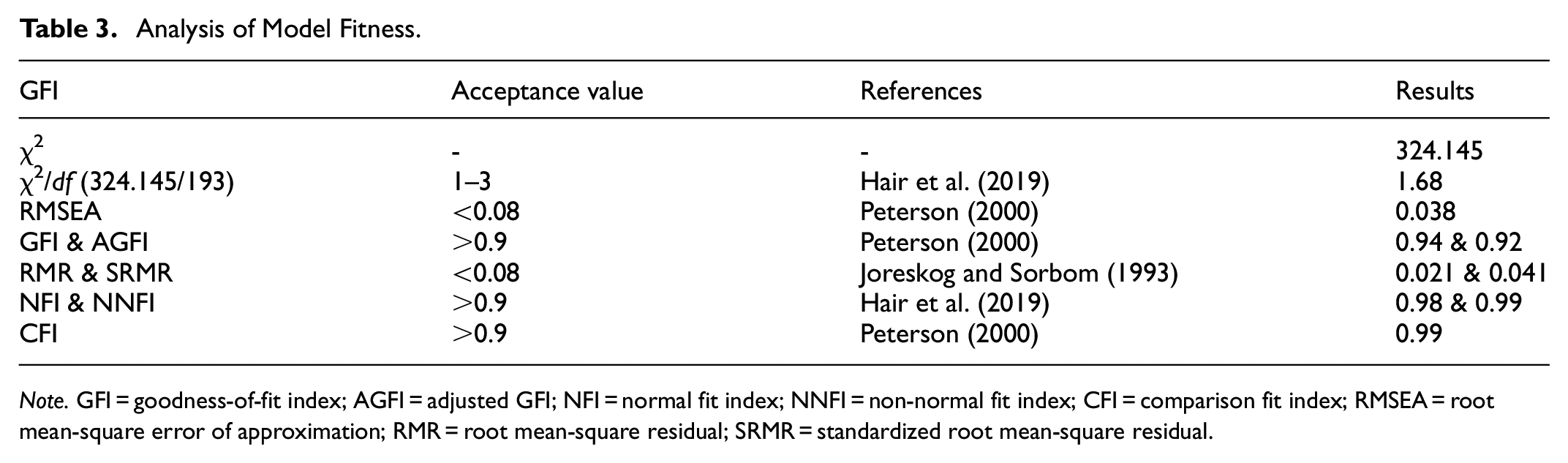
Note. GFI = goodness-of-fit index; AGFI = adjusted GFI; NFI = normal fit index; NNFI = non-normal fit index; CFI = comparison fit index; RMSEA = root mean-square error of approximation; RMR = root mean-square residual; SRMR = standardized root mean-square residual.
Discriminant validity is used to measure the different research dimensions. Each question should extract a more common variance in its corresponding research dimension than the other dimensions (Fornell & Larcker, 1981). The AVE (diagonal) values of all latent dimensions must be greater than the square of the correlation coefficients of the other latent dimensions (non-diagonal values). Table 4 shows that the discriminant validity agrees with this principle, indicating that the dimensions have good discriminant validity (Koufteros, 1999).
Discriminant Validity Results.

Empirical Results
This study uses SEM to analyze the following: the positive effects of four latent variables (sense of belonging, community interactivity, positive word-of-mouth, and information value) on brand community identification and trust, the positive effects of brand community identification on brand community trust, the positive effects of brand community identification and trust on brand loyalty, and the positive effects of brand loyalty on purchase intention. Eight research hypotheses were proposed, and the parameters were estimated using the maximum likelihood method and validated with the LISREL (version 8.54) analytic software.
Structural Model Analysis
This study adopts SEM orientation analysis, which can be divided into two application models: measurement and structural model analysis. The CFA of the measurement model confirmed that the various observed variables corresponded appropriately to the relevant latent variables, ensuring that the measurement scale has a unidimensional structure and good convergent and discriminant validity. Therefore, the next step is to conduct path analysis based on structural model analysis to verify the cause-and-effect relationship between variables.
A model fitness analysis measures the level of variance between the theoretical and hypothetical models (the observed data). As shown in Table 5, the GFI is 0.94, AGFI is 0.92, NFI is 0.98, NNFI is 0.99, CFI is 0.99, RMSEA is 0.038, RMR is 0.021, SRMR is 0.041, and χ2/df is 1.68. Among these, the GFI, AGFI, NFI, and NNFI are above the acceptance value of 0.9; CFI is above the acceptance value of 0.9; RMSEA is below the acceptance value of 0.08; and χ2/df is within the acceptance range of 1 to 3. Therefore, the model exhibits a good overall fit, indicating no significant difference between the hypothetical (observed data) and theoretical models.
Examination of Research Hypothesis.

Note. GFI = goodness-of-fit index; AGFI = adjusted GFI; NFI = normal fit index; NNFI = non-normal fit index; CFI = comparison fit index; RMSEA = root mean-square error of approximation; RMR = root mean-square residual; SRMR = standardized root mean-square residual.
p < .05 (t ≥ 1.96). **p < .01 (t ≥ 2.58). ***p < .001 (t ≥ 3.29).
The structural model validation results are presented in Figure 2. All path coefficients are significant, indicating that all hypotheses are supported (Table 4). A sense of belonging (H1) and community interactivity (H2) positively affect brand community identification, which positively affects brand loyalty (H3). In addition, positive word-of-mouth (H4) and information value (H5) positively affect brand community trust, which positively affects brand loyalty (H6). Moreover, brand community identification positively affects brand community trust (H7) and brand loyalty (H6). Finally, brand loyalty positively affects purchase intention (H8).

Structural model analysis.
The explanatory power of the latent dependent variables of the model is evaluated using the coefficient of determination (R2). Hair et al. (2019) stated that an R2 between .1 and .3 indicates that the model has some level of explanatory power, whereas an R2 > .3 indicates strong explanatory power. In some cases, such as logistic regression models, R2 is typically lower, and an R2 > .5 is considered substantively significant. The R2 of the four latent dependent variables (brand community identification, brand community trust, brand loyalty, and purchase intention) is >.58, indicating that the model has good explanatory power.
Discussion
Our study confirms the positive impact of word-of-mouth on brand community trust for Facebook fan pages. This finding supports the findings of many previous studies that used the SEM approach, including Wongsuphasawat and Buatama (2019), who investigated the factors affecting food supplement brand loyalty on social media in Thailand to develop a more efficient marketing program, finding that brand word-of-mouth is significantly related to brand loyalty. Moreover, Ibrahim et al. (2021) examined how social-media marketing activities affect brand loyalty, brand trust, and revisit intention for coffee shops in Northern Cyprus, finding that such activities, including word-of-mouth marketing, significantly positively influence brand loyalty. In contrast, this finding contradicts the findings of Ardyan et al. (2018), who investigated Xiaomi’s online community in Indonesia and found that online word-of-mouth did not positively impact trust in the e-brand community.
Our study supports the positive impact of information value on brand community trust for Facebook fan pages. This finding is supported by Al-Adwan and Kokash (2019), who investigated the relationship between trust in social commerce and customers’ purchase intentions on Facebook and Twitter, finding that informational support was a key driver of trust in social commerce sites in Saudi Arabia. In addition, our study supports the positive impact of brand community trust on brand loyalty for Facebook fan pages. This finding is supported by several previous studies, including Jibril et al. (2019), who used partial least squares and SEM and found that consumer brand promise and trust positively impact consumer brand loyalty on social media platforms in the Czech Republic. In addition, Chavadi et al. (2023) investigated online brand communities and found that brand trust positively impacts brand loyalty. Moreover, Samarah et al. (2022) investigated the relationship between brand interactivity, brand trust, and brand loyalty on the Royal Jordanian Airlines Facebook page, finding that brand trust is positively related to brand loyalty. In contrast, Ardyan et al. (2018) investigated the Xiaomi online community in Indonesia and found that e-brand community trust positively but nonsignificantly impacts brand loyalty.
Our study supports the positive impact of community identification on brand community trust for Facebook fan pages. This finding is partially supported by Coelho et al. (2018), who implemented a qualitative investigation on social media mass-marketing products, finding that consumer brand identification enables consumers to develop a relationship based on personality characteristics and personal values, which influence their positive attitude, brand trust, and loyalty. Finally, our study supports the positive impact of brand loyalty on purchase intention for Facebook fan pages. This finding is supported by J. Kim and Lee (2019), who found that luxury brand loyalty positively impacts the purchase intention of luxury brand communities on social media. It is also supported by Dülek and Aydin (2020), who investigated social media marketing’s impact on brand loyalty, purchase intention, and electronic word-of-mouth, finding a significant and positive relationship between brand loyalty and purchase intention. Moreover, this finding is partially supported by Munnukka et al. (2015), who found that the attitudinal loyalty of Facebook brand community users positively impacts their repurchase intention.
Conclusions, Management Implications, Theoretical Contribution, Limitations, and Future Direction
Conclusions
Our study answered its research question by developing a study framework and proposing hypotheses on the relationships between variables based on a literature review and the assumptions of auction theory. It tested and validated the model, ensuring the significance of its results. All study hypotheses are accepted and discussed in relevance to previous research findings. It found that previous studies had not investigated the impact of a sense of belonging and interactivity on identification. This approach provides new insights and broader areas of investigation that contribute to addressing gaps in current knowledge.
Our study found that Facebook fan pages demonstrate the full potential of social media marketing, serving as an important communication channel between consumers and brands. Members can use fan pages to engage in bilateral interactions with the brand or other fans, strengthening the relationship between the brand community members and the brand. Corporations use fan page communities to manage their brand and communicate brand information to group members. Members’ ever-growing trust in and identification with the brand community ultimately increases their purchase intentions. Our study used SEM to verify the correlations between research dimensions; the model exhibits a good fit and a high degree of explanatory power, indicating the reliability and validity of our analysis, which can be used by other researchers or those in the industry. Based on the results of the data analysis, our study presents the following conclusions.
First, a sense of belonging and community interactivity positively affects brand community identification. When members experience a sense of belonging and interactivity with others on a Facebook fan page, they better identify with this brand community. Algesheimer et al. (2005) suggested that when group members link their sense of self to the brand community, they develop a sense of belonging. Community identification develops when members’ self-concept is similar to the community’s. By joining Facebook pages to share preferences for the brand with other community members, the relationship between members and the brand community is strengthened through communication and interaction among members (Muñiz Jr & Schau, 2005). Increased interactions and more members with shared values exchanging thoughts about the brand make it easier for members to identify with the brand and its community, which is consistent with our findings.
Second, positive word-of-mouth and information value positively affect brand community trust. Social network theory states that trust can transfer among individuals in a network (Granovetter, 1973) and that others can affect an individual’s trust in an entity. In addition, when services or commodities are highly complex and difficult to judge, informal communication channels (e.g., word-of-mouth) become the primary means of distributing marketing information (K. K. Kim & Prabhakar, 2004). Moreover, McKinney et al. (2002) proposed that website users’ satisfaction is affected by the quality of the informational content provided, affecting their trust on the website. Our study used SEM for validation, and its findings indicate that positive word-of-mouth and information value have a positive and significant effect on brand community trust. In other words, the more positive consumers perceive word-of-mouth advertising and information value, the more they trust the brand community.
Third, brand community identification positively affects brand community trust. In brand community relationships, identification is the foremost element of community membership (Muniz & O’Guinn, 2001), and members develop trust through community identification (Ole Borgen, 2001). Morgan and Hunt (1994) defined trust as the willingness to believe in a trustworthy individual and the ability to share perceptions, emotions, and resources within an organization. Through this sharing process, people develop faith in the organization and integrate it into their personal identity (Whetten & Godfrey, 1998). Trust develops when organization members identify with other members and the organization. Our findings support past findings, meaning that when group members gain a sense of belonging, community interactivity, positive word-of-mouth advertising, and information value they need from Facebook fan pages, their identification with this community increases, thereby enhancing their trust in it.
Fourth, brand community identification and trust positively affect brand loyalty. Bhattacharya et al. (1995) argued that when individuals identify with an organization’s objectives, they become more loyal to its products or services. Robertson (1976) highlighted that when consumers have a stronger sense of brand identification, they are more willing to choose a particular brand, thereby generating brand loyalty. Our findings show a positive correlation between Facebook fan page identification and brand loyalty among members. The more the members identify with the brand community, the more willing they are to recommend this brand’s products or services to others, suggesting that their brand loyalty and intention to repurchase also increase. In addition, Lee et al. (2000) suggested a positive correlation between consumer trust and loyalty. Moreover, Singh and Sirdeshmukh (2000) believed trust is a critical mediating variable on purchasing behavior before and after making a purchase and can lead to long-term customer loyalty, bonding the two parties of the transaction more closely. Therefore, members’ trust in the brand community increases because they trust the product information provided on the brand’s Facebook fan page, thereby increasing their loyalty to the brand’s products. The findings indicate a positive correlation between brand community trust and brand loyalty.
Fifth, brand loyalty positively affects purchase intention. Greater consumer brand loyalty indicates that consumers are less likely to be influenced by external circumstances to change their behavior. They will also continue to purchase the same brand in the present and future as they have in the past (Morgan & Hunt, 1994; Oliver, 1999). Loyalty represents a customer’s love and commitment to a brand. When brand loyalty is relatively strong, customers are more receptive to purchasing other products from a brand, benefiting the corporation’s business performance. When consumers have a degree of loyalty to the brand’s core products provided on the fan pages, they are willing to continue purchasing the brand’s products. Our findings reveal a positive correlation between brand loyalty and purchase intention.
Theoretical Contribution
Our study contributes to the literature by expanding research on social media marketing and brand communities. It introduces a framework that examines factors from Facebook fan pages, such as belonging, interactivity, word-of-mouth, information value, brand community identification, trust, loyalty, and purchase intentions. While tested in the context of Facebook, the model can also apply to other social media platforms. Our study highlights the unique aspects of virtual brand communities and explores how belonging and interactivity affect brand community identification, a topic previously underexplored. Lastly, our study addresses the gap in understanding the relationship between consumer brand community and brand identification, trust, loyalty, and purchase intention, demonstrating the framework’s broader applicability beyond Facebook.
Management Implications
Our study finds that Facebook fan pages are built on the concept of brand community, serving as platforms for consumers to join and interact with other fans. This interaction fosters emotional communication and information sharing, enhancing consumers’ identification with and trust in the brand. Consequently, the loyalty developed through these fan pages significantly impacts purchase intentions.
In order to optimize this process, our study recommends that corporations enhance the management of their fan pages. Consumers are drawn to these pages due to their interest in specific brands, seeking to share experiences and connect with like-minded individuals while gathering brand-related information. Our study offers the following recommendations to help corporations effectively manage their brand products and improve the impact of their fan pages.
Enhancing Members’ Sense of Belonging to the Community and Brand Community Identification. Mole et al. (1999) proposed the “virtual community hexagon,” in which the “sense of belonging among virtual community members” is central and extends to seven other components: “degree of customization of informational content,”“degree of identification with the brand community,”“degree of awareness of other like-minded users,”“degree of ease of interaction with other members,”“degree of opportunity to participate in the development of the page,”“degree of interaction in the virtual community,” and “recognition among members through community participation.” When corporations manage Facebook fan pages, they can use the aforementioned factors to increase members’ sense of belonging to the community, such as by providing customized information to different members. The greater their sense of belonging to the community, the more members identify with the brand community and the more willing they are to participate in or browse this community.
Strengthening the Interaction Between Fan Pages and Members to Promote Brand Community Identification. Corporations can post on their Facebook wall to let fans obtain real-time brand information while browsing the website or replying to posts on the fan page about topics that interest them. Corporations should host themed lucky draws or games from time to time to encourage participation by fans. Moreover, by extending the Facebook API concept, corporations can develop marketing-related applications to diversify their interactions with fans. Approximately 70% of our study’s respondents considered entertainment a major factor for using Facebook fan pages. Therefore, this approach not only achieves the purpose of marketing but also enables members to communicate and interact with the brand in depth by playing games, thereby increasing their brand community identification.
Maintaining Information Quality on Fan Pages to Increase Members’ Brand Community Trust. Facebook fan pages constitute a platform and channel for communication between corporations and their fans. Consumers mainly join fan pages to obtain real-time brand-related information or messages from such communities. Therefore, in addition to observing consumers’ needs and preferences for information, corporations should focus on adding and updating information on fan pages, particularly its accuracy and richness. If consumers can access the information they want or other members’ reviews of the brand at any time from the fan page, they will use the fan page more frequently.
Using Positive Word-of-Mouth Advertising to Strengthen Members’ Brand Community Trust. Corporations can hold occasional trial events to let fans share and strengthen the image of the brand’s products. For example, corporations can use fan pages to invite fans to try new products, and the testimonials received in exchange can be used to promote those products through online word-of-mouth. The accumulation of positive word-of-mouth advertising can impact fans’ purchase intention for the brand’s products. Such events can increase the number of customers purchasing products through physical channels, and fans can share their thoughts online after trying products.
Managerial Implications for Optimizing Social Media Brand Communities. The managerial implications focus on enhancing the strategic use of social media brand communities like Facebook fan pages to achieve business objectives. First, brands should foster a sense of belonging among members by creating engaging content that aligns with their interests. Second, encouraging community interactivity through timely responses and meaningful discussions can strengthen trust. Third, brands must use these platforms to provide valuable information, improving perceived utility and reinforcing customer loyalty. Lastly, leveraging insights from community interactions to personalize marketing strategies can enhance purchase intentions. Our study provides a framework for brands to optimize fan pages as tools for building trust, loyalty, and sustainable consumer relationships, which can guide managers in redesigning their social media strategies to address identified issues and maximize the potential of their brand communities.
Practical application. To translate findings into actionable strategies, businesses can foster trust and loyalty in brand communities by designing content that emphasizes transparency, consumer voice, and consistent value. For example, showcasing authentic user-generated content, responding promptly to comments, and using polls or Q&A sessions can enhance perceived openness and engagement. Leveraging the informational value of posts—such as sharing behind-the-scenes content, product comparisons, or expert tips—signals credibility and invites deeper interaction. Additionally, brands can reward meaningful participation through recognition (e.g., top contributor badges) or exclusive access. These tactics align with incentive-compatible engagement, strengthening trust and long-term brand loyalty in social media environments.
Limitations
Our study has several limitations. First, it was conducted in Taiwan, indicating a spatial limitation. Facebook has only begun to gain popularity in Taiwan in the past 2 years, and fan pages are not yet fully developed in Taiwan. Therefore, respondents who were less familiar with the user interface of fan pages may have answered according to their preferences or imagination, resulting in slight variations in the data analysis. Second, it is cross-sectional, indicating a temporal limitation. Therefore, longitudinal analyses will likely provide more concrete results. Third, it did not consider the mediating effect of “brand community identification” and “brand community trust” on “brand loyalty” and “purchase intention.” Fourth, it is limited to the context of Facebook fan page users, as it did not examine other social media platforms. Fifth, applying auction theory to brand marketing on social media platforms is still in its infancy, and more in-depth analyses and broader application scopes should be examined.
Future Research Directions and Proposals
Our study mainly focused on corporations managing their brands or products through Facebook fan pages, which are defined as brand communities and include both brand and distributor fan pages. Researchers can further discuss the difference between pure brand fan pages and other fan pages (including distributor fan pages), observe the relationships and interactions between pure brand fan pages and fans, and examine how brands use the community management model to deepen members’ identification with and trust in the brand.
Our study examined how four variables (sense of belonging, community interactivity, positive word-of-mouth, and information value) affect brand community identification and trust, ultimately influencing purchase intention. Future studies can include other variables, such as brand reputation, from different perspectives to ascertain whether the findings are consistent. Such findings will more comprehensively reveal the factors affecting members’ identification with brand communities of Facebook fan pages and provide more diverse considerations and suggestions for corporations and brand managers.
Supplemental Material
sj-docx-1-sgo-10.1177_21582440251363700 – Supplemental material for Effects of Facebook Fan Pages on Consumer Brand Loyalty and Purchase Intention
Supplemental material, sj-docx-1-sgo-10.1177_21582440251363700 for Effects of Facebook Fan Pages on Consumer Brand Loyalty and Purchase Intention by Yi-Fen Chen, Wan-Hsin Yen and Tzu-I Jou in SAGE Open
Footnotes

Ethical Considerations
This study was granted exemption from requiring ethics approval because participants filled out anonymous questionnaire.
Consent to Participate
Informed consent was obtained from all participants to complete the anonymous questionnaire.
Author Contributions
A is responsible for guiding B and C to complete the journal paper submission. B is responsible for writing Chinese papers, including introduction, literature review and development of hypotheses, research methodology, data analysis and research results, and conclusions. C is responsible for translating Chinese papers into English and modifying them into the format prescribed by the journal.
Declaration of Conflicting Interests
The author(s) declared no potential conflicts of interest with respect to the research, authorship, and/or publication of this article.
Funding
The author(s) received no financial support for the research, authorship, and/or publication of this article.
Data Availability Statement
All data generated or analyzed during this study are included in this published article and its supplementary file.
Supplemental Material
Supplemental material for this article is available online.
References
Supplementary Material
Please find the following supplemental material available below.
For Open Access articles published under a Creative Commons License, all supplemental material carries the same license as the article it is associated with.
For non-Open Access articles published, all supplemental material carries a non-exclusive license, and permission requests for re-use of supplemental material or any part of supplemental material shall be sent directly to the copyright owner as specified in the copyright notice associated with the article.
