




Abstract
The conception of the consumer–brand relationship has been receiving immense and escalating attention, and it is considered essential for capitalizing the performance of brands. The purpose of this study is twofold: Foremost part of the study comprehends valuable consumer–brand relationships and antecedents of brand equity. The second part is measuring the significant variations in hypothetical model under consumers’ gender and age perspective. The structural equation model is used for analyzing 425 questionnaires through SmartPLS3. Analysis has been conducted several times for combine data and data sets of gender and age groups to identify variations in model relationships. The findings of this study revealed the significant relationship among constructs of the hypothetical model. Brand love emerged as not only one of the significant antecedents of brand loyalty but also the strongest predictor of brand equity. Significant variations have been identified as male, and older consumers are transforming their love into loyalty and equity more than female and young consumers, respectively. The study has revealed guidelines for designing consumer–brand relationship and identified some significant variations that can be helpful in designing such relationship and marketing offers for multiple market segments.
Keywords
Introduction
The notion of consumer–brand relationships (CBR) has received significant and escalating attention from researchers and practitioners (Tsai, 2011). Scholars deemed this relationship is hugely contributing to capitalizing the performance of brands, and they have realized the vital role of the CBR for the success of brands (Sharma et al., 2020). Previous researches have demonstrated that a productive CBR improves the willingness to pay premium prices (Thomson et al., 2005), brand durability (Ahluwalia et al., 2000), and brand loyalty among consumers (Hwang & Kandampully, 2012). Structuring such a relationship has become an area of study that receives significant attention and interest in marketing literature. Moreover, it is an essential element for fostering enduring and highly durable brand loyalty (Nobre et al., 2019; Tsai, 2011). Corporations use their successful brands as highly essential tools for gaining competitive advantages in a dynamic environment. In the twenty-first century, brand managers face challenging tasks to comprehend valuable relation between brand equity and its antecedents (Kuikka & Laukkanen, 2012). As brand equity is considered one of the significant success measures of a brand, it provides a corporation competitive advantage in achieving desired outcomes (Rambocas et al., 2018). Ultimately, it helps brands to generate long-term and valuable returns in markets (Cho & Hwang, 2020). Despite the plentiful research on brand equity, most studies investigate a limited amount of brand equity facets (Michaelidou et al., 2015), which fail to highlight the complexity of individual differences (Cho & Hwang, 2020).
Loyal behavior and loving affection among consumers are highly credible, strengthening the survival and success of brands (Khamitov et al., 2019; Setiawan & Sayuti, 2017). Considerable value is created by both elements for the company in the form of brand equity, which plays an influential role in shaping its vision and goals (Hwang & Kandampully, 2012). Although brands are not part of financial statements, many specialized consultants believe the brand is one of its precious assets; and brand management is mainly based on CBR (P. Rodrigues & Borges, 2020). Hence, the significance of developing and maintaining a valuable CBR is increased, especially in a complex environment surrounded by intensive rivalry. Brand managers pay immense attention, especially to consumers’ emotional feelings of love for brands (Cho & Hwang, 2020; Fetscherin et al., 2019). That influences consumers’ purchase decisions significantly (Khan et al., 2020). There is a need to focus on such a construct to examine and incorporate the relationship of brand love with brand equity in the context of building a CBR, which is hardly found in the literature (Cho & Hwang, 2020). Pakistan is one of the world’s emerging markets and receiving immense attention from multinational corporations as a potential market for their brands, especially after the progression of the CPEC (China-Pakistan Economic Corridor) project. Firms operating here need some proper guidelines, and directions to incorporate this phenomenon domestically and need to plan efficiently to coup up with a dynamic environment for survival, as too many foreign competitors are creating an intense level of rivalry for local firms, which are too young and immature. Pragmatically, the findings and implications of such study would be useful for marketers in developing CBR especially in emerging markets of the world (Cho & Hwang, 2020).
Moreover, the point of concern is how to design market offers to satisfy consumers with different preferences because satisfaction is the base of CBR (Hult et al., 2019; Ledikwe et al., 2019). Marketers have investigated consumers’ differences based on variations in traits and preferences that are significantly affecting marketing programs. A substantial study has investigated the phenomenon of brand equity; so far, only a few empirical research has examined determinants of brand equity, specifically from a perspective of individual differences (Cho & Hwang, 2020). While previous studies have investigated the determinants that influence individuals in technology adoption, the emphasis was mainly on how individuals’ demographic differences affect the adoption process. It makes sense to believe that individuals’ demographic differences are the central point in forming consumer attitude and behavioral intention in adopting brands (Chawla & Joshi, 2020). Marketers usually use gender and age as a standard criterion for segmentation. Gender differences can also affect the CBR as males are known more risk-taker than females (Byrnes et al., 1999), which indicates low commitment and loyalty in them in comparison to high loyalty in females for brands as they are risk avoider (Tifferet & Herstein, 2012). In such a situation, marketers are confused in shaping brands related marketing strategies and activities while having various gender-related theories (Chawla & Joshi, 2020; Machado et al., 2019).
Furthermore, consumer age is one of the valuable aspects of consumers’ demographics, significantly affecting marketing programs (Chawla & Joshi, 2020; Hwang & Kandampully, 2012). There are commonly held views regarding young consumers as they are an easy target for marketers for new and growing brands (Direction, 2011; Moliner-Tena et al., 2018). It shows their low loyalty with brands as they like new and innovative brands compared with older consumers (Hwang & Kandampully, 2012; Synodinos & Sharp, 2019). Often marketers put their efforts on the wrong side for chasing young consumers too diligently and ignoring older customers who are more loyal (Hwang & Kandampully, 2012; Moliner-Tena et al., 2018). These phenomena need to be addressed in such a way to investigate differences not only to manage consumer profiles efficiently but also to achieve desired objectives (Cho & Hwang, 2020; Moliner-Tena et al., 2018). Therefore, the present study examines how these two critical demographic variables, gender, and age moderate the brand equity model’s associations. The study’s findings could help marketers develop better market offers and a better understanding of consumer attitude in CBR formation, which could help corporations achieve desire outcomes (Chawla & Joshi, 2020). In addition, the present research investigates the influence of brand love on loyalty and equity, as previously brand love only indirectly investigated, with mediation, in contributing to brand equity. The study will incorporate the extended brand equity model in two different consumer demographics and emerging markets contexts to enhance CBR’s validity of findings and insights.
Literature Review and Hypothetical Framework
Consumer–Brand Relationship (CBR)
CBR is known as the psychological bond, which is created between brands and their consumers. It originated in social psychology, and this relationship has been considered an interpersonal relationship. It includes reciprocal interactions between relationship partners through several repetitive actions (Sharma et al., 2020). A sustained CBR generates several significant outcomes for both participants (Aaker & Equity, 1991; Keller, 2001; Nobre et al., 2019; P. Rodrigues & Borges, 2020). Numerous industries are at the maturity phase struggling for profit maximization by attracting new consumers. However, searching for new sources to generate profit is gaining a significant deal of attention. Therefore, leading corporations try their best to stimulate their loyal consumers for additional purchases, whereas those who entered late in the industry strive to reduce brand switching rates and employ multiple resources to attract customers of leading brands (Hur et al., 2011). The majority of the efforts of corporations are devoted to enhancing loyalty among customers. Since the consumer loyalty is generating favorable purchase behavior among customers, in the form of repeat purchase, cross-selling, and spreading the positive electronic word of mouth for nudging consumers of the competitors (Khamitov et al., 2019; P. Rodrigues & Borges, 2020).
Most of the scholars in their various researches have conceptualized the CBR as an outcome of one or more relational constructs such as satisfaction, trust, commitment (loyalty) (Khamitov et al., 2019), and love (Morgan & Hunt, 1994; Roberts et al., 2003). Moreover, the most modern school of thought proposed that the development of CBR at a global level, as generated by an amalgamation of such relational constructs of trust, loyalty, and relationship satisfaction, presents the significant measurement of relationship potency and behavioral loyalty (Sharma et al., 2020). Therefore, brand loyalty, brand trust, and customer satisfaction are the core three interrelated variables treated as critical components of such a relationship. After analyzing the proposed dimensions of CBR and human relationship approaches, scholars have arrived at that both approaches are sharing some standard dimensions such as the dimension of love and passion, indicating emotional attachment of consumers with specific brands (Fetscherin et al., 2019; Nobre et al., 2019; Roberts et al., 2003). As the previous literature failed to give proper attention to this construct in developing such an important relationship. That is why it has become an area of study that receives significant awareness and interest in the marketing literature (Cho & Hwang, 2020).
Customer Satisfaction
Satisfaction from a partner is a vital element for relationship bonds, and it is the base of every relationship. The conceptualizations of satisfaction have emphasized in various ways, either as an evaluation process of the customer (Fornell, 1992; Hult et al., 2019), as a response to a person’s process of evaluation (Halstead et al., 1994), as an overall evaluation of consumers (Fornell, 1992), and psychological state of a person (Dufer & Moulins, 1989). Moreover, satisfaction has been described as a conative, affective, and cognitive response of consumers, evaluating product attributes according to standards, product-related consumption experience of consumers, and/or experience regarding product attributes (Ledikwe et al., 2019). It occurs as transactional satisfaction of consumers through, after or before, choosing a product, after consumption experience of consumers, or as relational satisfaction of consumers through consumers’ extensive experiences with the provider (Ledikwe et al., 2019; Setiawan & Sayuti, 2017).
Consumer’s pleasure or the positive attitude that he develops from evaluating the result of his consumption experience regarding a particular product is known as customer satisfaction (Erciş et al., 2012). Customer satisfaction is gaining a great deal of attention from scholars and marketers (Hult et al., 2019). Firms are deploying a considerable amount of their resources to achieve a higher level of satisfaction among their customers because satisfaction has emerged as one of the significant antecedents of brand loyalty, which is developed through a process (Ledikwe et al., 2019) and significantly influences customers’ repurchasing decision for a particular brand (Erciş et al., 2012; Hult et al., 2019). Therefore, the CBR is always started with satisfaction between partners. However, the contribution of satisfaction in developing significant CBR needs to be investigated in the context of individual differences for a better understanding of the phenomenon.
Brand Trust
As satisfaction is the starting point of a relationship, trust strengthens the relationship (Ledikwe et al., 2019). When relationship partners are satisfied, they start believing each other. Trust has received significant attention from scholars and practitioners in numerous disciplines (Portal et al., 2019). This interest in multiple disciplines has enhanced the richness of this construct. However, on the other side, it has made it complicated for integrating different perspectives regarding trust and consensus for its nature. Brand trust can be defined as consumers’ willingness to rely on a brand that can perform according to the expectations regarding its functions (Ledikwe et al., 2019). The two basic approaches can be span to form such a definition of brand trust in literature. First, brand trust is viewed as consumers’ convictions and expectations about the brand’s trustworthiness resulting from its reliability, expertise, and intentionality (Portal et al., 2019). Second, brand trust can also be viewed as consumers’ behavioral intentions that reflect his reliance on the brand (Moorman et al., 1993).
Trust has been creating and maintaining valued and significant CBR, leading to loyalty (Ledikwe et al., 2019; Setiawan & Sayuti, 2017). Therefore, a brand is considered as trustworthy when it consistently fulfills all of its promises to customers throughout the various phases, such as in the phase of product development, production, selling, after-sales service, and advertisement, even in its critical time, when facing crises (Moliner-Tena et al., 2018). Mainly, in an uncertain environment, the notion of brand trust is useful in reducing the uncertainty among consumers, especially when they feel vulnerable because they can only rely on trusted brands (Portal et al., 2019). The notion of brand trust demonstrates the CBR that can go beyond customer satisfaction. Therefore, the present study investigates the role of trust in developing CBR and generating behavioral intentions that lead to building brand equity.
Brand Loyalty
Trust is an essential element for relational exchange, and loyalty is critical for maintaining such a valuable relationship, so loyalty is an indispensable ingredient for building a CBR (Ledikwe et al., 2019; Mohammad, 2012). Brand loyalty plays a vital role in maintaining a valuable link between consumers and brands (Sultan et al., 2019). As a matter of fact, attaining new consumers is a difficult task and a costly job. Moreover, loyal consumers play a significant role in the growth and endurance of a brand in the future (Synodinos & Sharp, 2019). The construct of brand loyalty has been emerged in the 1950s and has received significant attention in the marketing discipline. In the beginning, the phenomenon of brand loyalty has been studied in restricted perspectives, considering it as the purchasing behavior of consumers only. Under such considerations, customers are considered loyal when they repetitively purchase a brand (Sultan et al., 2019). Progressively, scholars came to know that the phenomenon of brand loyalty is more complicated than such an operational definition (Moliner-Tena et al., 2018). Under such limitations, scholars considered consumers’ attitudes as a substitute for brand loyalty (Dick & Basu, 1994; Setiawan & Sayuti, 2017).
Therefore, the attitudinal dimension of consumers’ loyalty for a brand emerged as an approach to focus on; now, customers are considered loyal with having true feelings of commitment for a particular brand (Sultan et al., 2019). Hence, attitudinal and behavioral approaches to brand loyalty have emerged in various researches (Ledikwe et al., 2019). As a result, researchers argue that repeat buying behavior and positive attitude of consumers are involved simultaneously in building true brand loyalty (Dick & Basu, 1994). Jacoby and Chestnut (1978) described it by concluding that brand loyalty is a combination of attitudinal and behavioral properties (Ledikwe et al., 2019; Nam et al., 2011). However, Chen and Gursoy (2001) excessively criticized these consumer behavior approaches in the tourism context. Loyal consumers are playing a significant role in revenue generation for a corporation and reducing marketing costs because they already have trust, satisfaction, and loyalty with brands (Alam et al., 2012; Setiawan & Sayuti, 2017). The present study explores the more insights into brand loyalty in different contexts compared with previous literature.
Brand Love
CBR can be developed through passionate and emotional feelings of consumers for a particular brand, a brand resonance which shows attitudinal attachments of the consumers for a brand that they love and considers it better in comparison with other brands of the same kind (Belaid & Temessek Behi, 2011; Junaid et al., 2019; Keller, 2003). Brand love is originated from emotional attachment theories (affection theory) of consumer behavior (Cho & Hwang, 2020). It is rotating around the influence of deep-seated emotions of customers on CBR. Brand love can be defined as a state of consumers’ emotional attachment characterized by intense and positive brand effect, greater stimulation generated by brand, and the brand’s tendency to dominate cognition of consumers (Cho & Hwang, 2020; Patwardhan & Balasubramanian, 2011). The positive brand associations based on the continuous satisfactory interactions between consumers and brand establish love in the relationship; therefore, cognitive and emotional aspects are essential to generate love for the brand (Cho & Hwang, 2020).
Fournier and Mick (1999) conceptualized brand love as one of the significant modes of customer satisfaction, a response generated by some satisfied consumers; however, it is a different construct from satisfaction (Carroll & Ahuvia, 2006). Furthermore, brand love also has some dissimilarity with brand commitment, which results from the passionate, emotional attachment of a consumer (Karjaluoto et al., 2016; Patwardhan & Balasubramanian, 2011). Besides, the factors other than brand love may be the motives to develop consumer commitments toward a brand, such as lack of availability of alternatives or moral or social or some contractual bonding (Junaid et al., 2019; Patwardhan & Balasubramanian, 2011). Some of the distinguished scholars and social psychologists such as Arriaga and Agnew (2001) and Tsai (2011) hypothesized in their studies that passionate feelings of love last for a long time rather than a temporary fascination that appears and vanishes quickly. Thus, scholars emphasize the significant role of brand love in developing and maintain the CBR (Kim & Lee, 2020; P. Rodrigues & Borges, 2020; C. Rodrigues & Rodrigues, 2019). However, previous literature disregards the direct relationship of brand love with brand equity. Therefore, the present study tries to bridge the gap in the literature.
Brand Equity
Fundamentally, two broad approaches are being used to define the brand equity, the first approach is from firms’ perspective, and the other is from customers’ perspective (Cho & Hwang, 2020; Mathew et al., 2012). Outcomes of brand equity are the base for the former approach, while consumers’ attitudinal associations are for the latter approach. Therefore, brand equity has been defined differently (Aaker, 1996; Keller, 2001). Consumer-based brand equity (CBBE) is developed when customers are highly aware of the brand and grasp the immense, reliable, and emotional brand affiliations in their memory (Cho & Hwang, 2020; Keller, 2001). Aaker (1996) has defined it as “a set of assets (and liabilities) linked to a brand’s name and symbol that adds to (or subtracts from) the value provided by a product or service to a firm and that firm’s customers.” Such situations create positive outcomes for the brand to gain high market share, price premium, mind share, positive word of mouth, competitive advantage, and many more (Iglesias et al., 2019; Lee et al., 2011).
Besides the importance of other intangible assets, brand equity reveals the strengths required to build sustainable and significant competitive advantages in a dynamic environment (Cho & Hwang, 2020). It generates a higher response to advertisements and promotional activities (Keller, 2001). It contributes to low cost and higher success rate in product line extension (Iglesias et al., 2019; Keller & Aaker, 1992). As a result, brand equity has a positive and long-lasting impact on corporate value (Cho & Hwang, 2020). According to brand management literature, brand equity is treated primarily as a relational construct, which has a significant role in CBR (Aaker & Equity, 1991). Most of its value is generated through a brand’s relationship with other participants of the value chain. Although a significant amount of literature on brand equity is available, most studies examine only a fractional number of brand equity aspects (Michaelidou et al., 2015), which fails to consider the complexity of individual differences (Cho & Hwang, 2020). The present study investigates the individual differences in the brand equity model to highlight some significant insights about the phenomenon.
Hypothetical Framework of Study
Framework theories
The present study’s theoretical framework is mainly based on the theory of the “consumer–brand relationship” (Fournier & Mick, 1999; Tsai, 2011). The study focuses on the consumer psychological perspective (i.e., cognitive, emotional, and behavioral aspects) (Gomez et al., 2019), which is considered fundamental assumptions of this CBR theory. To generate positive consumer responses, corporations seek to develop CBR based on satisfaction and trust (Brudvig, 2015; P. Rodrigues & Borges, 2020), which is the outcome of the brand experience’s cognitive evaluation. Therefore, this relationship’s foundation is based on the quality of the relationship; it will develop the brand’s love and loyalty, leading to brand equity (Fritz et al., 2017; P. Rodrigues & Borges, 2020). These outcomes represent the emotional and behavioral aspects of consumer psychological perspectives, respectively.
On the other hand, CBBE research is grounded on theories of Aaker and Equity (1991) and Keller (1993); both scholars propose that the strength of brand equity or brand can be measured by using brand associations and positive responses of consumers to brand. Although a substantial number of researchers applied the theories of Aaker and Keller in various contexts, somehow, few studies focus on a multitude of brand associations that are essential in building CBBE (Cho & Hwang, 2020). Moreover, CBBE studies have not conspicuously integrated consumers’ demographical aspects (Cho & Hwang, 2020). Therefore, based on both theoretical frameworks of CBR theory and CBBE theories, the present study develops an integrated research framework that examines the dynamics of CBBE in an attempt to establish CBR while capturing the aspects of consumer demographic differences in an emerging market context.
Customer satisfaction and brand trust
The relational construct that customer satisfaction always generates trust for a brand is investigated and supported in the literature (Belaid & Temessek Behi, 2011; Song et al., 2019). However, a few authors also investigated the correlation between brand trust and customer satisfaction to know whether brand trust creates satisfaction (Chaudhuri & Holbrook, 2001; Zehra & Arshad, 2019). Therefore, a more satisfactory brand can be treated as the most trustworthy brand (Belaid & Temessek Behi, 2011; Setiawan & Sayuti, 2017). Furthermore, the literature patronizes that customer satisfaction is one of the vital antecedents of brand trust and loyalty and playing a significant role as a critical factor in consumers’ repurchase decisions (Erciş et al., 2012; Zehra & Arshad, 2019). Such trust establishes a psychological bond between customers and brands (Morgan & Hunt, 1994; Song et al., 2019). It is considered one of the key drivers for developing and maintaining CBR. The affection of satisfied customers toward a brand could generate repeat purchase motivation and recommend the same as a trusted brand (Moliner-Tena et al., 2018). Similarly, customer satisfaction develops when customers perceive that the market offers are highly beneficial and reliable (Cho & Hwang, 2020). Hence, the following hypothesis is proposed.
Customer satisfaction and brand loyalty
One of the most significant outcomes of post-purchase as a consequence of customer satisfaction is brand loyalty. Various scholars have investigated and found that greater customer satisfaction always leads to high repeat purchase behavior (i.e., band loyalty) among consumers (Belaid & Temessek Behi, 2011; Song et al., 2019). Furthermore, some researches regarding customer satisfaction have concluded that customer satisfaction significantly affects consumers’ brand loyalty, and it can be one of the more significant predictors of repurchase intentions of consumers for a particular brand, which shows their loyalty for that brand (Ha & Park, 2012; Mohammad, 2012; Ramli, 2019). Faullant et al. (2008) substantiate customer satisfaction’s predictive capacity on consumer–brand loyalty. In addition, several empirical researchers support the significant and positive association between customer satisfaction and brand loyalty (Chaudhuri & Holbrook, 2001; Lin & Wang, 2006; Setiawan & Sayuti, 2017; Song et al., 2019). Thus, satisfaction is considered a key driver of brand loyalty by inspiring continuous support and promoting brand appreciation in the minds of current and potential consumers (Ledikwe et al., 2019). The empirical investigation of Chacha (2015) and Ledikwe et al. (2019) have supported the notion that satisfied customers can stimulate brand loyalty and long-term CBR. So, the following hypothesis is proposed.
Brand trust and brand loyalty
Integrity and reliability are the elements that create trust among consumers for a brand; both elements are considered sources of brand loyalty (Belaid & Temessek Behi, 2011). Trust has been developing and maintaining a valued and significant CBR, leading to loyalty (Song et al., 2019; Zehir et al., 2011). Brand trust usually influences and enhances both attitudinal and behavioral loyalty in consumers (Albert & Merunka, 2013; Setiawan & Sayuti, 2017). Trust is playing a significant and vital role in developing brand loyalty among customers. Therefore, in a CBR, brand trust and brand loyalty are equally imperative to uphold such association because brand trust is essential for relational exchanges, and brand loyalty plays a significant role in maintaining such a valuable relationship (Mohammad, 2012; Song et al., 2019). Consumers always try to purchase trusted brands, and such brands evoke a higher degree of brand loyalty (Menidjel et al., 2017; Mohammad, 2012) and positively influence customer retention (Giovanis & Athanasopoulou, 2018). Menidjel et al. (2017) argue that brand trust cultivation develops a stronger loyalty for brands (Ledikwe et al., 2019). Based on these findings, the following hypothesis is suggested:
Customer satisfaction and brand love
Brand love is considered a random outcome among satisfied customers, and it most probably appears as a consequence of merely successful interactions of customers with the brand firm (Carroll & Ahuvia, 2006). Researches in the marketing field reported the presence of passionate, emotional attachments between consumers and brand firms based on their successful or satisfied experiences (Soscia, 2007). Therefore, customer satisfaction is a significant antecedent for brand love and the cause of fluctuations in CBR (Long-Tolbert & Gammoh, 2012). Moreover, satisfaction is significantly enhancing the love for the brand among consumers; thus, such brand love generates positive word of mouth in the market and develops brand loyalty among consumers (Cho & Hwang, 2020). The more customers are satisfied with a particular brand, the more brand love will be generated in such a relationship (Song et al., 2019). However, satisfaction is an intangible concept, but it is an obvious consequence of consumer experience, which is demonstrated by several studies where the consumers’ delightful brand experience generates emotional affection (i.e., love) for that brand (Khan et al., 2020). Therefore, satisfaction is investigated to be positively associated with brand love examined in the context of various industries (Drennan et al., 2015; Khan et al., 2020). Thus, the following hypothesis is proposed to investigate such an association.
Brand trust and brand love
Besides all, brand love emerged as one of the highly significant constructs of the CBR. Researchers are still exploring the antecedents of brand love in such an ongoing relationship and identified the significant role of brand trust in generating love in consumers for a particular brand, so love for a brand can be developed only among trusted customers straightforwardly (Albert & Merunka, 2013; Song et al., 2019). Brand recognition and brand trust are the main determinants that develop a love for the brand in consumers, and this brand love appears as the outcome of such determinants (Carroll & Ahuvia, 2006; Chaudhuri & Holbrook, 2001; Khan et al., 2020). Moreover, the brand’s honesty and reliability attributes affect consumers’ feelings of love for the brand, as investigated critical antecedents of brand love in establishing valuable CBR (Albert & Merunka, 2013; Carroll & Ahuvia, 2006; Kennedy & Guzmán, 2020). So, brand trust significantly explains and influences brand love (Carroll & Ahuvia, 2006; Tsai, 2011), and a positive relationship has been found between both constructs in several studies (Albert & Merunka, 2013; Khan et al., 2020). Therefore, this study proposes the following hypothesis to investigate the relationship between constructs further.
Brand love and brand loyalty
Thomson et al. (2005) have investigated the three highly significant aspects of affection, association, and love as vital antecedents of brand loyalty, which help develop CBR. Therefore, intensive brand love ultimately develops high brand loyalty (Song et al., 2019; Tsai, 2011). Multiple scholars theoretically and empirically authenticated the significance of consumers’ love for brands as a primary driving force of brand loyalty, which not only helps to create and maintain a fruitful relationship but also generates some considerable favors for firms such as low switching rate, charge premium prices, and competitive edge (Thomson et al., 2005; Tsai, 2011). Brand love is a fundamental element for forming brand loyalty; the more consumers have brand love, the more they shall be loyal to the brand (Song et al., 2019). Prior studies investigated brand loyalty as one of the significant outcomes as well as consequences of brand love (Kaufmann et al., 2016; Kim & Lee, 2020). Moreover, Razzaq et al. (2017) identify that consumers always form specific attitudinal commitments with loving brands, which leads to greater brand loyalty (Cho & Hwang, 2020). Hence, this study is proposing the following hypothesis based on the above discussion.
Brand loyalty and brand equity
Brand loyalty is an indispensable contemplation while measuring brands’ value as brand loyalty can be converted into financial and non-financial benefits (e.g., brand equity) for a particular brand (Lee et al., 2011; San Martín et al., 2019). Consumers’ brand loyalty is playing the role of a significant driver for building brand equity, which leads to achieving objectives (Aaker & Equity, 1991; Delgado-Ballester & Luis Munuera-Alemán, 2005). Various studies previously highlighted the essential antecedents that can build brand equity for a particular brand, such as brand loyalty, customer satisfaction, brand awareness, perceived quality, brand affiliation, and associations (Lee et al., 2011). Moreover, brand loyalty is perused repeat purchase behaviors among consumers and acts as one of the barriers in customers’ switching behavior; ultimately, it creates brand equity (San Martín et al., 2019; Yoo et al., 2000). High brand loyalty generates desirable consumer outcomes in the form of positive word of mouth, purchase attitude, and foundations for incriminating premium prices for brands (Buil et al., 2013; Rambocas et al., 2018), which ultimately enhances the long-term returns as well as enhances the worth of tangible and intangible assets in the form of brand equity (Cho & Hwang, 2020). Therefore, based on the above findings, the following hypothesis is proposed.
Brand love and brand equity
The relational constructs of brand love and brand equity have not received immense attention from scholars. Typically, an appreciation framework is being used for evaluating intrinsic and extrinsic consumption values and satisfaction of brand experiences (Boyle, 2007). Such attitude and behavior show some emotional attachments (love) of consumers, which ultimately influence their purchase decisions and indirectly leads to developing equity for the brand. Consumers are making purchase decisions, exposing repeat purchase behaviors, associations, affiliation, and persuasion for the brands under the circumstances, such as religious, national, social, and noble causes even when they are not loyal with the brands, but still contributing toward some financial and non-financial benefits of corporations (Boyle, 2007; Machado et al., 2019). Various scholars in the field of emotional branding (Gobe, 2001), cultural branding (Holt & Holt, 2004), experiential branding (Daehyun, 2002), and relationship marketing (Morgan & Hunt, 1994) are supporting the relationship of brand love and brand equity with theoretical and empirical findings. Greater brand love generates desirable outcomes (Nikhashemi et al., 2019; Rambocas et al., 2018), which ultimately enhances the long-term returns on tangible and intangible assets (i.e., brand equity) (Cho & Hwang, 2020; Zhang et al., 2020). Therefore, this study proposes the following hypothesis to explain the relationship between brand love and equity.
Variations in the model in gender perspective
Marketers are using gender as the most common criterion for segmentation. Males are more risk-taker than females (Byrnes et al., 1999), which shows indirectly high brand commitment and brand loyalty in females (Tifferet & Herstein, 2012). However, females like more impulse purchasing than males (Coley & Burgess, 2003), and also like more hedonic aspects such as emotional arousal (e.g., brand love), fun, entertainment that is indirectly linked with customer satisfaction (Zhong & Mitchell, 2010), and shows fewer considerations for loyalty (Machado et al., 2019). It is a prudent fact that consumers cannot be treated as a homogeneous segment because there are several differences in terms of gender (Chawla & Joshi, 2020). Thus, marketers have to incorporate such differences while designing offers because a similar offer cannot be executed for every consumer (Chawla & Joshi, 2020). Hence, this study will also propose the following hypothesis to measure the variations in model relations to address significant differences as a guideline to achieve better results.
Variations in the model in age perspective
Age is another valuable aspect of consumers’ demographics that is also significantly affecting brands’ marketing programs. Young consumers are one of the attractive and emerging segments for companies, although they have less purchasing power yet have a significant role in brands’ sales (Hwang & Kandampully, 2012). There are commonly held views regarding young consumers that they are an easy target for brand managers for their new and innovative brands, because young consumers have less fixed views regarding brands, which shows their low concerns for brand loyalty as they like new innovated brands compared with older consumers (Hwang & Kandampully, 2012). A significant tendency is available for new and growing brands to have young consumer profiles and declining brands to have an older consumer profile. Differences in attitudes and behaviors between young and older consumers have been investigated in literature in several perspectives such as socialization, media habits, adoption of technology, general expenditure patterns, complaining behavior, information processing, behavior in crises, and shopping behavior (Das & Mandal, 2016; Moliner-Tena et al., 2018; Monferrer-Tirado et al., 2016). However, its impact on CBR is not well documented in the literature. Such age differences significantly affect CBR; this phenomenon needs to be understood to match marketing offers and programs effectively. Therefore, this study is proposing the following hypothesis.

Hypothetical model of research.
Method
Survey Instrument
A mix of offline and online survey methods was used to collect the sample population’s required data. This study’s population consisted of Samsung mobile phone users of Pakistan, including both genders and all age groups of consumers from diverse life fields. Samsung brand has been selected based on the rating given by the participants of the pilot survey (consisted of 50 university students, teachers, and staff) as the most familiar and famous brand. The pilot study also consolidated and conformed the adapted questionnaires’ reliabilities and validities. Pakistan is one of the world’s emerging markets where the mobile phone industry has the potential to grow. The convenience and snowball sampling techniques were used for selecting the respondents for this study keeping in mind the time constraints involved in this project. The questionnaires were circulated in different big cities. Five hundred respondents were physically approached, and the rest of social media was used, such as Facebook and WhatsApp platforms. The questionnaire was started with the opening question about “Are you a Samsung user?” so that Samsung users could be identified. The total sum of 425 useable questionnaires was approved for further process of analysis within the given time.
Measurement
The scale items of the survey instrument of the present study are adopted from various previously published researches of different renowned scholars of the same discipline. Customer satisfaction and brand trust were taken from Ganesan (1994) study and later was taken from Morgan and Hunt (1994) study. On one hand, brand loyalty was borrowed from Chaudhuri and Holbrook (2001) study. On the other hand, brand love has been received from Carroll and Ahuvia (2006) study. Moreover, items of brand equity were borrowed from the research of Yoo and Donthu (1997). For ensuring the validity and reliability of scales, a pilot study was undertaken first. A 5-point Likert-type scale was used to measure the study’s constructs ranging from strongly disagree to strongly agree.
Analysis Techniques
The partial least squares–structural equation model (PLS-SEM) was used for investigating the associations among variables of the research model, which has the causal nature of relationships. Moreover, to measure the effects of gender and age perspectives, data were further split into parts under each perspective and repeated each section’s analysis process. As recommended by Anderson and Gerbing (1988), the present study followed the two-step approach, and adopted Joseph F. Hair et al. (2019) strategy and elaborated the results.
Data Analysis and Results
To check the uniformity of data distribution, the variance-based PLS-SEM approach was adopted, as it handles the measurement model and structural model simultaneously (Joseph F. Hair et al., 2016, 2019). SEM was mainly used for prediction and exploration to explain the maximum variance.
Multicollinearity Assessment and Common Method Bias (CMB/CMV)
The variance inflation factor (VIF) values assess the collinearity issue in the formative constructs. The threshold value for VIF is five or above (W. W. Chin, 1998; Joe F. Hair et al., 2011). All the VIF values in the current research are less than five, indicating no collinearity issue in the research framework. And there are many different methods to calculate and reduce the CMB, but similarly, the current study has used PLS-SEM by using the SmartPLS-3 statistical package, so we calculated and assessed CMB through its analysis. PLS-SEM assesses the CMB by verifying the VIF values in the study (Kock, 2015). If the VIF values are under the threshold value of 5 (W. W. Chin, 1998; Joe F. Hair et al., 2011), there will be no CMB issue in the data.
Analysis of the Measurement Model
Content and convergent validity
According to Joe F. Hair et al. (2011), factor loading is being used to verify the content validity of scales. In Table 1, all scale items of constructs have significantly loaded and shown the highly significant inception level to confirm the content validity of scales (H.-C. Chin & Quek, 1997). Reliabilities of items are used to prove the convergent validity of the scale; for this regard, Cronbach’s alpha (α), composite reliability (CR), rho, and average variance extracted (AVE) were used. Overall, each variable has a significant value of Cronbach’s alpha, which showed the questionnaire’s high reliability.
Reliability and Validity of Scale Items.

Note. FL = factor loadings; α = internal reliability, Cronbach’s alpha; CV = composite reliability; AVE = average variance extracted; VIF = variance inflation factor; CS = customer satisfaction; BT = brand trust; BL = brand loyalty; BLv = brand love; BE = brand equity.
Discriminant validity
Discriminant validity is the degree to which a construct differs from other constructs used in the same model (Sarstedt et al., 2017). There are two main methods used to analyze the discriminant validity: the Fornell and Larcker criterion and the Heterotrait-Monotrait (HTMT) ratio of correlation. The results of the Fornell and Larcker tests are given in Table 2. Furthermore, the HTMT ratio of correlations was also calculated, as suggested by Henseler et al. (2015). It is a modern tool used to assess discriminant validity. According to the authors, the maximum acceptable value of HTMT to confirm discriminant validity is 0.85, while any value above this will indicate a discriminant validity problem. Table 2 provides the detailed results of the HTMT analysis.
Discriminant Validity and Model Fit.

Note. GoF = goodness of fit; SRMR = standardized root mean residual; NFI = normed fit index; HTMT = Heterotrait-Monotrait.
Analysis of the Structural Model
Coefficient of determination (R²), effect size (f2), predictive analytics Q2, and importance-performance map analysis (IPMA)
As a rule of thumb, the value of R2 for endogenous variables represents .75, .50, and .25 as substantial, moderate, and weak, respectively (Henseler et al., 2016; Sarstedt et al., 2017). In this research, the value of R2 for brand trust is .650, brand love is .666, brand loyalty is .752, and brand equity is .760. Rather than relying only on R2, researchers moved further and proposed a more reliable predictor of the model’s predictive relevance through Stone-Geisser (Q2) (Sarstedt et al., 2017). The value of Q2 is calculated by the blindfolding procedure, which indicates how well the path model can forecast the original observed values. The Q2 values represented 0.02, 0.15, and 0.35 as a small, medium, and considerable predictive relevance, respectively (Sarstedt et al., 2017). The Q2 values of our model are brand trust is 0.428, brand love is 0.438, brand loyalty is 0.508, and brand equity is 0.505, which indicates strong predictive relevance. In addition to R2 and Q2, the researchers also calculated the effect size (f2). The f2 is used to measure the influence of the latent construct on the endogenous constructs. The f2 values can be evaluated at 0.02, 0.15, and 0.35 as a small, medium, and large, respectively (Cohen, 1988). According to our results in Table 3, the f2 values are all good. To estimate the hypotheses’ statistical significance, bootstrapping was performed with the 5.000 resample technique (Joseph F. Hair et al., 2016). For examining the level of significance of path coefficients, the researchers considered that the t value should be greater than 1.96, and the p value should be less than .05.
Coefficient of Determination (R2), Effect Size (f2), Predictive Analytics Q2, and IPMA.

Note. IPMA = importance-performance map analysis.
The goodness of fit indexes
The current research standardized root mean residual (SRMR) value is 0.045 less than 0.1, representing a good model fit (Henseler et al., 2014; Hu et al., 1998). Second, normed fit index (NFI) is defined as 1 minus the chi-square value of the proposed model divided by the chi-square values of the null model. Consequently, the NFI results in values between 0 and 1. The closer the NFI to 1, the better the fit. NFI values above 0.9 usually represent an acceptable fit (Lohmöller, 1990). The NFI result of the current model is that 0.876 represents a good value. Also, we have calculated the value of goodness of fit (GoF), which is 0.716. According to the obtained value of GoF that is 0.763, which is higher than the threshold value of 0.36, the GoF has been proved (Wetzels et al., 2009) (see Table 3).

IPMA
IPMA’s primary objective is to identify which antecedents have high performance but low importance and vice versa (Sarstedt et al., 2017). Figure 2 and Table 3 indicate that brand love, brand loyalty, brand trust, and customer satisfaction have importance values of 0.767, 0.426, 0.403, and 0.680 and performance values of 27.472, 28.855, 22.538, and 21.386, respectively. If we compare the values, we see that all the independent constructs for brand equity lie between 21 and 29 and do not have a big difference. However, loyalty contributes more than other constructs in building brand equity, brand love competing right after loyalty. On the other hand, the importance values of brand love and customer satisfaction are substantially different from brand trust and brand loyalty. It represents that brand love and customer satisfaction are more important constructs for brand equity than brand trust and brand loyalty.

Importance-performance map analysis.
Hypothesis testing
This section of the study measures the causal associations of independent variables over dependent variables. Analysis has been conducted several times to estimate the hypotheses’ relationships, and the results are presented in Tables 4 and 5, and Figure 3. In the combined model, except for the H3, between brand trust and brand loyalty, all other hypotheses are accepted. Table 5 presents the results of the categorical moderator’s perspectives. From the categorical moderator gender perspective, the results are different. In males H2, H3, and females, H3 are rejected. Similarly, in the age perspective, we found differences. In youngers H2 and older H2, H3 are rejected.
Combined Model Results.

Note. CS = customer satisfaction; BT = brand trust; BL = brand loyalty; BLv = brand love; BE = brand equity.
Model Results in Categorical Moderators Perspectives.
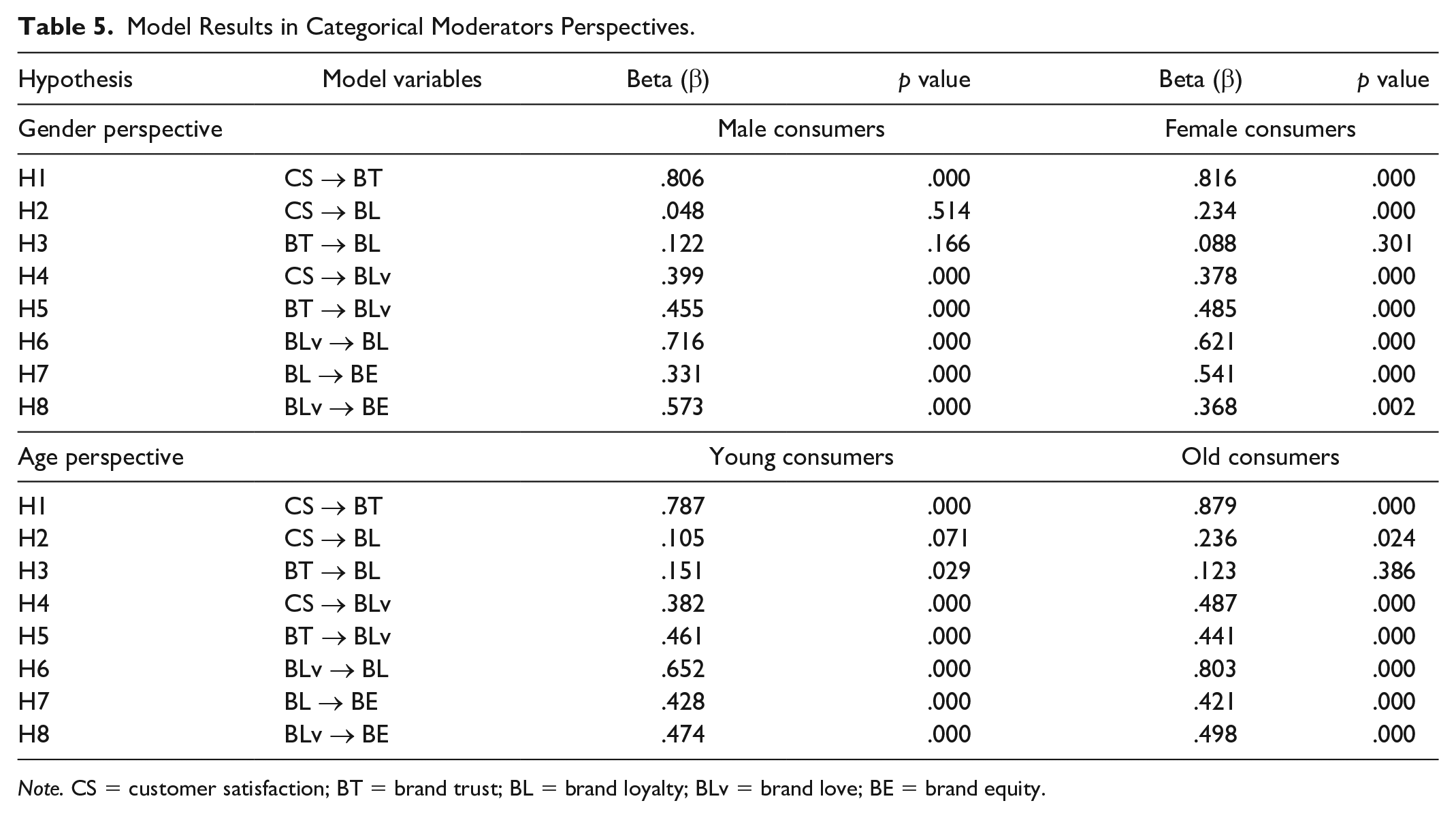
Note. CS = customer satisfaction; BT = brand trust; BL = brand loyalty; BLv = brand love; BE = brand equity.

Path coefficient combined results.
The relationships in terms of gender
The regression results identified some significant differences among the relationships of the model from the gender perspective. These results are supporting H9. Some of the differences are in the H2 relationship between customer satisfaction and brand loyalty supported in the female consumers’ category. However, this relationship is not supported by the male consumers’ category. On one side, the relationship between brand loyalty and brand equity in H7 is significantly stronger in females than males. On the other side, in H8, the association between brand love and brand equity is supported in both cases. However, this relationship is found stronger in males, while the relationship is weaker in females.
The relationships in terms of age
The regression analysis results have also found some significant differences in the model’s relationships from an age perspective, so H10 is supported by these results. The following are some significant differences found in the results. In H3, the relationship between brand trust and brand loyalty is supported by results in the case of young consumers, yet the strength of such a relationship is weak, while this relationship is found not only insignificant but also negative by results in the case of older consumers. Furthermore, the relationship between customer satisfaction and brand love in H4 is significantly influential in older consumers’ cases than young consumers. Nevertheless, the relationship is validated by results in both cases. Besides all this, in the H6 relationship between brand love and brand loyalty has also found stronger in older consumers than young consumers.
Significant Differences in Categorical Moderators.

Note. CS = customer satisfaction; BL = brand loyalty; BE = brand equity; BLv = brand love; BT = brand trust.
Discussion and Implications
Discussion
The present study has examined the relationships of various constructs used to build a valuable CBR. The entire study is based on two parts. The first part applies a conceptual model for understanding different constructs’ contributions in building a significant CBR. The study is identifying and highlighting the antecedents and outcomes of such a relationship. The second part is measuring the considerable variations in model constructs under gender and age perspectives. In line with the previous finding of research and as expected, customer satisfaction is a significant and robust predictor of brand trust (Cho & Hwang, 2020; Song et al., 2019), especially in female and older consumers.
On one hand, customer satisfaction has been explored as a significant antecedent to establish brand love (Cho & Hwang, 2020; Song et al., 2019); however, older consumers show more propensities in developing a love for the satisfying brand. On the other hand, brand trust also has a significant role in building brand love (Albert & Merunka, 2013; Khan et al., 2020; Song et al., 2019; Tsai, 2011), more significant in the case of young consumers. Moreover, brand trust has emerged as the strongest predictor of brand love than customer satisfaction. However, brand trust has not found significant in influencing the brand loyalty, which is contradicting to previous studies (Ledikwe et al., 2019; Menidjel et al., 2017; Setiawan & Sayuti, 2017) in the combine as well as in gender perspective and the case of the older consumers in age perspective, but the relationship is supported in case of young consumers only surprisingly.
Although consumers’ general tendency to become loyal to a brand makes them satisfied (Ledikwe et al., 2019; Ramli, 2019; Setiawan & Sayuti, 2017; Song et al., 2019), yet fragile relationship found in the current study. Moreover, an insignificant relationship is found in male consumers who are opposite to previous studies. Surprisingly, profoundly contradict findings are generated by present research in gender perspective where brand trust cannot explain the loyalty in both male and female consumers. However, the relationship of these constructs is validated only by young consumers unexpectedly. Such unexpected results may be due to the product industry used in this research; many firms are competing intensively in monopolistic competition with many highly similar alternatives. In this scenario, consumers are confused about establishing loyalty with a specific brand and mobile phone model. Moreover, brand love has found a highly significant predictor of brand loyalty (Albert & Merunka, 2013; Cho & Hwang, 2020; Kaufmann et al., 2016; Kim & Lee, 2020; Song et al., 2019); the relationship has been explained in a better manner in the case of male and older consumers. Interestingly, brand love has found the strongest predictor of brand loyalty for building CBR.
Furthermore, brand loyal consumers are significantly contributing to the progress of corporations in terms of brand equity explored by this study in line with previous researches (Cho & Hwang, 2020; Lee et al., 2011; San Martín et al., 2019; Song et al., 2019), as high performance construct is found in IPMA. Brand loyalty is considerably transformed into brand equity in female consumers, which shows that once female consumers become loyal to a brand, they will contribute through repeat purchase and promote a brand through positive word of mouth. While brand love has emerged as one of the highly essential antecedents of brand equity (Boyle, 2007; Cho & Hwang, 2020; Machado et al., 2019; Zhang et al., 2020), and also ranked first in importance in IPMA, surprisingly, such a construct is previously not incorporated visibly in studies of the same discipline. Male consumers are found as more efficient in transforming their love in affluence, a brand in terms of equity. Whereas, older consumers somewhat have more contribution than young consumers.
This study has generated some significant differences while analyzing the data from gender and age perspectives. On one hand, from a gender perspective, the relationship between customer satisfaction and brand loyalty is found insignificant in male consumers, which shows that they are not establishing loyalty based on satisfaction. This study has identified that female consumers are transforming their loyalty into brand equity for brands more than male consumers considering factors other than loyalty, such as time availability, innovation, and risk-taking behavior. However, males are transforming their love more significantly into brand equity. On the other hand, from the age perspective, the association between brand trust and brand loyalty is insignificant and negative in older consumers, which shows trust is not helpful to establish loyalty in them. Furthermore, customer satisfaction significantly enhances brand love in older consumers, exposing their nature in developing feelings of love based on their past positive experiences with the brand and transforming their love into loyalty more than young consumers. Most experience and mature consumers always become loyal consumers to loved brands.
Implications
Theoretical implications
The multinational corporations are highly concerned about developing brand equity, especially in foreign marketplaces, as brand equity emerged as a crucial element to generate positive consumer responses and evaluations. The present study investigated the constructs that are essential in building CBR and contributed significant insights into the field of consumer behavior. Corporations struggle to compete in a dynamic environment, especially those offering the same product for various kinds of consumers. The present study demonstrated the directions to incorporate in designing market offers for consumers and create opportunities to incorporate such directions in theoretical models in the CBR theory. The question is how to build a profitable relationship with consumers’ diverse nature and with diverse explicit and implicit needs. The study tested the theoretical model with two demographic constructs to provide some new insights with greater external validity. The study results validate the significant role of brand love and consumer demographics in building a fruitful CBR and show some variations and exciting findings across the two consumer demographics variables. This study opened up a gateway to study consumers’ demographics and provided the directions to study further such kind of constructs and their impact on brand equity models in the CBR perspective.
Such a relationship is remarkably contributing to corporations’ financial and non-financial performance because consumer retention is highly essential for brands’ success. On the other hand, the study also contributes to brand equity theories, especially in terms of consumer demographics differences explaining their attitude. The current study investigated some exciting facts regarding consumers’ demographics and opened the debate for scholars to measure their moderating impact in this regard. The present study also highlighted the fundamental antecedents of brand equity. As investigated by the research and the results of IPMA, brand love has emerged as one of the fundamental critical antecedents of brand equity, previously ignored in the literature. The emotional feeling of love contributes significantly to building CBR and developing brand loyalty and equity. Such findings are making some additions toward the framework theories and brand equity models in building CBR and started new theoretical dimensions to study.
General implications
This study generates several recommendations and implications for managers in the marketing field. As the current research shows CBR’s importance, in a highly competitive, globalized, and dynamic business environment, managers need to formulate effective and efficient marketing strategies to build and maintain a connection between consumers and brands. To maximize brands’ performance, managers should take some essential steps to lay down the strong foundations of such a relationship, which can be built through achieving a high level of customer satisfaction as a base, developing trust for brands, and enhancing emotional feelings of love for the brand to create strong brand loyalty that can help corporations not only to improve the performance of their brands in terms of brand equity but also can develop and maintain a strong CBR. Managers should design an efficient “Customer Relationship Management” system that can help corporations anticipate customers’ responses and reactions to designing customized offers better than competitors.
Consistency in performance, improvement in functional aspects, and meeting the stated and implied needs of consumers make customer delight and help develop and enhance brand trust. As the customer satisfaction emerged as one of the important determinants of brand equity as per the findings of IPMA, managers must incorporate some new and innovative features, unique styles, attach valuable support services and design reasonable competitive prices of brands to deliver some excellent and attractive customer value to increase the level of customer pleasures. Trusted consumers are the most valuable assets of corporations in terms of financial contributions, so managers should act constructively to create and maintain such customer portfolio and enhance their level of trust through ethical and honest dealings, consistency in providing customer value as stated, and functional conformance with needs.
There is a need to develop emotional feelings of love among consumers as brand love showed some exceptional contributions in results (i.e., IPMA). It will strengthen brand loyalty as brand love emerged as a significant antecedent of loyalty more than satisfaction and trust. Therefore, managers must effectively formulate some essential elements such as appropriate promotional mix for the brand, develop some unique set of brand associations, create some brand communities, build liaison between consumer–brand personality traits, design some attractive strategies to establish a right image of a brand, perhaps with repositioning of the brand and use some emotional appeals to develop emotional feelings of love. Such strategies will enhance brand loyalty and significantly affect brand equity in terms of financial and non-financial benefits.
Moreover, findings of the study proved brand loyalty is one of the significant antecedents of brand equity as per performance, so managers must deploy maximum resources to formulate and implement new and innovated loyalty programs rather than traditional ones, to build and enhance brand loyalty to gain a considerable rise in brand equity. Attention should be given to behavioral loyalty as well as to attitudinal loyalty, as consumers’ attitudinal loyalty is also significantly beneficial on the ground. Practitioners should also focus on cultivating opinion leaders and word-of-mouth marketing activities, primarily through social media campaigns. By doing so, firms can effectively and efficiently differentiate their brands in the market and survive in a complex and dynamic environment.
Implications for gender
As female consumers have more brand loyalty than male consumers, high-quality brands should be designed and offered to them, evoking superior loyalty. Simultaneously, female consumers tend to impulse buying compared with male consumers as the marketers are operating such impulse buying through several emotional cues at shopping places to attract female consumers. Managers and retailers can use such sensory cues such as touch, hearing/sound, sight/visuals, smell, color, and taste at point of purchase places to appeal to female consumers, which are likely to improve not only impulse buying behavior but also enhance their loyalty. Moreover, point of purchase displays have a highly significant impact on females’ purchase decisions, so managers should use such strategies at outlets and shelves where female-related products are placed. However, male consumers are somehow different in shopping activities; they are more risk-taker, style-oriented, and have a short time for shopping due to their hectic schedule of routine life. So, managers should offer them a nice variety, fashion, and style-oriented brands and try to provide some convenience in shopping activities to encourage them not only for positive purchase behavior but also for improving the level of loyalty. Moreover, as risk-takers, male consumers tend to adopt new and innovative products, so they should be provided such innovative products as early adopters. Practitioners must formulate strategies to develop feelings of love in male consumers as the study proved that they are transforming their love significantly into equity.
Implications for age
The majority of young consumers do not expect a long-term performance of brands but look for attractive, unique, famous, innovative, stylish, fashionable, and some personality-relevant commonalities in brands to satisfy their implicit and explicit needs. They are soft targets for marketers because they are generally unwilling to establish their loyalty for brands. Managers can target them by keeping in mind their preferences and satisfy their needs in their style by providing their desired products in their desired manners. Managers can also attract such consumers by promoting brands with activities of their interest (such as games, entertainment, music, reality shows, and sports) and by using renowned celebrities of their interest in the advertisement. Such strategies will encourage their buying behavior and develop some passionate feelings of love. However, older consumers are performance-oriented; they target excellent performance and quality, ease of use, durability in brands, and play a vital role in capitalizing the firm’s performance. It is advised to keep them as a loyal customer base by satisfying their needs in their desired manners and use young consumers as trump cards for fast growth and maximizing profits in the short run. Because it is a waste of resources to chase young consumers too diligently, who are reluctant to establish their loyalty for brands.
Limitations and Future Research
Future studies can be carried out by replicating the same framework using the larger sample and conducting in other areas. The present study uses a brand from the mobile phone industry, so future research can also be undertaken using some brands from different sectors such as FMCG’s brands. The current study has used gender and age as moderating demographic variables; future research can be conducted using some other demographic variables. Future research can also be conducted by incorporating different brand equity models with different brand loyalty and equity antecedents. Furthermore, consumer involvement levels can also be incorporated in this regard.
Footnotes
Declaration of Conflicting Interests
The author(s) declared no potential conflicts of interest with respect to the research, authorship, and/or publication of this article.
Funding
The author(s) received no financial support for the research, authorship, and/or publication of this article.
