




Abstract
In the present research, we sought to examine the relationship between the social power motives (dominance, prestige, and leadership) and risk preferences. In study 1, individuals high in the dominance motive were overall more likely to take risks, judge risks as beneficial in their results, and less likely to perceive risks as risky. Similarly, dominance demonstrated robust and unique predictive utility across all measured subdomains of risk taking (ethical, financial, social, recreational, health and safety). In study 2, we replicated the results of study 1 in a larger, more diverse sample while also controlling for narcissism—a possible common cause third variable. We discuss the implications of these findings for the study of power motives and risk-taking behaviors along with possible future directions.
Plain Language Summary
Introduction: Taking risks are a fact of life when we want to achieve are goals or aspirations. Some enjoy and readily take risks while other are quite risk averse. Power and the attainment of power is also a strong motivation in peoples lives. Social power motives (dominance, prestige, and leadership) influence how we interact and see the world. Aim: The present studies sought to examine the relationship between these social power motives and risk preferences. Method: An analysis of social power motivations effect on risk preferences through risk domains (ethical, social, recreational, health and safety, and financial). Study 2 replicates the methods while introducing pathological narcissism (to control for pathological narcissism). Results: In study 1 we found that dominance demonstrated robust and unique predictive utility across all measures sub-domains of risk-taking. Study 2 replicated the results and found similar results. Conclusions: Dominance appears to be the strongest predictor of risk-taking and risk preferences. Additionally, we discuss the implications of these findings of power motives and risk-taking behaviours along with possible future directions.
Power Desires and Risk Preferences
Literature Review
Risks are a fact, and it is often necessary to take risks to achieve one’s goals. However, when done rashly and without consideration, risk-taking can result in negative consequences ranging from loss of wealth/income, social/relationship failures, and in some cases death. Even with equal access to available information, people demonstrate markedly different attitudes towards risk-taking (Brailovskaia et al., 2018; Rolison et al., 2014; Zuckerman & Kuhlman, 2000), how they perceive those risks, if they in fact do perceive them as risks, and if they perceive benefits of the risks (Weber et al., 2002). There has been a large amount of research demonstrating the utility of modeling composites of these different aspects of risk attitudes as risk propensity (Figner & Weber, 2011; Shou & Olney, 2020).
A particularly useful insight from this work is that individuals demonstrate very different attitudes toward risk in different domains, including financial, social, sexual, health, and ethical domains (Breakwell, 2007; Kühberger & Tanner, 2009; Shearer et al., 2005; Weber et al., 2002). For example, men often engage in more risky behaviors than women (e.g., financial, recreational, ethical, and health risks) (Chen & John, 2021; Desiderato & Crawford, 1995) except for situations involving social risks, where women tend to engage more than men. Group identity and membership may influence individuals’ likelihood to engage in risk-taking behaviors along with cultural differences influencing behaviors (Hao et al., 2023; Qiao et al., 2024). In addition to within-individual differences in domain specific risk-taking propensity, there are also inter-individual differences in risk aversion (Boon-Falleur et al., 2021; Dohmen et al., 2011; Q. Zhu et al., 2024).
Independently, as age increases, risk-taking likelihood decreases for some domains, for example, financial risks, but increases for others such as social and recreational domains (Rolison et al., 2014). Given the variability of individuals’ preferences and behavior across different domains of risk behaviors and situations, Weber et al. (2002) developed the domain-specific risk-taking (DOSPERT) scale, which separates risk preferences into five domains. A meta-analysis found that from 104 samples, overall DOSPERT scores showed satisfactory alpha coefficients and ultimately recommended the utility of using the DOSPERT scale (Shou & Olney, 2020).
However, one promising but yet unexplored connection is that between individual differences in risk preferences and desire for power. Previous research, (Demaree et al., 2009), examined the relationship between dominance orientation (trait dominance) and risk-taking behaviors in the financial domain, finding that higher levels of trait dominance predicted an increase in financial risk-taking, but this research has not been extended to other domains, other power motives, nor to components of risk preference. Power desires/motives drive a wide variety of behaviors across all the subdomains measured by DOSPERT (e.g., see Suessenbach & Moore, 2015 for moral; see Winter, 1973 for competitive sports/recreation; see Jackson, 1984, Winter, 1988, and Suessenbach et al., 2019 for attainment of high power profession; see Kyl-Heku & Buss, 1996, for aggressive social behaviors) but recent advances in the measurement and theory of social power motives has not been applied to risk preferences.
The Social Power Motives—Dominance, Prestige, and Leadership Components Predict Unique Outcomes
Recent research on the general power motive has identified three distinct sub-components: dominance, leadership, and prestige (DoPL) (Suessenbach et al., 2019). These constructs represent both different types of social power that individuals prefer and different strategies or methods that people use to pursue/attain power (see below). While these are positively correlated, they are psychometrically distinct and differentially relate to various other elements of personality. For instance, dominance is uniquely positively associated with narcissistic rivalry and admiration, social dominance orientation, and fear of losing control, but negatively with agreeableness, conscientiousness, and desires for intimacy. By contrast, while prestige has similar positive associations with elements of narcissism and fear of losing control, it is uniquely positively associated with agreeableness, desires for intimacy, and fear of losing reputation. Leadership is uniquely positively associated with agreeableness, extroversion, conscientiousness, and openness, but negatively to neuroticism and fear of losing control. These constructs also differentially predict behavior, some of which suggests that these motives may also be linked to various aspects of risk preference.
Dominance
Dominance refers to a preference for, and strategy of, coercive power. Individuals who prefer dominance seek power through direct methods such as verbal or physical aggression, including bullying and emotional violence/intimidation (Howard et al., 1986; Malamuth et al., 1996; Williams et al., 2017). Critically, dominance as a form of power is exercised at someone else’s expense—it is a form of power that is taken from and used against others, primarily (if not solely) for the benefit of the wielder.
When dominance seeking individuals assert themselves, they are doing so to increase their sense of power (Anderson et al., 2012; Bierstedt, 1950), which can be a dangerous task. In the animal kingdom, it often leads to injury and can do so as well for humans. Dominance as a power motive can also result in other negative behaviors, such as increased and problematic pornography consumption, sexual assault, or violence (Bareket & Shnabel, 2020; Rosenthal et al., 2012; Williams et al., 2017). In short, individuals high in dominance are more likely to be male, to take risks that may physically endanger themselves or others, and they put low value on sustained social and interpersonal relationships.
Prestige
In contrast to dominance, prestige is bestowed upon an individual from others in the community for their demonstrated (or claimed) skills, abilities, or accomplishments (Maner & Case, 2016; Suessenbach et al., 2019). Individuals driven by the prestige motive seek opportunities to display or claim competence and success to earn admiration and respect from other members of the social group. Higher prestige motivation is associated with higher reported moral concern across a wide range of moral values (Suessenbach et al., 2019) but is not uniquely related to actual helping behaviors. Insofar as prestige motivation is associated with both the desire to demonstrate one’s valuable skills/abilities but also the fear of losing control and reputation, it is unclear how it might relate to risk preferences.
Leadership
Leadership represents the desire to take charge of a group for the purposes of coordinating goal accomplishment/achievement and prioritizing and advancing group interests (de Waal-Andrews et al., 2015; Suessenbach & Moore, 2015; Suessenbach et al., 2019; D. Zhu et al., 2023). Leadership motivation includes an individual’s desire to direct cooperation with others and is reflected in a significant positive relationship with both helping behaviors and actual leadership positions held (Suessenbach et al., 2019). However, insofar as effective leadership requires balancing risks versus rewards at both an individual and group level, we might expect that leadership motivation would predict a pattern of risk preferences quite distinct from that associated with dominance.
The Present Studies
Risk-taking can lead to both positive and negative outcomes. Individuals seem to differ in their likelihood to engage in, perception of, and expectation of benefits from risk-taking behaviors based on context, for example, social, or financial risks. Research on people’s motives to acquire power (through dominating their followers, acquiring prestige from them, or establishing a leadership relationship with them) suggests that dominance may be related to increased preference for risk-taking, and leadership might be (weakly) related to a decreased risk-taking preference, but possibly only with respect to certain components of risk preference (e.g., likelihood of risk taking as separated from anticipated benefits or perceived risk). Study 1 investigates what motivates people to prefer risks across a wide range of domains. In particular, how do dominance, prestige, and leadership differentially relate to individual components of risk preference and to specific subdomain preferences for risk? Answering this question should allow us to better understand what motivates individuals to take certain kinds of risks, even when doing so can be dangerous or self-defeating. Study 2 investigates the same influence of the social power motives on risk preferences as in study 1 while controlling for narcissism; a trait that is often linked to risk-taking (Buelow & Brunell, 2014; Foster et al., 2009; Leder et al., 2021) and is also linked to stronger desires for some forms of power (Cheng et al., 2010; Suessenbach et al., 2019).
Study 1
Hypotheses
We pre-registered several predictions (https://osf.io/a5nv4/?view_only=b9baba40070a4652870e0c7bbdb71428): (H1) dominance will be (uniquely) positively associated with belief in risk positivity/benefit, (H2) prestige will not be (uniquely) related to risk positivity/benefit, (H3) leadership will be (uniquely) weakly negatively related to risk positivity/benefit. We further hypothesized (H4) no unique predictive relationships between DoPL motives and general risk perception, (H5) males will be more risk-prone than females for financial risk-taking/acceptance (Franco & D’Angelo, 2011), and (H6) general positive relationships between unique dominance and subdomains of risk taking/acceptance (e.g., see Suessenbach et al., 2019, for a positive association between power motives and personal moral sacrifices in dilemmas; Demaree et al., 2009, for dominance and financial risk-taking; Zurbriggen, 2000, for aggression and social/sexual and financial risk taking). All anonymized data along with analysis code and Supplemental Materials are available at (https://osf.io/a5nv4/?view_only=b9baba40070a4652870e0c7bbdb71428).
Methods
Participants
Participants were a convenience sample of 111 individuals from Prolific’s crowd-sourcing platform (www.prolific.co). Participants were required to be 18 years of age or older and be able to read and understand English. Participants received £2.50, which is above the current minimum wage pro-rata in the United Kingdom, as compensation for completing the survey. A University Psychology Department Ethics Review Board approved all study procedures [ref: 212-2021/1]. In the present study, we minimized risks to participants by allowing them to withdraw at any time without consequences and providing a comprehensive debriefing statement after their participation. Informed consent was obtained digitally, with participants asked to click “I accept” to confirm their understanding of the information sheet with clearly laid out goals and implications of the study. We believe that the potential benefits of this research, which aims to offer valuable insights into power desires on risk preferences, significantly outweigh any minimal risks involved, contributing to societal knowledge and well-being.
Materials
Demographic Questionnaire
Prior to the main survey, participants responded to a series of questions about their self-identified demographic characteristics such as age, gender, ethnicity, and ethnic origin. Full demographic information for both studies 1 and 2 can be seen in Table 1.
Demographic Table for Studies 1 and 2.

Social Power Motives
Social power motives were measured with the 18-item Dominance, Prestige, and Leadership scale (DoPL; Suessenbach et al., 2019). Each question corresponds to one of the three domains (e.g., dominance, prestige, and leadership), with each domain scored across six unique items related to those domains using a mixed method approach of assessing goals and statements (e.g., “I relish opportunities in which I can lead others” and “I often share with others when I achieve something great” for leadership). These are rated on a scale from 0 (Strongly disagree) to 5 (Strongly agree). Questions “I have little interest in leading others” and “I avoid positions with responsibility over others” are reversed-scored. Within this scale, 15 items from the intimacy and affiliation subscales of the unified motives scale (UMS) were embedded to mask those specific domains within social power motives (Schönbrodt & Gerstenberg, 2012). The internal consistency reliability for the current sample is (α = .86, α = .82, α = .76, α = .86). Cronbach alphas follow a similar trend in previous studies validating the DoPL measure: dominance: α = .90, prestige: α = .83, and leadership: α = .89.
Domain Specific Risk-Taking Scale
The 40-item Domain-Specific Risk-taking Scale, (Weber et al., 2002) assesses individuals’ (a) likelihood of engaging in risky behaviors, (b) risk perception sensitivity, and (c) expected benefits from risk-taking within 5 domain-specific risky situations: financial (e.g., “Gambling a week’s income at a casino.”; likelihood), social (e.g., “Admitting that your tastes are different from those of your friends”; likelihood), recreational (e.g., “Trying out bungee jumping at least once”), health and safety (“Engaging in unprotected sex”), and ethical (e.g., “Cheating on an exam”) situations. Each risky situation is then rated on a five-point Likert scale (1 being very unlikely, and 5 being very likely). Two additional five-point Likert scales assess risk perception and expected benefits (1 = not at all risky and 5 = extremely risky; 1 = no benefits at all and 5 = great benefits) respectively. Examples of risky situations are “Admitting that your tastes are different from those of a friend” (social risk) and “Drinking heavily at a social function” (health and safety risk). Internal consistency reliability for the current samples for perception, likelihood, and benefits of risk behaviors are α = .85, α = .90, α = .92, respectively. For each of the domains the respective reliabilities of the current sample are as follows (financial: α = .71, social: α = .75, recreation: α = .76, health and safety: α = .70, and ethical: α= .73) α = .85, α = .90, α = .92 respectively. For each of the domain specific risk-taking domains the respective reliabilitys of the current sample are as follows (financial: α = .71, social: α = .75, recreation: α = .76, health and safety: α = .70, and ethical: α = .73).
Procedure
We calculated risk preferences from the separate response scales of the DOSPERT scale by combining questions from each subdomain following the aforementioned scoring guide. The coefficients calculated from each subdomain represent the risk attitudes for each of the subdomains for the specific response scale (i.e., likelihood, benefits, and perception). Calculating preference for each of the subdomains requires regressing expected benefits and perceptions of risk-taking for each participant in each subdomain. (Equation courtesy of https://sites.google.com/decisionsciences.columbia.edu/dospert/scoring-instructions).

Positive coefficients suggest risk-seeking while the reverse suggests risk-aversion behaviors. Participants were recruited via Prolific’s website or via a direct e-mail to eligible participants. The study landing page included a brief description of the study including any risks and benefits along with expected compensation for successful completion. Participants accepted participation in the study and were directed to the main survey (Qualtrics, Inc; Provo, UT) where they would be presented with a brief message on study consent.
After giving informed consent, participants answered demographic questions followed by the DoPL and the DOSPERT scales (order counterbalanced across participants), with items randomized with each scale. Upon completion, participants were debriefed, and compensation deposited to their prolific account.
Data Analysis
All analyses were implemented in the R statistical language (R Core Team, 2021). We conducted Bayesian regression analyses using the brms package (Bürkner, 2018), cmdstanr (Gabry & Cesnovar, 2021), bayestestR, rstan, and papaja/quarto packages (Allaire, 2022; Aust & Barth, 2020; Makowski et al., 2019; Stan Development Team, 2020). All continuous variables were standardized prior to analyses. We present results as the median posterior density estimate of the standardized regression coefficient(s) (i.e., betas) with 95% highest density intervals (HDIs) around those estimates, unless otherwise noted. Additionally, unless otherwise stated, all models reported here met diagnostic assumptions of general linear models. See Supplemental Appendix (Figures A1–A8 for performance check figures and results). Model checking was done using the performance package (Lüdecke et al., 2021).
Results
One hundred and thirteen participants participated in the study, however following pre-registered exclusion criteria, two were removed because of incomplete data. Table 1 shows the demographic information for the participants. The average completion time for participants was 20M 58s (SD = 10M 43s). Table 2 reports the zero-order correlation matrix of all measures.
Study 1 | Bayesian Correlation Matrix of All Measured Variables.

Asterisks denote probability of direction: *97.5%, **99.5%, ***99.95+%.
Preregistered Analyses
Our pre-registered hypotheses primarily targeted the associations between DoPL motives and general perceptions of risk benefits, the tendency of males to be more risk-seeking than females on average, and the positive predictive utility of unique dominance for all risk subdomains measured by the DOSPERT scale. To evaluate these hypotheses, we conducted a Bayesian multivariate multiple regression analysis using risk-benefit, likelihood of accepting/taking risks, and perception of risk as simultaneous criteria. Dominance, prestige, leadership, gender, and age were considered as predictors, with the latter two functioning as control variables. This approach allowed us to assess the specific connections between DoPL motives and perceptions of risk benefit while accounting for the relationships between these motives and other components of the DOSPERT scale, as well as the relationships among the DOSPERT components themselves. The results of our analysis are presented in Table 3.
Study 1 | Bayesian Regression of Individual DOSPERT Sub-Domains and Social power motives(DoPL).

Note: ROPE equates to percentage in Region of Practical Equivalence (±0.10). HDI equates to high density interval of the posterior distribution.
Bolded values indicate HDI values in the same direction indicating either a positive or negative effect.
Supporting H1, we found that increasing levels of dominance motivation predicted a more positive perception of the overall benefit of risk behaviors (β = .26, 95% HDI = [0.08, 0.46]). Supporting H2, prestige did not uniquely predict perceptions of risk benefit, (β = .15, 95% HDI = [−0.05, 0.35]). Contrary to H3, leadership motive also did not predict risk benefit perception (β = −.09, 95% HDI = [−0.27, 0.09]). To aid in visualizing the differences between the domains see Figure 1A.

Depicted are figures for the posterior effect sizes for study 1 (A: Experiment 1) and 2 (B: Experiment 2), respectively.
Regarding H4 (no relationship between DoPL motives and risk perception), we found mixed support. While there was, indeed, no relationship between neither the prestige nor leadership motives and perception of riskiness (see Table 2), there was a moderate negative relationship with dominance, with stronger dominance desires predicting decreasing perception of risk as risky (β = −.28, 95% HDI = [−0.49, −0.08]). H5 was simply our expectation of replicating the asymmetry between males and females in willingness to take financial risks, however we did not find evidence for this (β = −.30, 95% HDI = [−0.67, 0.07]).
Our final pre-registered hypothesis was that a stronger dominance motive would predict higher levels of willingness to take/accept risks (i.e., risk preference) for each subdomain. To evaluate this, we computed the risk preference score for each subdomain, which is a participant-wise ordinary least-squares weighted combination of risk-seekingness and risk aversion within each domain. These preference scores for all subdomains were then used as criteria in a multivariate multiple regression identical in specification to that above. Our data support the prediction for unique dominance’s predictive utility, most strongly for the recreational subdomain, followed by ethical, health/safety, financial, and finally the social subdomain (see Table 4 for full results).
Study 1 | Bayesian Regression of DOSPERT Risk Preferences and Social Power Motives (DoPL).

Note. ROPE equates to percentage in Region of Practical Equivalence (±0.10). HDI equates to high density interval of the posterior distribution.
Bolded values indicate HDI values in the same direction indicating either a positive or negative effect.
Exploratory Analyses
Domain-Specific Risk-Taking
We additionally conducted two types of exploratory model. First, we evaluated how the DoPL motives did, or did not, predict the other aspect of risk orientation measured by DOSPERT: likelihood of risk taking (these results come out automatically from the multivariate approach we adopted for our primary analysis, above). Second, we constructed alternative regression models that included interactions between the DoPL motives and gender and compared these to the primary model that lacked such interactions. This was to evaluate if there was evidence for motive by gender interactions for subcomponents of risk orientation, since there is some evidence that, particularly for dominance, males and females differ. Model comparison was via comparison of leave-one-out cross-validated expected log point-wise posterior density estimates.
Overall, non-interaction models were favored over gender interaction models, some by rather large margins, so we do not report those interaction models here (see Supplemental Appendix A for full results and details). Notably, the pattern of results for risk perception being uniquely predicted (unexpectedly) by dominance was also present for likelihood of risk taking, (β = .41, 95% HDI = [0.23, 0.59]), but in the opposite direction—stronger dominance motive predicted higher likelihood of risk taking (see Supplemental Appendix A).
Discussion
The results of this study largely supported our predictions. Dominance moderately positively predicted increased perception of the benefits of risk-taking, while prestige had no effect. Contrary to our prediction, unique leadership only descriptively negatively predicted perceived benefits of risk-taking. In exploratory analyses, unique dominance motivation was a moderately strong predictor of increased willingness to take risks, independent of the perceived benefit, and also uniquely predicted a reduced perception of risk as risky. There were no other such effects for either prestige or leadership motives. This unique predictive power of dominance extended across all subdomains measured by DOSPERT, with the strongest effects observed in recreational and ethical domains with smaller, but still meaningful effects in health and safety, social, and financial areas.
The results of this study add to the literature by furthering our understanding of how risk-taking behaviors are influenced by dominance, prestige, and leadership motivations. Given that dominance predicts a trifecta of differential risk attitudes—increased likelihood of taking risks, increased perception of benefits, and reduced perception of risk-as-risky—and that the general pattern of increasing dominance motivation predicting increased risk preference is replicated across all subdomains even when individual differences across such subdomains can be robust (Hanoch et al., 2006), this suggests a robust link between dominance as a social power motive and who takes risks and in what contexts. That leadership did not predict any component or subdomain of risk preference came as a surprise, given that accurately judging risks is a fundamental component of good leadership. However, it may be that there is a relationship between this unique power motive component and aspects of risk preference that is masked by a common third variable. This is a point we return to in Study 2.
There are some limitations to the current study. Most of our participants were white Europeans with a higher level of education, and cultural and gender differences in elements of risk preference are linked to learned cultural expectations regarding risk perceptions and expected benefits (Qiao et al., 2024; Weber, 2010). This limits the generalizability of our results.
Another issue that always exists in correlational research is the possibility of a third variable problem. It would be prudent, therefore, to further investigate known correlates of both the DoPL motives and risk preferences. There appears to be a strong connection between risky decision-making and pathological narcissism, and there are links between DoPL and elements of narcissism (Suessenbach et al., 2019). In the next study, we seek to replicate the results from study 1 in a larger, more diverse sample while also controlling for narcissism as a possible third common cause factor, which might distort the actual links between social power motives and aspects of risk preference.
Study 2
The Present Study
The results of study 1 suggest that unique dominance motivation may drive risk preference by a (possibly interacting) combination of enhancing raw willingness to act in risky settings, increased perception of the benefits of taking risks, and dulled/diminished perception of risky behaviors as risky. That dominance was uniquely positively predictive of risk preference across all subdomains in spite of the typically robust inter- and intra-individual differences observed in those contexts further reinforces this possibility, and the likely (though not entirely) negative consequences that probabilistically follow from a significantly higher risk preference across diverse areas of life.
We aimed to replicate previous findings and rule out the possibility that narcissism is driving the relationship between dominance and risk preference. Narcissism is linked to vindictiveness, domineering behavior, and risk-taking (Foster et al., 2009; Ogrodniczuk et al., 2009;Schoenleber et al., 2015). If narcissism is a common predictor of both dominance and risk preference, adding dominance as a predictor should not (meaningfully) improve predictive power. Alternatively, both narcissism and dominance may predict unique variance in risk preference. Or narcissism may influence risk preference through dominance desires, leading to a more nuanced understanding of decision-making and power motives.
Following on from study 1, we pre-registered 6 hypotheses (expressed here as Bayesian priors). Hypotheses 1 through 4 predict replications of results reported in study 1, with associated priors here being the relevant posteriors from that sample. Hypotheses 5 and 6 relate to predictions that narcissism will correlate with DoPL measures (see below) and predict DOSPERT outcomes. We adopt weakly informative (conservative) normalizing priors for exploratory mediation analyses.
Our predictions are: (H1) unique dominance will positively predict belief in risk benefit (β = .26, 95% HDI = 0.08, 0.46]), (H2) prestige will not be (uniquely) related to risk benefit (β = .15, 95% HDI = [−0.05, 0.35]), (H3) leadership will not be (uniquely) related to risk benefit (β = −.09, 95% HDI = [−0.27, 0.09]). We further predicted that we would replicate (H4) a positive relationship between unique dominance and subdomains of risk-taking/acceptance Ethical_b = 0.42, 95% HDI = [0.26, 0.58], financial_b = 0.22, 95% HDI = [0.06, 0.38], recreational_b = 0.47, 95% HDI = [0.32, 0.62], social_b = 0.24, 95% HDI = [0.07, 0.4], and health and safety_b = 0.37, 95% HDI = [0.21, 0.53]. The DoPL motives will all be positively zero-order correlated with narcissism (H5). We have unpublished data to quantify these relationships (redacted). Finally, we predict (H6) narcissism will be positively associated with DOSPERT subdomains (Buelow & Brunell, 2014; Leder et al., 2021).
Methods
Participants
Participants were a convenience sample of 297 adults, 18 years or older and fluent in English, from Prolific’s crowd-sourcing platform (www.prolific.co). Our original sampling plan called for 400 participants, but we exhausted available financial resources before meeting that target. Participants received £4.00 as compensation. A University Psychology Department Ethics Review Board approved all study procedures [ref: 212-2021/2]. The present study was pre-registered along with a copy of anonymized data and a copy of the R code available at (https://osf.io/a5nv4/?view_only=b9baba40070a4652870e0c7bbdb71428). Table 1 shows the demographic information of the participants. As with study 1, we minimized risks to participants by allowing them to withdraw at any time without consequences and providing a comprehensive debriefing statement after their participation. Informed consent was obtained digitally, with participants asked to click “I accept” to confirm their understanding of the information sheet with clearly laid out goals and implications of the study. We believe that the potential benefits of this research, which aims to offer valuable insights into power desires on risk preferences, significantly outweigh any minimal risks involved, contributing to societal knowledge and well-being.
Materials
Materials remain the same in terms of the (1) Demographic Questionnaire, (2) Dominance, Prestige, and Leadership Questionnaire, and (3) DOSPERT Questionnaire. However, we added the Brief-Pathological Narcissism Inventory (Schoenleber et al., 2015). As in the previous study, along with the brief pathological narcissism scale, participants completed the DoPL scale and the DOSPERT scale in counterbalanced order.
Brief-Pathological Narcissism Inventory
The 28-item Brief Pathological Narcissism Inventory (Schoenleber et al., 2015) is a modified version of the original 52-item Pathological Narcissism Inventory (Pincus et al., 2009). Like the PNI, the B-PNI is a scale measuring individuals’ pathological narcissism.
Items in the B-PNI retained all 7 pathological narcissism facets from the original PNI (i.e., exploitativeness, self-sacrificing self-enhancement, grandiose fantasy, contingent self-esteem, hiding the self, devaluing, and entitlement rage). Each item is rated on a 5-point Likert scale ranging from 1 (not at all like me) to 5 (very much like me). Example items include “I find it easy to manipulate people” and “I can read people like a book.” B-PNI was well correlated within itself, with α = .90 along with strong internal consistency within the sub-domains of pathological narcissism, along with internal facet α’s for Grandiosity (.79) and Vulnerability (.89).
Procedure
Participants were recruited via Prolific’s website or via a direct e-mail to eligible participants on that platform. The study landing page included a brief description of the study including any risks and benefits along with expected compensation for successful completion. Participants accepted participation in the study and were directed to the main survey on pavlovia.org (an online JavaScript hosting website) where they were shown a brief message on study consent. Once participants consented to participate in the study, they answered a series of demographic questions. Once completed, participants responded to, in counterbalanced order, the DoPL scale, the DOSPERT scale, and the B-PNI scale. Upon completion, participants were debriefed and paid £4.00 via Prolific. The average completion time for participants was 6.36 minutes (SD = 55.12). DoPL scores along with DOSPERT indices calculation remained as in Study 1. Additionally, unless otherwise stated, all models reported here met diagnostic assumptions of general linear models. See Supplemental Appendix (Figures A10–A17 for performance check figures and results).
Results
Two hundred and ninety-seven people (155 males) participated in the present study and are included in the analyses unless otherwise indicated. Descriptive statistics are presented, alongside those for Study 1, in Table 1. Table 5 reports the zero-order correlation matrix of all measures in this sample. The correlations between B-PNI, its subcomponents, and all DoPL motives strongly supports our prediction (H5) that these would be meaningfully positively correlated, at least at the zero-order level (all rs > .37, all pD > 0.975).
Study 2 | Bayesian Correlation Matrix.

Asterisks denote probability of direction: *97.5%, **99.5%, ***99.95+%.
Preregistered Analyses
Our first five predictions related to replicating the results from study 1. To evaluate these, we conducted a Bayesian multivariate multiple regression with risk-benefit, likelihood, and risk perception as simultaneous outcomes (to control for possible correlation among them) and dominance, prestige, leadership, pathological narcissism, gender, and age as predictors (the latter being a control/confound variable). Results are presented in Table 6. Figure 1B visualizes the domain differences of DoPL.
Study 2 | Bayesian Regression of Individual DOSPERT Sub-Domains and Social Power Motives (DoPL) + Brief Pathological Narcissism Inventory (B-PNI) as Predictors.
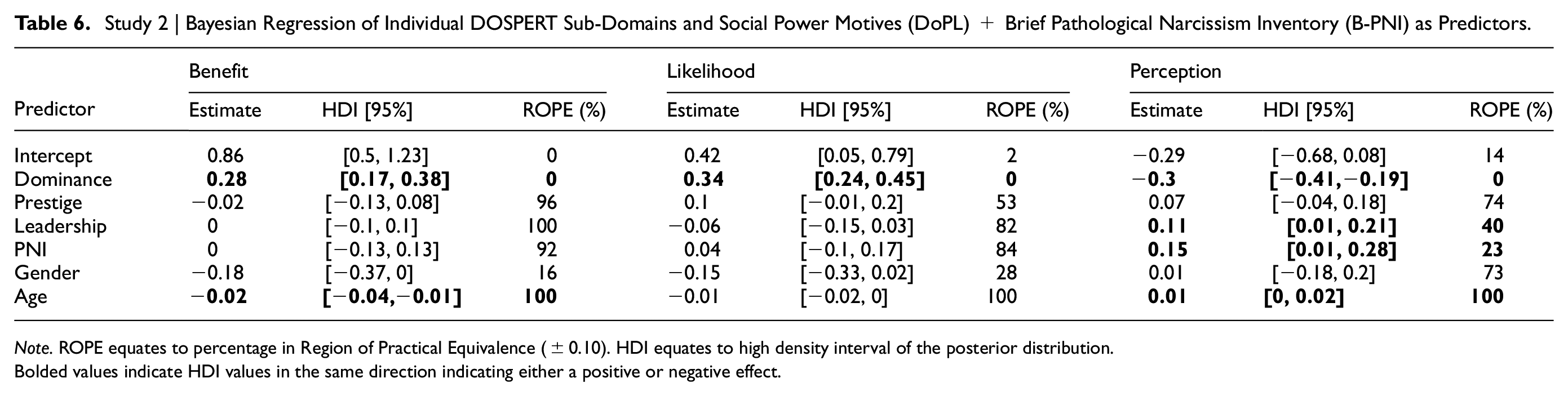
Note. ROPE equates to percentage in Region of Practical Equivalence (±0.10). HDI equates to high density interval of the posterior distribution.
Bolded values indicate HDI values in the same direction indicating either a positive or negative effect.
We successfully replicated the pattern of effects for DoPL motives from study 1. Higher dominance motive scores again predicted more positive evaluation of benefits of risks (β = .28, 95% HDI = [0.17, 0.38]), the prestige motive again did not have a unique predictive relationship with risk benefit (β = −.02, 95% HDI = [−0.13, 0.08]), and there was also again no unique relationship between leadership and risk benefit, (β = .00, 95% HDI = [−0.1, 0.1]). See Table 6 for full results. In support of H4, we again find that more dominance motivated individuals had unambiguously stronger preferences for all sub-domains of risk-taking, with effect sizes ranging from weak (β = .21) to moderate (β = .43; see Table 5). Contrary to H6, we found no unique relationship between narcissism and any of the sub-domains of risk-taking (see Table 5). However, in the exploratory section we further differentiate narcissism into its two constituent parts of grandiose and vulnerable narcissism.
Exploratory Analyses
Our data analysis strategy focused on 3 targets: evaluating how DoPL motives and narcissism predicted risk preference beyond perceived benefits, exploring if different components of narcissism predicted risk preference in subdomains, and evaluating mediation models including narcissism and dominance for general risk-taking likelihood.
As with study 1, our pre-registered analysis produced results relevant to risk perception and risk-taking likelihood alongside risk benefit (see Table 6). Dominance again negatively predicted risk perception (β = −.30, 95% HDI = [−0.41, −0.19]) and prestige did not meaningfully predict it. However, unlike in study 1, here higher leadership motive predicted increased perception of risk as risky (β = .11, 95% HDI = [0.01, 0.21]). Also surprisingly, higher narcissism predicted a similarly increased perception of risk as risky (β = .15, 95% HDI = [0.01, 0.28]). Regarding risk-taking likelihood, only dominance demonstrated unique predictive utility (β = .34, 95% HDI = [0.24, 0.45]). Prestige, leadership, and narcissism did not meaningfully predict this outcome.
We next repeated the multivariate multiple regression analysis using DOSPERT subdomain risk preferences as simultaneous outcomes and the DoPL motives, the two subcomponents of PNI—grandiose and vulnerable narcissism, as well as age and gender as predictors. This showed no meaningful predictive utility of elements of narcissism in any subdomain of DOSPERT with the sole exception of social risk preference, where vulnerable narcissism negatively predicts risk preference (β = −.16, 95% HDI = [−0.3, −0.03]). Full results are presented in Table 7. Of note, in this analysis we find, as with the previous corresponding analysis with undifferentiated narcissism, that dominance positively and meaningfully predicts higher risk preference across all subdomains measured. Unlike the previous result, now leadership also meaningfully, though weakly, predicts risk preference: negatively for health and safety (β = −.11, 95% HDI = [−0.20, −0.01]) and positively for the social domain (β = .13, 95% HDI = [0.03, 0.23]).
Study 2 | Bayesian Regression of DOSPERT Risk Preferences and Social Power Motives (DoPL).

Note. ROPE equates to percentage in Region of Practical Equivalence (±0.10). HDI equates to high density interval of the posterior distribution.
Bolded values indicate HDI values in the same direction indicating either a positive or negative effect.
Mediation
While mediation models are difficult to interpret, particularly using cross-sectional data, they can nevertheless point towards fruitful theoretical relationships testable via longitudinal methods. We sought first to replicate the findings of Foster et al. (2009) who reported a partial mediation of the connection between narcissism and risk-taking likelihood via perceived benefits of risk-taking. Using the reported results from Foster et al. as priors, we found a meaningful, but only partial, indirect positive pathway between narcissism and likelihood of risk-taking via perceived benefits (β = .11, 95% HDI = [0.06, 0.16]), and a weak, but meaningful, remaining direct path (β = .16, 95% HDI = [0.08, 0.24]).
Following this, we investigated two theoretically meaningful alternative models (see Figures 2 and 3 and Supplemental Appendix for Figure A1) in which our goal was to evaluate if dominance contributed unique direct and indirect effects toward risk taking in addition to narcissism (see also Supplemental Appendix A). First, we added dominance to the previous model, allowing both it and narcissism to have parallel direct effects on risk-taking likelihood and indirect effects via perceived benefits of risk. As seen in Figure 3, both dominance and narcissism positively predicted risk-taking likelihood via direct and partial indirect pathways. Figure 3 shows similar results, with a positive indirect path of narcissism via perceived benefits (β = .07, 95% HDI = [0.02, 0.11]) and of dominance via perceived benefits (β = .11, 95% HDI = [0.06, 0.16]).
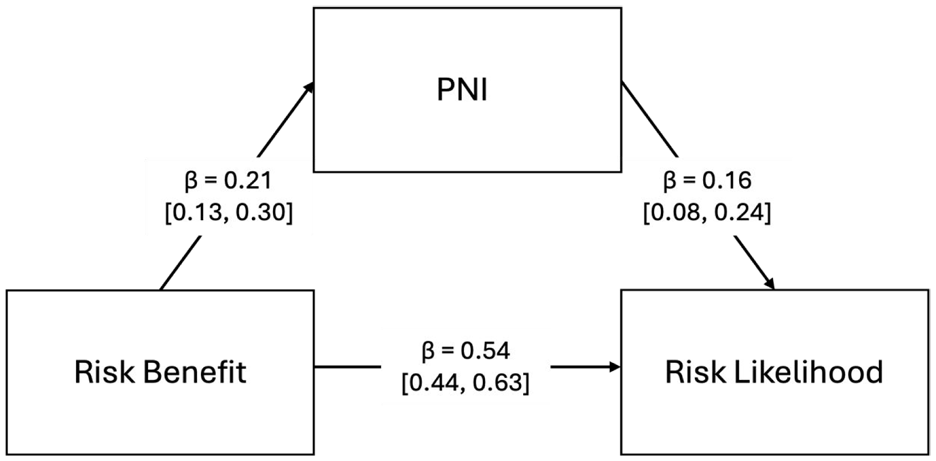
Figure represents a mediation model with Narcissism as the central mediator in the model. The outcome variables being risk likelihood.

Figure represents a mediation model with Narcissism and Dominance as the central mediators in a parallel model. The outcome variable being risk likelihood.
General Discussion
The present studies sought to further our understanding of risk preferences across domains and how social power motives might explain some of the inter- and intra-individual differences observed in these domains, and in the subcomponents (ethical, social, financial, recreational, and health/safety) of risk preference more generally. Study 1 established a relationship between the unique dominance component of the DoPL motives and risk-taking preferences. Dominance seems to meaningfully predict all components of general risk preference (increased likelihood to engage in risky behaviors, increased perceived benefits of risk-taking, and reduced perception of risk) as well as positively predict risk preference across the sub-domains of ethical, financial, recreational, health and safety, and social activities. Study 2 replicated these results in a larger, more diverse sample while also controlling for narcissism, which is a known predictor of the same outcomes. Dominance was a stronger predictor than narcissism in all cases. This raises questions about the relationship between personality/motive constructs and risk preference.
Interpreting mediation models on cross-sectional data is problematic (Maxwell & Cole, 2007; Maxwell et al., 2011; Thoemmes, 2015), but in this case, the emergence of the personality trait of narcissism and the social power motives are likely antecedent to the development of explicit risk preference attitudes in our adult sample (Boyer, 2006; Brummelman et al., 2015), rendering this problem somewhat attenuated. Hence, we sought not only to independently replicate a reported pattern of effects, but to evaluate if this pattern changes in theoretically suggestive ways with the addition of the dominance motive.
Foster et al. (2009) reported a mediation analysis indicating both a direct positive relationship between narcissism and risk-taking likelihood and an indirect pathway between these constructs, mediated by positive links through perceived benefits of risk-taking. Simply adding dominance to this model does not remove the predictive value of narcissism completely. Rather, it demonstrates that these constructs might operate in parallel, and in similar fashion (see Figure 3). The same is true if dominance is treated as an intervening mediator between narcissism and perceived benefits (present in Figure A9 in the Supplemental Appendix A), though effects in this case are quite weak. These relationships are speculative at best, absent large sample longitudinal evidence to support them, but they are suggestive of directions such research should pursue. It remains unknown, thus far, what the precise developmental relationship is between narcissism and the dominance motive, but our results do imply that they may work together (in some fashion) to amplify risk-taking behavior in a variety of ways. Such behavior can lead to profound success and achievement but also to self-destructive and socially maladaptive consequences (Braun, 2017; Buelow & Brunell, 2014; Leder et al., 2021). Psychologically, what motivates highly dominant individuals to engage in these risky behaviors? Highly dominant individuals may indeed see these risky situations as a pathway to demonstrate their power over others. Equally possible is that highly dominant individuals may use these risky situations as an opportunity to gain power over others or deprive competitors of it. Both explanations lead to the question of intervention and when would interventions be appropriate in maladaptive behaviors. As seen from Brummelman et al. (2015), explicitly narcissistic behaviors emerge in children around the age of 7 years old, and explicit power motives are likely to emerge concurrently. Interventions timed to these critical phases, or earlier, may be advantageous, particularly if they are structured to teach more adaptive behaviors likely to be attractive to individuals with a predisposition to particular social strategies and motives. Difficulties become present when there are disparities between education and funding of education on communities and groups especially when discussing risk-taking and risk behaviors (Fonner et al., 2014; Li et al., 2021). Additionally, recent research alludes to positive parenting styles acting as a risk-buffering for later childhood experiences and behaviors (Cao et al., 2025).
Limitations and Future Directions
While suggestive of a direct relationship between social power motives and risk preferences, our data are correlational and so do not license causal inferences. Future work could experimentally manipulate having power or the experienced sense of powerlessness (Pike & Galinsky, 2020) in order to evaluate possible downstream causal influences on risk preferences (or components thereof). Similarly, longitudinal work could evaluate the temporal relationship between the emergence of social power motive related behaviors and risk preferences in varying domains. To move beyond the suggestions we offer, theorists could use agent-based computational models to explore how higher power motives, influencing risk preferences, might play a role in the emergence of stable hierarchies (Przepiorka et al., 2020) and affect types of leaders who emerge to direct these hierarchies (Jiménez et al., 2021; Kakkar & Sivanathan, 2017). Such models could make testable predictions about the relative roles of power motives and risk preferences as well as link to the kind of causal and longitudinal data currently lacking.
Our work also suggests the possibility that dominance desires predict reduced sensitivity to some types of framing effects related to risk, compared to those with a weaker dominance motive. If strong dominance desires predict aberrant perception of both risks and rewards, then those with strong dominance motives may demonstrate a systematically different profile of choice behavior when confronted by typical manipulations designed to elicit loss aversion in risky decision making. Something similar might also happen in decision under uncertainty.
Conclusion
In our two studies, we investigated social power motives relationship with risk preferences, along with controlling for pathological narcissism (study two). In these two studies, we find robust evidence that dominance is a positive predictor of risk preference across every subdomain measured as well as for every sub-component of general risk preference. This remains true even when controlling for narcissism, which is a known predictor of these outcomes. There is some suggestive evidence that there may be a structured relationship between narcissism, dominance desires, and risk preference components, which merits further study. Understanding the complex relationship, with the addition of narcissism as a third variable, may indeed bridge the necessary gap in furthering our understanding of maladaptive risk-taking behaviors. Further studies may shed light on different aspects of risk-taking behaviors outside of the often-researched areas and look out more physical outcomes such as the sexual risk that is currently on the rise (Buelow & Brunell, 2014). Interventions may then be discovered that can possibly stunt the ever-increasing trend of maladaptive risk-taking behaviors.
Supplemental Material
sj-docx-1-sgo-10.1177_21582440251363317 – Supplemental material for Power Motivations and Risk Preferences
Supplemental material, sj-docx-1-sgo-10.1177_21582440251363317 for Power Motivations and Risk Preferences by Andrew Ithurburn, Adam Moore and Julie M. E. Pedersen in SAGE Open
Footnotes

Ethical Considerations
Ethical approval was granted by the University of Edinburgh PPLS Ethics Committee, REF: 212-2021/1 and 212-2021/2 on 15 February 21 and 19 November 21. Respondents gave electronic consent before starting both experiments.
Author Contributions
Andrew Ithurburn and Adam Moore: co-conceptualization, writing, and analysis; Julie M. E. Pedersen: analysis, editing, and data collection.
Funding
The authors received no financial support for the research, authorship, and/or publication of this article.
Declaration of Conflicting Interests
The authors declared no potential conflicts of interest with respect to the research, authorship, and/or publication of this article.
Data Availability Statement
Supplemental Material
Supplemental material for this article is available online.
References
Supplementary Material
Please find the following supplemental material available below.
For Open Access articles published under a Creative Commons License, all supplemental material carries the same license as the article it is associated with.
For non-Open Access articles published, all supplemental material carries a non-exclusive license, and permission requests for re-use of supplemental material or any part of supplemental material shall be sent directly to the copyright owner as specified in the copyright notice associated with the article.
