




Abstract
To promote leadership research on managers’ motivation, a measurement (Andersen Motivation Profile Indicator [AMPI]) has been developed and tested that (a) measures achievement, affiliation, and power motivation; (b) measures the relative strengths of these factors; (c) rests explicitly on the definitions of McClelland; and (d) measures managers’ work motivation. The questionnaire has been tested for reliability and validity with responses from 580 managers. The application of the instrument in four studies with responses from 565 managers in other organizations supported McClelland’s theoretical claims: (a) managers have motivation profiles, (b) there are differences in motivation profiles between managers across organizational types, (c) there are no significant differences in motivation profiles between female and male managers, and (d) managers who are predominantly power motivated enhance organizational effectiveness. Arguably, the application of the instrument may be an indicator of its quality. The instrument facilitates leadership research on the relationship between managers’ motivation profiles and organizational specifics, gender, sociocultural factors, and organizational outcomes.
Keywords
One approach in leadership research describes the behavior or behavioral pattern of managers and explains the reasons for the behavior. The ambition is also to predict the consequences of managerial behavior on organizational outcomes. Managerial psychology has a great deal of knowledge on motivation that can be used to enhance organizational effectiveness (Stone, 2010). The study of motivation-based behavior of formal leaders (managers) is part of this research tradition (e.g., Ebrahimi, 1996). A major contribution in the field of motivation linked to managers’ motivation is the work of McClelland (1961, 1990). He holds a significant position in leadership research verified by the number of references in Bass (1990) and Yukl (2010).
The three motivation factors highlighted in McClelland’s theory are the needs for achievement, power, and affiliation. According to McClelland, it is not the achievement, affiliation, or power motivation in isolation that is of central importance. Rather, it is managers’ comprehensive motivation profiles, that is, the relative strengths of these three kinds of motivation which are crucial.
Leadership scholarship requires a test of the concept of “motivation profile” (McClelland & Burnham, 1976). To avoid instrument-dependent conclusions, leadership researchers also need an alternative instrument to the Thematic Apperception Test (TAT). The alternative instrument must (a) measure achievement, affiliation, and power motivation; (b) measure the relative strengths of these factors; (c) rest explicitly on McClelland’s definitions, and indicators; and (d) be designed to measure the work motivation of managers.
Several instruments on motivation are available, but they do not measure the three motivation factors. They do not rest explicitly on McClelland’s definitions and are not designed to measure work motivation in managerial settings (e.g., Chan & Drasgow, 2001; Cook, Hepworth, Wall, & Warr, 1981; Gjemse & Nygård, 1970; Hansemark, 2000; James, 1998; Lennerlöf, 1966; Mehrabian, 1969, 1970). For these reasons, a questionnaire an alternative to the TAT has been developed. It has been tested and applied to facilitate motivation-based leadership research. Managers’ motivation affects the way they behave at work. This is the reason why empirical studies of managers’ motivation are important. In addition, studies have showed that managers in different kinds of organizations do have different motivation profiles (Andersen, 2010a; McClelland, 1971). It is also important to investigate the organizational outcomes of managers whose behaviors are affected by an achievement or an affiliation or a power motivation profile.
On this theoretical basis, a Norwegian-language instrument was developed and tested to measure motivation profiles of managers (Andersen, 1991a, b). Four studies show how the empirical results accord with the theoretical foundation of the questionnaire (Andersen Motivation Profile Indicator [AMPI]). This demonstrates the instrument’s scope of application.
The Theory
McClelland’s theory is briefly described with emphasis on managers’ motivation. His research has a number of characteristics: (1) a commitment to measurement of human motives; (2) a strong conviction that the TAT is a superior method for the study of motives; and (3) a focus on three fundamental motivational systems: (a) achievement/success, (b) power/impact, and (c) affiliation/intimacy; and (4) the belief that motives can be changed (McAdams, 1990). Murray (l938) pointed out that there were significant differences between people concerning the need for or inclination to execute power, to overcome obstacles, and to strive to do something difficult well. McClelland and Steele (1972, p. 33) defined the motivation factors thus:
Achievement—A desire to do better than other people or more effectively, to solve problems, to master difficult tasks. Power—A desire to control other people, to influence their behaviour, or to be responsible for other people and their work. Affiliation—A desire to establish and maintain friendly and close relationships with other people.
These needs are expressed in varying degrees and are a result of individual life experiences. It is important to stress that there are no specific theories of motivation for managers or leaders. McClelland and his associates spent much time on studying the motive for achievement in school children and small-business entrepreneurs. Later, they studied managers in larger enterprises. No theoretical arguments supported the notion that achievement-motivated managers would be more successful. The achievement-motivated individual wishes to do things themselves or to better themselves. They focus on personal improvements (McClelland & Burnham, 1976).
McClelland (1970) wrote, “I shall never forget the moment when I learned that the president of one of the most successful achievement-oriented firms we had been studying scored exactly zero on n Achievement!” (p. 30). “How was it possible to for a man to be head of an obviously achieving company and yet score low in n Achievement?” He added that stimulating achievement motivation in others requires a different motive and a different set of skills than wanting achievement satisfaction for oneself (McClelland, 1970, p. 30). Thus, a strong need for achievement was not the solution to leadership effectiveness.
Managers are also motivated by affiliation at work. McClelland and Burnham (1976) claimed that sociological theory and their findings indicate that the person whose need for affiliation (n Aff) is high does not make a good manager. A strong need for social relationships and friendship is fundamental for persons with a strong n Aff. McClelland and Burnham (1976) have argued that managers’ need to maintain a satisfactory social relationship with their subordinates prevents them from making effective decisions.
What about the power motive and leadership? The work of McClelland and his associates offers strong support for the view that effective leaders have a high need for power. Clark and Clark (1990) have written,
Moreover, their work show that such leaders direct their need for power in socially positive ways, that is, ways that benefit others and the organization rather than merely contributing to the leader’s personal status or material condition. Effective leaders want power and influence because they know that it is through power and influence that things get done in organizations. (p. 305)
The conclusion is that the motivation profile is effective when the need for power is stronger than the needs for achievement and affiliation. Motivation is based on needs implying that an individual wants or desires to achieve, to affiliate, and to influence others (McClelland & Steele, 1972). When Ebrahimi (1996) tested the Miner Sentence Completion Scale-H, he measured motivation in terms of the desire to compete, the desire to exercise power, and so on. James (1998) suggested a new system for measuring personality. It was applied to develop measures of achievement motivation. Motivation is, according to McClelland (1990), not a personality trait. Instead, motivation comprises a set of acquired needs that can be changed. In addition, Bing, LeBreton, Davison, Migetz, and James (2007) were concerned with how to test achievement-related cognitions. McClelland (1990) wrote that “the case for the achievement motive’s being a cognitive disposition is not persuasive for a variety of reasons” (p. 497). He argued that the need for achievement had to be distinguished from the cognitive variable “attitude towards achievement” (McClelland, 1990). In fact, McClelland (1985) found that the need factor had more explanatory power on behavior than the cognitive one. A recognition of the differences between needs, personality traits, and cognition linked to motivation is essential for the formulation of questionnaire items.
Motivation Profile
McClelland (1990) described specific behavioral patterns with the terms achievement, affiliation, and power motivated behaviour. A number of empirical studies has shown that these kinds of motivation affect actions and behavior with respect to energy, sensitivity, and learning (McClelland, 1990). McClelland and Burnham (1976) employed the terms motivation pattern and motivation profile. McClelland and Boyatzis (1982) applied the terms motive pattern and leadership motive pattern. The combination of an elevated need for power, a low n Aff, and a high degree of activity inhibition is called the “imperial power motive syndrome” or the “leadership motive syndrome” (McClelland, 1990). A number of studies (e.g., Boyatzis, 1982) has dealt with the effects of motivation profiles on managers’ behavior. Boyatzis (1982) used the term power motive syndrome.
Data for measuring motivational factors may originate from a TAT measurement or a questionnaire. Both kinds of instruments may measure the relative strengths of the three motivation factors. The scores for each respondent can be converted into categorical variables; that is, they identify which of the three motives is stronger than the others or which is the strongest. In this way, data from respondents will classify each manager as possessing one of three motive profiles or belonging to the group “no profile.” According to McClelland (1990), it is a theoretical assumption that most individuals have a motivation profile.
The Instrument
To McClelland, the TAT was a superior method for the investigation of motives, and he used it in all his empirical studies. McClelland and Steele (1972) provided a description of this instrument. Despite its merits, the TAT is criticized for a number of shortcomings involving reliability and validity (Bing et al., 2007; Harper, 1975). McClelland (1985) did, however, acknowledge the problems related to testing the reliability of TAT, as test–retests are difficult to conduct owing to the characteristics of the method. The TAT requires theoretical knowledge and experience for its proper use, especially with regard to coding the responses. It is both time consuming and costly, and it needs to be administered under controlled conditions (Ogden Hamilton, 1975). The TAT has long been considered the measurement of choice for measuring motivation. Objective tests, however, have considerable potential appeal to investigators for reasons of economy and ease of analysis (Wotruba & Price, 1975).
Alternative measures, first and foremost the questionnaire, are therefore recommended for further studies of motivation (Harper, 1975). Consequently, a number of scholars have developed written instruments as alternatives to the TAT (e.g., Gjemse & Nygård, 1970; Hansemark, 2000; James, 1998; Lennerlöf, 1966; Mehrabian, 1969, 1970). Mehrabian and Bank (1978) have tested an improved version of Mehrabian’s (1969) scales. It was not tested on managers. A large number of contemporary researchers have mainly addressed achievement motivation, and the measurement of achievement motivation.
The Test
The instrument is developed specifically for measuring managers’ motivation profiles. The instrument and test results were originally reported in Norwegian (Andersen, 1991a, b). The English version of the instrument has been subject to professional back-translation. “Different methods do exist for constructing measurement instruments representing abstract concepts, and each has specific advantages and disadvantages” (van der Heijde & van der Heijden, 2006, p. 457). With reference to the limitations of the TAT, a written instrument was preferred. Rather than the Likert-type scales, a forced-choice instrument was chosen because this measurement design has several advantages compared with more traditional instruments (Anastasi, 1988; Baron, 1996; Converse & Presser, 1986).
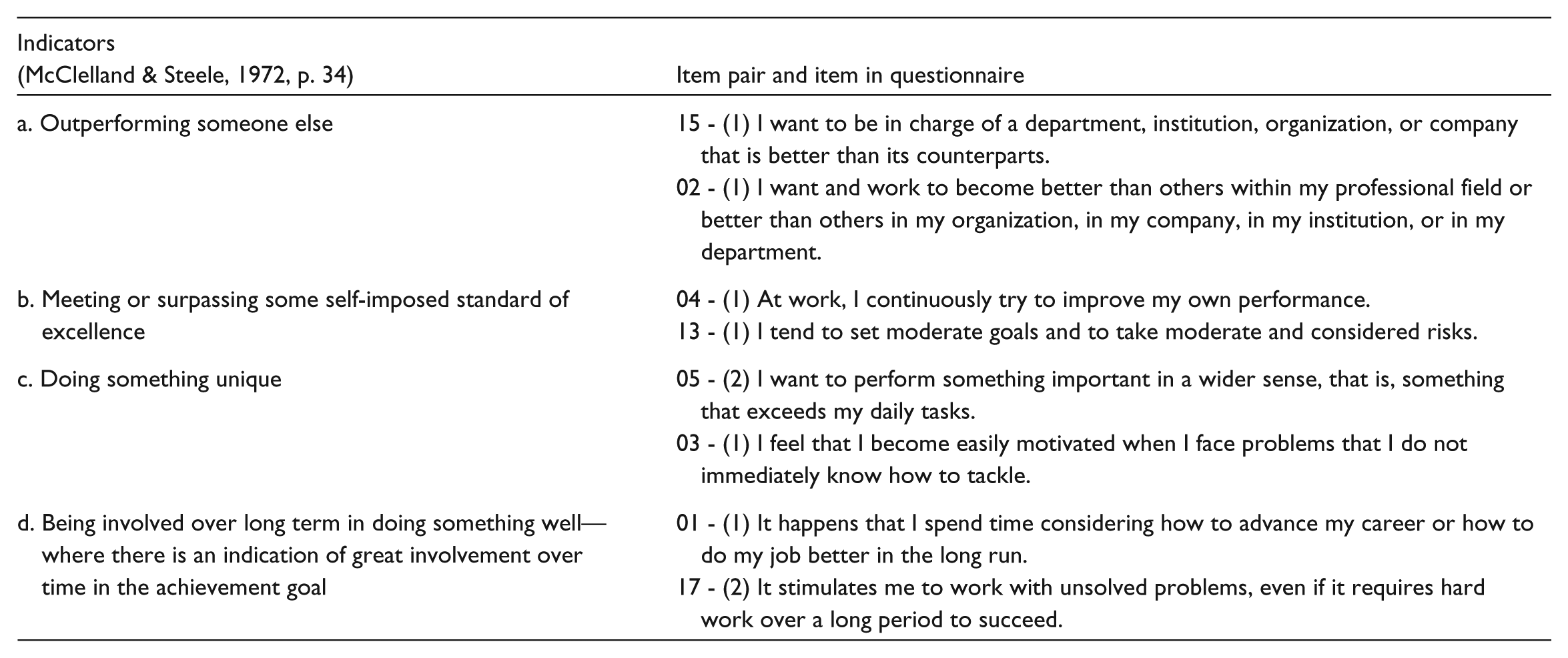
The concept of motivation profile (motivation pattern) and the theoretical claim that most individuals have a motivation profile constitute the rationale for developing a forced-choice instrument. The application of a forced-choice instrument minimizes the possibilities for the respondents to misrepresent themselves or to cheat. The lack of clarity and indecision that can arise during the coding of the response alternatives thus reduces owing to the fact that the respondent is confronted with two statements. It is a relative choice, which implies that the respondent does not have to make an absolute judgment. Sid and Lindgren (1982) have tested the NachNaff scale by application of a 30-items forced-choice questionnaire related to McClelland’s theory. In this case, the development of the instrument was explicitly based on McClelland’s theory in which three factors are given. Each of these factors is theoretically and empirically defined and supported by indicators (McClelland & Steele, 1972). The first step was the formulation of the items, and thus, the face validity is presented. It is imperative that the number of items is the same for each of the three factors. The second step is to select which pair of items to be included in the questionnaire (see Gill & Hodgkinson, 2007).
The development of a forced-choice instrument brings to the fore the question of the number of items. For guidance, other forced-choice instruments that have been applied in leadership research have been consulted. The leadership-style instrument developed by Reddin (1970) consists of eight items for each variable, whereas Kilmann and Thomas (1977) used six items.
The Construction of the Instrument
The Scaling Problem
A forced-choice instrument requires the respondent to choose between two descriptive terms or phrases. Both items may be desirable or undesirable (Anastasi, 1988). These two statements may not have the same weight or strength, which leads to the problem of scaling (Edwards, 1983). It is a theoretical requirement that the statements have the same frequency when responses from a large sample are compared. However, for individual respondents, this is not the case.
The instrument is especially designed to measure work motivation in managerial settings. It consists of eight items for each of the three motivation factors, in which one item measuring achievement is paired with one measuring affiliation or power motivation. Thus, such an instrument would consist of 192 pairs of questions. The first step in the development involved reducing the number of pairs by randomly drawing 25% of the total. Initially, the pilot instrument consisted of 48 pairs of questions, which was tested for the frequency of choices. On the basis of the responses from 372 male managers (response rate 83%), the pairs which showed the most equal distribution between the two alternative items in each pair were selected. The comparison of achievement items with affiliation items showed a distribution of 49.5% versus 50.5%, respectively. Achievement items versus power items yielded a distribution of 50.05% versus 49.95%. Finally, the comparison between affiliation items versus power items, the distribution was 49.0% versus 51.0% (Andersen, 1991b). The 24 pairs that showed the most equal distribution between the two alternative items in each pair constitute the instrument. The first pair (01) in the instrument can be used to illustrate the choice the respondents have to make (in this case between achievement and affiliation): 01—(a) It happens that I spend time considering how to advance my career or how to do my job better in the long run; and 01—(b) I want to consider the feelings of my subordinates when decisions are to be made and implemented. As the respondents are “forced” to choose one of the two statements in each pair, the total sum is 24. The forced-choice instrument yields the respondent’s motivation profile.
The Reliability Test: Test–Retest
Instruments that are based on Likert-type scales are often subject to factor analyses. Cronbach’s alpha is used to test reliability. The forced-choice instrument was tested by test–retest based on the responses from 51 Swedish managers (46 men, response rate 89%). It showed that for 42 respondents, the motivation factor, which was the stronger in the first test, was also the stronger in the retest (82.4%). The comparison of the choices made between the 24 item alternatives of the test with the result of the retest revealed that the responses were in average 59.6% the same. For specific items, the responses were the same between the two tests, in the range of 37.5% to 87.5%.
According to McClelland, most individuals have a (distinct) motivation profile. A test based on 272 responses showed that only 2.3% had no profile, as they scored equally on all three motives (8 + 8 + 8), while 17.6% scored equally high on two motives (e.g., 9 + 9 + 6 or 10 + 10 + 4 or 11 + 11 + 2). Almost 80% of the respondents had a motivation profile.
The Validity Test
Face Validity
The formulation of the items requires the proper handling of the differences between motivation as personality trait, as a cognitive factor, or as a need. If achievement motivation were a personality trait, the item could be as follows: “I am by nature in charge of a department that is better than its counterparts.” If achievement motivation is based on cognition, the item could be worded in this manner: “It is important to me to be in charge of a department that is better than its counterparts.” If achievement motivation is an acquired need, the item could read like number (15 - [1]) in the questionnaire: “I want to be in charge of a department, institution, organization or company that is better than its counterparts.” It is worth noting that Ebrahimi (1996) has also stressed the need basis of motivation when measuring managers’ motivation. The face validity is based explicitly on McClelland’s theory, specifically on McClelland and Steele (1972), which gives the theoretical definitions, the empirical definitions as well as indicators for each of the three motivation factors.
Empirical Definition—The Achievement Motive
The Achievement Motive (nAch), which is indicated by someone in a story wanting to perform or do something better, or by someone caring about performing or doing something better. (McClelland & Steele, 1972, p. 33)
Empirical Definition—The Affiliation Motive
The Affiliation Motive (nAff), which is indicated by someone in a story wanting to be with someone else and enjoy mutual friendship, but not merely wanting to do something for another. (McClelland & Steele, 1972, p. 33)
Empirical Definition—The Power Motive
The Power Motive (nPower), which is indicated by someone in a story desiring to have impact, make impression, on others or another in the story. (McClelland & Steele, 1972, p. 33)
The Test of Validity of the Achievement Score
A high degree of achievement motivation is theoretically associated with a high degree of internal motivation as defined by Rotter (1966). Hamilton and Akhter (2002) also refer to achievement motivation and Rotter (1966). The instrument was tested by a comparison of the achievement scores of this instrument with the internal motivation scores of Rotter’s (1966) test. The response from 67 managers showed a correlation of .857 between the internal motivation and achievement scores (Andersen, 1991a). Correlations above .8 are indications of validity (Anastasi, 1988).


The Test of Validity of the Affiliation Score
Affiliation-motivation items were tested by a comparison of their score with relationships-motivated style score of Fiedler’s (1967) Least-Preferred Co-Worker (LPC) instrument. High LPC scores (66 to 144) are indicative of the relationships-motivated leadership style. The response from the same 67 managers showed a correlation of .421 between the relationships-motivated style and affiliation scores (Andersen, 1991a). Due to the number of critical judgments regarding the LPC instrument (e.g., Green, Nebeker, & Boni, 1976; Sashkin & Warner Burke, 1990; Schriesheim & Kerr, 1977), the application of the LPC instrument for testing the affiliation items turned out to be ill-chosen.
The Test of Validity of the Power Score
It is argued that the power dimension is theoretically linked to dominance and dominant behavior (McClelland, 1990). Franken’s (1982) instrument, consisting of 50 bipolar statements, was used. High scores indicate dominance. The responses from the same 67 managers showed a correlation of .818 between the dominance score and the power score of the instrument (Andersen, 1991a). The tests of reliability and validity meet the requirements of a research instrument.
The Result of the Application of the Instrument
In addition to testing the validity and reliability of the instrument, it is also possible to assess the quality of this instrument in regard to some of McClelland’s major theoretical claims. The application of the instrument thus tested the claims that (a) most respondents (i.e., managers) have a motivation profile (i.e., one motivation factor is relatively stronger than the other two), (b) business managers are power motivated, (c) there were no significant differences between men and women in managerial positions in regard to motivation, and (d) power-motivated managers are more effective.
One Dominant Motivation Profile
McClelland (1990) has claimed that most individuals have one motivation factor which is more dominant than the other two, namely, a motivation profile. Data from 222 Swedish managers (Andersen, 1994) showed that 209 managers had one motivation factor scoring stronger than the other two, implying that 94.1% of these managers had profiles. The study of Andersen (2010b) contains data from 61 social-insurance managers, of which 53 (89%) had motivation profiles. It contains also data from 196 senior secondary-school headmasters, out of which 172 (86%) had motivation profiles. A study of vicars in the Church of Sweden is based on responses from 153 vicars, out of which 145 (84%) had motivation profiles (Hansson & Andersen, 2001). These studies have shown that managers had motivation profiles when the instrument was applied.
Power Motivation in Business and Public Managers
Managers in business are primarily concerned with influencing others. They ought to be characterized by a strong need for power (McClelland, 1971). It is expected theoretically that a successful manager has a stronger need for power than for achievement (McClelland & Burnham, 1976). Now, is this the case if the instrument is applied?
Data from 209 managers (Andersen, 1994) showed that 86 managers (41%) were power motivated, 68 business managers (33%) were predominately achievement motivated, while 55 managers (26%) were affiliation motivated. The average scores for the managers were 8.31 (SD, 2.87) for the achievement-motivated managers, 6.87 (SD, 3.10) for the affiliation-motivated ones, and 8.82 (SD, 2.88) for the power-motivated managers.
When comparing leadership behavior of public and private managers, Andersen (2010b) reported that business managers differed significantly from public managers in respect of motivation profile. The investigation consisted of 205 Swedish public managers and their motivation profiles in three different agencies. Out of these, 95 managers (46%) were predominantly achievement motivated, 67 public managers (33%) were power motivated, and 43 managers (21%) were affiliation motivated. The average score for the public managers were 8.99 for the achievement-motivated managers, 6.87 for the affiliation-motivated ones, and 8.16 for the power-motivated managers. Public managers in Sweden were characterized by achievement motivation. The validity test showed a low correlation between the relationships-motivated style and affiliation scores. Thus, the application of the instrument became crucial with respect to affiliation-motivation scores.
An investigation of leadership behavior of 153 vicars (whose position is the level below that of bishops) in the Church of Sweden by Hansson and Andersen (2001) found that 87 vicars (57%) were affiliation motivated, 46 vicars (30%) were power motivated, and 20 vicars (13%) were predominantly achievement motivated. As expected, vicars were predominantly affiliation-motivated.
Three causes may explain the differences found in managers’ motivation profiles across organizations: (a) organizational differences may lead to leadership differences, (b) the choice of profession or vocation, and (c) the differing criteria for promoting people to senior positions (Andersen, 2010a). Rainey, Backoff, and Levine (1976) argued that we cannot overlook a number of important differences between private and public organizations. According to McClelland (1990), all motives are acquired and learned from experience. Thus, managers’ experiences with different kinds of organizations, professions, and vocations affect their motivation profiles. Research indicates that public managers differ from their private-sector counterparts in terms of work-related values, reward preferences, needs, and personality types (Wittmer, 1991). If there are profound differences between public and private organizations, this fact may help to explain differences in public and private managers’ motivation. The theories of person-organization fit concern the antecedents and consequences of compatibility between people and the organizations in which they work. These theories include models of person-vocation fit and person-group fit. Theories of person-vocation fit may predict vocational choice according to Kristof (1996). Athanasaw (2003) addressed the question of why senior executives prefer civil-service positions to private-sector ones, and a link to the person-organization fit argument was suggested.
Power Motivation of Women and Men in Managerial Positions
Winter (1982 in McClelland, 1990) presented a convincing case for the fact that, in general, the power motivation functions in the same way for women as it does for men. The chief difference in male and female behaviors associated with high need for power scores lies in what is called the “profligate expansive impulse.” Women’s motives for power are expressed in more socially responsible ways. As 99% of the 580 instrument test respondents were men, it is crucial to assess the power motivation in women managers. Theoretically, we should expect the score for power motivation of male and female managers to be quite similar. But is this the case when both male and female managers respond?
A study by Andersen and Hansson (2011) explored behavioral differences between women and men in managerial positions. To eliminate any effects of organizational differences on motivation-based behavior, the study included only public managers responding to the instrument. The statistical analyses of data from three groups of Swedish public managers (n = 385) revealed virtually no significant differences between female and male managers in motivation profiles. Regardless of whether there is a female or male majority of employees in the organization or a female or male majority of managers, no significant differences in motivation emerged.
Are Power-Motivated Managers More Effective?
McClelland (1970, 1990) and McClelland and Burnham (1976) have suggested that power-motivated managers are more effective than those displaying other motivation profiles. This claim does not imply that the higher the power motivation, the higher the effectiveness. Rather, the main claim is that managers’ power motivation must be stronger than their affiliation motivation. The factor that is most often mentioned by n Ach theorists as being the least compatible with n Ach is the n Aff (Sid & Lindgren, 1982). Their study, however, does not contain any data on managers. On the basis of data from 222 managers, n Ach correlated significantly at –.55 with n Aff. The same study showed that n power correlated significantly at –.50 with n Aff (Andersen, 1994).
Ebrahimi (1996) stated that managerial motivation had been regarded as an independent variable in relation to the dependent variables of organizational performance and similar measures. Does the claim that power-motivated managers are more effective have empirical support? Andersen (1999) has performed a meta-study based on three previously published studies. The meta-study contains data from 757 managers (U.S. and Swedish managers). The statistical analyses support McClelland’s theory. The significant covariances found depended neither on the data-collection instruments used (TAT or this questionnaire) nor on the definition of effectiveness. Power-motivated behavior in managers appears to enhance organizational effectiveness.
Critical Comments
McClelland’s theory is a need theory, and thus, the general critique of need theories is valid for McClelland’s work as well. It is particularly the theory of achievement motivation which has been subject to criticism. The argument is that achievement is culturally dependent. It is not possible to exclude culture and context if achievement motivation is to be understood (Maehr, 1974). In addition, McClelland’s theory has been criticized owing to its individualistic, competitive, and value-based foundation (Parsons & Goff, 1978).
In addition, criticism has been especially directed toward McClelland’s claim that power motivation is important for effective management. McClelland claimed that the power need consisted of two components: personalized and socialized needs of power. Regarding leadership, McClelland holds that it is the socialized need that causes organizational effectiveness. It is therefore unsatisfactory that the socialized need is defined by the use of the concept of “activity inhibition,” which is not extensively addressed by McClelland. Moreover, some studies define “leader motive profile” with the concept of activity inhibition, while others do not (Andersen, 1999).
Conclusion
Several researchers have argued that it is important to investigate and measure managers’ motivation and their motivation profiles. A forced-choice questionnaire has been developed, which measures the motivation profile of each respondent. The instrument is especially designed to measure work motivation in managerial settings. It has been subject to reliability and validity tests. The tests confirm that the instrument is a sound research measurement. In addition, on the empirical basis of responses from several types of managers (including both men and women) in different kinds of private and public organizations, the applications of this instrument have corroborated the four main theoretical claims proposed by McClelland and his associates. Managers have motivation profiles. Differences in motivation profiles exist between managers across organizational types. Virtually no significant differences in motivation profiles between female and male managers exist. Managers who are predominantly power motivated enhance organizational effectiveness. The result of the application of the instrument for investigating the motivation profiles of 565 managers may be an indicator of its quality.
It is important to emphasize that the support for McClelland’s theory is independent of the measurement being applied. Regardless of whether TAT or the questionnaire is used, the empirical results are the same. The instrument (AMPI) has specific relevance for scholarship on management. It may contribute to research based on McClelland’s theory by facilitating investigations into the relationships between power-motivated managers and organizational outcomes, and managers’ motivation profiles across countries and organizational types.
This study of managers’ motivation is limited to three motivation factors. In addition, the relationship between managers’ motivation-based behavior and their organizations does not include any specific organizational or cultural variables. The findings that power-motivated managers are more effective are based on the assumption that this relationship is not contingent on organizational and external variables.
More research is required to investigate if and to what extent organizational variables, external variables as well as cultural variables have effects on or modify the findings of previous research, including what this article has presented.
The relevance for managers is not the motivation theory itself, but the findings of several investigations regarding the behavior of power-motivated managers who are often in charge of effective organizations. Power-motivated managers take and implement decisions and advice, as well as support their subordinates, and control the activities of others. They persuade and influence their subordinates with the best interests of the organization in mind. Power-motivated managers use their power in socially positive ways that benefit others and the organization.
Footnotes
Declaration of Conflicting Interests
The author(s) declared no potential conflicts of interest with respect to the research, authorship, and/or publication of this article.
Funding
The author(s) received no financial support for the research, authorship, and/or publication of this article.