




Abstract
The rise of individualism has led to an increase in narcissism across cultures, with significant negative impacts on social environments and organizations. Narcissistic traits, particularly grandiosity, are linked to risky behaviors in finance, ethics, health, and gambling. Existing studies have mainly focused on correlations and predictions without establishing causality, particularly in working adult samples. This study aims to examine the causal effect of narcissistic grandiosity on risky behaviors in specific domains using regression and instrumental variable regression analysis. A sample of 300 working adults was surveyed using the Narcissistic grandiosity and Domain-specific risk-taking scales. While grandiosity showed correlations and predicted significantly some risky behaviors, instrumental regression analysis revealed no causal effect of grandiosity on any domain. The findings suggest that other variables, such as antagonism and sensation seeking, might play a more significant role in driving risky behavior. This study highlights the need for more comprehensive research to understand the complex interactions between narcissistic traits and risky behaviors.
Introduction
Due to the rise of individualism, narcissism has increased in various cultures (Miller et al., 2015; Santos et al., 2017). Prior studies (O’Reilly et al., 2018; Ham et al., 2018) show that individuals with high levels of narcissistic traits can negatively impact their social environment and the entire organization in which they work. Narcissistic traits have been associated with risky behaviors in various domains, for example, finance, and ethics (Buelow & Brunell, 2014; Foster et al., 2009; Miller et al., 2009). Research findings on personality factors that affect risky behaviors may have preventive potential and protect organizations from unethical employee behavior.
To date, empirical studies examining narcissistic traits (i.e., grandiosity, vulnerability) and risky behaviors have primarily tested correlations and predictions (Hudek-Knežević et al., 2016; Malesza & Kaczmarek, 2021; Tamborski et al., 2012). The main research problem revolves around the absence of causal evidence, leading to unclear research directions and imprecise practical recommendations. Additionally, there is a lack of studies with working adult samples, which would enhance external validity.
Although some studies exist on narcissism and risky behavior from which causal conclusions can be drawn (O’Reilly et al., 2018), none of them focuses on grandiosity and risky domains derived from the risky behavior domains (Weber et al., 2002) previously linked with narcissistic traits (Buelow & Brunell, 2014; Tamborski et al., 2012). The problem we identified is that it is not known whether the relationship between narcissism and risky behavior is causal. Such knowledge would offer new theoretical and research implications for preventing risky behavior. Moreover, studying the cause-and-effect relationship between grandiosity and risky behavior domains can boost the validity of previous research findings. Therefore, the goal is to examine the causal effect of narcissistic grandiosity on risky behavior domains (i.e., finance, ethics, health, and gambling) in working adults. To draw causal inferences in a non-experimental study design, we conducted linear regression models that use instrumental variables to remove bias from the endogenous variable x (Antonakis et al., 2010; Maydeu-Olivares et al., 2020).
Risky Behavior
There is no scientific consensus on operationalizing risky behavior. The current study has adopted a domain-specific theoretical framework of risky behavior (Weber et al., 2002) that includes the domains of finance, health/safety, recreation, social, and ethics. Gender differences have been found in most of these domains, leading to the conclusion that men make more risky choices than women (Nelson, 2015), except for risk-taking in a social domain (Weber et al., 2002).
There are several other important factors associated with risky behavior that have been identified, such as risk perception (Ferrer & Klein, 2015), risk attitude (Menkhoff & Sakha, 2017), or perceived consequences (Morgenroth et al., 2022), age, personality, and audience presence (Leder et al., 2020; Reynolds et al., 2014; Weber et al., 2002; Weller & Tikir, 2011). A personality trait of low honesty-humility from the HEXACO model (Lee & Ashton, 2018) is associated with high risk-taking in health/safety and ethics (Weller & Tikir, 2011). The causal study shows that personality dimensions play a role in financial risk tolerance (Pinjisakikool, 2018). For the current study, the personality trait narcissistic grandiosity has been examined alongside domains relevant to working adults, including finance (e.g., investment decisions), gambling (e.g., betting), health (e.g., alcohol/drug abuse, diet), and ethics (e.g., stealing, cheating, illegal behavior).
Narcissistic Grandiosity
After years of research, significant progress has been made in conceptualizing the narcissism construct (Miller et al., 2021). Initially, it was defined as a unidimensional trait. In recent times, it has been redefined into two-dimensional traits, namely vulnerable and grandiose narcissism (Miller et al., 2011). The latest model suggests three-dimensional traits: agentic extraversion, antagonism, and narcissistic neuroticism (Crowe et al., 2019; Krizan & Herlache, 2018). According to social-personality psychology, narcissistic grandiosity and vulnerability are separate constructs that can be considered as two types of pathological narcissism (Pincus & Lukowitsky, 2010; Zerach, 2016) or a non-clinical manifestation of personality traits (Krizan & Herlache, 2018).
According to a recent study by Miller et al. (2021), individuals with a central feature of narcissism, which is grandiosity, tend to take more risks. Therefore, the current study will primarily revolve around the trait of narcissistic grandiosity, which refers to an individual’s feeling of self-importance, superiority in abilities as explained by Rosenthal et al. (2020), and a strong desire for dominance, excellence, and aggression as highlighted by Miller et al. (2011) and Sedikides et al. (2019). According to a three-dimensional model developed by Krizan and Herlache (2018), the antagonism factor is a common trait of all variants of narcissism. There is a consensus that when narcissism is expressed through antagonistic behavior, it can lead to negative outcomes such as aggressive behavior (Miller et al., 2021). Individuals with narcissistic traits often struggle to transform their needs and impulses into mature and socially appropriate behavior (Roche et al., 2013). Therefore, Pincus and Roche (2011) and Rosenthal et al. (2020) suggest investigating narcissistic traits in the context of negative consequences.
Narcissism and Risky Behavior
A significant portion of the research on risky behavior has primarily concentrated on grandiose narcissism and not vulnerable narcissism. Tamborski et al. (2012) and Buelow and Brunell (2014) reached similar conclusions regarding the correlation between narcissistic grandiosity and risky behaviors associated with ethics, finance, and health domains. Buelow and Brunell (2014) found a direct relationship between narcissistic traits and risky behavior. Men consistently tend to exhibit higher levels of narcissistic traits and are less risk-averse compared (Grijalva et al., 2015; Weber et al., 2002). Narcissistic grandiosity is associated with alcohol/drug abuse (Coleman et al., 2020; Buelow & Brunell, 2014; Lakey et al., 2008), gambling (Lakey et al., 2008), and it predicts risky behaviors in ethical (Buelow & Brunell, 2014; Tamborski et al., 2012), financial, and social domains (Buelow & Brunell, 2014). Vulnerable narcissism is related to low self-esteem, shyness, and envy (Salazar et al., 2021).
Risky behavior correlates with compulsive buying behavior (Zerach, 2016), sexually aggressive behavior (Mouilso & Calhoun, 2016), as well as aggressive driving (Britt & Garrity, 2006). In their meta-analysis, Cragun et al. (2020) found no positive correlation between narcissistic leaders and risk-taking behaviors such as high-risk investment strategies and excessive spending. Moreover, the dark trait narcissism (Paulhus & Williams, 2002) is associated with health-promoting behaviors (Dębska et al., 2021), such as regular exercise, breakfast, and doctor visits (Malesza & Kaczmarek, 2021).
To summarize, there is a consistent association between narcissistic grandiosity and various risky behaviors. However, no causal relationship has been established yet, and prior studies have conducted research using different methods and populations. In the current study, we will focus on measuring the narcissistic trait of grandiosity in the working adult population.
Study Rationale
Personality variables, such as sensation seeking, tolerance for ambiguity, gender, and big five traits, predict or even affect risk-taking (Malesza & Kaczmarek, 2021; Weber et al., 2002). Certain configurations of personality traits (higher extraversion and intellect, lower agreeableness, consciousness, emotional stability) can impact financial risk tolerance and financial behavior (Pinjisakikool, 2018). A narcissistic trait of grandiosity predicts risky behavior (Buelow & Brunell, 2014; Foster et al., 2009; Jonason et al., 2015; Lakey et al., 2008;). Narcissistic CEOs can influence financial risk-taking (Zhu & Chen, 2015). Narcissistic leaders negatively and positively affect organizational strategy and performance (Chatterjee & Hambrick, 2007; Zhu & Chen, 2015). In a study by O’Reilly et al. (2018), highly narcissistic CEOs were found to be less risk-sensitive than their less narcissistic counterparts, when making legal decisions. The current study is the first to investigate the causal relationships between grandiosity and specific domains of risky behavior.
Research has also identified potential mechanisms that might contribute to risky behaviors in relationship with narcissistic tendencies. High levels of sense of entitlement and antagonism may relate to self-defeating behavior and aggressive responses such as reckless driving, drug abuse, and sexual assault (Miller et al., 2009). The greater the level of grandiosity, the higher the level of behavioral activation and drive (Carver & White, 1994; Lisa & Valachova, 2021) that leads to risky behavior (Franken & Muris, 2006). The neurophysiological approach suggests that reduced action in people with narcissist traits leads to risky decision-making (Yang et al., 2018). People with narcissistic traits may take more risks because they perceive negative consequences, risks, and benefits differently compared to individuals without or with low narcissistic traits (Foster et al., 2009; Hawk et al., 2015).
To summarize, if grandiosity is a strong predictor of risky behavior, it might be proven through causal models. Therefore, the current study aims to investigate the direct impact of narcissism on risky behavior. Alternatively, it may be that narcissism does not directly cause risky behavior, but rather other variables that haven’t been accounted for are more significant. We proposed a comprehensive design where correlations, predictions and causality must be tested. Such a design is also a precondition for successfully implementing instrumental variable regression (IVR) analysis. To verify previous findings, we state that narcissistic grandiosity positively correlates with risky behavior domains (ethics, investment, gambling, health) (H1) and predicts risky behavior domains (ethics, investment, gambling, health) (H2). The main hypothesis assumes that narcissistic grandiosity affects risky behavior domains (ethics, investment, gambling, health) (H3).
Hypotheses
H1 Grandiosity will positively correlate with risky behavior domains.
H2 Grandiosity will predict risky behavior domains.
H3 Grandiosity will affect risky behavior domains.
Methods
Participants and Procedures
The research sample comprised 300 working adults (48.66% men; overall sample Mage = 38.35 years, SD = 6.44). We collected data on Facebook and LinkedIn through a convenience sampling strategy and then proceeded with a snowball sampling strategy to gather more participants. The participants were asked to share the research link with their friends and acquaintances, which enabled us to increase their trust in the research. The participants gathered by snowball sampling strategy could be so in a condition that allowed them to be more open in answering the questions about their risky behavior, such as their drug abuse. The online questionnaire was anonymous and included informed consent. Three control questions were added to detect incorrect answers. The following demographic variables were monitored: age, occupation, and gender. The sample comprised 65.66% employees, 34% self-employed/entrepreneurs, and 0.33% volunteers. Twenty-one participants (n = 321 to n = 300) were excluded from the analysis due to incorrect responses on attention check items. All the demographic characteristics are reported in Table 1.
Sociodemographic Characteristics of Participants.
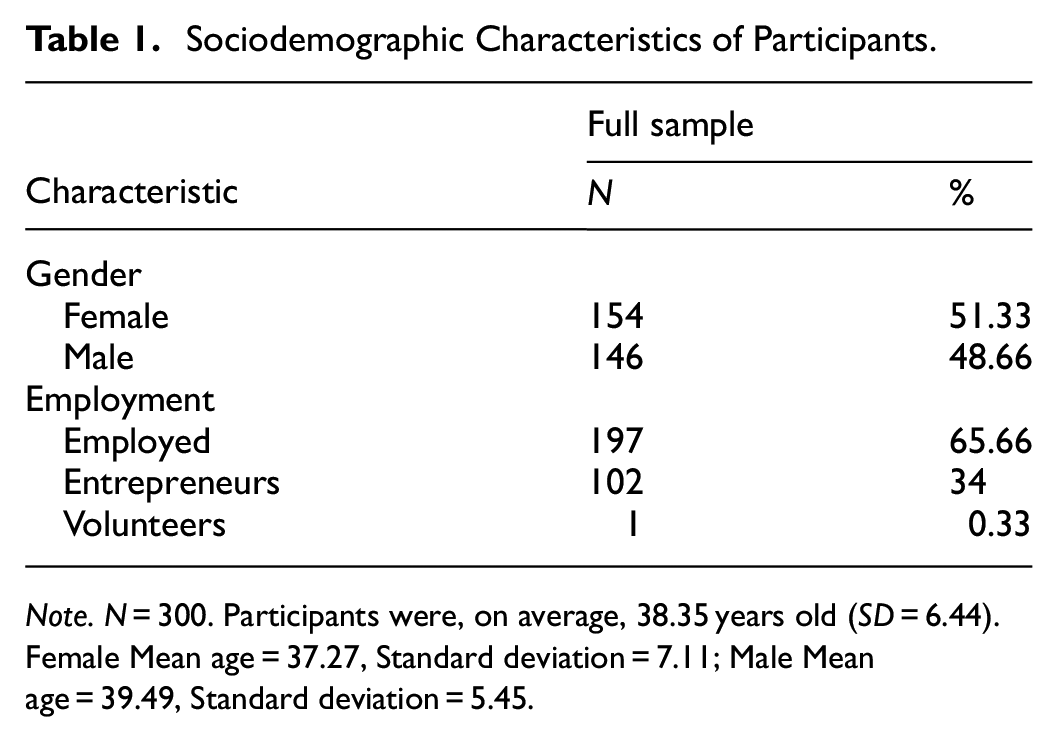
Note. N = 300. Participants were, on average, 38.35 years old (SD = 6.44). Female Mean age = 37.27, Standard deviation = 7.11; Male Mean age = 39.49, Standard deviation = 5.45.
Measures
The Narcissistic Grandiosity Scale (NGS-7) (Rosenthal et al., 2020) measured the level of the central narcissistic trait of grandiosity without simultaneously evaluating other narcissistic tendencies. The internal consistency for the current study was α = .80 and ω = .82. Narcissistic grandiosity represents an individual’s self-importance and superiority in abilities or status. There are currently two reliable and valid forms of NGS: NGS-16 and NGS-7. In the current study, we used a shortened version of NGS with seven items. The one-factor model showed for the current study excellent fit with the data χ2 (N = 300; df = 14) = 38.044; TLI = 0.97; CFI = 0.98; RMSEA = 0.07; GFI = 0.99. Participants evaluated themselves by the seven adjectives (e.g., superior) on a scale from 1 (not at all characteristic) to 7 (extremely characteristic).
Domain-Specific Risk-attitude Scale (DOSPERT) (Weber et al., 2002) was designed to assess risky behavior across six domains: ethical (e.g., Having an affair with a married man or woman), investment (e.g., Investing 5% of your annual income in a very speculative stock), health (e.g., Buying an illegal drug for your own use), gambling (e.g., Betting a day’s income at the horse races), recreational (e.g., Trying out bungee jumping at least once), social (e.g., Wearing provocative or unconventional clothes on occasion). We used a 40-item version of the scale. For the current study, four domains were administered: ethical with internal consistency α = .75 and ω = .77, investment (α = .72; ω = .75), health (α = .63; ω = .63), and gambling (α = .67; ω = .71). The four-factor model showed for the current study an excellent fit with the data χ2 (N = 300; df = 224) = 362.893; TLI = 0.96; CFI = 0.95; RMSEA = 0.04; p < .001. Participants responded to a 5-point Likert-type question about the likelihood of engaging in the behavior (1 = very unlikely; 2 = unlikely; 3 = not sure; 4 = likely; 5 = very likely).
The Basic Psychological Need Satisfaction and Frustration Scale (BPNSFS) (Chen et al., 2015) measures the satisfaction and frustration of basic psychological needs. The scale contains six subscales: autonomy satisfaction (α = .74; ω = .75; e.g., I feel a sense of choice and freedom in the things I undertake); autonomy frustration (α = 0.70; ω = .70; e.g., Most of the things I do feel like "I have to "); relatedness satisfaction (α = .77; ω = .77; e.g., I feel that the people I care about also care about me); relatedness frustration (α = .65; ω = .66; e.g., I feel excluded from the group I want to belong to); competence satisfaction (α = .77; ω = .77; e.g., I feel confident that I can do things well); competence frustration (α = .78; ω = .78; e.g., I have serious doubts about whether I can do things well). The six-factor model showed excellent fit with the data χ2 (N = 300; df = 237) = 382.983; TLI = 0.99; CFI = 0.99; RMSEA = 0.04; p < .001. These six subscales have been used as instrumental variables. Participants responded on a Likert-type scale (1 = completely disagree; 5 = completely agree).
Data Analysis
We used JASP 0.16.3 (JASP Team, 2022) to perform correlational analysis, linear regression, and path analysis. The path analysis was tested with a 95% percentile bootstrap confidence interval based on 5,000 replications with ML estimator. The chi-square test was applied to evaluate the overall model fit. Approximate fit indexes RMSEA, CFI, and TLI (Bentler, 1990; Browne & Cudeck, 1993; Tucker & Lewis, 1973) do not need to be interpreted within instrumental variable regression (Antonakis et al., 2010).
The independent variable used as a predictor was narcissistic grandiosity, measured and indexed as NG. Risky behaviors were the dependent variables measured by four domains: ethical (indexed as RBE), health (indexed as RBH), gambling (indexed as RBG), and investment (indexed as RBI). The instrumental variables were the need for autonomy, relatedness, and competence. Autonomy satisfaction has been indexed as AS, and autonomy frustration indexed as AF. The satisfaction with relatedness was indexed as RS (relatedness satisfaction), and relatedness frustration was indexed as RF. The level of satisfaction with one’s competence has been labeled as CS, whereas the level of frustration with one’s competence has been labeled CF. Because previous studies have found gender differences in risky behavior and narcissistic grandiosity, we included gender as a control variable in the analysis.
Instrumental Regression Analysis Strategy
In the cross-sectional study design, we conducted IVR, which best suits the research goal. The current study aims to evaluate causal models through instrumental variable regression analysis. The instrumental variables are predictors of predictors. They are exogenous variables that do not depend on other variables or disturbances in the system of equations. Certain criteria must be met to establish causality between x (independent variable) and y (dependent variable) in a regression model (Antonakis et al., 2010; Bollen, 1989; Maydeu-Olivares et al., 2020; Stock & Watson, 2003). First, x causes y when predictors of x (instrument z) are brought into the model. Particularly, z must significantly predict x. To meet the second criterion, the variable z must not have any correlation or association with variable y. The instrumental regression model cannot reach saturation, meaning it has zero degrees of freedom (df). When the chi-square test fails to reject the null hypothesis of the model fit, causal inferences can be drawn. An insignificant chi-square indicates a good model fit (Antonakis et al., 2010; Bollen, 1989; Maydeu-Olivares et al., 2020; Stock & Watson, 2003). It is crucial to have meaningful instrumental variables (IVs) with a solid theoretical basis to implement instrumental variable regression successfully. It is necessary to have at least as many instruments (z) as predictors (x) (Bollen, 1989). Likewise, it is recommended to have at least one more variable, z, than the number of predictors, x (Maydeu-Olivares et al., 2020). IVs can either be stable traits or events that are outside the control of the participants (Bollmann et al., 2019). The three fundamental psychological needs for autonomy, relatedness, and competence (Ryan & Deci, 2000) can be considered meaningful choices for independent instrumental variables because they are expected to predict both types of narcissism (Sedikides et al., 2019), which are predictors of risky behavior.
We initially employed correlational and linear regression analyses and then utilized instrumental regression analysis per Antonakis et al.’s recommendation (2010). They suggested that the model in which x is instrumented produces a significantly different estimate from the model in which x is not instrumented. The suitable instruments (z) must be exogenous and significantly predict the independent variable x. A criterion for a strong exogenous predictor (z) of endogenous predictor (x), which requires an F value greater than 10 (Stock et al., 2002; Stock & Yogo, 2005).
Five suitable instruments (z1–z5) were identified which significantly predicted narcissistic grandiosity with an F value above 10: competence satisfaction (z1); R2 = .20, F(1, 298) = 77.12, p < .001; autonomy satisfaction (z2); R2 = .09, F(1, 298) = 32.65 p < .001; competence frustration (z3) R2 = .07, F(1, 298) = 25.64 p < .001; relatedness satisfaction (z4) R2 = .04, F(1, 298) = 12.57, p < .001; and relatedness frustration (z5) R2 = .03, F(1, 298) = 11.21 p < .001. Autonomy frustration did not match the criterion (F > 10) and, thus, was excluded from the IVR model. Together with the strongest instruments (z1, z2, z3), we included gender as a predictor of risky behavior and a control variable for unobserved heterogeneity. The control variable age was excluded from the models because of its weak relationship with narcissistic grandiosity (rs = −.14*) (Angrist & Krueger, 1991).
Summary of steps: 1) correlation analysis (H1); 2) regression analysis (H2); 3) IVR analysis (H3).
Results
Correlational Analysis
Spearman coefficients have been computed for correlation analysis because the data were not normally distributed. The means, standard deviations, and zero-order correlations among the variables are presented in Table 2. We analyzed correlations between (x) and (z) and correlations between (z) and (y). Narcissistic grandiosity (x) correlated weakly and positively with three domains of risky behavior (y): investment (rs = .13*), health (rs = .12*), and ethics (rs = .16**). Narcissistic grandiosity correlated positively with the satisfaction of the needs for autonomy (rs = .27***), relatedness (rs = .16**), and competence (rs = .45***), and negatively with the frustration of the needs for relatedness (rs = −.17**), and competence (rs = −.26***). Basic psychological needs (BPNs) (z) correlated with narcissistic grandiosity (x), and BPNs were uncorrelated with the majority of risky domains (y), which means they were suitable instruments for IVR. However, four relationships between (z) and (y) were significant. Specifically, the ethics domain correlated with relatedness satisfaction (rs = −.13*), relatedness frustration (rs = .20***), competency frustration (rs = .13*), and the investment domain correlated with competence satisfaction (rs = .15**) which means these variables had to be omitted in the IVR modeling. The results supported H1 for investment, health, and ethical domains of risky behavior.
Zero-Order Correlation Coefficients, Means, and Standard Deviations.
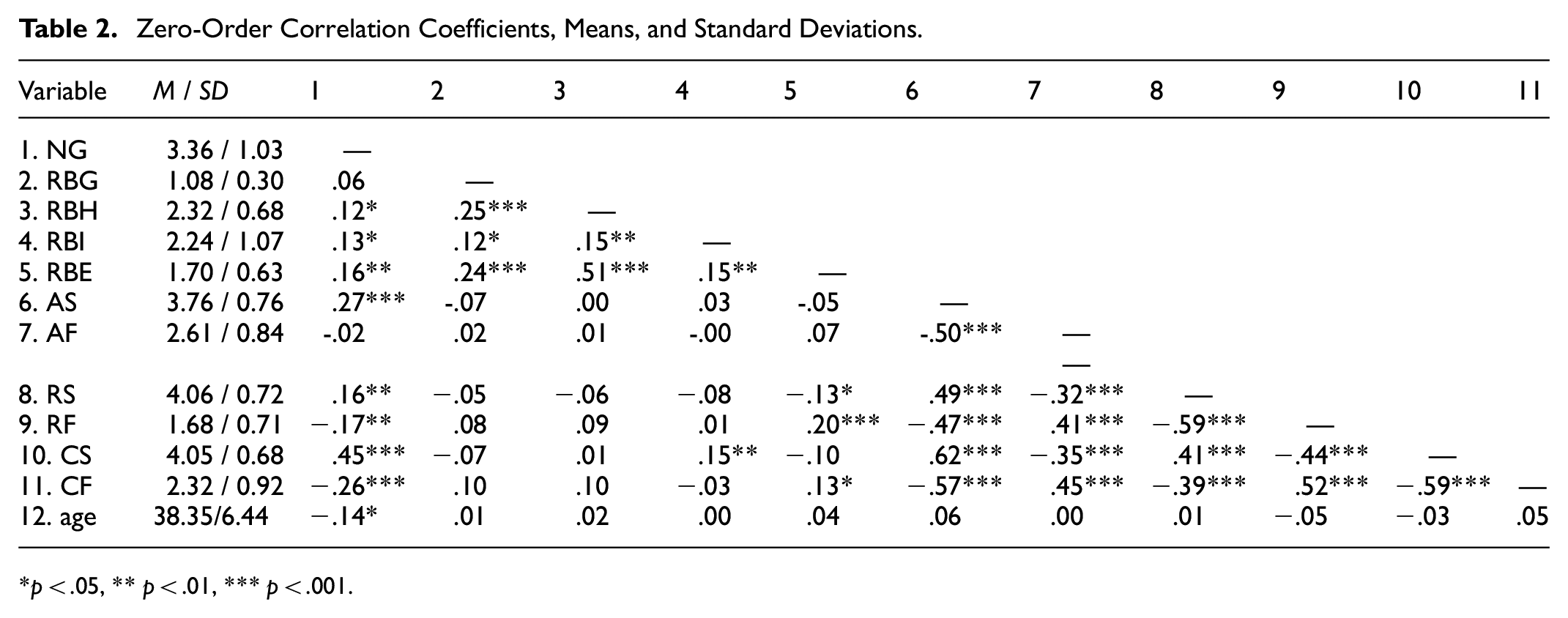
p < .05, **p < .01, ***p < .001.
Linear Regression Model
Mann–Whitney U test has been used to explore gender differences in variables. Men scored higher on narcissistic grandiosity z = −2.24, p = .02 than women. Men scored higher in every risky behavior domain. Specifically, they scored higher on investment z = −2.68, p = .007; health z = −5.25, p < .001; gambling z = −3.91, p < .001, and ethical domain z = −2.92, p = .003. Therefore, gender was used as a control variable.
Altogether, risky behavior comprised four risky domains: investment (y1), ethical (y2), health (y3), and gambling (y4). Narcissistic grandiosity correlated with three risky behavior domains: health, investment, and ethics. Grandiose narcissism significantly predicted two risky behavior domains. The overall regression with investment domain was statistically significant R2 = .04, F(3, 296) = 5.08, p = .002, and narcissistic grandiosity significantly predicted investment score β = .13, p = .03. The prediction of the ethical domain was statistically significant R2 = .06, F(3, 296) = 7.32, p < .001, and narcissistic grandiosity significantly predicted ethical score β = .12, p < .001. The results were controlled for gender and showed stronger predictions for men. Gambling and health domains were not predicted significantly. Regression coefficients for all the domains are presented in Table 3. The results supported hypothesis H3 for the investment and ethical domains.
Regression Coefficients (independent Variables: Narcissistic Grandiosity, Age, Gender; Dependent Variables: Investment, Ethical, Health, and Gambling Domains).

Note. Bootstrapping based on 5,000 replications. Coefficient estimate is based on the median of the bootstrap distribution. Men = 1, Women = 2. *Bias corrected accelerated.
Instrumental Variable Regression
Model 1 comprised narcissistic grandiosity (x) and the two strongest instruments, AS (z2) + CF (z3), which significantly predicted narcissistic grandiosity and did not correlate with the investment domain (y1). The Model 1 fitted data perfectly χ2 (2) = 3.85, p = 1.45, n = 300. When instrumented with autonomy satisfaction and competence frustration, narcissistic grandiosity did not significantly predict the investment domain β yx = .11, p = .49. Narcissistic grandiosity did not affect the investment domain. The path model is presented in Figure 1.
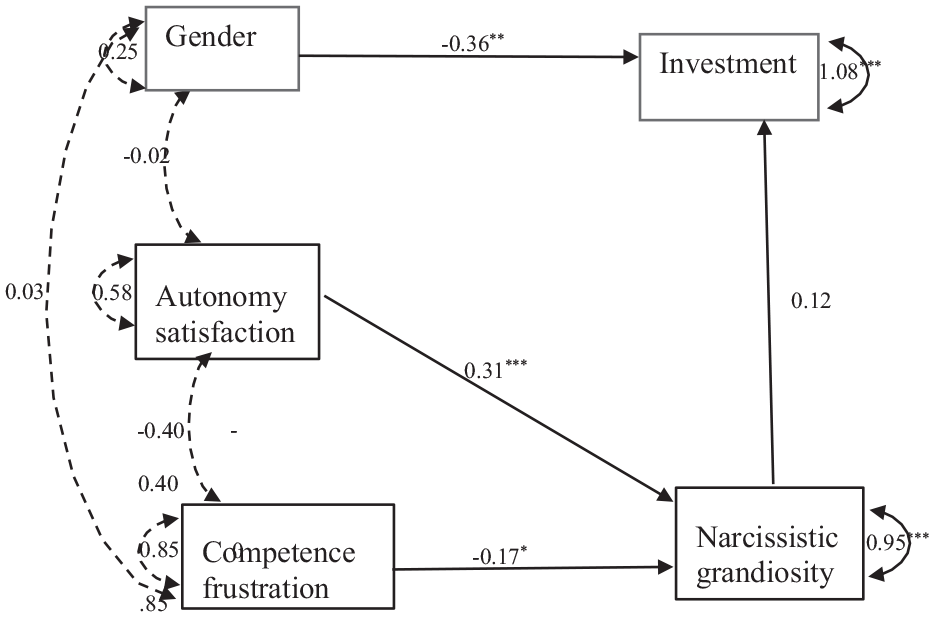
Path analysis model of associations between instruments, narcissistic grandiosity, and investment domain.
Model 2 comprised narcissistic grandiosity (x) and two instruments, CS (z1) + AS (z2), which significantly predicted narcissistic grandiosity and did not correlate with ethical domain (y2). The model fitted data perfectly χ2 (2) = 4.28, p = .11, n = 300. When instrumented with competence and autonomy satisfaction, narcissistic grandiosity did not significantly predict ethical domain β yx = −.10, p = .20. Results also showed that instrument AS (z2) did not significantly predict narcissistic grandiosity. After that, AS(z2) had to be excluded from the model. After excluding AS from the model, the overidentified test was still correct χ2 (1) = 3.49, p = .06, n = 300. When instrumented with competence satisfaction (z1) exclusively, narcissistic grandiosity did not significantly predict the ethical domain β yx = −.10, p = .19. Narcissistic grandiosity did not affect the ethical domain. The results were controlled for gender. The path model is presented in Figure 2.

Path analysis model of associations between instruments, narcissistic grandiosity, and ethical domain.
Model 3 comprised narcissistic grandiosity (x) and the strongest instrument, CF (z3), which significantly predicted narcissistic grandiosity and did not correlate with the health domain (y3). The Model 3 fitted data well, χ2 (1) = 3.49, p = .06, n = 300. When instrumented with competence frustration, narcissistic grandiosity did not significantly predict the health domain yx = .004, p = .96. Narcissistic grandiosity did not affect risky behavior in the health domain.
Model 4 comprised narcissistic grandiosity (x), and the strongest instrument, CF (z3), which significantly predicted narcissistic grandiosity and did not correlate with the gambling domain (y4). Model 4 fitted data well, χ2 (1) = 3.49, p = .06, n = 300. When instrumented with competence frustration, narcissistic grandiosity did not significantly predict the gambling domain β yx = −.06, p = .08. Narcissistic grandiosity did not affect the gambling domain. All four tested models’ coefficients are presented in Table 4.
Regression Coefficients of Four Tested Models.

Note. Bootstrapping 5000. NG = narcissistic grandiosity; CF = competence frustration; AS = autonomy satisfaction; CS = competence satisfaction. RB domains: RBI = investment; RBE = ethical; RBH = health; RBG = gambling.
The results did not support hypothesis H3.
The two-way arrows, or self-loops, in the path analysis figures, represent the residual variance of the variables. The residual variance is the portion of the variance in a variable that is not explained by the model. The coefficient next to the self-loop indicates the amount of the unexplained variance. For instance, a self-loop coefficient of .85 means that 85% of the variance in that variable is not explained by the other variables in the model. When the coefficients are statistically significant, indicated by asterisks (such as *** for p < .001), it suggests that the unexplained variance is substantial and not due to random chance. Significant residual variance implies that other factors may influence the variables not included in the model (Hox et al., 2017). The high residual variance, statistically significant, suggests that additional factors or variables might need to be considered to better explain the dependent variable. It highlights areas where further research or additional variables might be needed.
Discussion
Instrumental variable regression analysis is a valuable method for economic or social sciences. It allows researchers to make causal claims in studies with non-experimental settings (Antonakis et al., 2010; Maydeu-Olivares et al., 2020). The current study aimed to explore causality between the central narcissistic trait grandiosity and risky behavior in four domains related to working adults: ethics, investment, health, and gambling. The analysis included several steps: analyzing correlations and predictions, finding/including control variables, and testing causal/instrumental models. We hypothesized that narcissistic grandiosity relates to, predicts, and impacts risky behavior domains.
In the first hypothesis (H1), we assumed that narcissistic grandiosity correlates significantly with risky behavior domains. Grandiose narcissism correlated positively and weakly with investment, health, and ethical domains of risky behavior. The results were in line with previous studies (Britt & Garrity, 2006; Buelow & Brunell, 2014; Foster et al., 2009; Hill, 2016; Lakey et al., 2008; Tamborski et al., 2012; Zerach, 2016) where grandiose narcissism and/or its facets (grandiosity, exploitativeness) correlated significantly with risky behavior.
In the second hypothesis (H2), we assumed that grandiosity would predict risky behavior domains. Grandiosity significantly predicted two risky behavior domains: ethics and investment, while it did not predict health and gambling. The results align with previous findings by Buelow and Brunell (2014) and Hill (2016).
In the third hypothesis (H3), we assumed the causal effect of grandiosity on risky behavior domains. All risky behavior domains in instrumental regression models were evaluated to avoid bias or false omissions. Narcissistic grandiosity did not affect the investment domain, which aligned with the non-significant meta-analytic results on narcissistic leaders’ financial risk-taking (Cragun et al., 2020). Further, narcissistic grandiosity did not affect the ethical domain. Although no study examined causality in this relationship, the ethical domain was significantly associated with a greater level of narcissistic grandiosity in the previous study (Buelow & Brunell, 2014). Again, narcissistic grandiosity did not influence gambling and health domains. In summary, trait grandiosity did not affect any risky domains. Narcissistic grandiosity does not cause risky behavior in investment, ethical, gambling, or health domains. The results imply that there may be omitted variables explaining the influence on risky behavior.
Narcissistic grandiosity and risky behavior domains are gender-dependent (Grijalva et al., 2015; Twenge & Campbell, 2009; Weber et al., 2002), so the results were controlled for gender. Gender differences were present in narcissistic grandiosity, and all tested risky behavior domains. Women were less grandiose and more risk aversive in all domains of risky behavior (Grijalva et al., 2015; Twenge & Campbell, 2009; Weber et al., 2002) .
So far, the research has provided little evidence of causal relationships between specific risky behavior domains and personality traits of narcissism, although there were assumptions about the casual relationship. If causal relationships between examined variables do not exist, further research on omitted variables causing effect is needed. The unknown omitted variables could lead to risky behavior in four tested domains, but this is not necessarily due to grandiosity, overconfidence, or feelings of superiority. While risk-taking and grandiosity are often seen together in individuals with antagonistic personalities (Sleep et al., 2021), having a high level of grandiosity doesn’t necessarily mean that a person will also display a high level of problematic antagonism (Hart et al., 2022). In cases where there is a convergence of high scores on both grandiosity and antagonism, there may be a greater risk of engaging in risky behavior. Further, risky behavior may occur from a deeper, neurobiological core manifested as sensation seeking (Miller et al., 2009). It may force grandiose individuals to seek a way to experience the thrill. Particularly, if we detect someone as grandiose in the workplace, it may tell us about their tendencies to behave risky in the future if the other key variables, such as antagonism and sensation seeking, are also present.
Reasons for risky behavior may vary depending on a specific risky domain. General risk-taking is motivated by adventure and sensory experience (Ashton et al., 2010), which presume causal personality factors related to adventurous personality and seeking strong sensory experience preferences. Trait grandiosity simply may not have significant empirical overlap with these factors. According to Matthews (2018), traits are more predictive of performance when they are tied to a specific context of such performance. Why grandiosity may not cause risk-taking in chosen risky behavior domains could be explained by the fact that it is not closely tied to the context of these domains. Rather, grandiosity may be more valid for risky contexts associated with grandiosity itself, such as risky choices leading to fame, money or status advancement, which are narcissistic core motivators. An alternative personality variable that might lead to risky behavior in specific contexts is status-driven risk-taking, which refers to the willingness to accept risk in the pursuit of power and wealth (Visser et al., 2014). This disposition, together with grandiosity may be a meaningful choice in future models. The crucial question in this sense might be whether this risky behavior will lead to power, status, or satisfaction with self-importance. These can be a key element to consider.
The study’s results show that although narcissistic grandiosity shows some correlations with risk-taking behavior, it is not a direct cause of such behavior. This highlights the need for a more comprehensive approach to assessing and managing risk behavior that considers a broader set of personality traits and contextual factors. This way, we can better understand and address risky behavior across domains more effectively. Compared to other narcissistic traits, grandiosity is considered relatively adaptive. It causes fewer interpersonal problems than other traits of narcissism (Miller et al., 2021). Still, employees possessing pathological forms of narcissism or an extreme level of grandiosity are susceptible to risky behavior in specific contexts (Owen & Davidson, 2009). For instance, narcissistic personality disorder can be a dangerous form of personality expression when it coexists with Hubris syndrome, a transient disorder occurring due to possession of power, as has been observed in a study of American CEOs (Akstinaite et al., 2021).
Limitations
The current study has several limitations. The participants completed self-administered surveys. The independent and dependent variables were measured within one questionnaire, and this procedure can lead to common method bias that may affect the validity and reliability of the results (Jordan & Troth, 2020). The results do not represent a sample of Slovak working adults. The participants may have provided socially desirable answers when asked about illegal or questionable behavior. Using the snowball sampling strategy might introduce selection bias and affect sample representativeness. Finally, we have explored only one central facet of narcissism: narcissistic grandiosity.
Future Research Implications
The current study results show that the causality between grandiosity and risk-taking in behavior domains is not unequivocal. Next research might go in three possible directions: 1. To seek other causal factors that cause engaging in risky behavior domains beyond/together with grandiosity, such as antagonism and sensation seeking; 2. To seek other risky behavior domains that may be directly affected by narcissistic grandiosity; 3. To build complex models which consider contextual variables, such as the frustration of resources, low restrictions environment, etc.
We also recommend that the examined context in which grandiosity can be risky should be related to grandiosity per se (Owen & Davidson, 2009). For instance, we suggest exploring risky behavior that can lead to enhanced ego-view, power and prestige; for example, extreme sports, aggressive commercial practices, corrupt practices, or exploitation of sexual partners for money might be interesting. We also suggest examining grandiosity with status-driven risk-taking (Visser et al., 2014) and their common effect on chosen risky domains. Researchers might be more specific and ask their participants about risky choices that lead to fame, wealth and anything related to what grandiose individuals generally seek.
Further, researchers could test causal models with other facets of grandiose narcissism, such as exploitativeness, entitlement, and central narcissistic trait antagonism, as well as other risky behavior domains (i.e., recreational and social). A recent study by Sleep et al. (2021) found that grandiosity and risk-taking are closely linked to antagonism, which is associated with negative social behavior and interpersonal manipulation. Therefore, examining antagonism as a potential causal factor may be of future interest. In addition, narcissism has been associated with compulsive buying, where narcissistic traits of vulnerability and grandiosity were measured by the Pathological Narcissism Inventory (PNI) (Pincus et al., 2009). Thus, other narcissistic variants may be specifically related to risky domains. A study by Roche et al. (2013) found that a lack of mature regulatory mechanisms may contribute to risky behavior, which is relevant to vulnerable variants (Krizan & Herlache, 2018).
Although the current study did not find any influence of narcissistic grandiosity on risky behavior domains, prior research consistently suggests its relationship with risky behavior (Foster et al., 2009; Buelow & Brunell, 2014; Hill, 2016). Grandiosity may be used as a moderator to explain the relationship between independent variables such as sensation seeking, risk perception, impulsivity and risky behavior. Examining clinical forms of narcissism may yield different results. Therefore, research using clinical samples would be enriching.
The study suggests that narcissistic grandiosity may not be the primary driver of risk-taking behavior in certain domains and that other variables could be more relevant. The results suggest further complex research and recommend carefully choosing variables in the next theoretical models. The results suggest that revealing narcissistic grandiosity should not lead to premature conclusions about its riskiness in general or exaggeration of riskiness for the domains which weakly correlate with grandiosity. Rather, the next research should focus on other specific domains where grandiosity may be a crucial factor and, on the other hand, on alternative variables, which are causal factors to chosen domains.
The findings of this study have important implications for research methods and study design in social sciences. The study demonstrates the value of using instrumental regression analyses in psychological research. IVR could be more widely used to test causal relationships, especially in studies where experimental designs are not feasible.
Practical Implications
The results suggest that narcissistic grandiosity itself may not be a direct contributor to risky behavior in the work environment. Therefore, organizations should also consider other personality traits, such as antagonism and sensation seeking, when selecting and evaluating employees. Integrating multidimensional assessment tools that consider these factors can help to more accurately assess the potential for risky employee behavior.
Given the weak correlations between grandiosity and certain domains of risk behavior, training should focus on developing soft skills such as self-reflection, ethical decision-making and risk management or on identifying and managing traits such as antagonism and sensation-seeking. Although grandiosity does not directly cause risky health behavior, its correlation with such behavior suggests that prevention programs are needed. Employers should implement health and wellness programs that promote safe and responsible behavior and provide resources and support to address health and safety concerns (Lisa & Valachova, 2021).
In finance and investment, policy makers and regulators should consider the broader context of personality traits that may influence risk-taking behavior. For example, mechanisms could be put in place to monitor and regulate behavior that may be influenced by high levels of antagonism or sensation seeking rather than focusing on grandiosity alone. Educational programs to develop financial literacy should include components that teach individuals to identify and manage personality traits associated with risky behavior, which can help minimize the negative consequences of risky financial decisions.
Conclusion
The current study is the first attempt to investigate the causal effect of narcissistic grandiosity on specific risky behavior domains. Narcissistic grandiosity correlated with three risky behavior domains and predicted two risky behavior domains. However, narcissistic grandiosity was not the cause of risky behavior. The other omitted variables, such as antagonism, exploitation, sensation seeking, and/or their co-occurrence, might be investigated in the context of narcissistic personality traits and risky behavior.
Footnotes

Ethical Considerations
Participants agreed that their data would only be used for research purposes, and they were informed that they could leave the research whenever they wanted, without adverse effects. They signed informed consent online. The participation was voluntary and anonymous, without any reward. The manuscript is part of a dissertation thesis approved by the ethical committee of Faculty of Social and Economic Sciences, Comenius University under the number 216-12/2023.
Author Contributions
MV: Conceptualization, Methodology, Data curation, Statistics, Writing – Original draft preparation, Investigation, Writing – Reviewing and Editing. EL: Conceptualization, Validation, Supervision, Writing – Original draft preparation, Investigation, Writing – Reviewing and Editing.
Funding
The authors disclosed receipt of the following financial support for the research, authorship, and/or publication of this article: Vedecká Agentúra Ministerstva Školstva, Vedy, Výskumu a Športu SR (VEGA 1/0112/24).
Declaration of Conflicting Interests
The authors declared no potential conflicts of interest with respect to the research, authorship, and/or publication of this article.
Data Availability Statement
The datasets used and/or analyzed in the current study are available from the corresponding author upon reasonable request.