




Abstract
This investigation employs quantile hedonic regression methodology to analyze China’s painting and calligraphy auction market during the critical 2012 to 2019 adjustment and maturation period. Utilizing a comprehensive dataset of 47,540 artworks, we examine how artist reputation, artwork characteristics, and sale attributes influence valuation across different price segments. Our findings reveal substantial heterogeneity in the implicit prices of these attributes throughout the price distribution, providing empirical validation for market segmentation hypotheses previously unexplored in the Chinese context. Quality-adjusted price indices demonstrate a general downward trajectory, most pronounced in premium market segments following 2012, possibly influenced by political factors. Notably, we document a convergence phenomenon in price indices across market segments toward the study period’s conclusion, suggesting progressive market maturation—an observation corroborated by industry specialists. These findings substantively advance theoretical frameworks of art valuation while offering strategic insights for market participants navigating this complex marketplace.
Introduction
The burgeoning field of research on art auctions in emerging markets has provided valuable insights into the determinants of art prices and the investment performance of artworks, particularly in countries such as China, New Zealand, South Africa, and Turkey (e.g., Binge & Boshoff, 2021; Demir et al., 2018; Fedderke & Li, 2020; Forster & Higgs, 2018; Öztürkkal & Togan-Eğrican, 2020; Shi et al., 2018; Zou et al., 2021). Notably, since 2014, China’s art market has risen to become the second largest globally, rivaling the UK and closely following the US, and in 2020, it held the highest share of the global art auction market (McAndrew, 2021). Despite this remarkable growth, the literature examining the characteristics and determinants of art prices, as well as the indexation of art prices in China’s art auction market, remains comparatively limited when juxtaposed with research in developed Western markets.
Wu (2019) provides a comprehensive framework delineating the evolution of China’s art market into four distinct stages: an incubation phase from the end of the cultural revolution to 1992, an early period of development from 1993 to 2003, one of explosive growth from 2004 to 2011, and a subsequent one of adjustment and maturation from 2012 to 2018. During the phase of explosive growth, characterized by the emergence of art investment funds and art exchanges resembling equities markets, short-term investors flooded the art market in pursuit of quick gains, yet many retreated upon realizing its inability to deliver rapid profits. In November 2012, President Xi Jinping initiated an anticorruption campaign, resulting in a further decrease in demand for artworks and luxury sectors (X. Li et al., 2020; Masset et al., 2016). Concurrently, the China Association of Auctioneers (CAA), as the sole national association governing the auction industry in China, drafted “The Standard for Auction of Cultural Relics and Art Works” on behalf of China’s Ministry of Commerce in 2010, marking a pivotal moment in the standardization process of China’s art auction industry. With the subsequent vetting of auction houses according to this standard from 2012 onward, under the effective management of CAA, China’s art auction market has undergone a transformative shift from quantity-driven to quality-driven growth, progressing steadily toward maturation (Artnet, 2019; Artprice, 2018).
Prior academic studies on artwork valuation in China’s art auction market typically rely on data prior to this market maturation. Before 2011, art investment in China had a better risk and return profile compared to other assets and could serve as a diversification tool for the traditional financial asset portfolios (Shi et al., 2018; Zou et al., 2021). X. Li et al. (2020) identify two bubbles in the Chinese art market during the periods of 2004 to 2005 and 2010 to 2011, which were driven by the financialization of artworks, speculation by investment institutions, and macroeconomic fluctuations in China. The landscape of art auctions in China has witnessed significant transformations in recent years, so findings based on the earlier 2000 to 2010s period thus cannot adequately capture the current state of China’s art market, and there is a need for updated research based on post-2011 data.
This study endeavors to fill a void in the literature by investigating the evolved landscape of China’s post-2011 art auction market. We extend previous analyses by incorporating additional explanatory variables that illuminate collector and investor valuation criteria specifically for Chinese painting and calligraphy. Through quantile hedonic regression methodology, we identify substantial heterogeneity in the implicit prices of artist, artwork, and sale attributes across the price distribution, providing empirical validation for market segmentation hypotheses previously established in Western art markets but heretofore unexplored in the Chinese context. Furthermore, we document a notable convergence phenomenon in price indices across price segments toward the conclusion of our study period, suggesting progressive market maturation—an observation corroborated by industry specialists.
Our empirical analysis reveals that artist reputation consistently enhances artwork valuation, with this effect amplified in premium market segments. Artwork characteristics exhibit multifaceted relationships with pricing outcomes. We document an inverted N-shaped correlation between dimensional attributes and hammer prices, while identifying a distinct hierarchy in the valuation of artistic medium and subject matter that reflects culturally-specific preferences and material scarcity considerations. Notably, chromatic applications negatively influence realized prices, particularly in high-value segments—a phenomenon indicating the persistence of traditional esthetic preferences for monochromatic ink compositions. Temporal analysis demonstrates that Yuan dynasty works command significant premium valuations within the historical periodization framework.
Auction environment factors substantially impact pricing outcomes. The positive correlation between elevated sale rates, prioritized lot sequencing, and hammer prices underscores the significance of auction dynamics. Presale price estimates positively influence realized prices, with magnified effects observed at elevated price quantiles, highlighting the crucial role of information dissemination in shaping bidding behaviors for premium artworks. Seasonal patterns emerge with May, June, and November yielding superior price realizations, particularly for high-value pieces. Our investigation identifies a stratified hierarchy among auction houses regarding their capacity to generate price premiums, with Council consistently commands the highest premiums. Geographic analysis positions Hong Kong as the premier venue for premium artworks, while other localities demonstrate heterogeneous effects across market segments.
Quality-adjusted price indices reveal a general downward trajectory across market segments during 2012 to 2019, likely representing a protracted correction following the 2011 market bubble collapse. This decline manifested most acutely in high-value segments immediately post-2012, potentially influenced by political developments including President Xi Jinping’s anticorruption initiatives. Significantly, we observe convergence of price indices across market segments toward the conclusion of the study period, suggesting increasing market maturation—a finding corroborated by industry specialists’ assessments regarding the growing sophistication of China’s art auction ecosystem.
This research advances the scholarly discourse on artwork valuation while providing actionable insights for market participants in China’s art auction market. By examining the 2012 to 2019 period, we present a contemporary analysis of this market during its critical adjustment and maturation phase, addressing a significant research gap as existing literature has predominantly utilized pre-2011 data. Our methodological innovation—applying quantile hedonic regression across multiple price segments—enables a more sophisticated understanding of valuation determinants throughout the price distribution, transcending the mean-effect focus characteristic of previous studies. This approach yields robust empirical support for market segmentation hypotheses within fine art markets, demonstrating that the implicit values assigned to artist, artwork, and sale attributes exhibit significant heterogeneity across the price spectrum. The comprehensive examination of price determinants enhances our understanding of valuation mechanisms operating within the Chinese painting and calligraphy auction market. These findings offer strategic guidance for collectors, investors, and market participants navigating this complex marketplace. Furthermore, our documentation of price index convergence across market segments toward the conclusion of the study period provides valuable insights into market maturation processes. This observation contributes to theoretical frameworks concerning the evolutionary development of emerging art markets, offering a case study with potential applications to other developing art market contexts globally.
The remainder of this paper is organized as follows. Section 2 reviews the relevant literature. Section 3 outlines our methodology. Section 4 describes the dataset and defines the variables in the estimation. Section 5 analyzes the empirical results and the implications. Section 6 concludes this study.
Literature Review
The academic literature on artwork valuation within the context of aggregate price indices has primarily utilized two main methodologies: repeat sales regression and hedonic price regression. The repeat sales method estimates returns using paired transaction prices of identical artworks, avoiding quality measurement issues but suffering from selection bias due to limited repeat sales data (Korteweg et al., 2016; Park et al., 2017; Vecco et al., 2022). In contrast, the hedonic approach regresses prices on artwork attributes and time dummies, utilizing a broader dataset but potentially encountering endogeneity issues from omitted variables and successful auction selection bias (Fedderke & Li, 2020; Y. Li et al., 2024; Renneboog & Spaenjers, 2013; Shi et al., 2018; Zou et al., 2021). Art markets demonstrate segmentation across price tiers, from exclusive high-end segments to accessible low-end markets, with distinct valuation patterns across collector types. Consequently, studies augment hedonic models with quantile regressions to capture how artwork attributes influence auction prices across the price distribution (Fedderke & Chen, 2023; Y. Li et al., 2022; Renneboog & Spaenjers, 2013; Scorcu & Zanola, 2011; Wang, 2017).
Renneboog and Spaenjers (2013) analyze over 1 million auction transactions of paintings and works on paper using a comprehensive hedonic pricing model that controls for artist, artwork, and sale characteristics. They find art appreciated by 3.97% annually in real USD terms (1957–2007), comparable to corporate bonds but with higher risk. Their quantile regressions reveal higher price appreciations and volatilities in premium price segments. Y. Li et al. (2022) analyze global art market dynamics using six decades of transaction data. Their findings reveal that paintings and drawings achieved real and nominal annual returns of 2.49% and 6.24% respectively. Premium segments demonstrate superior returns, particularly for oil paintings, contemporary movements, and sales through prestigious auction houses. Shi et al. (2018) and Zou et al. (2021) employ hedonic regression analysis on data from Artron.net, examining traditional Chinese painting and calligraphy. Shi et al. report 8.42% annual appreciation (2000–2015), with prices significantly influenced by artist reputation, authenticity stamps, size, and auction house. Zou et al. document 10.67% annual appreciation (2000–2017), identifying two market peaks (2005 and 2011), with authenticity, mounting, creation time, month of sale, and auction house as key price determinants. Despite the prominence of Chinese painting and calligraphy as the dominant collecting category in China’s art market, market segmentation analysis remains unexplored in this sector, with only Wang (2017) examining segmentation in Chinese oil paintings.
Drawing from cultural consumption research of UNESCO-recognized heritage, understanding market-specific variables is crucial as consumer preferences significantly influence cultural product valuation (Heredia-Carroza et al., 2023). Given the distinct artistic and cultural elements of traditional Chinese painting and calligraphy, exploring additional variables beyond those identified in previous studies is essential to capture unique collector and investor valuation criteria. The distinctive characteristics of Chinese painting and calligraphy manifest in several aspects. Traditional works are executed on either paper—predominantly Xuan paper, though letter papers of various colors and designs are also used—or silk mediums, including both standard and damask varieties (Silbergeld & Sullivan, 2021). Both art forms share a fundamental emphasis on brushwork dynamics, characterized by precise brush tip control and evaluated through common criteria (Silbergeld & Sullivan, 2021). Within the diverse realm of Chinese paintings, the subject matter encompasses landscape, flowers and birds, figures, and religion, with landscape painting historically regarded as the pinnacle of the art form (Rawson, 2007). The primacy of ink painting in Chinese art history traces back to the Tang dynasty, specifically to Wang Wei’s influential assertion that “ink painting surpasses all other styles of painting” (Wang Wei’s “Landscape Jue, 2024). While ink remains the foundational medium, artists may selectively incorporate color pigments to enhance decorative elements or augment verisimilitude (Silbergeld & Sullivan, 2021). A distinctive artistic tradition involves gilding techniques, where artists apply gold foil or powder-based pigments bound with glue to embellish paper surfaces (Gold Paper Painting, 2025). The theoretical foundation for Chinese painting originates from Xie He’s “Six Principles” established during the Qi Liang period of the Southern dynasty, with the sixth principle of “copying and transmission” legitimizing artistic replication (Xie He’s Six Principles, 2024). This historical framework contextualizes the market presence of replicated masterworks, reflecting a distinctive paradigm in Chinese painting and calligraphy that diverges from Western notions of artistic originality and authenticity. Similar to the classification of Western paintings by art movements, Chinese painting and calligraphy exhibit distinct stylistic and esthetic characteristics that evolved across different dynasties throughout their long history (Renneboog & Spaenjers, 2013; Silbergeld & Sullivan, 2021; Zou et al., 2021). These stylistic shifts reflect broader cultural, philosophical, and artistic developments, further reinforcing the need to account for historically contingent variables when analyzing the determinants of auction prices in this market.
Prior research in auction theory provides valuable insights into artwork price determination. The literature emphasizes three key aspects of auction dynamics. First, auction atmosphere, particularly the auctioneer’s conduct and bidding dynamics, significantly influences final hammer prices during live auctions (Brandly, 2012). Second, Milgrom and Weber’s (1982) competitive bidding model demonstrates that expert appraisals enhance expected prices by reducing uncertainty and intensifying bidder competition. Ashenfelter (1989) empirically validates this framework, confirming the accuracy of auctioneers’ presale price estimates and suggesting a positive correlation between these estimates and realized prices. Third, extensive research documents a consistent decline in quality-adjusted prices throughout sequential English auctions, indicating the significance of temporal positioning on realized prices (Ashenfelter, 1989; Ashenfelter & Genesove, 1992; Beggs & Graddy, 1997; Hong et al., 2015; Y. Li & Shonkwiler, 2021; Lusht, 1994).
Sale characteristics demonstrably influence artwork hammer prices. The Western art auction markets exhibit distinct seasonal patterns, with significant auctions clustering in May, June, November, and December (Y. Li et al., 2022; Renneboog & Spaenjers, 2013). Market structure theory suggests that heterogeneous auction house characteristics—including reputation, market power, and fee structures—shape price outcomes (Y. Li et al., 2022; Renneboog & Spaenjers, 2013; Shi et al., 2018; Zou et al., 2021). Moreover, regional variations in auction policies, regulations, and market structures across Chinese provinces influence price formation. These institutional and geographic factors underscore the anticipated impact of both auction house-specific and location-specific characteristics on realized prices.
Methodology
Building on the literature reviewed in the previous section, this section outlines the empirical methodology and formulates the research hypotheses.
The Quantile Hedonic Regression
This study examines price determinants and the indexation of art prices in Chinese painting and calligraphy from 2012 to 2019. In econometric analysis, ensuring both
Given our dataset’s limited repeated sales observations but rich item characteristic information, we employ hedonic price regression. To validate market segmentation hypotheses previously unexplored in the Chinese context, we specifically implement quantile regression (QR) methodology, which offers distinct advantages over ordinary least squares (OLS) approaches. Unlike OLS, which estimates only conditional mean effects, QR characterizes the entire conditional distribution of the dependent variable (Koenker, 2005), revealing how determinants’ impacts vary across price segments. This quantile hedonic regression approach demonstrates greater robustness to non-normal errors and outliers prevalent in artwork price distributions while accommodating the heterogeneous nature of art markets where valuation determinants exert variable influences across different price segments (Fedderke & Chen, 2023; Y. Li et al., 2022; Renneboog & Spaenjers, 2013; Scorcu & Zanola, 2011; Wang, 2017). By implementing quantile hedonic regression, we obtain a comprehensive portrait of explanatory factors across the price distribution, delivering nuanced insights into China’s segmented art auction market dynamics.
We assume that the price function can be written as additively separable in the observed product characteristics and time dummies,

where

with the time dummy coefficient set equal to 0 for the benchmark year. Silver and Heravi (2007) point out that the index presented in Equation 2 tracks the geometric mean, rather than the arithmetic mean, of prices over time due to the log-linear form of Equation 1. The authors demonstrate that the relationship between a price index tracking the arithmetic mean and one observing the geometric mean depends on changes in the dispersion of log prices over time, which may be partially attributed to product heterogeneity. Thus, the value of the price index recording the arithmetic mean can be obtained according to Equation 3:

where
To estimate Equation 1, the QR method that involves the minimization of a weighted sum of the absolute deviations instead of minimizing the sum of squared residuals in the OLS method is employed. Therefore, the QR estimator for the qth quantile minimizes the objective function:
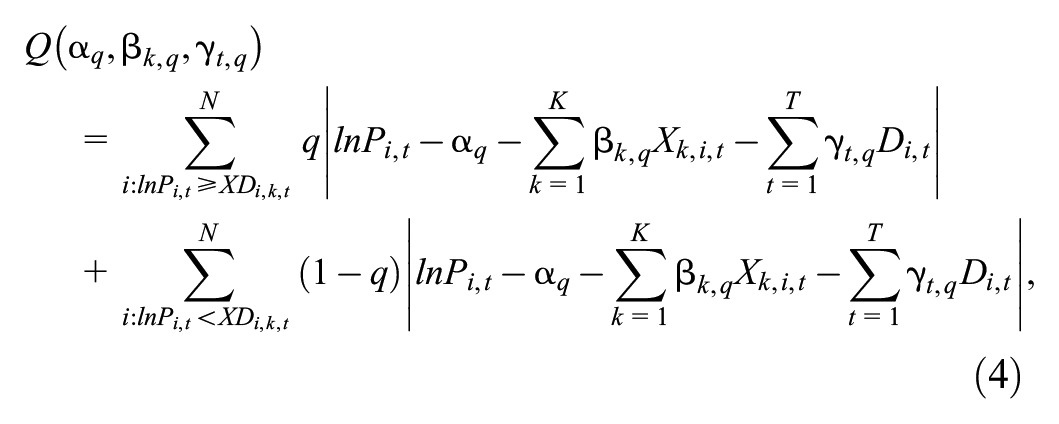
where
In this study, we employ the “sqreg” command in Stata software to estimate the hedonic QR model for the quantiles 0.05, 0.1, 0.25, 0.5, 0.75, 0.9, and 0.95 simultaneously and obtain estimates of the entire variance-covariance matrix of estimators by bootstrap with 1,000 replications. The hypothesis tests concerning coefficients both within and across equations can subsequently be performed (Stata, 2023).
Hypotheses
Drawing on the theoretical foundations and empirical findings presented in the literature review, we formulate the following hypotheses regarding price determinants in the Chinese painting and calligraphy auction market:
The value of artworks could be influenced by the reputation of the artist, with renowned artists commanding higher prices (Y. Li et al., 2022; Renneboog & Spaenjers, 2013; Shi et al., 2018).
H2a: Size-Price Relationship
Artwork size is expected to have a non-linear relationship with price, with larger works increasing in value until display constraints diminish marginal returns (Y. Li et al., 2022; Renneboog & Spaenjers, 2013; Shi et al., 2018).
H2b: Medium hierarchy
Reflecting both material value and cultural significance within Chinese artistic traditions, we hypothesize the existence of a hierarchical pricing structure across different mediums, with damask silk commanding premium valuations due to its scarcity (Silbergeld & Sullivan, 2021).
H2c: Subject matter valuation
Reflecting both culturally-specific preferences and inherent rarity, we hypothesize a hierarchical valuation structure across subject matter categories, with landscape paintings commanding premium prices over other genres (Rawson, 2007).
H2d: Color and gilding effects
Drawing from Wang Wei’s assertion regarding ink painting’s supremacy, we hypothesize that colored works may command lower valuations than monochrome works, while gilded works may elicit premium prices due to their material value and decorative significance (Gold Paper Painting, 2025; Silbergeld & Sullivan, 2021).
H2e: Dynasty and replication effects
We hypothesize that artwork values vary across historical periods, reflecting both artistic evolution and scarcity effects, with earlier periods commanding higher prices due to their historical significance and relative rarity (Silbergeld & Sullivan, 2021). How artworks emulating the style or content of renowned artists are valued remains uncertain and will be determined through the empirical analysis (Xie He’s Six Principles, 2024).
H3a: Auction dynamics
Higher sale rates positively influence hammer prices through improved auction atmosphere (Brandly, 2012). Presale price estimates positively affect final prices by reducing information uncertainty and intensifying bidder competition (Ashenfelter, 1989; Milgrom & Weber, 1982). Earlier lot positioning leads to higher prices, consistent with documented price decline effects (Ashenfelter & Genesove, 1992; Beggs & Graddy, 1997).
H3b: Temporal effect
We hypothesize significant seasonal patterns in the Chinese art market. Specifically, we predict price premiums during traditional peak auction seasons (May, June, November, December) due to concentrated high-quality consignments and heightened buyer attention (Y. Li et al., 2022; Renneboog & Spaenjers, 2013).
H3c: Institutional and geographic effects
Building on market structure theory and empirical findings from previous studies, we predict significant price variations across auction houses and cities (Y. Li et al., 2022; Renneboog & Spaenjers, 2013; Shi et al., 2018; Zou et al., 2021). This variation can be attributed to differences in auction house reputation and market power, with established houses commanding significant premiums; regional market development and collector bases; and regulatory environments and market structures across different Chinese provinces and special administrative regions.
Integrating quantile regression insights from prior studies (Fedderke & Chen, 2023; Y. Li et al., 2022; Renneboog & Spaenjers, 2013; Scorcu & Zanola, 2011), we hypothesize significant heterogeneity in the implicit prices of artist, artwork, and sale attributes across different price quantiles. These hypotheses will be tested through quantile regression methodology, enabling the examination of parameter variation across different market price segments and identification of potential market segmentation in China’s art auction market.
Data
The data applied in our analysis were obtained from Artron.net by utilizing a web crawler to collect information from the URL https://auction.artron.net/. Artron.net, originally established in 2000 as a privately owned entity but transitioned to state ownership in 2021, serves as an interactive online community dedicated to Chinese art. Recognized for its extensive range of art-related services, Artron.net houses the most comprehensive and reliable database of the Chinese art market (McAndrew, 2021). Information retrieved from Artron.net includes details such as the artist’s name and birth and death years, in addition to the artwork title, sale date, lot number, hammer price, presale price estimate, artwork description, and dimensions, as well as the auction house, auction location, and the sale rate and turnover of the held auction. According to the CAA, the Chinese painting and calligraphy category is segmented into ancient, modern, and contemporary subcategories. We define the market in this study as the art auction market of China where artworks in the Chinese painting and calligraphy category were created by artists born before the end of the Qing dynasty (1911/1912), with 84,042 auction records in total. After removing observations with incomplete information, items labeled as “combination of calligraphy and painting,” and multi-artwork book compilations, the final sample consists of 68,337 fully attributed artworks from 68 auction houses across 12 cities spanning 2012 to 2019. Among these, 47,540 lots were successfully sold, while 20,797 went unsold as “buy-ins.” This translates to a buy-in rate of approximately 30.43%.
Our hedonic regression model relates the natural logarithm of the real hammer price to several of attributes associated with the artist, the work, and the sale. The descriptive statistics for these hedonic variables are presented in Table 1.
Descriptive Statistics.

The hammer price displayed on Artron.net includes the buyer’s premium and is denominated in Chinese Yuan (renminbi, RMB). We convert all nominal hammer prices to 2010 RMB values using the consumer price index as a measure of inflation. The dependable variable is the natural logarithm of the real hammer price, denoted as lnP.
Artist Characteristics
Artist’s reputation dummy
Artists are categorized into two groups: “famous” artists whose names appear in at least one of three prestigious Chinese art history reference books (Chui & Wong, 2007; Hu, 2002; Sullivan & Vainker, 2018), and others. We denote the artist’s reputation with a dummy variable, Famous, which equals 1 if the artist is renowned.
Work Characteristics
Size
Measured by the surface area of the work in square centimeters (cm2), the natural logarithm of the area (lnarea), its square term (lnarea2), and the cubic term (lnarea3) are incorporated as controls.
Medium Dummies
To account for different mediums, dummy variables (XuanPaper, Silk, LetterPaper, and DaSilk) are introduced to represent Xuan paper, silk, letter paper, and damask silk, respectively, with Xuan paper serving as the benchmark.
Topic Dummies
The artworks are categorized into five groups—calligraphy, landscape, religion, and figures, as well as flowers and birds—denoted as Calligraphy, Landscape, Religion, Figure, and FlowerBird, respectively, with calligraphy serving as the benchmark.
Color Dummy
To quantify the impact of the artistic choice in using color pigments to enhance decorative elements or verisimilitude, we employ a binary Color variable (1 for added color, 0 otherwise) to isolate potential pricing effects of color embellishments on ink-based artworks.
Gold Dummy
We use a binary variable Gold (1 if gilded, 0 if ungilded) to quantify how supplemental gilding impacts valuations of traditional ink/pigment artworks.
Imitation Dummy
We introduce a binary variable, Imitation, which takes the value of 1 for artworks that emulate the style or content of renowned artists, and 0 otherwise.
Dynasty Dummies
To isolate and quantify the impact of different historical periods on artwork valuations, accounting for potential shifts in artistic styles, cultural contexts, and market preferences across China’s dynastic history, we categorize pieces according to the historical dynasty of the artist’s birth, which we use as a proxy for the artwork’s period of creation. We introduce dummy variables representing distinct dynastic eras: works created in the Song dynasty and earlier, as well as during the Yuan, Ming, and Qing dynasties, and those with unknown creation dates, denoted as SongBefore, Yuan, Ming, Qing, and Unknown, respectively. The Qing dynasty, which constitutes 70.31% of the entire sample, is designated as the benchmark category.
Sale Characteristics
Sale rate
The sale rate, defined as the percentage of total lots successfully sold at a given auction, serves as a proxy for capturing the auction atmosphere effect. A higher sale rate is taken to reflect stronger auction performance and momentum, thereby exerting a positive influence on realized hammer prices. Our analysis incorporates the natural logarithm of the sale rate (lnsr) to explicitly model the impact of the auction atmosphere on artwork pricing.
Presale Price Estimate Dummy
We introduce a binary variable, Destp, which takes the value of 1 when presale lower and upper price estimates are provided for an artwork, and 0 otherwise. This variable enables quantification of price estimate disclosure on final auction outcomes.
First-Half Dummy
To account for the lot sequencing effect on hammer prices, we introduce a binary variable, FirstHalf, constructed as follows: first, we assign each auction item an “order of auction” value based on its lot number, with 1 representing the first work auctioned and
Month Dummies
To account for the seasonal clustering of important sales, we include month dummies in our model. Given the low auction activity in February due to the Lunar New Year holidays (with only 148 sales in the sample), we merge January and February into a single category, denoted as JanFeb. With auction peaks in May, June, November, and December—December showing highest sales volume—we designate December as the reference category.
Year Dummies
Year dummies are included for each year from 2012 to 2019. Sales in 2012 and 2019 are approximately 4% lower compared to the period from 2013 to 2018. The year 2012 is used as the benchmark, serving as the base period for the price index. By anchoring our analysis to 2012, we can track the evolution of artwork valuations over the study period, providing insights into the market’s trajectory in pricing dynamics across this 8-year timespan.
Auction House Dummies
Our sample encompasses 68 distinct auction houses, with the top eight firms accounting for over 75% of the market share. Notably, Guardian and Poly dominate the market and are collectively responsible for 44.1% of the sales volume. To account for firm-specific influences on hammer prices, we introduce auction house indicator variables: Guardian, Poly, Hanhai, Council, Xilingyinshe, Christie’s, Duoyunxuan, Johhan, and OtherFirm (encompassing sales from houses outside the top eight). Guardian serves as the reference category in this analysis. This categorical framework allows us to isolate and quantify the impact of auction house-specific characteristics on artwork valuations.
Auction City Dummies
Our sample includes works transacted across 12 cities, with more than 70% of the volume sold in Beijing, and Shanghai ranking second. We introduce auction city dummies to capture location-specific effects on hammer prices: Beijing, Shanghai, HongKong, Hangzhou, Guangzhou, and OtherCity (aggregating all remaining cities). Beijing is set as the benchmark.
Results
Table 2 presents the estimation results for the full sample. The reference category comprises artworks in the Chinese painting and calligraphy segment by non-famous artists from the Qing dynasty period that were created using Xuan paper, without color or gold foil embellishments, and were not imitations of famous artists’ works, presented in the second half of an auction sale, without presale price estimates, and auctioned at Guardian, Beijing, in December 2012. It is noted that as the majority of parameter estimates for quantiles 0.05 and quantile 0.1 are not statistically significant, the estimation results for quantile 0.05 are omitted from Table 2.
Full Sample of Hedonic QR and OLS Results.

Note. The parameter estimates are presented in the first row. The corresponding t-values, shown in parentheses in the second row, indicate the statistical significance levels: ***p ≤ .001, **p ≤ .01, *p ≤ .05. The second item shows the price impact of the categorical variable, which is approximated by taking the exponent of the coefficient and subtracting one.
In addition to the statistical tests reported in Table 2, we empirically validate the market segmentation hypotheses by demonstrating significant heterogeneity in variable coefficients across price quantiles. We implement a rigorous pairwise testing protocol that (1) systematically compares variable coefficients across different price quantiles and (2) conducts comprehensive pairwise comparisons between variable categories to identify significant divergences—entailing hundreds of tests. In the subsequent sections, we present key summary statements that distil the critical insights from these tests, highlighting the most salient findings that support our market segmentation hypotheses.
We also present the estimation results in Figure 1 to illustrate the heterogeneity in attribute effects across the price distribution. In each graph within Figure 1, the solid horizontal line represents the OLS estimate of the conditional mean effect, while the two dashed lines indicate the conventional 95% confidence intervals for the OLS estimate. The quantile regression results are depicted by a solid line marking the estimated coefficient values across quantiles, enveloped by a shaded area representing the 95% pointwise confidence band.

QR and OLS estimates and the 95% of confidence band and confidence interval.
Artist Characteristics
Artist fame (Famous) significantly affects auction prices across all quantiles (p < .001), with stronger effects at higher price points (Table 2, Figure 1). At the 10th percentile (i.e., quantile 0.1, hereafter “q0.1”), works by artists included in important Chinese art history reference books command a 36.95% price premium compared to non-famous artists. This premium increases substantially to 207.4% at the 95th percentile. Figure 1 further illustrates that the QR coefficients and their 95% confidence bands frequently lie outside the OLS confidence interval, systematically increasing with higher quantiles. This pattern demonstrates the heterogeneous valuation of artistic reputation across different price segments of the art market.
Work Characteristics
Size matters. The coefficients for lnarea, lnarea2, and lnarea3 are statistically significant at the 0.1% level, with exceptions at q0.95. Figure 1 shows that quantile regression coefficients largely fall within the OLS confidence interval, indicating consistent effects across the price distribution. These variables collectively suggest an inverted N-shaped relationship between lnarea and lnP, implying that prices decrease with size up to 912 cm2, then increase up to 925,973 cm2, beyond which the artwork becomes excessively large. This finding establishes concrete parameters for optimal sizing decisions, providing valuable insights for both artists and collectors.
Coefficients for Silk, DaSilk, and LetterPaper are predominantly positive and significant at the 0.1% level, except at quantiles ≥q0.9 for Silk and LetterPaper. On average, works on damask silk, letter paper, and silk are priced 80.33%, 21.9%, and 9.31% higher than those on Xuan paper, respectively. Next, we tested whether these effects differ across quantiles for each category. Figure 1 shows the QR coefficients for LetterPaper generally align with the OLS confidence interval, suggesting consistent effects across the auction price distribution. For Silk, the effects are stronger at quantiles < q0.5. DaSilk exhibits stronger effects between q0.25 and q0.75, significantly differing from q0.1, q0.9, and q0.95. Finally, we test whether the coefficients of Silk, DaSilk and LetterPaper are different from each other at each quantile. DaSilk effects are significantly stronger than Silk and LetterPaper across all the quantiles (p < .001). LetterPaper effects exceed Silk ones at quantiles ≥q0.5 (p < .05). In summary, the pricing hierarchy for mediums is as follows: damask silk, letter paper, silk, and Xuan paper, reflecting the materials’ rarity and intrinsic value. However, at quantiles ≥q0.9, prices for letter paper, silk, and Xuan paper do not differ significantly. The pronounced premium for works on damask silk underscores its superior material value, offering clear guidance for collectors regarding material hierarchies.
Subject matter significantly influences artwork valuation. Compared to calligraphy, most coefficients across categories are statistically significant (p < .001), except for FlowerBird, Figure, and Religion at lower quantiles. The effects generally strengthen as the quantiles increase. On average, the Landscape, Religion, Figure, and FlowerBird categories are priced 43.2%, 31.57%, 21.63%, and 16.88% higher than Calligraphy, respectively. Figure 1 shows that the QR coefficients for these four categories generally lie outside the OLS confidence interval and increase across quantiles, suggesting that the effects vary across the distribution of auction prices. Cross-category comparisons reveal that Landscape has significantly stronger effects than FlowerBird and Figure across most quantiles (p < .001), but only more than Religion at q0.95 (p < .01). Religion is generally more valued than FlowerBird at quantiles q ≤ 0.9 (p < .05) and more valued than Figure at q0.25 (p < .05). Figure has a greater value than FlowerBird between q0.25 and q0.9 (p < .05). Our analysis reveals a hierarchy in collector valuations: landscape paintings receive the highest premiums, followed by religious and figural works—which are statistically indistinguishable—then flowers and birds paintings, and finally calligraphy. The observed premium for religious and figural paintings may reflect supply scarcity. This pricing hierarchy offers strategic insights for collection development. Notably, the top valuation for landscapes, despite representing the second-largest category, corroborates Rawson’s (2007) assertion of their preeminence in Chinese painting, thereby bridging art historical scholarship and economic valuation models.
Adding color to artworks negatively impacts hammer prices, with coefficients of Color being negative and statistically significant at the 0.1% level, except at q0.1. This finding aligns with Wang Wei’s historical preference for monochrome ink painting. The negative effect generally intensifies as the quantiles increase. Pairwise coefficient equality tests across quantiles reveal that the negative effects of Color on hammer prices can be roughly divided into three segments: quantiles between q0.1 and q0.25 (denoted as q0.1~q0.25), q0.5~q0.75 and q0.9~q0.95. Our analysis reveals that the observed negative correlation between color application and hammer prices, which is particularly pronounced in higher-priced market segments, suggests a persistent cultural and esthetic preference for traditional ink-based works in Chinese art. This finding not only corroborates historical artistic principles but also provides insights into contemporary market valuations and collector preferences in the Chinese art market. It offers strategic guidance for acquisitions and effectively bridges art historical scholarship with economic valuation models.
The coefficients for Gold indicate that gilding increases hammer prices at quantiles up to q0.5 (p < .001), but has no significant impact on prices above the median. No significant differences are found in gilding effects at the 10th, 25th, and 50th percentiles (
The effects of Imitation are positive and statistically significant at the 5% level only at q0.25 and q0.5, with the OLS estimate approximating the median estimate. As shown in Figure 1, the QR coefficients and their 95% confidence band generally fall within the OLS confidence interval, indicating that the effect of Imitation does not vary across quantiles. These findings indicate that while imitative works do command a price premium, particularly in the lower to middle range of the market, this premium does not significantly vary across different segments of the price distribution.
Our findings indicate that the value of the artwork is significantly influenced by its period of creation. Compared to the Qing category, the estimated QR coefficients for SongBefore, Yuan, and Ming are all positive and statistically significant at the 0.1% level, with the effect intensifying at higher quantiles. The inter-quantile tests reveal that SongBefore effects are homogeneous across q0.1 to q0.5, but differ significantly above q0.5. Yuan effects differ significantly across all the quantile pairs except (q0.9, q0.95), while Ming effects remain consistent from q0.5 to q0.95 but show significant differences at lower quantiles. Cross-dynasty analysis reveals Yuan coefficients exceed SongBefore at q0.5 to q0.9 and Ming at q0.75 to q0.95. On average, the pricing hierarchy (highest to lowest) is as follows: Yuan, Ming, SongBefore, and Qing, with works priced 99.19%, 76.23%, and 56.5% higher than Qing, respectively. However, at the 95th percentile and above, SongBefore works command significantly higher prices than Ming works. This pattern reflects the complex interplay of rarity, historical significance, and collector preferences across market segments. These findings uncover nuanced valuation dynamics and advance our theoretical understanding of art valuation mechanisms, particularly in the high-end auction market, where earlier works command exceptional premiums.
Sale Characteristics
All lnsr coefficients are positive and statistically significant at the 0.1% level, indicating a positive effect on hammer prices, which is stronger at higher quantiles. Pairwise tests of coefficient equivalence across quantiles reveal that most comparisons are significantly different at the 0.1% level, except for the pairs (q0.9, q0.95) and (q0.1, q0.5), with p-values of 0.3042 and 0.8022, respectively. This pattern suggests that the positive effect of the sale rate is more pronounced for higher-priced artworks. Our findings underscore the significant role of the auction atmosphere, as proxied by sale rate, in determining artwork prices. The intensification of this effect at higher price points suggests that the auction environment may play a particularly crucial role in the valuation of high-end artworks, potentially reflecting heightened competitive dynamics among affluent collectors. It is noted that the use of the sale rate as a proxy for auction atmosphere is a novel contribution by this study. However, the specific relationship between these two is not directly addressed in the literature, suggesting there might be space for more explicit research on this connection in the context of art auctions.
The coefficients of Destp are consistently positive and statistically significant at the 0.1% level across all quantiles, corroborating Milgrom and Weber’s (1982) theory that expert appraisals can elevate expected prices. Pairwise tests of coefficient equivalence across quantiles show no significant differences among q0.1 to q0.5 (p > .05), but reveal significant differences between q0.5 to q0.75 (p < .01), q0.75 to q0.9 (p < .05), and q0.9 to q0.95 (p < .001). Our findings demonstrate that the provision of presale price estimates positively impacts hammer prices, with this effect intensifying at higher price points. These findings underscore the pivotal role of information provision in shaping bidder behavior and price formation in the art market, particularly for premium artworks. The results substantiate the importance of transparent appraisal methodologies and justify investment in expert valuation capabilities for high-value consignments.
The consistently positive and statistically significant FirstHalf coefficients at the 0.1% level across all quantiles confirm that earlier auction positioning positively impacts hammer prices, aligning with previous research (Ashenfelter, 1989; Beggs & Graddy, 1997; Hong et al., 2015). Pairwise coefficient equivalence analyses reveal a nuanced pattern of auction positioning effects, demonstrating a more pronounced impact on hammer prices for mid-range artworks relative to high-value pieces. This insight provides actionable strategic guidance for auction house practitioners seeking to optimize lot sequencing and maximize price realizations across different artwork value strata.
Table 2 and Figure 1 demonstrate that the month dummies vary across quantiles, with a positive effect on hammer prices in May, June, and November, aligning with the findings of Renneboog and Spaenjers (2013) for the Western art market. Relative to December, the May and June coefficients are predominantly positive and statistically significant at the 0.1% or 1% levels across all quantiles. November coefficients exhibit a bifurcated pattern: negative and statistically significant (0.1% or 5% levels) at quantiles ≤q0.5, and positive and statistically significant (0.1% level) at quantiles ≥q0.75. The remaining months show negative and statistically significant (0.1% level) coefficients across all quantiles. An examination of coefficient estimates above the 90th percentile reveals that the positive month effect is most pronounced for the most expensive artworks auctioned in November and May in the Chinese art market. Our findings suggest strategic timing considerations for transactions. Collectors selling premium pieces should target November and May auctions, where the positive effect is most pronounced above the 90th percentile. Conversely, buyers seeking value should avoid these peak months.
Our analysis uncovers substantial variations in auction pricing across different auction houses, with the effects varying across price quantiles. Compared to Guardian, Council consistently commands the highest premiums, followed by Poly. Christie’s shows a mixed pattern, with higher prices at lower quantiles and discounts at higher quantiles. Hanhai generally achieves lower prices except for a small premium at the lowest quantile, while Johhan consistently underperforms. Xilingyinshe and Duoyunxuan exhibit no significant difference from Guardian. Inter-firm pairwise tests indicate significant differences among Poly, Council, and Christie’s, as well as between Hanhai and Johhan, particularly at the 0.1% level. Our findings indicate a clear hierarchy in auction house premiums, with Council, Poly, and Christie’s (in descending order) commanding significantly higher prices than Guardian, while Hanhai and Johhan typically realize lower prices. Our analysis of institutional effects provides actionable insights for auction houses. The observed hierarchy in auction house premiums (e.g., Council, Poly, Christie’s) provides a benchmarking framework for competitive positioning, suggesting that auction houses aiming to enhance their market standing may benefit from adopting the operational practices exemplified by these market leaders.
Our analysis of auction city dummies, using Beijing as the reference category, reveals significant variation in location-specific effects on auction prices across different price quantiles. Shanghai, Hangzhou, and Guangzhou show stronger positive effects at lower quantiles but weaker ones at higher quantiles, while Hong Kong exhibits the opposite pattern, with weaker effects at lower quantiles and stronger effects at higher ones. Other cities consistently display negative effects across all quantiles. Pairwise coefficient equality tests across quantiles reveal that differences among quantiles are most pronounced below q0.75. Inter-city comparisons reveal that Hong Kong stands out with significantly different effects compared to other cities: it has weaker ones at quantiles up to q0.25 but stronger ones above q0.5. Shanghai’s impact is stronger than Hangzhou’s between q0.5 and q0.75 but weaker than Guangzhou’s at lower quantiles, while Guangzhou’s effects are stronger than Hangzhou’s between q0.5 and q0.9. Ceteris paribus, high-end artworks command premium prices in Hong Kong, while lower-priced works achieve higher valuations in Guangzhou, Shanghai, and Hangzhou. This empirical pattern reveals a sophisticated interplay between geographical positioning and artwork valuation, potentially reflecting distinctive market compositions and heterogeneous economic conditions across significant Chinese art market hubs. Consequently, it presents strategic opportunities to tailor consignments according to regional price dynamics.
Price Index
We analyze the estimation results of year dummies and construct quality-adjusted art price indices based on them, followed by a discussion of the implications for China’s art auction market. Relative to 2012, year dummy coefficients are predominantly negative and significant (p < .001), with increasing negativity at higher quantiles, as shown in Table 3. Pairwise tests of coefficient equivalence show stability across most quantiles during 2015 to 2019, while 2013 exhibits equivalence only at quantiles ≥q0.75. The 2018 coefficients are significantly lower than other years (p < .001), while 2013 coefficients are higher at quantiles ≤q0.5. Notably, 2014/2017 and 2016/2019 coefficient pairs show no significant differences, except at specific quantiles.
Full Sample of Hedonic QR and OLS Results of Year Dummies.

Note: The parameter estimates are presented in the first row. The corresponding t-values, shown in parentheses in the second row, indicate the statistical significance levels: ***p = .001, **p = .01, *p ≤ .05. The second item shows the price impact of the categorical variable, which is approximated by taking the exponent of the coefficient and subtracting one.
To analyze price movements across different brackets, we constructed a series of art indices that adjust for time variation in art quality based on the coefficients and estimated variance of residuals from year dummies, as detailed in Equation 3), and illustrated in Figure 2. The indices clearly depict the downward trajectory of prices across various price segments of the market from 2012 to 2019, with prices peaking across all brackets in 2012. It is noted that the values of the uncorrected price indices of q0.1 and q0.25 in year 2013 are 115 and 101 respectively, which reflects the quantitative importance of the correction for the log transformation. This observed trend aligns with the aftermath of the 2011 art market bubble burst (X. Li et al., 2020). The subsequent decline in prices across all segments from 2012 onward is consistent with market correction following such a significant event. The persistent downward movement suggests a protracted period of price adjustment, potentially indicating a recalibration of market valuations in response to changing economic conditions and investor sentiment.

Quantile and OLS hedonic price indices.
The price indices also reveal distinct patterns across different price brackets during the 2012 to 2019 period. The higher price brackets (q0.75, q0.9, q0.95) experienced a precipitous drop, with indices plummeting to approximately 60 in 2013, followed by fluctuations in subsequent years. In contrast, the lower price brackets (q0.25, q0.5) exhibited a more moderate initial decrease, with indices falling to approximately 80 in 2013, followed by a continued decline until 2015, after which they also fluctuated. The lowest price bracket (q0.1) demonstrated the most resilience, with the index only marginally declining to 96 in 2013. Its subsequent movement pattern mirrored that of the lower price baskets, albeit with index values consistently surpassing those of other price brackets, except for 2018. These findings highlight a significant divergence in price dynamics across market segments immediately following 2012. The sharp decline in the most expensive segments in 2013 may be partially attributable to the anticorruption campaign initiated by President Xi Jinping in November 2012, suggesting a correlation between political initiatives and market dynamics, especially within the luxury segment (X. Li et al., 2020; Masset et al., 2016). This insight offers valuable information for policymakers and regulatory authorities, demonstrating how external factors such as anticorruption measures influence market dynamics in premium segments and can inform regulatory strategies that balance market integrity with sustainable growth.
Several noteworthy patterns emerge within the price brackets. The nadir of index values across all price segments was observed in 2018, with the exception of the 90th percentile, which exhibited its minimum in 2015. Following a price rebound across all segments in 2016, higher price brackets experienced a more pronounced recovery, surpassing the gains in lower brackets. The price index derived from OLS estimates closely mirrors that from QR estimates at the median (q0.5). Moreover, since 2015, the indices for q0.25, q0.5, q0.75, q0.9, and q0.95 have exhibited minimal divergence. While initial price adjustment patterns varied across brackets, as particularly evident in the sharp decline of the most expensive segments in 2013, a convergent trend emerged toward the end of the study period. The observed trend toward price convergence across different market segments signifies a potential structural shift in China’s art auction market. This convergence indicates an evolving market dynamic characterized by increased maturity, which may lead to more stable and predictable investment opportunities—a critical factor for informed investment allocation decisions. Our findings align with industry experts’ assessments, notably Artprice (2018) and Wu (2019), who have posited that the Chinese art auction market has progressed toward greater sophistication.
Robustness Check
The hedonic approach in art valuation assumes constant shadow prices of attributes throughout the sample period. However, this assumption may be problematic as shadow prices are determined by complex equilibrium processes, and can be influenced by shifting supply conditions or changing tastes. To address this limitation and allow for temporal variation in the implicit prices of artwork attributes, we employed an adjacent-period model (Griliches, 1961; Triplett, 2004). This approach involves conducting separate quantile hedonic regressions for every 2 consecutive years from 2012 onward, with the resulting sequence of shorter indices chain-linked to form a continuous overall index. The resulting art price indices are presented in Table 4.
Adjacent-Period Versus Full Sample Model in Index.

Note. index_ap is the index for the adjacent-period model, index_fs is the index for the full sample model.
To assess the statistical significance of differences between the adjacent-period and full sample models, we conducted paired-sample t-tests for each quantile. The results indicate that the null hypothesis of equivalent price indices between the two models cannot be rejected for q0.1, q0.75, q0.9, and q0.95. However, significant differences were observed for q0.25 and q0.5, with p-values of 0.0021 and 0.0208, respectively, for the two-tailed alternative hypothesis. This empirical evidence provides support for the validity of the benchmark price index derived from the full sample model while acknowledging potential nuances in mid-range price segments.
The Issues of Selection and Omitted Variables
The hedonic price method, while widely used in art market analysis, is subject to potential endogenous selection bias arising from omitted variables in model specification and the exclusive use of data from successful auctions. However, the availability of detailed art-specific data mitigates this concern to a considerable extent. Our hedonic regression model incorporates numerous value-determining variables, which should account for a substantial portion of the variation in sales prices, thereby reducing the impact of omitted variable bias.
Korteweg et al. (2016) enhance the repeat sales regression model by incorporating sale probability selection equations. Their findings reveal an asymmetric V-shaped relationship between returns and sale probabilities, with higher realization rates for both large gains and losses, and a discontinuity at the transition from loss to gain. Sample selection bias varies temporally, with gain realization more prevalent during market upswings and large loss realization during downturns, leading to systematic biases in non-corrected price indices. Given that the Chinese art market experienced a downturn during our sample period, including a particularly significant deterioration in the early stages, the impact of selection bias on our results should be relatively limited. Consequently, our estimates likely a conservative lower-bound approximination of the true effect over the studied timeframe.
Conclusion
This study provides a comprehensive analysis of the Chinese painting and calligraphy market during its adjustment and maturation phase from 2012 to 2019 through quantile hedonic regression methodology. Our analysis reveals substantial heterogeneity in implicit prices of determinants across the price distribution, validating market segmentation hypotheses previously established in Western contexts but unexplored in the Chinese market.
The findings demonstrate that artist reputation consistently enhances artwork valuation, with amplified effects in premium market segments. Artwork characteristics exhibit complex relationships with pricing outcomes, including an inverted N-shaped correlation between dimensional attributes and prices, alongside a culturally-specific hierarchy in the valuation of artistic medium, subject matter, and the historical periodization framework. Chromatic applications negatively influence prices, particularly in high-value segments, indicating the traditional esthetic preferences for monochromatic ink compositions.
Auction environment factors substantially impact prices, with positive correlations between elevated sale rates, prioritized lot sequencing, and hammer prices. Presale estimates positively influence realized prices, with magnified effects at elevated price quantiles. Seasonal patterns emerge with May, June, and November yielding superior price realizations. A stratified hierarchy exists among auction houses regarding price premium generation, with Council consistently commanding the highest premiums. Geographically, Hong Kong stands as the premier venue for premium artworks.
Quality-adjusted price indices show a downward trajectory during 2012 to 2019, representing correction after the 2011 market bubble collapse. This decline was most acute in high-value segments post-2012, possibly influenced by anticorruption initiatives. Notably, price indices converged across market segments toward the study’s conclusion, suggesting market maturation—corroborated by industry specialists.
These findings yield significant implications for diverse stakeholders within the art ecosystem while substantively advancing theoretical frameworks of art valuation. For collectors and investors, our research provides insights into the factors driving artwork valuation across different market segments, potentially informing acquisition and sales strategies. For auction houses and market intermediaries, our analysis provides empirical support for strategic auction design to maximize price realizations. Policymakers and regulatory authorities may derive valuable insights regarding the influence of external factors, including political initiatives such as anticorruption campaigns, on market dynamics—particularly within premium segments. Such understanding could inform regulatory approaches that effectively balance market integrity considerations with objectives for sustainable growth. Our research extends hedonic valuation frameworks by empirically demonstrating that price determinants exhibit non-uniform effects across the price distribution. This substantive advancement moves beyond traditional mean-effect models, revealing complex, heterogeneous valuation dynamics and offering a refined theoretical foundation for understanding art market segmentation and valuation mechanisms.
While our study provides insights into the Chinese art market, future research could adopt Lovo and Spaenjers (2018) framework, which endogenously determines investment outcomes within a dynamic economy incorporating individual payoffs and macroeconomic shocks. Although adjacent-period analysis validates our benchmark price index, discrepancies in mid-range price segments suggest differential market dynamics warranting further investigation.
In conclusion, this study not only advances our understanding of the contemporary Chinese art auction market but also highlights the complexities inherent in art valuation. As the global art market continues to evolve, such nuanced understanding is becoming increasingly crucial for both academic research and practical market applications.
Footnotes
Acknowledgements
The authors acknowledge the useful comments of three anonymous reviewers in improving the content of the manuscript. Responsibility for any remaining errors is ours alone.
Author Note
The authors hereby state that article authored by us is an original contribution. It has not neither been submitted for publication nor published elsewhere in any print/electronic form.

Ethical Considerations
This research does not involve any ethical issues.
Consent for Publication
This research does not involve human subjects or personal data that required informed consent.
Author Contributions
To-Han Chang: conceptualization, data curation, writing-reviewing and editing.
Chiung-Yu Huang: methodology, formal analysis, writing-original draft preparation and revised manuscript.
Funding
The author(s) received no financial support for the research, authorship, and/or publication of this article.
Declaration of Conflicting Interests
The author(s) declared no potential conflicts of interest with respect to the research, authorship, and/or publication of this article.