



Abstract
This study examines the influence of negative Feng-shui features on the prices of foreclosures (the houses subject to court-enforced auction) in Taiwan using the Google Street View function. The research objectives are threefold. Firstly, the study aims to compare whether foreclosed houses with negative Feng-shui features have longer auction times and higher discount rates compared to those without such features. Secondly, it seeks to explore the impact of negative Feng-shui features on investors in the foreclosed house market. Lastly, the study aims to assess the varying degrees of influence of different negative Feng-shui features on foreclosure prices. The findings of this study indicate that in the metropolitan area of Taiwan, foreclosures with more negative Feng-shui features tend to have longer auction times and higher discount rates compared to those without such features. Negative Feng-shui features may cause delays in investor bidding. Among the 12 negative Feng-shui features analyzed, only the presence of “facing-temple” is found to have a negative effect on foreclosure prices. This suggests that foreclosures with the “facing-temple” feature tend to have lower prices and potentially higher discount rates. The other 11 negative Feng-shui features do not have significant effects on auction pricing. This study discovered that the “facing-temple” was a significant negative Feng-shui feature in foreclosures in Taiwan against the traditional perspective. And it provides investors’ concerns toward foreclosures and their tendency in prices of foreclosures in Taiwan.
Plain Language Summary
This study investigates how negative Feng-shui characteristics impact the prices of foreclosed properties in Taiwan. Using Google Street View, we analyze the influence of these features on auction times, discount rates, and investor behavior. We find that foreclosures with more negative Feng-shui characteristics tend to have longer auction times and higher discount rates. Specifically, the presence of a “facing-temple” feature leads to lower prices and potentially higher discounts. However, the other 11 negative Feng-shui characteristics do not significantly affect auction pricing. This study challenges the traditional perspective by highlighting the significance of the “facing-temple” feature in foreclosures and provides insights into investor concerns and price trends in the Taiwan foreclosure market.
Keywords
Introduction
Feng-shui has gained international attention and finds application in urban planning, heritage preservation, and real estate development (Marafa, 2003; Tam et al., 1999). Empirical studies by Mak and Ng (2005), Chiou and Krishnamurti (1997), and Hwangbo (1999) support their relevance in architectural design and construction. Feng-shui influences real estate purchases alongside traditional factors like location, price, and quality (Chiou & Krishnamurti, 1997; Ogilvie et al., 2018). People believe Feng-shui affects their health and fortune, making it a significant factor in homebuying, particularly among executives and intellectuals (Lv, 2000). Japan and South Korea even sought UNESCO recognition for Feng-shui as an intangible cultural heritage (Lv, 1999). Foreclosures have long been attractive investment opportunities for real estate investors due to their potential for high profitability. Typically, foreclosed houses are offered at discounted prices during auctions, resulting in final sale prices lower than the market value. Many investors have successfully generated substantial profits by reselling such properties. In Taiwan, the number of foreclosures sold peaked at 28,713 in 2009, gradually declining thereafter. From 2014 to 2018, the annual transactions remained relatively stable, ranging between 4,000 and 5,000. However, in 2019, the number of transactions reached a new low of 2,295 (refer to Figure 1).

The number of registered units in Taiwan’s foreclosed house auction transactions.
Traditionally, Chinese homebuyers prioritize Feng-shui when purchasing a home (Bourassa & Peng, 1999). Dilapidated houses are challenging to sell in the used housing market, leading to higher discount rates in the foreclosure market. Negative Feng-shui features, along with property conditions and location, can impact real estate prices. For instance, C.-C. Lin and Huang (2014) found a roughly 10% price decrease due to negative Feng-shui features. Chen (2005) reported a regression model showing road-facing properties experiencing an average price decrease of 1.61 to 1.63 million TWD. C.-M. Lin (2007) identified specific concerns when buying houses near T-junctions, temples, scissors intersections, house corners, anti-bows, dead-end alleys, electricity facilities, and overpasses. However, little research has investigated the impact of negative Feng-shui features on foreclosure prices, motivating this study.
Previous literature on foreclosure prices has primarily focused on the impact of property characteristics on final bid prices. For example, Tsai et al. (1997) found that only auction times significantly affect bid prices, while house condition does not. Similarly, M.-Y. Chang and Chung (2002) reached a similar conclusion. Previous studies examining foreclosure discounts have mainly considered the difference between final and market prices (S.-L. Chiang et al., 2011; T.-C. Lin & Ko, 2010). However, little research has investigated factors influencing auction times and their impact on investor bidding delays. Thus, this study aims to explore the relationship between auction times and negative Feng-shui features in foreclosures.
Hence, this study examines the impact of specific negative Feng-shui features on the final bid prices of foreclosures in six metropolitan areas of Taiwan. Three key aspects regarding the influence of negative Feng-shui features on foreclosure pricing are considered. Firstly, investors can use the presence of negative Feng-shui features surrounding a foreclosed property as an indicator to estimate the discount rate range and determine optimal bidding timing. Secondly, investors can identify the specific negative Feng-shui features present and undertake appropriate measures to mitigate their effects. Lastly, the findings of this study can assist real estate agents in formulating pricing strategies for reselling foreclosures based on the observed discount margins. This serves as the third motivation behind this research endeavor. The four research objectives of this study are as follows:
Compare auction times and discount margins between foreclosures with negative Feng-shui features and those without in Taiwan’s metropolitan areas.
Investigate the influence of negative Feng-shui features on foreclosed house investors.
Assess the impact of different negative Feng-shui features on foreclosure prices.
Examine whether the influence of negative Feng-shui features on foreclosure prices varies across different price ranges.
The subsequent sections of this paper comprise the following: “Literature Review,” it presents a comprehensive overview of the context and perspectives of Feng-shui. And explores the features of Feng-shui, supported by relevant figures, and reviews related studies. In “Research Methodology,” Rosen’s hedonic price model is explained, along with the data sources and analysis methods employed in the study. “Results and Discussion” shown the findings of the data analysis are presented and discussed in detail in this section. “Conclusions and Recommendations” provides conclusions and offers recommendations based on the research results. It also includes a comparison of the findings with relevant studies. These sections contribute to the overall structure and content of the paper, providing a thorough examination of Feng-shui and its implications.
Literature Review
Context and Perspective on Chinese Feng-shui
Throughout Chinese history, dynasties attached significant importance to Feng-shui at a national level when establishing capitals, and constructing royal palaces, residences, villas, and tombs. Feng-shui is regarded to harmonize with nature, and adhere to natural laws, and land characteristics. By achieving ecological balance, it emphasizes cohabitation without harm and mutual coexistence without interference (M. Kuo, Barnes, & Jordan, 2019). Wang (2008) emphasized the crucial role of Feng-shui in traditional Chinese culture. As an integral part of folk culture, Feng-shui holds profound symbolism and has significantly influenced social life for countless generations. Even in contemporary times, people seek guidance from Feng-shui masters for astrology, geomancy, and auspicious dates for various occasions, such as weddings, funerals, house construction, well digging, stove building, and tomb construction. This enduring folk tradition remains popular and relevant even after thousands of years.
In the context of Feng-shui within residential settings, the presence of a “bad spirit” is indicative of a problematic house (Xie, 2005). In Feng-shui terminology, the term “bad spirit” refers to the energy that possesses negative influences. Various Feng-shui schools emphasize several aspects, leading to the identification of diverse types of bad spirits. Broadly speaking, bad spirits can be categorized as either “interior” or “exterior.” Interior bad spirits arise from factors such as partition walls, layout, decorations, and furnishings within the house. On the other hand, exterior bad spirits pertain to elements in the surrounding environment, including mountains, rivers, roads, architecture, plants, and other objects surrounding the house. From a scientific standpoint, this concept aligns with the recognition of how the surrounding environment and objects can impact domestic life, as observed in the fields of environmental science and geology.
The Western world has exhibited a profound curiosity regarding Chinese Feng-shui. Over the years, there has been a significant increase in publications on Feng-shui in the United Kingdom and the United States since 1995. Both countries have demonstrated a strong interest in this ancient Chinese practice. Notably, even British Prime Minister Tony Blair sought advice from a Feng-shui master for his official residence (Mastery Academy of Chinese Metaphysics, 2006). Consequently, Feng-shui has not only influenced housing choices among Chinese individuals but has also impacted homebuying behaviors worldwide. As a result, scholars from various domestic and international settings have recently delved into studying topics such as homebuying behaviors and the influence of Feng-shui on housing prices. Research has revealed that individuals prioritize concerns related to facing-road-clash and facing-overpass when purchasing homes, with 84.3% expressing their apprehension about these factors. Additionally, more than 70% of respondents expressed concerns about facing-scissors-intersections, facing-anti-bow, and facing-house-corner, while over 60% expressed concerns regarding located-at-dead-end-alley (Huang et al., 2005). These findings underscore the significance Chinese individuals attach to Feng-shui principles.
In the real estate market, Feng-shui has emerged as a significant consideration alongside traditional factors like location, price, environment, and quality. This is due to the widespread belief among the public that good Feng-shui in their homes can bring about improved health and fortune (Chiou & Krishnamurti, 1997; Ogilvie et al., 2018). Consequently, the concept of Feng-shui frequently impacts consumer decisions when it comes to property purchases. Buyers take Feng-shui into account as a determining factor. Surveys reveal that more than 70% of intellectuals believe in the principles of Feng-shui (Lu & Jones, 2000). Furthermore, a study conducted by the Institute of Ethnology at the Academia Sinica found that individuals with higher education levels and social status, including executives and professionals, demonstrated the highest exposure to practices such as fortunetelling and Feng-shui (Lu, 2000 & Jones). These statistics underscore the substantial influence of Feng-shui on people’s beliefs and decision-making processes.
C.-M. Lin (2007) discovered that homebuyers consider the influence of negative Feng-shui features when making purchasing decisions. They employ various strategies to address these features, such as refraining from buying a specific house, negotiating for a discount, or seeking guidance from a Feng-shui master. C.-O. Chang (2004) categorized house characteristics into four general groups based on their coverage area, ranging from larger to smaller: overall environment, neighboring environment, individual building, and individual household. Individual household characteristics encompass factors like the total number of rooms (e.g., living rooms, bathrooms), preferred floor level, and the ratio of public areas to the total area. Individual building characteristics include property type, age, presence of facing-road-clash, building structure, construction materials, number of surrounding roads, and road width. Neighboring environment characteristics comprise public facility types, accessibility of public facilities, and qualities of neighbors and the neighborhood. Overall environment characteristics encompass the administrative district of the residence, the ratio of mixed land use zoning (authorized by the government for various purposes, such as commercial, residential, or industrial), and overall environmental quality. In terms of housing choice factors, Taiwanese citizens have expressed the highest concerns regarding “not in my backyard” (NIMBY) facilities, followed by transportation, public facilities, economic conditions, natural environment, house attributes, and land use restrictions (C.-L. Chang, 2000). O’Sullivan (2000) proposed that housing exhibits heterogeneity, with variations in size, location, total floor area, property age, interior design, and facilities. K. C. Hsu (2019) highlighted that the interior house environment encompasses aspects such as layout, space, facilities, ventilation, and natural light. Basic properties of housing include location features, property and house types, product quality, design, and structural features. Functional properties encompass ventilation and lighting, interior space, house design quality, basic public facilities, interior layout, facilities, and exposure to daylight.
Lee and He (1999) conducted a questionnaire survey in the Taipei area to gauge public opinions on NIMBY facilities. The results revealed strong aversion toward crematoriums, cemeteries, funeral homes, slaughterhouses, landfills, gas distribution plants, prisons, and airports, with 80% of respondents expressing opposition to having such facilities near their homes. R.-S. Lin (1992) suggested that interior ventilation, lighting, and neighborhood safety and sanitation were influential factors in home purchases. Lindbergh (1989), and Arimah (1992) proposed that residential properties encompassed structural, neighborhood, and location features. Huang (1983) categorized residential properties into four major categories: house structural properties, neighboring environment properties, residential properties, and current house value. Hence, based on the aforementioned literature, six key factors in housing purchases can be identified: property type, transportation accessibility, natural environment, availability of public facilities, presence of NIMBY facilities, and economic factors.
C.-M. Ho (1999) identified 13 key factors influencing housing purchases, encompassing house orientation, location, Feng-shui, among others. Furthermore, C.-N. Ho’s (2001) research indicated that homeowners place greater value on aspects such as space, size, orientation, transportation, and living comfort compared to non-property owners. Hung (2003) employed factor analysis to categorize house characteristics, including accessibility, neighboring environment, building materials and location, architectural style, floor level, and orientation of the residence. Significant differences in decision-making factors were observed based on buyer gender and education level regarding the choice of floor and property orientation. Bai et al. (2004) found that the public considers not only Feng-shui but also its impact on the property when making purchases, highlighting the influence of Feng-shui factors on homebuying decisions. Different types of properties exhibited significant variations in the Feng-shui factors considered, while individuals with varying religious beliefs assigned differing degrees of importance to Feng-shui. Real estate agents’ interviews revealed that individuals often consider Feng-shui factors, particularly negative Feng-shui features and exterior bad spirits, during property purchases (C.-M. Lin, 2007). Commonly considered Feng-shui factors, based on agents’ experiences, include facing-road-clash, facing-temple (especially in proximity to cemeteries and temples), facing-house-corner (also known as facing-cutting-angle), next-to-overpass, facing-scissors-intersection, located-at-dead-end-alley, and facing-anti-bow. Studies have also demonstrated that belief in Feng-shui, subjective guidelines (e.g., the influence of relatives and friends), and homebuying self-efficacy all impact the intention to purchase a house ( C.-T. Chang, 2011a; W.-Y. Chiang, 2010). In summary, the aforementioned articles indicate that Taiwanese individuals consider various factors when buying properties, and Feng-shui, including geomancy and exterior bad spirits, holds significant importance in their decision-making processes.
Previous research has also investigated the connection between Feng-shui and housing prices. C.-M. Lin (2007) emphasized that Feng-shui constitutes a distinct life experience for Chinese individuals, with buyers often considering Feng-shui taboos when making real estate purchases. C.-M. Lin (2007) analyzed existing literature and conducted interviews with industry practitioners, concluding that Feng-shui factors indeed impact homebuying behaviors. In particular, exterior bad spirits emerged as a prominent concern for both homebuyers and appraisers, exerting a negative influence on real estate prices, estimated to be around 10%. Furthermore, Tam et al. (1999), Hong Kong scholars, performed a regression analysis using data from 15 villages in the Tai Po East area. They discovered a positive correlation between the Feng-shui of houses and housing prices (β = .95), as well as a negative correlation with house age (β = −.699). These two studies collectively highlight that, rooted in traditional Chinese culture, Feng-shui exhibits a significantly positive relationship with housing prices. Conversely, negative Feng-shui features can lead to depreciation or diminish people’s willingness to purchase a property.
Effects on the Final Prices of Foreclosures
Previous literature predominantly focuses on the factors that influence the final prices of foreclosures, particularly the characteristics of these properties. Tsai et al. (1997) discovered that auction time was the sole characteristic of foreclosures that significantly affected the final price, while the property’s condition exhibited no significant impact on the bid amounts. Utilizing the Hedonic price method, M.-Y. Chang and Chung (2002) identified that auction times, number of bids, and reserve price were the primary factors influencing the final bid amounts of foreclosures, rather than conventional housing factors. C.-C. Lin (2004) compiled a comprehensive list of standard features for foreclosed house bidding, encompassing individual household characteristics (e.g., floor level, building area), features of the individual building (e.g., architectural structure, property age, number of stories), features of the neighboring environment (e.g., overall environmental quality), and foreclosure-specific features (e.g., court check and handover, auction times). C.-C. Lin and Huang (2007) employed semi-parametric and parametric modeling, along with the hedonic price method, to investigate the factors contributing to price differences between foreclosed and pre-owned houses in Taipei City. From a market competition perspective, C.-O. Chang et al. (2008) discussed the reasons behind discounts on foreclosures, identifying reserve prices and market competitiveness as the primary drivers of foreclosure depreciation. Shie and Chang (2010) utilized quantile regression to explore the relationship between the cost per ping (1 ping = 3.3 m2) of foreclosures and their building area, finding that when the cost per ping surpassed a certain threshold, the building area became positively correlated with the cost per ping. Wu and Tan (2014) revealed that the clarity of the public’s housing preferences directly influenced housing policy formulation in Taiwan, and the extent of media advertising impacted foreclosure auction prices.
H.-H. Chiang (2015) identified several factors that influence the final prices at foreclosure auctions, including the “market final transaction price” and the “consumer price index.” The consumer price index was found to have a significant impact on the market final transaction price, which in turn mediated its influence on the foreclosure auction final price. Consequently, changes in the consumer price index can affect the final bid amounts and may initially impact the market final transaction prices, thereby influencing the final bid amount. In a study conducted by Kim et al. (2015) on home foreclosures in South Korea, it was discovered that proximity to schools had a more substantial effect on foreclosures with a lower price range, while scenic neighborhoods had a greater impact on foreclosures in a higher price range. However, the impact of scenic neighborhoods on low-priced houses was statistically insignificant.
Furthermore, previous research examining the depreciation or premium of foreclosures and the factors influencing them has provided valuable insights. Mayer (2011) suggested that fluctuations in foreclosed house values can be attributed to variations in real estate features across different auction markets. Studies conducted in the United States indicated that real estate at auction typically experienced a discount rate ranging from 33% to 37%, while foreclosed properties often commanded a premium in Australia. Campbell et al. (2011) employed the hedonic price method to investigate real estate in the United States, revealing that foreclosure prices were approximately 27% lower than the average house prices. Moreover, foreclosed properties sold at a lower price exhibited the highest discount rate. Qu and Liu (2012) analyzed the pricing impact of land leasing through auctions in China, comparing it with non-auction land leasing methods. They found that land lease prices obtained through auctions were higher than those achieved through non-auction mechanisms. Furthermore, bidder type was identified as a significant factor influencing auction premiums.
House Prices Affected by the Negative Feature of Feng-shui
Prior studies have consistently demonstrated the significant influence of Feng-shui features on housing prices. Chen (2005), for instance, investigated land consolidation in Taichung and found that road-facing land experienced a depreciation effect. Conducting a regression analysis exclusively on residential areas, Chen (2005) observed that facing-road-clash had an even more pronounced impact on the discount rate of residential land. On average, land with road-facing attributes exhibited a discount rate of 10%, while residential land with signs of facing-road-clash had an average discount rate of 14%. Additionally, each 1% increase in the road-facing level was associated with a corresponding 0.2% increase in the land discount rate. C.-M. Lin (2004) explored the influence of seven negative Feng-shui features as previously mentioned. In a study by C.-C. Lin and Huang (2014) on commercial real estate, they investigated the impact of four negative Feng-shui features and found that facing-road-clash reduced housing prices by 4.31%, next-to-overpass by 24.22%, next-to-altars-and-temples by 10.25%, and lower-than-road-ground-floor by 18.60%. When considering finer price margins, three Feng-shui factors—facing-road, next-to-temple, and lower-than-road-ground-floor—had a more substantial negative impact on commercial property at higher prices compared to lower prices. Moreover, negative Feng-shui features exhibited a stronger influence on commercial property than residential property, indicating that business individuals paid greater attention to Feng-shui when acquiring commercial real estate compared to the public.
C.-P. Chang (2015) conducted a comprehensive analysis of relevant literature and identified 11 external negative Feng-shui features those individuals expressed concerns about when purchasing homes. These features include facing-road-clash, facing-temple, facing-heaven-slash, facing-anti-bow, facing-scissors-intersection, facing-overpass, facing-tall-building, located-at-dead-end-alley, facing-electricity-facilities, and haunted house. Investigating the impact of these negative Feng-shui features on the discount range of real estate, C.-P. Chang (2015) observed that issues related to death, supernatural occurrences, and external bad spirits that affected health resulted in the highest discount range of 50%. This category encompassed haunted houses, facing-temple, and facing-electricity-facilities. Furthermore, negative Feng-shui features associated with traffic accidents and tragic events, such as facing-scissors-intersection, facing-anti-bow, facing-overpass, facing-road-clash, and facing-wall-knife, led to discount ranges between 20% and 30%. Finally, located-at-dead-end-alley and facing-tall-building had a relatively lower discount rate ranging between 10% and 30%.
Recent literature has explored the potential correlation between negative Feng-shui features and foreclosures characterized by depreciation. C.-T. Kuo (2018) conducted a study to investigate whether foreclosed properties exhibited a higher prevalence of negative Feng-shui features. The findings revealed that approximately 70% of foreclosures displayed negative Feng-shui features. Among these features, facing-electric-pole was the most observed, accounting for approximately 50%, followed by facing-road-clash, which accounted for approximately 15%. Negative Feng-shui features that disrupted airflow, including facing-electric-pole, facing-road-clash, facing-anti-bow, facing-wall-knife, facing-entrance-and-driveway-exit, facing-overpass, facing-heaven-slash, and facing-scissors-intersection, constituted the highest proportion, totaling approximately 80%. Furthermore, C.-T. Kuo, Lin, et al. (2019) examined the relationship between negative Feng-shui features of foreclosures and road planning in urban areas. Their findings indicated that over 40% of foreclosures in urban areas in Taiwan exhibited negative road Feng-shui features. Among these features, the “t-shaped road” had the highest percentage, followed by “sandwiched between front and back road,”“sandwiched between left and right road,”“x-shaped road,”“bow-shaped road,”“y-shaped road,” and “curved road.” When comparing the same type of negative road Feng-shui features, “multiple-roads” had the highest percentage, exceeding 20%, followed by “facing-road-clash” at 13%, and “curved road” at 10%. “Inconvenient traffic design” accounted for the lowest percentage.
In general, the literature review reveals a paucity of previous research investigating the impact of negative Feng-shui features on the ultimate prices of foreclosed properties. Hence, building upon prior studies, this research endeavors to explore whether negative Feng-shui features have an influence on the final prices of foreclosed properties. Drawing upon the summaries of Lin (2017), C.-P. Chang (2015), and C.-T. Kuo (2018), this study has identified 12 prominent negative Feng-shui features that are of significant concern to prospective homebuyers. These features encompass facing-electric-pole, facing-road-clash, facing-temple, facing-entrance-and-driveway-exit, facing-heaven-slash, facing-anti-bow, facing-wall-knife, facing-scissors-intersection, facing-overpass, facing-tall-building, located-at-dead-end-alley, and facing-electricity-facilities. Subsequently, Google Street View was utilized to ascertain whether any of these 12 negative Feng-shui features were present in the foreclosed properties. Furthermore, the study conducted a comprehensive analysis to determine the influence of negative Feng-shui features on the final prices of the foreclosed properties. Table 1 presents a compilation of the foreclosed properties featuring negative Feng-shui characteristics detected through Google Street View, along with their potential negative influence as indicated in the previous literature.
Negative Feng-Shui Features and the Potential Negative Influence.

Source. Ye and Zhu (2015); Yuan and Zhu (2015); C.-T. Kuo (2018); Google Street View.
Research Methods
Analysis Model
In this study, the hedonic price model proposed by Rosen (1974) was adopted, and the foreclosure auction features specified in C.-C. Lin’s (2004) work were utilized as the price characteristics. The hedonic price model, also known as the characteristic price model and utility valuation method, posits that real estate is made up of many different characteristics, and that the price of real estate is determined by the utility brought by all of these features (Bao & Wan, 2004). These features include area, floor, building materials used in housing, construction cost and infrastructure cost, location, community name, and environmental externalities of housing (Aziz et al., 2023; R. Y. M. Li & Chau, 2016; J. Li & Huang, 2020; N. Li et al., 2021; Potrawa & Tetereva, 2022; Xiao et al., 2019). Since each housing unit is unique with different features, the housing price is different. If these features can be decomposed, the impact of each factor on housing price can be calculated.
This study applied the hedonic price model, and the dependent variable was defined as the final price of a foreclosed property (AP), while the explanatory variables consisted of a set of dummy variables representing the presence of the 12 negative Feng-shui features outlined in Table 1 (FS) (coded as 1 if a negative Feng-shui feature was present and 0 otherwise) and seven control variables included individual household characteristics (Area) (such as floor area), building type (Bui) (whether it was a standalone house or the first floor of an apartment building), structure (RC) (whether it was constructed with reinforced concrete or reinforced bricks), location (Loc) (represented by the high-priced or low-priced administrative district), foreclosed house characteristics (HO, NA) (HO represented whether the house is handed over by the court to bidder, NA represented the number of foreclosure auctions), and the dummy variables of six cities (C). Formula 1 illustrates the construction of the hedonic price model accordingly.

In the formula, AP, Area, Bui, RC, Loc, HO, NA, FS_ j, C_k, and ε respect:
AP: Auction Prices of foreclosures
Area: Area of foreclosures
Bui: Building types, expressed as house or the first floor of the building, house is 1, and the first floor of the building is 0.
RC: Structure, reinforced concrete is 1, and other materials (such as reinforced brick, steel, wood, etc.) are 0.
Loc: Location of administrative districts is listed as high-priced administrative districts or low-priced administrative districts. The identification of high-priced administrative districts refers to the average land price table for residential areas in the Urban Land Price Index. Administrative districts with a number (inclusive) or more in the middle are considered high-priced districts, high-priced administrative districts are 1, and low-priced administrative districts are 0.
HO: It is a dummy variable of whether the house is handed over by the court, if yes, it is 1, if not, it is 0.
NA: The number of foreclosure auctions, the number of auctions that have gone through at the time of the auction.
FS_j:j = 1–12 The dummy variables representing the 12 types of Feng-shui characteristics that are suspected of being malignant as shown in Table 1, respectively.
C_k:k = 1–6 They represent the dummy variables of six cities, including Taipei, New Taipei, Taoyuan, Taichung, Tainan, and Kaohsiung.
Data Collection
In terms of data collection and the observation of negative Feng-shui features, conducting traditional field research methods would have entailed an extensive sample size and substantial time and financial resources. Consequently, in this study, Google Street View was employed to observe and identify foreclosed properties exhibiting negative Feng-shui features. The utilization of Google Street View as a research tool has gained prominence in recent studies, such as those conducted by H.-P. Chang (2011b) and Y.-C. Hsu (2017a). It should be noted that the observation of negative Feng-shui features in front of foreclosed properties located above the second floor was not feasible. Therefore, the focus of this study was restricted to houses and storefronts situated on the first floor, serving as representative samples for analysis.
Using Taiwan’s six municipalities, the data collection, observation of the negative Feng-shui features, and research steps were as follows:
Use the Real Estate Information Platform of the Ministry of the Interior to search for information and address of the foreclosures.
Use the addresses and foreclosed house information to search using Google Street View and take screenshots of the residences and their negative Feng-shui features.
Observe and take notes of the characteristic objects when negative Feng-shui features are spotted and the auction times of the house, and then categorize and summarize the data.
Summarize shared features between administrative districts and the Feng-shui of the property from the data.
Conduct multiple regression and quantile regression analysis.
Analysis and discussion of the practical results.
The data utilized in this study regarding the final prices and information on foreclosed properties in Taiwan were obtained from the Real Estate Information Platform of the Ministry of the Interior (2022). Specifically, the research focused on foreclosures within the six major municipalities, namely Taipei City, New Taipei City, Taoyuan City, Taichung City, Tainan City, and Kaohsiung City. Data collection encompassed the period between October 2016 and October 2018, encompassing foreclosed properties that had undergone auctions during this timeframe. Additionally, data sourced from Google Street View, covering the period of approximately 2014 to 2018, were used, resulting in a total of 1,149 foreclosed properties. Table 2 illustrates that negative Feng-shui features were identified in around 80% to 90% of the foreclosed properties within Taiwan’s six metropolitan regions, with an average occurrence rate of 87.24%.
The Total Amount of Foreclosed House in Each City of Taiwan.

Source. By Authors.
Table 3 shows descriptive statistics. The average auction price of foreclosure houses is NT$30,873,079, the area ranges from 3.05 to 5,642.02 m2, and the number of auctions ranges from 1 to 6.
Descriptive Statistics.

Source. By Authors.
Results and Discussion
Comparison Ratio of Variables
Initially, an analysis was conducted to ascertain whether foreclosures with negative Feng-shui features exhibited a higher number of court sale auction times compared to foreclosures without such features, indicating a larger discount range for properties with negative Feng-shui attributes. As depicted in Table 4, the findings revealed that exclusively within the metropolitan areas of Taiwan, foreclosures featuring a greater number of negative Feng-shui characteristics displayed significantly higher auction times than those without such features, indicating a wider discount range. Notably, 7.66% of foreclosures in Taiwan’s metropolitan regions exhibited more than three negative Feng-shui features, 24.37% featured two negative Feng-shui attributes, while 58.92% had a single negative Feng-shui characteristic. Only 9.05% of the foreclosures lacked any negative Feng-shui features. Thus, it can be deduced that over 50% of the foreclosures contained at least one negative Feng-shui feature, with more than 20% possessing two or more. Furthermore, the study identified that foreclosures with over three negative Feng-shui features were subjected to an average of 2.59 auctions, surpassing the average number for properties with fewer negative Feng-shui features, and exhibited an average discount rate of 43.89%. In contrast, foreclosures devoid of negative Feng-shui features experienced an average of 2.33 auctions, with an average discount rate of 40.54%. A thorough analysis of this disparity in the discount range revealed a significant relationship, indicating that the number of negative Feng-shui features influenced investors’ assessments of foreclosed properties.
The Quantity and Discount Range of Negative Feng-Shui Features.

Source. By Authors.
p > .05; ***p < .001.
The influence of foreclosures with negative Feng-shui features on foreclosed property investors’ timing for placing bids was then examined. Auction times were compared between foreclosures with negative Feng-shui features and those without, and the respective ratio was analyzed (Table 5).
The Proportion of Negative Feng-Shui Features and the Action Times of Foreclosures.

Source. By Authors.
According to Table 5, foreclosures featuring negative Feng-shui attributes accounted for 54.93% of the total sales occurring on the third and fourth bids, whereas properties sold on the first and second bids constituted 45.07%. In contrast, foreclosures lacking negative Feng-shui features witnessed 45.19% of sales on the third and fourth bids, while 53.85% were sold on the first and second bids. These findings suggest that foreclosures without negative Feng-shui features tend to attract investors who place their bids at an earlier stage, whereas foreclosures with negative Feng-shui features may experience delays in investors’ timing of bid placement. Consequently, the results indicate that the presence of negative Feng-shui features in foreclosures can influence the timing of investors’ bidding activities, potentially leading to delays in the bidding process.
In the final phase of this study, the examination proceeded to determine the extent to which each negative Feng-shui feature impacted the final prices of foreclosures. By utilizing multiple regression analysis on the collected variables of the foreclosed house data, Formula 1 was analyzed, and the results are presented in Table 6. Among the 12 negative Feng-shui features under investigation, only the presence of the “facing-temple” feature exhibited a statistically significant negative influence on the final prices of foreclosures. This implies that foreclosed properties featuring the negative Feng-shui characteristic of facing a temple tended to be sold at lower final prices, indicating a higher discount rate. However, the remaining 11 negative Feng-shui features did not demonstrate a significant influence on the final prices of foreclosures.
The Analyzed t Values of the Negative Feng-Shui Features Affected the Price of Action Times.

Source. By Authors.
p > .05; ***p < .001.
Predictive Variables
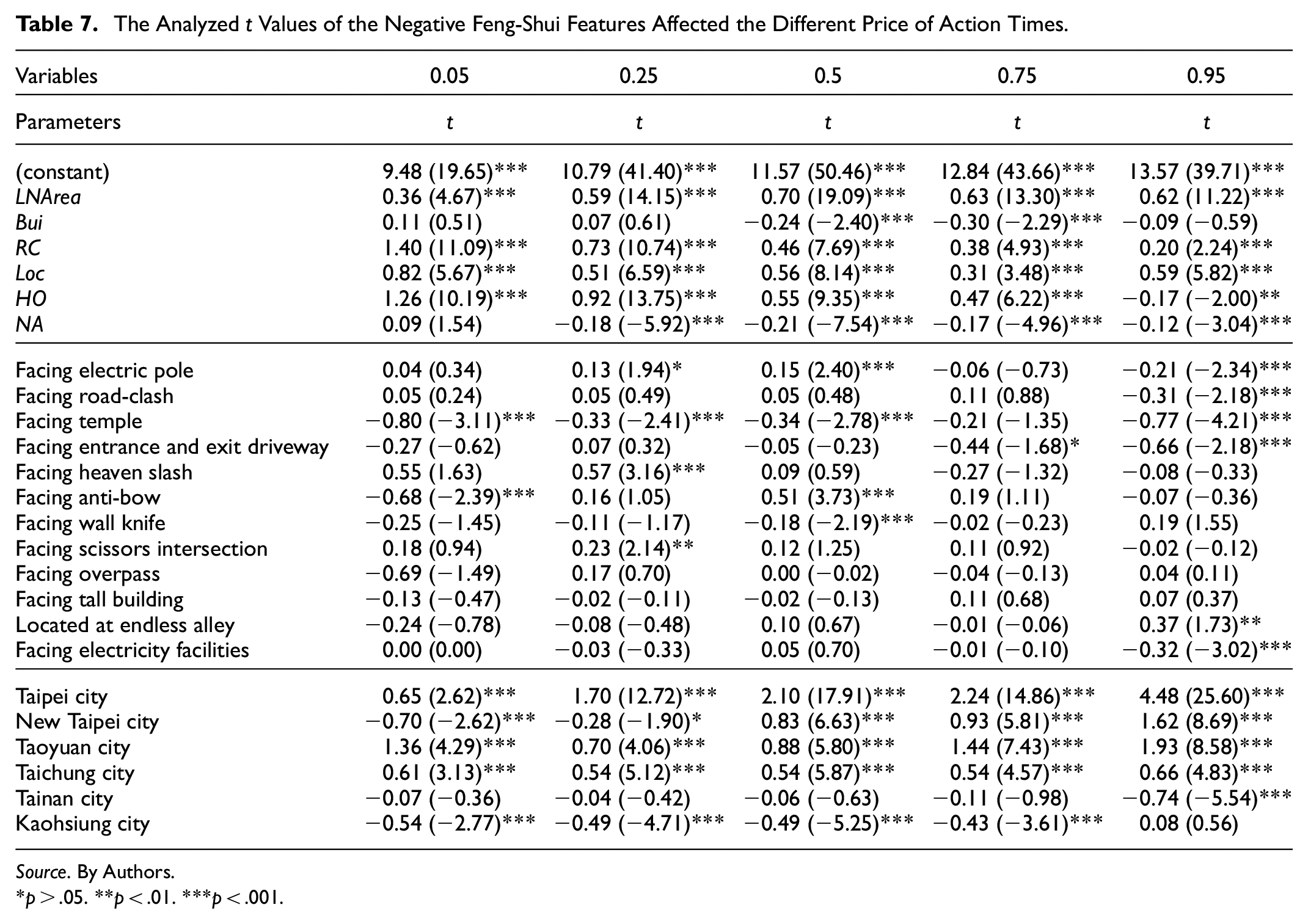
To examine whether negative Feng-shui features exerted varying effects on the final prices of foreclosures across different price ranges, quantile regression analysis was employed. The results presented in Table 7 revealed that in the highest-priced areas, a greater number of Feng-shui features tended to have a significant influence on the final price. Specifically, within this price range, five features, namely facing-electric-pole, facing-road-clash, facing-temple, facing-entrance-and-driveway-exit, and facing-electricity-facilities, exhibited a significant negative correlation with the final price. This suggests that individuals of higher economic means, who are capable of affording higher-priced real estate, are more attentive to Feng-shui considerations. These findings align with two of the three conclusions drawn by C.-C. Lin and Huang (2014), who reported that facing-road-clash, next-to-altars-and-temples, and lower-than-road-ground-floor were negatively impactful factors with a greater influence on high-priced properties compared to low-priced ones. Additionally, the negative Feng-shui feature of located-at-dead-end-alley displayed a positive influence on the final price of houses situated in high-priced areas. This observation may be attributed to the fact that although a dead-end alley may offer limited accessibility and convenience, it provides a quieter and more private environment, qualities that are typically favored by affluent individuals.
The Analyzed t Values of the Negative Feng-Shui Features Affected the Different Price of Action Times.
Source. By Authors.
p > .05. **p < .01. ***p < .001.
The results carry several potential economic implications. Firstly, investors in foreclosures demonstrate a higher degree of rationality compared to general homebuyers, as their assessments of foreclosed properties are only minimally influenced by negative Feng-shui features. These investors are likely to possess knowledge about real estate or may even be bidding agents specializing in foreclosed properties for the sake of business benefits. Secondly, once foreclosures with negative Feng-shui features are sold, it is unlikely that investors themselves will reside in these properties. Therefore, the presence of negative Feng-shui features holds little significance in terms of influencing the quality of life for these investors. Thirdly, the significant negative impact of the facing-temple feature can be attributed to its dual role as both a negative Feng-shui attribute and a NIMBY (Not In My Backyard) facility. This feature is often listed as a potentially detrimental facility and an unsightly element in real estate appraisal reports. Its potential effects encompass issues such as air pollution resulting from the burning of ceremonial money, noise pollution, and disruptions in traffic due to temple fairs. These factors can directly or indirectly diminish the quality of life for individuals residing near a foreclosed property. Consequently, this feature may not only influence the future sale of a house but also impact its resale price for investors. Lastly, individuals belonging to the upper class, who possess the financial means to acquire high-priced properties, exhibit a greater emphasis on Feng-shui considerations compared to their middle-class counterparts. Specifically, they display particular concern for four negative Feng-shui features, namely facing-electric-pole, facing-road-clash, facing-temple, facing-entrance-and-driveway-exit, and facing-electricity-facilities. Furthermore, they exhibit a preference for properties featuring the located-at-dead-end-alley attribute.
Negative Feng-shui features exhibit similarities to the concept of NIMBY (Not in My Backyard) facilities that have garnered attention in foreign cultures, including dumpsites, cemeteries, fire stations, and red-light districts. The notion of negative Feng-shui features also highlights an aspect of Chinese culture that places importance on the visual outlook from one’s residence. In Chinese culture, if a home is exposed to an unpleasant surrounding environment for an extended duration, it may eventually have a detrimental impact on the mental well-being of its occupants. Previous literature has established that the environment and landscape can indeed influence individuals’ mental states. For instance, Kaplan (1989, 1995) proposed the attention restoration theory, which suggests that excessive stress in urban environments can deplete individuals’ attentional resources. Thus, people can restore their attention indirectly by engaging with the natural environment. Van den Bergh (2021) explored the control of environmental stimuli to elicit internal physiological feedback and discovered that visual and auditory environmental stimuli often play a role in obtaining such feedback. Moreover, recent studies employing functional magnetic resonance imaging with the blood-oxygen-level-dependent technique as a physiological indicator have revealed that the quality and nature of the environment can elicit responses from distinct brain regions (Y.-Y. Hsu, 2017b; Liang, 2020).
Conclusions and Recommendations
Conclusions
This study specifically focused on foreclosed properties in Taiwan’s major cities within recent years. By drawing upon previous literature, the study identified 12 negative Feng-shui features that elicit concerns among homebuyers, including facing-electric-pole and facing-road-clash. Furthermore, the investigation delved into the impact of these negative Feng-shui features on the final sale prices of foreclosed properties. The study yielded four major findings. Firstly, foreclosed properties featuring a higher number of identified negative Feng-shui features exhibited significantly longer auction times. Secondly, foreclosures devoid of negative Feng-shui features tended to attract investor bids at an earlier stage, in contrast to foreclosures with negative Feng-shui features, which experienced potential delays in receiving bids from investors. Thirdly, the facing-temple feature exerted a significant negative influence on the final prices of foreclosed properties, indicating a higher discount rate. However, the remaining 11 negative Feng-shui features did not demonstrate a substantial impact on the final sale prices of foreclosures. Lastly, in areas characterized by higher property prices, negative Feng-shui features displayed a more pronounced influence on the final sale prices of foreclosed properties.
Recommendations
The results carry four potential economic implications. Firstly, investors in foreclosed properties exhibit a higher level of rationality compared to general homebuyers, as their evaluation of foreclosed properties demonstrates a lesser sensitivity to negative Feng-shui features. Secondly, once investors have successfully secured a foreclosed property through the bidding process, it is unlikely that they themselves will inhabit the property. Consequently, negative Feng-shui features hold limited influence on the investors’ quality of life. Thirdly, the facing-temple feature possesses dual significance as both a negative Feng-shui attribute and a representation of a NIMBY (Not In My Backyard) facility. This dual nature is likely to impact the future resale prices of the property. Lastly, within Chinese culture, individuals with higher incomes who have the means to afford high-priced real estate exhibit a greater degree of attention toward Feng-shui considerations.
Limitations
This study is subject to certain limitations that should be acknowledged. Firstly, to mitigate discrepancies between the condition of foreclosed properties depicted in Google Street View images and their current state, many of the analyzed foreclosures in this study were sold and transferred during the same period when the Google Street View images were captured. Secondly, it is worth noting that certain districts may have a smaller sample size of foreclosed properties compared to others, potentially introducing statistical bias. In future research, efforts can be made to address these limitations to yield more precise and refined results.
For Future Research
Based on the findings and limitations of this study, several suggestions for future research can be made:
Extended Geographical Scope: Although this study focused on foreclosed properties in major cities in Taiwan, future research could consider expanding the geographical scope to include other regions or countries. This would allow for a more comprehensive understanding of the influence of negative Feng-shui features on foreclosed property prices in different contexts.
Longitudinal Study Design: To further investigate the impact of negative Feng-shui features on foreclosed property prices, a longitudinal study design could be employed. By collecting data over an extended period, researchers can examine how the influence of these features may change over time and whether certain patterns or trends emerge.
Qualitative Research Approach: In addition to quantitative analysis, future research could incorporate qualitative methods such as interviews or surveys to gather more in-depth insights into homebuyers’ perceptions and experiences related to negative Feng-shui features. This qualitative approach would provide a richer understanding of the psychological and cultural factors that influence homebuyers’ decision-making processes.
Comparison with Non-Foreclosed Properties: To better understand the unique influence of negative Feng-shui features on foreclosed properties, future studies could compare the impact of these features on foreclosed properties to that on non-foreclosed properties. This comparative analysis would shed light on whether negative Feng-shui features have differential effects depending on the property’s foreclosure status.
Consideration of Other Factors: While this study focused specifically on negative Feng-shui features, future research could explore the interaction between these features and other factors that affect property prices, such as location, property size, or neighborhood characteristics. Investigating the combined effects of multiple factors would provide a more comprehensive understanding of the determinants of property prices.
Refined Data Collection Methods: To address the limitations related to the use of Google Street View images, future research could employ alternative data collection methods, such as conducting site visits or utilizing updated imagery sources, to ensure more accurate representation of the current condition of foreclosed properties.
By addressing these suggestions, future research can build upon the present study and contribute to a more nuanced understanding of the influence of negative Feng-shui features on foreclosed property prices, thereby enriching the field of real estate studies.
Footnotes
Declaration of Conflicting Interests
The author(s) declared no potential conflicts of interest with respect to the research, authorship, and/or publication of this article.
Funding
The author(s) disclosed receipt of the following financial support for the research, authorship, and/or publication of this article: This study is grateful to the Taiwan Ministry of Science and Technology for the Tertiary Student Research Program subsidy fund (108-2813-C-034-057-H).

Data Availability Statement
The author will provide the research data in case the reader requests and contacts.