




Abstract
This study addresses the lack of empirical research on medical tourist revisit intention, focussing on Malaysia’s medical tourism. It examines the factors influencing revisit intention and the moderating role of perceived satisfaction, grounded in the cognitive model and expectation confirmation theory. The proposed model tested seven hypotheses using a Google form online survey in Johor Bahru and Kuala Lumpur, targeting inbound medical tourists. All four direct relationship hypotheses were supported, identifying perceived authenticity, destination image, employee attitude, and perceived satisfaction as significant predictors of revisit intention. Moreover, perceived satisfaction moderated the relationships between these factors and revisit intention. These findings validate the new model and highlight the importance of medical tourist revisit intention in marketing strategies aimed at increasing revisits to Malaysia. The study also provides practical insights for medical tourism and healthcare practitioners into the factors influencing medical tourist revisit intention.
Keywords
Introduction
The fundamental marketing research-based theory on medical tourist destination marketing has been a captivating topic. Despite the field’s expansive scope, there has been a limited review of studies, especially concerning medical tourists’ revisit intentions in Malaysia over the decades. One key challenge is providing a focus for such a disparate body of knowledge, leading to this study’s structured around a principal question: “To what extent can medical tourists' revisit intention be applied as a strategy in marketing to increase a medical tourist destination's competitiveness?” In addressing this question, we explore perceived authenticity, destination image, employee attitude, and perceived satisfaction. There is a noticeable gap in the existing literature, with many studies focussing primarily on the demand for medical tourism in Malaysia or on perceived services and satisfaction. This gap underscores the need to evaluate or explore the aspects that could enhance medical tourists’ revisit intentions to Malaysia.
Consequently, this study investigates the factors that may increase the likelihood of medical tourists revisiting Malaysia. Additionally, it examines the moderating effect of perceived satisfaction on the relationship between perceived authenticity, destination image, employee attitude, and medical tourists’ revisit intentions. Meanwhile, the framework for this study includes the cognitive model of antecedents and consequences of satisfaction decisions and the expectation disconfirmation theory. These theories support the notion that medical tourism can significantly boost tourists’ revisit intentions to Malaysia. Oliver’s (1980) Expectation-Confirmation Theory (ECT) is relevant to this study as it underpins the relationship between expectation, confirmation, satisfaction, and behavioural intention. The theory supports the model by explaining how satisfaction, formed through the confirmation of expectations, influences users’ attitudes and intentions. Its validity has been confirmed in prior studies such as Harasis et al. (2018), Huang et al. (2015), and Rahman and Zailani (2016). Previous research has also identified perceived authenticity, destination image, and employee attitude as common determinants of revisit intention (Cham, Cheng, et al., 2021; Cham et al., 2016; Heydari Fard et al., 2021; Irimiás & Volo, 2018; Ismail et al., 2018; M. J. Khan et al., 2016; Khan et al., 2020; Lim et al., 2017; Manaf et al., 2015; Mihaela, 2015; Rahman, 2019; Shivany, 2013; Sultana et al., 2014). However, there is a lack of studies explicitly addressing these factors in the context of medical tourists’ revisit intentions in Malaysia. Hence, this study aims to close the gap while conducting empirical research on the role of perceived satisfaction, moderating perceived authenticity, destination image, and employee attitude towards medical tourist revisit intentions.
The concepts of these factors towards Malaysia medical tourism continuos success, perceived value, perceived satisfaction, destination image, authenticity, and employee attitude are essential for fostering revisit intentions, as demonstrated in numerous studies on tourism marketing (Cham, Cheng, et al., 2021; Cham et al., 2016; Heydari Fard et al., 2021; Irimiás & Volo, 2018; Ismail et al., 2018; M. J. Khan et al., 2016; Khan et al., 2020; Lim et al., 2017; Manaf et al., 2015; Mihaela, 2015; Rahman, 2019; Shivany, 2013; Sultana et al., 2014). By ensuring that medical tourists perceive they have received high-quality services at fair prices, we can significantly enhance their overall experiences and perceived value, ultimately encouraging repeat visits. Exceeding patient expectations regarding care, outcomes, and overall experience can lead to even higher satisfaction levels, motivating tourists to return. Furthermore, cultivating a strong and favourable image of Malaysia as a leading medical tourism destination can build trust and not only attract new patients but also remind former patients of their positive experiences.
The current issue suggests a quality medical healthcare services at affordable prices, positive medical tourism destination image, employee attitude in communication and cultural language barriers, and authenticity in medical facilities are all critical issues that can be used to influence medical tourists’ satisfaction and revisit intention to Malaysia’s hospitals (Chhabra, 2019); Gopalan et al., 2021; Ministry of Health Travel Council [MHTC], 2023). Thus, perceived authenticity lacks a comprehensive understanding regarding the pivotal role it could play in medical tourists’ revisit intention to Malaysia (Almodawer et al., 2024), mainly whether its authenticity or genuine identifications is ascribed to medical services either infrastructure, the medical facilities, the culture and others (Heydari et al., 2019). These factors need to be studied in Malaysia. This creates a significant gap in identifying and assessing these factors’ collective impact on medical tourists’ decision-making process, hindering the formulation of effective strategies aimed at enhancing medical tourist revisit intentions and overall success in Malaysia’s medical tourism sectors. In addition, authenticity in healthcare services, encompassing cultural, experiential, and service-related, needs more comprehensive analysis despite its potential influence on customer decision-making (Heydari et al., 2019; Keadplang, 2025). While the research gap has demonstrated the need to clarify the perceived authenticity in the context of genuine medical facilities, accreditation of medical healthcare services providers, cultural impediments, experiential, and service-related in Malaysia’s medical tourism concept, hence, this study aims to close the gap while conducting empirical research on the perceived authenticity to help provide a clear understanding of what constitutes the “term” authenticity or genuine in medical tourists’ term, creating an avenue for improvement which can be applied to retain medical tourist through the outcome of the revisit intentions study.
Regarding destination image, it remains an area for improvement, especially in the study of medical tourist revisit intentions in Malaysia (Cham, Lim, et al., 2021; Heydari et al., 2019). Having yet to consider the research gap, it demonstrates a need for further research to ascertain the effectiveness of destination image as a factor within Malaysia’s medical tourism research study. Cham, Lim, et al. (2021) and Heydari et al. (2019) found that tourist’s perception of the destination image, whether positive or negative, can significantly influence their decision to revisit. Meanwhile, the research gap pointed at underexplored areas of destination image and its collective impact on the decision-making process for medical tourists, which includes three factors: cognitive, effective, and cultural affinity (Cham, Lim, et al., 2021; Heydari et al., 2019). The cognitive aspect pertains to individuals’ perceptions of their host destination’s features, the effective aspect involves emotional responses towards the host destination, and cultural affinity becomes significant for medical tourists, especially in areas such as gynaecology and fertility treatments, where religious similarity may alleviate anxiety in an unfamiliar environment. Therefore, further exploration into the role and impact of destination image on patient revisit intentions in Malaysia’s medical tourism industry is necessary to fill this research gap. Bridging the research gaps will help employ the factor in a collective research framework, providing a comprehensive understanding of the complexities within Malaysia’s medical tourism landscape, facilitating strategic improvements, and informed policy decisions towards actualizing the trust and confidence of medical tourists towards revisiting intentions.
There is a significant gap in the current literature regarding the impact of employee attitudes on medical tourists’ revisit intention, particularly within the Malaysian context (Agyeiwaah & Dayour, 2021; Heydari Fard et al., 2021; Rodrigues et al., 2017). Although previous studies have addressed factors such as service quality, effective communication, and access to medical records, there is a lack of comprehensive analysis that specifically examines the role of employee attitudes in influencing revisit intentions among medical tourists in Malaysia. Research conducted in other regions may not reflect the unique characteristics of Malaysia’s healthcare and tourism landscape, making it necessary to explore this issue locally. A better understanding of how employee attitudes contribute to revisit intentions can help identify areas for improvement and guide strategies to retain international patients. Filling this research gap will also support the development of targeted policies to improve service delivery, build trust, and enhance the competitiveness of Malaysia’s medical tourism sector.
In addition, there remains a notable gap in understanding the role of perceived satisfaction in evaluating the quality of services received by medical tourists in Malaysia. While studies by Cham, Lim, et al. (2021) and Heydari et al. (2019) have examined factors contributing to satisfaction, limited research has focussed on how these elements influence revisit intentions specifically within the Malaysian medical tourism context. Elements such as service quality, cost satisfaction, communication, timely access to medical records, and prompt service have been explored in different settings (Mohaidin et al., 2017; Rahman, 2019), but not comprehensively linked to perceived satisfaction among medical tourists in Malaysia. To address this, the study draws on Oliver’s Expectation Confirmation Theory, which posits that satisfaction results when service performance meets or exceeds expectations, thereby shaping future behavioural intentions. Applying this theory provides a suitable foundation for examining how satisfaction mediates the relationship between employee-related factors and medical tourists’ intention to revisit healthcare facilities in Malaysia.
Perceived satisfaction lacks comprehensive understanding regarding its pivotal role in analysing how medical tourists rate satisfaction with the quality of services received (Heydari et al., 2019). There is a significant gap in identifying and assessing the collective impact of the factors on the decision-making process of medical tourists’ revisit intentions, which hinders the formulation of effective strategies aimed at enhancing medical tourists’ revisit intentions and overall success in Malaysia’s medical tourism sectors. Therefore, addressing this gap and incorporating perceived satisfaction as a moderator will clarify the outcomes of medical tourists’ revisit intentions. It will also help formulate effective strategies to enhance overall success in Malaysia’s medical tourism sector. Furthermore, bridging this research gap and adopting a collective research framework will contribute to a more nuanced understanding of the complexities within the medical tourism landscape in Malaysia, facilitating strategic improvements and informed policy decisions. Ultimately, this approach aims to build and actualize the trust and confidence of medical tourist patients in their revisit intentions.
Based on the preceding discussion, this study aims to investigate the influence of perceived authenticity, destination image, and employee attitude on medical tourists’ intention to revisit, with perceived satisfaction acting as a moderating variable. The structure of the paper is as follows. Section 2 reviews the relevant literature, theoretical framework, and the development of hypotheses. Section 3 outlines the research methodology employed. Section 4 presents the empirical results of the study. Finally, Section 5 discusses the findings along with their theoretical and practical implications, outlines the study’s limitations, and suggests directions for future research and the conclusion.
Literature Review, Theory and Hypothesis Development
Medical Tourists Revisit Intention
Medical tourists are travellers who have left their home country to seek medical treatment abroad (M. J. Khan et al., 2016, 2017). According to the Ministry of Health Travel Council (MHTC, 2023), Medical tourists are comprised of individuals who are commonly referred to as medical tourists, Health Tourists (HTo), and Foreign Patients (FP). Health tourists travel to Malaysia to receive healthcare treatment. According to previous studies, “tourist intention” is aligned with subjective probability in expecting tourists to take specific actions regarding whether to revisit a particular situation (Hennessey et al., 2016; Hultman et al., 2015; Wu et al., 2015). Some notions made consumers (tourists) seek information regarding their intended travel purchases, tangible or intangible, before deciding to purchase. Also, there is a notion of antecedents and consequences of changes in consumer intentions ascribed value to buying, while predicted shifts over time affect intentions (Bradley & Sparks, 2012). In this study, a medical tourist is defined as a foreign patient, including non-Malaysian residents such as expatriates, foreign workers, foreign students, and MM2H participants who have received or are seeking medical healthcare in Malaysia.
Perceived Satisfaction
Perceived satisfaction in the context of medical tourism is critical as it directly influences how individuals assess the services they receive. It’s essentially how people judge whether the healthcare experience abroad meets their expectations. Researchers like Sunny and John (2014) and Alberts and Hazen (2010) emphasize that perceived satisfaction reflects an individual’s assessment of the product or service they receive. If the actual performance meets or exceeds expectations, it leads to satisfaction. This positive feeling arises when the quality of care or service received aligns with what the individual anticipated. Conversely, if the received service or product falls short of expectations, it results in dissatisfaction. Cham, Lim, et al. (2021) and Heydari et al. (2019) highlight that dissatisfaction occurs when perceived quality does not meet the individual’s expectations. This gap between expectations and actual performance is crucial in shaping perceived satisfaction. Therefore, for medical tourists, ensuring that the healthcare experience meets or surpasses their expectations is essential in fostering positive feelings and potentially influencing their intention to revisit for future medical treatments.
Perceived Authenticity
The term “perceived authenticity” defined by Heydari et al. (2019), Yi et al. (2021, 2023) as an expression that describes the degree to which medical tourists perceive products and service experiences received. Authenticity, in general, is an indistinct concept that is defined and interpreted diversely in different fields (Reisinger & Steiner, 2006). In tourism issues, authenticity is an in-between concept of an individual’s thoughts, beliefs, and perceptions towards services, products or even a place in reality check (Knudsen & Waade, 2010). Authenticity may be synonymous with accreditation (Cook, 2010). Accreditation is an evaluative method used to assess medical centres by non-profit organizations. Medical tourists were provided with good medical facilities centres to meet the norms (Heydari Fard et al., 2021). The current study attributes it to medical tourists’ overall impression regarding the genuineness and credibility of medical healthcare services in Malaysia. Maintaining a high level of perceived authenticity is essential to attracting and retaining medical tourists, which can benefit the healthcare sector and the countries.
Destination Image
Destination image is a collection of beliefs, ideas and feelings about a place (Cham, Lim, et al., 2021; Heydari et al., 2019). In this study, the destination image refers to the overall judgement of an individual’s feelings, ideas, or impressions of the destination, which includes medical healthcare or clinics and facilities in Malaysia. The image or reputation of a destination significantly influences revisit intentions. Whether shaped by marketing, word of mouth, or previous experiences, positive perceptions contribute to the desire to revisit intentions. A strong, positive image can create a pull factor for tourists. Meanwhile destination image and its collective impact entail the decision-making process for medical tourists, which includes three factors such as cognitive, effective, and cultural affinity (Cham, Lim, et al., 2021; Heydari et al., 2019). The cognitive aspect pertains to individuals’ perceptions of their host destination’s features, the effective aspect involves emotional responses towards the host destination, and cultural affinity becomes significant for medical tourists, especially in areas such as gynaecology and fertility treatments, where religious similarity may alleviate anxiety in an unfamiliar environment. Therefore, further exploration into the role and impact of destination image on medical tourists’ revisit intentions in Malaysia’s medical tourism industry is necessary to promote the revisit intention.
Employee Attitude
Employee attitude is defined as employees’ overall disposition and performance, particularly those engaged in direct customer interactions (Agyeiwaah & Dayour, 2021). This attitude is paramount due to its direct correlation with how services are delivered (Agyeiwaah & Dayour, 2021). In the current study, the term “employee attitude” refers explicitly to the overall appraiser judgement rated by patients on employee attitude to enable quality service delivery that will lead to patient revisit intentions. While there have been studies on related factors such as quality services, effective communication, and timely access to medical records, there is a notable lack of comprehensive analysis and research specifically focussed on the role of employee attitude in the context of Malaysia’s medical tourism industry. Although there have been studies conducted by Rodrigues et al. (2017), Heydari Fard et al. (2021), and Agyeiwaah and Dayour (2021) that have addressed similar issues in different regions, there is a specific need for research in the Malaysian context.
Oliver’s Cognitive Model and Expectation Confirmation Theory
The model’s initial attitude at t1 is formulated as a function of expectations. In contrast, the revised post-exposure attitude at t2 was suggested as a composite function of the previous attitude at t1 and the perceptions of satisfaction/dissatisfaction at t2. Satisfaction at t2 can be defined as a function of expectations and disconfirmation. The expectations form the base level for evaluating the disconfirmation of perceived performance. Finally, an individual’s behavioural intention can be initially defined as a function of attitude at t1 and later at t2 as a function of satisfaction at t2, attitude at t2, and prior intention at t1. These notions can be represented as a set of structural equations as follows: Attitude (t1) = f (Expectation (t1)); Satisfaction (t2) = f (Expectation (t1); Disconfirmation (t2)); Attitude (t2) = f (Attitude (t1), Satisfaction (t2)); Intention (t1) = f (Attitude (t1)); Intention (t2) = f (Intention (t1), satisfaction (t2), attitude (t2)). The model stated that disconfirmation refers to a person’s judgements or evaluations concerning a product or service received. The assessments or judgements consider the individual’s initial expectations-positive evaluation results in post-adoption. The Cognitive model of the antecedents and consequences of satisfaction decisions (Oliver, 1980) concluded that expectations are a set of ideas about a product, service, or brand that a consumer has regarding confirmation (authenticity), satisfaction and attitude perception. Nevertheless, Oliver (1980) established the model for satisfaction decision studies adopted in different contexts.
These theories are relevant to medical patient revisit intentions as they help understand how patients deal with discrepancies between their expectations and the healthcare quality received that may alter the interest to revisit (Jumaan et al., 2020; Shamsudin et al., 2019). It reveals whether patients rationalize their experiences positively or negatively, impacting their post-tourism behaviour, such as revisiting intentions. Extending Oliver’s theory and integrating the likelihood variables can aid in predicting patient behaviour, satisfaction, and post-experience reactions. These theories will help tailor healthcare services to meet or surpass patient expectations, enhancing their satisfaction.
Insights from these theories can guide Malaysian medical tourism stakeholders in identifying areas needing improvement. Addressing gaps between expectations and experiences can enhance service quality and the competitiveness of the medical tourism industry in Malaysia. Further research on these theories within Malaysian medical tourism could shed light on patient satisfaction, influencing factors, and ways to enhance service quality. Understanding these psychological mechanisms is crucial for sustained growth and competitiveness in the global medical tourism industry.
Meanwhile, in expectation disconfirmation, applying the theory in the study highlights the importance of understanding consumer behaviour and satisfaction in the post-purchase or consumption phase. This theory emphasizes how individuals assess their expectations against their actual experiences and the impact it has on their satisfaction levels and subsequent behaviours. The theory is applied to comprehend the decision-making process and satisfaction levels of patients seeking healthcare services in the country. For instance, the Expectation Confirmation Theory (ECT) suggests that patients arrive with preconceived expectations regarding healthcare quality, facilities, medical professionals’ expertise, cost-effectiveness, and overall experience in Malaysia. The theory posits that satisfaction levels depend on the confirmation or disconfirmation of these expectations. If their experience aligns with or exceeds their expectations, patients will experience positive confirmation, leading to higher satisfaction. Therefore, research can investigate how patients’ preconceived notions of Malaysian healthcare facilities and services align with their encounters. Understanding these alignments or disparities will help predict satisfaction levels and subsequent behaviours, such as revisiting intentions.
In summary, the theory model depicts that when a medical tourist’s experience does not meet their expectations, it triggers cognitive dissonance, which causes discomfort due to conflicting beliefs (Ghorbanzade et al., 2019; Luo & Chea, 2018; Oliver, 1980). Individuals may rationalize their experience or alter their perceptions to reduce this dissonance.
Perceived Authenticity and Medical Tourist’s Revisit Intention
According to Chhabra, 2019, authenticity plays a crucial role in motivating tourism visitors to a destination. The authenticity of Malaysian medical healthcare must meet the conditions of “integrity” or “authenticity” and be of “outstanding universal value.” Nonetheless, authenticity and integrity are practical guiding concepts in striving for a systematic approach to preservation in diverse contexts (Alberts & Hazen, 2010). This means that Malaysia medical tourism and healthcare services providers must be able to strive to be the best in terms of creating authenticity and integrity for their services due to the proliferation of medical tourism destinations and their profitability, in addition to their other benefits such as job creation, the competition to attract more customers has been increased among the medical tourist destination (Heydari Fard et al., 2021). A structural equation modelling investigation by E. Park et al. (2019) substantiated the function of existential authenticity in the link between tourist satisfaction and cognitive and affective loyalty. S. Park et al. (2020), perceived satisfaction is influenced by perceived authenticity when revisiting intention. While Heydari Fard et al. (2021) argued that authenticity was considered an inherent feature of a place or product, independent of the consumer or tourist’s opinion. Based on this discussion, the study proposes the following hypothesis:
Destination Image and Medical Tourist’s Revisit Intention
From the perception of medical tourists’ revisit intention to destination, most marketing strategies aim to create an image that reinforces positive images of the destination in the minds of their visitors (Chon, 1992; Mun et al., 2014; Pike, 2014). Meanwhile, Chen and Tsai (2007) found that destination image directly and indirectly influences tourist satisfaction, which leads to revisiting behavioural intentions. Ali (2015) discovered that if the destination’s image is positive, tourists will be interested in revisiting it. In addition, studies have acknowledged the significant impact destination image has on tourists’ behavioural intentions (Yin et al., 2014; Shafiee et al., 2016). Meanwhile, Jahari et al. (2014) revealed a positive relationship between the perception of destination image and tourist satisfaction that leads to revisit. Most research revealed behavioural intention’s direct effect or indirect relationship in medical tourism destinations (Heydari Fard et al., 2021; Rahman, 2019; Verulava & Jorbenadze, 2018). Studies also concluded a significant relationship between destination image and satisfaction, which influences the behaviour of medical tourists’ revisit intention to destinations (Cham et al., 2016; Mohaidin et al., 2017). Also, previous studies revealed an indirect effect or relationship between destination image, satisfaction, and tourists’ revisit intention behaviour (M. J. Khan et al., 2016; Shafiee et al., 2016). Therefore, the following hypothesis is proposed:
Employee Attitude and Medical Tourist’s Revisit Intention
Previous researchers such as (Higgins-Desbiolles, 2021; M. J. Khan et al., 2016, 2017; Noorashid & Chin, 2021; Pandža Bajs, 2015; Shah et al., 2020) devoted extensive research that identified various factors to address and improve such goals but rarely discussed employee attitude in relationship to the customer’s satisfaction experience that could lead to medical tourist revisit intention. Employee attitude in the study context is defined as mechanism behaviour with capacity enriched with authentic information and enlightened communication in an aspect of their related assignment that can lead to medical tourist trust and satisfaction. Meanwhile, assessing the said attitude is a prerogative of medical tourists to assess through experience. If such assessment led to satisfaction, it could facilitate predicting various individuals’ actions or attitudes towards revisit. According to C. K. Lee et al. (2014) highlighted motivational model study, attitude is a vital factor in satisfaction with mega-events and motivational cues. Thiumsak and Ruangkanjanases (2016) validated factors influencing international visitors’ revisit intentions and suggest that attitude is one of the most influential factors in satisfaction and the intention to revisit a particular destination. Also, in a study, Mohaidin et al. (2017) affirmed the role of attitude in the relationship between satisfaction and the intention to choose a destination. A relationship model by B. Lee and Choi (2020) suggests that attitude influences satisfaction and revisit intention. Recently, Mankame (2021) stated that office practices in expected attitudes impact guest satisfaction. Based on the previous study, this study proposes the following hypothesis:
Perceived Satisfaction and Medical Tourist Revisit Intention
Perceived satisfaction is the overall assessment of a person’s experience with a product, service, or destination. In medical tourism, perceived satisfaction is the overall assessment of a medical tourist’s experience with a destination hospital or healthcare provider. Suppose medical tourists perceive high levels of satisfaction with their medical experience. In that case, they are more likely to intend to revisit. Meanwhile, Assaker and Hallak (2013), Nguyen Viet et al. (2020) revealed the importance of expanding previous literature on tourists’ revisit intentions to a destination. The study highlighted satisfaction as one of the factors that needed to be explored to achieve that. Other researchers have also conducted a study on tourist satisfaction and its dimension, giving an insight into the link between perceived satisfaction and behavioural intention that has been a significant controversy due to the different definitions from different researchers (Gholipour Soleimani & Einolahzadeh, 2018; Jang & Feng, 2007; Rahman & Zailani, 2016; H. Zhang et al., 2014).
Moreover, satisfaction is a relatively common determinant in the medical tourism concept. It is essential to measure such variables in this study directly. Consequently, the following hypothesis is proposed:
Perceived Satisfaction in Moderation
The medical tourists’ revisit intention is a dependent variable in this study. Meanwhile, the intention of medical tourists to revisit has been proved to be a crucial component in a tourism research literature review (Assaker et al., 2011; Shafiee et al., 2016; Williams & Soutar, 2009). According to Dolnicar et al., (2015), satisfaction and behavioural intention have a considerable direct relationship. The connection between satisfaction and behavioural intention is a recurring theme in the literature, where the research was mainly based on the service sector. Satisfaction is advocated as a direct antecedent of several behavioural intention forms (Dileep Kumar et al., 2019; Rajesh, 2013). The satisfaction of tourists has been discussed in previous literature as one of the core concepts of tourist behaviour studies (Alegre & Garau, 2010; Correia et al., 2013; Kim et al., 2013; Moon et al., 2013).
Furthermore, studies affirmed that the moderating effect of satisfaction through the direct or indirect relationship between destination image to medical tourism revisit intention should be examined (Gholipour Soleimani & Einolahzadeh, 2018; C. K. Lee et al., 2014; Moon et al., 2013; E. Park et al., 2019; Yin et al., 2014). Past studies found a link between satisfaction and other factors, such as destination image, affecting the behaviour intention of medical tourists (Heydari Fard et al., 2021; Mohaidin et al., 2017; Thiumsak & Ruangkanjanases, 2016). As a result, from the literature review and the objectives of this study, this study suggests a perceived satisfaction to moderate significant relationship effect between the following:
Meanwhile, understanding the difference between perceived satisfaction acting as a predictor and as a moderator is vital for comprehending its function in this study medical tourism. When perceived satisfaction serves as a predictor, it means that greater levels of satisfaction lead to positive outcomes, such as a higher probability of returning to or recommending the destination to others. In this scenario, if a medical tourist is pleased with their experience, as seen in areas like care quality, service, and overall value, they are more likely to return to Malaysia for future medical needs.
On the other hand, when satisfaction acts as a moderator, it affects the strength or direction of the relationship between other factors (like perceived value, destination image, or employee attitude) and the outcome (such as revisit intentions). For instance, if a tourist views high value and has a positive impression of the destination, their overall satisfaction can greatly enhance the chances of a return visit. However, if they are not satisfied, even with a strong perceived value and a good image, returning visits may not be guaranteed. By clearly distinguishing these roles, it becomes evident that while perceived satisfaction is essential in itself for encouraging return visits, it also plays a pivotal role in shaping how effectively other factors influence intended outcomes in the realm of medical tourism. Addressing any gaps in perceived authenticity and employee attitude can further enhance perceived satisfaction, establishing it as both a critical predictor of positive outcomes and a moderator that amplifies the impact of other influencing factors.
Methodology
Sample and Collection Procedures
A questionnaire survey was conducted to collect data for this study, focussing on the relatively unexplored issue of medical tourists’ revisit intentions in Malaysia. While numerous studies have addressed various aspects of medical tourism, few have specifically examined revisit intentions in the Malaysian context. A quantitative research approach was employed, and data were purposefully collected from 218 medical tourist respondents in Malaysia, using electronics online (google form as a tool). Without a doubt, Google Forms provides more convenient tool for collecting primary data in today’s technological era. However, we aknowledge that depending exclusively on Google Forms can be detrimental, as it allows us to connect only with individuals who possess communication tools, leaving out others who do not have access. Therefore, it is necessary to conduct a pilot survey for quality assurance and to obtain an accurate representation. Meanwhile, after processing and cleaning the data, 183 valid responses were retained for analysis.The data were analysed using SPSS version 25 and Smart-PLS 4 software. The study’s theoretical framework was based on an extensive literature review, incorporating the cognitive model of antecedents and satisfaction decisions proposed by Oliver (1980) and the determinants of medical tourists’ revisit intentions outlined by Heydari Fard et al. (2021).
The questionnaire, accompanied by a letter outlining the study’s objectives and ensuring confidentiality, was distributed over 6 months (September 2022–March 2023). It was written in English and translated into Malay, comprising two parts. Part A contained statements on the respondents’ demographic such as gender, age, education, employment, income, and nationality. While Part B focussed on obtaining information regarding the variables of medical tourist revisit intentions. Of the 218 responses received, 139 were deemed suitable for analysis. The result shows that there were more male respondents (n = 104, 56.8%) compared to female respondents (n = 75, 41.0%). Most respondents fell within the age bracket of 36 to 44 years (n = 63, 34.4%), followed by those in the 45 to 53 age bracket (n = 47, 25.7%). The fewest respondents were in the 18 to 26 age brackets (n = 15, 8.2%). Additionally, many respondents have an undergraduate degree (n = 62, 33.9%), followed by those with a master’s degree (n = 51, 27.9%). The fewest were at the Sijil Pelajaran Malaysia (SPM) level (n = 2, 1.1%). Furthermore, most respondents were employed (n = 163, 89.1%), followed by unemployed respondents (n = 15, 8.2%). The fewest respondents preferred not to disclose their employment status. Additionally, most respondents had a monthly income above USD3,500 (n = 94, 51.4%), followed by those earning USD2,600 to USD3,500 per month (n = 40, 21.9%). The fewest respondents earned less than 1,500 per month (n = 23, 12.6%). Most respondents were non-Malaysian (n = 139, 76.0%; Table 1).
Sample Demographics Profile.

Measures
All study constructs were evaluated using instruments that have been previously established and widely employed in the field of medical tourism studies. In order to ensure content validity, the instrumentation validation was submitted to a panel of experts from academia and the medical healthcare industry. The panel comprised two senior management lecturers from Universiti Teknologi Malaysia, one senior lecturer from the academic division of Singapore Institute of Management, one assistant director of business development and special projects from Sunway Medical Centre Velocity, one executive corporate communications management staff from Sunway Medical Centre Velocity in Kuala Lumpur, one general manager from Columbia Asia Hospital Iskandar Puteri Johor Bahru, and one licenced TCM private hospital and clinic physician from Hua An TCM Clinic in Singapore. The experts from these hospitals provided their expert opinions.
The measurement for Section 1 of the questionnaire delves into the demographic profile of the respondents with six questions, which were adopted and adapted from Kim et al. (2013). Section 2 probes into patient revisit intentions with five questions adapted from Nguyen Viet et al. (2020). Section 3 pertains to perceived authenticity with five questions adapted from Heydari Fard et al. (2021) The measurement for Section 4 includes questions relating to destination image with five questions adapted from Cham, Lim, et al. (2021). Section 5 comprises questions related to employees’ attitudes, with five questions adapted from Agyeiwaah and Dayour (2021) Section 6 addresses perceived satisfaction with five questions adopted and adapted from Cham, Cheng, et al. (2021). A 5-point Likert scale was adapted according to research conducted by Bosque et al. (2009), with the scale depicting “Strongly Agree” as “Option 5” and “Strongly Disagree” as “Option 1.” The respondents were asked to indicate their answers by checking a box corresponding to the scale after each statement.
Data Analysis
Following the structural equation guidelines set by Hair et al. (2014) and Ringle et al. (2012), the study employed structural equation modelling (SEM) using Smart-PLS 4 to analyse data. The study also employed SPSS at the initial stage to obtain a descriptive frequency of the data analysis.
Measurement Model
According to Hair et al. (2014) guidelines, the study’s analysis includes testing for reliability using measures such as Cronbach’s Alpha, Average Variance Extracted (AVE), and cross-factor loading values, as well as Fornell-Larcker and the Heterotrait criterion (HTMT-Monotrait ratio). The factor loading values in the measurement model all exceed 0.70, as indicated in Table 2 (Hair et al., 2014). Both Cronbach’s Alpha and composite values have demonstrated acceptable reliability, with all latent variables showing values ranging from .8 to .9, indicating strong internal consistency reliability for each latent variable in the model (Hair et al., 2017). The study assesses the level of positive association between different items within the same construct (Hair et al., 2014). Hair et al. (2014) suggest that the AVE should be greater than 0.50 for testing convergent validity. The values in Table 2 confirm that the AVE values are higher than 0.50, indicating no need to remove any items. The AVE for the components used in this study exceeds the specified criterion of 0.5, affirming the convergent validity of the data (Table 2).
Internal Consistency Reliability.

Following Hair et al. (2014), assessing discriminant validity entails ensuring that the square root of AVE exceeds the correlation between constructs and that the Heterotrait-Monotrait correlation ratio (HTMT) remains below .85. As illustrated in Table 2, discriminant validity was ascertained by comparing the correlations among the latent variables with the square root of AVE (Fornell & Larcker, 1981) and the HTMT ratio (Henseler et al., 2015), with values falling below the conservative threshold of 0.90. Consequently, discriminant validity has been established, reflecting correlation coefficients ranging from below .78 to .90, with the square root of AVE exhibiting the highest inter-construct correlation. These findings affirm the establishment of discriminant validity (Fornell & Larcker, 1981). Furthermore, the HTMT ratio remains below 0.90, confirming discriminant validity (Hair et al., 2014). According to empirical criteria, this study confirms the distinctiveness of all constructs. As a result, the construct validity, encompassing both convergent and discriminant validity, is deemed satisfactory for this study (Table 3).
Discriminant Validity – Fornell Larcker Extracted in Reflective Analysis Model.

Note. Inclusion criteria: The correlation of a construct with another construct must be less than the square root of the AVE.
Common Method Bias
A three-step approach was implemented to avoid potential common method bias. Firstly, respondent anonymity was maintained to minimize evaluation anxiety. Secondly, data were collected from medical tourist patients due to their direct exposure to the study variables. Thirdly, an Exploratory Factor Analysis was conducted following Harman’s single-factor test guidelines for all variables (Podsakoff et al., 2012). Harman’s single-factor test results indicate no significant concerns, as they explain less than 50% of the variance threshold (Fuzi et al., 2022).
Structural Model
The study conducted a structural analysis and hypothesis testing by first analysing direct relationship effects between independent variables such as perceived authenticity, destination image, employee attitude, and perceived satisfaction towards the dependent variable, that is, medical tourist revisit intention. Bootstrapping technique with a setting of 5,000 resamples using Smart-PLS 4 was used according to (Hair et al., 2014), and the results showed more reasonable standard error estimates and significance path coefficients. The findings in Table 4 revealed that perceived authenticity, destination image, employee attitude, and perceived satisfaction towards medical tourist revisit intention have been tested. Meanwhile, the result indicates a significant relationship effect between all these variables in a direct relationship towards medical tourist revisit intention. The results are as follows: the initial findings for H1 revealed perceived authenticity at 23.8% of the variance in medical tourist revisit intention and (β = 1.400, t = 2.386; p = .009), which is considerably accepted in relationship effect. The significant size of the effect is by Cohen’s guideline (Rosenthal & Rosnow, 2008). Findings for H2 revealed destination image at 18.8% of the variance in medical tourist revisit intention (β = .713, t = 1.881; p = .030), a considerably accepted relationship effect. H3, Employee attitude at 30.5% of the variance in medical tourist revisit intention (β = −1.169, t = 3.050; p = .001) is a considerably accepted relationship effect. H4, perceived satisfaction at 19.8% of the variance on medical tourist revisit intention at (β = .213, t = 1.984; p = .024) is accepted.
Results of Direct and Indirect Relationship Effects (Moderation).
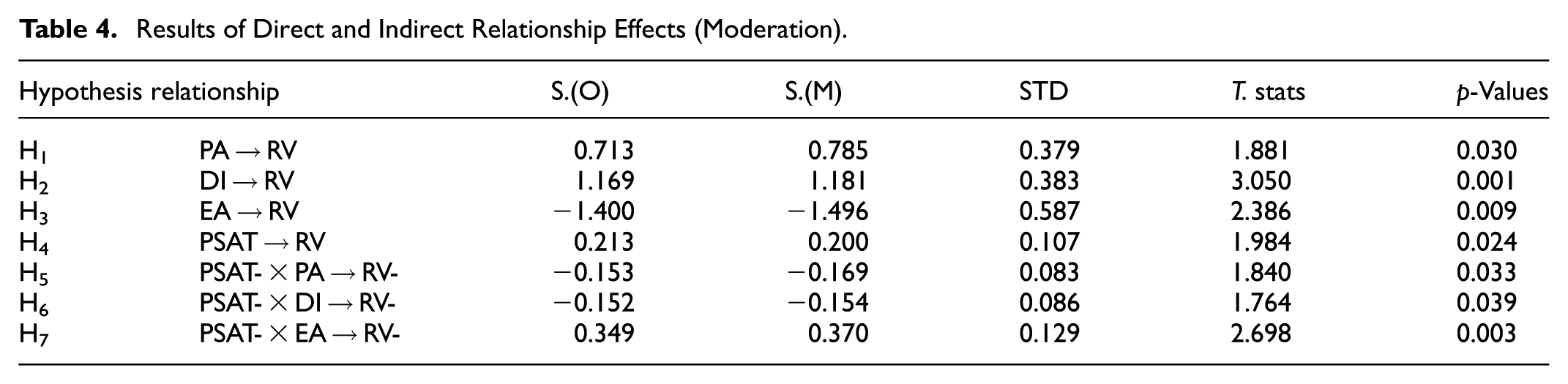
In the second stage, the moderation hypotheses testing was extracted, and we followed the suggestions of Preacher and Hayes (2004, 2008) by bootstrapping the construct effect. Suppose the confidence interval strengthens or weakens the effect size between the independent and dependent variables. In that case, we can conclude that there is significant moderation. As shown in Table 4, H5, PSAT × PA → RV is at (β = .349, t = 2.698; p = .003), H6, PSAT × DI → RV is at (β = −.153, t = 1.840; p = .033) and H7, PSAT × EA → RV is at (β = −.152, t = 1.764; p = .039), these two out of the four hypotheses in proposed moderation were significant. The confidence interval bias corrected is based on 90%. Also, it did not show any intervals straddling at 0, thus confirming our findings. Hence, H5, H6, and H7 were significantly moderate and supported (Figure 1).
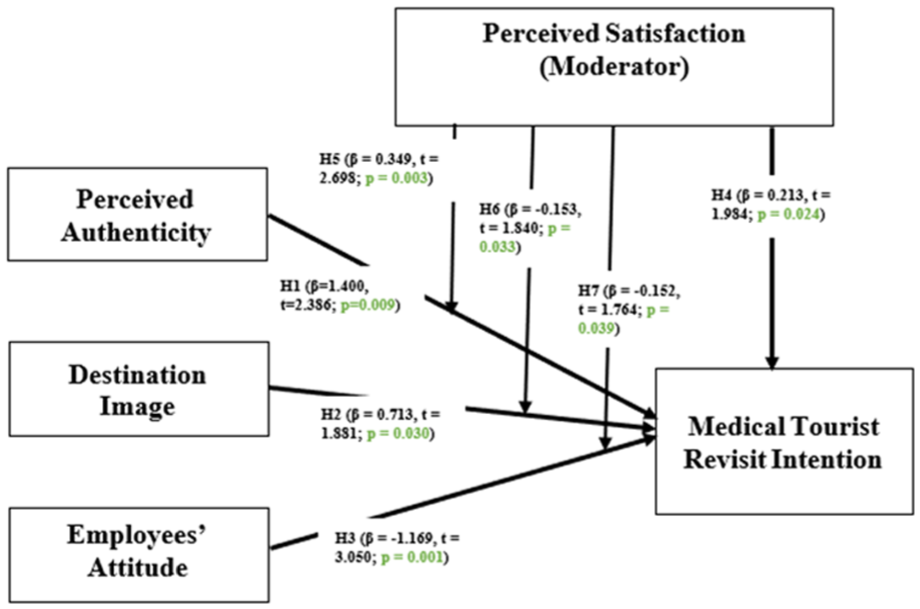
A conceptual framework for the perceived authenticity, destination image, and employee attitude on medical tourist revisit intention: the role of perceived satisfaction in moderation.
According to Cohen et al. (2003) guideline, an assessment was conducted using high and low simple slope analysis to examine further the progress of significant moderated variables in the model. This analysis is typically used for interactions between two numerical predictors. However, it can also be applied to other types of interactions. Cohen et al. (2003) depict that examining the simple slope and investigating the interaction is identified when a strong effect is observed at a high level, while a weak effect is seen at a low level. In Figures 2 and 3, the interaction plot shows a steeper slope for the red line represents the high path coefficient.

Moderation of perceived satisfaction between perceived authenticity and medical tourist revisit intention, using two-way slope interaction effects.

Moderation of perceived satisfaction between destination image and medical tourist revisit intention, using two-way slope interaction effects.
In contrast, the blue line represents the low interaction. The positive effect observed in the slope analysis is due to its upward and leftward sloping movement. It indicates a positive moderating effect between perceived authenticity and medical tourist revisit intention and a positive moderating effect between destination image and medical tourist revisit intention. This effect is established due to the dampened impact of perceived satisfaction (the moderator) following the approach outlined by Cohen et al. (2003) and providing significant support for Hypothesis H5 and H6.
In Figure 4, the interaction plot reveals a slight slope for low perceived satisfaction, indicating that the influence of employee attitude on medical tourist revisit intention is weaker at a low perceived satisfaction compared to high perceived satisfaction. Medical tourists generally have high expectations for professionalism and expertise in healthcare settings. When these expectations are met, the focus may shift towards other factors, such as perceived value or quality of care, making employee attitude appear less significant in comparison. In the realm of medical tourism, the technical quality of services, including successful procedures and advanced medical technology, often takes precedence over interpersonal interactions. As a result, patients may prioritize outcomes over the attitudes of staff, particularly in critical healthcare situations.

Moderation of perceived satisfaction between employee attitude and medical tourist revisit intention, using two-way slope interaction effects.
Cultural differences in communication and interaction styles can also lead to varying interpretations of employee attitude. What one culture perceives as warmth and friendliness, another may interpret as excessive or insincere, which can dilute the impact of employee behaviour on customer satisfaction. While employee attitude is undoubtedly important, it can sometimes be overshadowed by systemic factors within healthcare facilities, including operational efficiency, cost, and perceived quality. If these systemic aspects do not align with patient expectations, the effectiveness of positive employee interactions may not be fully realized. Language barriers or miscommunications can further diminish the impact of positive employee attitudes. If patients are unable to fully understand or engage with staff, even the friendliest demeanour may fail to enhance their overall experience. Moreover, tourists often prioritize their overall experience, which encompasses various elements such as travel, wellness, and leisure. Consequently, if aspects like destination image and perceived value resonate more strongly with them, the specific contribution of employee attitude may become less pronounced as the case of the result of this study. Meanwhile, these factors present an opportunity for healthcare providers in Malaysia to enhance the training of staff in soft skills and cultural competency. By doing so, positive employee attitudes can more effectively complement the other critical aspects of medical tourism. Addressing this gap could significantly improve patient experience and satisfaction, ultimately driving revisit intentions.
The highest medical revisit intention was observed in medical healthcare with high perceived satisfaction and positive employee attitude. This finding confirms Hypothesis H3, demonstrating that the connection between employee attitude and medical tourist revisit intention is stronger when perceived satisfaction is high. This validation of our hypothesis strengthens the credibility of our research. Furthermore, the relationship between employee attitude and medical tourist revisit intention strengthens at high perceived satisfaction, further supporting Hypothesis H7.
Discussion
This study has two main aims. Firstly, it investigates the factors that may lead medical tourists to revisit intention as a marketing strategy measure. Secondly, the study aims to suggest a perceived satisfaction model as a moderator between the independent and dependent variables in a medical tourism study context. The study gauged the findings on various medical tourist revisit intention information in Malaysia. The results are set to reveal whether independent variables predict medical tourist revisit intention to Malaysia and whether perceived satisfaction moderates the relationship between the independent variable and medical tourist revisit intention. The findings showed a significant relationship between perceived authenticity, destination image, employee attitude, and perceived satisfaction in medical tourist revisit intention. Perceived satisfaction also moderates perceived authenticity and medical tourist revisit intention, Perceived satisfaction moderates destination image and medical tourist revisit intention, and Perceived satisfaction moderates employee attitude and medical tourist revisit intention. Therefore, this study established a significant direct relationship and moderating effect. The results findings are in line with prior studies such as those (Cham, Cheng, et al., 2021; Cham, Lim, et al., 2021; Crooks, 2011; Ganguli & Ebrahim, 2017; Heydari Fard et al., 2021; M. J. Khan et al., 2016; Lim et al., 2017; Milman & Pizam, 1995; Mohaidin et al., 2017; Nilashi et al., 2019; Rahman, 2019; Shafiee et al., 2016). The findings and information discovered from this study have carried their weight of importance on the existing literature within the perspective of medical tourist revisit intention. Nevertheless, it is vital to recap the fact that this study revealed that medical tourist revisits intention is vital marketing psychology that believes that, in the service industry, more than 5% of the upsurge in retention of customers will yield 85% additional profit based on their satisfaction level (H. Zhang et al., 2014).
The study’s results show that the importance of medical tourist revisit intention is evidenced in the study; thus, proof efforts to greater awareness among Malaysian medical tourism, medical healthcare and other service-related providers should persist in canvasing for medical tourist revisit intention as part of their core marketing strategy. It is urged that all chief executive marketing officers and managers understand the study’s concept in essence that it would reform medical tourism management and its vast potential contribution to creating a company’s business sustainability and success. Introducing the concept of this study in reports and strategic decisions is also necessary. Additionally, this study revealed that employee attitude is one crucial element in an organization. A company is always driven by its people.
Consequently, those people should conduct business with their most truthful and honest spirit. The insertion of an independent variable (i.e., perceived authenticity, employee attitude, and destination image) in this study shows healthcare practitioners and medical tourism institutions that this variable is among the essential elements in a business that cannot be disregarded. Hence, future research on medical tourist revisit intention should always incorporate this model as part of the intention component. In line with notions highlighted by Heydari Fard et al. (2021), positive consumer satisfaction, the optimistic notion of destination image and perceived authenticity may significantly impact the intention to revisit; hence, the study is supported.
Furthermore, the result confirms that perceived authenticity, destination image, employee attitude and perceived satisfaction are predictive factors towards medical tourist revisit intention. Moreover, all the list factors significantly affect medical tourists’ revisit intention to Malaysia hospitals. Therefore, as the Smart-PLS result has depicted a relationship effect, these variables can provide a base argument for revisit intention decision based on medical tourists’ intention to revisit Malaysian hospitals. The results should encourage organizations to strive for the best practices. Perceived authenticity influences the relationship between a medical tourist’s revisit intentions. Perceived authenticity should represent the organization’s core marketing strategy measure that will allow an organization to effectively apply marketing concepts to target and direct medical tourists to Malaysia abundantly. Forthwith, if medical tourists perceived Malaysia as an authentic destination for medical tourism, their intention to revisit may increase, but only if there is an iota of satisfaction towards Malaysia medical tourism as an authentic destination choice in their experience process. Overall, the finding is supported by the past studies conducted by (Agyeiwaah & Dayour, 2021; Cham, Lim, et al., 2021; Chenini & Cherif, 2016; Huang & Hsu, 2009; M. J. Khan et al., 2016, 2017; Shivany, 2013). Based on the results of this study, it is reasonable to conclude that the study is successfully proven as a catalyst for change in medical tourism organizations.
Theoretical and Managerial Contributions
The result findings of this study provide helpful theoretical implications for the limited and scarce literature studies on the role of perceived satisfaction as a moderator between independent variables and medical tourist revisit intention in Malaysia (Heydari Fard et al., 2021). The moderating effect of perceived satisfaction between the independent variable stipulated in this study and medical tourist revisit intention is not exclusively associated with any specific or exclusive medical tourist revisit Intention theory. Nevertheless, the study was conducted based on a conceptual framework outlining a few gaps in the literature underpinned by the cognitive antecedent of satisfaction decision and expectation disconfirmation theories by (Oliver, 1980). Most past research frequently linked the cognitive model of the antecedents and consequences of satisfaction decisions theory to consumer satisfaction through expectation disconfirmation effects (Heydari Fard et al., 2021). According to Oliver (1980), positive disconfirmation above specific performance will increase consumer satisfaction, and negative disconfirmation may lead to lower consumer satisfaction. As far as we know, this is the first study that examines a significant direct relationship effect and moderating effect by integrating variables in the same model, such as perceived authenticity, destination image, employee attitude, and satisfaction towards medical tourist revisit intention. This research has contributed to the literature by providing empirical support to the moderation role of perceived satisfaction between independent variables and medical tourist revisit intentions. The research has also established a direct relationship between perceived authenticity, destination image, employee attitude, and perceived satisfaction towards medical tourist revisit intention contributing significantly to the literature. Theoretically, this has helped to develop a different opinion of conceptualization in examining the conventional study within the area of medical tourism management and marketing management, which leads to the acceptance of a new theoretical model.
From the management perspective, the cognitive model of the antecedents and consequences of satisfaction decisions expresses consumer satisfaction as a function of expectation and expectancy disconfirmation (Ghorbanzade et al., 2019; Luo & Chea, 2018; Oliver, 1980). It plays a vital role in medical tourist revisit intention which has been viewed as a theoretical lens. In addition, attitude creates an emotion concerning the degree of pleasure or displeasure with a product or service. In contrast, perceived satisfaction is an evaluation of that emotion based on the performance of the medical tourist revisit intention (Hashim et al., 2020; Shamsudin et al., 2019). Therefore, the objective based on the literature review has helped to produce the moderating role of perceived satisfaction between perceived authenticity, destination image, and employee attitude in medical tourist revisit intention. The results and the findings should encourage organizations to strive for the best business marketing practices and keep ahead of their competitors. All the integrated factors have been proofed to be the predictive factors towards medical tourist revisit intention (Hashim et al., 2020; Cham, Lim, et al., 2021; Chandran et al., 2017; Heydari et al., 2019; Shamsudin et al., 2019). These factors should represent the organization’s core marketing and strategy measure that will allow an organization to effectively apply marketing concepts to target and direct medical tourists to Malaysia abundantly. If medical tourists perceive Malaysia as an authentic destination, their intention to revisit may increase.
Further, suppose medical tourist sees high value in the destination image through its components. In that case, this may lead to high chances of intention to revisit. Suppose medical tourists’ have a positive perception of employee attitude. In that case, their intention to revisit may increase. All these findings can be applied to both the public and private healthcare industries in several ideas, especially in increasing the number of medical tourists to Malaysia (Cham, Lim, et al., 2021; Chandran et al., 2017; Heydari et al., 2019). The findings and collective advantage of the study are not limited to leading medical institutions, this findings will also help contributes to any other institutions with less recource if adopt the concept of the study. Apart from this study been in the context of Malaysia study, the general finding can be applied to many other countries and region especially regards to the antecedence of medical tourist revisit intention as supported in this study, where variables such as perceived authenticity, destination image, and employee attitude are extremely important to any medical institutions success.
Limitations and Future Research Direction
This study encounters challenges but with careful consideration in analysing and interpreting research findings. The study outcome of medical tourist revisit intention scope is restricted to selected regions in Malaysia, namely Johor Bahru and Kuala Lumpur. The decisions to covered Johor Bahru and Kuala Lumpur is relied upon as this geographical area represent Malaysia’s current medical tourism strengths in revenue recorded within their respective regions, this is supported by ministry of health travel council report (MHTC, 2023). In addition, studies in specific locations often have reasons rooted in the practicality, accessibility, or unique characteristics of those areas especially, taking the fact of adopting purposive sample in this study which support a specific target location based on its traits. Hence, medical tourist research study in Johor Bahru and Kuala Lumpur (KL) rather than the entirety of Malaysia is align with the strength identified by MHTC report on blueprint of medical tourism in Malaysia for the year 2023 to 2025.
Like many other study, this has creates a limitation of the study and questions may arise if there is need for the study to extend to other regions in Malaysia beyond these two areas. Whereas, study was conducted as a cross-sectional study, which makes it challenging to capture the dynamic user behaviours related to revisiting intentions behaviour. This could cause biased arguments since there was no follow-up on new data and results after the initial data collection. If the data were collected periodically, the results could differ. It would be beneficial to conduct a longitudinal experimental method, where researchers will have more time to explore respondents’ options. Future research is encouraged to investigate the trend and changes in patient intentions to revisit Malaysia’s medical healthcare. Past studies showed that perceived value, destination image and satisfaction were the most critical medical tourist components in the past years. This study revealed that independent variables, that is, (perceived authenticity, destination image, employee attitude and perceived satisfaction) are the most influential among the medical tourist patient revisit intentions components. The current study indicates that this trend will change in many years. Hence, future research is encouraged to engage in a longitudinal study to gather a more comprehensive view and understanding of the progress of patient revisit intentions and observe its conditional movement change in Malaysia. Since perceived satisfaction (as a moderator) has a significant moderate relationship effect between perceived authenticity and medical tourist patient revisit intentions, also perceived satisfaction (as a moderator) has a significant moderate relationship effect between employee attitude and patient revisit intentions, it is in the opinion that future study could further examine the mediating effect of perceived satisfaction between independent variable and medical tourist patient revisit intentions to Malaysia medical healthcare. The mediating effect in the future research study can help clarify the mechanism or reasons behind how an independent variable, like perceived authenticity, destination image, and employee attitude, influences a dependent variable, such as medical tourist revisit intention, essentially serving as a conduit or process. In contrast, a moderating variable that affects the intensity or direction of the relationship between the independent and dependent variables. Additionally, future research might investigate if variations in the dynamic roles of healthcare in private or government institutions can notably affect the likelihood of medical tourists’ revisit intention. Aspects such as the quality of service, trust in clinical practices, and the overall experience within a facility could influence a tourist’s decision to revisit a particular place or suggest it to others.
Conclusion
The role of perceived satisfaction moderating between independent and dependent variables in the Malaysia medical tourist revisit intention study is drown from the literature review and the identified past research gaps. Moderation of perceived satisfaction between an independent variable and medical tourist revisit intention has been revealed and accepted in Malaysia medical tourism and affiliated institutions in this study. The overall result indicates that the significant direct effect between the independent variable and medical tourist revisit intention has created higher acceptance of the study in the corporate domain, especially in medical tourism and healthcare providers. These findings are consistent with those revealed by the past research studies. The findings on the perceived authenticity towards medical tourist revisit intention clearly show the existence of authentication pronouncement, which refers to the extent to which the destination or experience is perceived as genuine, original, and representative of the local culture. Even the perception that the medical treatment is based on local knowledge, expertise, and resources has created additional significance on medical tourist revisit intention with the alarming findings on the direct effect on the other independent variable on revisit intention. The finding on destination image and employee attitude towards medical tourist revisit intention has also clearly shown that the concern of image presentation of a place influences medical tourists to visit and revisit. At the same time, effective communication between employees and medical patients is critical to revisit intention. This could be seen as medical tourists affected by perceived authenticity, destination image and employee attitude mainly if they had initially visited while sharing their experience. This, in turn, should focus more on the rest of the independent variable which would eventually facilitate the medical healthcare institutions to attain higher medical revisit. Overall, this study achieved its objective and thus discovered new, exciting and insightful findings that are unique. This study has greatly provided abundant and fruitful experience of conducting research, which is beyond expectation, some of which were not anticipated in the earlier stage of this study. Nevertheless, the challenges and limitations throughout the research process have inspired new ideas and put forward more significant opportunities for future research.
Footnotes

Funding
The authors received no financial support for the research, authorship, and/or publication of this article.
Declaration of Conflicting Interests
The authors declared no potential conflicts of interest with respect to the research, authorship, and/or publication of this article.
Data Availability Statement
Data sharing not applicable to this article as no datasets were generated or analysed during the current study.