



Abstract
This study focuses on pathways for enterprises to build green competitive advantages in the digital economy era. Building upon matched panel data of A-share listed companies (2001–2021) from the CSMAR database and incorporating green patents (classified by the China National Intellectual Property Administration) and digital patents (screened by the International Patent Classification), this study constructs digital transformation intensity and persistent green innovation indices. By employing two-way fixed effects models and mediation effect models, this study systematically investigates the effect of digital transformation intensity on persistent green innovation, its underlying mechanisms, and the moderating role of the concept of new quality productive forces (NQPF). Findings demonstrate the following content: (1) Digital transformation significantly enhances persistent green innovation capabilities, exhibiting a monotonic increasing relationship without an “inverted U-shaped” inflection point. (2) Heterogeneity analysis reveals more pronounced effects in nonstate-owned enterprises, capital-intensive firms, enterprises in regions with advanced digital infrastructure, companies adopting foundational digital technologies, industries with higher digital penetration, and larger-scale corporations. (3) Mechanism tests identify three empowerment pathways: innovation learning effects, resource allocation effects, and transaction cost reduction effects. (4) NQPF amplifies this relationship through technological synergy and data factor empowerment. This research provides theoretical foundations and policy targets for governments in designing differentiated digital–green transition incentives considering corporate characteristics, accelerating NQPF cultivation, promoting balanced regional digital infrastructure development, and advancing the synergy between digitalization and green–low-carbon transformation.
Keywords
Introduction
The global climate crisis has entered a decisive phase. The provisional report by the World Meteorological Organization in 2023 indicates that the global average temperature in October 2023 was 1.4°C higher than pre-industrial levels, whereas the rate of Antarctic ice sheet melting reached a historical peak during the same period. Despite the commitments of Paris Agreement signatories to advance emission reduction targets, data from the International Energy Agency (2023) reveal that over 150 countries still face policy implementation gridlocks and risks of deviating from their emission reduction pathways. Against this backdrop, corporate environmental compliance pressures have intensified, necessitating the restructuring of business models and optimization of production processes through green innovation to mitigate the negative externalities of economic activities on ecosystems. However, existing research shows that although corporate green innovation investments have increased year by year, the lack of sustained driving forces and systematic catalytic mechanisms has made it difficult to achieve long-term emission reduction targets (B. Liu et al., 2024).
The rapid development of digital technologies offers new opportunities to address these challenges. Digital transformation refers to the fundamental changes in traditional business models, processes, and value chains through the application of digital technologies, with the aim of achieving more efficient, flexible, and innovative operations and management within firms (Chiarini, 2021). It facilitates the digitization, automation, integration, and intelligentization of production processes, effectively promoting corporate innovation (Zhang et al., 2022). Closely related to this concept, digital transformation intensity reflects the extent of resources and efforts devoted by firms or organizations during the process of digital transformation, as well as the depth and breadth of the application of digital technologies internally and externally (Hao et al., 2023; Zhang et al., 2022). Compared to digital transformation, digital transformation intensity emphasizes the degree of investment in resources, time, and energy, focusing more on the depth and scope of digital transformation and the extent of digital technology applications within and beyond the organization, thereby reflecting the effectiveness and effect of digital transformation. Although digital transformation and digital transformation intensity holding the same characteristics of technology penetration, efficient collaboration, and low-cost substitution are closely linked to innovation promotion (X. Chen et al., 2023; H. Li et al., 2022; Soto Setzke et al., 2023). The “double-edged sword” nature of technological progress may trigger a modern version of the Jevons paradox, where improvements in technological efficiency reduce per-unit resource consumption, but the scale expansion driven by technology adoption exacerbates overall resource demand and carbon emissions (Polimeni, 2008). This contradiction comes from two limitations: first, studies often adopt a static perspective, simplifying digital transformation as a binary dummy variable and overlooking its dynamic and continuous characteristics (H. Wang et al., 2020); second, green innovation measurement systems lack a temporal dimension, making it difficult to capture the long-term evolution of corporate innovation capabilities (Schumacher et al., 2023). The potential tension between digital transformation and green innovation underscores the urgent need for theoretical frameworks to reconcile the conflict between technological efficiency and ecological sustainability and explain whether digital transformation can sustainably drive green innovation.
In this context, China’s theory of new quality productive forces (NQPF) offers a critical solution. It is defined as a productivity paradigm underpinned by digital technologies and oriented toward green sustainable development. Its core lies in achieving a dynamic balance between productivity enhancement and ecological optimization through a “digital empowerment–green transition” synergy mechanism (Cao & Dai, 2025; Cao & Yu, 2024). Different from traditional productivity, which focuses on singular efficiency goals, the NQPF theory emphasizes the deep integration of digital technologies and green innovation, requiring enterprises to restructure production processes around data elements and drive the sustained evolution of green innovation through technological innovation learning effects, resource allocation optimization effects, and transaction cost reduction effects. The proposal of this theory provides a theoretical bridge to overcome the Jevons paradox and reconcile the contradictions between digital transformation and green innovation. Industrial practices have preliminarily validated its feasibility: Tesla’s Shanghai Gigafactory, for instance, has applied digital twin technology to optimize production processes, reducing the carbon emissions of the Model Y by 23% compared to traditional methods. Similarly, Xiaomi’s integration of photovoltaic power generation and AI-based energy consumption prediction through its smart microgrid system has increased its renewable energy share to 68% in 2023, with a 41% year-on-year decrease in carbon intensity per unit of output value. Such cases demonstrate that deepening digital transformation intensity can break the constraints of the Jevons paradox and promote the co-evolution of technological innovation and ecological optimization.
Against this backdrop, this paper focuses on the following core questions: Can the deepening of digital transformation intensity, as expected, persistently drive corporate green innovation, and what are the underlying mechanisms? What role does NQPF play in moderating this relationship? To address these questions, this study constructs an L-P analytical framework and integrates financial data, green patent data, and digital patent data from Chinese A-share listed companies from 2001 to 2021 to empirically examine the effect of digital transformation intensity on firms’ persistent green innovation. Furthermore, the research introduces three mediating mechanisms—innovation learning effects, resource allocation effects, and transaction cost reduction effects—to dissect the internal logic through which digital transformation intensity drives persistent green innovation and validates the positive moderating role of NQPF.
Literature Review
Modern enterprises’ green innovation, integrating environmental protection and technological advancement, is widely acknowledged as a pivotal strategic instrument for sustainable development (Xu et al., 2024). Numerous existing studies have focused on extensively exploring factors influencing green innovation (D. Li et al., 2017; Shahzad et al., 2020). Y. Zhao and Fang (2025) and Liao et al. (2022) confirmed that organizations pursue green innovation by introducing green technologies to enhance resource efficiency. From a dynamism perspective, companies’ practice of establishing supply chain dynamics and green dynamics significantly promotes green innovation (Belhadi et al., 2024; Ferreira et al., 2021; Hendriksen, 2023; Singh et al., 2022; Yousaf, 2021). In recent years, with the development of the digital economy, research on the drivers of corporate green innovation has expanded to include digital transformation.
Many scholars have examined the relationship between digital transformation and green innovation. Empirical evidence from multidisciplinary studies demonstrates that corporate digital transformation can facilitate green innovation through heterogeneous mechanisms and contextual pathways at varying levels of organizational complexity. From the perspective of environment performance, the findings of Ding et al. (2024) suggested that digital transformation improves their internal information environment, strengthens internal control, and alleviates financing constraints, thereby enhancing the level of green innovation in listed firms. Wu and Li (2023) explored the relationship between corporate digital transformation and green technological innovation, finding that digital transformation effectively improves corporate green technological innovation with environmental regulation acting as a mediating factor. From the perspective of pollution emissions, Xue et al. (2022) found that digital transformation activates firms’ green innovation drivers, promotes green technological innovation, and thus reduces pollution emissions. B. Liu et al. (2024) also showed that digital transformation curbs corporate pollution emissions by improving productivity, optimizing energy consumption structures, and enhancing pollution treatment capacities. Digital transformation enhances firms’ persistent green technological innovation primarily by increasing research and development (R&D) investment, improving information transparency, strengthening positive market expectations, reducing green agency costs, and improving green investment efficiency (Sui & Yao, 2023; Tang et al., 2023). Liakhovych (2021) reported that digital transformation helps firms overcome digital technology challenges and reduce uncertainties in R&D, motivating R&D personnel to actively explore the integration paths of digital technologies and persistent green innovation activities, thereby effectively reducing ambiguities in the persistent green innovation process. Overall, digital transformation enhances innovation efficiency, reduces energy consumption, and optimizes costs and benefits, providing a solid technical foundation and financial backing for corporate green innovation.
However, many studies have shown a positive correlation between digital transformation and innovation (P. Chen & Kim, 2023; H. Li et al., 2022; Satalkina & Steiner, 2020). Although some studies have suggested that such effects exhibit variations across firm ownership structures, organizational scales, and geographic contexts, there remains limited consensus on the underlying moderating mechanisms (Cennamo et al., 2020; Furr et al., 2022; Sun et al., 2022). For example, digital transformation had more significant effect on the level of environmental responsibility of heavily polluting enterprises, enterprises in the growth and maturity stages, and state-owned enterprises (SOEs; Shen et al., 2023; Xu et al., 2024). The effect of corporate digital transformation on innovative performance is more pronounced in larger organizations than in smaller and medium-sized enterprises (SMEs; Sun, 2024; Xu et al., 2024). The promoting effect of digital transformation on green innovation is heterogeneous in different degrees of marketization, and the effect is more significant in regions with higher degree of marketization (Xu et al., 2024). However, there exists a broad consensus that digital transformation can facilitate corporate green innovation, as evidenced by studies conducted in countries such as China, Italy, Ireland, Brazil, and Australia (Lerman et al., 2022; Leviäkangas et al., 2017; Montresor & Vezzani, 2023; Rowan et al., 2022; Xu et al., 2023; Yin & Yu, 2022). Some scholars have argued that digital transformation exhibits a significant nonlinear relationship in driving corporate green innovation. Some companies cannot continuously increase their level of digitalization because excessive digitalization is detrimental for environmental performance (Ahmadova et al., 2022). Contrary to traditional perceptions, the relationship between the digital transformation and corporate green innovation is not a simple linear one but rather follows an inverted U-shaped pattern. This inverted U-shaped relationship emerges with a turning point as digital transformation progresses (Dou & Gao, 2022).
The contradiction above regarding whether the relationship between digital transformation and corporate green innovation is linear reflects that scholars have not considered two variables in the time dimension. From the digital transformation perspective, existing literature predominantly focuses on the results of firms’ implementation of digital transformation but overlooks the process. They consider digital transformation as a process from 0 to 1. However, the cumulative effects that arise as the transformation process deepened were overlooked. Therefore, this paper introduces digital transformation intensity that reflects the degree of transformation to examine the effects of digital transformation over time. From the green innovation perspective, existing literature also fails to incorporate the time dimension when exploring firms’ green innovation. Based on the above considerations, our study tried to find a suitable framework to explore digital transformation intensity and firms’ persistent green innovation.
The concept of NQPF provides a new paradigm for persistently observing how corporate digital transformation influences green innovation research (G. Wang & Cheng, 2024). NQPF is a form of productivity driven by digital transformation and green innovation, achieved through the pursuit of disruptive technologies, which transcends traditional productivity (Gao & Liu, 2024; Y. Liu & He, 2024; Xie et al., 2024; Zhang, 2024). Data elements and digital technologies are at the core of NQPF, enabling improvements in industrial structure, optimizing institutional environments and industrial systems, and thus empowering ecodevelopment (L. Liu & Jiang, 2024). As a key moderator, green innovation amplifies the positive effects of NQPF on environmental performance (Du & Ye, 2024). Therefore, this paper combines theoretical analysis with empirical testing to directly investigate the relationship between digital transformation intensity and firms’ persistent green innovation under the framework of NQPF.
The potential marginal contributions of this paper are as follows. (1) It introduces the concept of digital transformation intensity and explores, from this perspective, the relationship between digital transformation intensity, NQPF, and persistent green innovation in detail. (2) Building upon existing research, this paper further measures digital transformation intensity and persistent green innovation capabilities at the firm level, using data from Chinese listed companies, matched green patents, and digital patents to empirically test the effect of digital transformation intensity on persistent green innovation. (3) It constructs a provincial-level measurement system for NQPF in China, quantifying NQPF across different provinces and empirically testing the positive moderating effect of NQPF on the relationship between digital transformation intensity and firms’ persistent green innovation.
Mechanism and Research Hypotheses
Theoretical Mechanism: Direct Effect of Digital Transformation on Green Innovation
Goldfarb and Tucker (2019) posited that manufacturing enterprises often encounter transport, search, and communication costs in the production process, with these costs exhibiting a multiplier effect as the length of the upstream and downstream supply chains increases. Digital transformation help enterprises to build supply chain dynamics, including the application of the Internet of Things (IoT) and the construction of smart manufacturing systems, thereby making production processes more efficient and precise.
On the basis of the analytical framework of Lanz and Piermartini (2018), this study assumes that firms in the market operate under conditions of perfect competition, with zero profit. In addition, firms along the supply chain, excluding the initial and terminal firms, have upstream and downstream relationships, with a sequential production process. Moreover, the supply chain comprises N firms, and the final product undergoes S stages of production from the first manufacturing firm to the finished product. Each firm in the supply chain purchases intermediate goods from its upstream counterparts, where
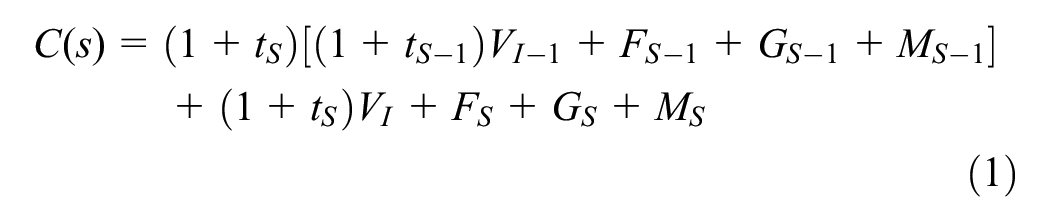
where
To further elaborate on the role of digital transformation in promoting enterprises’ persistent green innovation, we extend the above analysis by assuming that the final product is sequentially produced by three enterprises within the industrial chain. Defining



By examining Equations 2 to 4, the total production costs of the three enterprises in the industrial chain are composed of production, transportation, search, and communication costs at different production stages. Digital transformation can effectively mitigate information asymmetry among enterprises in the industrial chain, enabling them to select optimal upstream and downstream suppliers. This not only reduces transportation costs but also decreases the energy consumption associated with transportation. Moreover, by leveraging its cross-temporal and cross-spatial capabilities, digital transformation can significantly lower communication and search costs, thereby increasing enterprises’ R&D investments in persistent green innovation.
Further observation of
Moreover, digital transformation provides more comprehensive, real-time, and accurate data collection and analysis capabilities, enabling enterprises to better understand resource utilization, environmental effects, and emissions at various stages. Through data analysis, enterprises can more quickly identify potential environmental issues and optimize resource and energy utilization, waste management, and other areas, thereby achieving green production and innovation. Digital transformation also facilitates internal and external collaborative innovation, breaking down departmental barriers and information silos and encouraging green innovation. By leveraging digital technologies, enterprises can better establish circular economy systems, emphasizing the efficient use of resources and waste reduction across product design, production, sales, and post-sales stages, thereby driving green and sustainable development.
Digital transformation offers a range of advanced tools, such as artificial intelligence, big data, and cloud computing. The integrated application of these technologies can assist enterprises in improving carbon emission management, environmental protection, and the development of clean production technologies, thereby advancing continuous progress in green innovation.
Based on the above analysis, this study proposes
Decomposition Mechanism: Three Intermediary Effect Channels
By synthesizing the existing literature, this paper posits that digital transformation may influence firms’ persistent green innovation through three channels, including innovation learning effects, resource allocation effects, and transaction cost reduction effects.
From the perspective of innovation learning effects, digital transformation facilitates persistent green innovation primarily through intra- and inter-firm learning effects. On the one hand, regarding intra-firm learning effects, digital transformation provides more accurate and extensive data, enabling firms to gain a deeper understanding of their industrial ecosystems. These data facilitate environmental learning, including insights into resource utilization, energy consumption, and waste emissions. By analyzing and comprehending this information, firms can identify opportunities and challenges, allowing them to formulate appropriate environmental strategies and innovative measures. In addition, digital transformation enhances knowledge management within firms, enabling the storage and dissemination of existing environmental knowledge and experiences. This promotes iterative learning based on practical outcomes, driving continual innovation in environmental practices (Young, 2009). On the other hand, from the perspective of inter-firm learning effects, digital transformation creates more open innovation opportunities, encouraging firms to strengthen internal and external cooperation, share resources, and exchange knowledge. This openness fosters cross-industry environmental technology exchange and experience-sharing, stimulating firms’ motivation for autonomous innovation and promoting cross-boundary learning in green innovation (N. Zhao et al., 2021).
From the resource allocation effects perspective, digital transformation helps firms allocate resources more efficiently, including human, material, and financial resources. The application of digital technologies enables more refined management of production processes, reducing resource wastage and improving resource utilization efficiency, thereby providing greater support for green innovation. Moreover, digital transformation facilitates firms’ access to the latest environmental technologies and solutions, helping to establish supply chain dynamics and reduce resource waste, thereby enhancing green innovation efficiency. Through digital technology support and priority allocation, firms can more rapidly introduce and apply new technologies, thereby accelerating the process of green innovation (Tsou & Chen, 2023).
From the perspective of transaction cost reduction effects, digital transformation, through the development and application of information systems, enhances firms’ management and monitoring capabilities across the entire supply chain. Given that green innovation often involves supply chain cooperation and coordination, digital transformation reduces coordination and communication costs, simplify information transmission processes, and enhance supply chain dynamics, providing better support for green innovation. Furthermore, digital transformation facilitates more efficient and effective information sharing and collaboration between firms and their partners. By leveraging digital platforms, firms can engage in closer cooperation with partners, reducing collaboration costs, improving cooperation efficiency, and jointly undertaking green innovation projects (Y. Liu et al., 2022).
Based on the above analysis, this paper proposes
Amplification Mechanism: Moderating Effect of NQPF
From the perspective of transformation intensity, examining corporate digital transformation reveals that, first, NQPF encourage firms to increase their investment in digital technologies. By introducing advanced production equipment, automated production lines, IoT technology, and big data analytics, firms can improve production efficiency, optimize production processes, and achieve digital management of production data, thereby enhancing their digital transformation intensity (Dong et al., 2024; W. Zhou, Li, & Li, 2024). NQPF also encourage innovation in management models, particularly in areas such as production planning, supply chain management, and quality control. They stimulate firms to implement comprehensive enterprise resource planning systems, supply chain management systems, and customer relationship management systems, which promote centralized management and data sharing, further strengthening corporate digital transformation intensity (Gao et al., 2024; Guo et al., 2024).
From the perspective of persistent green innovation, NQPF emphasizes achieving economic growth through technological innovation and improved production efficiency. By increasing R&D investment and focusing on breakthroughs in key areas such as new energy and environmental technologies, firms can make their production processes greener and more low-carbon. The adoption of modern production methods, such as automation and intelligent manufacturing, not only reduces resource consumption and emissions but also enhances production efficiency, thereby driving green innovation (Ren et al., 2024). Moreover, the development of NQPF facilitates the integration and upgrading of industrial supply chains. Through collaborative innovation with upstream and downstream firms, enterprises can build greener and more efficient supply chains, advancing the green transformation of entire industries and promoting persistent green innovation at the firm level (H. Wang, 2024).
Based on the above analysis, this paper proposes
By combining the above three hypotheses, the theoretical framework of this paper is shown in Figure 1.

Conceptual framework of this study.
Model Specification and Index Measurement
To test the hypotheses proposed earlier, this paper utilizes matched data from the database of China’s A-share listed companies, the enterprise patent database, the enterprise digital patent database, and the enterprise green patent database for the period of 2001 to 2021. First, a panel fixed effects model is used to empirically test the effect of corporate digital transformation intensity on persistent green innovation. Second, a mediation effect model is employed to empirically test the mediating effects of innovation learning, resource allocation, and transaction cost reduction. Finally, a moderation effect model is used to empirically examine the positive moderating role of NQPF in the relationship between digital transformation intensity and persistent green innovation.
Model Specification
Empirical Model for Testing the Effect of Digital Transformation Intensity on Persistent Green Innovation
According to Hypothesis 1, a potential positive correlation may exist between digital transformation intensity and persistent green innovation. Therefore, this study employs a two-way fixed effects model (controlling for firm and time fixed effects) rather than pooled OLS, random effects, or other models, primarily based on the following considerations. First, data structure and model assumptions necessitate this choice. The research data consists of unbalanced panel data from A-share listed companies spanning from 2001 to 2021, encompassing time and individual dimensions. The fixed effects model, by incorporating firm and time dummy variables, effectively controls for time-invariant individual heterogeneity (e.g., corporate registration location and ownership structure) and individual-invariant time trends (e.g., macroeconomic fluctuations and policy shocks), thereby mitigating endogeneity bias caused by omitted variables. Second, compared to the random effects model, which assumes that individual effects are uncorrelated with explanatory variables, the core variables in this study may be correlated with inherent firm characteristics (e.g., management risk preferences, and industry technological attributes). Ignoring this correlation leads to biased estimates in the random effects model. Furthermore, the Hausman test results show a test statistic of 37.62 (p = .000), strongly rejecting the null hypothesis that “individual effects are uncorrelated with explanatory variables” and supporting the suitability of the fixed effects model.
Therefore, this study constructs a two-way fixed effects model, as shown as follows:

where
Mediation Effect Model for Testing Innovation Learning, Resource Allocation, and Transaction Cost Reduction Effects
According to Hypothesis 2, corporate digital transformation intensity may positively influence persistent green innovation through innovation learning, resource allocation, and transaction cost reduction effects. To test Hypothesis 2, this study follows the three-step method proposed by Baron and Kenny (1986) to conduct the mediation effect test. The specific test models are


where
Empirical Model for Testing the Positive Moderating Role of NQPF on the Relationship Between Digital Transformation Intensity and Persistent Green Innovation
According to Hypothesis 3, NQPF may positively moderate the relationship between digital transformation intensity and persistent green innovation. To test Hypothesis 3, this study further constructs the following moderation effect model:

where
Variable Selection and Measurement
Measurement of Digital Transformation Intensity (
)
Although no specific research on measuring digital transformation intensity is currently available, the measurement of digital transformation has been widely studied. Yuan et al. (2021) employed a method where they extracted relevant digital transformation terms from listed companies’ annual reports and counted the frequency of those terms in a given year as a measure of digital transformation. Building on this approach, Xie and Yu (2023) developed a comprehensive indicator for measuring digital transformation by considering the technical, organizational, and product application aspects of firms, thereby providing a more holistic measurement of digital transformation. Although the frequency of terms related to digital transformation reflects whether a firm has planned or implemented digital transformation, it does not capture the extent of firms’ investment in this process nor does it fully reflect the intensity of digital transformation (Cheng et al., 2024; Jin et al., 2024; Sui et al., 2024; Wu et al., 2021; S. Zhao et al., 2024). A high-quality indicator evaluating digital transformation should not only focus on whether firms have planned or implemented digital transformation but also on the depth and extent of their investment in the process.
This paper constructs the indicator of digital transformation intensity based on two elements. First, the frequency of digital transformation-related terms in corporate reports reflects the degree of attention firms pay to digital transformation in their business activities. These terms likely encompass various aspects of digital transformation, and the higher their frequency, the deeper firms’ engagement with digital transformation in their operations. Second, the number of digital patents reflects firms’ innovation capacity and technological accumulation in digital technologies, indicating firms’ R&D investment and achievements in digital transformation. An increase in the number of patents suggests deeper innovation and exploration in digital transformation. Therefore, this paper matches the frequency of digital transformation-related terms extracted from listed companies’ annual reports with the number of digital patents granted to the same companies. Then take the logarithm of the summed total frequency of digital transformation-related terms and the number of digital patents granted in the same year to measure digital transformation intensity.
Measurement of Persistent Green Innovation (
)
The literature on measuring green innovation in firms is abundant, with many studies using the number of green patents filed by firms to assess the degree of green innovation. However, research on measuring persistent green innovation is relatively scarce. Based on existing studies, this paper adopts the approach of Triguero and Córcoles (2013), Y. Wang et al. (2023), and Gu (2024) to measure firms’ persistent green innovation capability. Specifically, the year-over-year growth rate of the sum of green patents obtained by a firm in year

where
Measurement of NQPF (Nqpf)
Current research on NQPF is predominantly theoretical, with few quantitative studies available. NQPF demands a higher caliber of labor, more technologically advanced capital, and a broader range of labor inputs compared to traditional productivity. H. Wang (2024) proposed a framework for constructing measurement indicators for NQPF, drawing on its core concept from the perspectives of laborers, labor objects, and labor means. Building on H. Wang’s (2024) research, this paper constructs a comprehensive indicator system to measure NQPF from three dimensions: production personnel, objects, and means. The entropy method is used to calculate a composite index of NQPF at the provincial level. The detailed measurement indicators are shown in Table 1.
NQPF Measurement Index System.

Measurement of Mediating Variables
The mediating variables in this paper include innovation learning effects, resource allocation effects, and transaction cost reduction effects. To measure the innovation learning effects, this study adopts the approach of Y. Li and Wu (2023) and uses the logarithm of the number of citations a firm’s patents receive from other firms as a measure of innovation learning effects. Regarding resource allocation efficiency, this paper follows Wei (2022) and measures it using the firm’s resource misallocation index. For transaction cost reduction effects, this paper adopts the method used by B. Liu and Wang (2016) and measures it by the ratio of selling expenses to the main business sales revenue.
Selection and Measurement of Control Variables
Drawing on the research by D. Li and Shen (2021), this paper selects the following control variables: firm size (
Data Sources
The data in this study primarily focus on A-share listed companies, covering major industries in China’s national economy, with manufacturing enterprises accounting for over 60% of the sample, which aligns closely with the research theme. The data of these companies is strictly regulated by the China Securities Regulatory Commission (CSRC), ensuring its completeness and reliability. As a result, a significant portion of the existing literature on digital transformation and innovation in Chinese enterprises is based on data from A-share listed companies.
The financial data of A-share listed companies used in this study are sourced from the CSMAR Listed Companies Financial Database, which includes all non-financial A-share listed companies (excluding banks, insurance, and securities firms). Companies labeled as ST, *ST, or delisted are excluded to avoid financial anomalies, as well as samples with missing key variables (e.g., total assets, operating revenue, and R&D expenses) for more than 3 years. Only companies that had been in continuous operation for at least 5 years are retained to ensure the balance of the panel data. Data on green patents are obtained from the Green Patent Classification List publicly available from the China National Intellectual Property Administration (CNIPA), matched with the International Patent Classification (IPC) codes according to the World Intellectual Property Organization (WIPO)’s IPC Green Inventory. The processing steps include extracting the primary IPC classification codes for enterprise patents from the CNIPA patent database, filtering green patents based on WIPO-defined green technology fields (e.g., renewable energy B63G and pollution control F01N), and matching them by application year and enterprise ID to construct a panel dataset of green patent counts by enterprise and year. Data on digital patents are sourced from the CNIPA patent database, combined with IPC classification codes corresponding to “digital technology application industries” as defined in the Classification of Core Industries in the Digital Economy (2021 Version) (e.g., G06F for digital data processing, and H04L for digital information transmission). The processing involves manually verifying the relevance of IPC codes to digital technologies and excluding patents with ambiguous classifications. Data on the term frequency of digital transformation is collected by crawling the full text of annual reports of listed companies using Python, based on a predefined keyword library to count the frequency of digital transformation-related terms. Provincial-level macro data for NQPF indicators are sourced from the China Statistical Yearbook, China Science and Technology Statistical Yearbook, and China Environmental Statistical Yearbook. Enterprise-level labor data (e.g., the proportion of high-skilled employees) are obtained from the employee structure tables in the Wind database. Descriptive statistics for the variables are presented in Table 2.
Descriptive Statistics of Variables.

Empirical Tests
Empirical Examination of the Relationship Between Digital Transformation Intensity and Firms’ Persistent Green Innovation
Baseline Regression
The empirical results of the relationship between corporate digital transformation intensity and persistent green innovation are presented in Table 3. Columns (1) to (7) display the results of the fixed effects regression model with gradually added control variables, and Column (8) shows the fixed effects regression results after including all the control variables. Column (10) presents the clustered robust OLS regression results after incorporating all the control variables. Columns (1) to (7) of Table 3 indicate that as control variables are progressively added, the magnitude and direction of the effect of digital transformation intensity on persistent green innovation remain relatively stable. Column (8) shows that after accounting for all the control variables and controlling for firm and time fixed effects, digital transformation intensity exerts a positive effect on persistent green innovation, with a coefficient of 0.0381, which is statistically significant at the 1% level. The clustered robust OLS regression results in Column (10) similarly indicate a positive effect of digital transformation intensity on persistent green innovation, further confirming the validity of Hypothesis 1.
Baseline Regression Results.

Note. ***, **, and * indicate significance at 1%, 5%, and 10%, respectively; brackets indicate robust standard error.
Some studies have suggested that the development of digital transformation may crowd out firms’ innovation funds (A. Li et al., 2023), potentially hindering persistent green innovation. Thus, as digital transformation intensity increases, its effect on persistent green innovation might diminish or even reverse. Hence, the possibility of an inverted U-shaped relationship is tested. To empirically examine whether such a relationship exists, this study introduces a quadratic term of digital transformation intensity into Model (1) and tests the relationship between the quadratic term of digital transformation intensity and persistent green innovation. The results are presented in Column (9) of Table 3. The coefficient of the quadratic term is positive and statistically significant at the 1% level, albeit with a smaller effect size. This indicates that no inverted U-shaped relationship exists between digital transformation intensity and persistent green innovation.
Two potential explanations can explain this finding. First, firms have not yet been engaged in digital transformation for an extended period, and their financial investments in this area remain relatively low. Thus, the crowding-out effect on green innovation funds is not particularly evident. Second, the marginal benefits of digital transformation investments in driving green innovation may outweigh the marginal costs of crowding out funds allocated to green innovation.
Observing the regression results of the control variables reveals that firm size and firm age are positively correlated with persistent green innovation, and these relationships are statistically significant at the 5% and 1% levels, respectively. This suggests that larger firms and those with longer operating histories have stronger persistent green innovation capabilities. The possible reasons are that larger and older firms attract greater public attention and thus have stronger social responsibilities, leading to higher investments in green innovation, which, in turn, supports their persistent green innovation efforts. Return on assets is also positively correlated with persistent green innovation, although its effect is relatively small and only significant at the 10% level. Revenue growth rate and board structure are positively correlated with persistent green innovation, with both being significant at the 1% level. This indicates that firms with higher revenue growth and more reasonable board structures tend to have better performance and greater support for persistent green innovation. In addition, a well-structured board enhances transparency, which facilitates firms’ engagement in innovation activities.
The separation of ownership and control is negatively correlated with persistent green innovation, although only significant at the 10% level. The relationship between capital structure and persistent green innovation is insignificant. This may be due to the dual effects of firm debt ratios on innovation. If a firm’s debt ratio is extremely low, then it may hinder the efficient utilization of funds for green innovation activities. Conversely, if the debt ratio is extremely high, then it increases the risks associated with green innovation, potentially leading to disruptions in the innovation funding chain and elevating the risk of innovation failure.
Heterogeneity Analysis
The effect of digital transformation intensity on persistent green innovation may vary significantly across firms due to differences in ownership structure, factor intensity, regional digital infrastructure, and the type of digital transformation being implemented. Therefore, this study conducts a heterogeneity analysis for firms with different ownership structures, factor intensities, levels of regional digital infrastructure, and distinct types of digital transformation intensity.
Ownership Structure
The level of persistent green innovation in firms is closely related to how profits are distributed. SOEs balance profit-seeking with the need to align with national strategic development and social development goals, whereas non-SOEs tend to prioritize profit maximization. This difference in ownership structure can potentially influence the relationship between digital transformation intensity and persistent green innovation. Consequently, this paper divides firms into SOEs and non-SOEs for empirical testing. The results are shown in Columns (1) and (2) of Table 4. Digital transformation intensity has a positive effect on persistent green innovation in SOEs and non-SOEs, but the magnitude and statistical significance of the effects differ considerably. Specifically, the effect of digital transformation intensity on persistent green innovation in SOEs is smaller and only significant at the 10% level, whereas for non-SOEs, the effect is larger and significant at the 1% level. One possible explanation is that R&D and innovation activities in SOEs are often closely tied to national strategic goals, which limits the firms’ autonomy and makes it difficult to sustain persistent green innovation.
Heterogeneity Analysis.

Note. ***, **, and * indicate significance at 1%, 5%, and 10%, respectively; brackets indicate robust standard error.
The possible reasons are as follows. First, SOEs face diversified objectives and insufficient innovation incentives. SOEs are tasked with social responsibilities such as employment security and regional stability, leading their management to prioritize short-term operational safety over long-term, high-risk investments such as green innovation. As a result, digital transformation is often reduced to a “compliance task” rather than being pursued as a proactive innovation strategy. Second, SOEs are subject to soft budget constraints and resource misallocation. SOEs have easier access to policy-driven credit and fiscal subsidies (e.g., low-interest green loans), which diminishes their cost sensitivity to digital transformation intensity. Resource misallocation leads to a disconnect between digital technology procurement and business needs (e.g., redundant data center construction), making it difficult to translate digital efforts into tangible green innovation outcomes. Third, SOEs experience administrative interference and delayed market responsiveness. The decision-making process in SOEs is often lengthy, requiring multiple layers of approval for digital transformation projects. Given the short window of opportunity for green innovation, SOEs struggle to respond quickly to market changes. By contrast, non-SOEs, with their flatter organizational structures, can achieve faster closed-loop iteration between digital technologies and green innovation.
Factor Intensity
Given that most investments in digital transformation are closely related to capital production factors, increasing digital transformation intensity may benefit capital-intensive firms more than labor-intensive ones. Thus, differences in factor intensity can significantly influence the relationship between digital transformation intensity and persistent green innovation. Following the methodology of Lu and Dang (2014), this study measures firms’ capital intensity using the natural logarithm of the net fixed assets to employment ratio. Firms above the median are classified as capital-intensive, whereas those below the median are classified as labor-intensive for empirical testing. The results are presented in Columns (3) and (4) of Table 4. The results indicate that although digital transformation intensity positively promotes persistent green innovation in capital- and labor-intensive firms, the effect is significantly stronger in capital-intensive firms. This may be due to the fact that investments in digital transformation are largely concentrated in capital factors, and capital-intensive firms typically invest more in innovation and R&D than labor-intensive firms. Therefore, capital-intensive firms are more sensitive to improvements in digital transformation intensity when it comes to sustaining green innovation.
Regional Digital Infrastructure
The increase in digital transformation intensity depends not only on firms’ internal investments but also on the level of digital infrastructure in the region where the firms operate. Regions with higher levels of digital infrastructure may provide greater support for corporate digital transformation, thereby facilitating persistent green innovation. Drawing on the method of Huang et al. (2023), this study classifies firms into two groups based on whether they are located in regions with above-median or below-median digital infrastructure levels, as measured by the ratio of Internet access ports to population in the region. The empirical results are shown in Columns (5) and (6) of Table 4. The regression results show that digital transformation intensity positively promotes persistent green innovation in firms located in high and low digital infrastructure regions, with both effects significantly at the 1% level. However, the effect is significantly stronger in firms located in regions with better digital infrastructure, confirming that digital infrastructure construction can significantly enhance the positive effect of digital transformation intensity on persistent green innovation.
Types of Digital Transformation Intensity
The process of digital transformation in firms can be divided into two main categories: the foundational application of digital technologies and the external practice of digital technologies (Tao et al., 2023). The frequency of digital transformation-related terms used earlier did not account for these differences. Therefore, following the methodology of Tao et al. (2023), this study categorizes digital transformation-related terms and conducts empirical tests accordingly. The results are presented in Columns (7) and (8) of Table 4. The foundational application of digital technologies has a significantly stronger positive effect on persistent green innovation than the external practice of digital technologies. A possible explanation is that foundational applications directly contribute to internal technological upgrades, which not only strengthen corporate digital transformation intensity but also enhance green innovation capabilities. By contrast, the external practice of digital technologies primarily affects market environments and related industries, indirectly influencing firms’ green innovation efforts.
Industry-Specific Effects
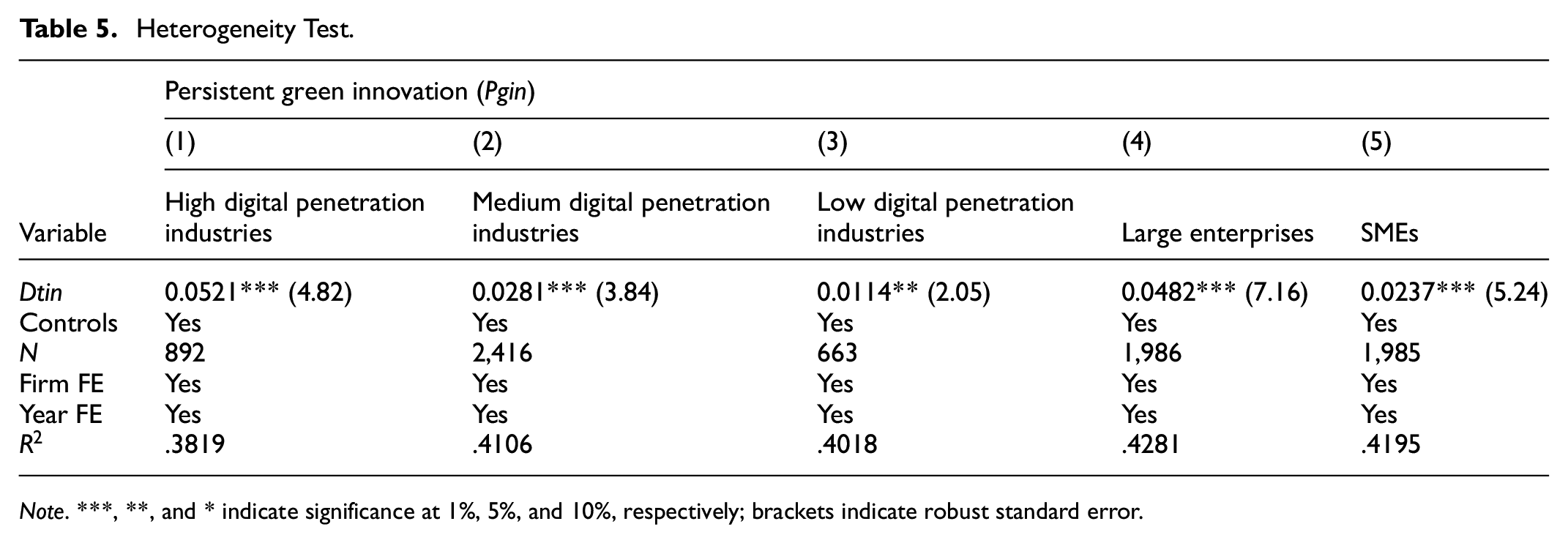
The effect of digital transformation intensity on persistent green innovation may exhibit heterogeneity due to differences in industry technological attributes and digital penetration rates. Based on the CSRC industry classification, this study divides the sample into high digital penetration industries (e.g., information technology and finance), medium digital penetration industries (e.g., manufacturing and utilities), and low digital penetration industries (e.g., mining, agriculture, forestry, animal husbandry, and fishing). The empirical results are presented in Columns (1) to (3) of Table 5.
Heterogeneity Test.
Note. ***, **, and * indicate significance at 1%, 5%, and 10%, respectively; brackets indicate robust standard error.
The findings reveal that the positive effect of digital transformation intensity on green innovation is strongest in high digital penetration industries (e.g., information technology), with a coefficient of 0.0521. This is attributed to digital gaps built via their deep accumulation of digital technologies, which facilitates the seamless integration of green technologies and digitalization (e.g., using cloud computing to optimize energy management systems). By contrast, the coefficient for low digital penetration industries (e.g., mining) is only 0.0114, indicating that traditional industries, constrained by lagging digital infrastructure and insufficient technological adaptability, have not yet fully realized the green innovation potential of digital transformation.
Scale-Specific Effects
Differences in firm size may lead to heterogeneity in the effect of digital transformation intensity on persistent green innovation. Large enterprises typically possess stronger resource endowments (e.g., capital, data asset, and cost tolerance) to support long-term investments in digital transformation, whereas SMEs may face constraints such as digital divides or cost barriers, resulting in weaker green innovation effects from digital transformation. To examine this difference, this study divides the sample into large enterprises and SMEs based on the median of total assets and conducts further empirical tests. The results are presented in Columns (4) and (5) of Table 5.
The findings show that the coefficient of digital transformation intensity for large enterprises (0.0482) is significantly higher than that for SMEs (0.0237), indicating that cost barriers produced from economies of scale play a remarkable role in the synergy between digital transformation intensity and persistent green innovation. Large enterprises can reduce unit transformation costs through centralized procurement of digital equipment and the establishment of dedicated data platforms while leveraging their market power to mitigate the risks associated with upfront investments in green innovation. By contrast, SMEs, constrained by fragmented resources (e.g., dispersed supply chains and limited IT budgets), tend to focus on localized optimizations (e.g., financial digitization), which limits their ability to drive systemic green technological innovation.
Robustness Tests
To ensure the robustness of the empirical results, this study conducts robustness tests by replacing the independent and dependent variables and modifying the sample period.
Results After Replacing the Explanatory Variables
First, this paper disaggregates the measurement of digital transformation intensity into two components: the total frequency of digital transformation-related terms and the number of digital patents for empirical testing. Moreover, following the approach of M. Zhou, Xing, and Xu (2024), the ratio of digital R&D investment to total R&D expenses in annual reports is used as a proxy for digital transformation intensity. The empirical results are presented in Columns (1) to (3) of Table 6. In Column (1), using only the frequency of digital transformation-related terms yields a smaller effect on persistent green innovation, with significance only at the 10% level. In Columns (2) and (3), the results indicate that even after replacing the measure of digital transformation intensity, it still has a positive effect on persistent green innovation.
Robustness Tests.

Note. ***, **, and * indicate significance at 1%, 5%, and 10%, respectively; brackets indicate robust standard error.
Results After Replacing the Explained Variable
Although the number of green patents alone may not fully capture the continuity of firms’ green innovation, it is a fundamental indicator of such innovation. Therefore, this paper uses the number of green patents as the dependent variable for empirical testing, with the regression results presented in Column (4) of Table 6. The findings suggest that digital transformation intensity continues to positively influence persistent green innovation.
Results After Modifying the Sample Period
Given that the pace of digital transformation in Chinese firms was relatively slow between 2001 and 2010, its influence may have been underestimated. To address this, the sample period is restricted to 2011 to 2021 for further empirical testing. The results, shown in Column (5) of Table 6, demonstrate that digital transformation intensity still has a positive effect on persistent green innovation, with a regression coefficient significantly larger than that reported in Column (8) of Table 3.
Endogeneity Tests
Given that digital transformation not only requires firms to implement digital operations in various areas but also to utilize advanced digital technologies—many of which may themselves be green innovation technologies, which, in turn, enhance digital transformation intensity—this paper further conducts endogeneity tests. Following the method of Krusell et al. (2000), the average digital transformation intensity of firms in different industries (
Endogeneity Test Results.

Note. ***, **, and * indicate significance at 1%, 5%, and 10%, respectively; brackets indicate robust standard error.
Mediation Effect Tests
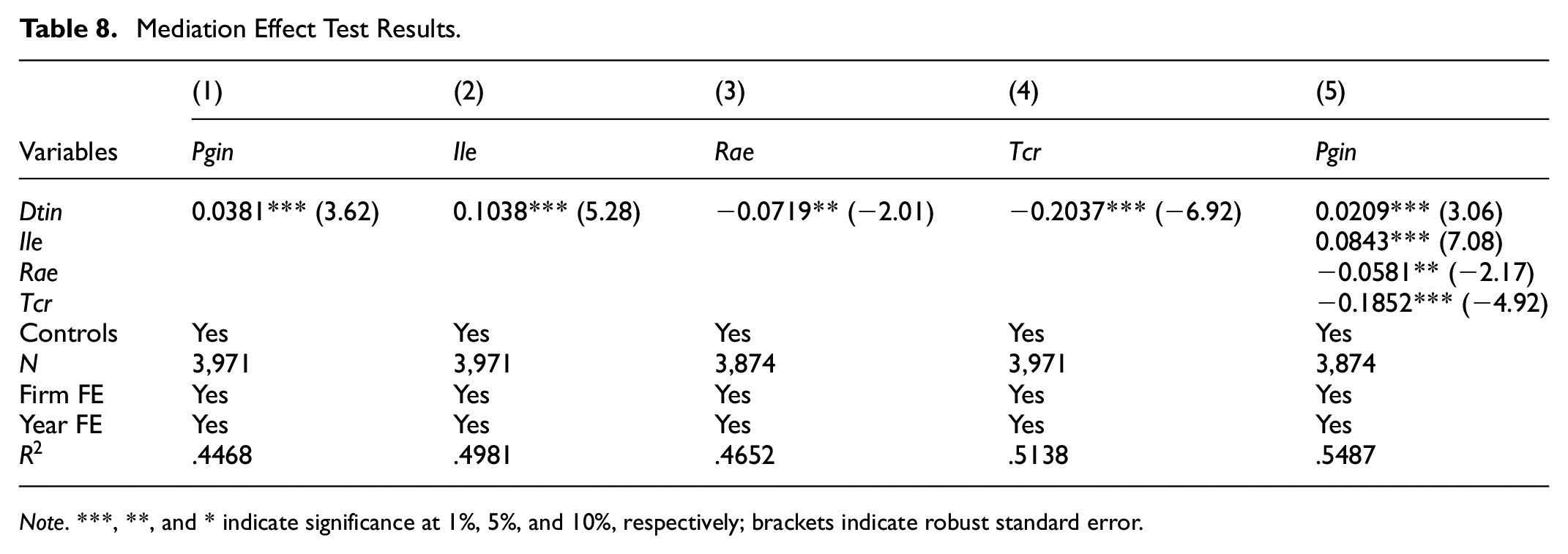
Table 8 presents the mediation effect test results for innovation learning, resource allocation, and transaction cost reduction effects. In Column (5) of Table 8, after incorporating all the mediating variables, digital transformation intensity still positively affects persistent green innovation, although the effect size diminishes significantly. Moreover, all the mediating variables positively contribute to the development of persistent green innovation. This suggests that innovation learning, resource allocation, and transaction cost reduction partially mediate the effect of digital transformation intensity on persistent green innovation, thereby confirming Hypothesis 2.
Mediation Effect Test Results.
Note. ***, **, and * indicate significance at 1%, 5%, and 10%, respectively; brackets indicate robust standard error.
The economic logic underlying this effect is as follows. From the perspective of innovation learning, digital transformation introduces advanced information technologies and data analysis tools, enabling firms to more effectively collect, process, and utilize vast amounts of internal and external information. This helps firms more quickly identify market and technological trends, thereby fostering innovative thinking. Furthermore, digital transformation strengthens internal knowledge sharing and collaboration, enhancing employees’ innovation capacity. From the resource allocation perspective, digital transformation helps firms better identify and seize market opportunities by utilizing digital tools to gain deeper insights into market demands and consumer behavior, thereby optimizing the allocation of internal resources, improving resource utilization efficiency, and ultimately enhancing persistent green innovation capabilities. From the transaction cost reduction perspective, digital tools enable firms to communicate and collaborate more quickly and easily with suppliers, customers, and other partners. This reduces the costs of information transmission and coordination, improves managing supply chains, and lowers logistics costs and risks, thereby increasing R&D investment in persistent green innovation.
Empirical Examination of the Positive Moderating Role of NQPF
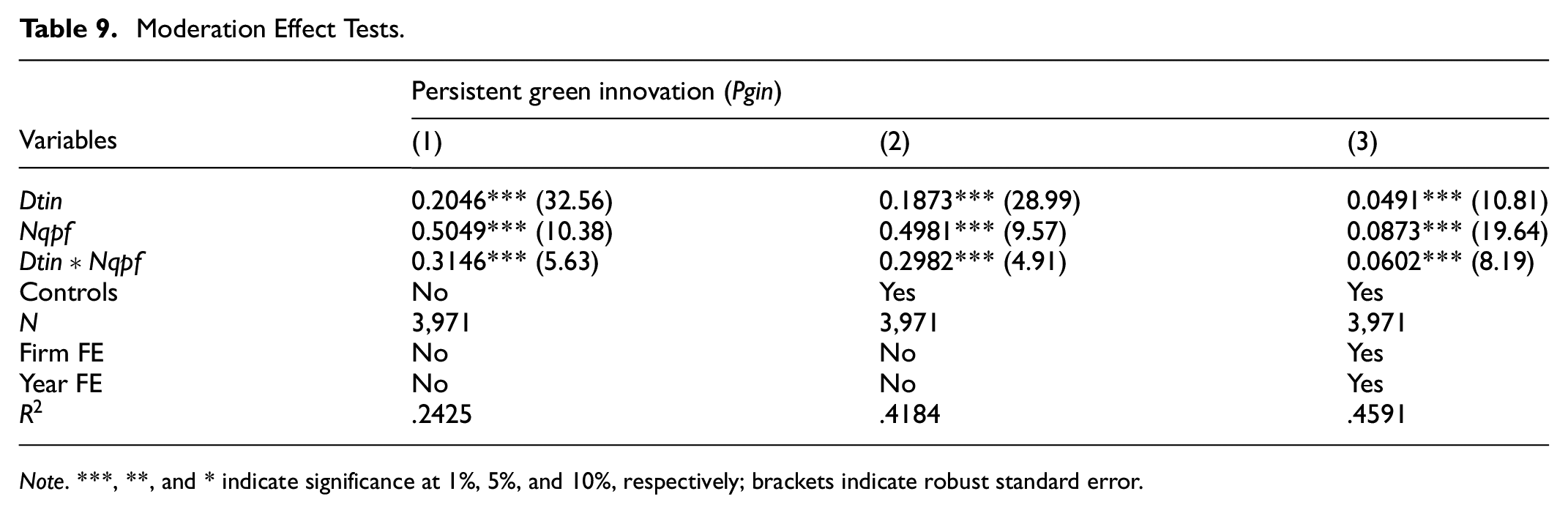
On the basis of the concept of NQPF and Hypothesis 3, NQPF not only enhance digital transformation intensity but also promote persistent green innovation. Therefore, this paper further empirically tests the moderating role of NQPF in the relationship between digital transformation intensity and persistent green innovation. The results are shown in Table 9. In Column (3), after incorporating the interaction term between digital transformation intensity and NQPF, the coefficient of the interaction term is significantly positive, and the effect of digital transformation intensity on persistent green innovation is significantly larger than that in Column (8) of Table 3. This indicates that NQPF positively moderates the effect of digital transformation intensity on persistent green innovation, thereby confirming Hypothesis 3.
Moderation Effect Tests.
Note. ***, **, and * indicate significance at 1%, 5%, and 10%, respectively; brackets indicate robust standard error.
One possible explanation is that the enhancement of NQPF encourages firms to adopt more environmentally friendly and efficient technologies, which themselves may constitute part of green innovation. As a result, the combination of NQPF, digital tools, and digital platforms enables more precise and efficient control over product design, production processes, and supply chain management, thereby fostering the development of green innovation. Furthermore, the improvement of NQPF helps firms better respond to market changes and shifts in consumer demand. Under the backdrop of digital transformation, firms can leverage NQPF to quickly adjust their products and services to meet the growing demand for green and sustainable products, gaining a competitive advantage and further promoting persistent green innovation.
Further Discussion
Relationship With Existing Literature on Digital Transformation
Existing studies have predominantly focused on the influence of the “presence or absence” of digital transformation on corporate innovation or green development. However, by introducing the concept of digital transformation intensity, this study deepens the understanding of the dynamics and continuity of digital transformation. The results show that the positive effect of digital transformation intensity on persistent green innovation does not exhibit an inverted U-shaped relationship (Column 9 of Table 3), which contrasts with the view held by some scholars that “digital transformation may crowd out innovation funding.” A possible explanation is that the long-term benefits of digital transformation can offset short-term investment costs, and green innovation itself may rely on the foundational support of digital technologies. This finding expands the boundaries of digital transformation theory, suggesting that sustained investment in digital transformation is key to unlocking its potential for green innovation.
Contributions to the Theory of NQPF
The moderating effect of NQPF validates its role as an “innovation catalyst.” This study is the first to translate NQPF from a macro-level policy concept into a quantifiable provincial-level indicator and empirically tests its moderating effect on corporate green innovation. The results demonstrate that NQPF enhance the green innovation effects of digital transformation through technological synergy and resource integration, providing micro-level evidence for the theoretical hypothesis that “NQPF empower high-quality development.” Furthermore, the moderating effect of NQPF is more pronounced in the application of foundational digital technologies, indicating that technology-driven productivity upgrades are a core pathway for the synergy between digital transformation and green innovation.
Research Limitations and Future Directions
This study has the following limitations. First, the measurement of new quality productivity forces is focused only on the provincial level. Future research could explore enterprise-level indicators, particularly the digital divide in the digital transformation of SMEs, such as inequalities in technology access and digital skill gaps. Second, the sustainability of green innovation is measured solely through patent growth, without encompassing nontechnical dimensions such as management innovation and supply chain dynamics. Third, the study does not address cross-country differences in digital transformation intensity and green innovation, especially the disparities between developing and developed countries in terms of digital infrastructure, policy support, and technological capabilities. Follow-up research could incorporate enterprise case studies and cross-country data for in-depth analysis, providing more universal and practical insights.
Research Conclusions and Policy Implications
Conclusions
This study, based on the L-P analytical framework, not only validates the positive effect of digital transformation intensity on firms’ persistent green innovation but also reveals its underlying mechanisms, heterogeneity characteristics, and the moderating role of NQPF. The main research conclusions are as follows.
(1) Enhancing digital transformation intensity has a significant and robust positive effect on firms’ persistent green innovation. This conclusion holds true after multiple robustness and endogeneity tests, indicating that digital transformation is not only a key driver of corporate green innovation but also a core strategy for achieving sustainable development in the future. This finding provides a solid theoretical foundation for firms to achieve green transformation through digital means in complex and dynamic market environments.
(2) The positive effect of digital transformation intensity on persistent green innovation exhibits significant heterogeneity across different contexts. Specifically, non-SOEs, capital-intensive firms, enterprises located in regions with advanced digital infrastructure, and firms that extensively apply foundational digital technologies demonstrate more pronounced green innovation outcomes. This finding offers important insights for policymakers to design targeted measures and provide differentiated guidance for corporate green innovation.
(3) Digital transformation intensity significantly drives persistent green innovation through three key mechanisms: innovation learning effects, resource allocation effects, and transaction cost reduction effects. These mechanisms deepen the understanding of the relationship between digital transformation and green innovation while providing actionable pathways for firms to formulate digital transformation strategies.
(4) The effect of digital transformation intensity on persistent green innovation follows a linear growth trend rather than an inverted U-shaped relationship. This result suggests that as digital transformation intensity continues to increase, the potential for green innovation will be persistently unlocked, with no sign of diminishing marginal effects. This provides confidence for firms to make long-term investments in digital transformation to fully realize the long-term benefits of green innovation.
(5) NQPF play a significantly positive moderating role in the process through which digital transformation intensity promotes persistent green innovation. This conclusion offers a new perspective for future research on the deep integration of digital transformation and NQPF. It also suggests a pathway for firms to achieve rapid development through simultaneous transformation in digitalization and greenization.
Policy Implications
This paper argues that the Chinese government and enterprises could make joint efforts on synergistic transformation of digitalization and greenization. The government should create a favorable external environment through top-level design, policy support, and resource integration. Enterprises, on their part, should enhance their digital transformation capabilities and the sustained momentum of green innovation. Specifically:
(1) The research results indicate that the level of digital infrastructure not only directly affects the enhancement of corporate digital transformation intensity but also significantly influences persistent green innovation. Therefore, the Chinese government should accelerate the construction of digital infrastructure to promote the synergistic development of digital transformation and green innovation. The government should also promote data sharing and openness; expedite the construction of a national data-sharing platform; and facilitate the interconnection of government, industry, and corporate data to provide high-quality data support for corporate digital transformation and green innovation.
(2) Chinese enterprises should strengthen the foundation of digital transformation by increasing investment in digital infrastructure to enhance data processing capabilities and efficiency, thereby driving green technology innovation. Moreover, enterprises should focus on cultivating digital talent, training, and reserving technical experts to improve the overall implementation capacity of digital transformation.
(3) The Chinese government and enterprises should embrace NQPF by increasing investment in green technology R&D, leveraging digitalization to optimize production processes, and promoting green digital transformation while enhancing production efficiency.
Through the above recommendations, the government and enterprises can form a collaborative force to jointly advance the synergistic development of digital transformation and digital transformation.
Footnotes

Ethical Considerations
This article does not contain any studies with human participants or animals performed by the authors.
Funding
The author(s) disclosed receipt of the following financial support for the research, authorship, and/or publication of this article: This work was supported by: National Natural Science Foundation of China (Grant No. 72273057,72163009). 2024 Social Science Foundation of Jiangxi Province (Grant No. 24JL08). 2023 Humanities Project of Colleges in Jiangxi Province (Grant No. GL23216). 2021 Jiangxi Province Graduate Innovation Special Fund Project (Grant No. YC2021-B111). 2024 Humanities Project of Colleges in Jiangxi Province, (Grant No. JJ24202).
Declaration of Conflicting Interests
The author(s) declared no potential conflicts of interest with respect to the research, authorship, and/or publication of this article.
Data Availability Statement
Data is available from the corresponding author upon reasonable request.