




Abstract
Local governments’ monopolistic low-price supply of industrial land has long induced industrial land dependence (ILD), triggering a “resource curse” that hinders high-quality industrial development. Using panel data from 286 Chinese cities (2003–2022), this study examines ILD’s impact on industrial land use efficiency (ILUE), its transmission mechanisms, and heterogeneity. Drawing on resource curse theory, we propose that ILD reduces ILUE via enterprise entry-exit imbalances, resource misallocation, innovation suppression, and environmental pollution. Innovations include: (1) Focusing on existing low-efficiency land rather than new allocations; (2) Employing mediation effect models to verify ILD’s pathways through excessive enterprise entry, hindered low-efficiency exits, rigid resource allocation, innovation suppression, and pollution exacerbation; (3) Using the 2012 abandoned industrial land reclamation pilot as a negative shock to reveal ILD’s curse mechanism. Results show: (1) ILD significantly reduces ILUE, while reclamation pilots enhance ILUE; (2) Mediation analysis confirms enterprise imbalances, resource misallocation, and innovation suppression mediate ILD’s negative effects, with pollution amplifying efficiency losses; (3) Land marketization and industrial restructuring significantly boost ILUE in small-medium and non-resource-based cities. This study offers policy insights for breaking the industrial land curse, fostering economic growth, and upgrading industrial structures.
Keywords
Introduction
Enhancing the utilization efficiency of urban industrial land is crucial for China’s sustainable socioeconomic development (Luo & Peng, 2016). However, the conventional “seeking development through land” model, where local governments leverage their monopolistic control over the land market to supply industrial land at low prices (Fan & Mo, 2014; S. Liu et al., 2022; Y. Liu & Chen, 2020), has led to a “resource curse” effect, whereby industrial land dependence (ILD) undermines high-quality industrial development. Drawing on Auty’s (1993) resource curse hypothesis and Sachs and Warner’s (2001) transmission mechanisms, this study posits that ILD mirrors resource dependence, distorting land markets, altering enterprise behavior, and causing resource misallocation, ultimately reducing industrial land use efficiency (ILUE). China’s rapid urbanization and industrialization have driven economic growth but also resulted in disorderly industrial land use, with extensive industrial parks and high-tech zones characterized by low efficiency (S. Y. Liu et al., 2020). As urban expansion faces land scarcity constraints, shifting from incremental land development to optimizing existing stock is critical. Addressing ILD’s adverse effects is essential for achieving high-quality industrial development within limited land resources.
Industry acts as a vital driver of socioeconomic development (Pu & Zhang, 2021). local governments attract industrial investments through low-cost land supply (Y. Liu, 2018). During industrialization (G. C. S. Lin, 2007), China’s industrial land expanded rapidly (Z. Huang et al., 2017), accounting for 19.7% of urban construction land in 2019 (global average: 10%). While land expansion provides spatial foundations for urban growth (Tu et al., 2014), restricted secondary market transactions limit economic efficiency (H. Xie et al., 2016). In the post-industrial era, local governments are increasingly focusing on restraining the expansion of industrial land and facilitating its transfer (T. Wang et al., 2019; J. Zhang et al., 2019), international practices emphasize brownfield regeneration (Green, 2018; Jamecny & Husar, 2016), while China adopts land consolidation and mixed-use strategies (H. Xie et al., 2016).
This study adopts a resource curse perspective, integrating land economics to examine ILD’s impact on ILUE. Unlike prior studies focusing on new land transfers, we analyze the stock of low-efficiency industrial land, a critical but underexplored constraint on high-quality industrial development. We propose a theoretical framework where ILD reduces ILUE through: (1) Land market distortions, as low prices encourage inefficient land use; (2) Imbalanced enterprise entry-exit dynamics, where ILD lowers entry barriers but suppresses the exit of low-productivity firms; (3) Resource misallocation, which stifles innovation and increases pollution. Using panel data from 286 prefecture-level cities (2003–2022), we empirically test these mechanisms and explore heterogeneity across regions, city sizes, resource-rich cities.
This study contributes by: (1) Extending the resource curse framework to industrial land, incorporating China’s unique land system. Existing studies on resource curse (Auty, 1993; Sachs & Warner, 2001) highlight how resource dependence distorts markets and misallocates resources, yet few apply this lens to industrial land. This study fills this gap by examining ILD as a land-based curse, integrating resource curse theory with land economics. (2) Developing a transmission chain (“ILD → land market distortion → entry-exit imbalance → resource misallocation → reduced ILUE”) grounded in Melitz’s (2003) firm heterogeneity model. (3) Providing empirical evidence on ILD’s pervasive effects and policy implications for high-quality industrial development.
The research structure encompasses literature review, industrial land policy background and theoretical modeling, empirical verification, discussion, and policy implications.
Literature Review
Existing research, apart from measuring ILUE (Shi, 2009; Xiong & Guo, 2013), has predominantly focused on exploring the factors influencing ILUE, with a primary emphasis on the land market, government governance, and socioeconomic factors.
Land Market Factors
Transfer Methods and Property Rights Differences
Y. Zhang and Zhou (2007) identified that the planned supply mode of industrial land leads to inefficient utilization, while Y. Meng et al. (2008) emphasized that quantity control, spatial layout, and development timing constitute three primary factors influencing industrial land use efficiency. K. Wang et al. (2013) empirically demonstrated through comparative analysis that the market-oriented supply approach yields higher output elasticity than planned supply. Wu et al. (2009) proved that integrating market mechanisms with government planning enhances efficiency. Tu et al. (2014) found that industry type, land lease duration, and land size exert more significant impacts on industrial land use efficiency compared to government interventions, with a negative correlation between land lease durations and efficiency. However, B. Wang et al. (2019) revealed spatially heterogeneous negative effects of government interventions, showing weaker impacts in eastern regions and stronger impacts in western China. Regarding property rights constraints, Choy et al. (2013) confirmed that collective land with incomplete property rights results in inefficient land use by small and medium enterprises. Du et al. (2016) and Turnbull (2010) highlighted that blind urban expansion, non-transparent land pricing, and illegal transfers of land-use rights exacerbate efficiency losses.
Industrial Land Planning and Location
Regional analyses reveal urbanized areas demonstrate higher productivity than peripheral regions (W. Chen et al., 2018; Louw et al., 2012; J. Zhang et al., 2019). Park and Kim’s (2022) study of 697 South Korean industrial parks (2011–2020) shows sprawling developments negatively correlate with land productivity across all park types. While industrial parks enhance efficiency through knowledge spillovers and labor mobility (Cainelli, 2008; Z. Huang et al., 2017), Ben and Wang (2011) counter that oversized cities/parks diminish efficiency. This paradox manifests in China’s development zones, where park advantages fail to materialize (Zhuang & Li, 2011).
Government Factor
Governance and Policy Support
Advanced industrial land management can effectively boost its utilization efficiency (X. Zhao, 2008). Caragliu and Del Bo (2019) proposed urban border policies to control expansion and enhance urban land use efficiency. B. Wang et al. (2019) found positive spatial correlation in Chinese cities’ land transfer interventions, with industrial land transfer interventions having a west-strengthening negative impact on efficiency. X. Lu et al. (2020) used DID to study 285 Chinese cities (2003–2016) and found high-tech zones positively impact green urban land use efficiency. Song et al. (2023) showed expenditure policies for resource-oriented cities improve industrial land use in China’s resource-exhausted cities. Zhu et al. (2023), with panel data from 277 cities (2009–2019), found differential urban land use tax policies can enhance industrial land use efficiency, mainly by spurring tech innovation and industrial restructuring. Moreover, policies like Shrinking Cities (Y. Wang et al., 2022), carbon trading (Duan & Ji, 2021), building resource-saving and eco-friendly societies (Pu et al., 2021), smart city construction (A. Wang et al., 2021), and New Energy Demonstration City Policy (M. Wang et al., 2023) also contribute to improving industrial land use efficiency.
Policy-Guided Industrial Development and Migration
Regarding industrial development and relocation, W. Chen et al. (2017) found that higher industrial levels positively impact industrial land use efficiency. H. Xie et al. (2016) emphasized that protecting industrial area ecology is crucial for this efficiency. W. Chen et al. (2018) showed manufacturing agglomerations boost nearby ILUE, and the relocation of chemical, rubber, mineral, and machinery manufacturing industries has a positive effect. Regional economic integration can optimize resource allocation and land-use efficiency (Gao et al., 2020). Rationalizing the industrial structure also benefits land-use efficiency (He & Peng, 2017). Urban industrial agglomeration and intensive land use are well-coordinated (Gong et al., 2021). Z. Wang et al. (2023) indicated that during urbanization, industrial structure optimization correlates positively with urban land use efficiency, while the relationship between industrial structure upgrade and this efficiency is an inverted U-shape, depending on urbanization level.
Other Factors
Current research shows land utilization efficiency is closely linked to economic development level (W. Chen et al., 2019; Yan et al., 2020), market openness (Z. Huang et al., 2017), R&D level (H. Xie et al., 2019; Yan et al., 2020), and public infrastructure level (Sun et al., 2020). Socioeconomic development brings better tech and management for land use, cutting costs and expanding industrial land. Environmental quality crowds out urban land-use efficiency (Peng et al., 2018). W. Chen et al. (2019) found regional economy, industrial structure, and tech level boost industrial land use efficiency, while labor and enterprise ownership structures have negative impacts. J. Zhang et al. (2019) used 2006 to 2016 data from 275 cities to show capital, labor density, urban area, population, economic growth, and industrial structure affect land productivity. S. C. Liu et al. (2021) found enterprise ownership structure harms ILUE, while high-tech manufacturing specialization, urbanization, and transport help, and chemical-rubber specialization and local financial pressure hurt. Yu et al. (2019) evaluated 12 Chinese city clusters, suggesting economic level, structure, and government oversight drive land use efficiency. H. Li et al. (2013) used the Tobit model for urban land green use efficiency. H. Xie et al. (2016) stressed industrial area ecological protection. Capital, labor density, urbanization rate, industrial structure, and land policy also influence land productivity (W. Chen et al., 2018; Louw et al., 2012).
Literature Commentary
Extant studies have systematically revealed the mechanisms through which land market pricing, property rights allocation (Y. Zhang & Zhou, 2007), government governance (X. Lu et al., 2020), and industrial agglomeration (W. Chen et al., 2018) influence industrial land use efficiency (ILUE), establishing a “market-government-industry” analytical framework that provides theoretical support for intensive land use. However, the current perspective overly focuses on incremental land supply mechanisms, failing to systematically deconstruct the “resource curse” effects and transmission pathways caused by long-term dependence on existing industrial land stock.
Firstly, while existing literature examines the impacts of incremental factors such as land transfer pricing (Z. Xie & Zhu, 2019) and marketization levels (X. Yang & Li, 2018), it overlooks the lock-in effects of stock dependence on industrial development. Empirical evidence shows that industrial land stock expansion triggers subsidy competition (Z. Xie & Zhu, 2019), overinvestment (X. Wang et al., 2021), and productivity decline (Zhang et al., 2019) through low-price supply (J. Huang et al., 2015), creating a vicious cycle of “inefficient supply → resource misallocation → path dependency” (Z. Huang et al., 2022). Market-oriented allocation only partially alleviates these issues (Q. Yang et al., 2014) without addressing the deep-rooted institutional inertia of the stock-driven resource curse.
Secondly, although scholars recognize that the resource curse inhibits economic growth through human capital displacement (Sachs & Warner, 2001) and rent-seeking (Krueger Anne, 1974), they have not constructed transmission chains specific to industrial land dependence. In the land context, Auty’s (1993) “resource-institution” paradox manifests as local governments acquiring excessive rents through land finance (T. Chen & Kung, 2016), distorting official promotion mechanisms (prioritizing signaling over genuine GDP growth), and consequently weakening industrial innovation investment (Papyrakis & Gerlagh, 2007) and resource allocation flexibility (Badeeb et al., 2017). This “dual lock-in” political-economic mechanism urgently requires empirical validation. Existing studies on the resource curse (Auty, 1993; Sachs & Warner, 2001) have demonstrated how resource dependence distorts markets and induces resource misallocation, yet few have applied this perspective to industrial land. This study extends the typology and theoretical mechanisms of the resource curse by conceptualizing industrial land dependence (ILD) as a land-based resource curse, thereby integrating resource curse theory with land economics.
Industrial Land Policy Background and Theoretical Model Analysis
Industrial Land Policy Background
Local governments have been pivotal to China’s economic growth since the reform and opening-up period, leveraging their monopoly over the primary land market to control land supply and pricing (Ma et al., 2017). This monopoly, rooted in the 1982 Constitution and the Land Administration Law (1986, revised 1998, 2004), designates urban land as state-owned and restricts collective land transfers for non-agricultural use. Local governments act as sole buyers of collective land and sellers in the primary market, creating a “dual-track” system of expropriation and transfer (Bao et al., 2016). High transfer costs, low holding costs (holding costs amount to only 0.5%–2%; C. Meng et al., 2016), and heavy taxation on secondary market transactions (e.g., 30%–60% land value-added tax) discourage land reallocation, leading to idle and inefficient land use (Y. Chen & Zhong, 2016).
Driven by GDP-focused performance evaluations, local governments have pursued “land-based capital attraction,” supplying industrial land at low or zero cost to attract investment (Tao et al., 2009; L. Zhang et al., 2017). Between 2009 and 2014, industrial land accounted for over 28% of total land supply, exceeding national standards, but was priced at merely 14.5% of residential land (D. Xie, 2018). This strategy has fueled economic growth but also caused overcapacity, land hoarding, and environmental degradation.
The central government has introduced reforms to address these issues. The 1990 Interim Regulations shifted industrial land transfers to agreement-based mechanisms, but low prices persisted (Wu, 2007). The 2002 Regulations mandated competitive bidding, auction, and listing for commercial land, extended to industrial land by 2006 (Order No. 39, 2007; J. Xu et al., 2009). The 2007 National Minimum Price Standard and 2014 Provisions on Economical and Intensive Land Use promoted market-oriented transfers and flexible leasing (W. Xie & Qu, 2021), yet industrial land prices remained low, and long transfer periods (up to 40–50 years) persisted, misaligned with SMEs’ average 5-year lifespan and under 3% idle land recovery rate (L. Zhou, 2020). The 2020 Market-oriented Factors Allocation Guidelines emphasize industrial land reform, though outcomes require verification (Pi & Li, 2020). These policies have had limited success in curbing ILD’s adverse effects, as idle land and inefficient use remain prevalent. Industrial land area increased 57% during 2004 to 2016, yet its GDP contribution declined by 8 percentage points (Y. Zhou et al., 2019).
Theoretical Model Analysis
Theoretical Framework
Drawing on Auty’s (1993) resource curse hypothesis and Sachs and Warner’s (2001) transmission mechanisms, we conceptualize ILD as a resource curse, where over-reliance on low-cost industrial land distorts economic incentives and reduces ILUE. Auty (1993) argues that resource dependence leads to economic distortions, rent-seeking, and sectoral imbalances, akin to the Dutch Disease, where resource sectors crowd out manufacturing. Sachs and Warner (2001) identify crowding-out, institutional weakness, and resource misallocation as key channels through which resource abundance hinders growth. In China’s context, ILD mirrors resource dependence, as local governments’ monopoly and fiscal reliance on land revenue (land finance) create a “land curse,” distorting the land market, altering enterprise behavior, and misallocating resources.
Land economics complements this framework by highlighting how market distortions, such as subsidized land prices, lead to inefficient resource allocation. China’s land system amplifies these effects: low industrial land prices reduce entry barriers, encouraging excessive firm entry, while high secondary market taxes and long transfer periods suppress the exit of inefficient firms, rigidifying resource allocation. The Melitz (2003) model of firm heterogeneity further elucidates how ILD disrupts the natural selection of high-productivity firms, lowering overall economic efficiency.
We propose a transmission chain: ILD → land market distortion → imbalanced enterprise entry-exit → resource misallocation → reduced ILUE. Specifically: ① Land Market Distortion: Low land prices, driven by local government monopolies and land finance, encourage overinvestment in low-efficiency projects, crowding out high-value industries (Auty, 1993). ② Enterprise Behavior Imbalance: Cheap land lowers entry barriers, increasing new firm entry, but suppresses exit of low-productivity firms due to low holding costs and secondary market barriers (A. Zhao et al., 2016), disrupting market selection (Melitz, 2003; Sachs & Warner, 2001). ③ Resource Misallocation: The entry-exit imbalance ties capital and labor to inefficient firms, reducing innovation and increasing pollution, undermining ILUE (Sachs & Warner, 2001; C. Xie & Hu, 2020). ④ China-Specific Context: Land finance and long transfer periods exacerbate these effects, creating a feedback loop where ILD perpetuates inefficiency.
Hypotheses: ① H1: ILD negatively affects ILUE due to resource curse effects. ② H2: ILD causes an imbalance in enterprise entry-exit, exacerbating resource misallocation. ③ H3: The impact of ILD on ILUE varies by region, city size, and land policy.
Model Specification
Assuming that the representative consumer has a CES utility function, the alternative good ω belongs to a large set Ω:

the price index is:

Firm demand and revenue are:
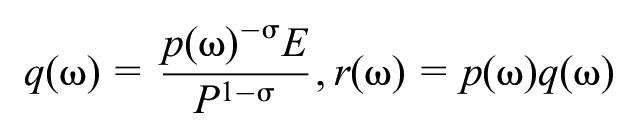
Firms produce using labor (L), with variable costs dependent on productivity ϕ:

Fixed costs include land costs

Firm profits are:

Productivity ϕ follows a distribution

Under free entry and exit, firms enter until expected profits are zero. Firms learn their productivity ϕ upon entry and exit if profits are negative, facing an exogenous exit shock δ. The zero-profit cutoff productivity

From this, we derive:

Lower land costs

A lower
The theoretical model yields the following conclusions: ① ILD reduces the entry threshold
Econometric Model and Data Description
Econometric Model and Variable Description
Building upon prior literature reviews and theoretical analysis, we establish the following econometric regression model to examine the impact of ILD on the logarithm of ILUE in prefecture-level and higher cities in China:

In Equation 10, the variables m and t represent the city and year, respectively, while the explained variable

where m represents the city, t represents the year, ilue represents the industrial land productivity of a certain city in a certain year,gyzjz represents the general industrial output value of a city in some year, and area represents the industrial land area of a city.
The main independent variable, denoted as “gyydyl”, represents the reliance on industrial land. We measure urban industrial employment density as the ratio of industrial land area to industrial employment, reflecting land-labor matching efficiency; the share of industrial land in urban construction land area (H. Xu et al., 2025) to capture its spatial planning weight; and fiscal dependence on land revenue as the ratio of land concession fees to local general budget revenue (Liang & Lan, 2023). These three indicators are integrated using the entropy weight method to construct a comprehensive industrial land dependence (ILD) index.
Other relevant control variables include: (1) Mineral resource dependence (kczyyl), which is measured by the ratio of employees in the mining industry to total industrial employees (Shao et al., 2013). According to the resource curse theory, the regression coefficient for this variable is expected to be negative. (2) Physical capital investment (wzzbtz), represented by the proportion of total social fixed asset investment to GDP (Shao et al., 2013). It is difficult to determine in advance whether the regression coefficients are positive or negative. (3) Urban R&D innovation factors (invo), quantified by the logarithm of the total number of patents obtained by the city in a given year, contribute to the enhancement of ILUE (Yan et al., 2020). (4) The level of a city’s openness (dwkfcd) is gauged by the proportion of utilized foreign direct investment (FDI) to GDP in the current year. Assessing the impact of foreign capital on land use efficiency is challenging due to the varying quality of foreign investments. (5) Urban foreign trade (dwmy) is quantified by the logarithm of export volume (B. Lin & Liu, 2015). (6) Economic growth target pressure (jjzzmbyl) and its quadratic term (
Data Sources
The data of industrial land area come from China’s urban and rural construction database, while industrial added value and industrial employment are sourced from the China Urban Statistical Yearbooks. The data of industrial land in a municipal district are collected to compare urban difference, which are the data from 2003 to 2022. Moreover, the data are revised with 2003 as the base year to reflect the real change of productivity. The data of industrial land productivity from 2003 to 2022 will be reduced to 2003 on the basis of the corresponding related price index, which can be retrieved from the China Statistical Yearbooks. The data for control variables, including the number of employees in the mining industry, the total social fixed asset investment of the entire city, GDP, the actual utilized FDI, the export volume, and the proportion of the three industries, are sourced from the Chinese city database. The total number of patents obtained in the city each year is derived from the patent database of Chinese enterprises. Urban economic growth targets are derived from the annual government work reports of cities at the prefecture level and above in China. The GDP and industrial added value data from 2003 to 2022 will be adjusted to 2003 levels using the factory gate price index of each province. The data for the total social fixed asset investment of the entire city from 2003 to 2022 will be adjusted to 2003 levels using the fixed asset investment value index of each province. The statistical data of the number of new enterprises and cancelled enterprises from 2003 to 2022 in prefecture-level and above cities comes from the big data of China Business Registration Information Data. The actual utilized FDI and export volume in the current year, denominated in USD, are adjusted for inflation using the constant USD price with 2003 as the base period to eliminate the influence of price changes. Land-related data are sourced from the China Soil Dataset of the Harmonized World Soil Database (HWSD), downloaded from the National Cryosphere Desert Data Center. The 2010 annual nighttime light data for China are obtained from the Resource and Environmental Science and Data Platform.
Descriptive Statistics
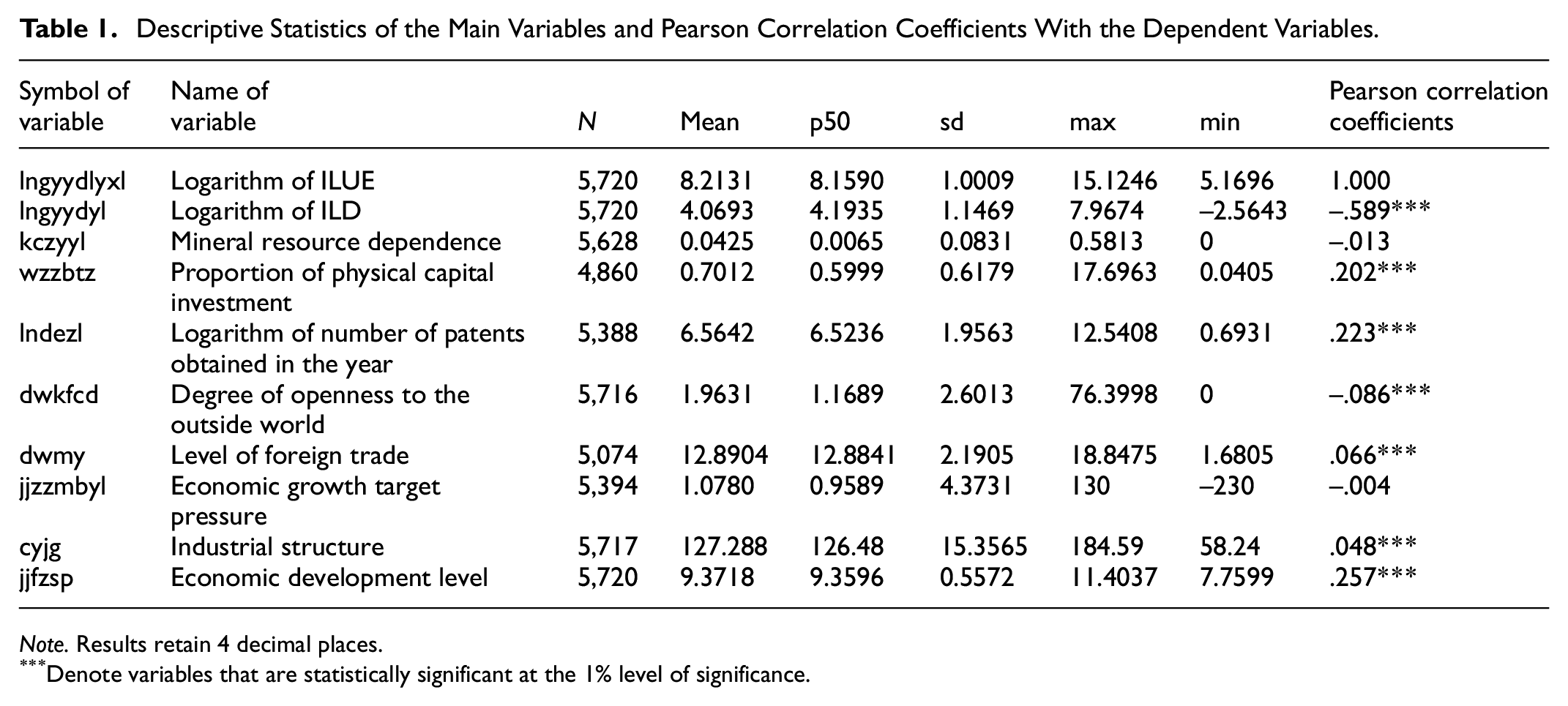
Table 1 presents the descriptive statistics and Pearson correlation coefficients for each variable with the dependent variable. The logarithm of ILUE has a mean value of 8.2131 and a standard deviation of 1.0009. The maximum value is 15.1245, and the minimum value is 5.1696. The standard deviation, being relatively small compared to the mean, indicates a relatively concentrated overall distribution density of ILUE in cities at the prefecture-level and above in China. Similar to ILUE, the overall distribution density of the logarithm of ILD is also relatively concentrated. Its mean (4.0693) is lower than the mean (8.2131) of ILUE, and its standard deviation (1.1469) is similar to that of ILUE (1.0009). This suggests that the coefficient of variation for ILD is relatively large compared to the logarithm of ILUE.
Descriptive Statistics of the Main Variables and Pearson Correlation Coefficients With the Dependent Variables.
Note. Results retain 4 decimal places.
Denote variables that are statistically significant at the 1% level of significance.
Mineral resource dependence has a mean value of 0.0425 and a standard deviation of 0.0831, indicating significant variation among cities. The average value of the proportion of physical capital investment is 0.7012, indicating a significant contribution of social capital investment to GDP and reflecting the investment-driven characteristics of China’s economy. The average value of the logarithm of number of patents obtained in the year is 6.5642. The maximum value is 12.5408, and the minimum value is 0.6931, indicating substantial variation in the total number of patents obtained among cities. The degree of openness to the outside world and the level of foreign trade, similar to the total number of patents obtained in that year, exhibit significant variation among cities.
The economic growth target pressure has a mean value of 1.0780, while the maximum value is 130, and the minimum value is −230, indicating a substantial deviation between the economic growth target and the actual economic growth speed in certain cities. The industrial structure and the level of economic development, similar to the total number of patents obtained in the same year, exhibit significant variation among cities. The Pearson correlation coefficient between the logarithm of ILD and the logarithm of ILUE is −.589, which is statistically significant at the 1% significance level. This suggests a substantial negative correlation between ILD and ILUE. The correlation coefficients of other variables are not discussed in this study.
Empirical Results and Analysis
Benchmark Regression Results
We conducted regression analysis using panel data from 286 cities at the prefecture-level and above in China, employing stata13.1 software. On the one hand, in order to control the effects of land endowment and economic endowment at the city level, as well as the effects of land policy and economic policy in different years, the fixed effects of both city and year should be controlled to reduce the bias caused by missing variables; on the other hand, the estimation feasibility and the calculation speed should be considered. To this end, we used the multidimensional panel fixed effect estimate to enhance computational efficiency and used the estimation results, which include dummy variables and control variables, as the benchmark for exposition.
Table 2 presents the regression results for ILD and ILUE. Table 2 displays four different regression models: (1) Least squares regression (OLS) with only core independent variables, (2) Least squares regression (OLS) with core independent variables and control variables, (3) Multi-dimensional panel fixed effects regression (reghdfe) with only core independent variables and dummy variables, and (4) Multi-dimensional panel fixed effects regression (reghdfe) with core independent variables, dummy variables, and control variables. These models test the impact of variable changes on the regression results.
Benchmark Regression Results of ILD and ILUE.

Denote variables that are statistically significant at the 1% and 5% levels of significance, respectively.
The regression results presented in Table 2 demonstrate an improvement in the goodness of fit after incorporating control variables. The goodness of fit for the least square method increases significantly from 0.3474 to 0.4733, while the multi-dimensional panel fixed effect regression shows a notable increase in goodness of fit from 0.8941 to 0.9090. The dependence on industrial land negatively affects its utilization efficiency, as supported by statistical significance at the 1% level.
Regarding control variables, it is observed that employees proportion in the mining industry, physical capital investment, foreign trade, the degree of openness to the outside world, industrialization in the industrial structure, positively influences the efficiency of industrial land utilization. The impact of the number of patents obtained in the current year, and the level of economic development on ILUE is inconsistent, making it challenging to draw a unified conclusion. The coefficient reflecting the influence of the pressure of economic growth targets on ILUE consistently remains insignificant, indicating a lack of impact.
Robustness Test
(1) In addition to the single index method, data envelopment analysis is used to measure ILUE. This study refers to existing literature, and considers industrial land, industrial capital stock, employment, and industrial electricity consumption as inputs, and takes industrial added value, industrial sulfur dioxide emissions, and industrial wastewater emissions as outputs. It measures the utilization efficiency of industrial land in cities at the prefecture level and above in China by using two methods: global non-radial directional distance function (NDDF; H. Xie et al., 2019) and slacks-based directional distance function (SBM-DDF) ( A. Wang et al., 2021). The specific regression results can be found in columns (1) and (2) of Table 3, labeled as NDDF-ilue and DDF-ilue, respectively.
(2) Bidirectional causality may exist between ILD and ILUE. The low utilization efficiency of industrial land may result from backward industrial development and an excess of available industrial land. This situation leads to a surplus of undeveloped industrial land, which local governments can exploit through “attracting capital from land” strategies to stimulate industrial growth, thereby creating a dependence on industrial land (Tao et al., 2009). To assess the robustness of the benchmark regression results, this study employs the following methodologies: (1) Lagged dependence on industrial land is used as the independent variable to mitigate potential causality issues. (2) The average slope of the city and the distance from the city to the nearest port are used as instrumental variables for ILD. The average urban slope reflects the availability of industrial land and the construction costs associated with it, while the distance from the city to the nearest port represents the demand for industrial land in coastal regions and inland cities driven by China’s export-oriented strategy since the reform and opening up. Additionally, due to the small sample nature of LIMI potentially outperforming 2SLS and to address concerns about weak instrumental variables and non-spherical disturbances, the instrumental variable regression employs the commands of 2SLS and LIMI. (3) Given that the efficiency index value obtained from the data enveloping analysis method is double-censored data between 0 and 1, this study adopts the Tobit model as the underlying regression model, following the approach of B. Lin and Liu (2015).
Robustness Test Results.

Denote variables that are statistically significant at the 1%, 5%, and 10% levels of significance, respectively.
Table 3 displays regression results of the robustness test. The analysis of columns (1) and (2) in Table 3 reveals that the regression coefficient of core independent variable remains significantly negative, suggesting that the conclusion is unaffected by potential measurement errors in ILUE. By examining Column (3) in Table 3, it becomes evident that the impact of one-period lagged ILD on the utilization efficiency of industrial land remains significantly negative. However, the magnitude of the regression coefficient increases due to the substantial addition of industrial land since 2003. Columns (4) and (5) of Table 3 present the regression results obtained using 2SLS and LIMI with instrumental variables, respectively. The regression coefficients for the average urban slope and the distance from the city to the nearest port, concerning the logarithm of ILUE, are −0.0196 and 0.0593, respectively. These coefficients have corresponding p-values of .000 and .016, respectively. The p-value of the Anderson canonical correlation LM statistic in the unrecognizable test is .0000, indicating rejection of the null hypothesis that instrumental variables and endogenous variables are uncorrelated at a significance level of 1%. The Cragg-Donald Wald F value in the weak instrumental variable test is 15.79, surpassing the empirical threshold of 10 proposed by Staiger and Stock (1997), suggesting the absence of weak instrumental variable issues. The over-identification test results indicate a Sargan statistic value of 0.730 and a corresponding p-value of .3928, suggesting the absence of overidentification issues. Hence, there is no basis to reject the null hypothesis that all instrumental variables are exogenous. The use of instrumental variables reveals a significantly negative regression coefficient for ILD, further confirming that ILD has a negative impact on ILUE. Columns (6) of Table 3 presents the regression results obtained using 2SLS with instrumental variables. Instrumental variables used the average value of the industrial land dependence of the same province and the slope value of the same province after the industrial land dependence and the average value of the city as the instrumental variables to conduct the robustness test. The results are still stable. Additionally, the Tobit model is employed, and its results are presented in Column (7) of Table 3, which also exhibit a significant negative effect. In conclusion, the estimated coefficients maintain consistent signs and significance levels, providing further support for the robustness of the benchmark regression results.
To enhance the credibility of the research conclusions, the following methods were employed:
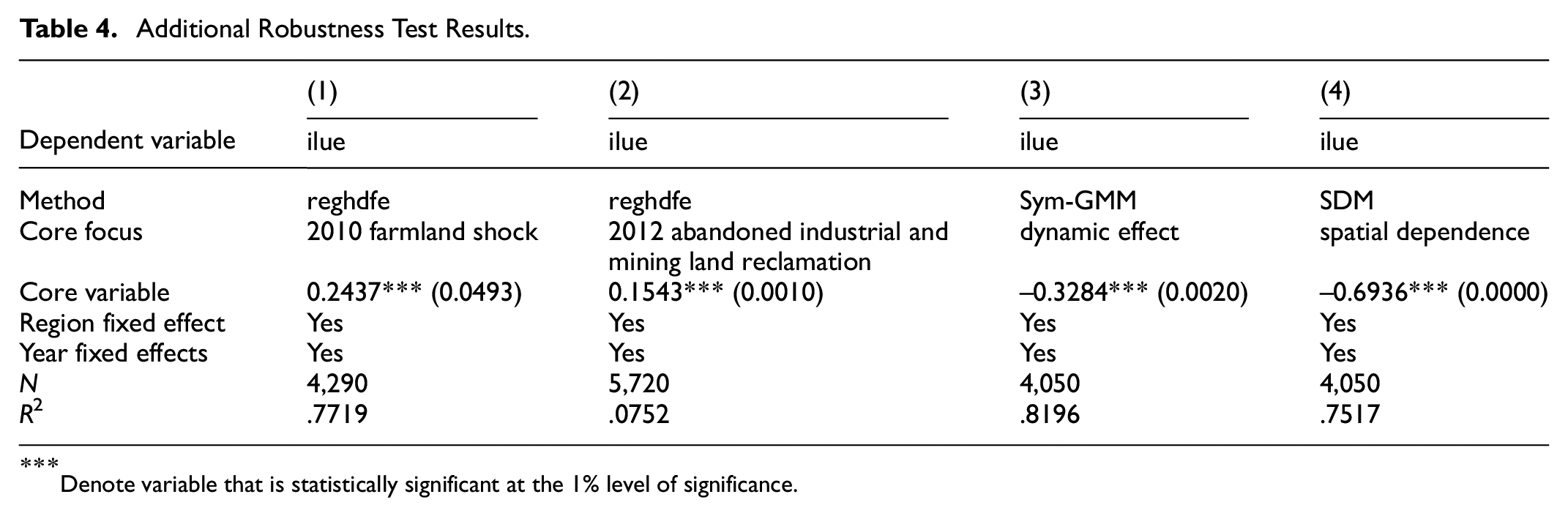
(1) Drawing on T. Xie and Zhang (2024), we used soil survey data from 1989 to 1993 to measure the area and location of land suitable for cultivation in each city, based on indicators such as organic carbon, pH, salinity, gypsum, gravel content, and soil drainage, within the suitable range for arable land. A composite soil index greater than 2 was classified as suitable arable land, and the area was calculated using ArcGIS software. This index, derived from weighted averages of soil conditions, is exogenous as it is unrelated to urban economic development or productivity levels. Combined with the National Land Use Master Plan (2006–2020) approved by the State Council in 2008, a quasi-natural experiment was constructed to examine the impact of industrial land dependence (ILD) on industrial land use efficiency (ILUE). Farmland abundance was measured as the ratio of a city’s suitable arable land area to the national farmland preservation target for 2020, minus the mean ratio across all Chinese cities. Cities with farmland abundance ≥ 0 in 2010 were unconstrained by the National Land Use Master Plan for industrial land development (control group, representing traditional land-driven development), while those with farmland abundance < 0 faced sudden restrictions on converting farmland to industrial use (treatment group). Regression results are shown in Table 4(1).
(2) In April 2012, the Ministry of Land and Resources issued a notice to launch pilot programs for the reclamation and utilization of abandoned industrial and mining land in 10 provinces (Hebei, Shaanxi, Inner Mongolia, Liaoning, Jiangsu, Anhui, Henan, Hubei, Sichuan, Shanxi). This policy linked reclaimed abandoned land to new construction land allocations, adjusting land use layouts, and served as a negative shock to industrial land supply. Cities in these 10 provinces were designated as the treatment group (constrained industrial land supply), while cities in other provinces formed the control group. The policy implementation period was set as 2012 onward. Regression results are presented in Table 4(2).
(3) System GMM was employed to address potential dynamic effects. Regression results are shown in Table 4(3). The AR (1) test yielded a p-value of .000, indicating strong significance, while the AR (2) test p-value was .806, and both Sargan and Hansen tests met the requirements for system GMM.
(4) Spatial dependence was tested, incorporating spatial lag or error terms into the model. A spatial distance matrix was constructed using the inverse of spherical distances between cities to accurately reflect inter-city interactions. Regression results are shown in Table 4(4). Annual global Moran’s I tests confirmed spatial dependence in both ILUE and ILD indicators. The Hausman test (p = .0000) strongly rejected the null hypothesis, favoring fixed effects (FE). LM tests on non-spatial models showed significant LM-lag and LM-error, with robust LM-lag being more significant, suggesting the SAR model may be preferable to SEM. Further tests using the SDM model showed LR statistics of 12.37 (p = .004) and 12.18 (p = .005), rejecting the null hypotheses that SAR or SEM were superior to SDM. AIC/BIC criteria indicated SDM’s best fit. All results in Table 4 confirm that ILD suppresses ILUE.
Additional Robustness Test Results.
Denote variable that is statistically significant at the 1% level of significance.
Intrinsic Mechanisms and Heterogeneous Effects
Analysis of Internal Mechanism
ILD greatly diminishes the efficiency of utilizing industrial land, and there are four primary possibilities for this: (1) A large number of industrial land supply, greatly increased the number of new enterprises, unable to eliminate inferior enterprises, results to resource allocation function of market economy rigid, It is manifested as a quantity imbalance between the exit enterprises and the newly established enterprises. Based on the aforementioned theoretical model analysis, local governments have consistently offered a substantial quantity of industrial land at low prices, thus reducing the “entry threshold” for enterprises. the transfer price of industrial land represents a one-time low cost but offers long-term usage rights. In the secondary market, land transfers prioritize turnover tax over ownership tax, resulting in an excessive tax burden on land entering the market circulation. Consequently, this situation leads to substantial idle and wasted land, suppresses normal land market transactions, and impedes the orderly exit of backward enterprises. From 2003 to 2020, the number of cancelled and newly established industrial enterprises in China was 1,514,647 and 5,171,783, new enterprises’ number is much higher than cancelled enterprises. We measure the imbalance between cancelled enterprises and newly established enterprises by the ratio between cancelled enterprises and newly established enterprises in 286 prefecture-level and above cities. (2) Mismatch of land resources. This abundant supply of industrial land leads to decreased enterprise productivity upon entry into the market, resulting in the misallocation of land resources. Furthermore, the transfer price of industrial land signifies a one-time low cost while granting long-term usage rights. In the secondary market, land transfers prioritize turnover tax rather than ownership tax, leading to an excessive tax burden on land entering the market circulation. Consequently, this situation results in significant idle and wasted land, suppresses regular land market transactions, and hinders the orderly exit of outdated enterprises. Consequently, a mismatch of land resources arises. The measurement of Land misallocation: (Misall, %). Misall = (the Industrial land area in city i/the sum of Industrial land area in all cities except city i)/(the added value of industrial in city i/the sum of added value of industrial in all cities except city i). The larger the value of the Misall is, the more Industrial land area will be allocated, which is conducive to the happens in industrial land area (J. Wang et al., 2020). (3) Decrease in factor returns. By “attracting capital from land” local governments stimulate investment and employment, potentially resulting in a decline in the marginal output of capital and labor in accordance with the law of diminishing marginal returns. The capital-output ratio (cap_ratio) measures the marginal product of capital, while labor productivity (lab_ratio) measures the marginal product of labor. The capital-output ratio represents the ratio of urban industrial added value to industrial fixed capital stock, while labor productivity is measured as the ratio of urban industrial added value to industrial employment. (4) Inhibition of innovation behavior (S. Wang et al., 2022). C. Xie and Hu (2020) demonstrated that China’s current developmental stage is characterized by a land resource allocation model involving the extensive transfer of industrial land and insufficient supply of commercial and residential land. This model has an overall negative impact on urban innovation, with a more pronounced inhibitory effect on the innovation of economically developed eastern cities and high-tech industries. The innovation within high-tech industries necessitates greater capital and talent, and the pursuit of profits across industries by innovation funds, coupled with the displacement of human capital resulting from the current land resource allocation, exerts a more significant adverse effect on innovation. According to the above model analysis, there are too many new enterprises, and inferior enterprises cannot exit in an orderly manner, which will lead to crowded production factors, idle capacity and profit decline, which is not conducive to enterprise innovation and research. The overall innovation and green innovation of urban areas are quantified by the logarithm of the total number of patents acquired by the city in a given year (pretent) and the logarithm of the total number of green patents obtained by the city in that same year (gre_pre), respectively. (5) Increase in environmental pollution (Anser et al., 2020). Based on the analysis of the aforementioned theoretical model, local governments continuously provide a substantial quantity of industrial land at a reduced price. This practice lowers the entry threshold for enterprises, resulting in the accumulation of outdated production capacity and a subsequent increase in environmental pollution (Tan et al., 2024). Environmental pollution indicators are quantified through measurements of industrial sulfur dioxide emissions (ind_so2).
Using the 2012 Ministry of Land and Resources pilot program for the reclamation and utilization of abandoned industrial and mining land in 10 provinces (Hebei, Shaanxi, Inner Mongolia, Liaoning, Jiangsu, Anhui, Henan, Hubei, Sichuan, Shanxi) to construct a negative shock to urban industrial land supply as the core independent variable, and employing the aforementioned mechanism variables as mediators, we conduct a mediation effect analysis (Baron & Kenny, 1986).The regression results are presented in Table 5. In Column (1) of Table 5, the imbalance in enterprise entry and exit indirectly suppresses the improvement of industrial production efficiency. In Column (2) of Table 5, Mitigating factor misallocation can significantly enhance industrial land use efficiency, with an indirect effect of 1.292. In Column (3) of Table 5, The capital-labor ratio has an indirect positive effect on industrial land use efficiency, but the effect is relatively small, at 0.025. In Column (4) of Table 5, ILD enhances labor productivity, The suppression effect on industrial land use efficiency is highly significant, at −0.503. The results are shown in Column (5) of Table 5, capital-labor ratio The suppression effect on industrial land use efficiency is −0.211, which is relatively high. In columns (6) and (7) of Table 5, the regression analysis reveals: Enterprises’ innovative behavior can indirectly and significantly enhance industrial land use efficiency. Columns (8) in Table 4 demonstrate that ILD leads to an increase in sulfur dioxide emissions. The rapid expansion of industrial land and land waste accumulated much material and energy consumption (Yuan et al., 2019), attract industrial enterprises characterized by low factor intensity and high energy consumption, increasing carbon emission intensity (H. Xie et al., 2018; D. Zhou et al., 2022), causing severe environmental pollution.
The Mechanism Test of ILD Affecting ILUE.

Denote variables that are statistically significant at the 1% and 5% levels of significance, respectively.
The above empirical research results consistently indicate that negative shocks to industrial land supply improve industrial land use efficiency. Mediation effect analysis shows that alleviating factor misallocation and innovation R&D can significantly and indirectly enhance industrial land use efficiency, while labor productivity and capital-labor ratio substantially and indirectly suppress industrial land use efficiency.
Analysis of Heterogeneous Effects
While this research has successfully demonstrated the influence of ILD on the utilization efficiency of industrial land and its underlying mechanism, it is important to investigate whether variations in the impact exist based on different regions and city sizes. Due to China’s vast territory, the differences in cities and their sizes in different regions will lead to the differences in the supply and demand of industrial land. Additionally, it is essential to examine whether the impact varies between resource-based cities and non-resource-based cities. Addressing these inquiries is crucial. Despite the general consensus among the academic community regarding the existence of variations in land use levels across regions, driven by differences in economic development and industrial structure, the comparative issue of land use differentiation has received scant attention to date (W. Chen et al., 2015). W. Chen et al. (2015) conducted a study to analyze the influence of variations in industrial floor area ratios and regional disparities on the calculation of total industrial land and its corresponding utilization efficiency. In order to gain insight into the determining factors that shape the relationship between ILD and ILUE, further investigation of this issue is warranted. Consequently, this research aims to examine the heterogeneous impact of ILD on ILUE, taking into consideration factors such as region, city type (i.e., resource-based or large and medium-sized).
(1) Regional Division: Eastern region and central-western region. Starting from 2003, the government implemented a land supply policy that favored the central and western regions, resulting in a corresponding reduction in land supply in the eastern region (M. Lu et al., 2015). However, following the subprime mortgage crisis in 2008, a significant expansion of industrial land occurred from 2009 to 2013. The eastern region experienced the most extensive expansion, maintaining an area of over 30,000 ha for several years. The central and western regions had moderate expansion, while the northeastern region experienced the smallest expansion, consistently below 20,000 ha (L. Li et al., 2022). Changes in land supply by the central government in each region will impact the efficiency of industrial land use.
The regression results in Table 6 indicate that: Land marketization has an indirect suppression effect of −0.136 on industrial land use efficiency in eastern cities, but no effect on central and western cities; Industrial structure adjustment has no effect on industrial land use efficiency in eastern cities, but an indirect effect of 0.532 in central and western cities, significantly enhancing efficiency.
(2) Resource-Based and Non-Resource-Based Cities (NRBCs). Existing literature in the mining industry suggests that a large amount of mining industry can lead to the mineral resources curse. Resource-based cities (RBCs) are characterized by their reliance on mining and the processing of natural resources such as minerals and forests as their primary industries. This includes prefecture-level cities, regions, other prefecture-level administrative regions, county-level cities, and counties. Many resource-based cities in China play a vital role in resource and energy supply, providing crucial support for the development of an independent and comprehensive industrial system, as well as contributing to the steady growth of the national economy (Cheng et al., 2021). However, as resource exploitation intensifies, a significant number of resource-rich cities inevitably face resource depletion. This leads to various challenges, including weak economic growth, declining employment opportunities, unused industrial land, and environmental degradation, which collectively present a major obstacle to achieving high-quality transformation in resource-depleted cities (Song et al., 2023). Numerous resource-based cities around the world are now termed as “shrinking cities” because they have been experiencing significant population losses (B. Li & Dewan, 2017; Long & Wu, 2016); these cities may be abandoned when the resources are depleted (W. Chen et al., 2019). Resource-based cities are susceptible to the resource curse and depletion, which consequently impacts ILUE.
Results of the Regional Heterogeneous Effect Test.

Denote variables that are statistically significant at the 1%, 5%, and 10% levels of significance, respectively.
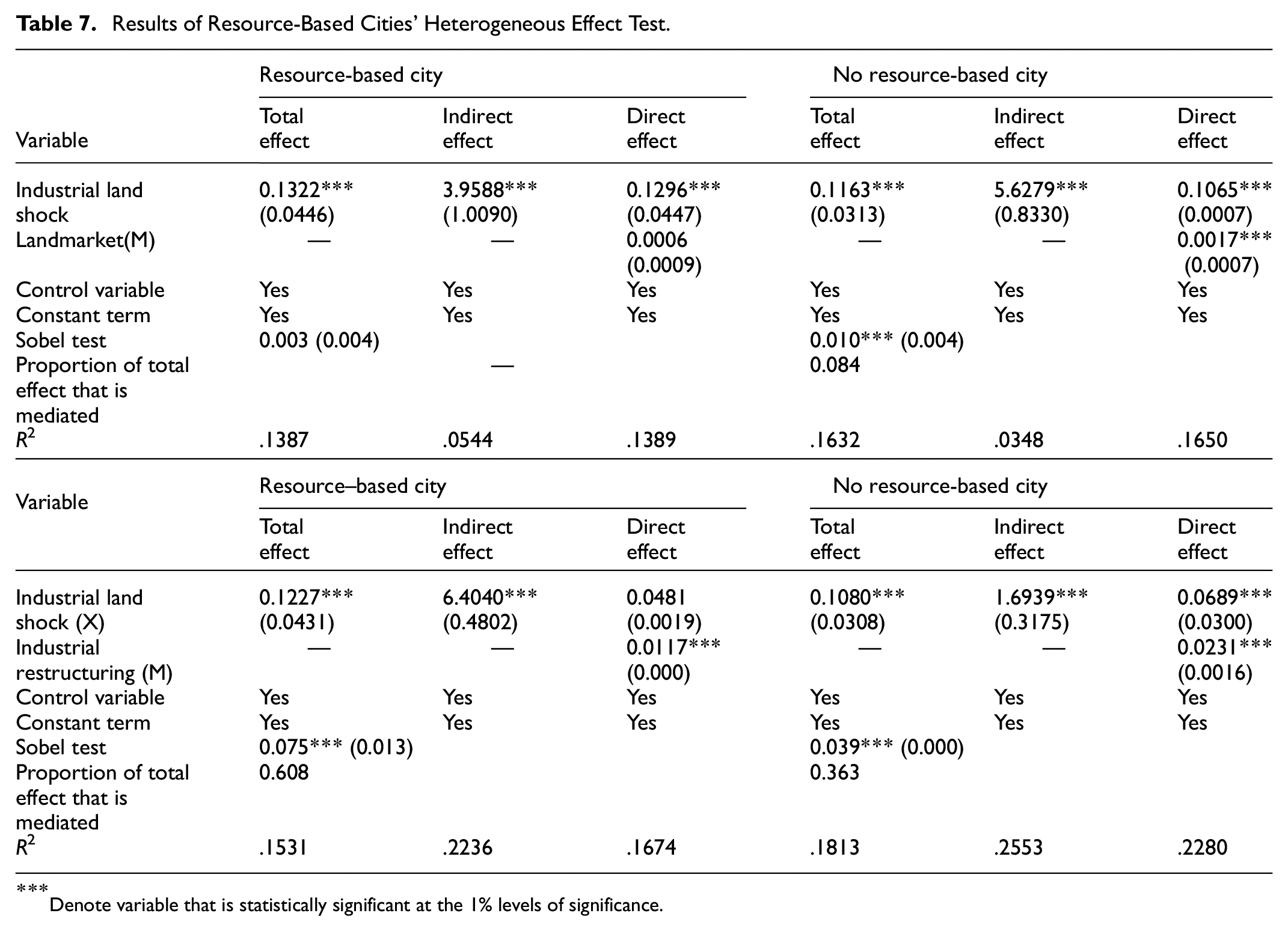
The regression results in Table 7 indicate that: Land marketization has no indirect effect on resource-based cities, but shows a 0.084 indirect enhancement effect on non-resource-based cities; Industrial restructuring exerts significant indirect improvement effects on industrial land use efficiency in both resource-based and non-resource-based cities.
(3) Division of urban population size. Related studies on the subject demonstrate that land utilization efficiency is subject to city size, industrial development, and national macro policies (Barbosa et al., 2015; Du et al., 2016). Research by Guastella et al. (2017) holds that land utilization efficiency has a positive linear relationship with city size, meaning that the larger the city size is, the higher city’s land utilization efficiency is. In contrast, Yan et al. (2020) applied data from cities in Eastern China to explore the nonlinear effect of city size on land utilization efficiency, revealing an inverted U-shaped relationship between city size and land utilization efficiency. D. Gao and Wang (2023) demonstrate that improvements in transportation infrastructure, such as high-speed rail openings, can enhance urban carbon efficiency by optimizing industrial layouts and reducing carbon emissions, with large and medium-sized cities benefiting from better transportation infrastructure. As the scale of a city expands, urban land utilization efficiency apparently exhibits a trend of initially rising and subsequently falling. The sample is divided into two groups for regression based on the size of the permanent resident population in urban areas: large and medium-sized cities (with a population of more than 500,000 people), and small cities (with a population of less than 500,000 people; Song et al., 2023).
Results of Resource-Based Cities’ Heterogeneous Effect Test.
Denote variable that is statistically significant at the 1% levels of significance.
The regression results in Table 8 indicate that: Land marketization has a slight indirect positive effect on industrial land use efficiency in large and medium-sized cities, but no effect in small cities. Industrial structure adjustment indirectly enhances industrial land use efficiency in both large and medium-sized cities and small cities.
Results of Urban Population Size’ Heterogeneous Effect Test.

Denote variables that are statistically significant at the 1% and 5% levels of significance, respectively.
In conclusion, utilizing land marketization as a policy driver can indirectly enhance industrial land use efficiency in central and western cities, non-resource-based cities, and medium-to-large cities; while adopting industrial restructuring as an intervention strategy can indirectly improve industrial land use efficiency across central and western cities, both resource-based and non-resource-based cities, as well as medium-to-large cities.
Discussion
Most of the existing research on the impact of industrial land factors on industrial development has been conducted from the perspective of new industrial land transfer behavior (including transfer scale, price, method, marketization, and reduction assessment, etc.). The larger the scale of industrial land transfer, the more likely it is to be transferred through negotiation and allocated to polluting industries (Z. Huang et al., 2022), reducing the industrial added value per unit area (Z. Xie et al., 2019). The low-price transfer of industrial land leads to capital subsidy competition (Z. Xie et al., 2019), resulting in over-investment (J. Huang et al., 2015) and a decline in productivity (B. Wang et al., 2021). On the contrary, the high-price transfer of industrial land improves total factor productivity (J. Zhang et al., 2019). The marketization of land transfer, measured by the proportion of land auctioned, listed, and transferred, alleviates financing constraints (S. Xu et al., 2018) and optimizes resource allocation (X. Yang & Li, 2018), increasing the probability of enterprise entry (B. Li, 2020). The negotiated transfer of industrial land attracts investment projects of poor quality (Q. Yang et al., 2014) and reduces productivity (L. Li et al., 2016). Reduction assessment curbs the investment scale and the number of enterprises (C. Wang, 2019) and improves total factor productivity (Deng et al., 2021).
In 2014, the Ministry of Land and Resources proposed the “implementation of the total amount control and reduction strategy of construction land,” which was elevated to a national strategy in 2015, and the supply of new industrial land has been significantly reduced. To cope with the soaring land cost, in July 2018, Huawei relocated its new production base from Shenzhen to Dongguan.
To sum up, the existing research and governance regarding industrial land all revolve around newly-added industrial land, lacking research and governance of the stock of industrial land:
(1) There is a lack of research on the restrictive factors of high-quality industrial development from the perspective of the stock of low-efficiency industrial land. Existing research mainly explores the impact and mechanism of new industrial land transfer behavior on industrial development. In fact, the new industrial land transfer behavior has little or no impact on the existing low-end industrial enterprises that have not obtained land, because land-use expenditures are paid in a lump sum and the right to use the land is held for a long term. The new industrial land transfer behavior mainly has a negative impact on the development of emerging and advanced industrial enterprises through land costs.
(2) There are few studies on the problem of high-quality industrial development from the perspective of the resource curse caused by industrial land dependence. Existing resources that cause curses mainly include extractive industries, oil and gas energy, construction land, cultivated land resources, tourism resources, agricultural virtual water, political resources, etc. There is a lack of research on the resource curse problem from the perspective of the stock of industrial land.
(3) There is a lack of research on the transmission mechanism of industrial land dependence leading to the imbalance of industrial enterprise entry-exit and the rigidification of resource allocation function. Although existing research has recognized that a large supply of industrial land will affect industrial development through transmission variables such as cost, quality of investment projects, and over-investment.
The research results of this study show that a large amount of stock industrial land has reduced the entry threshold for new enterprises, increased the number of new enterprises, inhibited the exit of existing inferior enterprises, caused an imbalance in the number of enterprise exits and new establishments, generated a congestion effect of production factors, inhibited the innovative behavior of high-quality enterprises, and brought about environmental pollution. The crux of the difficulty in improving the quality of industrial development lies in the inability of inferior enterprises to exit in an orderly manner. To this end, in August 2016, the Supreme People’s Court promulgated a working plan for the establishment of liquidation and bankruptcy tribunals in intermediate people’s courts, using legal means to resolve overcapacity, eliminate “zombie enterprises,” and improve the exit mechanism of backward enterprises. The establishment of bankruptcy tribunals is the key guarantee for legally implementing the exit of inferior enterprises, reducing production capacity in accordance with the law, and realizing the optimization of resource allocation. At the same time, in recent years, some local governments have recognized the governance issue of the orderly exit of inefficient industrial land. Based on the previous experience in Shaoxing and other places, Zhejiang Province proposed the “evaluating heroes by mu-average output” reform of the differentiated allocation of resource elements. Subsequently, provinces such as Jiangsu, Anhui, Shaanxi, Sichuan, and Guangdong have popularized it by drawing on the experience of Zhejiang Province.
Conclusions and Policy Implications
Conclusions
Enhancing the utilization efficiency of urban industrial land is a necessary approach to address the existing limitations of urban land resources and propel the high-quality development of China’s economy. Drawing on panel data encompassing 286 cities at the prefecture-level and above in China from 2003 to 2022, this study examines the influence, transmission mechanism, and heterogeneous effects of ILD on ILUE. The findings of this research indicate that:
(1) ILD negatively impacts the utilization efficiency of industrial land. The robustness of these conclusions is confirmed through a series of tests, including the consideration of measurement errors in the dependent variable, lagged core variables, instrumental variable analysis, and other robustness checks.
(2) Regarding its transmission mechanism, ILD exacerbates the mismatch of land resources in the industrial sector. This leads to capital-biased investment, a decline in the capital-output ratio, reduced innovation output, and increased industrial sulfur dioxide emissions. These results demonstrate that ILD distorts industrial land allocation, suppresses urban innovation, worsens environmental pollution, and ultimately diminishes ILUE.
(3) Heterogeneity analysis reveals that ILD’s negative effects are nationwide but vary across regions and city types. Specifically: Resource-based cities suffer more severe efficiency losses due to their over-reliance on land-intensive industries. Policy interventions should prioritize industrial diversification and strict environmental regulations to break path dependence. Large cities exhibit greater resilience due to higher land marketization, while small-medium cities face rigid resource allocation. Differentiated land policies are needed. Large cities: Focus on market-driven land reallocation and innovation clusters. Small-medium cities: Implement targeted subsidies for green upgrades and link land supply to industrial restructuring.
Policy Recommendations
To address these challenges, governments should adopt context-specific strategies:
(1) Systematic Withdrawal of Inefficient Land: Introduce a graded elimination system for inefficient enterprises, combining punitive measures and incentives. Leverage the “Area-Based Evaluation Mechanism” to accelerate exits, with stricter timelines for resource-based cities.
(2) Differentiated Land Supply Policies: For resource-based cities, tie land approvals to industrial diversification targets. For small-medium cities, pilot land-use covenants requiring efficiency benchmarks for new allocations.
(3) Innovation and Environmental Synergies: Use fintech tools to enable dynamic resource allocation and reward green patents (D. Gao et al., 2024). Redirect land sales revenue to fund innovation hubs in large cities and pollution remediation in industrial zones.
These measures, tailored to city-specific dependencies and market conditions, can help dismantle the industrial land curse and align land use with high-quality development goals.
Footnotes

Author Contributions
Conceptualization, X.Y. and R.Z.; methodology, R.Z.; software, R.Z.; validation, X.Y. and R.Z.; formal analysis, X.Y. and R.Z.; investigation, X.Y. and R.Z.; resources, X.Y.; data curation, R.Z.; writing—original draft preparation, X.Y. and R.Z.; writing—review and editing, X.Y.; visualization, X.Y.; supervision, X.Y.; project administration, X.Y.; funding acquisition, X.Y. All authors have read and agreed to the published version of the manuscript.
Funding
The author(s) received no financial support for the research, authorship, and/or publication of this article.
Declaration of Conflicting Interests
The author(s) declared no potential conflicts of interest with respect to the research, authorship, and/or publication of this article.
Data Availability Statement
The datasets analyzed during the current study are available from the corresponding author on reasonable request.