




Abstract
Previous research studies on innovation tend to focus on process and product innovations. Recent theoretical opinions reveal that Organizational and Marketing Innovations (OMIs) could be the necessary prerequisites to optimally utilize and deploy such process and product innovations. It is important to note that there is a dearth of information on the enablers of OMIs capabilities among small and medium-sized enterprises (SMEs). Despite their closeness to their customers, many SMEs are finding it difficult to achieve successful and effective innovations; these are innovations that have a positive impact on the business growth and returns. This study presents findings from exploratory qualitative research conducted in South-Western Nigeria. Drawing upon information-rich evidence from 13 in-depth interviews with the owners and the managers of SMEs, this study identifies some enablers that can promote SMEs’ OMIs capabilities, effective innovations, and organizational survival.
Keywords
Introduction
Despite the fact that academic research on innovation processes has been ongoing for a number of decades (Andriopoulos & Dawson, 2009), research addressing the innovation process in developing nations is very scarce (Calvert, Ibarra, Patel, & Pavitt, 1996; Salavou, Baltas, & Lioukas, 2004). Calvert et al. (1996) and Salavou et al. (2004) posit that using the findings from academic research on innovation studies in advanced countries to model or explain the innovation process in developing countries may be misleading. In developing nations, innovation strategies focus mainly on technology acquisition, in the form of knowhow embodied in innovative processes and products such as machinery and equipment (Goedhuys & Veugelers, 2012; Organisation for Economic Co-Operation and Development [OECD]/Eurostat, 2005), but the literature lacks profound insight on what drives or hinders firms in developing countries to adopt and adapt new technologies (Goedhuys & Veugelers, 2012). Besides, the studies on drivers promoting acquisition of technological capabilities from foreign firms by small and medium local enterprises are scarce in the literature (Park & Ghauri, 2011). Maine and Garnsey (2006) emphasize the need to investigate factors that influence the financial success and successful commercialization of product innovation. Although most of the research focuses on product and process innovations (Conway & Steward, 2009), the soft components (Organizational and Marketing Innovations [OMIs]) of innovation process capable of facilitating the adoption and adaptation of technological innovations in the developing countries receive very limited attention.
Despite their closeness to consumers coupled with their strong ability to invent, many small firms are unable to achieve effective innovation; they are unable to commercialize their inventions successfully (Gans & Stern, 2003; O’Regan, Ghobadian, & Gallear, 2006; Van de Vrande, de Jong, Vanhaverbeke, & de Rochemont, 2009). Effective innovations have direct impact on business returns (O’Regan, Ghobadian, & Gallear, 2006). Also, many small and medium-sized enterprises (SMEs) in developing countries are finding it difficult to achieve effective innovations (O’Regan, Ghobadian, & Gallear, 2006). According to O’Regan, Ghobadian, and Gallear (2006), many SMEs are facing some difficulties in converting R&D activities into effective innovation that leads to positive returns and firm growth. Limited research has been carried out on the productivity of innovation within the context of SMEs (Cosh, Fu, & Hughes, 2005). A recent study by Park and Ghauri (2011) reveals that SMEs in developing economies search for complementary knowledge and learning opportunities, and this never guarantees possession of sufficient capacity to absorb these priceless technological innovations when compared with small firms in developed economies.
The growth of SMEs in developing nations has been constrained by limited information on their operating procedures and their management styles (Jackson, Amaeshi, & Yavuz, 2008; Lee, Park, Yoon, & Park, 2010). Beyond SMEs in the developing nations, Lam (2011) calls for the investigation of the roles of endogenous organizational forces, for instance, capacity for learning, values, interests, and culture, in organizational change and innovation. Also, Adekunle (2011) emphasizes the need to investigate institutional factors that affect enterprise performance other than availability of external capital in support of SMEs. Nevertheless, De Mel, Mckenzie, and Woodruff (2009) argue that micro and small firms, despite constituting the majority of the companies in the developing countries, have been neglected in the study of innovation. Pre-existing innovative products and processes are frequently imported by developing nations from developed nations (Acharya & Keller, 2009; Blalock & Gertler, 2008; OECD/Eurostat, 2005). However, these technological product process innovations are not yielding the desired results in the business and economic environment of many developing nations (Khosla, 2005). Are the wrong technologies imported? The answer is likely to be no; the frameworks needed to obtain their full benefits and/or to put them into optimal usage could be missing.
Of the four types of innovation identified in the Oslo Manual for guidelines for collecting and interpreting innovation data, only two, product and process innovations, have significant attention in the literature (Edquist, 2005; Naidoo, 2010; OECD/Eurostat, 2005; Salavou et al., 2004). While Naidoo (2010) specifically identifies that marketing innovation needs to be fully researched, Salavou et al. (2004) reveal that the relationship between market orientation and innovation process has received little attention from researchers. Augusto and Coelho (2009) further confirm that marketing innovations need thorough scrutiny and research. With respect to SMEs, the relevance of OMIs to their performance has been neglected for so long. Quoting Edquist (2005), “ . . . the non-technological forms of innovation deserve more attention . . . and that there are strong reasons to use a comprehensive innovation concept and give more attention to non-technological and intangible kinds of innovation . . . ” The research work on innovation traditionally focuses on technological innovation and utilizes a narrow working definition of process and product innovations (Conway & Steward, 2009).
Non-technological innovations can be compared with software in a computer system. The hardware parts of the computer system are unable to perform their designated functions without appropriate instructions coded in the software. Similarly, the hardware components (process and product innovations) are unlikely to generate the desired business outcomes without the software components (OMIs) of the business innovation system.
Literature Review
SMEs and Innovation Process
The global financial crisis of 2008-2009 has led to an increased interest in the role of SMEs in job creation and economic growth (Ardic, Mylenko, & Saltane, 2011). According to Ihua (2009), “ . . . SMEs have been given due recognition especially in the developed nations for playing very important roles towards fostering accelerated economic growth, development, and stability within several economies.” SMEs are vital to sustainable, diversified, and long-term economic growth (Ardic et al., 2011). As described by Levy and Powell (2005), SMEs constitute a vibrant and growing sector in most economies across the globe, and changes in the global economic conditions contribute to the rise in the number of SMEs. Surveys reveal that about 95% of firms are SMEs, employing an average of 65% of the formal workforce within the OECD, many of which are involved in new innovations (Beck, Demirguc-kunt, & Martinez Peria, 2008; Dietrich, 2010; Levy & Powell, 2005). SMEs also play a significant role in employment generation, revenue generation, and export earnings in developing and emerging economies (Javalgi & Todd, 2011). However, SMEs are often faced with market imperfections and their limited resources impair their access to new innovation (Verheugen, 2003).
The SME sector has been the target of international and national aid agencies in many countries of the world (Department of Trade and Industry [DTI], 2005, 2006; Omankhanlen, 2011a, 2011b). For instance, in 2007, SME Support Service provided US$1.1 billion financial support for the Brazilian SMEs (Cravo, Gourlay, & Becker, 2010). Based on the country-level data analysis by Ayyagari, Beck, and Demirguc-Kunt (2007), SMEs in countries across the globe provide 60% of employment in the manufacturing sector. It is often believed that SMEs are more innovative than the large firms (Ardic et al., 2011). When compared with large firms, SMEs in the developed countries often enhance their competitiveness through high-quality product, flexibility, and responsiveness to customer needs (Ardic et al., 2011). It is also important to note that there has been more detailed attention given to those in developed nations than in developing nations.
The choice of SMEs in this research is because of the dearth of studies that focus on the importance of SMEs for economic growth in the developing nations (Cravo et al., 2010). Besides, SMEs have suffered higher failure rates when compared with large firms because of their reactive nature to problems, limited resources, informal strategies, and structures (Qian & Li, 2003; Terziovski, 2010). Most of the research studies on innovation management have been on large industries (Terziovski, 2010). Despite their immense contributions to the economic success of many nations, their significant roles in job creation, in encouraging entrepreneurship and innovation (EU Commission, 2003; Javalgi & Todd, 2011), there have been very few studies on an innovation model specialized for SMEs (Lee et al., 2010). This sheds light on one of the reasons why many SMEs are finding it difficult to achieve successful innovation despite the huge investment in SME-related research and development activities (O’Regan, Ghobadian, & Sims, 2006).
Soft and Hard Components of Innovation
Innovation in firms can take many forms (Bessant & Tidd, 2007). A broader framework, other than that of/those of technological product and process innovations proposed by the OECD and the Statistical Office of the European Communities in the Oslo Manual, distinguishes innovation into four main areas: Process, Product, Organizational, and Marketing Innovations. The inclusion of OMIs is considered necessary because of the need to create a more complete framework and identify the full range of innovative changes that guarantee improved firm’s performance and successful economic outcomes (OECD/Eurostat, 2005). These four types are defined as follows (OECD/Eurostat, 2005):
Product innovations: innovations that represent significant changes to goods and services.
Process innovations: innovative activities that represent significant changes in methods of production and delivery.
Organizational innovations: innovative changes that facilitate and/or involve the implementation of new organizational methods.
Marketing innovations: innovative changes that involve the implementation of new marketing methods such as new or significant changes in product design and packaging, product promotion and placement, and pricing methods.
From these four main types of innovations, process and product innovations can be grouped as the hard components, while the other two, OMIs, are the soft components of innovation process (SCIP), as shown in Figure 1.
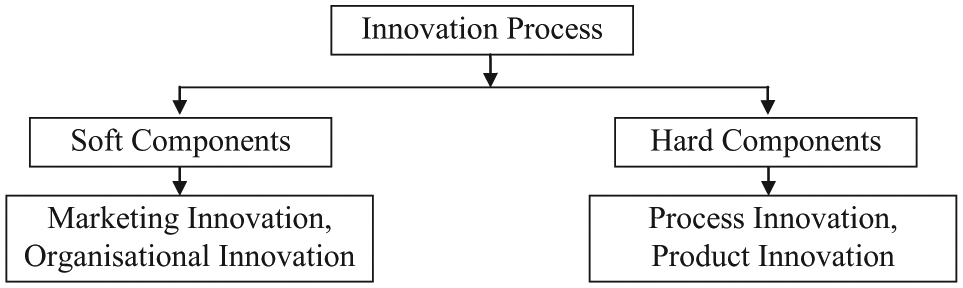
Soft and hard components of innovation.
Of the four groups of innovation identified here, only two, product and process innovations, have significant attention in the literature (Edquist, 2005; Naidoo, 2010; OECD/Eurostat, 2005; Salavou et al., 2004). According to Naidoo (2010) and Augusto and Coelho (2009), marketing innovation needs to be fully researched and thoroughly scrutinized. Salavou et al. (2004) further establish that the relationship between market orientation and innovation process has received little attention from researchers. According to Edquist (2005), “ . . . the non-technological forms of innovation deserve more attention . . . and that there are strong reasons to use a comprehensive innovation concept and give more attention to non-technological and intangible kinds of innovation . . . ” Although previous research work on innovation traditionally focuses on technological innovations (Conway & Steward, 2009), OMIs, which are needed to facilitate and sustain the entire innovation process in developing countries, are often left out or not given the needed attention (Lam, 2005; OECD/Eurostat, 2005).
Promoting SMEs Growth Through Soft Components of Innovation
Organizational innovations
Organizational innovations are the results of management’s strategic decisions emerging from the implementation of organizational methods that have never been used before in the firm (OECD/Eurostat, 2005). According to OECD/Eurostat (2005), the new organizational methods can be in business practices, workplace organization, or in external relations. For Lam (2005), organizational innovation could be a necessary foundation for technological process and product innovations. It is important to note that firm’s organizational innovations are not merely a formulation of improvement strategies, but the actual implementation of organizational methods, which have not been used by the firm before (OECD/Eurostat, 2005). However, Teece (2008) propounds that organizational innovation is as significant as technological innovation in value creation.
The term “management innovation” has been used to describe some of the concepts that apply to organizational innovation: The DTI (2006) views management innovations as strategic changes to organizational structure that lead to improvement in management-related activities; Andriopoulos and Dawson (2009) define it as new management practices that aim to reduce costs, improve quality, and increase productivity, and Wang, Zhao, and Chen (2009) describe it as a core and essential ingredient required to build core competitive advantages for firms to achieve better performance in a highly competitive market. The core competence, which emphasizes skills, knowledge, and values, originates within organizations that are equipped with highly efficient management capabilities (Wang et al., 2009). It is therefore a pathway that links the present state of an organization to its future state; this is because it involves making the best use of resources to develop a more reliable and effective management system with brand advantages (Wang et al., 2009). Although management innovation may not have a direct and quantifiable impact on manufacture and operation, it plays a unique role in long-term survival and development of any enterprises: The transformation of China’s economy from labor-intensive to technology-intensive requires the implementation of management innovation (Wang et al., 2009) and provides illustration of the significance of management or organizational innovation.
Marketing innovations
Marketing innovations involve the implementation of new marketing methods not previously used by the firm to focus on addressing customer needs, opening up new markets, or positioning a product on the market with the sole aim of increasing the company’s sales (OECD/Eurostat, 2005). Dibrell, Davis, and Craig (2008) posit that SMEs show a very slow response or sometimes are not able to respond to change in market expectations and opportunities, because they fail to acquire necessary innovative capabilities. It is also important to note that small firms have a strong ability to invent because they are very close to the customers. However, their main problem is in the commercialization of their inventions, that is, achieving effective innovation (Gans & Stern, 2003; O’Regan, Ghobadian, & Gallear, 2006; Van de Vrande et al., 2009). For instance, in the research study by Amara, Landry, Becheikh, and Ouimet (2008), while 78.1% of SMEs develop product and process innovations, the challenge is how to increase the degree of novelty of these innovations so as to improve the firm’s competitive advantage and create new markets. This highlights the need to focus on the innovation system in a more comprehensive way to achieve the desired market outputs from innovation activities.
Liao and Rice (2010) use the market transformation outcomes of Schumpeterian models and find that firm performance is positively influenced by its innovation activities where they are mediated through these outcomes; such outcomes include the range of products, distribution mechanisms, and market targets and can be addressed easily by activities associated with marketing innovations. In their survey and analysis of 449 Australian manufacturing SMEs, Liao and Rice found that innovation activities that focus only on primary R&D, training, and increasing the use of production technology only form a necessary and insufficient prerequisite to improve firm competitive performance. Their work reveals the essential and mediating roles of market engagement between innovation capabilities and firm performance.
Transnational corporations in developing nations can be a crucial source of technological innovations and enhanced economic performance for SMEs through subcontracting relationships (Sudhir-Kumar & Bala-Subrahmanya, 2010). However, it should be noted that these relationships have a lot to do with the market orientation of such SMEs. The Rhee, Park, and Lee (2010) study of 333 technology-innovative South Korean SMEs found that market and entrepreneurial orientations positively affect the learning orientation, which significantly and positively influences the innovativeness and performance of these small firms. Van de Vrande et al. (2009) define how SMEs in the Netherlands are using the concept of open innovation to monitor competitors, focus on the need of their current market, and open up new markets.
The conceptual model of Naidoo (2010) further highlights the importance of marketing innovation to firm survival. The adoption of a market orientation strategy by firms is crucial to the development of marketing innovation capabilities, which are, in turn, needed to build and sustain a firm’s competitive advantage and survival strategy in an economic crisis; indeed, competitive advantage developed and sustained through marketing innovation have been proven to play vital roles in the survival of Chinese manufacturing SMEs (Naidoo, 2010).
OMIs: Prerequisites for Effective Innovation
OMIs have been identified in this study as the SCIP; both these are crucial for effective innovation in any organization, irrespective of its size, location, and activities. Organizational innovations are strongly related to the management efforts in renewing the organizational routines, procedures and other mechanisms that encourage teamwork, information sharing, effective coordination and collaboration, and learning (Gunday, Ulusoy, Kilic, & Alpkan, 2011). Findings from the literature (cf. Gunday et al., 2011; Lin & Chen, 2007) reveal that organizational innovation plays a fundamental role for innovative capabilities and performance. In addition to having a direct impact on the business innovative performance, organizational innovation contributes greatly to a suitable business environment in which the other types of innovations can thrive (Gunday et al., 2011).
Organizational innovations, which Lin and Chen (2007) described as administrative innovations in their research study, are found to be the most crucial factor in explaining a company’s sales. Administrative innovations include improvements in organizational structures, innovative policies, and transformation of management systems. Strategic innovation is concerned with organizational strategies that focus on continuous competitive advantages for companies (Lin & Chen, 2007): Strategic innovation type includes alliances with competitors, alliances across industries, alliances with suppliers, outsourcing, and the redefining of the firm’s core competence, for example (Lin & Chen, 2007). Based on the above description, administrative and strategic innovations will be collectively referred to as organizational innovations in this study.
Lin and Chen (2007) posit that real innovation success is in the marketplace and that creating innovative marketing measures is crucial in transforming good ideas and good products into a company’s revenue and profit. The study of Schubert (2009) on the roles of OMIs in entrepreneurial innovation processes found that OMIs reinforce technological innovations. Battisti and Stoneman (2010) further Schubert’s work by showing that organizational and technological innovations complement rather than substitute each other.
The adoption of technological innovations by firms is not enough to gain competitive advantage, and the far-reaching benefits of technological innovations can only be achieved if they are accompanied by non-technological innovations (Battisti & Stoneman, 2010). While most studies on innovations focus only on one innovation type at a time, Battisti and Stoneman (2010) show that OMIs have been under-researched and that robust empirical evidence on the existence of complementarity across innovation types is scarce, thereby making knowledge about the synergies among these innovation types limited. The lack of prior research on non-technological innovations has been attributed to poor data availability (Schubert, 2009). Moreover, “ . . . innovation that has not involved changes in processes and products has traditionally merited little effort in data collection” (Battisti & Stoneman, 2010).
Also, many empirical studies on firms’ innovative capacity, innovation inputs, and other support instruments do not take into account the complementary innovation strategies of OMIs (Nguyen & Mothe, 2008). Some theoretical studies on innovation, however, highlight the crucial roles of these non-technological types of innovations, although Nguyen and Mothe (2008) also highlight the effects of the complementary strategies of OMIs on the firms’ technological innovation ability. They show that marketing innovations provide a complementary innovation activity for both the tendency to innovate and the innovative performance of the firms. Thus, it can be posited that incremental and substantially new marketing initiatives (marketing innovations) are the needed antecedents to firms’ process and product innovations.
De Mel et al. (2009) propose an innovation model which incorporates the role of both the owner and the firm’s characteristics into the organization’s innovation activities. This model depicts how product, process, marketing, and organizational innovations vary with firm size and competition. Based on a large representative survey on micro and small firms from Sri Lanka, De Mel et al. found that marketing innovations are the most common type of innovations among these firms. According to Ogechukwu and Latinwo (2010), SMEs need to adopt and apply a marketing concept to grow and survive in this prevailing business environment. Moreover, for the owners and managers of SMEs to build up some dynamism in their operations, they should integrate strategic marketing planning into their overall strategy. The review of extant literature has established that OMIs are prerequisites to effective innovations, organizational growth, and survival; thus this study aims to explore factors that promote capabilities of OMIs.
Research Methodology and Design
Research Approach
A qualitative methodology was adopted for this study. Semi-structured, in-depth exploratory interviews were conducted. To gain a broad understanding of the informants’ perceptions of both the organizational and the marketing innovations within their companies, open-ended questions were used for the interview. Prior to the interviews, a series of themes were generated based on the descriptions of OMIs by the academic and the innovation policy makers. With respect to organizational innovations, the interview questions and the subsequent probes were geared toward exploring the steps taken to initiate significant changes in the organizational structures, business practices, workplace arrangement and processes, or external relations with suppliers or customers, in the organizations within the last three. With regard to marketing innovation capability, the interview questions and the probes were designed to determine factors promoting significant changes in the product marketing methods, product design and packaging, product promotion, and pricing. Outcomes of the changes were also explored.
Sample and Data Collection
According to Udechukwu (2003), members of the National Council on Industry in Nigeria defined micro, small, and medium-sized enterprises at the 13th Council meeting held in July 2001, as shown in Table 1.
Definition of Micro, Small and Medium-Sized Enterprises in Nigeria.

For the purpose of this research, the target population comprises enterprises with a staff headcount of between 10 and 300, inclusive, to satisfy the research focus on small and medium-sized organizations. MacCracken (1988) recommends a minimum of eight interviews to establish common themes. The South-Western region of Nigeria consists of six states (Lagos, Ogun, Oyo, Ondo, Osun, and Ekiti), as shown in Figure 2.

Map of Nigeria showing south-western region.
Despite moving the political capital of Nigeria from the South-Western region (Lagos) to the central region (Abuja) in 1991, the South-Western region continues to provide numerous business advantages. For instance, Lagos remains the economic nerve center and commercial capital, controlling more than 50% of the economic activities of the country. Based on the findings from the Small and Medium Enterprises Development Agency of Nigeria and the Manufacturers Association of Nigeria, the researcher established initial contact with 20 companies located in the South-Western region of Nigeria via emails and phone calls. This phase of the study was quite challenging as initially the companies were not willing to communicate with an “unknown person” via the phone and/or email. In fact, no response was received until a copy of the research introductory pack was sent to each company. Table 2 gives the subsequent sequence of events for the study’s interviews.
Sequence of Events for the Study Interviews.
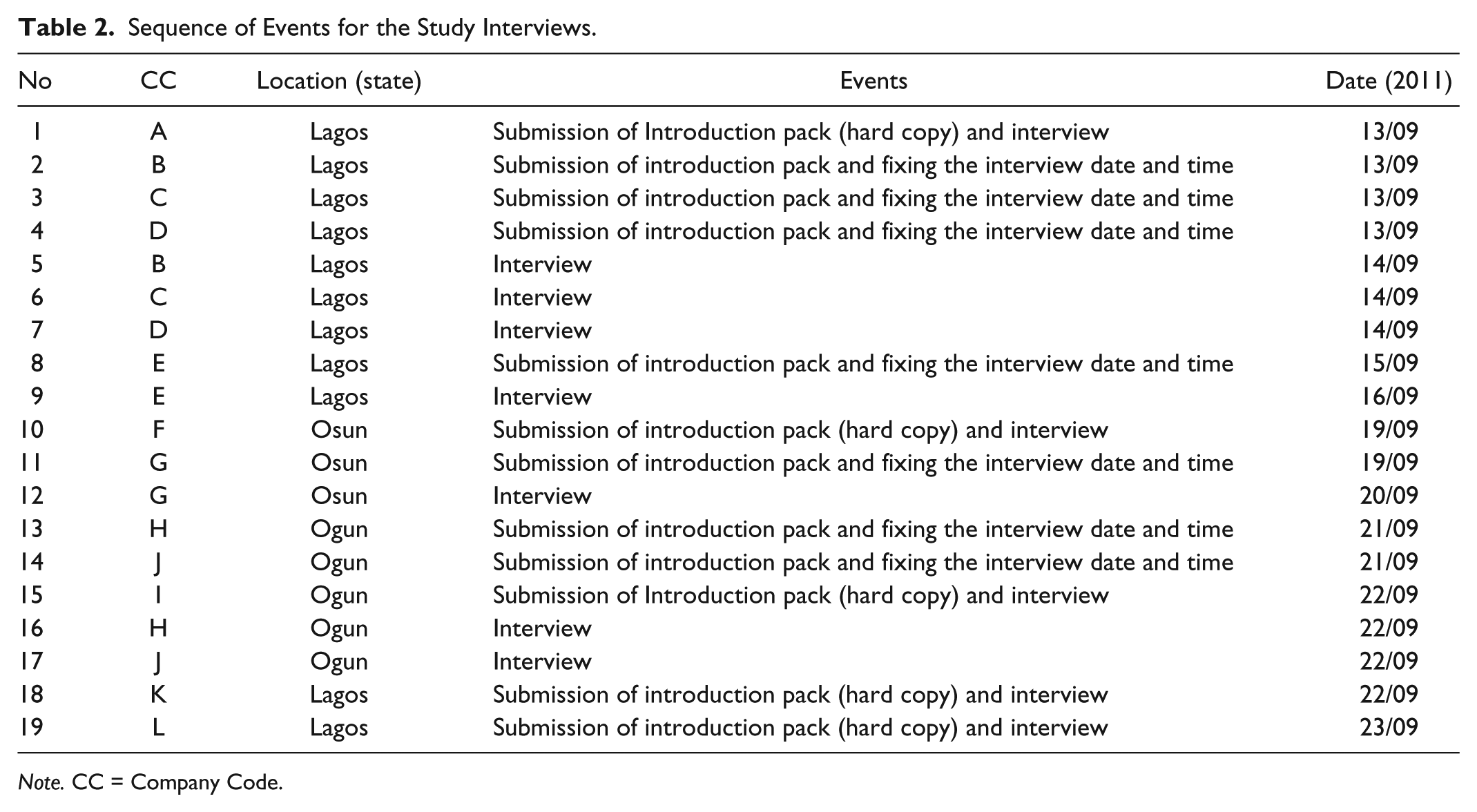
Note. CC = Company Code.
Of 20 organizations that were contacted to participate in the research, only 12 met the criteria for the research study, as detailed in the definition of SMEs. Thirteen managers and owners from 12 companies across three states in the South-Western region of Nigeria ultimately agreed to participate in the research. As shown in Table 3, Lagos state has the highest number of cases, being the commercial center of Nigeria.
Research Cases.

Note. n = number of employees.
The research participants were recruited based on their organizational roles and their knowledge of the research themes. Each participant was interviewed for an average of 1 hr and after securing the permission of the interviewees, each was digitally recorded to ensure accurate capture of the data. For Companies A, F, K, and L, the interview dates were prearranged via phone calls. Company E has the lowest number of employees while Company K has the highest number of employees.
Results
Data Analysis
The interviews were transcribed and content analysis performed to identify any emerging themes, according to the steps enumerated in Creswell (2009), who advocates transcribing the raw data, organizing and preparing it for analysis, reading through it all, coding it, generating themes and descriptions, interrelating themes and descriptions, interpreting the meaning of themes and descriptions, and validating the accuracy of the information. Based on the suggestions of Gibbs (2007) and Creswell (2009), some of the main considerations to ensure validity of the study were incorporated as follows: Data transcription was carefully and patiently carried out to avoid mistakes; during the coding process, constant comparison was made of data with the emerging codes and themes to ensure that there was no drift in their definition; each of the themes was established based on several informant sources; and evidence from different informants was compared to facilitate triangulation and a coherent justification for each of the themes.
Research Findings
Emerging themes from this study are grouped into organizational Innovation Enablers and Marketing Innovation Enablers.
Organizational Innovation Enablers
Findings reveal that Continuous Learning Culture, Employee Training and Development, Effective Workplace Communication, and Employees Empowerment and Participation are crucial to these organizations’ development of Organizational Innovation capability.
Continuous Learning Culture
Responses on the issues that affect the organizational ability to implement new organizational methods in their business practices, workplace organization, or external relations show that employees should be capable of being trained and always ready to learn. The need for continuous learning among the employees was emphasized, as follows: Learning is taken as a never-ending process . . . there is a culture of never-ending education. Employees are encouraged to learn new things and share them with others . . . we have to constantly find new ways of doing things, otherwise, the company goes out of the business or becomes a back bencher. Constant learning is the demand of the industry . . . as long as we want to be ahead, we have to learn new things or create new things for other people to learn from. (Interview 1) We have to think about the future and we don’t like being caught unaware. We are not satisfied with where we are now . . . doing everything possible to achieve excellent status. (Interview 6) We do a lot of research, if there is any emerging issue; we research about it so that we are able to have a firm knowledge about it. The company encourages people to attend seminars and pay for such seminars so that employees can update their knowledge. (Interview 13)
Employee Training and Development
There is evidence of employee training and development in support of the organizational ability to implement new organizational methods in their business practices, workplace organization, or external relations. Some of the issues raised include in-house knowledge transfer, on the job training, accessing external knowledge, staff seminars and training, and measures for appraising staff performance after training. Evidence from interviews to support this includes the following: Before we implement anything, we try to simulate the scenario prior to the actual implementation . . . again training and motivation are provided to the staff to make sure they are up to the task. (Interview 1) We have been able to work on our human resources . . . top level management members have been attending different training courses to improve the quality of our work force. We entered into partnership with a firm in Italy, this is 5 years old now, and this promotes our access to external knowledge and raw materials. Our desire to become better encourages us to learn every day. Employees are briefed and trained of any impending changes . . . we make sure that they have perfect knowledge of any changes. We always do research about finding ways to enter the new markets . . . about finding efficient and effective ways to reach our final consumers. We are improving our information search and research so that we can develop products that meet world standards and are globally acceptable. (Interview 2) We employ the people we can train. . . . we need to transfer knowledge about the jobs to them. The mind-set of the employees is proportional to what you get from them . . . We invite specialists for our training so that we can upgrade ourselves with relevant knowledge . . . There are ways the management is planning for us, making us aware of the latest technology; they invite specialists for staff training, such as seminars. (Interview 11) Occasionally, members of some professional bodies in the industry are invited by our Managing Director to give us lectures, we ask them questions and also ask for their professional advice on issues affecting us. (Interview 7) When we train our staff, they become more functional and more reliable. (Interview 3) We have regular training especially for the production staff and in all areas as well. (Interview 9) We attend seminars. Knowledge is limitless; we continue to learn and to acquire more. We try as much as possible to keep abreast with new discoveries in our industry. We send employees out for training and also bring facilitators to the companies to train us. (Interview 5) I do attend exhibitions and when I come back, skills and knowledge gained are transferred to the staff. We do update ourselves through series of programs, conferences, and convention and learn a lot to inject into our system. (Interview 6) In order to enhance our competitive advantage, staff training is being provided by our international technical partner from time to time. (Interview 10) . . . we have class room training, formal training, the company also hires expatriates as necessary, who will work on the jobs and ensure that members of staff learn under them . . . (Interview 12)
Effective Workplace Communication
Another prominent issue raised by some of the informants is the need for an excellent workplace internal communication structure in the implementation of any new organizational methods in their business practices, workplace organization, or external relations. Employees are to be listened to, and recommendations from them are to be encouraged. With regard to information exchange, the manager should not hide any information needed by the employees to effectively carry out their responsibilities: There are constant meetings and seminars to get the necessary update about the industry. The management members hold meeting once in a week and a general meeting with the employees once in a month. (Interview 11) Management and the employees have good rapport. The management and the employees talk at length and we also have regular meetings to address issues affecting the staff and the company. (Interview 7) We discovered that for the company to move forward and for production to be effective, we need to be communicating very well with every member of staff. We have also successfully bridged the communication gap between the top level and middle level managers. Employees are free to discuss any aspect of the business with the management . . . We listen to every suggestion by staff. (Interview 2) There is free flow of information, especially the most important one for the employees. (Interview 13) From time to time, we have alignment meetings. At the start of the project, there will be a kick-off meeting. So, in these meetings, we keep asking questions, we keep submitting our works for review. That is the way we ensure that we do exactly what we have to do. If we make a mistake, it is not a big deal as long as the job is not yet delivered. (Interview 12)
Employees Empowerment and Participation
Some of the informants considered empowering the employees to be of the utmost importance to organizational innovation, such that their opinions would be welcomed, trusted, and valued in the decision-making process. Some opined that employee sense of belonging, teamwork, and getting feedback from the employees would promote the creation of a well-informed employee community. Such a community is a prerequisite for the implementation of a successful and fruitful organizational change: If we are introducing any changes, all the members of staff, the old and the new ones, are involved. All members are carried along. We provide training that relates to the changes . . . Training allows our employees to work with minimum supervision. For example, some of them are in the field doing the jobs perfectly with no one guiding them . . . Whenever we have tasks to execute, I call on my subordinates, the workers, we study the tasks together, everyone will contribute their ideas. (Interview 4) Because employees are well informed, there has been a decrease in the time it takes to design, fabricate, and test new machines. (Interview 6) We discovered that the truck drivers are a key factor to our success . . . we are now seeing them as partners, though they are our employees, creating forums where we can come together, seek their opinions, and address issues that affect them and the company. (Interview 13) We always encourage our staff to contribute ideas; anything they think can move the company forward. (Interview 2) Here we understand that the more your employees know their jobs and duties, the faster your products will get to the market because the senior members of staff need less time to supervise them. We are able to delegate very well. (Interview 5)
Marketing Innovation Enablers
Customer Relationship Management, Referral Marketing, and Customer Partnering are highlighted as being of key importance to how marketing innovation capability is developed.
Customer Relationship Management
The ability of the selected firms to introduce significant changes in the product appearance, product design or packaging, product placement, product promotion or pricing, or even new marketing concepts highlights that companies need strategic measures to manage their interactions with customers. For a company to address its customer needs better, cordial relationships with the customers and understanding their needs were noted as crucial: We have database for our customers, we have their contacts, we relate on one-on-one basis to identify their needs. (Interview 9) We are building a strong relationship with our customers . . . occasionally we invite them, we hold meeting with them and we host seminars with them. During the seminars, we share our views, so that our relationship is more strengthened. We build a strong relationship with our clients to make us more united. (Interview 11) As a company, we build personal relationship with our customers . . . We established relationship with our customers . . . Sometimes we visit, we send gifts to them, birthday messages and anniversary messages . . . We also keep our customers’ interests in our minds. We make our customers to be in control because it is what they want we are giving to them . . . Also from the details they provided, there are certain things that show that interested in some things and when that things come up, we get in touch with them. There is software program they call data mining, through which we are able to get certain information. If we notice that our customers are interested in certain thing, we tailor our products to such. If we notice that they are not interested in certain things, we move away from such. We get those things from their data. (Interview 1) Most of our employees are well known outside the company . . . they interact well with some of our customers, and projecting the good image of the company . . . and this makes our customers to develop more interest in what we do. (Interview 8) There are occasions when our customers come to request for customized productions, we do that. It is a really flexible approach to satisfy our customers. When they make their requests, we offer suggestions on how we can make their requests better and in many occasions, they listen to us because they believe in us and our suggestions . . . we start production based on the final agreement between the company and the customers. (Interview 3) When the clients bring their jobs, they tell us what they want and we put it together. At different stages of the design work, the clients come in to check to be sure that what we are doing is what they want. Anywhere they notice a deviation, they highlight it and they put note so that we can readjust it back to what they want . . . the quality engineer will ensure that all recommendations of the clients are put into the final design. (Interview12)
Referral Marketing
Some informants identified that, in an attempt to improve their marketing innovation capability, companies maximized their current customers’ ability to introduce activities of the companies to new customers. Responses revealed that some of the companies benefited from introductions to new customers via their existing customers: We enjoy more introductions to new customers from our old customers . . . our customers introduce us to new and potential customers. (Interview 8) Word of mouth from our customers has made us to have more demand for our products and services. (Interview 6) It starts with better service, then more customers because of word of mouth from our customers, then increase in production, because we have more demand. Then expansion due to increase in production that is what I have observed. (Interview 1) We distribute gifts annually to our customers. Through this kind gesture, they introduce new customers to the company . . . potential customers get to know us through our customers. (Interview 5)
Customer Partnering
Some companies are keen to directly engage their customers in their business activities. Enabling the customers to have a voice in the activities of the company is crucial in meeting customer needs and in successful implementation of new marketing methods for their products and services. Customer partnering goes beyond putting customers first; the organizations aim to connect their business activities with their old and new customers on a continuous basis: We treat our customers as partners in business; this gives us an added advantage. (Interview 9) Information comes from those resellers; they are our partners. It is three sided, the staff, the customers, and the partners, those are the people bringing insights to what we do. (Interview 1) So we are seeing our customers as partners, and from time to time, we meet with them. We put some ideas before them on how they can do better and how we can serve them better and they also serve us better, so that the operations can go smoothly. (Interview 13) We provide seminars for our customers to know how to more about our products, particularly how to effectively use them. (Interview 6)
Discussion and Conclusion
This research has identified two soft components of an innovation system: OMIs. Findings reveal that these two soft components are necessary prerequisites for business growth and survival among SMEs. However, they have only received limited attention from academic researchers despite their roles in achieving effective innovative changes (Lam, 2005; OECD/Eurostat, 2005; O’Regan, Ghobadian, & Gallear, 2006). Organizational learning is crucial to how the SMEs in the South-Western Nigeria develop their Organizational Innovation capability. Table 4 provides a summary of the issues discussed by the informants and relates these to the corresponding Organizational Innovation Enablers.
Emerging Organizational Innovation Enablers.

Findings reveal that Continuous Learning Culture plays a central role in developing Organization Innovation capability. While it is important to create the environment for continuous learning in the organizations, employees’ readiness to learn new things is equally important. Effective Workplace Communication allows feedback of the employees’ discoveries into their organizations. Findings also reveal that when the organization encourages employee participation in its decision-making process, its Organizational Innovation capability increases. Table 5 relates the resultant issues to the corresponding Marketing Innovation Enablers.
Emerging Marketing Innovation Enablers.

Table 5 shows that cordial relationships with customers are central to how the SMEs develop their Marketing Innovation capability. SMEs’ owners and managers directly engage their customers in their business activities to ensure successful implementation of new marketing methods for products and services. Figure 3 encapsulates the identified antecedents of OMIs and the emerging enablers that can promote OMIs capabilities and organizational survival from Tables 4 and 5, respectively.

Identified antecedents of OMIs capabilities.
Figure 3 shows that Employee and Customer Engagement are crucial to the development of OMIs capabilities, which are needed to promote effective innovations and long-term organizational survival.
A number of austerity measures in different countries across the globe provide indications that governments in these countries do not have enough resources to meet their own obligations. It is therefore important for small organizations to start looking inward and focus on maximizing their internal capabilities toward their continuous survival. OMIs are needed for every organization to achieve effective innovations; innovations with positive impact on business returns and organizational growth. Formulating policies that support and encourage OMIs in small and medium-sized organizations will optimize their internal capabilities toward promoting their sustainable growth. This will promote long-term organizational performance and consequently increase the number of viable SMEs needed to offset the prevalent public sector job losses. This research is limited to the study of a small number of organizations in the South-Western region of Nigeria and the findings are difficult to generalize to all Nigerian SMEs. Thus, further research is required to enable generalization of these exploratory results. The findings presented here will form the relevant inputs to an extended and enhanced quantitative study of OMIs capabilities and their effects on organizational performance. This will enable a survey design that will involve a considerably larger sample than the organizations investigated in this study.
Footnotes
Declaration of Conflicting Interests
The author(s) declared no potential conflicts of interest with respect to the research, authorship, and/or publication of this article.
Funding
The author(s) received no financial support for the research and/or authorship of this article.