




Abstract
Although the COVID-19 pandemic has largely subsided, it remains crucial to reflect on past experiences and shortcomings to better prepare for potential future outbreaks. Effective outbreak management is a complex scientific challenge that demands robust interdisciplinary collaboration. However, there is currently a lack of quantitative and objective assessments of progress in interdisciplinary research on coronaviruses, particularly measures that directly evaluate the extent of such collaborations. In this study, we employed Python-based algorithms to analyze 156,674 publications from the Web of Science database, tracing the development of coronavirus research and interdisciplinary collaboration. Our findings reveal a significant upward trend in both the volume of coronavirus research and the intensity of interdisciplinary collaboration over the past 5 decades. Notably, major outbreaks have acted as critical catalysts, driving substantial advancements in this field. The past 2 decades, marked by three major coronavirus outbreaks, have seen dramatic growth in the scale and depth of interdisciplinary studies. Nevertheless, achieving seamless cross-disciplinary integration remains a persistent challenge. This study offers valuable insights for fostering interdisciplinary collaboration and optimizing academic discipline structures in universities.
Keywords
Introduction
Epidemic outbreaks have emerged as a pressing global public health challenge (McCloskey et al., 2013; Rojek & Horby, 2016). Factors such as rapid climate and ecology transformations, accelerated urbanization, consistent population growth, and outdated public health systems contribute to the increasing frequency, complexity, and manageability of epidemics (Bedford et al., 2019). Addressing these multifaceted issues requires more than siloed approaches, necessitating robust interdisciplinary collaboration in scientific research (Georgalakis, 2020; Leahey & Barringer, 2020; Moradian et al., 2023).
The study of coronaviruses exemplifies the importance of such collaboration. Spanning over half a century, from their discovery in 1937 to the emergence of the COVID-19 pandemic in 2020, coronavirus research has underscored both the effectiveness and limitations of interdisciplinary approaches. Bibliometric methods have become crucial in examining these dynamics. Rooted in information transfer theory, citation analysis is a foundational tool for exploring disciplinary intersections. However, conventional bibliometric approaches, such as co-authorship networks derived from software like VOS Viewer and Citespace, often yield limited insights into discipline-to-discipline collaboration. Python-based algorithms, by contrast, offer enhanced flexibility for independent design, programming, and direct measurement of interdisciplinary relationships, addressing some of the limitations of existing tools.
Despite the critical role of interdisciplinary collaboration in tackling coronaviruses, the integration of Python in bibliometric studies remains underexplored. A review of the Web of Science (WOS) database found only two relevant studies using Python for bibliometric analysis (Rose & Kessler, 2019), and only one study applied Python to coronavirus research (Abd-Alrazaq et al., 2020; Feng et al., 2019). Similarly, searches combining terms like “multidisciplinary collaboration,”“coronavirus,”“public health,” and “epidemic” revealed limited substantial literature, reflecting a significant gap in both empirical analysis and methodological innovation in this domain.
Theoretical frameworks for interdisciplinary collaboration also vary widely, particularly between social cognitive and identity theories, leading to inconsistencies in their application to empirical studies. This lack of cohesion further impedes a systematic understanding of interdisciplinary practices in coronavirus research. Given these gaps, there is a pressing need for more comprehensive studies that not only analyze interdisciplinary dynamics but also evaluate the applicability of innovative methodologies, such as Python algorithms, in advancing the field. This study addresses these challenges by employing Python to analyze 156,674 academic papers on coronavirus research from the WOS Core Collection. By examining the evolutionary trends of interdisciplinary collaboration, the study aims to provide a global perspective on the progression of coronavirus research. Additionally, it seeks to rationalize theoretical differences in interdisciplinary collaboration, particularly between social cognitive and identity frameworks, offering insights into their empirical implications.
Through this novel approach, the study not only enhances understanding of the interdisciplinary nature of coronavirus research but also explores the broader application potential of Python methods in bibliometric analysis. The findings offer valuable directions for future research and practical strategies for epidemic management, contributing to more effective interdisciplinary collaboration in addressing global public health challenges.
Literature Review
Interdisciplinary Cooperation
Interdisciplinary collaboration has been conceptualized in various ways by scholars, with three primary perspectives emerging: (1) Transdisciplinarity as Synthesis: The first perspective views transdisciplinarity as a synthesis that transcends individual disciplines. Advocates of this approach emphasize the application of systems theory to address broad, multifaceted problems. It integrates political, environmental, and institutional factors to tackle complex challenges in social, economic, and human health domains comprehensively (Stokols et al., 2003). (2) Interdisciplinarity as collaboration: The second perspective considers interdisciplinary research a collaborative effort among individuals or teams, motivated by scientific curiosity or practical necessity. This form of integration involves the convergence of ideas, concepts, and theories, alongside tools, techniques, and data. The primary objective is to address fundamental theoretical and practical problems that cannot be resolved within the confines of a single discipline. (3) Transdisciplinarity as Reflexive Integration: The third perspective defines transdisciplinarity as “a self-reflexive, integrative, and methodologically-driven scientific principle that distinguishes and then integrates knowledge in the process of social and scientific problem-solving” (Özerol et al., 2018). This view highlights the reflective nature of interdisciplinary research, where the integration of knowledge is guided by methodological rigor and driven by the imperative to address intricate challenges.
These perspectives underscore the diverse ways in which researchers from various disciplines can collaborate to address complex issues, such as the study of coronavirusesor epidemic management. By considering these frameworks, scholars can better comprehend the interdisciplinary nature of their work and its implications for advancing knowledge and developing practical solutions.
These perspectives underscore the diverse ways in which researchers from various disciplines can collaborate to address complex issues, such as the study of coronaviruses or epidemic management. By considering these frameworks, scholars can better comprehend the interdisciplinary nature of their work and its implications for advancing knowledge and developing practical solutions.
The multifaceted nature of the problems tackled through interdisciplinarity, coupled with the diverse collaboration models it entails, complicates the task of offering a singular definition. Nonetheless, its key connotations are summarized in Table 1. Interdisciplinary cooperation aims to address complex theoretical and practical challenges, often paving the way for the emergence of novel research domains. These collaborations may involve individual researchers, teams, or organizations and typically integrate elements such as ideas, concepts, theories, tools, techniques, and data. Reciprocal learning and knowledge integration are central to fostering new ideas, implementing innovative methodologies, and generating groundbreaking findings.
Connotation of Interdisciplinary Cooperation.

Generally, the interdisciplinary process can be delineated into three distinct phases: problem identification, knowledge generation, and knowledge application. Each phase contributes to the collective endeavor of addressing the complex issues that lie at the heart of interdisciplinary research.
Discipline Classification
Discipline classification is a systematic approach that organizes the vast scientific system into distinct subjects and fields based on specific principles and criteria, arranging them into a logical structure. Each discipline establishes its unique research paradigm.
Globally, a series of standardized and differentiated classification systems have been developed, including those by the Organization for Economic Co-operation and Development (OECD), the Essential Science Indicators (ESI) database, the United Nations Educational, Scientific, and Cultural Organization (UNESCO), and discipline classification frameworks in countries such as the United Kingdom, the United States, Germany, Japan, and Korea.
In Chinese universities, academic disciplines are categorized into three hierarchical tiers: “academic disciplines,”“major disciplines” (first-level disciplines), and “specialties” (second-level disciplines). These encompass a total of 13 academic disciplines: (1) Philosophy; (2) Economics; (3) Law; (4) Education; (5) Literature; (6) History; (7) Science; (8) Engineering; (9) Agriculture; (10) Medicine; (11) Military Science; (12) Management; and (13) Art. This classification framework includes 110 first-level disciplines and 375 second-level disciplines.
Within the Science category, there are 14 first-level disciplines, such as Biology, Mathematics, Physics, and Chemistry. For instance, the first-level discipline of Biology includes 11 subdisciplines, such as Microbiology, Neurobiology, Genetics, Cell Biology, Biochemistry and Molecular Biology, Biophysics, Botany, and Zoology.
The Medicine category comprises 11 first-level disciplines, including Basic Medicine, Clinical Medicine, Public Health and Preventive Medicine, and Pharmacy. For example, the first-level discipline of Basic Medicine, there are seven secondary disciplines, including Immunology, Pathogenic Biology, and Pathology. Similarly, Clinical Medicine includes 18 subdisciplines, such as internal Medicine (including Infectious Diseases), Oncology, and Emergency Medicine.
This structured system ensures a comprehensive and coherent organization of academic fields, fostering systematic research and interdisciplinary collaboration.
Theoretical Foundation
Interdisciplinary collaborative research is underpinned by a diverse array of theoretical frameworks, which can be categorized into four primary perspectives:
Knowledge Integration Perspective
The Knowledge Base View builds upon the Resource-Based View, emphasizing the pivotal role of knowledge as an intangible asset in shaping an organization’s core competitiveness. Particularly crucial knowledge and resources that are scarce, imitable, and heterogeneous (Barney, 1991). Interdisciplinary collaboration leverages, integrates, and learns from distinct disciplinary knowledge, potentially transforming the structural relationships within the original fields. This process, coupled with the fusion of static “stock knowledge” and dynamic “flow knowledge,” enhances the creative capacity of organizations or teams, empowering them to fulfill its innovative function (Hoffmann et al., 2017).
Cognitive Conflict Perspective
Social Cognitive Theory highlights the dual influence of goal-driven behavior and self-efficacy on individual actions. Self-efficacy refers to an individual’s belief in their ability to control their behavior, shaped by their personal capabilities and the external environment. In interdisciplinary collaborations, where participants contribute diverse knowledge, shifts in environmental factors often arise, leading to cognitive and emotional conflicts (Van Knippenberg & Schippers, 2007). These conflicts can manifest in three forms—cooperative, confrontational, and concessionary, each with varying impacts on knowledge sharing and team dynamics during conflict resolution.
Cohesion Perspective
Social Identity Theory posits that initial interactions between individuals aim to maximize mutual understanding and influence. Through repeated interactions, individuals form task-oriented and affective social relationships (Corsaro et al., 2012; Lavy et al., 2015). In interdisciplinary teams diverse professional backgrounds and knowledge can result in differing perceptions, potentially causing conflicts in thought processes and decision-making. However, such conflicts are often transient and when managed effectively, contribute to team cohesion. Fostering understanding, tolerance, and network cohesion plays a critical role in conflict resolution, ultimately enhancing team performance (Reagans & McEvily, 2003).
Group Perspective
Scholars such as Bonebright (2010) have examined interdisciplinary collaboration through the lens of Group Dynamics Theory. Interdisciplinary teamwork is framed as a group growth process comprising four stages: (1) Cooperation: This initial stage focuses on uniting members around shared goals and objectives. (2) Turbulence: In this phase, power struggles and conflicts arise due to diverse perspectives. Constructive resolution leads to greater understanding and collaboration. (3) Norms: Teams establish roles, expectations, and norms, fostering deeper communication, and cohesion. (4) Performance: The final stage is marked by productive collaboration, where members work efficiently toward shared goals, supported by trust and mutual understanding. This perspective sheds light on how team dynamics evolve, enabling interdisciplinary teams to navigate challenges and achieve effective collaboration.
Review of Theoretical and Empirical Insights
The theoretical foundation of interdisciplinary collaboration underscores its potential to drive knowledge integration and innovation, as highlighted in the Knowledge Base View (Leahey & Barringer, 2020; Salem, 2017). However, practical implementation often encounters challenges, such as limited communication and process conflicts, as noted in Social Cognitive Theory. Many interdisciplinary collaborations occur within related disciplines, reflecting the inherent difficulty of transcending disciplinary boundaries (van Noorden, 2015).
Empirical evidence illustrates that interdisciplinary approaches have provided critical insights into addressing global challenges, such as the COVID-19 pandemic. However, these collaborations also reveal persistent bottlenecks, including cognitive conflicts and barriers to team cohesion. Understanding these complexities offers an opportunity to enhance collaboration through targeted countermeasures, enabling more effective interdisciplinary solutions to real-world problems.
This comprehensive theoretical and empirical analysis highlights both the potential and challenges of interdisciplinary collaboration, emphasizing the need for continued refinement of strategies to overcome barriers and foster innovation in diverse fields.
Methods
Data Collection
The Web of Science (WOS) Core Collection, a comprehensive research literature database, was selected for its extensive coverage of English-language research across all fields. A search of the WOS database was conducted up to the end of 2023, using “Coronavirus” as the search keyword.
A Python program was employed to generate seed URLs, which were subsequently added to a crawling queue. Literature pages were downloaded and exported in the format ‘Full Record with Cited References.” The complete search results were saved as TXT files. Metadata, including publication year, author, organization, country, and abstracts, were extracted from these files. After thorough manual data cleaning, a total of 156,674 documents were processed and incorporated into the study’s database.
For the analysis of interdisciplinary collaboration, the Python program was further utilized to decompose author affiliation data and extract the disciplinary keyword fields from the database. These fields were measured, organized, and presented using graphical and textual formats.
Rationale for Choosing Python
Python was selected as the primary tool for data mining and analysis due to its distinct advantages in data processing and scientific computing. Three key reasons underpinned this choice:
Flexibility and Iterative Analysis. Traditional data analysis and statistical software are often constrained by rigid parameters and complex operations. In contrast, Python provides flexibility, enabling researchers to write custom code and perform iterative, exploratory data analysis tailored to specific research questions. For example, this study used Python to decompose author affiliation information and extract disciplinary keywords, forming the foundation for measuring interdisciplinary collaboration. Such functionality is beyond the capabilities of standard citation or co-authorship analysis tools.
Handling Large Datasets. Python’s robust algorithms are capable of managing large-scale datasets, offering comprehensive data mining, analytical capabilities, and visualizations. In this study, Python was used to analyze over 150,000 articles, encompassing hundreds of thousands of data points related to authors, disciplines, countries, and affiliations.
Efficient Web Content Parsing. Python’s powerful HTML parser facilitates rapid and efficient extraction of webpage content, aligning seamlessly with the study’s objective of mining bibliometric data from database webpages.
By leveraging Python’s advanced programming and data mining capabilities, this study was able to process large volumes of data scientifically and efficiently. This approach not only improved the precision of data handling but also enhanced the overall quality of the analytical results.
Research Process
This study is structured into two primary sections. The first section is focuses on delineating the sample, encompassing the evolution of coronavirus research, while the second section analyzes interdisciplinary collaboration within coronavirus studies. The first section is further bifurcated into two sub-sections: an encapsulation of the overarching trends in coronavirus research and an examination of the trends in distribution across academic disciplines.
Section Breakdown
The first section is divided into two sub-sections:
A summary of overarching trends in coronavirus research.
An analysis of the disciplinary distribution trends in coronavirus studies.
Data Preprocessing and Temporal Segmentation
During the data preprocessing phase, it was observed that the body of coronavirus research published prior to 2000 was minimal and insufficient to substantiate meaningful interdisciplinary analysis. Consequently, the scope of this study was confined to interdisciplinary collaborative investigations conducted between 2000 and 2023.
To provide a comprehensive understanding of temporal patterns, the research period was segmented into three distinct phases, corresponding to the major coronavirus outbreaks:
2003 to 2011: Marking the Severe Acute Respiratory Syndrome (SARS) outbreak.
2012 to 2019: Spanning the Middle East Respiratory Syndrome (MERS) outbreak.
2020 to 2023: Encompassing the global impact of Coronavirus Disease 2019 (COVID-19).
This temporal segmentation aligns with the three pivotal outbreaks, facilitating a nuanced analysis of the evolution and interdisciplinary collaboration trends in coronavirus research. Figure 2 provides a detailed illustration of these phases.
Sample Description
Evolution of Coronavirus Research
Coronaviruses were first isolated from poultry in 1937 (Kuiken et al., 2003), and subsequently identified in humans in 1965 as a causative agent of severe acute respiratory syndrome (SARS). Since then, coronaviruses have been extensively studied. To illustrate the annual trend in coronavirus research output, Figure 1 depicts the number of publications by year, while Figure 2 provides a timeline of significant historical events in coronavirus research.

Trends in disciplinary distribution of coronavirus research.

Timeline of key historical events for coronaviruses.
The timeline spans from the discovery of coronaviruses in poultry (1937) to present-day advancements, including key events such as the SARS outbreak in 2003, the Middle East Respiratory Syndrome (MERS) outbreak in 2012, and the COVID-19 pandemic starting in late 2019. These events marked critical points in coronaviruses research, significantly influencing publication trends.
Observations from Figures 1 and 3
The analysis of Figures 1 and 3 demonstrates a significant upward trend in coronavirus-related publications, particularly following the emergence of COVID-19. This growth reflects the heightened global research focus on coronaviruses in response to major outbreaks. Notably, three distinct peaks in research activity are observed. The first minor peak occurred in 2004, coinciding with the SARS outbreak, during which the annual number of publications increased from 100 to over 600. The second minor peak in 2013 is associated with the MERS outbreak. The most pronounced peak began in 2019 due to COVID-19, resulting in tens of thousands of publications annually, representing an unprecedented surge in scientific output. Furthermore, disciplinary distribution patterns, as illustrated in Figure 3, reveal contributions from the top 10 fields, which align closely with the overall publication trends. These fields exhibit a consistent and sustained focus on coronavirus research, highlighting the interdisciplinary nature of efforts to address this global health challenge.
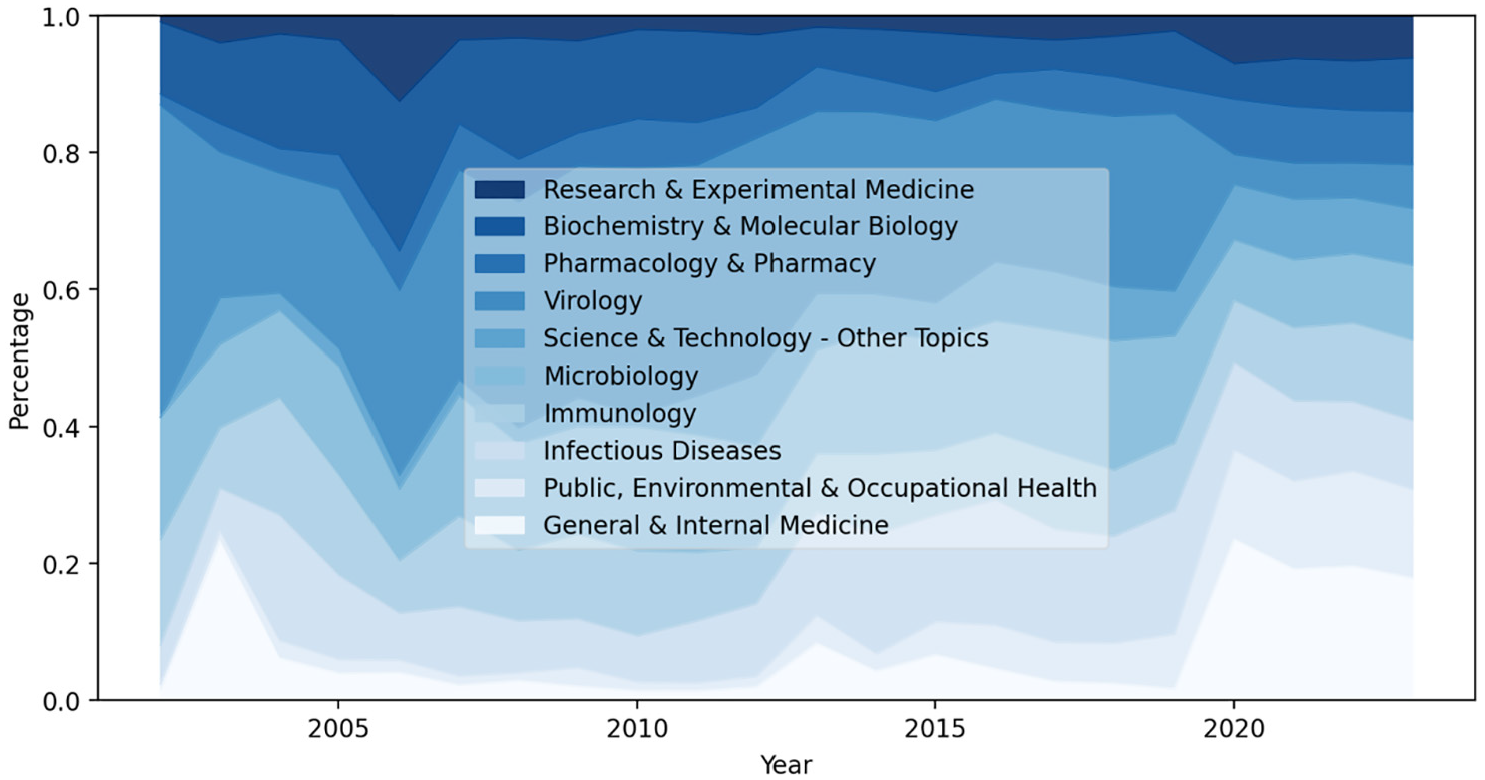
Percentage map of top 10 disciplines in coronavirus research.
Trends in Disciplinary Distribution
The study ranks disciplines based on their contributions to the analyzed sample and examines their geographic distribution, as illustrated in Figure 3. Furthermore, a bar chart in Figure 4 highlights the top 10 disciplines by publication volume, which include General and Internal Medicine, Public, Environmental and Occupational Health, Infectious Diseases, Immunology, and other related fields. These disciplines collectively represent the primary areas of focus in coronavirus-related research, reflecting the interdisciplinary nature of efforts to address the global challenges posed by these diseases.
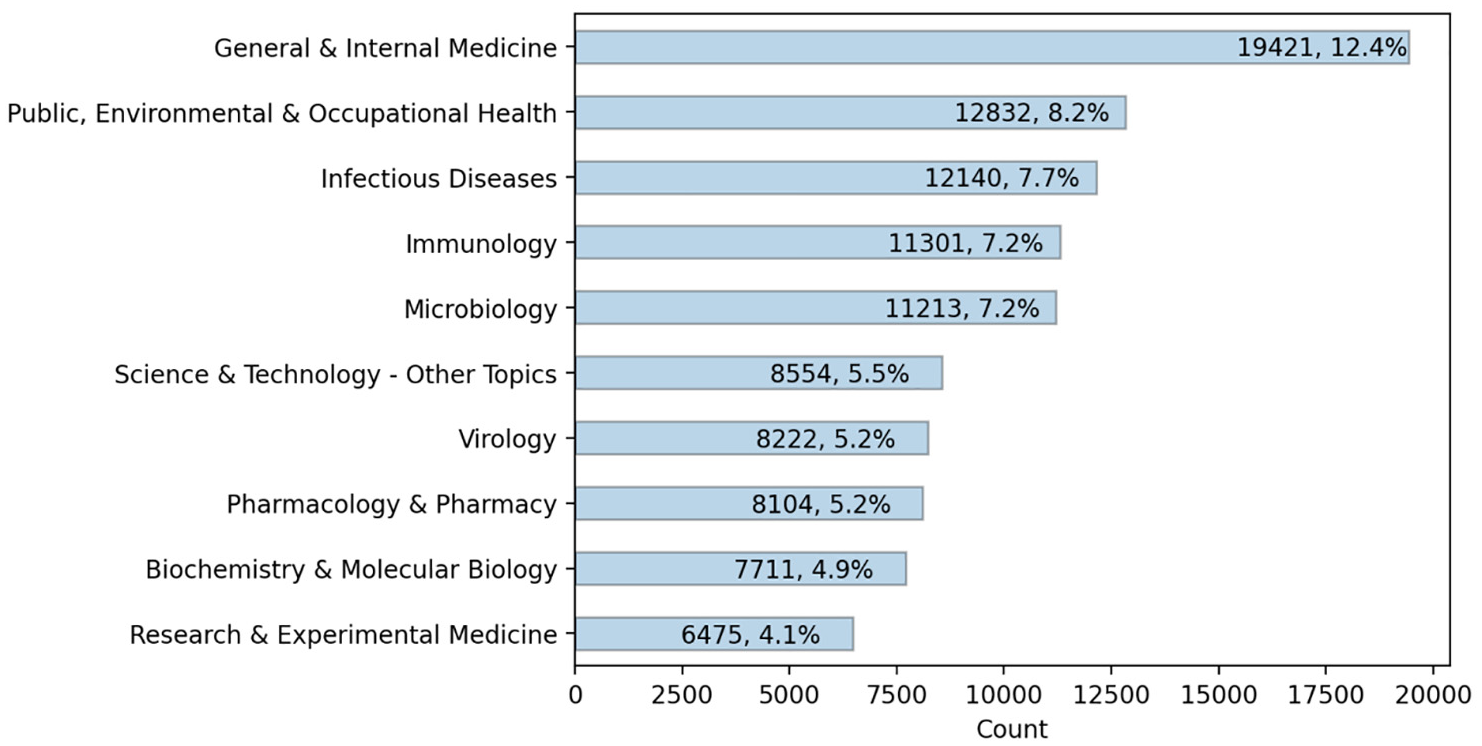
Bar chart of top 10 disciplines ranked by publication volume.
Analysis of Interdisciplinary Collaboration
Interdisciplinary collaboration were analyzed based on the keywords associated with author contact information. For example, if an article listed three authors—Author A from epidemiology, Author B from molecular biology, and Author C from immunology-the following collaborations would be recorded: epidemiology-molecular biology (1 instance), epidemiology-immunology (1 instance), and molecular biology-immunology (1 instance).
These statistics were examined across three distinct time intervals, corresponding to major coronavirus outbreaks: Interval I (2003–2011, Figure 5), Interval II (2012–2019, Figure 6), and interval III (2020—2023, Figure 7). For consistency, the analysis focused on the top 40 collaborating disciplines in each interval. Collaboration thresholds were adjusted for each period to account for increasing publication volumes: 44 collaborations for Interval I, 150 for Interval II, and 4,056 for Interval III. The rising thresholds reflect the exponential growth in interdisciplinary collaboration over time.
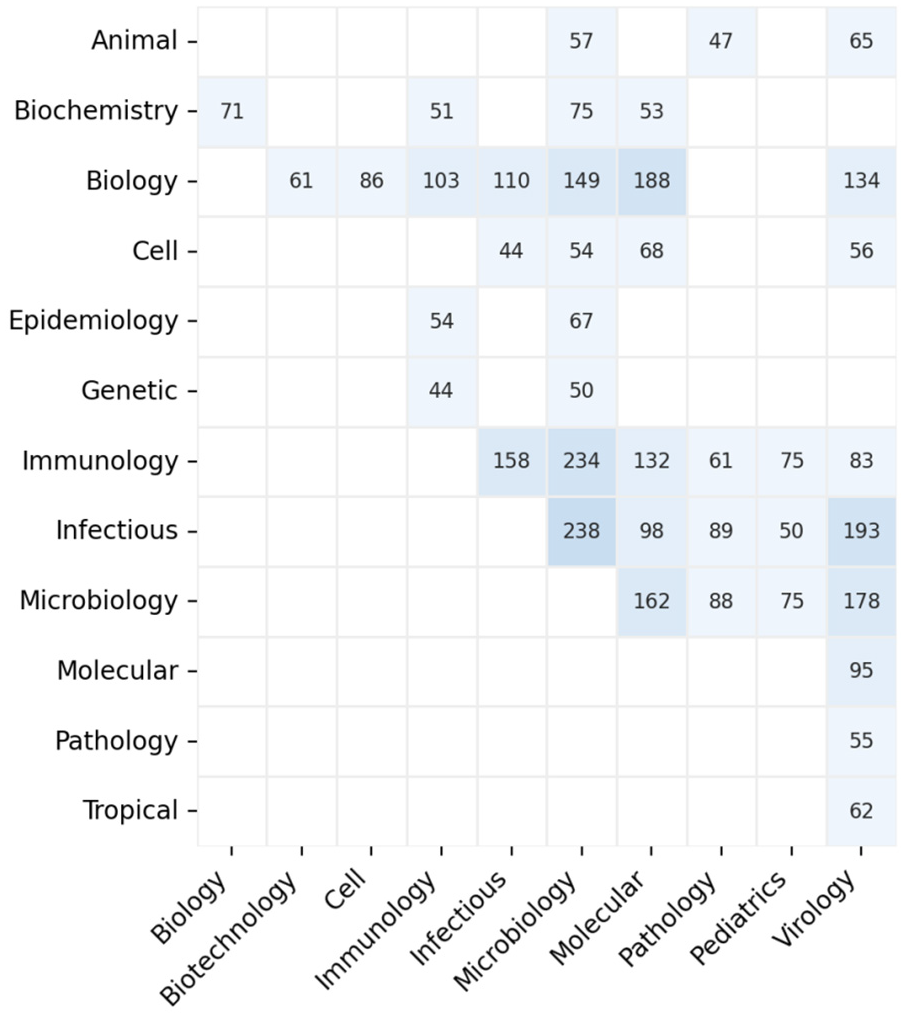
Interdisciplinary collaboration on coronaviruses, 2003 to 2011 (top 40 disciplines, threshold = 44).

Interdisciplinary collaboration on coronaviruses, 2012 to 2019 (top 40 disciplines, threshold = 150).

Interdisciplinary collaboration on coronaviruses, 2020 to 2023 (top 40 disciplines, threshold = 4,056).
Interval I (2003–2011)
The first interval corresponds to the period following the outbreak of Severe Acute Respiratory Syndrome (SARS). During this time, interdisciplinary collaboration was relatively limited. As shown in Figure 5, the disciplines with the highest number of collaborations were:
Biology and Microbiology, with 238 collaborations.
Epidemiology and Virology, with 193 collaborations.
Biology and Molecular Science, with 188 collaborations.
Microbiology and Virology, with 178 collaborations.
Despite the emerging importance of SARS research, the overall scale of interdisciplinary collaboration during this period was relatively modest, and the collaborations were primarily concentrated within closely related fields.
Interval II (2012–2019)
The second interval aligns with the outbreak of Middle East Respiratory Syndrome (MERS). During this period, a significant increase in interdisciplinary collaboration was observed. As depicted in Figure 6, the following collaborations were most prominent:
Infectious Diseases and Microbiology, with 1,357 collaborations.
Infectious Diseases and Virology, with 715 collaborations.
Immunology and Infectious Diseases, with 704 collaborations.
Immunology and Microbiology, with 644 collaborations.
The number of collaborations during this interval increased by approximately tenfold compared to Interval I. This growth reflects the heightened global attention and the complexity of research required to address the challenges posed by MERS. The expansion of interdisciplinary networks also indicated a gradual shift toward integrating expertise from diverse scientific fields.
Interval III (2020–2023)
The third interval corresponds to the period of the Coronavirus Disease 2019 (COVID-19) pandemic, which led to an unprecedented surge in interdisciplinary collaboration. Figure 7 illustrates that the most frequent collaborations during this period were:
Emergency and Critical Care with pediatrics, recording 23,220 collaborations.
Infectious Diseases with pediatrics, recording 17,032 collaborations.
Immunology with Infectious Diseases, recording 14,106 collaborations.
Infectious Diseases with Microbiology, recording 13,135 collaborations.
A notable feature of this period was the emergence of novel collaboration patterns, particularly the prominence of partnerships involving Emergency and Critical Care with Pediatrics, which had not been widely observed in previous intervals. This development highlights the urgent need for diverse and interdisciplinary approaches to address the multifaceted challenges of the COVID-19 pandemic, including clinical care, public health interventions, and vaccine development.
Conclusions
This study reveals a marked evolution in the complexity and scope of interdisciplinary collaborations during major coronavirus outbreaks over the past 2 decades. The findings underscore significant progress in fostering collaborations within adjacent disciplines while highlighting the persistent challenge of integrating cognitively distant fields. Targeted efforts to promote cross-disciplinary collaborations and more inclusive research frameworks are essential for advancing the collective capacity to address epidemic-related challenges and broader global health issues.
Results and Discussion
This study systematically investigates the evolution of interdisciplinary research collaborations during three significant coronavirus outbreaks from 2000 to 2023. The findings demonstrate a pronounced quantitative surge in collaborative efforts during the COVID-19 pandemic compared to prior outbreaks, with the volume of interdisciplinary collaborations escalating from hundreds to tens of thousands across successive stages.
Evolution of Collaborative Disciplines
The scope of interdisciplinary collaborations has expanded markedly over time. In the initial stages, collaborations were predominantly concentrated within closely related domains such as “Epidemiology-Virology,”“Biology-Molecular,” and “Microbiology-Virology” (Huang et al., 2020; Woolhouse et al., 2015). During the second stage, corresponding to the Middle East Respiratory Syndrome (MERS) outbreak, the spectrum of collaboration broadened to include “Infectious-Microbiology,”“Infectious-Virology,”“Immunology-Infectious,” and “Immunology-Microbiology” (Callaway, 2021; Casadevall et al., 2022).
In the third stage, reflecting the COVID-19 pandemic, the interdisciplinary landscape diversified further to encompass specialized intersections such as “Emergency & Critical Care and Pediatrics,”“Infectious-Pediatrics,”“Immunology-Infectious,” and “Infectious-Microbiology.” These trends are consistent with findings from recent studies emphasizing the need for integrative and nuanced interdisciplinary frameworks to address increasingly complex biomedical challenges (Kumar et al., 2023).
The observed transition from adjacent disciplinary collaborations to more specialized and diverse intersections underscores a growing recognition of the necessity for integrated expertise in epidemic management. Nevertheless, a substantial proportion of collaborations remains confined to proximate fields, with limited engagement across distant disciplines. This phenomenon aligns with existing literature that highlights cognitive, cultural, and institutional barriers to achieving seamless interdisciplinarity (Börner et al., 2021; Porter et al., 2020; Smith et al., 2024).
Comparative Contributions to Existing Literature
Notably, the role of business-related disciplines in interdisciplinary collaboration has become increasingly significant, particularly during the COVID-19 pandemic. Disciplines such as Business Management, Operations Research, and Health Economics contributed to optimizing supply chains, modeling healthcare resource allocation, and analyzing the economic impact of lockdown policies. These business-oriented perspectives facilitated more informed and efficient decision-making processes in pandemic response. Despite these contributions, their visibility in bibliometric records remains relatively limited compared to biomedical disciplines, suggesting the need for more integrated reporting standards and interdisciplinary outreach in business scholarship.
This study extends the scope of earlier research, which predominantly focused on mapping citation networks or analyzing collaborative structures (Chen et al., 2019; Leydesdorff et al., 2018). Unlike prior work centered on traditional biomedical collaborations, the findings here reveal the dynamic integration of non-traditional contributors during the COVID-19 pandemic, such as “Data Science and Epidemiology” and “Sociology and Public Health” (Zhou et al., 2023).
Despite the exponential growth of interdisciplinary activities, the study corroborates previous findings that most collaborations occur within disciplinary proximities (Adams et al., 2021; Rafols & Meyer, 2020). Overcoming these disciplinary silos is imperative for fostering transformative collaborations capable of addressing complex global challenges, including but not limited to epidemics. Promoting interactions across diverse domains such as “Artificial Intelligence and Sociology” or “Engineering and Biology” could generate innovative solutions with far-reaching implications.
Expanded Strengths and Limitations
This study’s strengths lie in its longitudinal analysis of interdisciplinary collaboration trends during three major outbreaks, providing a comprehensive perspective on the evolution of research efforts in response to public health crises. The use of Python-based methodologies enhances the robustness of the analysis, offering scalable and replicable tools for studying interdisciplinary patterns across various domains. Furthermore, the findings emphasize the pivotal role of emergency medicine as a nexus for interdisciplinary collaboration in later outbreak stages, presenting practical implications for optimizing collaborative frameworks.
However, certain limitations must be acknowledged. First, the reliance on bibliometric data excludes informal or unpublished collaborative efforts, potentially underrepresenting the true extent of interdisciplinary interactions. Second, while the study captures historical trends, it does not address ongoing or emergent dynamics that may shape future collaboration patterns, particularly in rapidly advancing fields like artificial intelligence and computational biology.
Moreover, the study primarily focuses on collaborations within medical and scientific disciplines, leaving interactions with more distant fields—such as sociology, economics, and engineering—underexplored. These interactions could offer transformative insights for epidemic management and policy development. Lastly, while the study quantitatively maps collaboration trends, it does not evaluate the qualitative impact of these efforts on research outcomes or public health policies. Future research should incorporate mixed-method approaches to address these gaps and deepen our understanding of interdisciplinary collaboration’s efficacy.
Theoretical Contributions
This study advances the academic understanding of interdisciplinary collaboration in epidemiological decision-making by addressing several critical aspects.
First, the research delves into the theoretical tensions that arise in interdisciplinary collaboration. The integration of diverse methodologies, objectives, and disciplinary perspectives often leads to misunderstandings and conflicting viewpoints. By identifying and analyzing these theoretical challenges, the study enriches the discourse on interdisciplinary cooperation and provides insights to guide more effective collaboration (Gralinski & Menachery, 2020).
Second, the innovative use of Python methods in analyzing interdisciplinary dynamics offers a methodological contribution. Through the application of computational tools, this research demonstrates how advanced programming can bridge qualitative and quantitative approaches, enabling more precise analyses of complex collaborative systems. This methodological advancement paves the way for future studies to leverage computational tools in similar interdisciplinary contexts (Chochole, 2022; Eckmanns et al., 2019).
Moreover, the study establishes a reference framework for synthesizing evidence from various disciplines to support epidemiological decision-making. This contribution addresses existing gaps in integrating diverse data sources, providing a theoretical foundation for creating robust, evidence-based public health policies. By emphasizing interdisciplinary approaches, this framework holds significant potential for improving the effectiveness of epidemiological interventions (Brown & Prescott, 2015).
Practical Implications
The findings of this research carry notable practical implications for researchers, policymakers, and practitioners engaged in public health and epidemiology.
A key implication lies in enhancing collaborative decision-making. The proposed reference framework equips practitioners with the tools needed to integrate multidisciplinary insights into epidemic response strategies. This holistic approach fosters more comprehensive and effective public health interventions (Gralinski & Menachery, 2020).
Another important contribution is the application of computational tools, particularly Python, in managing diverse datasets and streamlining interdisciplinary collaboration. By highlighting these practical techniques, the study encourages the adoption of data-driven methods that enhance analytical rigor and improve decision-making processes in complex public health scenarios (Boccaletti et al., 2020; Eckmanns et al., 2019; Wang & Zhang, 2024).
Additionally, the insights from this research provide a foundation for shaping institutional and policy frameworks. Policymakers can develop targeted mechanisms, such as funding incentives and revised evaluation criteria, to promote and sustain interdisciplinary collaboration in both research and practice. This institutional support is essential for overcoming barriers to collaboration and achieving impactful results.
Finally, the integration of computational methods into educational curricula emerges as a significant implication. By equipping future researchers with these tools, academic institutions can better prepare them to tackle global health challenges that require interdisciplinary solutions (Saw & Jiang, 2020).
Recommendations for Future Research
Building upon the findings, this study identifies several promising directions for advancing interdisciplinary research.
One critical avenue is the integration of social sciences into epidemic prevention and management. Disciplines such as political science, sociology, and ethics offer unique perspectives on the multifaceted challenges of public health crises, yet their potential remains underutilized. For instance, political science can provide insights into governance structures that facilitate effective epidemic response, while sociology and ethics help address behavioral and equity considerations in public health strategies (Brown & Prescott, 2015; Dingwall et al., 2012). Recent developments, such as the application of AI-powered tools, further highlight the possibility of bridging these fields through technology, enabling comprehensive frameworks for managing complex epidemics (Lee et al., 2024). Additionally, future interdisciplinary frameworks should actively incorporate insights from business studies, such as risk management, strategic agility, and innovation policy, to strengthen system-level responses to public health crises.
Cross-disciplinary synergy within the natural sciences also deserves increased attention. The integration of biology, mathematics, and data science has already demonstrated its value in pandemic modeling and vaccine development (Eckmanns et al., 2019). The application of advanced computational tools, such as machine learning algorithms, has facilitated breakthroughs in understanding disease transmission and predicting outbreak patterns (Chochole, 2022). Such collaborations not only accelerate innovation but also enhance the precision and scalability of public health interventions.
Intra-disciplinary engagement represents another fruitful direction. Fields like epigenetics, which naturally bridge life and social sciences, provide opportunities to investigate how environmental and social factors influence biological processes. For example, studies on epigenetic changes linked to socioeconomic status or stress environments illustrate the intersection of these fields, offering transformative insights into addressing health inequities (Dubois et al., 2020).
However, interdisciplinary collaboration must be approached judiciously. For relatively straightforward challenges, mono-disciplinary approaches may remain sufficient, as pursuing unnecessary collaboration could dilute resources and focus (Nurok & Gewertz, 2018). When addressing complex problems, researchers should assess whether collaboration genuinely adds value. To promote meaningful interdisciplinary efforts, fair and transparent evaluation mechanisms are essential. Current assessment frameworks often undervalue the unique contributions of collaborative work, creating barriers to sustained engagement. Establishing metrics that fairly evaluate and reward interdisciplinary achievements can encourage researchers to pursue cross-disciplinary partnerships (Saw & Jiang, 2020).
Finally, the exploration of leadership theories in interdisciplinary contexts could significantly enhance collaborative outcomes. Effective leadership—both structural and process-oriented—is crucial for navigating the complexities of interdisciplinary work. For instance, leaders who foster open communication and align diverse disciplinary goals are better positioned to transform potential conflicts into productive synergies. This focus on leadership is particularly critical in high-stakes areas such as epidemic management, where the alignment of resources and expertise directly impacts outcomes (Gralinski & Menachery, 2020).
These recommendations underscore the importance of integrating diverse disciplines thoughtfully, employing strategic resource allocation, and fostering institutional support to maximize the impact of interdisciplinary research. Such efforts are essential for advancing solutions to public health crises and other complex global challenges.
Footnotes
Acknowledgements
We sincerely thank all participants for their valuable contributions.

Ethical Considerations
This study did not involve human participants, animals, or personally identifiable data. Therefore, ethical approval and informed consent were not applicable. The analysis was based solely on bibliometric data retrieved from the Web of Science database. Ethical approval for this type of study is not required by our institute.
Author Contributions
Shufang Huang performed the research and writing of the entire article.
Funding
The author disclosed receipt of the following financial support for the research, authorship, and/or publication of this article: This work was supported by Science and Technology Department of Zhejiang Province, Natural Science Foundation of Zhejiang Province (No. LY20G030013) and Ministry of Science and Technology of the People’s Republic of China, National Natural Science Foundation of China (No. 71704155).
Declaration of Conflicting Interests
The author declared no potential conflicts of interest with respect to the research, authorship, and/or publication of this article.
Data Availability Statement
Data sharing not applicable to this article as no datasets were generated or analyzed during the current study.
Reflexivity Statement
The author is a female researcher with over 10 years of experience in innovation management and policy research, a non-native English speaker and affiliated with a university in a undevelopmented country. She has substantial experience in heterogeneous subject cooperation (e.g., Huang, 2019).