




Abstract
This study aimed to examine the learning progression (LP) model of scientific imagination among undergraduate students using the Scientific Imagination Test-Verbal (SIT-Verbal) and investigated the influence of students’ demographic characteristics including gender, age, and discipline on their scientific imagination. Six hundred and sixteen undergraduates from a university in southern Taiwan participated in this study. The SIT-Verbal covered four key components of the scientific imagination process: brainstorming, association, transformation/elaboration, and conceptualization/organization/formation. The multiple validities of SIT-Verbal were assessed via a Rasch partial credit model. The results indicated that the SIT-Verbal had good model–data fit, supporting that undergraduate students’ scientific imagination in four stages from brainstorming, association and transformation/elaboration to conceptualization/organization/formation. Additionally, the results showed that the SIT-Verbal was suitable for measuring students’ scientific imagination at the university level. The study also provided abundant evidence verifying the SIT-Verbal and supported the learning progression for undergraduate students’ scientific imagination.
Keywords
Introduction
In the development of science, scientific creativity and imagination have played crucial roles. Through continuously thinking, trying, revising, and shaping and matching previous experiences or new encounters, individuals can make use of their innate imagination to establish new visions, discover scientific principles, and create new inventions to improve people’s lives (Hsu et al., 2012; Vygotsky, 1930/2004). For instance, by considering environmental sustainability, the organizers of the 2020 Tokyo Olympic and Paralympic Games invented a new material for bedframes that is made almost entirely from renewable materials; its innovative design is inspired by the structure of beehives and can be adjusted according to the athletes’ needs (Gleeson, 2019). Innovative material and design are good examples of transforming imagination into creation.
Established on scientific processes and existing knowledge with an appropriate scientific disposition, scientific creativity encompasses the cognitive ability to develop products that are related to the context and possess usefulness or importance (Ayas & Sak, 2014; Hu & Adey, 2002). Scientific imagination, on the other hand, is the mental activity linking scientific principles with ubiquitous experiences to generate novel ideas (Ho et al., 2013); this mental activity is not restrained by any limits or hindered by pre-existing frames of mind. Scientific imagination can help individuals to escape limitations imposed by existing frames of knowledge and reality and can help to visualize and actualize ideas into scientific principles and technological products. The difference between scientific imagination and scientific creativity is that the former is a cognitive activity that stimulates and generates ideas in one’s mind, whereas the latter involves not only idea generation but also implementation and production of novel inventions or products (Seligman et al., 2016).
For scientists, imagination is an important skill that has made immense contributions to the development of science (Ren et al., 2012). Science education is a useful path for cultivating talent with rich imagination and creativity (McCormack, 2010). The Next Generation Science Standards report lists “Science is a Human Endeavor” as one of the themes of the “Nature of Science” and emphasizes the importance to science of creativity and imagination in grades 3–5, junior high school, and high school (NGSS, Lead States, 2013). Therefore, questions regarding how to spark students’ creativity, guide ideas into creation, and transfer scientific knowledge to students’ everyday lives are crucial issues that need to be addressed in science education.
Previous literature on creativity or imagination in science focused mostly on the former and rarely the latter (Ayas & Sak, 2014; Hu et al., 2013; Vries & Lubart, 2019). Ho et al. (2013) systematically collected, recorded, and analyzed fifth and sixth graders’ process of scientific invention and concluded that scientific imagination is a process with three stages and four key components. The three stages are the Initiation Stage, Dynamic Adjustment Stage, and Virtual Implementation Stage. The four key components include: (1) brainstorming; (2) association; (3) transformation & Elaboration; and (4) conceptualization, organization, & formation. With teachers’ guidance, students can employ their scientific imagination to conduct purposeful imagination activities aimed at solving problems. These activities may involve: (a) brainstorming; (b) selecting, sorting and linking ideas; (c) recombining the relationships among ideas; (d) considering the practicality of ideas and refining ideas into a solution. The three stages form a recursive cycle, constantly generating relevant ideas based on the needs of the problem through separation and recombination.
Based on this scientific imagination model, a pilot study of a learning progression (LP) for fifth and sixth graders’ scientific imagination via meetings with experts on educational assessment, science education, and imagination with in-service teachers was conducted (Wang et al., 2015). This previous study utilized the Berkeley Evaluation and Assessment Research (BEAR) Assessment System (BAS, Wilson, 2005, 2009) to clarify the key concepts and developmental process of scientific imagination. The aim was to then establish assessment tools that could inform lesson designs on scientific invention and improve the link between instruction and assessment.
The development of an LP requires a literature review, proposal of model hypotheses, systematic empirical data collection, repeated verifications and revisions (Claesgens et al., 2009; Shea & Duncan, 2013; Songer et al., 2009). In this vein, the purpose of the current study was to verify LP model of scientific imagination using undergraduate samples and to further investigate the relationships of scientific imagination and imagery with other variables including gender, years of study (grade level), and academic background. Therefore, this study aimed to explore: (1) whether the scientific imagination of undergraduate students could match the learning process model of scientific imagination and (2) whether there are any significant differences in undergraduate students’ scientific imagination and imagery across gender, year of study (grade level) and academic background.
Literature Review
Learning Progression for Scientific Imagination
Past research has mentioned that imagination is an ability to connect images, pictures or ideas in the mind (Wang & Huang, 2015). During the transition from imagination to creativity, a variety of cognitive changes, such as “disassociation and association” (Eckhoff & Urbach, 2008), “conceptual combination” (Horng et al., 2013), and “remote association” (Mednick, 1962) are experienced. Furthermore, imagination involves the process of analogy—establishing correspondences between different knowledge concepts. The more distant objects seem to be in relation or in structural commonality, the greater the chance of producing highly creative ideas (Kao, 2014; Ward & Wickes, 2009). When thoughts are visualized, the ability of mental imagery is also activated (LeBoutillier & Marks, 2003). Mental image is an experience or activity in which individuals employ sensory perception to create picture-like images presented in the mind, and then search the brain for memory information, or extract information from personal experience. Through the process of imagination, individuals will form sketches (design drawings or ideas) and then create prototypes of specific ideas, which lay the basis for the connection between imagination and subsequent actual creation (Ho et al., 2013, 2014a, 2014b).
With respect to imagination process, Finke et al. (1992) proposed the Geneplore Model to explore the role of imagination in creative activities. According to Finke et al. (1992), many creative activities result from the generation of ideas or problem-solving methods, followed by in-depth exploration. These ideas may not be entirely new products or correct answers, but are the source of creative outcomes and are therefore described as pre-inventive forms, the result of a combination of mental imagery (Finke, 1990; Finke & Slayton, 1988). In the early stages of idea formation, pre-inventive forms may exist in interesting forms, which can be deemed as an interpretation of a particular item or concept according to the needs of the situation or task. Through the formation and application of previous invention forms, individuals may create many inventions.
As to scientific imagination, Ho et al. (2013) and Wang et al. (2015) identified the key elements in each stage of the scientific imagination process, noting that the same components may vary in levels and features at different stages. Brainstorming, or the ability to generate many ideas, is the first key component. In the Initiation Stage, students may emphasize thinking of a number of problems that they encounter in their daily lives; in the Dynamic Adjustment Stage, the component is practiced by students proposing solutions for the problem. The second component is Association, or the ability to link and match the relationships among ideas. Association may be practiced by linking similar ideas, extending a concept shared among them, or finding discrepancies among them. In the Initiation Stage, students may show Association through relating problems to their life experiences, and in the Dynamic Adjustment stage, students need to propose ideas that can solve a problem and be able to explain how those solutions would function. The third component is Transformation & Elaboration, referring to the recombination and separation of the relationships among ideas. Wang et al. suggest that this competence is mainly utilized during the Dynamic Adjustment Stage, when students are reconstructing the shape and functions of their inventions to solve a problem. The last key component of the scientific imagination process is Conceptualization, Organization, & Formation, which describes students’ ability to select materials and build something using their capabilities to the fullest, to sketch and construct their design, and to use their design draft as a reference for future invention and imagery. This component is mainly exercised in the Virtual Implementation Stage.
Wang et al. (2015) devised the SIT-Verbal situational test based on their LP for scientific imagination. The test includes two scenarios, each describing a “mission” in which students are required to provide answers to open-ended questions about the problem scenarios. In the first mission, the participants need to think of possible problems that may arise from the described situation and state the functions and design of a product to solve one of these problems. The second mission then asks the student to draw a new invention, something that does not currently exist, to solve the problem, specifying its functions, materials, and name. Results from a Rasch partial credit model (PCM) analysis (Wang et al., 2015) revealed that, except for the Conceptualization, Organization, & Formation component, the components possessed the characteristics of different stages. Besides, the levels and stages for Transformation & Elaboration and Conceptualization, Organization, & Formation required revisions and verification.
Wang et al. (2015) also developed a scientific imagination curriculum based on their LP. The objective of this curriculum was to allow students to identify inventions and notice that inventions are everywhere in their lives, as well as sparking their imagination and creativity, inspiring them to invent and to stop perceiving invention as difficult. The curriculum design attempted to bridge course, instruction, and assessment, which enabled both students and teachers to learn from science teaching interactions. The results showed that incorporating the curriculum could enhance teachers’ expertise and students’ learning; however, revision and improvements were still needed. Hence, Wang et al. (2015) advised investigating teachers’ reflection and feedback further during each stage of students’ scientific inventing to enhance teachers’ expertise in teaching imagination and students’ learning behavior, and to provide a basis for promoting scientific imagination education and experimental teaching in the future.
To apply the three-stage scientific imagination LP model to teaching contexts, Wang et al. (2017b) adopted Wilson’s (2005, 2009) BAS to verify and extend the LP. Wang et al. proposed a hypothetical LP model and revised their related assessments in line with this LP. They suggested that for elementary school students, the scientific knowledge included should not be emphasized in addressing scientific imagination; the novelty of ideas should be highlighted. In contrast, with older students, the importance of scientific knowledge should be emphasized. In addition, in the Virtual Implementation Stage, two key components should be exercised and emphasized: the ability to restructure and separate relationships between ideas (Transformation & Elaboration), and the ability to select materials, devise methods of implementation, and create design drafts that can serve as the basis of future imagery and actual construction of an invention (Conceptualization, Organization, & Formation). Table 1 elucidates the revised stages of scientific imagination LP.
Learning Progression for Scientific Imagination and its Indicators.

Note. From “Validation of learning progression in scientific imagination using data from Taiwanese and Finnish elementary school students,” by Wang et al. (2017a, p. 75).
Imagination and Relevant Variables
Imagination and imagery
Imagery is the mental ability to imagine a scene, image, or item beyond existing reality (Cheng, 1993). Imagery is perceived as a basic form of cognition and has been identified as playing a crucial role in many mental activities, such as direction recognition, memory, and problem solving (Han et al., 2010; Riquelme, 2002). Imagery possesses three characteristics: (1) the ability to generate imagery is a human universal; it can help with an incomplete formation of an item or scene in reality; (2) it can be manipulated freely and be fictive; for instance, one can picture an elephant as small as a mouse; and (3) it can be merged, as when one thinks of an image of a bus with a facial expression and wearing glasses. Thus, imagery can be not only fictive but also a combination of different ideas. Thoughts are processes that execute or transmit messages mentally or cognitively. To sum up, imagery is a mental process in which individuals think using imagery: the phenomenon of cognition through visual processing (Cheng, 1993).
Cognitive neuroscience studies (e.g., Farah et al., 1988; Kosslyn, 1994; Kosslyn & Koenig, 1992; Levine et al., 1985) suggest that imagery incorporates two subsystems that illustrate the brain’s different ways of encoding and processing visual messages: object imagery and spatial imagery. Object imagery denotes individual’s representations of items in their minds considering their actual form, size, shape, color, and brightness, while spatial imagery involves individual’s cognition of the spatial relations between parts of an object, the spatial location and movement of the object, and other complex spatial representations of transitions (cited from Blajenkova et al., 2006).
Imagination plays a vital role in the process of creation, from identifying the problem, through thinking of solutions, evaluating, collecting data, and editing (image/media/meaning), to presenting the final product. Scientific imagination is a mental activity that involves generating new imagery by connecting life experience with scientific principles (Ho et al., 2013) and includes the behavior of forming, or being able to form, mental imagery (Chen, 2013; Efland, 2004). Riquelme’s (2002) study, which focused on creative thinking and the identification of ambiguous images, reported an experiment with 47 managers who were attending an MBA course. The study found that people who engaged in creative imagery were faster at finding changes in ambiguous images and at explaining the relationships among images. Past research has also found that different types of imagery address different aspects of creativity; for instance, visual imagery is related to artistic creativity, and spatial imagery to scientific creativity (Kozhevnikov et al., 2013). Furthermore, the available empirical evidence now supports the view that mental imagery can occur in any sensory modality, though degrees of vividness may widely vary (Spence & Deroy, 2013). In other words, imagery is closely related to imagination.
Imagination and age (grade level)
Imagination begins in infancy and continues to develop until adulthood; individuals’ childhood experiences with imagination often influence their imagination as adults (Gündoğan et al., 2013; Root-Bernstein & Root- Bernstein, 2006). The functioning of imagination is very complex and can be influenced by a series of various factors. For example, life experience serves as a basis for imagination. The world that children experience is different from that of adults. In addition, the relationship between children and their environment, be it complex, simple, or traditional, will stimulate their creative processes, which are very different from those of adults. Furthermore, children and adults have different interests in objects and events. Hence, due to differing life experiences and development of cognitive tools, the imagination of an adult is completely different from that of a child (Eckhoff & Urbach, 2008; Vygotsky, 1930/2004).
Ren et al.’s (2012) study explored the development of students’ imagination from grade 4 to grade 12. They found that imagination increased with the students’ progression in school (from grade 4 to grade 11) but decreased in grade 12. Mun et al. (2015) investigated the scientific imagination performance of Korean students in grades 4 to 8 and found that elementary students performed better than junior high school students. They found that from grades 4 to 6, students’ scientific imagination did not differ; in grades 6 and 7, their scientific imagination started to decrease; by grades 7 and 8, their performance had declined significantly. In other words, the developmental trajectory of scientific imagination varies at different levels of education. Generally speaking, grades 4–6 and grades 7–9 are periods of rapid development. When children enter puberty, their dramatic physical and mental development lays foundations for their growth of imagination. Furthermore, at different education levels, students tend to express their imagination through different media: younger students tend to express their thoughts through drawing or illustrations, whereas older students are more likely to use language for this purpose. Wang et al. (2017b) suggested that age (grade level) might not be an important factor determining scientific imagination among elementary school students, and advised that in the future, more samples be collected from high schools, and universities, along with qualitative data (e.g., thinking aloud, observation, and interviews) to verify a more comprehensive LP for scientific imagination at different ages (grade levels).
On the other hand, given the fact that divergent thinking (DT) is the foundation of creativity and imagination, Shah and Gustafsson (2021) conducted a study on British primary school students’ creative thinking using verbal and figural creative thinking tasks, noting that students’ DT, on average, increased with age (grade level) for verbal originality and verbal elaboration. However, a meta-analysis of 16 papers from 1970 to 2018 exploring the effect of age on DT indicated that there may not be a linear relationship between age and DT (Fusi et al., 2021); namely, one’s divergent thinking does not necessarily increase or decrease by age. The mixed results from previous studies have suggested a need to further clarify the association between age (grade level) and divergent thinking. Additionally, past studies dealing with this issue were mainly conducted among primary and middle school students. Hence, exploring the varying development and expressions of imagination among undergraduate students in different grade levels was one of the objectives of the present study.
Imagination and gender
Previous research has not produced clear conclusions about gender differences in creative behaviors (Alfonso-Benlliure & Santos, 2016; Baer & Kaufman, 2008). The issue has received even less attention in imagination research. Using electroencephalograms, Razumnikova’s (2004) study investigated differences in brainwave activities between genders as participants engaged in creative problem solving. The study found neuroscientific evidence that gender differences existed in the process of successful divergent thinking. Studies on gender differences in creativity often showed contradictory results (Baer & Kaufman, 2008). Some research found that girls had higher creativity scores than boys (e.g., Wang et al., 2014b; Dudek et al., 1993), some found the opposite (e.g., Chan et al., 2001), and some found no gender differences (Hargreaves, 1977). In addition, some studies have suggested that gender differences in creativity may be influenced by the environment (McVey, 2004; cited from Baer & Kaufman, 2008) or may simply reflect differences in assessment tools (Hardy & Gibson, 2017).
With particular regard to scientific imagination, Wang et al. (2015) found no difference between boys’ and girls’ performance in elementary school. Mun et al. (2015) noted that girls in Korean elementary schools and junior high schools performed better than boys on measures of scientific imagination. A study carried out by Hsu et al. (2012) found that students’ visual imagination varied according to gender and level of expertise in the mental factors that facilitate imagination. Though these factors themselves did not differ by gender, males’ experience with autonomy and respect from others generated positive emotions that facilitated imagination. In another study investigating the influence of psychological and environmental factors on teachers’ imagination in designing lessons, the female teachers reported teaching resources, intrinsic motivation, positive emotion, and learning by doing had more significant impact on their imagination in lesson designs than school environment (Hsu et al., 2013). Thus, individuals having different stations in life may exhibit gender differences in imagination, which is an issue worthy of investigation.
Imagination and academic background
Individuals with different learning backgrounds may portray varying imagination performance due to their different learning experiences. Wu et al. (2016) examined the creative behaviors of students from the College of Business Management, College of Engineering, College of Liberal Arts, and College of Design and found students from the College of Design had better creative performance than those from the other colleges. The difference might arise from the fact that students at College of Design had more creative experiences through their assignments and more exposure to creative books or creativity-induced environments. Pan (2016) investigated the creativity and remote associations of students in the College of Arts showed that students in the department of performing arts excelled on tests of remote associations than students in the department of design, who outperformed in divergent thinking.
In sum, students from different departments or colleges possess varying ways of thinking and life experiences; thus, they may differ in their creative thinking or imagination performance. However, previous research has rarely compared the imaginative performance of students from different departments or colleges. This study aimed to investigate further the relationship between students’ academic background and their imagination.
Method
This current study aimed to explore whether the scientific imagination of undergraduate students could match the learning process model of scientific imagination and whether there are any significant differences in undergraduate students’ scientific imagination and imagery across gender, year of study (grade level) and academic background. In this study, learning progression (LP) is the theoretical framework used to extend and clarify the core concepts of scientific imagination. The development framework, recruitment of participants, use of instruments, as well as procedures of data collection and analysis are stated as follows.
Development Framework
In order to validate the LP for scientific imagination among university students, the study utilized the Bear Assessment System (BAS). The BAS combines the functions of formative and summative assessment to diagnose students’ performance and efficiency using feedback (Wilson, 2005). Teachers and education practitioners can adopt this system to seek a match between instruction and assessment, generate high-quality evidence and to provide students appropriate feedback, feedforward, and follow-up instruction (Wilson, 2009). The four principles were transformed into four concrete building blocks via the BAS, shown in Figure 1 (Wilson, 2005, 2009).
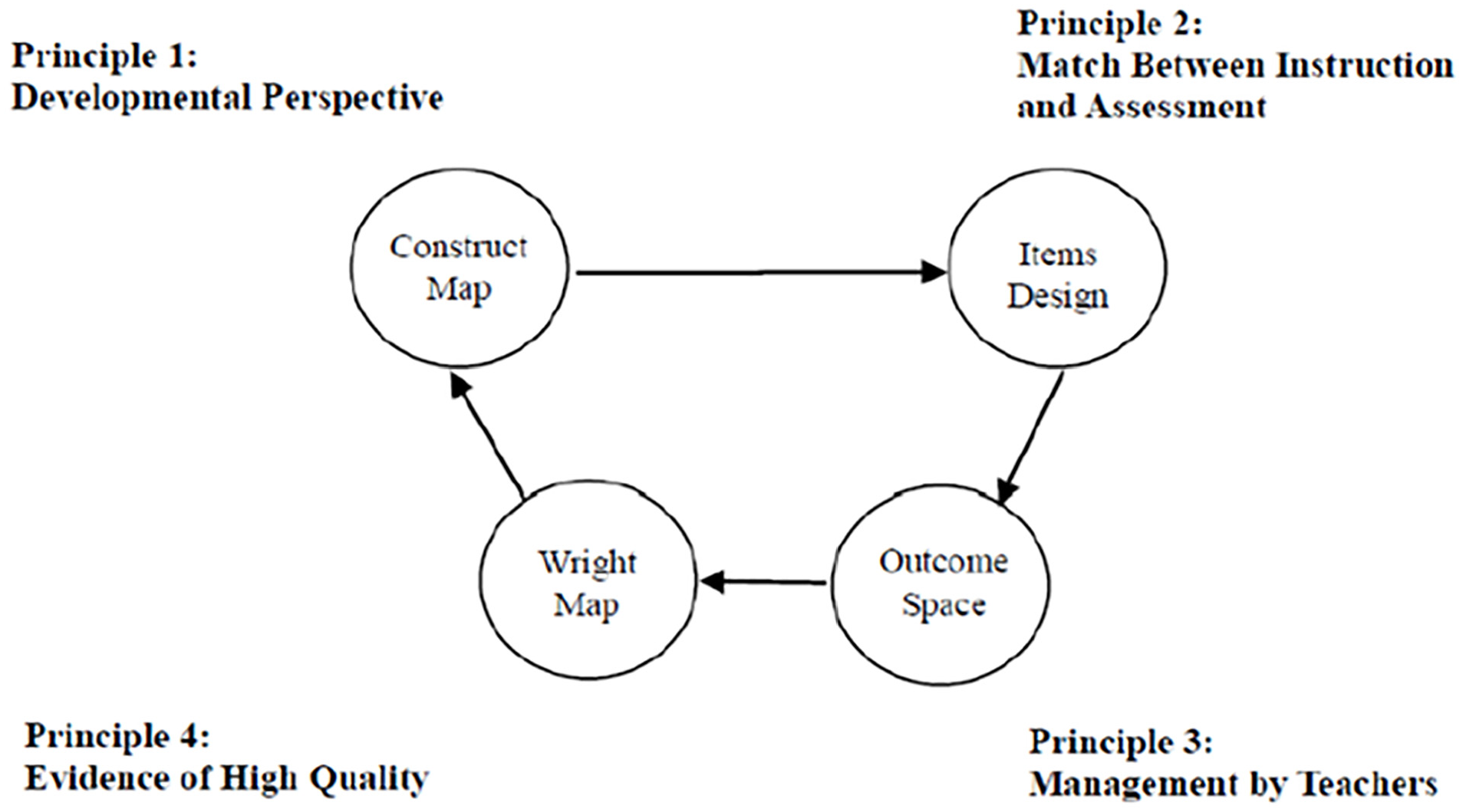
Four building blocks in the Berkeley Evaluation and Assessment Research (BEAR) assessment system (BAS). from “Measuring progression: Assessment structures underlying a learning progression.” by Wilson (2009, p. 718).
Developmental progress variables
The development progress variables are the variables or constructs corresponding to the understanding level of the student over the duration of the LPs, which are assessed as a means of gaging progress. To clarify students’ understanding level in one or more categories, hierarchies of conceptual understanding or construct maps created by Wilson (2005, 2009) was also employed. A group of experts who specialized in creativity, imagination, and educational testing and assessment were invited to panel discussions on the component hierarchies of LPs of scientific imagination for undergraduate students, developed and validated by Wang et al. (2017b).
Item design
Item design governs the match between classroom instruction and the various types of assessments (Wilson, 2009). After experts’ panel discussions, it was decided not to modify either the components of that LP or the content of the SIT-Verbal. As the SIT-Verbal was designed according to the situations that students will encounter at school, it can be applied to assess scientific imagination among students of different age groups or grade levels, including college students (see Table 2).
Contents of the Revised Version of the Scientific Imagination Test-Verbal (SIT-Verbal).

Note. From “Validation of learning progression in scientific imagination using data from Taiwanese and Finnish elementary school students,” by Wang et al. (2017a, p. 76).
Outcome space
An outcome space is the set of categorical outcomes into which test-takers’ performances are categorized for all items associated with a progress variable (Wilson, 2009). In the present study, published scoring guides (Wang et al., 2017b) were adopted by raters to assess students’ responses. Among the three raters, two held master’s degree in education and one was an assistant professor whose expertise was educational psychology, creativity & imagination, and educational assessment (e.g., Ho et al., 2013; Wang et al., 2011, 2014a, 2014b). After all the raters reached their consensus on the scoring criteria and rubrics, a set of 10 questionnaires was given to each of the raters to allow for the calculation of inter-rater reliability. The reliability values ranged from 0.20 to 0.83, indicating considerate stability among raters (Miles & Huberman, 1994).
Measurement model
The BAS uses Rasch models to analyze data. Rasch models are commonly used to represent participants’ responses in terms of probabilities, which may overcome some limitations of psychological testing associated with classical test theory (CTT). The next step was to validate the LP of scientific imagination using the BAS, a measurement model using Rasch techniques, to analyze data in the outcome space. According to the Standards for Educational and Psychological Testing (American Educational Research Association, American Psychological Association, & National Council on Measurement in Education [AERA, APA, & NCME, 1999, 2014), the Rasch techniques can be used to evaluate an assessment tool by providing multiple sources of validity evidence. In the previous study, we validated the SIT-Verbal using a sample of elementary school students (Wang et al., 2015). As the cross-sample validation is also necessary for enhancing the quality of the adopted test—the SIT-Verbal, the current study revalidated the SIT-Verbal with a sample of undergraduate students by evaluating its content validity, structural validity, generalizability, substantive validity, interpretability, and external validity (Messick, 1994, 1995a, 1995b; Wolfe & Smith, 2007).
Considering that each item of the SIT-Verbal has four response categories, the Rasch partial credit model (Rasch PCM; Masters, 1982) was employed to analyze multiple ordered responses to the test. The PCM is a unidimensional model consists of two primary parameters: the person’s (n) ability (θn) and the item’s (i) difficulty (δi). When person n responds to item i, the probability of that person having the correct answer to that item is given as follows:

where Pnix is the probability of person n scoring x on item i. Additionally, θn, which is the latent trait level of person n, refers to the construct that is the target of measurement (e.g., scientific imagination), and δj is the overall difficulty of item i (e.g., difficulty or threshold value). τ ij is an additional step parameter for scoring j rather than j−1 on item i.
Participants
A total of 621 undergraduate students enrolled in 14 general education courses at a science and technology university in southern Taiwan were recruited as the subjects of the study. Students who completed the SIT-Verbal were rewarded with a gift card worth 50 New Taiwan dollars. After deducting the invalid sample (e.g., subjects giving incomplete responses or missing data), 616 students provided valid samples. Among them, 49.8% of participants were female (N = 307), 48.9% were male (N = 301), and eight did not report their gender; 32.8% of students (N = 202) were from the College of Engineering, 42.4% (N = 261) from Business, 13% (N = 80) from Humanities and Social Sciences, and 11.9% (N = 73) from Digital Design; 37.8% were first-year students (N = 233), 17.2% second-year students (N = 106), 28.6% (N = 176), third-year students (N = 176), 14% forth-year students (N = 86), 2.3% extended students (N = 14), and class was not reported for one. The average age was 20.26 years (range: 18–49 years).
Instruments
Scientific imagination test-verbal
The SIT-Verbal, a context-based measurement tool designed by Wang et al. (2015) to measure fifth and sixth graders’ scientific imagination in the present study, covers four domains: brainstorming, association, transformation/elaboration, and conceptualization/organization/formation (see Table 2). The test items involved a space mission to another planet in which test-takers encountered “a lot of falling leaves” at a school on the planet. In the open-ended test, students were asked to accomplish two tasks. After successfully completing Task 1 (answering the first three questions), students continued to carry out Task 2, in which they needed to draw an inventive idea to solve the problem identified in Task 1. The transformation/elaboration and conceptualization/organization/formation components were assessed in Task 2. Among the test items, six of them addressed the four components of scientific imagination. Students were given 15 minutes to complete both tasks and their responses ranked from “category 0” (the lowest level) to “category 3” (the highest level).
The revised object-spatial imagery questionnaire
To provide external validity evidence of the SIT-Verbal, the Object–Spatial Imagery Questionnaire (OSIQ; Blajenkova et al., 2006; Wang et al., 2017b) was revised to assess individual differences in visual imagery preferences and experiences. As the original questionnaire questions were written in English, Wang et al. (2017b) selected the suitable items for measuring imagery, translated them into Chinese, and asked two experts specializing in English literature and language to review and modify items. Furthermore, two experts with expertise in educational psychology, educational testing and assessment were invited to examine content validity and the construct of imagery. The Revised OSIQ consisted of a total of eight items in two sub-scales: an object imagery scale (OIS) and a spatial imagery scale (SIS). The OIS assessed test-takers’ preferences for representing and processing colorful high-resolution pictorial images of individual objects (e.g., my images are very vivid and photographic). The SIS evaluated test-takers’ preferences for representing and processing schematic images, spatial relations amongst objects, and spatial transformations (e.g., I can easily imagine and mentally rotate three-dimensional geometric figures).
The unidimensionality of the Revised OSIQ was scrutinized through the Rasch partial credit model (Rasch PCM). The results demonstrated acceptable infit and outfit mean squares (MNSQs; range: 0.6–1.4) in all items. No substantial differential item functioning (DIF) for gender was found. The person separation reliability for mental imagery was 0.73. The participants were asked to respond to all questionnaire items and rated each item on a 5-point scale, where 0 = totally disagree and 4 = totally agree.
Analysis
The SIT-Verbal was analyzed via Rasch PCM to provide evidence of content validity, structural validity, generalizability, interpretability, substantive validity and external validity (Wolfe & Smith, 2007). To test content and structural validities, the Rasch PCM was used to examine the fit of each item and the unidimensionality of scientific imagination. According to Wilson (2005), the criterion for a reasonably good model–data fit should be set at a MNSQ value ranging between 0.75 and 1.33. Besides, the hypothesized score categories for each item represented students’ different levels of understanding. Theoretically, the hypothesized item hierarchy should be consistent with the empirically derived hierarchy. The higher the respondent’ ability, the more likely it is to reach a higher level. Hence, if the proportion of respondents for each level is greater than 5%, it indicates that the four levels have achieved a certain degree of distraction. If the results match the theoretically expected hierarchies, it means that the four options of each question can distinguish the ability of the respondent.
To test generalizability, differential item functioning (DIF) was analyzed across genders, grades, and colleges (Holland & Wainer, 1993). A difference of 0.5 logits in the overall difficulty of items across groups was considered as substantial DIF (Wang, 2008). Additionally, person separation reliabilities (Schumacker & Smith, 2007) and conditional reliabilities were calculated for measurement precision (Raju et al., 2007).
As for interpretability evidence, the Wright Maps, which provides a visual representation of how the ability level of the test-taker (from lowest to highest) is correlated with and the difficulty level of item (from the easiest to the most complex) on the measured construct, were employed in this study to represent participants’ scientific imagination levels and the difficulty level of each item, The Wright Maps analyses also allowed for the determination of hierarchies of scientific imagination. Finally, students’ differences in scientific imagination across gender, college, and grade were evaluated using one-way analysis of variance (ANOVA). Regarding the evidence of external validity, the correlation between SIT-Verbal and OSIQ was calculated using the PCM (Cheng et al., 2009).
Results
Content and Structural Evidence
The Rasch PCM was used to examine the unidimensionality of scientific imagination. The results demonstrated acceptable infit and outfit MNSQs in all items (acceptable range: 0.75–1.33) (Table 3). As all the items had good model-data fit, indicating that the items measured the same constructs, all items were retained.
Estimates of Item Difficulty and Goodness-of-Fit Values for Scientific Imagination.

Generalizability Evidence
With respect to generalizability, DIF analyses were conducted across genders, grades, and colleges. All estimates of item difficulty δi between genders were less than 0.13 logits, and no substantial DIF values were between the genders. No substantial DIF values were detected among grades, except for item A2-1, which measured brainstorming. Differences between grades in all estimates of item difficulty δi were 0.57 logits. All estimates of item difficulty δi among colleges were less than 0.42 logits, and no substantial DIF values were found among the colleges (Table 4). The person separation reliability for scientific imagination was 0.83.
Estimates of Item Difficulty and DIF Values for Students of Different Genders, Years of Study and Colleges.
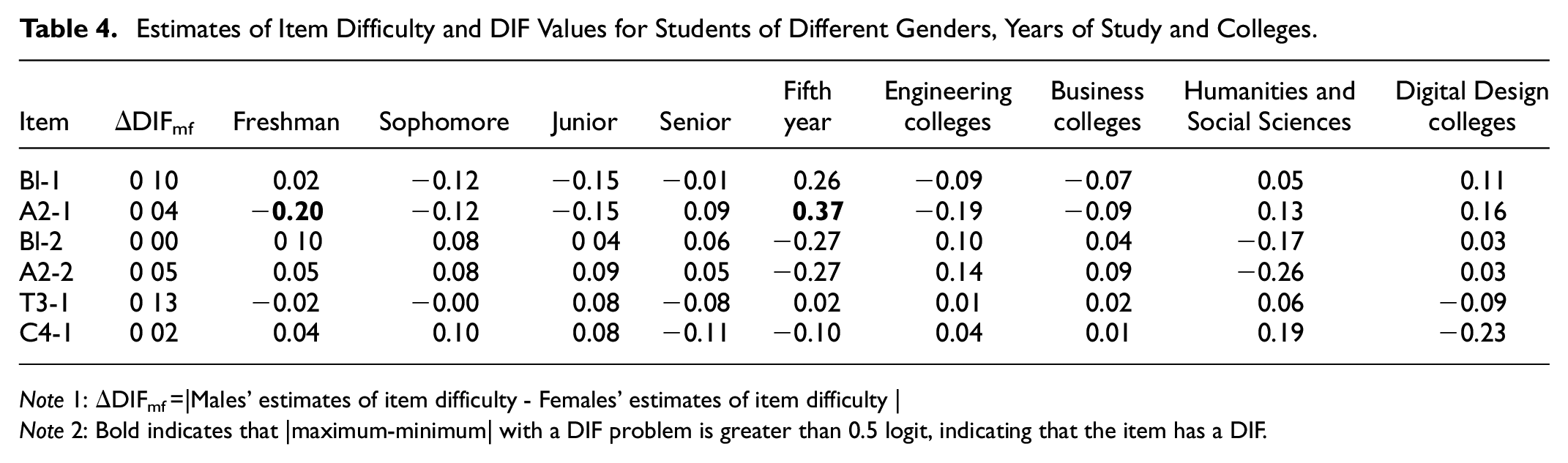
Note 1: ΔDIFmf =|Males’ estimates of item difficulty - Females’ estimates of item difficulty |
Note 2: Bold indicates that |maximum-minimum| with a DIF problem is greater than 0.5 logit, indicating that the item has a DIF.
To obtain more precise measurement, the conditional reliabilities for each participant and estimation errors for abilities were calculated, as shown in Figure 2. Results showed the SIT-Verbal was more suitable for measuring students in the mid-level range of understanding (θ range: −2.99 to 2.95 logits; conditional reliability range: 0.74–0.84) than those at low-level or high-level extremes of understanding.

The conditional reliabilities and estimation errors for abilities.
Interpretability Evidence
The person-item map displays the location of person abilities and item difficulties respectively along the same latent dimension. Concerning individual performance and item difficulty, each “X” to the left of Figure 3 denotes individual student’s scientific imagination ability, θn, whereas the digit on the right of Figure 3 denotes the item number corresponding to the item difficulty δi. Positive values mean higher levels of scientific imagination ability θn, achieved by that individual; an increase in the value for an item would lessen the probability that the individual achieved scientific imagination with regard to that item. The SIT-Verbal test results indicated item difficulty δi values for scientific imagination, (M = 0.32, SD = 1.30) were higher than the scientific imagination scores for undergraduates (M = 0.00, SD = 1.17). The hierarchies of scientific imagination learning progression were thus confirmed.

Individual performance data and second Thurstone threshold item difficulty.
Table 5 showed means and standard deviations for scientific imagination, θn, according to gender, grade, and college for undergraduates. Overall, females (M = 0.14, SD = 1.11) showed significantly higher scientific imagination than males (M = −0.15, SD = 1.21; t = 3.056, p < .05). One-way ANOVA was used to test the difference in scientific imagination for different grades. The results showed a significant difference in scientific imagination among grades (F = 4.000, p < .05, η2 = 0.03). Scheffé’s method showed that the performance of the fifth-year students was better than those of the freshmen and seniors. Both the sophomores and juniors performed better than the freshmen. The other comparisons among grades revealed no significant differences. There was a significant difference in scientific imagination between colleges according to one-way ANOVA (F = 6.022, p < .05, η2 = 0.03). Scheffé’s method showed that students in the Digital Design, Humanities and Social Sciences, and Business Colleges performed significantly better than those in the Engineering College.
Means and Standard Deviations for Scientific Imagination According to Genders, Years of Study and Colleges.

p < .05.
Substantive Evidence
Results suggest that the higher the ability of the student θn was, the greater the probability of higher level achievement. In the Rasch PCM analyses for items addressing the “brainstorming” component of the Initiation Stage of Mission 1, the x-axis denotes students’ brainstorming θn at different levels (unit: logits) and the y-axis denotes the probability at each level. The four curves plotted in Figure 4 correspond to the four levels of understanding for one item. Students who demonstrated an ability θn of less than −2.38 logits in brainstorming had higher chances of attaining the Level 0 category, whereas students whose ability θn values ranged from −2.38 to −0.03 logits, 0.03 to 1.05 logits, and >1.05 logits had a greater likelihood of achieving the categories corresponding to Levels 1, 2, and 3, respectively. This indicated that the assumption of level setting for each category (Level 3 > Level 2 > Level 1 > Level 0) was well suited to the actual performance of the students.

Probabilities of students choosing each of the four category levels of understanding, using B1-2 as an example.
The category analysis for item B1-2 is shown in Table 6, in which the percentage for each category was higher than 5%, indicating distractibility of this item. The estimates for students at different levels showed that the average θn for Level 0 students was the lowest (−1.98 logits), followed by Levels 1, 2, and 3 (−0.60, 0.48, and 1.23 logits, respectively). These results revealed that the SIT-Verbal differentiated students’ abilities on items B1-1 to C4-1, except for the items addressing transformation/elaboration. Levels 2 and 3 were not achieved for the test items on transformation/elaboration (C4-1), suggesting the need to revise the scoring guide for this item.
Category ANALYSIs for Item B1-2.

External Evidence
To assess external validity, the Rasch PCM was used to directly estimate the correlation between the single dimension of SIT-Verbal and the two dimensions of OSIQ. The results showed that the correlation between scientific imagination and mental imagery was .26, indicating that scientific imagination had a low correlation with mental imagery.
Discussion and Conclusions
This study aimed to explore the learning progressions of scientific imagination among university students using the Scientific Imagination Test-Verbal (SIT-Verbal) and also investigated how students’ demographic variables, including gender, years of study (grade level), and academic background, influenced their scientific imagination and imagery. The empirical data analyzed with the Rasch PCM were to verify the four-dimensional scientific imagination process model: brainstorming; association; transformation and elaboration; and conceptualization, organization, and formation). All items of the test had good model data fit, signifying that the items had content and structure validity for assessing the relevant components of the scientific imagination model.
In terms of generalizability, most of the items in the SIT-Verbal situational test had the same meaning for students across gender, year of study (grade level) and academic background. No substantial DIF was found between male and female students. Most test items showed no substantial DIF across students’ grade level, with the exception of A2-1, which had a small DIF. Also, most items exhibited no substantial DIF according to students’ academic background. The person separation reliability for scientific imagination was 0.83. The conditional reliabilities indicate that the SIT-Verbal test for undergraduate students is suitable for students whose ability θn score is between −2.99 and 2.95 logits.
As for interpretability, the test items for each of the four components were ordered according to increasing difficulty (see Figure 3). These results echo the findings of Wang et al. (2016). The scientific imagination model hypothesizes that a good idea originates from abundant ideas (Wang et al., 2014b), which is valid in common situations. In addition, the current study found that female students performed better on SIT-Verbal than did male students. This result was consistent with the findings from Mun et al.’s study (2015) in which they investigated the scientific imagination performance of Korean students in grades four to eight and noted that girls performed significantly better than boys. The gender difference in scientific imagination was also found in visual design, the mental factors that facilitate imagination according to gender and level of expertise (Hsu et al., 2012). Hsu et al. (2013) further reported that female teachers regarded teaching resources, intrinsic motivation, positive emotion, and learning by doing as important factors in facilitating imagination in lesson designs. However, it was difficult to identify the sources of gender differences originating from motivation, social expectation, nurturing environment, professional background, and other influences (Baer & Kaufman, 2008). The above-mentioned related studies may highlight that gender differences in imagination exist; however, the fact that these differences exist at all, their impact, and their cause need further investigation. Thus, we suggest that gender differences be considered when striving to inspire students’ imagination.
In addition, this study found that students at different stages in their education performed differently in terms of scientific imagination. The students in their fifth year of study performed better than freshmen and seniors, while sophomores and juniors performed better than freshmen. Comparisons of other age group combinations showed no significant differences. We speculate that freshmen may have poorer performance because they have just entered the university and thus have less experience and training in this area of expertise. This result is consistent with the assumption that the accumulation of professional knowledge is positively correlated with students’ scientific imagination. However, senior students’ performance was not significantly better than that of other students. This finding may be related to the culture of Taiwanese universities. Most senior students in Taiwanese universities devote their time and effort to future career planning and may take fewer courses and have less motivation to learn than other students. Previous research has shown that a lack of motivation has a negative impact on creative performance (Amabile, 1996). Furthermore, if the classroom atmosphere makes students feel stressed and decreases their motivation, it may reduce students’ creative behavior (Yeh et al., 2008). Thus, classroom atmosphere may be one of the factors influencing students’ imagination. Future research should address learning motivation and perceived classroom atmosphere as variables influencing scientific imagination.
According to Kozbelt et al. (2015), imagery had more impact on domain-specific applications than on domain-general ones, in terms of creative problem solving. Their study also implied that students’ scientific imagination performance might be related to their methods of learning, thinking styles, and personal characteristics. In the current study, analyses of students’ academic background and its possible impact on scientific imagination revealed that the students in Colleges of Humanities and Social Sciences, Digital Design, and Business Management performed better than did those in Engineering. This result might be related to the fact that the Colleges of Humanities and Social Sciences, Digital Design, and Business Management usually adopt guiding questions or exploration as methods of instruction. Therefore, students in these colleges may be more accustomed to offering their perspectives in a short period of time. The assessment tools adopted by the present study were timed tasks in which students were asked to produce many ideas within a designated time limit. This type of test may not be familiar to students from the College of Engineering. Sternberg’s (1994) classification suggests that people’s preferred modes of expressing their abilities and of thinking vary significantly, and these may influence students’ performance on measures of scientific imagination. In addition, Kandemir and Kaufman’s (2020) revealed a reciprocal relationship between college students’ college major and their perceived creative performance. Art majors were generally regarded as having a high level of creative expression and therefore some art students considered themselves to be more creatively expressive, but some students thought taking art-related courses allowed them to have better creativity performance. Therefore, we suggest that future research could further investigate variables related to learning strategy, thinking style, and perceived creative performance.
Many case studies on creativity have proposed the so-called 10-year rule, and many people think that individuals engaging in creative activities generate endless ideas (Sternberg, 1998). The results of this study may be best understood by invoking a cognitive psychology perspective that notes the differences between novices and experts (Mayer, 1987). For example, students from the College of Design can be seen as experts; they do not need to generate numerous ideas as a basis for forming one good idea. They have had extensive contact with creative books and environments, so they would be expected to perform better on tests of creative ideas, thoughts, and abilities. Thus, it is understandable that students from the College of Design were able to create or draw something with higher speed and more delicate detail than those in other colleges (Wu et al., 2016). To clarify the mechanism of the scientific imagination process, future studies could invite students from different colleges as participants and adopt a think-aloud protocol to record their thinking processes as they answering various questions. Such data could serve not only as evidence supporting the scientific imagination process but also as a tool for modifying the assessment.
In terms of substantial evidence, the PCM analysis showed that as students’ ability increased, the probability of their achieving a higher level in their answers increased. Interestingly, although imagery is the ability to restructure images or past experiences, this study only found a small correlation between imagery and scientific imagination. For more accurate results, future research could make use of hands-on imagery or imagination tasks, extend the test’s time limit, and analyse students’ textual data to assess any differences between the two tasks in the test.
In conclusion, the development and refinement of LPs might not be completed in a single verification effort. This study aimed to verify the SIT-Verbal situational test using a Rasch model. The study not only attempted to provide an objective perspective for assessing scientific imagination but also to investigate the relationships of scientific imagination with various other factors, including imagery, gender, age (grade), and academic background, with the goal of improving the process of promoting scientific imagination in practice. This study suggests that future research could begin with a more systematic investigation and analysis of the development of Taiwanese students’ scientific imagination so that the components and mechanism of the scientific imagination process could be established more comprehensively. For instance, teaching strategies and materials that address the three stages and four components while stimulating innovation and transdisciplinary abilities should be developed to cultivate students’ imagination and problem-solving abilities. Also, universities could offer courses that enhance creative thinking in different colleges or throughout their general education courses. A variety of creative courses could allow students from various colleges to share their creative experience and understanding of relevant concepts, balancing or strengthening their creative potential, and building a bridge to other courses, instruction techniques, and forms of assessment.
Footnotes
Declaration of Conflicting Interests
The author(s) declared no potential conflicts of interest with respect to the research, authorship, and/or publication of this article.
Funding
The author(s) disclosed receipt of the following financial support for the research, authorship, and/or publication of this article: This research was supported by grants from the Ministry of Science and Technology of Taiwan under contract no. MOST 106-2410-H-218-010-SS2.
