




Abstract
A review of the literature on the application of artificial intelligence (AI) in the recruitment and selection process (RSP) was conducted, but no relevant studies were identified. While several reviews have focussed on AI in human resource management in general, none of these have examined the RSP in detail or employed an AI taxonomy for clustering. Consequently, we applied an AI taxonomy identified in the literature with the aim to identify the stages of the RSP in the focus of research and the algorithms mostly used. We conducted a systematic literature review underpinned by a concept matrix, complemented by a computational literature review (CLR), that employed natural language processing (NLP). The initial 4,579 studies were sourced from three databases and narrowed down to a total of 502. Our major findings indicate that the majority of studies were categorised under the stages “assessment & selection” and “processing incoming applications” in the RSP. The predominant algorithms in use pertain to the field of NLP and machine learning. The CLR emphasised the significance of ethics in AI research. While our study has expanded the general AI taxonomy by incorporating an ethical perspective and is one of the studies with the most articles used to reflect this topic, it is solely focussing on describing the past. Nevertheless, this article helps to align research on exploring and testing alternative approaches with those most frequently used.
Introduction
In the context of conducting research in a novel field, for instance, the domain of artificial intelligence (AI) in the recruitment and selection process (RSP), with the objective of addressing a gap in the existing literature, constitutes the initial step. This is equally applicable to organisations that seek to align current processes with existing research. There is numerous research covering the application of AI in the RSP, and examples include the identification of applicants (Mohd Jamaludin et al., 2020), the attraction of applicants (Jiang et al., 2023; Liu et al., 2024), the processing of incoming applicants (Alsaif et al., 2022; Tian et al., 2023), and the assessment and selection of applicants (Hemamou et al., 2023; Kilic et al., 2020). A plethora of empirical studies have been conducted that focus on the applicant’s perception of AI in that process (e.g., Bhatt, 2023; Feldkamp et al., 2023). However, a systematic review of the current state of the art research is absent.
Interestingly, there are several attempts reviewing AI in human resource management (HRM) with four major limitations. Firstly, the majority of AI-related reviews target HRM in general (Basu et al., 2023; Budhwar et al., 2022; Pan & Froese, 2023; Prikshat et al., 2023; Vrontis et al., 2022), with scant attention paid to the entire RSP. Alternatively, reviews may focus only on specific task within the RSP that involve AI (de Ruijt & Bhulai, 2021; Dinika & Sloane, 2023; Rawat et al., 2021). In relation to the broader context of AI in HRM, Budhwar et al. (2022) conducted a comprehensive analysis of the role of AI-supported applications in HRM functions, with a particular focus on recruitment and selection as integral components of the review. The study also examined the diffusion of such innovations based on human-AI interactions. Pan and Froese (2023) focus on the critical evaluation of AI in HRM, whereas Vrontis et al. (2022) concentrate on systematising the academic contributions to clarifying the use of intelligent automation in HR. Another focus is made by Basu et al. (2023), whose review examines the interaction process of AI and HRM to identify and explain favourable and reactionary outcomes. A comparison of these reviews can be found in Appendix 1 for further details. Regarding the RSP using AI for a special task, Dinika and Sloane (2023) use a semi-systematic approach doing a field scan on AI, inequality and recruiting. Rawat et al. (2021) conducted a specific systematic literature review on CV parsing. de Ruijt and Bhulai (2021) concentrated their review on job recommendations systems. However, it appears that currently, there is currently a lack of literature reviews that systematically cover the entire RSP and the use of AI. Secondly, the number of articles included in the mentioned reviews only ranges from 45 to 184. As research in the field of AI and HRM has grown, we will increase the number of articles included in our review. Thirdly, among the aforementioned reviews, none employed or delivered a framework to organise the articles searched with regard to AI methods. Consequently, we will use the published AI taxonomy of Pournader et al. (2021) for deductive coding. Fourthly, it is evident that all reviews utilise the classical/semi-systematic literature review, with no application of a computational literature review (CLR). Therefore, we will apply natural language processing (NLP) for the purpose of inductive coding.
Therefore, the objective of this study is to undertake a comprehensive review of the utilisation of AI across the entire RSP, underpinned by empirical research finding. Whilst it is acknowledged that this study will not prove generalised statistical significance in the manner of meta-analyses, the emphasis is instead placed on a descriptive systematic review that employ a standardised taxonomy for the purpose of clustering articles. A central concern of this study is to demonstrate to HR researchers and practitioners that research in this field is already well advanced. Therefore, we have derived the following three research questions for this study:
How has the research of AI evolved in the RSP over time, in regard to the publication outlet, timeline and type of article?
What have the focal points of research been in the RSP, AI taxonomy as well as the combination of both?
Can the AI taxonomy be enhanced by applying the CLR?
In order to address the aforementioned questions, the present study commences with the theoretical section, wherein a definition and taxonomy of AI, as well as the RSP, are provided. Secondly, in the methodological section, the process of the systematic literature review is described, including the literature analysis based on the concept matrix and CLR. Thirdly, the result section is structured in accordance with the research questions, providing both descriptive statistics and qualitative results. Finally, we discuss the contribution and limitations of our study.
Framework for Analysing AI in the Recruitment and Selection Process
A significant limitation identified in the scientific literature reviews of HRM and AI is the absence of an AI taxonomy for the purpose of clustering scientific articles. Consequently, the decision was taken to introduce a taxonomy for AI and a process model for the RSP to construct the theoretical framework for the review process. Consequently, this chapter proffers, on the one hand, the AI taxonomy and, on the other hand, the RSP model.
Artificial Intelligence: Definition and Taxonomy
AI is a field of computer science that focuses on the development of systems that are capable of performing tasks traditionally that are ordinarily thought of as requiring human intelligence. The term “artificial intelligence” was first coined by John McCarthy in (1955) with the intention of exploring the potential of machines to use language in order to solve problems that are typically addressed by humans (Nilsson, 2010). Russel and Norvig (2021, p. 7) define AI as an intelligent agent that “receives precepts from the environment and performs actions.” The definition that forms the foundation of this study is that proposed by Kaplan and Haenlein (2019), who define AI as the ability to interpret data, to learn from it, and to utilise these learnings to achieve goals.
Currently, AI is undergoing a significant resurgence in both academic research and industrial applications, driven by three factors: (i) significant advancements in computational power (Duan et al., 2019), (ii) the availability of large datasets for training the algorithms due to of widespread adoption of Internet of Things devices (O’Leary, 2013), and (iii) the development of novel learning algorithms (Al-Jarrah et al., 2015). Furthermore, the ongoing advancements in AI technology are fuelled by substantial investments from organisations such as Google, IBM, Microsoft, and Amazon, thus establishing them as the leaders in the emerging AI marketplace (Lohr, 2016). Especially, the introduction of ChatGPT (Generative Pre-trained Transformer) has had a significant impact on public perception of AI (OpenAI Blog, 2022), given its capacity to produce human-like responses to a wide range of inquiries.
Although a consensus exists in defining the essential features and values of AI applications, a clear taxonomy outlining the fundamental branches of AI is notably lacking. AI can be regarded as a highly fragmented field, with its branches often overlapping in terms of types and methods. Consequently, efforts to categorise the diverse AI methodologies are frequently accompanied by inherent limitations. For instance, while some consider ML and natural language processing (NLP) to be distinct branches of AI, ML techniques are frequently used to address NLP challenges (Trappey et al., 2020).
As stated in the introduction, a number of studies which conduct literature reviews in the field of AI and HRM omit a taxonomy for classification (Basu et al., 2023; Budhwar et al., 2022; Pan & Froese, 2023; Prikshat et al., 2023). Pournader et al. (2021) also noted this limitation that other reviews lack an AI framework (Baryannis et al., 2019; Toorajipour et al., 2021). In addressing this gap, Pournader et al. (2021) have developed an AI taxonomy based on their findings from a literature review in the supply chain domain. This taxonomy is informed by a range of academic sources and subsequently validated informally (Salkind, 2010) through interviews with AI experts. The proposed taxonomy, as illustrates in Figure 1, exhibits notable similarities to certain established AI frameworks (Kotu & Deshpande, 2019). In comparison to existing taxonomies, it provides a more detailed perspective on the primary branches and applications of AI methods. Specifically, it provides a three-tiered view of the field: (i) “branch,” indicating the main functional area, (ii) “application,” specifying the use of AI, and (iii) “method,” detailing the technical basis (Pournader et al., 2021). It is important to note that the objective of this categorisation is not to provide a comprehensive analysis of each individual algorithm and method, but rather to offer a concise overview of the major branches and application of AI methods. Pournader et al. (2021) divided AI into three branches: “Sensing & Interacting,”“Learning,” and “Decision Making.” These branches can also be used for the RSP because of the need for data-driven decision-making, process efficiency, and the ability to learn from vast amounts of data to make accurate predictions about candidate fit and performance.

AI taxonomy.
In the following each branch will be described with its application and method, according to the three-tiered view of the field. The branch entitled “Sensing & Interacting” comprises approaches related to different aspects, including text, audio and video (Ramos et al., 2008). These approaches encompass speech, vision and NLP, which is an application of AI that focuses on the development of systems that complete tasks based on human instructions. The foremost NLP methods include text categorisation, information retrieval, clustering, and machine translation (Manning & Schütze, 2005). The application of NLP in the design of more advanced interfaces between humans and systems has recently gained prominence (Zanon et al., 2020). For instance, research has demonstrated the integration of chatbots within the RSP, with focus on the personalised dialogue structures to enhance the design, usability and effectiveness of recruitment chatbots (Akram, 2023). Another interface of note is the automated video interview interface, which uses NLP, facial recognition and machine learning to assess candidates and provides employers with personalised feedback and detailed performance reports to improve the efficiency of the hiring process and the quality of decisions (Joshila Grace et al., 2023).
The learning branch is centred on the most widely recognised application of ML, which involves the process of developing algorithms that can use training data to learn problem-solving by leveraging knowledge gained from previous cases (Michalski et al., 1983). This field can be further subdivided into three primary methods: supervised learning, unsupervised learning, and reinforcement learning (Overgoor et al., 2019). Supervised learning employs a dataset to predict an output based on an applied algorithm, including decision tree models, support vector machines and neural networks (Hastie et al., 2009). In contrast, unsupervised learning algorithms employ datasets devoid of pre-labelled information, thus facilitating the detection of patterns. These algorithms are widely applied in the context of clustering (Hastie et al., 2009). Reinforcement learning shares similarities with unsupervised learning, but is distinguished by the receipt of feedback upon task completion (Mnih et al., 2015).
Decision-making is an inherent feature of AI, and it is associated with the concept of “Expert system,”“Optimisation” and “Simulation & Modelling.” This association is contingent upon the specific AI taxonomy employed (Pournader et al., 2021). However, the latter category is not important for the RSP and is therefore excluded from the AI taxonomy shown in Figure 1. Expert systems, also referred to knowledge-based systems, represent a further facet of AI applications. These systems are capable of covering a variety of domains and utilising a range of problem-solving approaches, thereby enabling systems to execute tasks that are typically performed by human experts (Giarratano & Riley, 2006; Tecuci, 2012). Examples of expert systems applications can include rule-based, fuzzy-based and hybrid-based systems, which enhance performance when integrating more than one intelligent system (Zarbakhshnia et al., 2018). Research indicates that expert systems excel in domains where human intelligence can be formalised and organised effectively (Jakupović et al., 2014). However, it is important to note that if such formalisation is unattainable, the efficacy of the expert systems may be significantly reduced (Haenlein & Kaplan, 2019). This challenge becomes more pronounced when expert systems are utilised to address cognitive problems. Optimisation techniques can be divided into several groups, including nature-inspired methods (e.g., ant colony optimisation and genetic algorithms), game theory-based approaches (e.g., cooperative models), market-based strategies (e.g., negotiation and auction algorithms), decision theory-based methods (e.g., Bayesian approaches), and knowledge-based methodologies (Saghaei et al., 2020).
The framework delineated above, which is utilised in this study, facilitates a systematic categorisation of AI applications in the RSP. It can assist in the classification of specific technologies, such as recommender systems (de Ruijt & Bhulai, 2021) and CV parsing (Rawat et al., 2021), even when these technologies are not immediately evident. It may appear somewhat unconventional that the model encompasses machine learning algorithms, while domains such as NLP and computer vision are regarded more as fields of application. However, this delineation underscores the versatility of the AI taxonomy and its capacity to amalgamate diverse facets of AI in a holistic manner. Although the AI taxonomy has certain weaknesses, its publication in a peer-reviewed journal provides a sound basis for the systematic evaluation of the use of AI in recruitment, thus creating a scientifically recognised foundation for further research.
AI/Algorithms in Recruitment and Selection Process
AI exerts a significant influence on numerous domains within the field of HRM (Chowdhury et al., 2023), including employee relations, wellbeing, talent and performance management. Furthermore, it plays a crucial role in the recruitment and selection process (Eubanks, 2019), where it can broaden the candidate pool, enhance efficiency and length of employment, and reduce hiring times and costs (Tippins et al., 2021). AI can also be implemented at each stage of the RSP (Sánchez-Monedero et al., 2020), but it is currently predominantly employed in connection with chatbots, screening software and task automation tools (Albert, 2019). One of the core challenges of using AI in HR is the data to be analysed, it may contain historical biases, unrepresentative data, and collection bias (Caliskan et al., 2017).
In order to systematically review the empirical articles of the RSP with a linkage, the framework of Holm, 2012; Holm & Haahr, 2019) is utilised, given that the other reviews do not apply a specific RSP framework for analysing the data. Holm differentiates between the traditional RSP and the process involving technology, as illustrated in Figure 2. It is notable that both processes encompass the same phases; however, the integration of technology facilitates continuous interaction throughout the entire RSP. The process is delineated in five phases: the identification of the applicants, the attraction of applicants, the processing of incoming applications, the communication with applicants, and the assessment and selection.

Overview recruitment and selection process.
The first phase of the recruitment process is the identification of suitable applicants. This is achieved by reviewing hiring requests provided by clients, such as other departments, and by gathering information from job analysis. The purpose of this is to determine the profiles of applicants and their necessary qualifications. It is also used to identify segments of the labour market that cover qualified applicants. The creation of a job description and specifications for the position is the subsequent step. The second phase entails the attraction of suitable applicants to choose the recruitment channel and the determination of the most efficacious method for reaching the intended audience through the drafting and publishing of job advertisements on the chosen platforms. The third phase, processing incoming applications, relates to the incoming applications, which are sorted and registered in order to monitor and manage the RSP. The applications are then pre-selected and checked before the shortlist is forwarded for assessment. The fourth phase is communication with applicants, and involves notification of applicants who are either shortlisted or for whom the application process has ended. The department also serves as a resource for applicants, answering queries and providing guidance throughout the application process. The final phase, assessment and selection is not described by Holm (2012), but rather refers to the evaluation of an applicant’s suitability through various metrics to select the most appropriate candidate, thereby overcoming the “barrier to entry” faced by the organisation (Anderson, 2005).
In conclusion, the use of HR analytics, particularly the implementation of AI-based tools within the context of HRM, including its application in recruitment and selection, remains in its nascent stage. Nevertheless, various methods are already being used to improve recruitment and selection with the help of algorithms. To the best of the authors’ knowledge, there has been no scientific analysis of the utilisation of algorithms in the specific context of the application process.
Review Methodology
This article presents a systematic review that adheres to the methodological requirements necessary for ensuring scientific reproducibility of research design, with high standards of reliability and quality. This approach is consistent with the elevated standards for methodological rigour in the review of management literature (e.g., Briner et al., 2009).
The process of literature research is based on the model of Vom Brocke et al. (2009) and includes five phases, which are shown in Figure 3. In the first phase, the research scope was focussed on artificial intelligence in the recruitment and selection process, with a particular emphasis on studies employing algorithmic approaches. In the second phase, conceptual issues were identified, including the recruitment and selection process and general aspects of artificial intelligence. In addition, working definitions of key terms within these topics were established. The first two phases of the literature review were specifically applied in the introduction and theoretical background of this article, thereby establishing the foundation for subsequent analysis. The third phase, termed as literature search, involves a database and keyword search, as well as an ongoing evaluation of sources (Vom Brocke et al., 2009). This phase will be explored in the next section. The fourth phase concerns literature analysis and synthesis, whereby a concept matrix can be utilised for qualitative analysis (Webster & Watson, 2002). This concept matrix can be either based on a theoretical framework (step 4a), in our case the AI taxonomy and RSP model, or derived by CLR (step 4b). The latter is especially “useful for handling of large bodies of published and unpublished texts” (Antons et al., 2023, p. 108). The synthesis of literature is expected to lead to the formulation of a research agenda (phase 5). This agenda aims to encompass more focussed and perceptive questions for future research. This aspect will be elaborated upon in the discussion and conclusion part.

Literature review process.
Literature Search: Extracting Relevant Scholarly Articles (Step 3)
The primary focus of this study is to review previously less researched but important aspects of AI applications in the context of the RSP. Using the proposed AI taxonomy to structure the keyword list and to search for relevant articles, the authors primarily focussed on keywords that represent aspects of the taxonomy (as seen in Table 1). Additionally, some keywords were added which are abbreviations for words used in the taxonomy. For example, machine learning (ml) or rule based expert systems that addresses multi-criteria decision making (mcdm) using algorithms such as analytic hierarchy process (ahp), analytic network process (anp) or technique for order preference by similarity to ideal solution (topsis). Focussing on the RSP keywords, these address general terms and synonyms to cover the framework as well as keywords which cover the domain of HRM. We worked with a wildcard “*” for recruiting to also cover recruitment or recruited. It is important to note that all keywords within one framework are linked with an “OR” and the two groups of keywords are linked with an “AND.”
Keyword List.

As illustrated in Figure 4, the search and selection process of the literature was methodical. Three databases were utilised in the identification of relevant literature: Scopus (www.scopus.com) and Web of Science (www.webofknowledge.com) were utilised as the primary search engines for scholarly sources, with IEEE (www.ieee.org) selected due to its predominant focus on technology. A total of 4,579 articles and conference papers were extracted from these three databases. The subsequent step involved the elimination of duplicates, a process that was conducted manually through a comparison of the titles of the articles. This process resulted in the removal of 3,152 articles and conference papers. The authors of the study elected to concentrate on articles and papers from the period from 1990 onwards, on account of the fact that the development of contemporary AI was significantly influenced by advances in computer hardware, which began in the early 1990s with the development of supercomputers (e.g., Haenlein & Kaplan, 2019). This subsequent reduction resulted in the final tally of 3,081 articles and conference papers. Following a thorough review of the abstracts, 557 full-text publications remained. The substantial reduction in the number of publications can be attributed to the challenge of standardisation in the application of terms related to recruitment and selection, which are employed not only in HRM but also in other disciplines, such as medicine and agriculture. Subsequent to the full-text reading, a further 55 articles were eliminated on the basis that they were not within the scope of the research. For instance, articles pertaining to decision-making in RSP did not contain any mention of AI. The final number of articles and conference articles included in the further analysis totalled 502, which exceeds the current AI in HRM reviews by 318 articles.

Literature search and selection process.
Literature Analysis Applying Concept Matrix (Step 4a)
For the purpose of conducting a literature analysis of the identified articles, we developed a concept matrix based on Webster and Watson (2002). This instrument is utilised to arrange the various units of analysis into topic-related concepts (Vom Brocke et al., 2009). In this case, the units of analysis are the searched articles. The analysis is driven by three overarching concepts, which address the three research questions derived in the introductory section: metadata of the articles, the AI taxonomy and the RSP model.
The first major concept of the metadata encompasses the sub-concepts of publication outlet, date of publication and type of article. The categorisation of the aforementioned publication outlet was conducted through the implementation of four self-developed categories: (a) computer science/technology/mathematics, given the predominance of AI research in these domains, (b) business/economics, considering HR as a distinct function within the broader business context, (c) HR, given the specific nature of recruitment and selection as a process within HR, and (d) others, designated for generic outlets lacking a clearly defined focus, such as PLoS One. For the second sub-concept, we utilised the date of publication. The final sub-concept, pertaining to the nature of the publication, is comprised of two distinct categories. The first category encompasses reviews/conceptual articles, empirical articles utilising AI, and empirical articles employing alternative methods (e.g., surveys reflecting AI). The second category encompasses the outlet, whether it be a journal or in a conference proceedings. The second major concept is the AI taxonomy (see Figure 1). The sub-concepts cover the branches which are categorised in the areas of application and methods. Finaly, the RSP model (see Figure 2) is addressed, with the sub-concepts covering the phases.
Literature Analysis Applying CLR (Step 4b)
In addition to the literature analysis based on the concept matrix, we also conducted a CLR with the aim of identifying unknown patterns in the dataset. CLR represent a novel approach that employs computational text mining and ML algorithms to facilitate the analysis of the content (rather than effect sizes or meta-information) of the text corpus under review (Antons et al., 2023). The CLR has been demonstrated to broaden the potential of systematic literature reviews. The CLR method facilitates the identification, extraction, and synthesis of knowledge/topics which might otherwise be difficult or inaccessible through manual analysis (Boyd-Graber et al., 2017). The purpose of CLRs are not intended to replace the efforts of researchers in all areas of systematic literature reviews, but rather to enhance their ability to process and analyse information for specific tasks that are particularly time-consuming, resource-intensive or otherwise costly (Raisch & Krakowski, 2020). Consequently, the authors employ all 502 publications for the application of the CLR to generate additional insights from the data. Initially, the articles available in PDF format needed to be converted to plain text. To this end, a range of Python libraries like PyPDF2, TIKA, Textract, PyMuPDF, pdftotext, and pdfminer.six were evaluated. The evaluation process revealed that the PyMuPDF library yielded the optimal results in terms of readability and layout ignorance. The second step involved pre-processing of the corpus in accordance with the methodology outlined by Miner et al. (2012) using the Python/NLTK library. This included removing special chars from the corpus and converting to lower case. Then, text was tokenized to single words and English stop-words were excluded. Following this, word frequencies were analysed to identify words or characters for further exclusion (these were only =, :, ;). The third step constituted an additional element to pre-processing not included in the Miner et al. (2012) framework, namely part of speech (POS) tagging (Chiche & Yitagesu, 2022). This allowed verbs, adjectives, and nouns to be extracted from the corpus, using NLTK for this step as well. The fourth step comprised the corpora topic analysis based upon bidirectional encoder representations from transformers (BERT, Panagides et al., 2024) with the Python/BERTopic library. The first sub-step of this approach is to transform the input documents into a numerical representation (embedding). The second sub-step is to reduce the dimensionality (UMAP: uniform manifold approximation and projection) of the input embeddings to a workable size. After the reduction the embeddings are clustered into groups of similar embeddings to be able to extract topics (HDBSCAN: Hierarchical Density-Based Spatial Clustering of Applications with Noise). For calculating the topic representation CountVectorizer as well as class-based term frequency and inverse document frequency (c-TF-IDF) was used.
Results
The results section is structured according to three research questions. Each is answered in a separate sub-section.
Publication Outlets, Timeline of Publication and Type of Articles
The initial phase of the analysis, which also encompasses the first research question, pertains to the development of AI in the RSP with respect to the publication outlets, the timeline and the nature of articles. The initial aspect pertains to the distribution of journal and conference articles (N = 502), which have been categorised into four distinct classifications as delineated above. A comparison of the three primary categories reveals that the majority of publications are concentrated within the field of “Computer Science/Technology/Mathematics” (see Figure 5). Conversely, publications in business-related categories, particularly Human Resources, account for only half or one-third of the total. This finding suggests that, while HR-related topics are being discussed in other fields with a stronger technology-oriented focus, there is less integration of these topics within the specific field of HR research. The category of “Others” is notable for its preponderance of articles, suggesting challenges in the placement of AI-related HR publications in field-related outlets. The journals in this category are very general, such as PLoS One, AI & Society and Applied Sciences.

Classification of publication outlets.
Addressing the second point of RQ 1 is an overview of the distribution of publications per year, as illustrated in Figure 6. In the timeframe from 1991 until 2008 the number of publications remains relatively low and begins to increase in 2009. Interestingly, after a tipping point in 2010, there is a slight decrease followed by a period of stagnation until 2014. However, from 2014 onwards, there was a marked increase in the number of publications, indicating a growing foothold for the discussion of HR related AI analysis was gaining significant foothold. The decline in 2023 can be attributed to the cessation of the analysis period in July of that year.
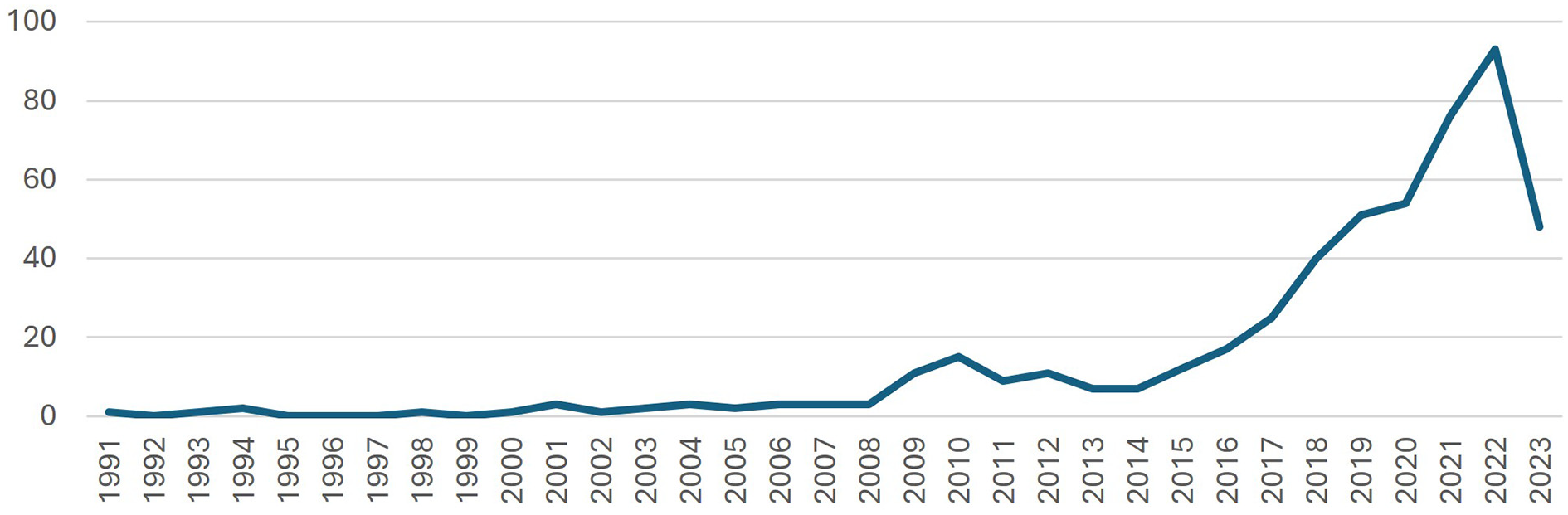
Frequency of publications per year.
The second step of the analysis entailed the classification of the publications as reviews/conceptual or empirical articles, with the objective of narrowing the subsequent analysis to empirical articles and focussing on applied AI methods. Group 1 encompasses articles focussing on conceptual/review articles (N = 28). The second group consist of empirical articles (N = 474), which are further distinguished between articles focussing on applied AI methods (N = 435) and articles focussing on the perception of AI (N = 39).
Focal Points of Research of the RSP, AI Taxonomy, and Their Combination
As the results regarding the second research question are rather complex, we provide three sub-sections to structure the results.
Publications Along Recruitment and Selection Process
As illustrated in Table 2, the distribution of publications for each phase of the RSP (Holm, 2012) is demonstrated, with the emphasis being placed exclusively on articles that concentrate on applied AI methods. This particular focus corresponds with the second research question concerning the RSP. The identification of applicants is the focus of one publication. The second phase, which focuses on attracting applicants, consists of 102 publications. The majority of studies focussed on examining online job advertisements. Jiang et al. (2023) developed a Chinese gender lexicon using approximately 54,000 job advertisements and applying different algorithms, which proved successful in detecting gendered words. Liu et al. (2024) investigated ethical requirements in job advertisements, applying deep learning and NLP on 196,272 job postings to yield insights into the ethical practices of businesses and academic education. The third phase concerning processing incoming applications contains 151 publications, the majority of which deal with investigating resumes. For example, Alsaif et al. (2022) used job advertisements and applicant resumes to analyse how to match the best candidates with the potential job, applying a deep learning approach for matching both data types. Tian et al. (2023) compare the performance of different ML, text vectorisation and sampling approaches on the HR resume data with the aim of enhancing the RSP. The new system offers HR professionals clearer insights into recommendation results by extracting topics from resumes, in contrast to the current machine learning-based screening. These findings can aid organisations in improving their resume screening and evaluation methods. The communication with applicants was not addressed in any of the articles. In the assessment and selection phase, 181 publications were identified, the majority of which focussed on multi-criteria decision-making applying fuzzy logic and various types of ranking algorithms. Kilic et al. (2020) used an integrated decision analysis approach, which is based on intuitionistic fuzzy DEMANTEL and ELECTRE, that are multi-criteria decision making algorithms for ranking applicants in the RSP. This method culminates in the provision of a weighted ranking for the final five candidates, predicated on a diverse set of criteria, including but not limited to education, professional experience, linguistic proficiency, technical aptitude, and personal attributes. In a separate study, Hemamou et al. (2023) employed a neural network algorithm to analyse asynchronous video interviews, in which candidates were tasked with answering standardised questions. The algorithm was able to predict the candidates’ performance with a high degree of accuracy, utilising three distinct modalities: verbal content, prosody and facial expressions. The final category of the RSP, designated as “Other,” encompasses a total of three publications. Zazon et al. (2023) introduces a novel neuro-based decision support system for enhancing employee RSPs. They use neurobiological signals, specifically electroencephalogram data, to classify cognitive functions during recruitment. Using machine and deep learning algorithms, the system achieved up to 72.6% accuracy in assessing executive functions and up to 71.2% accuracy in evaluating intelligence scores. This approach lays the groundwork for a new remote assessment method.
Distribution of Publications Based on the RSP.
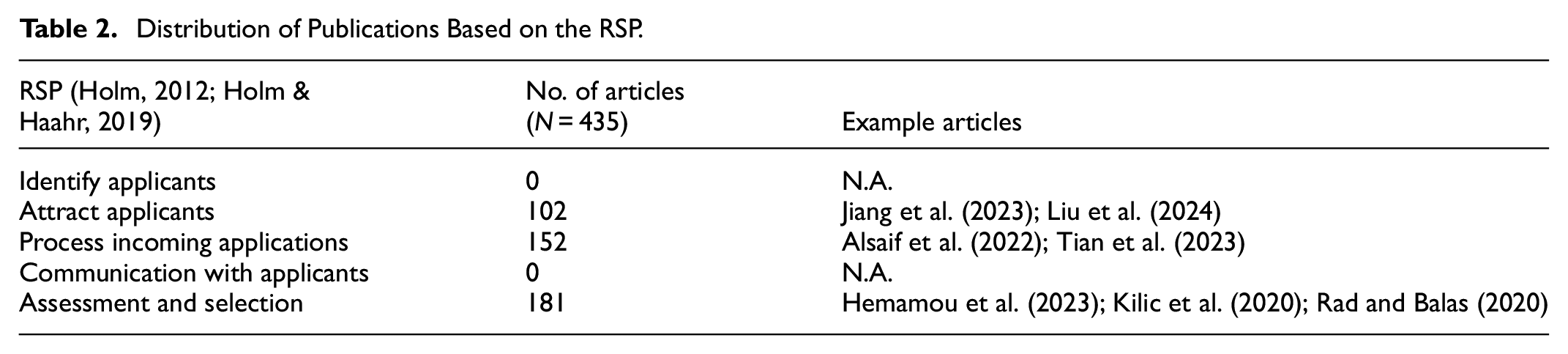
In sum, our findings show that the assessment and selection phase emerge as the leading research area in terms of AI related algorithms, with the phase of processing incoming applications ranking second.
Publications Along the AI Taxonomy
Compared to Figures 1 and 7 shows the distributed frequencies of AI methods within the main branches (Sensing & Interacting, Learning, Decision Making) as well as for the area of application (NLP, ML, Expert System, Optimisation). These results also refer to RQ 2 with a focus on the AI taxonomy. From highest to lowest ranking, NLP as part of “Sensing & Interacting” is used a total of 317 times, divisible into text categorisation (150), information retrieval (145) and clustering (22). The “Learning” branch exclusively encompasses the “Machine Learning” area of application, exhibiting a total frequency of 206 instances, including “Supervised Learning” (155), “Unsupervised Learning” (49) and “Reinforcement Learning” (2). The branch of “decision making” includes “Optimisation” with a frequency of three (equal to the frequency of the “knowledge-based” method) and “Expert system” (182). The “Expert System” can be further subdivided into “Rule-based” (60), “Fuzzy-based” (30) and “hybrid-based" (92) methods. Two salient points merit attention. Firstly, the aggregate frequency of applied methods (N = 708) exceeds the number of articles (N = 435), a discrepancy attributable to the frequent utilisation of multiple AI methods per article. Conversely, it is imperative to acknowledge that the branch and area of application should not be viewed in isolation, as the AI methods from disparate areas of application are frequently employed in tandem when addressing specific research questions along the RSP.
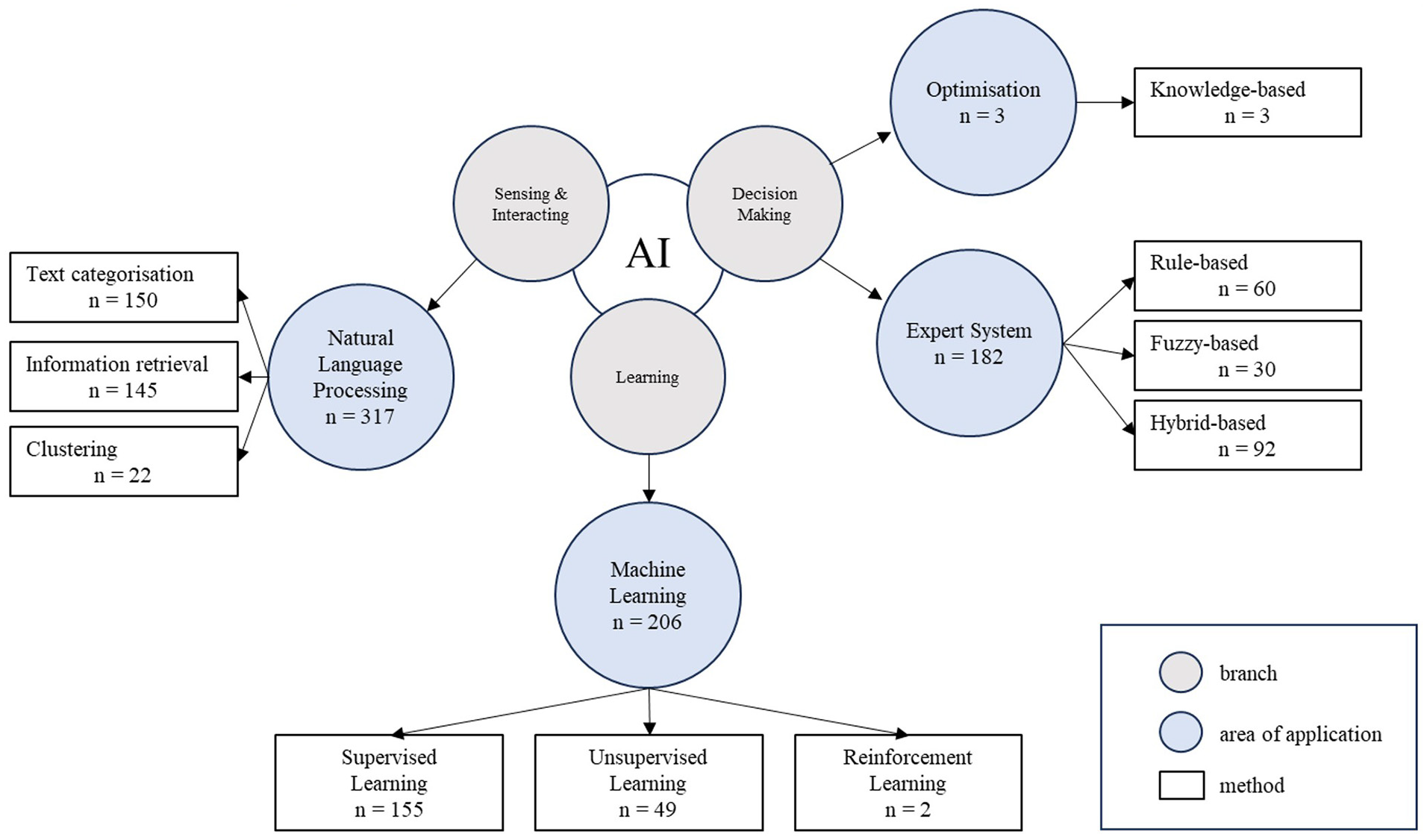
Frequency of AI methods in the identified publications based on the reduced adopted AI taxonomy.
Matching AI Taxonomy With Recruitment and Selection Process
Table 3 presents a cross table that combines the AI taxonomy and the RSP, showing the frequency of articles with applied AI methods (N = 435) within the area of application (column) across the RSP phases (rows). These results address research question two, which relates to the combination of the RSP and AI taxonomy. Furthermore, additional columns illustrate the combination of each area of application, considering the potential for ML methods to be employed in specific instances of NLP, vice versa.
Cross Table of the RSP and AI Taxonomy.

Note. ML = Machine Learning, NLP = Natural Language Processing, ES = expert system. Bold are the top 3 values of aggregated methods.
The interconnectedness of the individual results from the AI taxonomy and RSP is instrumental in identifying focal points of research (see Table 3 and Figure 7). The highest number of aggregated methods (bold) is found in the RSP phase “Assessment & Selection” within “Expert System” (152), with a focus on applying multi-criteria decision making and ranking the final candidates. The second largest number of aggregated methods appears in the RSP phase “Process incoming applications,” with the highest numbers in the combined category of “ML & NLP” (91), focussing on the analysis of resumes. A similar category is also prominent in the RSP phase “Attract applicants” (68), where the majority of articles examine online job advertisements.
CLR Results
In the following, the in-depth qualitative results based on the concept matrix are extended by applying CLR. As formulated in research question three, we would thereby like to clarify whether the AI taxonomy can be enhanced. The CLR facilitates the identification, extraction, and synthesis of knowledge which might otherwise be difficult or inaccessible through manual analysis (Boyd-Graber et al., 2017). Consequently, all 502 articles have been analysed, and Figure 8 illustrates the outcomes of the hierarchical clustering for topic modelling with BERTopic. The analysis identified 63 distinct topics, which were then aggregated into eight primary topics. There are four primary topics dealing with “Decision Making,” but with different foci. The first addresses “Multi-Criteria Decision Making,” while there are two that address fuzzy-based logic, which are “Fuzzy-Based Decision Making” and “Fuzzy-Based Selection.” The last focuses on “Rule-based Decision Making.” Categorising these four primary topics within the AI taxonomy, they can all be placed into the branch of decision making and the application of expert systems. The sixth primary topic is “Job Matching” and includes terms such as “clustering and tokens.” Categorising it within the AI taxonomy, the best allocation is achieved within NLP as the area of application which uses the method of clustering and information retrieval. The seventh primary topic “Resume/CV analysis,” emphasised by terms such as “resume, CV, extraction, words, and similarity” can also be placed in the AI taxonomy to NLP as the area of application, including text categorisation and information retrieval. The eighth primary topic, “KSAO-Based Analysis” (where KSAO denotes Knowledge, Skills, Abilities, and Other characteristics), addresses terms such as “job requirements, skills, and shortage.” Because it is primarily conducted with methods of NLP, we do place it within the AI taxonomy in the same branch as topics six and seven.

Hierarchical clustering on the whole dataset (black box covers the download licence).
The fourth, not yet discussed primary topic entitled “AI Ethic/Trust,” is the only one identified which cannot be placed in the AI taxonomy. It encompasses terms such as “ethical, trust, fairness, and discrimination,” which currently have no related branch in the adopted AI taxonomy. Thus, a new branch of “Ethic & Trust” needs to be added to the AI taxonomy.
Finally, topic representations given by the most important words (c-TF-IDF scores) have been named and are provided in Figure 9. Generally, the results diverge slightly from the cluster analysis discussed above, highlighting a variety of very specific research areas. Although eight topics were extracted, there are three resume-based topics. The first addresses “Job Matching” and contains words such as “job, model, attention.” In relation to the AI taxonomy, it combines NLP as the first area of application with the methods of text categorisation and information retrieval, as well as ML as the second area of application with the method of supervised learning. Due to the three top words of this topic (“job,”“candidate,”“system”), it has been named as “Candidate system.” It also falls within the purview of the aforementioned two application areas. The third topic “Resume Analysis” covers the specific method “lstm” used to generally extract information from text. Therefore, it also falls in the previously mentioned areas of applications and methods used in the AI taxonomy. Interestingly, “Multi-Criteria Decision Making” and “KSAO-Based Analysis” are congruent to the cluster analysis. The topic “Multi-Criteria Decision Making” incorporates terms such as “criteria, selection, method” and “KSAO-Based Analysis” addresses terms such as “skills” and “language.” Thus, we do place it within the AI taxonomy in the same branches as discussed in the cluster analysis.

Topic specific term weighting.
Furthermore, new topics were identified including “Hiring,”“Fake Detection,” and “Higher Education.” The term “Hiring” can be considered synonymous with the entire RSP, which encompasses terms such as “ai, hiring, recruitment, human and process.” These terms are associated with NLP and ML as two areas of application within the AI taxonomy. The topic of “Fake Detection” addresses a specific challenge in the RSP that emerged due to the AI’s capabilities and is addressed by the terms “fake, detection, dataset, job and fraudulent.” Within the AI taxonomy it uses the same two areas of application as the topic “hiring.” The topic of “Higher Education” signifies a distinct industry sector that has been the focus of numerous studies, which appear to derive their data from this domain. While the terms such as “teaching, students, education, system and development” do not explicitly address a branch of the AI taxonomy, we know from the literature analysis based on the concept matrix that articles containing such keywords address use-cases of AI-related recruitment of employees in higher education. Thus, we do not add a new branch to the AI taxonomy.
Discussion
Recent literature reviews in the field of HRM and AI have been shown to fall into two categories: those that focus on AI and HRM in general, and those that cover the RSP but neglect AI. Therefore, the objective of this paper was to offer a systematic literature review incorporating both a literature analysis based on a concept matrix and on a CLR to investigate the usage of AI in the RSP.
Theoretical Contribution
The primary research question focuses on the evolution of research in AI within the RSP, with a particular emphasis on publication outlet, timeline as well as type of article. The study found that although AI originated in the 1950s (Nilsson, 2010), it was only from 2009 that it received significant attention in recruitment. This is in contrast to other areas of business management, such as financial fraud detection or estimating marketing margins, where AI applications were documented as early as the early 1990s (Vellido, 1999). This finding suggests that the integration of AI into the RSP may be regarded as a relatively recent development. This finding extends existing research by revealing a unique time lag and the associated challenges for integrating AI into HR processes. It is suggested that the challenges posed by the placement of AI-related HR research in non-HR-specific journals could be addressed by targeted special issues. Furthermore, the promotion of more open peer review by journals is encouraged to promote broader acceptance of innovative methods. These recommendations contribute to the ongoing discussion by highlighting new ways to strengthen the integration of AI into HR science.
The second research question examines the focal points of research regarding the RSP, the AI taxonomy, and the combination. The analysis of the RSP identified specific research gaps, particularly in the areas of applicant identification and communication with applicants. Indeed, no studies could be identified that deal with the use of AI-based methods in those two areas. This finding gives rise to new fields of research, such as the computer-assisted analysis of interviews to derive job requirements and descriptions, the computer-assisted content analysis of job profiles to identify occupational families, and prescriptive labour market analysis. A gap has also been identified in the area of communication with applicants, which could be addressed by introducing large language models such as ChatGPT (OpenAI Blog, 2022).
A thorough examination of publications within the AI taxonomy reveals that the predominant branches of research in the RSP primarily encompass NLP and ML, exhibiting a notable degree of interdependency identified between these two areas. It has been observed that NLP algorithms frequently incorporate ML techniques, such as Word-2-Vec or BERT, while NLP often functions as a pre-processing step for ML algorithms in data analysis. This intertwining of methodologies gives rise to questions regarding the continued relevance of traditional AI taxonomies, which have been observed to result in overly generalised or interconnected categorisations (OECD, 2022; Russell & Norvig, 2021). By comparing it to other frameworks, such as the OECD taxonomy and the definitions of Russell and Norvig, it becomes clear that existing classifications do not always meet the specific requirements of modern AI applications. An innovative approach could be to align the taxonomy more closely with the specific capabilities and application areas of AI, as is partly suggested in the European AI ecosystem (European Union, 2023). It is suggested that such a realignment could not only structure research but also simplify the identification and categorisation of research results. This proposal contributes to the ongoing discussion by offering a novel perspective on the necessity for a taxonomy in AI research that is more dynamic and oriented towards applications.
Moreover, an emphasis on the integration of RSP and AI taxonomy underscores notable research lacunae within the domain of HR. As previously mentioned, there are two steps of the RSP that are currently rarely covered by AI methods. However, it is evident that advanced algorithms such as ML, NLP, and optimisation are seldom employed in comparison to expert systems, particularly in the “evaluation and selection” phase. This is primarily due to the fact that rule-based, fuzzy, or hybrid systems can be more readily applied to manually derived criteria. These findings emphasise the need within the domain of HR research to develop innovative pipelines that employ AI methodologies such as ML and NLP to analyse input data prior to its transmission to expert systems. Such integration has the potential to markedly enhance the efficiency and accuracy of applicant evaluation and selection, thereby representing a significant opportunity for the further development of the HR sector.
While technical advancements and the development of innovative AI pipelines offer promising avenues for improving RSP, they also raise critical questions about the responsible use of such technologies. As AI systems increasingly influence key HR decisions, concerns regarding fairness, transparency, and accountability have come to the forefront. In this context, ethical considerations in algorithmic decision-making are becoming central to academic discussions. These dimensions are particularly relevant in high-stakes areas such as recruitment, where biased or opaque systems can have far-reaching consequences for individuals and organisations alike. In view of these developments, it is recommended that ethics should be incorporated as a fundamental dimension in the proposed AI taxonomy for future HR analyses (see Figure 10). In accordance with Lewis et al. (2013), it is proposed that computer analyses be employed to complement systematic literature searches, thereby facilitating the acquisition of a more comprehensive perspective. The integration of these approaches will empower HR researchers and practitioners to consider both the technological and human components, thereby facilitating a more comprehensive approach to the challenges associated with the integration of AI in the field of HR.
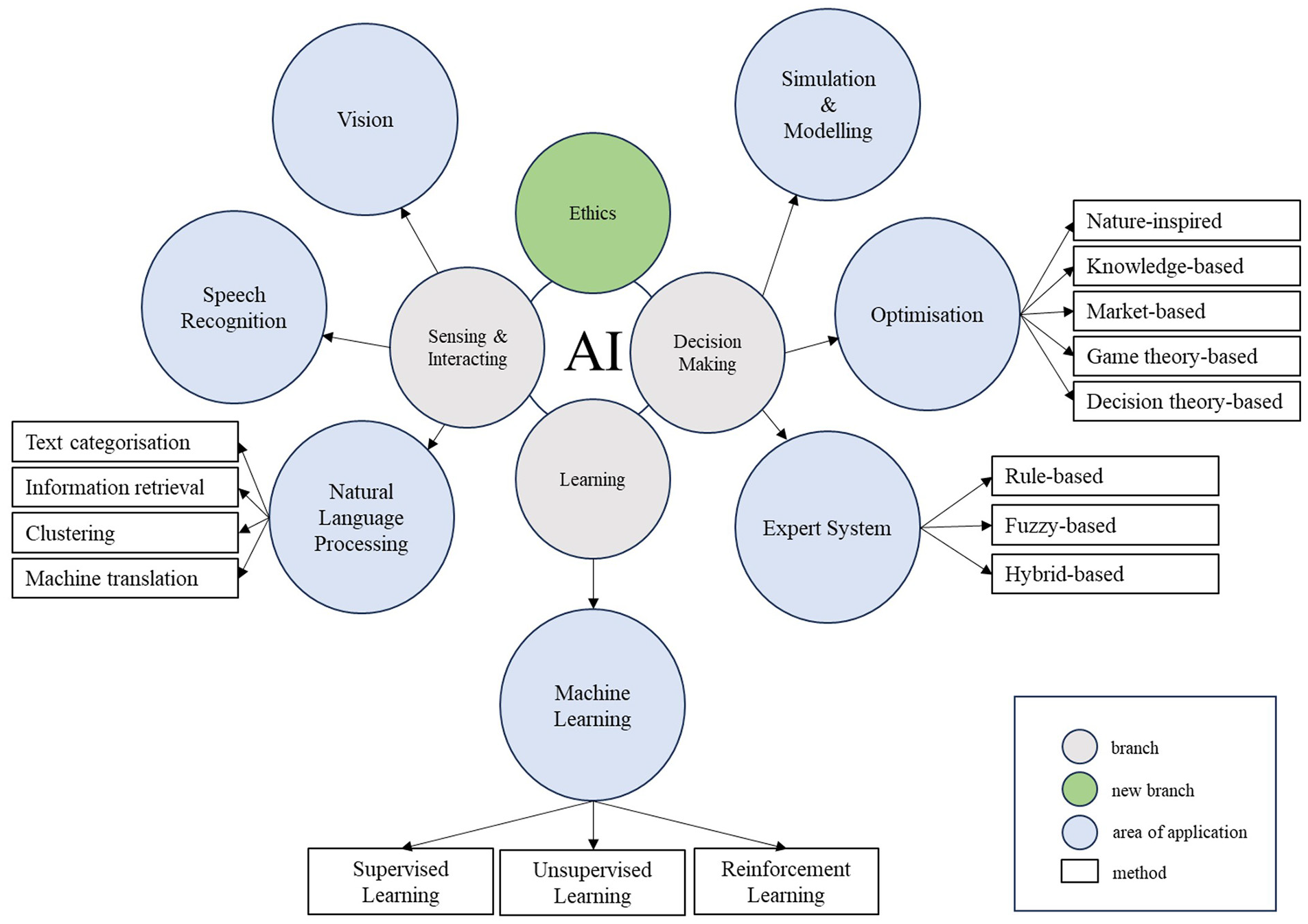
Adopted framework with AI ethics included.
Practical Implications
This study offers several valuable implications for HR practitioners, managers, and developers of AI-based HR tools. First, by applying and critically reflecting on the existing AI taxonomy, the study provides a structured overview of how AI technologies are currently applied across different phases of the RSP. This structure enables HR professionals to better understand which technologies are used, in which steps, and where methodological gaps exist.
A key practical insight is the insufficient integration of ethical considerations in traditional AI classifications. Given the increasing reliance on AI in decision-making processes, especially in high-stakes areas like recruitment and selection, ethical concerns are critical for ensuring fairness, transparency, and trust. Therefore, the proposed modification of the AI taxonomy—including the integration of ethics—can serve as a practical guideline for organisations aiming to implement responsible and trustworthy AI systems in HRM.
Furthermore, the study identifies specific opportunities for the practical application of advanced AI tools in HR, such as the use of large language models based chatbots to automate applicant communication and improve candidate experience. These models offer the potential to develop organisation-specific, AI-supported chatbots that would render the application process more interactive and provide applicants with the opportunity to receive detailed and contextual answers to their questions. This is especially relevant in light of increasing expectations on the applicant side regarding responsiveness and transparency throughout the process.
The potential of AI-driven job analysis to enhance job profiling is also highlighted, offering a path to more efficient and accurate HR practices. The CLR reinforces the relevance of AI technologies for core HR functions, including job matching, CV screening, fraud detection, and KSAO-based assessments. These tools can support HR practitioners in making more objective, data-informed decisions and streamlining administrative tasks.
Moreover, the identification of (fuzzy) multi-criteria decision-making methods within expert systems provides HR managers with additional strategies to tackle complex evaluation and selection scenarios. However, the results also emphasise the need for a thoughtful integration of AI and human expertise, as existing approaches, such as concept-based literature reviews, may not fully capture the complexity of practical decision-making. This underscores the importance of combining technological solutions with domain-specific knowledge to ensure robust and context-sensitive HR decisions.
Concurrently, it accentuates the escalating pertinence of the subject, as evidenced by the finding that 76% of the surveyed HR managers consider the implementation of AI as pivotal to future competitiveness (Gartner, 2024). In sum, this study equips practitioners and managers with a refined taxonomy, highlights underexplored application areas, and encourages the responsible integration of AI in HR by balancing efficiency with ethical responsibility.
Social Implications
It is particularly noteworthy that the computer-based analysis identified ethics and trust as “new” and central topics in the context of the applied AI taxonomy. This finding aligns with the conclusion of other systematic literature reviews (e.g., Budhwar et al., 2022) and is of particular relevance for HRM. The ethical implications of AI applications can directly influence the functioning and trust within organisations as well as the whole society. Given the potential harm that AI technology can cause if used improperly (Bankins, 2021), the consideration of ethics and trust has gained significant importance. This is further reinforced by the ongoing social discourse surrounding the EU AI Act (European Commission, 2023), which delineates the regulatory framework governing the application of AI methods within organisations.
Limitations and Suggestions for Further Studies
The primary limitation of this study is the reduced number of studies included in our systematic literature review. While the initial data set comprised over 4,000 articles subjected to computer-based analysis, the selection was considerably narrowed through a qualitative assessment of the abstracts. This selection process, influenced by human judgement, may be subject to future review and standardisation to ensure that all relevant HR-related studies are considered. This limitation underscores the necessity for a more focussed approach to specific HR-related topics, with a view to achieving more comprehensive and precise results.
A further potential limitation pertains to the structure of the AI taxonomy in general. It has been observed that the structuring of methods in the AI taxonomy does not always align consistently with the approaches described in the broader statistics or ML literature. This discrepancy highlights the necessity for the development of a more unified and application-focussed taxonomy that aligns more closely with the specific requirements of the HR domain. A cross-disciplinary consensus on the integration of AI capabilities and methodologies, as opposed to the current approach of delineating distinct branches and application domains, would be highly advantageous. The establishment of such a framework would represent a substantial advancement in the field of HR research, given its capacity to address the diversity and complexity of contemporary AI applications in recruitment and administration.
The key finding of this study is thus that the targeted use of AI in HR not only entails technological but also ethical challenges that need to be addressed. The findings of this study indicate that HR practice stands to benefit significantly from the results by exploring and implementing new approaches to increasing efficiency and fairness in applicant evaluation and communication.
Conclusion
This study provides an integrated overview of how AI is currently applied within the RSP and where critical gaps remain. By combining different review approaches, it identifies both the dominant technologies, such as ML, NLP, and expert systems, and the underrepresented RSP phases, particularly in applicant identification and communication.
A central contribution is the refinement of the existing AI taxonomy through the inclusion of ethical dimension. This addition responds to growing concerns about fairness and transparency in algorithmic decision-making and reflects current regulatory and societal debates, such as those surrounding the EU AI Act.
For practitioners, the study highlights concrete application potentials, including AI-based job analysis, LLM-driven applicant communication, and decision support systems for selection. These findings are highly relevant, as 76% of surveyed HR managers consider AI pivotal for future competitiveness.
Overall, this study underscores the need for a more responsible and application-oriented use of AI in HRM—one that balances technological innovation with ethical accountability and human expertise.
Footnotes
Appendix 1
Comparison of Related Review Papers.

| Article | Method | Focus | No. of reviewed articles | Time frame | Review Framework (yes/no) | AI methods | HRM areas |
|---|---|---|---|---|---|---|---|
| Basu et al. (2023) | Systematic review (keyword search, content analysis, configurational approach) | Identification of explanations to beneficial and reactionary outcomes in the AI-HRM interaction process based on thematic configuration | 100 | Not specified | No | AI specific keywords used (e.g., NLP, machine learning, artificial intelligence | No specific HR function |
| Pan and Froese (2023) | Systematic review (keyword search) | Providing overview of the existent literature to AI-HRM and focusing on the critical evaluation | 184 | 1990–2020 | No | No keywords mentioned | No specific HR function |
| Prikshat et al. (2023) | Systematic review (keyword search, context analysis, content analysis) | Providing an overview of context (i.e., chronological distribution, theories, and methods used) and the theoretical content (key themes) of HRM(AI) research | 56 | 1990–2021 | No | AI specific keywords used (e.g., NLP, machine learning, artificial intelligence, fuzzy logic) | No specific HR function |
| Budhwar et al. (2022) | Systematic review (keyword search) | Analysing the role of AI-assisted applications in HRM functions and human-AI interactions in large multinational enterprises diffusing such innovations | 70 | 2010–2020 | No | AI specific keywords used (artificial intelligence, AI, robotics, bots) | HR planning, recruitment and selection, training and development, Compensation and benefits, Performance management |
| Vrontis et al. (2022) | Systematic review (keyword search, thematic analysis | Providing an overview of systematising the academic inputs to clarify utilisation of intelligent automation in HRM. | 45 | Not specified | No | AI specific keywords used (e.g., artificial intelligence, chatbot, intelligent automation) | No specific HR function |
| Dinika and Sloane (2023) | Semi-systematic approach | Providing a field scan of scholarly work on AI and hiring. | 56 | Not specified | No | No keywords mentioned | Productivity, gender, and AI bias |
| de Ruijt and Bhulai (2021) | Systematic review (keyword search, | Providing an overview of used algorithms used for Job Recommender Systems in hiring | 87 | 2011–2021 | Keywords (e.g., job recommender systems, job recommendation, and job matching) | Focus only on job recommender systems |

Ethics Considerations
There is no ethics statement required because that statement was not relevant for this study type.
Consent to Participate
There is no informed consent statement required because that statement was not relevant for this study type.
Funding
The author(s) disclosed receipt of the following financial support for the research, authorship, and/or publication of this article: We acknowledge support by the Open Access Publication Fund of Technical University of Applied Sciences Wildau, Germany.
Declaration of Conflicting Interests
The author(s) declared no potential conflicts of interest with respect to the research, authorship, and/or publication of this article.
Data Availability Statement
Data can be provided on request.