



Abstract
The rapid integration of artificial intelligence (AI) into organizational processes presents both opportunities and challenges for human resource management (HRM), yet a systematic understanding of its scholarly development remains limited. This bibliometric review examines the “influence of artificial intelligence” (AI) on “human resources management” (HRM) literature, following the PRISMA protocol to identify knowledge gaps and guide future inquiry. Data from “the Scopus database” is analyzed by VOSviewer software to visualize the research landscape. By analyzing publication trends, citation networks, and thematic clusters, this review uncovers key research themes, influential authors, and emerging directions in AI-HRM studies. The results highlight the growing integration of AI knowledge in HRM practices, showcasing both their potential advantages and the challenges they pose. The key themes center on talent acquisition, performance analytics, ethical concerns, and decision-making automation. Influential authors and sources were mapped, and emerging research frontiers identified. The study concludes that AI is reshaping HRM practices, but ethical, legal, and human-centered implications remain underexplored. Future research should address cross-cultural perspectives, long-term impacts on workforce dynamics, and the development of inclusive AI systems in HRM. This thorough analysis provides valuable understandings for practitioners, policymakers, and researchers, supporting the development of AI-driven HRM strategies and developing a deeper consideration of AI’s evolving role in the workplace.
Introduction
The rise of “artificial intelligence” (AI) has changed numerous fields, including human resources management (HRM). “AI technologies,” such as “machine learning,”“natural language processing,” and “robotics,” have had a profound impact on HRM practices, spanning areas like recruitment, selection, performance management, and employee engagement (Strohmeier, 2020). This rapid integration of artificial intelligence (AI) into organizational processes presents both opportunities and challenges for human resource management (HRM), yet a bibliometric understanding of its scholarly development remains limited. However, scholars, practitioners, and policymakers need to understand its impact on HRM literature.
A bibliometric study offers an organized approach to mapping the academic landscape and development of a research field (Nerur et al., 2008; Priyan et al., 2023). Through the analysis of publication patterns, citation networks, and co-authorship, bibliometric studies provide valuable insights into the growth, trends, and major contributions within a field (Leydesdorff et al., 2011). This manuscript seeks to conduct a bibliometric review to explore the impact of AI on HRM literature, identifying key research themes, influential authors, and emerging trends.
The combination of AI and HRM has been a central topic of academic research in the past decade. Scholars have examined various dimensions, such as AI-driven recruitment, predictive analytics for employee performance, and AI-enhanced training programs (Benabou & Touhami, 2025; Chowdhury et al., 2023; Chui et al., 2018; Srivastava, 2024). However, a thorough bibliometric analysis of this research field is still missing. This review aims to address this gap by providing a comprehensive overview of the AI-HRM literature, highlighting key contributions, and identifying potential avenues for future research.
This study uses bibliometric methods to analyze publication data from a prominent academic database (Scopus) to create an inclusive overview of the AI-HRM research domain. The results offer valuable understandings for practitioners, policymakers, and researchers, helping to shape the development of AI-driven HRM strategies and enhancing the knowledge of AI’s evolving role in the workplace. The findings carry significant implications for practitioners and policymakers, particularly in developing countries where the integration of artificial intelligence (AI) into human resource management (HRM) remains at an early stage. The identification of emerging themes—such as AI in recruitment, employee performance analytics, and ethical HR practices—provides actionable insights that can guide the formulation of policies and strategies tailored to local needs and capacities. For practitioners, the results offer a roadmap for adopting AI tools to enhance efficiency, objectivity, and scalability in HR processes. For policymakers, the study underscores the importance of establishing regulatory frameworks that ensure transparency, data privacy, and fairness in AI-driven HR systems. Additionally, the research highlights the need to invest in digital infrastructure and workforce training to bridge the technological gap and promote equitable access to AI benefits. By leveraging these insights, developing countries can foster more adaptive, inclusive, and innovation-oriented HR ecosystems aligned with global best practices.
As AI continues to advance, its application in HRM is growing as well. The combination of AI and HRM practices offers numerous benefits, such as “improved efficiency,”“data-driven decision-making,” and “enhanced employee experiences.” However, it also presents challenges, such as ethical concerns, the risk of bias, and the necessity for ongoing learning and adaptation (Brougham & Haar, 2018; Haenlein et al., 2019). Understanding these dynamics is crucial for maximizing AI’s potential in HRM while managing the associated risks.
This bibliometric review will not only chart the historical evolution and current trends in AI-HRM research but also offer a roadmap for future investigations. By identifying key publications, authors, and research institutions, it aims to build a knowledge map that can guide academic exploration and real-world applications as well. This in-depth analysis will lay the groundwork for future research and practice, encouraging a more profound integration of AI capabilities into HRM. Therefore, the following research objectives will be the target:
to examine the evolution and trends in the “impact of AI” on HRM research,
to identify intellectual structure and area of focus in the “impact of AI on HRM,”
to identify key contributors in “the impact of AI on HRM research,”
to suggest research gaps and potential directions for upcoming research.
With the rising importance of sustainable business models, this bibliometric review is mainly appropriate for policymakers, corporate leaders, and academics seeking to improve organizational performance through modern HRM practices. By identifying research gaps, this study aims to facilitate further academic contributions and practical applications in the impact of AI on HRM.
The structure of this manuscript is: Section 2 specifies the reviewed literature; Section 3 discusses the methodology for the bibliometric analysis; Section 4 offers results and discussion of key findings, including publication trends and thematic clusters; and Section 5 presents a conclusion with identifying research gaps, the study limitations, and suggestions for imminent research.
Literature Review
The “impact of AI on Human Resources Management” (HRM) has garnered increasing attention in recent years. AI technologies such as machine learning, natural language processing, and predictive analytics have been progressively integrated into various HRM functions, reshaping traditional practices and boosting efficiency (Strohmeier, 2020). AI-driven HRM practices show great promise in automating routine tasks, enhancing decision-making, and providing more personalized employee experiences (Prikshat et al., 2023). However, this transformation also presents challenges, including ethical issues, the potential for bias, and the need for continuous learning and adaptation (Haenlein et al., 2019).
Ethical concerns surrounding the use of artificial intelligence in human resource management warrant deeper examination, particularly regarding bias, privacy, and surveillance (Brougham & Haar, 2018; Haenlein et al., 2019). AI systems, often trained on historical data, risk perpetuating or amplifying existing biases in hiring, promotion, or performance evaluations, potentially leading to discriminatory outcomes. Moreover, the increasing use of AI-driven monitoring tools raises significant privacy issues, as employees may feel subjected to constant surveillance, affecting morale and autonomy. Without transparent algorithms and clear regulatory frameworks, these practices can undermine trust and ethical integrity (Brougham & Haar, 2018; Haenlein et al., 2019). Addressing these concerns is essential for ensuring responsible and equitable AI adoption in HRM, especially in developing contexts.
A significant body of research has examined “the use of AI in recruitment and selection processes.”“AI-driven tools,” such as “applicant tracking systems” and “chatbots,” have modernized the early stages of recruitment by automating tasks like resume screening and candidate communication (Benabou & Touhami, 2025; Chowdhury et al., 2023; Chui et al., 2018; Srivastava, 2024). Researches have specified that these tools can reduce hiring time and costs while enhancing the accuracy and objectivity of candidate assessments (Raghuram et al., 2019). However, concerns regarding potential algorithmic bias and its impact on candidate diversity have emerged, highlighting the need for further research and the creation of ethical guidelines (Biradar et al., 2024; Prikshat et al., 2023).
AI’s impact on performance management and employee development has also attracted significant attention. AI-powered performance appraisal systems can analyze large volumes of data to deliver actual feedback and create personalized development plans for employees (Huang & Rust, 2020). These systems assist in identifying skill gaps, recommending training programs, and supporting career advancement. Moreover, AI-driven analytics can provide valuable insights into “employee engagement” and retention, permitting HR experts to implement targeted plans to boost “satisfaction and reduce turnover” (Davenport et al., 2020). However, the use of AI in performance management raises concerns related to privacy, data security, and the risk of intrusive monitoring (Ajunwa, 2018).
The literature also underscores the transformative effect of AI on employee “training and development.”“AI-powered learning platforms” can offer modified training content, adjusting to individual learning styles and progress (Popenici & Kerr, 2017). Additionally, AI-driven virtual reality (VR) and augmented reality (AR) technologies are being used to create “immersive training experiences” that improve skill development and knowledge retention (Sitzmann, 2011). AI also supports continuous learning by offering employees on-demand access to relevant resources and feedback (Haleem et al., 2020). However, the implementation of AI-based training solutions requires substantial investment and a cultural shift toward embracing digital learning (Allal-Chérif et al., 2021).
AI’s integration into HR analytics is another key area of focus. By harnessing AI, organizations can analyze huge volumes of data to uncover trends, predict workforce needs, and optimize HR strategies (Marler & Boudreau, 2017). Predictive analytics can anticipate employee performance, turnover, and engagement, allowing for proactive interventions to address potential challenges (Allal-Chérif et al., 2021). The literature highlights the significance of data value and governance to ensure the accuracy and consistency of AI-driven insights. Furthermore, moral issues such as data transparency and privacy must be carefully managed to foster trust and acceptance among employees (Prikshat et al., 2023).
Another important aspect of AI in HRM is its “influence on employee well-being” and work-life balance. AI-powered wellness programs can track employee health metrics and offer personalized recommendations to improve well-being (Allal-Chérif et al., 2021). Additionally, chatbots and virtual assistants can help employees by responding to HR-related questions and providing information on workplace policies (Hussein & Abdullah, 2023). While these technologies can improve employee support and satisfaction, fears about data confidentiality and the risk of increased surveillance have been raised (Prikshat et al., 2023). Striking a balance between utilizing AI to enhance employee well-being and respecting privacy is crucial.
In conclusion, the literature on AI in HRM highlights both the potential advantages and the challenges involved in its implementation. AI can transform HRM practices by boosting efficiency, enhancing decision-making, and offering personalized experiences for employees. However, to fully capitalize on these benefits, ethical issues, potential biases, and the ongoing need for learning and adaptation must be addressed. Further research is vital to create ethical agendas, tackle privacy concerns, and examine the long-term effects of AI on the workforce (Haenlein et al., 2019). The combination of AI and HRM marks a significant step toward the digital transformation of the workplace, with profound implications for both organizations and employees.
Research Methods
This study looks at the growth that has occurred in research on the impacts of technology acceptance on industrial growth within the last 30 years, namely from 1985 to 2025. Due to the impacts of AI on HRM’s current significance and relevance—especially with regard to the Scopus database entries—Vagner et al. (2021) chose it as the research’s focal point. On this topic, a comprehensive review of 1,133 articles was carried out. Using VOSviewer for creating and visualizing bibliometric links, the results of the parameters that were evaluated (“co-citation,”“citations,”“co-occurrence of phrases,” etc.) were clearly shown (Benziane et al., 2022; Nyabakora, 2023).
To create clusters based on co-occurrences, citations, and co-citations, VOSviewer can handle data about countries, researchers, journals, publications, and themes (Benziane et al., 2022). The information is then displayed graphically to improve comprehension (Vagner et al., 2021). This application displays the pertinent facts in a map format by using data from the Scopus database. The impacts of artificial intelligence on HRM are examined in this study from 1985 until 2025. It is possible to follow the change in perception regarding this theme by conducting a long-term analysis.
The PRISMA framework was utilized to create the inclusion criteria before the initiation of data gathering (Nyabakora, 2023; Priyan et al., 2023). The evidence-based “Preferred Reporting Items for Systematic Reviews and Meta-Analyses” (PRISMA) is a set of tools that helps writers describe a diversity of systematic evaluations that weigh the benefits and drawbacks of specific activities’ involvement. According to Gough et al. (2012), PRISMA places a strong emphasis on techniques that help writers make sure this kind of research is reported truthfully and openly.
Data Sources
Hallinger and Kovačević (2019) challenged the idea that higher-quality sources are linked to the Web of Science’s limited scope, arguing that discipline-specific validation is necessary. Their argument responded to Mongeon and Paul-Hus (2016), who, based on their “empirical research,” asserted that “Scopus” is a more comprehensive resource for retrieving and analyzing papers in the social sciences. Additionally, Scopus provides more innovative exporting landscapes than “Google Scholar” (Mongeon & Paul-Hus, 2016; Nyabakora & Mohabir, 2024). Scopus also provides a standardized method for document indexing (Benziane et al., 2022). Archambault et al. (2009) conducted an interdisciplinary study that found a significant correlation between articles and citations from “Scopus as well as the Web of Science.”
Criteria for Data Search
A preliminary search was conducted on January 14, 2025, using the previously defined search string in the Scopus repository. The “TITLE-ABS-KEY” tool was employed along with the PRISMA technique, as outlined by Hallinger and Nguyen (2020), to explore “the Scopus database” and gather only “double-blinded,” peer-reviewed research. The search was restricted to final papers in English published by January 14, 2025. Eligibility and exclusion criteria were applied to narrow the results, yielding 7,289 publications. Following this, a four-step process (Nyabakora, 2023) was used to select only the publications relevant to this analysis (Figure 1).

The PRISMA flowchart showing systematic sampling stages (Priyan et al., 2023).
The search yielded 4,097 results when limited to papers within the fields of social sciences, business, management, economics, accounting, finance, and econometrics. The number of articles was further narrowed down to those specifically discussing the impact of artificial intelligence on HRM using relevant keywords, resulting in 1,675 articles. After excluding 542 non-English papers, 1,133 articles remained for inclusion in the bibliometric review.
The PRISMA technique (Hallinger & Nguyen, 2020; Priyan et al., 2023) was employed as the search methodology, with brackets used to ensure accuracy. The search terms were adjusted using an asterisk (“”) or a question mark (“?”) to narrow or expand the scope as needed. The search string used included the following terms: ((“artificial intelligenc*” OR “automat* intelligenc*” OR AI OR “machine* intelligenc*” OR “digital intelligenc*” OR “smart algorithm*” OR “intelligent system*”) AND (HRM OR “human resource* management” OR “personnel management” OR “workforce management” OR “talent management” OR “human capital management” OR “staffing and development” OR “labor administration” OR “manpower management”)) were applied to refine the search. Using this method, the Scopus database yielded 7,289 documents in the initial query (Figure 1). However, the final count was reduced to 542 after filtering out irrelevant or non-compliant papers.
Data Analysis and Discussion of Findings
From the 1,133 documents selected for further analysis, “a bibliometric” approach was employed to examine the findings in more depth. This included creating a graphical representation to show the relationships between keyword co-occurrence and author co-citation analysis, alongside considering both “co-citation” and “citation” analysis (Benziane et al., 2022; Priyan et al., 2023). The bibliometric analysis was conducted using VOSviewer software, Excel, and Scopus analytics (Benziane et al., 2022). This section offers the results from the investigation into the impacts of artificial intelligence on HRM knowledge bases. The research questions were evaluated in the following order:
Emerging Trends in Artificial Intelligence and HRM Research
The exploration of how artificial intelligence impacts HRM has revealed an evolving understanding of the concept. According to an exploration of “the Scopus database,” 1,133 manuscripts have been “published” on this topic since 1985. One of the earliest contributions was the 1985 paper “Job process charts and Man-Computer interaction within naval command systems,” authored by Tainsh M.A. and “published” in Ergonomics. From that start, a single document was published every year for 7 years. This means there was a dormant growth until 1997, when three papers were published. After that year, a single paper was published every year until 2001. In the year 2002, interest in the topic revived with the three publications. Since 2017, the frequency of publications on the impacts of artificial intelligence on HRM has significantly increased, with a peak of 361 publications in 2024 (Figure 2).
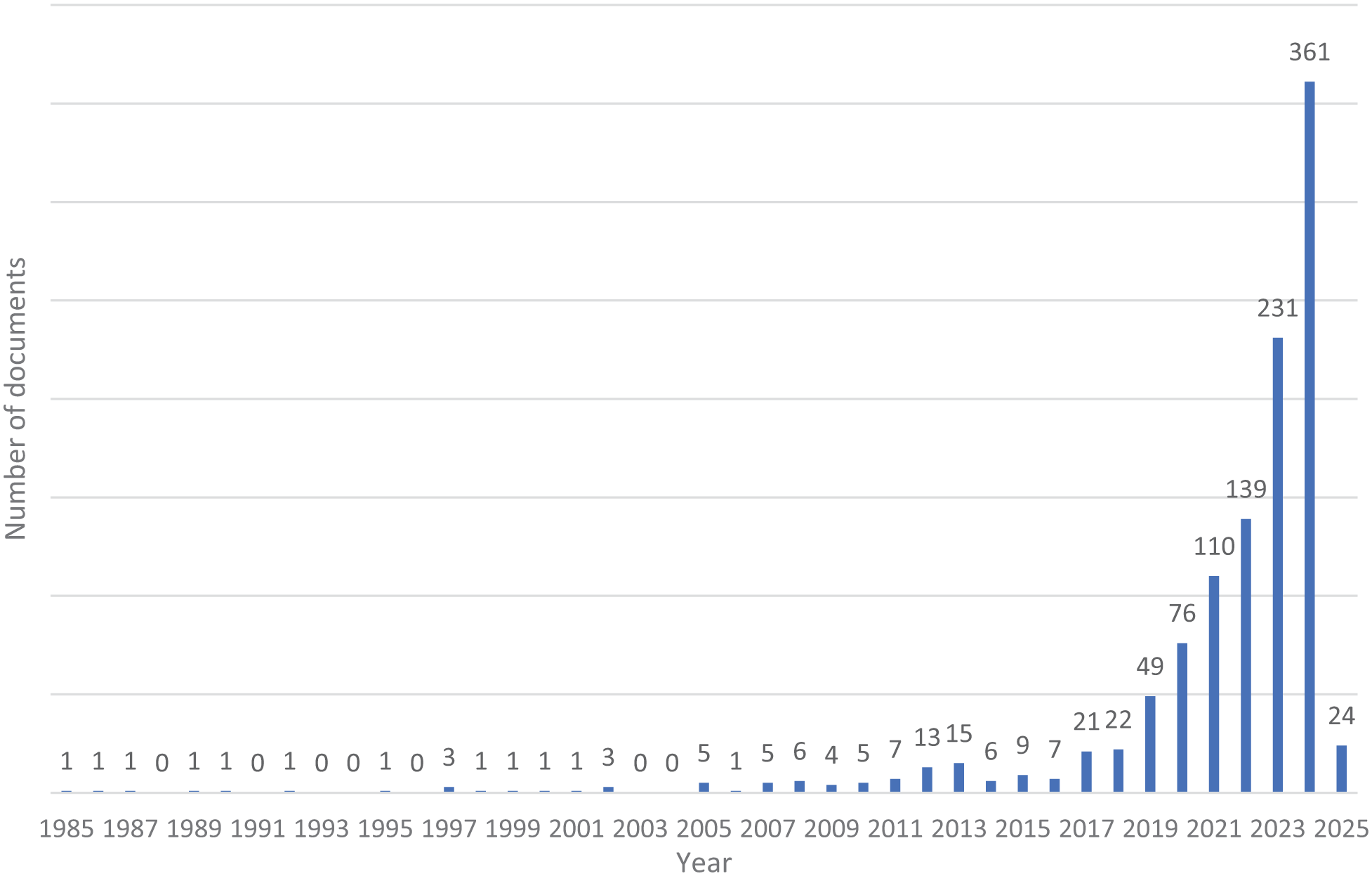
Research growth in the impact of AI on HRM.
Descriptive Trends in the Artificial Intelligence and HRM Knowledge Base
The review’s starting point was an essay by Tainsh M.A. titled “Job process charts and man-computer interaction within naval command systems,” published in 1985. However, significant scholarly interest did not emerge until 2017, when the number of publications began increasing annually. The study divided the timeframe into smaller intervals to analyze keyword growth more effectively. The temporal evolution of keywords was examined by tracking their timelines and normalizing frequencies subject to the number of keywords in each term, following the approach of Agramunt et al. (2020). Table 1 presents the growth of keywords across the entire term and within each of the three terms. Regarding the initial phase, sub-period one (1985–2015) saw the publication of an average of just four publications annually (Figure 2). The four terms that showed the largest co-occurrence, with more than 3 percent of the overall occurrences, were “human resources management systems,”“knowledge management,”“workforce management,” and “personnel management.”
Keywords Growth for Research in the Impact of AI on HRM.
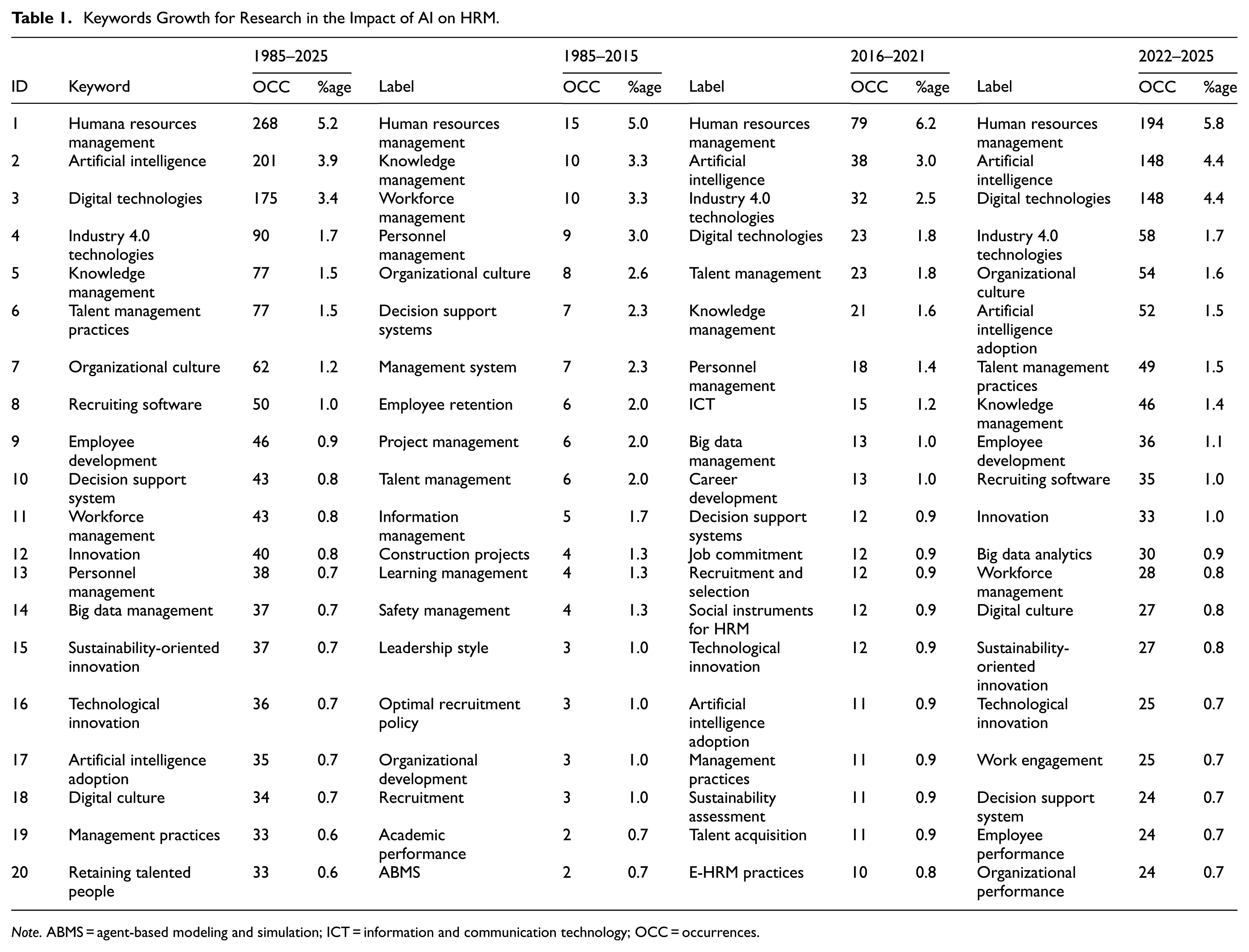
Note. ABMS = agent-based modeling and simulation; ICT = information and communication technology; OCC = occurrences.
Referred to as the “take-off phase,” the second sub-period, which runs from 2016 to 2021, was marked by a progressive increase in the quantity of articles. Every year, on average, over 48 papers were published. The 10 most common terms throughout the sub-period were “human resources management,”“artificial intelligence,”“Industry 4.0 technologies,”“digitization,”“talent management,”“knowledge management,”“personnel management,”“information and communication technologies,”“big data management,” and “career development”; each accounted for more than 1 percent of all terms used. The evolution of “artificial intelligence,”“Industry 4.0 technologies,”“digitization,”“knowledge management,”“personnel management,”“information and communication technologies,”“big data management,”“career development,”“decision support systems,”“job commitment,”“recruitment and selection,”“social instruments for human resources management,”“technological innovation,” and “artificial intelligence adoption” took place throughout this sub-period. However, the keywords “personnel management,”“information and communication technologies,”“career development,”“job commitment,”“recruitment and selection,” and “social instruments for human resources management” lasted for only this single period and disappeared. The use of specific co-words like “employee development,”“recruiting software,”“workforce management,” and “digital culture” might be the reasons for the disappearance of personnel management, career development, recruitment and selection, “information and communication technologies,” and “social instruments for human resources management.” During this sub-period, the keywords “human resources management” and “industry 4.0 technologies” became more and more popular among scholars as the foundation for “artificial intelligence environments.
The third sub-period, which runs from 2022 to 2025, is the present phase. This sub-period contains an average of about 190 articles per year, and this phase saw the beginning of a significant increase. When it reached a maximum of 361 documents in 2024, it had the biggest surge (see Figure 2). The examination of the co-occurrence keywords suggests digital technologies, organizational culture, employee development, recruiting software, workforce management, digital culture, sustainable-oriented innovation, work engagement, and employee performance as newly developed keywords during the third sub-period. They were not included in previous sub-periods’ research but started appearing in this sub-period.
“Human resources management,”“artificial intelligence,”“digital technologies,”“digitization,” and “Industry 4.0 technologies” serve as the main subjects. They can be viewed as focused terms that become noticeable as top keywords over time. The terms human resources management, knowledge management, decision support system, and talent management (Table 1) are the most frequently used keywords and are also important issues concerning human resources management and artificial intelligence. The terms appeared most frequently throughout all sub-periods (1985–2025). Due to the late start in using modern technologies in human resources management, the keywords “industry 4.0 technologies,”“artificial intelligence,” and other “digital technologies,” which are keys for digital human resources management, cannot be seen throughout all sub-periods. They all miss sub-period one, which started in 1985.
The Increasing Prevalence of the Top 5 Recurring Topics in AI and HRM
The development of key topics that have significantly contributed to the understanding of the association between artificial intelligence and “HRM” is better comprehended through the analysis of their growth trends. Human resource management experienced the highest growth rate among all occurrences during the first sub-period, reaching 5%. This rate increased to 6.2% between 2016 and 2021, before slightly declining to 5.8% in the 2022 to 2025 sub-period. Overall, the keyword demonstrated a growth rate of 5.2% (Table 1). Its rapid growth can be attributed to Wolfartsberger’s (2019) findings, which suggest that human resource management improves communication within design review teams by reducing the exclusion of professional groups. Additionally, it can accelerate the evaluation process and address user isolation challenges (Lankes et al., 2017). However, issues arise with the interactive nature of the HRM movement, creating a need for a “freeze” feature. These factors have driven continued research on the topic, making it a frequently used keyword.
As one of the two most significant concepts linking AI and HRM, “artificial intelligence” is a key topic that emerged in the last two sub-periods and has been identified in the literature as having the greatest impact. It was absent from discussions between 1985 and 2015 but became the second-most frequently occurring concept. AI gained prominence in the second sub-period (2016–2021) with a 3% occurrence rate. This increased to 4.4% between 2022 and 2025. Overall, artificial intelligence exhibited an average growth rate of 4% across all instances (Table 1). Its rising popularity is largely due to its potential applications in human resource management (Vagner et al., 2021). Egger and Masood (2020) highlight that “artificial intelligence” plays a vital role in ensuring real-time contextual access to the vast data generated by cyber-physical production systems for human users (Yao et al., 2017). It is also essential for implementing a human-centered approach to “Industry 4.0 technologies” (Kong et al., 2019), actively enhancing intelligent environments. Additionally, the European Union has recognized AI as a key technology driving the development of smart factories (Egger & Masood, 2020). As cited in Davies’ 2015 study, AI is instrumental in promoting collaboration and engagement between individuals and data-driven manufacturing systems (Oztemel & Gursev, 2020).
The body of literature on “Industry 4.0 technologies” has steadily expanded over the years. It gained momentum during the second sub-period (2016–2021), reaching a 2.5% occurrence rate. However, this rate declined to approximately 1.7% between 2022 and 2025. Within human resource management, Industry 4.0 remains relatively new, despite being the third fastest-growing term (Table 1), accounting for 1.7% of all occurrences. This continuous growth suggests a sustained level of interest in the topic among researchers. Chiarello et al. (2018) revealed that while “Industry 4.0 technology” is not a new concept, it is extremely diverse, spanning more than 30 different technological fields (Dalenogare et al., 2018). As a result, many stakeholders struggle with a lack of expertise across the full range of technologies, leading to difficulties in communication between different domains (Chiarello et al., 2018). This ongoing complexity has driven continued research in the field, making the keyword one of the most prominent in recent sub-periods.
During the initial sub-period, the term “digital technologies” was absent from the top 20 keywords. However, its occurrence rate reached 3.4% between 2016 and 2021, followed by a significant rise to 4.4% between 2022 and 2025 (Table 1). The close connection between human resource management and emerging technologies (Kang et al., 2016) contributed to its frequent mention during this sub-period.
The keyword “knowledge management” exhibited fluctuating growth rates over time, with an incidence rate of 3.3% between 1985 and 2015, decreasing to 1.6% from 2016 to 2021, and further declining to 1.4% between 2022 and 2025. Despite an average growth rate of 1.5%, it is steadily approaching the top 10 most frequently used terms. Since human resource management is the central theme of the research, all studies were conducted within this field, with technologies serving as supportive tools for sustainable development.
The Leading Contributors in AI and HRM Literature
Understanding the current state of research on AI and HRM can be enhanced by recognizing the key authors and resources that significantly contribute to the field. This awareness can similarly help recognize possible sources for innovative ideas and studies that could lead to more progress in the area. Moreover, it provides scholars with an understanding of which “countries,”“journals,”“authors,” and “papers” are significant and should be referred to for more detailed information, as outlined below:
Productive Countries in Artificial Intelligence and the HRM Literature
By understanding which countries are highly active in the field, researchers can recognize current trends in artificial intelligence and human resource management research, as well as gain insight into the emerging standards for practices within the domain. Additionally, an analysis of the geographic locations of the authors was conducted to identify the academic regions where research on AI and HRM has gained significant attention.
The study explored the geographical locations of authors to identify the academic areas that have focused on the association between AI and human resource management. The fact that this corpus of material was written in 103 different nations shows how popular the topic is around the world. The United States (158), India (135), China (125), the United Kingdom (83), Australia (62), Malaysia (54), France (53), Ukraine (50), Italy (47), and Spain (47), Portugal (71), Brazil (61), Canada (52), Finland (52), and Greece (47) were the 10 countries with the highest concentration of authorship, nevertheless. Researchers having ties to these fifteen nations provided more than half of the research on the connection between artificial intelligence and human resources management gathered for this review (Table 2).
Countries With the High Number of Documents.

Additionally, as Table 3 illustrates, of the top 20 nations by citation count, researchers from the USA (4,506), the UK (2,984), India (2,730), France (2,446), China (2,259), Australia (1,761), Italy (1,505), Spain (908), Poland (903), Pakistan (870), Hong Kong (749), the United Arab Emirates (746), Germany (741), Malaysia (681), and Canada (612) contributed more than half of the AI and the HRM citations reviewed in this research. As a result, the countries mentioned above were the primary contributors, playing a significant role in shaping the field and strongly influencing academic work through their research. In this case, developed nations dominate the research on artificial intelligence and human resource management, while developing nations remain largely uninformed (Tables 2 and 3).
Countries With High Citations.

Analysis of the Key Contributing Journals
To keep up with the latest research advancements and identify journals that are likely to publish their manuscripts and align with their research topics, researchers should familiarize themselves with the most significant sources in the virtual reality field. In this case, the 1,133 papers on artificial intelligence and human resource management were spread across 505 sources. However, the majority of these sources (62%) contained only a single paper, while the remaining 38% of journals had numerous “publications.” The topmost 15 journals, listed in Table 4, account for over 27% of the total corpus. The “Sustainability (Switzerland)” journal was the most productive, producing 86 papers. However, the 413 sources collectively received a total of 21,893 citations. Approximately 20% of the sources had no citations, whereas the topmost 20 productive journals contributed over 42% of the total citations (Table 5). “Sustainability (Switzerland)” led with 1,563 citations from its 86 publications, and Table 4 provides the citation statistics for the other top sources.
More Productive Sources With High Number of Documents.

Highly Cited Sources in the Literature for Impact of AI on HRM.

Examination of Key Authors in AI and HRM Literature
Table 6 highlights the leading researchers in the field of artificial intelligence and HRM. Notable among them are Chowdhury, Soumyadeb, with 496 citations; Dey, Prasanta, with 468; Liang, Huigang; Wang, Nianxin; and Wang, Zhining with 377; Pereira, Vijay, with 336; and Dochy, Filip, with 315, among others. These authors are the most cited and, consequently, the most prolific in the field. The citation impact of the authors is substantial and meaningful, as shown in Table 6. However, “the Scopus h-index considers an author’s entire body of academic work,” extending outside the specific topic of artificial intelligence and human resource management (Nyabakora & Mohabir, 2024; Priyan et al., 2023), so it has not been included in this analysis. Hence, the quotes listed in Table 6 are entirely based on the publications of each writer within the scope of our review.
More Prolific Authors in Area of AI-HRM.

Examination of Key Documents in AI and Human Resources Management
Table 7 presents the most quoted manuscripts in artificial intelligence and human resource management research, based on all Scopus citations. This analysis seeks to evaluate the influence of researchers’ contributions to the field. Fifteen papers received over 21,893 citations. Given the relatively recent emergence of the connection between artificial intelligence and human resource management, these citation counts are within a reasonable range. As a result, the article by Wang et al. (2014), with 377 citations, arises as the most frequently cited in this field, appearing among the top-cited papers in Table 7. However, the most significant and impactful documents were not necessarily the most cited. Therefore, Table 7 presents the most relevant and influential articles on “the impact of artificial intelligence on human resources management,” along with their respective citation counts.
Most Prolific Documents in the Literature on the Impact of AI on HRM.

Wang et al. (2014) paper “Knowledge Sharing, Intellectual Capital, and Firm Performance” made a notable contribution by empirically demonstrating the positive effects of “knowledge sharing” and intellectual capital on enterprise performance. It presented a thorough framework connecting these concepts, emphasizing how effective knowledge-sharing practices boost intellectual capital, ultimately leading to better firm performance. This integrative approach provided valuable insights for both scholars and practitioners, outlining the mechanisms through which knowledge sharing can be used to benefit from “competitive advantage,”“making it a widely cited and influential work in the field.”
Chowdhury et al.’s (2023) manuscript “Unlocking the Value of Artificial Intelligence in Human Resource Management through AI Capability Framework” made a major contribution by offering a comprehensive framework that incorporates AI capabilities into HR practices. This framework not only emphasized AI’s possibility to improve key HR roles such as “recruitment,”“performance management,” and “employee engagement” but also provided practical implementation guidelines. Its innovative approach and actionable insights have made it an essential resource for HR professionals and researchers, earning it recognition as the most cited article in its area.
Ivanov’s (2023) paper “The Industry 5.0 Framework: Viability-based Integration of the Resilience, Sustainability, and Human-centricity Perspectives” made a significant contribution by introducing a comprehensive framework that combines “resilience,”“sustainability,” and “human-centricity” within Industry 5.0. This holistic approach tackles the complex interconnections between these three crucial dimensions, offering a practical pathway for industries to address the challenges of contemporary manufacturing and production. With its innovative perspective and actionable solutions, the paper has become a highly cited reference in the field, providing valuable insights into creating a balanced and sustainable industrial ecosystem.
Palumbo’s (2020) paper, “Let Me Go to the Office! An Investigation into the Side Effects of Working from Home on Work-Life Balance,” made a valuable contribution by thoroughly analyzing the effect of distant work on “employees' work-life balance.” It explored both the positive and negative effects, providing empirical evidence and practical recommendations for organizations to address the challenges while maximizing the benefits. Its balanced approach, coupled with its timely relevance during the growth of remote work, has made it a widely cited and influential work in the field.
Shamim et al.’s (2019) paper “Role of Big Data Management in Enhancing Big Data Decision-Making Capability and Quality Among Chinese Firms: A Dynamic Capabilities View” made a significant contribution by offering a comprehensive framework that combines big data management with dynamic capabilities theory. This integration provided valuable insights into how Chinese firms can utilize big data to improve their decision-making processes and overall quality. The paper’s innovative approach and practical recommendations have made it highly influential, resulting in its recognition as one of the most quoted works in the field.
Garay-Rondero et al.’s (2020) paper on the “Digital Supply Chain Model in Industry 4.0” made a notable contribution by introducing an inclusive framework that incorporates advanced digital technologies like “IoT,”“AI,” and “blockchain” into supply chain management. This model improves transparency and efficiency while enabling real-time decision-making and predictive analytics, which are essential for modern supply chains. Its innovative approach and practical implications have made it a widely cited reference in the field, addressing the critical need for digital transformation in supply chains.
Akram et al.’s (2019) paper “The Impact of Organizational Justice on Employee Innovative Work Behavior: The Mediating Role of Knowledge Sharing” made a significant contribution by clarifying how perceptions of fairness within an organization can promote a culture of knowledge sharing, which ultimately boosts employee innovation. This study uniquely connects organizational justice and innovation, emphasizing the essential role of knowledge sharing as a mediator. Its empirical findings provide valuable insights for managers seeking to foster an innovative workforce by promoting fair practices and encouraging the free exchange of knowledge.
Cognitive Framework of the Artificial Intelligence and HRM Knowledge Base
Researchers using scientific mapping review methods have examined the “intellectual structure” in numerous academic fields (Nerur et al., 2008; Priyan et al., 2023). The term “intellectual structure” denotes the core “theoretical” and “empirical” research directions that shape a specific area of study. By applying author co-citation analysis, a system map was created in “VOSviewer” to visualize the intellectual framework within the knowledge bases of virtual reality and the manufacturing industry.
A co-citation analysis was conducted to assess how often authors were quoted together in 1,133 papers. As a result, co-citation analysis covers a significantly larger body of literature compared to Scopus citation data.
Scholars who use “co-citation analysis” suggest that writers who share similar research perspectives are often co-cited by their peers (Hallinger & Kovačević, 2019; Priyan et al., 2023). Additionally, by analyzing “author co-citations,” the “VOSviewer software” can create a system map that visually shows common traits among the writers quoted in the selected database (Nyabakora & Mohabir, 2024; van Eck & Waltman, 2017).
Using VOSviewer with a threshold of 100 author co-citations, 174 researchers (Figure 3) appeared in the co-citation network. The larger nodes indicate prominent researchers based on the frequency of co-citations. Scholars are grouped into research topics by colorful clusters that reflect co-citation connections. The intellectual structure of the link between virtual reality and manufacturing industry literature is divided into three main clusters: 3D technologies and augmented reality in manufacturing (green cluster), Industry 4.0 technologies and virtual reality (red cluster), and smart manufacturing (blue cluster).

Cognitive framework of the artificial intelligence and HRM knowledge base.
Theoretical Interpretation of Findings
The integration of the Technology Acceptance Model (TAM) and the Dynamic Capabilities View (DCV) provides a robust theoretical foundation for interpreting the findings of AI’s role in HRM. TAM (Davis, 1989) explains that the perceived usefulness and ease of use of AI tools—such as in recruitment and performance analytics—drive their acceptance among HR professionals. The bibliometric trends highlight a growing interest in these applications, reflecting their perceived efficiency and seamless incorporation into existing HR practices. Complementing this, DCV (Teece et al., 1997) emphasizes an organization’s ability to adapt by building and reconfiguring competencies. The increasing scholarly focus on AI-powered talent management, upskilling, and workforce planning indicates that organizations are not just automating functions but are strategically evolving to meet the demands of a rapidly digitizing environment. Together, these frameworks illuminate how AI adoption in HRM is both a response to technological utility and a proactive effort to enhance organizational adaptability.
Conclusion, Research Gap, and Limitations
Conclusion
This study lays the groundwork for organizing the current body of scientific knowledge on the influence of AI on HRM. A variety of quantitative bibliometric methods, alongside algorithmic approaches, were used to assess the spread of knowledge in this field. Potential research areas were pinpointed, a comprehensive overview of existing findings was compiled, and a roadmap for future research was established, reflecting the growing landscape of the field.
This analysis highlights the extensive body of “research on the effect of AI on HRM,” which dates back to the first study published in 1985 in “the Scopus database.” The majority of the “literature” on this theme has emerged in the past decade, possibly driven by developments in technology.
The study enhances the understanding of the impact of artificial intelligence on HRM by reviewing existing research, identifying recurring themes, and pinpointing areas that require further exploration. It provides a comprehensive overview of the topic and a detailed examination of the reference structure for researchers. This can help educators by highlighting gaps and the most studied areas, staying updated with the latest developments, and identifying the direction in which the field is evolving, ultimately contributing to the expansion of existing knowledge on the influence of AI on HRM. Practitioners and policymakers can apply insights to integrate AI tools more strategically and ethically into HRM practices. Ultimately, this work bridges academic inquiry and practical implementation, offering a knowledge base that supports evidence-based decision-making and future innovation in the AI-HRM interface.
This analysis of the influence of AI on HRM highlights the prolific and extremely quoted journals and countries, providing valuable insights to help academics and “other stakeholders” make conversant decisions concerning research and publication in the area.
Research Gaps
Currently, most investigations in the area of the impact of AI on HRM have centered on topics such as HRM, AI, digital technologies, industry 4.0 technologies, and organization culture. These areas, which remain relatively underexplored, especially in both developing and many affluent nations, require significant attention from academics (Tables 2 and 3).
Secondly, research from the third term discovered a notable surge in the frequency of co-words interrelated to the impact of artificial intelligence on HRM across all three sub-periods: human resources management (15, 79, 194); artificial intelligence (0, 38, 148); digital technologies (0, 23, 148); industry 4.0 technologies (0, 32, 58); and talent management (6, 23, 49), among others. This trend demonstrates that research on the effect of AI on HRM continues to experience substantial growth (Figure 2 and Table 1).
Thirdly, future research should focus on the “artificial intelligence” keyword, which has seen a nearly 5% growth and emerged as the second most prominent keyword across the two sub-periods (Table 2). This growth is largely driven by the increasing acceptance of technology in the human resources cadre. Therefore, further investigation is needed to fully explore the interceding role of artificial intelligence in the association between human resources management and organizational performance.
Fourth, the keyword “big data analysis” has shown a steady increase in articles published from 1985 to 2025 in the Scopus repository, indicating that this area is still relatively emerging. More research is required to discover the influence of big data analysis on human resources management, as this keyword was presented in the second term and remains an under-explored topic requiring additional investigation.
Limitations
While the use of “the Scopus database” offers several advantages, it also has its limitations. A common issue in bibliometric research is the potential exclusion of works from “other databases” like “ABI,”“Web of Science,” and “ProQuest” (Jacsó, 2008; Nyabakora & Mohabir, 2024). To address this limitation, future research should incorporate additional repositories to ensure more comprehensive results.
In addition to the results gathered from the Scopus search filters, which focused solely on peer-reviewed journal articles, it is recommended to explore other sources such as editorial content, conference proceedings, and national publications. These materials may also provide valuable insights when discussing the impact of artificial intelligence on HRM (Casado-Belmonte et al., 2021; Nyabakora & Mohabir, 2024).
Consistent with the research by Hallinger and Nguyen (2020), Nyabakora and Mohabir (2024), and Nyabakora (2023), this study utilized “co-citation,”“citation,” and “co-occurrence analysis,” Incorporating bibliographic coupling could further enhance the findings. However, the limitations highlighted suggest potential avenues for improving bibliometric research in future studies.
Footnotes
Acknowledgements
We would like to thank our Almighty God for keeping us healthy so that we managed to complete this research. Our heartfelt thanks to the Local Government Training Institute for their material and moral support. We alone remain responsible for any errors © 2025 by Dr. John W. Kasubi, Dr. Lazaro A. Kisumbe, and Dr. Wakara Ibrahimu Nyabakora.

Ethics Considerations
These considerations were not relevant for this study type because there were neither human nor animal participants in this article.
Author Contributions
All authors contributed to the study’s conception and design. Material preparation, data collection, and analysis were performed by Dr. John W. Kasubi, Dr. Lazaro A. Kisumbe, and Dr. Wakara Ibrahimu Nyabakora. The first draft of the manuscript was written by Wakara Ibrahimu Nyabakora. Editing of the manuscript was done by Dr. Lazaro Kisumbe, and all authors commented on the versions of the manuscript, read and approved the final manuscript for publication.
Funding
The authors received no financial support for the research, authorship, and/or publication of this article.
Declaration of Conflicting Interests
The authors declared no potential conflicts of interest with respect to the research, authorship, and/or publication of this article.
Data Availability Statement
Data sharing not applicable to this article as no datasets were generated or analyzed during the current study.